The 1970 Fiat 124 Sport Coupe

The post about my family’s 1966 Buick Sport Wagon ends with the statement that I sold the wagon in order to purchase a Fiat. This is the story of that Fiat. My “first car”, the Mustang, was mine to drive, but it belonged to my father. The Buick was registered in my name, but I bought it from my mother and had given her a token sum for it. Up until this point, I had yet to go out and purchase a car on my own. That changed in 1974.


First, some background on what led to this. In 1973, I was nineteen, and having withdrawn (temporarily) from college, was working full-time in a clerical position for an insurance company in downtown Manhattan. The Buick, while a reliable beast, was also very thirsty. In my earlier post, I stated that local driving returned 8 mpg. Highway driving did not do much to improve on that figure.


In late 1973, the U.S., indeed the world, was struck by the first oil embargo, sharply driving the price of gasoline upward, while at the same time, severely limiting supplies. My full-time salary of $110/week was being stretched by the suddenly more expensive fill-ups. Besides, I really wanted to ditch the wagon and get a sports car, and had always been attracted to the looks of the Fiat 124 coupe, first introduced to this market in 1968. Scanning the classifieds for several weeks with no luck, I noticed there was one parked on the street about two miles from my house with a For Sale sign on it.


It was February of 1974. I called the number on the placard, and the seller agreed to show me the car. My friend Vinny came along. We looked at the car. It looked OK to me. I had no idea what I was looking at! My mind was made up before the owner showed it to me. His ask was $1700. There was no negotiation. I had the money, gave it to him, he signed it over, handed me the key, and wished me luck.

My Valentine’s present to myself

The Fiat, of course, was a stick shift, a 5-speed, when my two best friends, one driving a VW Beetle, the other a Toyota Corolla, were both rowing 4-speeds. There was just one small problem in getting this thing home: I did not know how to drive a manual transmission car. Oh, I knew the theory of driving one. However, I had never actually put the theory in practice. (Typing this 42 years later makes me realize that I did not test drive my own used car purchase.) Vinny had dropped me off and went on his merry way, so I was alone. I started the car, put it into gear, and was thankful it was just two miles home. Somehow, after stalling only 10-12 times, I made it. Breathing a sigh of relief, I coasted into the driveway, turned it off, and went inside.
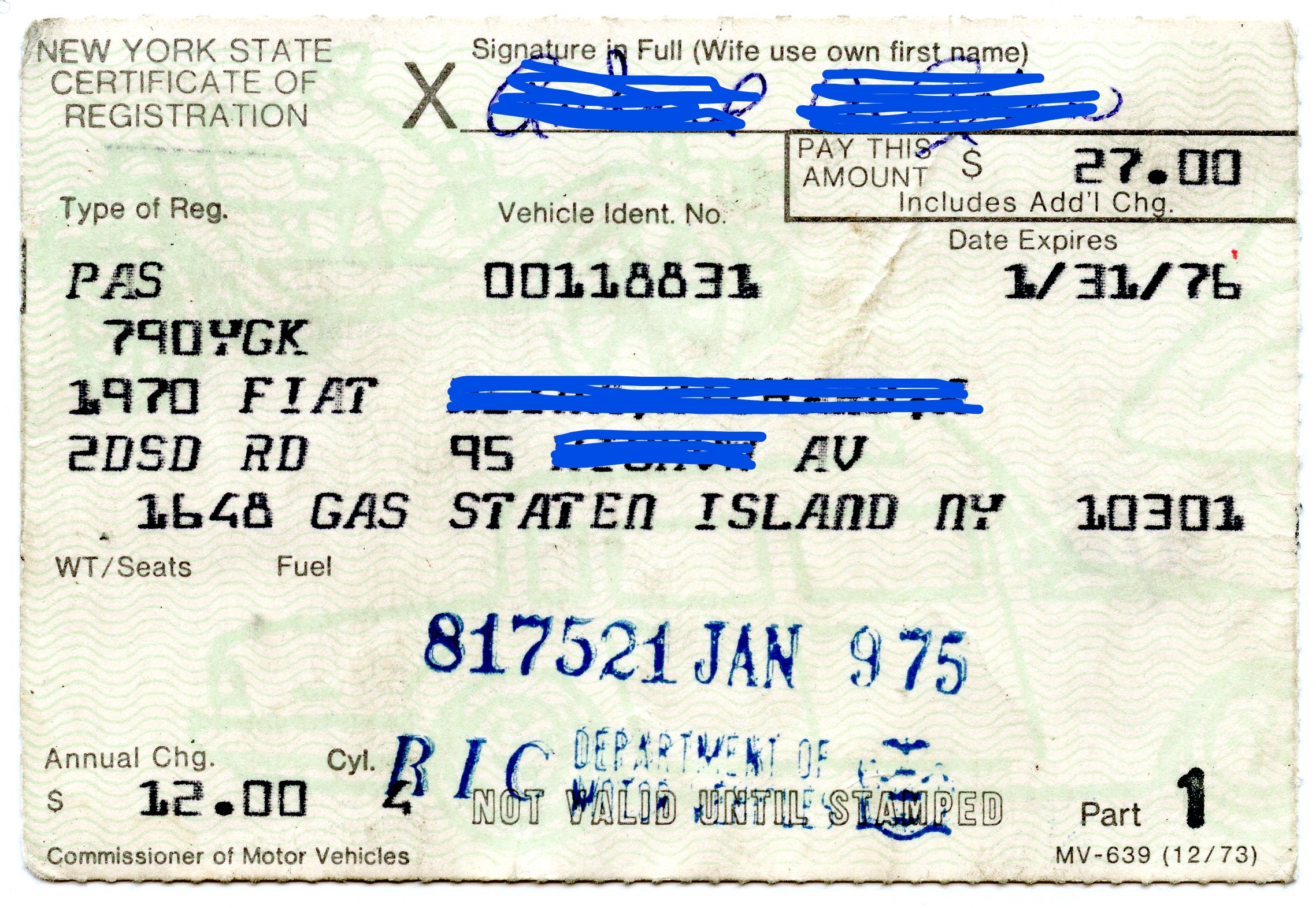
Yes, it weighed 1,648 lb.

First call was to my best friend Richard Sawler, whom I sheepishly asked to give me lessons. We went out together, me driving, he riding shotgun. Richard would instruct me on the finer points of shifting. He worked the parking brake whenever I had to stop on an incline. After about a week, enough confidence was gained to venture out solo.

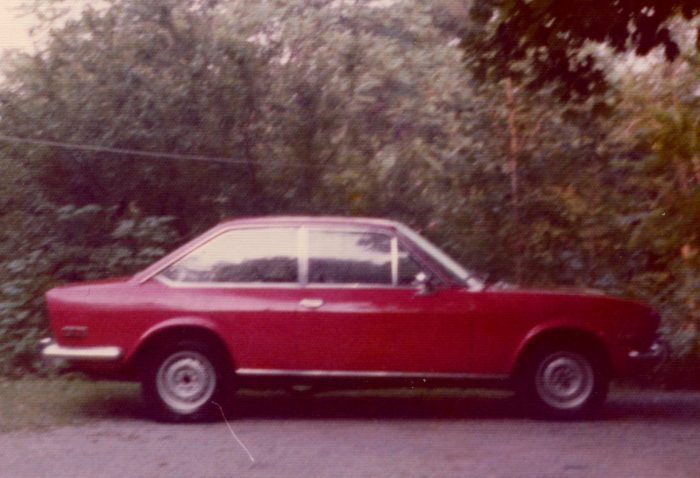
 

Acquaintances presume that my automotive mechanical knowledge came from working at car dealerships, which began in 1978. That is not exactly true. It really started with the purchase of this Fiat. The car was an absolute joy to drive, and I drove it a lot. However, “something” happened to that car about once every other week. There was no way I could afford to pay someone to fix the car that frequently (see weekly salary quoted above). Soon after the purchase, I was at my local Sears, buying my first set of metric tools, a set of 1/2” drive sockets which I still own (Dad had nothing metric). I also obtained a Haynes Workshop Manual for the car, which I read on the ferry as I commuted to and from my insurance company job.

Kept the book in case I get another...
Kept the book in case I get another…

Small jobs I could do, and I started small, doing the brakes, a tune-up, and a coolant flush. But a U-joint went, then the exhaust, and I needed someone to make those repairs for me. On Staten Island, two brothers had opened a “foreign car only” repair shop. The name of the business was “Brothers”. By the summer of 1974, we were on a first-name basis with each other. To be fair, they were great guys, and were very fair to me, realizing that I couldn’t afford to take care of every single thing that poor piece of Italian transportation needed.

Brothers they were. I was there so much I considered getting a part-time job with them.

Frequent repairs or not, the Fiat was taking me all over the place. In March, a friend and I used the car to make a successful round trip to Buffalo, NY, the farthest I had driven from home in my life. Its cavernous back seat could hold my drum set, so the Fiat was the car driven to all my music gigs. Vinny was so impressed, he traded the Corolla for a new 124 Coupe. My car had about 57,000 miles on it at the time of my purchase. Within the first six months, I had driven it about 8,000 miles.

March, 1974, unwashed but safely back from Buffalo

Then the timing belt broke.


On a warm summer August evening, heading back from Brooklyn to Staten Island via the Verrazano Narrows Bridge, I paid the toll on the S.I. side, accelerated out of the toll booth, aimed for the Bay St. exit on my right, and the car died. It cranked just fine, but made no attempt to catch. Finding a phone booth, I called my dad, and somebody called a tow truck. The car was brought to Todd Motors, Staten Island’s only Fiat (and coincidentally, only Volvo) dealer.


They called me with the bad news. All I heard was a litany of parts: head gasket, valves, pistons, rods, etc. They said the job would take a while, perhaps a week. In a matter of days, I was heading back to college. Being without transportation was torture. But the real torture was seeing that repair bill. At the age of 20, I wasn’t exactly floating in spare cash; $345! Were they kidding? Look at this Repair Order: Nine hours of labor at $16/hour! Four exhaust valves at $8 a piece! A SIX DOLLAR head gasket, for cryin’ out loud! Did they think I owned Fort Knox?

At the time, highway robbery. In retrospect, quite fair.

This is all quite funny now. We have become accustomed to labor rates close to 10 times this figure. Somehow, I found the money, paid the dealer, and picked up my car. The good news was that it ran well. Yet, the car continued to penny-pinch me. The brake master cylinder went (for which I bought a rebuild kit, and rebuilt it in my dorm room). A carburetor screw fell out, and the car would not idle. A steering tie rod went bad. The Fiat got me through my sophomore year of college.
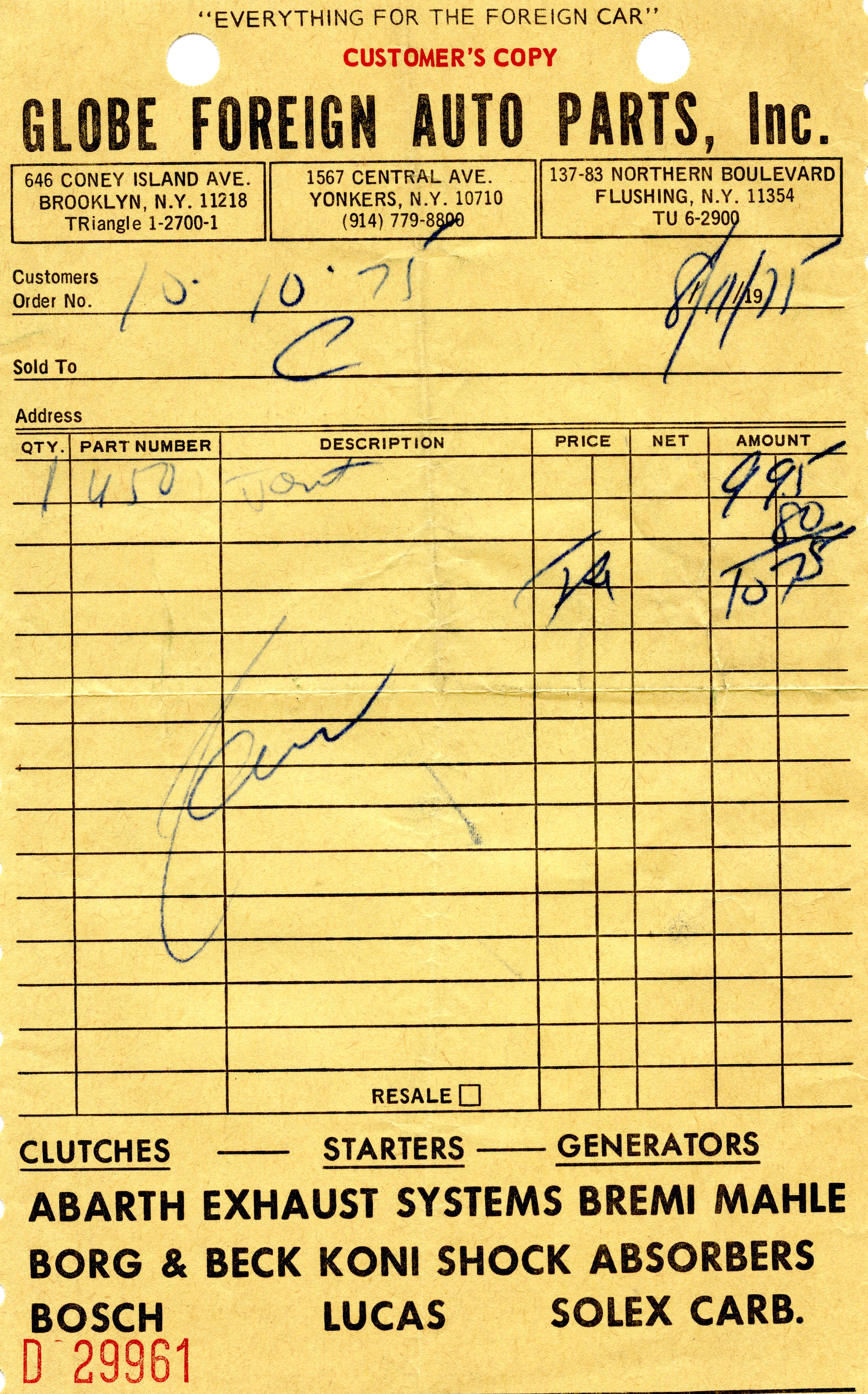
NYC phone nos. still used 2-letter exchanges, and area code was not needed (all 212)

Returning home from college for the summer of ’76, the rust was getting worse, with an actual hole in the left front fender, large enough to see through. When the water pump quit that summer, I felt defeated. The fun-to-drive aspect never went away, and my technical skills were improving, but I could no longer count on the car to get me around. The Fiat, at 6 years of age, its cancerous rust eating away at all four corners, was sold to Stuckers, the well-known foreign-car junkyard on Staten Island. It had been mine for the last two-and-a-half years and 40,000 miles of its life.

Stuckers was a great source for parts, and the car's final resting place
Stuckers was a great source for parts, and the car’s final resting place

As time went on, I only remembered the good things about the Fiat, never dwelling on the breakdowns or repair costs. At my father’s urging, the next car was an American make, but after that came a succession of German cars, then a career in the car business with a Swedish auto maker (and many Swedish cars in the driveway). It would be 37 years before another Italian car entered my life. While that car is my delightful Alfa, it has not stopped me from thinking that someday, I’ll find room for another Fiat. I remain that impressed by the little coupe’s capabilities.
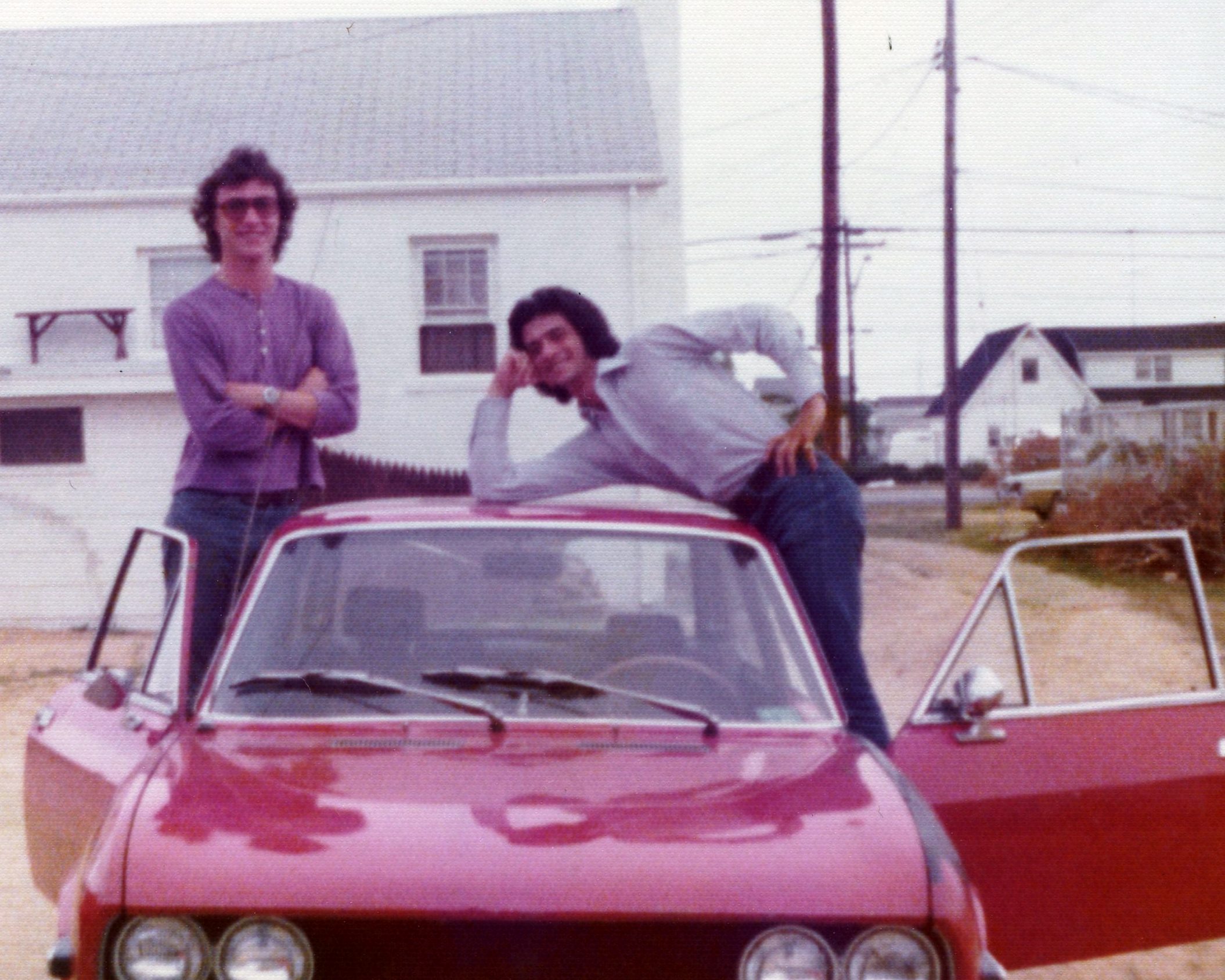
Richard Sawler (L) and Vinny Signoriello (R) prove that rust has yet to permeate door sills. Good times, good memories.


All photographs copyright © 2016 Richard A. Reina. Photos may not be copied or reproduced without express written permission.
 

Father’s First Ford: The 1967 Mustang

My dad was a GM man throughout the first two decades of his marriage. Although it was a Willys station wagon which served as family transportation when he and my mom got married in 1950, he bought a new Chevy 210 sedan in 1953 (the car which brought me home from the hospital), and a new Corvair wagon in 1961. The ‘60s saw the Corvair augmented with a ’63 Pontiac Catalina wagon, then replaced by a used 1966 Buick Sport Wagon.

 
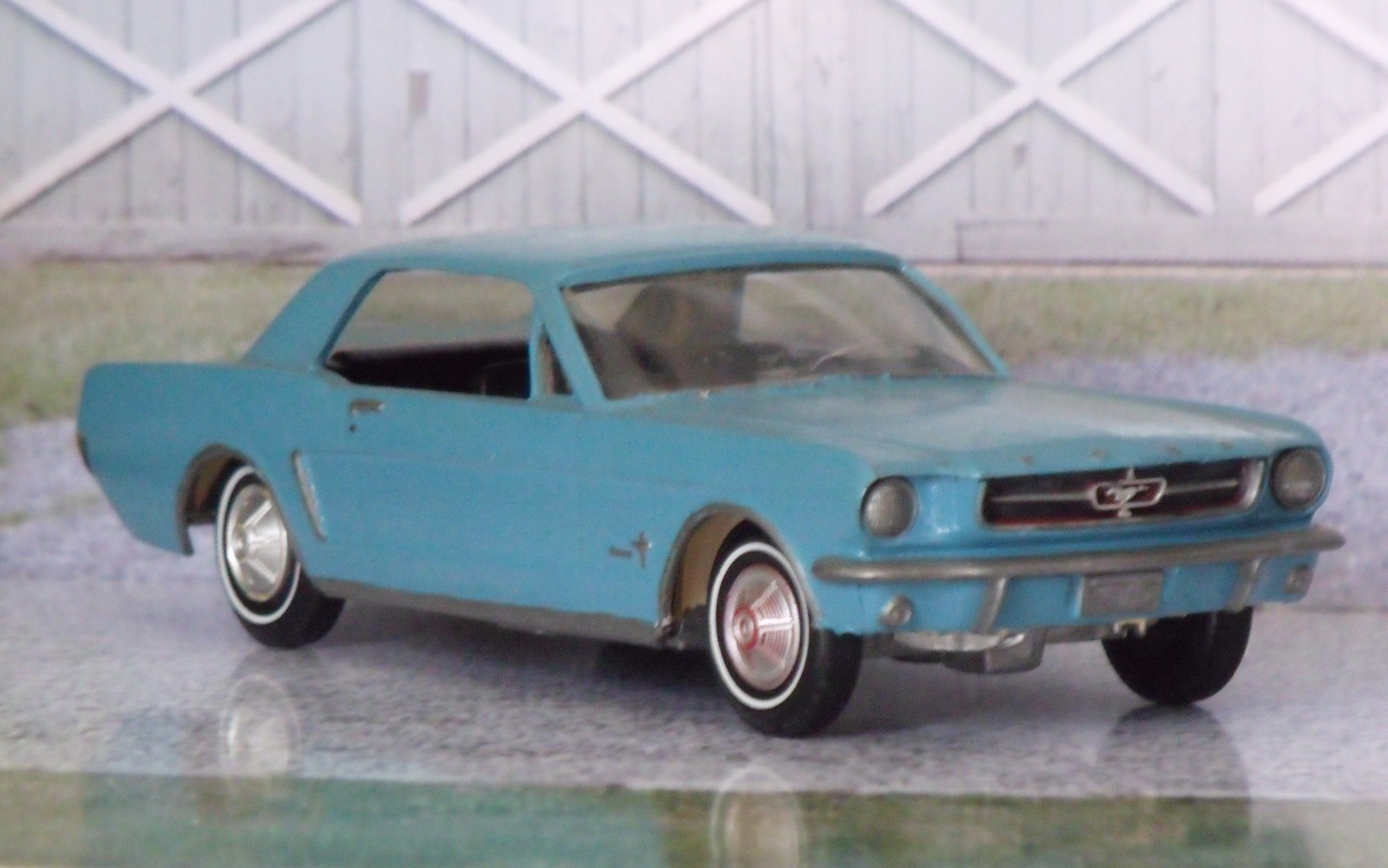
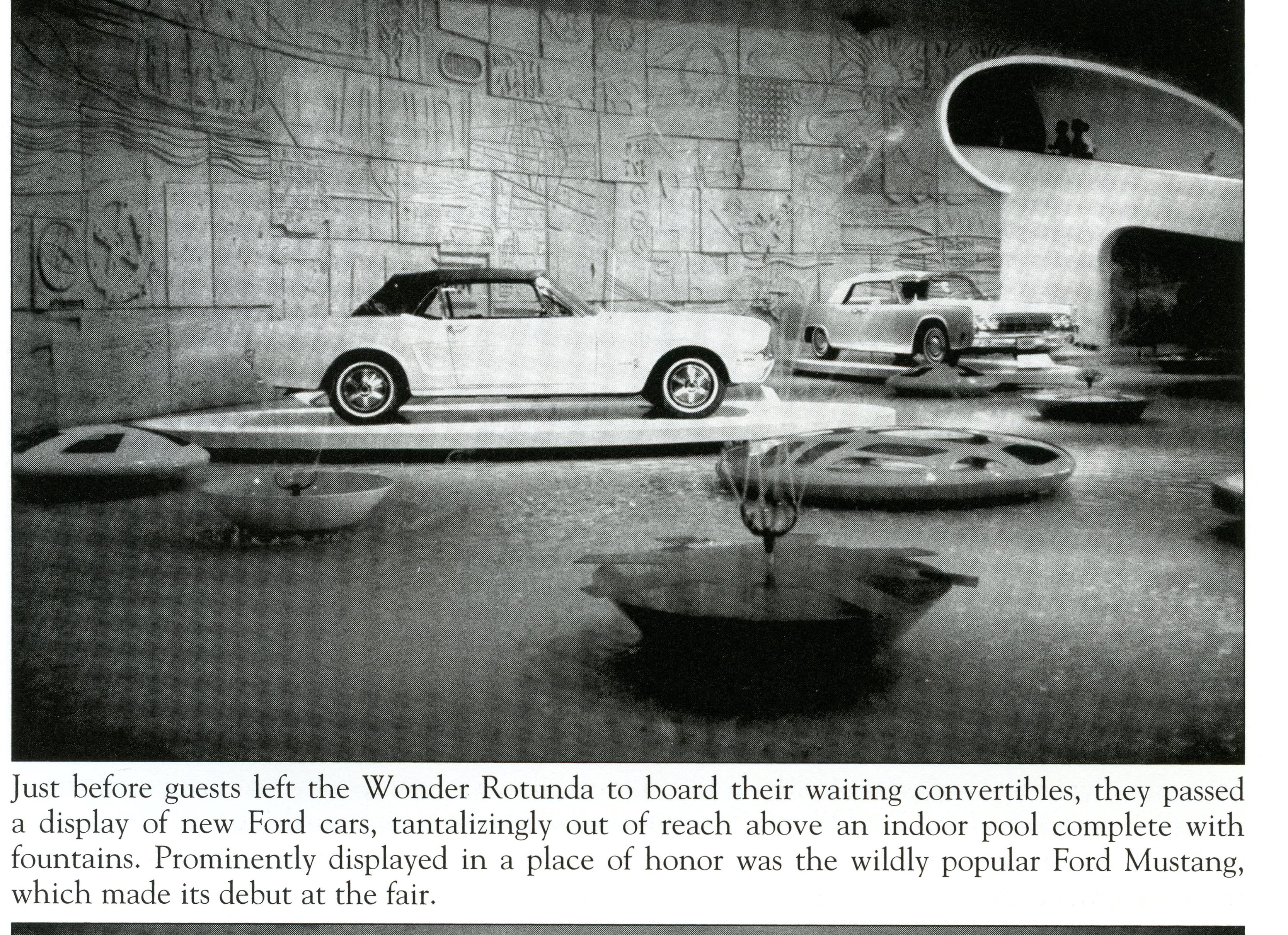
When the Ford Mustang was introduced in 1964, this 10-year-old car-crazy boy was infatuated with it. Some magazine advertisement at the time offered the chance to buy a promo model, which I did (and which I disassembled so I could paint it.) One advantage of growing up in New York City was the opportunity to visit the 1964-1965 World’s Fair in Flushing Meadow Park. The family went six times! Of course, the new Mustang, having been introduced there, was always on prominent display. Dad, who normally didn’t say much, ever so slightly let it be known that he “liked” this new pony car.

1964 1/2 Ford Mustang promo model (hand painted)


From the book "Images of America; The 1964-1965 New York World's Fair (author's collection)
From the book “Images of America; The 1964-1965 New York World’s Fair” (author’s collection)


In the mid-sixties, we were a typical suburban American family with two cars, what with two working adults and three school-age children in the household. At that time, our transportation needs were met with station wagons (the Corvair, Catalina, and Sport Wagon). But by the late ‘60s, perhaps there was room for something more fun. (Was it a coincidence that my father turned 50 in 1969 and may have been having something of a mid-life crisis?) To my surprise and delight, “we” got just that in the form of a Ford Mustang.

 
In 1969, my father found a used ’67 Mustang for sale in our hometown of Staten Island, NY. It was a Lime Gold coupe, 289 2V, automatic, vinyl roof, full wheel covers, whitewalls, AM radio, and nothing else. My dad paid $2,050 for it; the number always stuck in my head because of the odd $50. I was 15, and, just two years away from a driver’s license, hoping that someday it would become my car.


My dad's '67 Mustang, photo taken by me in our yard in 1969
My dad’s ’67 Mustang, photo taken by me in our yard in 1969

In 1971, with that freshly minted license, the Mustang was ‘mine’ to drive. Dad bought a third car so that he and Mom would each continue to have their own wheels. Giving a 17-year-old a V8 Mustang was maybe not his best decision, although I used the car responsibly as transportation to a part-time job, as well as a weekend “cruisemobile” with my high school buddies. Like many teenagers, I considered myself a good driver, but in retrospect, my driving was aggressive, cocky, and naively self-assured.

 
It is ironic then, that on the morning of December 23, 1971, at the speed of perhaps 10 mph, I rolled through an intersection, having failed to see a stop sign, and was punched by another car. The accident was 100% my fault. The car had 2-point lap belts, but mine wasn’t on. My head hit the steering wheel, I was knocked unconscious, suffered a concussion, and required 10 stitches. (The hospital needed to shave my hairline to sew me up. Today, the scar is well below the hairline!)

The wrecked Mustang in 1972

This happened in Brooklyn, which is why my speed was so low. I didn’t know the neighborhood, and was looking at street signs. Dad drove to the hospital to see me. I dreaded his scolding, but he didn’t. He was upset, but took it all in stride. The Mustang was totaled. For reasons possibly having to do with insurance, the car was towed to our house, where it sat for several months before he sold it to a salvage yard. My father went back to new GM cars (Buicks and Oldsmobiles), a new Dodge Dart, and eventually moved to import vehicles (Renault, Datsun, Mazda). “Father’s first Ford” turned out to also be his last; he never bought another Ford.

 
Fast forward to August 2003: I purchased my first collector Mustang, a ’68 California Special, in Lime Gold (my first color choice for sentimental reasons). Dad was in failing health, and never got to ride in it. He passed away in 2006. My ’68 is a story for another time. But every so often, I think back to that ’67 coupe and wonder: did someone rescue it from the junkyard, or did it give itself up for parts so that other Mustangs could stay on the road to be enjoyed today?

The 1968 Mustang California Special in Lime Gold

All photographs copyright © 2016 Richard A. Reina. Photos may not be copied or reproduced without express written permission.


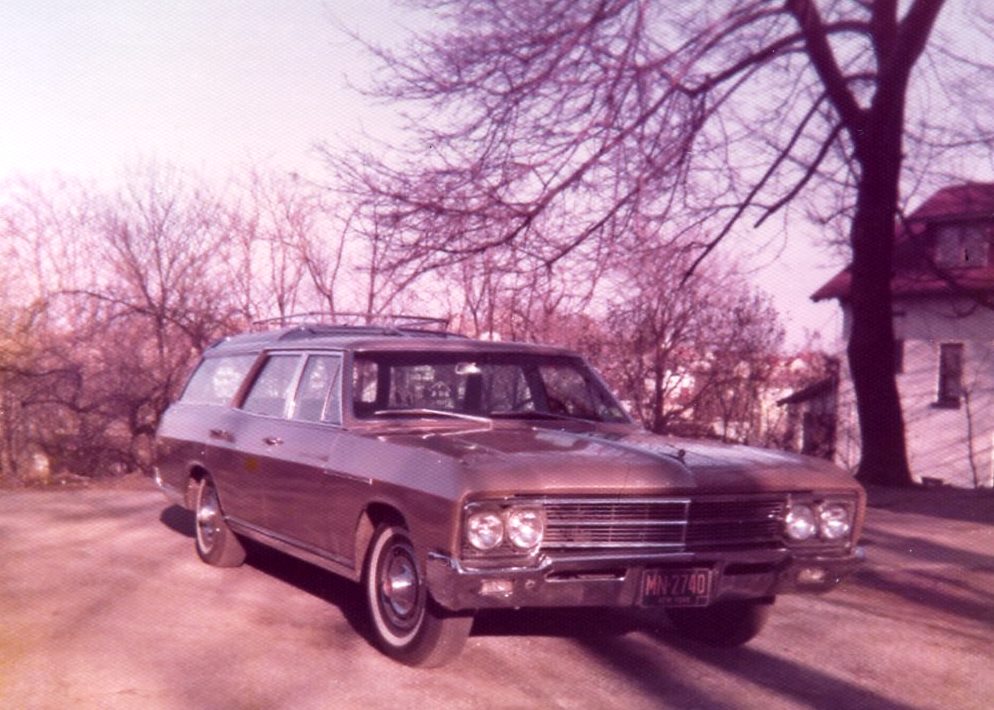
Dad’s 1966 Buick Sportwagon

My father was always a GM guy, at least through most of my boyhood. Later on he moved away from General Motors products, first with a Mustang, and then some Japanese cars. But during most of the time I lived with my family, my dad’s daily driver was either a new Chevrolet or a used Pontiac or Buick.

It was probably 1969 when, while perusing the Sunday classifieds, he mentioned to me that Reedman’s in PA had a used Buick in which he was interested. At that time, Reedman’s Auto Mall had a reputation as one of the largest used car dealers in the Northeast. While they did sell new cars, they never seemed to advertise them. Years before the advent of the automotive superstore, they regularly ran newspaper ads which featured their gigantic pre-owned inventory. Located in Langhorne, PA (and still in existence today as Reedman-Toll), it was an hour ride from our house on Staten Island. Dad invited me to accompany him to check out the car, a 1966 Buick Sportwagon. He had never before involved me in any aspect of a vehicle purchase, and I was utterly thrilled.

scan299c
We arrived and found the car. The concept of a gold station wagon did nothing to excite me. But its list of comfort and convenience features did. This car had factory a/c, power windows and seat, AM/FM radio, and cruise control. NO vehicle in the Reina family fleet up until now had ANY ONE of these, much less all of them in one automobile. A second glance at the body style made me realize that this “Sportwagon” had the second windshield above the rear seat, as did the more aptly named Olds Vista-Cruiser. So this was something cool, at least as station wagons go.

scan298c

The passage of time has caused me to completely forget the dealer’s asking price. A check of my Encyclopedia of American Cars tells me that a 1966 Buick 2-row custom Sportwagon carried a base MSRP of $3,155. What could the price have been on a 3-year-old example, $1,900? Whatever it was, I begged my father to buy the car. He did. We traded in the Corvair; I think we actually drove the Corvair there and drove home in the Buick, the deal done in one day.

 
The Buick became mom’s car; dad was still driving the ’63 Pontiac Catalina (of which I have no photos). (Writing that previous sentence brought out a chuckle in me; in the 1960s, wives had no input in the selection of their cars – their husbands just bought them and brought them home.) He was soon about to get his Mustang, which is a story for another time. I got my driver’s license in 1971, and by 1973, mom was ready for a new car. The Buick became mine. The FM radio, along with its ability to swallow my drum set, were its best features. By far its worst feature was the 8 miles-per-gallon I was achieving in local Staten Island driving. By 1974, when the first gas crisis hit, the fillup costs were crushing my meager budget. The Buick was also using a quart of oil about every 500 miles. It was sold for $400. I bought a Fiat 124 Sport Coupe, which could get an amazing-for-its-time TWENTY miles per gallon!

 
Buick Sportwagons never appear at any of the various car shows and auctions I attend. Hagerty’s Classic Car Price Guide pins the value of one today (Nov. 2015) at $9,850. Gee, if I had only held onto it….

All photographs copyright © 2015 Richard A. Reina. Photos may not be copied or reproduced without express written permission.

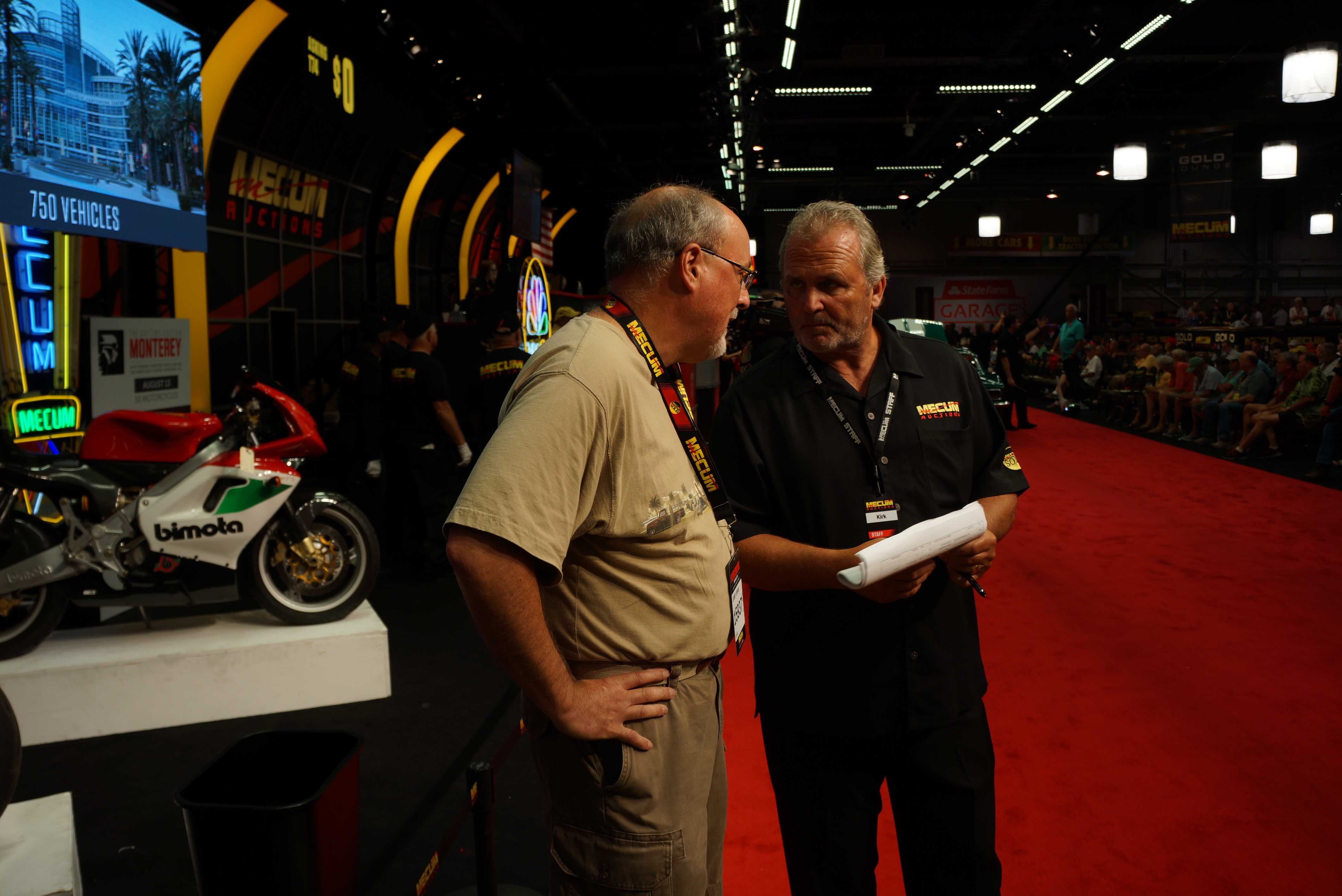
Larry Moves The Mercury At Mecum

“A roller coaster”: Those three words, direct from my friend Larry, summed up his experience as a first-time seller of a vehicle at a public auction. But this was no ordinary car, and certainly was an extraordinary auction. The car was his 1963 Mercury Marauder, a one-family car previously owned by his late aunt. (Regular readers of this blog have likely seen the coverage of this gem of an automobile. For those who may have missed it, you can find the story here.) It was Larry’s decision to liquidate it via his chosen venue, the Mecum auction in Harrisburg PA.

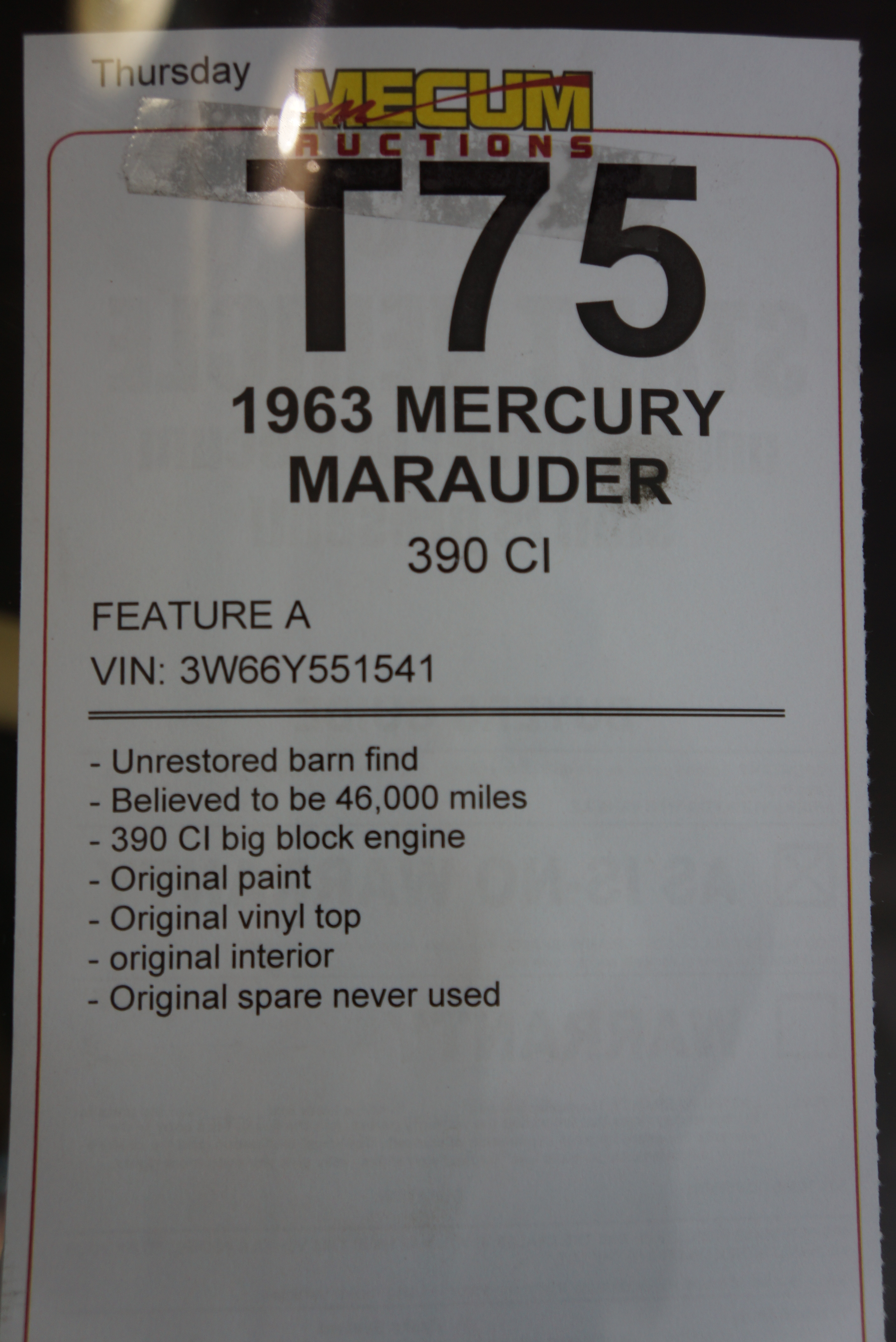
We’ve known for months that the vehicle would cross the block on Thursday July 30, the first of three selling days. We’ve also known that the lot number, T75, ostensibly meant that his would be the “75th car” to sell that day. Initial concerns about the car going up too early in the day evaporated when The Selling Day arrived. More about that in a few moments.

Larry had previously arranged for the car to be transported to the auction site via truck. Our plan was to arrive on Wednesday, do a final prep of the car, and check out the other cars for sale. We would be back early Thursday to stay with the car during its final roll under Larry’s ownership, and Friday would be our day to return to the auction in a more relaxed mode. Most of that went according to schedule.

After the requisite stop for a road-trip breakfast of Dunkin’ Donuts bagels and coffee, we were at the Farm Show Complex by 11 a.m. Wednesday morning. Credentials were quickly issued (registering ahead of time has its perks), and our lanyard-mounted badges allowed us access to the entire building. Your author attended this auction last year, but never left the main auction room. Much to my surprise, we found that there are many additional rooms throughout the complex. This is where all the cars and trucks (and tractors) sit waiting their turn. Finding the Mercury meant wandering among these rooms, although we were helped by the “Thursday”, “Friday”, and “Saturday” signs providing direction. As the Complex is used primary for animals, these back rooms are not air-conditioned (the main hall is), and have a musty, dingy feel to them. It’s not the most appealing arrangement for classic cars and trucks.

The Merc as found in Thursday's holding pen
The Merc as found in Thursday’s holding pen

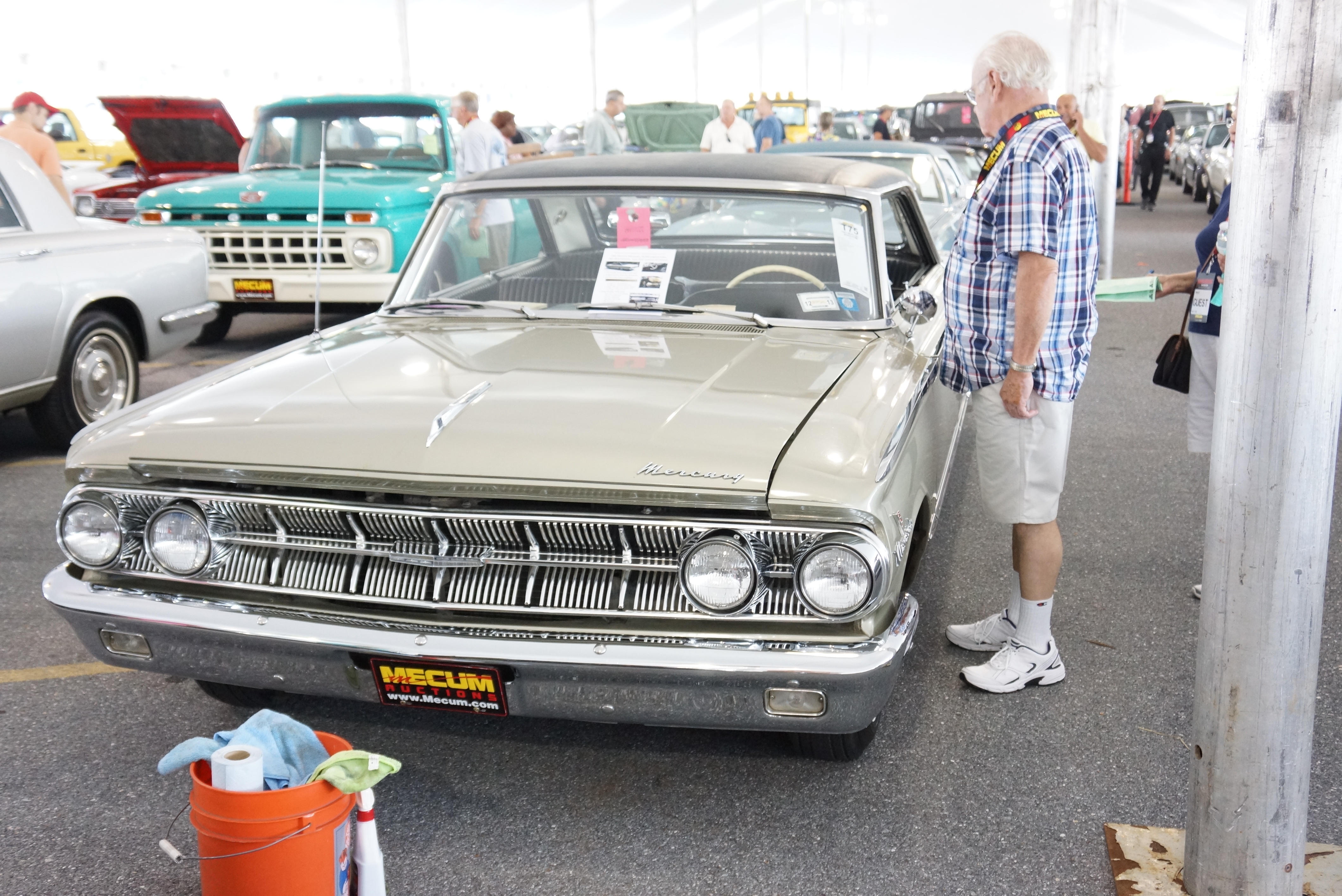
The Merc was in the Thursday room, and looked pretty good after its journey. In fact, we decided based on the conditions in the holding pen that any final detailing would best wait until early Thursday morning. This was our excuse to spend the rest of Wednesday checking out the merchandise! By late afternoon we learned that drivers would be restaging Thursday’s cars from the pen to the tent immediately outside the main hall’s entrance. At around 5 p.m., “our” driver arrived, and suggested that we hop in for the ride, which of course we did. This was my first time in the Marauder with it moving under its own power, and it was Larry’s last time. As we coasted into our parking spot, I saw that we had a good location: the fourth row, near the front of the tent, very close to the main room’s entrance ramp.

Under the big tent
Under the big tent

The Big Day arrived soon enough. We were on site by 8 a.m. in order to secure a close parking spot for the daily driver, detail the ‘63, and chat up any potential prospects. Fears that we would not have an audience due to our rather early time slot were allayed when we saw A) the mob lined up at this hour to get into the building, and B) all the attention the Mercury was getting under the tent. Of course, there were about 150 other cars sharing the tent with us, many of them real beauties. But surreptitious listening to observers’ comments reinforced what we already knew: this was a nice car. Most onlookers told each other (or us) that it was great to see such a rare car; that the car’s condition was “fantastic” for an unrestored vehicle; and that it was one of the more striking cars in the tent that morning. We were feeling good! One gentleman in particular lingered long enough that he asked for the car to be started, and he was the only one to peer into the trunk. He told Larry that he would be bidding.

Detail bucket deployed for final time

Mecum’s schedule said that automobilia would be sold starting at 9:30, with the first automobile crossing the block at 10 a.m. We do not know why cars did not start rolling out of the tent until about 10:45. However, once they started to roll, they moved quickly. Official drivers, distinguished by their neon green Mecum caps, were staged at the top of each row, and dispatched to the cars in plenty of time to start them, warm them up a bit, and begin the parade.

DSC01050
In case his green hat isn’t obvious enough, his badge says DRIVER

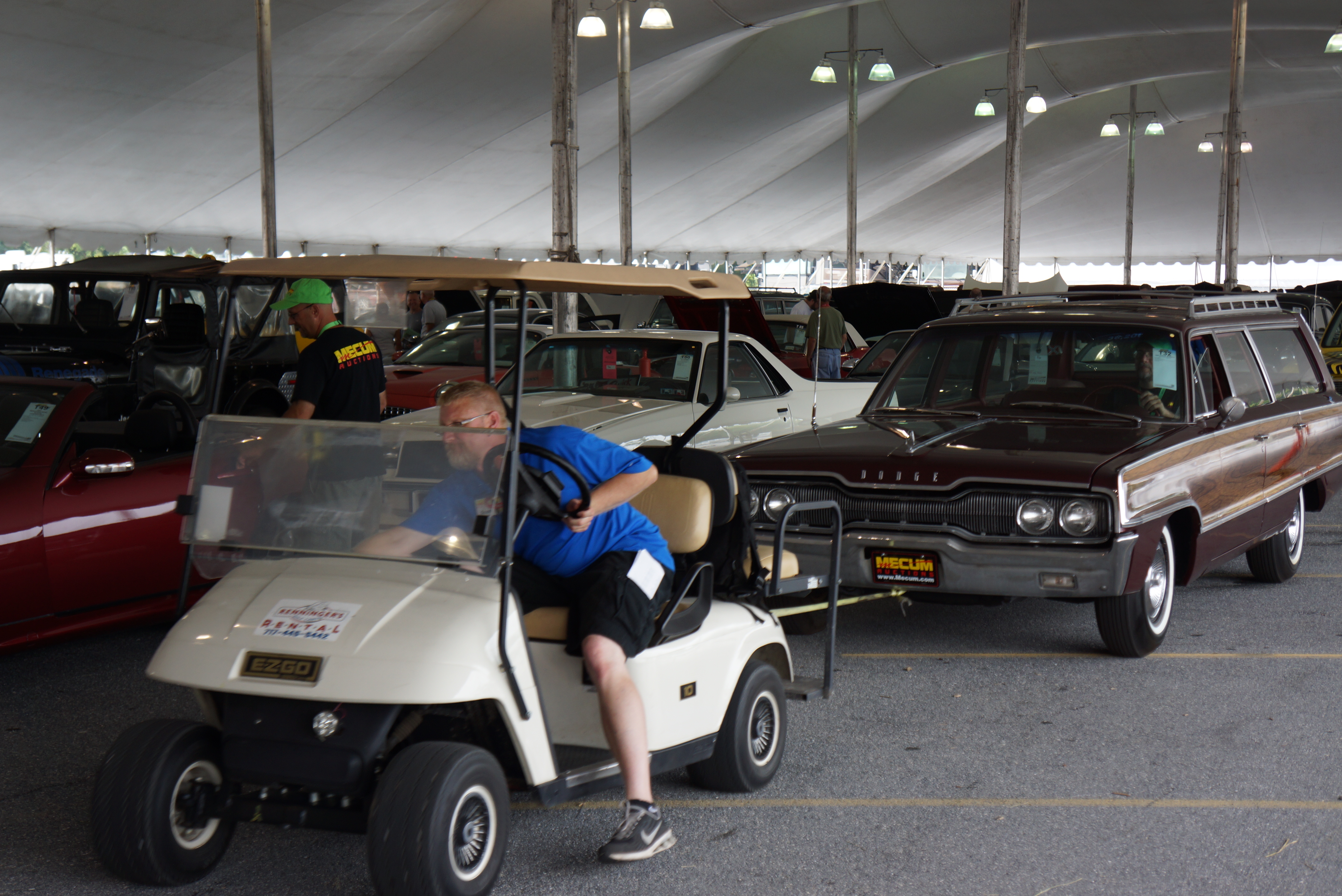
A few digressions: perhaps it’s me, but wouldn’t you think that if YOU had a classic car that you planned to sell at auction, YOU would make sure that the car would start at its appointed time? When I say “start”, I’m referring to “crank”, as in “have a charged battery in the car”! To my utter amazement, I saw not one, not two, but THREE cars ahead of us in the tent require the services of the jump-start cart in order to become motorvated (Chuck Berry’s word). In at least one of those cases, the jump attempt failed, and the good ol’ golf-cart-with-a-tow-rope was deployed. Once inside and on the smooth level ground, the white-gloved pushers move the car along with the engine off, and most of the bidding audience is never the wiser.

Golf cart doubles as tow truck

One of the volunteer drivers, a middle-aged woman assigned to move the ’67 Dodge next to us, chatted me up about the Merc, saying that while she liked it, she and her husband collected Pontiacs. I used the opportunity to inquire how she landed this prestigious job, and she told me that their club, the Susquehanna Valley GTO Club, volunteered their services to the auction company. So these drivers knew each other, and were on site primarily for the fun of it. She then confided to me that she did not drive a manual transmission, and she was quite nervous hopping into these “strangers’ cars and figuring out the controls”! Having worked for years at car dealerships, I told her that driving many different new and used cars every day becomes second nature.

It was time. Even with the late start, we had predicted that Larry’s car would cross the block between 12 and 12:30, and here it was just a few minutes before noon. The driver assigned to the Marauder asked Larry if there was anything special to the starting procedure. “Hop in and she should start right up” was the reply. He did and she did.

In the building at last

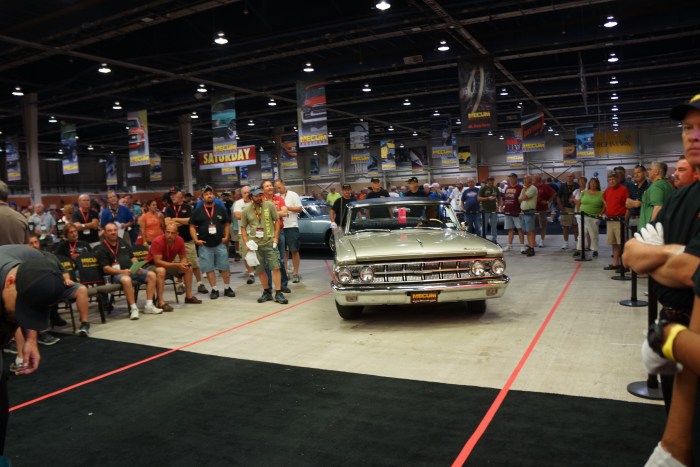
The Mercury cruised effortlessly up the ramp and into the queue. Once in the main building, the excitement level for both of us jumped up several notches. First, the car looked even more incredible under the neon lights. Second, the inside crowd mobbed this car (in truth, they mobbed every car in line). We got the sense that these folks were the more serious potential bidders, rather than the tire-kickers outside. The car got a more thorough going-over during these brief moments than it had at any point prior. Third, this line was moving fast! It felt like less than a minute before the Marauder was about to make the 90° right turn toward the block.

Then…everything stopped. A charity appeal began, in order to raise money for childhood cancer. This was a truly noble cause; and while $10,000 was raised, it gave us a chance to catch our breaths.

Mecum Man talks to the owner

Like a light switch on at full brightness, then turned off, it was switched on again. I couldn’t tell you a thing about any of the cars that crossed the block ahead of us, whether they sold or not, and if they did, for what amount. My eyes were glued to that Merc, headed to a new destiny. The auctioneer’s voice was suddenly clear enough for me to understand every word: “Lot T75, 1963 Mercury Marauder, 45,000 original miles, unrestored barn find, one family since new, do I have 20,000, 20, 20, who will bid 20? Can I have 15, 15,000, anyone? 10,000, 10,000 for this Mercury? Do I have 5?” Finally, a bite. While I knew he would start high, there was a slight sinking feeling when I heard the opening bid drop all the way to 5,000. The auctioneer continued: “6,000, I have 6, 7,000, who will bid 7? 7, now 8,000?” And so on, as it quickly jumped to $10,000. “Eleven thousand dollars, who will bid 11? 11? 11?” Nothing. It stalled at 10,000. Larry, in the “batter’s box” as they call it, directly below the auctioneer’s podium, was getting pressure from the Mecum man to lower his reserve from $12,000. Larry would not. It was over. The car did not sell. It was 12:15 p.m.

We had 10; asking for the 11 which never came

Shock. Disappointment. Dismay. We could only repeat “I can’t believe it!” to each other over and over. The car missed Larry’s reserve by $2,000. It got a “The Bid Goes On” sticker stuck to its windshield, and was relegated to one of the back rooms normally used by horses and cows. Our cell phones went into overdrive, but instead of broadcasting success, our emails and texts informed our friends that Larry still owned the Mercury. Which brought up this realization: it would be Larry’s responsibility to move the car back home, on his dime. Time to stop thinking about it so much. Time to take a break and not worry about it for a while. We decided to have lunch.

After eating, we convinced ourselves that watching and enjoying the auction proceedings was a good thing to do, so we did. A calmness settled in, combined with an acceptance of the outcome. Larry would do what needed to be done, and I would do my best to support him through this.

Close to 5pm, almost 4 hours after the car failed to sell, Larry’s cell phone rang. It was a brief conversation. The Mecum rep who called told Larry that they had just gotten a bid from an absentee bidder (phone or internet) for the reserve price of $12,000. The car was sold. There was nothing he needed to do. Relief, not joy, was the emotion of the moment. We could talk all day and all night about how the car was worth more; about the lack of real interest among the in-person bidders; and about the sale going to someone who presumably didn’t even see the car in the metal. Finally, the goal was achieved, and a real sense of “done” settled over us. The beers with dinner that night tasted especially good.

DSC01039
We returned bright and early on Friday morning to watch more of the auction without the pressure of the Mercury hanging over us, but we were tired. We hung around until right after lunch, when it seemed our best course of action would be to get on the road and ahead of the upcoming weekend’s traffic. The trip home gave us a chance to review everything that went down over the preceding several days.

There were some lessons learned about the entire auction process. Much of what occurs on the block is not predictable. While some nice cars sold for strong money and a few poor cars sold for cheap prices, good cars were not always bid up to a fair value, and some junk sold for what seemed like crazy high dollars. With all the effort we put into representing the car on Wednesday and Thursday, it ended up selling to someone offsite. Mecum’s cars and trucks tend to be all about the sizzle, whether they are bondo-filled quickie repaints, 100-point restorations, or dolled-up restomods. The Mercury was none of these. Did that affect its outcome? Who knows, because we don’t. Would the car have found a more receptive audience on Friday or Saturday? Again, perhaps, but perhaps not. Finally, would it have done better somewhere else? If so, where? One attraction about Harrisburg is its closeness. Taking it to another locale would have raised the costs of doing business for shipping and accommodations.

The collector car hobby is immensely fulfilling in so many ways. Auctions are only one part of it. At times, they’re a necessary element to help us continue with our passion. In this case, after the ups and downs of the roller coaster, the ride ended, and the players got what they needed to get out of it.

All photographs copyright © 2015 Richard A. Reina. Photos may not be copied or reproduced without express written permission.

Larry’s 1963 Mercury Marauder

A while back, my good friend Larry mentioned to me, almost in passing, that his uncle owned a 1963 Mercury. Larry went on to say that the car actually had belonged to his aunt who passed away a few years ago, and with his uncle getting on in years, the uncle wanted to give the car to Larry.

Larry, in his understated way, made it sound like the Mercury was “nothing special” even if it was purportedly a one-family, low-mileage car. The implication was that the car was a true barn-find: left in a garage for years, unkempt, uncared-for, and likely in need of some deferred maintenance.

His uncle wanted Larry to keep the car. The problem is that Larry is like many of us in the hobby: there were already more cars than available garage spaces at his house. Over a period of time, Larry and his uncle came to an agreement that Larry would sell the car on the family’s behalf. He decided to list the car with Mecum Auctions, scheduled to cross the block at their Harrisburg PA event in late July.

This is where your scribe enters the picture: Larry wanted to dedicate an upcoming Saturday to get the car primped and primed, and requested that I be the official photographer for the submissions needed by Mecum. I also offered to assist in the primping/priming. On a sunny and warm Saturday in early May, we did just that.

The Merc's VIN.
The Merc’s VIN.

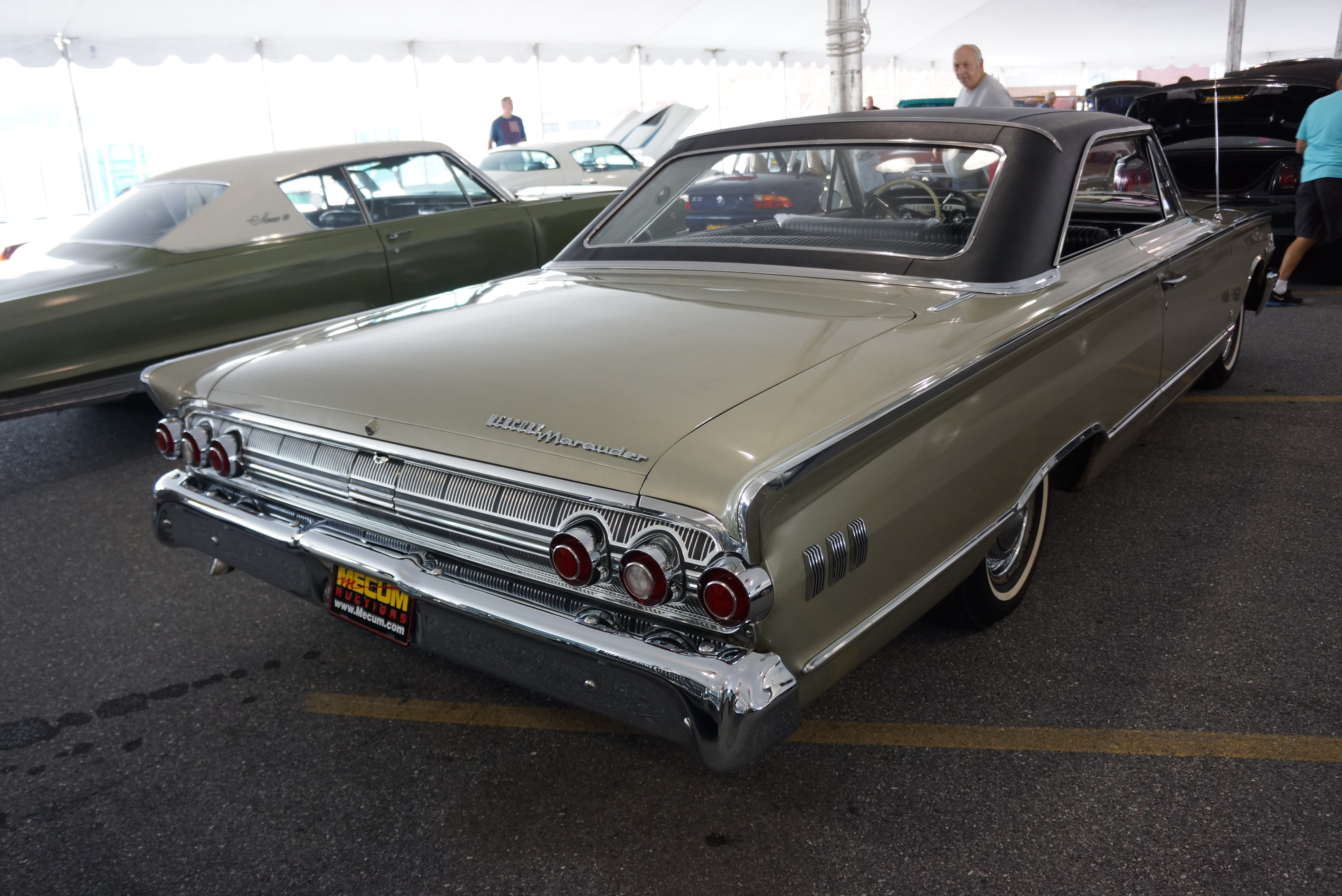
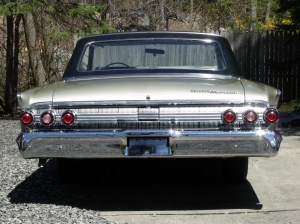
Upon first seeing the car, I was pleasantly surprised to learn that this was no ordinary 1963 Merc: in fact it is the 2-door fastback “Marauder” model, with a 390 cubic inch V8 and automatic transmission. The car is metallic beige with a black vinyl roof and black vinyl interior. It started right up, and Larry backed it out of the driveway so we could give it a bath. That is when I saw just how preserved an original car this is.

Everything on the car appears as it did from the factory. There are no signs of any paint work anywhere; sighting down each side of the car shows not a ripple. The vinyl roof and interior are in similarly unblemished condition. The carpet on the driver’s side shows some entry/exit wear, only because the full-size floor mats did not extend to the door sill. All 4 full-size wheel covers are in place. Underhood, with the exception of some service items like hoses and clamps, the engine compartment is likewise original. All of the factory decals and labels are there (as is the trunk label). A really neat discovery was the “390 W” crayon marking on the firewall.

The glove box was a treasure’s trove of discoveries. A brown-paper bag with various small bits of hardware threw me for a loop until Larry identified it as the unused license plate hardware! We also found an almost-unbroken string of insurance cards going back to the 1980s to help support the one-family-ownership claim.

With an odometer reading just over 45,000 miles, we scoured the car in search of supporting evidence.

Original miles.
Original miles.

This is some of what we found:
• Owner’s manual shows 12k service done on 10/1/65 at 9,993 miles
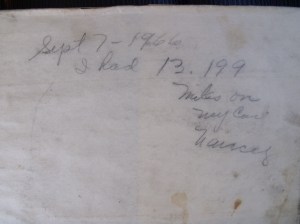
• Hand-written note: on 9/7/66, car had 13,199 miles
• 11/25/79: lube sticker shows mileage of 40,055.0

After a wash and wipe, with a really thorough cleaning given to all the glass, vinyl and chrome, we were both surprisingly shocked how great the Marauder looked. The photos do bring out that the car has survived, and survived well. For Larry, if I can make this statement on his behalf, this is bittersweet: on one hand, he would love to keep the car as it was his aunt’s; on the other hand, he knows that he does not have the space or time needed to keep the vehicle, and moving it to the next owner is in many respects the best thing to do. His uncle reluctantly agrees.

The 1963 Mercury Marauder basking in May's afternoon sunshine.
The 1963 Mercury Marauder basking in May’s afternoon sunshine.
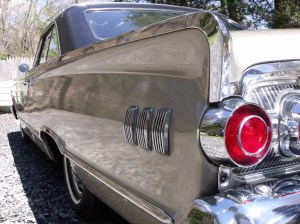
In 1963, before mid-sized cars took over the muscle-car spotlight, this flag helped identify the Marauder as a "performance" car.
In 1963, before mid-sized cars took over the muscle-car spotlight, this flag helped identify the Marauder as a “performance” car.

The car will cross the block in Harrisburg on Thursday July 30. A link to the car’s listing on the Mecum website is here:

https://www.mecum.com/lot-detail/PA0715-216423/0/1963-Mercury-Marauder/

All photographs copyright © 2015 Richard A. Reina. Photos may not be copied or reproduced without express written permission.
Dad’s 1957 Volkswagen Beetle

Difficult as it may be to believe, but there was a time when most American families had only one car. In the years immediately after World War II, as America became prosperous again, plenty of new cars were being manufactured and sold, and roadways were being built to drive these cars to and from the expanding suburbs. Yet the “traditional” family model remained: dad worked, mom stayed home to take care of house and children, and one automobile sufficed. This was reality for many baby boomers growing up in the ‘50s and ‘60s. It was no different for me.

In my family, by the late 1960s, all three children were in school, which was close enough for us to walk. Mom had started to work part-time in the evenings, and Dad was steadily employed in Manhattan, commuting via bus, ferry, and subway. While the Corvair did the job as the family carry-all, my father decided that he could afford a second vehicle. Did we need another set of wheels? Not really. Certainly because he always liked small cars, and possibly because he had been born in Germany, he got a Volkswagen, a 1957 Beetle sedan.

The 1957 VW. Note the antenna, hub caps, and whitewalls.

As the resident car nut, I loved the idea of another car. There was also the pride I felt in an ability to distinguish one year VW from the next. At a time when we were still used to sweeping styling changes every year from the American car makers, Volkswagen actually bragged that they did not subscribe to annual redesigns. So for most drivers, all these Beetles looked alike. Yet I knew my father’s car was older. The one-piece oval rear window and tiny tail lights were all dead giveaways, and no prompting was needed for me to point these things out to anyone within earshot.

It was a treat to go for rides. I enjoyed watching my dad work the shifter and clutch, although I had no interest in trying to understand the mechanics behind such maneuvers. The VW had no heater, so winter rides were always accompanied by the warning to “bring a blanket”. It didn’t stop me from wanting to go.

The '57 Beetle from the rear. Note the blue & gold NY plates. Both photos taken in our backyard on Staten Island.
The Beetle from the rear. Note the blue & gold NY plates. Both photos taken in our backyard on Staten Island.

Alas, after almost exactly a year, Dad sold the VW. He never said why. Perhaps his practical side woke up to the realization that we really did not need two cars, at least not yet. For years afterward, my father continued to brag about that Beetle, repeating the line that he “bought it for $275, and sold it for $275”.

Pretty good deal. Wish I had it today.

All photographs copyright © 2015 Richard A. Reina. Photos may not be copied or reproduced without express written permission.

Dad’s 1961 Corvair

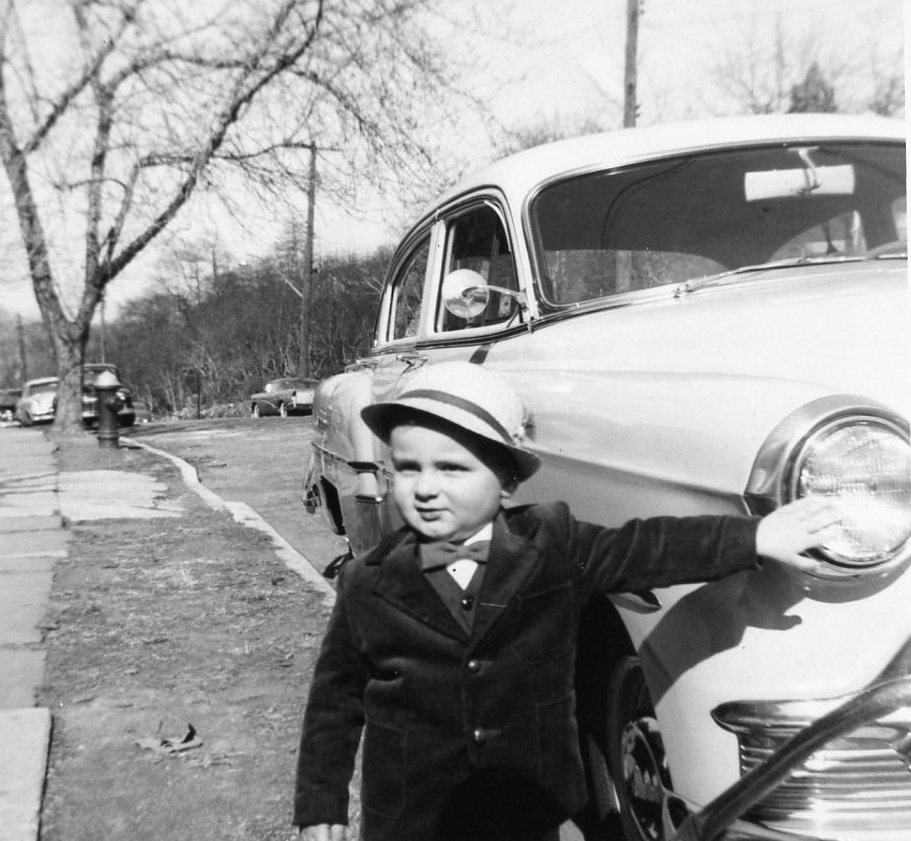
The first new car that my mother and father purchased after their 1950 wedding was a 1953 Chevrolet 210 4-door sedan, 6 cylinder, 3-on-the-tree. Of course, I say “mother and father” to be polite. This was the early ’50’s. My mom neither worked outside the house nor drove. The ’53 was the car that brought me home from the hospital. (Although I would be lying if I claimed to remember it, I have no doubt that my mother sat in the front passenger seat and cradled me in her arms during that initial ride. Good thing that the hospital was less than a mile away.)

The author, age 2, with Dad's '53 Chevrolet. I had to touch the car.
The author, age 2, with Dad’s ’53 Chevrolet. I had to touch the car.

My dad, ever practical with the 4-door Chevy, nevertheless enjoyed the idea of small, quirky cars. He told me when I was a boy that he liked the Nash Metropolitan, and I know he liked VW Beetles (had one later, but that’s another story). So when GM announced the Corvair in the fall of 1959, Dad was smitten. He waited a year, and by doing so, was able to consider the new-for-1961 Corvair station wagon.

By this time, I was 6, and had been obsessed with automobiles for four years already. The excuse given for my mother’s lack of a driver’s license was that she could not handle a clutch. So as my parents considered the replacement car, it had to be an automatic.

The closest Chevrolet dealership to our home on Staten Island was King Chevrolet, at 181 Bay St. (Years later, King would move about a mile down the street. Another car dealership took over King’s original spot, but today, there are no car dealerships along that stretch of road.) We went as a family to the dealer, and at that time, it seemed to me that my parents were there for hours, talking to salespeople. Perhaps they were. My mind can still picture the 1961 Impala convertible on the showroom floor, red, top down, with two life-size mannequins perched on deck above the rear seat, as if in a parade.

Finally, it was delivery day. Dad probably traded in the ’53. A new car to call our own! My first! This car was white with a red interior. Dad stepped up and got the “700” model over the available “500”, which meant more trim both outside and inside. We all rode home together from the dealership, with me in the way-back, above the engine. Dad had his quirky new car, mom had her license, and we had new-found freedom. Since dad worked in Manhattan and took public transit every day, the Corvair was de facto mom’s car during the week.

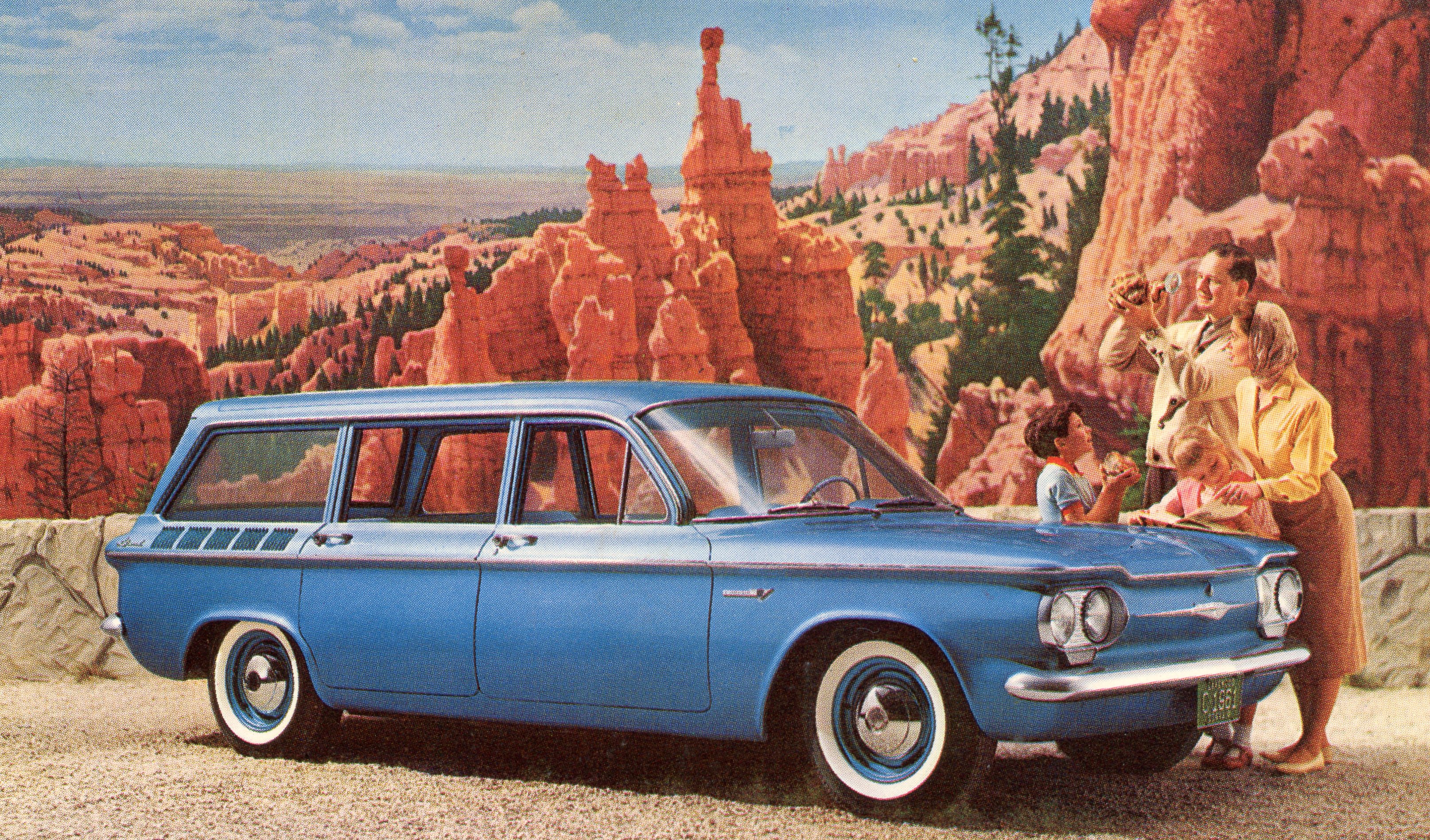
A publicity postcard for the 1961 Chevrolet Corvair station wagon. From the author's collection.
A publicity postcard for the 1961 Chevrolet Corvair station wagon. From the author’s collection.

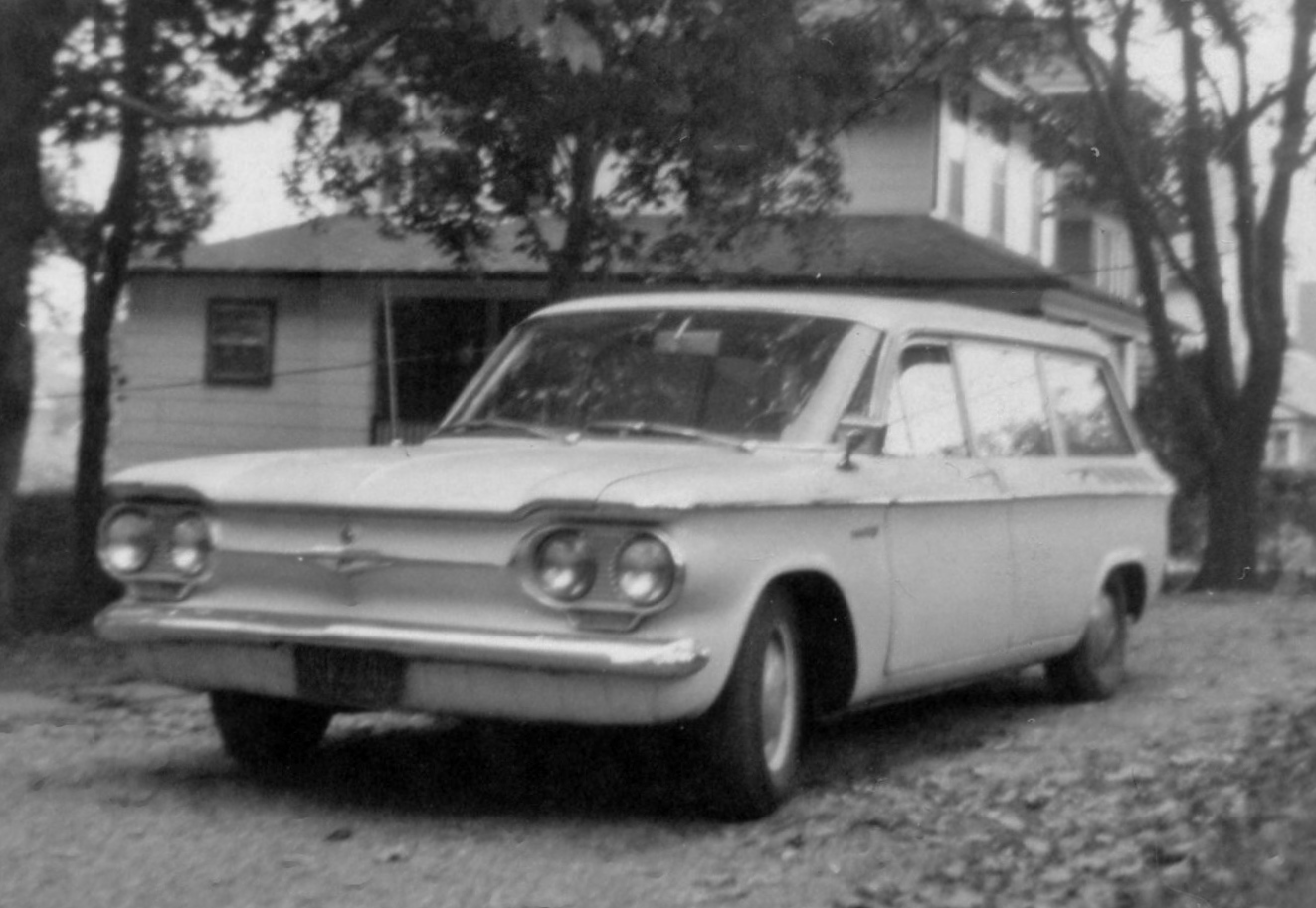
That Lakewood wagon was essentially the only family car for about seven years, from when I was 6 until about 13, so I have strong memories of it. And what do I remember? How dad loved to fool his friends by offering to show them “the engine”, then opening the front trunk to near-universal amazement. How my mom was invincible in the New York snow every winter. How that red light would appear on the dash, and dad would swear under his breath as he removed all those Philips screws to access the engine and reinstall the fan belt which came off with regularity. How we would complain about the odor of gasoline whenever the heater was on. How one year, my parents used the front trunk as the hiding place for that year’s Christmas presents. How the transmission shift lever was this rod the diameter of a ball-point pen, jutting from the right side of the instrument cluster. And how reliable the car seemed to be, year after year. I have no recollection of the Corvair ever being out of service.The family Corvair from the front.

The family Corvair from the front.


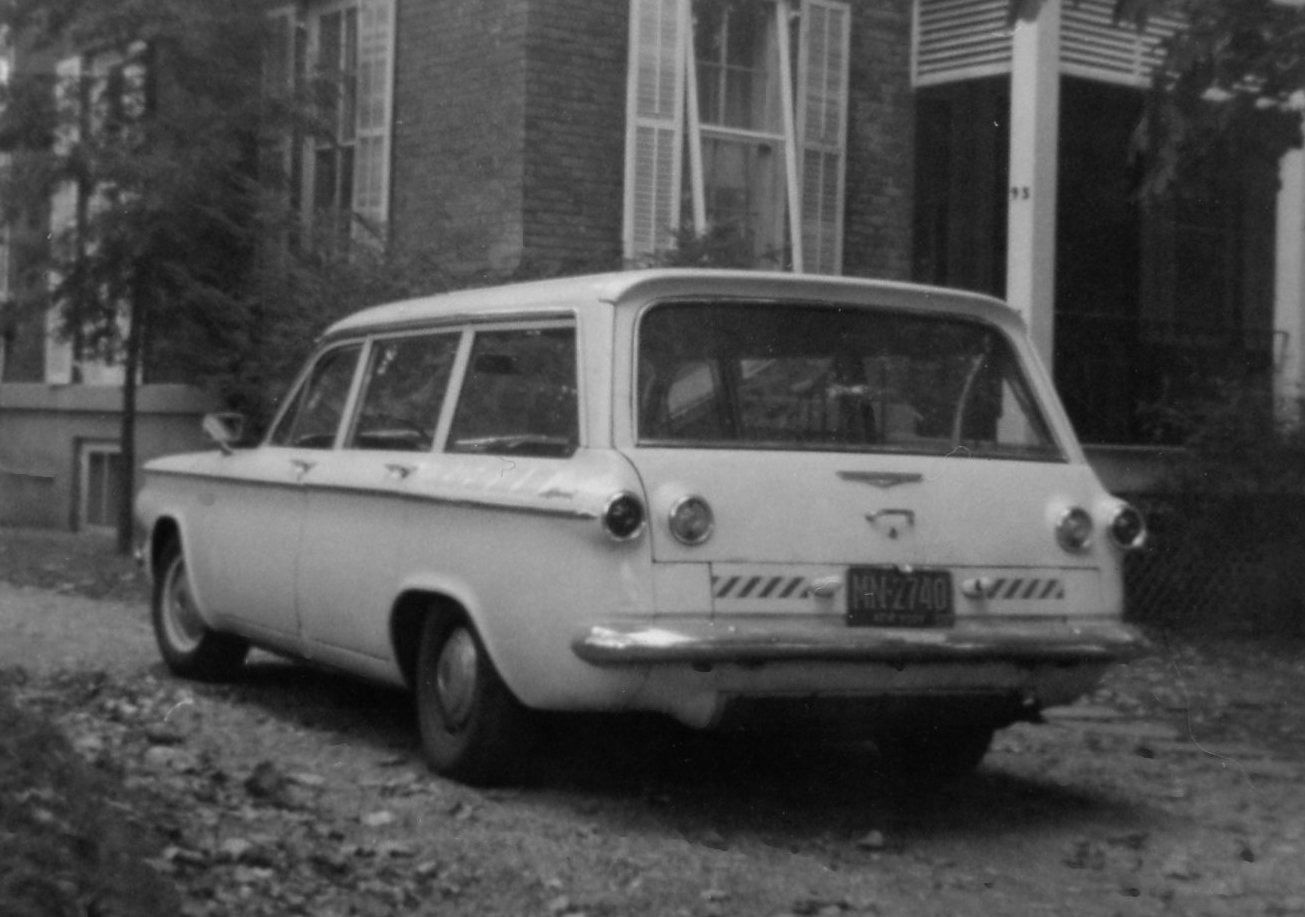
The Corvair from the rear. My father added the reflector stickers. Both these photos taken Nov. 1966 in our driveway at 95 Highview Ave. on Staten Island.
The Corvair from the rear. My father added the stick-on reflectors. Both these photos taken Nov. 1966 in our driveway at 95 Highview Ave. on Staten Island.

Then Dad started to talk about a replacement car. He said something about the engine getting “tired”. I was soon to find out that the car was running on 4 or 5 of its 6 cylinders, and it likely had 80,000-90,000 miles on it. Although frugal, my father was not going to spend big bucks on an engine overhaul. He asked me if I wanted to ride with him to Reedman, the mega-dealer in Langhorne PA, as he saw a listing for a 1966 Buick station wagon. He was staying with GM, and moving up from Chevrolet by buying used. Shrewd man, my father. We traded in the Corvair.

The Chevrolet Corvair was made and sold by General Motors from model years 1960 through 1969. The station wagon was manufactured for only two years, 1961 and 1962, and so is quite rare. I have come across a wagon at car shows now and again, but quite infrequently. Seeing one always brings back a flood of memories.

All photographs copyright © 2015 Richard A. Reina. Photos may not be copied or reproduced without express written permission.