In 1953, three of General Motors’ five divisions launched exclusive, high-end convertibles: the Buick Skylark, Oldsmobile Fiesta, and Cadillac Eldorado. All three cars featured futuristic styling trends including dipped beltlines, wraparound windshields, and custom interiors. These halos cars were in addition to, and not replacements for, the divisions’ other convertibles. The look was sky-high and so was the pricing. While a Buick Roadmaster convertible cost $3,506, moving up to the Skylark would set you back an even $5,000 (43% more). Over at Olds, a 98 convertible listed at $3,229 while the Fiesta started at $5,715, a 77% jump. But the big money was at Cadillac. A “regular” Series 62 convertible was pricey enough at $4,144. You needed really deep pockets for the Eldorado, which cost $7,750 (an increase of 87%). At these prices, it’s no surprise that all three of these dreamboat models sold in very low numbers.

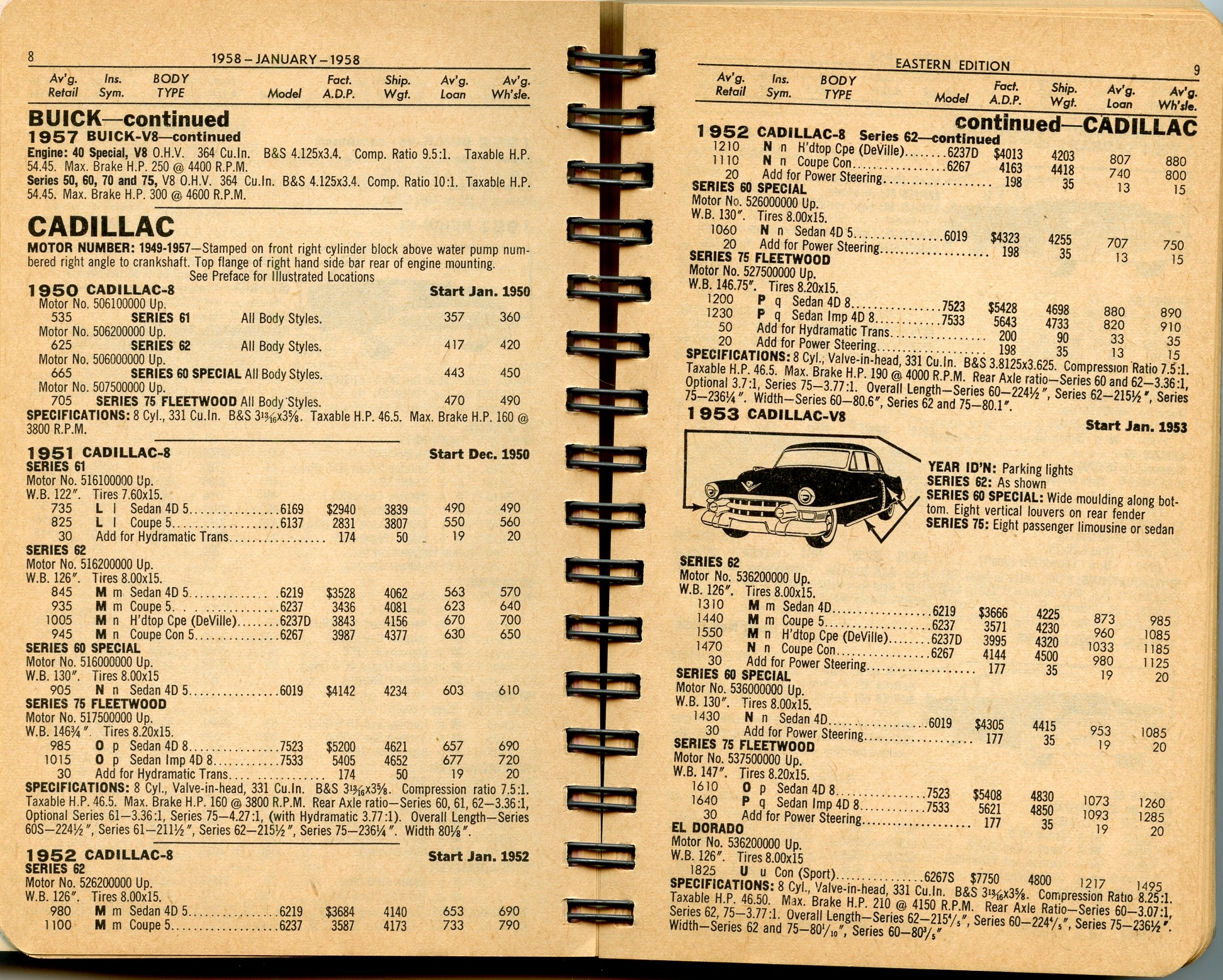
Then as now, depreciation takes a big chunk out of a car’s value, especially during the first few years. I happen to have a copy of the January 1958 edition of the NADA (National Automobile Dealers Association) Official Used Car Guide, and seeing the retail values of the Skylark, Fiesta, and Eldorado at five years of age may bring a tear to your eye. Starting with our $5,000 Skylark, its value after five years was $945, a drop of 81%! The story at Olds is similar. The $ 5,715 Fiesta was now worth $1,075, the same 81% loss of value. The Eldorado actually fared a little better, losing “only” 76.5% of its value with a retail worth of $1,825. (In the pages reprinted here, you’ll find the new car prices in the column marked “Fact. A.D.P.”, which stands for “Factory As Delivered Price”.)

Not surprisingly, all the other models in the lineups also suffered significant depreciation, although the three regular convertibles (Roadmaster, 98, and Series 62) kept a higher percentage of value. Here, the Cadillac again came out on top. The 1953 Caddy Series 62 convertible was worth $1470 retail in 1958, losing 65% of its value.

Imagine that it’s 1958, and your ’53 Eldorado, now five years old with about 50,000 miles on it, is looking a bit shabby, but worse, its styling looks downright outdated compared to the chrome-laden ‘58s which have just been introduced. You drive it down to your local Caddy dealer and check out your choices. There’s the beautiful Series 62 convertible starting at $5,454. But what really catches your eye is the Eldorado Biarritz convertible, at $7,500 (actually less than you paid for your ’53!). While you prefer the Series 62, your wife is smitten with the Biarritz. During the test drive, the dealer appraises your car, and upon your return, offers you $1,500 for your ’53. Your choices are, cough up $4,000 for the Series 62, or $6,000 for the Biarritz (which also keeps the spouse happy). If you did spring for the Biarritz, you were one of only 815 people who did! Which would you choose?
ADDENDA
My automotive literature collection includes a wide range of price guide books. For many years I subscribed to CPI (Cars of Particular Interest), and it is often enlightening as well as entertaining to go back in time and revisit the value of collector cars. For instance, 30 years ago, in 1994, CPI listed the “average” value of a Mercedes-Benz 300 SL Roadster as $165,000. To purchase such a car today, you would need to add a zero to the end of that number. That’s an investment! And while most collector cars have appreciated over the last 3 decades (driven by inflation along with a general across-the-board rise in the hobby), not every car has appreciated. In 1994, CPI stated that a late 1940’s Studebaker convertible was worth $13,500. A 2023 edition listed the same vehicle at $16,300, making it not the best place to have parked one’s money.

Entire blog post content copyright © 2024 Richard A. Reina. Text and photos may not be copied or reproduced without express written permission.
 richardscarblog