My first-ever bid on Bring a Trailer

While I cannot recall the exact date that I was introduced to the Bring a Trailer website (www.bringatrailer, from hereon referred to as BaT), I can recall the person and the setting. I had been transferred back into HQ at Volvo Cars North America (VCNA), where I finished my career, working there from 2006 to 2009. My boss’s boss, Chris Dauerer, asked me if I had heard of BaT and when I replied in the negative, he suggested that I needed to visit their site immediately. At that time, BaT did nothing more than republish links to interesting cars found for sale on other sites, like eBay and Craigslist. Since then, BaT has grown into one of the largest online collector car auctions, with gross sales numbers placing it at or near the top among competing auctions.

Since that introduction by Mr. Dauerer, I’ve had a daily addiction to the site, and have used it as a barometer of car values. (Compared to “for sale” ads which only tell you asking prices, completed BaT sales give you up-to-date transaction prices.) But BaT has perhaps become too big: the website now closes between 100 and 150 auctions a day! So I’ve pulled back, and have chosen to follow only a handful of makes and models which interest me.

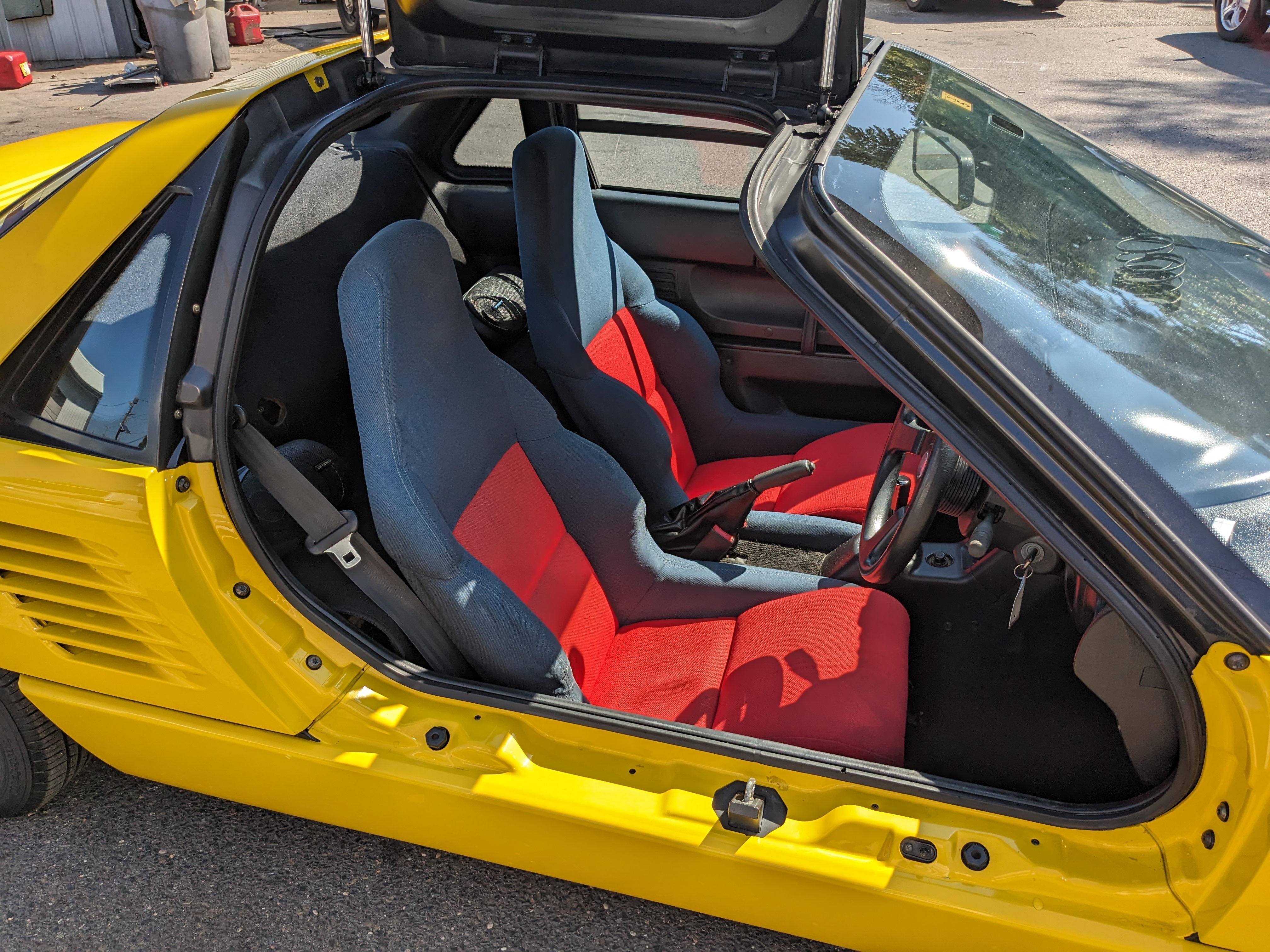
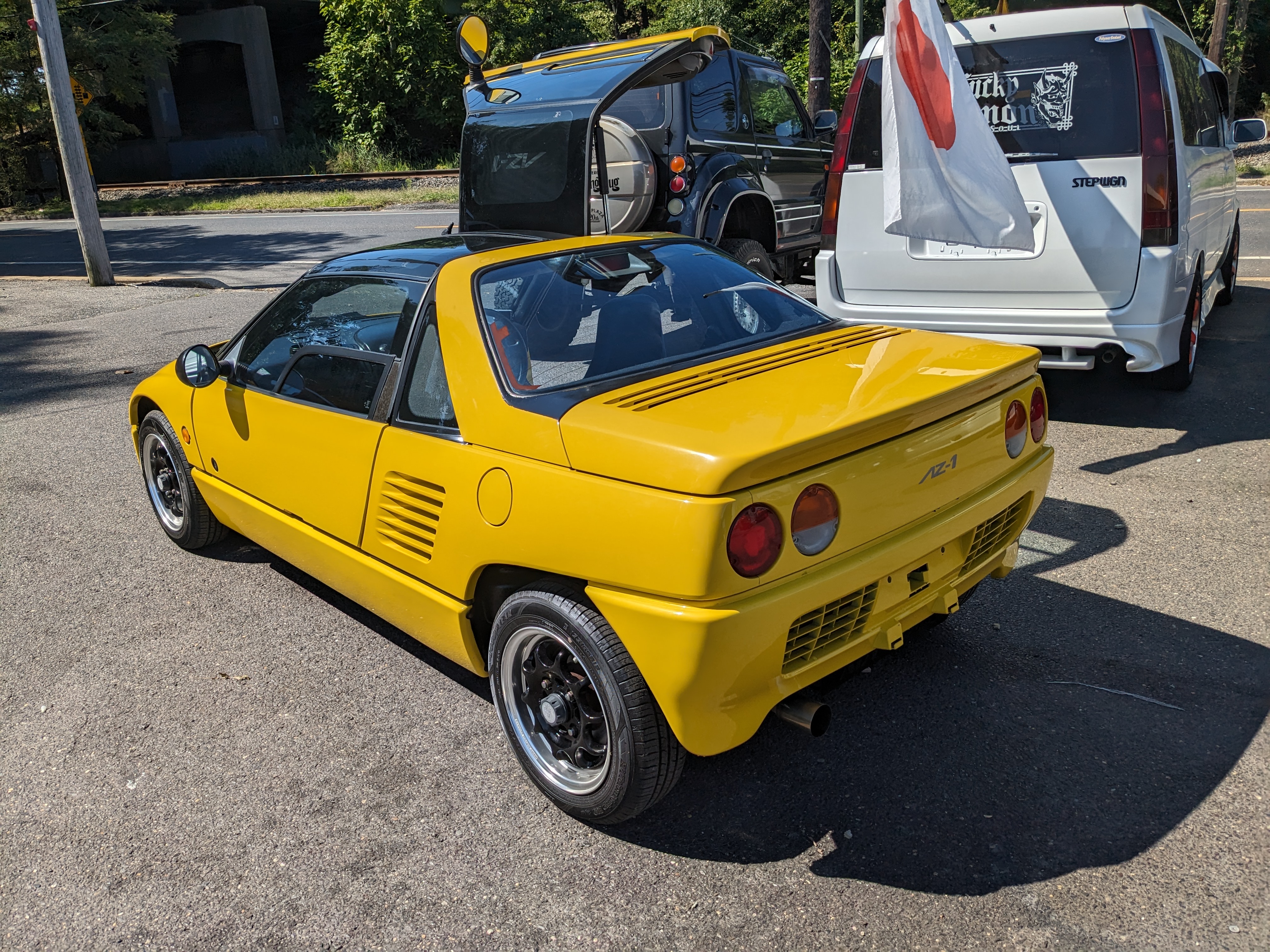
One of those cars I follow is quite unique: the Autozam AZ-1, a Japanese kei car (limited in size and engine displacement by national regulation). While there are other kei cars and trucks, the AZ-1 distinguishes itself further with its mid-engine placement and gullwing doors. These turbocharged 3-cylinder marvels show up on BaT several times a year, and when one appeared a few weeks ago located in NJ, I decided to join the fun. Previous auction results pinned these Autozams in the low-to-mid 20s, but the NJ car had been repainted a non-factory yellow, which I thought might hold the price back. With the current market a little soft, I fantasized that this one might sell in the mid-teens. So now it can be told: for the first time ever, I placed a bid on BaT, throwing my hat into the ring at $7,500. I was quickly outbid, and I raised my bid to $8,100. When that bid held for over 24 hours, a minor panic came over me, as I wondered if I’d remain the high bidder! It was time to see the car in person.

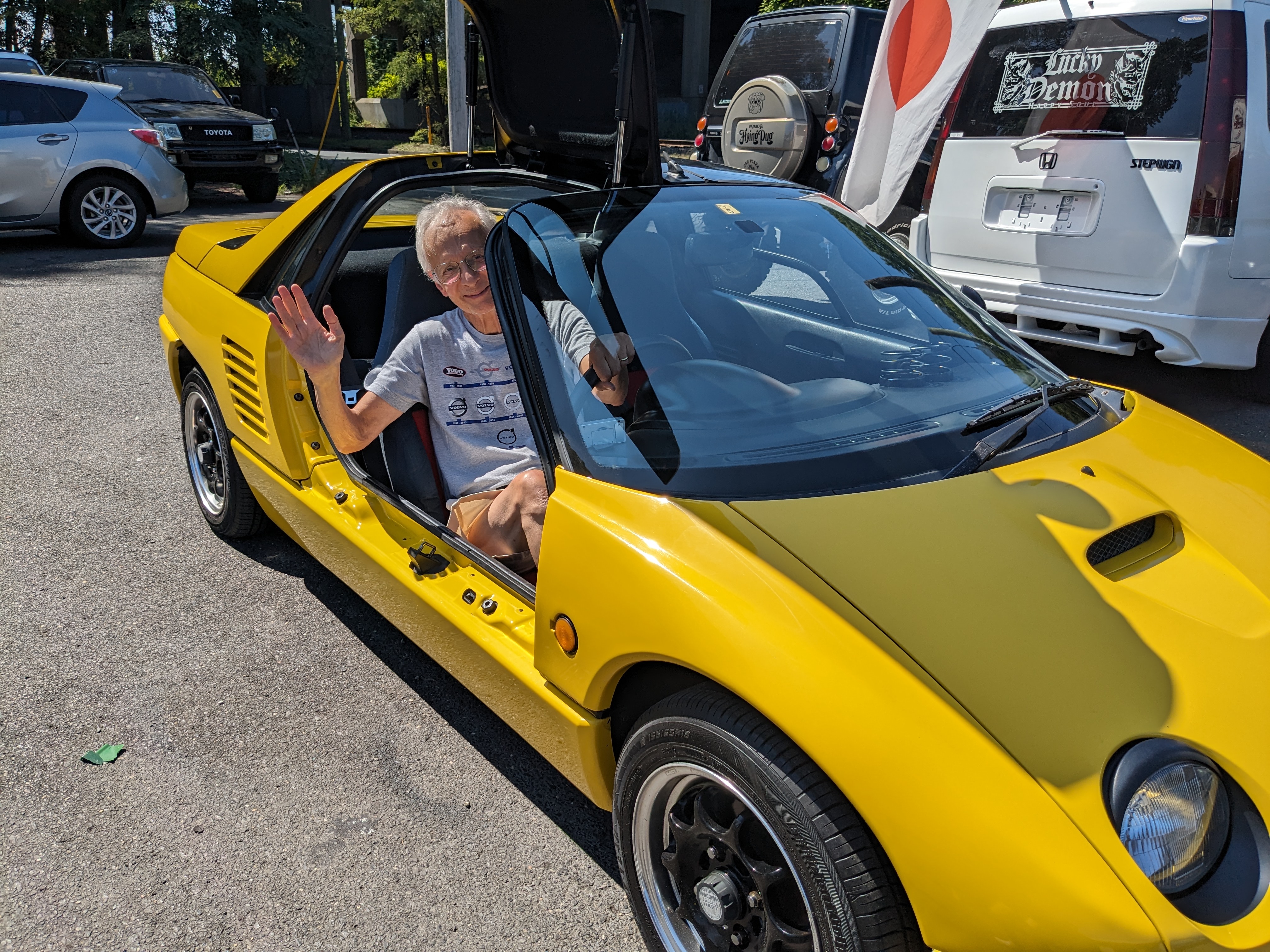
Luck was on my side here. The family was vacationing in Cape May, and I was headed home for several days just to check into things at home. The car was located near Cherry Hill, about halfway between Cape May and home. I made an appointment with the dealer, and arrived at his place about 11 a.m. on a Friday. There was the car, even smaller than I imagined. The dealer, a friendly and accommodating young man named Eli, invited me to look over the car. The size was not an issue (you’re looking at a guy who used to drive a BMW Isetta on the street), but the gullwing doors were something else. While incredible to look at, the high sills made ingress and egress most awkward. Once in the car, room was limited. From the driver’s seat (RHD), the non-adjustable steering wheel was offset to the left. The seats slid back and forth but the seat backs were fixed.

Eli offered to let me drive, but I demurred, and suggested that I would ride while he drove. He had many JDM (Japanese Domestic Market) vehicles on his lot and seemed completely at ease with the RHD. Off we sent, with the cold A/C cranking the entire time. We went onto the highway where I saw 120 kph (75 mph). The car ran well, but there was a loud clunk with every shift, possibly normal for a remote shifter. Aside from the interior access (my wife would never put up with it!), the biggest issue was the driver-quality paint job. I liked the yellow, but didn’t care for the application of it.

I thanked Eli for his time, and concluded that my automotive lust for an Autozam AZ-1 had now been satisfied. I had no reason to worry about the bidding as the car sold for $20,151, five grand higher than I predicted but five grand below other recent sales. It was fun to be a bidder on BaT, as they make the process almost too easy. For me, the real bottom line is that online auctions give you great exposure to a wide variety of vehicles, but I would still greatly hesitate to purchase any vehicle sight unseen.

 

ADDENDUM

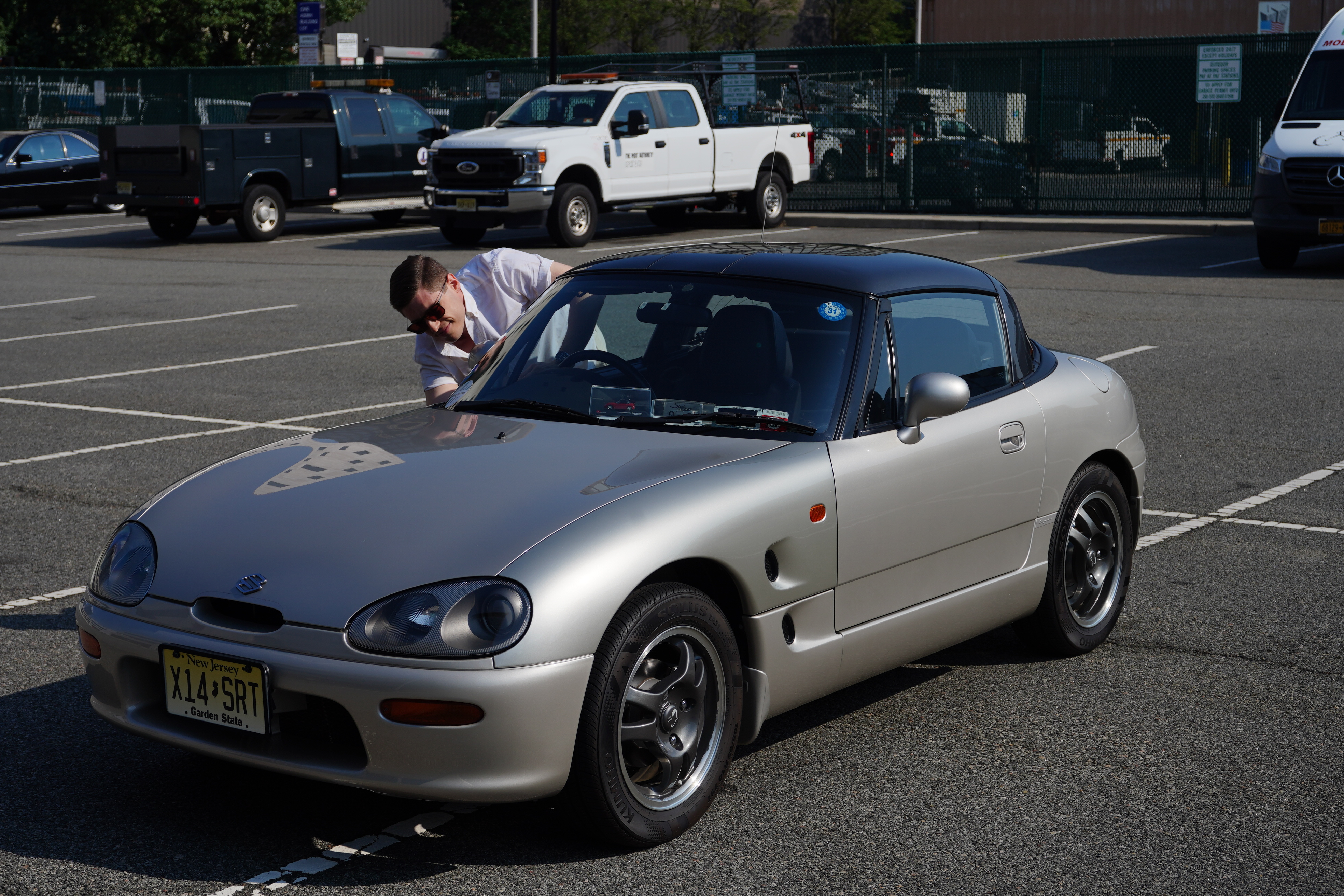
Although I didn’t identify it by make, model, or size class, I did include a different kei car in my blog post from July of this year about the Concours on the Palisades in Fort Lee, NJ. In the Japanese class was a Suzuki Cappuccino, a kei car which happens to use the same 3-cylinder engine as the Autozam.
Entire blog post content copyright © 2024 Richard A. Reina. Text and photos may not be copied or reproduced without express written permission.
 

Bidding at RM/Sotheby’s “Shift/Monterey” Online Auction

Enough digital “ink” has been spilled regarding our current global pandemic’s effect on the collector car hobby that I don’t need to rehash it here. (The more serious human toll certainly puts our hobby into some perspective.) So why am I mentioning it at all? I bring it up only because there have been some rays of hope for those of us still looking for ways to enjoy it. Classic car auction companies, at least some of them, have found a path forward by switching from live events to online formats.

One cannot discuss web-based car auctions without first acknowledging the success of Bring a Trailer (www.bringatrailer.com, aka BaT). The website, which started as nothing more than a place to repost links for interesting cars found elsewhere online, began to auction vehicles several years ago. Fed by a mostly-positive and very enthusiastic comments section, they have changed the rules of engagement. One element of their business which is now blatantly copied is their two-minute anti-sniping provision. A classic complaint about eBay has been bidders with sharp reflexes (or clever computer programs) placing bids with one second remaining on the clock. Bidding would close, the so-called “sniper” would win the item, and anyone who had been willing to bid higher was shut out.

BaT, wanting to level the playing field, was I believe the first online auction company to change the game: any bid placed with two minutes or less on the clock resets the countdown clock to two minutes, giving others a chance to still bid.

Another surprise element was BaT’s move into the premium segment of the hobby. When their auctions started, naysayers claimed that “this is fine for $12,000 Alfa Spiders and $20,000 BMW 3-series sedans, but the big money buying 6-figure exotics will only do that at a live auction”. Wrong. Just this year, BaT sold a 1960 Ferrari 250GT for $585,000; a 1913 Rolls Royce for $657,913; and a 1968 Lamborghini Miura for $990,000. If you think that Bonhams, Gooding, and RM haven’t noticed, I’d think you’re mistaken.

Of course, when the year started, none of the major auction houses were expecting the shutdown. The pandemic’s message was: either find a new way forward, or spin your wheels while waiting out the crisis. As 2020 unfolded, with news only getting worse, one auction company in particular led the pack in switching from in-person to online, and that was RM Sotheby’s.

I’ve attended many live auctions. Whether it’s the boisterous volume of Mecum, or the understated elegance of Bonhams, there’s excitement in the air. You can touch the cars, watch them drive across the block, and feel the tension in the room as the auctioneer implores the audience to bid higher. The crowd may be milling around the block (Mecum) or may be patiently parked in their seats ready to raise paddles (Bonhams). Emotions are running high, causing some bidders to bid with their hearts and not their heads. Consigners are counting on that! Yet all that is lost in the online setting. Still, RM Sotheby’s knew they had to try, and motivated in part I would guess by BaT, they embraced this new business model by doing things they’ve never done before.

On RM’s website, the number of photographs of each vehicle has expanded, with photographers emphasizing flaws (paint chips, upholstery tears, oil stains) to avoid any post-sale surprises. Any available repair or restoration receipts are scanned and posted as PDF files. Finally, for almost every car, RM provides a condition report which lists the condition of the paint, engine, upholstery, and undercarriage using the traditional 1-to-5 scale. I’ve read a few of them, and while they’re brief, they’re also refreshingly honest. RM’s online auctions also use the two-minute extension a la BaT.

August has always been Monterey’s month: the Pebble Beach Concours d’Elegance, the multiple car auctions, and myriad number of special car shows. This week-long event in northern California is one of the biggest car-centric extravaganzas in the world, and like almost everything else this year, it’s been cancelled. RM Sotheby’s, though, is holding its “Shift/Monterey” online auction this week. Bidding opened on Monday August 10, with lots scheduled to close either on Friday the 14th or Saturday the 15th. I’ve been anxious to test the waters with RM, as I have my sights set on a future auction, so I took the plunge: I registered to bid at “Monterey”, and actually placed a bid!

The registration process was too easy: I scanned my driver’s license and a recent bank statement, provided a credit card to be used for a hold, and submitted those docs. About 15 minutes later I got an email message: “Congratulations! You’re registered to bid.” Unlike some previous auctions I’ve watched, there was no bidder’s registration fee.

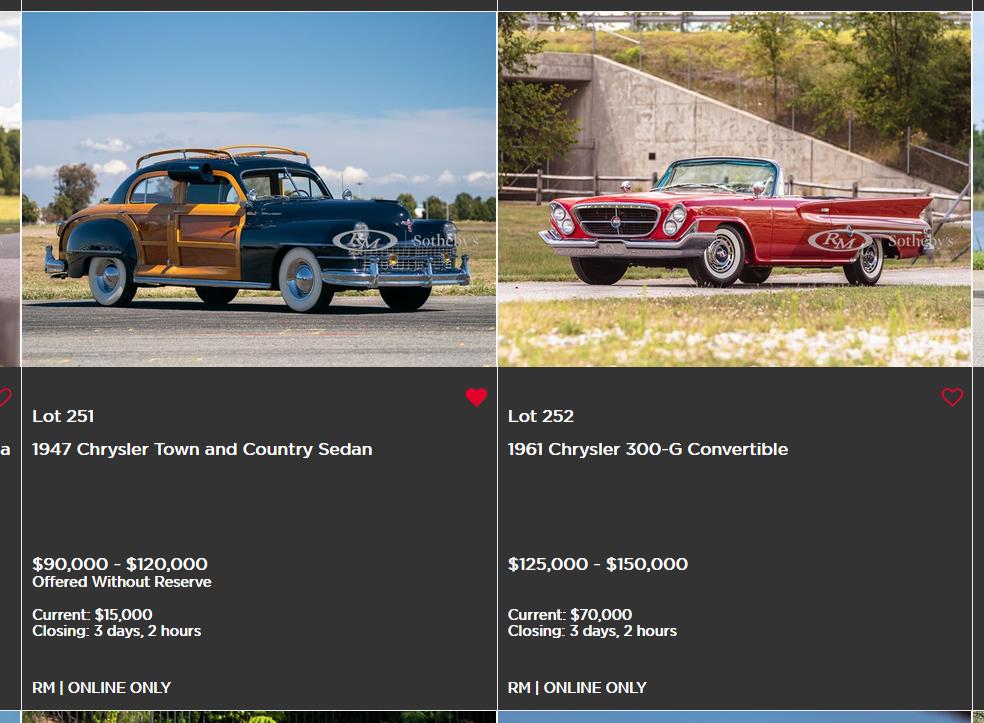
RM website clearly indicates if lot is no reserve

There are 109 vehicles (107 cars, 2 motorcycles) and some automobilia online at Shift/Monterey. (Note that despite its name, vehicles are physically scattered around the country, an advantage for sellers who avoid transport costs; the website indicates the vehicle’s location by city and state). By RM standards, it’s not a big auction. Since I don’t intend to actually purchase a car but want to experience the process, I sought out something with a high pre-sale estimate and with a very low current bid. I found a 1947 Chrysler Town & Country sedan, listed at no reserve, with a pre-sale estimate range of $90,000-$120,000. The current bid was $3,600.

I’m high bidder!

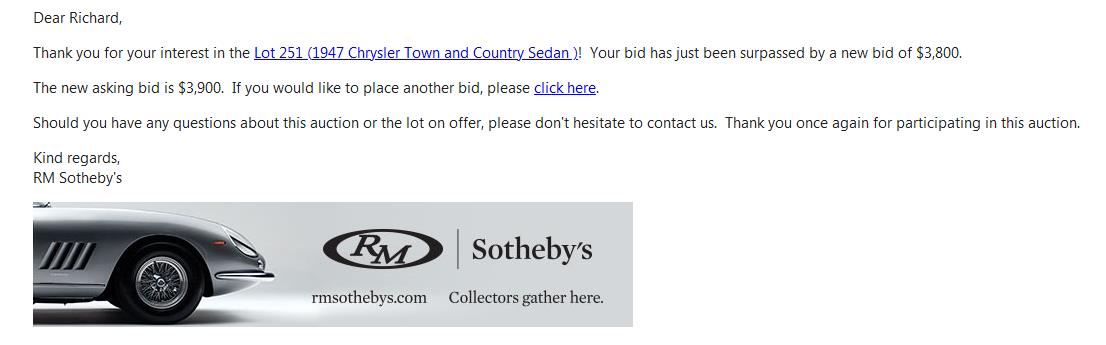
In spite of the numbers, I was still nervous. What if I won? (Sure, I’m going to get a woody Chrysler for under $5,000.) RM provides the minimum bidding increment, in this case, $100. I keyed in “$3,700”, clicked on the green “place bid” bar, and the screen changed: “Your high bid!” I got a confirmation email informing me that, for now, I was high bidder on the Chrysler. Did I mention this is a no-reserve auction? That means if NO ONE ELSE BIDS, THE CAR IS MINE. The euphoria lasted for four minutes. A new email popped in: “You Have Been Outbid”. I was further informed that the “new asking bid is $3,900”. At least I knew where I stood. As tempted as I was, I stopped.

I know where I stand

Everything considered, the RM online bidding experience is perhaps the best it can be when you can’t be there in person. I’m frequently asked “do people really buy cars sight unseen?” Yes they do. RM’s online closing ratio is around 60-65%, which is very respectable, if not as high as it’s been at live shows. Still, I think that RM has set a fine example for conducting honest and transparent business in an online format under particularly difficult circumstances. I’ll have more to say about RM Auctions in future posts.

All website screen shots courtesy of RM Sotheby’s