AAA SURVEY SHOWS INCREASE IN FEAR OF AUTOMOTIVE AUTONOMY
For the last few years, the AAA (American Automobile Association) has been conducting an annual survey of consumer attitudes toward “automated driving”. The most recent survey, results of which were released last week, showed a marked increase in the percentage of drivers who are afraid of fully automated vehicles. The number jumped 13%, from 55% in 2022 to 68% this year. Yet many are supportive of ADAS (Advanced Driver Assistance Systems) in their cars, such as adaptive cruise control, blind spot monitoring, and emergency braking. The AAA survey shows that there is confusion among drivers in distinguishing between ADAS-equipped vehicles and fully autonomous vehicles, leading to some level of mistrust in them.
U.S. PEDESTRIAN FATALITIES IN 2021 REACHES 40-YEAR HIGH
In spite of more and more safety systems in modern automobiles, the number of pedestrians killed on roadways in 2021 was the highest it has been in 40 years. Additionally, the first six months of 2022 resulted in 3,434 pedestrian lives lost, a 5% increase from 2021. Highway traffic experts blame a number of factors, including more aggressive driving, heavier vehicles, and roadway and sidewalk infrastructure which favors vehicle speed over pedestrian safety.
F-150 LIGHTNING PRODUCTION TO RESUME MID-MARCH
The Ford Motor Company, having stopped all F-150 Lightning EV pickup production several weeks ago because of an unspecified battery issue, announced that Lightning production will resume on March 13, although the company has not as of yet stated any details about the problem or what was done to resolve it.
TESLA’S INVESTOR DAY MEETING LACKS ANY NEW PRODUCT INFO
Elon Musk and a team of executives held what they billed as an Investor Day meeting on March 1, announcing plans to cut costs, build a factory in Mexico, and streamline operations. However, those (i.e., Wall Street) who were hoping for big product news such as a new, lower-priced EV, or more details about the soon-to-be-released CyberTruck, were left disappointed, and the drop in stock value reflected that disappointment.
TESLA SHAREHOLDERS SUE COMPANY OVER FALSE FSD CLAIMS
FSD, or “Full Self-Driving”, is a Tesla option which costs up to $15,000 above the cost of the vehicle itself. A group of Tesla shareholders has sued the company, claiming that they were misled, both by the promise of “SAE Level 4” autonomous driving which in reality is Level 2, and by the failure of Tesla to reveal certain inherent dangers in FSD.
RIVIAN PINS HOPES ON 2023 AFTER REPORTING BIG LOSSES IN 2022
Rivian, the all-EV manufacturer which builds the R1T pickup and R1S sport utility, reported that it lost $1.7 billion in the 4th quarter of 2022, bringing calendar year ’22 losses to $6.8 billion. Yet the company hopes to produce 50,000 vehicles in 2023, which would be about twice its 2022 total. While the company claims that demand for its trucks remains strong, its primary objective for this year will be, like so many other auto manufacturers, to drive down costs. Down the road, Rivian plans to put up a new plant in GA to produce two smaller and presumably more affordable models, the R2T and R2S.
J. D. POWER EV SATISFACTION SURVEY: RIVIAN AND MINI ARE TOPS
The consulting firm J. D. Power has released its 3rd annual “Electric Vehicle Experience (EVX) Ownership Study”. While the survey continued to segment vehicles into premium and mass-market segments, the ownership focus changed this year to first-time EV purchasers. In the premium segment, the Rivian R1T pickup came out on top, with the Tesla Model 3 in 2nd. The Model 3 was in first place the previous two years. The Mini Cooper Electric ranked 1st among mass-market models, beating out the 2nd place Kia EV6. The Kia Niro EV was on top the previous two years.
VW TO BUILD SCOUT PLANT IN SC
VW announced that it has chosen SC as the location for its new U.S. manufacturing plant, where the Scout EVs will be built. The company will invest $2 billion in the operation, which will bring around 4,000 jobs to the area. Production could begin in 2026, with VW hoping to churn out up to 200,000 Scout vehicles annually.
FOUR-DOOR CORVETTE MAY BE ON ITS WAY, ZORA SPINS IN GRAVE
Rumors continue to swirl that GM is planning to extend the Corvette as its own brand, coming out with a 4-door EV followed by a crossover EV, both named “Corvette”. Instead of sharing a platform with other GM EVs, these vehicles will use a platform unique to them, and tuned more for performance. Before you write your scathing letters to GM, know that the 2-door ICE Corvette is intended to continue, at least for now.
VINFAST DELIVERS FIRST U.S. VEHICLES, DROPS LEASE PRICE
Vietnamese EV maker Vinfast delivered its first 45 vehicles to U.S. customers last week. Further, the company announced a drop in its published lease price. The monthly number has decreased from $599 (in January) to $399 (on Monday) to $274 (via messages sent to those who paid a deposit). Initial deliveries are scheduled only in California for now.
FISKER OCEAN EV DELIVERIES TO BEGIN THIS YEAR
Fisker announced plans to begin deliveries of their Ocean EV in 2023. The Ocean, which was shown in prototype form at the 2020 CES and then in final form at the 2021 L.A. Auto Show, has obviously been in the works for some time. The company claims that the base model, the Ocean Sport, will start as low as $37,499. Fisker, relying on Magna as a manufacturing partner, plans to build 42,000 units of the Ocean this year.
USPS TO PURCHASE FORD EV VANS
The U.S. Postal Service announced that it will buy over 9,000 Ford E-Transit vehicles, and will install 14,000 charging stations at its post office facilities across the country. Deliveries of the Ford E-vans will begin later this year. To fulfill a shorter-term need, the USPS will also be buying the same number of Ram ProMaster ICE vehicles. No word on whether consumers would have access to the chargers (“let me drop off this package for mailing and top up the F-150 Lightning while I’m there”). Now that I think about it, allowing customer access to these chargers could put the USPS back in the black….
AUDI AND POLESTAR SAY ‘NO’ TO EV PRICE CUTS
After Tesla slashed its prices, giving rise to concerns of an all-out price war, Ford cut its EV prices, but GM and VW said they would not follow suit. Now other companies have also spoken up. Jens Puttfarcken, the head of Audi Europe, said that Audi will adjust prices only when it is right for Audi to do so. And Polestar CEO Thomas Ingenlath told analysts that Polestar will not play the price game, as it plans to stay in the luxury EV segment and will not chase volume like mass-market manufacturers.
EU POSTPONES ICE BAN AFTER “NEIN” FROM GERMANY
The EU had scheduled a vote on approving a new law effectively banning the sale of ICE cars after 2035, but that vote has now been put on hold. Germany wants the EU to consider allowing the use of synthetic fuels; it’s suspected that Germany, a country well-vested in automotive manufacturing, wants to afford some protection for its legacy auto makers. Italy, which had earlier declared it would not support the total ban of ICE vehicles, also supports the use of renewable fuels.
AM RADIO GOING THE WAY OF THE DODO BIRD?
Many new vehicles are being produced without an AM radio. The trend has been growing for years among EVs, and now, even some hybrids and ICE cars lack AM radio. (My 2023 Volvo V60, which is a mild hybrid, has no AM radio, and frankly, I miss it. For up-to-date traffic and weather reports in the NY Metro area, AM radio was the best.) Concern is increasing, though, among some government officials who believe that access to an AM signal is a necessity during national emergencies. There is some rumbling that Congress may take action, and either request or insist that car makers include AM radio in their infotainment systems.
Until the day arrives when we are ferried to and fro in anonymous autonomous pods, THIS is the future of human-piloted automotive transportation.
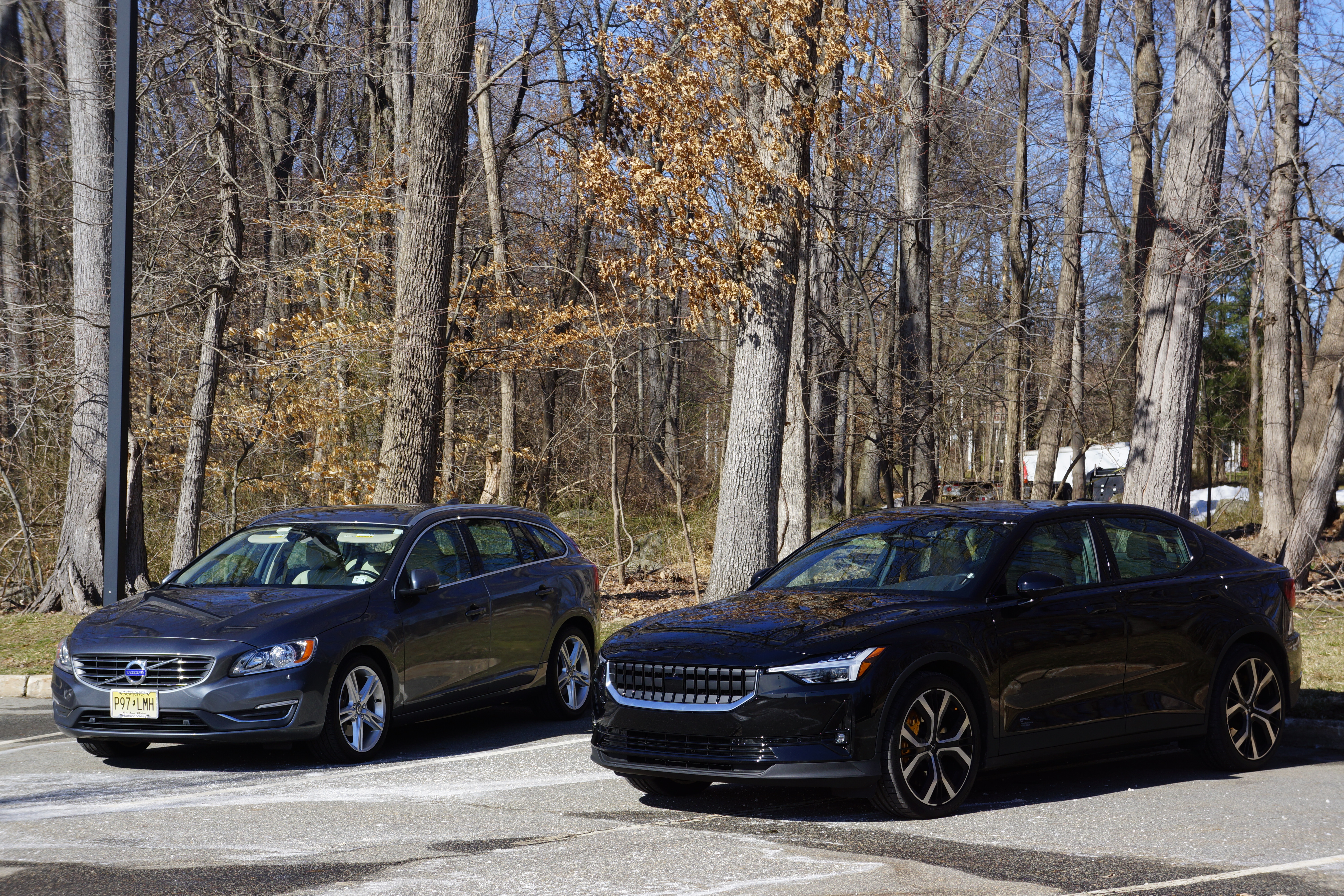
After 48 hours, I didn’t want to give it back. My extended test-drive of a Polestar 2 began when I signed up for a 30-minute drive, and the return text message asked: “would you like to take the car home for the weekend?” (It helps to be good friends with a former colleague who is a Polestar exec.) I didn’t need to be asked twice. I drove up to Volvo/Polestar HQ in Mahwah NJ on Friday afternoon, left my Volvo V60 in the lot, and returned home in the “2”. Sunday afternoon I reversed the process, putting about 200 miles on the vehicle during my time with it.
Picking up the Polestar 2Kissing cousins
Polestar is a name which has had an ongoing connection to Volvo since the first decade of this century. Starting as Polestar Racing, the company prepped modified Volvos for competition. By 2009, Polestar was the official performance outlet for production cars, analogous to Mercedes-Benz’s AMG or BMW’s Dinan. As Volvo grew under ownership of China-based Geely, Polestar was designated to serve as an upscale, breakout brand for hybrid and fully electric vehicles (EVs). The first Polestar-branded vehicle, Polestar 1, is a two-door hybrid, built in very limited numbers (see Sidebar). The next model to be released, and the first with some volume aspirations, is the Polestar 2, a five-door hatchback sedan.
It simply is not going to be possible to cover everything there is to say about this automobile. I’ve broken down my observations and comments as: the vehicle as an upscale brand, the vehicle as transportation, and the vehicle as an EV.
AS A BRAND
While the desire to project an image of Polestar as a notch above Volvo is understandable, the car has Volvo genes, and that’s a good thing. This isn’t some unknown startup launching its first-ever automobile. (It’s not been widely publicized, but Volvo has been working with EVs at the concept level for at least a decade.) It is comforting to think of this vehicle as “Volvo+”.
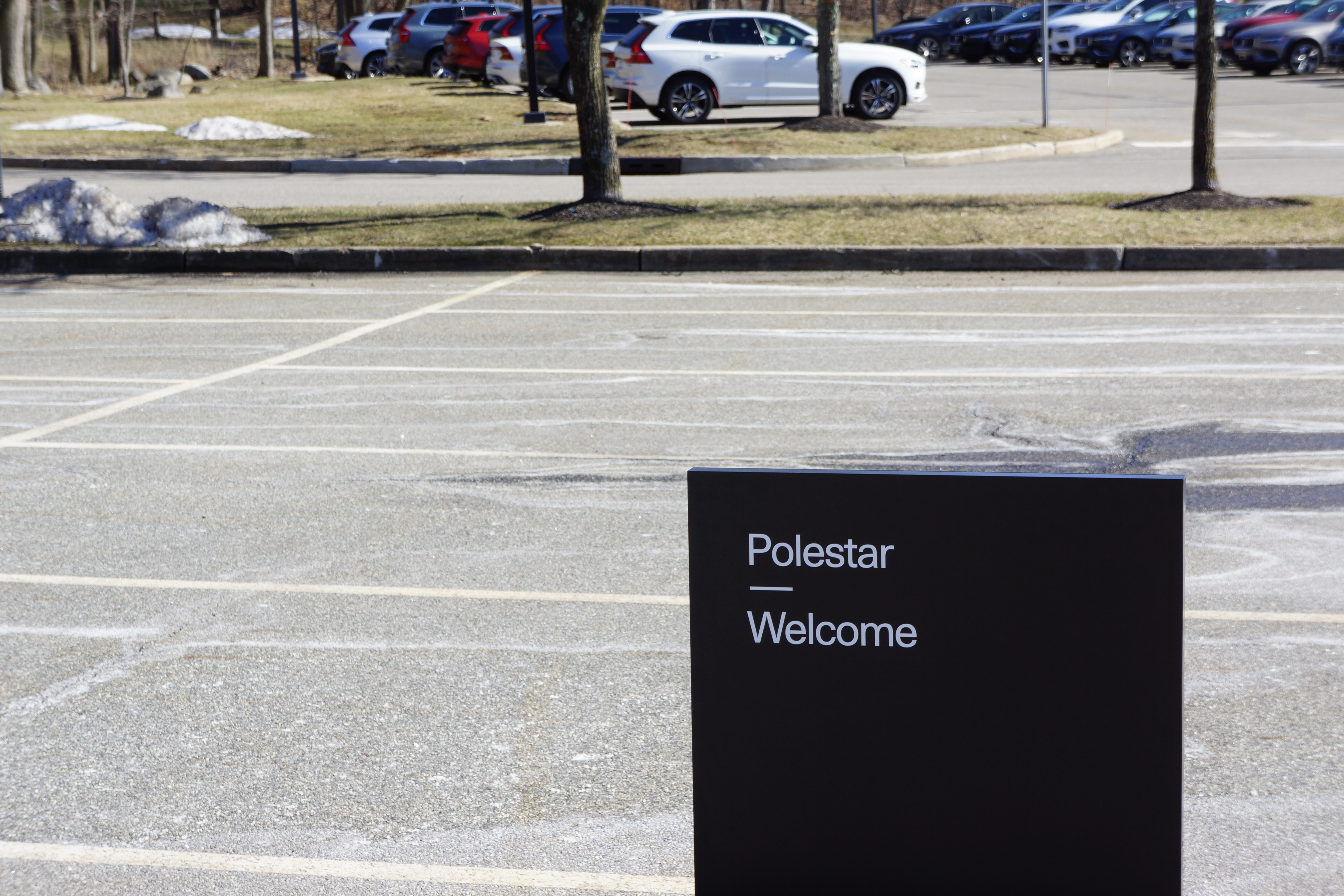
Polestar shares space with Volvo’s NJ HQ
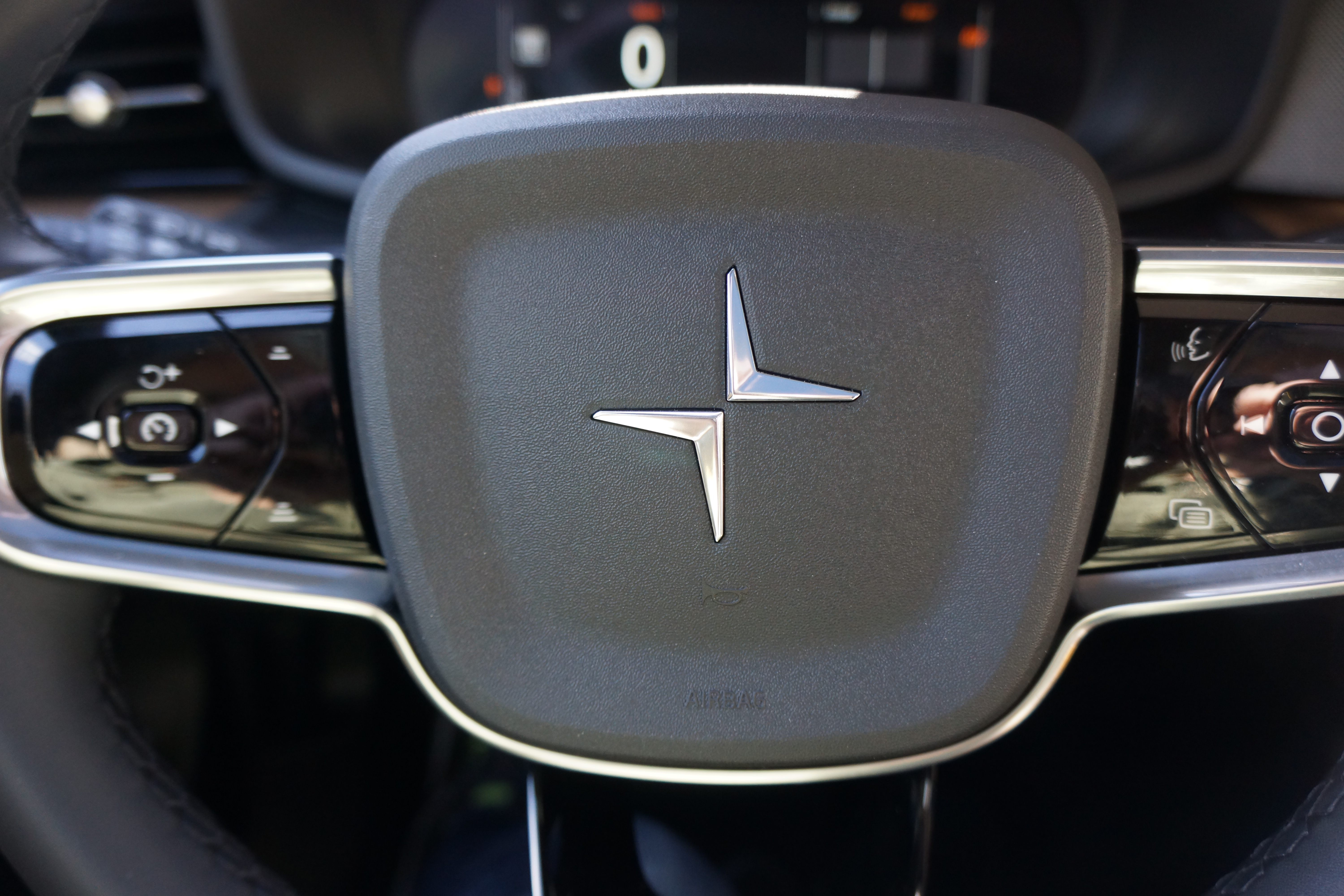
These attributes include quality, attractive minimalist (Scandinavian) design, and safety. An exterior walk-around assures the viewer that fit and finish are top-notch. Doors and front and rear lids open and close with authority. Interior components are well-trimmed and operate like precision machinery. It was very easy to find a comfortable seating position and adjust everything to the driver’s needs. Anyone who has spent any time behind the wheel of a late-model Volvo, or indeed any European luxury car will quickly feel right at home.
Volvo has owned “safety” for its entire time in the U.S. market, and although the competition keeps threatening to catch up, Volvo, and now Polestar, work at staying ahead of the pack. There are no optional safety features on the Polestar 2: a full suite of air bags, front and rear collision mitigation, run-off mitigation, cross traffic alert, lane keeping assist, adaptive cruise control, 360 camera, and more, are all standard.
AS A CAR
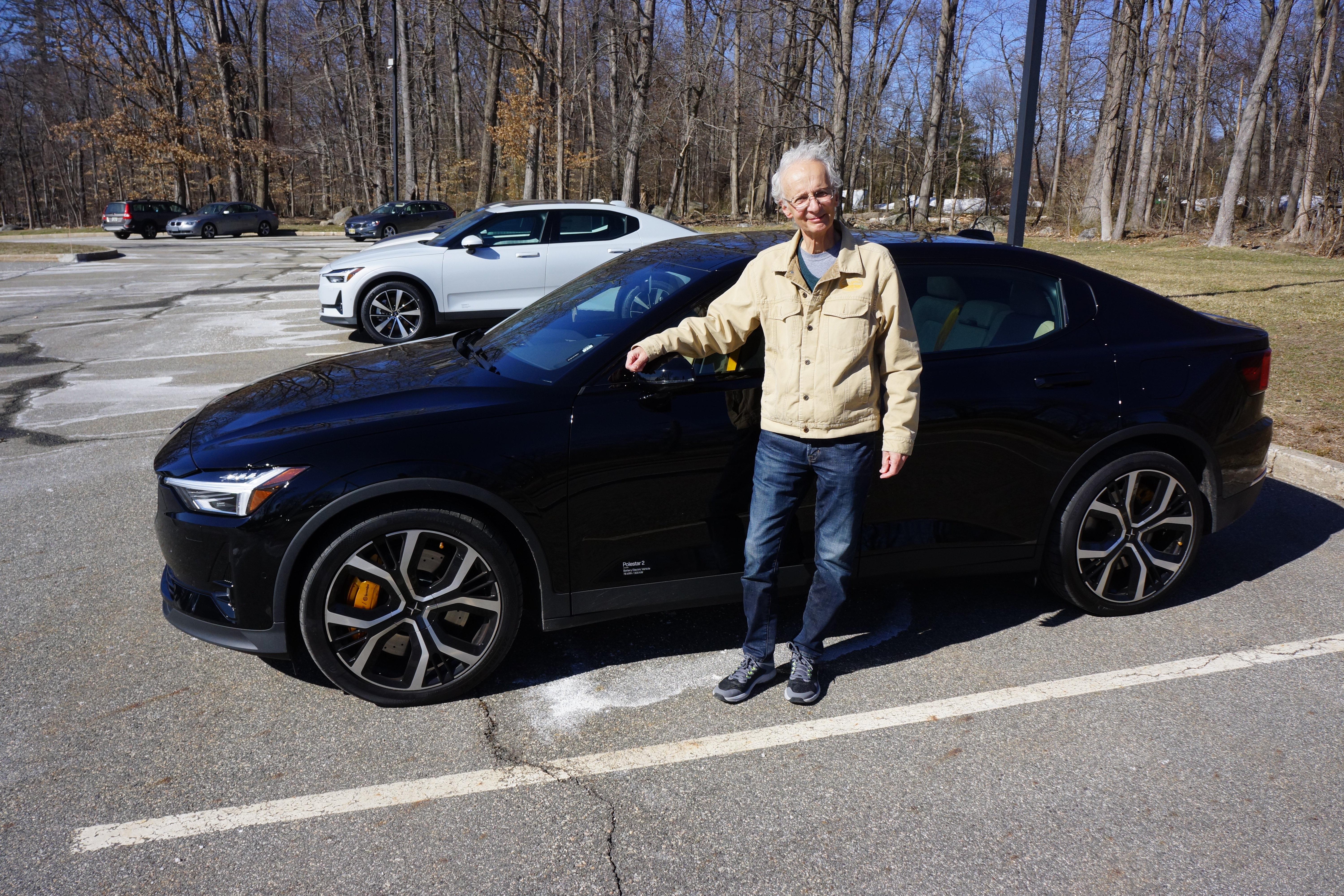
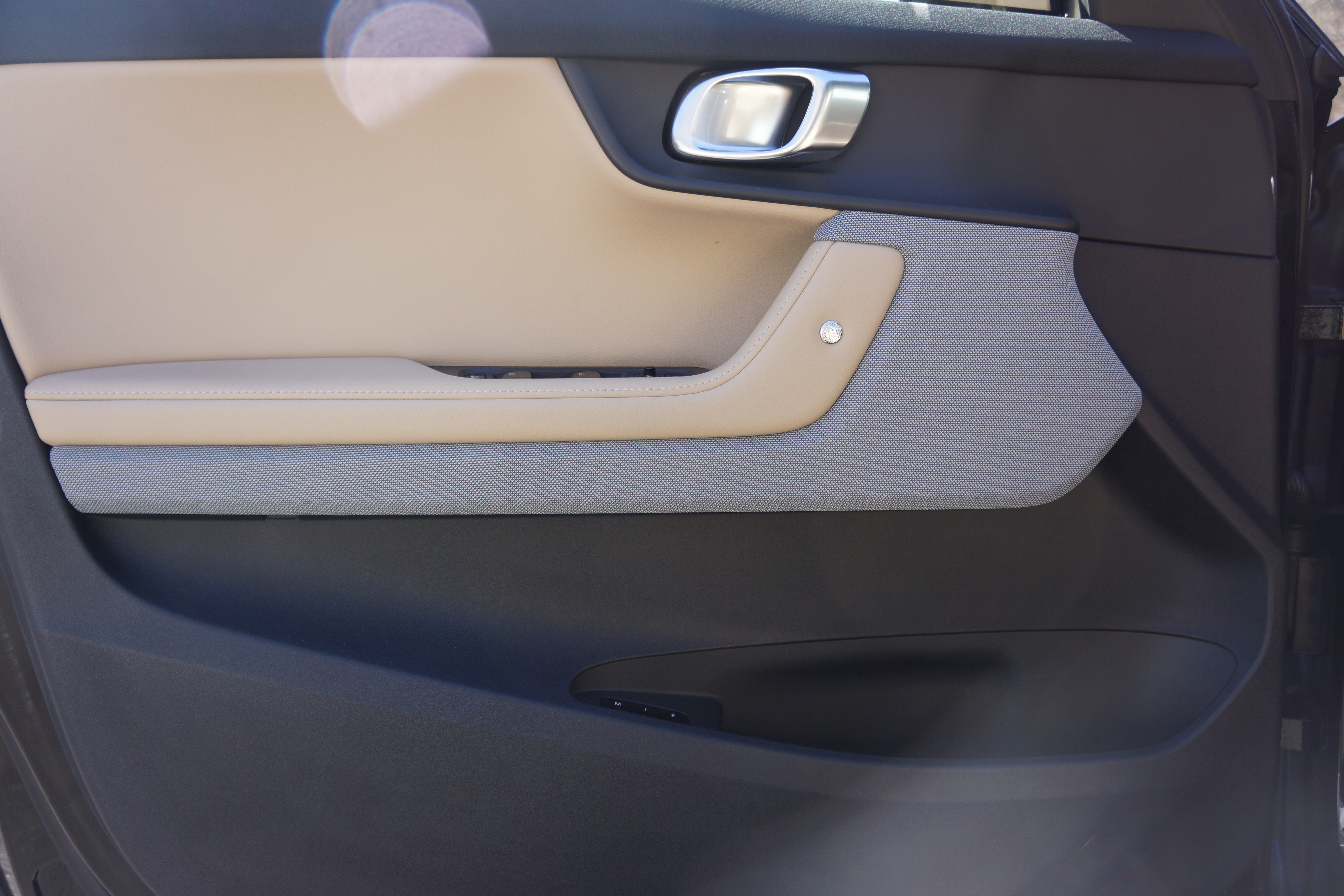
Eric greeted me at the Polestar pod, informed me that he was expecting me, and told me that my car was ready. The model I was given had two major options: an all-leather interior upgrade, and the Performance Package. My car, finished in black (Polestar calls the color “Void”) was offset by an interior trimmed in gorgeous tan leather with birch-looking wood trim. The most eye-catching accents are the gold calipers (Brembo in front) and matching gold seatbelts. It’s just enough bling to let you know you’re in something special.
Masked Eric in the Polestar pod
Controls were easy to find and intuitive to operate. I set the power seat and mirrors, and adjusted the wheel for reach and rake (it’s manual, which may irk some, but a power-adjustable steering column is overkill).
Gold Brembos behind 20″ wheels, both part of Performance Package
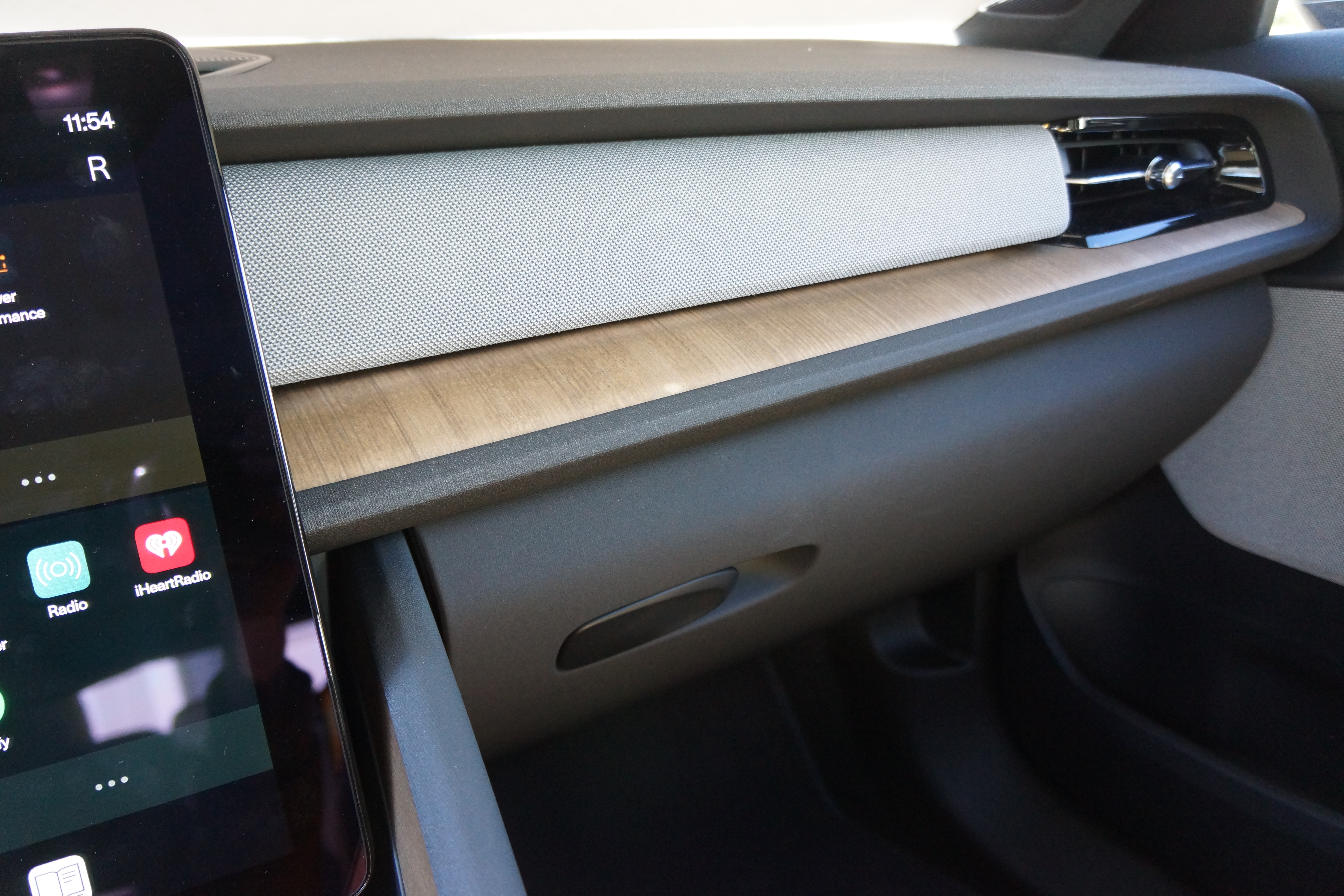
The vertically-oriented center screen uses large-font typeface and large icons, a boon for operating while driving. I didn’t want to be too distracted while driving a car that didn’t belong to me, but I was pleasantly surprised by its ease of use. Polestar uses Google as its screen Operating System, and once your phone is paired, using the various features (navigation, phone calls, plus any app that’s on your phone) is a snap. Voice commands were especially reliable (“Hey Google, navigate me to 777 MacArthur Boulevard in Mahwah New Jersey” was correctly understood on first try each time). This stuff is far from my area of expertise; I’m convinced that if this were my car, I’d learn a lot more about it the more time I spent with it.
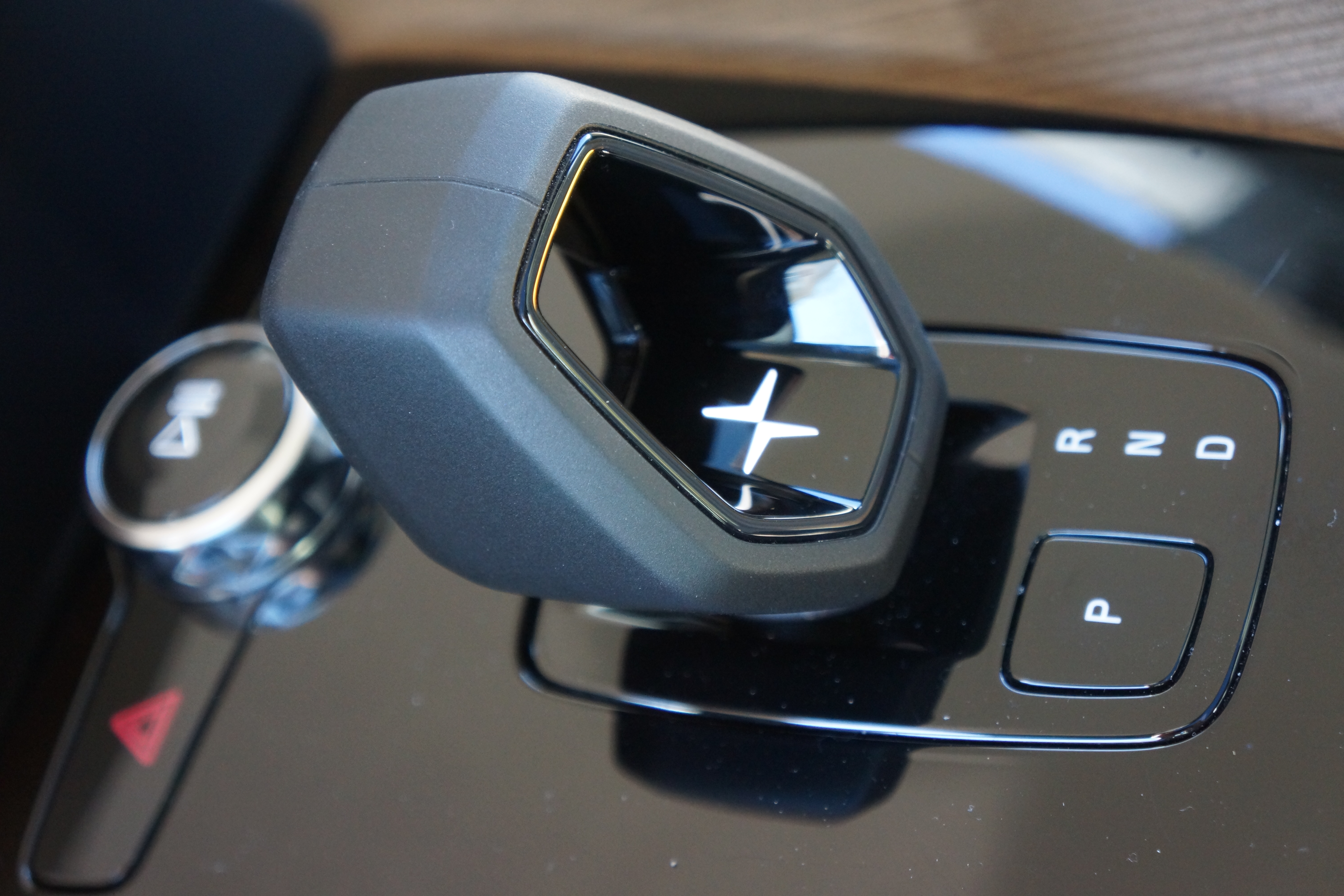
There is no “ignition” – with key in proximity, once the driver is seated and belted, the gearshift can be moved from P into either R or D, and a tap on the accelerator (can’t say gas!) starts it rolling. At first, the quiet is eerie. Once you’re at or above 30 mph, tire noise is the predominant sound, but is not obtrusive. The car is so much quieter than an ICE vehicle, and it’s a quiet that you quickly accept, then appreciate.
The Performance Package concerned me, with its 20-inch wheels shod with Continental high-performance summer tires. I expected a harsh ride as a tradeoff for good handling. My concerns were assuaged within the first five minutes of driving. The suspension tuning provided both a quiet and comfortable ride along with rail-like handling.
Once I pulled out of the parking lot, with Nav set for “home”, I was on local roads for about 15 minutes before reaching the Interstate on-ramp. I rounded the curved ramp at about 35, and a quick glance in the mirrors showed that both middle and right lanes of the highway were empty. I said to myself ‘what the hell’, and floored it. The acceleration caught me by such surprise that I slammed the back of my head into the head restraint. The car jumped from about 35 to about 75 in 2.5 seconds. I have never experienced automotive acceleration like that in my life. The problem is it’s addictive: it happens so quickly and so quietly, with so little drama (aside from the self-induced headache) that you’re only discouraged from this behavior by its effect on battery life (and the threat of summonses).
Forward and side visibility are very good to excellent; to the rear, the fixed rear seat head restraints and blocky rear pillars limit your view (which is where the 360 mirror comes in handy). Braking is superb, but really deserves to be discussed as an EV-attribute.
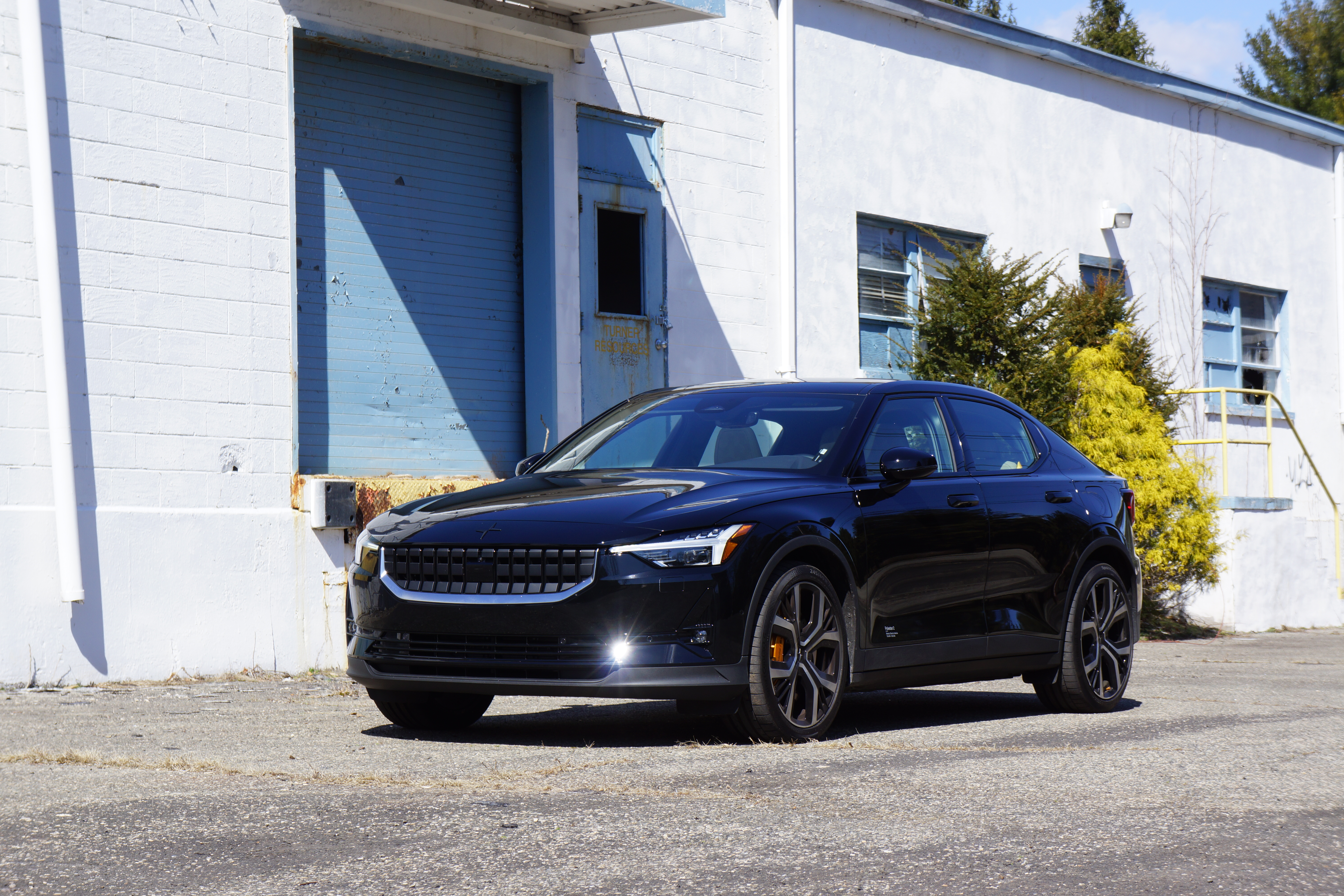
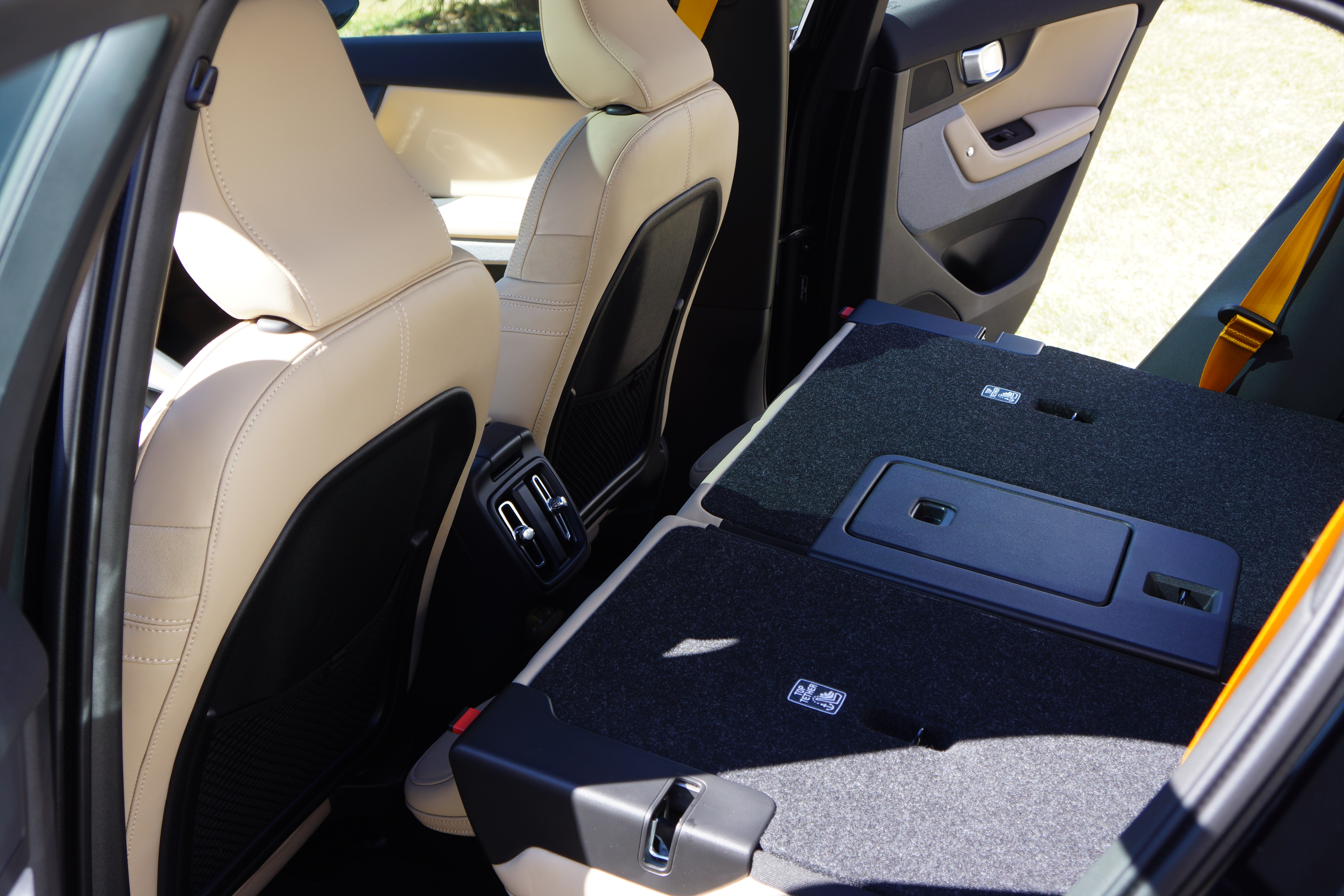
Some final comments about styling: from the front, it looks like a mid-size 4-door car, although you will also notice it sits a little higher than a typical 2021 sedan (the matte black wheel-well trim provides an accent for its slightly higher ride height). From the rear, the hatchback is not obvious (the long sloping rear has become a styling cliché on late model sedans). Opening the hatch and folding the rear seat backs forward reveals a generous cargo hold that it limited only by its lack of a vertical tailgate.
Rear hatch open, rear seats folded, charging cables on the left
Some of you may be thinking “sedans are dead; EVERYONE wants an SUV”. Yes, well, maybe most, but certainly not everyone. It’s time to bring up that T word for the first time (5 letters, ends in A, last name of electrical engineer Nikola, company founded by that guy Elon something….). If sedans are dead, how is Tesla doing so well with its Model 3 sedan, the best-selling EV vehicle in America? “Oh that’s different” you might say. How so? I don’t know Polestar’s future model aspirations, but I think the Polestar 2 neatly splits the difference between “sedan” and “SUV”.
Another view of the folded seats
AS AN EV
Aside from a 10-minute test drive in a BMW i3, and several rides in EVs (most recently, a long test-ride in a Mustang Mach-E), I have not driven a pure EV long enough to get some sense of what day-to-day living with one might encompass. I had that chance this weekend, and I am a convert.
Starting with the driving experience, the quiet, the acceleration, and yet the normalcy of cruising down the highway brings you to the understanding that it’s still a car, and as long as it’s a good car (which the Polestar 2 is), it could be your daily driver.
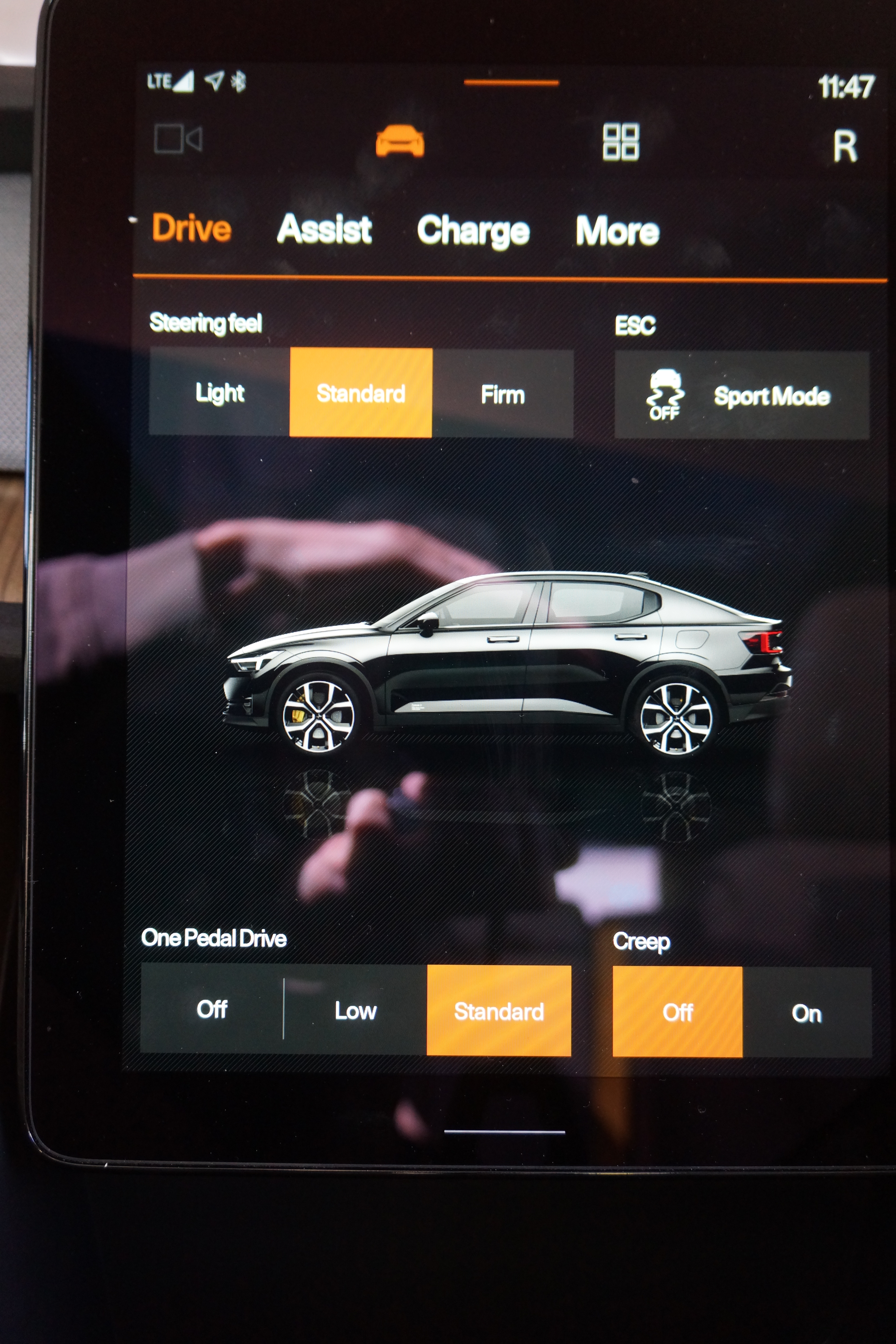
Earlier, I mentioned braking and said that my comments will fit better under the EV discussion. The “2” has adjustable regenerative braking. The screen calls it One Pedal Drive, and the 3 modes are “off”, “low”, and “standard” (which is full regenerative). When turned off, releasing the ‘go’ pedal will allow the car to coast for as long as momentum and gravity will let it, just like an ICE car. At “full”, the accelerator is like an on/off switch. As soon as it’s released, the car starts to slow down. If you’re at very low speeds, the car stops almost immediately; at higher speeds, it will roll for a few yards, but you’ll sense that the brakes have been applied. If this sounds weird, I gotta tell you: I got used to it in about 30 minutes. One pedal driving. It’s easy. It’s safer. It’s fantastic. I wish all my cars had it!
Center screen, One Pedal Drive options on lower left
I tried the “low” mode and frankly didn’t see the point. It’s an unnecessary compromise. I suspect drivers will either get used to and enjoy “full” or will want it to be as much like an ICE car and turn it off. When you do need to quickly get on that brake pedal, those front Brembos haul this 4,700 lb mass to a stop quickly and quietly. Those batteries are heavy, but the car does not have a heavy feel when driving.
I was provided with charging cables for home use, both 120V and 240V. I do not have a 240 setup at home, so I plugged into a 120 outlet in my garage, snaked the cable under the garage door, and let it charge overnight. Admittedly, the battery was only 25% depleted when I started, but I had a full charge in the morning. I was told that at 120V, a full charge from 0 to 100% would take 24 hours. The 240V charge would happen much more quickly. Owning this vehicle would really require the one-time investment of a dedicated home charger – figure roughly a grand for that.
I cruised by two public charging stations, both within a 15-20 minute ride from my home. Spots were available, but I did not take the time to top off the battery. At one (Charge Point) juice can only be purchased if the app is downloaded to your phone. The other, Electrify America, offers the option of an app or will take a credit card at the charging station.
Don’t even think of parking your ICE car here!
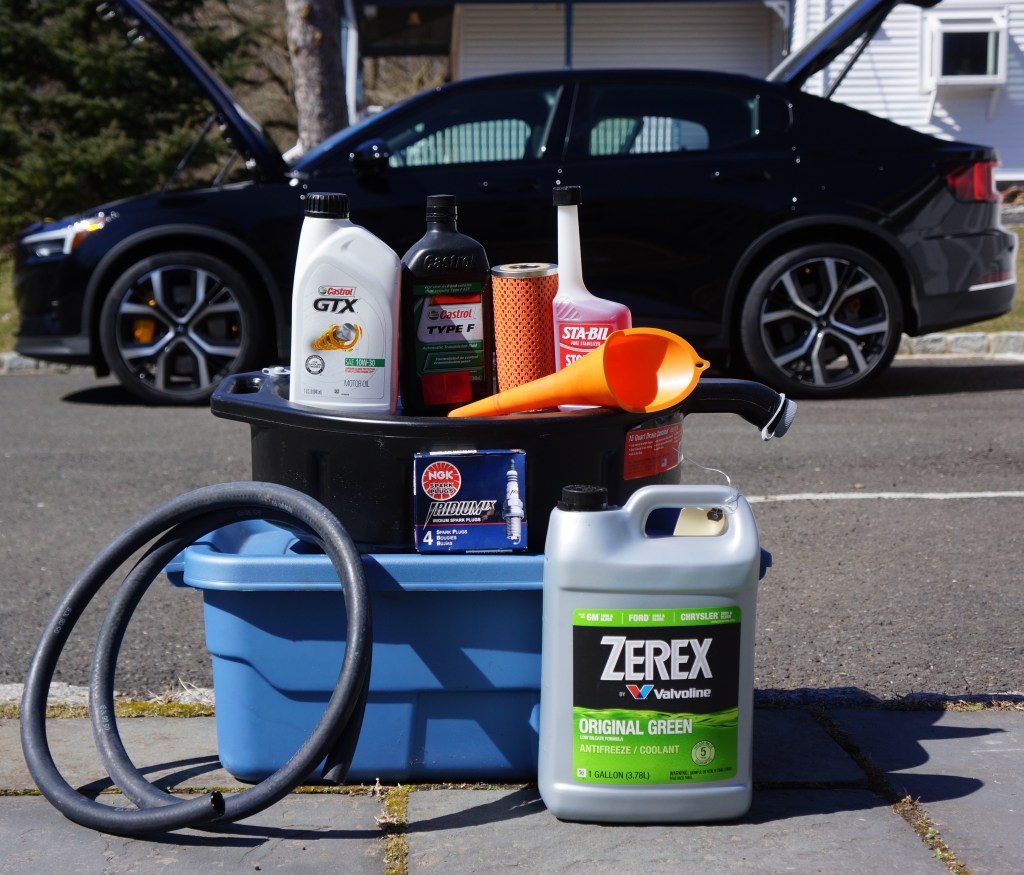
The following comments are true for all EVs, not just Polestars: not enough has been made of the savings in repair and maintenance costs. Starting from the moment of purchase, you will never need to be concerned with spark plugs, engine oil, oil filters, transmission or gear oil, oxygen sensors, charcoal canisters, exhaust systems, radiator coolant, belts, or hoses. There’s nothing to leak. I’m having a difficult time imagining what happens at a dealer service visit: check your tire pressure and fill your washer solvent bottle? Your “consumables” are reduced to tires, brakes, suspension bits like shocks and bushings, wiper blades, light bulbs (less and less of an issue with LEDs), and…what, THE BATTERY? By that time you’ll be trading in for a new one.
Even the funnel, Sta-Bil, and drain pan become obsolete
TO THE NAYSAYERS
I know that some of you, including friends and colleagues of mine, don’t agree that the advantages of an EV outweigh the disadvantages. Listen, I get it. You should drive what you want to drive. However, living with this Polestar 2 for 48 hours also brought me to the conclusion that many of the stated opinions why EVs won’t replace ICE cars are excuses. Let’s address some of the commonly-cited issues about EVs:
“Range is too short”
Three factors influence range: the size of the fuel tank (or for EV, energy supply, i.e., the battery); the fuel economy of the engine (for an EV, its ability to efficiently consume that energy as motive power); and finally, the driver’s influence (local vs highway driving, frequent stops, idling, heavy accelerator usage, etc.).
The range on the Polestar 2 with 100% battery is 230 miles. Some critics have knocked that as not up to Tesla standards, and it’s not. But how large a factor is that in the purchase decision? It’s never been for me; fuel economy, yes, but my earliest car purchases were vehicles with 10-gallon tanks, so 30MPG still only netted a range of 300 miles, and that’s if I drove it dry, which I never did. Realistic range was 250-275 miles (and that’s what it is in my Miata, also with a 10-gallon tank).
Committing to a purchase of an EV, I now realize, requires a mental shift and a mindset change. Some planning ahead will help ensure that you’ll get there and back. You do the same thing now with gasoline: if you’re leaving early in the a.m. on a 300-mile trip, you’ll likely fill up the evening before. Why wouldn’t you do the same with an EV? Yes, with an ICE, you’ll always find gas stations to refuel, no waiting. The Polestar 2 has tools to overcome “range anxiety”.
“Range anxiety means I’m nervous about venturing far from home”
Google Maps very happily responds to the voice command “Hey Google, where are the nearest charging stations?” by displaying a list of EV chargers within sight on the map. Amazingly to me, this list includes information about the total number of chargers at the site, and how many are presently occupied.
Choice #1 has 1 of 2 medium-speed chargers open, and both slow chargers open
Wouldn’t that be neat to do for the local Exxon station? “Hey Google, how many Exxon stations are nearby?” and you not only get a map of them, you see that “Ed’s Exxon” has 6 pumps, and 4 are being used at present.
“Ha!” You laugh at this notion. “Who needs that? There’s never a wait at a gas station!”
I’m convinced you have short memories. Many of you were driving in 1979, when we had our 2nd fuel crisis of the decade, with OPEC turning off the taps, leading to oil shortages, and eventually, rationing. At that time, I was making an 80-mile round-trip to work, and I could only purchase fuel on “even days” based on my license plate. I could do no extra driving outside of my commute during the week. In 1979, I had range anxiety, although we didn’t call it that.
How stable is the Middle East today compared to 40 years ago? Let’s see: Iran’s nuclear buildup, the wobbly Iraqi government, civil unrest in Syria, the Khashoggi murder by Saudi Arabia; I guess we can expect unlimited oil supplies to continue from the region …. The truth is we don’t know what could happen in one, five, or ten years down the road. I would not bet against another large price jump or oil shortage.
“I can’t charge my car if there’s a power failure”
This is very true. Actually, there are a lot of things you can’t do if there’s a power failure. At my house, loss of power means we can’t charge our phones, keep our refrigerated food cold, wash dishes, take showers, flush toilets, light up rooms after sundown, use the microwave, or watch TV. The last time we had a lengthy, large scale power outage was during Superstorm Sandy in 2011, when the neighborhood lost power for four days. At least we weren’t alone in our misery: a quarter-mile away from me is a Shell gas station. They lost power too. You know what they couldn’t do?
They couldn’t pump gasoline.
“I can’t fill up my car with gas if there’s a power failure”. What WE did, based on the forecast, was fill both cars before the storm arrived. Then we didn’t go anywhere anyway. True, we don’t always know when the power will go out. But if I had an EV and we were expecting a major outage, I’d top up. And probably not go anywhere anyway.
“I’ll miss that incredible thrust from that massive V-8”
Anyone who says that has not driven an EV like the Polestar 2 with its instantaneous 487 lb-ft of torque. End of that discussion.
NITS TO PICK
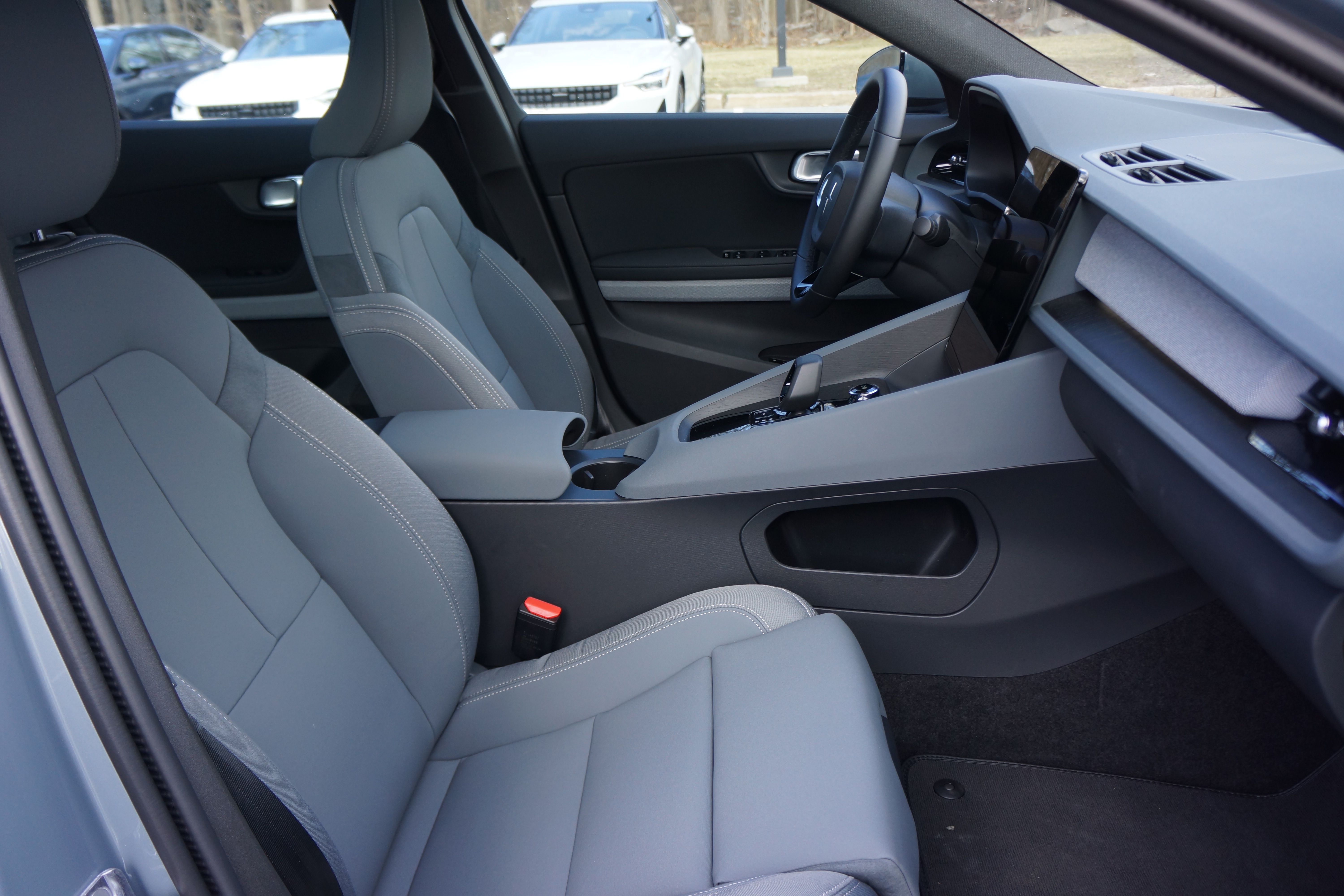
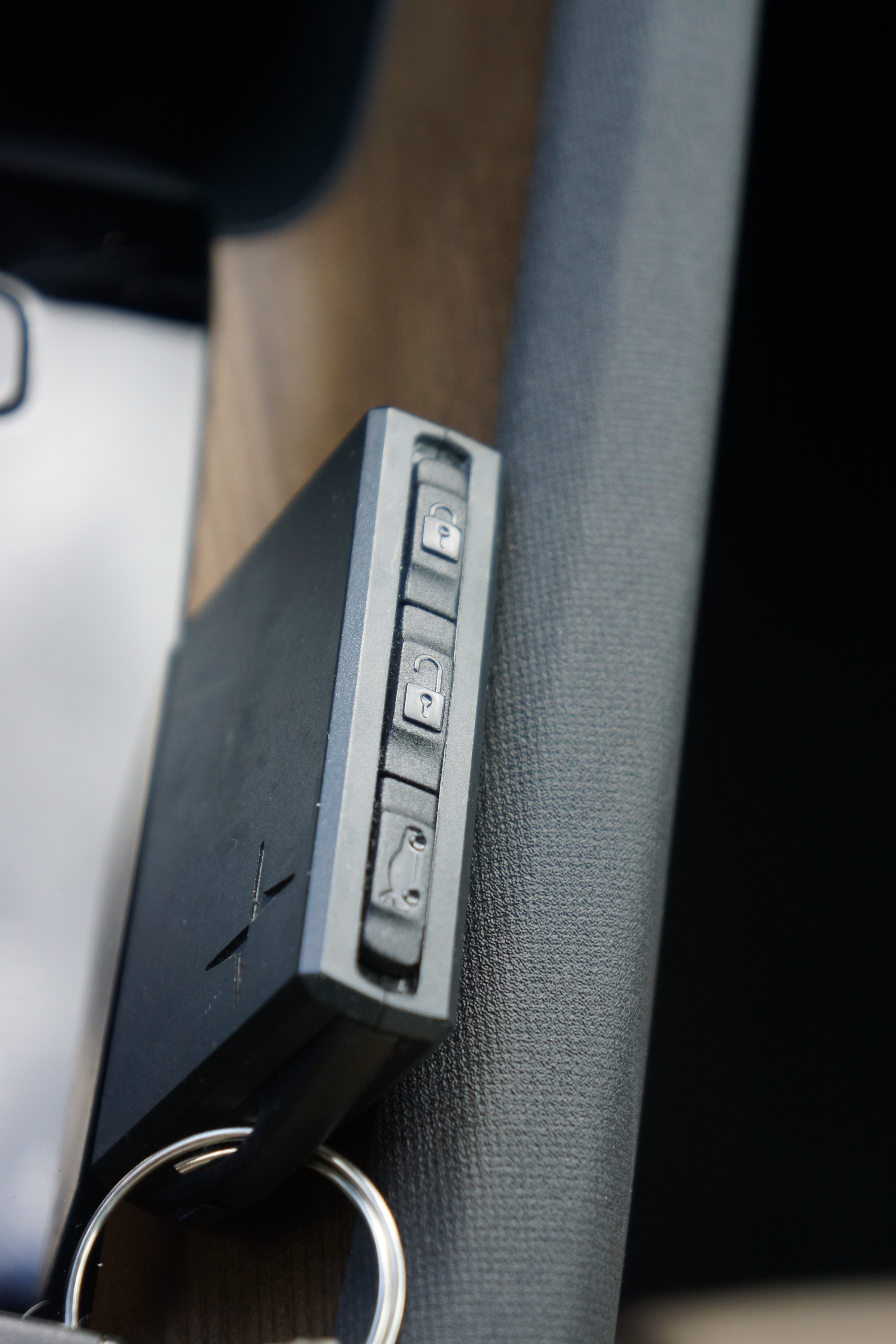
Trying my best to be objective, there is nothing I found that would be a deal-breaker if I were in the market for an EV in this price range. Like so many other vehicles today, the exterior and interior color palette is limited. To my eye, the “2” looks better in lighter colors. I wish there were interior options between the basic grey/black synthetic and the full-zoot tan leather. My V60 has power-folding rear seat head restraints; I miss them here only because I have them already. The buttons on the side of the little black key fob are ridiculously small for my old eyes (yet admittedly I didn’t need to touch them once). That’s all I can think of.
Basic grey interior; functional and un-fancyYeah, at 3x magnification I can see ’em!
HOW DOES IT COMPARE?
I would spec it out in white with the tan leather (I would spring for the upscale interior and skip the $5,000 Performance Package). All Polestars are eligible for the $7,500 Federal Tax Credit. $59,900 plus destination, metallic paint, and leather interior, minus the credit, puts me right at $59,000. Don’t forget to factor in the fuel and maintenance savings.
I’m hard pressed to think of another $60,000 sedan, ICE or EV, that beats this car in equipment, safety, driving dynamics, and environmental care. Teslas have their advantages, including a dedicated charging network, and extensive range. The Model 3 is smaller and has less equipment than the “2”. The Model S is closer in size, yet is priced starting at $10,000 above the “2”, is no longer eligible for any Federal Tax Credit (no Tesla is), and have you seen that yoke of a wheel? How is that thing even legal? A close competitor might be the Volvo S90; I’d hate to suggest that Polestar would cannibalize its own sibling, and the choice might come down to preferences over things like colors and motive power.
When I was checking out one of the charging stations, a guy in a pickup truck stopped and yelled out the window: “Nice car! What is it?” When I responded “a Polestar”, he asked “where do I get one?” I told him NYC. Hope I made a sale.
SIDEBAR: THE POLESTAR 1
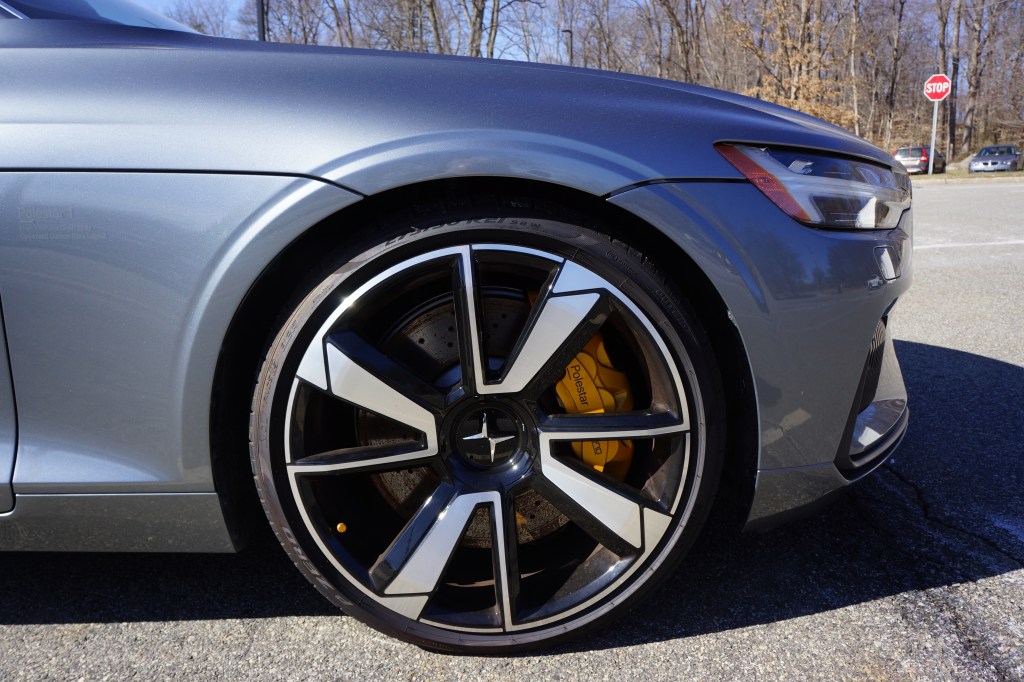
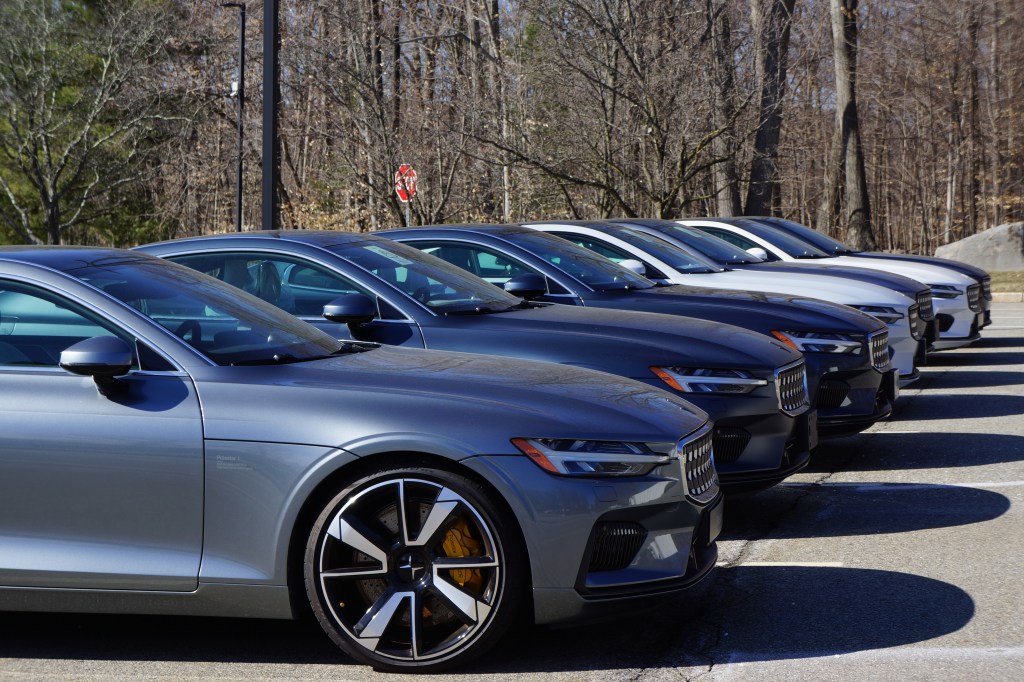
There were seven of these beauties lined up in the same lot where I picked up my loaner. This was my first time seeing this car in person. It’s lower than I expected; at first glance, I called it the “Swedish Camaro” – it has that pony car stance.
On closer examination, I began to see hints of the P1800 coupe from the 1960s. Make note of the jutting grille and the sweep of the roof’s rear pillar. The taillights are current Volvo design language. Hoping for a drive in one of these on my next visit.









 richardscarblog