I collect maps. Unlike most other things I collect (cars, tools, books, cameras), maps take up very little space. I can bring home a few maps and slip them into my collection without it raising an eyebrow.
When I attend automotive flea markets, typically Carlisle and Hershey, I see vendors who specialize in maps, and vendors who happen to have a box of maps along with other stuff. Map collecting is a subset of the automotive hobby, and the map specialists recognize this and price their wares accordingly. I don’t know what makes one map more valuable than another, but obviously, age, condition, and rarity all play a part. I tend to do most of my pickin’ at the vendors who are not specialists.
A few years back, rifling through a box of maps at one of these shows, I came across a copy of the “official” map of the 1964-1965 New York World’s Fair. It was in like-new condition, and while I don’t recall the exact price I paid, it was five dollars or less. I thought that was a sweet deal, especially since I didn’t own a copy.
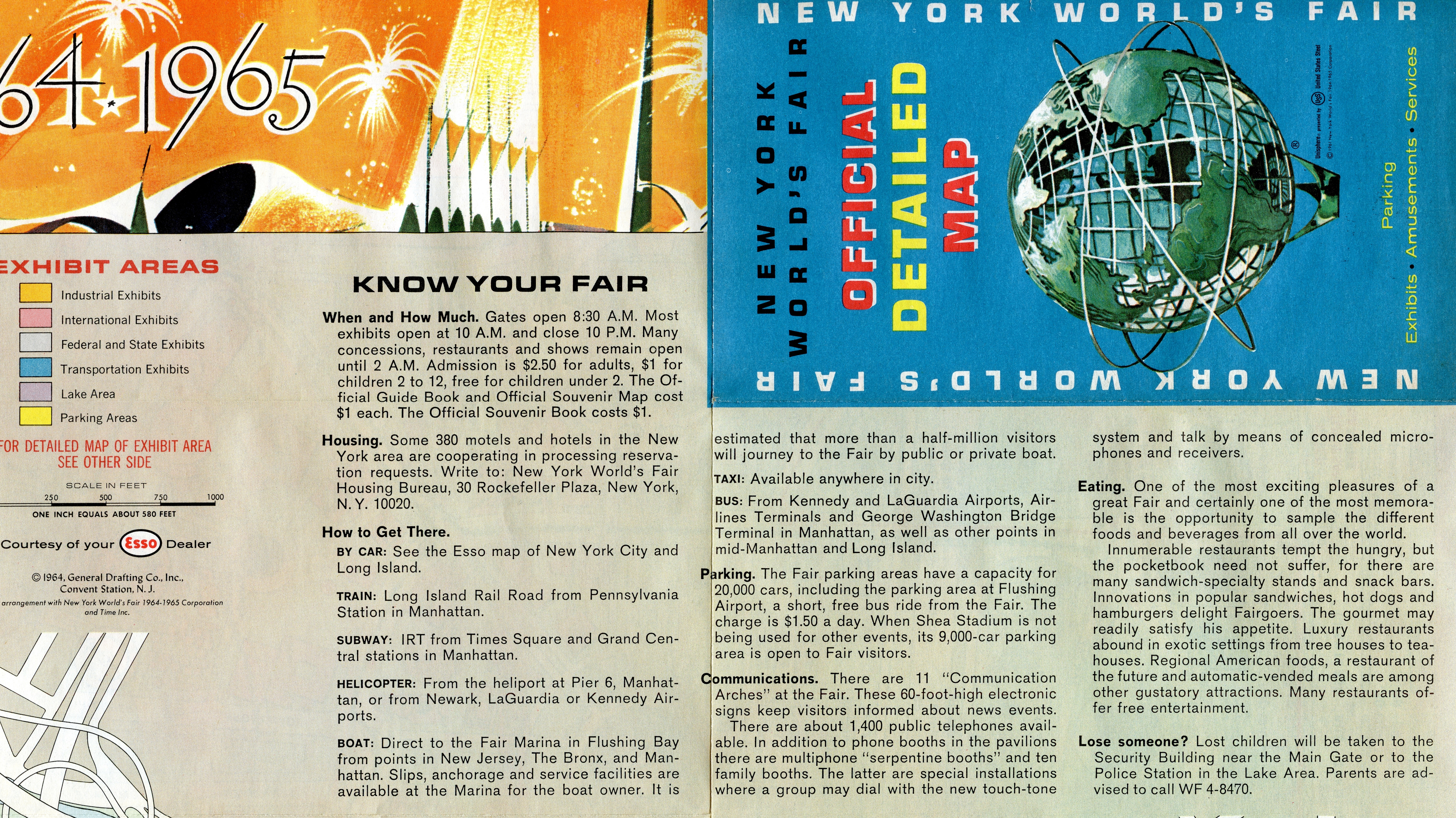
The map’s cover and some general information
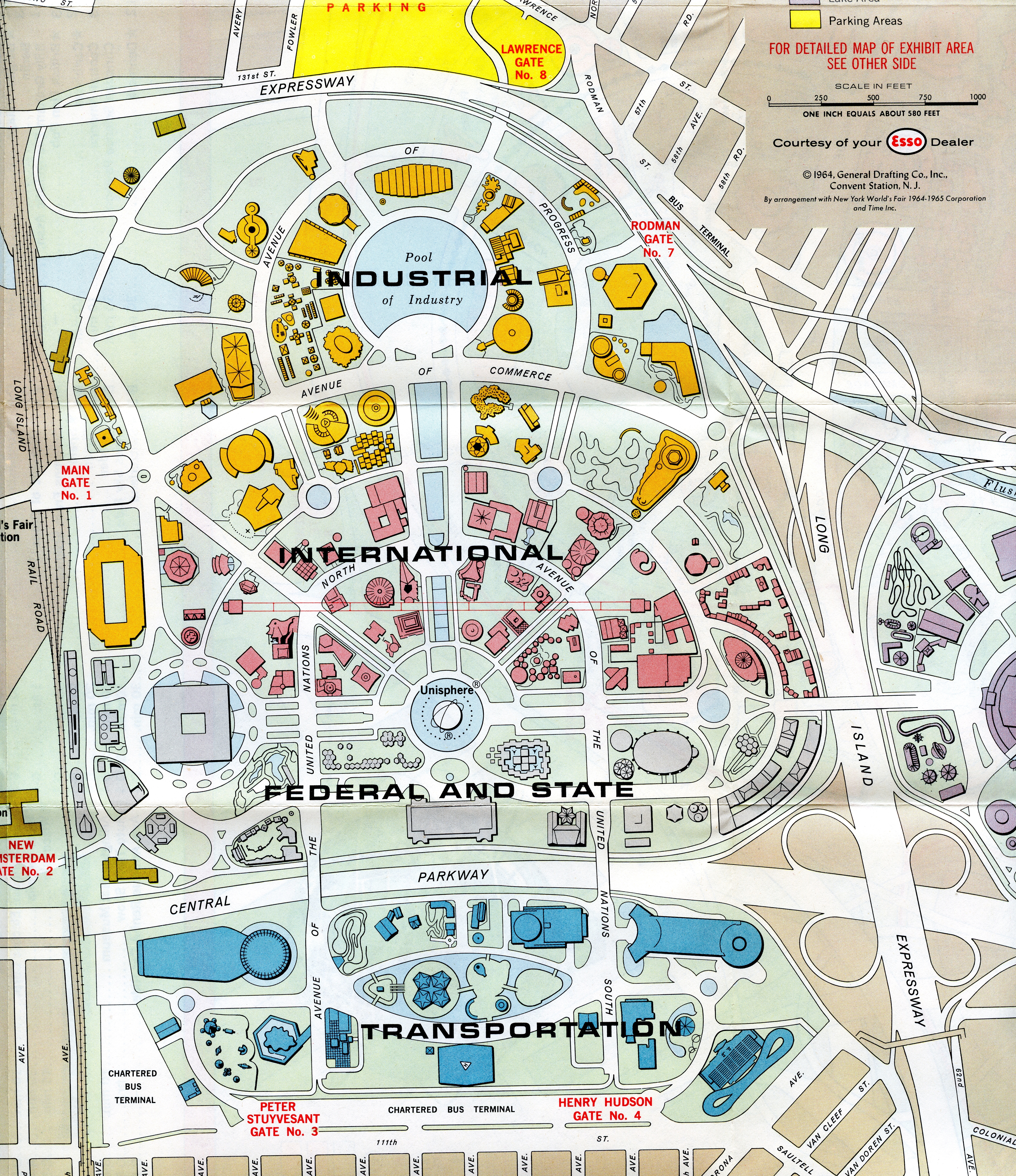
Although I attended the ’64-’65 NY World’s Fair six times with my family, I have only fleeting memories of it. I was just a kid, and as if you need the reminder, this was 56 years ago. So the map was a welcome way to revisit the event. It came as a surprise to me to see that the exhibits were arranged by category: Industrial, International, Federal and State, and Transportation.
The complete exhibit map
In Transportation, the buildings from Ford and GM dominated. Everything else (Chrysler Corporation, rental car companies, oil companies, and suppliers) was small potatoes compared to these behemoths. (Notably absent was Rambler/American Motors; even back then their budget was so tight that they had to sit this one out.) If the full map is done to scale, and it likely is, then it appears that the Ford Motor Company exhibit may have been the single largest building at the Fair. (In an earlier blog post, I had shown a postcard image of the GM building from this Fair.)
The Transportation exhibits
Look at the index which is part of the map. The ‘time’ next to each exhibit name indicates the approximate amount of time needed to tour the exhibit. This was intended as a way for attendees plan their day, and (as the fair organizers hoped) realize that a return visit would be necessary to see it all. GM, Ford, AND Chrysler each have a recommended visit length of one hour.
The index of Transportation exhibits
When the Fair closed, most of it was torn down with the notable exceptions of the Unisphere and the NY State Pavilion. Flushing Meadow Park, where the Fair was located, still exists, and I visited it in 1984 and took these two photos.
The Unisphere in 1984. Made of stainless steel, it shows no signs of aging.
The New York State Pavilion in 1984
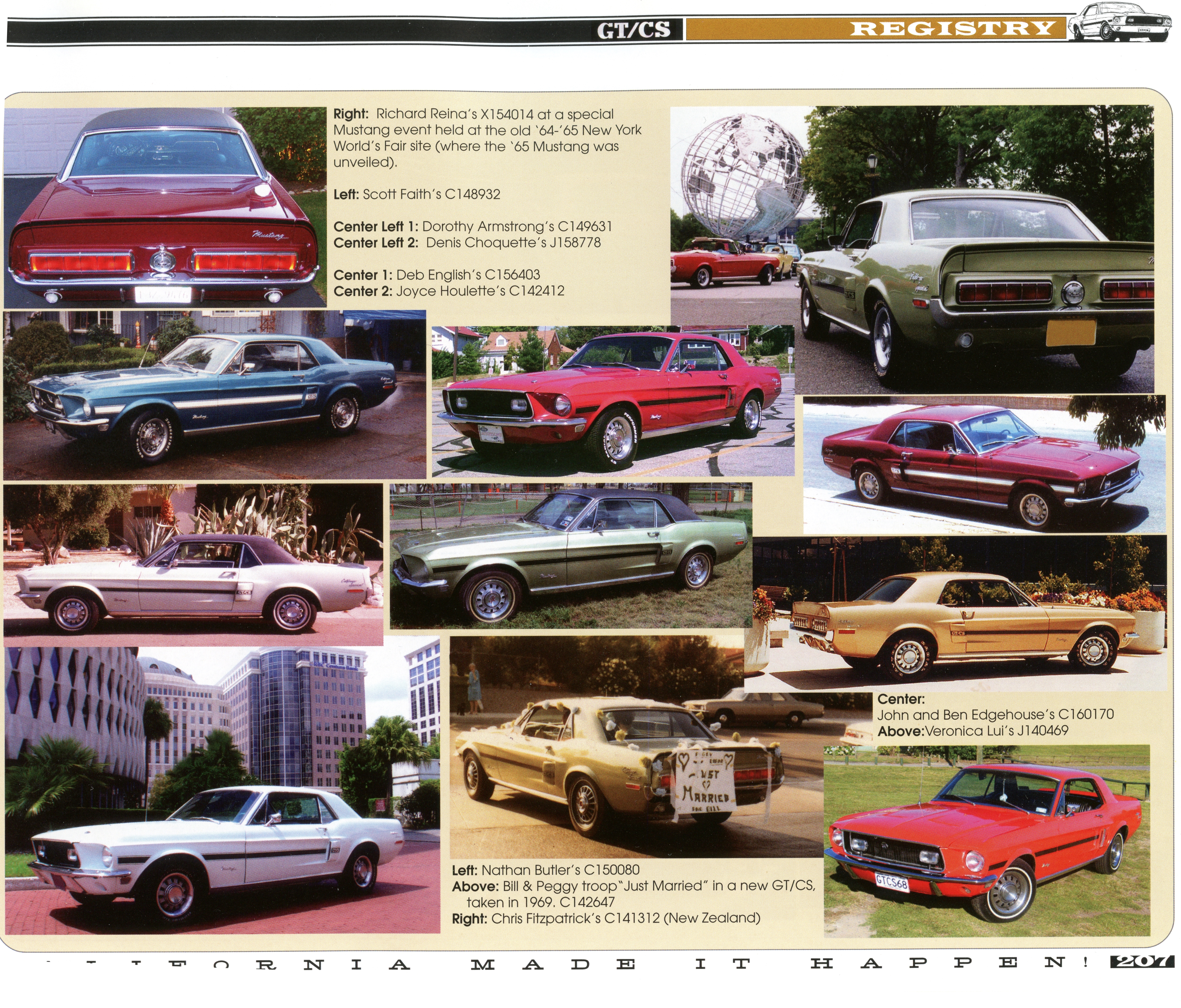
Then, in 2004, the local Mustang Club invited a select few of us back to the Park for the unveiling of the new 2005 Mustang, replicating the launch of the new 1964 ½ Mustang at the NY World’s Fair in April ’64. A photo of my 1968 California Special at that event, with the Unisphere in the background, made its way into the Mustang GT/CS Recognition Guide & Owner’s Manual (3rd Edition) by Paul M. Newitt.
My GT/CS is in the upper right corner
If you visited the Fair, I hope that some of this brings back pleasant memories. If you were not able to visit, I hope that you can marvel at what seemed so futuristic to us in the mid-‘60s.
In the latest edition (June 2020) of Sports Car Market (SCM) magazine, a reader wrote a letter to the Editor, requesting an explanation of the so-called “frequent flier” phenomenon (referring to the same vehicle appearing at multiple auctions over a short period of time). I will quote part of his letter:
“… often in the auction reviews, you note a car has been at or across the auction block three or five times in four or six years. Is there a story here? ….Is there a certain type of car which attracts this ‘flipping’ activity?’ …. Is there a certain type of buyer/seller involved in this? The easy answer is ‘speculators hoping to make a quick buck’…..”
I think that SCM dodged providing a real answer when they responded: “There is indeed a certain type of seller – we suspect possessing a world-class stubbornness – who trucks a car to several auctions in a short period of time. … (these) cars mostly have an impact on the bank account of the present owner….”
Whether the individual who posed the question intended this or not, the answer presumes that the ‘frequent flier’ vehicle never gets sold, so the same owner incurs transportation costs, auction fees, and the like. From my own observations of the auction market, the reality is different. Many frequent fliers DO get sold, chalking up multiple new owners over the short haul.
The obvious next question is: did the seller make a profit? Here’s the crux of the issue. Why would any owner of a special-interest vehicle consider selling it within the first year or two of ownership? While there could be any number of reasons (needs the money/found something else/didn’t meet expectations), was the car principally purchased as an investment?
The subheading on each month’s cover of SCM is “The Insider’s Guide to Collecting, Investing, Values, and Trends”. I’ve been a subscriber since 1997. I enjoy the magazine. It’s always done a great job of reporting auction results worldwide, in a timely fashion for a print periodical. What SCM cannot do, and no one can, is predict the future. This is not a knock on the magazine. A vehicle, or a class of make and model vehicles, rises in value faster than the overall market for a multitude of reasons. Many of these reasons have no basis in rationality. Several of my car buddies agree with me that the #1 rule is to buy what you like, enjoy it, and don’t worry too much about values. Yet it’s always interesting to speculate what would have happened if I bought X instead of Y.
Late in 2003, I bought a 1968 Mustang ‘California Special’ aka GT/CS. At that time, average selling prices for cars with the small block 289/302 V8 were around $15,000. There was a 20% premium for the ‘S’ code (4 barrel carb) big-block 390. I found a car for sale with the ‘X’ code 2-barrel 390, and paid $16,000, which I thought was a fair price, not a steal, but perhaps slightly under market. I liked that Mustang a lot, drove it to many shows and events, and sold it nine years later. The irony is, I had been considering some vehicles other than the Mustang, including an older 911, but it wasn’t so serious that I actually sought out or test drove one.
Why hadn’t someone told me 911 values were going to go through the roof? Is it because no one knew?
From the Jan. 2004 CPI
I subscribe to, and keep old copies of, the price guide known as Cars of Particular Interest (CPI). The book publishes retail values for cars in excellent (#2), good (#3) and fair (#4) value. I decided to have some fun with this by going back to the January 2004 edition and looking up 10 cars of interest to me whose #3 value was very close to my Mustang’s purchase price. (That copy of CPI had my Mustang at $18,600 for a #3 car.) I then compared those numbers to their 2020 CPI values, and calculated the percentage increase (none lost value). The chart is arranged in order of value increase from smallest to largest.
YEAR
MAKE
MODEL
Value 2004
Value 2020
CHANGE
1970
Plymouth
Barracuda 340 coupe
$15,525
$26,000
167%
1963
Studebaker
Avanti R2
$15,600
$28,000
179%
1968
Oldsmobile
4-4-2 convertible
$13,750
$27,000
196%
1971
Alfa Romeo
Montreal
$13,100
$42,000
321%
1969
Jaguar
E-Type Ser. II coupe
$14,500
$55,000
379%
1968
Mercury
Cougar GT-E 427
$13,000
$53,000
408%
1967
Mercedes-Benz
230SL roadster
$14,900
$61,000
409%
1963
Porsche
356 S90 coupe
$14,750
$62,000
420%
1961
Lincoln
Continental 4-dr conv.
$11,500
$56,000
487%
1969
Porsche
911 S coupe
$11,500
$83,000
722%
Again, we’ve kept things apples-to-apples by using CPI and by using #3 condition values. I’ll make the following observations:
It surprised me to see that the 3 cars with the smallest value changes are all domestic. None of those cars are performance slouches, and given the general trend that “muscle sells”, I expected higher numbers.
The other two domestic cars posted extraordinary results. The big-block Cougar rose over 400%, and the Continental disproves the adage that 4-door cars aren’t collectible.
The value of the Montreal seems artificially low to me, and I say that only as an Alfa owner who follows the market. However, the Jag value looks spot-on for a Series II coupe.
The two ‘ringers’ are the Porsches. Note that in 2004, the 356 was actually valued higher than the 911S! And in 2004 dollars, the 911 is the lowest-value car here, tied with the Continental.
What does all this mean? Nothing. (Like Seinfeld.) Seriously, it means that no one saw any of this coming. Looking at this with hindsight, do I have a twinge of regret? Ever so slightly, but not really. The Cougar is the same year as my Mustang, but would not have looked as unique as my car. I adore E-Types, and perhaps missed the boat my not snagging one when I could have. But making those statements does not take in the complete picture:
When I bought the GT/CS, it was in Maryland, about 3 hours away. I felt lucky finding one within a day’s round trip drive. Who knows where I would have found any of these other cars?
The Mustang was comparatively easy to work on, and I did most of my own maintenance and repair work.
Wrenching on a Jag or Porsche of any flavor means exponentially higher parts prices, and greater levels of complexity.
The Cal Special was very reliable. I drove it to Nashville, and on two complete New England 1000 rallies. Who is to say that any of these others would have been equally reliable?
I sold my GT/CS in 2012 for $20,000. You think I made a profit? Adding up insurance, routine maintenance, and repairs, it’s closer to the truth to say I broke even. But I had nine years to enjoy the hobby in it, and there’s no telling what kind of experiences any of these other vehicles could have delivered. So no regrets at all.
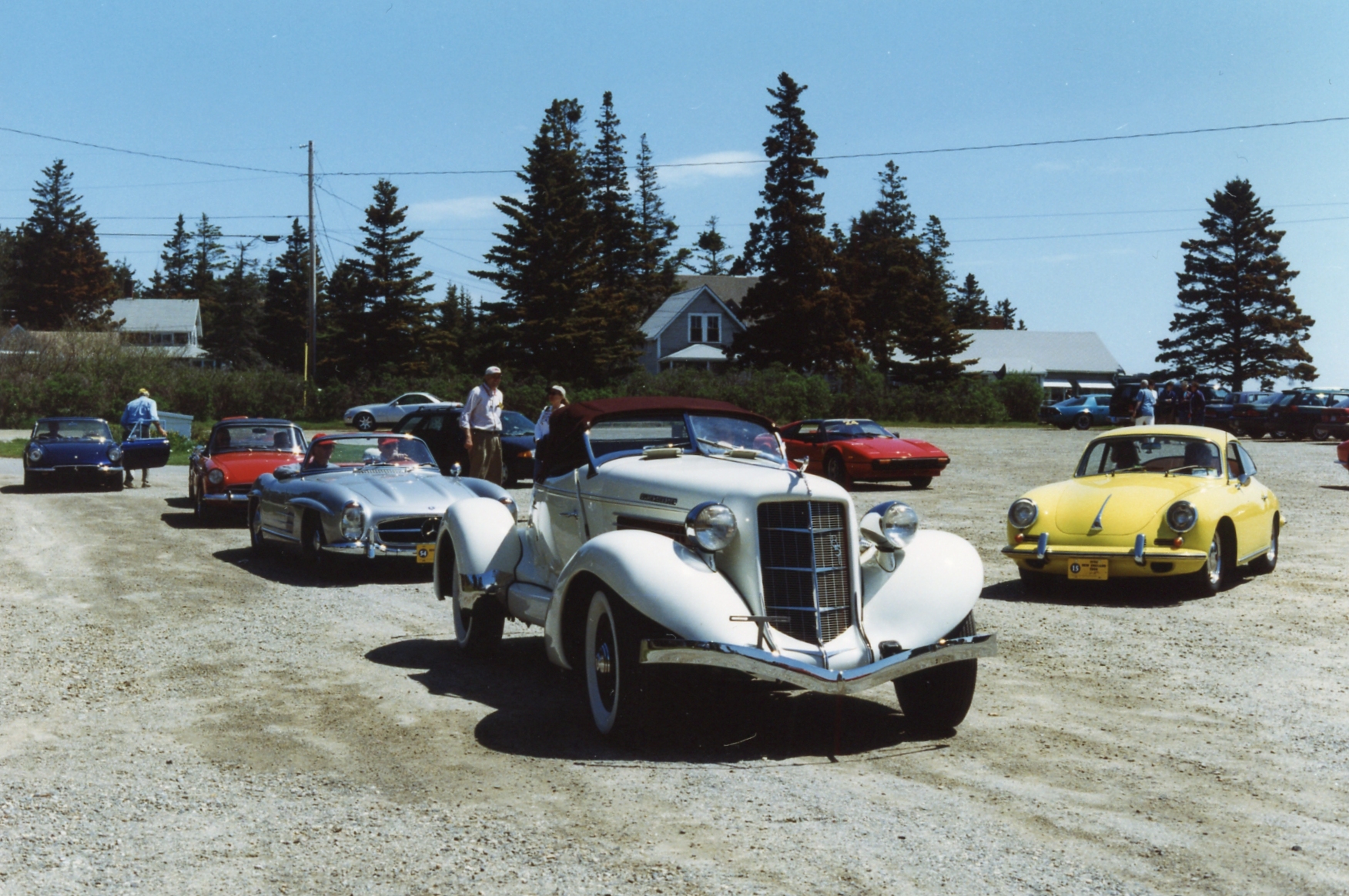
My GT/CS, the only domestic in sight, at the 2007 New England 1000 rally
Can anyone predict which collector cars of today will show value increases of 400% over the next 15 years? It’s fun to talk about, but I won’t be using real money to place any wagers. I’d rather get out there and drive.
Part of my frustration in putting that blog post together was the lack of any hard information about Auburn Speedster values, either based on recent sales or on numbers published in price guides. So I was pleasantly surprised when I leafed through my copy of the 2020 edition of Keith Martin’s Sports Car Market Pocket Price Guide, and found figures for Auburn Speedsters!
First, there was an 8-cylinder Speedster made from ’31-’34, which I had neglected to mention. The SCM median price for that model is $245,000. The V12 Speedster from the same vintage is shown with a value of $410,000. The 1935-1936 Speedster (they are all boattails) with the supercharged straight 8 sits at the top of the heap: SCM claims a median price of $756,000.
These numbers baffled me, because I expected the V12 to be more highly valued than the 8, even if the 8 was supercharged. Googling some further images solved that puzzle. The ’31-’34 Speedsters, while attractive cars, carried over a linearity from the 1920’s in their styling. A vertical grille, standalone headlamps, dual sidemounts, and bulky running boards stood in stark contrast to its reclining windshield and new-fangled boat tail.
When I compared this model with the updated ’35-’36, I understood why market values are higher for the newer car. All its features are swept back, making it look like it’s going 90 standing still. The fenders have started to become integrated with the body. The entire exterior appears to be more of a single piece of sculpture. While each car would draw a crowd today (and certainly did in the 1930s), there’s no mistaking the supercharged model as the prettier ride.
By the way, supercharging, like turbocharging, provides a lot more grunt with fewer cubes. The Lycoming V12, with 392 cubic inches, produced 160 horsepower. The I-8 with 280 c.i. pushed out 150 boosted ponies, impressive for 1935.
Let’s also quote some interesting sales facts from this article:
A writer from Sports Illustrated magazine in attendance claimed that “the standing record price for a car at auction was $45,000 for ‘the legendary ‘Harry Johnson’ Mercer back in 1968”.
A Duesenberg Le Baron Phaeton was reportedly bid to $66,000, but did not meet reserve and was declared a ‘no sale’.
The highest sale price of the auction was $20,000, for a 12-cylinder Auburn Speedster. It was reported that the new owner planned to drive the Auburn from the auction location in Philadelphia back to his residence in Indiana.
Reading some of these numbers from the perspective of 2020 is dizzying. The $45,000 record sale price would today barely get you into a near-luxury sedan or SUV. Checking my June 1971 Car & Driver, I see that a new 1971 Corvette with a 454 LS6 engine listed for $7,619. A new 1971 Volvo 142E had a list price of $4,032. The back cover ad for the de Tomaso Pantera stated that the car is “around $10,000”. So twenty grand in 1971 dollars for any car, much less an old Auburn, was a lot of coin.
A 12-cylinder Auburn Speedster is, of course, the striking boattail. My reference books indicate that the V-12 Speedsters were made for two model years only, 1932-1933. The 1933 model cost $1,745 new (a 1933 Ford V8 cabriolet was $585). This was during the Great Depression! It’s a coveted model today, so coveted that an entire cottage industry has sprung up building replicas which tend to sell in the $40,000-60,000 range, if Mecum’s recent sales of them are an indicator.
The 1971 sale car was a real one – the ‘tribute’ market had not been born yet. In 1971, $20,000 could have bought 2 Panteras, or 3 Corvettes, or 5 Volvos, any of which would have served as more reliable daily drivers than an Auburn. So spending twenty large ones on an old car was a real indulgence. Did the owner keep it? If so, for how long? When he sold it, did he earn a profit on the sale? If he or his heirs still own the car today, what is it worth?
There are very few recent documented sales of real Auburn boattail Speedsters. Mecum, at its January 2020 Kissimmee auction, sold a RHD one that needed extensive engine and other mechanical work for $440,000. There is exactly one on Hemmings.com at present, with a supercharged 8 and not a V12, carrying an ask of $795,000. If we split the difference and state that an Auburn Speedster might be worth $600,000 in the real world, that’s a 30-fold increase in value over 49 years.
Wait. We have no idea of this Auburn’s condition in 1971. Sure, it was reported that the new owner planned to drive it back to Indiana, which doesn’t mean that the paint and interior were pristine. Once home, he had to garage it; insure it; perform routine maintenance on it; refresh its cosmetics; acquire a tow vehicle and trailer so as not to sully its refreshed cosmetics; make repairs as items wore out or broke; replace the battery, fluids, tires, brakes, and rubber parts on a regular basis; and so on.
If the car saw any regular use, chances are it would have reached the point where it needed a complete restoration. Even without regular use, cars which sit deteriorate. Depending on how it was stored, maintained, and used, it’s not unreasonable that decades later, it may have needed yet another restoration. Any calculation of ‘final sale price’ as an indicator of profit ignores the decades of maintenance and repair necessary when a valuable old car is under your care.
Old-car enthusiasts who are not active owners seem to presume that all old cars increase in value. I’ve heard it, I’ve read it, and I’ve had it said to me when showing one of my own cars at an event. The conversation goes something like this:
Show-goer: “Hey, nice car! I bet that thing is worth some money!”
Me: “Well, maybe it is, but I’m in the hobby to enjoy the cars and the people”.
Show-goer: “Hey, if you don’t mind my asking, what’s that thing worth?”
Me: “Well, I’m not really sure. Any number I quote is just a figure from a piece of paper anyway”.
Show-goer: “Well, I bet you’re sure that you’re gonna make a killing on that thing when you go to sell it!”
Me: “We’ll see. It’s not for sale, and like I said, I’m in this hobby to enjoy it without focusing on values too much”.
Do classic cars increase in value? The answer is almost certainly “yes”. However, the intrinsic value of the car, its condition, and the length of time between two sale points all play significant roles in any potential value increase. A 1933 Ford 4-door sedan is very likely worth more today than it was in 1971. But there is no comparing such a car with a genuine Auburn boattail. Perhaps the biggest argument against the Ford would be its lack of desirability in today’s collector car market.
I still see too many ‘collectors’ who are more focused on future values than they are on the enjoyment that the hobby can bring. Following recent auction trends, it’s not unusual to see the same cars repeatedly dragged across the block, and either failing to meet an unreasonable reserve, or actually selling for less than the car sold for the previous year. It’s a complete oversimplification to look at this 1971 Auburn sales result and exclaim “I told you that there’s money to be made doing this!” Sure. Would you have had that kind of spare cash in 1971 AND have been able to wait 49 years before reselling? I didn’t think so.
If I had known when I met Kirk White that he did indeed kick-start this entire collector car auction mania, I would have personally thanked him. Are all car auctions great? No. Does every vehicle sold at auction hammer for a number higher than its previous sale? Absolutely not. Have auctions brought many more people into the hobby and served as a source of education and entertainment for collector car enthusiasts? We can only answer that with an unqualified ‘yes’.
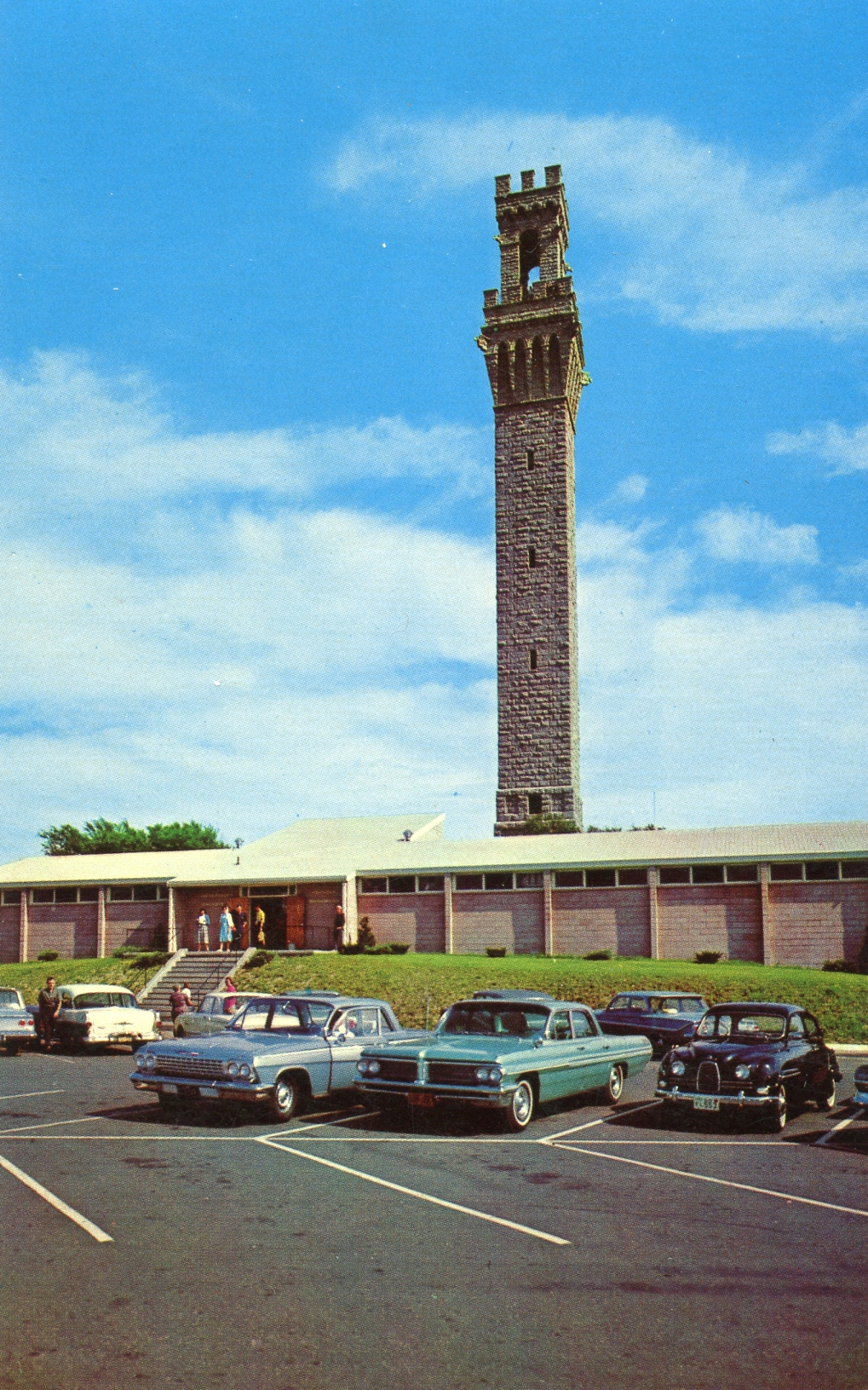
Old Postcards Part 1 covered postcards of the two New York World’s Fairs. These three postcards below found in my dad’s collection are a potpourri: two are from Cape Cod MA, one of the places my father liked to visit when he traveled (which was infrequent), and the third is an advert for the Datsun 210. I can hear the youngin’s from here: “What’s a Datsun?”
“BEACH BUGGIES TOURING THE SAND DUNES ALONG RACE POINT, PROVINCETOWN, CAPE COD, MASS.”
So reads the back of this postcard. Beach buggies? The ‘buggy’ in question is an International Harvester Travelall, a forerunner to today’s ubiquitous SUV. Looking at that soft sand, I’m not sure I’d trust ANY 4WD vehicle to return to pavement, but obviously, the folks who ran these tours found these trucks to be up to the job. Carrying capacity was another advantage. Presuming the vehicle had 3 rows of bench seats, it could likely accommodate a driver plus 8 passengers, adding to the tour company’s revenue per outing.
Relying as I do on Wikipedia, it appears that the pictured Travelall is a model year 1968, the last year for this body style. That conclusion is based on the rear quarter panel trim, which seems to have been a 1968-only treatment. In 1969, the Travelall was redesigned and bore an appearance very similar to the smaller IH Scout.
“PROVINCETOWN MUSEUM WITH PILGRIM MONUMENT IN BACKGROUND, PROVINCETOWN, CAPE COD, MASS.”
I can’t say that I recognize either the museum or the monument, but I do recognize all the cars in the parking lot. Was GM having a convention that weekend? Did the Saab owner know that someday the brand would be owned by GM? I kid. Among the GM cars are two ’61 Chevrolets, a ’62 Chevrolet, ’55 and ’62 Pontiacs, and behind the ’62 Chevy, perhaps an early ‘60s Ford Falcon.
At first I had a difficult time determining if the Saab was a late-50s 93, or an early-60s 96, as their front ends are nearly identical. However, the 93s had ‘suicide’ doors while the 96’s doors were hinged conventionally, as appears here. The front grille was substantially redesigned in 1965, putting the postcard car into the 1960-1964 model year range. So except for the ’55 Pontiac, all the cars pictured here are of very similar vintage.
“DATSUN 210: Five models to pick from, with one kind of gas mileage…. It’s economy that makes you feel rich.”
The Datsun 210 had a short run in the U.S.: the model was sold here only from 1979 through 1982. There were indeed 5 body styles: a two-door sedan, four-door sedan, five-door wagon, three-door hatchback coupe, and a special 210MPG two-door sedan.
The U.S. was hit with its 2nd gas crisis of the decade in 1979, so Datsun’s timing was, shall we say, fortunate. The wording on the postcard talks about little other than fuel economy, because that’s what Americans were shopping. The 210MPG model, with a reduced horsepower 1.4L engine and a five-speed manual gearbox, was rated at 47 mpg on the highway. Perhaps most surprising to me is that this vehicle, like almost all Asian imports at this time, was still RWD.
Datsun was still a few years away from switching over its brand name to Nissan, but do note the corporate Nissan symbol in the bottom left-hand corner.
My dad bought a new Datsun 200SX in the early ‘80s, so no doubt he picked up this free postcard at that time. Was he considering the flashy 210 three-door hatchback coupe in the photo? Didn’t the image of the young man serenading his date with a flute influence his decision?
All images are from my personal collection of postcards.






 richardscarblog