Replacing the Miata’s Clutch Hydraulics

It is somewhat well-known among Miata owners that one of the few mechanical weaknesses of the car is its clutch hydraulic system. Typically, the secondary cylinder1 fails and needs replacement, and indeed, that component was already replaced once on my car, back in 2010. The good news is that the failures tend to happen gradually, and the driver gets significant advance notice as the clutch pedal gradually sinks while gear engagement becomes progressively more difficult.

I hopped into the Miata last week for the first time since winterizing it last autumn and in my case, the pedal was “gone”. Popping the hood, I saw that the clutch hydraulic reservoir was empty, although the dirty fluid left enough of a stain that one could be fooled into thinking there was still some fluid in there. I watched a few YouTube videos, several of which contradicted themselves (more about that coming up) and ordered a new primary cylinder, secondary cylinder, and flexible hose. All are Dorman products; one reason for the choice is that Dorman offers a lifetime warranty on the parts, when most competitors offer one year. The three parts cost me around $65 with shipping.

ABOVE: There are many cars where a single reservoir is shared by the brake and clutch systems, but the Miata is not one of them. The larger reservoir on the left is for the brakes. Note how clean that fluid looks, almost clear in fact. On the right is the clutch primary cylinder, and despite appearances, that reservoir is empty.

All exposed threads got a spray shot of rust-buster the day before, but none of the threads gave me a fight the following day when I put a wrench to them. The primary cylinder came off first: the fluid pipe fitting and two nuts were all easily accessible. Moving downstream, I tackled the clutch hose next. I had never really noticed this part before. In fact, it’s tightly tucked directly between the back of the cylinder head and the firewall. The pipe/hose routing is as follows: a metal pipe is routed from the primary, along the firewall, where it makes a 180-degree turn on the passenger side and connects to the hose. The hose runs back toward the driver’s side, held in place by two firewall-mounted brackets. From there, another metal pipe snakes downward to the secondary cylinder mounted low on the passenger side. (I suspect that much of this back-and-forth routing is due to the JDM (Japanese Domestic Market) Miata being RHD, and this lengthier routing was necessary to adapt to LHD.)

ABOVE: Primary cylinders laying side-by-side, old on left and new on right.
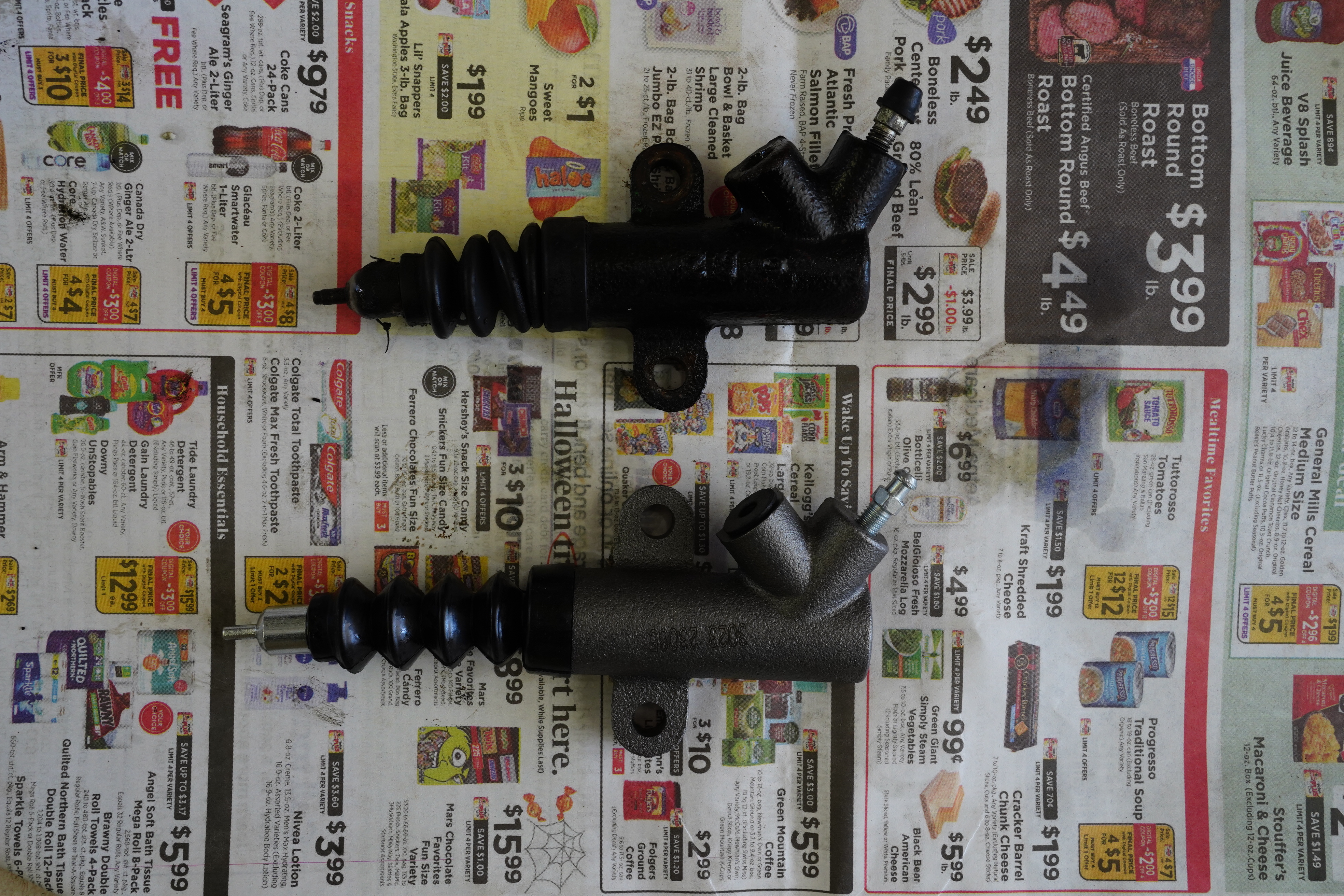
 

ABOVE: Old secondary cylinder on top, new one on bottom.


Why am I describing all this? Because these hose connections were a B – I – T – C – H to reach, something completely left unsaid in all the videos I watched. The video voiceovers cheerfully exclaimed “And then we replaced the clutch hose before moving to the secondary cylinder” or similar. I ended up disconnecting two wiring harness brackets to provide myself enough room to get a flare nut wrench on the hose ends. Several bloody knuckles later, it was done.

ABOVE: New hose on bottom appeared to be slightly longer, but that did not affect installation.

The secondary cylinder was the third and final piece of the puzzle. Without a lift, access required removing the right front wheel and squeezing my torso into the wheel well to reach the connections. As with the primary, there was only the threaded pipe and two bolts holding the cylinder to the block. After several hours of contorting myself, the R&R portion was done.
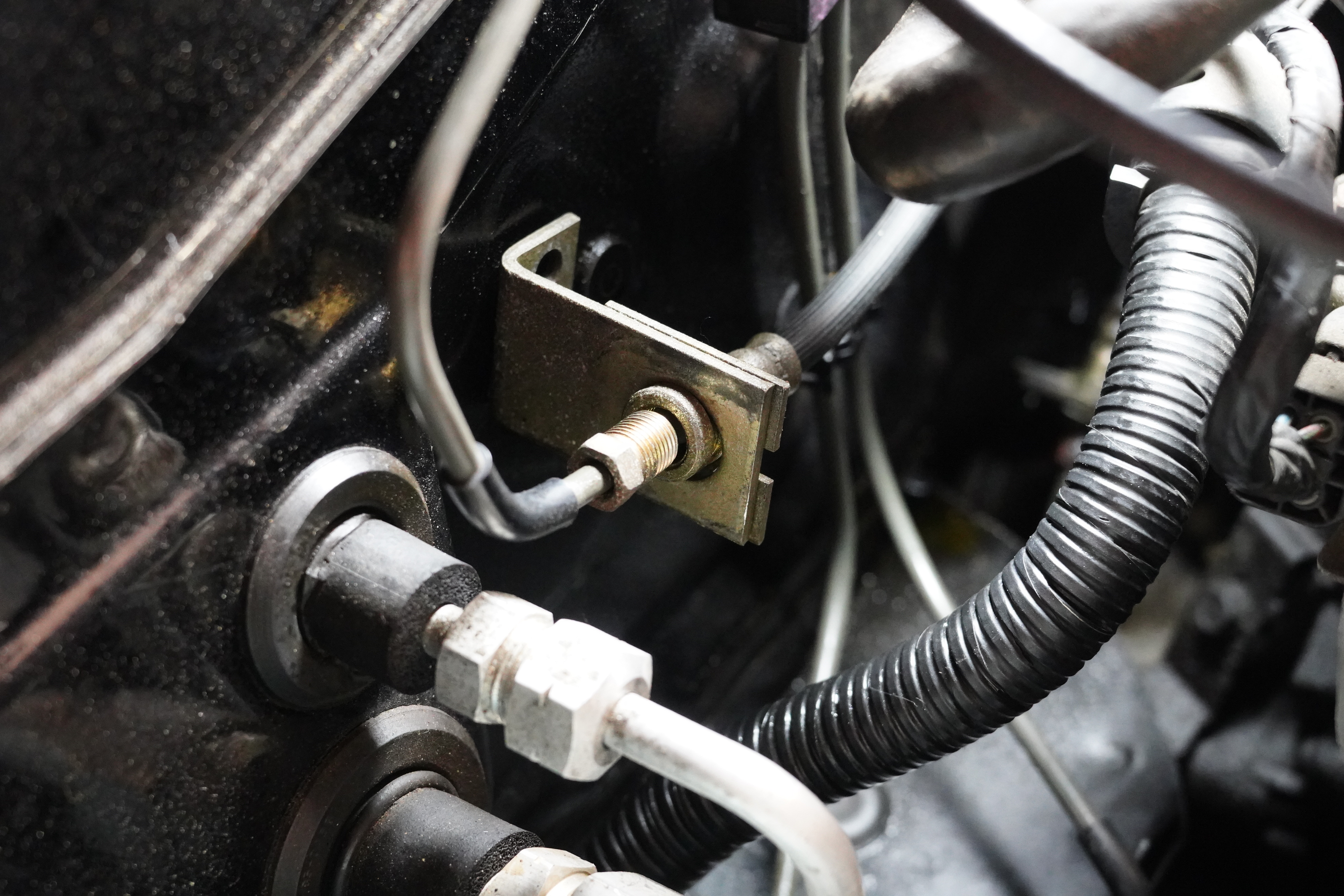
ABOVE: This was the easier of the two pipe-to-hose connections to access. Even here, A/C hoses and wiring harness run interference.

Next, it was time to call my able assistant who is well-versed in the “press – hold – release” mantra. My only regret is that I didn’t get a snapshot of Mrs. Reina as she sat in the driver’s seat and multi-tasked: left leg mindlessly going up and down on the pedal while she nursed a hot cup of tea and scrolled through her phone as it sat perched on the center console. And one more comment about the videos: one video insisted that bench-bleeding the primary cylinder was a necessity, while a second video declared it a waste of time. I chose to bypass the bench bleed, but before my wife came out to the car, I filled the reservoir, filled a small jar with brake fluid into which I inserted a hose from the bleeder screw, and left the screw loose. I then pumped the clutch pedal at least 50 times, refilling the reservoir once. This seemed to get a goodly amount of air out and shortened the length of time my wife was on the job. Thank you honey!

I took the car for a short spin and the clutch pedal felt marvelous. Let’s hope the hydraulics last another 10 years.

1Traditional automotive terminology has referred to brake and clutch cylinders as “master” and “slave”, terms which frankly have always caused me to wince. Here, because it’s my blog and I can describe things as I please, I have opted to refer to these parts as “primary cylinder” and “secondary cylinder”. I doubt it will catch on, but I would be eternally pleased if it did.


All photographs copyright © 2024 Richard A. Reina. Photos may not be copied or reproduced without express written permission.

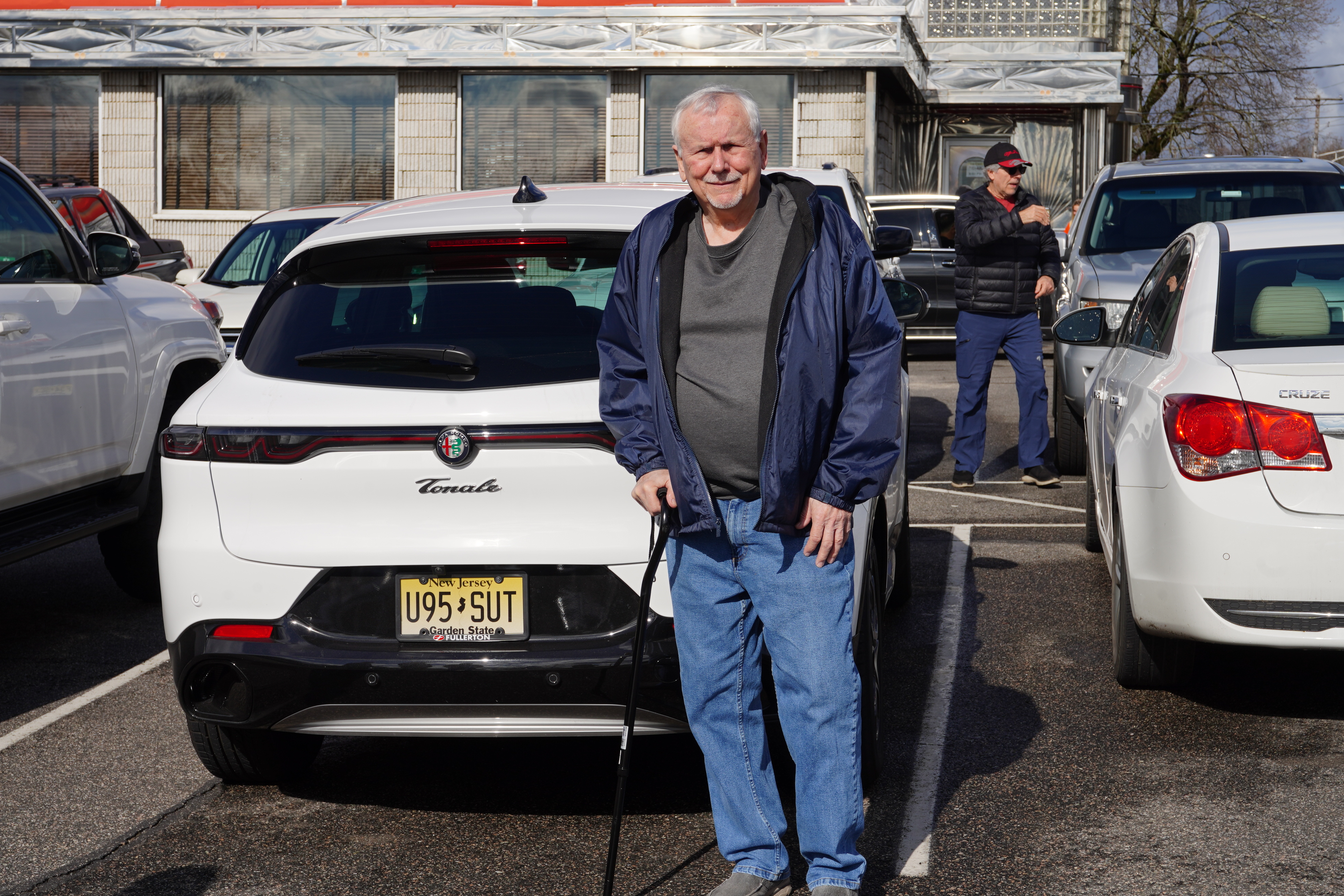
NJ Alfa Club Breakfast Meet, March 10, 2024

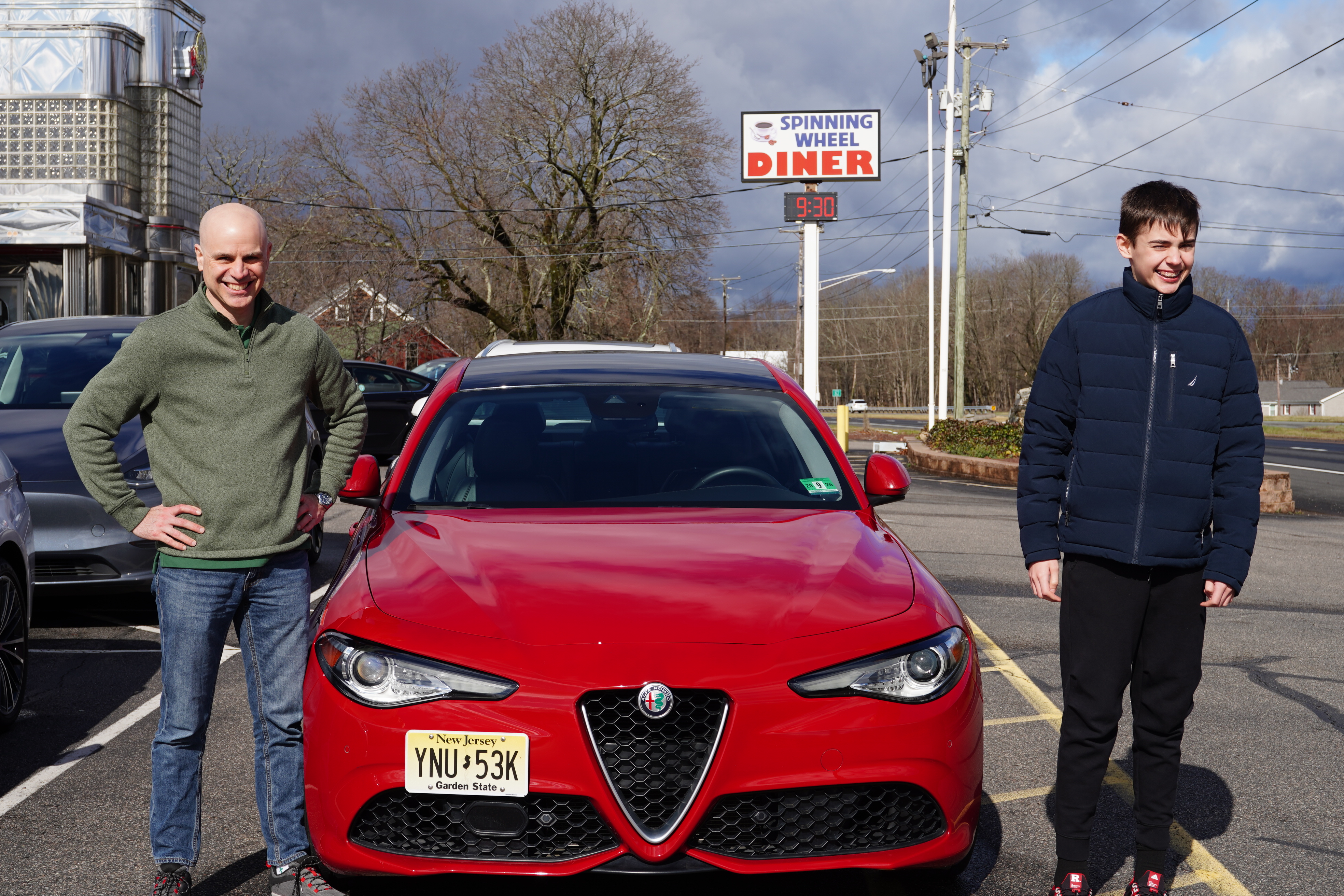
The NJ Chapter of the Alfa Romeo Owners Club (AROC) proved that it can make a plan and stick with it. Having decided late last year to begin a tradition of monthly breakfast meetings, the Chapter successfully held its 3rd consecutive breakfast meeting on Sunday March 10, returning to the Spinning Wheel Diner in Lebanon NJ, the site of our January meet.

The participant count was a little light at 6, and since we need to generate an excuse, we’ll blame that morning’s switch to Daylight Savings Time which caused all of us to lose an hour’s sleep. Winter was still very much in the air, so no classic Alfas made an appearance at breakfast. Instead, we were again treated to John’s new Tonale and Steve’s current-generation Giulia sedan.

One of the great benefits of these breakfast meetings is the chance to chat with each other about our cars. Tony and I shared the news about getting his Giulia TI going again thanks to the spark plug replacement; I mentioned that I got to drive John’s modern Giulia sedan, which was quite possibly the best performance sedan I’ve ever piloted; and poor Gene “entertained” us with his sad tale of spinning 180 degrees after the rear axle locked up on his ’76 Spider. Thankfully there was no body damage. His car is at the shop awaiting diagnosis and repair.

With food and drink done, we headed out early enough to enjoy the remainder of a brisk late winter day. But we also got to enjoy an extra hour of sunshine! The April breakfast meet will find us back at the Americana Diner in Shrewsbury, and fingers crossed, I plan to drive my GT Junior there.


All photographs copyright © 2024 Richard A. Reina. Photos may not be copied or reproduced without express written permission.
 

AACA NJ Region Judging Seminar, Mar. 9, 2024

The NJ Region of the AACA holds its biggest event of the year, the Spring Meet, every year on the first Sunday in May. This is a judged car show which at times has seen up to 250 vehicles in attendance. The cars are put into classes, and volunteer members of the Region perform the judging. Judges are arranged in teams of two, and with a dozen and a half classes to judge, the Region would ideally have 30 or more volunteers. As someone who has judged our Spring Meet for the last few years, I’ve seen how woefully short of that number we usually are.

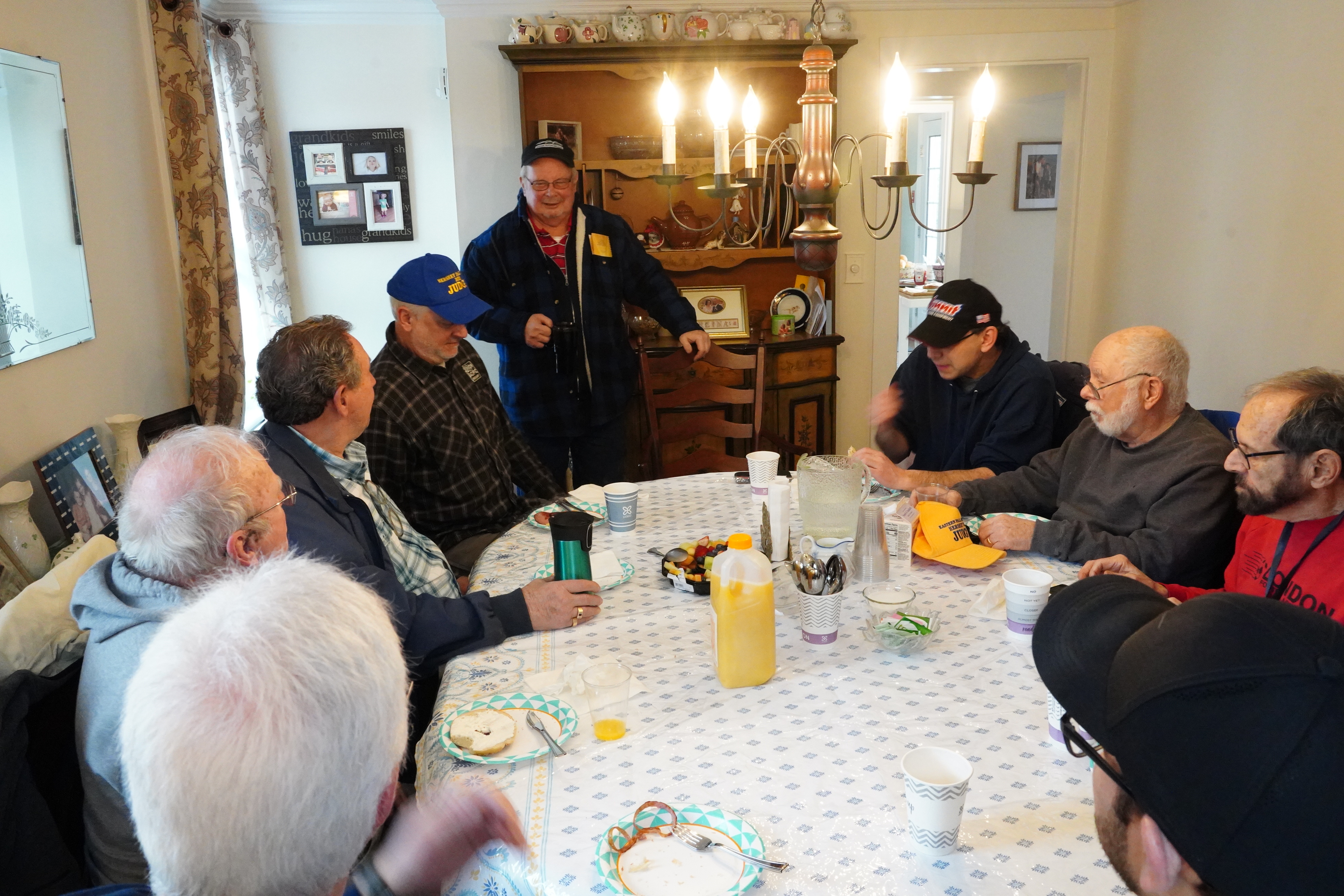
In years past, our chief judge, Ed G., would hold a judging seminar a week or two before the Spring Meet. While well attended, the club still lacked the requisite number of volunteers. Several club members, including our new chief judge Anthony C., decided last year to expand the number of judging seminars. As covered in this recent blog post, the first such seminar was held at Dick B.’s house in late January. This month, your humble blogger agreed to play host. We started with a 9 a.m. breakfast (assembled by my most gracious wife, who allowed a dozen NJ Region members into her dining room), followed by a 10 a.m. start in the garage.

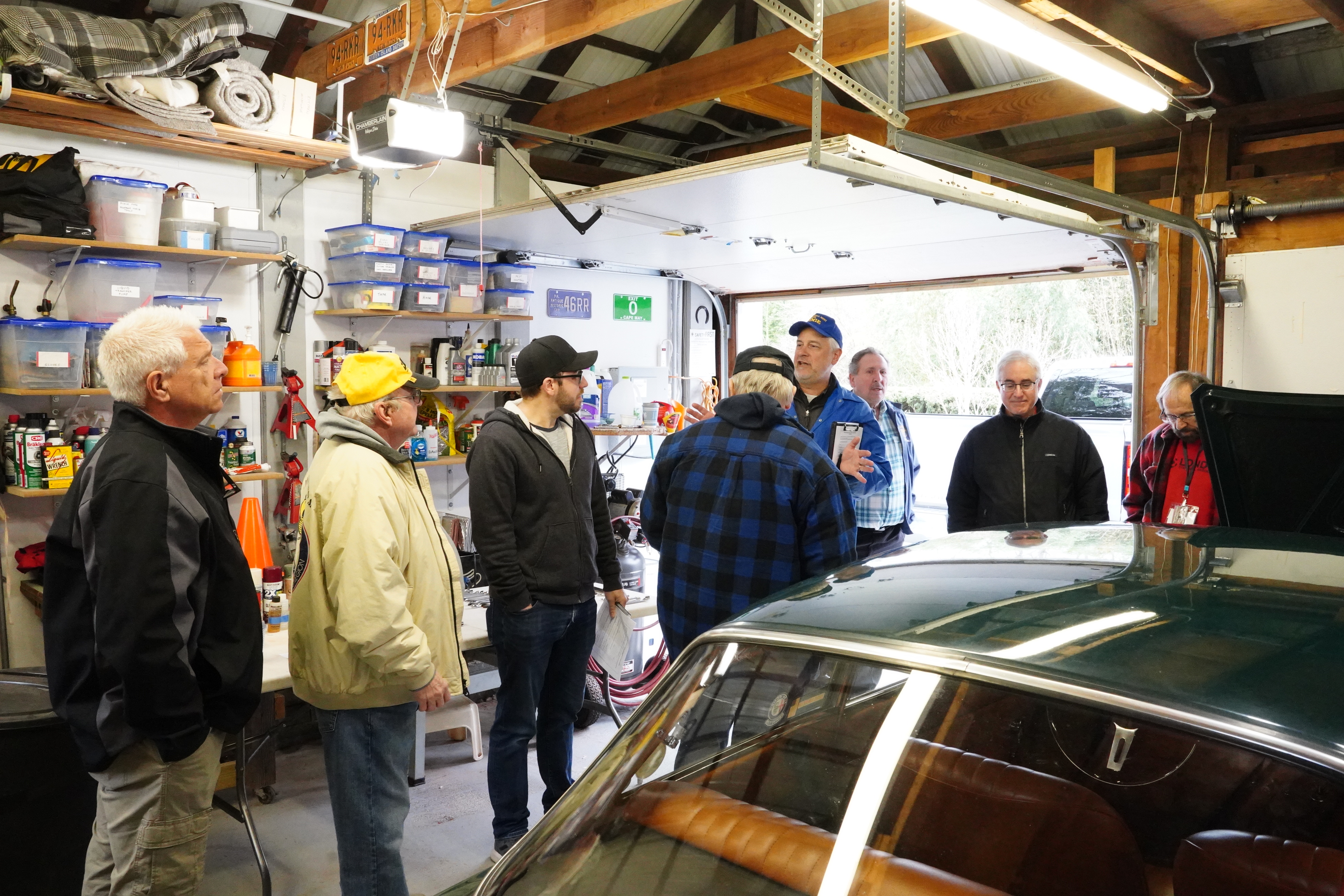
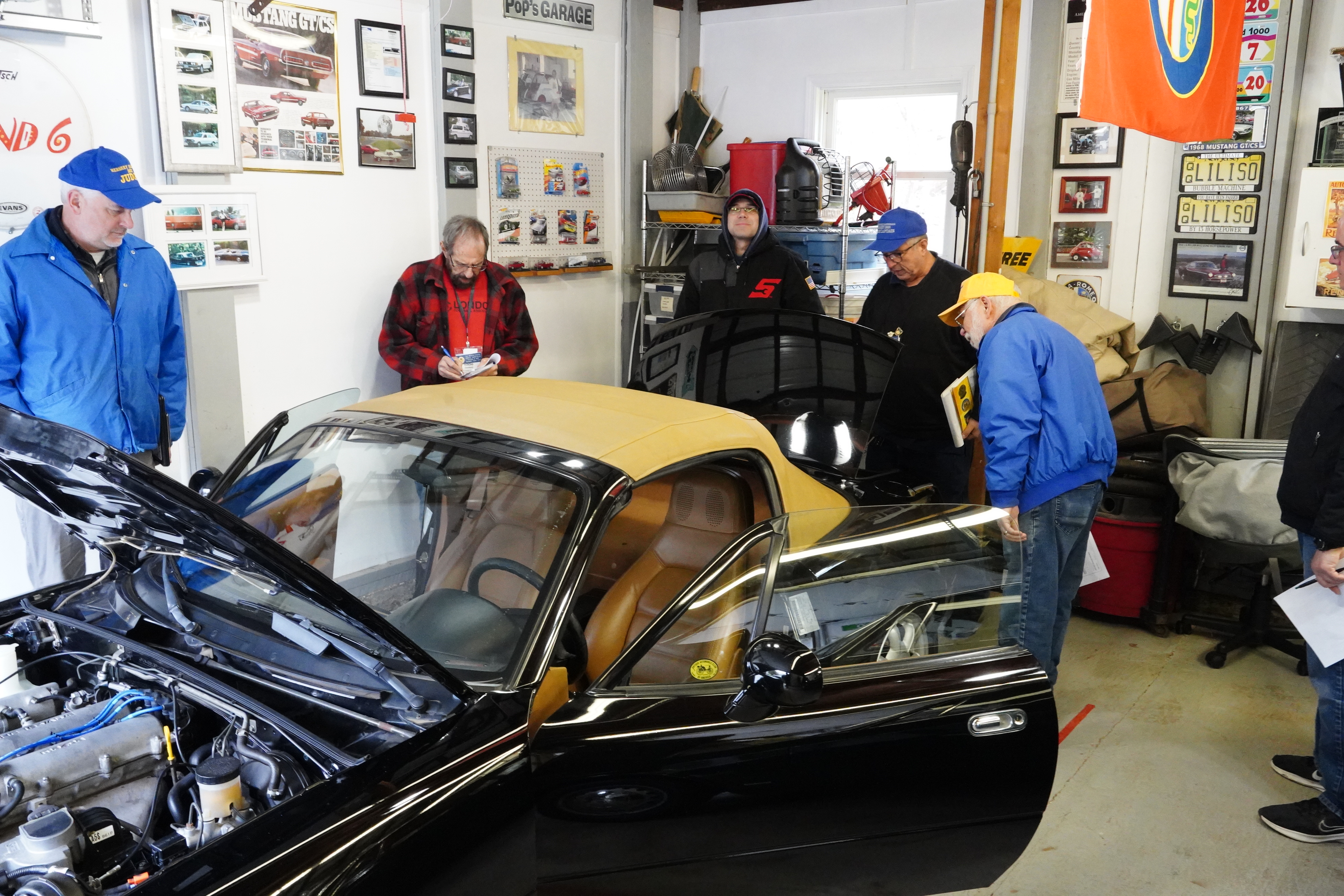
The seminar was again ably led by our “pro tem” chief judge Craig K, with my two cars, the ’67 Alfa Romeo and the ’93 Mazda Miata, as the objects of our collective scrutiny. The focus of the training exercise was “class judging”, with cars evaluated for correctness and condition in 4 areas (exterior, interior, engine compartment, and chassis). However, both of my cars are HPOF, “Historical Preservation of Original Features” and would not normally be subject to a point-by-point evaluation. Still, it was good practice for the Region members to analyze the cars on a 40-point scale (10 points for each of the 4 areas). I kept my lips zipped as horrors such as faded paint, door dings, a dirty bellhousing, a semi-opaque convertible window, worn upholstery, window decals (!) and other atrocities were critiqued. Still, on a 40-point scale, the group reached a consensus that each car earned a total point score in the low-to-mid 30s. Similar to what we learned last time, each “defect” would result in only a ½ or 1 point deduction out of 10 available points. The goal should not be to deduct as many points as possible, but to treat each deduction relative to the 10 available points. A car would need to be in very poor condition for it to earn a loss of 7 or 8 points out of 10.

We finished up around 12 noon, and Craig and I were pleased to see a number of new faces in the crowd. Attendance at a judging seminar is not a commitment to judge, but it certainly is our hope that with 2 training sessions done and a third one scheduled for April, we should see an uptick in volunteers at our May Spring Meet.

Craig (in blue jacket) begins the session


The Alfa was judged first


Each participant was invited to judge each section of the car


Craig reminds the crowd to not touch the car without the owner’s permission!


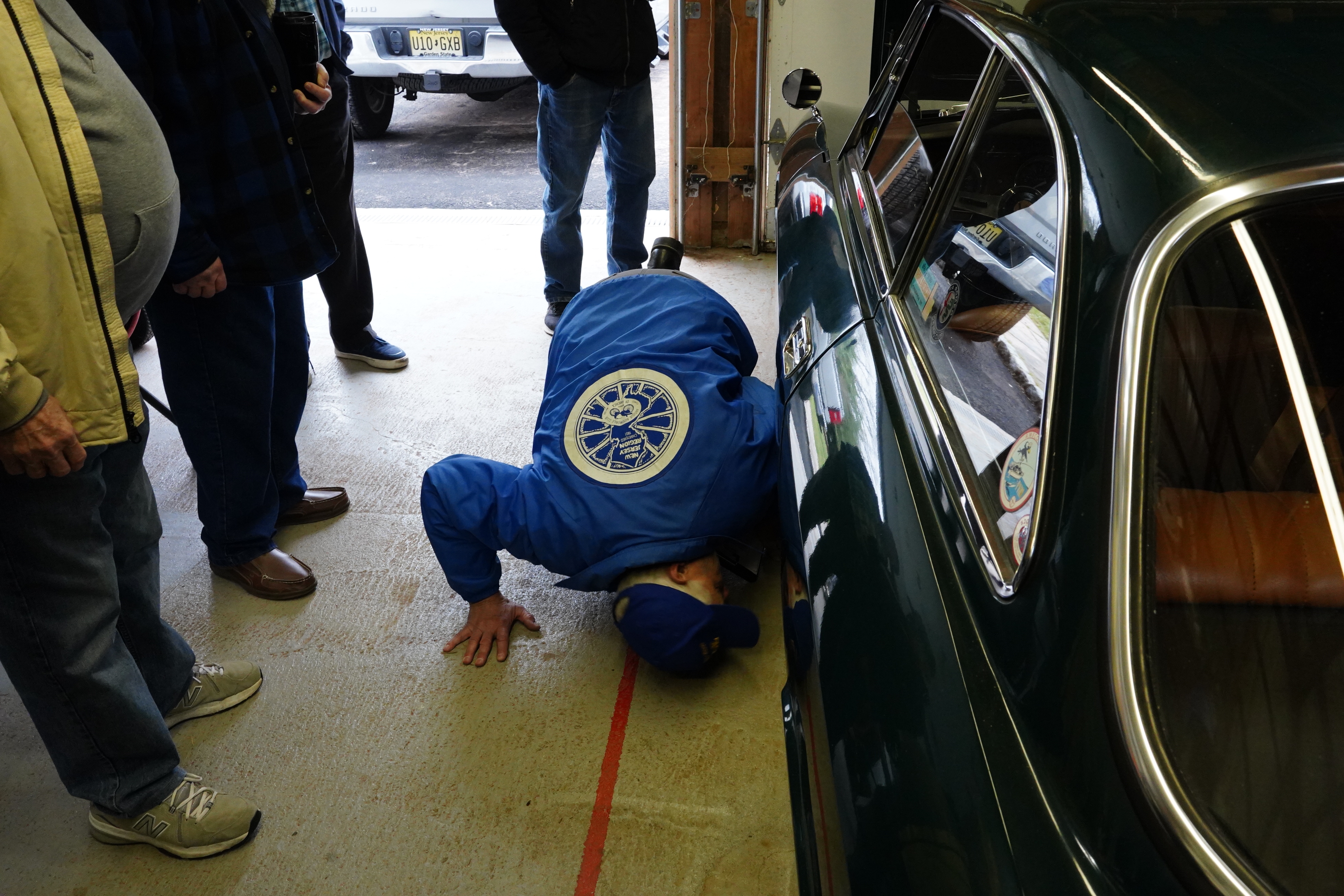
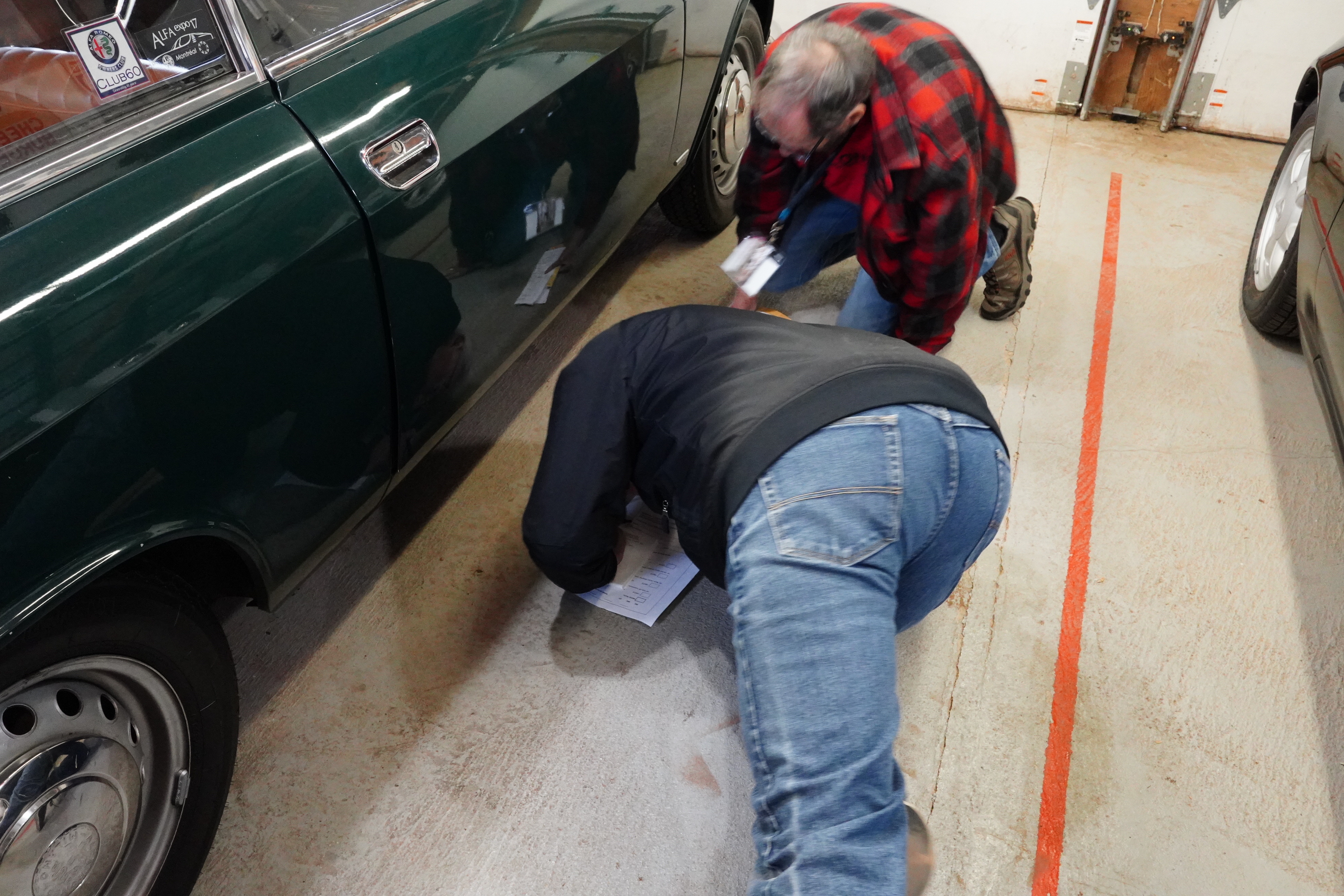
Chassis judging requires someone willing to get down on all fours


Points were lost for “non original” window decals seen here in upper left


Trainees correctly noted that in some areas, newer Miata lost more points than older Alfa


Correct judging position requires that convertible top be up


All photographs copyright © 2024 Richard A. Reina. Photos may not be copied or reproduced without express written permission.


“Ferrari”: The Movie AND The Book

The movie “Ferrari”, a biopic about Enzo Ferrari who founded and ruled over the famous car company that bears his name, was released to movie theaters late last year. I saw it during its opening week, and despite my initial misgivings, I enjoyed it. Much of my doubt centered around two concerns: one, I knew that the movie covered only one year of Enzo’s life (1957), and I could not imagine how a 2+ hour-long movie could do his story justice; and two, with an American (Adam Driver) in the lead role, and a Latino (Penelope Cruz) playing his wife Laura, I had trouble believing that these non-Italian actors could carry their parts. However, Director Michael Mann, who I’m told is famous for many of his previous movies about which I know nothing, brilliantly brought it together. By focusing primarily on the races, race cars and drivers of that year, and all but ignoring the production cars, the plot moved along nicely.

I had read complaints about the crash scenes, which were very realistic, including the depiction of gore. The harsh reality is that in racing, cars crash, and drivers die. The real tragedy in the races of this time, though, is that they were held on public roads, and too often, fatalities included innocent bystanders of all ages. The gore in “Ferrari” wasn’t there for its own sake. Rather, it was a real-world depiction of what happened during this era in racing.

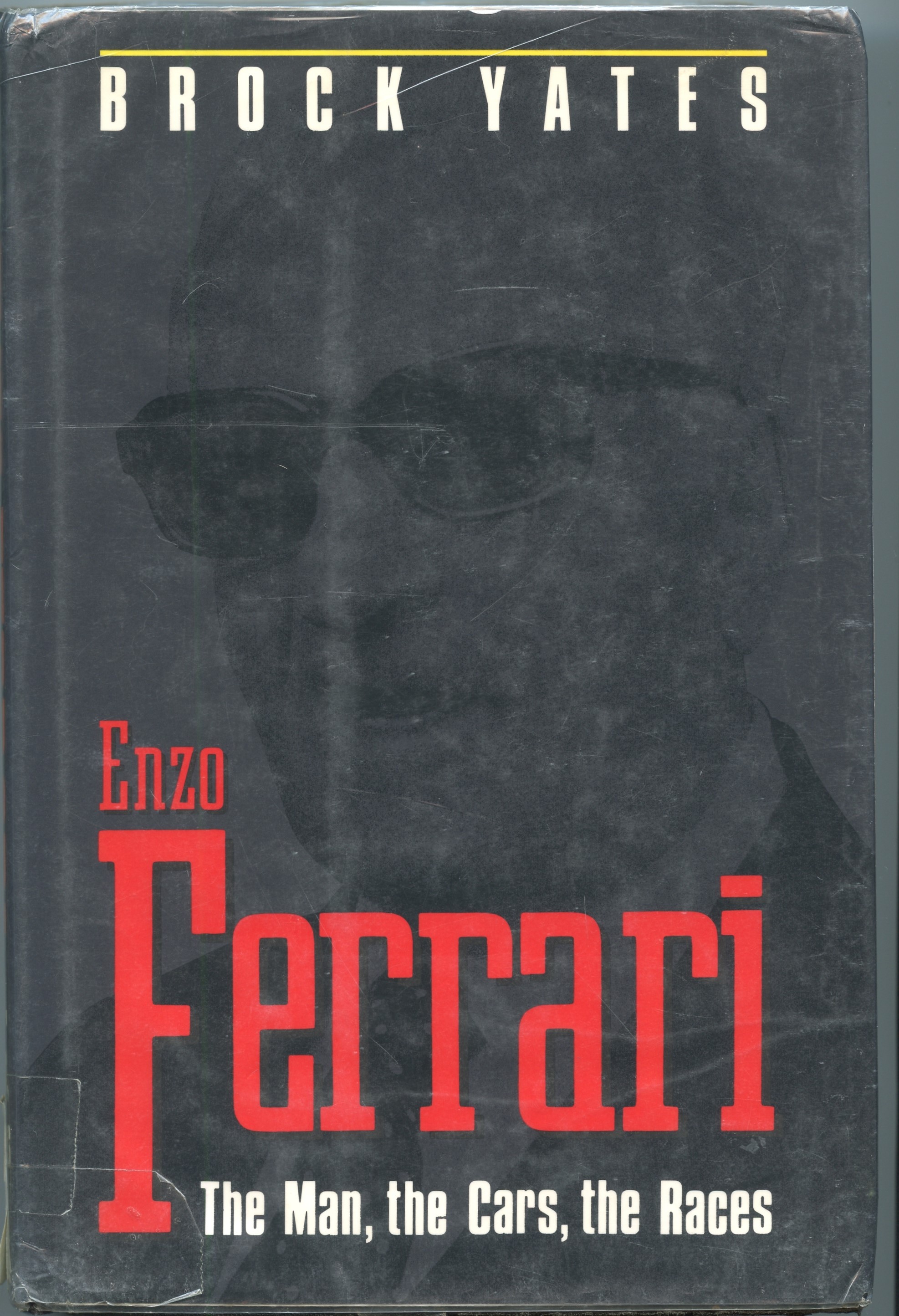
The single most fascinating aspect of “Ferrari” the movie, though, wasn’t what was shown on screen; rather, it was the screenwriters’ source material which piqued my interest. The movie is based on but one chapter from the Brock Yates-penned biography “Enzo Ferrari: The Man, the Cars, the Races”, first published in 1991, a year after Enzo’s death. I have known of this book since it was released, and had always intended to read it. Watching the movie finally provided the impetus (it was available at my local public library).

At 453 pages including endnotes, it will take you a while to dig in. Brock had a certain writing style, one that I am well accustomed to from reading his columns and articles in Car & Driver magazine (see my blog post honoring him shortly after his passing here). He loved sentences that could snake across the page with a litany of adjectives or nouns, like “a lusty man who embodied the image of the wild-living, extroverted, hard-driving international racing star”. He delighted in describing this race scene with as much excess as he could pour out: “They sailed through the twisting downhill of The Hatzenbach with the tires smoking, then hammered, eyeballs bulging and palms dripping sweat, through the terrible, blind humps of the Flugplatz. Two Rip Van Winkles hounded by the Headless Horseman, they skidded and bounced around the ghostly place, the shriek of their Jano V8s slowly being battered away by the baleful yowl of Colombo’s venerable straight-6.” Okay, Brock!

But when Yates wanted to, he could craft a narrative to bring you to the edge of your seat, feeling like you were a first-hand witness to the drama and excitement. From the Ferrari book, here is Yates’s description of how Tazio Nuvolari, driving for the Scuderia Ferrari, blasted past the favored Germans to win the 1935 German Grand Prix. (This excerpt has been edited for brevity.)

There was one final, monumental triumph for the Scuderia Ferrari before the capitulation to the German onslaught was completed. It was only proper that the greatest living race driver – and perhaps the greatest of all time – Tazio Nuvolari, should be the key to that astounding moment in motorsports.

The rise of the Germans had produced a national craze for motorsports, and by July it seemed like the entire population of Germany was descending on the Nürburgring for an event that was sure to fall to either Auto Union or Mercedes-Benz.

The front row consisted of the two Mercedes-Benzes of Caracciola and Fagioli bracketing the Nuvolari Alfa – a mechanical sandwich with a red Italian morsel pinched between a pair of sure winners. But this was Tazio’s day, and he launched the old Alfa off the line as if amphetamines had been mainlined into its fuel tank. On the eleventh lap of the huge circuit Nuvolari made a routine stop for fuel and was delayed when a pump failed and the tank had to be hand-filled from cans sloshing with gasoline. By the time he jumped back aboard the Alfa, apoplectic over the delay, he had fallen far behind into sixth place.

At this point began what many believe to be one of the greatest feats of driving in the history of the sport – a titanic driver on a magnificent racetrack facing overwhelming odds. Nuvolari seemed at this moment to ascend into another sphere of skill entirely. Even the multitudes could sense that a master was at work. He was hardly braking for the corners, those stomach-turning twists and hollows. He was charging into the bends flat out, then yanking the Alfa into a series of lurid slides, elbows akimbo, flailing madly to maintain control.

Manfred von Brauchitsch (in a Mercedes Benz) had assumed the lead in the later stages, as the other German aces had either faltered or stopped. There was little doubt that he could hold off the mad thrusts of Nuvolari – who had now, amazingly, preposterously, surged into second place. Three laps remained and Nuvolari had cut Brauchitsch’s lead to sixty-three seconds. Observers on the circuit were reporting that Nuvolari was gobbling up the distance like a berserk hare. The pressure was becoming unbearable. Could Nuvolari pull it off? One mad fourteen-mile lap remained.

The squad of NSKK troopers in black motorcycle helmets were standing by to hoist an immense swastika on a flagpole that towered over the grandstand. Meanwhile, out on the circuit, Nuvolari continued his banzai drive. The masses in the pit-row tribunes and the assembled teams heard the shocking news from the loudspeaker: “Brauchitsch has burst a tire! Nuvolari has passed him! Brauchitsch is trying to catch up on a flat tire!”

Despair. Humiliation. Defeat. Nuvolari crossed the finish line a clear winner. In the midst of his mad game of catch-up, Nuvolari had also spotted a wind-frazzled Italian flag hanging over the main press tribune. It stood in stark, shoddy contrast to the pristine red, black and white Nazi bunting surrounding it. The first words the sweating, exhausted Nuvolari spoke as he crawled from behind the Alfa’s wheel were: “Tell the Germans to get a new flag!”

Brock Yates apparently spent years researching Ferrari’s life, including multiple trips to The Old Man’s homeland, to produce an impeachable bio. He does not hold back. Many of the Ferrari faithful on both sides of the Atlantic though Enzo was a saint in life and a deity in death. The book, much like the movie, tells a very different story. But in fairness, Brock Yates devotes equal time to the great successes along with the great failings of someone who, by any measure, launched one of the most successful car companies of all time.

I enjoyed the book most of all for what it taught me about Enzo the man. Here are the major points which I either learned from the book, or I thought I knew and were confirmed by it:

Enzo Ferrari did indeed begin his automotive career by racing Alfa Romeo race cars during the 1920s and 1930s (Scuderia Ferrari). However, he was fired by Alfa Romeo in the late 1930s, and held a grudge against the Milanese company for most of the rest of his life.

Ferrari didn’t produce the first automobile (really a prototype) bearing his name until 1947, when he was already 49 years old.

For the first few decades of the company’s racing experience, Ferrari stubbornly clung to the idea that “horsepower is everything”, and all other vehicular components had little impact on the success of a race car. To quote Yates: “ A myth has grown up around the cars relating to their advanced designs, but actually Enzo Ferrari was extremely conservative and was often left at the starting gate by more creative builders (his reluctance to adopt such obviously superior components as mid-engine layouts, coil spring suspensions, disc brakes, monocoque chassis, magnesium wheels and fuel injection exemplifies his crude approach to design).”

The above ties in very neatly with what I have heard from those who have owned Ferrari road cars from the 1950s and ‘60s. One fellow hobbyist described his Ferrari thusly: “It’s an engine on a tractor chassis”.

Contrary to almost everything I’ve read over the last 50 years, Enzo’s son Dino had just about nothing to do with the development of the Ferrari V6 engine which the father named after the son. Simply put, at his young age (25), Dino lacked the education and experience to delve deeply into engine design. The book notes that Jano and Lampredi, world-famous engineers in their own right, had both been working on V6 designs shortly before the Ferrari Dino debuted, and they are given credit for its design.

Ferrari traveled very little. Once his car company started, he rarely ventured more than a few kilometers from his home base. He almost never attended any Formula 1 races; he preferred to hear about results via long-distance phone calls. His trips outside of Italy could probably be counted on one hand.

Racing was everything to him. It is certainly true that the only reason he manufactured street cars at all was to fund the racing business. He grew to detest the wealthy people who gobbled up his cars as if they were precious diamonds, even though it was their funds which fed the hungry racing machine.

It was Fiat’s takeover in the late 1960s which finally propelled the road cars into the modern era. Mid-engine placements, modern manufacturing methods, and up-to-date comfort and convenience features were first found in the mid-‘70s’ 308/328 Berlinettas and Spiders. According to Yates, Ferrari cared even less about the road cars at this point and simply rubber-stamped whatever Fiat churned out for him.

Whether you’re passionate about the Ferrari mystique or simply want to learn more about the man behind the name, I recommend both the movie and the book.