Last we left off, your intrepid garage hack was somewhere in the process of replacing the engine compartment coolant hoses, as part of a heater core replacement on his 1993 Mazda Miata. In this installment, we will provide an update on the progress of said hoses.
You may be saying to yourself, “the blog post is entitled ‘heater core replacement’, but there are nary few words so far about the actual core”. This would be an accurate observation, as in fact, the heater core has been removed from the vehicle, but I am not quite ready to begin the installation of the new part. Instead, I’m documenting the work that’s been done most recently (the hoses), and will soon be writing more about the core. At least I certainly hope I will be, as it’s almost June and I haven’t driven this car since last fall.
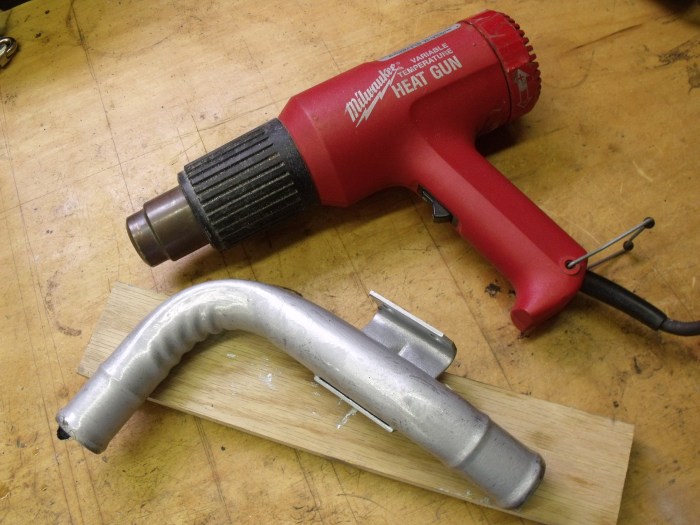
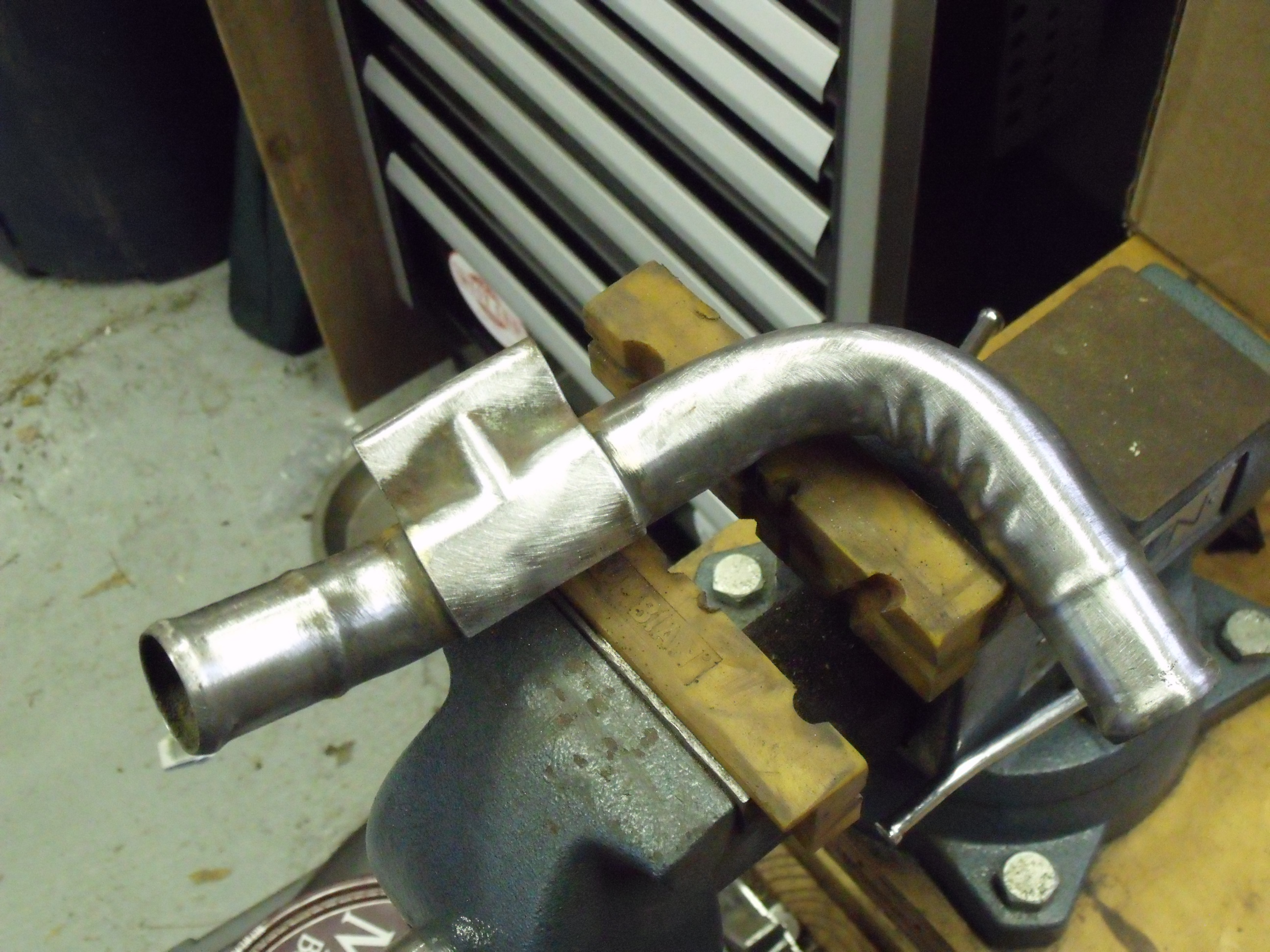
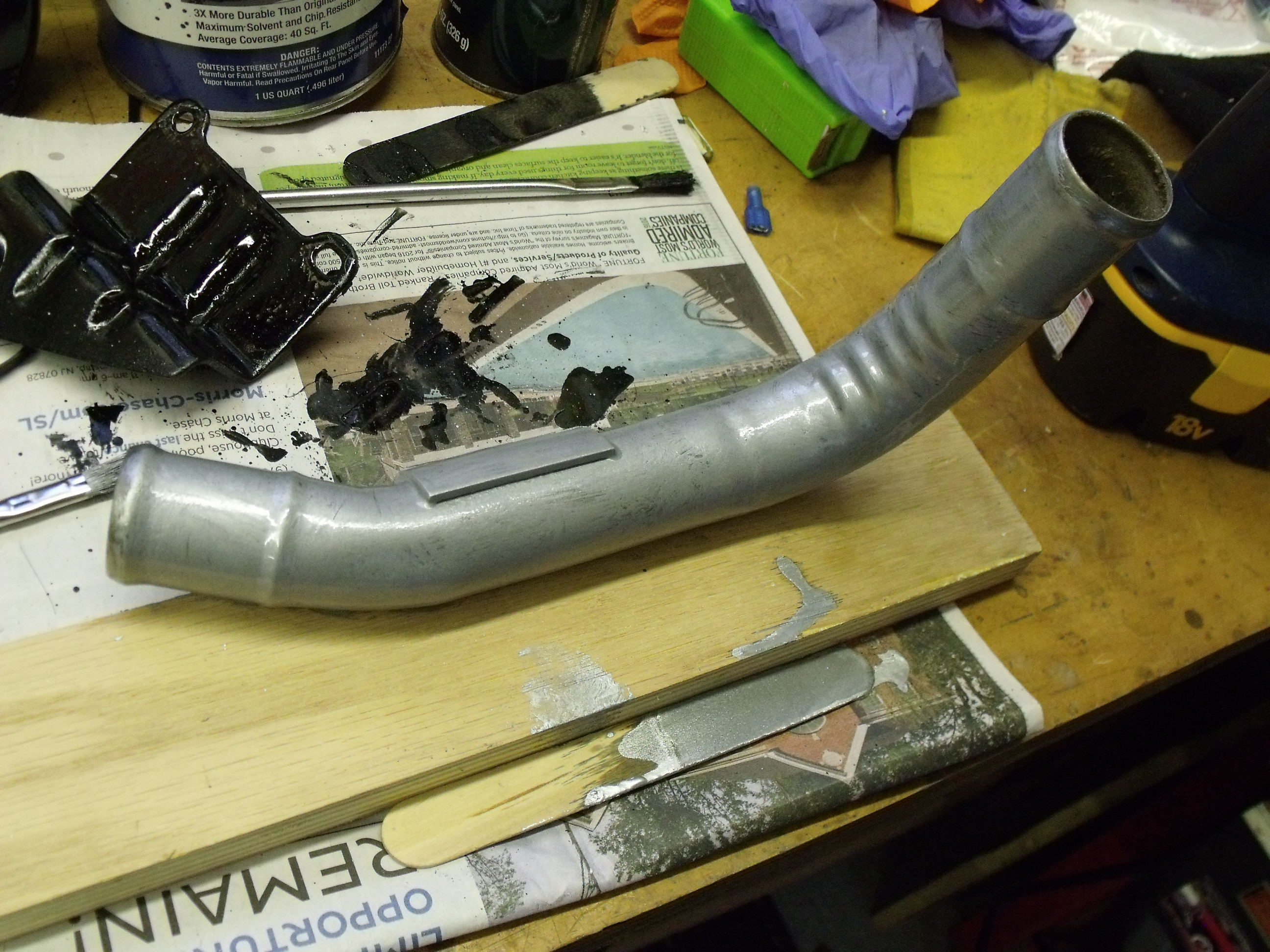
Intermediate pipe, painted with high-temp paint, was cured with heat gun
Back to the hoses. In Part 1, I gave mention to a “heater hose kit” from Moss Motors. The kit comprises of 7 hoses: 3 larger-diameter pieces, and 4 smaller-diameter ones. The larger hoses are your typical radiator-to-engine coolant hoses, excepting the fact that Mazda has a 3-part lower setup, with a rubber hose running to a metal intermediate pipe, followed by another rubber hose. But it was the 4 small ones which threw me the curve ball, as I had no idea that the car had these additional coolant hoses. As Moss did not provide a diagram, I also had no idea where in the engine compartment they were.
The two hoses, running parallel between intake and valve cover, are coolant hoses
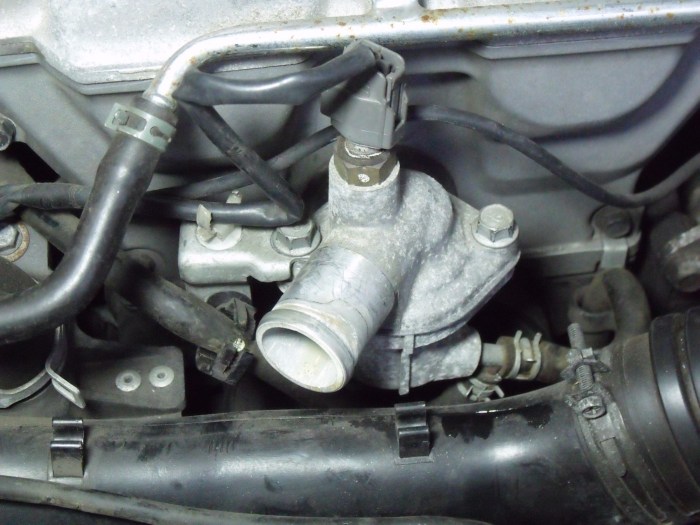
Poking around the area of the thermostat housing, I found two; the other two were over at the intake manifold. The function of these hoses seems to be to provide a “warm engine temperature” signal to the idle control and the radiator fan control. I didn’t research it further as I wanted to devote the time to getting the spring-loaded hose clamps off.
Note clamps under and to the right of thermostat housing
These clamps were not only difficult to reach; the clamps ears in some cases were rotated away from what might be the most accessible positions. It is possible that these were built up as subassemblies before the engine was dropped into the car. In any event, they had not been touched since the car was built, and I needed to get them off. Using various shaped pliers, including needle-nose, curved nose, and slip-joint, most of them eventually came loose. One clamp in particular, under the thermostat housing, was twisted back and forth until it broke off (I was very mad at it). Like many other underhood jobs, components which were in the way were removed for better access.
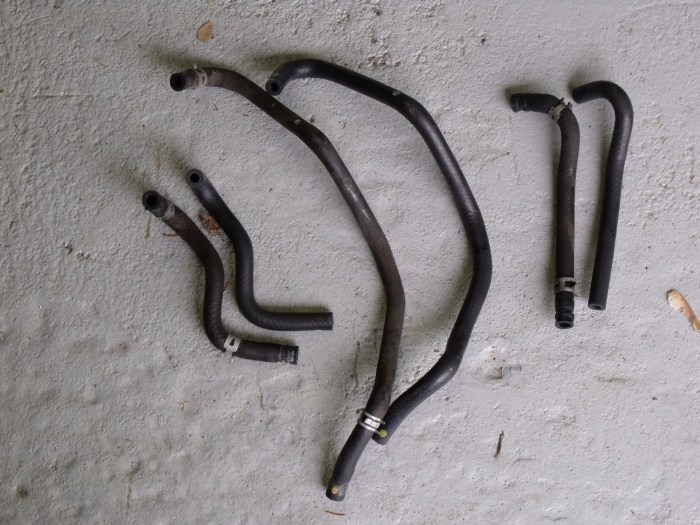
Old and new hoses side-by-side. Old ones were hard but not leaking (yet)
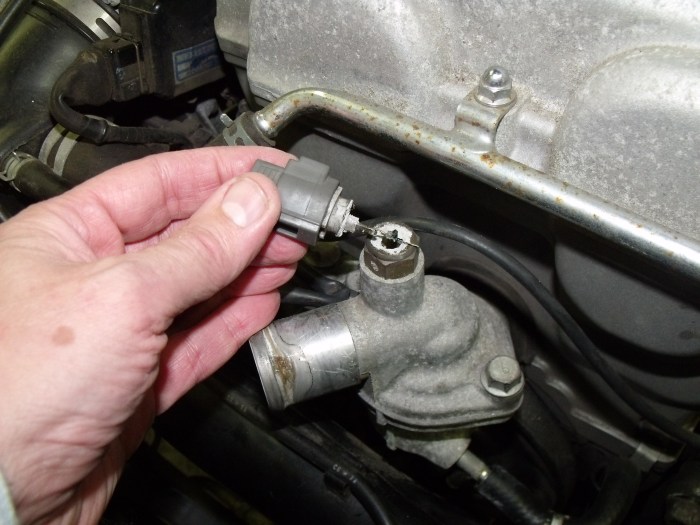
Besides the clamp which was twisted to death, there were two other casualties: the A/C-power steering belt was removed with a hacksaw, because I intend to replace it anyway; and the fan temperature sensor switch in the top of the thermostat housing fell victim to an errant wrench. New parts have been ordered and are on their way.
Switch is NOT designed to be removed in several pieces
As of today, the upper radiator hose, lower rear hose, and all four smaller hoses have been replaced. On the smaller hoses, several spring clamps were replaced with screw clamps for easier installation. With this part of the job basically done, we’re soon moving back to the heater core.
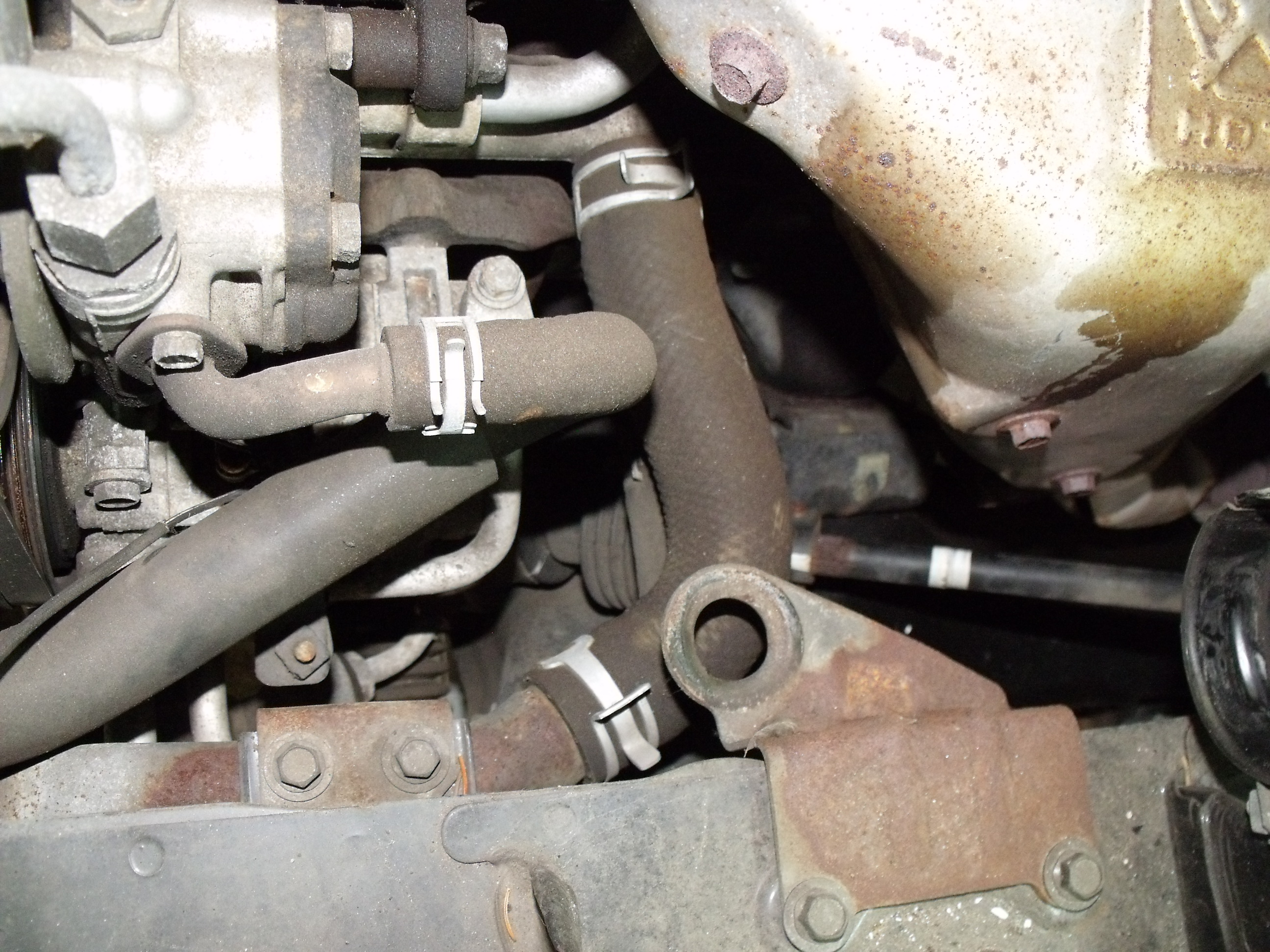
Before: rusty pipe and bracket
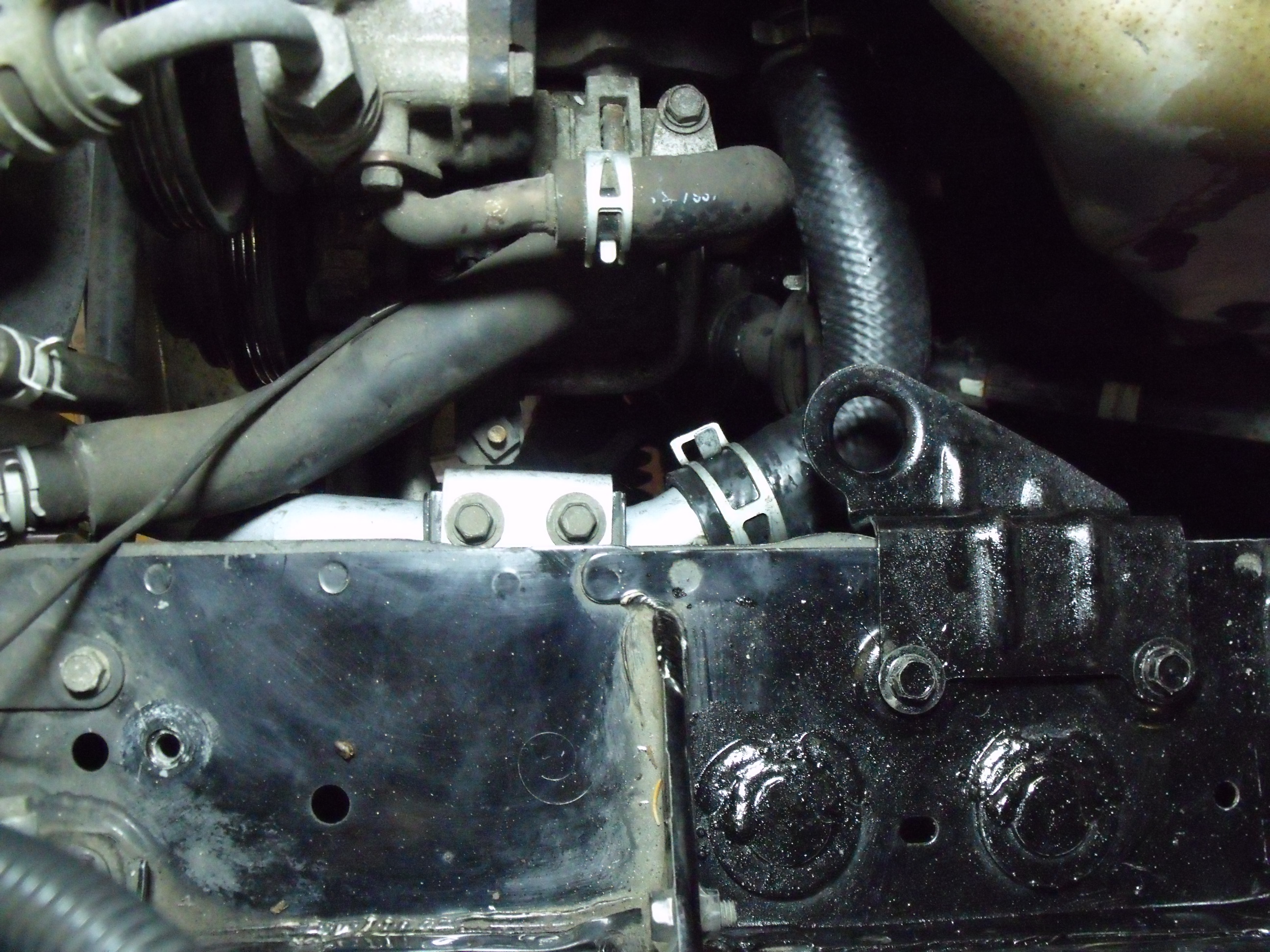
After: parts are painted, even if they will be hidden
The ’93 Miata at the 2014 Lime Rock Vintage Fall Festival
August of 2016, three months from the time of this writing, will mark 20 years that I’ve owned my black Mazda Miata. Aside from its incredible driving characteristics, it has been a typical Japanese-car ownership experience, which is to say, the vehicle has needed almost no repairs during the 65,000 miles I’ve put on it.
Of course any car needs maintenance and consumables, so tires, brakes and batteries have been changed out. The engine oil is replaced once or twice a year regardless of mileage. The typical tune-up items such as plugs, wires, and filters are changed regularly. Light bulbs? One headlight bulb went out a few years ago. The convertible top was replaced around 2002.
The upholstery, stereo, exhaust, clutch, shocks, springs, and U-joints are all the pieces which the factory installed in 1993. The R-12 A/C still blows cold, but did need one top-up (I still have 12 oz. cans of Freon). The one repair which almost put the car off the road was a leaky clutch slave cylinder. It’s a common Miata failure, and the new one took about 30 minutes to install.
However: last summer, I began to notice a slight film at the base of the inside of the windshield. At first, I chalked it up to a typical dirty window. Then I noticed that using the heater made the film cover a greater area of the glass. I swiped a finger through it, and it had an oily feel. Uh-oh, said I; could this be the dreaded heater core? Each time I thoroughly cleaned the inside of the windshield, the film came back. Even with the heat completely off, it appeared. At 98,000 miles and 23 years, I knew it was time.
Heater core replacement on ANY car is not easy. My 1968 Mustang (with factory air) got its core replaced by me, and it involved disassembling most of the dash and center console. During my brief time professionally wrenching on Volvos, I did my share of heater cores on 240s. (The Volvo 240 heater core is infamous: Click and Clack, the Tappet Brothers, had a running joke on their show, in which they said that Volvo would assemble a 240 by taking a heater core, putting it on the assembly line, and building up the rest of the car around it.)
The entire air filter box must be removed to gain access to the lower rear hose (at right)
Besides a new core, it seemed to be a good idea to also replace all the original coolant hoses. The hoses are available as a kit from Moss Motors, so with said kit in hand, I drained the system and began with the engine compartment hoses. They were all hard as rocks, and most needed to be cut off their metal pipes.
From L to R: lower radiator hose, intermediate pipe, lower rear hose
The Miata lower radiator hose does not connect to the front of the engine. Rather, it passes through a metal intermediate pipe, then another rubber hose, connecting to the engine at the rear. This pipe looked terrible, so I removed it to give it a closer look. The corrosion on it was superficial, but in the interest of longevity, it is getting cleaned and painted.
This pipe barely looks reusable
But it cleaned up with a Scotch-Brite wheel in a drill
First coat of Bill Hirsch aluminum paint
Had this from a previous project; my experience with Hirsch products has been excellent
The main hoses are off; there are 5 smaller hoses which also need replacing, and these clamps look like some knuckles will bleed. More to follow.
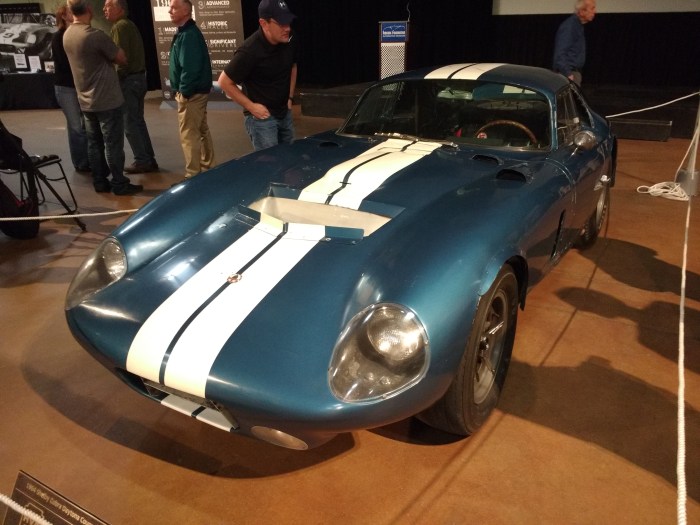
On Saturday, December 12, 2015, the Simeone Foundation Automotive Museum in Philadelphia PA hosted a special “Preservation Workshop”, featuring the Shelby Cobra Daytona Coupe (serial number CSX2287) owned by the Foundation. The gist of the presentation was that, after this vehicle spent some 30-odd years languishing in hidden storage, it was acquired by the Foundation and brought back to running, driving condition. The work to accomplish that goal was considered “preservation” and “conservation”, not “restoration”, in an attempt to keep the car as original as possible.
The star of the show awaits its start
This particular vehicle is one of only 6 Cobra Daytona Coupes built, and on that basis alone, it is an historically important vehicle. However, CSX2287 is also the first Daytona Coupe built, and the only one constructed entirely in the U.S. Most infamously, it has a long and convoluted ownership history (including, for a short time, serving as daily driver for the music producer Phil Spector). No attempt will be made here to delve into this history, about which much has been written elsewhere. Instead, this blog entry will summarize the workshop presentation, which was fascinating both for its detail as well as some of its controversial “conservation” decisions. For those interested, the Foundation’s website has this information on the car: http://www.simeonemuseum.org/the-collection/bonneville-salt-flats/1964-shelby-cobra-daytona-coupe
Various views: left front
Left rear
Right rear
The event started promptly at its scheduled time of 12 noon, with about 150-175 people in attendance. After the briefest of introductions, the mic was handed to Dr. Fred Simeone, who spoke while clicking through Power Point slides on a large screen at the front of the room. The Belle of the Ball, the car itself, sat on the floor, roped off from groping hands.
Dr. Fred Simeone works the crowd
The good doctor proved himself to be knowledgeable, well-spoken, interesting, and occasionally amusing. One got the sense while listening to him that he was actively involved in the car’s refurbishment. He may not have literally had his hands on components (indeed, he informed us that the work was performed by a restoration shop in Georgia), but he likely was helping to make key decisions.
Original tire, dry-rotted but OK for demo runs
Exotic spare tire hold-down mechanism
Fuel filler detail
The slide presentation began with the history of CSX 2287: its creation and racing exploits. Again, there is no need to cover that here. The Foundation purchased the car in the early 2000s, and since one of their goals is to maintain all vehicles in running condition, work started to make it a driver again. A rotisserie was constructed, with mechanical systems (fuel, suspension, brakes, etc.) disassembled and carefully documented and photographed. Various methods were employed to remove dirt, scale, and rust, while preserving whatever original finishes might be found. In this way, the original black paint on the tube frame was saved; so were factory markings on the engine, cooling system, even the hardware. Rubber fuel lines, obviously corroded to nothingness after such a long time, were replaced as a necessary safety matter. However, the metal ends were reused, a painstaking and more expensive approach, but one which preserved what could be saved. Almost every piece of hardware was cleaned and reused. In cases where worn parts were replaced (wheel bearings), the originals were kept and stored away.
As Yogi might have said: “Carroll must have signed it while he was still alive”
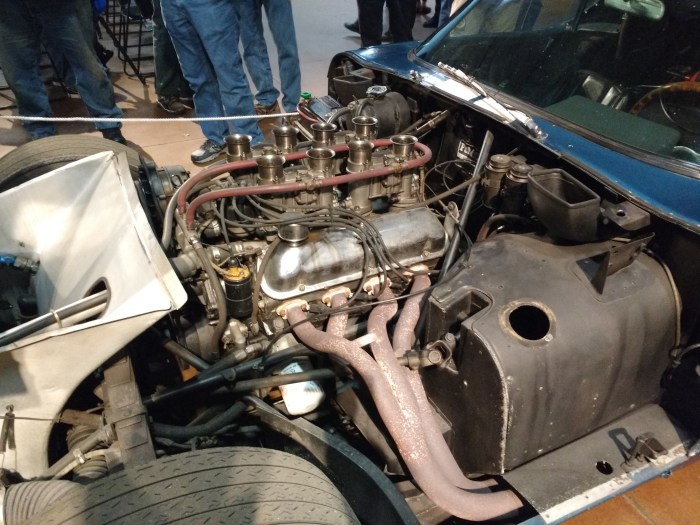
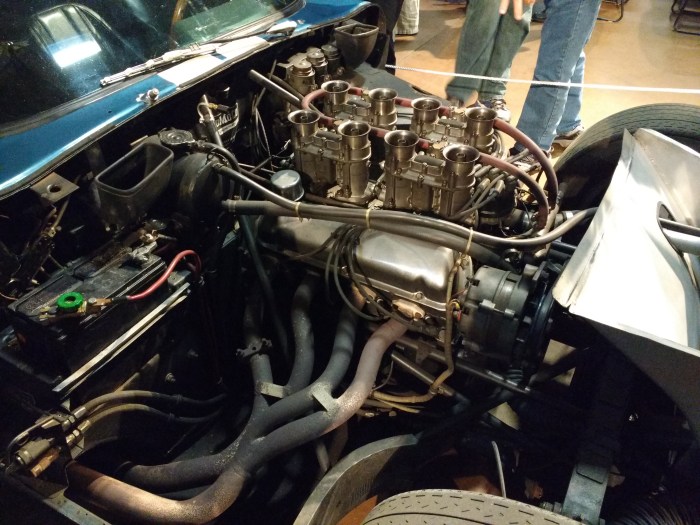
The engine, not original to the car (Shelby American installed a “spare” Hi-Po 289 into it when they sold it to a private individual in the late ‘60s), was determined to have relatively few miles on it. One controversial decision was to NOT rebuild the engine, for as far as anyone knew, there was nothing wrong with it! In fact, Dr. Fred stated that the ONLY reason the engine was removed from the frame was to replace a seeping freeze plug, a job which could not be done with the engine in situ.
Left side of Hi-Po 289- note steering shaft through header
Right side of engine- note Weber carbs
The photos below reveal that the body and paint on this Shelby were decidedly not restored. This of course, was also controversial, for several reasons. The first and most obvious is that in this hobby, “refurbished” cars are not just mechanically corrected; they are cosmetically returned to their most glamorous state. The controversy is further fueled by Pete Brock, this vehicle’s original designer. He has made it publicly known that in his opinion, the only correct “restoration” of CSX2287 is to remove its hood scoops and rear spoiler (which were added while the vehicle was competing in real races), and to repaint it in the original (lighter) shade of blue which it wore in 1964. Dr. Simeone was not shy in stressing that while he respects Pete, he disagrees with him.
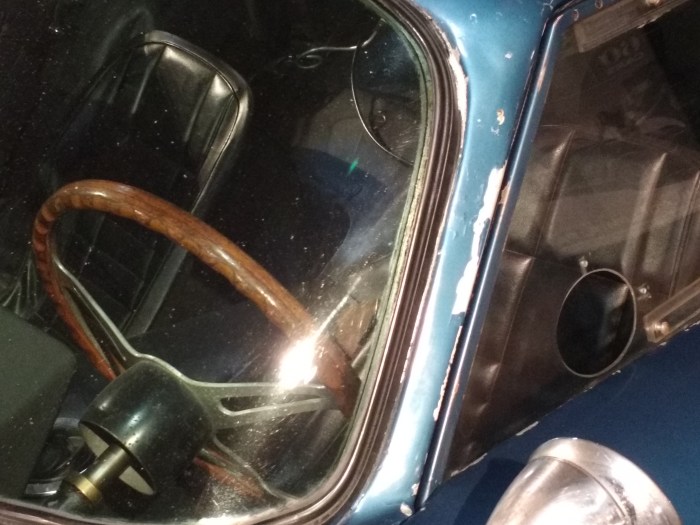
Flaking paint at left A-pillar
Chipped paint at door/fender seam
As mentioned earlier, Dr. Fred was far from boring during the hour+ he held the mic. Some of his memorable quotes from the day include:
• “A car that doesn’t run isn’t a car. It’s a statue.”
• “Restoring a car for Pebble Beach does nothing for its conservation. All it does is make you eligible to win a plastic trophy.”
• (Quoting Carroll Shelby, who was trying to negotiate the repurchase of the Daytona coupe from the woman who hid it away for 30 years): “The bitch would only talk to me through the screen door”.
• “Watch out if you disagree with Pete Brock. First he’ll argue his case with you, and when he’s done, he’ll sic his wife on you”.
Floor poster sums up an incredible history
This concept of keeping original cars original is not new to CSX2287. Those in the old car hobby began to notice a hard right turn in that direction within the last decade or so. Recent auction results around the globe have shocked onlookers by repeatedly proving that “barn finds” in some cases fetch more money than 100-point restorations. The Simeone Automotive Foundation, in 2012, published a book “The Stewardship of Historically Important Automobiles”which draws parallels between art and furniture collections (which pieces would never be stripped of their finishes) and automobile collections.
Hood up so the battery could be connected
The book does make the distinction (as Dr. Fred did today) that the concept of preserving what is original is not intended for every “Model A and Mustang out there”. Some astute writers have noted that compared to an oil portrait or a desk, a functioning automobile has moving parts which are designed to become worn, deteriorated, and consumed. Eventually, the entire vehicle is discarded. Therefore, for many vehicles selected for the restoration process, there is no choice but to completely renew all their components.
After an hour of the slide presentation and audience Q & A, the Daytona Coupe was started and allowed to idle for a minute. Slow to crank, it fired up on the second try. Expecting a cacophonous roar, the vehicle sounded docile at idle. While never to turn a wheel in anger again, this simple demonstration helped prove that the preservation efforts accomplished their intended goal.
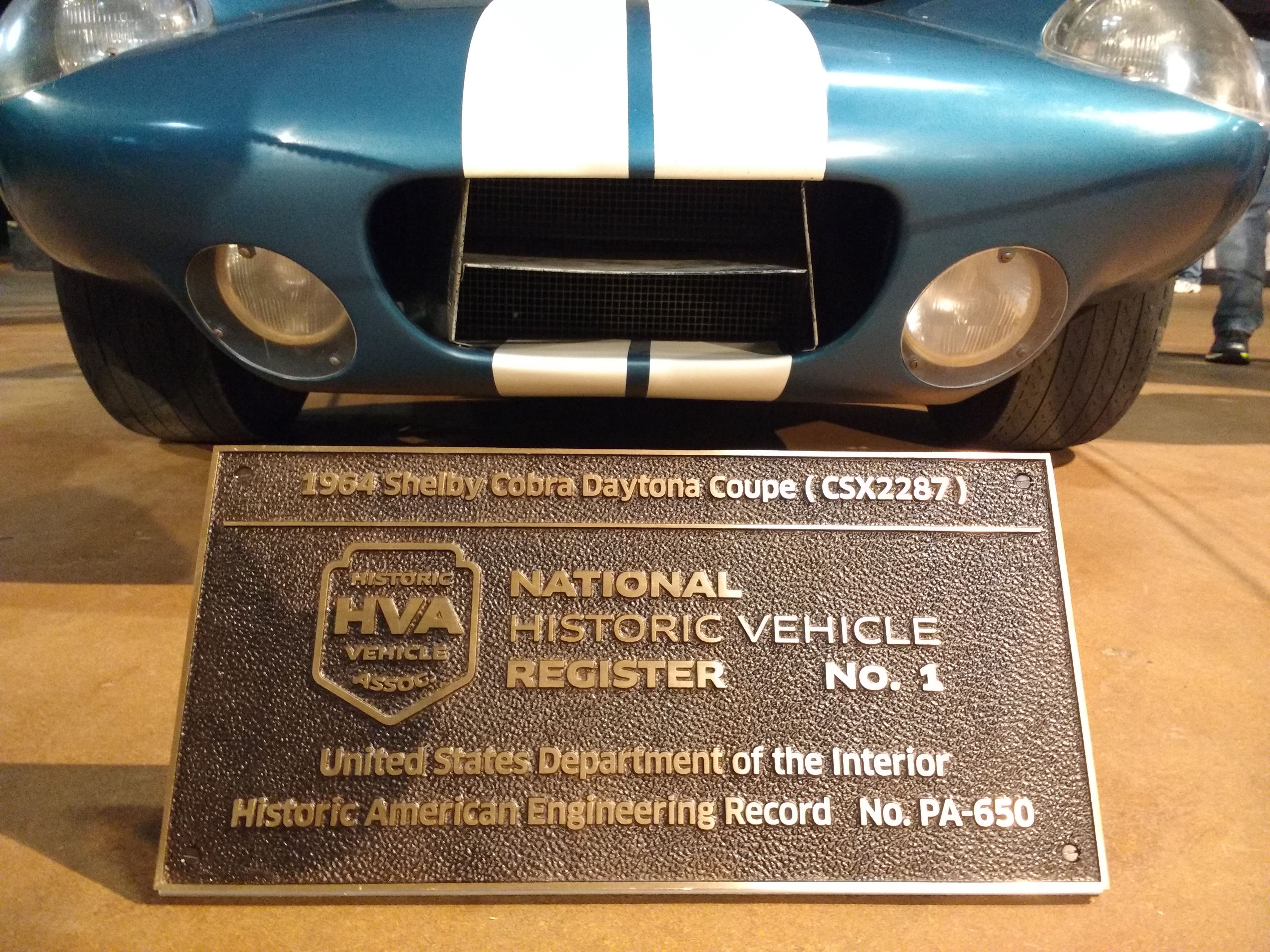
The first automobile granted historic status
More info about the HVA
A final note about this particular car and the maturing of the old car hobby concerns the National Historic Vehicle Register, overseen by the U.S. Department of the Interior. The National Historic Register has been awarding “historic status” to buildings and other architecture in this country for decades. Recently, it was proposed to extend such recognition to automobiles. This Shelby Cobra Daytona CSX2287 is the first such vehicle recognized, a massive accomplishment, and one that signifies that not only is the old car hobby alive and well, it is growing in important ways.
Comments concerning “restoration” versus “preservation“ are invited.
My friend Enzo (he signs his emails as “EC”, so that shall be his nom de plume) is a former colleague of mine from Volvo corporate. We’ve known each other for over 25 years. After I retired from Volvo in 2009, I didn’t see him again until he retired this past December, when we reconnected. Since then, he’s joined us for several of our weekend breakfast runs, but always riding shotgun.
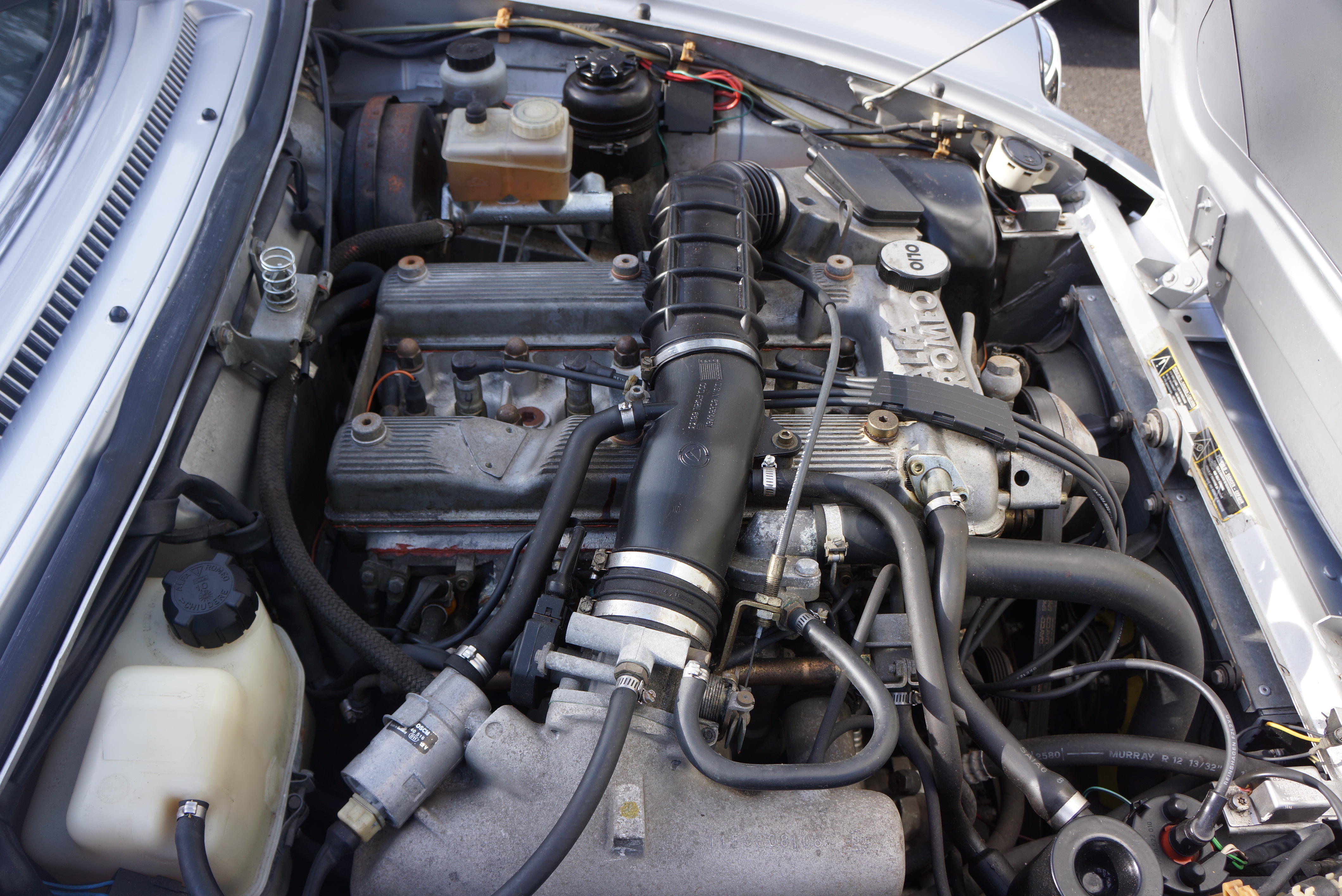
Note valve cover indentation for previous version air intake
Since his retirement, he’s talked about acquiring a toy car, preferably an Alfa Romeo. He informed me that as a younger man, he owned a Fiat 124 spider and several water-cooled 4-cylinder Porsches, and had no desire to repeat those experiences. He TRIED to buy my Alfa from me, but alas, it’s not for sale. The only Alfa GTVs in his price range are project cars, which are not where his interest lies.
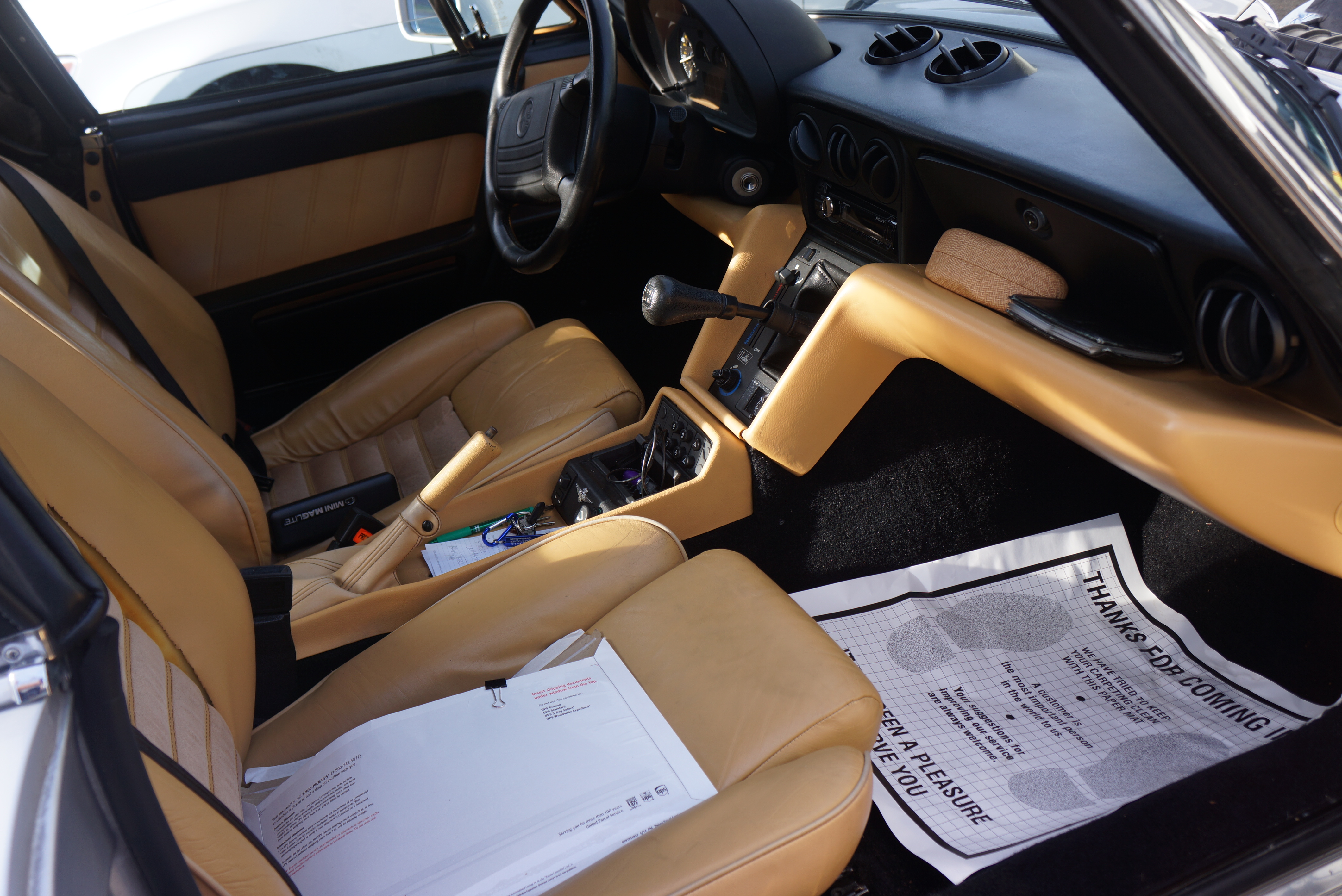
Clean interior features Alcantara seat inserts
EC put considerable effort during 2015 into searching for the “right” car. He and I talked at length about an Alfa spider. Although a convertible was not his first choice, he did finally recognize that at the present time, almost all of the “Duetto” shaped spiders, built for over 25 years without significant change, represent a good value in the collector car marketplace. Only the original dove-tail spiders, sold in the U.S. from 1966-1969 (MIA in 1968 and again in 1970 for failing to meet emission standards), were out of his price range.
VIN plate verifies that in 1991, official company name was “Alfa Lancia”
The so-called Series 2, 3, and 4 spiders, which differ mainly by fuel delivery systems and nose-and-tail styling enhancements, are available in the high 4-figure range in reasonably good condition. They also were built in sufficient quantity that dozens are on the market at any given time. As with any Italian car, rust is public enemy #1. A former Alfa corporate field rep once cautioned me: “these cars are pre-rusted from the factory”.
Company symbol “f”, company name “pininfarina”. Anyone know why? Add a comment.
Earlier this month, EC found the right car. A classic used-car dealer in Queens, NY had a 1991 spider, with a purported 43,000 original miles. Attractive in silver with a black cloth top and tan interior, there was a stack of recent maintenance and repair records, including but not limited to new Pirelli tires, new brake calipers, rotors, pads and hoses at all 4 corners, and a front suspension rebuild. The car was put on a lift and verified to be solid. EC’s assessment after several test drives was that the mileage was believable, the condition was excellent, and the price was fair. A deal was struck, and EC picked up his new toy and first-ever Alfa Romeo several weeks ago.
Washer motor and A/C accumulator only accessible from under front bumper
On the day after Thanksgiving, by mutual arrangement, EC drove the car to my house so that we could give it a more thorough going-over. While much work had indeed just been completed, there were still items requiring attention, truthfully not unusual for a 21-year-old used (Italian) car. This GT 1300 Junior owner took the spider for a spin, and overall, completely agreed with the new owner’s assessment: the car was solid, drove well, and gave us no reason to think that it couldn’t be taken for a long weekend trip right now. The few minor mechanical and cosmetic issues were not deal-breakers, and most could be tackled while continuing to enjoy the car, at least until the first snow flies.
Spider at rest
We rotated the tires, and while doing so, verified the date stamps on all the tires (good) as well as the brake and suspension work (also good). Several torn boots on steering tie-rods were noted, as well as one incorrect wheel lug nut, so a list was begun of needed parts. Just before he was about to head home, I asked EC to drive my ’93 Miata. He had never driven an MX-5, and found it enjoyable, if a bit rough-riding with 98k on the clock (the original shocks are shot and will be replaced this winter).
Tire rotation aided by fire-truck-sized wheel chocks
All 4 wheels have right-hand threaded nuts; author’s ’67 has left-hand threads on 2 left wheels
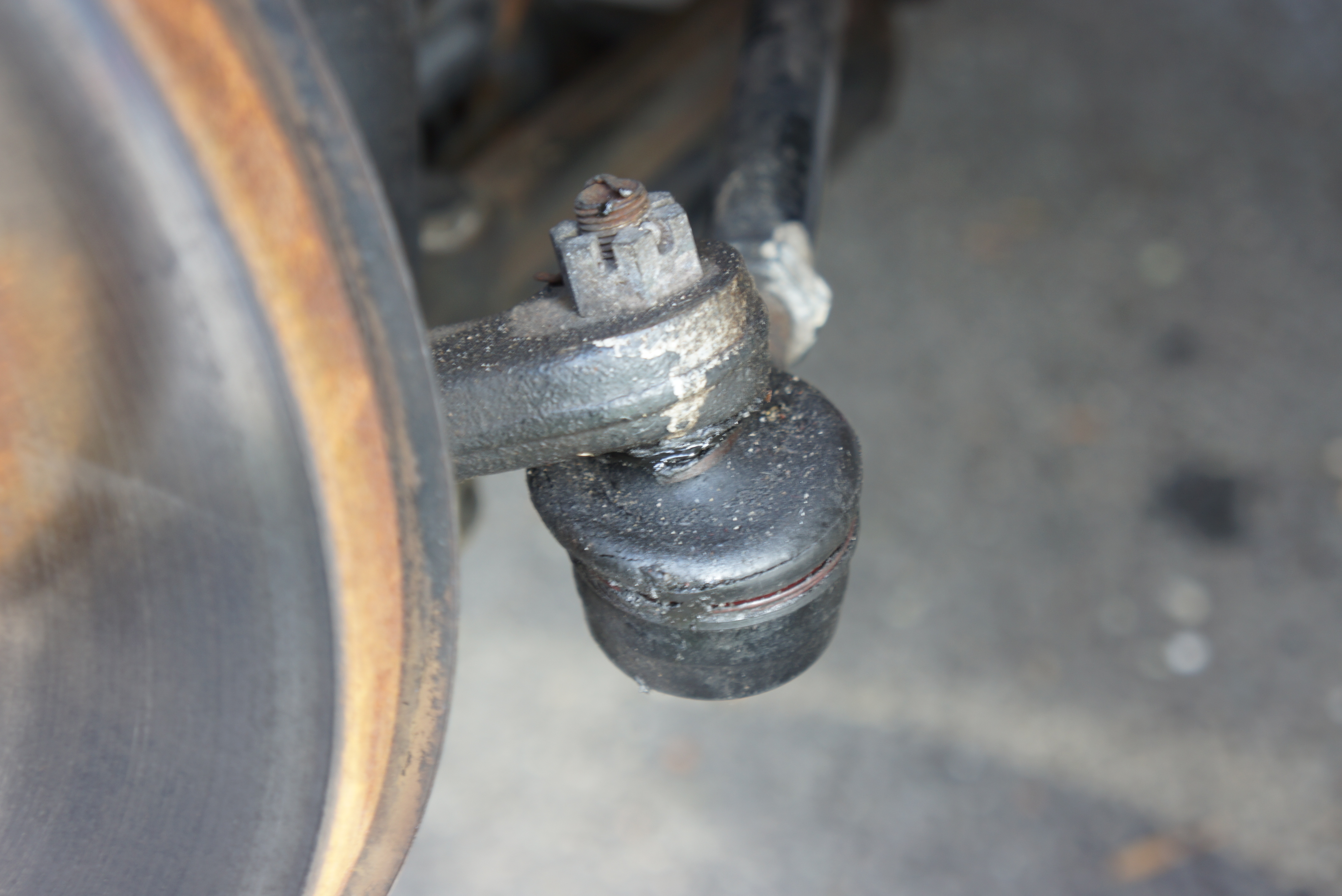
Steering tie rod end boot is torn but still holds grease
So, to my friend Enzo, I offer heartfelt congratulations on behalf of myself and the rest of our group! As you yourself would say, you finally pulled the gun. When we schedule our first breakfast run of 2016, you no longer need to hitch a ride – we look forward to seeing you there with YOUR OWN Alfa Romeo.
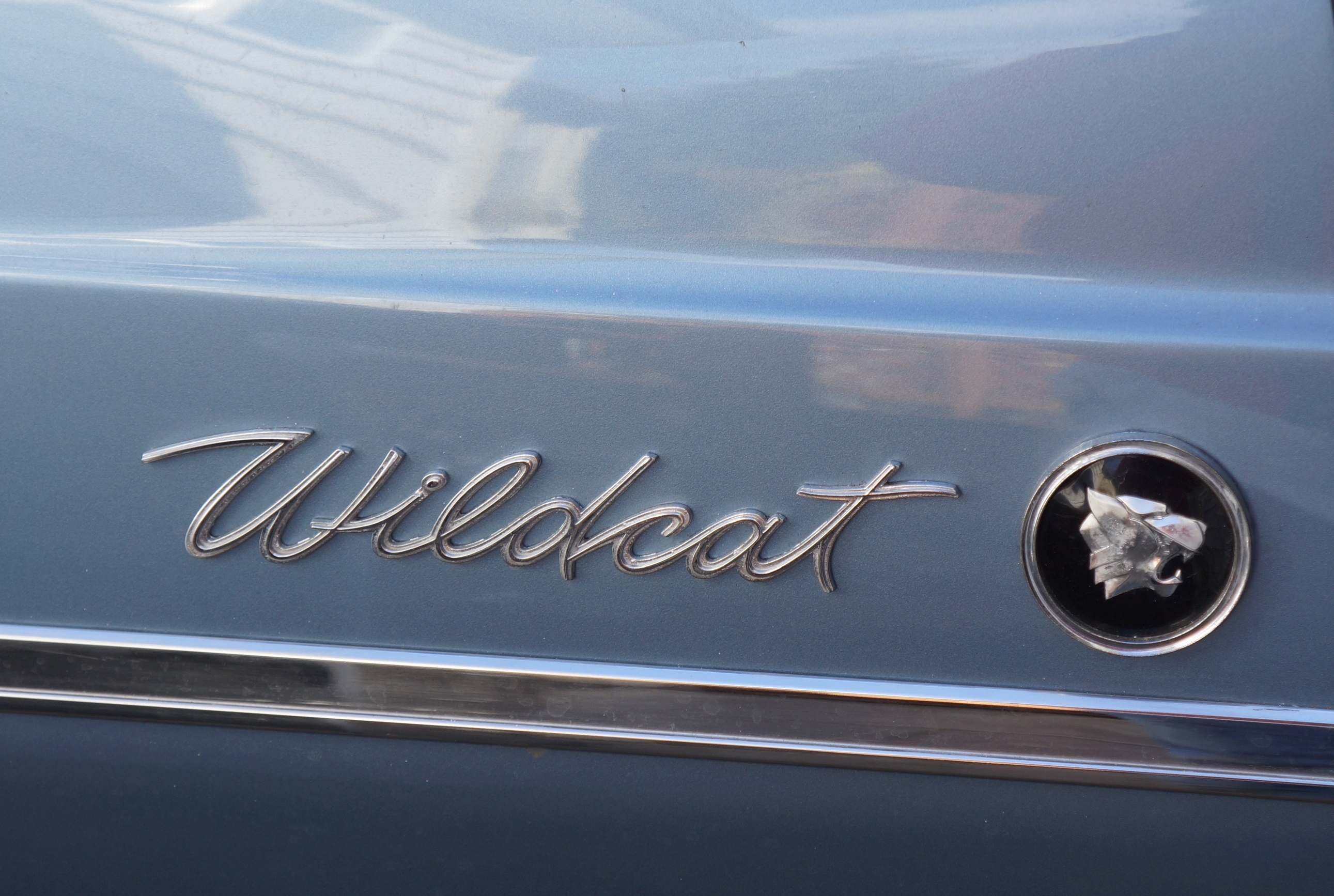
My good friend John M. owns a 1963 Buick Wildcat convertible, which he bought in 1992. Yours truly accompanied John on the trip to Staunton VA when he purchased the car, which is a whole ‘nother story (which will someday be told in a blog post, as I have PHOTOS). Fast forward to 2015: John has been slowly but steadily bringing the Buick back from the brink, and requested that Larry and I assist him in diagnosing some troublesome overheating issues, plus a rough idle/rough running complaint.
Let’s start under the hood…
We had not seen the car since John had the body and paint work completed, and overall, the exterior looked stunning. The car had also just come back from Montclair Auto Top where a new convertible top was installed, and that was looking fine. Regarding the overheating, John told us that it took a few miles of driving before the red dash light would come on (no temp gauge), yet the water pump, thermostat, and hoses were new.
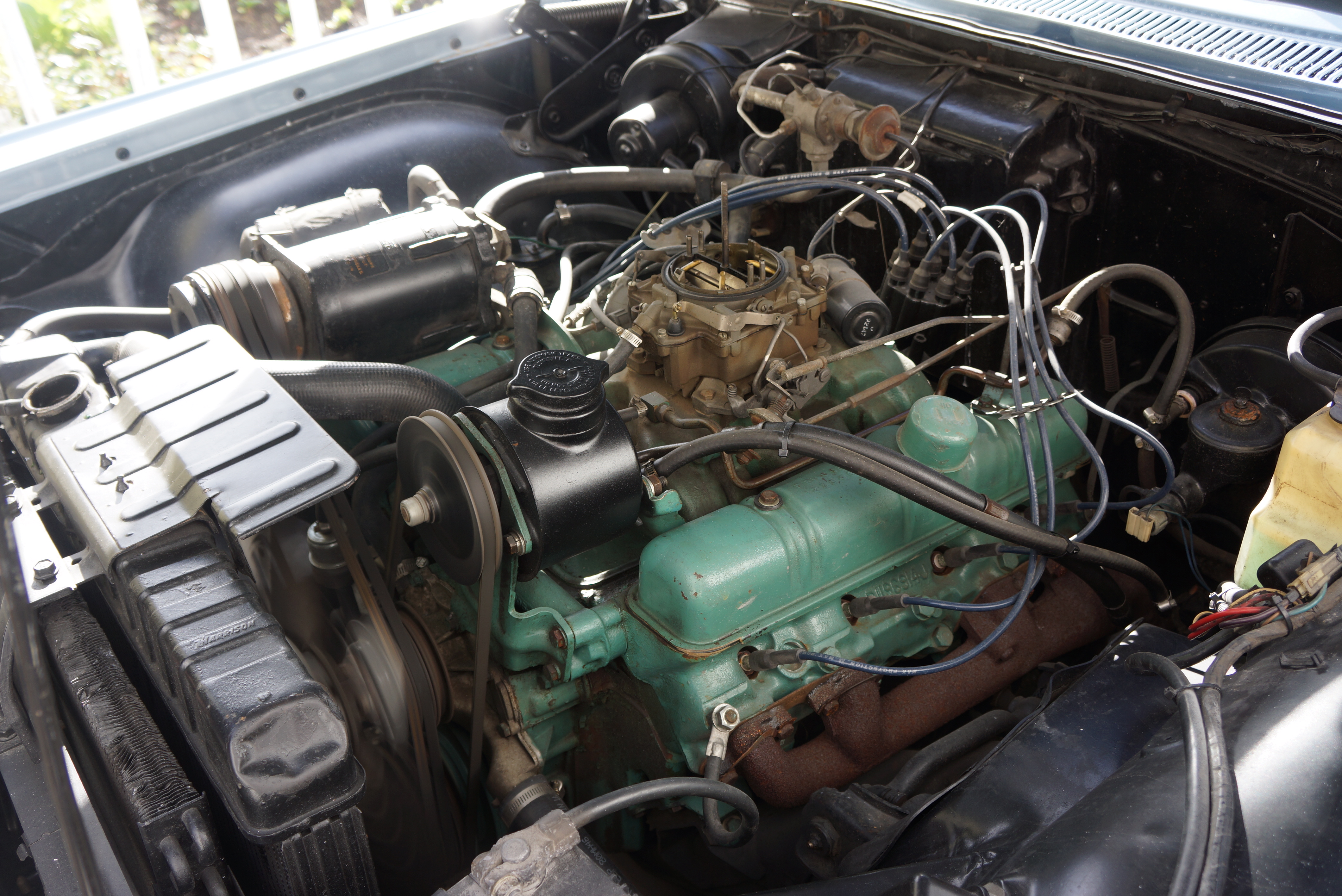
Buick 401 nailhead, with 4 barrel carb, power steering, and factory air
Examining the radiator, it seemed obvious to all that it had either never been out of the car, or, if it had been removed, it was sometime during the Carter Administration. The coolant itself looked suspect, and a hydrometer check revealed it to have minimal temperature protection. Leaving the radiator cap off, John started the car and let it warm up so that we could continue our checks.
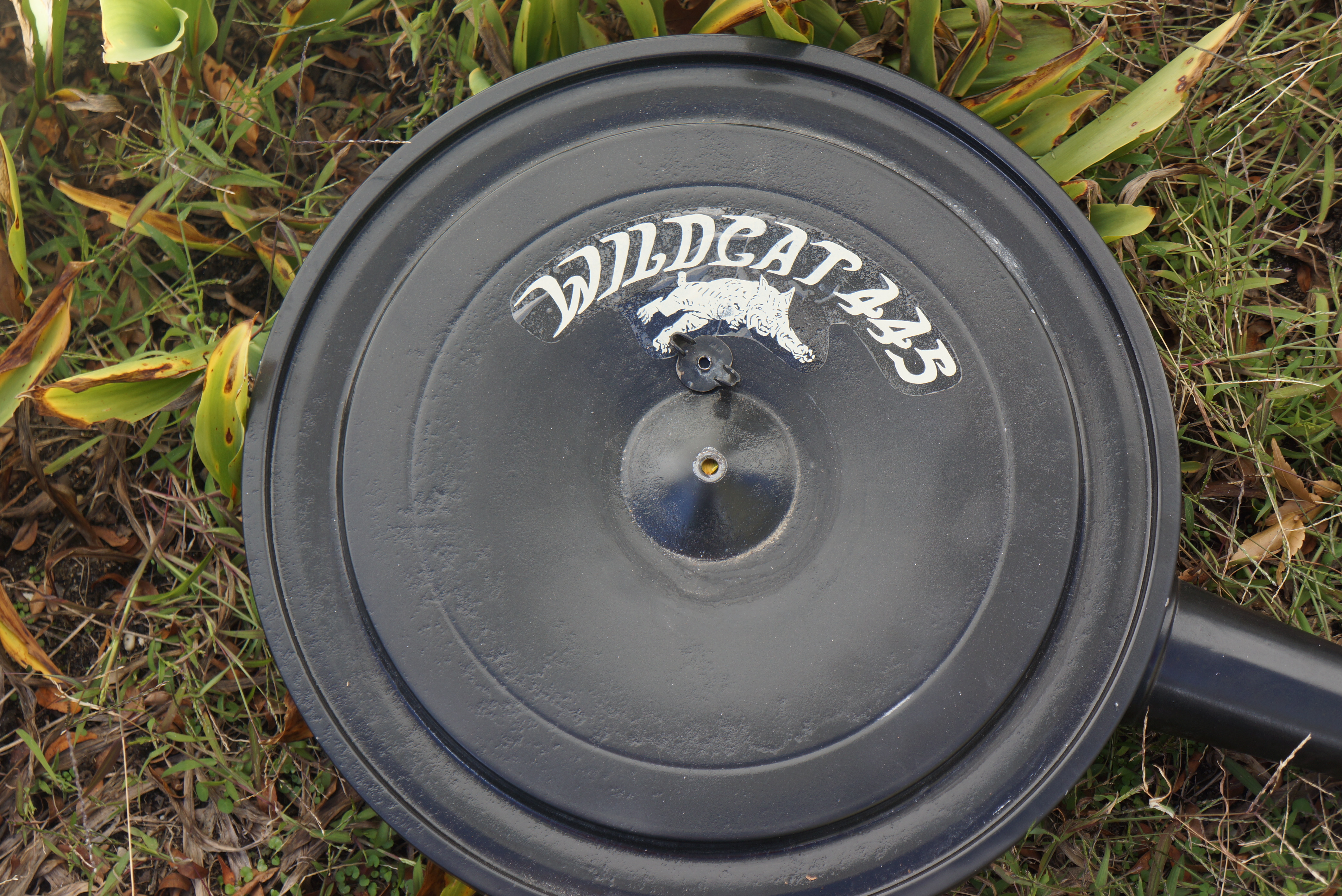
The “445” is the engine’s torque in ft. lb.
With the engine idling, Larry the Carburetor Expert began to apply his touch. First he checked the dwell and found that needed adjustment. The ignition timing was spot on at 12 degrees BTDC. But the 4V carb was running quite rich. Larry leaned out the carb mix and reset the idle to spec. John pronounced that the resulting smooth idle was the best he had experienced with the car in a long time.
In 1963, dwell and idle speed were adjustable
Back to our cooling system, we observed good flow past the cap opening, and a digital temperature gauge recorded a coolant temp of about 185 degrees, well below boiling (but keep in mind that the system was not pressurized). It took a long time for the bottom (return) radiator hose to feel warm. We still suspected slow flow through the radiator core.
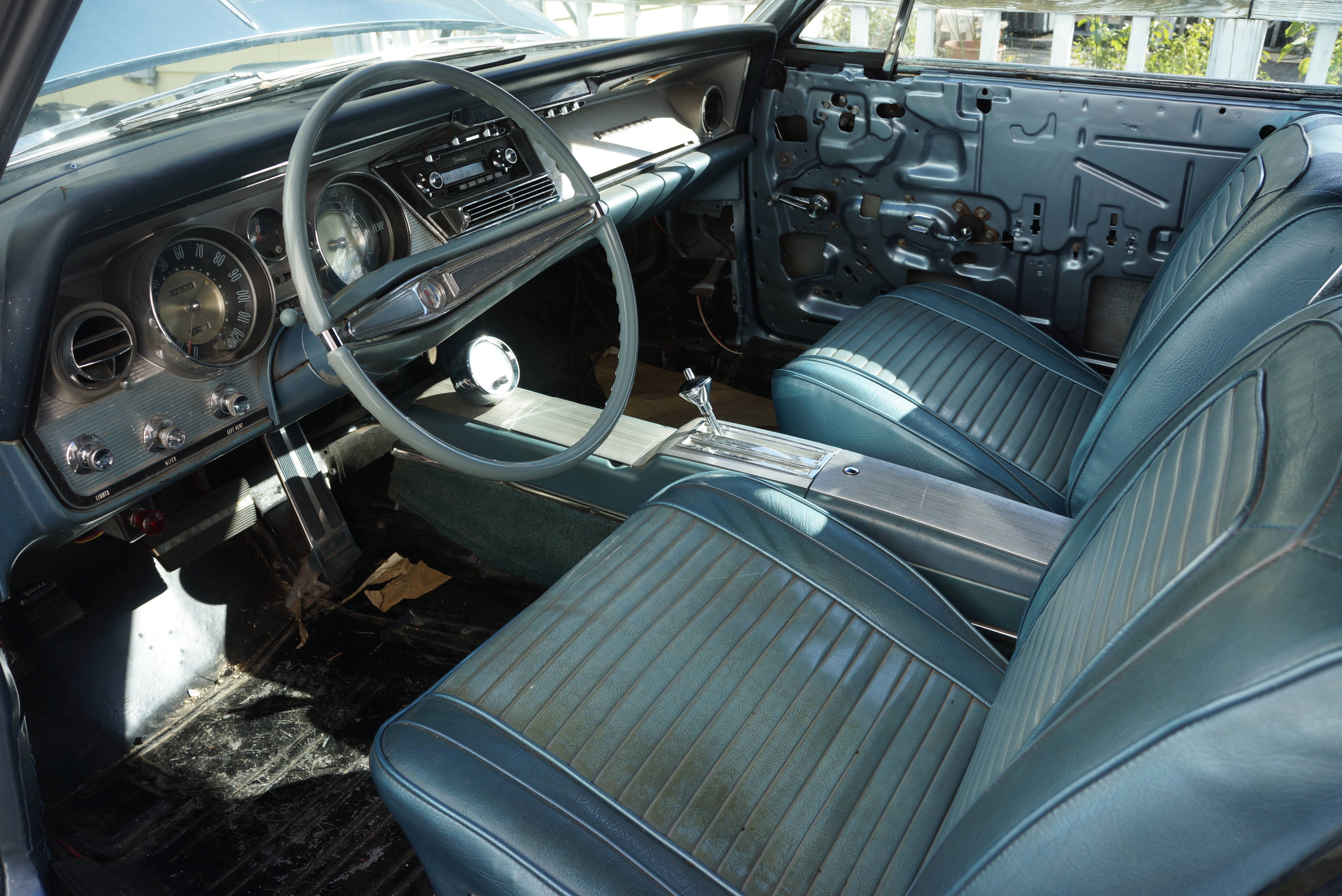
Interior is final step to be tackled; John has all the parts
Time for a test drive; with the owner piloting, the two visitors climbed in for a tour of downtown Glen Ridge. John said that the car ran stronger, and the slight hesitation/surge he felt when he put his foot into it was almost, but not completely, gone. After about a 10 minute ride, we were back at John’s house, and leaving the car to idle, we never saw the temp light come on. The daytime temperature was around 50 degrees, so to be fair, we were not duplicating the outside temps John experienced in August.
Car looks as distinctive from the rear
Our wrench work finished for the day, John treated us to bagels and coffee while we searched for Buick parts on our phones (could not have written that sentence during the Carter Administration). With driving season almost completed for the year, John said his next step may be replacing the coolant with fresh mixture. He will consider pulling the radiator, but perhaps not until first thaw of next year. As we departed, Larry and I both told him we’d be thrilled to see that big ol’ Buick on the road in 2016.
















 richardscarblog