The Taunus: Ford’s Forgotten ‘50s Compact

Yesterday was spent rummaging through several plastic containers full of my parents’ “stuff,” as I pondered (and ultimately postponed) the idea of organizing hundreds and hundreds of my mother’s photographs (which go back to the 1940s) and arranging them in something close to chronological order. The real goal is to get them into photo albums so that my family can enjoy leafing through them.

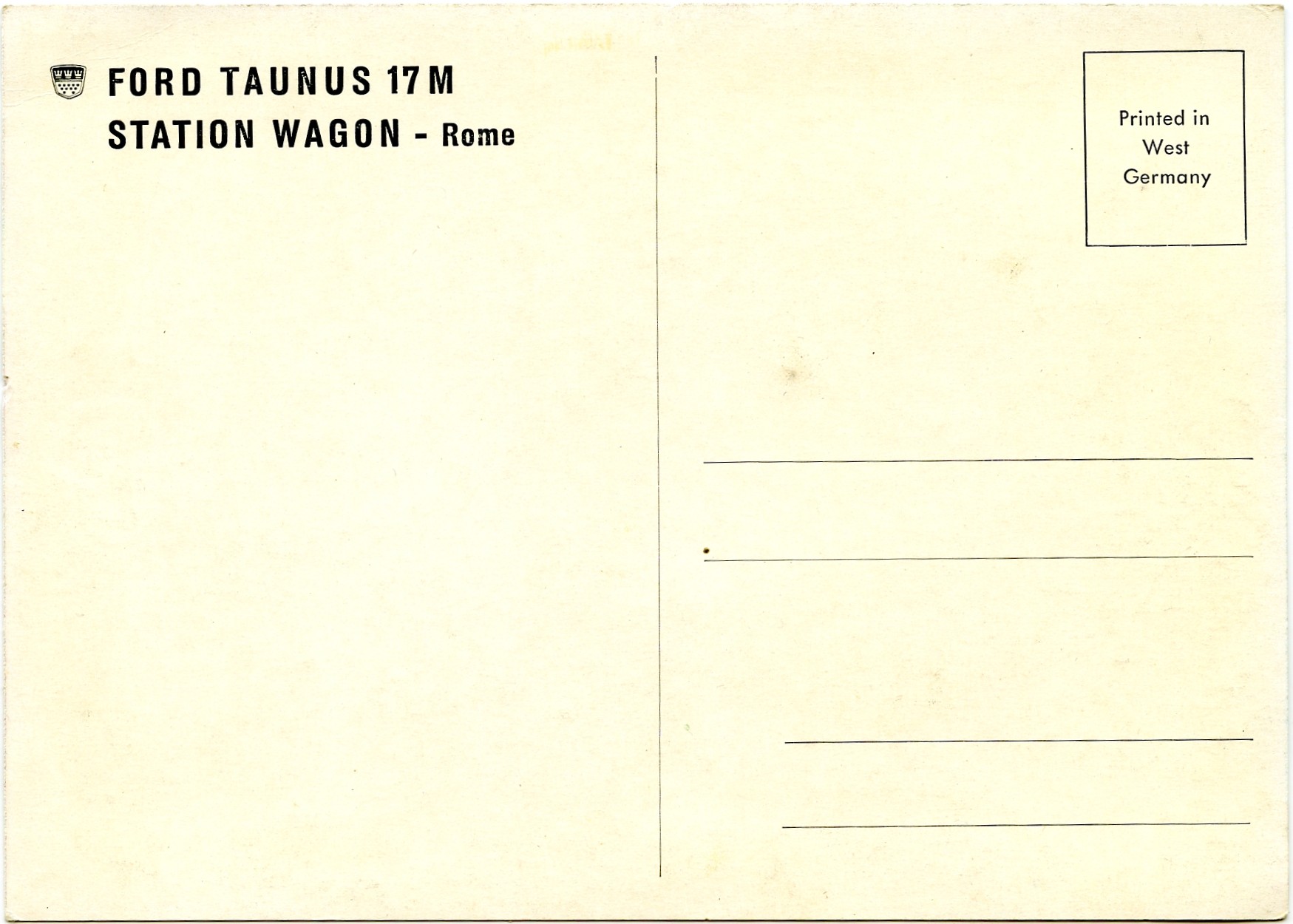
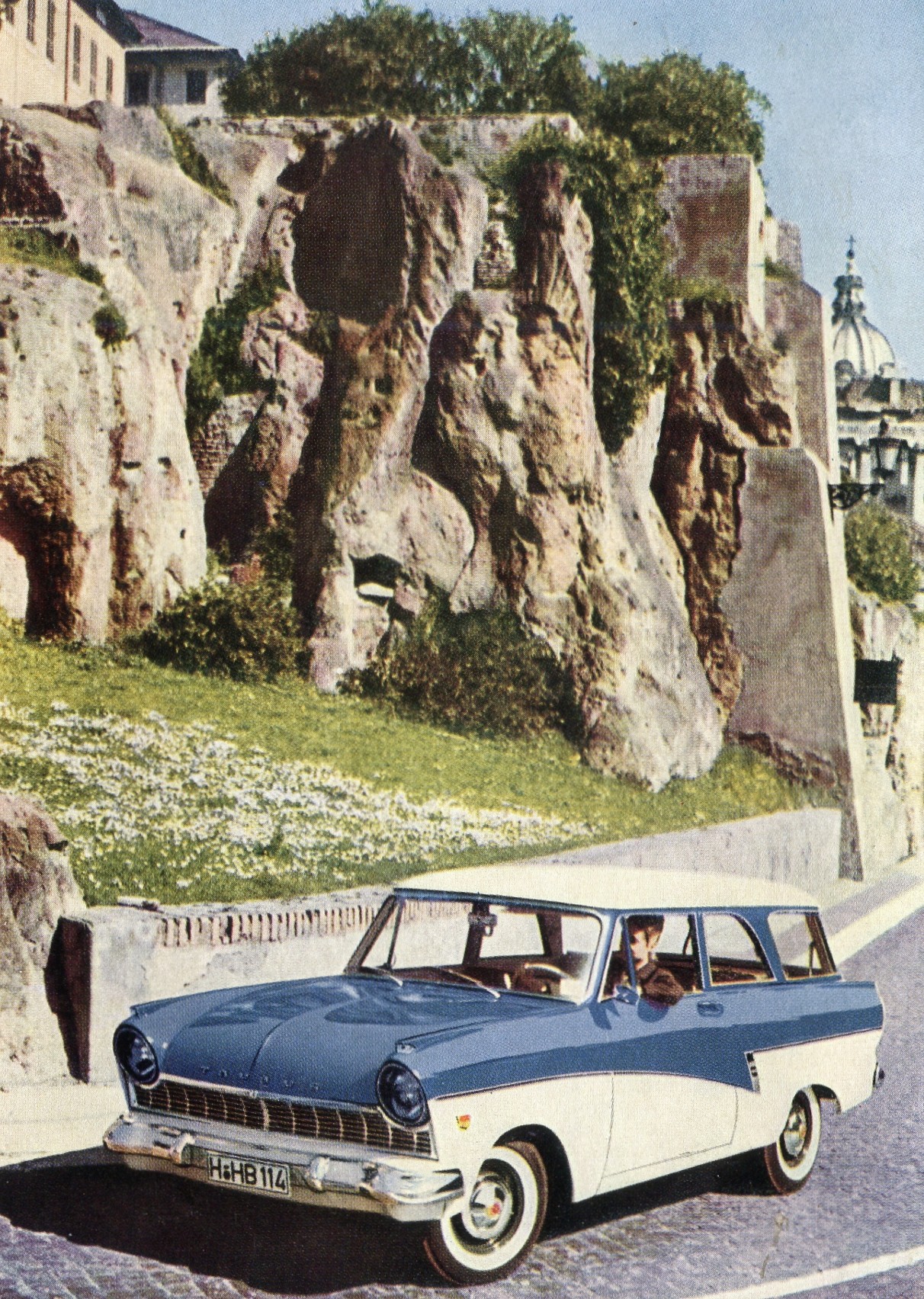
But I did (re)discover several old postcards which brought back a rush of memories. I am in possession of two of my father’s postcards, both with images of Ford’s German Taunus 17M, one car a four-door sedan, the other a two-door wagon, both cars in a very ‘50s two-tone paint scheme. (The car was named after a German mountain range. Is it a coincidence that “Taurus” differs by only one letter?) I clearly recall my dad showing these to me when I was a mere pup. Both postcards are in pristine shape, and what’s especially intriguing is the setting, as noted on the back: “Rome”. Why would Ford produce postcards of its German-built cars with images taken in Italy? Given the use of English on them, I can only presume that these were produced for U.S. dealers.
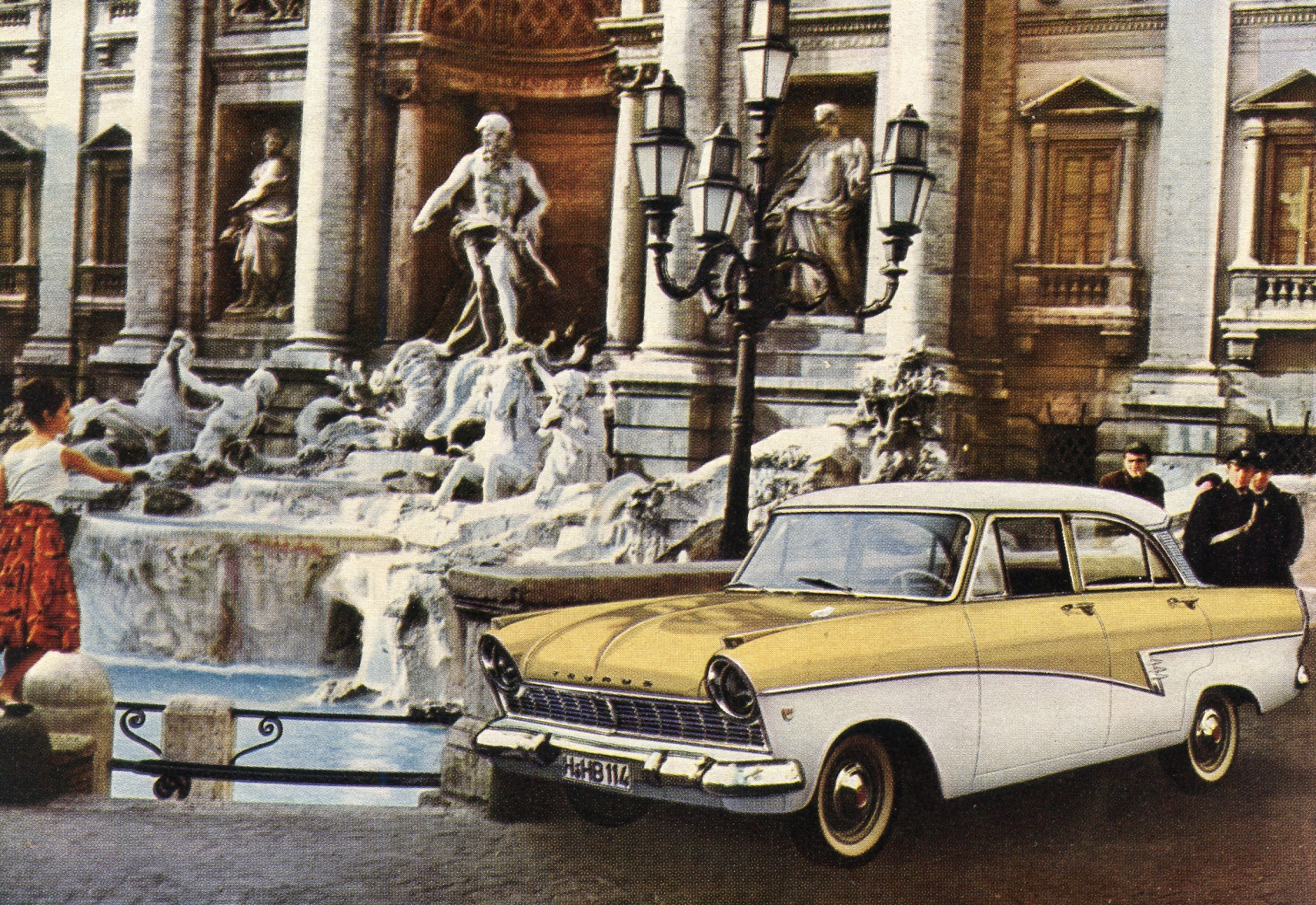
Since I know next-to-nothing about the Taunus, the reference books came out. My copy of the Standard Catalog of Imported Cars, 1946-1990 tells me that after several years of building Taunus 12M and 15M models, in 1958 the 17M model was introduced, with a larger engine and all-new styling reminiscent of American cars of that time. Out of a total of 67,772 units produced for global sales in 1958, 1,627 (2.4% of the total volume) were sold in the U.S. The 17M engine displaced 1698cc, and churned out 67 horsepower and 98 lb. ft. of torque. There were three body styles, two-door sedan, four-door sedan, and two-door wagon, each available in base or deluxe trim. Retail prices ranged from $2,017 to $2,311. The only options were overdrive or a Saxomat automatic clutch. These cars still used six-volt electrics, even though American Fords had already switched to twelve volts. The styling as illustrated in my photos remained through 1960, at which time the 17M was substantially redesigned.
As a final note, the book states that by 1961, “exports to the U.S. had diminished and Taunus was no longer listed as an official import. Not until the Capri of the 1970s and then the subcompact Fiesta did substantial numbers of Fords again arrive in America from Germany.” Of course, in model year 1960, Ford fielded its own home-grown compact in the form of the Falcon, as a two-door sedan, four-door sedan, two-door wagon, and four-door wagon. With a more powerful six-cylinder engine, and factory prices ranging from $1,974 to $2,225, the Taunus didn’t stand a chance against its domestic cousin.

Ford’s attempt to sell its European Taunus compact in the States is a long-forgotten memory for most. But as noted above, Ford would not stop trying, and General Motors (with its Opel) and Chrysler (with its rebadged Mitsubishis) would join the fray. The repeated attempts by U.S. auto manufacturers to sell imports in domestic showrooms is a convoluted story which continues to this day!
Entire blog post content copyright © 2025 Richard A. Reina. Text and photos may not be copied or reproduced without express written permission.


Book Review: “Fins – Harley Earl, the Rise of General Motors, and the Glory Days of Detroit”

Book Review: Fins – Harley Earl, the Rise of General Motors, and the Glory Days of Detroit, by William Knoedelseder

From the publisher:

The New York Times bestselling author of Bitter Brew chronicles the birth and rise to greatness of the American auto industry through the remarkable life of Harley Earl, an eccentric six-foot-five, stuttering visionary who dropped out of college and went on to invent the profession of automobile styling, thereby revolutionized the way cars were made, marketed, and even imagined.

Knoedelseder tells the story in ways both large and small, weaving the history of the company with the history of Detroit and the Earl family as Fins examines the effect of the automobile on America’s economy, culture, and national psyche.

I came across this book in my local library and decided I had to read it. If you already have the slightest interest in the history of American automobiles of the twentieth century, the name Harley Earl will be familiar to you. His thirty-year career with General Motors, from the late twenties through the late fifties, was instrumental in GM’s sales dominance at that time. With chapter titles like “The Cadillac Kid,” “The Birth of Fins,” and “The Great American Sports Car Race,” the author’s deep dive into Earl’s role within the General’s hierarchy is thorough, and keeps the reader’s interest throughout. Although I thought I knew much about the man, I discovered many interesting details about Earl’s life after reading this book.

For example, he grew up not in Detroit but near Hollywood, before that town became home to wealthy movie stars. From a young age, he did design work in his father’s carriage shop, and that expanded to sleek, one-off custom bodies for Hollywood’s new elite class. When a local Cadillac dealer sought to purchase 100 bare chassis for Earl to customize, the sales order got the attention of G.M. brass, some of whom flew to California to investigate. Once they saw what was going on, they asked Earl to create new designs for Cadillac and LaSalle. In 1926, new Cadillacs were available in three different body colors. In 1927, under Earl, there were 500 color and upholstery combinations. The newly launched LaSalle is cited as being the first car that was “styled,” thanks to Harley Earl.

Harley pioneered the use of modeling clay in the studio, saving much time in creating mockups. In short order, he was promoted to become the company’s first V.P. of Styling, and he is credited with inventing the concept of annual model year design changes. Harley was not an easy man to work for, and the book retells many stories about rank-and-file designers who were sometimes required to work seven days a week, even through holidays like Christmas. He was not beyond reducing grown men to tears, and more than one designer quit or was fired if the slightest infraction incensed Mr. Earl. Some of them outright hated their boss, but hung on because of the success of their work.

One of my favorite stories as told in this book concerns the design work for the 1958 Buicks (the ’58 GM lineup is considered a low point against what was otherwise a long series of successes for Mr. Earl). The stylists were torn between a large trim piece for the rear fender (what the book calls a “thick, five-foot long oblong configuration of chrome and stainless steel”), or a simple sweep spear, similar to what previous Buicks had used. About to break for lunch, the designers, as a matter of expediency, attached both ideas to the side of the full-size mockup. Harley happened to walk through the studio while the staff was dining. When they returned, he excitedly said to them, “Boys, you’ve done it! This rear quarter trim on the Buick is perfect. Let’s do it just like this!” To their utter horror, their boss wanted BOTH trim considerations used, and that’s what went into production.

This factory photo of a 1958 Buick highlights its rear quarter trim

Harley’s Y-Job and LeSabre custom cars were outstanding visions of what the future of car design could look like, and even better, they were fully operational. Earl regularly commuted to work in one or the other, to the delight of fellow motorists who were lucky enough to catch a glimpse.

The book does an admirable job covering the state of the industry in parallel with Earl’s history. His main competitor at the time, Henry Ford, is also written about extensively, but I found some of this coverage to be the biggest fault of the book. While it is understandable that the author would be a fan of his subject, and find ways to praise him despite his shortcomings, Henry Ford gets no such slack. Ford’s personal faults are well known: his antisemitism (the New York Times is quoted as calling Ford “… an industrial Fascist…. The Mussolini of Detroit”), his battles with his son Edsel, and his stubborn refusal to adapt new engineering, but Knoedelseder included these without offering corresponding praise for Ford’s many great achievements, giving the book a one-sided flavor. He even credits Earl with the invention of the tail fin, although the book’s text makes it clear that another designer, Frank Hershey, deserves that credit. (Hershey, fed up with working for Earl, moved to Ford, where he designed the new two-seat Thunderbird.)

Despite these criticisms, overall, I greatly enjoyed the book, and I highly recommend it, not only for fans of General Motors cars, but for anyone who desires to learn more about the history of American automobiles.

SOME EXAMPLES OF HARLEY EARL’S WORK


1934 LaSalle


1936 Oldsmobile


1940 LaSalle


1953 Cadillac


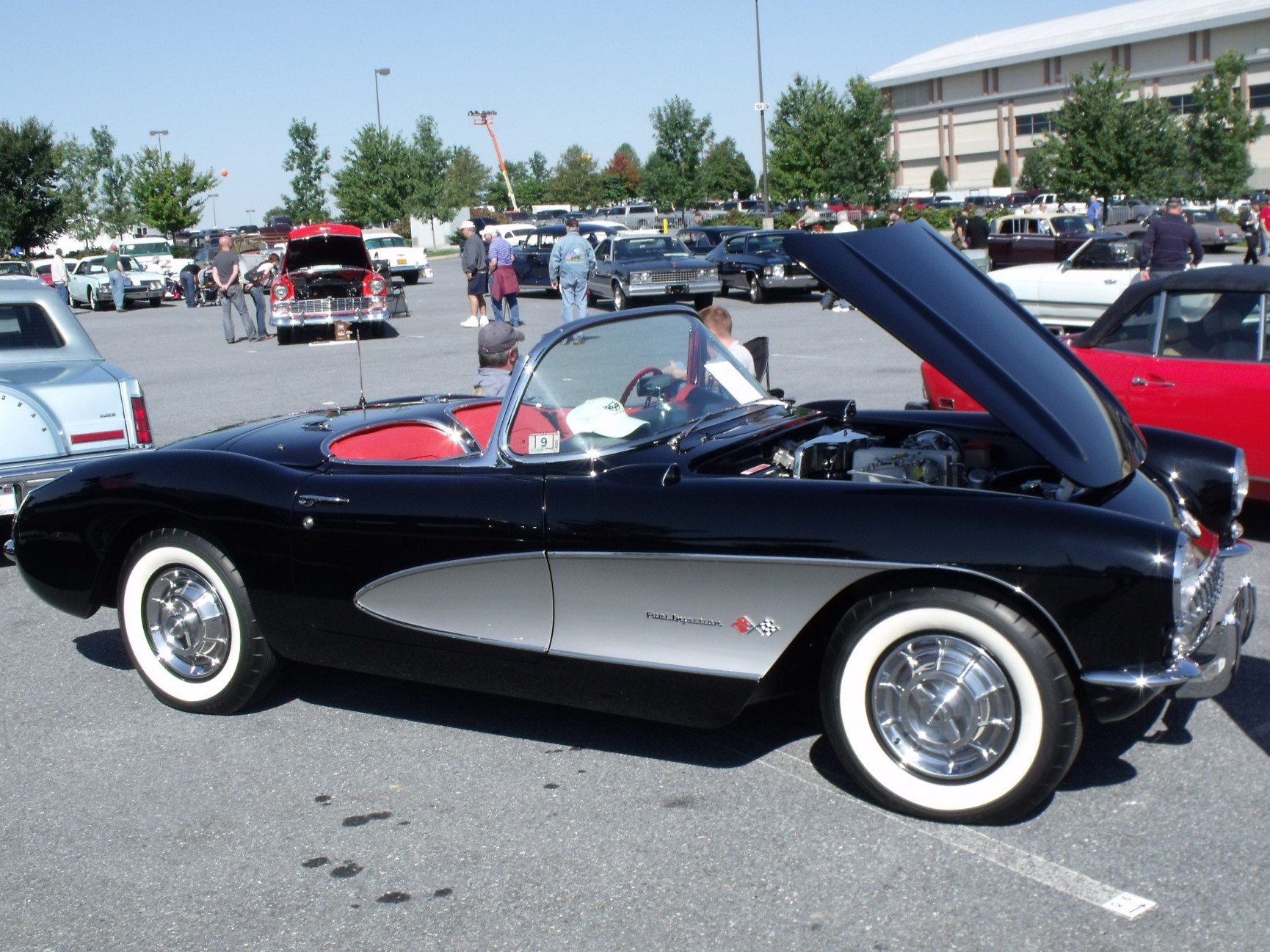
1957 Corvette


Entire blog post content copyright © 2025 Richard A. Reina. Text and photos may not be copied or reproduced without express written permission.


The Volvo 480ES: The Rest of the Story

Today, the online auction website Bring a Trailer (BaT) sold a 1995 Volvo 480 Turbo for $15,250. If you’ve never heard of the Volvo 480, you’re not alone. Even I was surprised by the number of usually knowledgeable BaT commenters who posted sentiments along the lines of “I never heard of this model!”

A few days ago, I posted a photograph of a Volvo 480ES which I had taken in the parking lot of Volvo Corporate Headquarters in NJ, sometime in early 1987. I added a comment of my own at that auction, and posted a link to the photo, promising that I would flesh out the story, as I have below.

I started working at VCNA (Volvo Cars North America) in October of 1986. My recollection is that I spotted a Volvo 480 in and around the corporate industrial park within my first few weeks. I also recall meeting Bob Austin, head of the Public Relations Department for the company, around the same time, and his ‘company car’ was a 480ES! It may have been the only one the company had, or they may have been others, of that I’m not sure. But it was well-understood among the employees that VCNA intended to begin importation of this Dutch-built car, planning on a 1987 launch. Volvo dealers had been clamoring for a less-expensive model, and management thought that this new 480 could be it. In 1986, VCNA was selling 240- and 740-series models, carrying MSRPs between $15,000 and $21,000. (The 760 models were more expensive still.) The 480 would need to slide in under that to make sense.

Not only was the 480 Volvo’s first FWD car; if imported, it would become the first U.S. Volvo brought in from Volvo BV, based in Holland. The factory was co-owned: 30% Volvo, 70% the Dutch government. As an insider, I sensed that there were some concerns: Would it be perceived as a “true” Volvo? Would it be up to the same quality standards as the existing U.S. models? Would the new FWD technology be embraced? (Some of the company’s marketing in the 1980s bragged about our RWD powertrain.) And perhaps most importantly, could it be priced below the 240s, but also at a number which would make it competitive against other like-sized models?

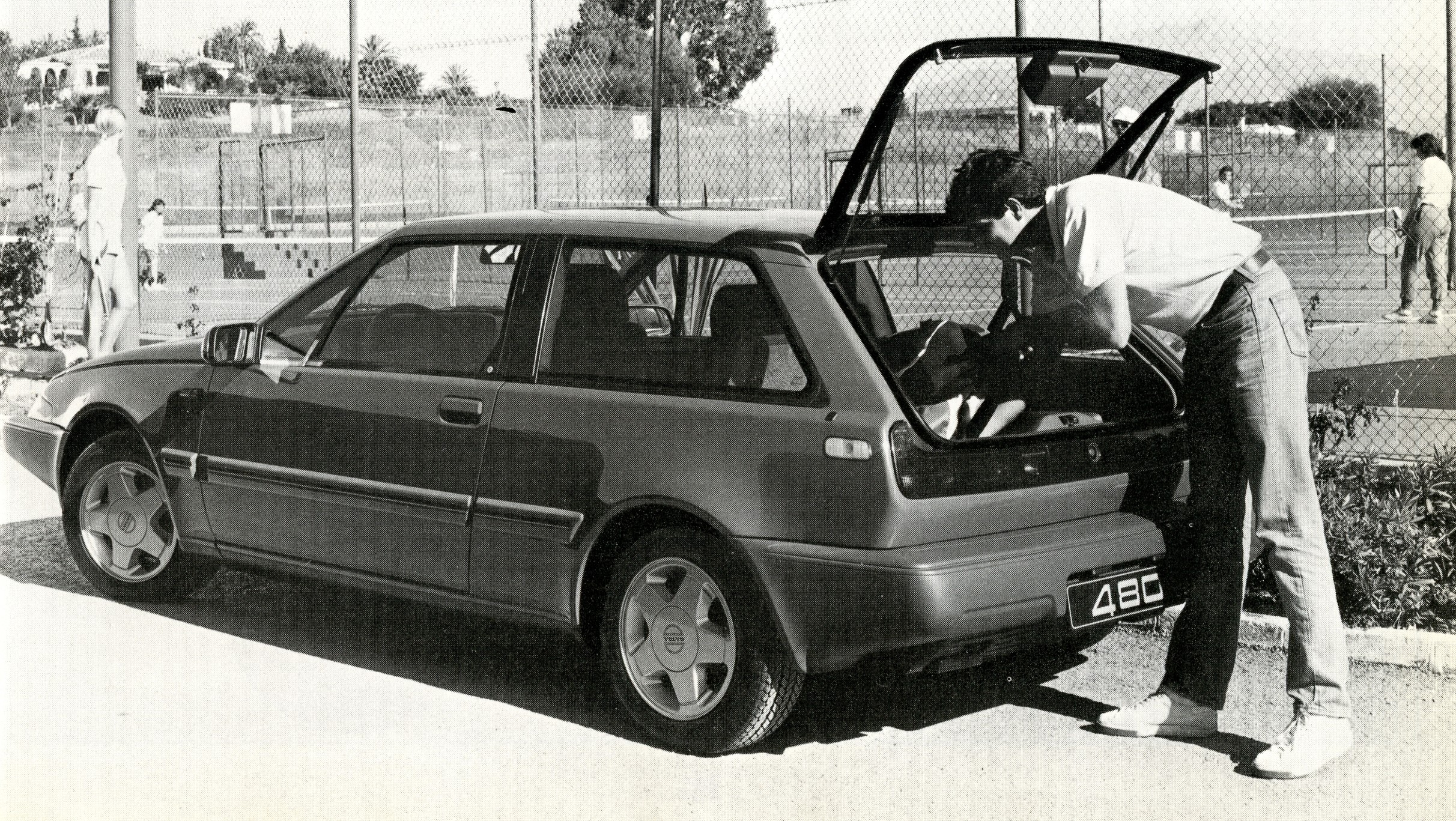
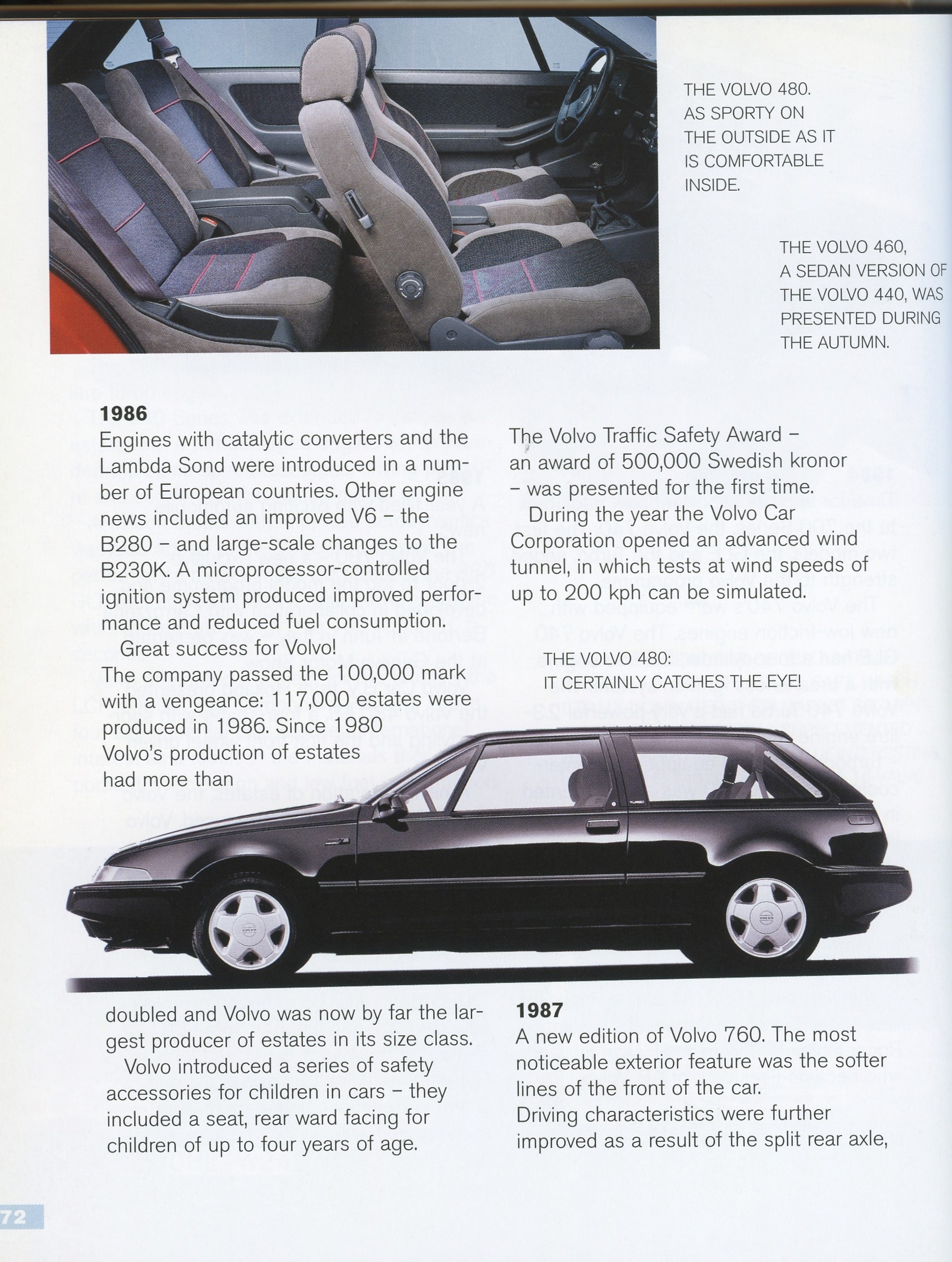
My copy of the book “Volvo The Cars – From the 20s to the 80s”, by Bjorn-Eric Lindh, was published in 1986. Interestingly, there is a two-page spread on the 480 (b&w images below). The book’s text states in part:

“Given Volvo’s world-famous reputation for quality and durability, the new 480ES is almost certain to become a major competitor in its class, particularly in the USA…. Initially, annual output will total approximately 35,000 units, 25,000 of which will be destined for the American market.”

Those are heady numbers, given that during the years 1987 through 1989, U.S. Volvo sales totals were between 98,000 and 106,000, meaning the 480 would represent 25% of that. However, after months of planning, VCNA management realized that the exchange rate would be a roadblock to any plan to sell the 480 at the right price (at least that was the official line as spelled out in the letter sent to all U.S. Volvo dealers).

From an internal Volvo publication in my collection

America would have to wait until model year 1993 for the launch of the all-new Volvo 850, our first FWD car, and one designed and built in Sweden to boot. In the meanwhile, the 480 sold respectably well in Europe. I have a Volvo internal publication which states that the 480 existed from model year 1986 to model year 1995, and that the company built 76,375 of them (making that earlier prediction a bit of a stretch!). I suspect that Volvo felt the car was a success, and despite its Dutch parentage, it likely gave the company some needed experience in FWD technology.

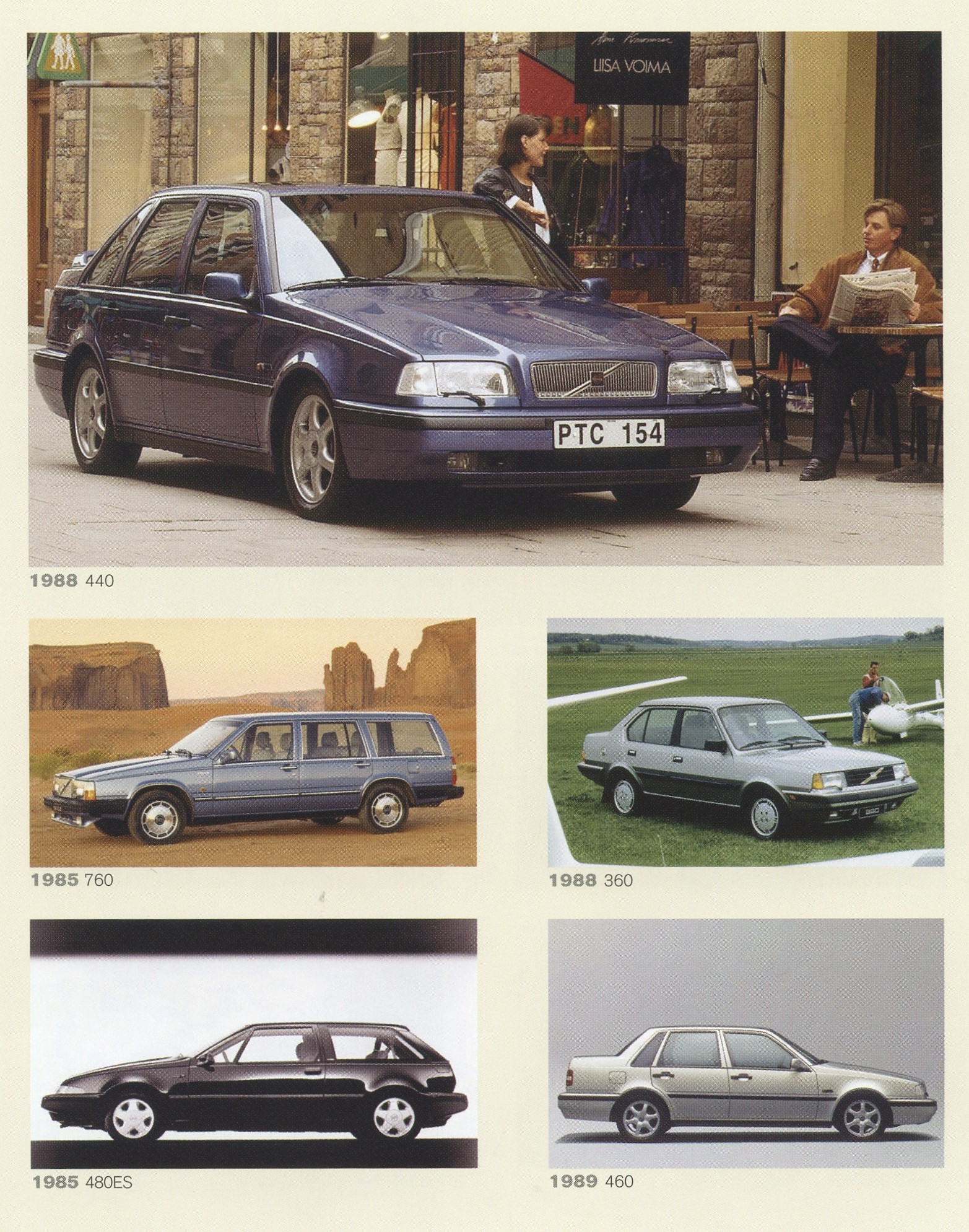
This page, also from an internal book, shows how different the 480 is compared to other Volvos.

If any of my fellow former-VCNA colleagues have any additional recollections (or corrections), please share them!


All photographs copyright © 2023 Richard A. Reina. Photos may not be copied or reproduced without express written permission.


BACK TO PRINT: Selections from the 1958 “International Auto Parade” Book

I’ve long enjoyed collecting automotive print publications, although perhaps I should switch to making that statement in the past tense, as I’ve reached critical mass on the shelves of my home library. First, there is the collection of Car & Driver magazines going back to the 1950s through the present. Then there are the hardcovers; much of my time at Hershey over the last 20 years has been spent scouring the flea market for titles to add to the collection. My wife often asks what I do with all these publications, and the truth is, I frequently pull one off its shelf and breeze through it. So it was with the book I am presenting here.

The book I am featuring this week, though, was not purchased by me, instead, it was gifted to me after it was uncovered by someone who thought I would enjoy it. The aptly titled “International Auto Parade, Vol. II”, was published in Zurich, Switzerland (interesting because that country does not have a native auto industry). It does an admirable job covering all the new vehicles available around the world. All the U.S. makes are there, as are cars from unexpected countries such as Czechoslovakia and Russia. To top it off, the text is in 6 languages: English, German, French, Italian, Spanish, and Portuguese.

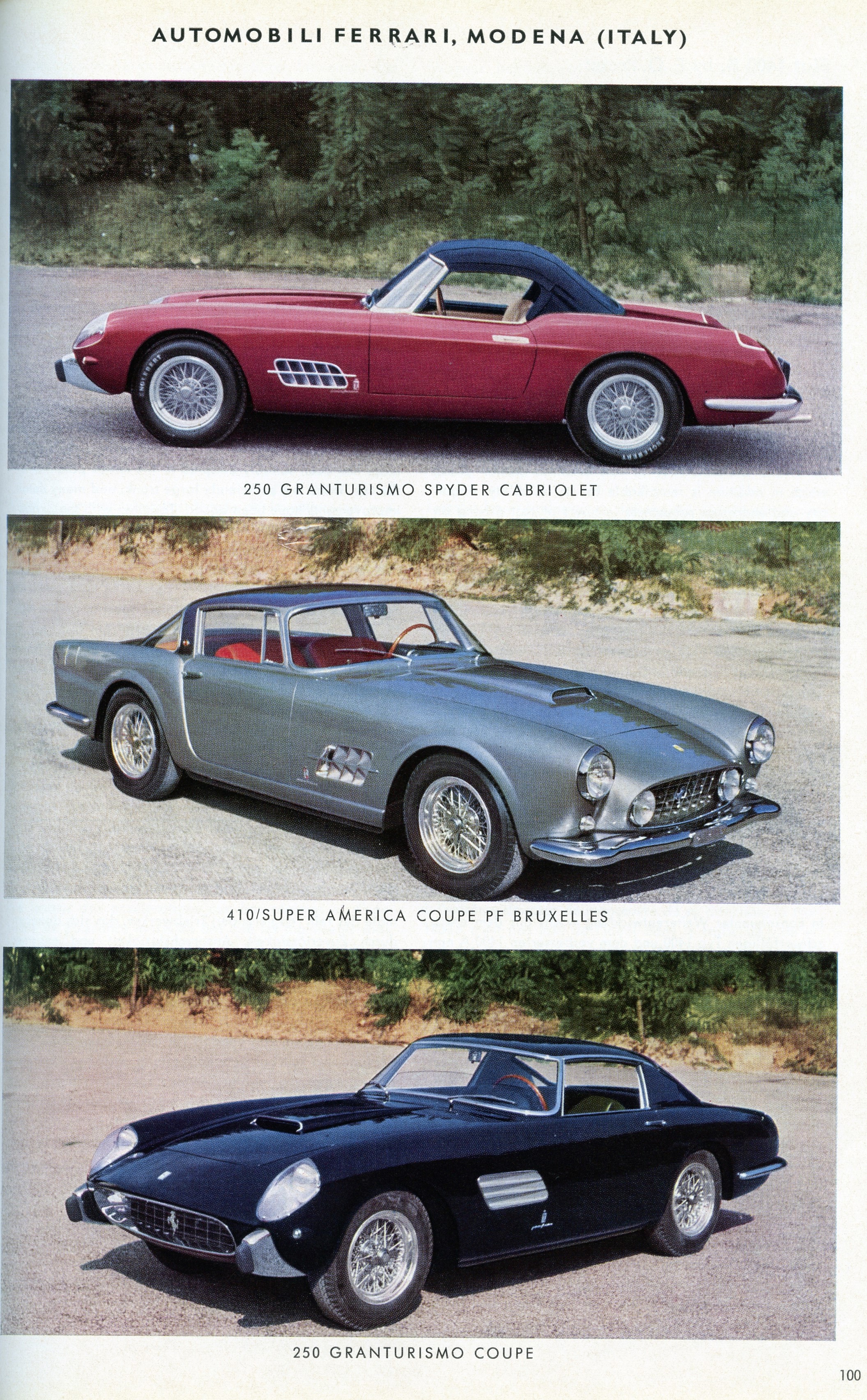
The book’s best feature are its sharp color photos. My favorites are of cars I’ve heard of but have never seen. Then there are the ones to drool over, such as the Ferraris. I’ve chosen 3 pages to highlight simply because the photography was especially striking. My Italian preferences really come through here, although there is one Japanese car to admire….


In my mind, Ferrari didn’t start to build tremendously sleek looking cars until the mid-1960s, but this trio of Modena sports cars from 1958 proves me wrong. The two 250 models had V-12 engines displacing 3.0 liters and putting out 240 HP. The 410 had a 4.9 V12 making 340 HP. I think I’ll take the Spyder.


The two Morettis look identical except for their roofs. The cars were based on Fiat mechanicals, and were at the opposite end of the scale from the Ferraris. Their 1200 cc engines put out 55 HP. Although I’ve read about them for years, I don’t believe I have ever seen one. However, if I came across one for the right price, I’d be interested!

At the bottom of the page is the Datsun 1100 Saloon, manufactured by the Nissan Motor Company of Yokohama Japan. Stare at this picture and remind yourself that in 12 short years they would introduce the 240Z sports car to the world.


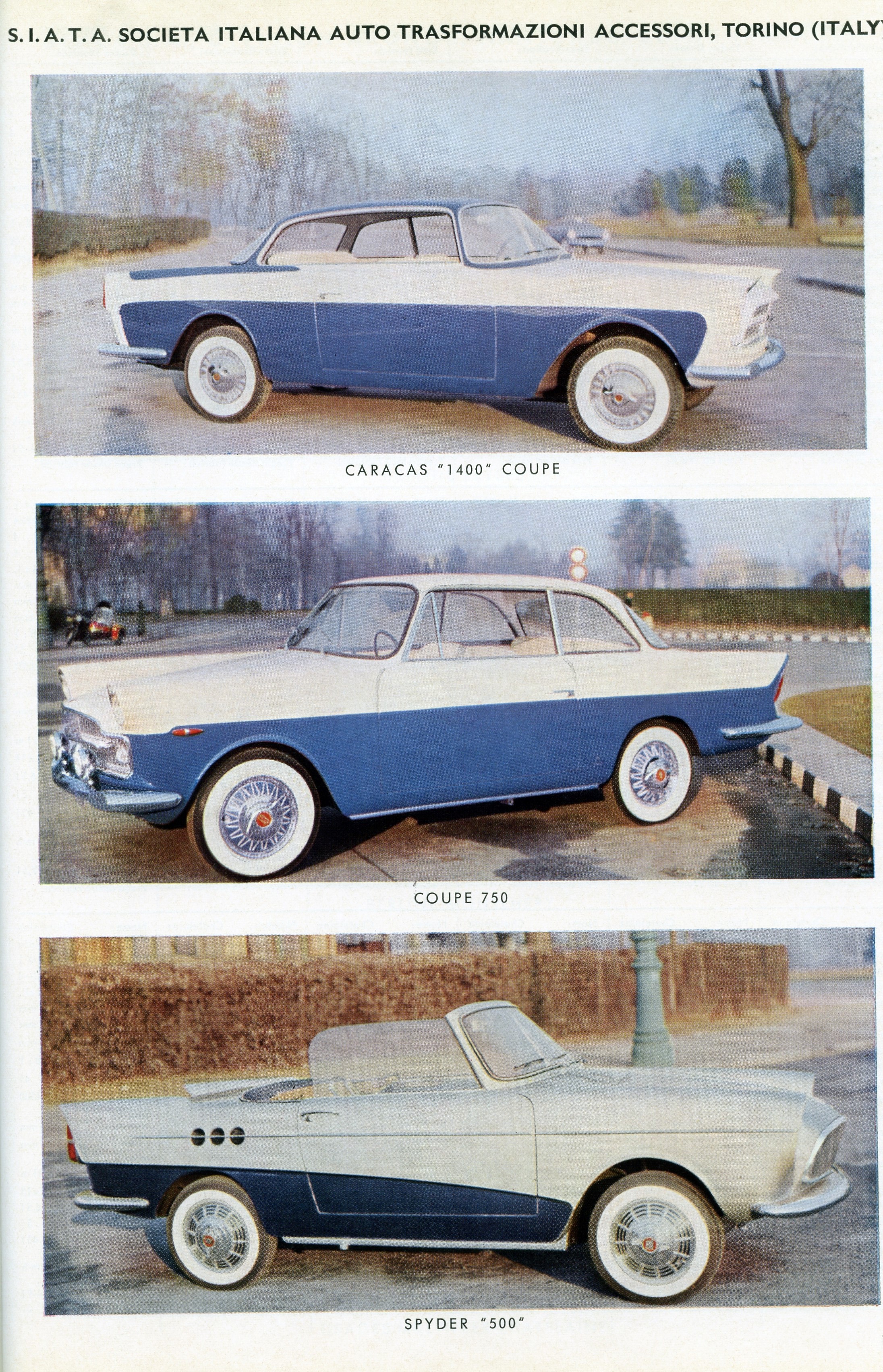
Unlike the Moretti, I have seen a Siata: I featured one which was on display at the AACA Museum at the same time my Alfa was there. These 3 Siatas are among the best-looking cars in the book. They might be a bit underpowered for American roads, though. The 1400 at the top of the page produced 58 HP, but the 750 Coupe managed only 30 HP; the Spyder 500 made do with 18, only 5 more than my Isetta. (But it is better-looking.)


All photos are from the author’s private collection.


Back to Print: 1990 AutoWeek issue predicts the collector car future

It’s obvious from all my blog posts covering automotive auctions from Mecum, Carlisle, RM Sotheby’s, and others, that I enjoy the collector car auction experience. Unlike classified ads, auction results provide an in-the-moment, real-world snapshot of what cars sell for. Part of the auction education is to learn about values. Price guides are great, but they’re numbers on a page or a screen. One can argue that a car at auction sold for too much or too little, but one can’t argue that a seller was willing to let it go at a certain price, or that a buyer was willing to pay a certain price.

Several friends of mine who are interested in the old car hobby have asked me about values rising over time, or put another way, “what can I buy today that I’ll make money on tomorrow?” They expect me to gaze into my crystal ball and spit out an answer. It might be possible to make the general statement that “all special interest cars appreciate over time”. However, it you’ve been at this long enough, and I know that many of my readers have, we’ve learned some hard lessons about vehicles and values.

Values of cars from the decade of the 1950s have peaked and have slid back, because the generation which grew up with them is dying off. Cars which are purchased as 100-point show cars and are then driven or allowed to deteriorate will decline in value. Sometimes, what’s hot today has simply cooled off by next month.

Conversely, we baby boomers have watched in amazement as cars from the ‘80s and ‘90s (which to us are “just used cars”) are being snapped up, some at surprisingly high prices, by the next generation of collectors. One famous scribe, who shall not be cited by name, proclaimed 20 years ago that “Japanese cars will NEVER become collectible!” He’s eating his words today as 1st gen Datsun Z cars, 4th gen Toyota Supras, and Acura NSXs trade for prices approaching or exceeding six figures.

My answer to my colleagues about my crystal ball? I tell them that my crystal ball shattered when the Ouija board fell off its shelf and knocked it to the ground.

Instead of a crystal ball, it’s more fun to travel back in time and see what was predicted about collector car values. I have the May 21, 1990 issue of AutoWeek magazine, its headline blaring “1990 Old Car Issue: Bring ‘em Back To Drive; A users’ guide to finding, buying and enjoying collectible cars”. I believe this 1990 edition was the first in what would become an annual series for AutoWeek, at least for most of the rest of the decade (I have two later examples in my collection). Let peruse the pages and see how right and how wrong they were.

The lead article, “Get ‘Em While They’re Cold”, suggests taking a long hard look at cars from the 1980s, buying them while they’re cheap, and then riding the wave of escalating values. By the way, this concept of buying cars which are 10 to 20 years old, at the bottom of their depreciation cycle, and then (hopefully) watching their values rise has really grown legs in recent decades.

A sample of the featured cars and their 1990 values, include:

  • 1986 Corvette Roadster, for about $25,000
  • 1982-1985 Buick Riviera convertible, many at less than $10,000
  • 1985-1988 Fiero, at anywhere from $6,000 to $16,000 depending on equipment
  • 1981-1983 Imperial, and I quote: “Current prices are in the $4,000 to $6,000 range, so it doesn’t take a Donald Trump to see the profit potential….”
  • 1984-1986 Mustang SVO, with “prices all over the map”

The featured story and cover car, about one man’s obsession with obtaining and restoring the 1938 BMW328 which won the 1940 Mille Miglia, is a delightful human interest tale of overcoming many setbacks before eventually triumphing. But there’s no mention of actual dollars spent. To his credit, even with the article implying that this BMW might be worth $2 million (remember, this was written in 1990), the owner said “Of course I’ll drive it, ‘cause that’s what it is – a car…. I just can’t understand the way some people think. The thought of turning a car into a $2-million floor lamp makes me sick”.

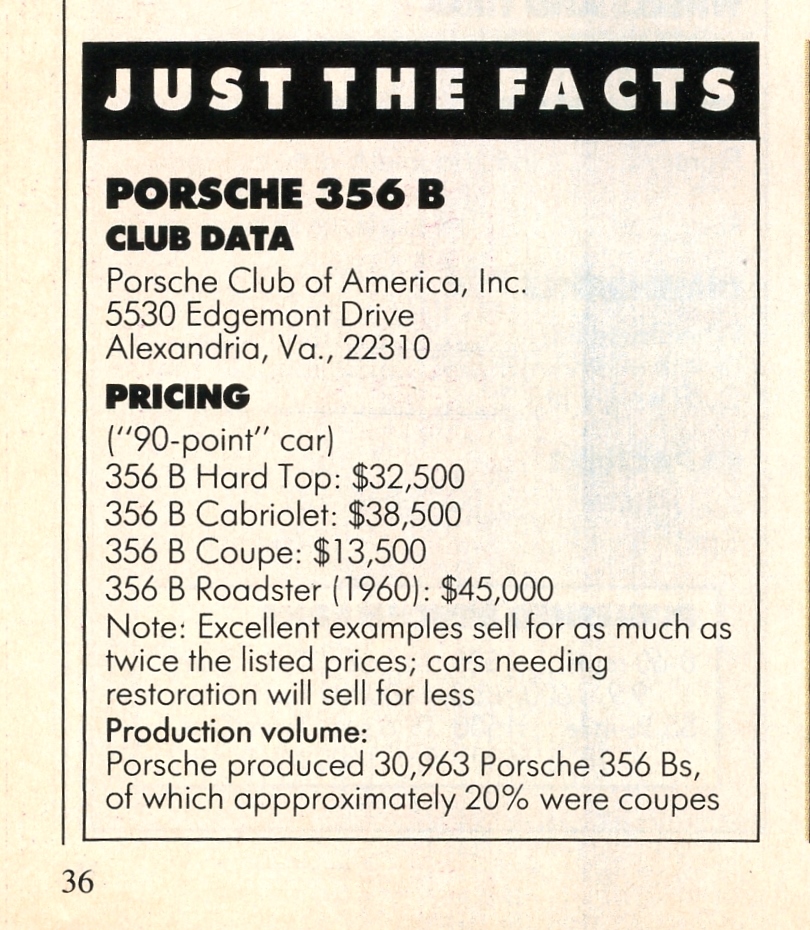
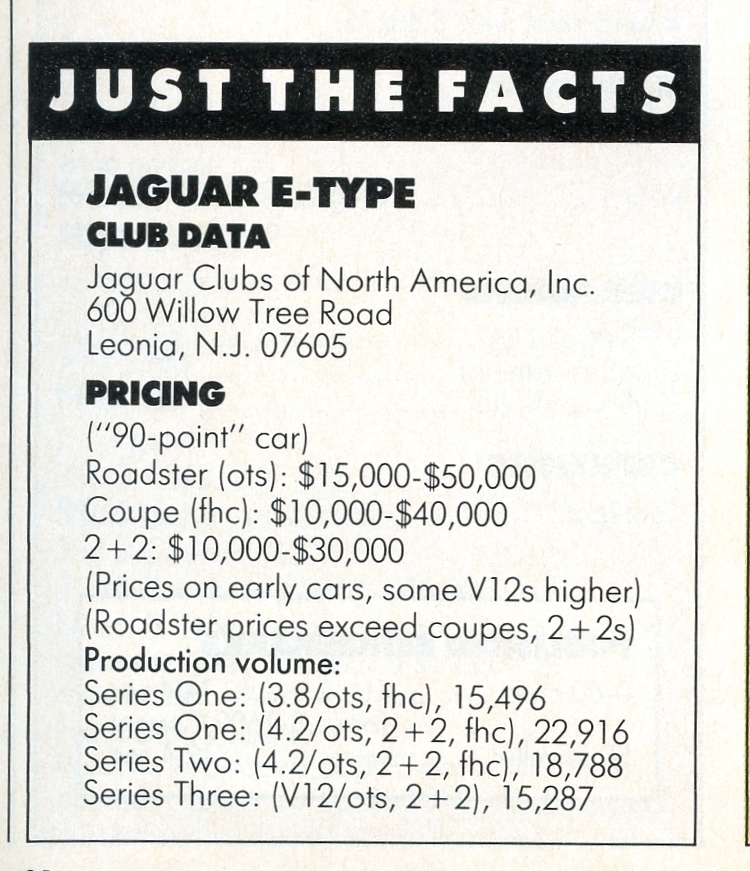
The final series of articles in this issue highlight 3 popular collectibles: the MGA, the Porsche 356, and the Jaguar XKE, also known as the E-Type. For two of these, I’ve captured AutoWeek’s pricing for a 90-point car. Just to keep things in perspective, Google reports that the 1990 average new-car price was $15,500, and the median household income was $35,400.


My January 2021 edition of CPI (Cars of Particular Interest) Price Guide shows a 1960 Porsche 356B S-90 Roadster worth $198,000 in excellent condition, and a 1967 Jaguar XKE roadster (OTS) worth $302,000 in excellent condition. Now that’s what I call appreciation!

Abarth Obsessed

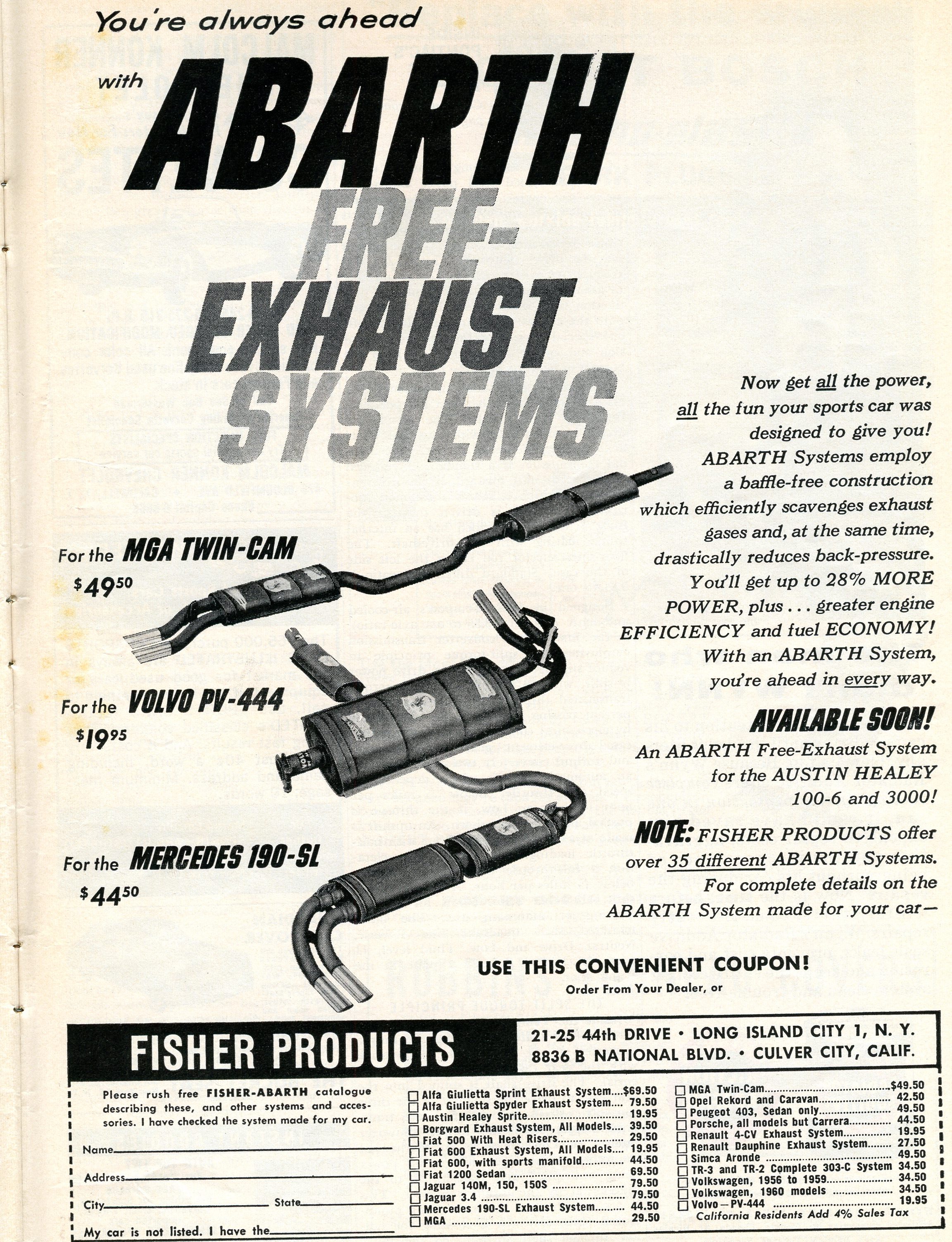
Does the name Abarth ring a bell? If you’ve been around automobiles a while, you may recall a line of performance mufflers and exhaust systems sold under the Abarth name. For much of the ‘50s through ‘70s, it was one of the hot setups. Relatively affordable compared to more extensive modifications, an Abarth exhaust system bolted on easily, provided at least a few additional ponies, and sounded like you added more than just a few.


This Abarth exhaust ad is from the Oct. 1960 issue of Sports Cars Illustrated magazine

Fast forward a bunch of decades, 2012 to be exact, and remind yourself that this was the year Fiat reentered the U.S. market, offering new Fiat automobiles to Americans for the first time in about 30 years. To start, there was one model, the 500, available in several trim levels. Top of the heap was the Abarth, utilizing a turbocharged engine which gave it a 59-horsepower advantage over its lesser brethren. A few years after that, when the 124 convertible was reintroduced, there was an Abarth version too.

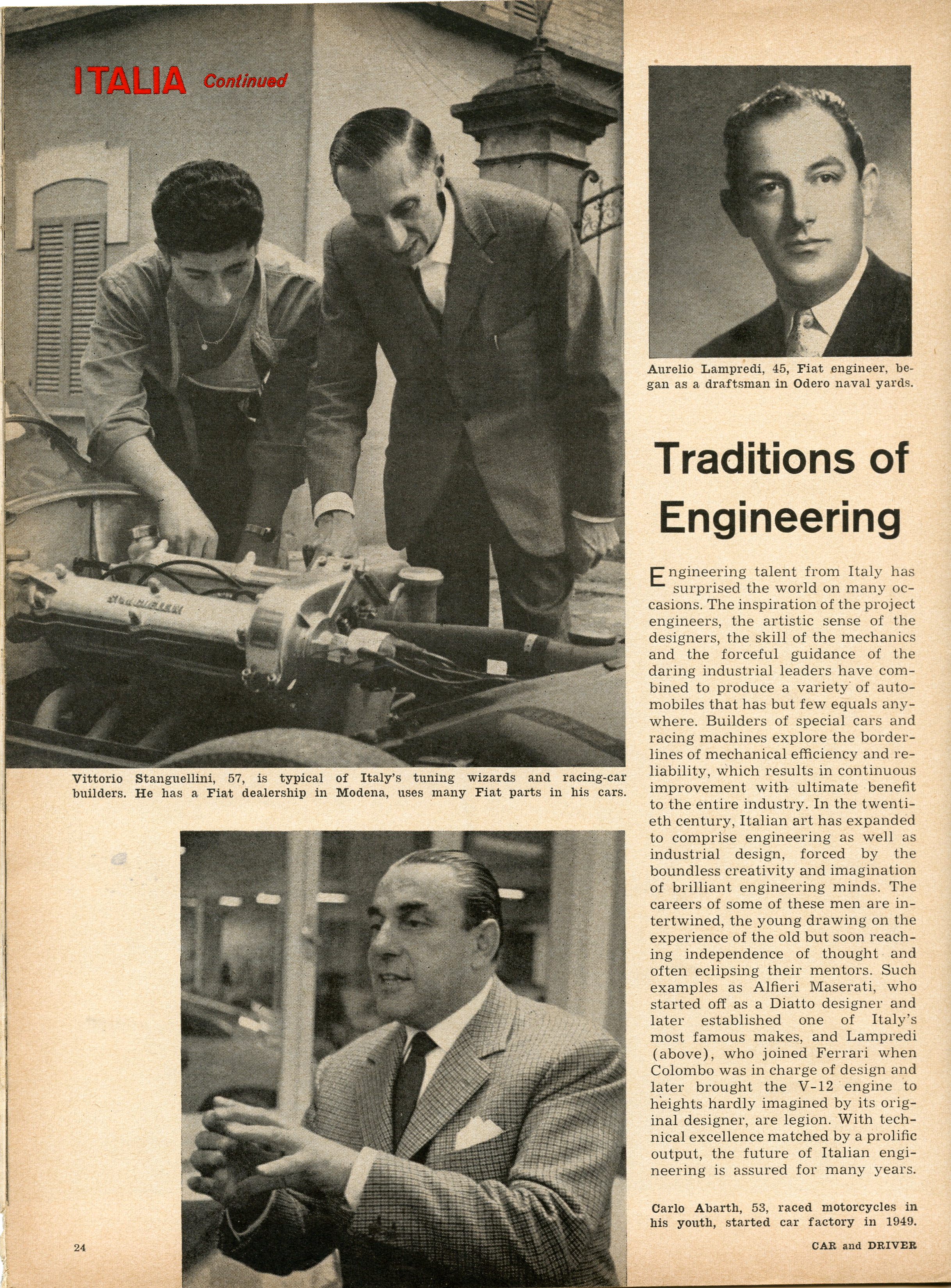
Of course, there’s more to the story. The Abarth company was started by and named after its founder, Carlo Abarth (born Karl Abarth in Austria), who moved to Italy, amended his first name to sound Italian, and began to build performance engines. From there he progressed to modifying Fiats, and eventually manufactured his own cars. The Abarth company was at its peak during a 15-year run from about 1956 to 1971, at which time the company was purchased outright by Fiat. His Astrological sign, Scorpio, inspired the Scorpion image which adorns the Abarth badge.

The March 1962 issue of Car & Driver magazine included this blurb on Carol Abarth

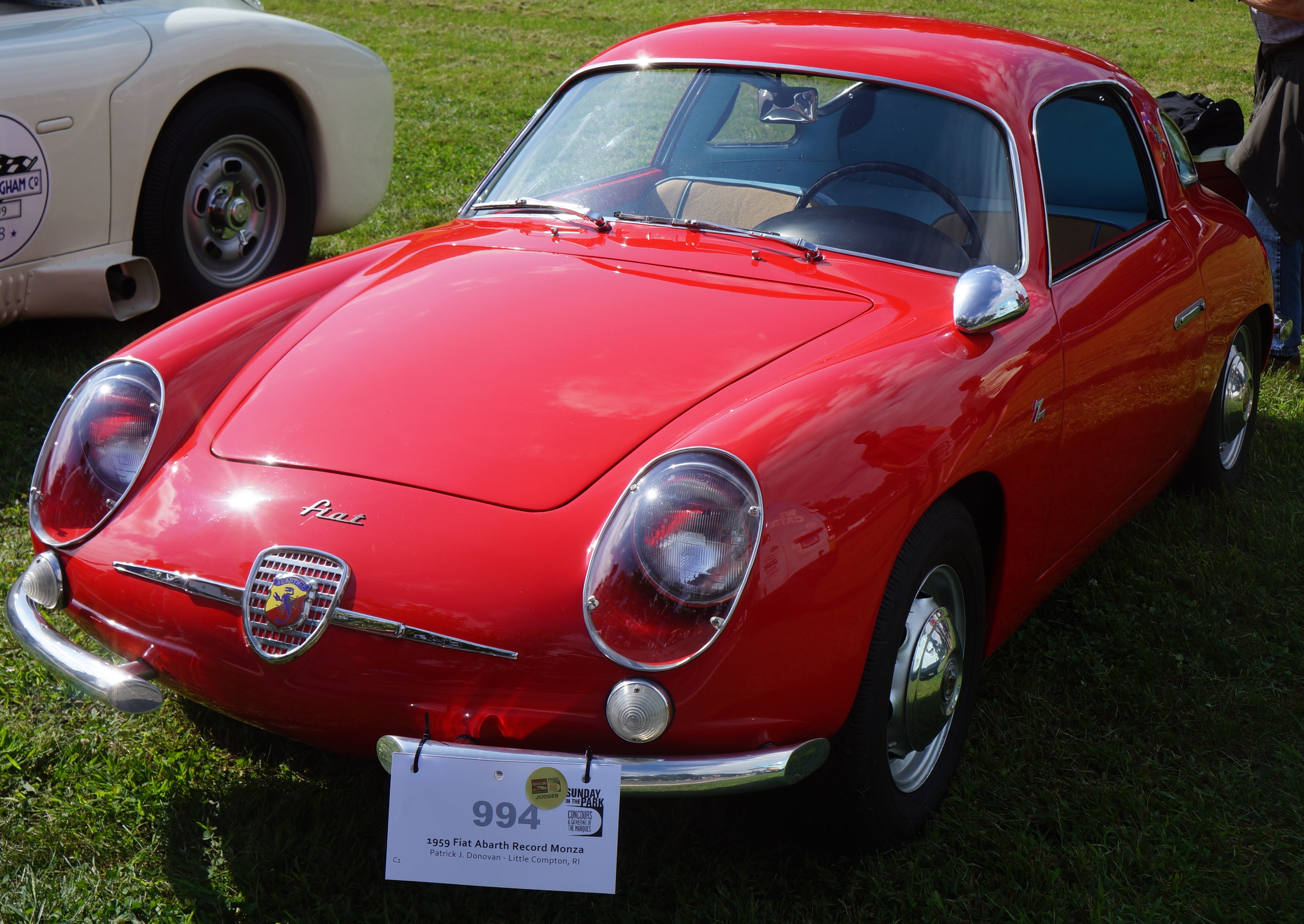
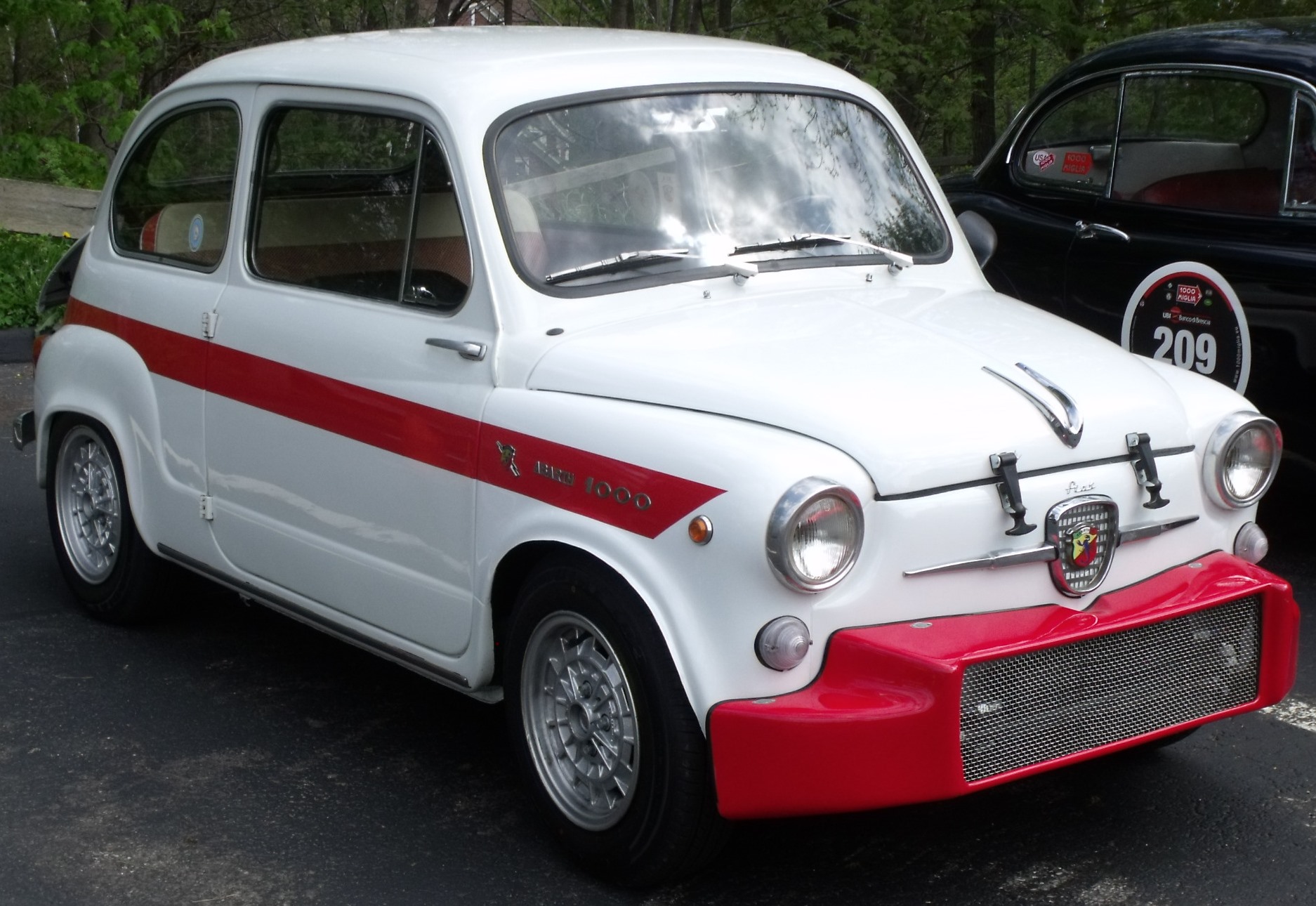
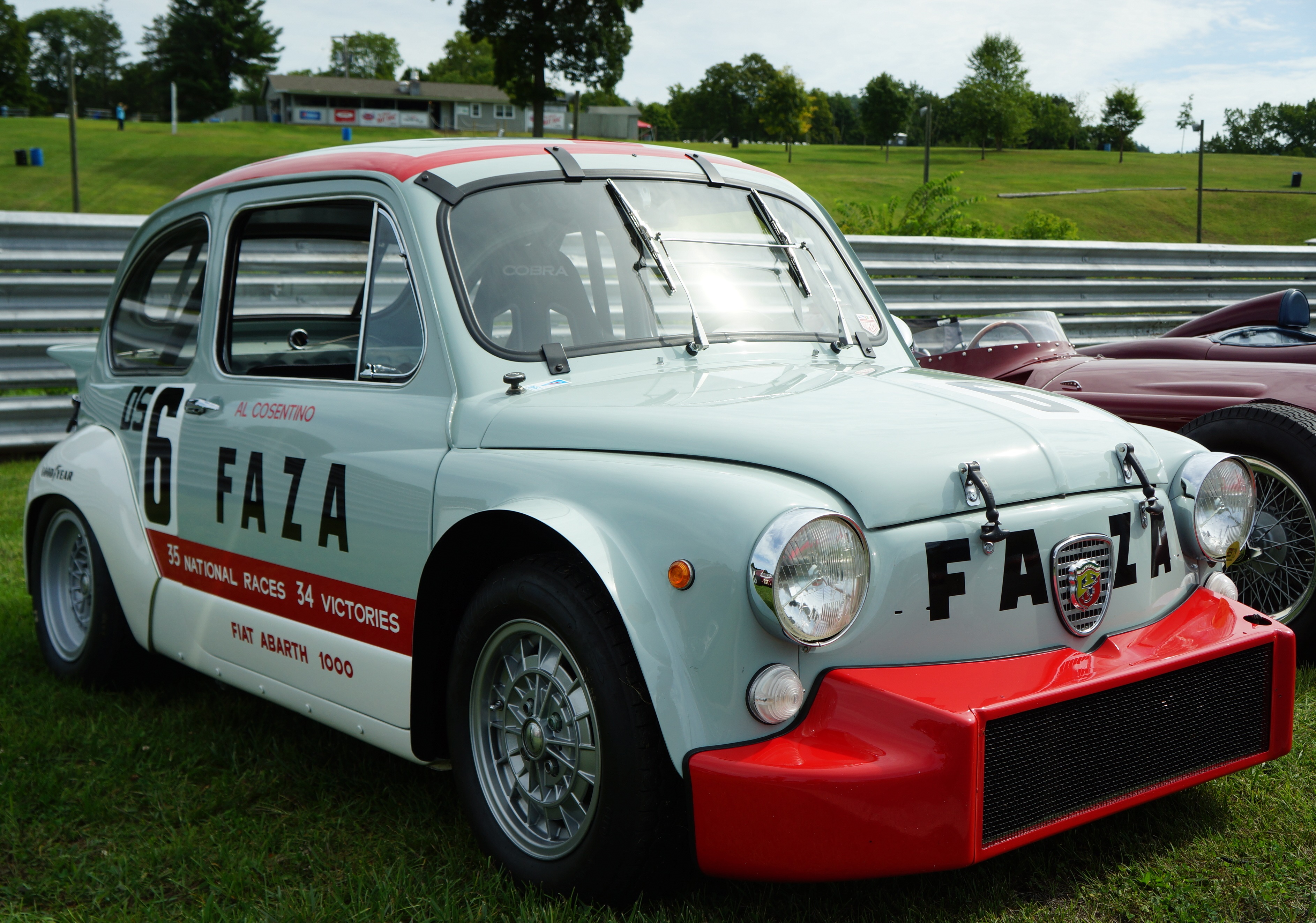
I’ve long been obsessed by Abarth cars. First, they’re Italian. Second, their diminutive size is something I’ve always found attractive (this coming from a former Isetta owner). Third, their status as the “David” versus the “Goliaths” of the day always had me rooting for them. Amazingly, in spite of a sometimes tremendous horsepower disadvantage, they racked up a series of impressive racing wins. Not a lot of Abarth cars were built, more than a few were wrecked, and even fewer were preserved, so spotting one today is a treat.

I’ve photographed Abarths at Hershey, at Lime Rock, and at the New England 1000 rallies, yet I realized that I knew very little about the cars. Poring through my automotive library in search of historical information on the brand, I was surprised how little I found. Most of my general-interest books on European cars do not mention Abarth, and I would venture to guess that they were thought to be similar to a ‘tuner’ like Dinan for BMW or AMG for Mercedes-Benz. The Standard Catalog of Imported Cars 1946-1990 has the most extensive Abarth coverage of any of my books, with good technical specs yet few photos.


This page is from Tad Burness’ scrapbook-like Imported Car Spotter’s Guide


This Abarth was seen at Hershey in 2015


This Abarth joined us during the 2014 New England 1000


Found on display at Lime Rock in 2014


Searching online, I discovered a book by Peter Vack: Abarth Buyer’s Guide, published in 2003 by Veloce Press. I bought it and have begun reading it. It’s not easy keeping track of models with such similar names as Fiat Abarth 750 Berlina, Fiat Abarth 750 GT Zagato, and Fiat Abarth 750 Allemano. Then we move to Fiat Abarth OT 850 Series, Fiat Abarth OT Coupes, and Fiat Abarth OT Sports Racers. Some have stock Fiat sheetmetal, some are externally modified, and some have bespoke bodies. All of them have rear-mounted Fiat-based engines, modified modestly or aggressively. For some models, the book notes that “no two cars were alike”.

There will be more to say about Abarth cars in the coming weeks.  Actually, this post will be tied into another recent post, and will become an ongoing storyline through the summer and fall. In the meantime, if you come across an Abarth on the street, please snap a pic and send it to me. Thanks.


All photographs copyright © 2020 Richard A. Reina. Photos may not be copied or reproduced without express written permission.

The 1940 Triborough Bridge Authority Map

As I’ve mentioned in previous posts, I collect maps. I’m especially fond of older maps which were printed before the era of modern interstate roadways. As a native New Yorker, I’m partial to maps of the metro NY/NJ area.

Most of my old maps are undated, which is a shame. However, careful study of streets, highways, bridges, tunnels, and other human-built structures usually provides enough clues to date a map to within a year or two of its printing.

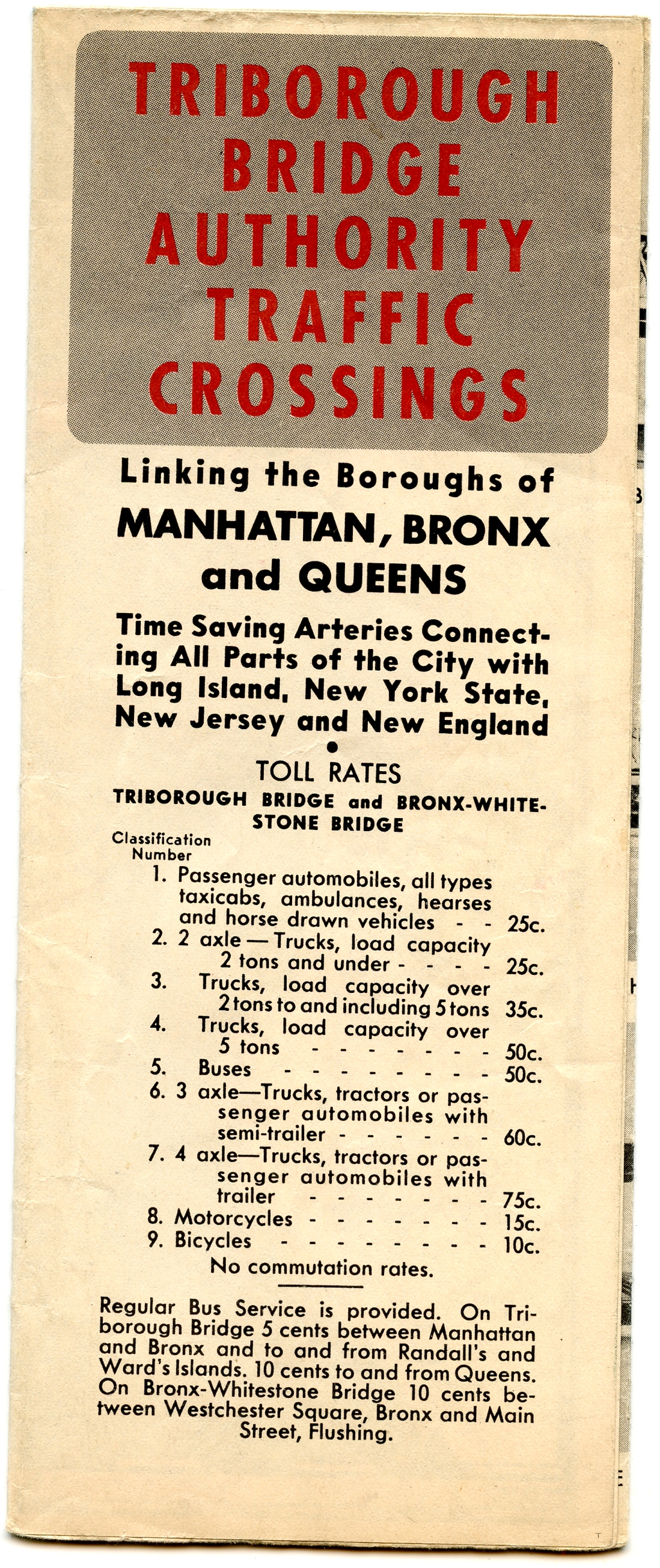
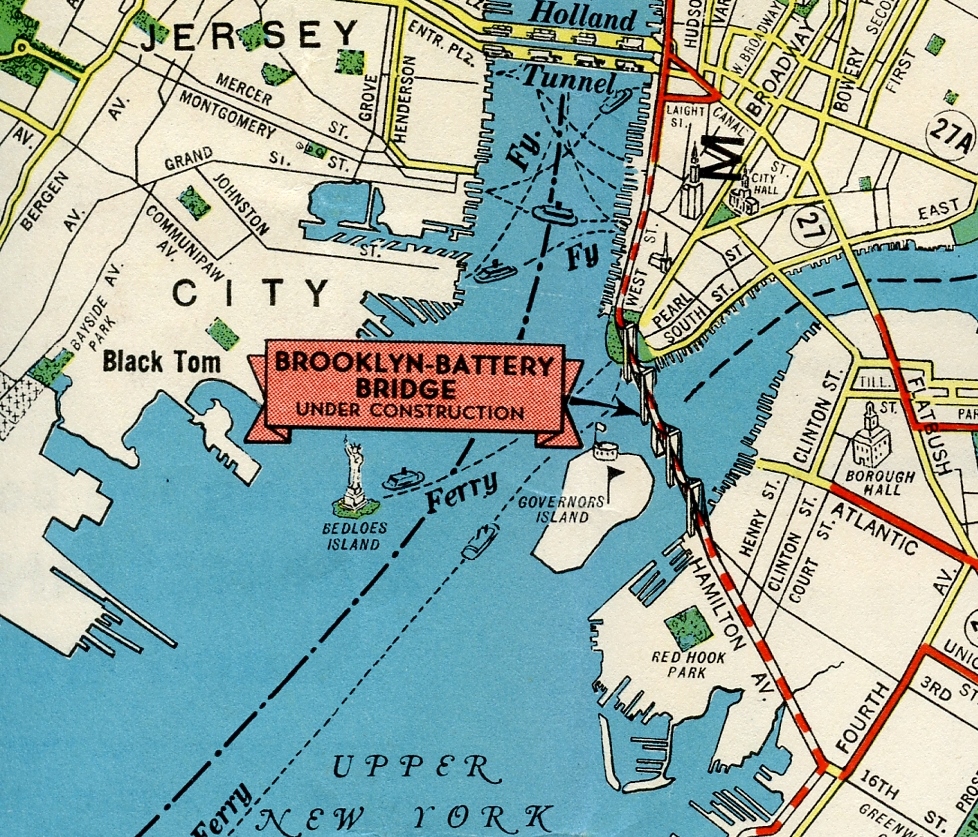
One of the more unusual maps in my collection isn’t a typical gas station giveaway of a city or state. This map is entitled “TRIBOROUGH BRIDGE AUTHORITY TRAFFIC CROSSINGS”. It shows most of the five boroughs of NYC, and as the title states, it highlights the bridges and tunnels which are under the purview of that agency. The map has another quite unique feature: it illustrates a crossing as “UNDER CONSTRUCTION” which never got built.

Look at those tolls! But remember, back then they were collected each way.

Because four of the five boroughs of New York City are on islands, as vehicular traffic increased during the first half of the 20th century, structures were erected to allow cars and trucks to traverse waterways without using ferries. While the Brooklyn Bridge was opened in 1883, well before automobiles became mainstream, the Williamsburg, Manhattan, and Queensboro Bridges were all completed during the first decade of the new century. After that came the Holland Tunnel in 1927. The next 13 years saw rapid growth as the George Washington, Triborough, and Whitestone Bridges along with the Lincoln and Queens Midtown Tunnels were up and running by 1940.

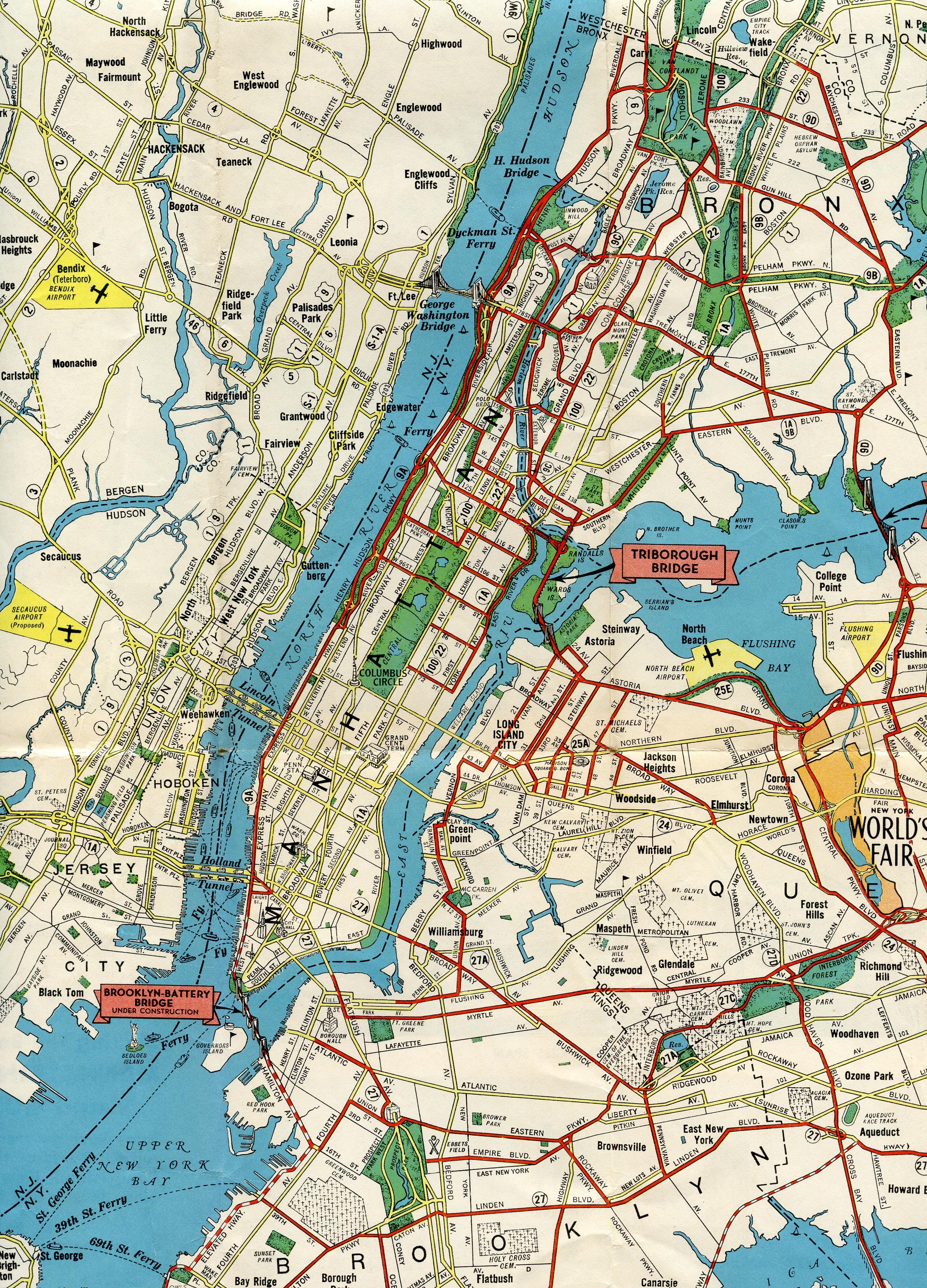
Much of NYC, with some of NJ, as it appeared circa 1940

It’s impossible to discuss this growth without bringing up the name of Robert Moses. A hero to some and a villain to others, I will not even wade into those waters. However, the decade of the 1940s was a difficult one for him because it was one of the few times when he didn’t get his way. I’m referring to his plan for the Brooklyn-Battery Bridge.

It was 1940 when Mr. Moses made his proposal for a bridge to connect the southern tip of Manhattan with downtown Brooklyn. While he had his supporters, the opposition on this one was strong. Among those in the “against” camp were the U.S. Government, who saw such a bridge as a potential bombing target; a bombed bridge would then block access to the Brooklyn Navy Yard. There was also a fierce argument put forth that such a structure would ruin the view of the downtown skyline from Brooklyn.

Yet my map labels the bridge, and refers to it as “under construction” (a wildly optimistic claim with no basis in fact). I estimate this was printed around 1940, based on the inclusion of the (1939-1940) World’s Fair site. By the late 1940s, Robert Moses acquiesced and agreed to the construction of a tunnel in lieu of a bridge, which has given us today’s Brooklyn-Battery Tunnel (officially the Hugh L. Carey Tunnel, but try telling that to a Brooklynite).

An enlargement from the map showing the Brooklyn-Battery ‘Bridge’

By the way, have some fun hunting down other landmarks shown on the map, including Penn Station, Grand Central Station, and all 3 Major League Baseball stadiums!


All scans are from my personal map collection.


The Transportation Exhibits at the 1964/1965 NY World’s Fair

I collect maps. Unlike most other things I collect (cars, tools, books, cameras), maps take up very little space. I can bring home a few maps and slip them into my collection without it raising an eyebrow.

When I attend automotive flea markets, typically Carlisle and Hershey, I see vendors who specialize in maps, and vendors who happen to have a box of maps along with other stuff. Map collecting is a subset of the automotive hobby, and the map specialists recognize this and price their wares accordingly. I don’t know what makes one map more valuable than another, but obviously, age, condition, and rarity all play a part. I tend to do most of my pickin’ at the vendors who are not specialists.

A few years back, rifling through a box of maps at one of these shows, I came across a copy of the “official” map of the 1964-1965 New York World’s Fair. It was in like-new condition, and while I don’t recall the exact price I paid, it was five dollars or less. I thought that was a sweet deal, especially since I didn’t own a copy.


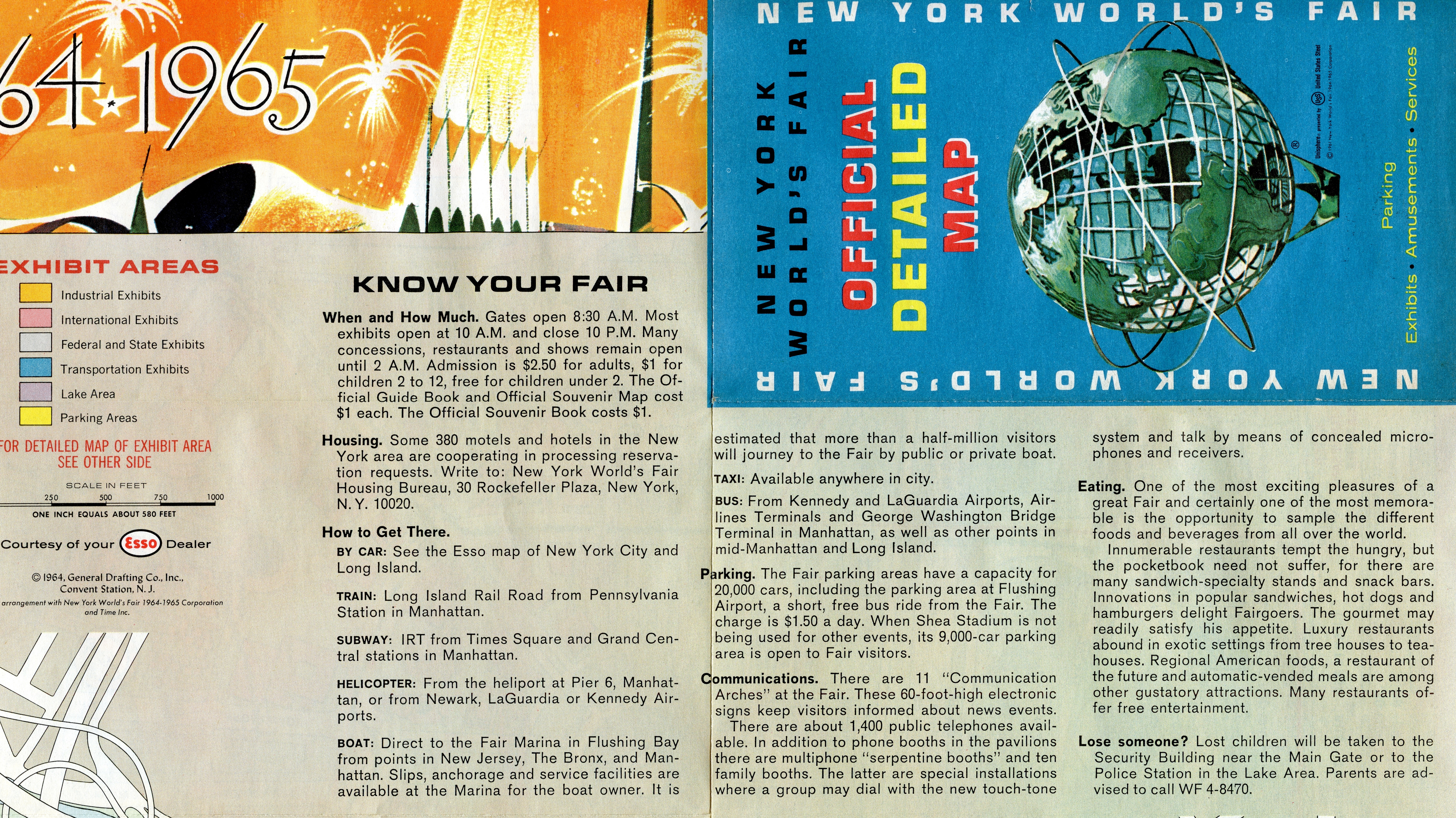
The map’s cover and some general information

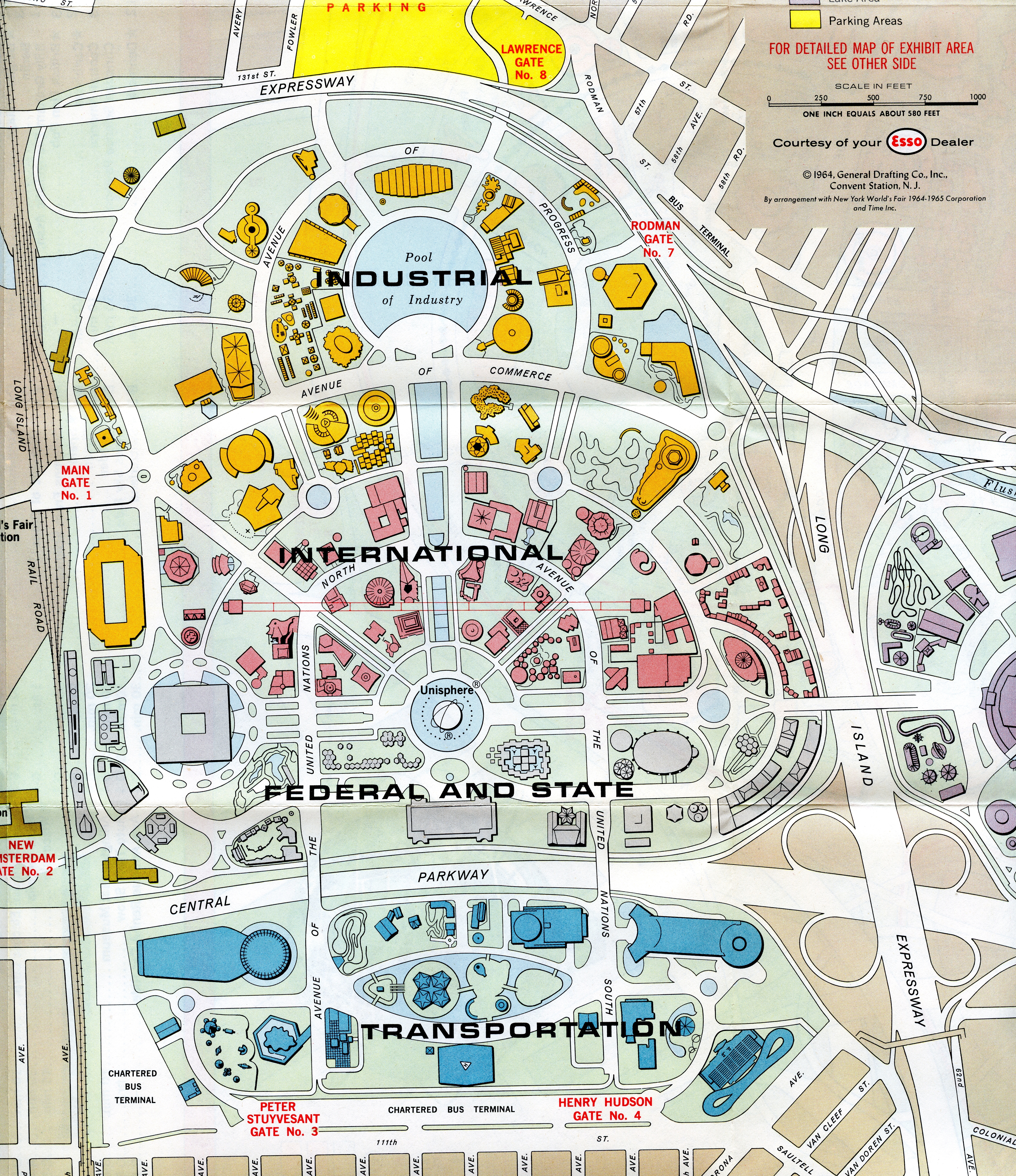
Although I attended the ’64-’65 NY World’s Fair six times with my family, I have only fleeting memories of it. I was just a kid, and as if you need the reminder, this was 56 years ago. So the map was a welcome way to revisit the event. It came as a surprise to me to see that the exhibits were arranged by category: Industrial, International, Federal and State, and Transportation.


The complete exhibit map

In Transportation, the buildings from Ford and GM dominated. Everything else (Chrysler Corporation, rental car companies, oil companies, and suppliers) was small potatoes compared to these behemoths. (Notably absent was Rambler/American Motors; even back then their budget was so tight that they had to sit this one out.) If the full map is done to scale, and it likely is, then it appears that the Ford Motor Company exhibit may have been the single largest building at the Fair. (In an earlier blog post, I had shown a postcard image of the GM building from this Fair.)


The Transportation exhibits

Look at the index which is part of the map. The ‘time’ next to each exhibit name indicates the approximate amount of time needed to tour the exhibit. This was intended as a way for attendees plan their day, and (as the fair organizers hoped) realize that a return visit would be necessary to see it all. GM, Ford, AND Chrysler each have a recommended visit length of one hour.


The index of Transportation exhibits

When the Fair closed, most of it was torn down with the notable exceptions of the Unisphere and the NY State Pavilion. Flushing Meadow Park, where the Fair was located, still exists, and I visited it in 1984 and took these two photos.

The Unisphere in 1984. Made of stainless steel, it shows no signs of aging.


The New York State Pavilion in 1984


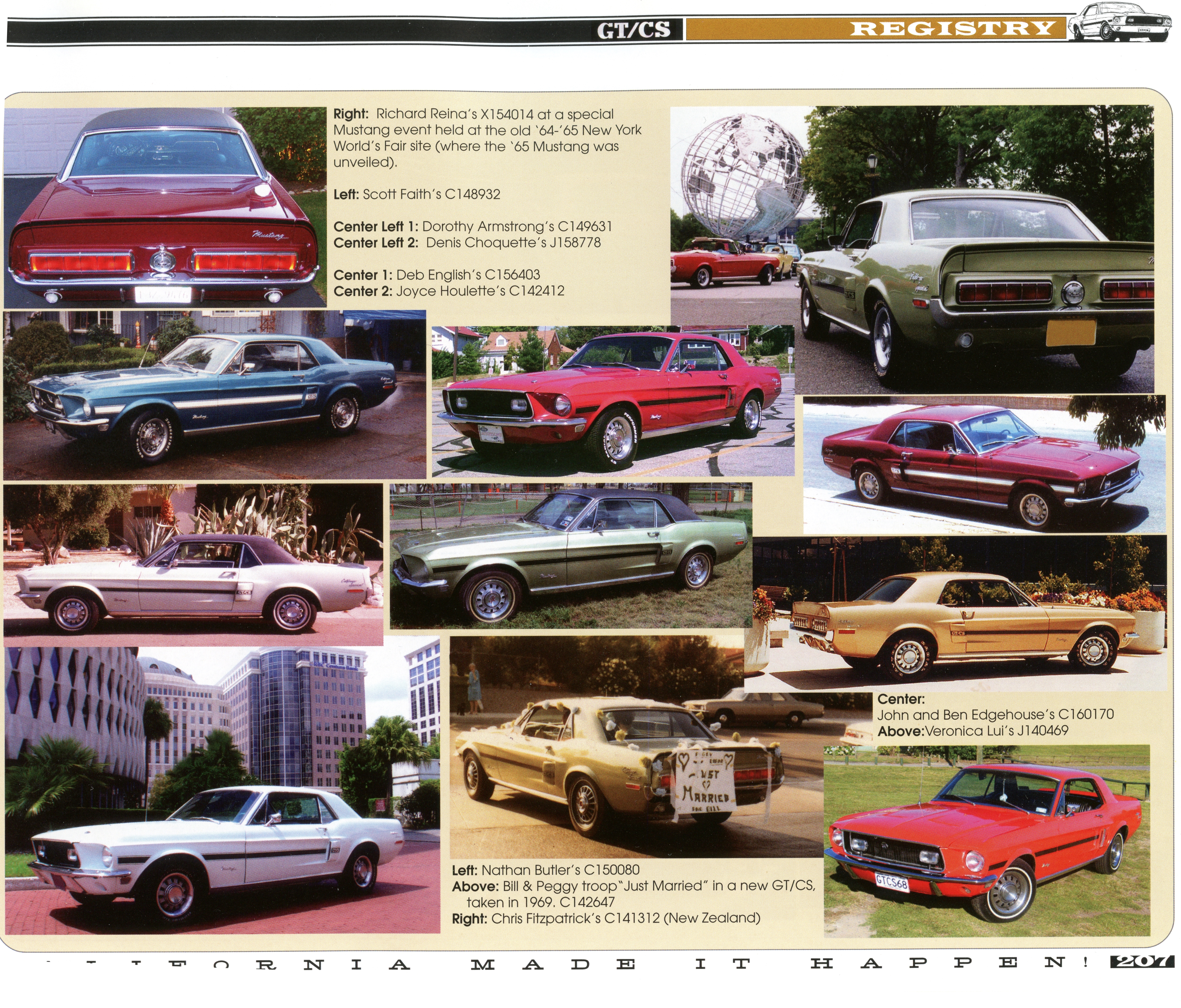
Then, in 2004, the local Mustang Club invited a select few of us back to the Park for the unveiling of the new 2005 Mustang, replicating the launch of the new 1964 ½ Mustang at the NY World’s Fair in April ’64. A photo of my 1968 California Special at that event, with the Unisphere in the background, made its way into the Mustang GT/CS Recognition Guide & Owner’s Manual (3rd Edition) by Paul M. Newitt.

My GT/CS is in the upper right corner

If you visited the Fair, I hope that some of this brings back pleasant memories. If you were not able to visit, I hope that you can marvel at what seemed so futuristic to us in the mid-‘60s.


All photographs copyright © 2020 Richard A. Reina. Photos may not be copied or reproduced without express written permission.
Old postcards Part 2: Travelalls, Datsuns, and Saabs

Old Postcards Part 1 covered postcards of the two New York World’s Fairs. These three postcards below found in my dad’s collection are a potpourri: two are from Cape Cod MA, one of the places my father liked to visit when he traveled (which was infrequent), and the third is an advert for the Datsun 210. I can hear the youngin’s from here: “What’s a Datsun?”


“BEACH BUGGIES TOURING THE SAND DUNES ALONG RACE POINT, PROVINCETOWN, CAPE COD, MASS.”

So reads the back of this postcard. Beach buggies? The ‘buggy’ in question is an International Harvester Travelall, a forerunner to today’s ubiquitous SUV. Looking at that soft sand, I’m not sure I’d trust ANY 4WD vehicle to return to pavement, but obviously, the folks who ran these tours found these trucks to be up to the job. Carrying capacity was another advantage. Presuming the vehicle had 3 rows of bench seats, it could likely accommodate a driver plus 8 passengers, adding to the tour company’s revenue per outing.

Relying as I do on Wikipedia, it appears that the pictured Travelall is a model year 1968, the last year for this body style. That conclusion is based on the rear quarter panel trim, which seems to have been a 1968-only treatment. In 1969, the Travelall was redesigned and bore an appearance very similar to the smaller IH Scout.


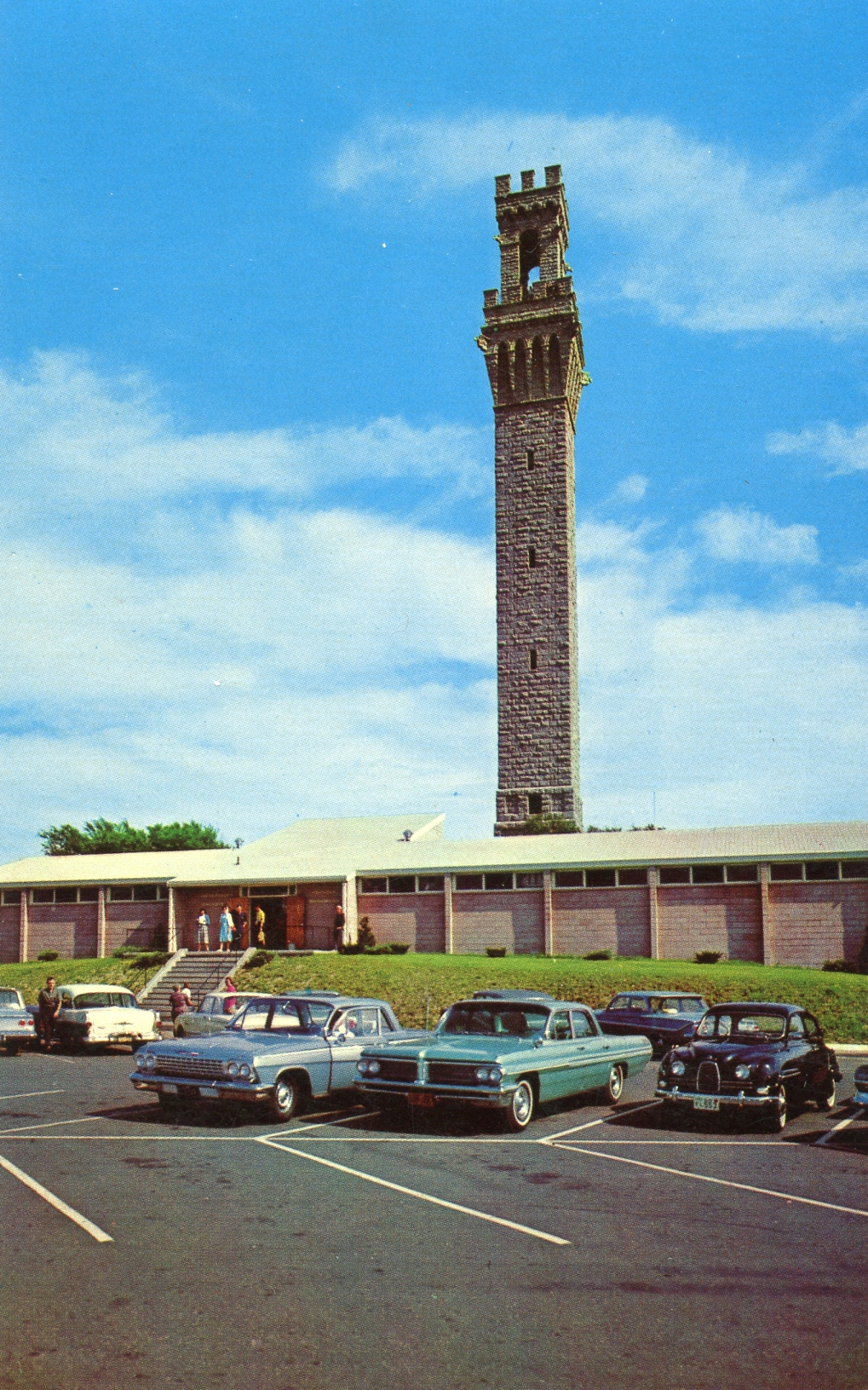
“PROVINCETOWN MUSEUM WITH PILGRIM MONUMENT IN BACKGROUND, PROVINCETOWN, CAPE COD, MASS.”


I can’t say that I recognize either the museum or the monument, but I do recognize all the cars in the parking lot. Was GM having a convention that weekend? Did the Saab owner know that someday the brand would be owned by GM? I kid. Among the GM cars are two ’61 Chevrolets, a ’62 Chevrolet, ’55 and ’62 Pontiacs, and behind the ’62 Chevy, perhaps an early ‘60s Ford Falcon.

At first I had a difficult time determining if the Saab was a late-50s 93, or an early-60s 96, as their front ends are nearly identical. However, the 93s had ‘suicide’ doors while the 96’s doors were hinged conventionally, as appears here. The front grille was substantially redesigned in 1965, putting the postcard car into the 1960-1964 model year range. So except for the ’55 Pontiac, all the cars pictured here are of very similar vintage.


“DATSUN 210: Five models to pick from, with one kind of gas mileage…. It’s economy that makes you feel rich.”

The Datsun 210 had a short run in the U.S.: the model was sold here only from 1979 through 1982. There were indeed 5 body styles: a two-door sedan, four-door sedan, five-door wagon, three-door hatchback coupe, and a special 210MPG two-door sedan.

The U.S. was hit with its 2nd gas crisis of the decade in 1979, so Datsun’s timing was, shall we say, fortunate. The wording on the postcard talks about little other than fuel economy, because that’s what Americans were shopping. The 210MPG model, with a reduced horsepower 1.4L engine and a five-speed manual gearbox, was rated at 47 mpg on the highway. Perhaps most surprising to me is that this vehicle, like almost all Asian imports at this time, was still RWD.
Datsun was still a few years away from switching over its brand name to Nissan, but do note the corporate Nissan symbol in the bottom left-hand corner.

My dad bought a new Datsun 200SX in the early ‘80s, so no doubt he picked up this free postcard at that time. Was he considering the flashy 210 three-door hatchback coupe in the photo? Didn’t the image of the young man serenading his date with a flute influence his decision?


All images are from my personal collection of postcards.


A Tribute to the Late Brock Yates

Brock Yates passed away a few weeks ago. If by chance the name is not familiar, he had a long career as a writer and editor for Car & Driver magazine, and wrote over a dozen books on cars, auto racing, and the automotive industry. His most infamous “accomplishment”, however, may be as the chief instigator of the Cannonball Baker Sea-to-Shining-Sea Memorial Trophy Dash, a recurring stunt which led him to write the screenplays for the movies Smokey and the Bandit II and The Cannonball Run.


When I was a senior in high school, the March 1972 copy of Car & Driver magazine arrived home. In it was the story of the running of the first Cannonball race, which was held in November 1971. As an impressionable young lad who was car-crazy and had traveled no farther from my Staten Island home than the Catskills of upstate NY, the idea of hopping into a car, any car, and racing from New York to California absolutely infatuated me. I brought the magazine to school, showed it to the few buddies whom I thought might be interested, and read and re-read the story on my bus-subway-and-ferry commute. To this day, it is perhaps my favorite article ever published in a magazine.


Yates, with co-driver Dan Gurney (talk about a ringer), won in a Ferrari Daytona, making the trip in under 36 hours at an average speed of 80 miles per hour. (Favorite quote: “Masterful driving by Gurney negotiates the extremely dangerous stretches of Route 89 through the Prescott National Forest and the Cliffside highway at Yarnell with relative ease. Yates proves ‘Ban don’t wear off’.”) The other entrants were almost as interesting, and included a Cadillac, an AMX, and several full-size vans. Reading the story again reminds one of both Yates’ determination to change the world, and his own naiveté in thinking that this was the way to do it. (In his C&D columns, he frequently argued that driving was a quicker way to cover long distances than flying.)


Five years later, I completed my first coast-to-coast drive, although it was no race, and it was in a Volvo. My fascination with Ferraris reaches back to this story, and a few short years ago, the very Daytona piloted by Yates and Gurney was on display at Carlisle. It was no small thrill to see it in the metal.


race-p1 race-p2 race-p3 race-p4 race-p5 race-p6 race-p7 race-p8


The entire article is scanned from my original copy, and is attached as 8 PDFs. Take a few moments to read it, then lift your glass to the memory of Brock Yates.