After the love/hate relationship which was my 1970 Fiat 124 Coupe, my father, wanting to be helpful, told me to “get an American car”. It was the summer of 1976 and I was about to enter my senior year of college. Although I was working a summer job which paid a decent wage, I wasn’t exactly able to afford what I really wanted – which was a new sporty import.
Deciding at first to ignore dad’s advice, I visited various car dealerships on Staten Island and looked at or test drove the new Toyota Corolla SR-5, Mercury Capri, and Datsun 280Z. The MSRP of these cars in 1976 was $3900 for the Corolla SR-5, $4100 for the Capri, and $6600 for the Datsun (these numbers courtesy of my copy of the Standard Catalog of Imported Cars 1946-1990). My budget, however, was around $1500.
The reality of this situation made me conclude that I only needed a car to last me a year or so. Once I graduated and landed a real job, I could then buy something new. So I thought I would heed my father’s words and look at American iron. In 1976, if one were considering an American car and wanted a sporty, small, 2-door coupe, there were two choices: a Pinto or a Vega.
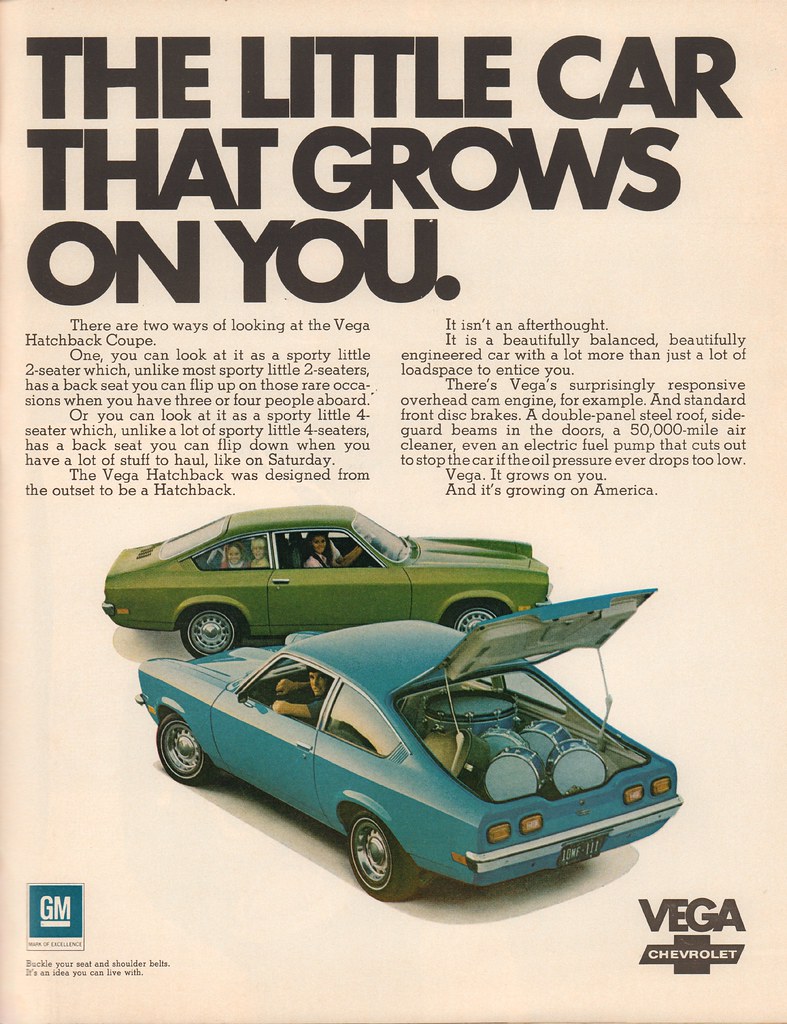
The recollection is that I only looked at Vegas, and I’m not sure why. However, an advertising photo put out by Chevrolet when the Vega was launched had always stayed with me, which showed a drum set in the load area of the hatchback. A car which could more easily swallow my kit was a priority (the Fiat had room for the drums, but using the side doors for rear seat access was awkward).
My attention was caught by this Vega ad showing its ability to carry a drum kit
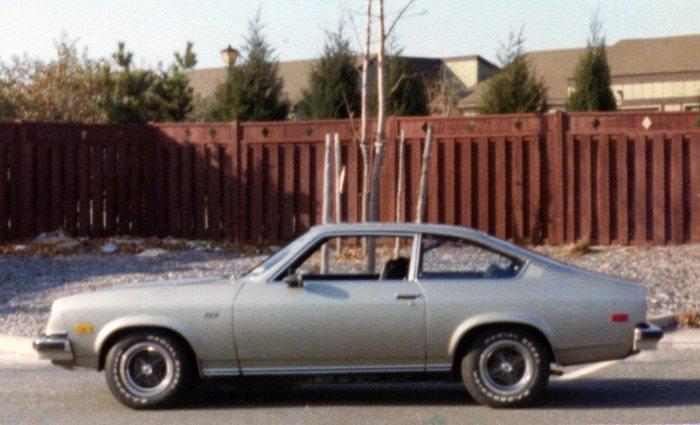
There was also the temptation of the Vega “GT” model, which included nice looking alloy wheels and more complete instrumentation. After test driving several used Vegas, I found a 1974 GT with a 4-speed stick for only $1350. This car was four model years newer than the outgoing Fiat, and was in overall good condition.
Side view of my ’74 Vega GT, taken autumn of 1976
The Vega got me through my senior year of college, and truth be told, it wasn’t a bad car. It never broke down on me, it was somewhat fun to drive with the manual tranny, and it cost me very little in the way of maintenance and repair. The car’s Achilles’ heel was oil consumption. During the entire time I had it, the engine consumed a quart of oil about every 400-500 miles (I saw no external leaks). It’s likely that I dispensed with regular oil changes, as the car was getting a fresh quart every couple of weeks or so. Other than oil, I don’t believe I put any money into the car.
Photos taken at the local car wash, right after it got cleaned
In May of 1977, I graduated, moved back home with my parents, and decided to take the summer off to enjoy what would be my last long stretch of free time for quite a while. My brother Karl was desperate for transportation, so I gave him the Vega, with full disclosure about its oil issue. Shockingly, I replaced it with… nothing. When I needed wheels, I borrowed a car from dad, mom, or bro’. Instead of driving, I spent time in NYC, accessible by public transportation. Later that summer, I made my first cross-country trip by car, sharing a ride in a friend’s 1971 Volvo 144. I (correctly) presumed that upon my return from California, I would land a job and buy my first new car. That’s a story for another post at another time.
My parents certainly were tolerant of my boyhood fascination with automobiles. It was bad enough that instead of watching TV, I was building 1/25 scale models; and instead of studying, I was sketching tomorrow’s designs. My appetite for reading, which began when my dad took me at age 6 to the New York Public Library, was fed by devouring every car magazine that came into the house.
Perhaps the greatest display of parental tolerance occurred every year around September. My extremely patient mother would drive me to the local new-car dealers, where I would collect all the new car brochures I could. (In retrospect, I have a much better appreciation of how difficult it was for my mom to constantly fight off salesmen with the line “it’s for my son; he loves cars; we’re just looking”).
The annual New York Auto Show, held during the 1960s and ‘70s in the NY Coliseum at Columbus Circle, was another opportunity to add to the pile. My father loved going to the show anyway, so it was a natural for him to take me. I would sit in bed at night and pour through the pages of the sales literature, memorizing models, colors, and engines.
This, uh, obsession of collecting new car brochures continued as an adult; eventually, there were boxes and boxes of it, hardly touched by me. When I moved for the umpteenth time in the late 1990s, I cried uncle, called a good friend whom I knew would appreciate the horde, and gave it all away (Steve H., is it still in your good care?)
Well, I gave almost all of it away. There were a few, very few, pieces which were too precious to let go. This Jaguar XK-E brochure from 1967 fascinated me from the moment I picked it up. Forty-nine years later, it is just as fascinating, maybe more so. First, let us acknowledge that the Jaguar E-Type (funny to see proof here that the U.S. market did indeed call it “XK-E”) is one of the most beautiful cars ever; it consistently makes Top Ten lists when votes are tallied for best designs. (Enzo Ferrari allegedly called it “the most beautiful car ever made”). The brochure is a beautiful piece of artwork on its own, displaying this magnificent automobile.
There were no Jaguar dealers on Staten Island where I grew up, so although I have no direct recollection, I must have picked up this piece at the New York Auto Show. I’m certain I’ve had it since it was new. Compared to the typical American car sales brochure, the photography, imagery, and colors were like nothing my teenage eyes had seen before.
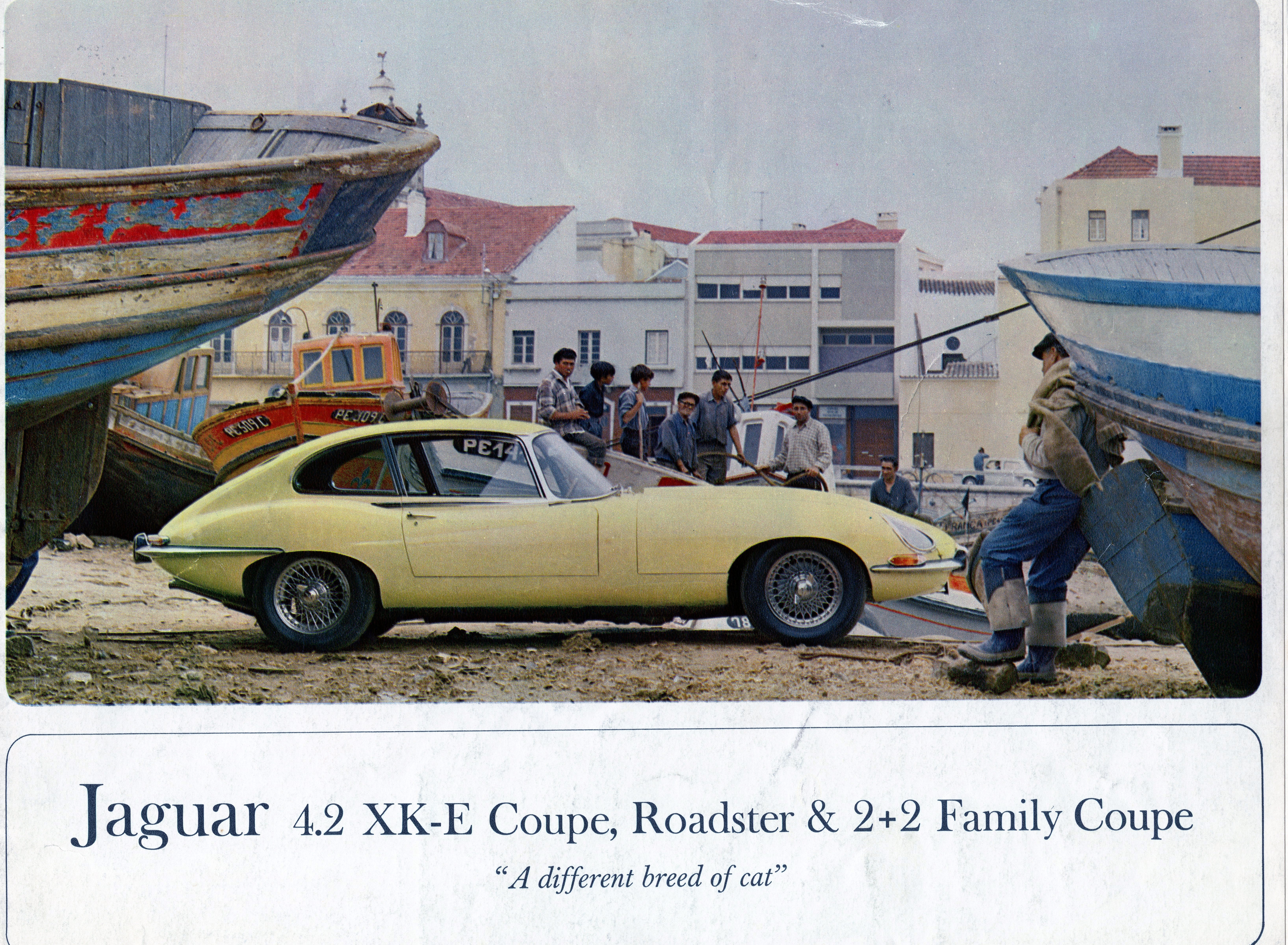
The brochure cover, featuring a primrose yellow 2+2
Start with the cover photo, showing the new 2+2 sitting on a dirt-strewn pier, surrounded by dock workers. Who were these guys? Models hired by the ad agency? I doubt it. Unlike every other car in this brochure, the primrose yellow car is RHD, so this one was likely taken in the mother country.
The red coupe and black roadster, showing the roadster’s red interiorThis time, coupe in foreground, roadster in back
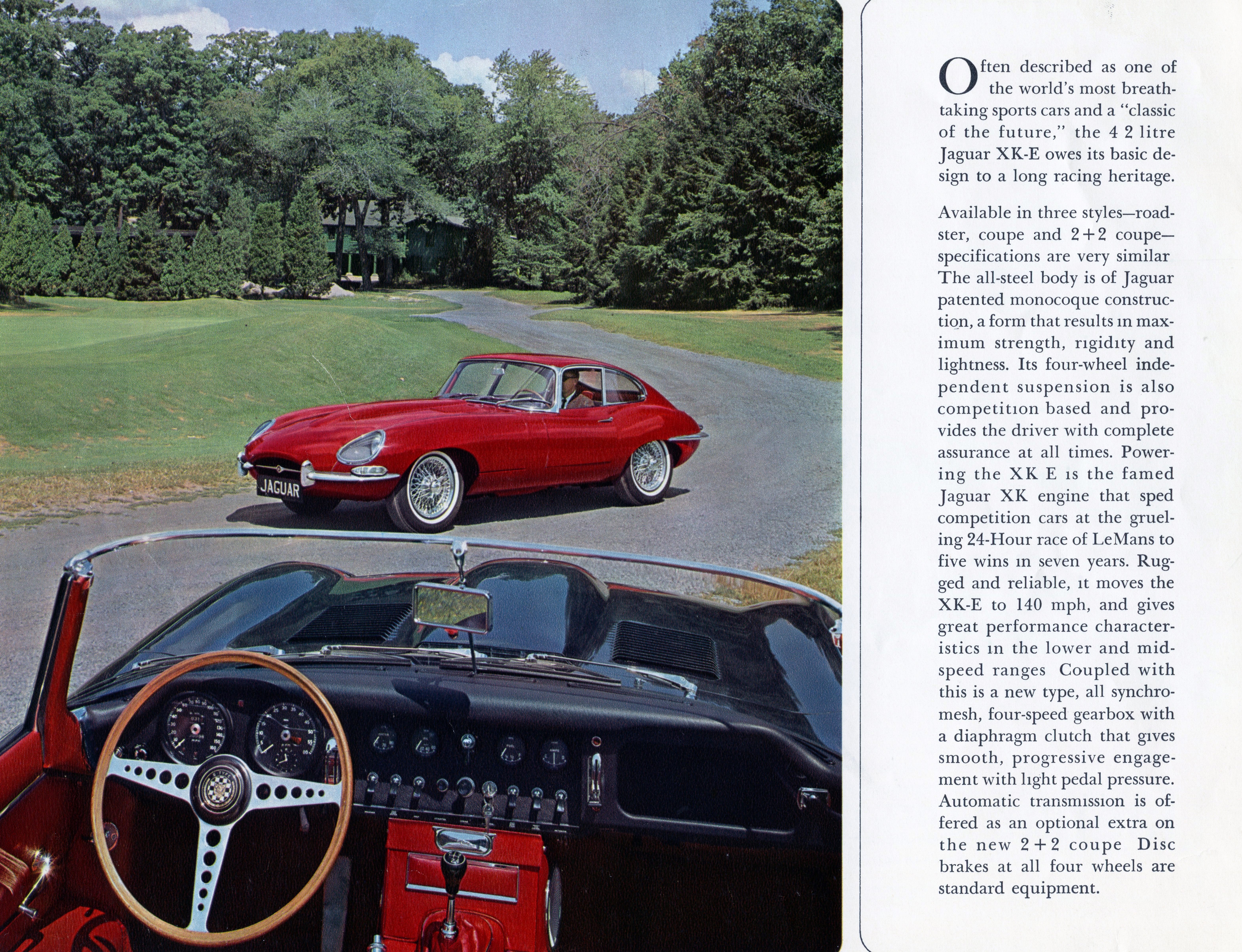
Opening up the booklet (it’s six pages, three on each side, folded twice), there are two photos of a red coupe and black roadster. Your eye is drawn to the wood steering wheel, chrome wires, whitewall tires, and “JAGUAR” license plates. It is impossible not to swoon over these cars. The page between these two is devoted to the 2+2 model; pictures highlight the rear seat, automatic transmission, and ample luggage space. The text provides the line for husband to deliver to his spouse: “The XK-E 2+2 thus becomes the Jaguar family coupe.”
“It’s a sports car!” “It’s a family car!” “It’s both!”
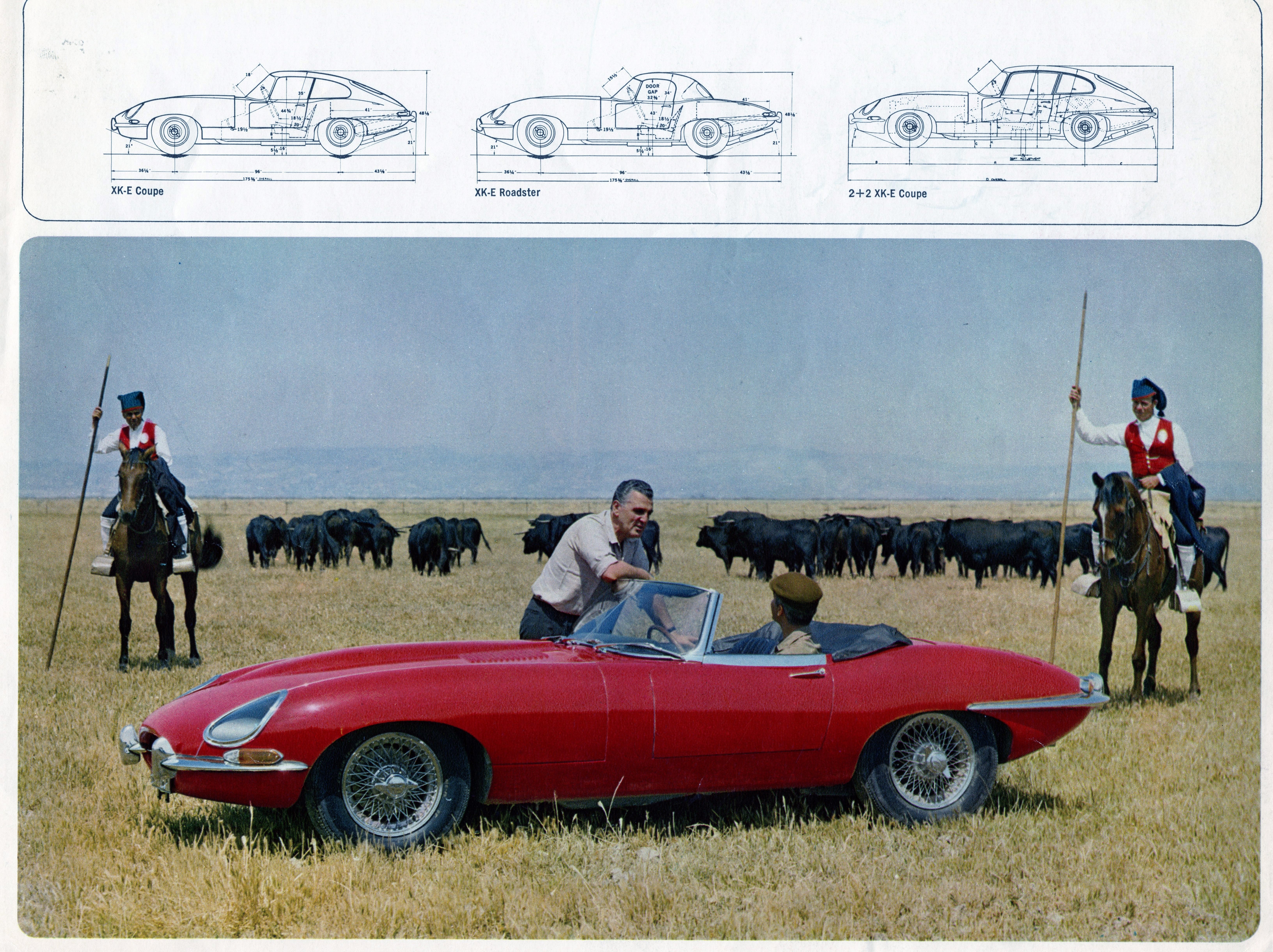
The award for most-interesting-photo-ever-in-a-car-brochure may go to the red roadster, what, on safari? What photographer was brave enough to stand behind the lens, while several dozen bulls loitered in the background? Was it the job of the two guys on horseback to drive away the herd should they decide to charge? (I would have chosen another color for my vest.) At least the Jag, with its dirty blackwalls, looks like it was driven, not trailered, to the location.
Good thing that Jaguars can outrun bulls
The back page provides all the specs you could wish for. My young brain could not pronounce “monocoque”, and didn’t know its true meaning for years. And the list of optional equipment, taking up four lines of text, sharply contrasted with the typical American car brochure, which needed several pages to describe all the add-ons.
Specifications to your heart’s content
I’ve always wanted an E-Type; like many other collector cars, their affordability always seems to be just beyond reach, as their values continually climb. In the meantime, I’ll happily stare at my 1967 XK-E brochure (make mine the red coupe please).
All scans of the “Jaguar 4.2 XK-E Coupe, Roadster & 2+2 Family Coupe” brochure are from the copy in the author’s collection.
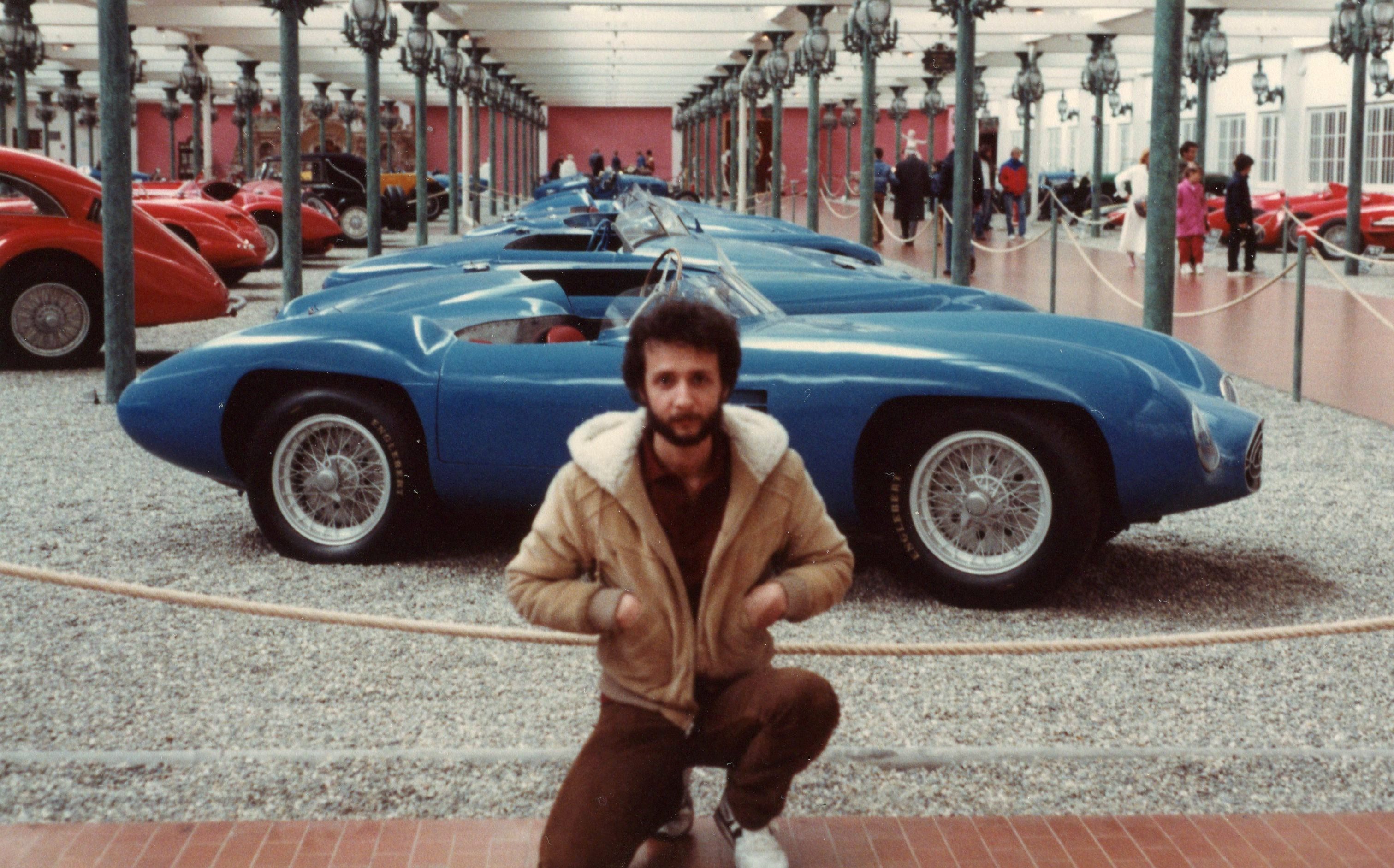
In March of 1983, my girlfriend and I took a one-week vacation trip to visit her sister and brother-in-law in Germany. The BIL was in the armed services for the U.S., and was stationed in Frankfurt. They had a government-assigned apartment and a room to put us up while we toured the German countryside, happily eating and drinking our way through the week. Somehow, I managed to convince my girlfriend that we should use our rental car to make a slight detour to the small town of Mulhouse, France, a short trip across the border. There in Mulhouse was the French National Automobile Museum, also known as the Schlumpf Collection.
Portrait of the car enthusiast as a young man
I knew of the Schlumpf brothers and their Bugatti automobiles from numerous articles in the automotive press (especially those in Road & Track) published throughout the 1970s. For those unfamiliar with the long involved history of Ettore Bugatti, his racing and road cars, Hans and Fritz Schlumpf, their Bugatti obsession, and the brothers’ eventual downfall, further reading is recommended, as it is beyond the scope of this blog entry to cover these stories.
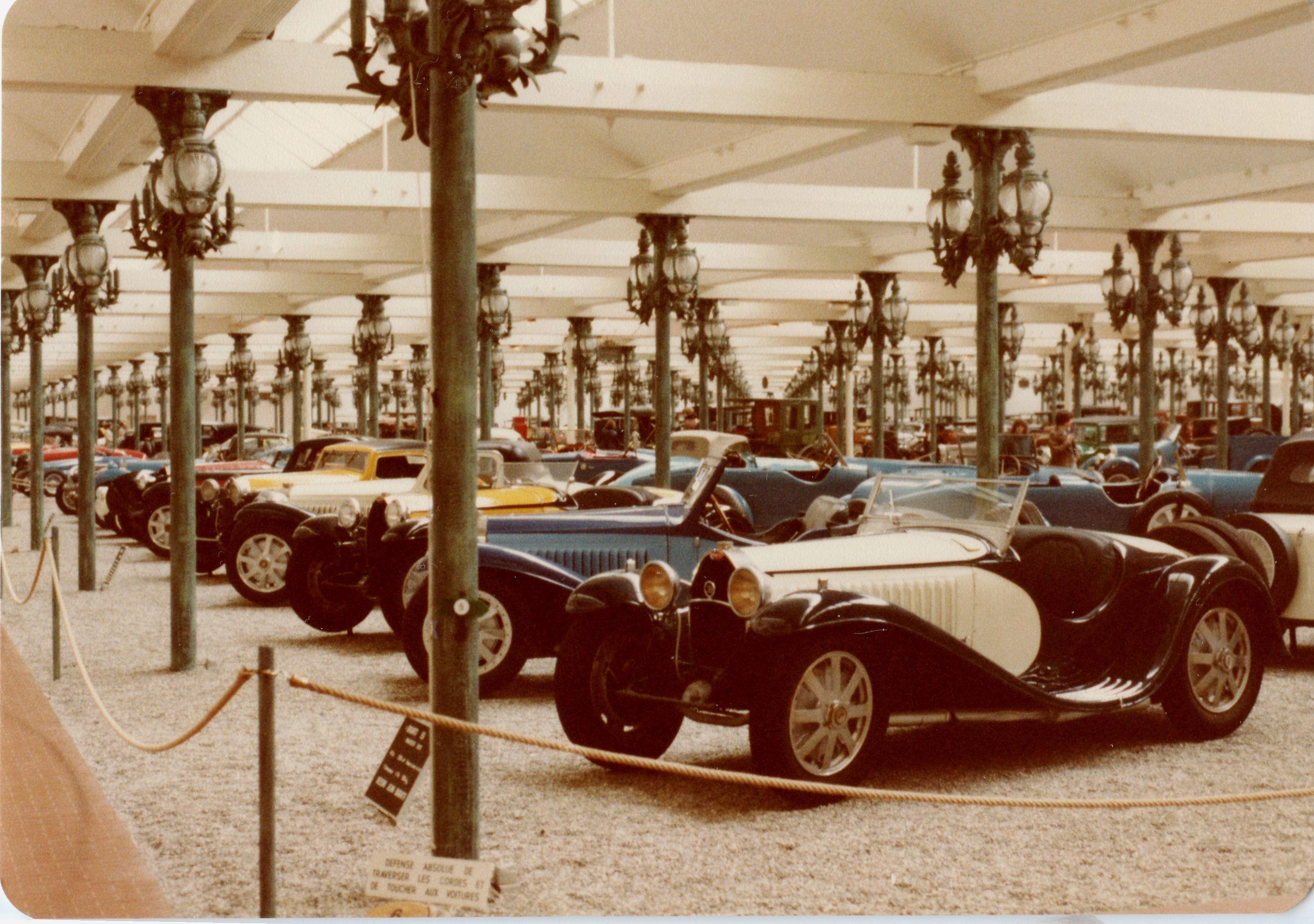
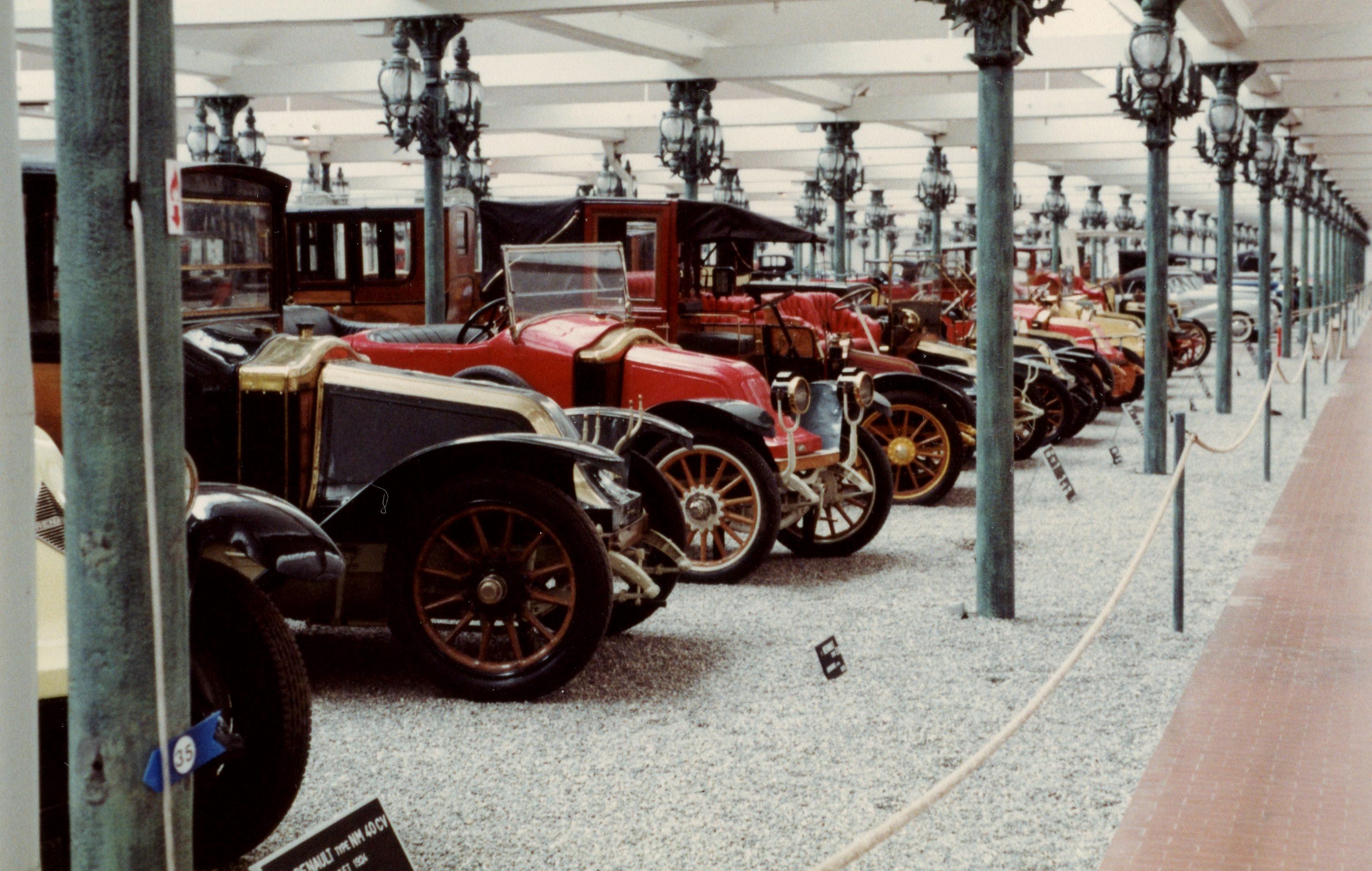
The Parisian street lamp motif is especially noticeable here
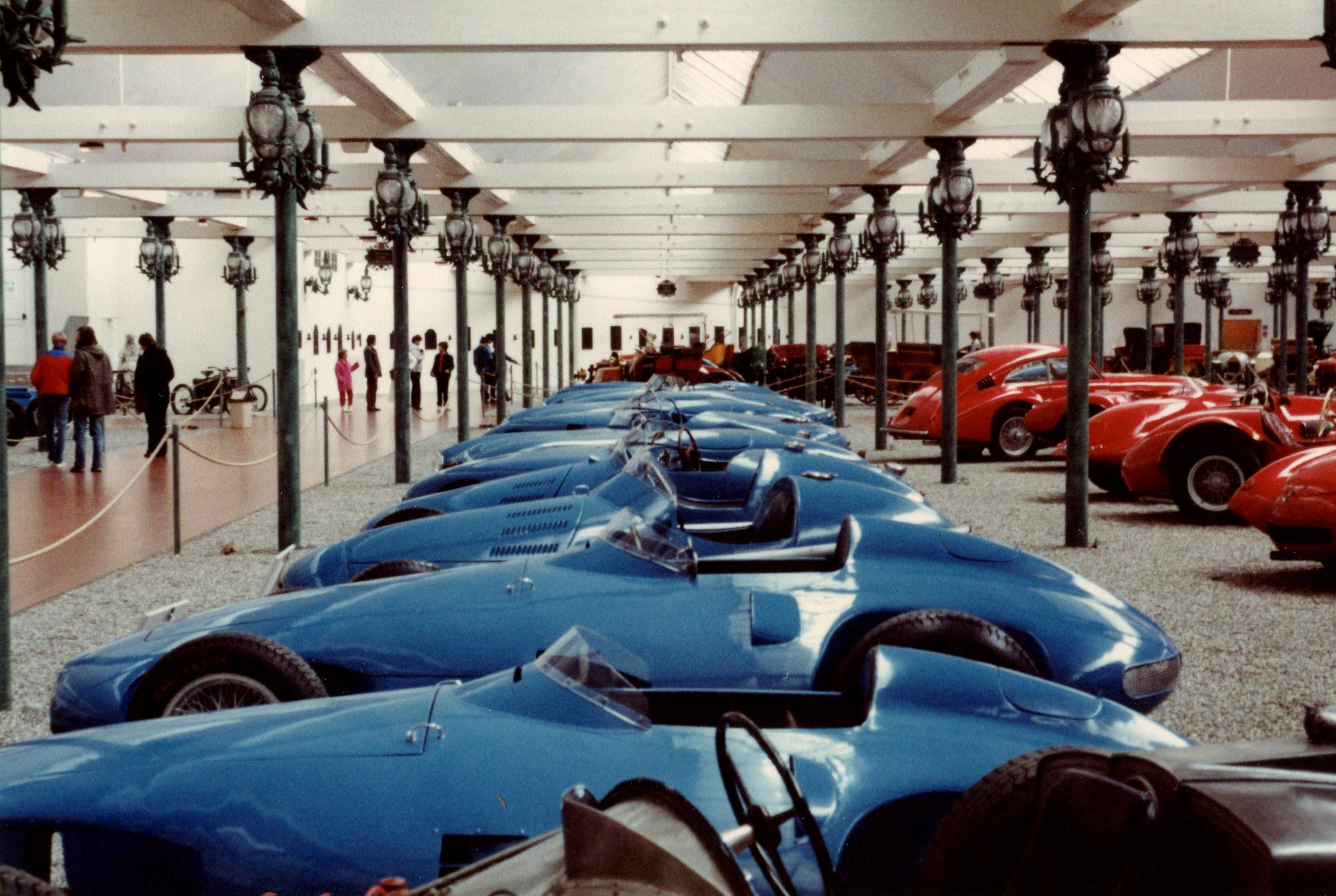
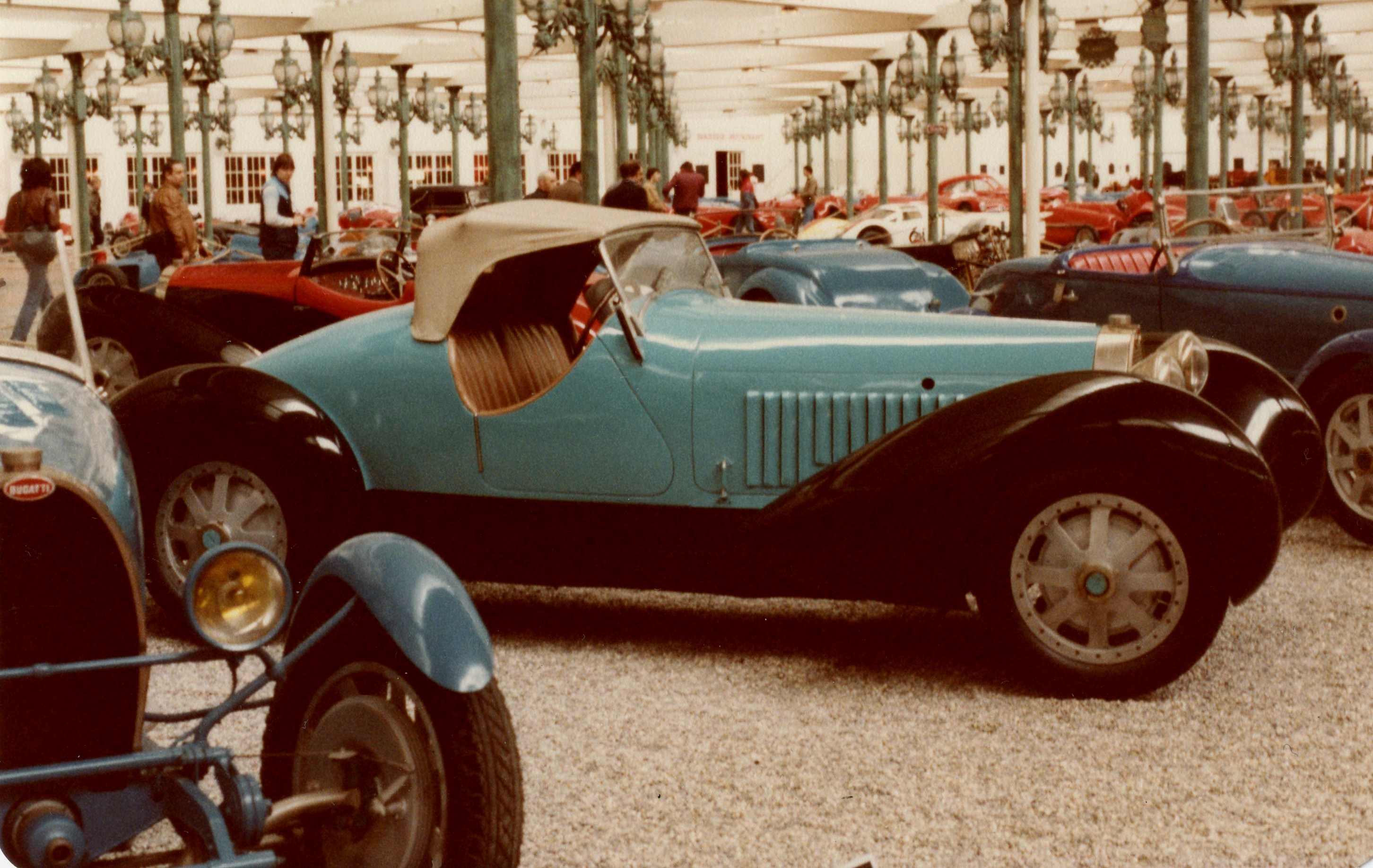
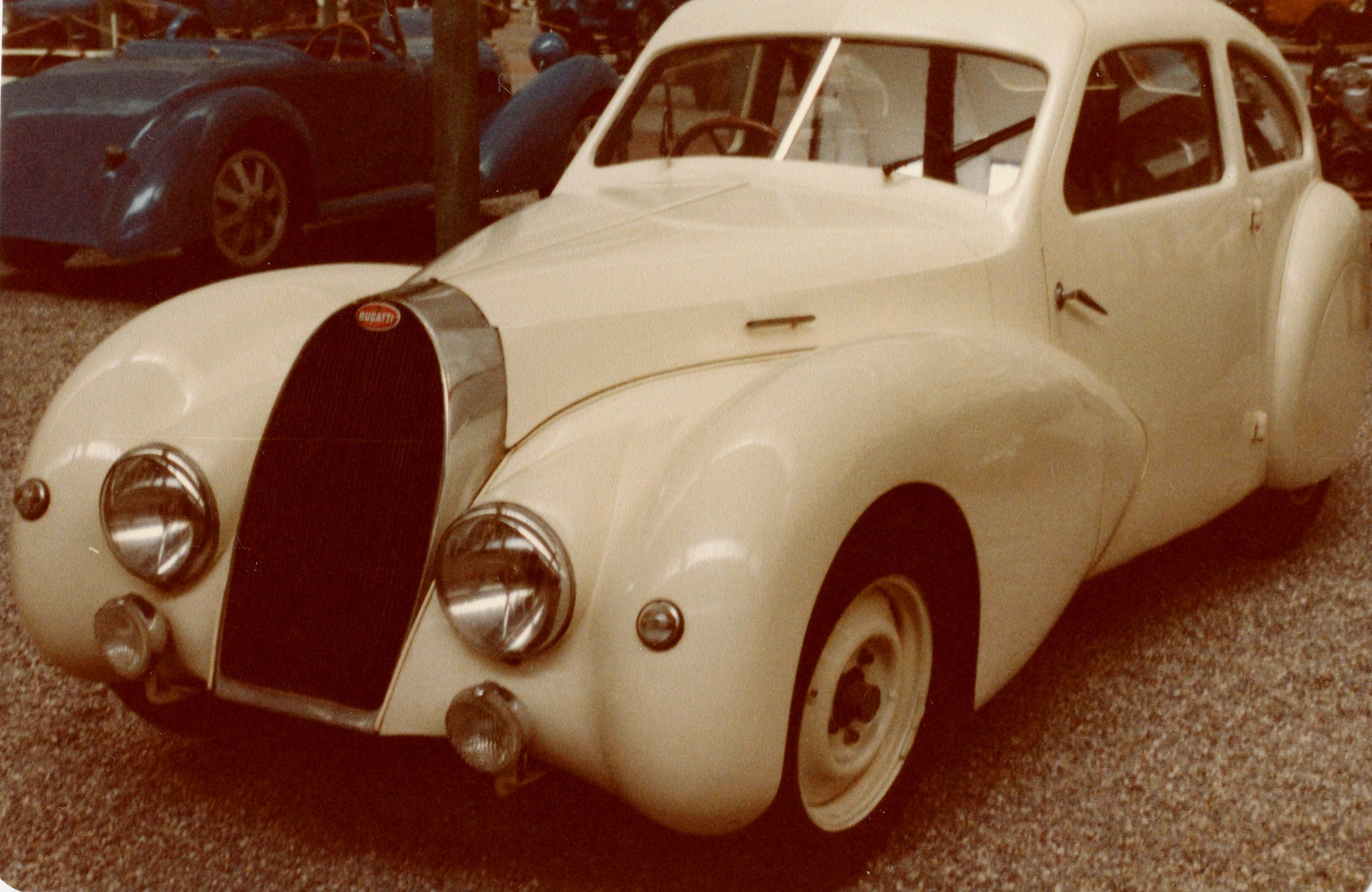
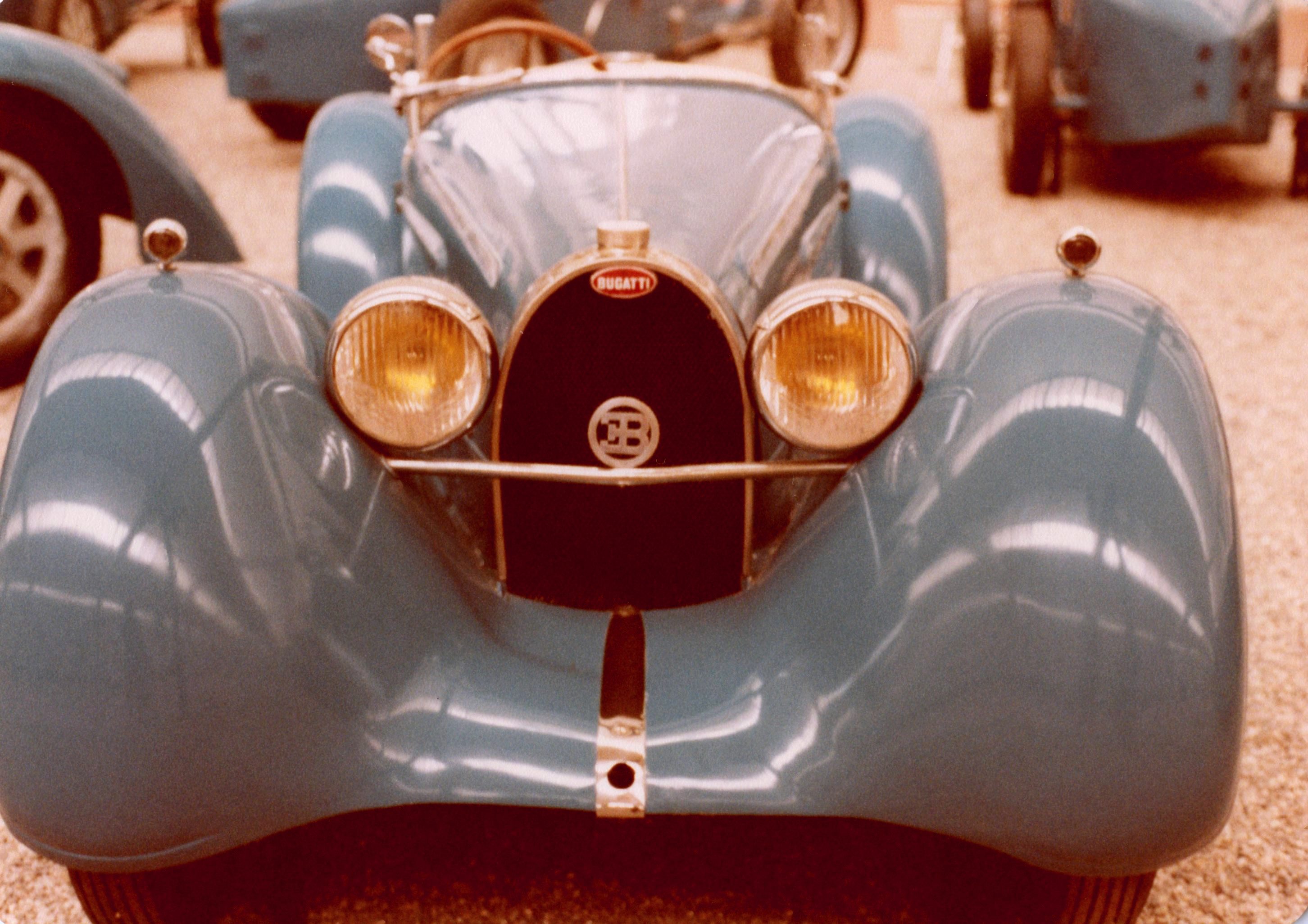
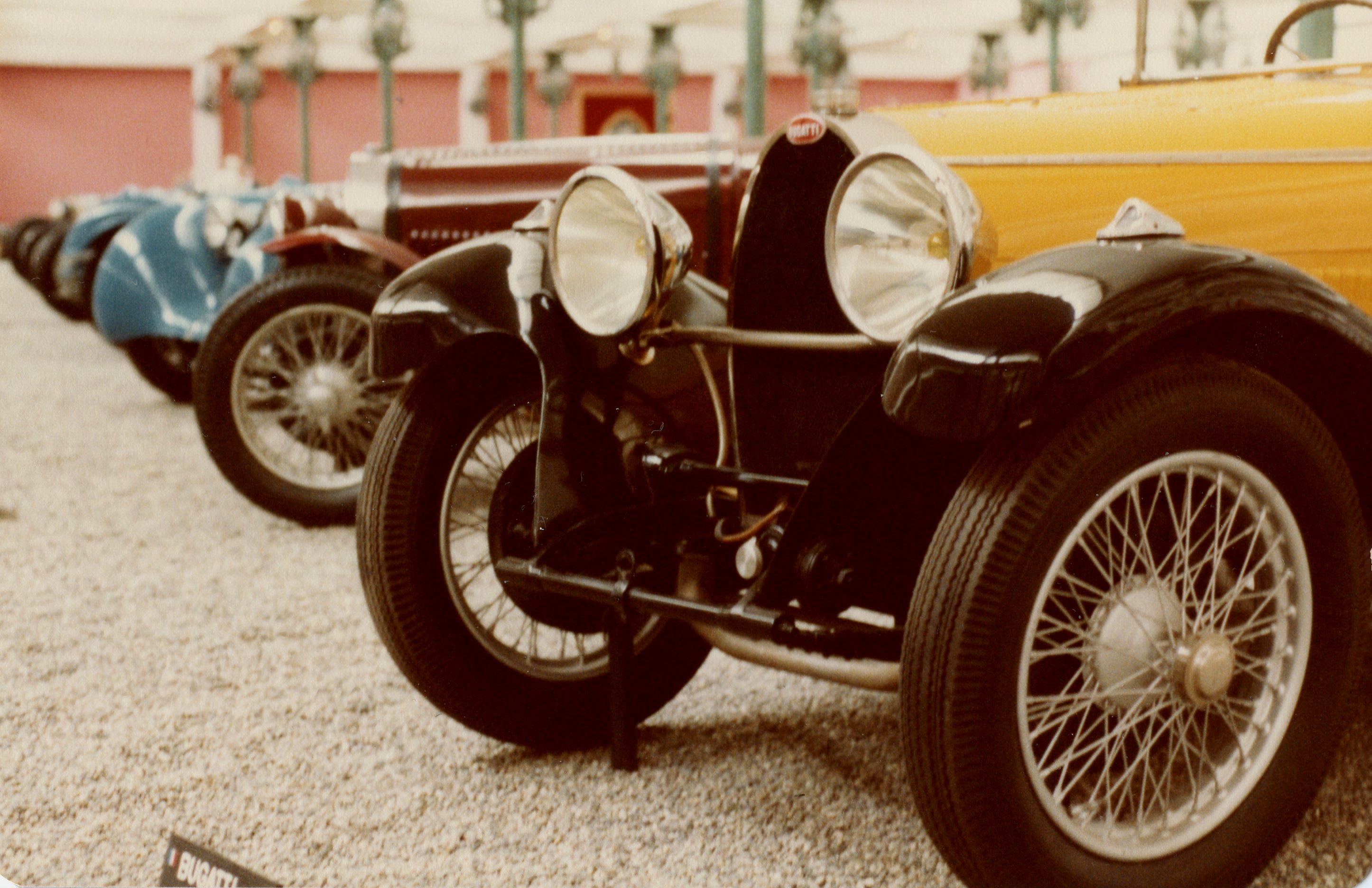
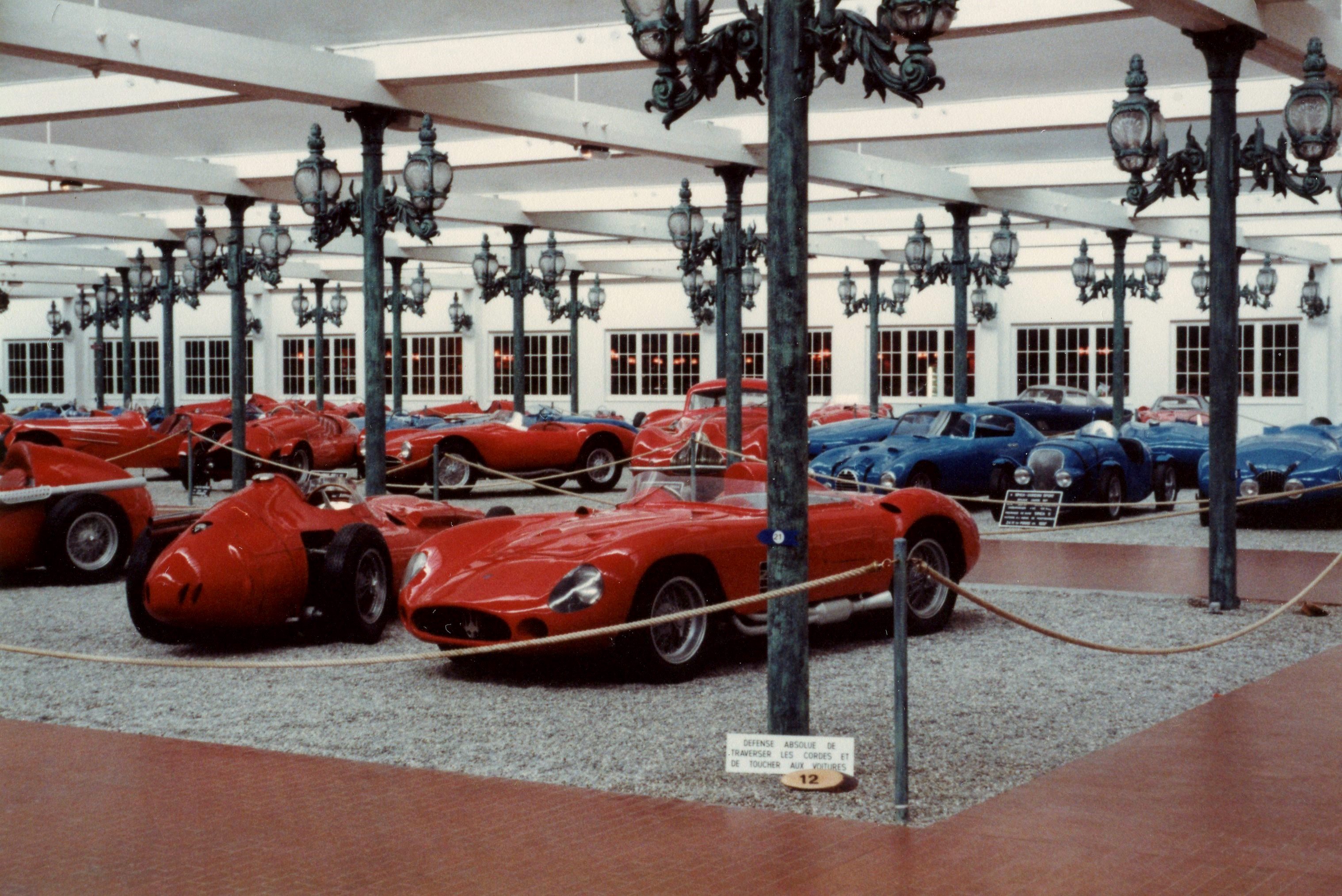
Back to our visit: we showed up on a weekday morning, and the museum was sparsely attended, although there were several busloads of French students milling about. The sheer number of cars was overwhelming, and the fact that the majority of them were Bugattis in a matching shade of French blue was even more overwhelming. Try as I might to capture them with my film camera, I only shot about two dozen pictures, which leads me to conclude that I had but one 24-exposure roll with me. As I had not documented specific model information for the vehicles I photographed, the museum’s website plus Google were used to research those details. The photo captions provide the year, make and model for all but a few of the cars below.
THE BUGATTIS
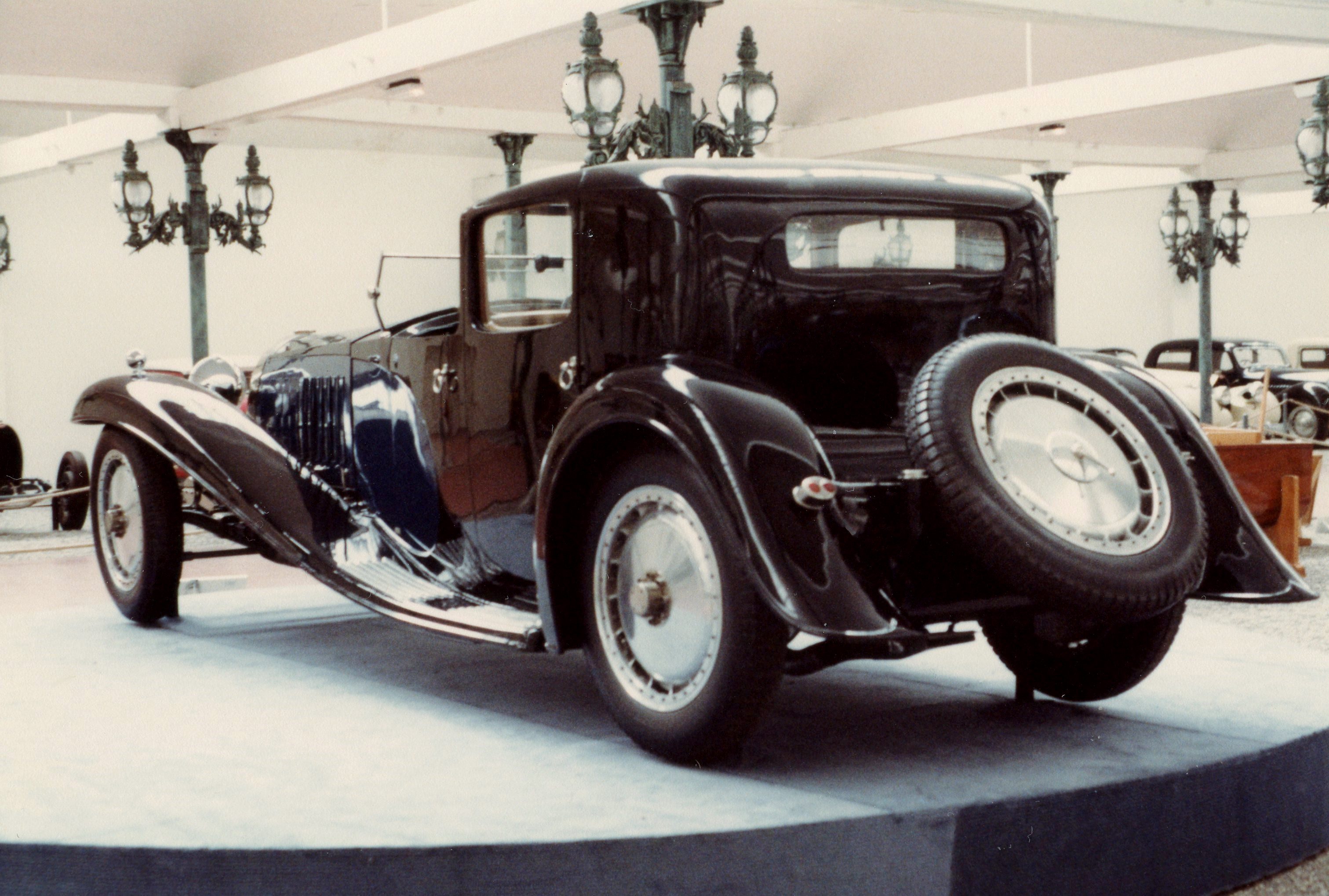
1929 Bugatti Royale Coupe Type 41 (photos cannot convey the enormity of this thing)
Bugatti Royale Coupe from rear
1930 Bugatti Type 43
1937 Bugatti 57 Coupe Atalante
1938 Bugatti Coupe Type 57 SC
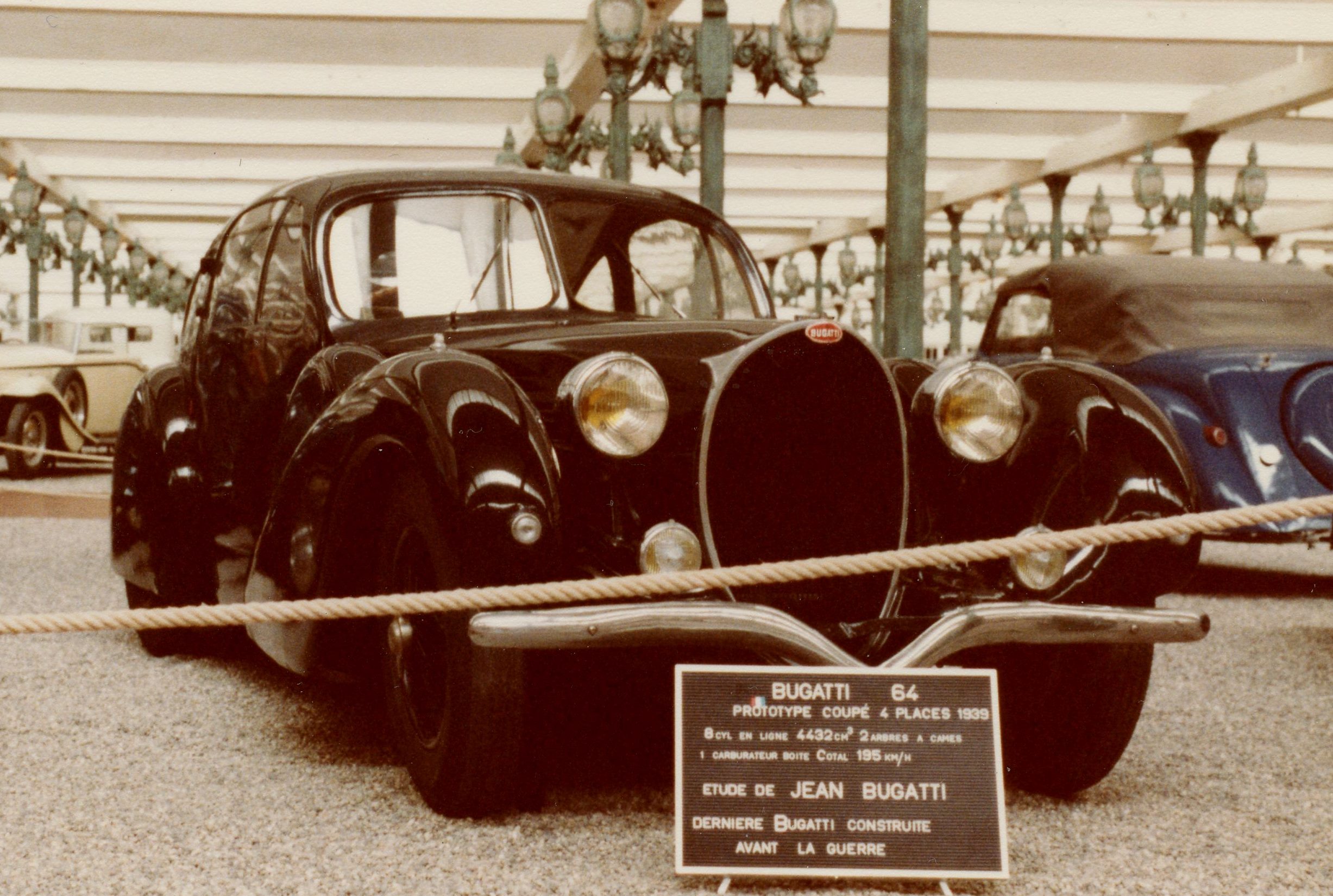
1939 Bugatti Type 64 prototype
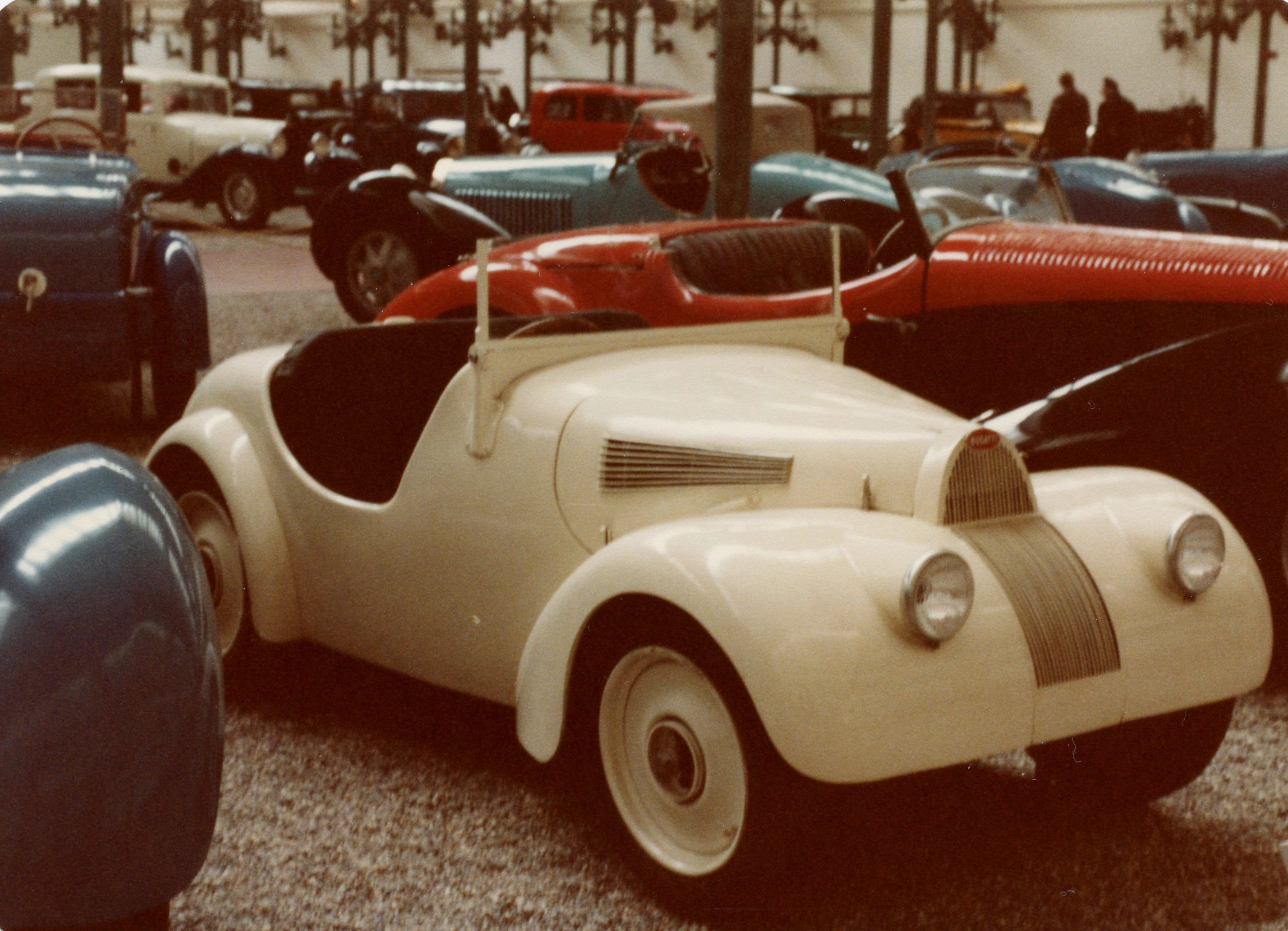
1942 Bugatti Type 68 (micro Bugatti prototype)
1947 Bugatti Type 73
Possibly a Type 57 with alternate coachwork
1957 Bugatti Sport Type 252
A Bugatti of unknown vintage; note the EB on headlight bar
Not all Bugattis are blue
OTHER MAKES
Pre-war cars at the Schlumpf
Red cars (mostly of the Italian racing variety)
Mercedes Benz 300 SLR racer
1953 Gordini 17S
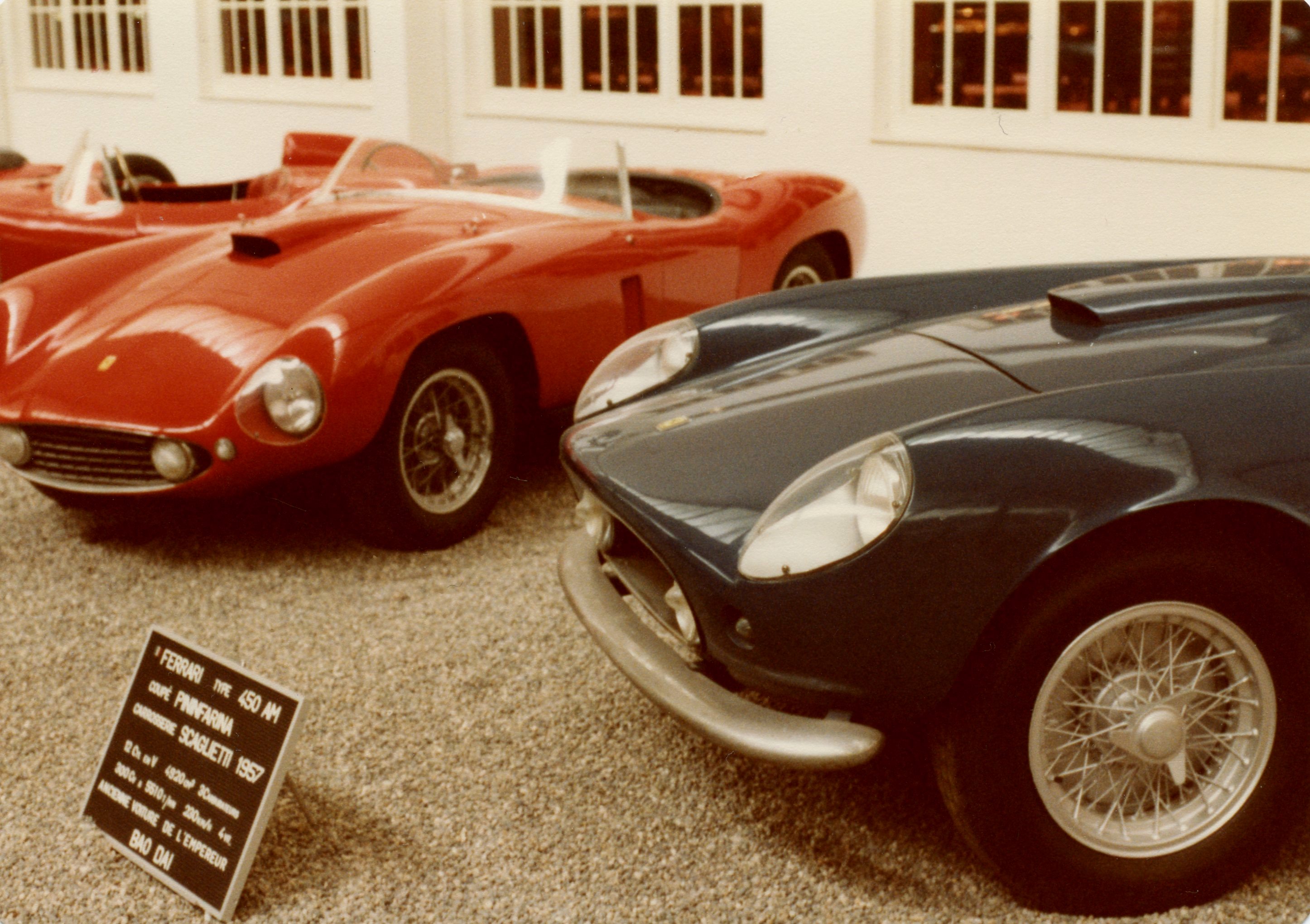
A pair of Ferraris
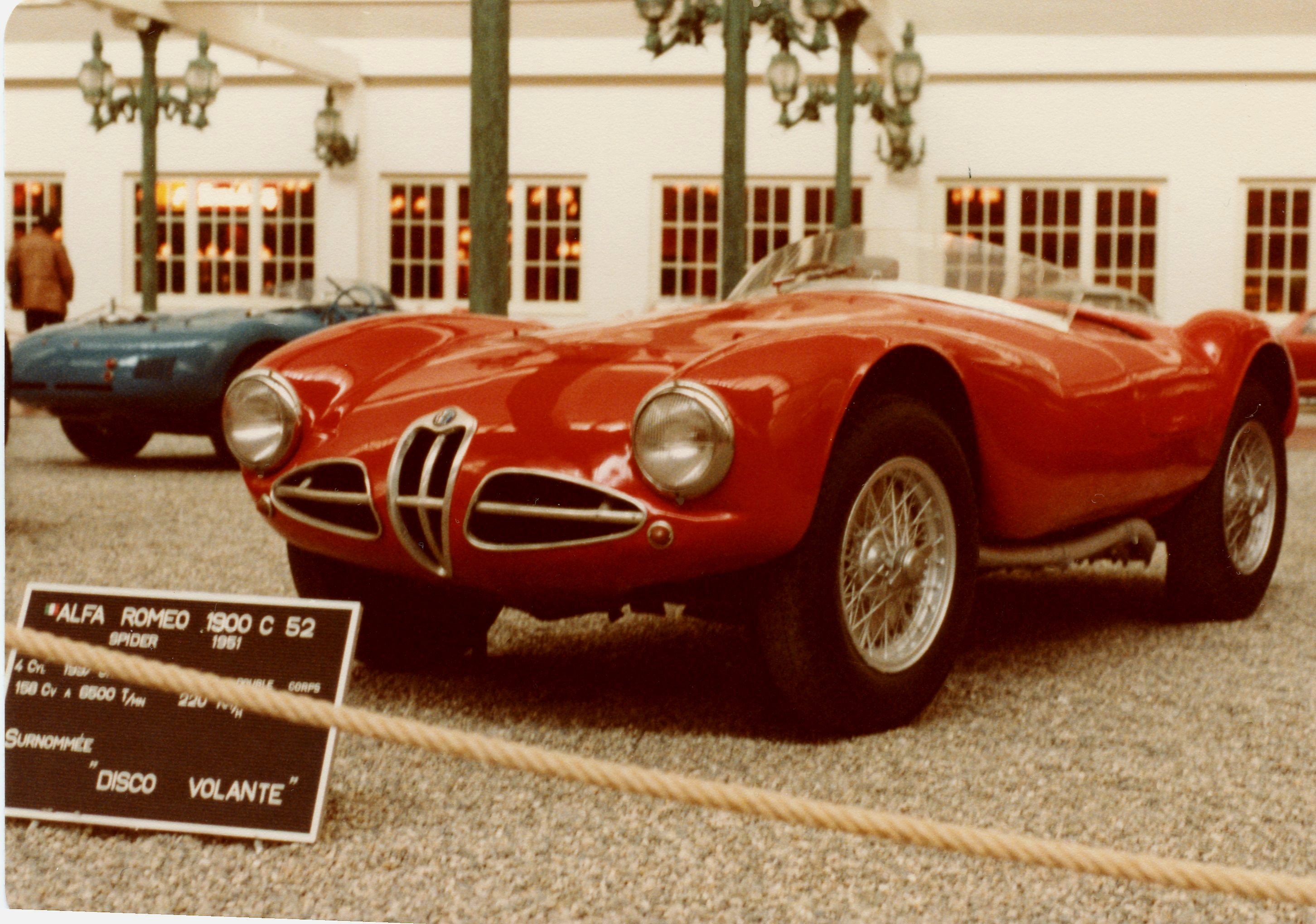
1951 Alfa Romeo Disco Volante (greatest car name ever: “Disco Volante” means “flying saucer”)
The museum visit was a highlight, perhaps the highlight, of that week in Europe. What an honor to be able to say that I visited this tremendous collection in person. Reading the museum’s website, it is eye-opening to see that it has been changed, enlarged, and enhanced, as you might expect of any museum after so many years. It remains on my bucket list to make a return visit to what is now known as the “City of the Automobile – National Museum – Schlumpf Collection”.
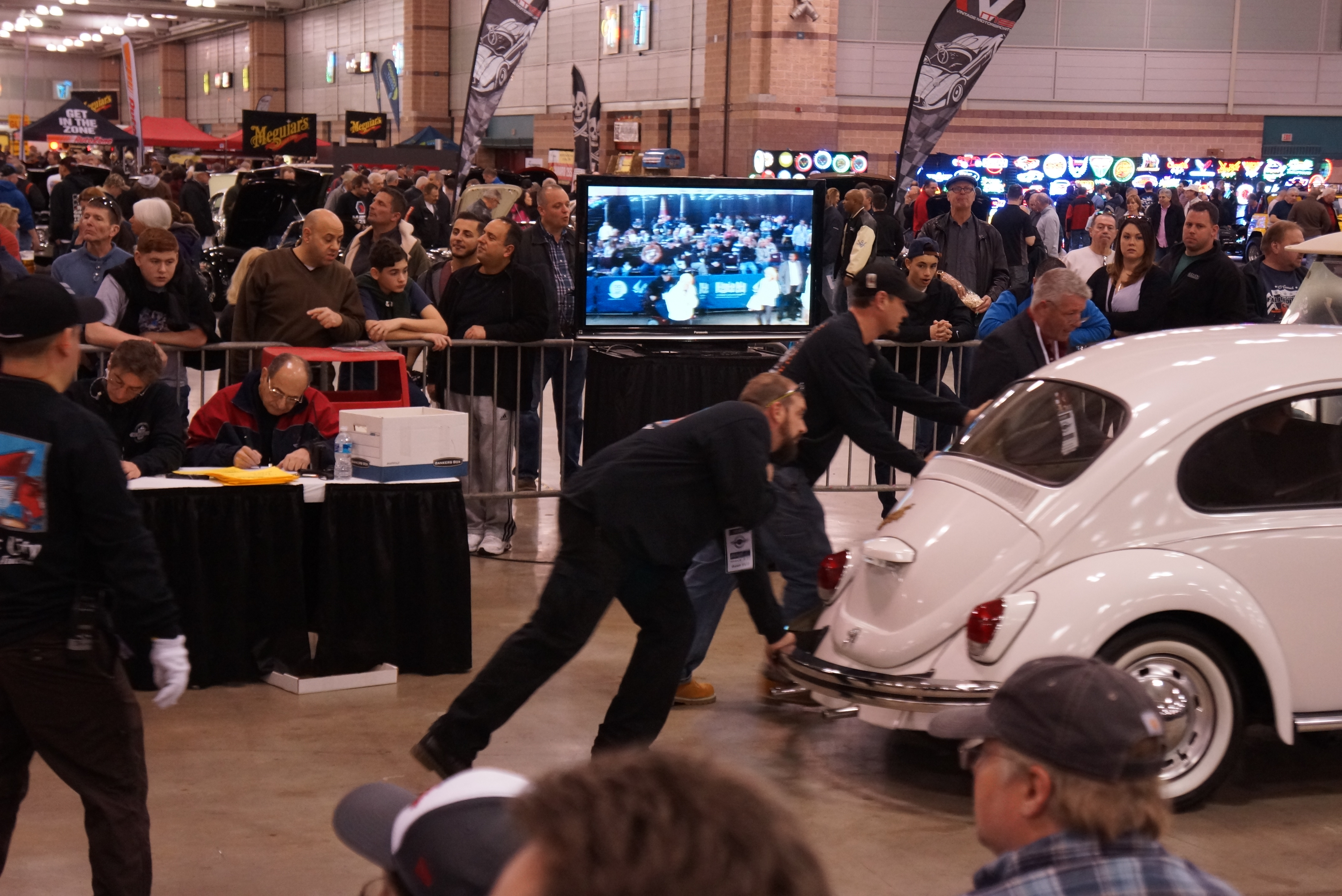
The pushers move a VW Beetle off the block. This one was a no-sale at $4,250.
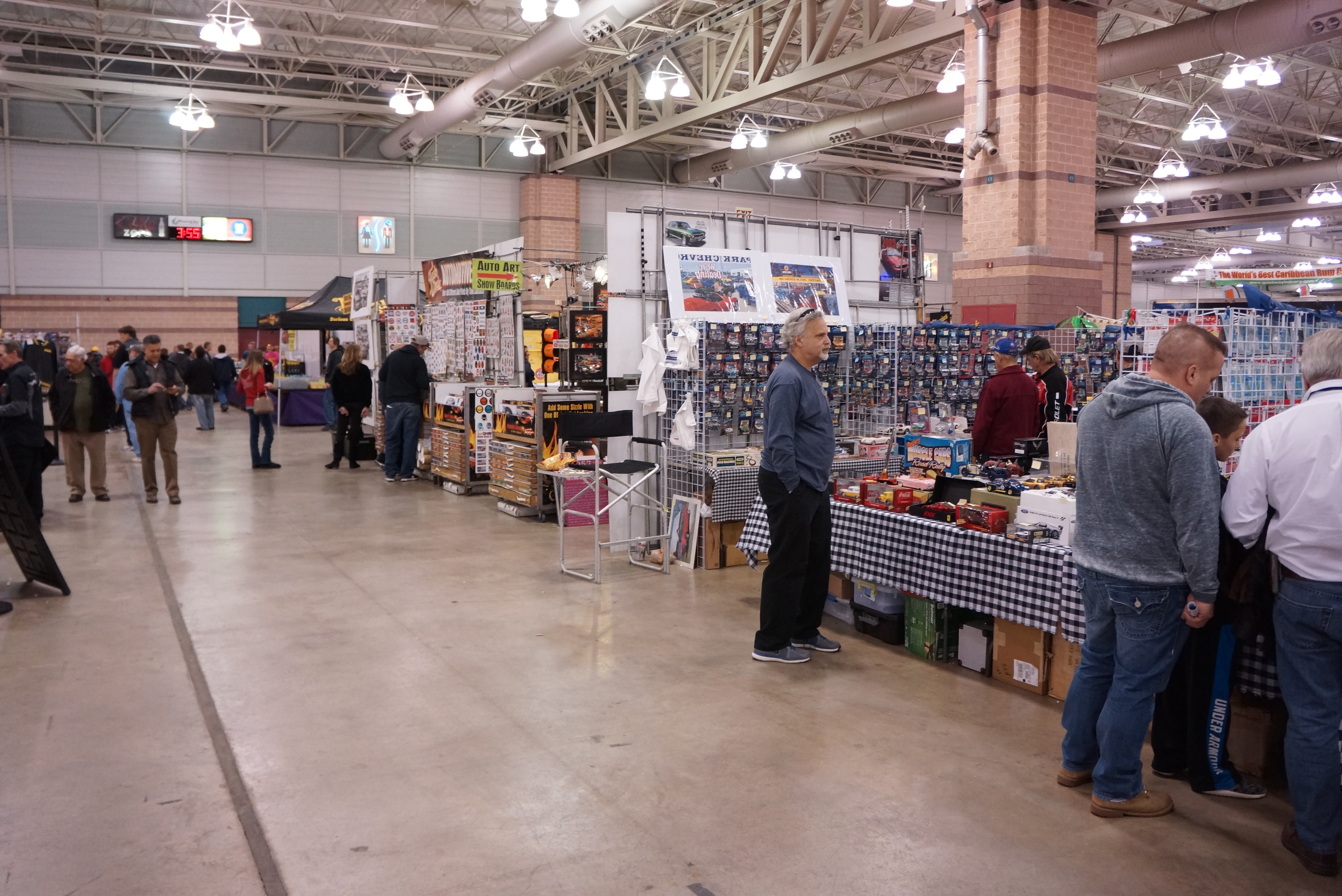
G. Potter King (GPK) again hosted its winter edition car show in the Atlantic City Convention Center during the last weekend of February. The event features an auction, a car corral, and a swap meet, all of which comfortably fit inside the cavernous hall. One of the main attractions of this show is that it is mostly impervious to the weather, and so gives us hobbyists a chance to relieve our cabin fever.
The swap meet had the usual mix of old and new stuff to tempt us all.
This year, similar to what we observed in 2015, the number of consignments seemed to continue to be on the decrease. The car corral in particular had enough empty space for an additional 20 or 25 cars. The auction side of the building was a bit more occupied, yet still could have held a few more cars.
The car corral again included plenty of dealers showing new and classic iron.
For the third time in the last 5 years, GPK rearranged the auction stage and seating. This time, the flow of cars on and off the block seemed better integrated, and seating for non-bidders (like me) was more readily available. One downside to the new set-up was the lack of airflow. Non-catalyzed vehicles emitting exhaust fumes in an enclosed space eventually gets to you. There needs to be a way to move more fresh air through the grandstands.
The view of the auction block from the grandstand.
Having attended auctions hosted by Mecum, RM, Bonhams, Auctions America, and Carlisle, it’s frustrating to see that GPK still could improve their auction block screen shots. This year, they took a step in the right direction by superimposing the lot number, vehicle year and make, and current bid onto the TV image. But the wording was not always easy to read, and often, the bidding on screen far lagged the real-time bidding. Mr. King, a suggestion: watch Mecum to see how it’s done.
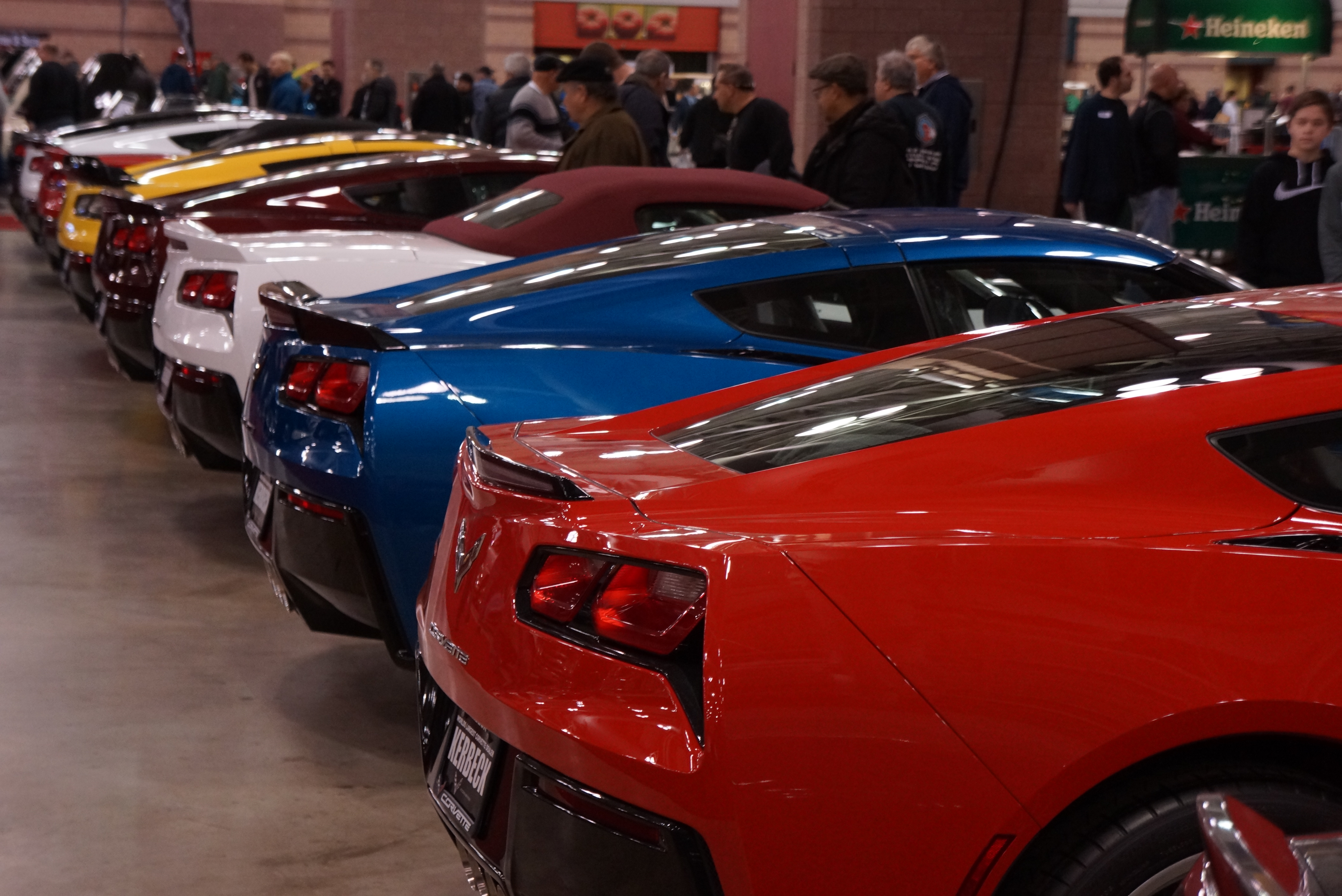
If old cars bore you, gaze upon this row of new C7 Corvettes.
The show was helped by a decent weekend of dry and sunny weather in southern New Jersey. There were 100 or more early birds who were waiting for the doors to open at 9 a.m. Foot traffic was plenty strong, and the bidders area directly in front of the auction stand was almost filled to capacity. Nevertheless, the sell-through rate, or, the percentage of cars actually meeting reserve and moving to new owners, appeared to hover around 50-60%. This is due to some combination of unrealistic reserves, poor quality offerings, or not the right bidders in the room.
Car show food is overpriced and doesn’t taste great. We walked 5 minutes to the AC train station in the same building for great food at Esquire’s.
It says a lot about an auction company which can attract quality consignments, get sellers to agree to reasonable reserves, and then draw hungry bidders into the process. It may look easy from the outside, but it’s not. The Arizona auctions in January indicated some slight softening of the market, which didn’t help here. But we did see some cars change hands. Below are details on a random sampling of cars which caught our interest from both the auction and the car corral. (“CPI” values are from the author’s copy of the Jan.-Feb. 2016 edition of the classic car price guide Cars of Particular Interest.)
Auction cars, coming or going (sellers hope the latter).
AUCTION CARS
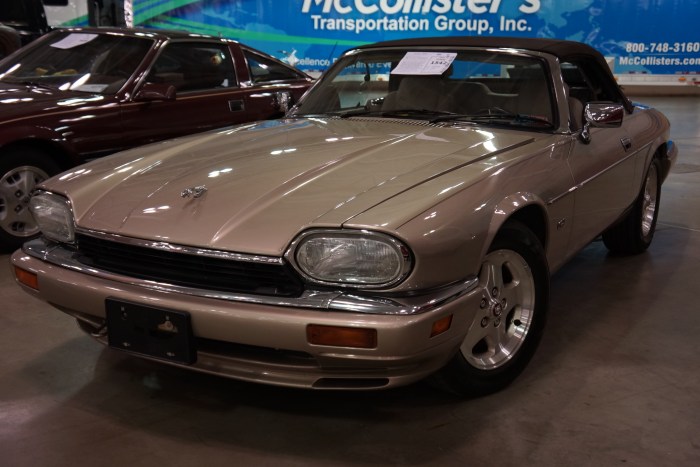
Lot #1542, 1995 Jaguar XJS convertible, champagne, brown cloth top, glass rear window, tan interior, 86,900 miles. Car looks very nice from the outside. Some driver’s seat bolster wear, otherwise clean interior. 6 cylinder, automatic, nice alloy wheels, paint looks great except for repainted passenger door (but it’s hardly noticeable). Sign on the dash said “not sold on Friday, but for sale at asking price of $9,500”. Online, the car was reported sold for $8,000. CPI values the car between $10,250 (#3) and $17,425 (#2). We would rate is at 3+ and call it very well bought.
’95 XJS looks good here
… as well as here
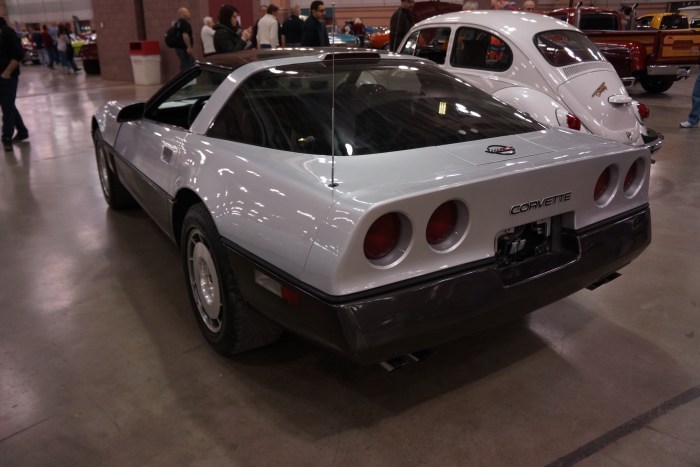
Lot #1712, 1986 Corvette coupe, silver/dark grey, red interior, automatic. Mileage is 109,073. Looks just OK on outside, red interior is very worn. Car offered at no reserve, hammer price was $3,400. We rate it a #4 car, and CPI rates a #4 car at $4,475. If it runs, passes state emissions, and doesn’t leak copious amounts of fluid, someone who just wants to have fun may have gotten a very good deal. As one buddy put it, “drive it for 10 years, then throw it away”.
OK from the front
OK from the rear
Interior quite worn
Someone just got a ‘Vette for $3,400
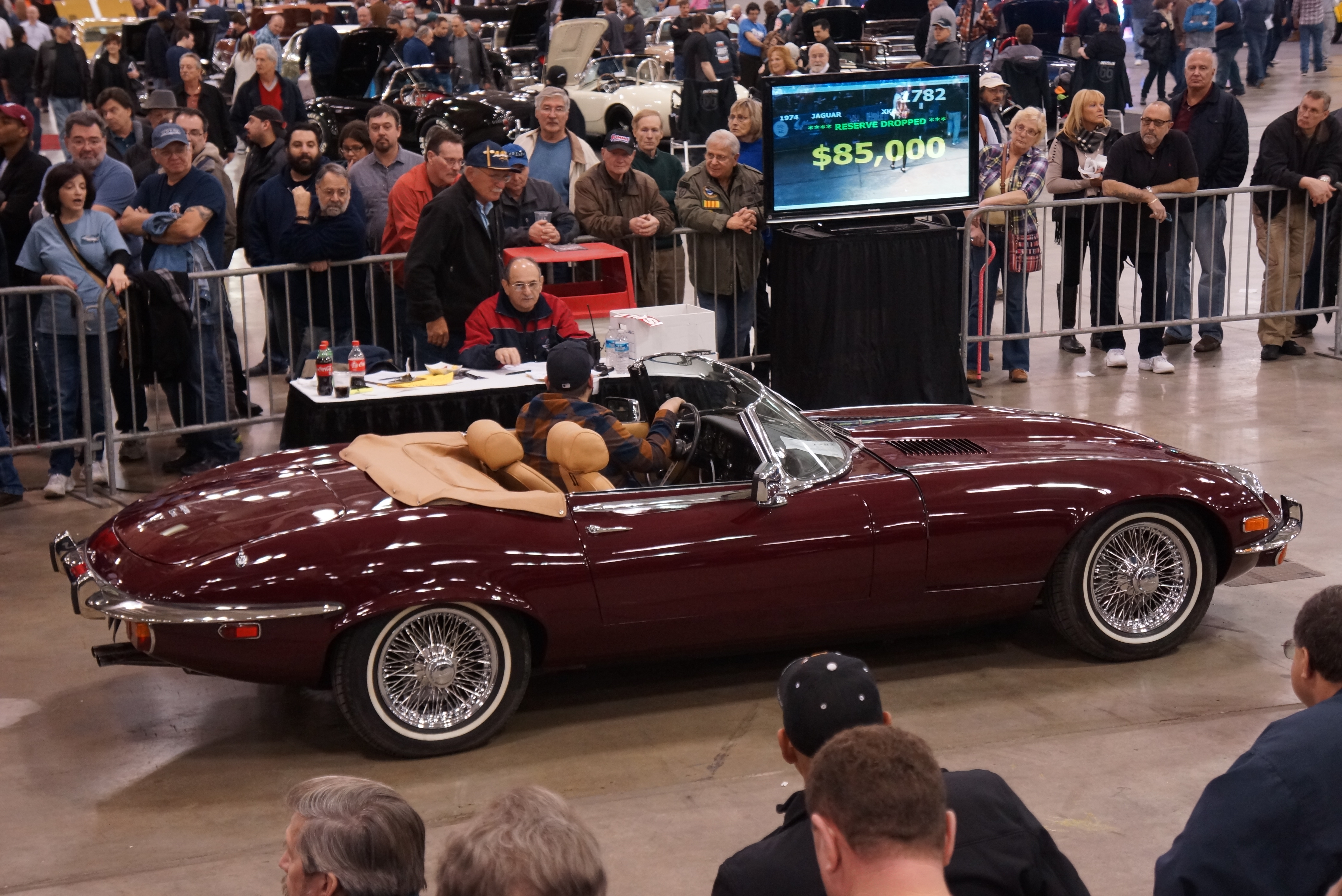
Lot #1782, 1974 Jaguar E-type convertible, Series III with V12 engine, manual transmission, A/C, dark red with biscuit top and interior. Last year for the E-type. Owner claims 16,000 original miles, and also claims it was thoroughly restored. We didn’t see this one up close, but it did appear to be near a #2 condition car. CPI values a #2 car at $87,750, and this hammered sold at $85,000, so someone was willing to pay full boat for it.
At $85,000, this E-Type was the highest sale we saw on Saturday.
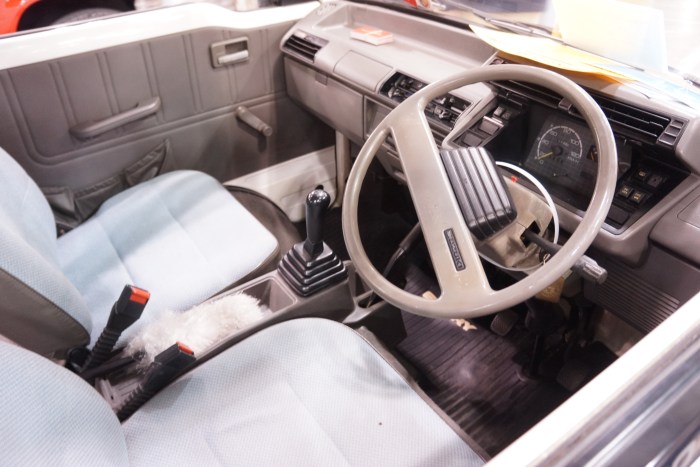
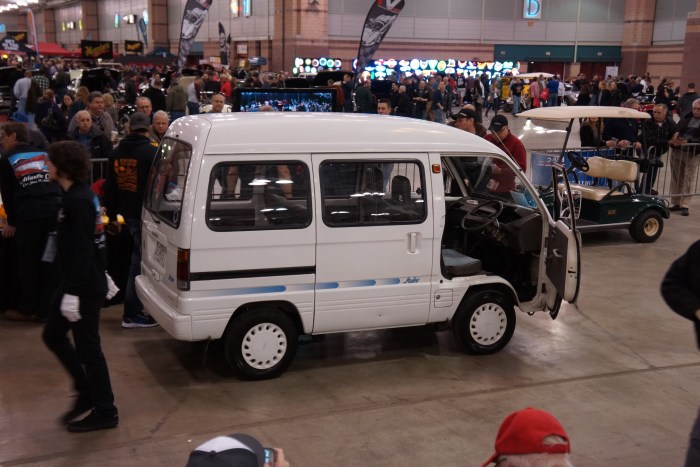
Lot #1716, 1990 Suzuki “Every” mini-mini van. Right hand drive, 3-cylinder, 5-speed, factory air, 2,800 original miles. Sliding doors, 2 rows of seats, roomy looking interior. Tall, narrow box on 4 wheels. Everyone was all over this little thing, but it was declared no-sale at a reported high bid of $8,250. We hope it sells just so you can claim to be the only person in your state with one.
That’s one small mini-van
Get a part-time job delivering mail
The Suzuki does not go to a new home
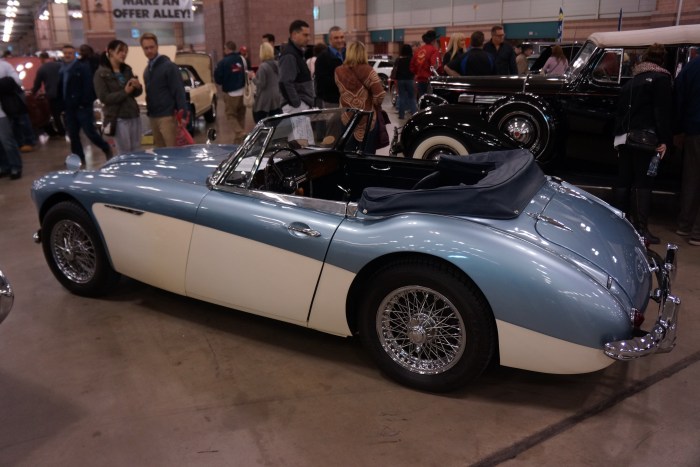
Lot #1783, 1965 Austin-Healey Mark III, inline 6, light blue over white paint, with dark blue leather interior. Chrome wire wheels, blackwall tires. Odometer reads 77,000. Car looks very clean overall, no blemishes outside or inside, but appears that restoration may have been done a few years ago. CPI rates a #3 car at $52,500 and a #2 car at $100,000, so that’s a huge spread, mostly defined by condition as there were few options. This one sold for $58,000 which was fair to buyer and seller.
’65 A-H in a classic color combo
Chrome wires set off the paint
Nice leather interior
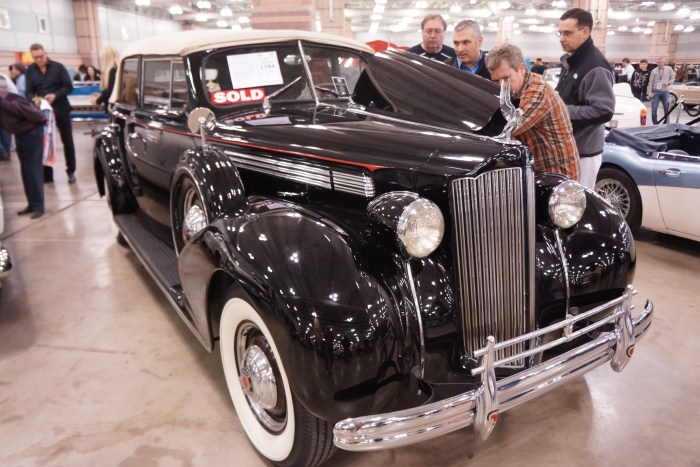
Lot #1784, 1939 Packard, 4 door convertible sedan, black, off-white convertible top, dark red interior. Odometer reads 50,166. Whitewall tires, Packard hub caps, everything looks stock. The car gives off the vibe of a vehicle that was restored 20-30 years ago. It’s all there, and may run out well, but everything has the look and feel of a 20-year-old used car. Rare and unusual body style not seen much, where the B-pillar is removable for a full-open look when the top is down. Car hammered sold for $38,000, which may seem rich, but A) it’s a Packard, and B) try to find another convertible sedan in that price range. Join AACA and go on a tour.
Packard grille stands out
Convertible top in good shape
Plenty of room on front bench
Inside shot of Packard B-pillar shows latches
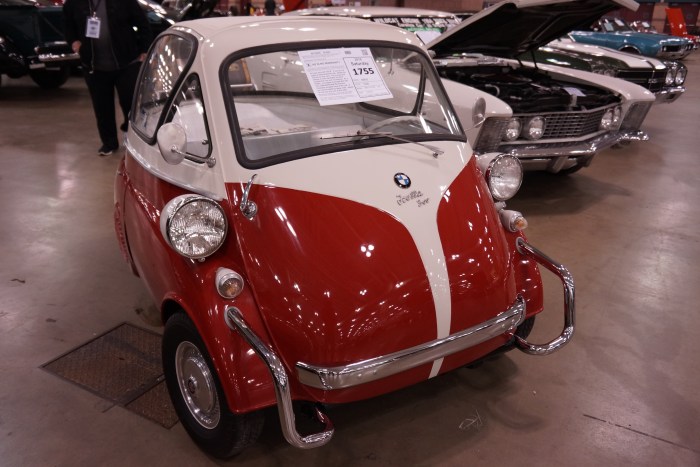
Lot #1755, 1956 BMW Isetta, bubble-window coupe, red/white, white sunroof, white vinyl interior. Restored to an acceptable cosmetic standard. Like most Isettas, interior not done to original style. Car has original ISO-designed side windows, as well as coveted “Z-molding” on the side. Every auction seems to have at least one Isetta. This one had shiny paint but little else to rave about. In the opinion of this former Isetta owner, if you plan to drive the thing, get the sliding-window model, as airflow through these tiny pivoting triangular windows is next to non-existent. CPI rates a #3 Isetta (which this one barely was) as worth $30,000. The car was sold for $33,500, so someone paid a slight premium for 13-horsepower worth of cute.
Red/white 2-tone is seen often
Side shot shows bubble windows, molding
There’s no trunk, so you need this
CAR CORRAL ENTRIES
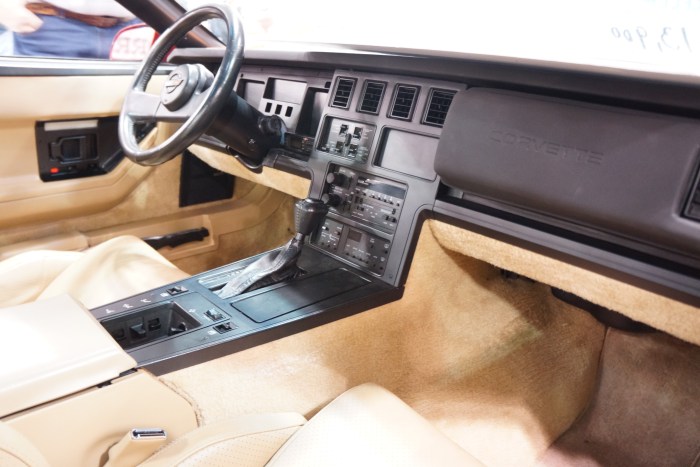
1986 Corvette coupe, red, tan interior, automatic, claimed to have 23,000 original miles. Asking $13,900. Car was fairly clean yet obviously used. Rear panel has been resprayed, and that red does not match rest of car. Lots of swirl marks in paint. Car is in CPI between $8,000 (#3) and $14,700 (#2), and this car just didn’t look like a 23,000 mile car. $10,000 would be all the money, however, there are lots of C4 Corvettes for sale all the time, many of them under $10k .
’86 Corvette for $13,900
Rear ‘cap’ repainted, doesn’t match
Interior as expected for 23,000 miles
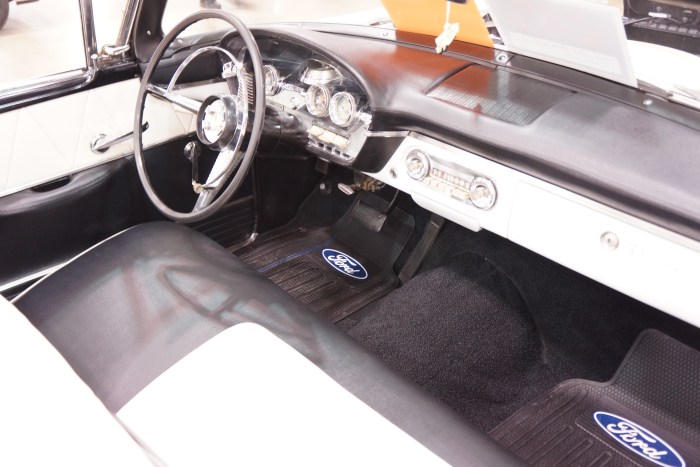
1958 Edsel Pacer convertible, unusual off-white/pale yellow exterior, black interior. Sign claims 35,000 miles, yet car looks restored, not preserved. Very straight overall, interior very nice, engine compartment especially well-done. The entire car does pop, but so does the asking price of $100,000. That is not a typo. CPI values a #2 car (which this is) at $66,000. Even if you pay a premium for the low miles, what do you do with it? Every mile you drive it will depreciate it.
1958 Edsel Pacer
Rear shows off 2-tone
Interior nice but bland
“E” stands for Edsel of course
1963 Mercedes Benz 190 SL, dark silver, black convertible top, red interior, narrow whitewall tires, MB hub caps in red, cosmetically very pretty car. No asking price displayed. (Why would you put a car in the car corral and not show a price?) All 190s have 4-cylinder engines and manual gearboxes. Having never driven one, I’ve read that the driving experience is nothing special. Up until about 2 years ago, these languished in the $30k-40k range. Suddenly, as 300SL Gullwings and Roadsters regularly broke through a million, the baby brother 190 came along for the ride. Prices broke $100,000 and seemed headed to $200,000. Now that there’s been a slight cooling, more level-headed thinking has pushed these values back into the high-fives. Whatever he’s asking, I wish him luck.
190 SL in car corral
Not sure if plate is included
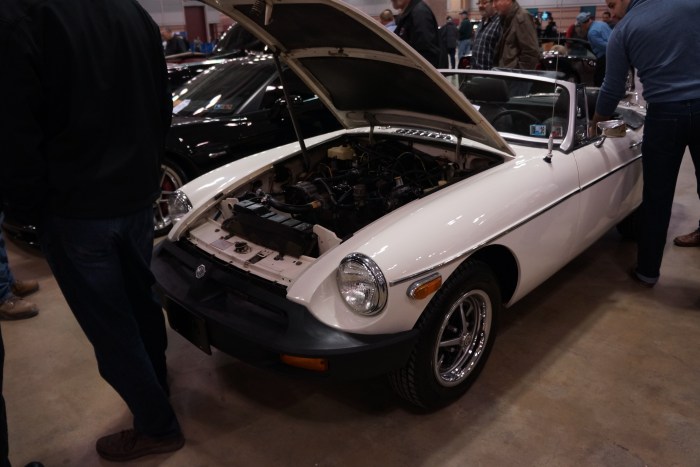
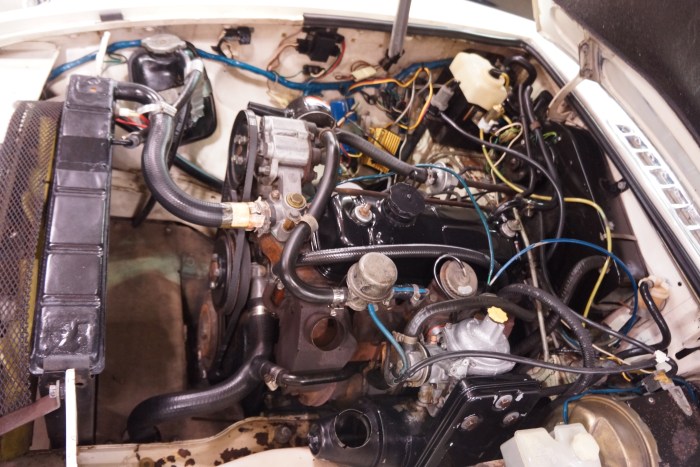
1980 MGB convertible, odometer reads 45,822 miles, odometer may have turned over once. White with black interior, stick shift with overdrive switch in shift knob, MG-style mag wheels, trunk-mounted luggage rack. Engine compartment a bit of a mess. Last year for the MGB in this market. This car might be unrestored, as it’s all there but nothing is tidy. We would rate this car as a #3- or even a #4. CPI puts a #4 car at $4,150 and a #3 car at $8,000. The ask here is $8,995. Offer $6,000 if a rubber-bumper MGB is on your bucket list and you’re feeling generous.
Last week’s blog entry on the 1970 Fiat 124 Sport Coupe which I owned for two and a half years reminded me of the lasting impact that car had on my automotive psyche. As my first European car, first Italian, and first stick-shift vehicle, it’s something I recall with fondness. Through the years, I’ve collected various publications on the 124 Sport, and piecing together last week’s posting had me referencing this printed material. So, as an epilogue of sorts, here is a short history of the three generations of this coupe with which not everyone may be very familiar!
Early print ads (this from 1968) were stark, showing only part of the exterior and the price
The Sport Coupe’s mechanically-identical sister, the 124 Spider (later known as the Spider 2000), is much better known in the States for several reasons. The Coupe’s production run ended in 1975 but the Spider’s continued until 1985. Ironically, the Coupe’s production numbers far exceeded the Spider’s (278,000 vs. 210,000 worldwide), but from 1975 to 1981, the Spider was built exclusively for the U.S. market. The Fiat Spider was also part of a “last gasp” of affordable European sporty convertibles, most of which withered and died away by the end of the ‘70s (think MG B and Midget, and Triumph Spitfire, TR7, and TR8.) The typical buff book review gave high praise to the Fiat when compared to the British iron, much of which was rooted in the Sixties. Unfortunately, various mechanical ills, aided by the tin worm, resulted in many Fiat owners deciding not to repeat the ownership experience.
The 124 Coupe, for those requiring four seats under all-weather protection, was the more attractive offering compared to the Spider. The car was built in 3 series, internally known as AC, BC, and CC (“A” Coupe, “B” Coupe, and “C” Coupe). The basic body shell and greenhouse carried over; front and rear styling was tweaked with each succeeding generation. The wonderful Lampredi-designed DOHC inline-4 grew from 1438cc to 1608cc, and finally to 1756cc.
The first-gen coupe (AC) was officially built from 1967 to 1969 (U.S. sales began in 1968). Preferred by many for its clean design, the front end had dual headlights and a sharply sloping hood. Tail lights were simple horizontal affairs on a vertical back panel. The airy greenhouse was distinguished by rear quarter glass larger than the door glass. The instrument panel centered two large round dials in front of the driver, with smaller round gauges to the side.
The first generation “AC” 124 Coupe is considered the best-looking by many
In 1970, the BC model saw a significantly revised front end, now with quad headlights. The car’s front bore more than a passing resemblance to the Fiat Dino Coupe. The tail lights were larger, but the sheetmetal to which they attached did not change. Minor refinements to the interior were noticeable only if one parked the old model next to the new one.
Straight-on front and rear shots of the 2nd gen “BC” model
Model year 1973 Coupes, the “CC” models, again brought front and rear styling changes. The headlights were set into their own panels, and the grille was recessed, with a dual-step front bumper below it all. To most eyes, the front end was too “busy” compared to the clean predecessors. The trunk lid opening extended down to the bumper, greatly reducing liftover height, but this required the tail lights to become vertical elements, moved to the outer edges of the quarter panels. Convenience was gained at the expense of looks. While many felt that the changes were necessary to keep this aging model looking “current”, 1975 was the end of the line for the Sport Coupe.
The 124 Coupe CC model; the book agrees that it’s not the most attractive version
This 124 Full-Line brochure from 1972 includes the 124 sedan and wagon, both of which used the OHV-4 engine. By grouping them together, Fiat was undoubtedly trying to allow some of the sportiness of their Coupe and Spider to rub off on the more pedestrian offerings.
The cover of the 1972 Fiat 124 Full-Line brochure (from the author’s collection)
While white paint does it no favors in my eyes, the Coupe did get its own page in the brochure
The spec page for the 124 Coupe
Today, it’s rather easy to find a 124 Spider/Spider 2000 for sale; amazingly, the survival rate is high enough that eBay or Craigslist will put one up on your mobile screen in a matter of moments. (Condition of said find is another matter.) You’ll have no such luck with the Coupe version. Yes, they’re out there, but so is a small and rabid contingent of collectors who see the goodness in these little cars. Those who own one tend to hold onto it. Values aren’t going anywhere; but it’s nice to know that Fiat’s long-lost classic Coupe has its admirers.
Stats and photos for this blog entry taken from “Essential Fiat 124 Spider & Coupe” by Martin Buckley (in the author’s collection)
The post about my family’s 1966 Buick Sport Wagon ends with the statement that I sold the wagon in order to purchase a Fiat. This is the story of that Fiat. My “first car”, the Mustang, was mine to drive, but it belonged to my father. The Buick was registered in my name, but I bought it from my mother and had given her a token sum for it. Up until this point, I had yet to go out and purchase a car on my own. That changed in 1974.
First, some background on what led to this. In 1973, I was nineteen, and having withdrawn (temporarily) from college, was working full-time in a clerical position for an insurance company in downtown Manhattan. The Buick, while a reliable beast, was also very thirsty. In my earlier post, I stated that local driving returned 8 mpg. Highway driving did not do much to improve on that figure.
In late 1973, the U.S., indeed the world, was struck by the first oil embargo, sharply driving the price of gasoline upward, while at the same time, severely limiting supplies. My full-time salary of $110/week was being stretched by the suddenly more expensive fill-ups. Besides, I really wanted to ditch the wagon and get a sports car, and had always been attracted to the looks of the Fiat 124 coupe, first introduced to this market in 1968. Scanning the classifieds for several weeks with no luck, I noticed there was one parked on the street about two miles from my house with a For Sale sign on it.
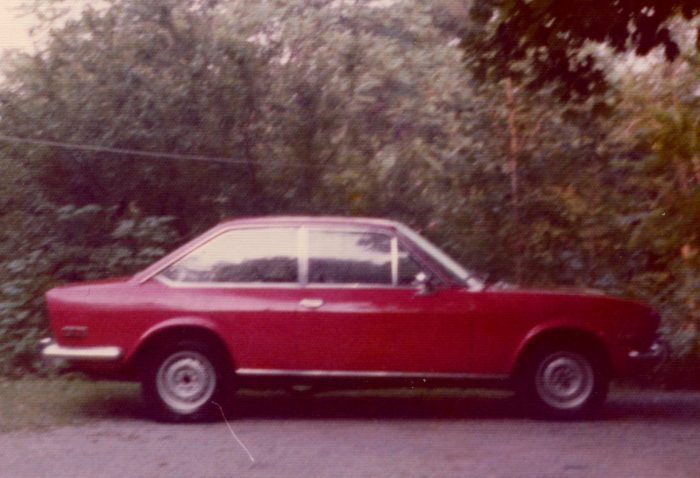
It was February of 1974. I called the number on the placard, and the seller agreed to show me the car. My friend Vinny came along. We looked at the car. It looked OK to me. I had no idea what I was looking at! My mind was made up before the owner showed it to me. His ask was $1700. There was no negotiation. I had the money, gave it to him, he signed it over, handed me the key, and wished me luck.
My Valentine’s present to myself
The Fiat, of course, was a stick shift, a 5-speed, when my two best friends, one driving a VW Beetle, the other a Toyota Corolla, were both rowing 4-speeds. There was just one small problem in getting this thing home: I did not know how to drive a manual transmission car. Oh, I knew the theory of driving one. However, I had never actually put the theory in practice. (Typing this 42 years later makes me realize that I did not test drive my own used car purchase.) Vinny had dropped me off and went on his merry way, so I was alone. I started the car, put it into gear, and was thankful it was just two miles home. Somehow, after stalling only 10-12 times, I made it. Breathing a sigh of relief, I coasted into the driveway, turned it off, and went inside.
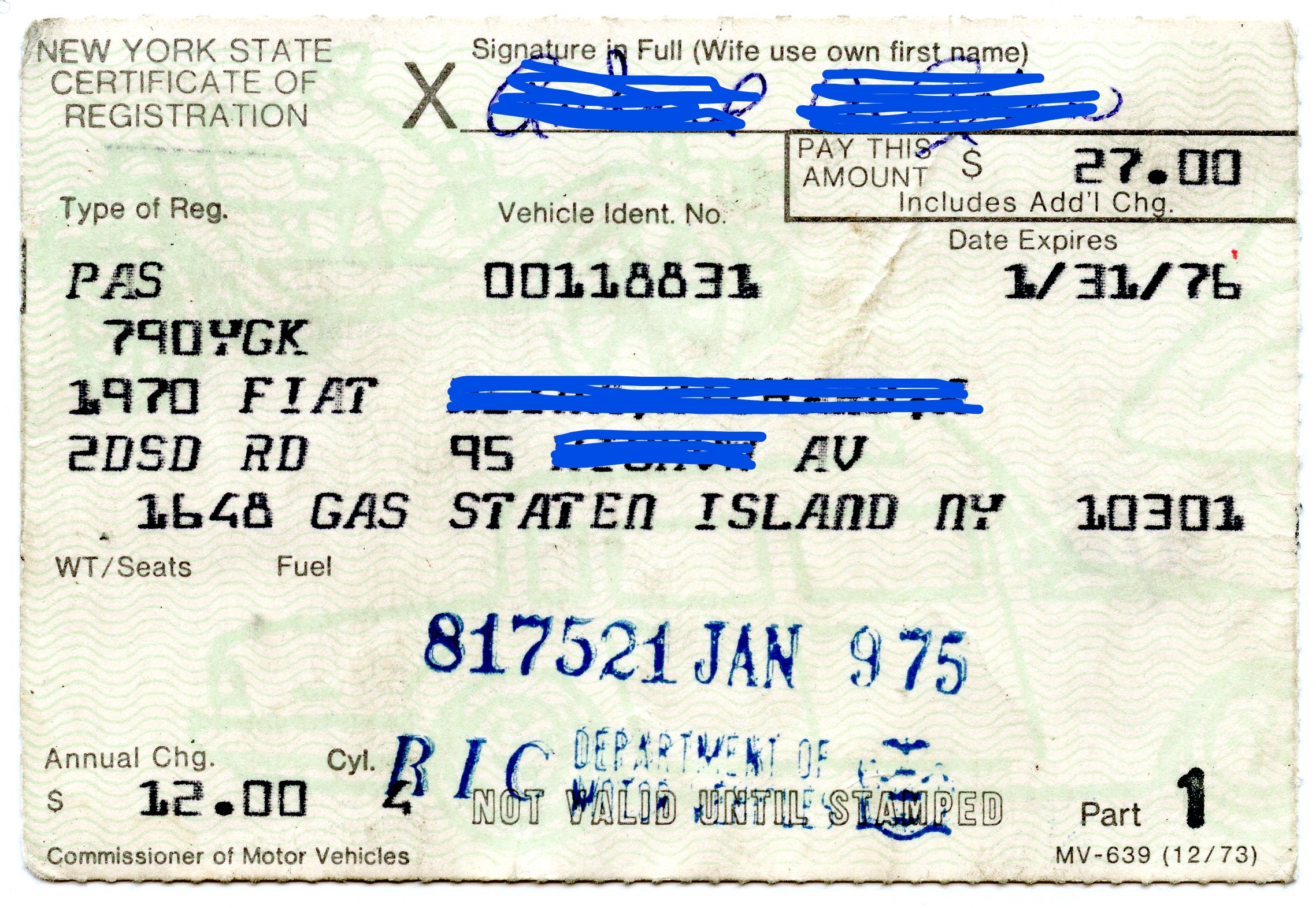
Yes, it weighed 1,648 lb.
First call was to my best friend Richard Sawler, whom I sheepishly asked to give me lessons. We went out together, me driving, he riding shotgun. Richard would instruct me on the finer points of shifting. He worked the parking brake whenever I had to stop on an incline. After about a week, enough confidence was gained to venture out solo.
Acquaintances presume that my automotive mechanical knowledge came from working at car dealerships, which began in 1978. That is not exactly true. It really started with the purchase of this Fiat. The car was an absolute joy to drive, and I drove it a lot. However, “something” happened to that car about once every other week. There was no way I could afford to pay someone to fix the car that frequently (see weekly salary quoted above). Soon after the purchase, I was at my local Sears, buying my first set of metric tools, a set of 1/2” drive sockets which I still own (Dad had nothing metric). I also obtained a Haynes Workshop Manual for the car, which I read on the ferry as I commuted to and from my insurance company job.
Kept the book in case I get another…
Small jobs I could do, and I started small, doing the brakes, a tune-up, and a coolant flush. But a U-joint went, then the exhaust, and I needed someone to make those repairs for me. On Staten Island, two brothers had opened a “foreign car only” repair shop. The name of the business was “Brothers”. By the summer of 1974, we were on a first-name basis with each other. To be fair, they were great guys, and were very fair to me, realizing that I couldn’t afford to take care of every single thing that poor piece of Italian transportation needed.
Brothers they were. I was there so much I considered getting a part-time job with them.
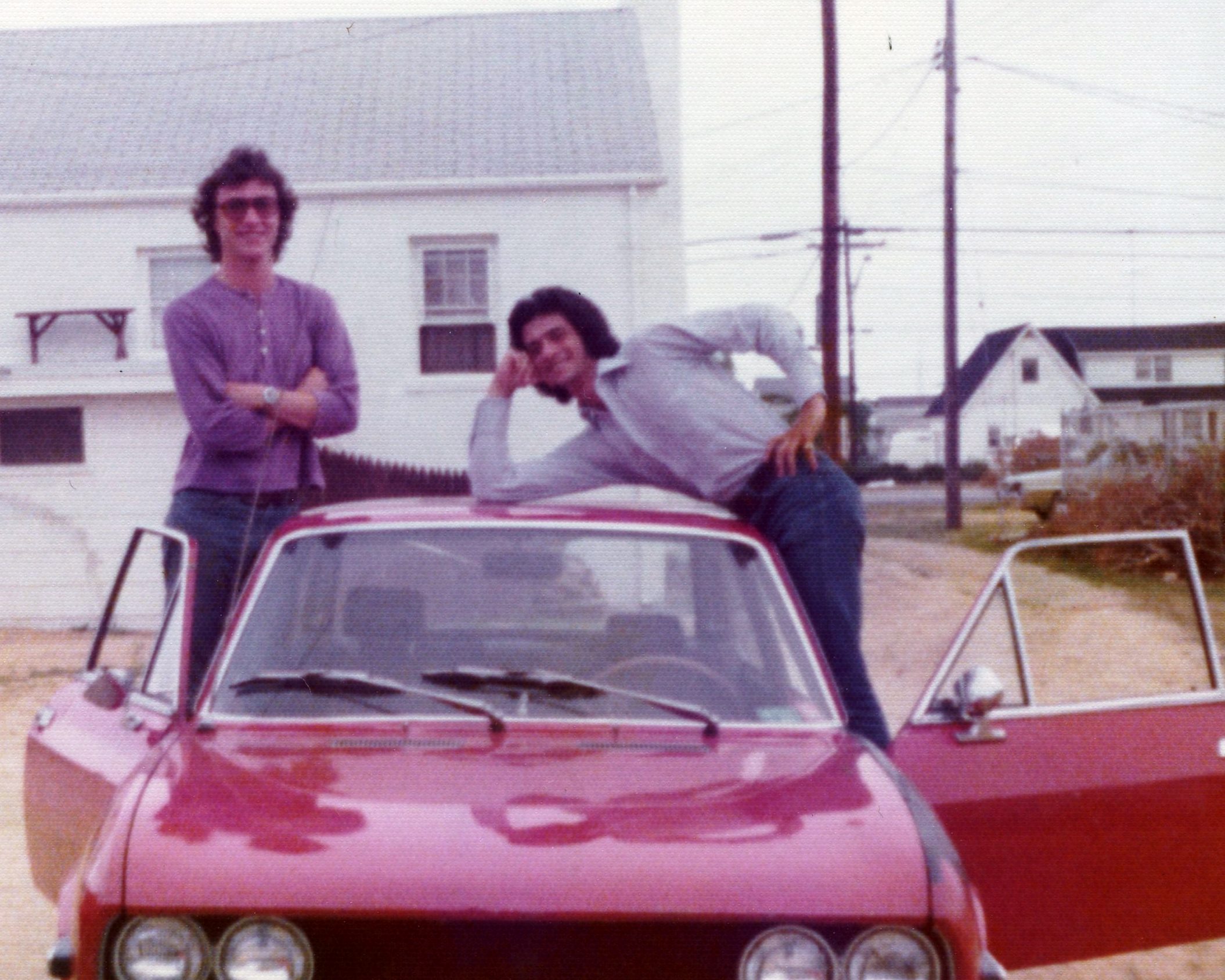
Frequent repairs or not, the Fiat was taking me all over the place. In March, a friend and I used the car to make a successful round trip to Buffalo, NY, the farthest I had driven from home in my life. Its cavernous back seat could hold my drum set, so the Fiat was the car driven to all my music gigs. Vinny was so impressed, he traded the Corolla for a new 124 Coupe. My car had about 57,000 miles on it at the time of my purchase. Within the first six months, I had driven it about 8,000 miles.
March, 1974, unwashed but safely back from Buffalo
Then the timing belt broke.
On a warm summer August evening, heading back from Brooklyn to Staten Island via the Verrazano Narrows Bridge, I paid the toll on the S.I. side, accelerated out of the toll booth, aimed for the Bay St. exit on my right, and the car died. It cranked just fine, but made no attempt to catch. Finding a phone booth, I called my dad, and somebody called a tow truck. The car was brought to Todd Motors, Staten Island’s only Fiat (and coincidentally, only Volvo) dealer.
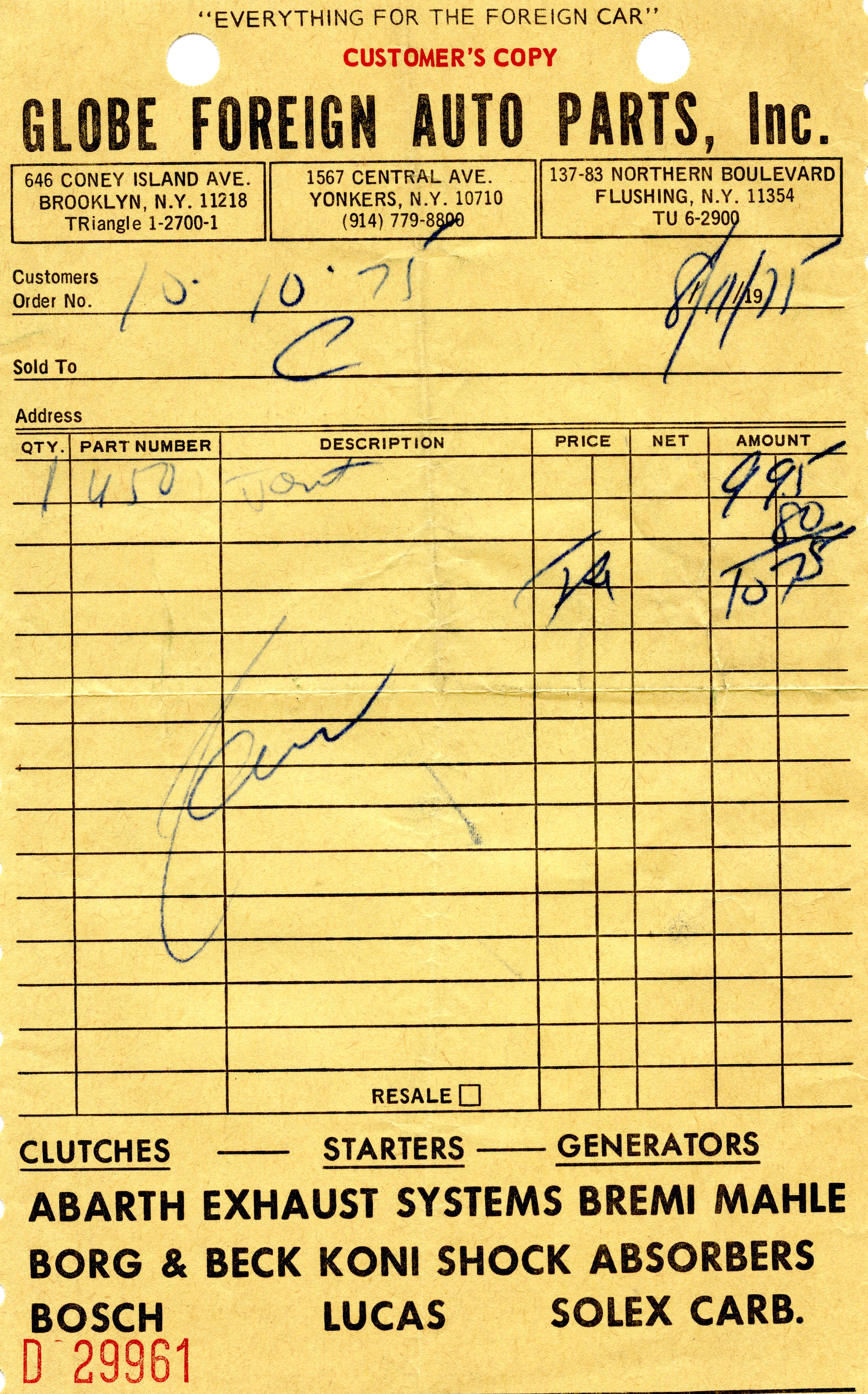
They called me with the bad news. All I heard was a litany of parts: head gasket, valves, pistons, rods, etc. They said the job would take a while, perhaps a week. In a matter of days, I was heading back to college. Being without transportation was torture. But the real torture was seeing that repair bill. At the age of 20, I wasn’t exactly floating in spare cash; $345! Were they kidding? Look at this Repair Order: Nine hours of labor at $16/hour! Four exhaust valves at $8 a piece! A SIX DOLLAR head gasket, for cryin’ out loud! Did they think I owned Fort Knox?
At the time, highway robbery. In retrospect, quite fair.
This is all quite funny now. We have become accustomed to labor rates close to 10 times this figure. Somehow, I found the money, paid the dealer, and picked up my car. The good news was that it ran well. Yet, the car continued to penny-pinch me. The brake master cylinder went (for which I bought a rebuild kit, and rebuilt it in my dorm room). A carburetor screw fell out, and the car would not idle. A steering tie rod went bad. The Fiat got me through my sophomore year of college.
NYC phone nos. still used 2-letter exchanges, and area code was not needed (all 212)
Returning home from college for the summer of ’76, the rust was getting worse, with an actual hole in the left front fender, large enough to see through. When the water pump quit that summer, I felt defeated. The fun-to-drive aspect never went away, and my technical skills were improving, but I could no longer count on the car to get me around. The Fiat, at 6 years of age, its cancerous rust eating away at all four corners, was sold to Stuckers, the well-known foreign-car junkyard on Staten Island. It had been mine for the last two-and-a-half years and 40,000 miles of its life.
Stuckers was a great source for parts, and the car’s final resting place
As time went on, I only remembered the good things about the Fiat, never dwelling on the breakdowns or repair costs. At my father’s urging, the next car was an American make, but after that came a succession of German cars, then a career in the car business with a Swedish auto maker (and many Swedish cars in the driveway). It would be 37 years before another Italian car entered my life. While that car is my delightful Alfa, it has not stopped me from thinking that someday, I’ll find room for another Fiat. I remain that impressed by the little coupe’s capabilities.
Richard Sawler (L) and Vinny Signoriello (R) prove that rust has yet to permeate door sills. Good times, good memories.
In 1993, with seven years at Volvo Corporate under my belt, I had done my share of domestic and international business travel. Volvo generously allowed employees to keep and use their own earned frequent flyer points. In April of that year, with some of my points about to expire, I burned a bunch of them by taking a long weekend trip to Phoenix AZ.
Now, Phoenix was not exactly my first choice as a vacation hot spot. Of course, there was an ulterior motive: I had heard about the auto salvage yards in the area, mainly filled with ‘50s-‘60s Detroit iron (as rust was not an issue in the Southwest). My 1967 Dodge Dart was in need of a few components not available in the aftermarket. Telling this to my buddy John M, who owned a 1963 Buick, resulted in being given a shopping list for his car. (I sold the Dart several years after this trip was taken; John still owns that ’63 Wildcat convertible today.)
Packing little more than a weekend bag, my camera, and some cash, I was off to Phoenix. Expecting warm weather, I didn’t bother with sweaters or coats. Good thing, too, because Phoenix was having a heat wave. Temperatures reached 114 degrees F during my stay, making me very glad that my hotel’s swimming pool was open.
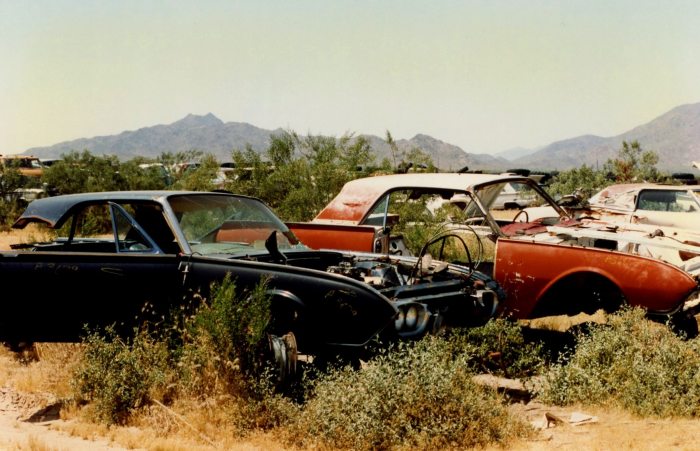
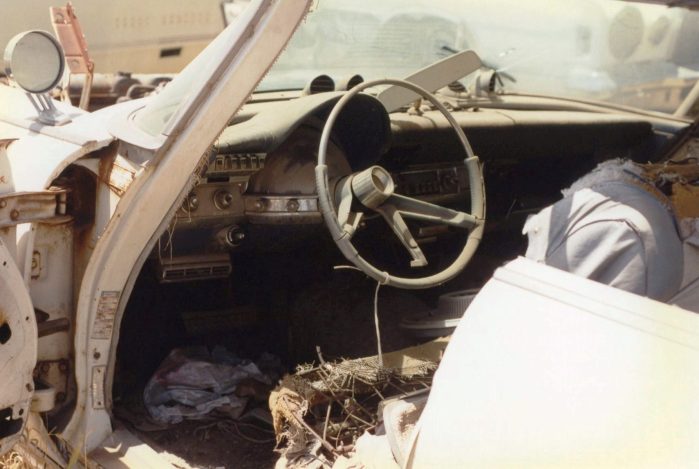
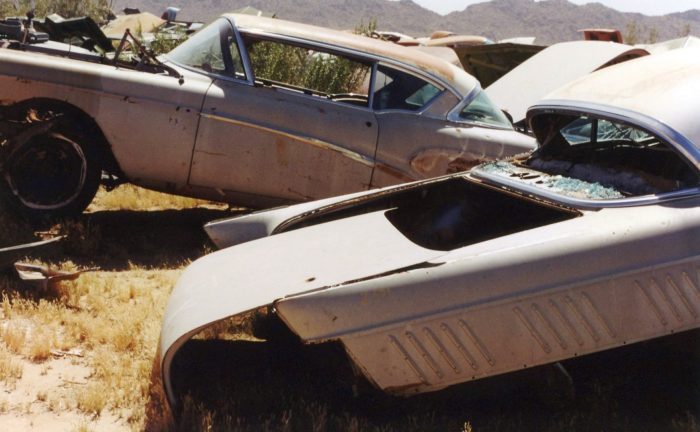
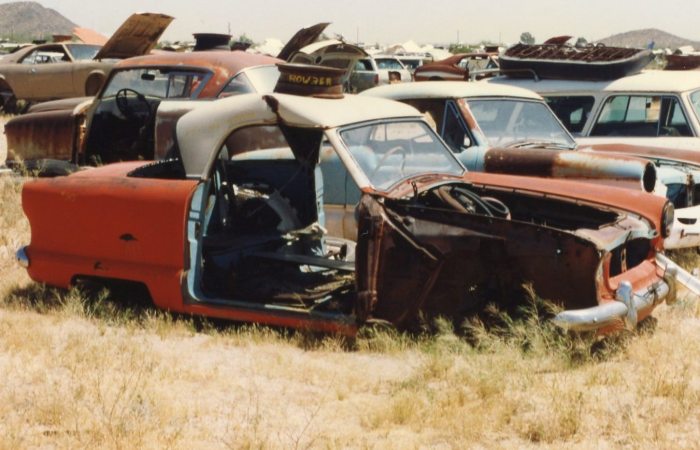
Finding the salvage yards was easy. I brought the Yellow Pages from my hotel room with me, and armed with a map I picked up in the airport, off I went in the rental car. While I did find my parts, the real treat was being able to stroll through these yards at my leisure. The staff was more than willing to let me wander, scrounging for parts, admiring the cars, taking photos, and generally acting like the East Coast tourist I was.
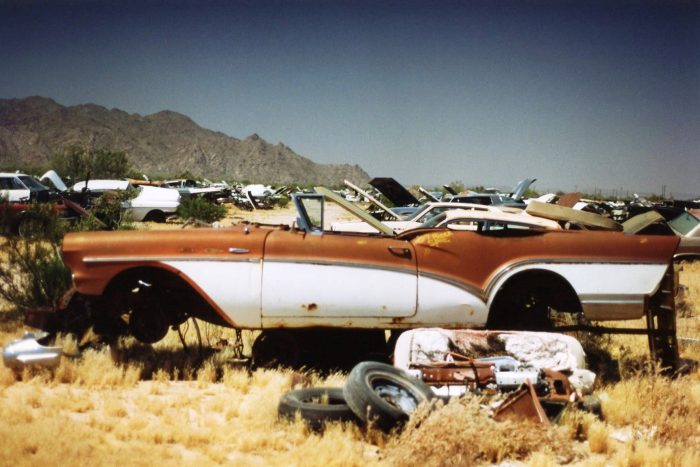
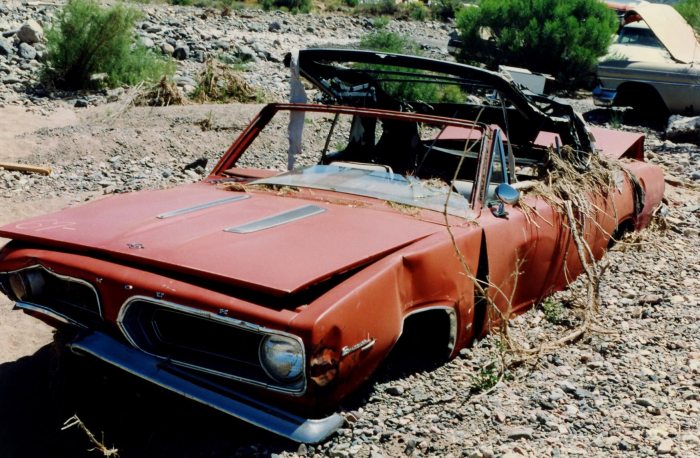
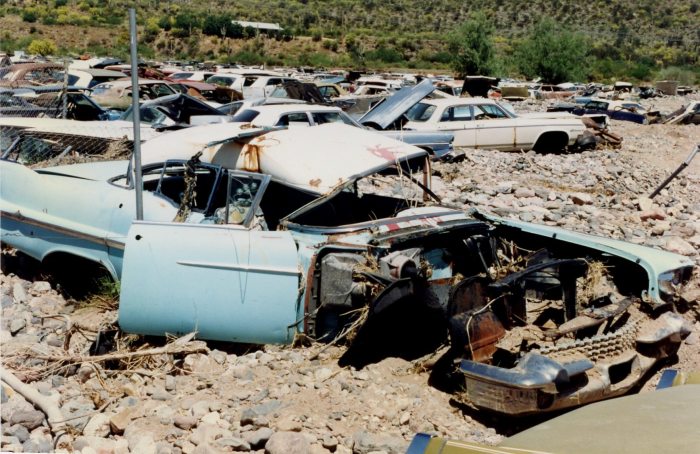
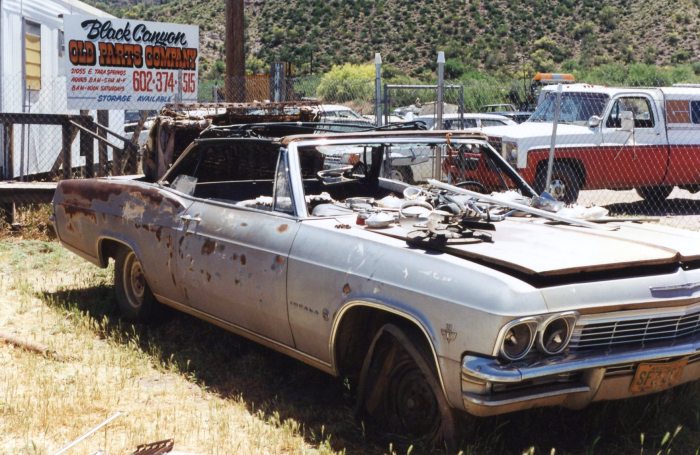
I’ve long forgotten what I purchased for the Dart and Wildcat (John, do you recall?). However, the sights of the 4 or 5 yards I visited were captured on color film, and looking at them brings me back to that busy (if blazing hot) weekend. Here is a small selection of those photographs.
A stack of ’60s BuicksAnother stack of Buicks, with a ’63 on top
The evolution of the Cadillac tail fin
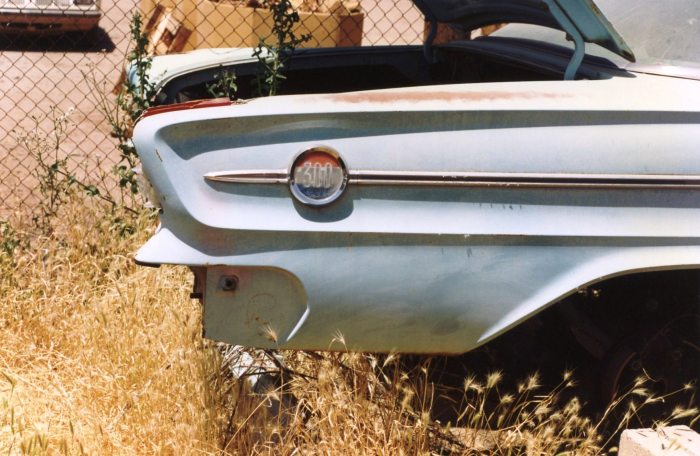
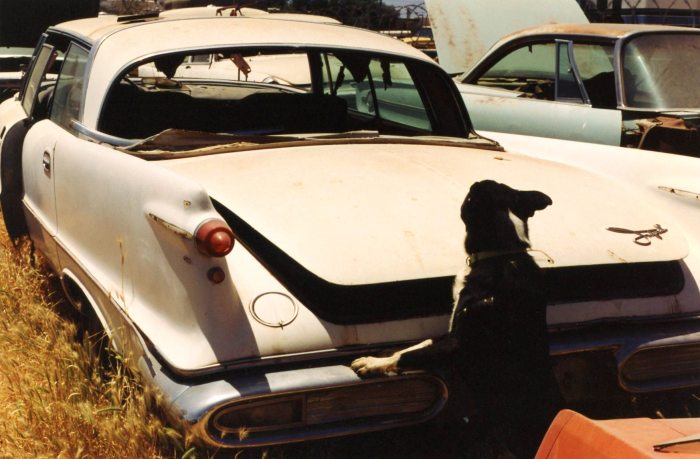
1962 Chrysler 300- that’s a good quarter panel!Junkyard dog admires Imperial stylingA pair of ’61-’63 ‘Jet Age’ T-BirdsWhat a great instrument cluster; does anyone know the year and make of this MoPar?More Buicks! Was this a Buick-only yard?These Nash Metropolitans were among the few imports I saw 1957 Buick with AZ mountains as backdrop2nd gen Plymouth Barracuda; pebbles & weeds indicate she’s been under waterNot much left to pick off this ’58 Caddy carcass’65 Chevy Impala looks like it could be brought backLet’s not forget we’re in the (former/still) Wild West
Photos were taken with my Nikon EM camera; film info not recorded, but likely Kodak Gold, either 100 or 200 ISO. Prints scanned with Epson V500 photo scanner.
In March of 1967, for my 13th birthday, I was given a subscription to CAR and DRIVER magazine. I already had been reading everything I could on the topic of automobiles. Up until this point, the majority of that had been my dad’s Popular Science and Popular Mechanics magazines. While their automotive articles were good, they encompassed but a fraction of those magazines’ editorial content.
It was my father who selected C&D among the then-available buff books; it was a decision which profoundly affected and still influences the way I think about automobiles. CAR and DRIVER, in 1967 under the helm of David E. Davis Jr., was already displaying a slant toward European machinery and away from American iron. They were also several years into embracing a tone of irreverence, in part fed by 1960s counter-culture, that would grow stronger in the decade of the 1970s.
My first issue of CAR and DRIVER magazine, March 1967. Mailing label still attached.
I recently plucked that March of ’67 issue from the bookshelf for a revisit. Their preference may have been sporty European cars, but they were also in the business of selling magazines (at 60 cents per copy), so the newly-announced 1967 Pontiac Firebird graced the cover. The statistics page at the end of the Firebird road test swings between factual calculations (0-60 in 5.8 sec.), and a “Check List” which uses “excellent”, “very good”, “good”, “fair”, and “poor” for its subjective ratings. Nice to know that the “synchro action” was excellent, while the “trunk space” was poor.
This says there were 3,450 Pontiac dealers in the U.S. in 1967.
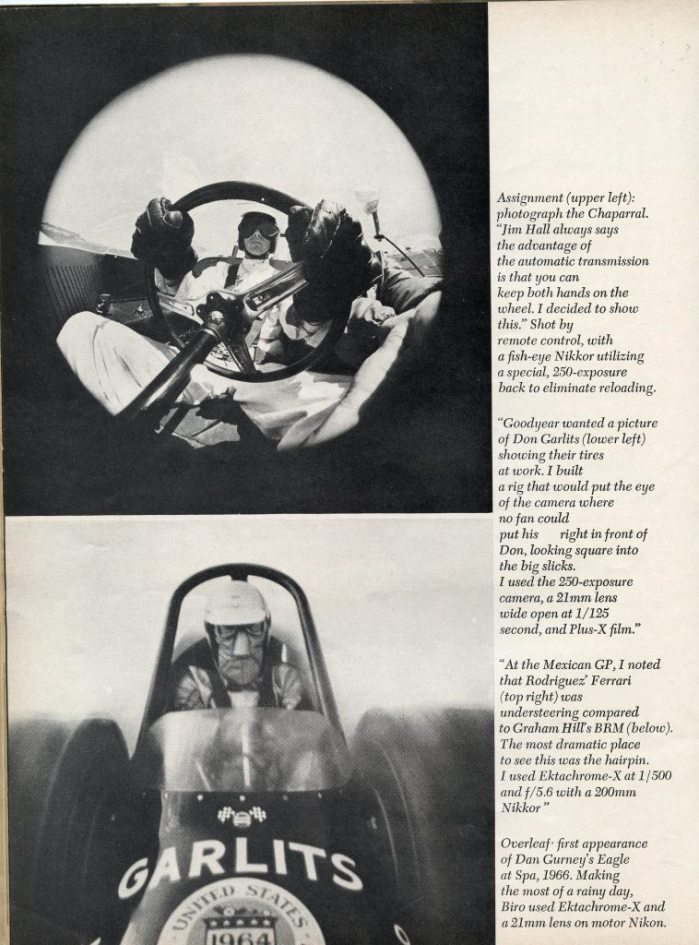
C&D regularly featured articles on personalities and/or topics related to, but not necessarily directly about, cars. Case in point was this article about the photographer Pete Biro. The sharpness of the color photos I find especially enthralling.
Pete Biro: One Man ShowJim Hall and Don GarlitsRodriguez in the Ferrari, and Hill in the BRM
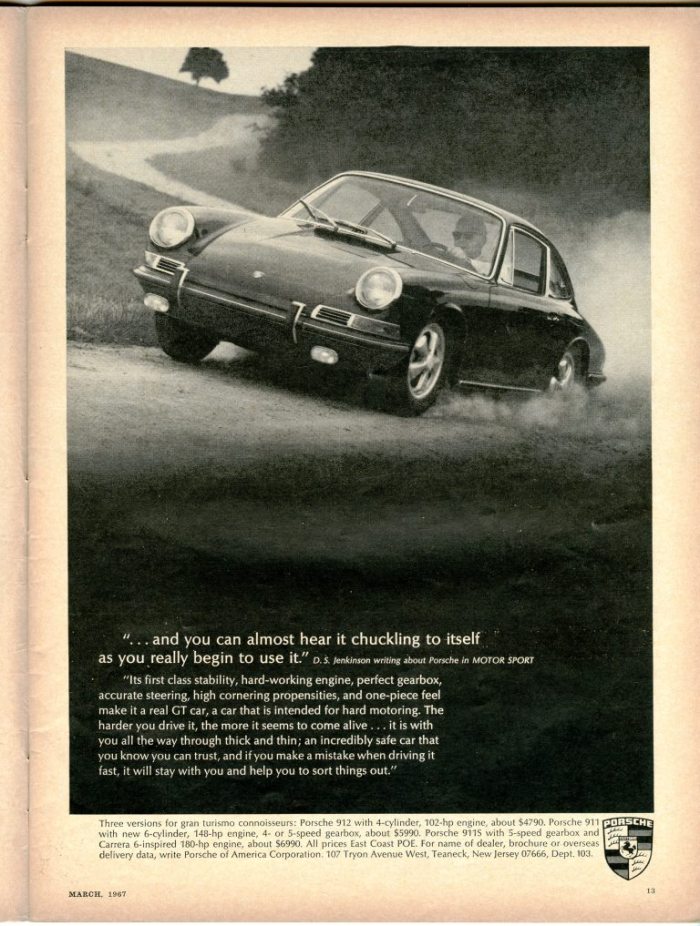
Some of the real fun in browsing through an almost-50-year-old magazine is re-reading the advertising. The Volvo ad for the 122 uses the “Stronger Than Dirt” tag line which Volvo aficionados know well. But look at the fine print: “Stronger than dirt copyright Colgate Palmolive, used with permission”. The Porsche ad, like Volvo’s, quotes a 3rd party source for credibility. With prices ranging from $4790 to $6990, these German sports machines were expensive cars, especially compared to other cars featured in ads in this issue such as the Renault 10 for $1647, the Fiat 124 for $1798, and the MGB/GT for $3095.
Volvo print ad from 1967Porsche print ad from 1967
By contrast, note that these two ads from domestic manufacturers are in color. Bigger ad budget perhaps? The Camaro ad pointedly attacks the perceived discomfort and unreliability of other (unnamed European) sports cars, finishing off with “… and go show those purists”. The biggest surprise in the magazine for me is this ad: “Mercury, the Man’s Car”. Really? Try that today. Nevertheless, they still attempt a tie-in with the overseas competition by informing you that “European elegance comes to Cougar Country in Mercury’s Car of the Year”.
Camaro print ad from 1967
Cougar print ad from 1967
Bringing up the rear is “The Classified Marketplace”. While Road & Track magazine’s classified section was probably better-known (and more likely to contain exotic sports cars), there are still interesting tidbits here at CAR and DRIVER. Among them are a Lancia Flaminia for $1100, a ’63 Porsche 90 coupe for best offer over $3000, and a 1934 Rolls-Royce for $1450 FOB England. My favorite is the picture ad which ran in C&D for years: “A Playboy’s Dream”, the Volvo 1800 convertible. With all my years around the product, I’ve rarely seen one in the metal, which makes me wonder how many were made, and how many survive?
The Classified Marketplace
This glance back to March of 1967 was fun, and I think we’ll do this again with other ancient periodicals that may be in the collection.
All scans are from the March 1967 issue of CAR and DRIVER magazine; the copy of the magazine is from the author’s collection.
My dad was a GM man throughout the first two decades of his marriage. Although it was a Willys station wagon which served as family transportation when he and my mom got married in 1950, he bought a new Chevy 210 sedan in 1953 (the car which brought me home from the hospital), and a new Corvair wagon in 1961. The ‘60s saw the Corvair augmented with a ’63 Pontiac Catalina wagon, then replaced by a used 1966 Buick Sport Wagon.
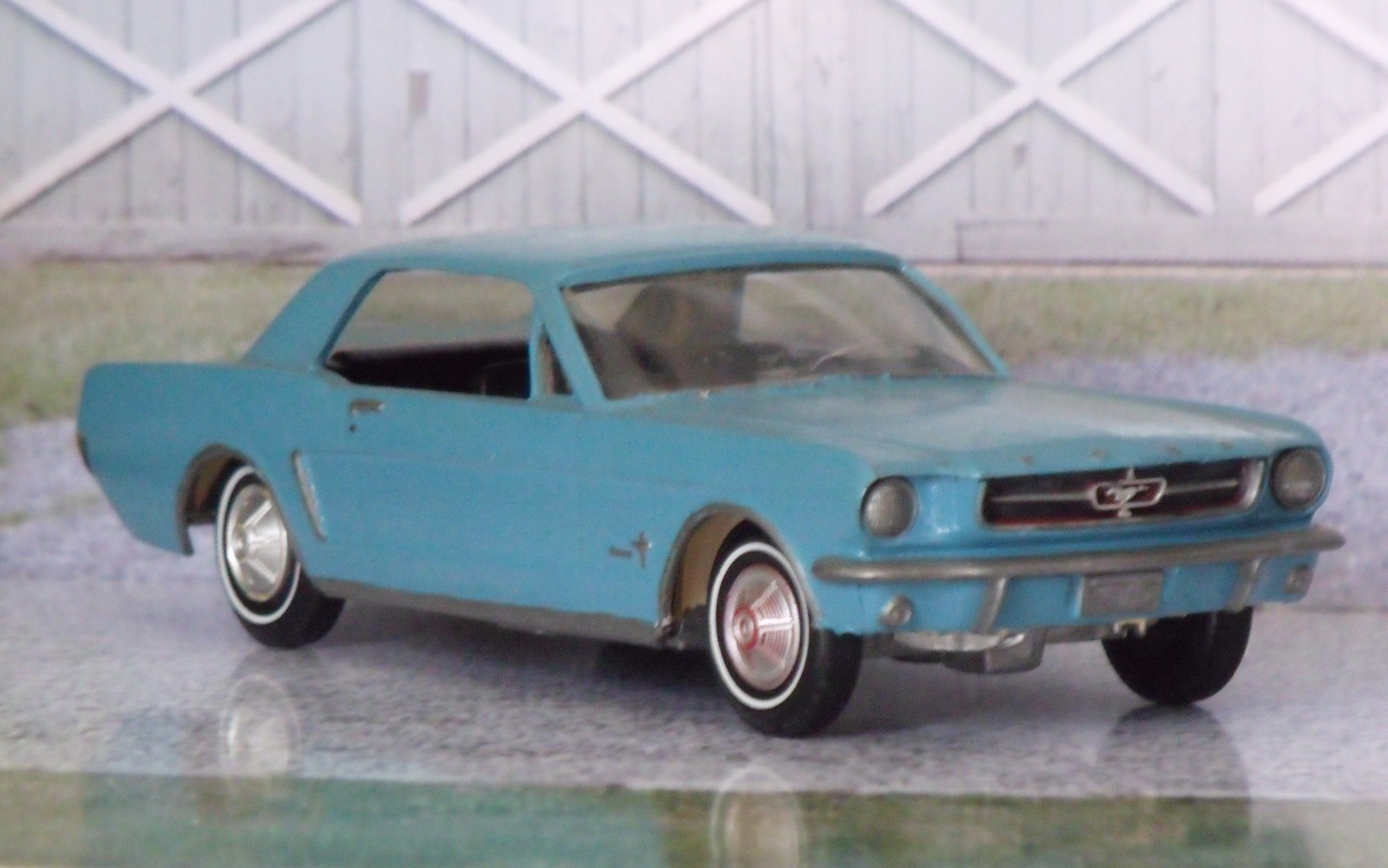
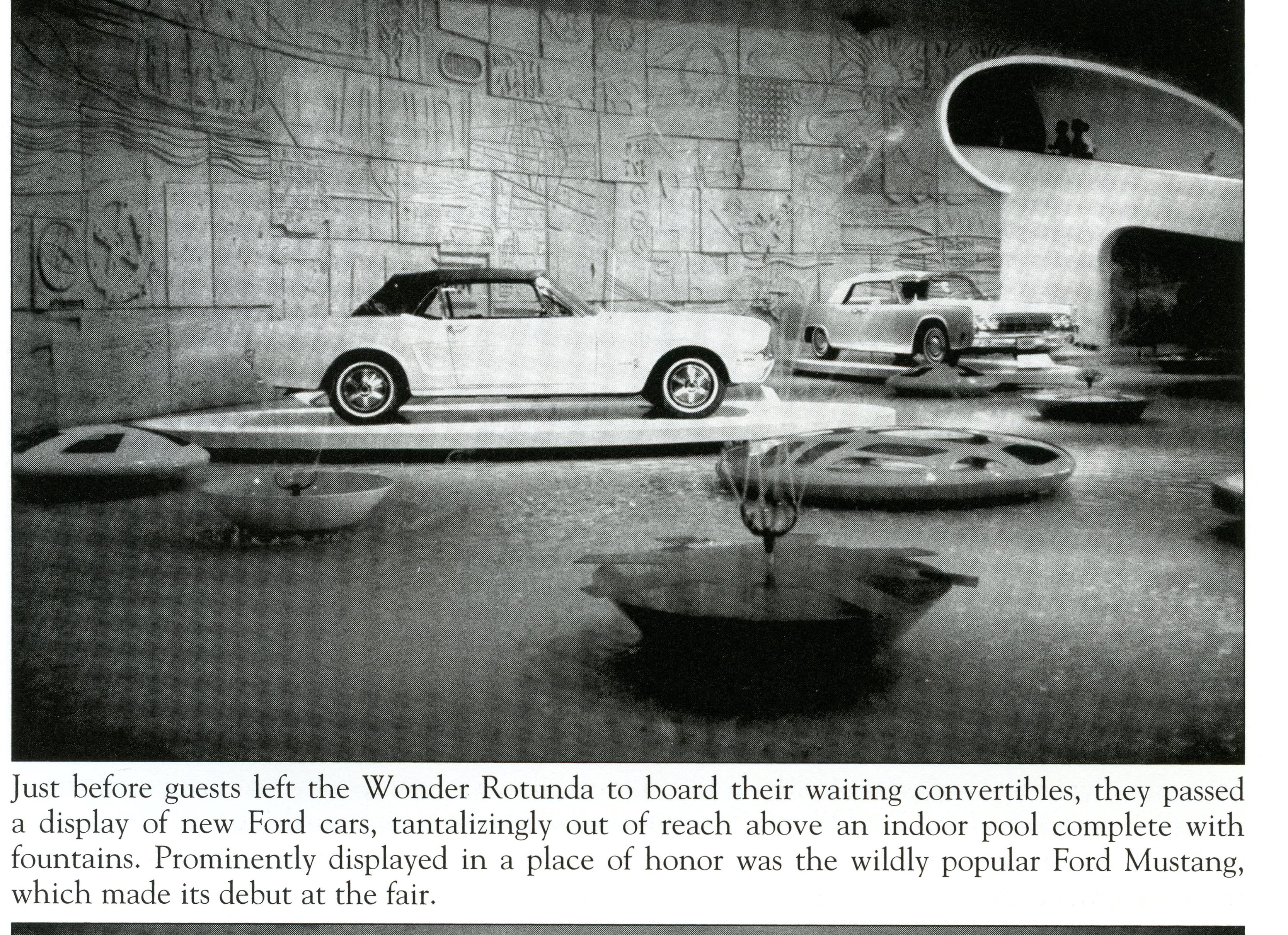
When the Ford Mustang was introduced in 1964, this 10-year-old car-crazy boy was infatuated with it. Some magazine advertisement at the time offered the chance to buy a promo model, which I did (and which I disassembled so I could paint it.) One advantage of growing up in New York City was the opportunity to visit the 1964-1965 World’s Fair in Flushing Meadow Park. The family went six times! Of course, the new Mustang, having been introduced there, was always on prominent display. Dad, who normally didn’t say much, ever so slightly let it be known that he “liked” this new pony car.
1964 1/2 Ford Mustang promo model (hand painted)
From the book “Images of America; The 1964-1965 New York World’s Fair” (author’s collection)
In the mid-sixties, we were a typical suburban American family with two cars, what with two working adults and three school-age children in the household. At that time, our transportation needs were met with station wagons (the Corvair, Catalina, and Sport Wagon). But by the late ‘60s, perhaps there was room for something more fun. (Was it a coincidence that my father turned 50 in 1969 and may have been having something of a mid-life crisis?) To my surprise and delight, “we” got just that in the form of a Ford Mustang.
In 1969, my father found a used ’67 Mustang for sale in our hometown of Staten Island, NY. It was a Lime Gold coupe, 289 2V, automatic, vinyl roof, full wheel covers, whitewalls, AM radio, and nothing else. My dad paid $2,050 for it; the number always stuck in my head because of the odd $50. I was 15, and, just two years away from a driver’s license, hoping that someday it would become my car.
My dad’s ’67 Mustang, photo taken by me in our yard in 1969
In 1971, with that freshly minted license, the Mustang was ‘mine’ to drive. Dad bought a third car so that he and Mom would each continue to have their own wheels. Giving a 17-year-old a V8 Mustang was maybe not his best decision, although I used the car responsibly as transportation to a part-time job, as well as a weekend “cruisemobile” with my high school buddies. Like many teenagers, I considered myself a good driver, but in retrospect, my driving was aggressive, cocky, and naively self-assured.
It is ironic then, that on the morning of December 23, 1971, at the speed of perhaps 10 mph, I rolled through an intersection, having failed to see a stop sign, and was punched by another car. The accident was 100% my fault. The car had 2-point lap belts, but mine wasn’t on. My head hit the steering wheel, I was knocked unconscious, suffered a concussion, and required 10 stitches. (The hospital needed to shave my hairline to sew me up. Today, the scar is well below the hairline!)
The wrecked Mustang in 1972
This happened in Brooklyn, which is why my speed was so low. I didn’t know the neighborhood, and was looking at street signs. Dad drove to the hospital to see me. I dreaded his scolding, but he didn’t. He was upset, but took it all in stride. The Mustang was totaled. For reasons possibly having to do with insurance, the car was towed to our house, where it sat for several months before he sold it to a salvage yard. My father went back to new GM cars (Buicks and Oldsmobiles), a new Dodge Dart, and eventually moved to import vehicles (Renault, Datsun, Mazda). “Father’s first Ford” turned out to also be his last; he never bought another Ford.
Fast forward to August 2003: I purchased my first collector Mustang, a ’68 California Special, in Lime Gold (my first color choice for sentimental reasons). Dad was in failing health, and never got to ride in it. He passed away in 2006. My ’68 is a story for another time. But every so often, I think back to that ’67 coupe and wonder: did someone rescue it from the junkyard, or did it give itself up for parts so that other Mustangs could stay on the road to be enjoyed today?
Similar stories about the end of this storied Italian design house can be found in other locations on the internet.
Reading this saddened me, and not just because a Bertone-designed car currently sits in my garage. First, on a higher level, we have observed that the car business goes through changes, and those changes can drive away marques that you thought would be around forever. When I was 15, posters of the 1969 Pontiacs were Scotch-taped to my bedroom walls. Never in my lifetime would I have believed that the day would come when Pontiac would be no more. The last 20 years have also witnessed the demise of Plymouth, Oldsmobile, Mercury, and Saab, among others.
Second, on a more personal level, I am fortunate to have once visited the Bertone factory outside of Torino, Italy. It was one of the most memorable business trips I have ever taken, and it’s a story that I’ve never told in its entirety. Allow me to tell it here.
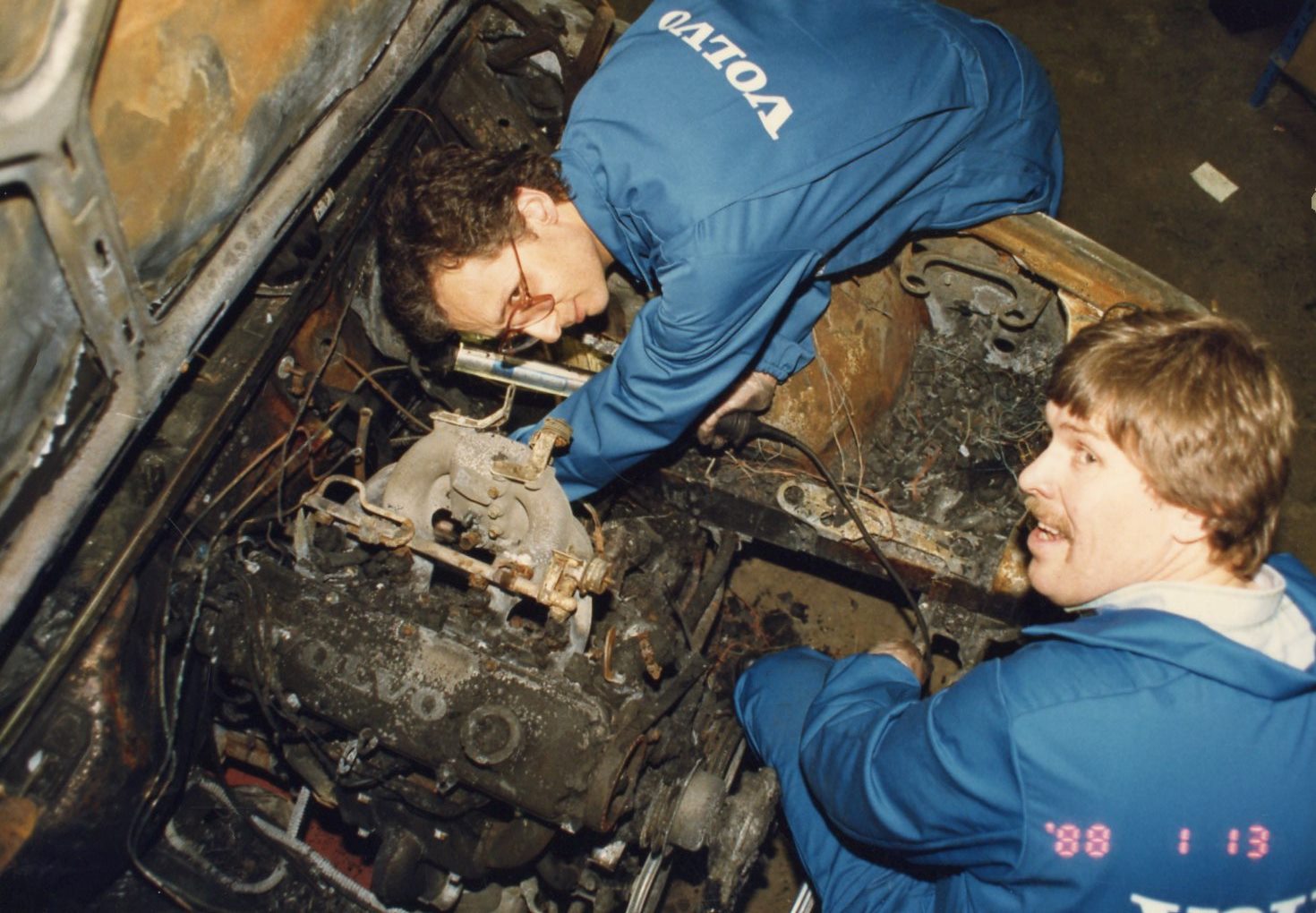
In January of 1988, 15 months into my employment with Volvo Cars of North America (VCNA), the management team decided that I should travel to Volvo’s world headquarters in Gothenburg, Sweden, to be trained in the investigation of vehicle fires. While fires were not a huge problem for the company, very little was known at that time about the cause and effect of “thermal events” (the euphemism we used). The Volvo Car Corporation in Gothenburg (VCC) had done some investigative work on its own, and they had an in-house fire expert who would train me. For me, it was an opportunity to travel to the land which gave birth to all those Volvo 140s and 240s I had wrenched on as a technician, so off I went, my delight completely undiminished by the concept of winter in Scandinavia.
Arriving in very snowy and very dark Gothenburg was a culture shock. Given that “daylight” such as it is lasts from about 9am to 3:30pm in January, this combined with a 6-hour time difference made the first few days at work a struggle. Nevertheless, my hosts were cordial and accommodating, and always polite about speaking English in my presence. Within 3 days, we made a field trip to investigate a Volvo which had gotten crispy a few days before. What a thrill – I was getting my hands dirty.
The author and Viking Hallgren of VCC on the job, Jan. ’88. From the author’s collection.
Then Friday came.
During my first four days at work, no mention was made of a looming “engineers” strike. In Sweden, unlike the U.S., many of the white-collar workers are unionized. Lots of banter in the native tongue was overheard but not understood about management, the union, the labor negotiations, etc. On Friday morning, there were union representatives outside the now-barricaded chain link fence in Torslanda (the Volvo factory). No one was being allowed admittance to the buildings. My Swedish colleagues were on strike, and I was on my own.
The strike, at first predicted to last only several days, was soon seen to be stretching out to a week or more. As part of my business trip, I had made tentative plans to also travel to Brussels, Belgium for an auto show; to Hamburg, Germany, if only because my father was born there and I had yet to visit; and to Italy, because I had been there 10 years before and had fallen in love with the place. Besides, I told my boss back in the States, visiting Italy was really a “business trip”.
In 1988, for the second time in its history, Volvo contracted with Carrozzeria Bertone to design and manufacture a limited-production, 2-door specialty car. First was the Volvo 262C, made from 1978 to 1981. Next came the Volvo 780, which was in production at Bertone at the time of my planned visit. Such was the extent of freedom with business travel that I needed no more of an excuse than that. Euro-rail pass in hand, I headed south through mainland Europe, arriving in Italy, and finding it less snowy but just as cold, dark, and damp as Sweden.
The Volvo 780. From the author’s collection.
Through contacts in Gothenburg, I was given the name of someone who would host my visit. Taking a cab from the train station in Torino to the suburb of Grugliasco, I somehow found my way to the correct office building in the sprawling Bertone complex, and was greeted by a Mr. Mario Panizza. He welcomed me, and asked me to sit while he fetched my Swedish host. Within a few minutes, Mr. Roine Lundin arrived.
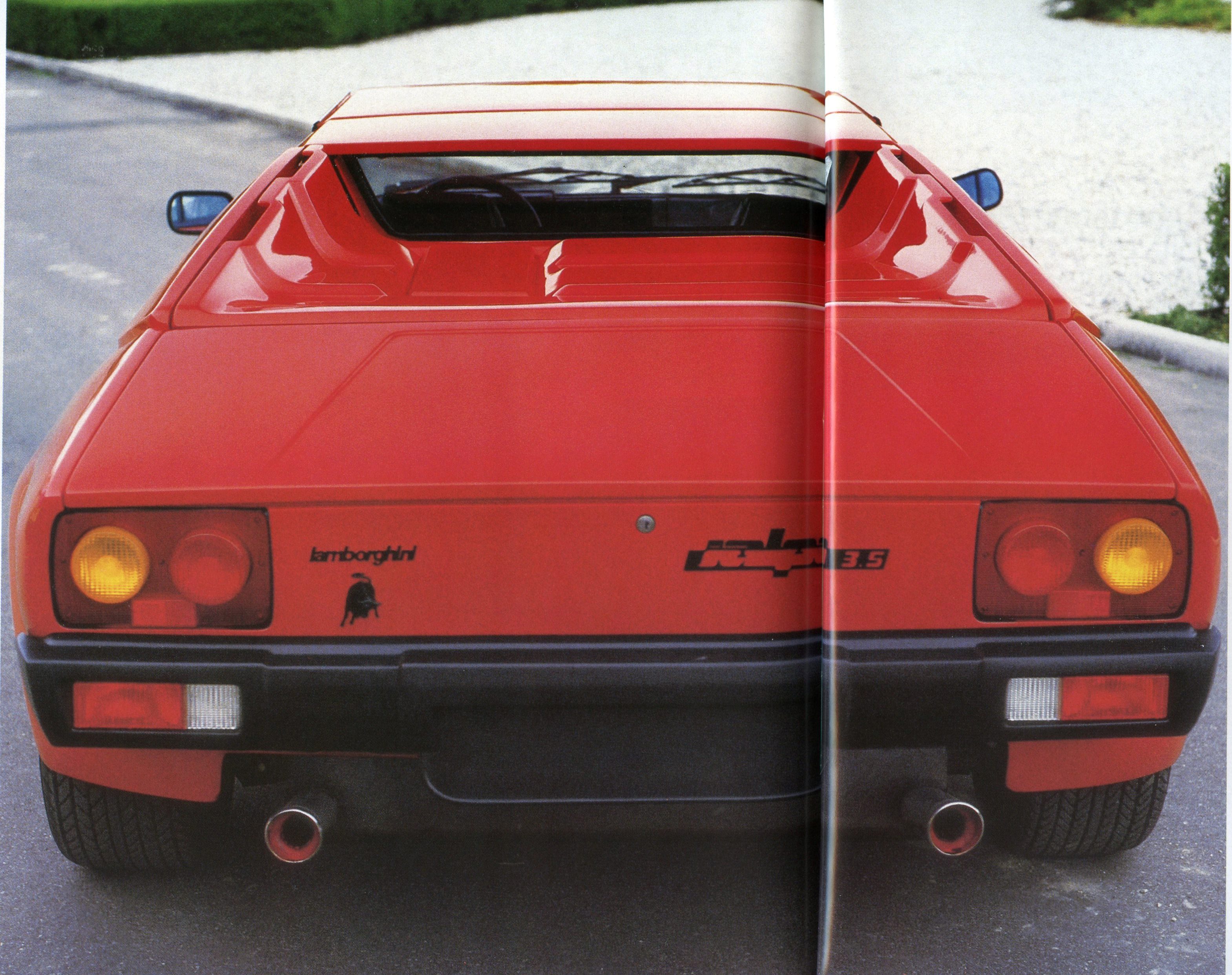
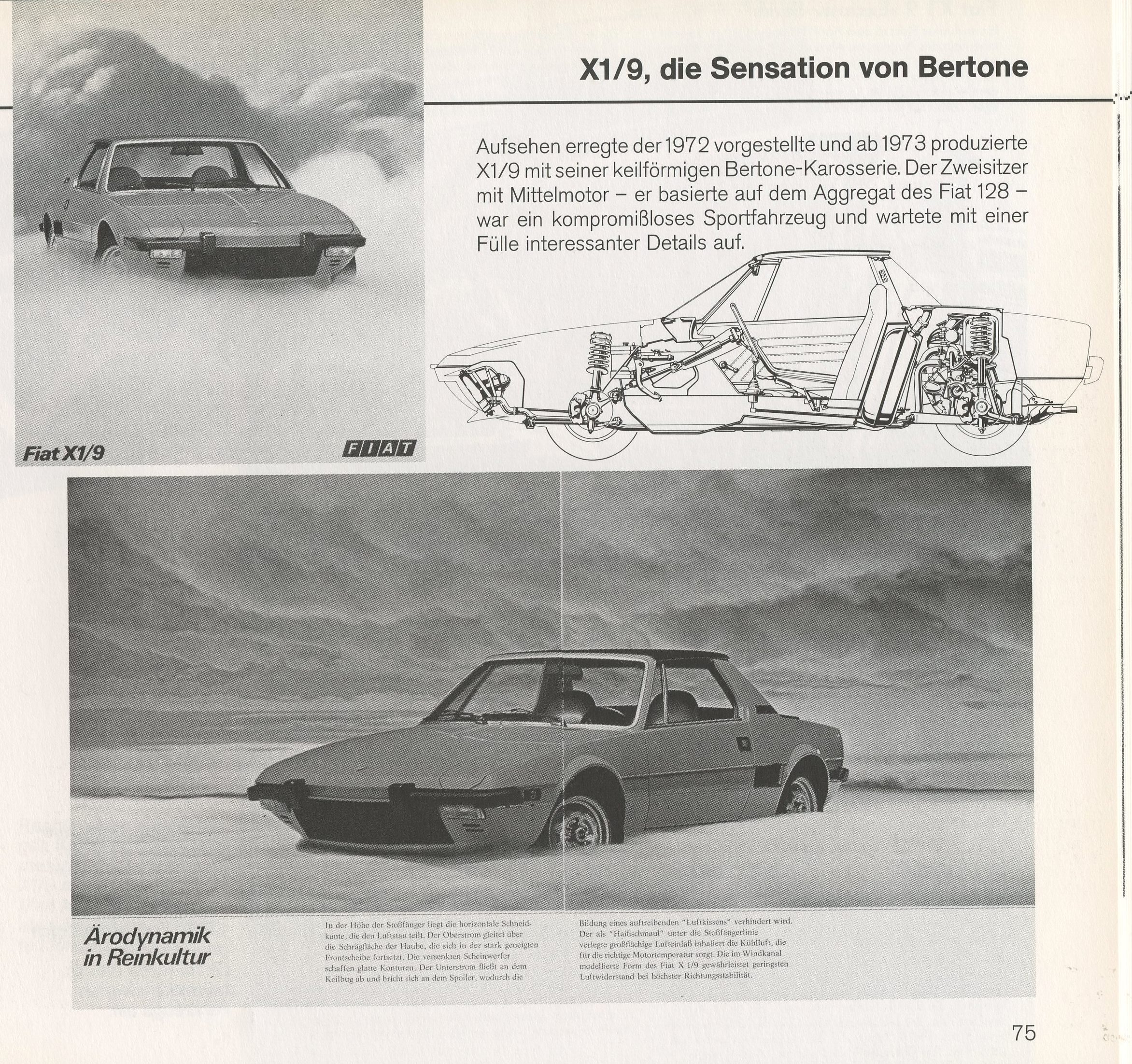
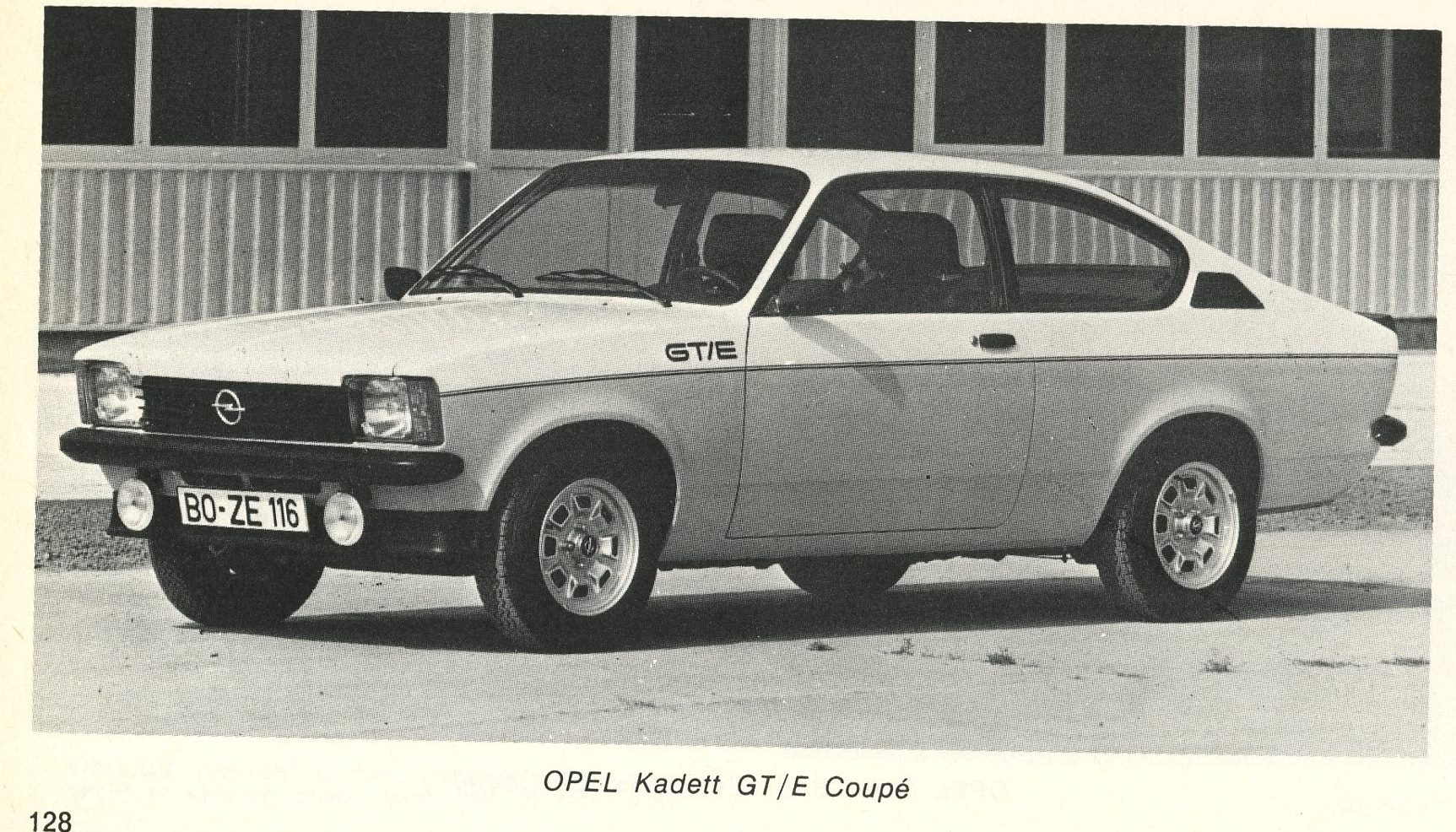
Roine was a Swede temporarily relocated to Italy in order to oversee Volvo’s interests there. (As an aside, Roine told me that he had a Chinese wife and a 6-year-old daughter, both living in Italy with him. The daughter went to an English-language school, and she was already fluent in Swedish, Chinese, English, and Italian. Wonder what she’s doing today.) Roine gave me the behind-the-scenes tour of the factory. Photographs were strictly prohibited. But I have a clear memory of watching the factory workers as they assembled FOUR distinctly different cars going down the assembly line at the same time: in addition to the Volvo 780 were the Lamborghini Jalpa, the Fiat (Bertone) X1/9, and the Opel Kadett Cabriolet. The point was made to me that at Volvo’s insistence, Bertone significantly upgraded their painting facility in order to meet the Swedish carmaker’s standards, and the Fiat, Opel, and Lamborghini also benefited from the improved painting process.
The Lamborghini Jalpa. From the author’s collection.
The Fiat/Bertone X1/9. From the author’s collection.
A previous-generation Opel Kadett. For the cabrio, picture a Chevy Cavalier convertible in Euro-trim. From the author’s collection.
At lunchtime, Roine and I dined in the factory cafeteria with the line workers. That lunch was the best meal I had during what turned out to be an almost 3-week-long visit to Europe. After lunch, Roine invited me to have espresso with him in the executive dining area. As coffee was served, he asked me if I wanted my drink “fixed”, a time-honored Italian way of asking if I desired a shot of liqueur, such as Sambuca or Amaretto. I demurred.
Knowing he was setting me up, Roine pointed to a sign hanging over the bar and asked me what it said. It was in Italian, so I had no idea. He translated: “There shall be no alcohol served at this bar during work hours”. He paused and, as a smile crept across his face, waited for my reaction. “But Roine, you just offered to ‘fix’ my drink, what gives?” He answered “you have to think like an Italian. The sign means that you cannot drink the alcohol by itself. But in the coffee, it’s OK!”
The tour concluded, I left the Bertone complex and found a hotel to spend the night. By the next morning, I was again on a train for the return trip north. Convinced that the strike would be over by the time I got back to VCC, alas it was not. Calling my boss back home one more time, we both agreed that enough time had been spent waiting (and wandering). The long-planned training event lasted for 4 days out of its expected 2+ weeks.
Since that trip in January of 1988, I made business trips to VCC in Sweden in excess of 20 times. Yet that first trip remains most memorable. And someday, I’d like to have another one (or three) Bertone-designed cars in the fleet.














































 Cougar print ad from 1967



 richardscarblog