The Romans knew it all too well: “Tempus fugit”, Latin for “time flies”. But I don’t think the Romans were thinking of the Greenwich Concours d’Elegance when uttering those words. I certainly was saying “time flies” to myself when I looked at the calendar, saw that it was 2007, and realized that the Isetta would again be eligible to be shown at this favorite car show of mine. So I sent in my registration form, got my acceptance letter, and off we went!
This view highlights the attractive and verdant setting
Compared to 2004, the weather was much more cooperative, if still a bit warm and muggy for early June. My wife Margaretanne, for the third and final time, accompanied me to the show. The show organizers, Bruce and Genia Wennerstrom, have always made it a point to recognize all the hard work and effort that goes into bringing a car to an event. As such, Greenwich is one of the few car shows where vehicle owners do NOT pay an entrance fee; instead, catered breakfast and lunch are provided, plus this year, we took advantage of a cruise boat ride into Long Island Sound, a non-automotive diversion which my wife appreciated.
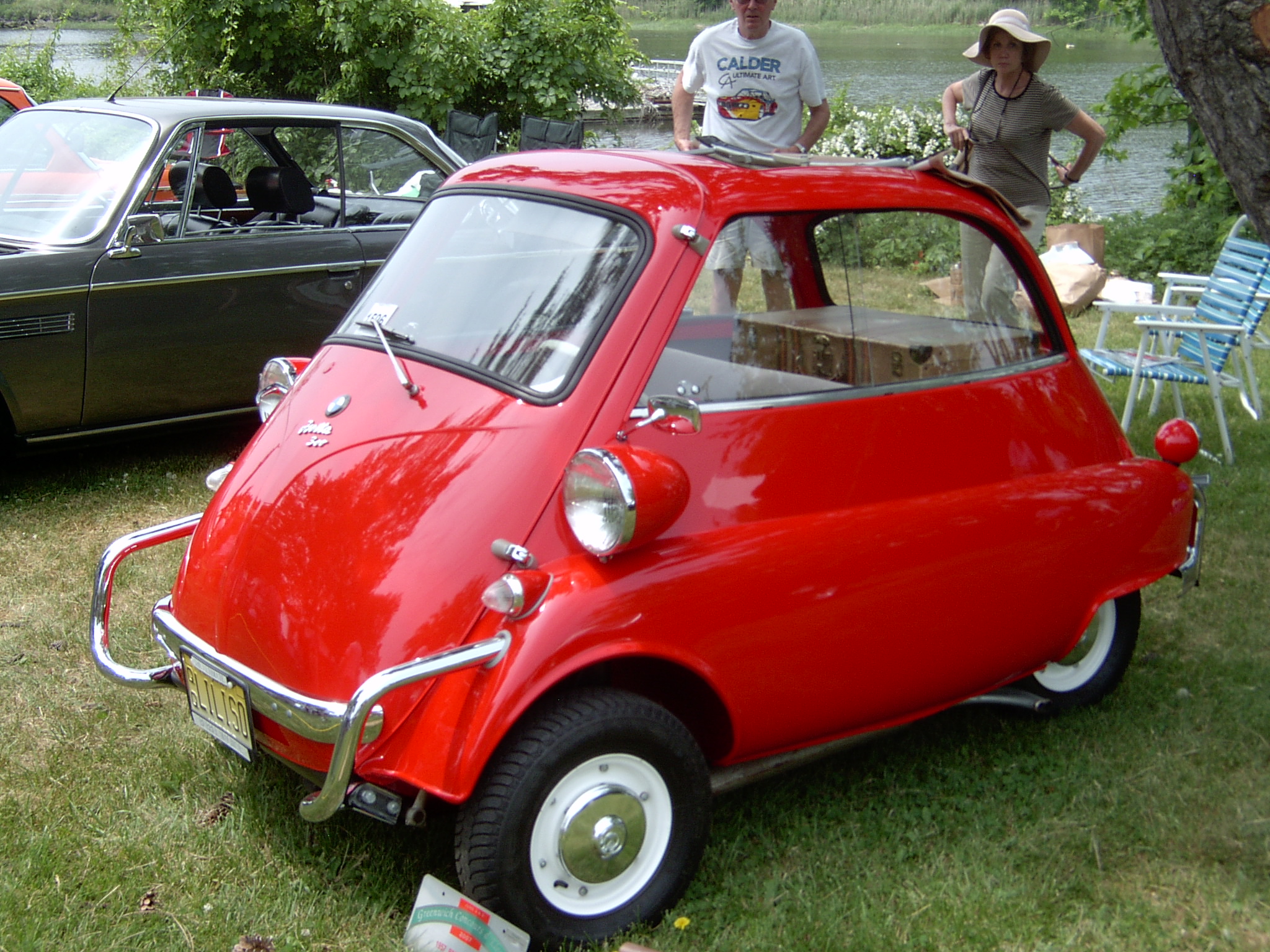
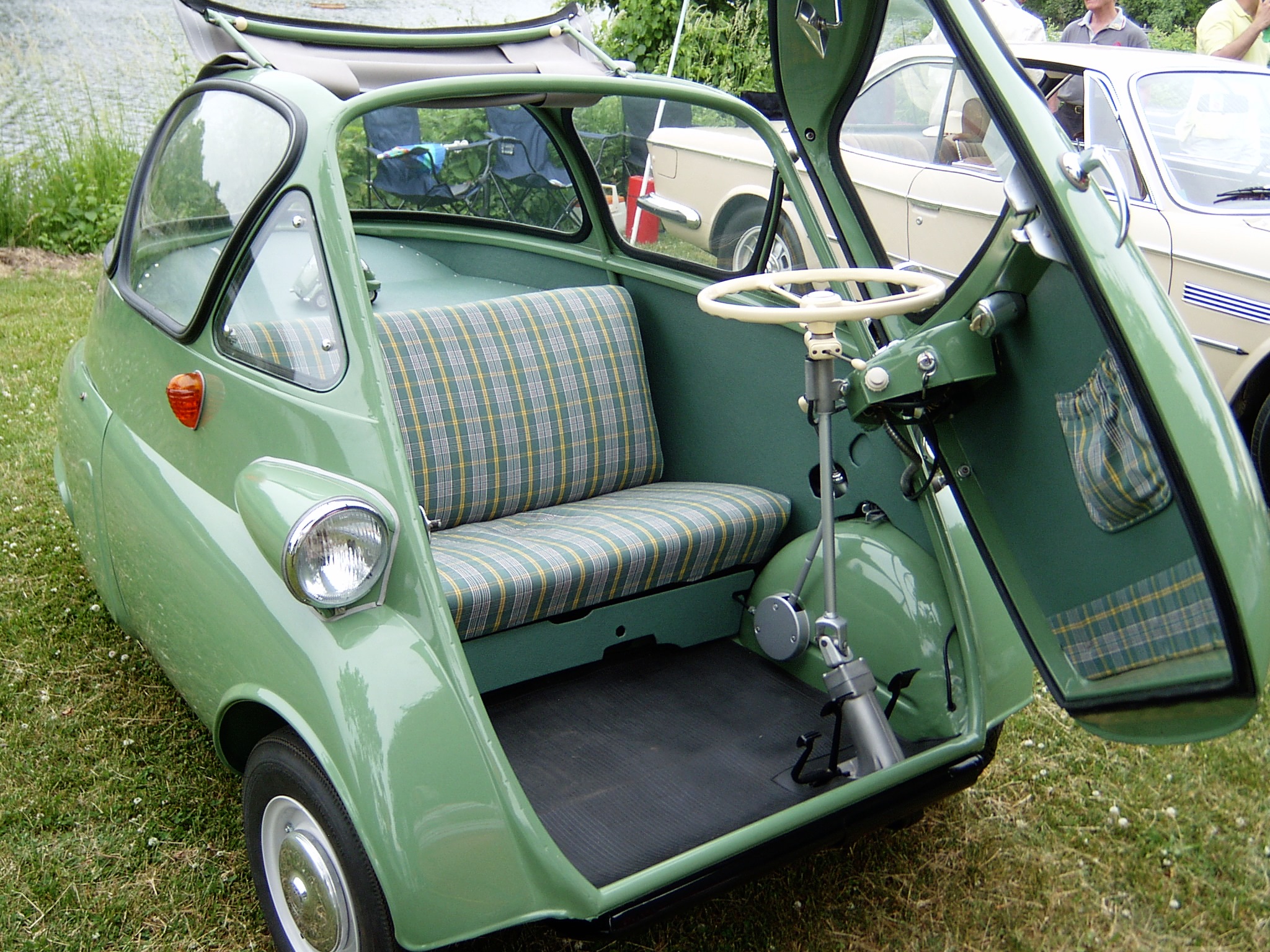
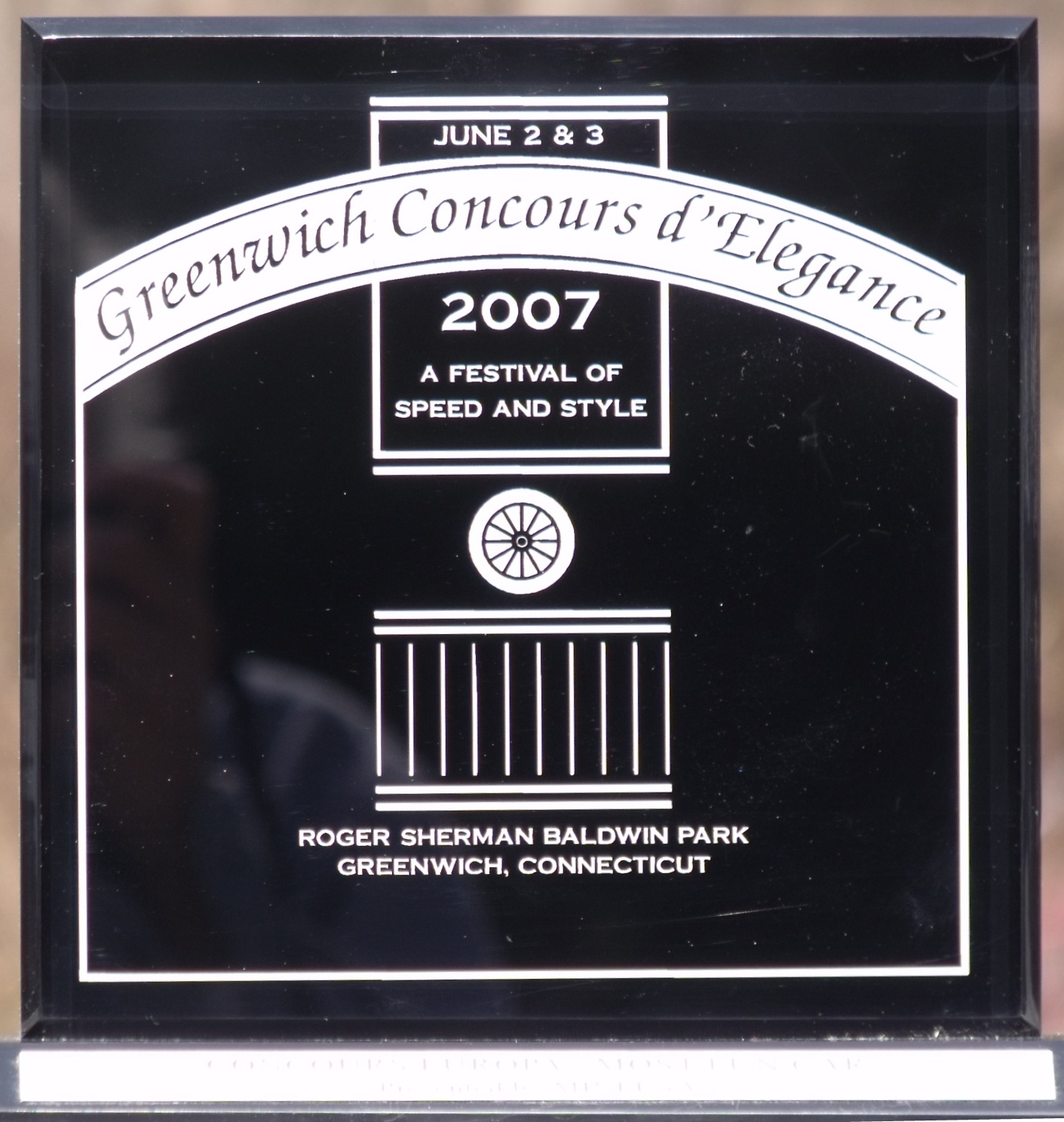
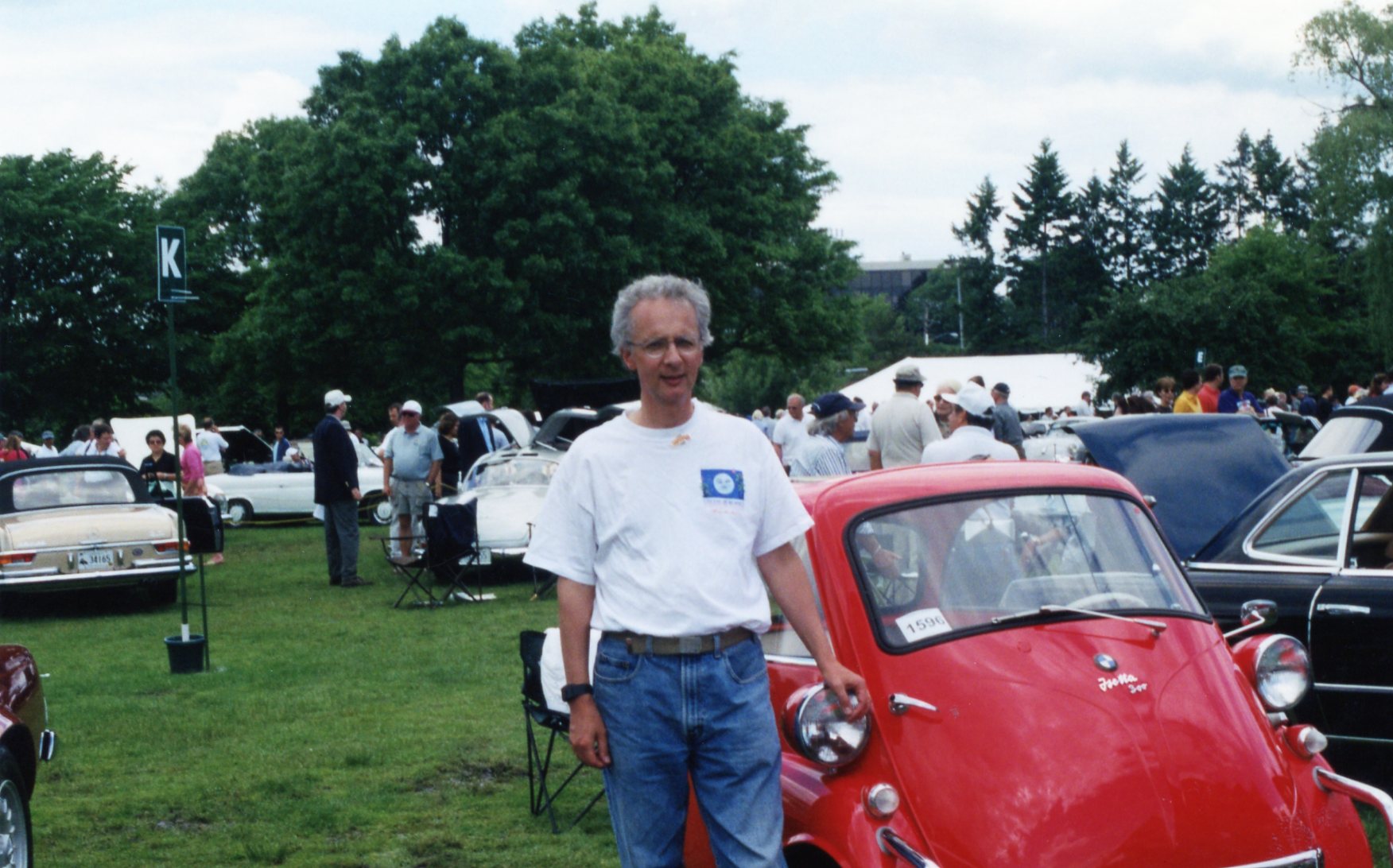
As happened in 2004, the Isetta was wisely placed among other BMWs, with some Porsches on the other side of it. And in another echo of 2004, there was another Isetta, this time, a European-spec 300 which had been beautifully restored. I enjoyed my time chatting it up with attendees about my car, and Bruce most generously awarded me with a Concours Europa – Most Fun Car trophy. During the ceremonial drive-by, he chuckled once again when I told him about my US-spec car having the “larger and more powerful 13 horsepower engine”!
Euro-spec Isetta: note smaller headlights, lack of bumpers, and amber sidelight
This is what 13-hp can get you
At the end of the show, we drove the Isetta back to the parking lot, about a half-mile away, and began the process of loading the car onto the trailer once again. Several yards from me, I noticed an elderly man, who looked to be at least 90, struggling to roll his own open trailer into position. He was a dapper dresser in his plaid sport coat and tweed cap. A woman who may have been his daughter was scolding him that he shouldn’t be pushing the trailer on his own, which didn’t phase him one bit. He looked familiar to me, so I took a chance and approached him.
“Excuse me, are you John Fitch?”
“Why, yes I am!”
“It’s a real pleasure to meet you.”
“Thank you very much!”
With that, I shook the hand of 90-year-old John Fitch, race car driver, inventor, and on this day, just another participant at the Greenwich Concours d’Elegance.
The collector car hobby experienced tremendous growth during the latter part of the 20th and early years of the 21st centuries, a good part of which was fueled by small town “cruise nights”. The name is certainly a misnomer: participants aren’t cruising anywhere except into the town or lot where the evening show is being held. Each owner finds a parking spot while the general public wanders among the vehicles. It’s a nice way to spend a warm summer evening.
Compared to larger and more formal car shows, cruise nights have proven to be simpler to organize and run. Vehicles are usually not limited by make, model, or age; spectators do not pay a fee for the privilege of attending; weekday evening time slots makes it family-friendly and possible to sample while still arriving home at a reasonable time; and maybe best of all, local towns have benefited as restaurants, bars, and retail stores stay open during cruise night hours to service the increased foot traffic.
Sometime during the summer of 2006, my friend Richard Sweeney let me know that his hometown, Metuchen NJ, was hosting a monthly cruise night on the first Wednesday of each month, and he suggested that the Isetta would be a hit there. I had become friendly with Richard because his wife and my wife worked together for many years. Richard and I got along, but I would never describe him as a “car guy”. Yet, he knew about my Isetta, and from our conversations, I sensed that he was more interested in the public’s reactions to my car than he was interested in the car itself. Wednesday would be somewhat difficult, as Metuchen is 45 minutes from my house, and I didn’t relish getting home too late with work the next day, but I agreed, really for Richard’s sake, as he was genuinely excited at the prospect.
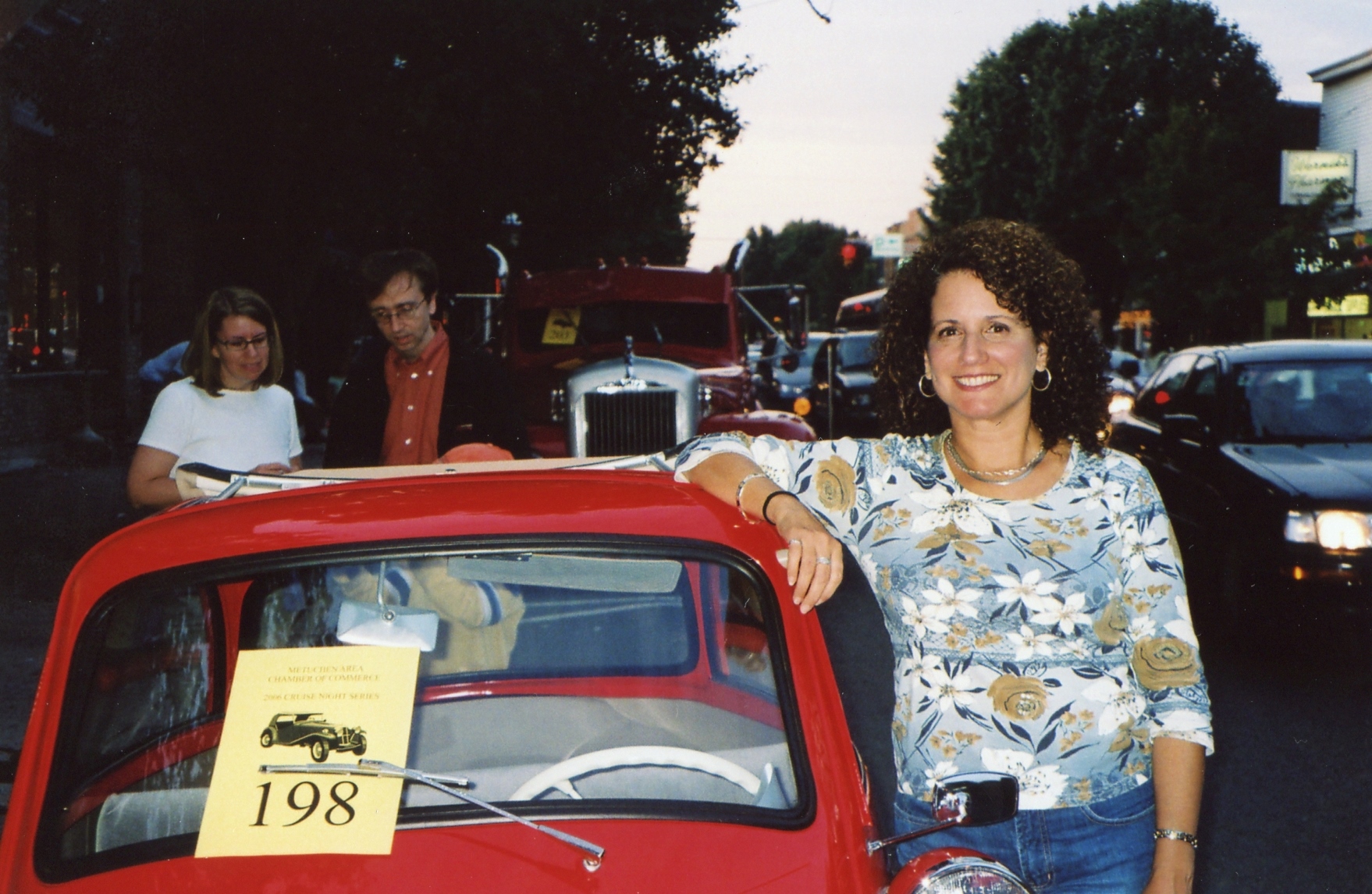
On the appointed night, my wife and I drove to Metuchen. Like the Friday night Somerville cruise night, Metuchen cordoned off its downtown Main St. and reserved street parking for show cars. After parking the tow rig and trailer and unloading the Isetta, I drove the Isetta along Main St., snagging one of the last available parking spaces.
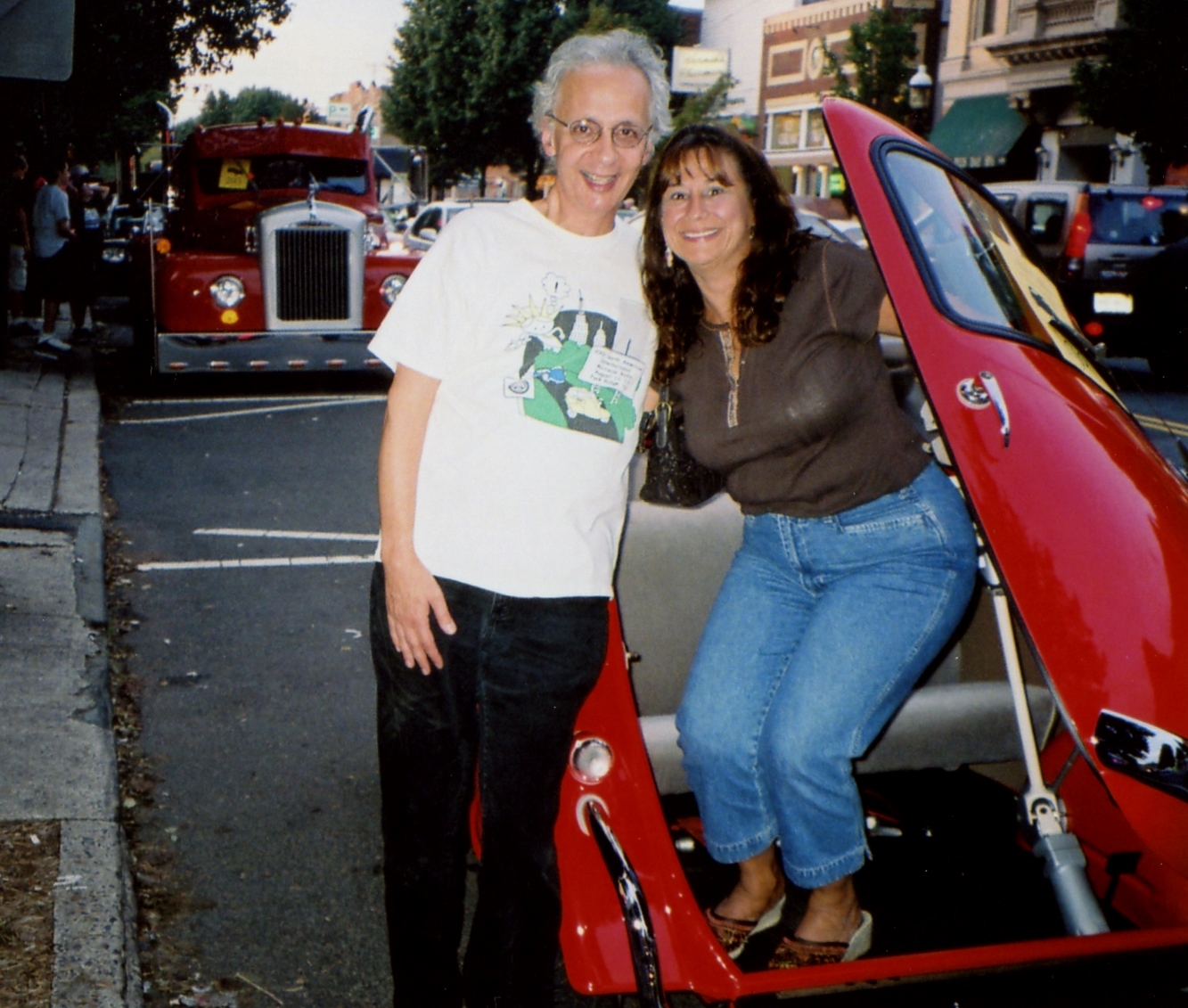
Women practically lined up to pose with the car and me
This event was also the debut of a board game I created called Isetta Jeopardy. At every previous showing of this car, I was struck how show-goers repeatedly asked the same questions. I found myself reciting the same answers so often that I wondered if I should make up a sign with all the answers preprinted. This gave birth to the idea of a game whereby, when a question was asked, I would point to a board which would have a dozen different numbers on it. I would then challenge the questioner to guess which number correctly answered their question. The numbered “answer” would then be raised to reveal the “question”, a la the real Jeopardy game.
The Isetta Jeopardy board game
A few weeks before the cruise night, I revealed the Jeopardy game to Richard, and not only did he enjoy it, he committed all the answers to memory (a brilliant man, he was the Chief Librarian at NJIT, the New Jersey Institute of Technology), and, he volunteered to be the one to work the crowd that night! I made sure to pack a folding table so we had somewhere to place the game.
Richard Sweeney (in blue shirt) about to reveal an answer
Richard patiently awaits the audience’s best guess
Of course, the crowd loved the Isetta, and the usual questions arose. “How much did this cost new?” “How many were sold in the U.S.?” “What does it weigh?” Although I had known Richard for years and had always observed him to be mild-mannered, he was a different animal that night. Overhearing the crowd’s questions, he practically pulled people over to the Isetta Jeopardy display and dared them to pick the right answer. I’m not sure which Richard was having more fun.
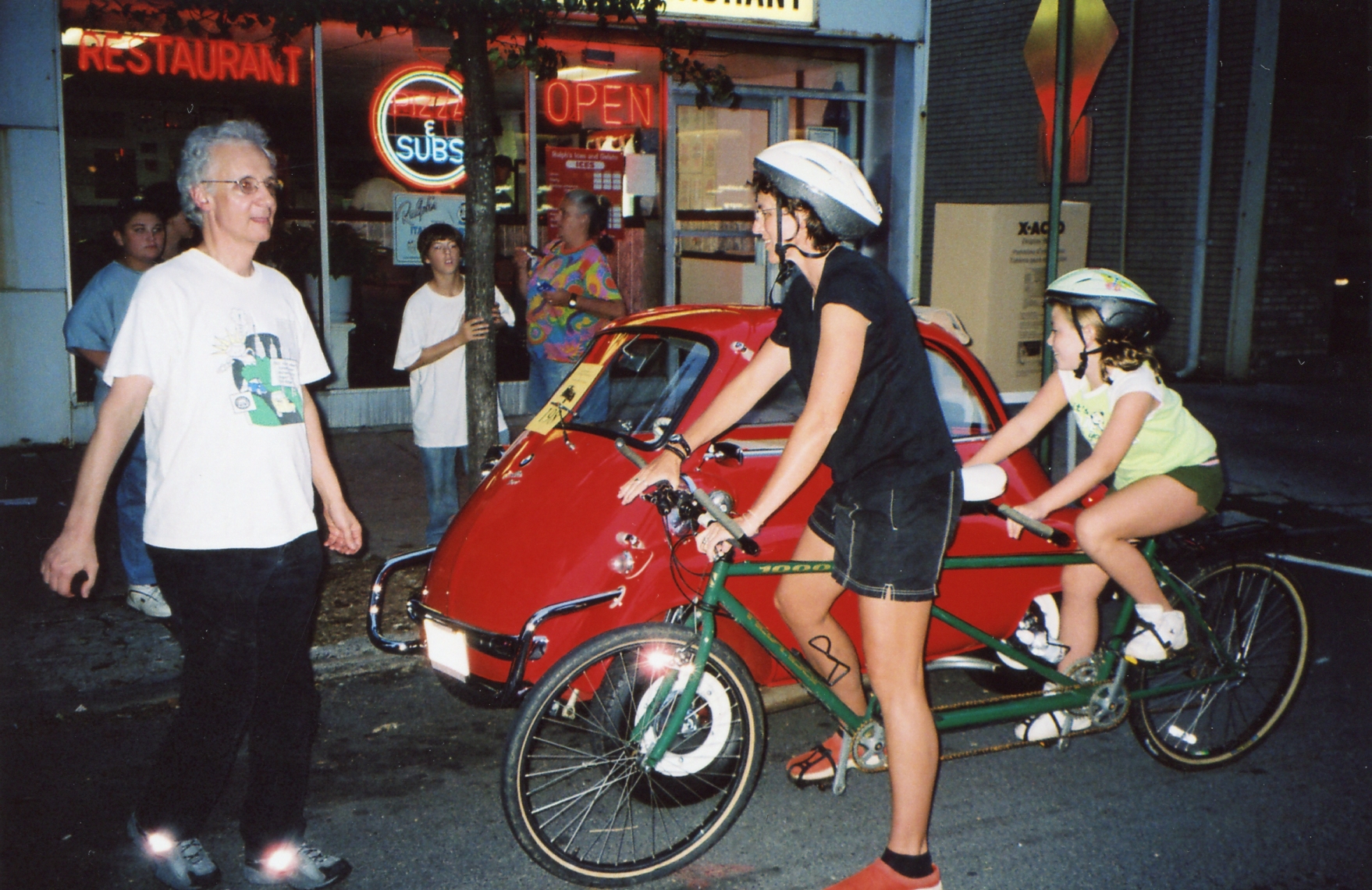
From this angle, it appears that the tandem bike’s wheelbase is longer than my car’s
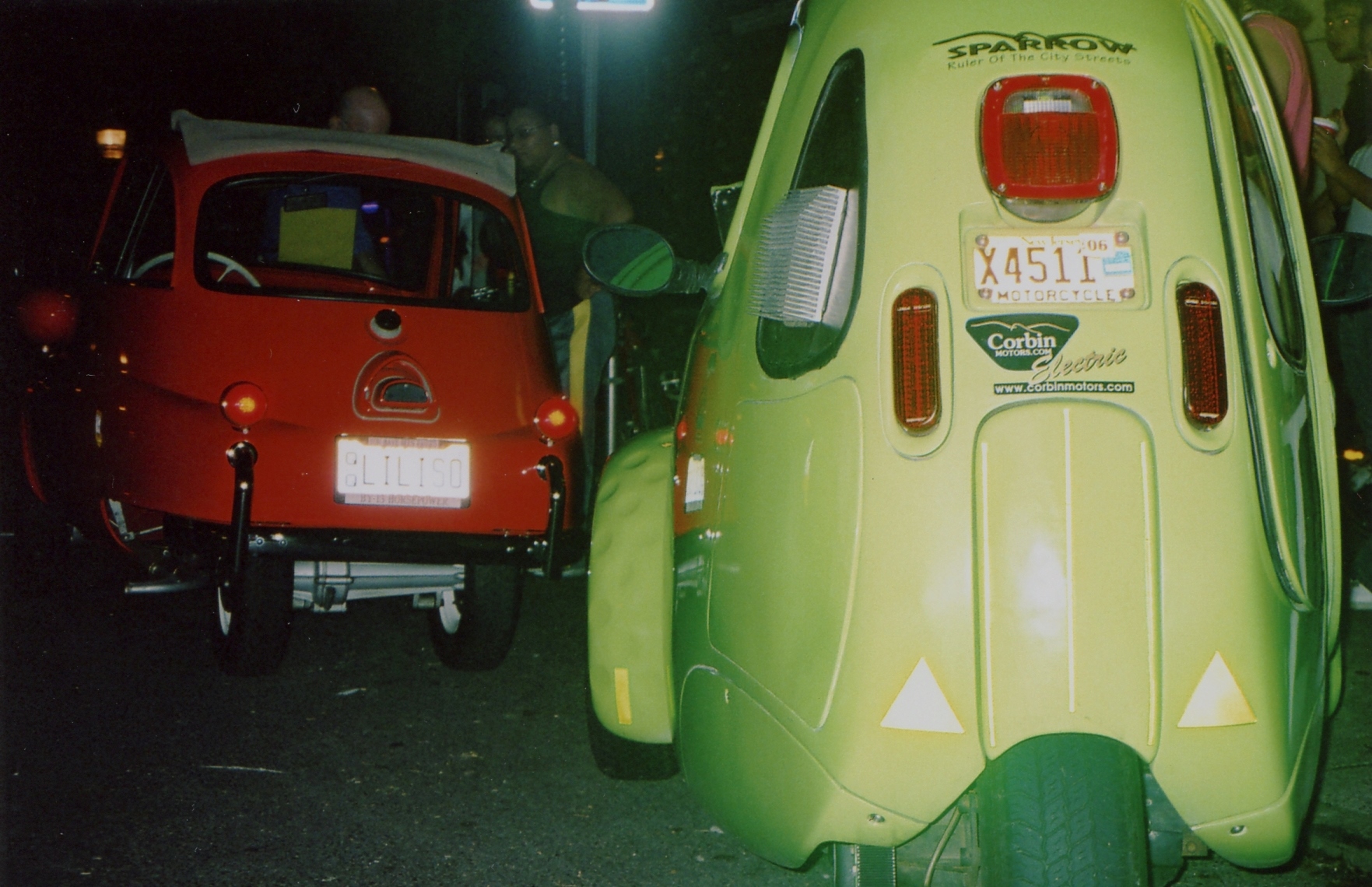
The cruise night continued well past sunset, and it was shortly after dark when a Corbin Sparrow pulled in behind me. The Corbin was a one-passenger all electric “commuter car”, and the owner, an enthusiastic young man, told me he was driving by when he saw the Isetta and had to stop. The Corbin was within 3 inches of the Isetta’s total length, and while the electric Corbin beat my little bubble for efficiency, I must point out that the Sparrow is strictly a one-passenger vehicle, while my Isetta, at least in a pinch, could fit three people (provided they really liked each other).
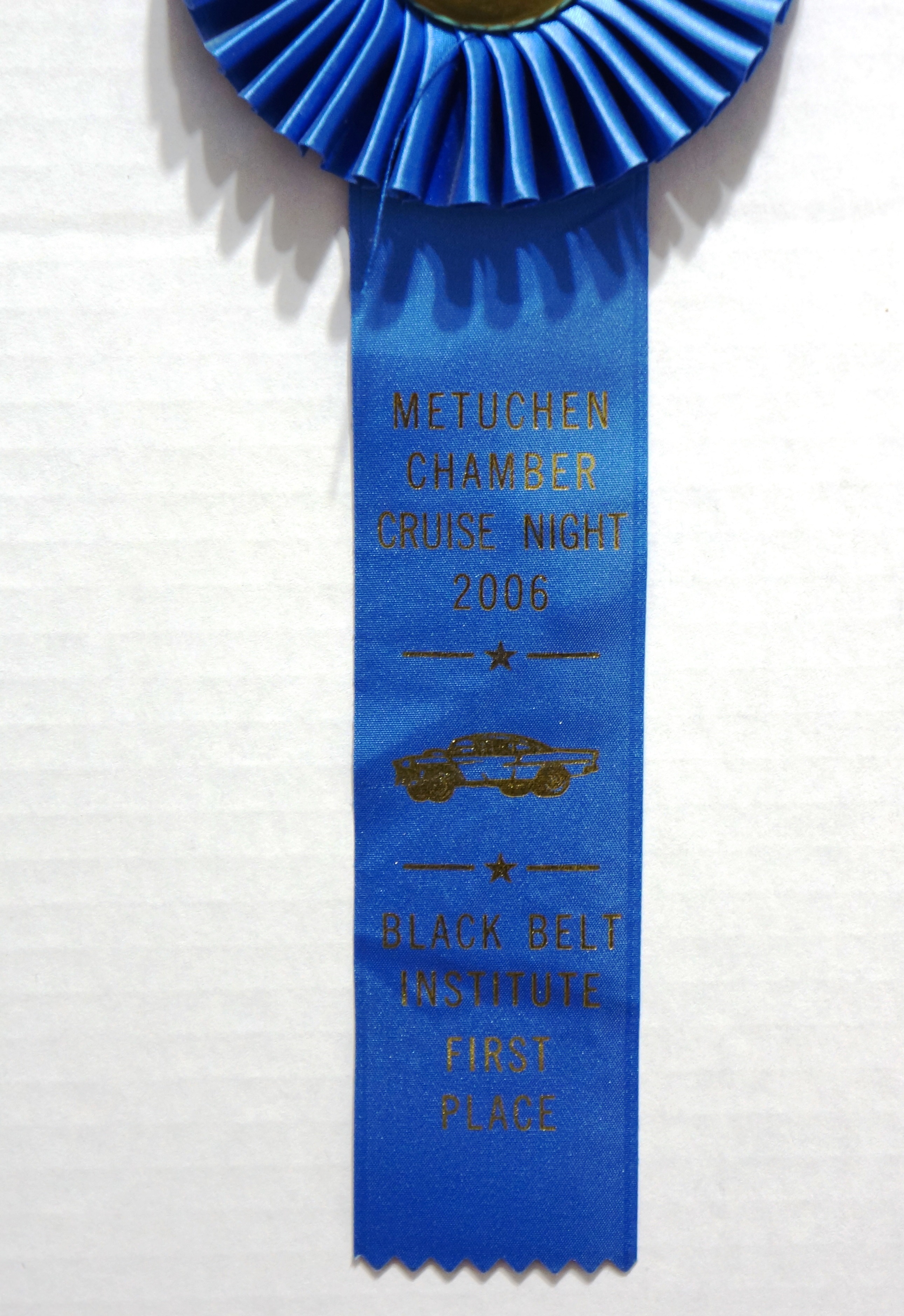
Some cruise nights have awards, and if they do, it’s “People’s Choice”. Well, the Isetta won. “We” got the proverbial blue ribbon, and I really wanted Richard to have it because of his relentless enthusiasm. But he wouldn’t hear of it. Richard Sweeney, the non-car guy, got full immersion into the sociological impact that a BMW microcar can have on the public. This was the first, but would not be the last time that Richard would join me and the Isetta at an automotive event.
Enough digital “ink” has been spilled regarding our current global pandemic’s effect on the collector car hobby that I don’t need to rehash it here. (The more serious human toll certainly puts our hobby into some perspective.) So why am I mentioning it at all? I bring it up only because there have been some rays of hope for those of us still looking for ways to enjoy it. Classic car auction companies, at least some of them, have found a path forward by switching from live events to online formats.
One cannot discuss web-based car auctions without first acknowledging the success of Bring a Trailer (www.bringatrailer.com, aka BaT). The website, which started as nothing more than a place to repost links for interesting cars found elsewhere online, began to auction vehicles several years ago. Fed by a mostly-positive and very enthusiastic comments section, they have changed the rules of engagement. One element of their business which is now blatantly copied is their two-minute anti-sniping provision. A classic complaint about eBay has been bidders with sharp reflexes (or clever computer programs) placing bids with one second remaining on the clock. Bidding would close, the so-called “sniper” would win the item, and anyone who had been willing to bid higher was shut out.
BaT, wanting to level the playing field, was I believe the first online auction company to change the game: any bid placed with two minutes or less on the clock resets the countdown clock to two minutes, giving others a chance to still bid.
Another surprise element was BaT’s move into the premium segment of the hobby. When their auctions started, naysayers claimed that “this is fine for $12,000 Alfa Spiders and $20,000 BMW 3-series sedans, but the big money buying 6-figure exotics will only do that at a live auction”. Wrong. Just this year, BaT sold a 1960 Ferrari 250GT for $585,000; a 1913 Rolls Royce for $657,913; and a 1968 Lamborghini Miura for $990,000. If you think that Bonhams, Gooding, and RM haven’t noticed, I’d think you’re mistaken.
Of course, when the year started, none of the major auction houses were expecting the shutdown. The pandemic’s message was: either find a new way forward, or spin your wheels while waiting out the crisis. As 2020 unfolded, with news only getting worse, one auction company in particular led the pack in switching from in-person to online, and that was RM Sotheby’s.
I’ve attended many live auctions. Whether it’s the boisterous volume of Mecum, or the understated elegance of Bonhams, there’s excitement in the air. You can touch the cars, watch them drive across the block, and feel the tension in the room as the auctioneer implores the audience to bid higher. The crowd may be milling around the block (Mecum) or may be patiently parked in their seats ready to raise paddles (Bonhams). Emotions are running high, causing some bidders to bid with their hearts and not their heads. Consigners are counting on that! Yet all that is lost in the online setting. Still, RM Sotheby’s knew they had to try, and motivated in part I would guess by BaT, they embraced this new business model by doing things they’ve never done before.
On RM’s website, the number of photographs of each vehicle has expanded, with photographers emphasizing flaws (paint chips, upholstery tears, oil stains) to avoid any post-sale surprises. Any available repair or restoration receipts are scanned and posted as PDF files. Finally, for almost every car, RM provides a condition report which lists the condition of the paint, engine, upholstery, and undercarriage using the traditional 1-to-5 scale. I’ve read a few of them, and while they’re brief, they’re also refreshingly honest. RM’s online auctions also use the two-minute extension a la BaT.
August has always been Monterey’s month: the Pebble Beach Concours d’Elegance, the multiple car auctions, and myriad number of special car shows. This week-long event in northern California is one of the biggest car-centric extravaganzas in the world, and like almost everything else this year, it’s been cancelled. RM Sotheby’s, though, is holding its “Shift/Monterey” online auction this week. Bidding opened on Monday August 10, with lots scheduled to close either on Friday the 14th or Saturday the 15th. I’ve been anxious to test the waters with RM, as I have my sights set on a future auction, so I took the plunge: I registered to bid at “Monterey”, and actually placed a bid!
The registration process was too easy: I scanned my driver’s license and a recent bank statement, provided a credit card to be used for a hold, and submitted those docs. About 15 minutes later I got an email message: “Congratulations! You’re registered to bid.” Unlike some previous auctions I’ve watched, there was no bidder’s registration fee.
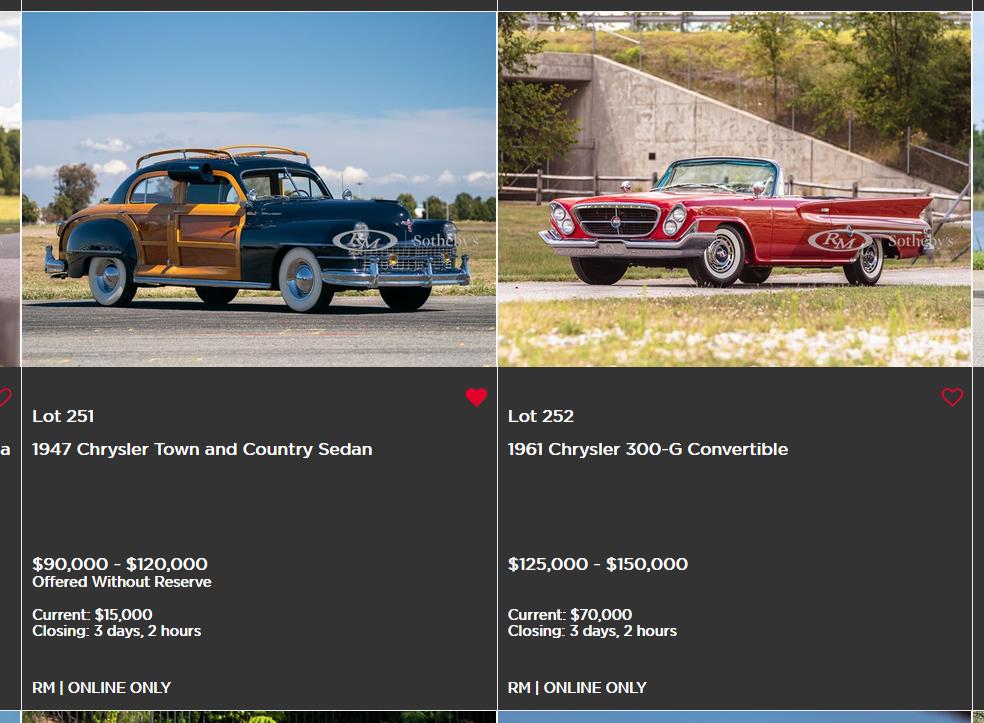
RM website clearly indicates if lot is no reserve
There are 109 vehicles (107 cars, 2 motorcycles) and some automobilia online at Shift/Monterey. (Note that despite its name, vehicles are physically scattered around the country, an advantage for sellers who avoid transport costs; the website indicates the vehicle’s location by city and state). By RM standards, it’s not a big auction. Since I don’t intend to actually purchase a car but want to experience the process, I sought out something with a high pre-sale estimate and with a very low current bid. I found a 1947 Chrysler Town & Country sedan, listed at no reserve, with a pre-sale estimate range of $90,000-$120,000. The current bid was $3,600.
I’m high bidder!
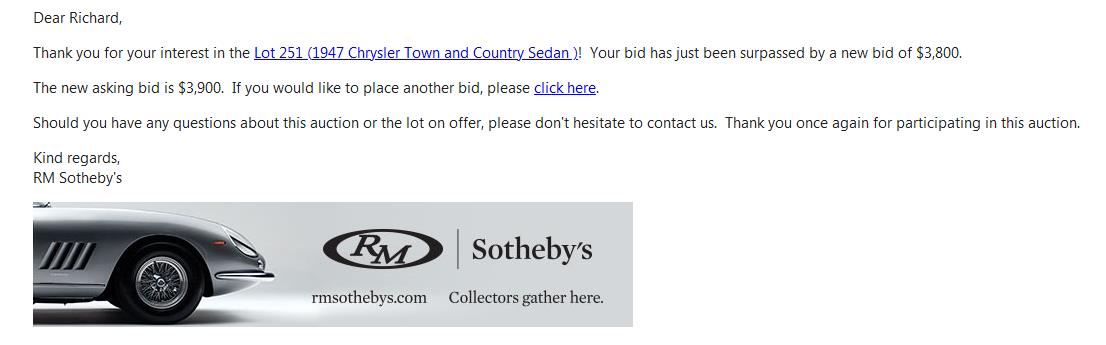
In spite of the numbers, I was still nervous. What if I won? (Sure, I’m going to get a woody Chrysler for under $5,000.) RM provides the minimum bidding increment, in this case, $100. I keyed in “$3,700”, clicked on the green “place bid” bar, and the screen changed: “Your high bid!” I got a confirmation email informing me that, for now, I was high bidder on the Chrysler. Did I mention this is a no-reserve auction? That means if NO ONE ELSE BIDS, THE CAR IS MINE. The euphoria lasted for four minutes. A new email popped in: “You Have Been Outbid”. I was further informed that the “new asking bid is $3,900”. At least I knew where I stood. As tempted as I was, I stopped.
I know where I stand
Everything considered, the RM online bidding experience is perhaps the best it can be when you can’t be there in person. I’m frequently asked “do people really buy cars sight unseen?” Yes they do. RM’s online closing ratio is around 60-65%, which is very respectable, if not as high as it’s been at live shows. Still, I think that RM has set a fine example for conducting honest and transparent business in an online format under particularly difficult circumstances. I’ll have more to say about RM Auctions in future posts.
After two consecutive years of successfully showing the Isetta at several shows, two of which involved a lengthy drive to Connecticut, I was ready to take some time off from the circuit. A glance through my photo archives reveals little participation in automotive events of any kind for the years 2002 and 2003. In the autumn of ’03, I purchased the 1968 Mustang California Special, which made me feel like I was cheating on the Isetta. Now I had to divide my attention between two cars, and the Mustang beckoned, not only because it was newer, but also because a trailer was not required. The medium-term plan was to drive the Mustang in an upcoming New England 1000 rally, a task that the Isetta was sadly not up to.
Before I knew it, it was 2004, and three years had passed since showing the little red car at Greenwich in 2001. Concours rules said “a vehicle displayed at Greenwich is eligible for showing every three years”, so I applied and was accepted.
Rain or shine, it was car show time
My Isetta with its BMW brethren
This time, my BMW was correctly placed in the same display circle as the other BMWs. But that was about the only happy element of the event. It was a day of miserable weather, with a steady cool rain which kept spectators away. My wife and I were dressed for the occasion, and worked to make the best of it.
My wife Margaretanne was a trooper for tolerating the weather
Parked directly next to my car was a BMW 600 (often incorrectly referred to as an “Isetta 600” –its officially name is “BMW 600 Limousine”). From the front, most people mistake it for an Isetta. It does share its front-hinged door and pivoting steering column with its little brother. Built on a slightly longer wheelbase, the 600 included a 2nd row of seats, one side door for access to that row, and most importantly, a two-cylinder boxer engine displacing about 600 cc.
The differences between the 600 (L) and 300 (R) are obvious here
The 600 is an interesting vehicle in BMW’s history. With the runaway success of the Isetta on a global scale (ultimately, 160,000 units produced, which made it BMW’s largest-volume model to date), company management wanted that success to be a springboard to a larger model, presumably to attract a bigger audience. Unlike the Isetta which was designed by the Italian firm Iso, the BMW 600 was designed in-house. Complaints that the Isetta was too small, underpowered, and lacked passenger room were all addressed in this larger model. Alas, the public did not respond in kind. Produced from 1957 to 1959, only 35,000 units were sold. The silver lining is that the 600 begat the “normal looking” BMW 700, which begat the Neue Klasse cars, and the rest, as several million people before me have said, is history.
The BMW 600, which some feel is less cute than the 300
Back to the car at the show: the young woman who piloted the 600 there was not the owner. She claimed that the car was owned by her boss, and he asked her to bring it to the show. Yet she seemed to be well-versed in its history. She had no issue with the idea that she would be driving her boss’s 600 back in the rain!
She was more than happy to display her boss’s 600
Awards were announced, and what’s this? No award for the Isetta this year? Hey Bruce, what gives? I was getting used to the accolades. Oh well, I told myself, I’m not here for the trophy, I’m here for the experience.
A few months later, I decided to bring the Isetta to the Somerville (NJ) Cruise Night, held every Friday between Memorial Day and Labor Day (and weather permitting, extended for as long as cars show up). This time, my stepson accompanied me, and assisted with trailer duties and photography. Like many cruise nights, there is no pre-registration, and parking on the street is on a first-come, first-served basis. We parked the trailer several blocks away, and got to drive the Isetta on some local streets through town. Luckily, as soon as I turned onto Main St., the show’s location, a parking spot appeared.
Stepson John takes first known photo from inside my moving Isetta
Just another red car out for a cruise
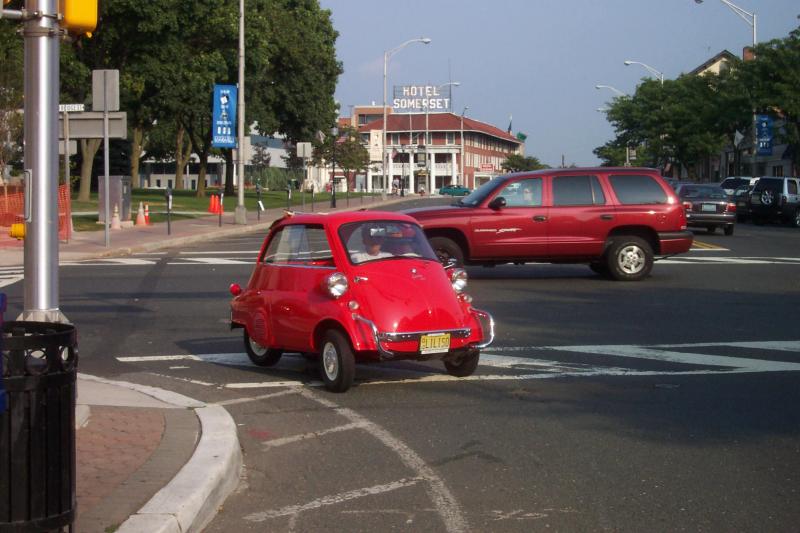
Managing to avoid Dodge Durango while turning onto Main St.
Blowby from tractor-trailer threatened to flip Isetta
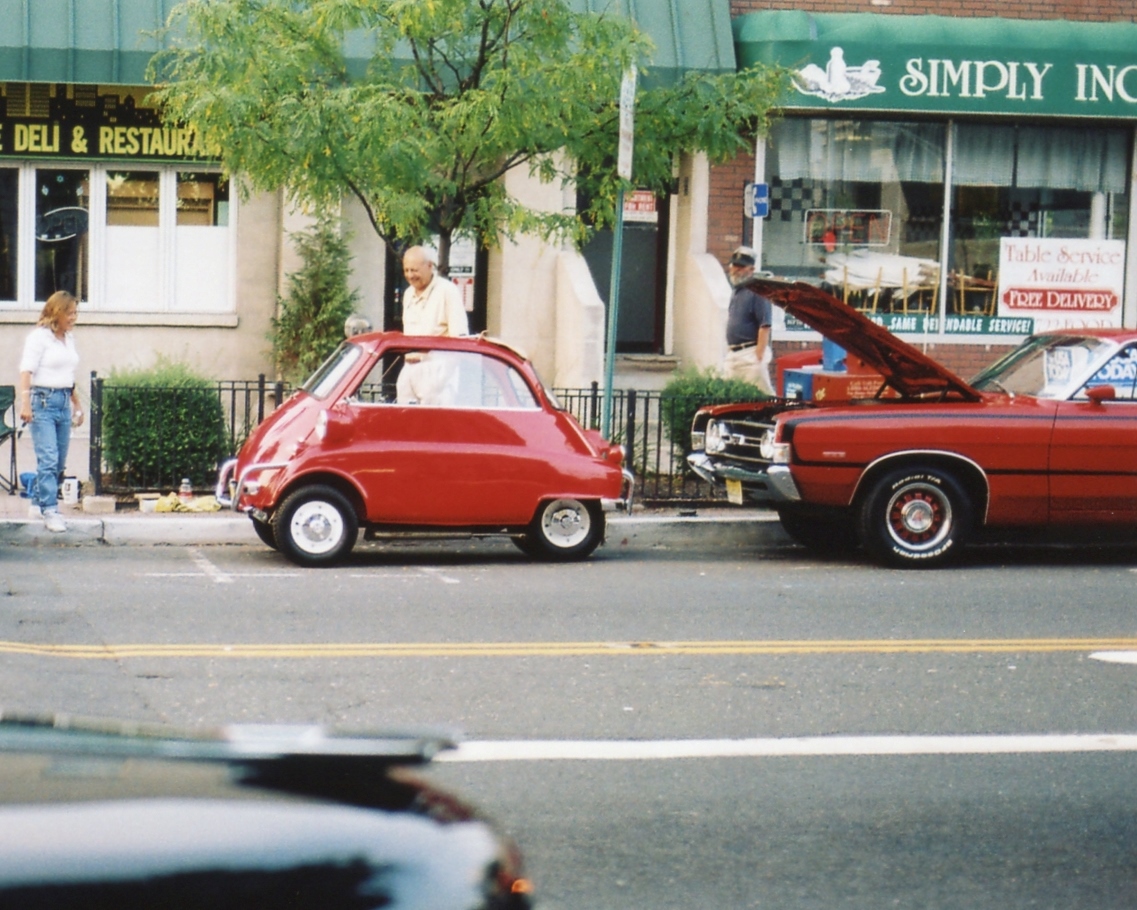
It’s one thing to look at the Isetta and say “that thing is small”. It’s another thing to park it adjacent to other vehicles and see how truly tiny it is.
Isetta’s length matches hood of Torino behind it
As has been the trend, I spent much of the evening answering what seemed to be the same half-dozen questions:
Is this thing street-legal? (Sure, I drove it here)
How much horsepower does it have? (Thirteen, but a healthy 12-year-old boy on a bicycle can outdrag me)
What the top speed? (50 mph, downhill with a tailwind)
What kind of gas mileage does it get? (60 miles per gallon, so the 3-gallon tank gives me a cruising range of 180 miles)
How many people can you fit in there? (Two, but they really have to like each other)
The Isetta was proving to be a consistent attraction
The repetition was encouraging me to shoot back the same zany answers every time. By 9 p.m., it was time to get the Isetta back on the trailer. At least home was only eight miles away.
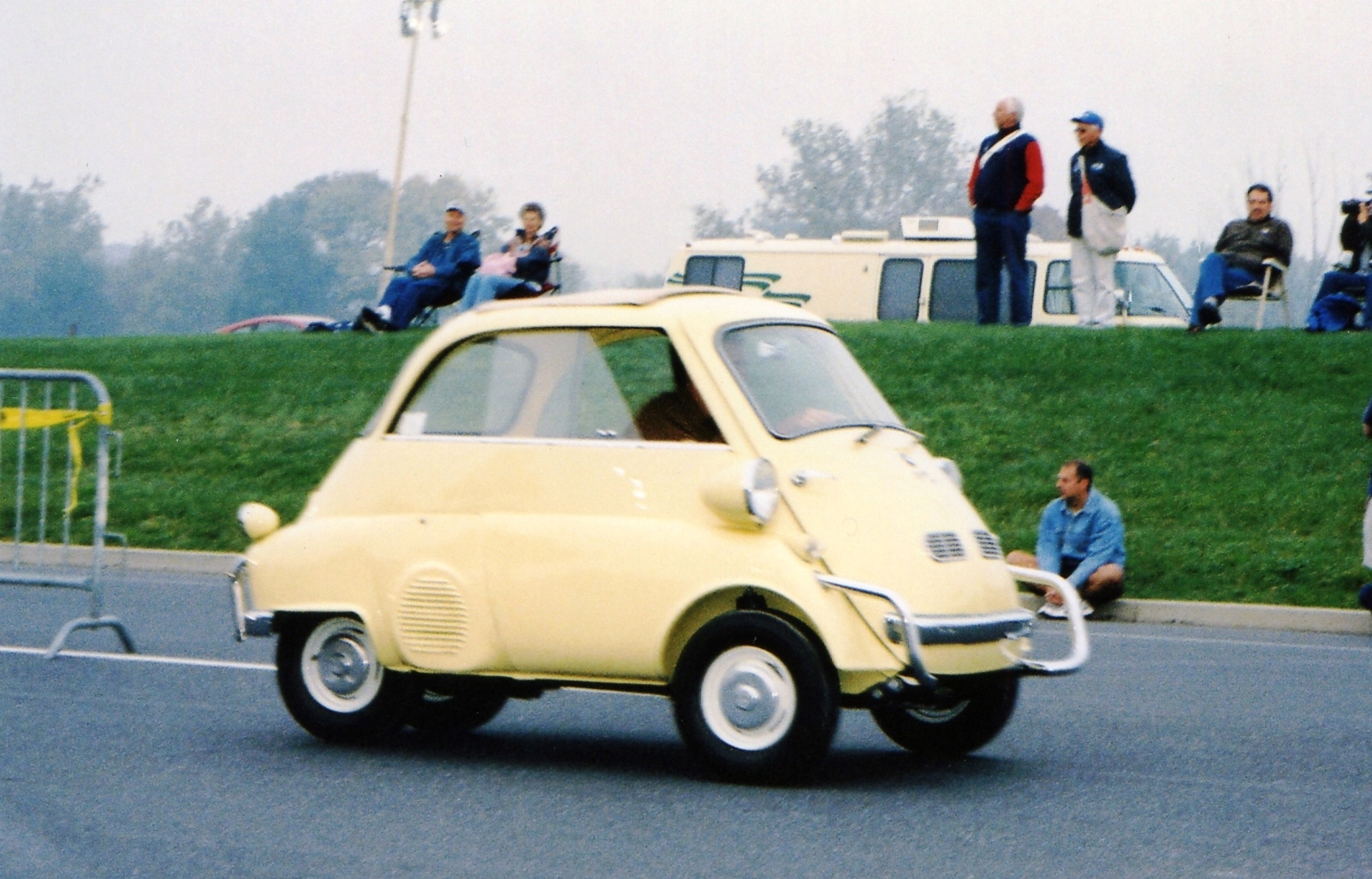
Later that year, while attending Hershey, I saw a beautiful yellow Isetta at the show. This was the germination of an idea: perhaps I could look into entering my Isetta at a future AACA event….
The Greenwich (CT) Concours d’Elegance, which began in 1996, was an almost immediate success. It is one of the few true classic concours held in the NY/NJ/CT metro area, and it has much more than that going for it. The show, traditionally held on the first weekend of June, is located in a small park bordering Long Island Sound. The park’s size limits the show’s size – visitors feel welcomed knowing that the entire show can be viewed in the course of a day with no need to rush. Clusters of trees provide shade when needed, and the grassy field is far superior to pavement. Vehicle manufacturers and dealers showcase new cars along the park’s perimeter. Perhaps best of all, each day’s lineup is unique: Saturday’s arrangement focuses on historic American vehicles, while Sunday’s participants arrive in European classics (this convention has changed somewhat in the last several years). Combined, these attributes make the Greenwich Concours one of the most unique and enjoyable car shows I’ve attended.
My relationship with the Concours, and more specifically with its chairperson Bruce Wennerstrom, began professionally. Volvo Cars of North America, my employer, was invited by Bruce to bring new cars to the show (and to monetarily contribute for the privilege of doing so), and my job was to provide the iron, which I did starting in 1997. As mentioned in Chapter 24 of the Isetta Saga, Bruce saw me and my Isetta at the 2000 Lime Rock Fall Vintage Festival, and invited me to bring my car to Greenwich in 2001, an invitation I immediately accepted.
We (Margaretanne and I) of course would be attending on Sunday, which at that time was referred to as “Concours Europa”. The date was June 3, 2001, and like every other participant, I could only hope for good weather. But Bruce’s luck had run out. After years of avoiding the wet stuff, it rained for the Saturday portion of the show. It wasn’t a total washout, though, as the skies cleared on Sunday; they just didn’t clear early enough to dry the grass.
Arriving with Isetta on trailer, I was directed to “trailer parking”, about a half mile away. I unloaded the car, we hopped in, and I drove to the park’s entrance. The routine went like this: each car and driver stopped at the registration table and was handed a packet. On the outside of the packet was a large letter indicating your ‘circle’. All the show cars were parked in circles, the cars perpendicular to the circle’s circumference, facing outward (got that, geometry majors?). Once cleared of check-in, the driver (me) held up the envelope so that volunteers could direct me to the appropriate circle, which as I understood it, was the BMW circle.
This shot gives you an idea of the field’s wet condition
The first hundred feet or so within the park was paved. As soon as I turned right, as directed, and hit the wet and muddy grass, all forward motion ceased. I had no traction. Weighing under 1,000 pounds with passengers, I suspect that the Isetta’s 10-inch tires didn’t have enough mass pushing downward. Show workers tried to push the car, but it was slow going, not helped by their own struggles to keep their sneakers from slipping. We made it a few yards at a time when someone in a supervisory role spoke up and said to me “look, your circle is on the other side of the park. We’re not going to get there. We’re just going to put you in this circle near to us”. Who was I to argue? I said “sure”, and we entered the circle and parked. Climbing out, I saw that I had the only BMW in a circle of … Mercedes-Benzes.
The lone Bimmer among the Benzes. At least they’re all German.
The Benzes were beautiful –exactly what you’d expect, with most of them SL models, including one 300SL Gullwing. I cleaned my car the best I could (the tires and wheel wells were quite muddy), set up our lawn chairs, and tried to relax. This was to be a judged show again (and yes, I dusted the spare!).
In the collector car hobby, it is a fact that most car owners enjoy talking about their cars. I again bore first-hand witness to the incredible reactions show-goers had to a BMW Isetta, and all the questions which were directed at me. Attendees tended to fall into one of two general camps: those who had never seen an Isetta and didn’t know the first thing about it; and those who knew something about the model yet had not seen one in years. So the time passed quickly, because everyone wanted to talk to me about my car. I also noticed that people chatting it up with me spent little or no time at the other vehicles in my circle. A friend who was at the show let it be known that he overheard two Mercedes owners complaining about “that intruder BMW” in their midst.
Taking a break from non-stop gabbing
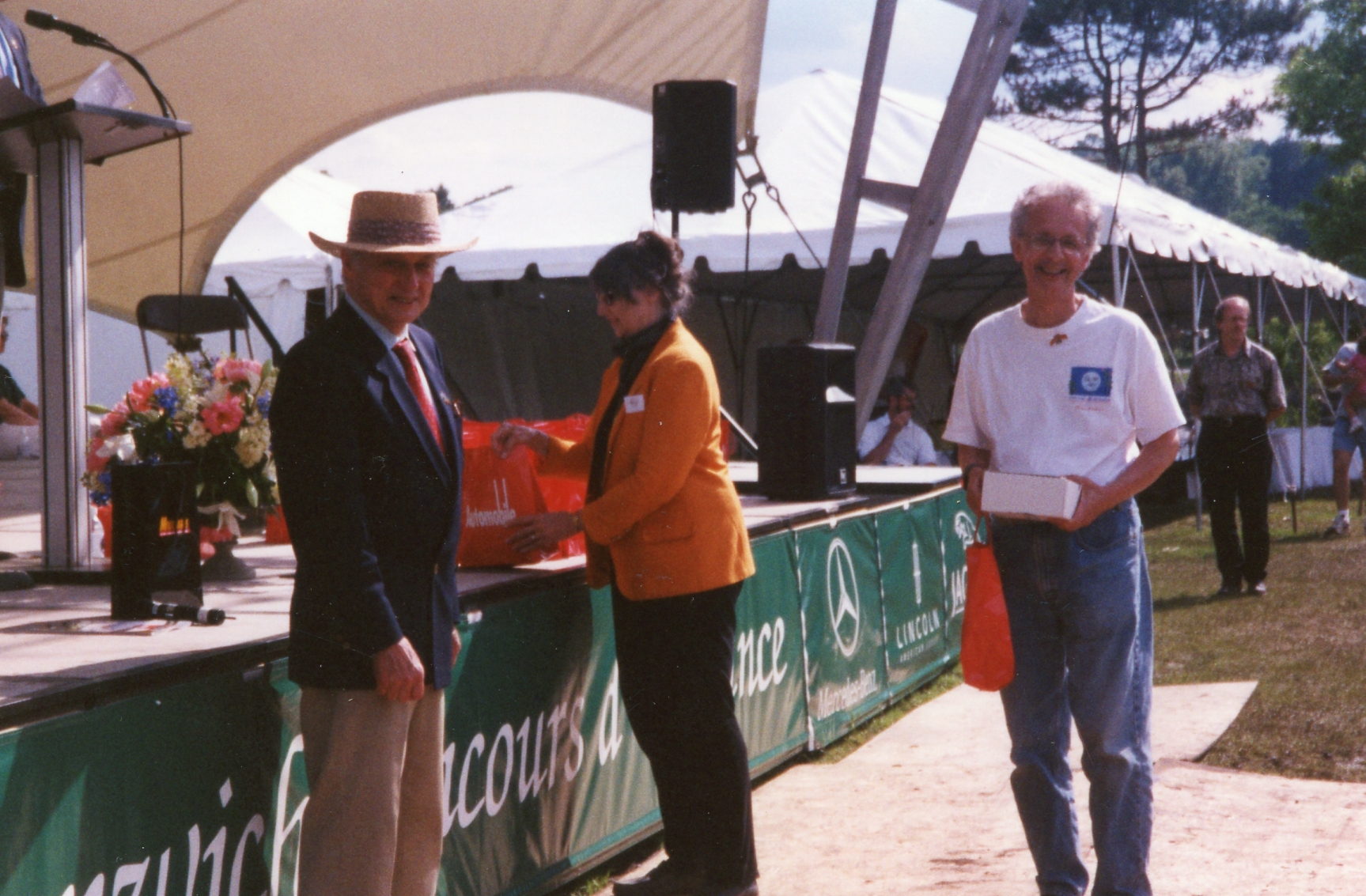
Here’s another fun feature employed by the Greenwich staff: as class winners are announced, the winning vehicles line up and are driven at parade speed past a viewing stand. Each car stops, and the driver is handed a trophy and invited to say a few words. I had observed in previous years that Bruce and his wife Genia made it a point to have multiple classes in order to provide participants with as much recognition as possible. It was still a shock, though, when my name was called as winner of the Concours Europa “Best Special-Interest Car”. I honestly think mine was the ONLY special-interest car!
We pose by the car (photo courtesy Dennis & Ann Marie Nash)
We got in the queue (with better traction on the now-dry grass) and motored up to Bruce. He stuck a microphone through the car’s open sliding window and asked me about my car. I mumbled something about it being a U.S.-spec Isetta. This seemed to catch him by surprise, and he asked me what the difference was. I replied “The European Isettas got a 12-horsepower engine, but here in the States, we were given the bigger engine, which made 13 horsepower”. This sent Bruce into a fit of laughter, but he managed to make sure the audience understood that my Isetta had “the big block”.
Bruce Wennerstrom and his wife Genia hand me the goodies (photo courtesy Dennis & Ann Marie Nash)
Another car show, another trophy! During the entire restoration, I repeatedly told myself that I was NOT doing this in order to collect what I derisively referred to as “dust-collectors”. But again, the recognition among my peers was humbling, and certainly rewarding. We loaded the Isetta back on the trailer and headed home, with no immediate plans for any future car shows for my little red cuddle-box.
EPILOGUE
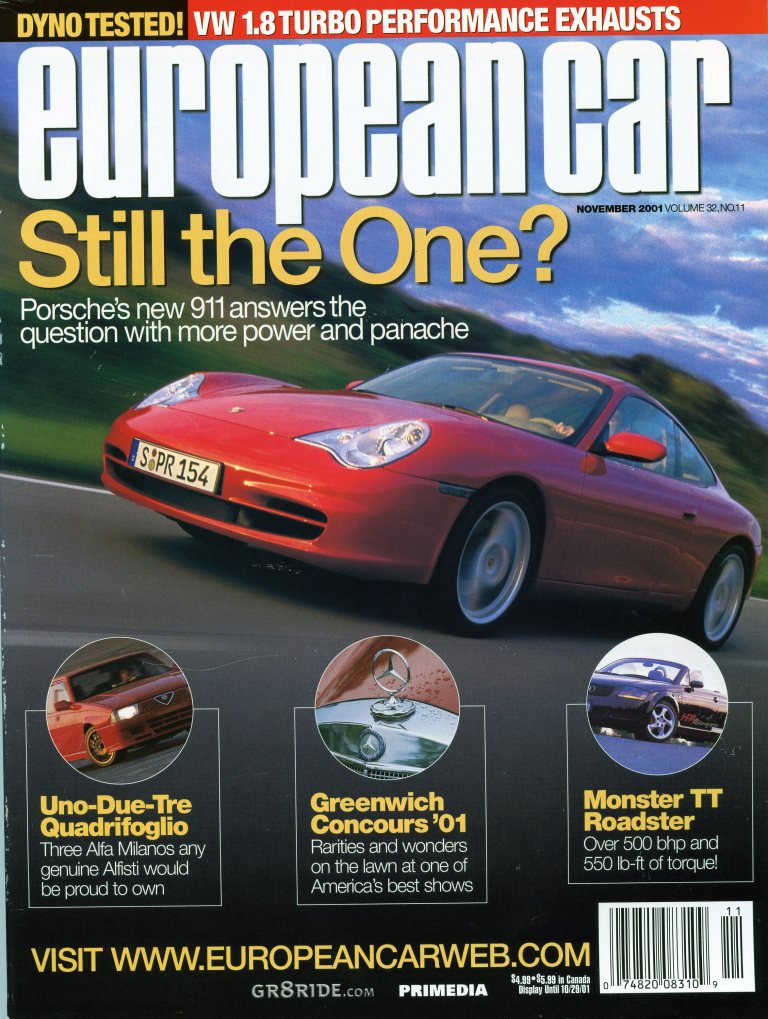
The November 2001 issue of (now defunct) European Car magazine published a story on the most recent Greenwich Concours, and even included a cover blurb: “Rarities and wonders on the lawn at one of America’s best shows”. Lo and behold, the magazine, which titled the story “Rainwich” Concours, included a small story about my small car.















 richardscarblog