My good friend Enzo (“EC” to his buddies) bought his first collector car, a 1991 Alfa Romeo spider, last autumn. This was not Enzo’s first Italian car, as he had Fiats as daily drivers, albeit 30 years ago. But upon retirement, he decided to treat himself, and found this pristine low mileage beauty locally. Like any other 25-year-old vehicle, it needed attention to some small details, but EC has been fastidious about staying on top of needed repairs.
When I had had the chance to go over the car with him late last year, we found that one of the tie rod end boots was torn. It didn’t require immediate replacement, but over the winter he ordered parts, then invited me to his home for a day to be spent swapping out tie rod ends.
One of the outer tie rod ends, about to meet its demise
Upon arriving one day last week, I saw that he had ordered ALL SIX tie rod ends. I was under the now-mistaken impression that we were replacing only the two outer. (All 4-cylinder Alfas on the 750-, 101-, and 105 platforms use recirculating ball steering, with a center link and two tie rods. Each rod has two ball joints, one with right-hand thread, and one with left-hand thread, to allow for toe adjustment.)
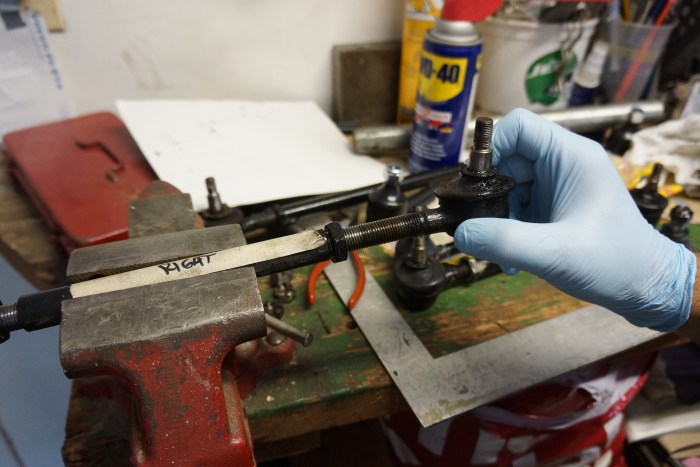
One of the tie rods is out and is measured
We got to work. First order of business was to pull out the cotter pins, but these pins were so thin and rusted that half of them broke before we could retract them. We ended up forcing the socket over the castle nuts and using an impact wrench to remove all six nuts.
Part numbers marked on each end to keep track
A trick I had remembered from doing the same repair on my Alfa was to rotate the steering wheel to bring the center nuts to an exposed position from within the engine compartment. Then, using a long extension, we could gun the nuts loose from up top, which was much easier than trying it while on our backs.
Next came out the pickle fork. Persuasion from a two-pound hammer was all it took to get the links to drop.
We were cranking the tunes in the garage!
With the three links off the car, we counted threads AND measured overall length, as our best attempt to reassemble the car without changing the alignment too much. We matched up old and new parts (with EC marking part numbers on each component using a Sharpie), and had all six tie rod ends installed into their respective links within minutes.
This may have been the point when we took a lunch break. Prosciutto, Parmesan, salami, olives, and wine (!) were on the menu. Lunch concluded with a nice cup of coffee (to wake me up after the wine), and we were back to the garage.
Masking tape helps keep identification straight (wine does not)
The new parts, bought from Classic Alfa in the UK (the author’s favorite Alfa parts supplier) used castle nuts and cotter pins for the four outer ends, and locking nuts for the two inner. We did not have the correct-sized cotter pins on hand, so the ever-resourceful EC made his own from coat hanger wire. The temporary pins will be replaced with authentic pins once he gets to the store.
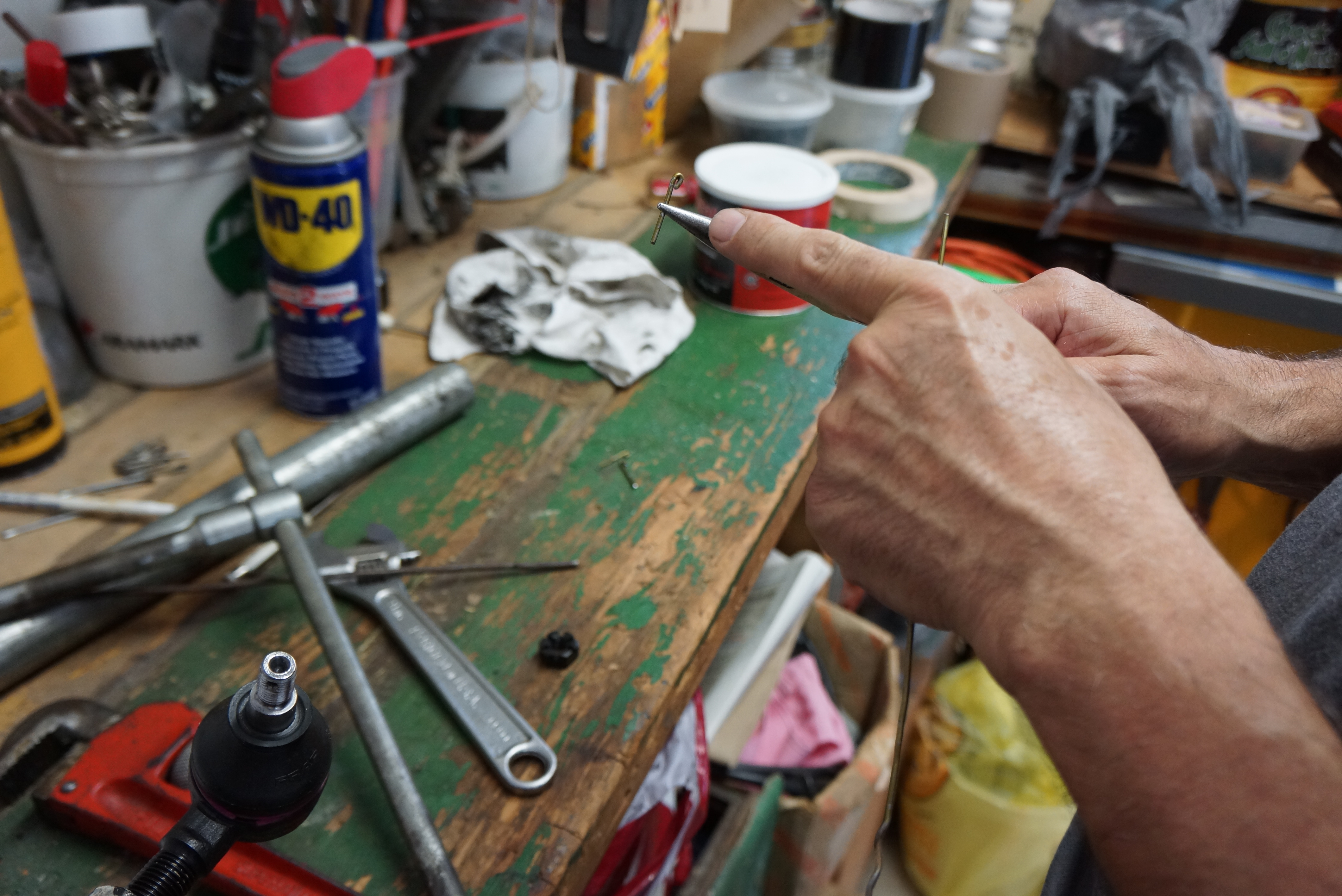
EC fashions cotter pins…
… points out handiwork
Much to my surprise and satisfaction, all six nuts tightened right up without giving us any trouble. I had concerns that the ball joints might spin and prevent us from reaching the proper torque, but that didn’t happen. With everything buttoned up, Enzo took the car for a test drive, and came back to report that the only issue was a steering wheel which was slightly off center. The car will need an alignment after this work anyway.
Front wheels remained attached during test drive
At the rate my friend EC is moving, there is very little else that needs attention on this gorgeous drop-top. It’s running great, and he’s got the summer to enjoy it! I know that we’ll see him and his Alfa out with us on our weekend jaunts.
The Boonton NJ cruise night, held on Fridays in the WalMart shopping Plaza, had its first show of the 2016 season on June 10. This year’s festivities were scheduled to start on June 3, but that show was cancelled due to inclement weather.
The cruise night, sponsored by the Starlight Cruisers car club, began in 2007 and has proven to be one of the better attended events of its kind in northern Jersey. The parking lot is roped off to allow parking for up to 250 cars. Because of the show’s popularity, vehicles are limited to those with QQ (NJ antique automobile) plates, or those which are at least 25 years old. The club provides music and door prizes.
The weather on the 10th was perfect – sunny, warm, cloudless, with low humidity, which brought out the crowds. The show cars were 99% domestic product, with a large percentage of them easily defined as “modified” – everything from bolt-ons to full customs in the old-school sense. GM vehicles from the 50s and 60s dominated, but there was also enough variety to keep things interesting for those who seek the unusual. There was a smattering of pre-war iron, including a lovely 1940 LaSalle convertible. Original owner and/or unrestored cars were present, such as a 1967 AMC Marlin whose owner has had it since 1971. And some imports dared to show up among all the Chevys and Fords, including an Opel GT, a Saab 93, and your author’s Alfa.
AMC products are rare sightings at any car event. This cruise night featured a number of them, including this Rebel “The Machine”, and this 1978 Concord AMX.
AMC Rebel The Machine
1978 AMC AMX
This 1967 Marlin was striking in several ways, most notably because its owner told us that this was his first car when he bought it in 1971. His daughter was dutifully deployed to attend to polishing duties. When asked about the missing fuel door, he replied that the door has been shipped to Sweden (!) for color-matching. We were left unclear as to why.
1967 was on Ambassador platform
Sign nicely captures history
She’s only half-way done
The number of Corvettes in attendance easily reached several dozen. What was especially impressive was the large number of C1 and C2 cars.
’58 and ’62 C1 side-by-side
1961 C1 in Fawn Beige
Iconic ’63 Split Window- note the plate
These C2s lined up their beautiful rear ends
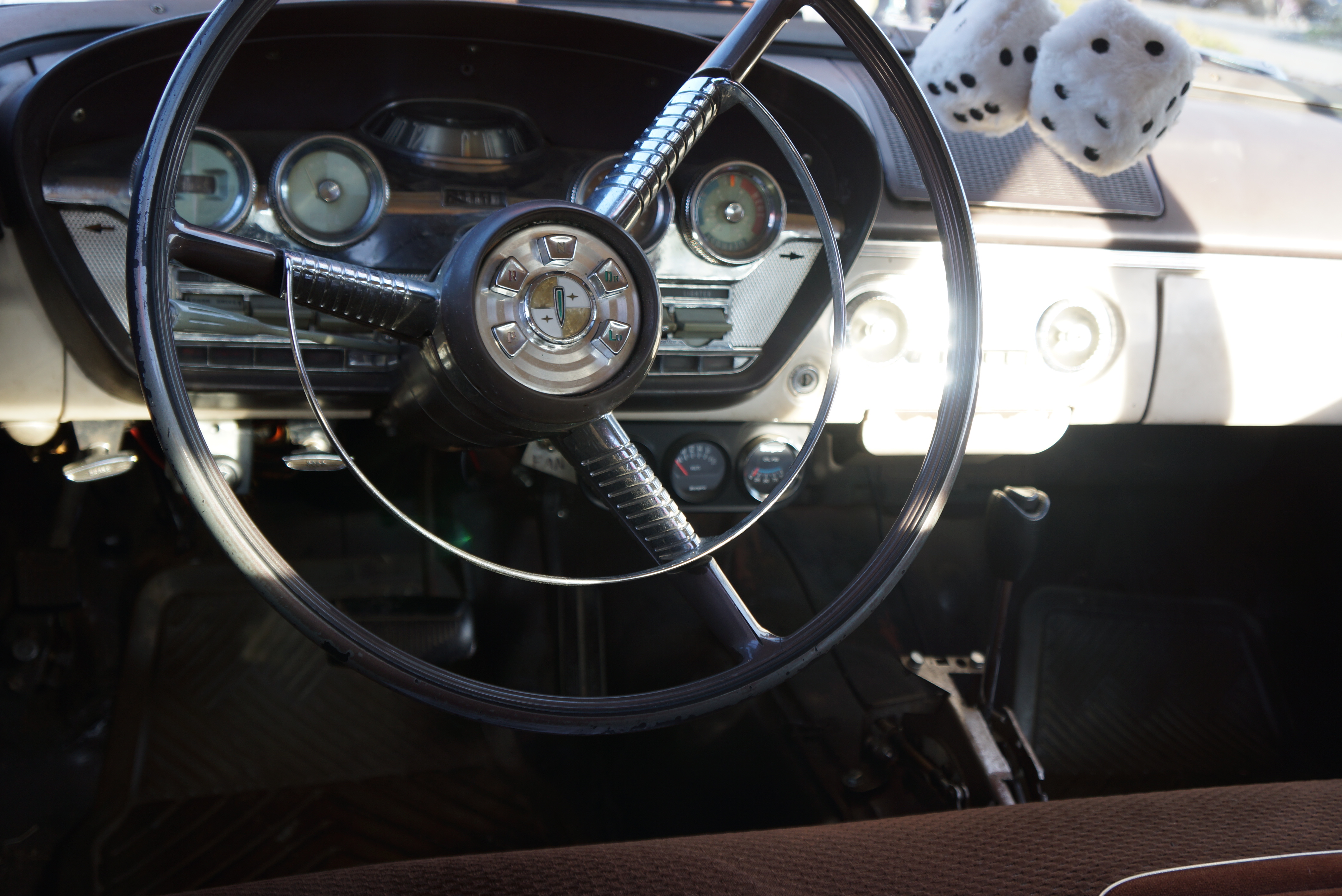
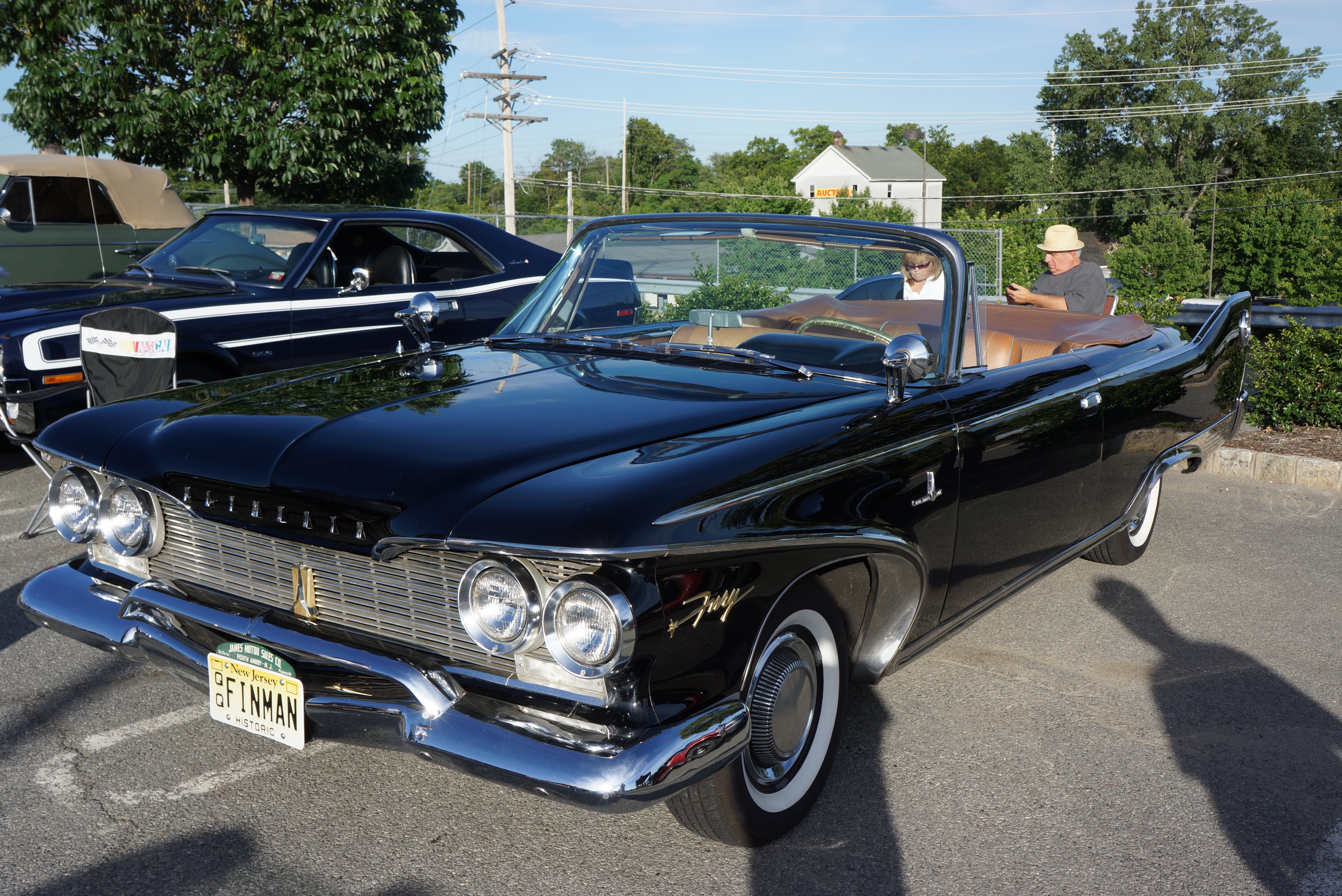
It is often stated that American car styling reached its bizarre peak in the late 1950s. While that may be true, what is sometimes missed is that interior styling also captured some of that strange creativity, and that included functional items such as transmission controls. This 1958 Edsel and 1960 Plymouth both used unusual solutions for transmission control placement. (Note that the Edsel has a floor shifter as part of a complete drivetrain swap.)
Quarter panel trim for a ’58 Edsel? Yeah, we got that.
Tranny buttons front and center
Chrysler didn’t get the memo that tail fins were out
Trans push buttons and square wheel
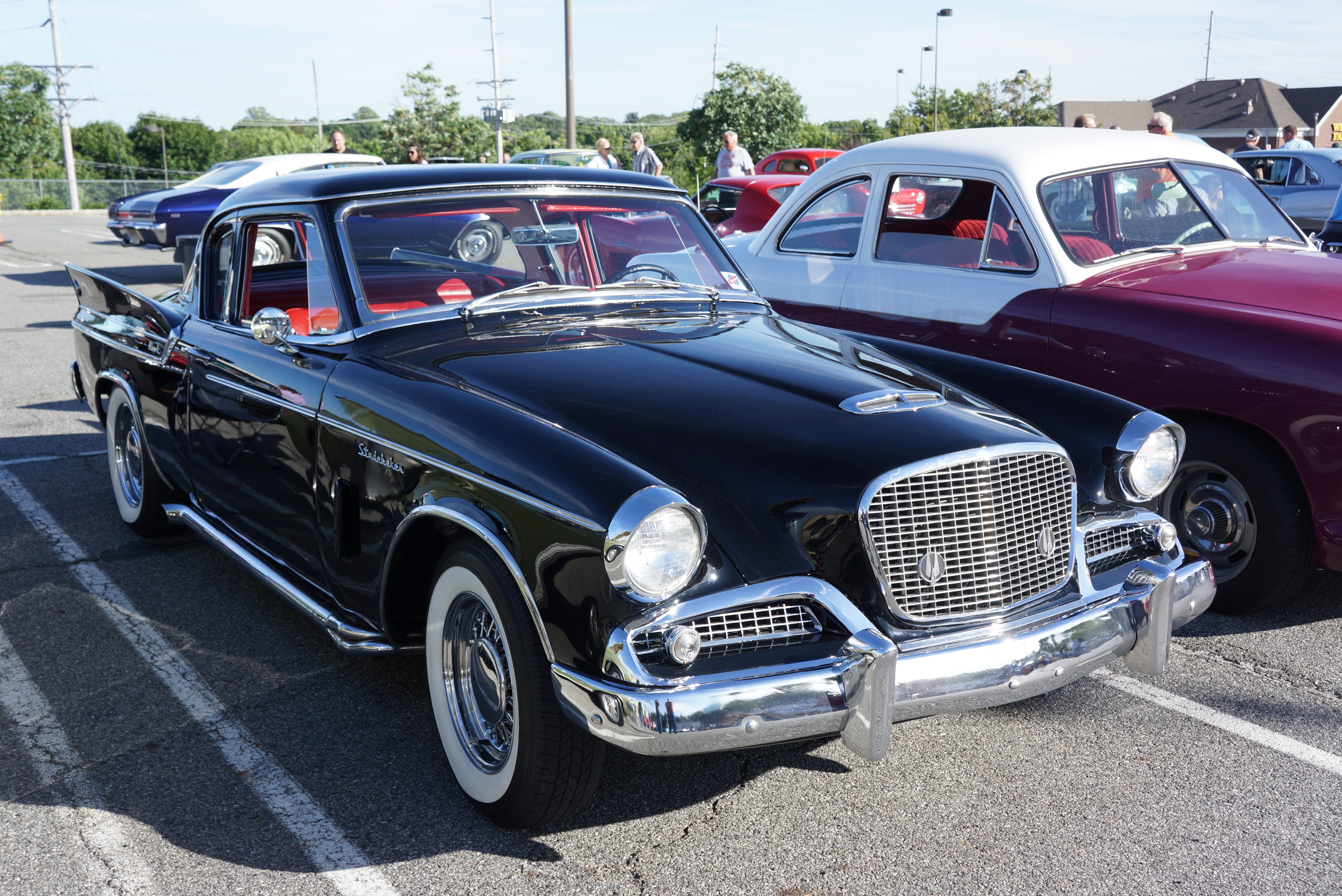
Studebaker’s history began 50 years before the dawn of the motorized vehicle, when the Studebaker brothers manufactured covered wagons. By the 1950s, they struggled to compete with the Big Three. “Daring to be different” was a strategy employed by them (as well as by AMC), as borne out by this Hawk and Avanti.
Studebaker Hawk with side pipes
’63 (first year) Avanti
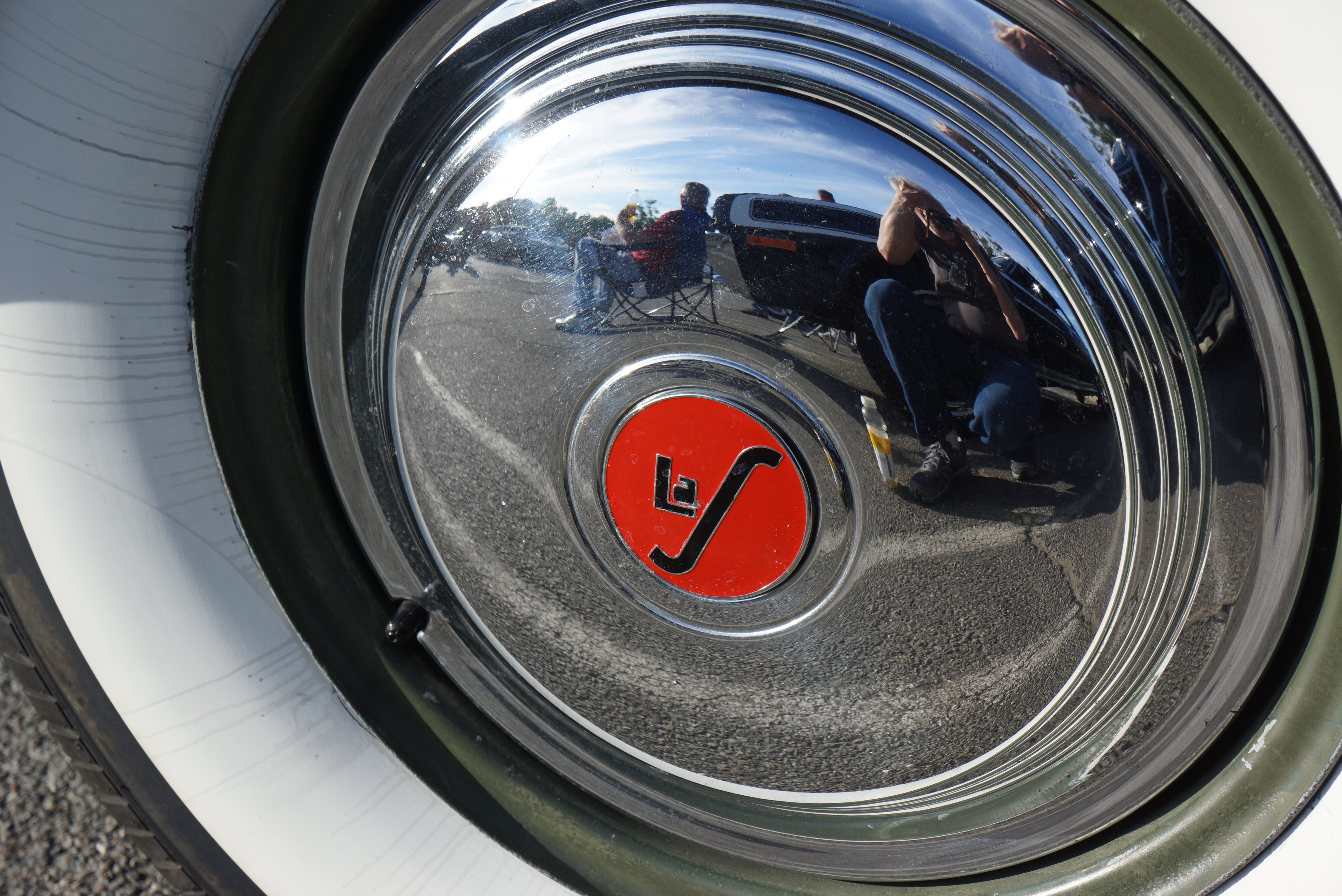
Despite the dominance of 50s-60s muscle, a few cars from an earlier time were also on the show field. None was more striking than this 1940 LaSalle. The LaSalle brand was a “junior Cadillac”, but alas, could not compete in the marketplace. Production ended in 1940, making this car a representative of the marque’s final year.
1940 LaSalle convertible
Gorgeous Art Deco logo
Grille badge is subtle
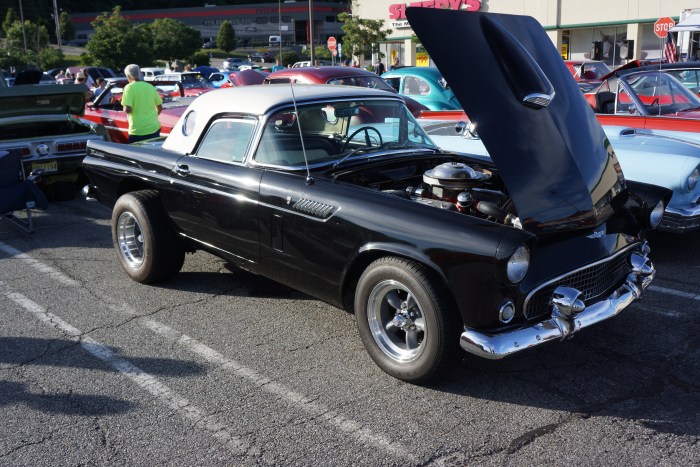
Not all T-Birds are restored to AACA standards. This ’56 was ready to rumble.
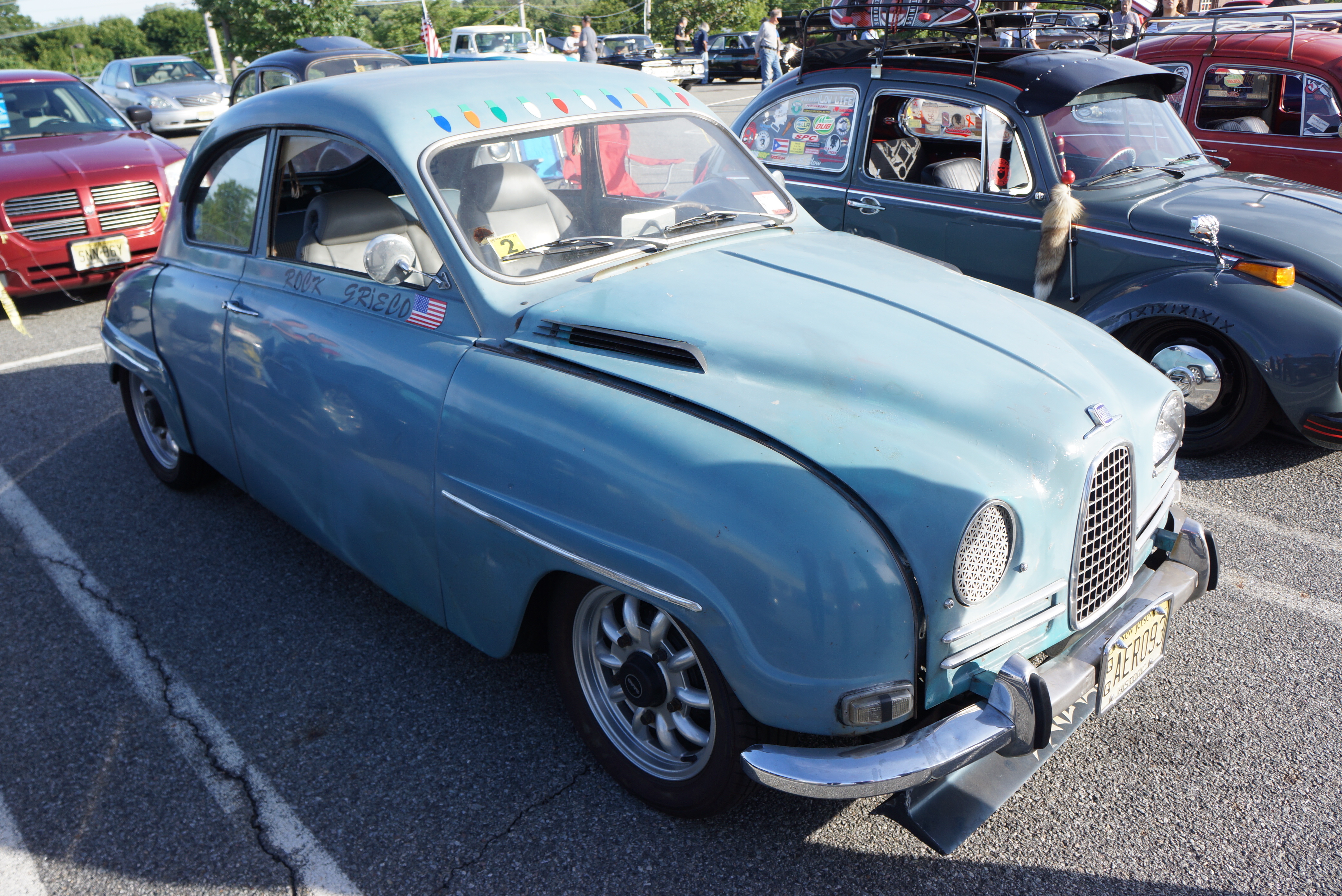
This Saab has been in Boonton before. Although we did not have the pleasure of seeing it run on this particular evening, the owner has kept the 2-stroke motor and has opened up the exhaust a bit, resulting in some glorious albeit raucous noises.
Saab 93
Sounds like a popcorn machine when running
Proof that Erik Carlsson has not driven this Saab
DeLoreans never went away; they’ve been hiding in plain sight all these years. For a vehicle which was manufactured for only two years (1981-1982) and in limited numbers, one always seems to turn up. Their collectibility may be on the rise, though, as a recent change in government regulations will allow the “new” DeLorean Motor Company to begin to legally manufacture cars again.
No BttF jokes, promise!
In 1970, if you could not afford a new Corvette, you may have been drawn to the Opel GT. Buick dealers sold them as captive imports. Built in Germany, the Opel GT was available with either a 1.1L or 1.9L inline 4-cylinder. You certainly didn’t pay the Corvette’s price, but you didn’t get the Corvette’s horsepower either.
Rarely seen Opel GT
Was called the “Corvette Jr” when new
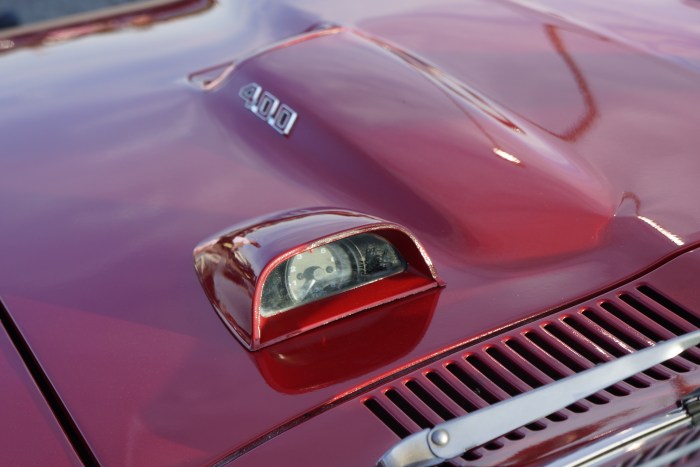
This ’67 Firebird has the optional hood-mounted tach
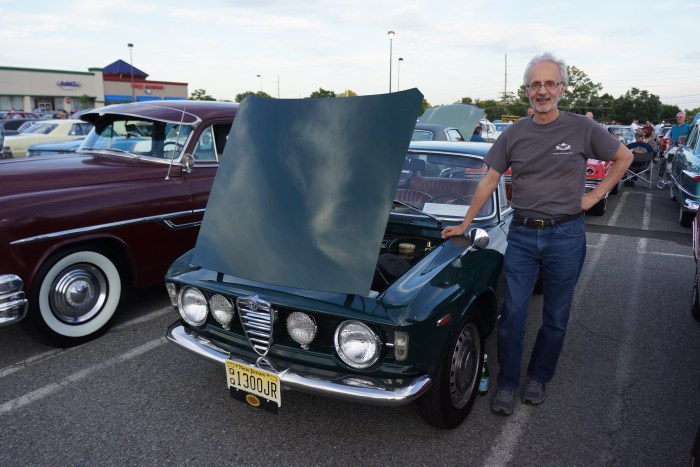
The Alfa may have looked lost among the sea of U.S. built cars (it certainly is physically smaller than all of them), but several spectators stopped by to tell the typical “I had one of those” stories. The car ran flawlessly up and down Route 287 that evening.
September of 1977 was a month of new beginnings: I began my first post-college job, working in NYC for the U.S. Department of Labor, and purchased my first new automobile, a 1977 VW Rabbit. Commuting from Staten Island to Manhattan, though, did not involve driving. As it is for the vast majority of New Yorkers, public transport was the way to go. In my case, the one-way journey was a 90-minute ride on bus, ferry, and subway, giving me plenty of time to read.
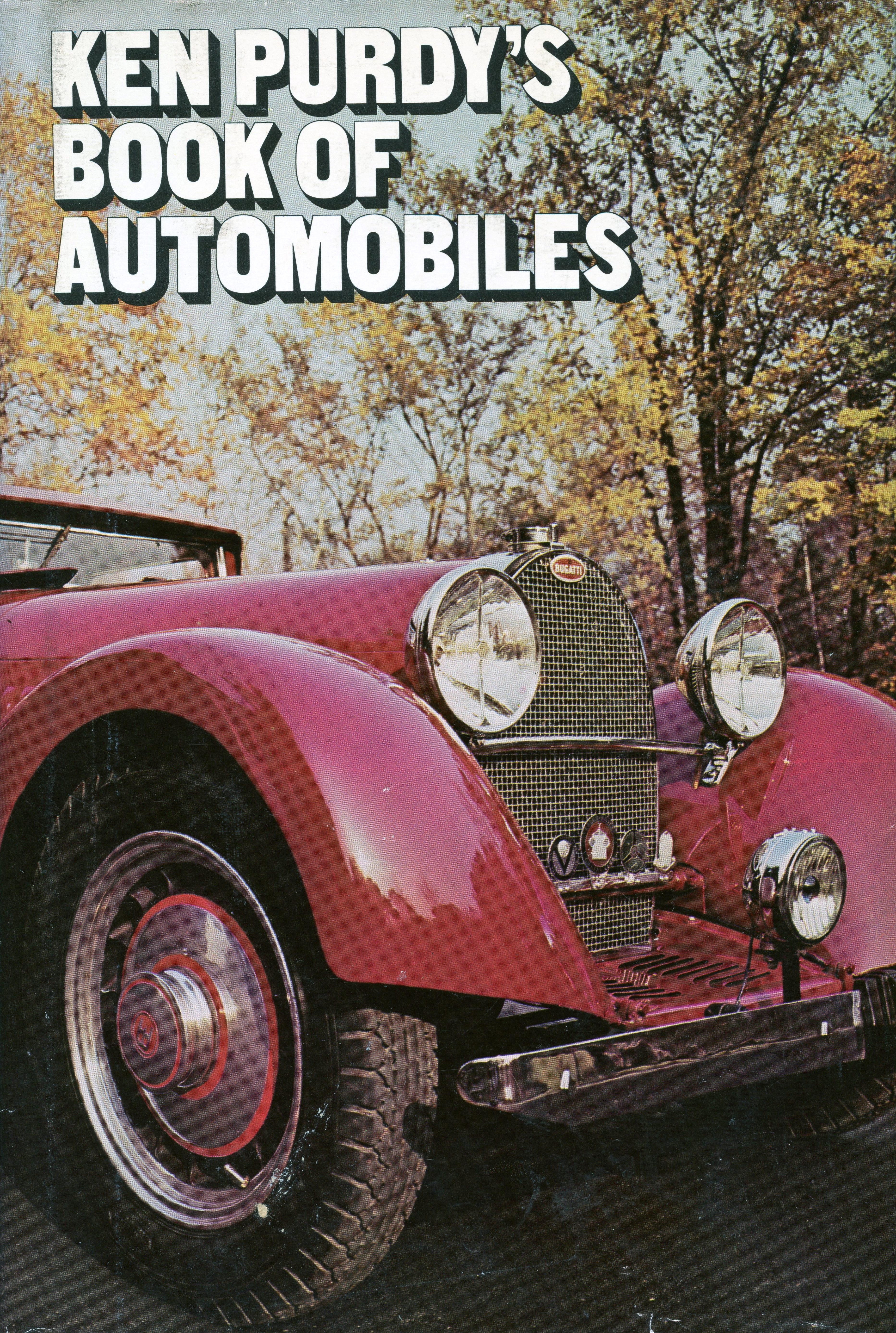
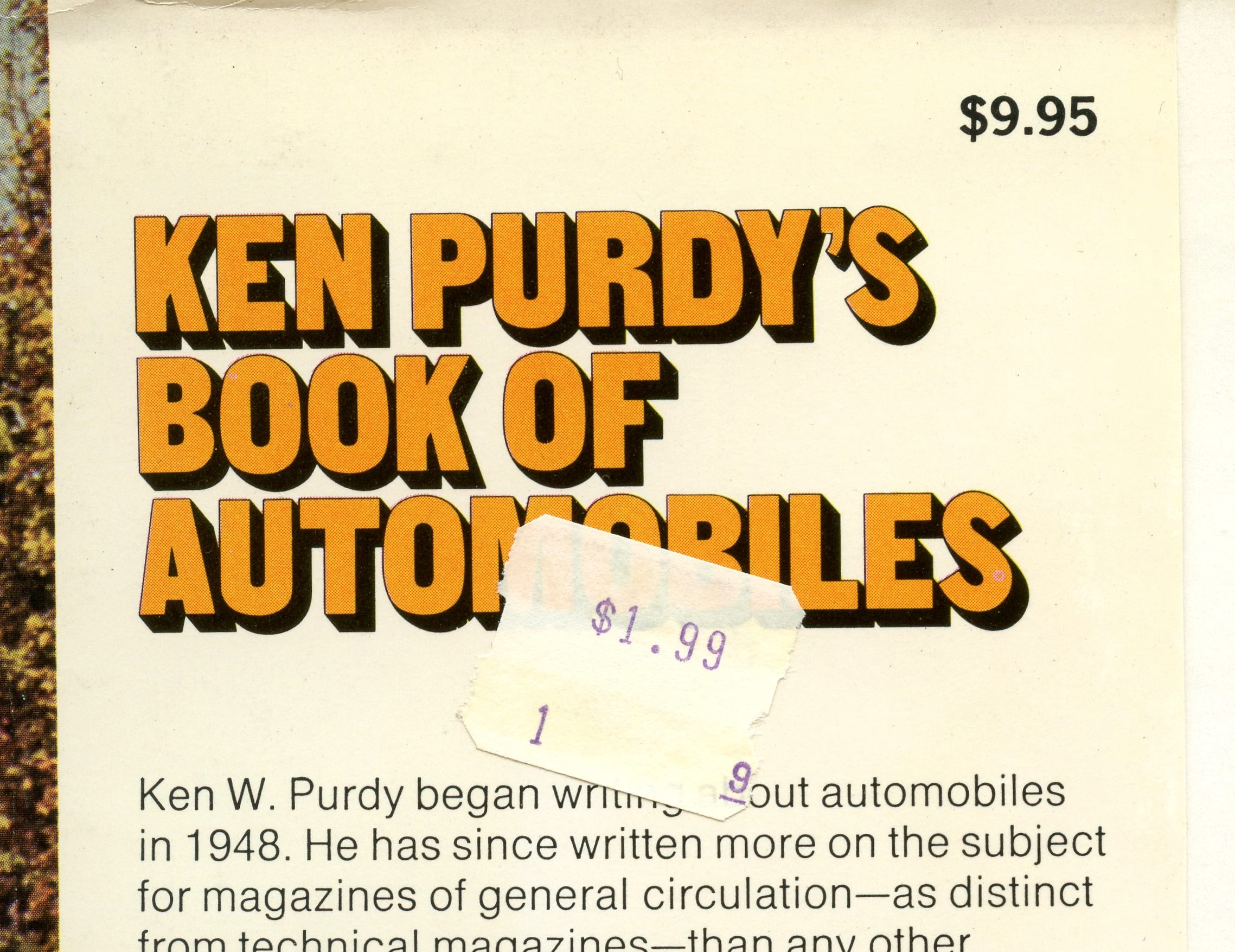
One day at lunchtime, I wandered into a bookstore. On the bargain table sat a book entitled “Ken Purdy’s Book of Automobiles”. While I had never read anything by Mr. Purdy, I knew the name because David E. Davis, editor of Car and Drivermagazine, had extolled the virtues of Ken Purdy’s writing in numerous columns. Perhaps best of all, the book was marked down from $9.95 to $1.99. I bought it.
A Bugatti, one of Ken Purdy’s favorites, is featured on the cover
At $1.99, it was impossible to pass up
This was not a book of new material; rather, it was a compendium of previously published short stories and articles. (Unbeknownst to me at the time, Ken Purdy had died in 1972.) Nevertheless, it was all new to me. The brevity of each chapter made it an easy read; I devoured the book in a matter of days. As soon as I finished it I had an epiphany: automobiles were something that I could enjoy as a hobby! No matter what daytime job I had, car collecting would allow me to indulge in my true passion. I decided to consider buying a collectible car, and that is when I remembered the Manna family.
Lou Manna was a college friend whom I had met through mutual friends. Unlike most of us in the dorms whose homes were several hours away, Lou’s home was about a 15 minute drive from campus. One day, Lou invited me to have Sunday dinner with his parents. This starving college kid said ‘yes’ before the invite was finished.
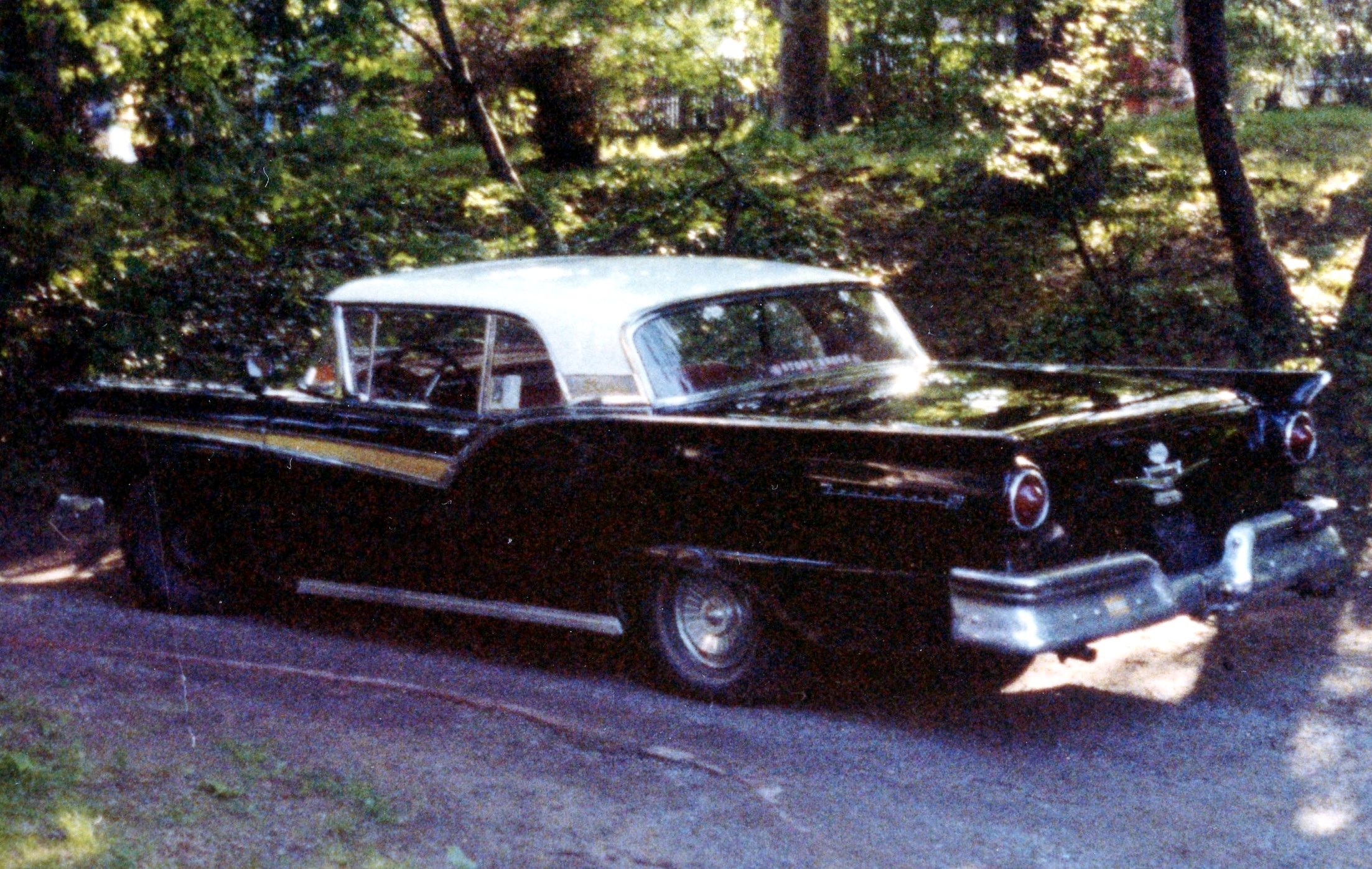
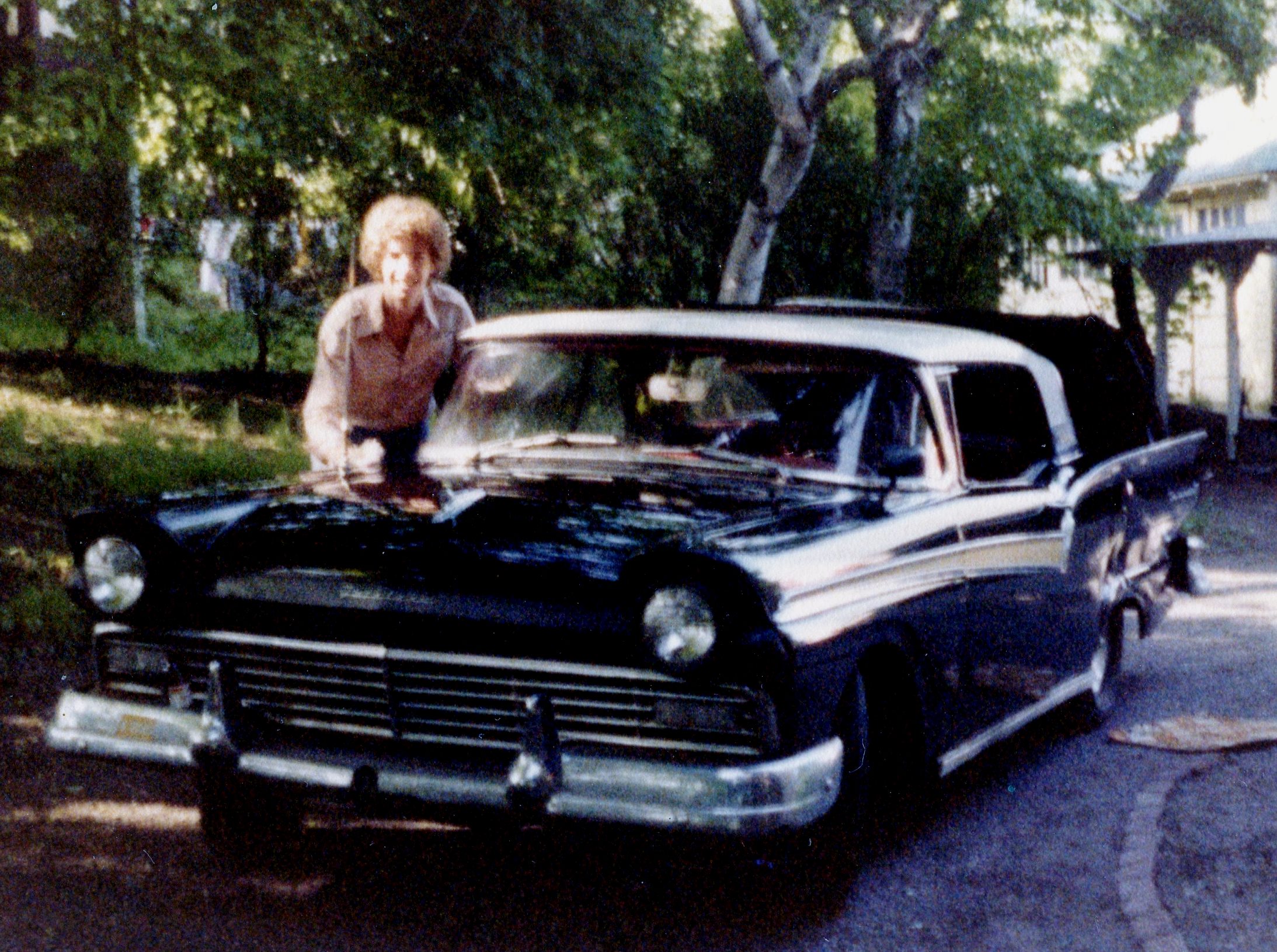
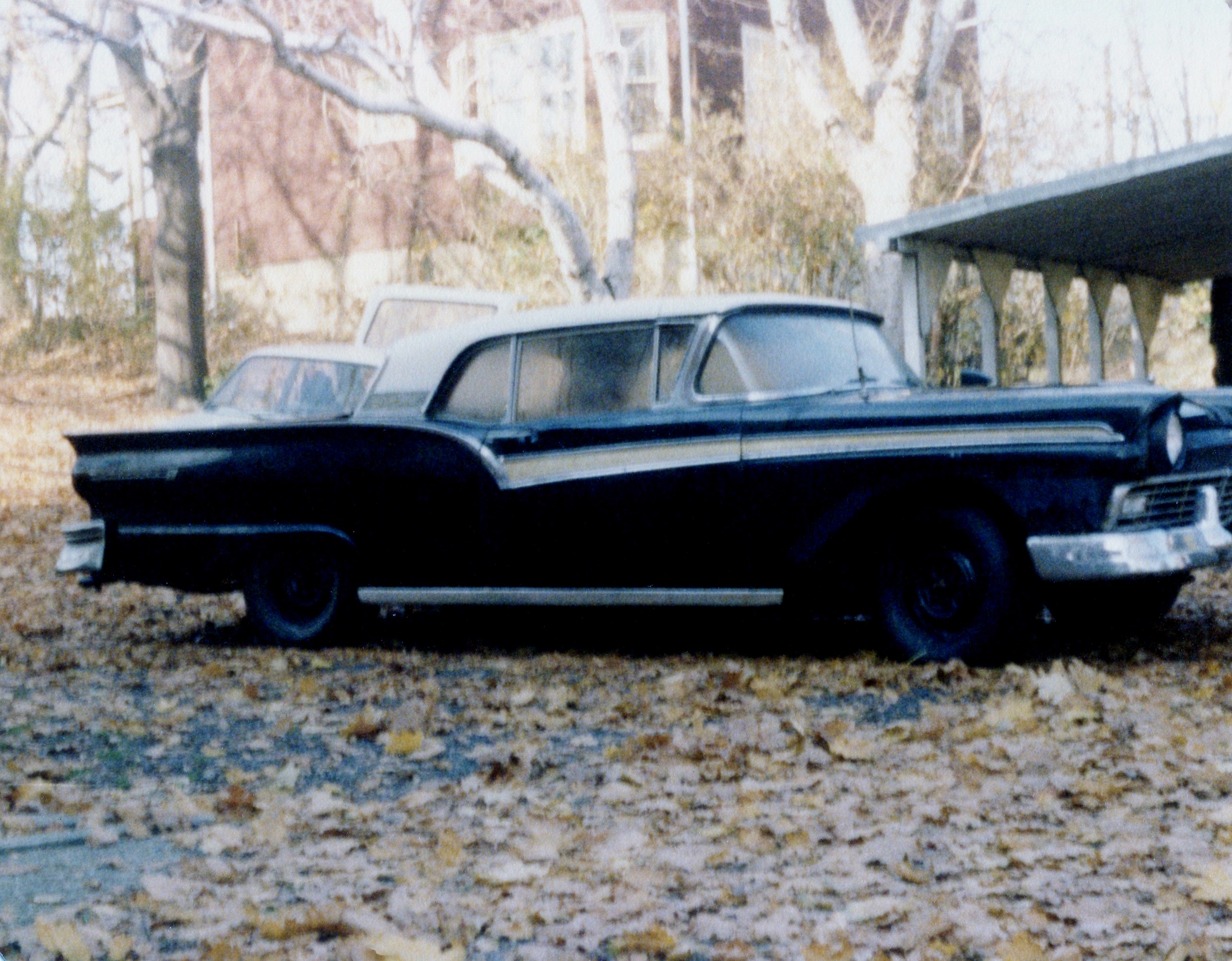
Mrs. Manna cooked a wonderful Italian meal, and I probably got some leftovers to help get me through the week. Mr. Manna (Louis Sr.), it turned out, was a bit of a car enthusiast. He drove a Fiat 128, and his wife drove a 1957 Ford Skyliner (retractable hardtop convertible), which the family had owned since new.
The Ford brochure for ’57 featured the Skyliner on the cover (from the author’s collection)
Mr. Manna Sr. told me that he always had convertibles. After the war, he bought a new 1948 Ford convertible. But he said he always hated dealing with soft tops which were noisy, leaked, required replacement, and didn’t offer enough security. When Ford announced mid-way through the 1957 model year that they were introducing a convertible with a steel roof, Mr. Manna told me he was hooked, and he purchased one. The car they bought was black with a white top and red interior. I thanked them for the meal, and did not think much more about the Skyliner.
The NY registration in Louis Manna’s name (NY did not use titles at this time)
After college, I had not seen much of Lou, but in November of 1977, I reached out to my college buddy, and as luck would have it, his parents had realized that it was time to let the car go. They told me that the asking price was $1,000; my offer of $900 was accepted. The car had 140,000 miles on it, the rear quarters were rusty, but the vehicle was in otherwise decent original condition.
I took the Long Island Rail Road out to Kings Park, and drove the big Ford home to Staten Island. Mrs. Manna was so upset at her car’s departure that she cried, and went back into the house rather than watch the car leave her driveway for the last time. Even though the car was “only” 20 years old, it drove like an old car. My Rabbit with rack and pinion steering was a model of directional accuracy and stability. This Ford had so much freeplay that I could rotate that big wheel 90 degrees left and right before my inputs had any influence on vehicular direction. The Belt Parkway was a quite the challenge that night, but we safely made it.
Summer of ’78: the author behind the wheel
Time for a wash and wax
With friends’ help, detailing the rear
Looks good for 21-year-old paint
Now that the car was home, I really didn’t know what to do with it! The Ford sat semi-enclosed in a carport my father had built next to our 2-car garage. I didn’t bother registering or insuring the car, as I had no intention of driving it that much. Fast forward to the summer of 1978, when I left my cushy Manhattan office job to begin employment as an apprentice auto technician, and my tool collection and confidence both grew. It was time to overhaul the Ford’s engine.
New pistons visible here
Bill Hirsch engine paint brush-applied
This was my first engine rebuild. I purchased the factory service manual, and with a rented cherry picker and borrowed engine stand, yanked the block with the vehicle in the carport. The cylinder heads and ancillaries were removed, and I had the nerve to put the bare block into the back of the Rabbit so that I could drive it to a machine shop.
Dig those labor prices!
The cylinders were bored 0.030” over, which necessitated eight new pistons. The heads were sent out for a complete valve job. In addition to the machine shop’s parts and labor costs, I spent money for new gaskets, motor mounts, water pump, and camshaft. It felt like every spare cent I earned was going into this engine rebuild, which likely was close to the truth.
Looking forlorn with hood off and radiator out
Rebuilt engine on its way back in
The rebuild came together, the engine was reinstalled, and the Ford was roadworthy again, but still not legally so. The interior needed to be reupholstered, the tires and brakes were poor, and there was the matter of the rusty rear quarters. But other changes were coming first.
Nov. ’79: the last photos of it running
Dreaming of a full restoration “some day”
In January of 1980, I moved out of my parent’s house and into an apartment in Somerville NJ, a mile from the dealership where I worked. The Ford stayed on Staten Island, at least until 1982, when my father retired and my folks decided to sell the house and move to a retirement community.
The Skyliner was moved into a public storage garage, really a converted chicken coop, in Readington NJ. The rent at “Van’s Storage” was $18 a month, and the owner said that there were strict rules against working on the cars on site. My Ford was on the 2nd floor of a two-story cinder block building, nestled among 50 other collector cars in various states of disrepair. The storage facility also had trucks, school buses, and loads of printed material stored among the classic and not-so-classic old cars.
The years were rolling by, and no work was being performed on the Ford. It had ceased to become a priority. With no garage access, I had no place to work on it. In the back of my mind, this was a “one day I’ll get to it” project, with the reality that “one day” could be a long way off.
One evening in the summer of 1984, enjoying a quiet weeknight in my apartment, the phone rang. It was “Van” of Van’s Storage. The voice said “I have bad news. We’ve had a fire out here. Everything’s in bad shape. You need to come out and see what you can salvage of your car.” I was upset, but not that upset, thinking I could rebuild the car or at worst, sell off the car for parts.
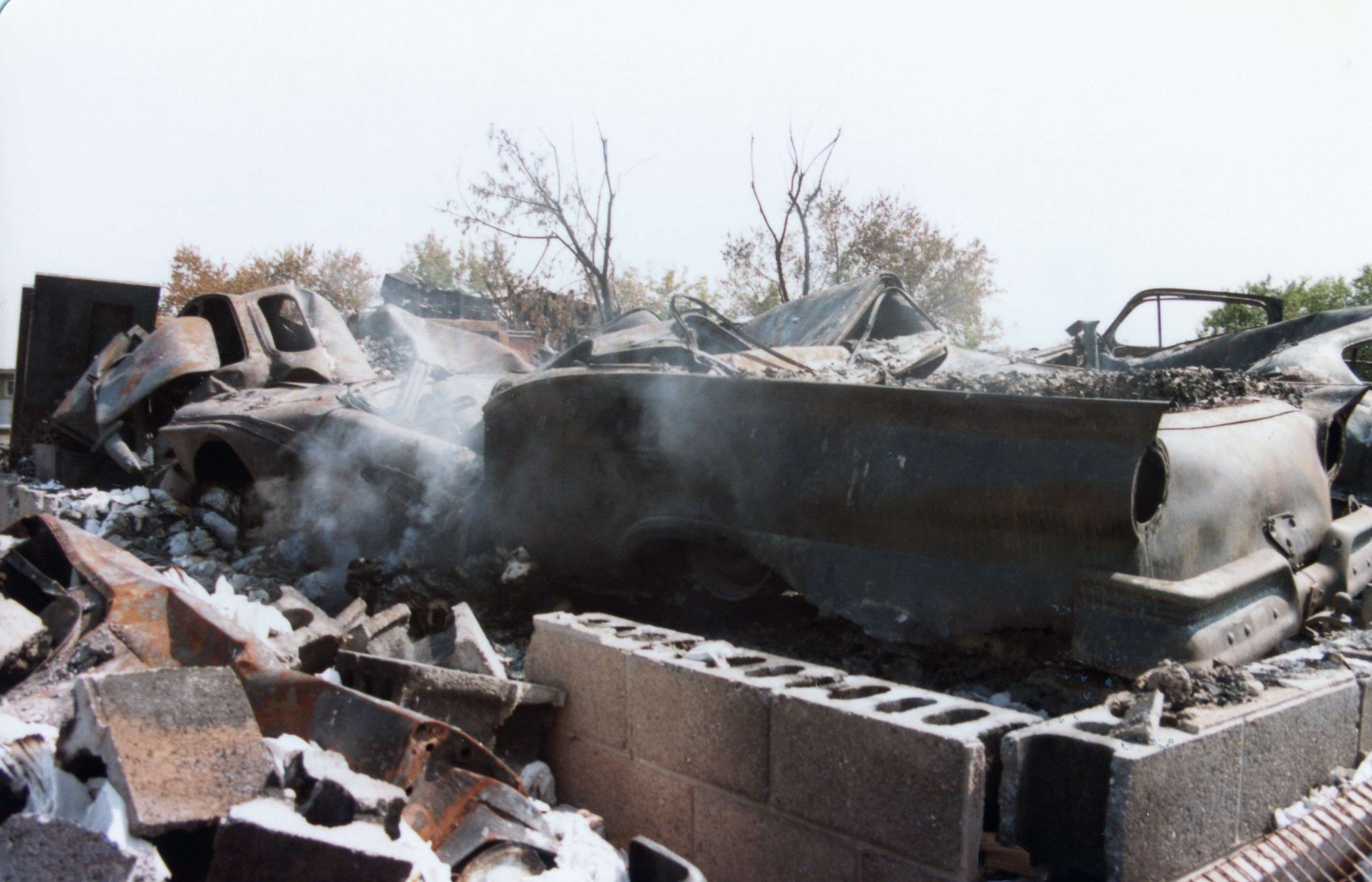
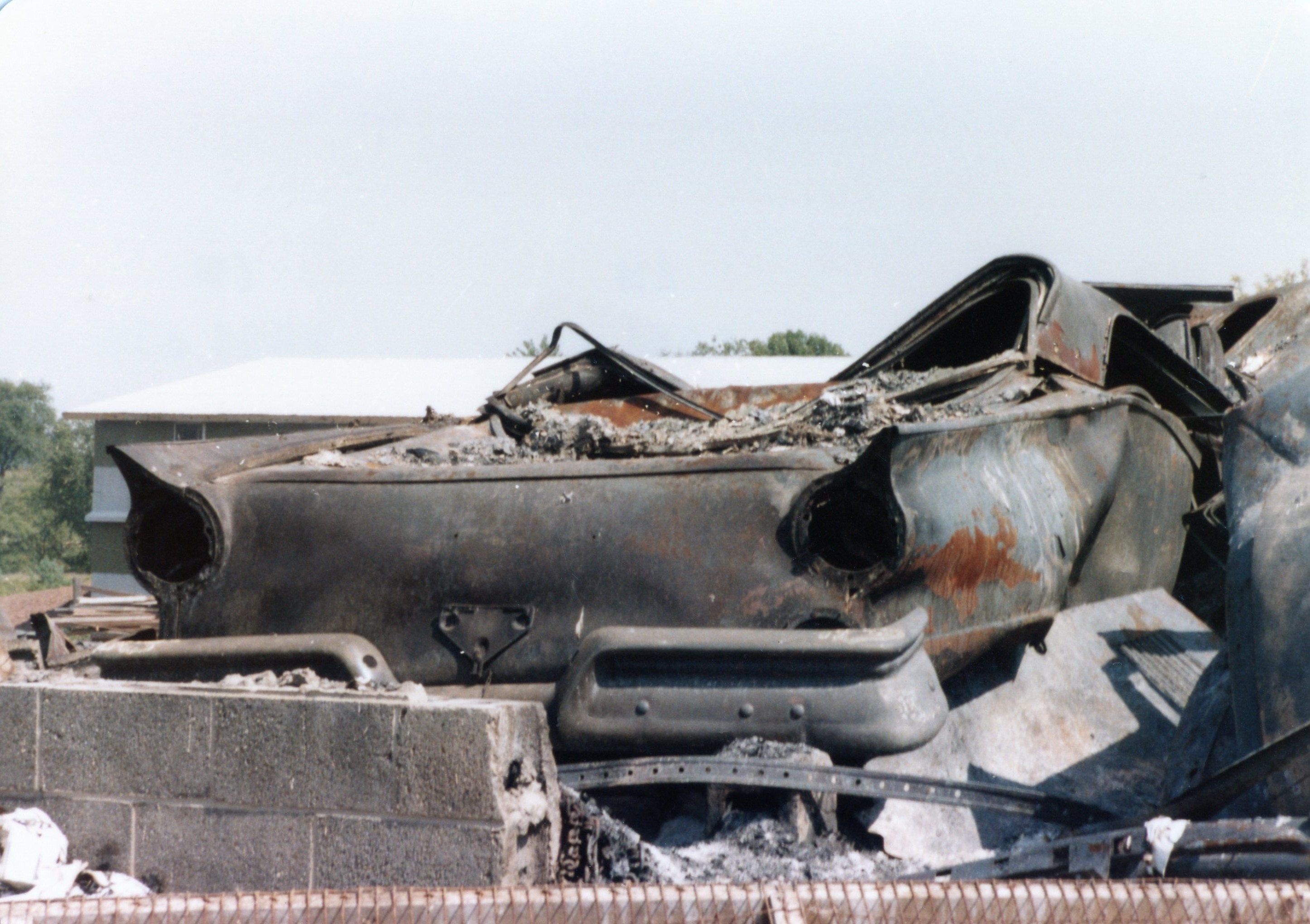
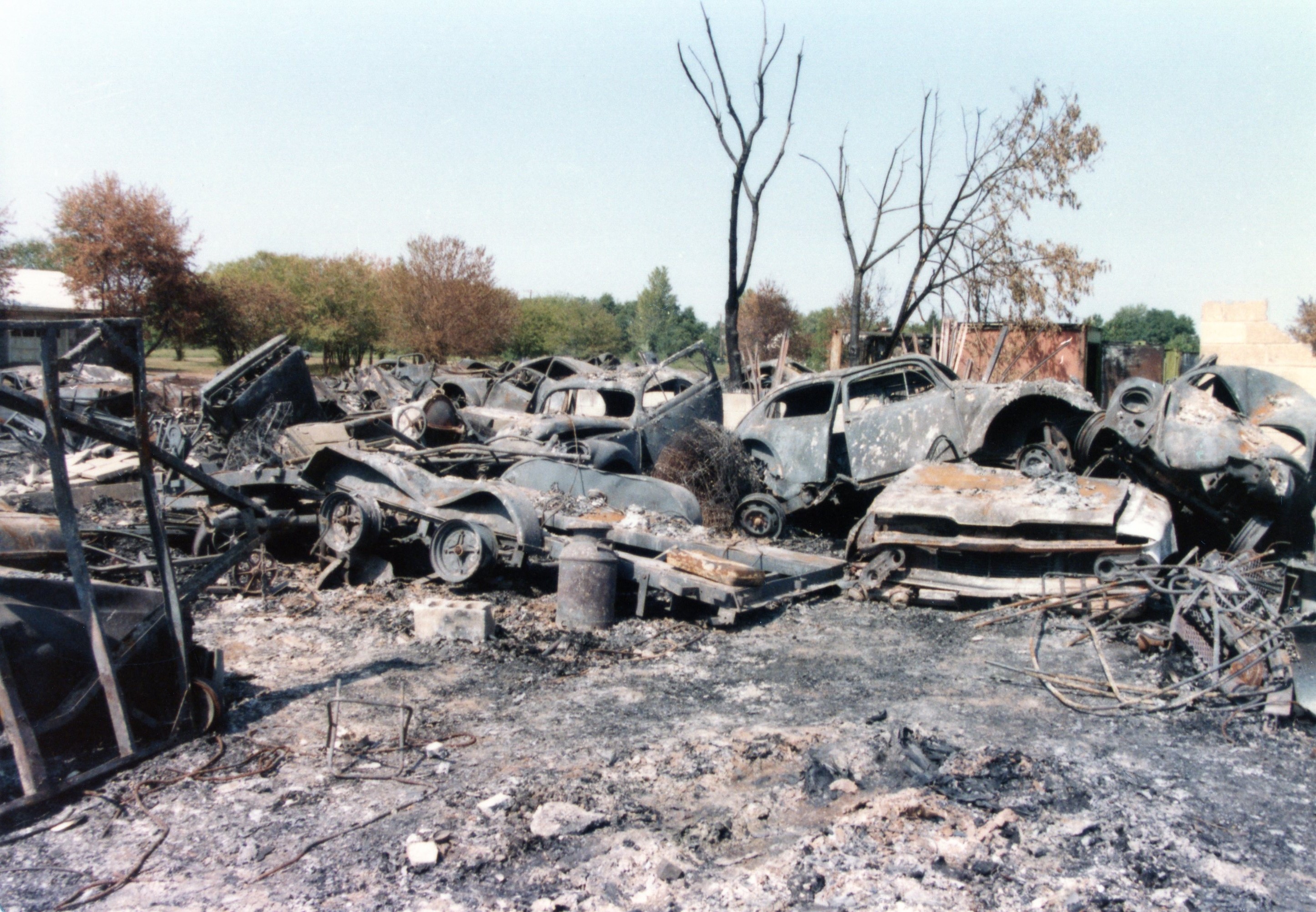
I waited until the weekend to drive out to the site. Four days after the phone call, the pile of ashes was still smoldering. The building was gone, and so were all 50 cars. Amazingly, I could spot my Ford. The fact that it was on the 2nd floor meant that as the building collapsed, my car was on top. But I was horrified at what fire can do: the glass, engine, wiring, and much of the sheet metal were consumed. The only component potentially salvageable was the rear bumper. It was all I could do to snap a few photographs and walk away.
My Ford in the middle of the pile
Still smoldering
Note the buckled roof
The scene resembled a war zone
Many other nice cars were lost
Newark Star-Ledger article
As reality sank in, I was angry only at myself for my own immaturity: I never had bothered with insurance on the Ford. The fire was investigated by the local Police Department, and was ruled accidental. Van’s was not responsible; in fact, the rental agreement I signed absolved Van’s of any responsibility for theft, fire, etc. My total monetary investment in the Skyliner was about $4,000, now literally all up in smoke. At the age of 30, I felt foolish for fancying myself a “car restorer”.
Letter from local police department
This was a tough way to learn some difficult lessons. One lesson was to ensure that my first order of business needed to be attending to my legal and financial obligations. Insurance exists for a reason. There was the more subtle lesson that letting a restoration project “sit” for years is not a workable approach. If I wanted to succeed in the restoration of collector cars, I’d need to do better. Losing the Ford was a wake-up call. I’d like to think it helped me as I moved forward with my other projects in this hobby.
Last we left off, your intrepid garage hack was somewhere in the process of replacing the engine compartment coolant hoses, as part of a heater core replacement on his 1993 Mazda Miata. In this installment, we will provide an update on the progress of said hoses.
You may be saying to yourself, “the blog post is entitled ‘heater core replacement’, but there are nary few words so far about the actual core”. This would be an accurate observation, as in fact, the heater core has been removed from the vehicle, but I am not quite ready to begin the installation of the new part. Instead, I’m documenting the work that’s been done most recently (the hoses), and will soon be writing more about the core. At least I certainly hope I will be, as it’s almost June and I haven’t driven this car since last fall.
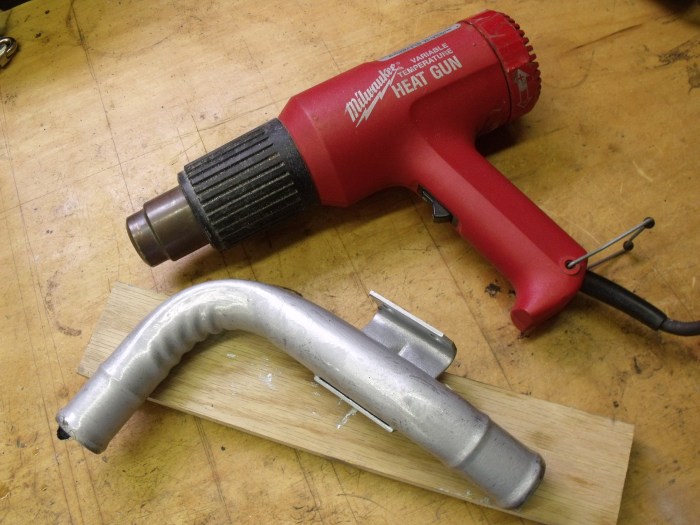
Intermediate pipe, painted with high-temp paint, was cured with heat gun
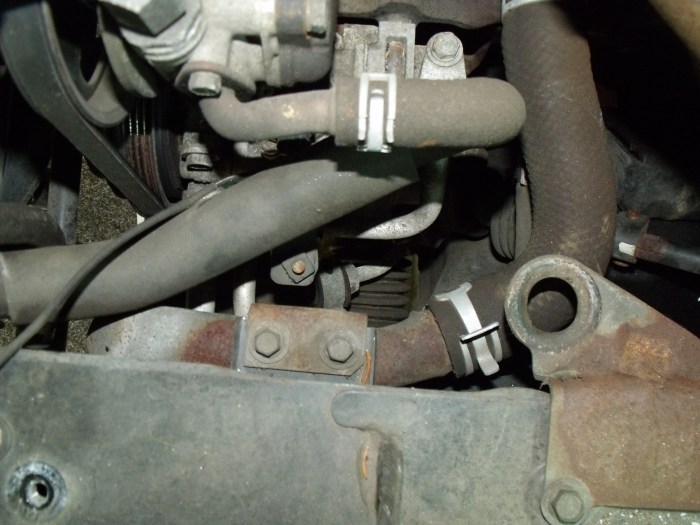
Back to the hoses. In Part 1, I gave mention to a “heater hose kit” from Moss Motors. The kit comprises of 7 hoses: 3 larger-diameter pieces, and 4 smaller-diameter ones. The larger hoses are your typical radiator-to-engine coolant hoses, excepting the fact that Mazda has a 3-part lower setup, with a rubber hose running to a metal intermediate pipe, followed by another rubber hose. But it was the 4 small ones which threw me the curve ball, as I had no idea that the car had these additional coolant hoses. As Moss did not provide a diagram, I also had no idea where in the engine compartment they were.
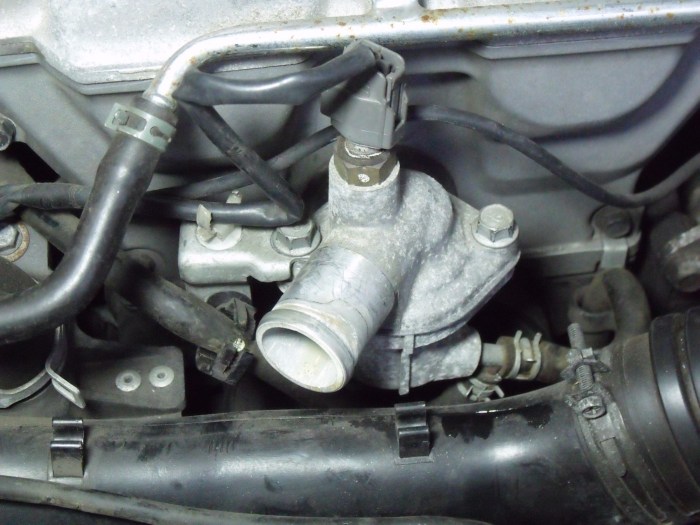
The two hoses, running parallel between intake and valve cover, are coolant hoses
Poking around the area of the thermostat housing, I found two; the other two were over at the intake manifold. The function of these hoses seems to be to provide a “warm engine temperature” signal to the idle control and the radiator fan control. I didn’t research it further as I wanted to devote the time to getting the spring-loaded hose clamps off.
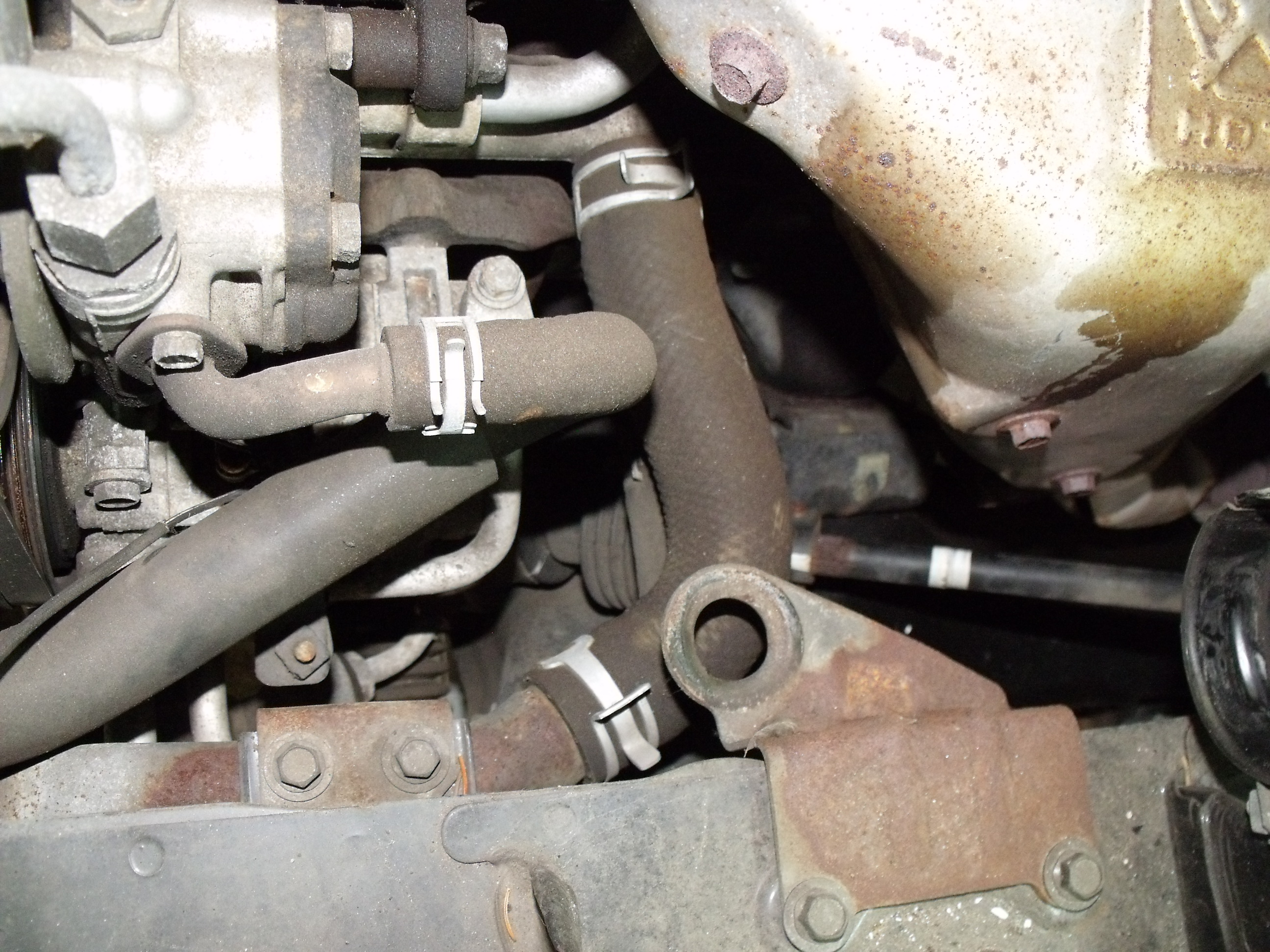
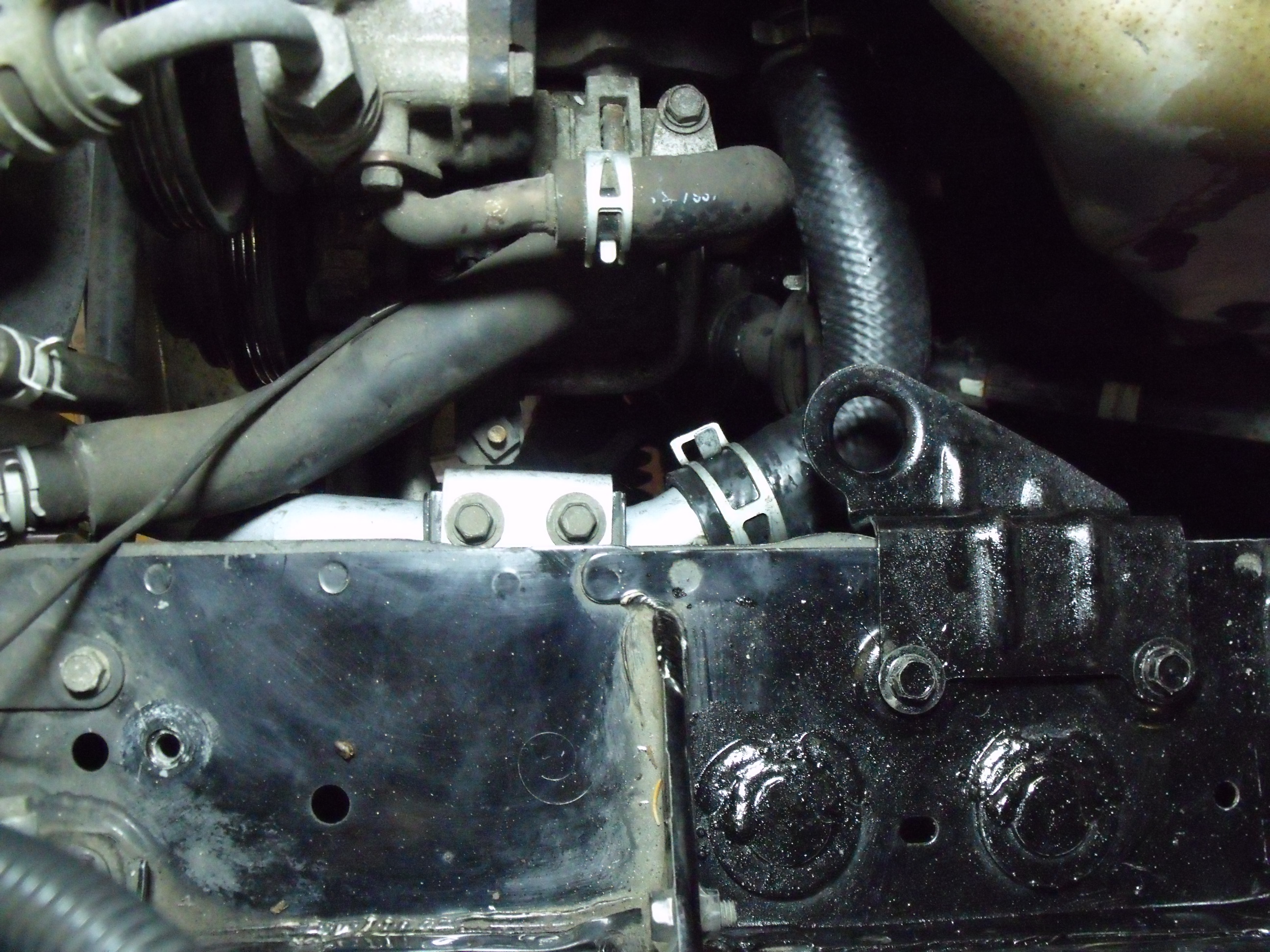
Note clamps under and to the right of thermostat housing
These clamps were not only difficult to reach; the clamps ears in some cases were rotated away from what might be the most accessible positions. It is possible that these were built up as subassemblies before the engine was dropped into the car. In any event, they had not been touched since the car was built, and I needed to get them off. Using various shaped pliers, including needle-nose, curved nose, and slip-joint, most of them eventually came loose. One clamp in particular, under the thermostat housing, was twisted back and forth until it broke off (I was very mad at it). Like many other underhood jobs, components which were in the way were removed for better access.
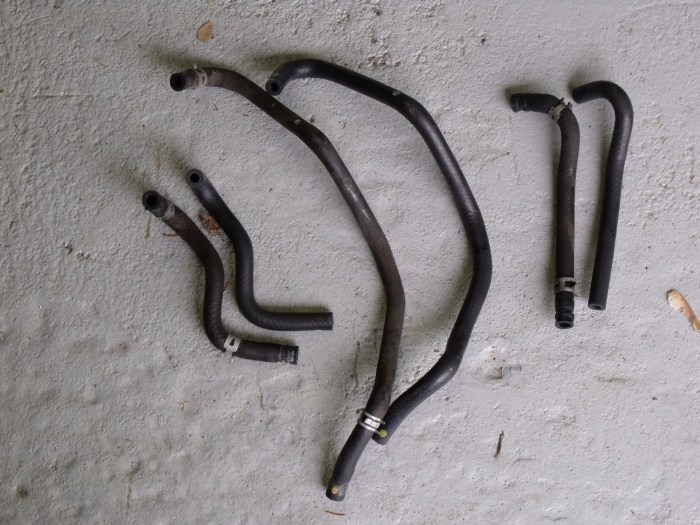
Old and new hoses side-by-side. Old ones were hard but not leaking (yet)
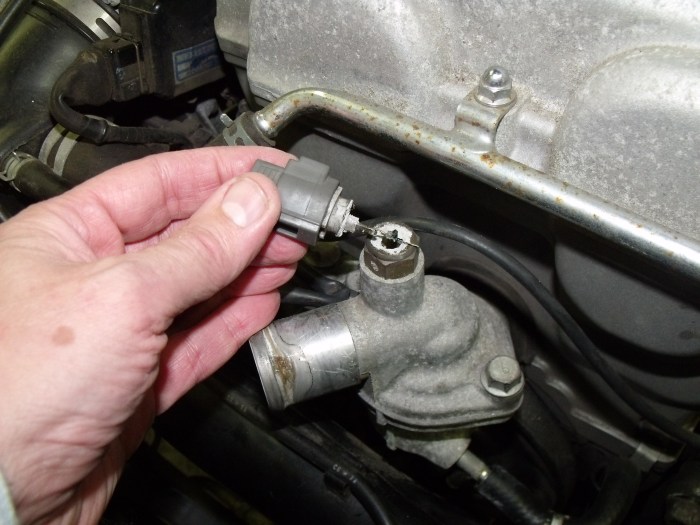
Besides the clamp which was twisted to death, there were two other casualties: the A/C-power steering belt was removed with a hacksaw, because I intend to replace it anyway; and the fan temperature sensor switch in the top of the thermostat housing fell victim to an errant wrench. New parts have been ordered and are on their way.
Switch is NOT designed to be removed in several pieces
As of today, the upper radiator hose, lower rear hose, and all four smaller hoses have been replaced. On the smaller hoses, several spring clamps were replaced with screw clamps for easier installation. With this part of the job basically done, we’re soon moving back to the heater core.
Before: rusty pipe and bracket
After: parts are painted, even if they will be hidden
Upon my return home from the 3-week adventure which we nicknamed “Coast-to-coast in the Swedish car”, a letter was awaiting me. The U.S. Department of Labor was offering me an interview to be considered for employment in their Bureau of Labor Statistics. I interviewed, was accepted, and was told I could start in mid-September. Elated at the prospect of full-time employment, I especially looked forward to a full-time paycheck! Since I was still without wheels of my own, having sold my Vega to my brother several months prior, my thoughts turned to consideration of finally owning a new car.
The car magazines which I voraciously devoured had said generally good things about Volkswagen’s newest economy car, the Rabbit. The vehicle (called the Golf in the rest of the world) was introduced in North America as a 1975 model. During its first two years on sale here, one of the few issues concerned its troublesome carburetor. In 1977, VW ditched the carb, switched to Bosch K-Jetronic fuel injection, and likewise jettisoned the catalytic converter in the process. There were other attractive features: front wheel drive, hatchback roominess, and great fuel economy. I test drove several models at my local dealer, Staten Island Small Cars. Frankly, I don’t believe I even considered anything else. At least there’s no recollection of test-driving anything but Rabbits.
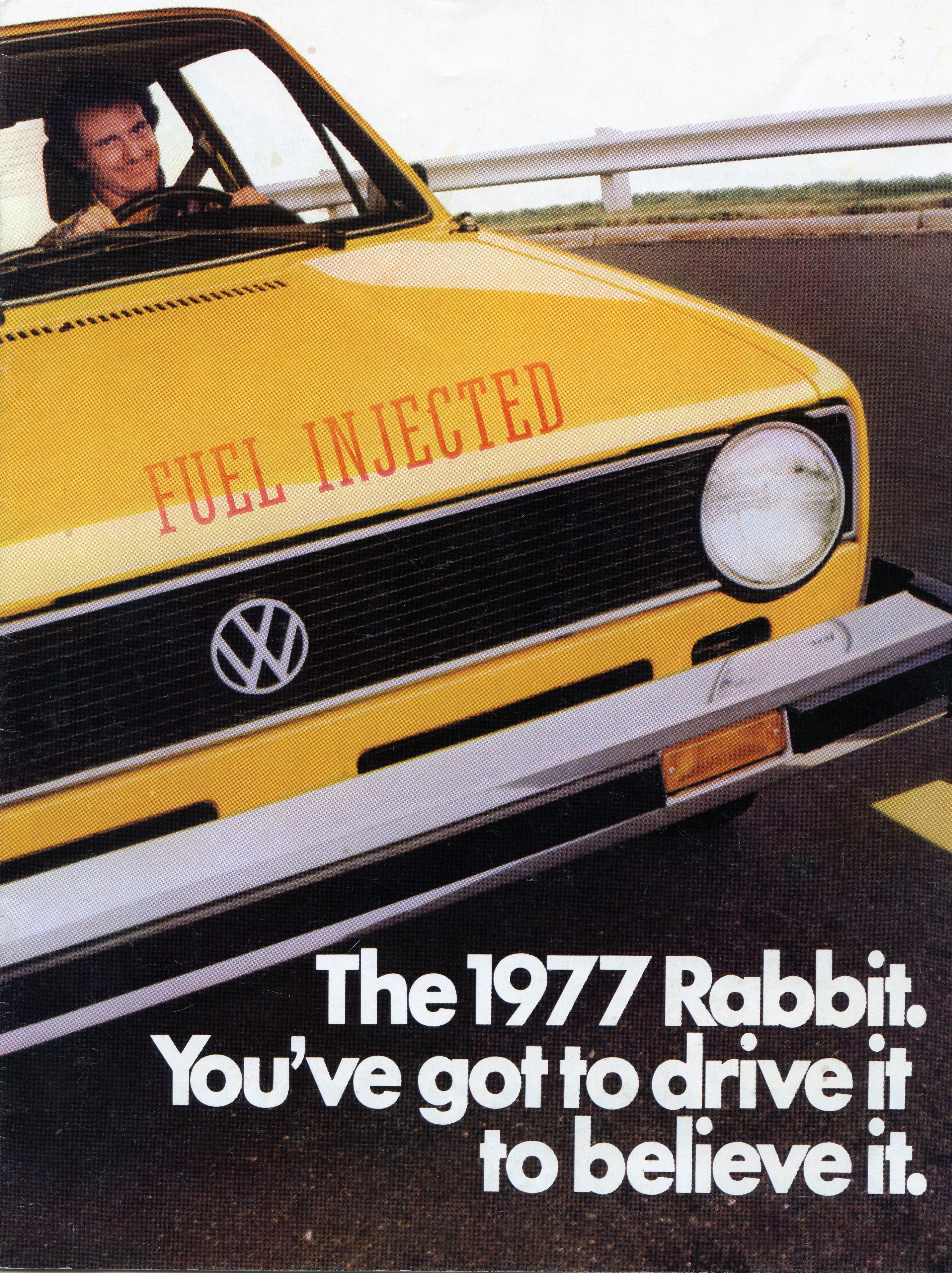
Front of the 1977 Rabbit sales brochure
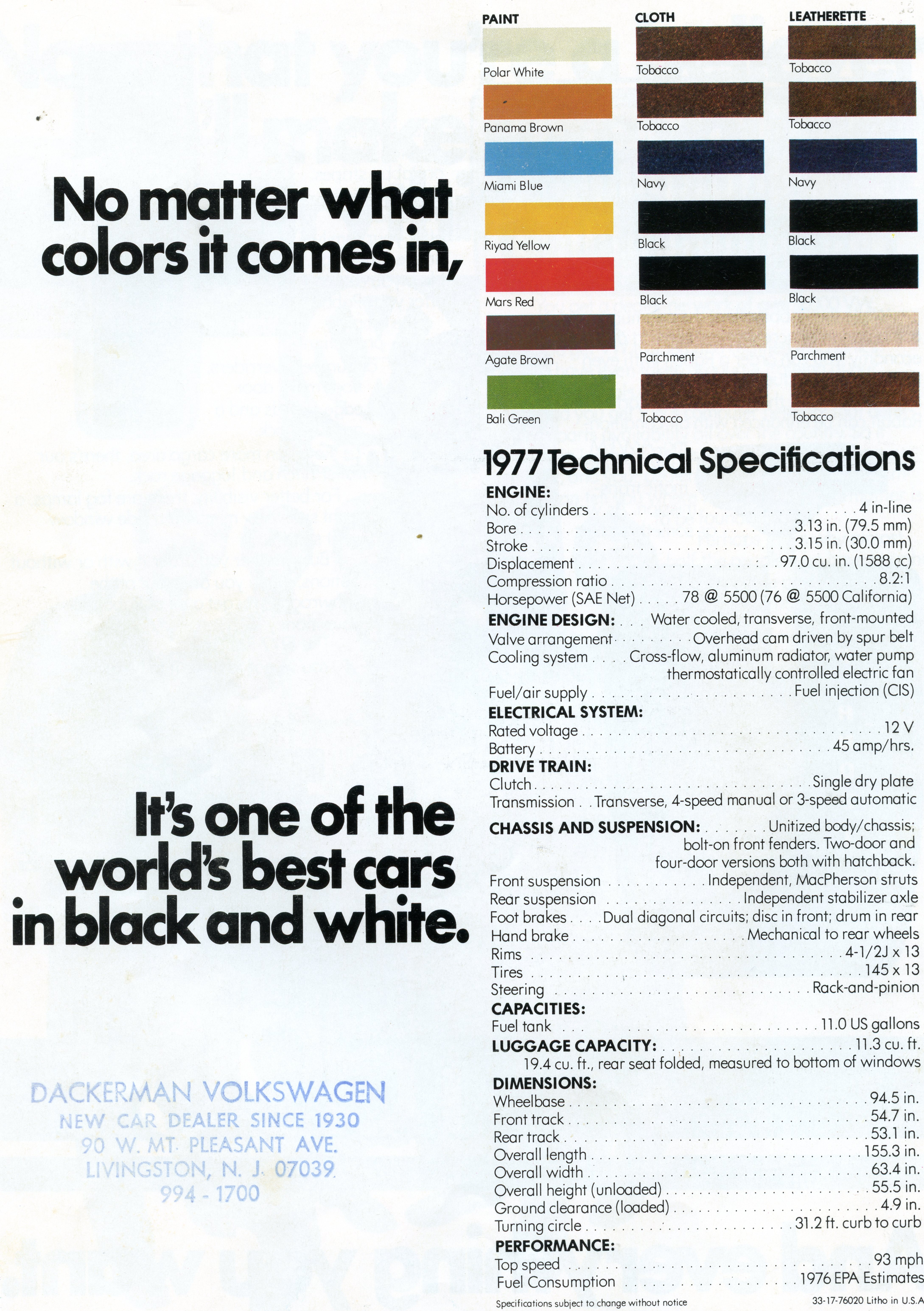
Back of the brochure
It was now September of 1977, and the new ‘78s were on their way. The buff books had informed me that for 1978, VW was reducing the engine size from 1.6L to 1.5L, with a horsepower drop from 78 to 71. Determined to find the “best” ’77 I could, I bounced around VW dealers in Brooklyn, Queens, and NJ, but ended up back at the Staten Island store.
My salesman was Arthur McKeever, an interesting guy, and difficult to forget once you met him, as Mr. McKeever had no right arm. He shook hands with his left, and could shock you with his ability to drive a stick shift. As we climbed into his red demo, I reached for the seat belt. He said “oh, you don’t need to put that on”. I put on the belt, as I had been wearing one since the Mustang wreck six years prior. The Rabbit was quite peppy, and while the shift action didn’t have quite the precision of a RWD car, it wasn’t bad at all. My mom’s ’76 Honda Accord had tons of torque steer; by comparison, the Rabbit had almost none.
Area code not required; Anyone care to guess what the “YU” exchange stood for?
He had three 1977 2-doors remaining (the 4-door model was not sporty enough for me, and so was a deal-breaker). One was his red demo, but I didn’t think the car looked good in red. The yellow car was attractive, but the priciest of the choices. The white car was an anomaly: a base model Rabbit, when every other car I looked at was the “Custom”. The base model had these features compared to the Custom: 145-13 bias-ply tires instead of radials; houndstooth cloth upholstery instead of leatherette; vinyl flooring instead of carpeting; non-opening vent windows instead of opening ones; and a manual rod for the hatch instead of a gas strut. But the sticker price of $3599 was very attractive.
The back of his card spells out my 3 options
A deal was struck for the white car, which looked good with its black-and-white interior. My dad had to co-sign the bank loan, but he knew I was good for it. Taking delivery of my first new automobile still ranks up there with one of the great car-related thrills of my life.
Yes, I kept the Monroney
Three weeks into the ownership, I ordered a set of Pirelli CN-36 radial tires in size 175/70-13. They truly transformed the car, and lasted 56,000 miles! I also was an early adapter of Cibie euro-style headlights with replaceable H4 bulbs, which did amazing things for night-time visibility. Both the tires and the lights were purchased from Euro-Tire, which advertised heavily in Car and Drivermagazine. I put my own sound system in the car, and repainted the bumpers, but did little else other than maintain it and drive it.
A week old; bias ply tires are still on
Spartan interior, but cloth was comfortable
Car had amazing winter traction
The Rabbit served as my daily driver for over four years, from September of 1977 until December of 1981. I put about 112,000 miles on it, almost all of it trouble-free. The car started to use oil, a known issue with the valve stem seals, but oil was cheap enough that I just kept checking and adding it. There was also the start of some rust at the base of the A-pillars. My overall experience was so positive that I replaced this VW with another new VW. We’ll get to that story at another time.
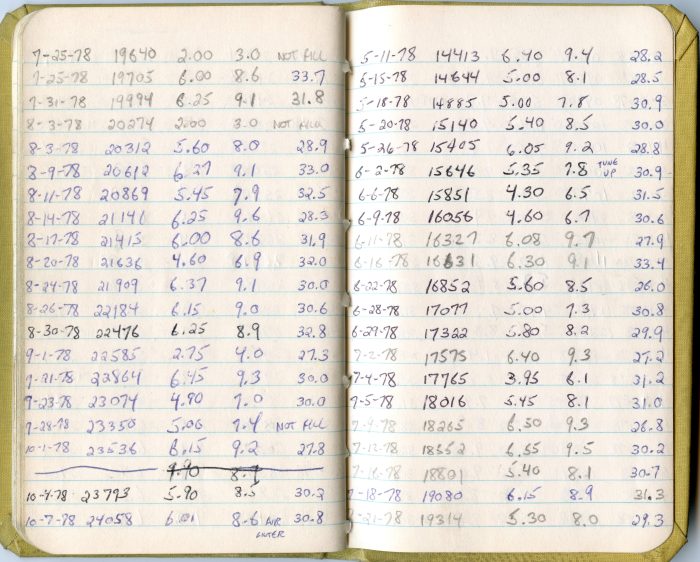
Fuel log: average price was 68 cents/gallon
Summer of ’79: The Rabbit carried that Y-block Ford engine
On Bridge St. in Somerville, now a NJ resident
Parked at the back lot at AutoSport in Somerville NJ
The ’93 Miata at the 2014 Lime Rock Vintage Fall Festival
August of 2016, three months from the time of this writing, will mark 20 years that I’ve owned my black Mazda Miata. Aside from its incredible driving characteristics, it has been a typical Japanese-car ownership experience, which is to say, the vehicle has needed almost no repairs during the 65,000 miles I’ve put on it.
Of course any car needs maintenance and consumables, so tires, brakes and batteries have been changed out. The engine oil is replaced once or twice a year regardless of mileage. The typical tune-up items such as plugs, wires, and filters are changed regularly. Light bulbs? One headlight bulb went out a few years ago. The convertible top was replaced around 2002.
The upholstery, stereo, exhaust, clutch, shocks, springs, and U-joints are all the pieces which the factory installed in 1993. The R-12 A/C still blows cold, but did need one top-up (I still have 12 oz. cans of Freon). The one repair which almost put the car off the road was a leaky clutch slave cylinder. It’s a common Miata failure, and the new one took about 30 minutes to install.
However: last summer, I began to notice a slight film at the base of the inside of the windshield. At first, I chalked it up to a typical dirty window. Then I noticed that using the heater made the film cover a greater area of the glass. I swiped a finger through it, and it had an oily feel. Uh-oh, said I; could this be the dreaded heater core? Each time I thoroughly cleaned the inside of the windshield, the film came back. Even with the heat completely off, it appeared. At 98,000 miles and 23 years, I knew it was time.
Heater core replacement on ANY car is not easy. My 1968 Mustang (with factory air) got its core replaced by me, and it involved disassembling most of the dash and center console. During my brief time professionally wrenching on Volvos, I did my share of heater cores on 240s. (The Volvo 240 heater core is infamous: Click and Clack, the Tappet Brothers, had a running joke on their show, in which they said that Volvo would assemble a 240 by taking a heater core, putting it on the assembly line, and building up the rest of the car around it.)
The entire air filter box must be removed to gain access to the lower rear hose (at right)
Besides a new core, it seemed to be a good idea to also replace all the original coolant hoses. The hoses are available as a kit from Moss Motors, so with said kit in hand, I drained the system and began with the engine compartment hoses. They were all hard as rocks, and most needed to be cut off their metal pipes.
From L to R: lower radiator hose, intermediate pipe, lower rear hose
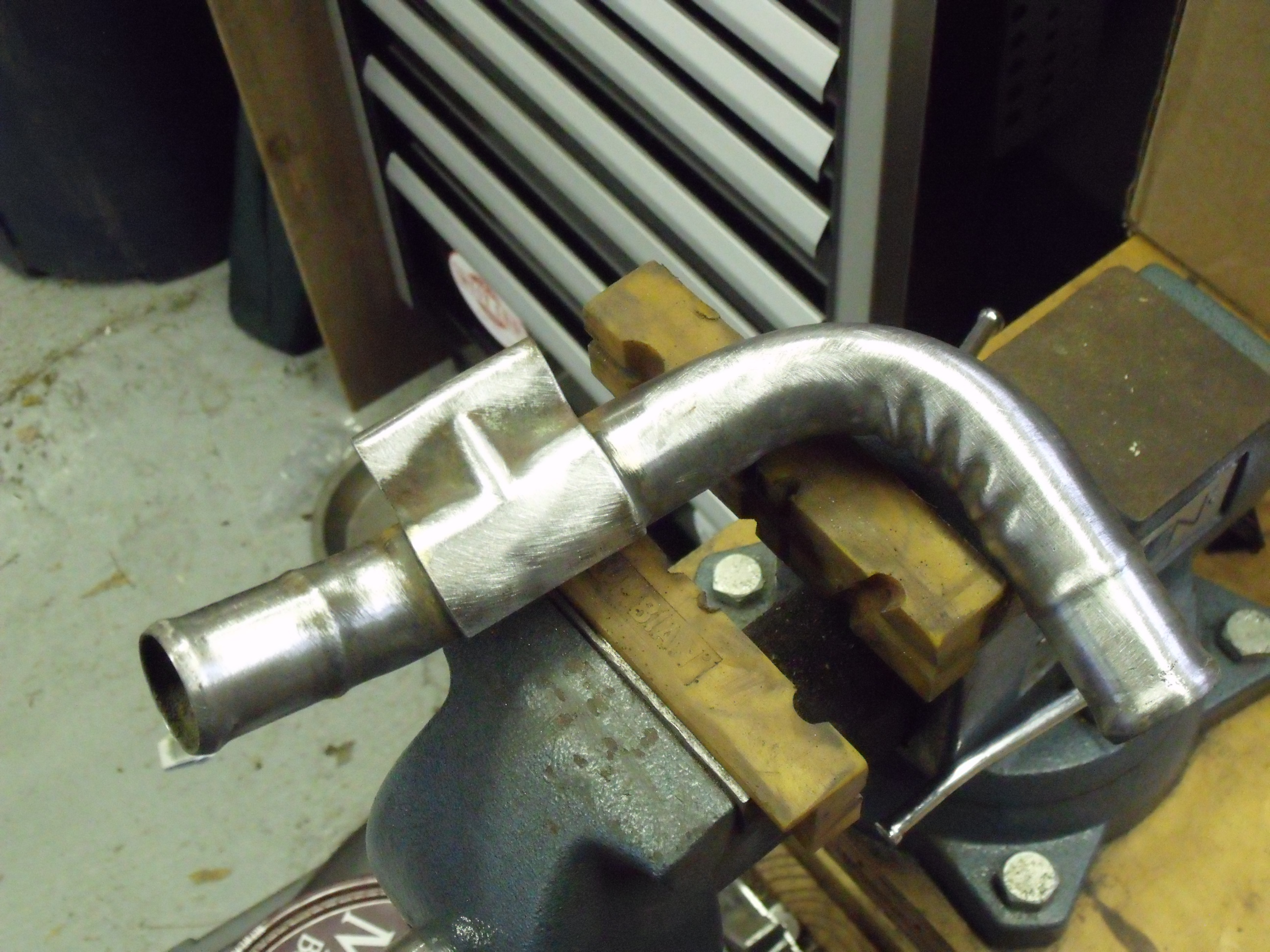
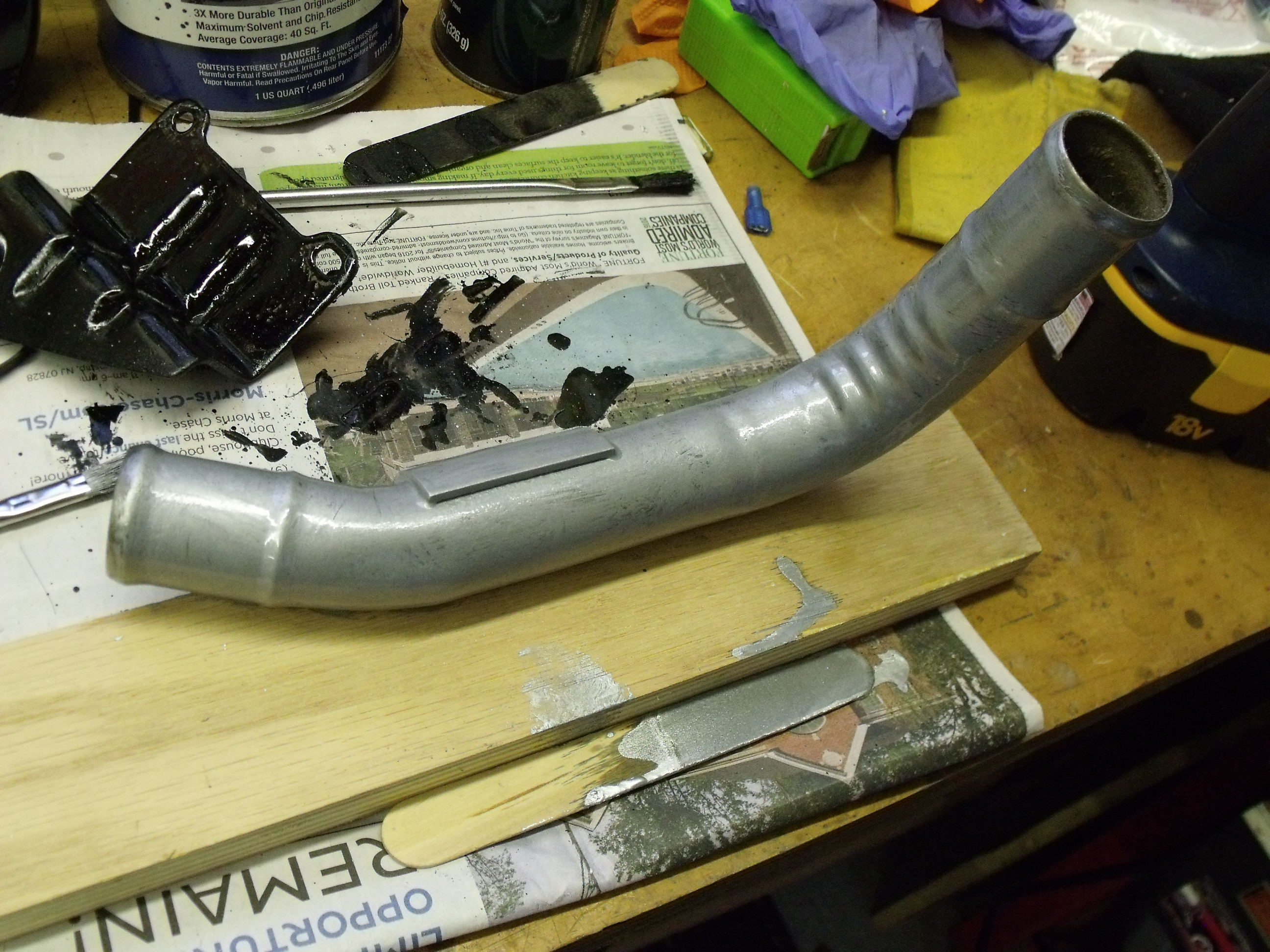
The Miata lower radiator hose does not connect to the front of the engine. Rather, it passes through a metal intermediate pipe, then another rubber hose, connecting to the engine at the rear. This pipe looked terrible, so I removed it to give it a closer look. The corrosion on it was superficial, but in the interest of longevity, it is getting cleaned and painted.
This pipe barely looks reusable
But it cleaned up with a Scotch-Brite wheel in a drill
First coat of Bill Hirsch aluminum paint
Had this from a previous project; my experience with Hirsch products has been excellent
The main hoses are off; there are 5 smaller hoses which also need replacing, and these clamps look like some knuckles will bleed. More to follow.
After a relatively mild winter, the spring of 2016 has been taking its sweet time arriving in the Northeast. Any fears of summer heat waves in early May have been unfounded, with daily temperatures often running 10 degrees below normal. Our little driving club tried to get an early start on the season by planning a mid-April event, which had to be cancelled due to the threat of snow! Our scheduled drive on Sunday May 15 did successfully occur, in spite of cool weather and surprise showers.
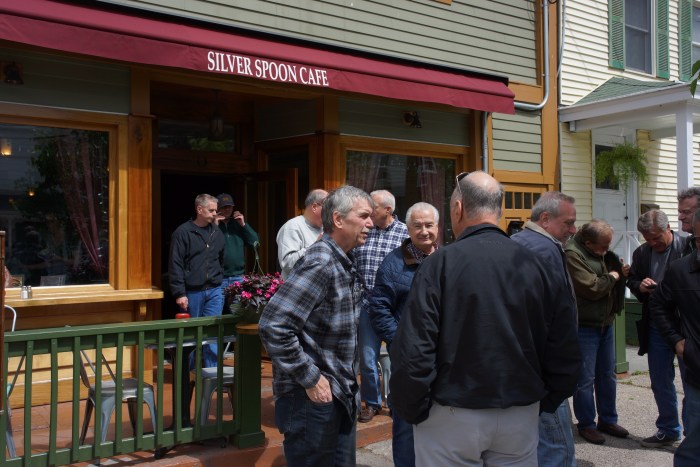
Hey guys, do you want to eat, or would you rather stand around and shoot the breeze?
Checking back on last year’s blog entries, we never had more 15 participants on any one run (excepting Spousal Accompaniment Day). Today, we broke that record with 17 gentlemen occupying 12 cars. Obviously, we had 5 passengers, several of whom were joining us for the first time. Our destination was a crowd favorite, the Silver Spoon Café in Cold Spring NY.
We pull over to give those in back a chance to catch up
The cars: we usually count up the Chevys, and then all the rest. Today, the Europeans won the day with a total of 7 cars: 3 Germans, 2 Brits, and 2 Italians. We had 4 U.S. brand cars, and one Japanese. There were old(ish) and new(ish) vehicles in all the subcategories with multiple vehicles.
The Mother Country was beautifully represented Rich S’s black MGB and Rich L’s white Jaguar F-Type.
The MGB of Rich S
The F-Type Jag of Rich L
The 2 Italians cars were both Alfas: EC was the proud papa bringing his ’91 spider out with us for the first time, while your humble scribe brought his trusty, un-rusty ’67 GT Junior.
Enzo’s 1991 Alfa Spider
The author’s ’67 Alfa GT Junior
German marques ruled the roads today with 3 cars: Peter’s stunning red 911, Sal’s BMW 325is, and John M’s new Audi A3 cabrio.
Peter’s Porsche 911
John’s Audi A3
Sal’s BMW 325is
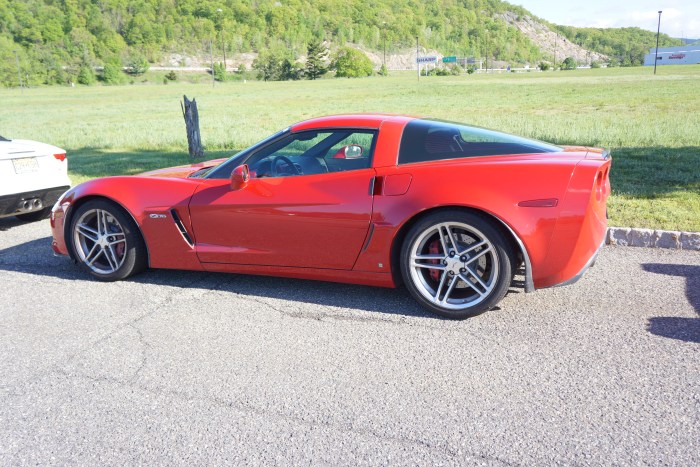
Among domestic product, it was all Chevrolet, including 3 Corvettes: Bill’s C1, Ron’s C4, and George’s C6. Larry ran his reliable Camaro.
Bill’s C1
Ron’s C4
George’s C6
Larry’s ’94 Camaro
The sole Asian car was Jim N’s Datsun 280Z.
Jim’s Datsun 280Z
We departed the Sheraton Crossroads parking lot (almost) right on time and headed north. As soon as we did, the skies darkened, and the clouds threatened. In spite of the weather, several drivers motored with convertible tops down. After a beautiful ride along Seven Lakes Drive and over the Bear Mountain Bridge, we were at our destination with 10 minutes to spare. The staff at the Silver Spoon had a table for 17 waiting. Coffee was almost immediately served, with hot breakfast plates soon following. As always, the camaraderie around the table made it difficult to leave.
The obligatory wave before breakfast
When we finally wrenched ourselves away from the food and endless caffeine, we stepped outside to some slight sprinkles. Those who had left their tops down scurried back to their cars. Several of us continued to linger and chat, not wanting the festivities to end. But end they eventually did. We’ve assured the group that we’ll do our best to get out at least once a month this driving season.
The Silver Spoon Cafe, on Main St. in Cold Spring NY, survived our visit
In the summer of 1977, I had just graduated college; I had sold my Chevy Vega to my brother Karl and was without my own car; and I had decided to postpone the post-grad job hunt, knowing full well that this could be the last time for a very long time that I’d have a few months of freedom.
My friend Mike who was in graduate school also was free for the summer. He had recently purchased a 1971 Volvo 144 (his first choice, a Volvo 164, was a bit out of his financial reach), and together we hatched a plan to drive the Volvo to California and back, visiting friends and relatives along the way. Sometime in late July, we departed my parents’ house on Staten Island and pointed the car west.
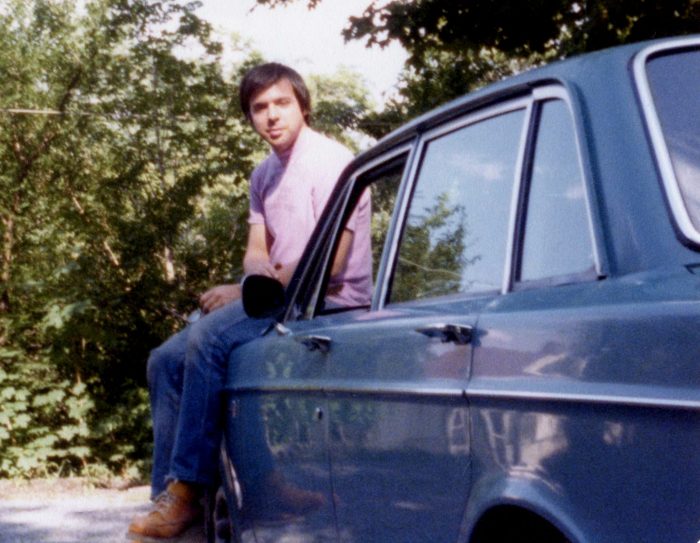
On the hood of his new (to him) 1971 Volvo 144
Growing up as an East Coast car enthusiast, I had tolerated the inevitable corrosion that beset our automobiles, brought on by winter’s road salt. California had always been a dream, not just for its beautiful weather, but for its supposed rust-free cars. At the age of 23, I was finally about to see the Golden State for the first time. Heck, this trip would be the first time that I would be traveling further west than Youngstown, Ohio.
The photographs I took during the 3-week long journey included some interesting finds in the Midwest, as well as plenty of neat cars in California, even by 1977 standards. My camera at that time was a cheap Kodak Instamatic, so please forgive the quality of these pictures.
To put some historical perspective on this trip:
A week before our trip began, on July 13, 1977, all of New York City was hit by a 2-day power outage.
During that summer, the city was gripped by the horrific Son of Sam killings. When we departed, he was still at large. As we traversed the country in our NY-plated car, more than one person asked if either of us was Son of Sam (macabre humor). On August 10, 1977, David Berkowitz was captured, and we both were relieved to hear this news on the Volvo’s AM radio.
Less than a week later, on August 16, while we were in Lexington KY, the news broke that Elvis Presley, the King of Rock and Roll, had passed away.
Three days later, on August 19, Groucho Marx died, and the country was so riveted by Elvis’ passing that the loss of Groucho barely made a dent in the news.
In Ohio, we stopped to visit Marianne, one of Mike’s college friends. I snapped this photo as we parted company, as she strolled toward her Volkswagen Fastback.
Marianne and her VW Fastback
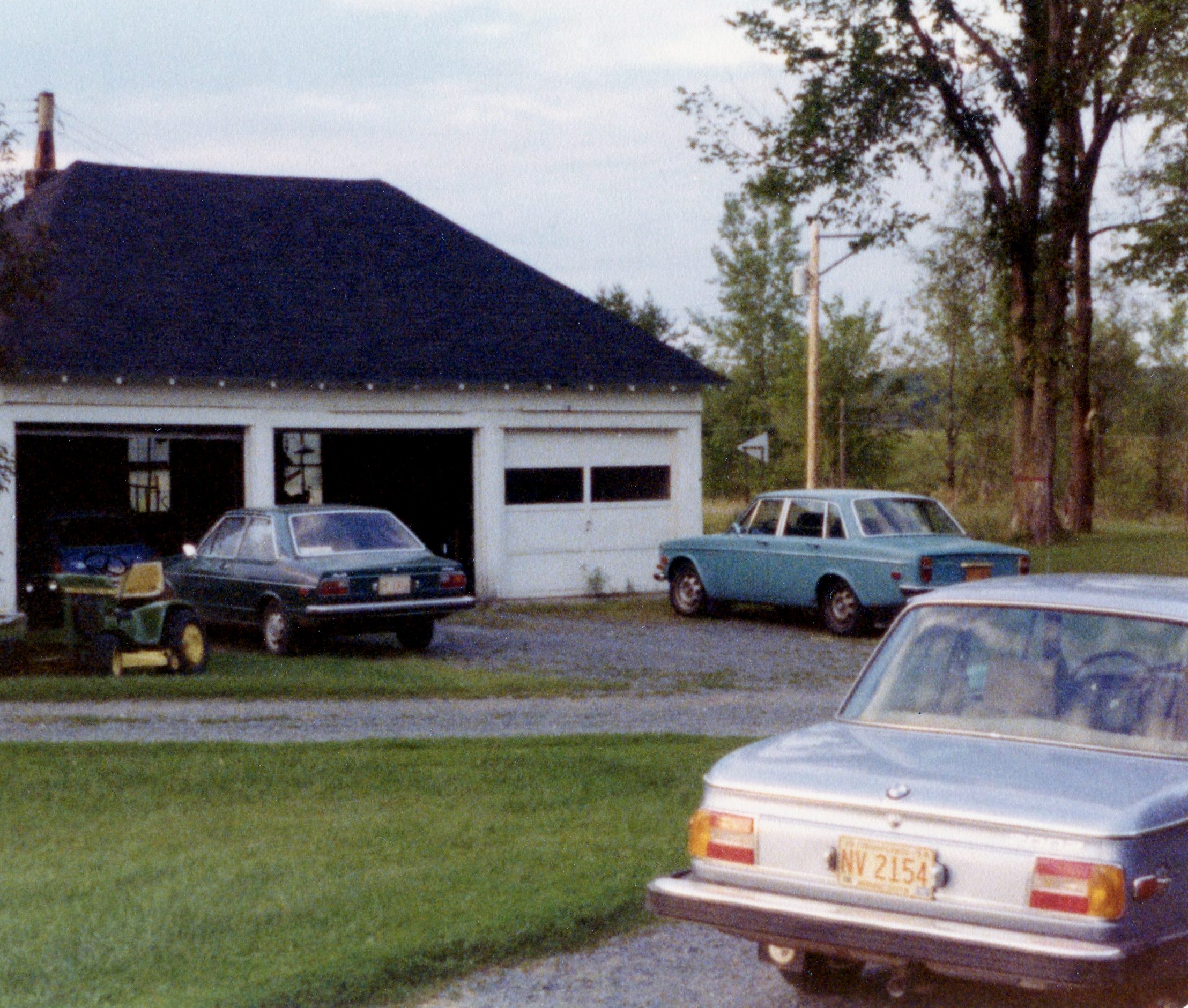
We visited another college friend at her mother’s home in Stillwater, Minnesota. Imagine my surprise to discover that her mom drove a BMW 2002, and her brother’s daily driver was an Audi Fox, with an MGB-GT project car in the garage. All 3 cars had manual transmissions. The bro’ let me drive the Fox, which had a direct influence on the new-car purchase I would be making in about two months.
European cars in Stillwater MN
BMW 2002, Audi Fox, and MGB-GT (in garage) along with our 144
Colorado was a revelation. While I have returned multiple times, this first visit stands out because we young men had no idea why, as our sturdy Swedish machinery climbed the Rocky Mountains, we lost power. It got to the point that the car would barely do 40 mph uphill. Those funny-looking SU carbs under the hood were a complete mystery to us. The Volvo’s automatic transmission wasn’t helping with the search for more speed.
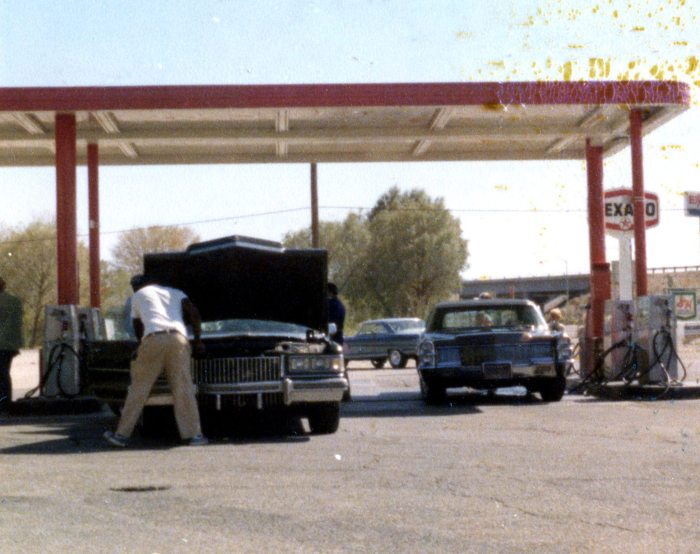
Self-serve fill-up, Colorado style. Note the whitewall tires and missing hub caps.
When we arrived in Albuquerque, New Mexico, where Mike’s grandparents lived, he decided that he had enough driving for a while. Reaching California was my dream, not his. Content with spaghetti, beer, and A/C (which the Volvo lacked), my buddy handed me his car keys and said, “if you’d like to continue, you’re on your own. Just pick me up on your way back.”
I took the car and left. The one-way trip to L.A. was 800 miles and about 12 hours of driving. Making the trip in one day, the only “difficult” part of the journey was the Mohave Desert. I bought a huge iced tea in Needles CA, crossed the 110-degree desert with all the windows open, and stopped to refuel in Barstow CA, where this photo was taken:
Barstow CA, 1977: A newish Caddy has its hood open, while a ’65 Caddy manages to look cool.
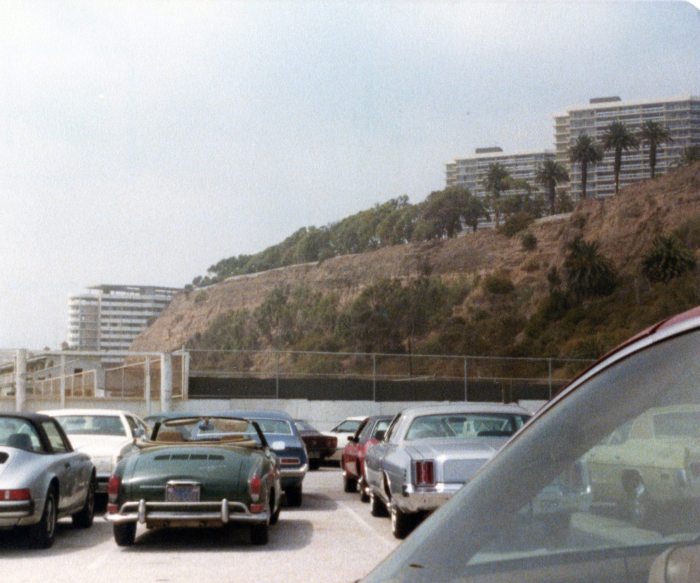
At last, San Bernadino, and the Pacific ocean. Finding a beach, I parked so that I could at least put my feet in water 3,000 miles from where I usually swam. This parking lot photo mainly features newer cars, but back home, Karmann-Ghias had already become rare sights.
A VW Karmann-Ghia sits between a Porsche 911 Targa and a Chrysler Cordoba.
Searching for Los Angeles, I was confused by the sprawl. There were no clear city boundaries. But I did find Sunset Blvd., and as I was about to turn onto it, two ’60s era Chevrolets were in front of me. This photo was taken while driving, mainly for my brother Karl who was in the midst of trying to resurrect a 1964 Impala back home. Karl’s car looked nothing like this one!
The street sign says Sunset! A Nova SS followed by a ’64 Impala.
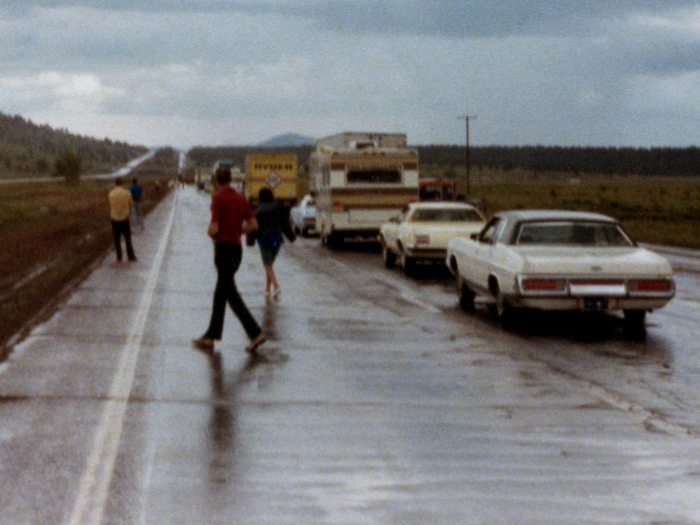
Heading back to NM, a summer storm may or may not have been a contributing factor to this massive traffic tie-up. We were stopped long enough that most folks turned off their cars and wandered around on the highway.
A 1972 Ford sits behind a 1973 Pontiac Grand Prix
Except for the power loss in the Rockies (which could have been cured had we known to lean out the carbs), the Volvo performed quite well. Its seats were incredibly comfortable and supportive for what was probably 7,000 miles of driving over 3 weeks. The gas mileage was decent. A stick shift and an FM radio would have been my preferences, but it wasn’t my car. It was my first real experience with the brand, and the irony of driving a Volvo on this trip was not lost on me when 13 months later, I entered the car business by going to work for a Volvo dealership.
The New Jersey Region of the Antique Automobile Club of America (NJ AACA) held its annual car show at the Mennen Arena in Morristown NJ on Sunday, May 1, 2016. Compared to previous events, this year’s affair was unique in several ways: this was the first time that this location was utilized, as the venue which had been used for the previous 40+ years in Florham Park NJ was unavailable; and the turnout this year was the smallest your author has ever observed.
Yes, this was the NJ Region’s 65th show
The reason why 30 vehicles instead of the expected 200+ vehicles were in attendance had nothing to do with the location, and everything to do with the weather. The NJ AACA maintains a strict “rain or shine” show policy, but a steady series of showers combined with temperatures parked in the mid-40s kept entrants and spectators away in droves.
This ’30 Model A was one of the very few pre-war cars out to brave the elements
Nevertheless, vehicles did arrive, even if for the most part they were owned by club members. An advantage for those whose cars were to be judged is that no class had more than 4 vehicles in it (some had 2), and with 1st, 2nd, and 3rd place prizes to be awarded, your chance of winning went up exponentially.
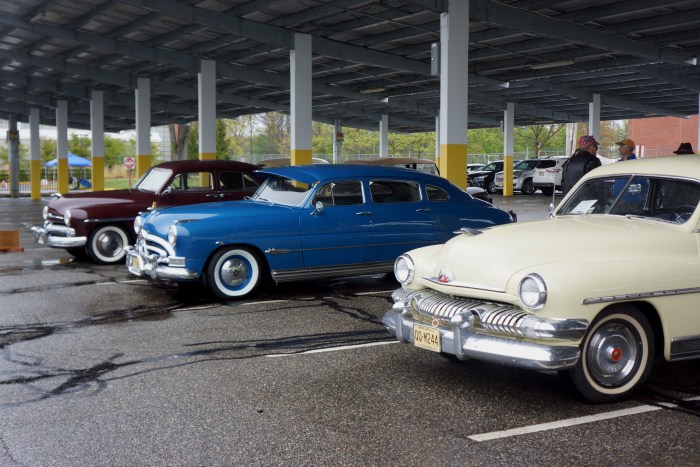
A trio of immediate post-war iron: 2 Mercurys and a Hudson
Below is a sample of the fine machinery, both domestic and imported, which graced the show field. A trend which has been noticed on the National level was also found at this event: as AACA’s “25-year” rule continues in effect, the inclusion of unrestored and/or original-owner cars is growing, reinforced by vehicles which were considered collectible when new and were salted away (think Eldorado, Fiero, Beetle convertible, and anything first-year, last-year, or commemorative edition).
General Motors
An immaculate 1946 Chevy pickup
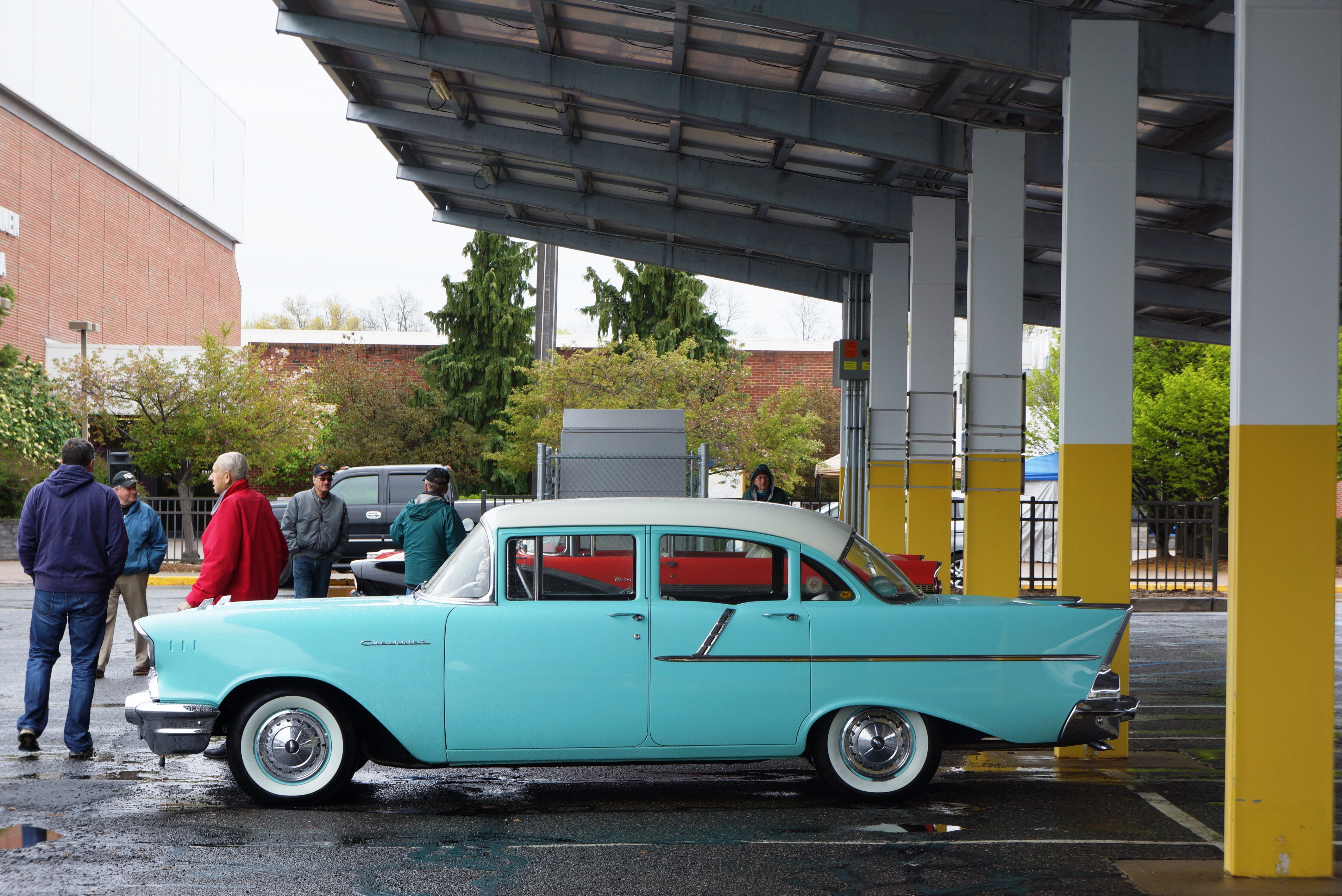
A rarely-seen 1957 Chevy 150; note different side trim
This Fiero was displayed in unrestored condition by its original owner
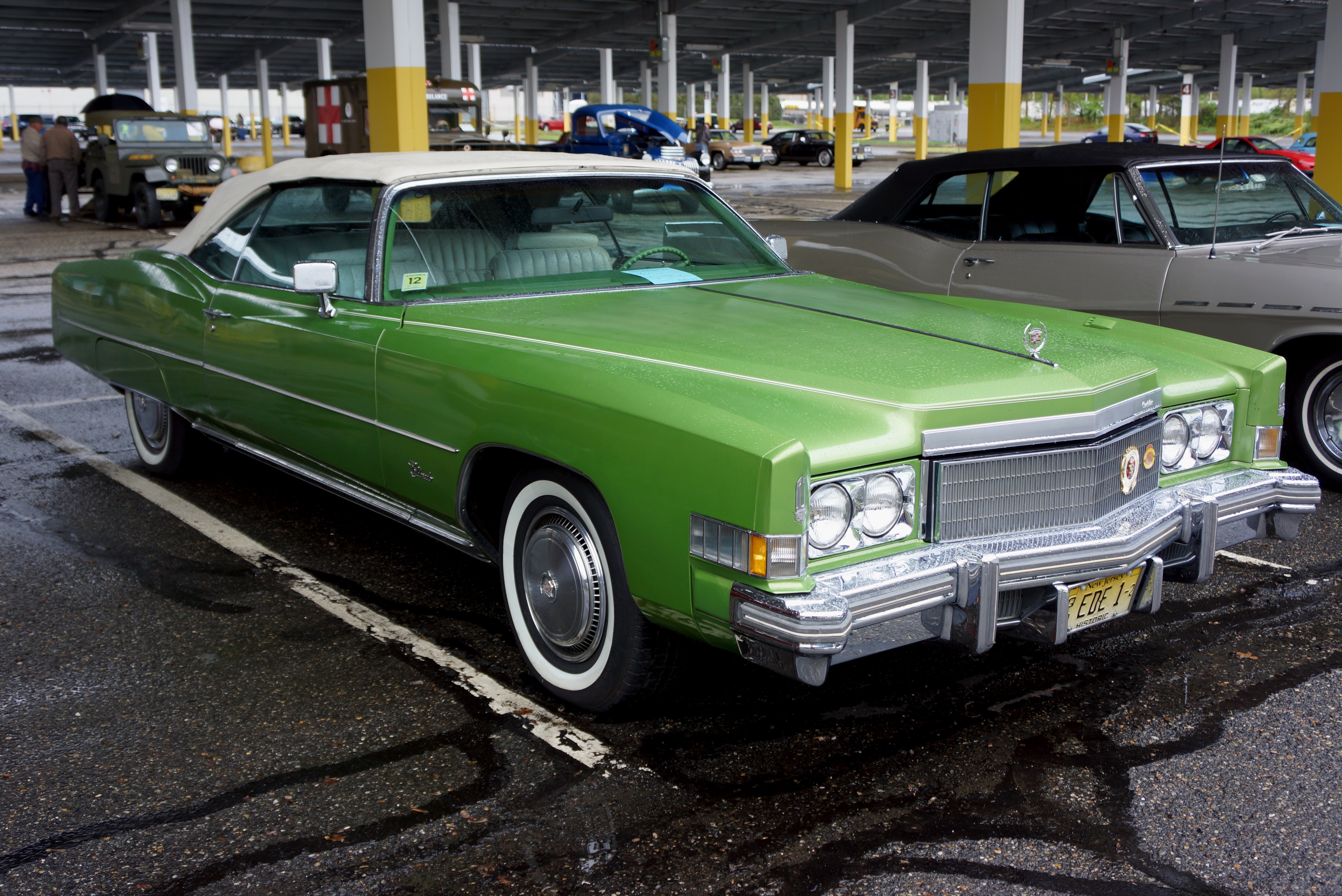
This Eldorado in its period green had matching dash & steering wheel
Bill Mitchell’s last hurrah: a bustle-back Cadillac Seville
FoMoCo
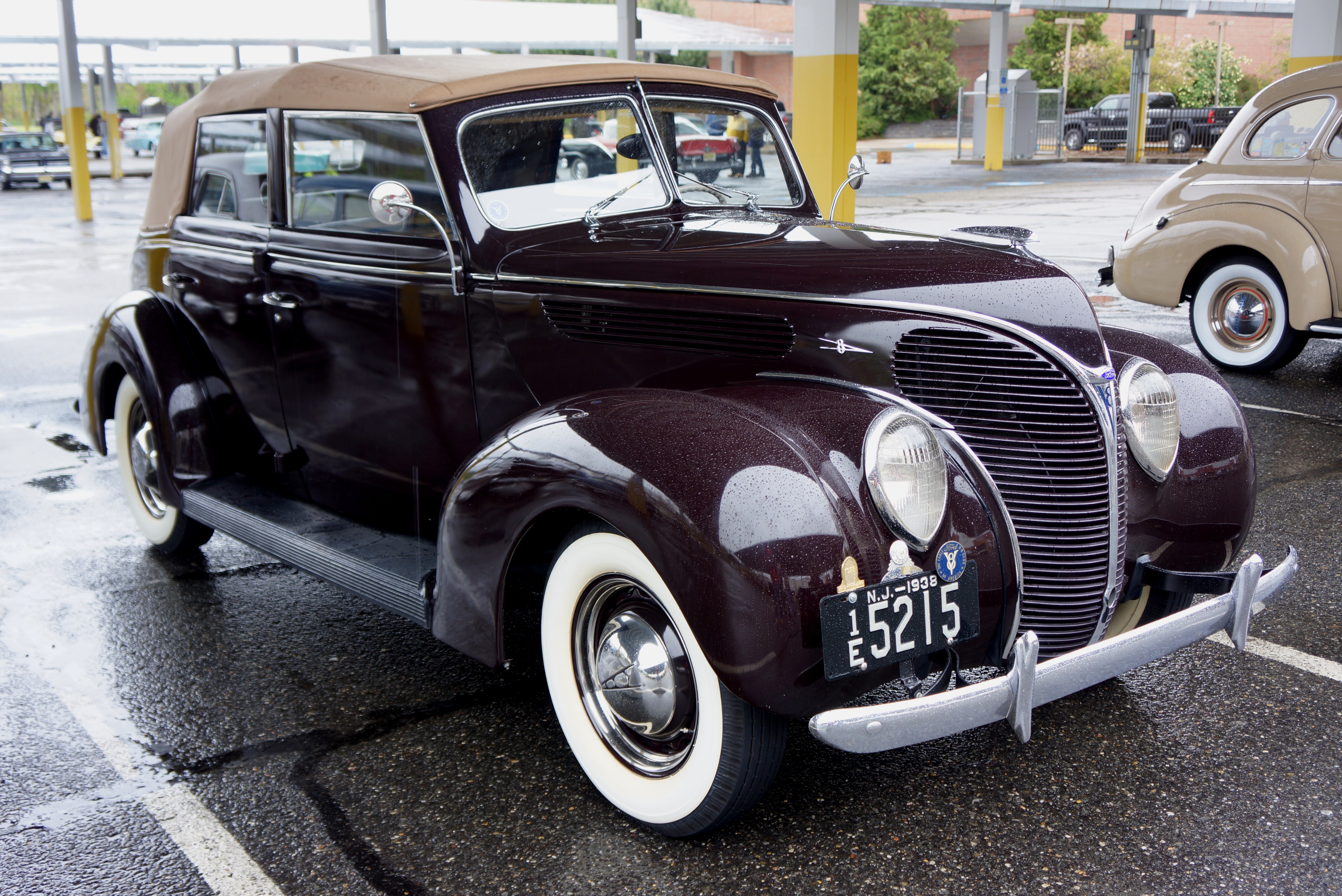
A 1938 Ford convertible sedan, a soon-to-be-extinct bodystyle
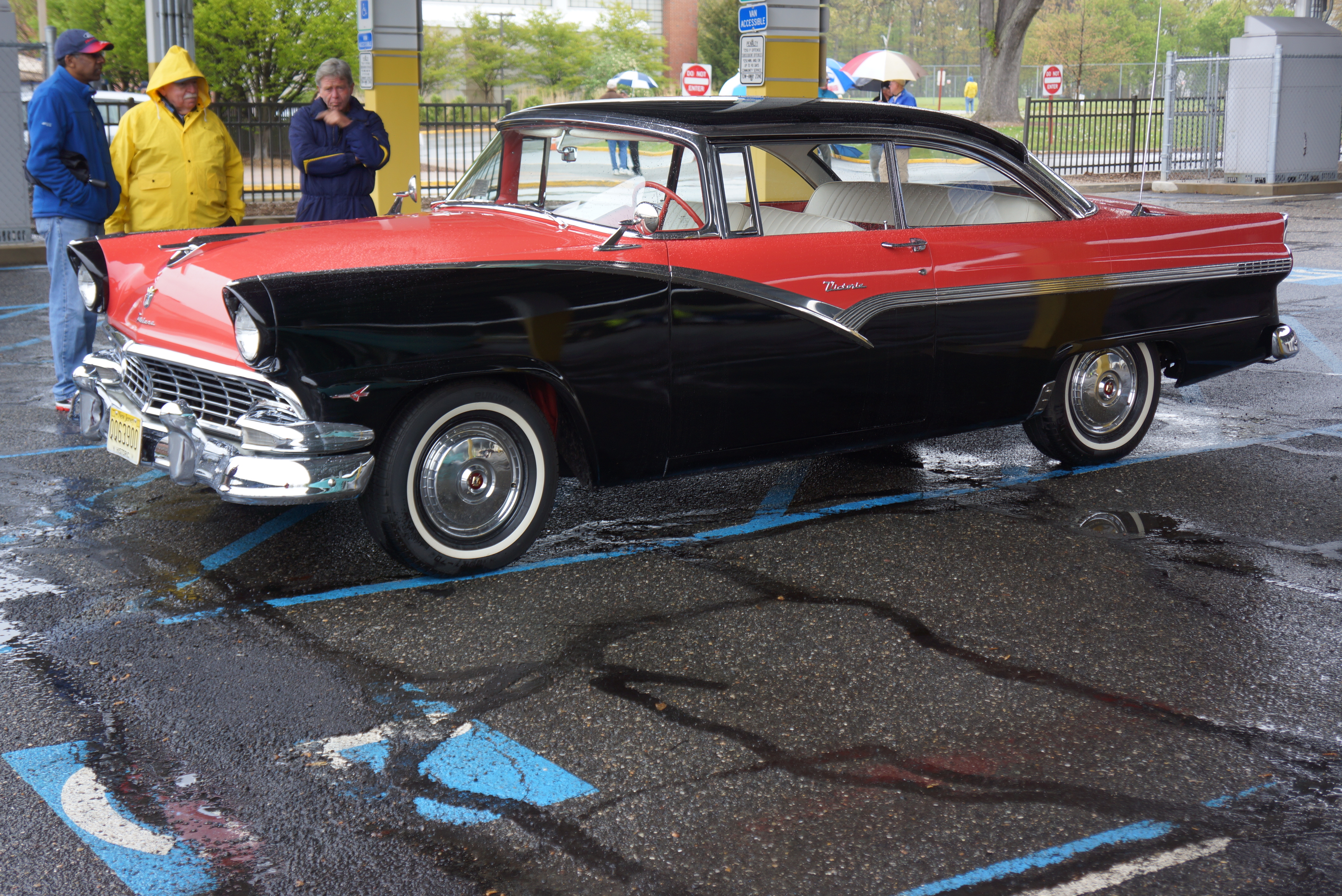
Eighteen years later you could get this 2-tone ’56
The 1957 T-Bird was the last of the two-seaters
Twelve years later, muscle cars like this ’69 Mach I were the rage
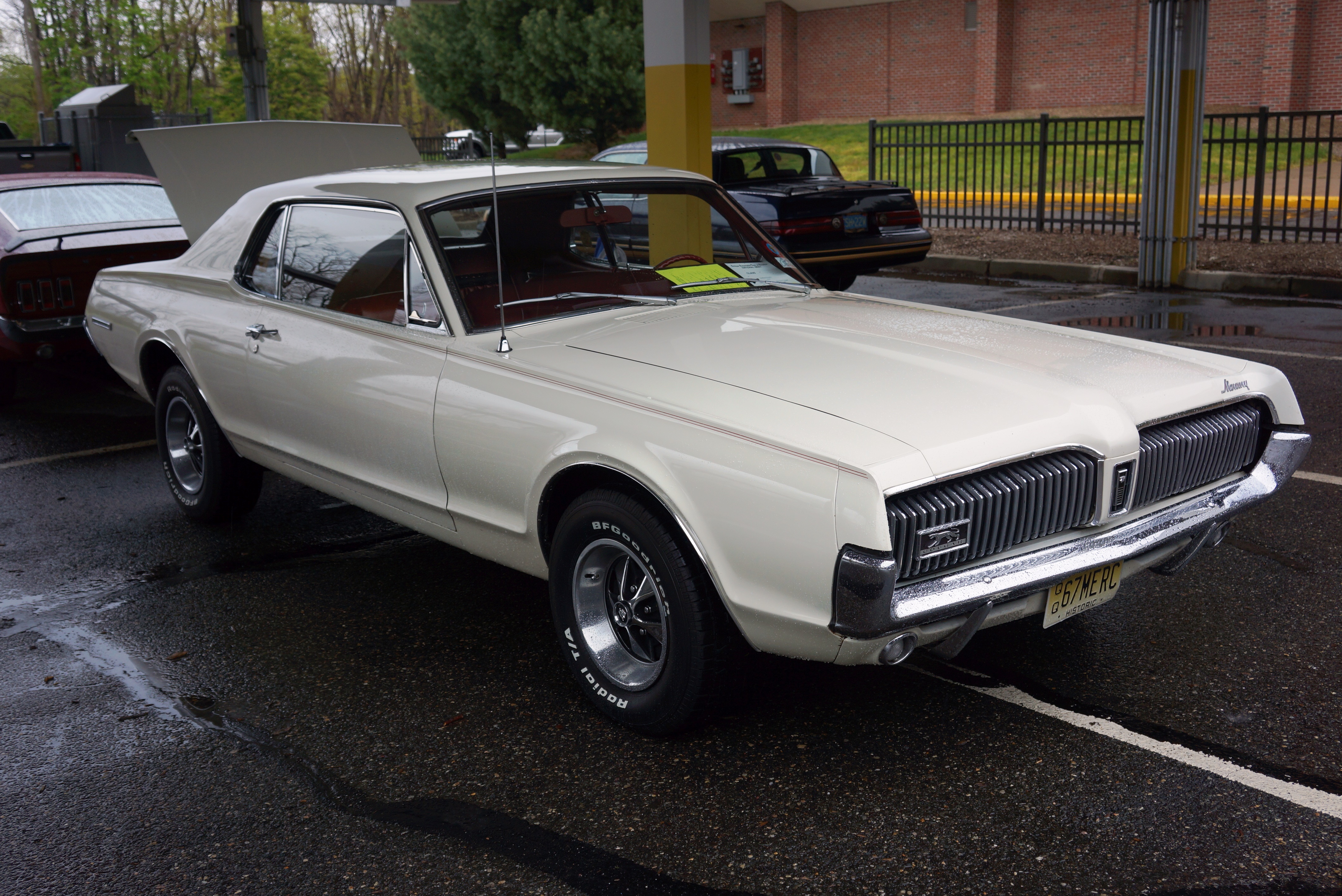
This first-year ’67 Cougar was original except for one quarter panel repaint
By the late 1980s, the Cougar nameplate was on a larger platform shared with the T-Bird
Jeep
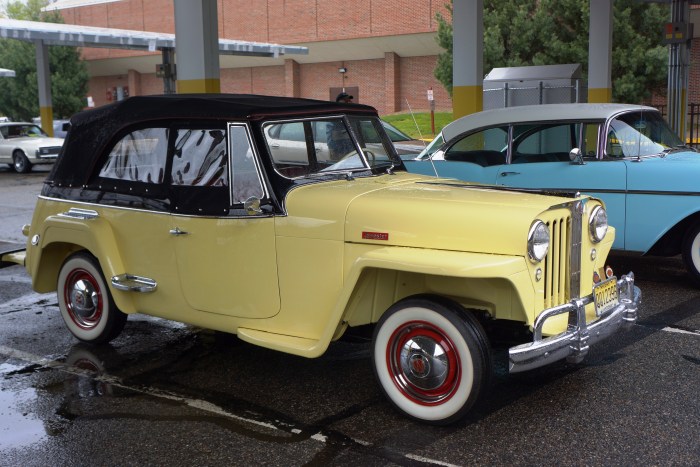
This immaculate Jeepster was driven to and from the show
Italian
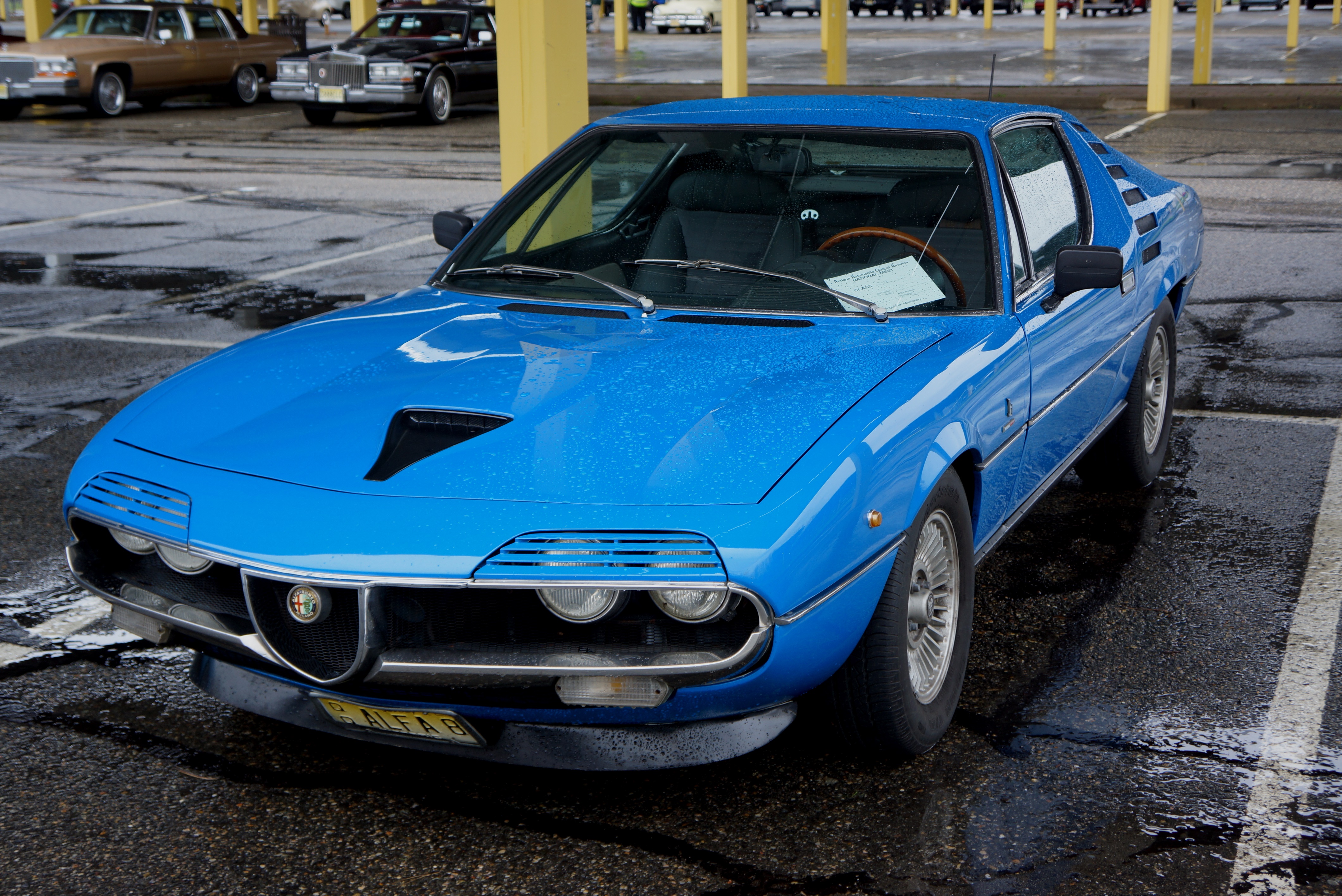
An Alfa Romeo Montreal coupe
The Montreal has a V8 engine, and was never officially imported into the U.S.
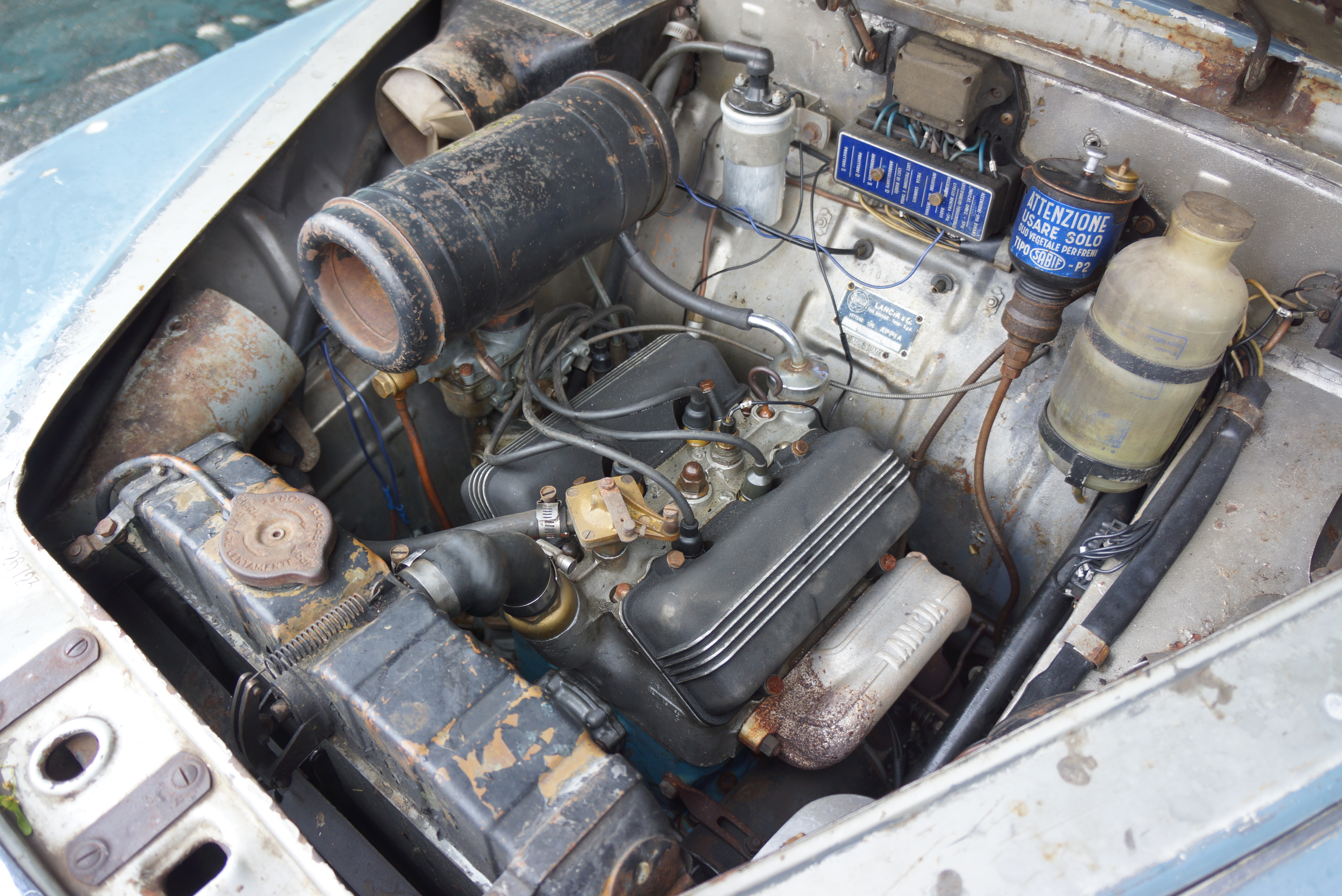
A 1958 Lancia Appia sedan
The Lancia narrow-angle V4 engine
This unrestored car has no B-pillar and rear-hinged back doors
Spring Carlisle 2016, featuring an automotive flea market and car corral, was held at the Carlisle PA Fairgrounds from April 20th through 24th, 2016. In recent years, parent company Carlisle Events has also hosted a collector-car auction during the same week. This year, the auction was run on Thursday and Friday the 21st and 22nd at the Carlisle Expo Center, one block from the fairgrounds.
The Carlisle Expo Center is across the street from the famous fairgrounds
About 350 cars and trucks were driven, pushed, and dragged across the block. This is said with some facetiousness, as overall, the quality of the consignments was quite good. The few rats were obvious, and a cursory inspection of any of the vehicles revealed their true nature.
Overall highlights included the aforementioned strong condition of most of the entries, sufficient seating for bidders and spectators, a well-ventilated and well-lit indoor auction area, and plenty of available food and drink (including the hard stuff, which helps to lubricate your bidding arm).
On the downside, the Carlisle crew was lax in getting run sheets for Thursday printed when promised. During a phone call made earlier in the week, a staffer stated that run sheets would be ready at 8 a.m. Thursday morning. However, upon my arrival at 9, they were not out yet. Repeated trips to the windows were met with promises that they would have them “within the hour”. They finally made it out at 12:40 p.m, a little more than one hour before the auction’s start. At least Friday’s run sheets were out at 10 a.m.
Carlisle Events also seems to allow consignments to be added on the day of the auction; making matters worse, these vehicles in some cases do not show up on the grounds until hours before they are scheduled to cross the block. Prospective bidders have little chance to inspect the goods, and sellers are simply hurting themselves.
The auction business is still new to the folks who work for Carlisle Events, and while everyone seems to be trying very hard, the production has an amateurish, mom-and-pop feel to it. However, the crowds were there, cars changed hands, and as long as they keep trying, they should get better at this.
Following is a sample of the vehicles which crossed the block. CPI (Cars of Particular Interest) values are from the March-April 2016 price guide, value range is good-to-excellent, with amounts rounded to the nearest thousand. Reserve is shown on no-sale cars if the block announced it.
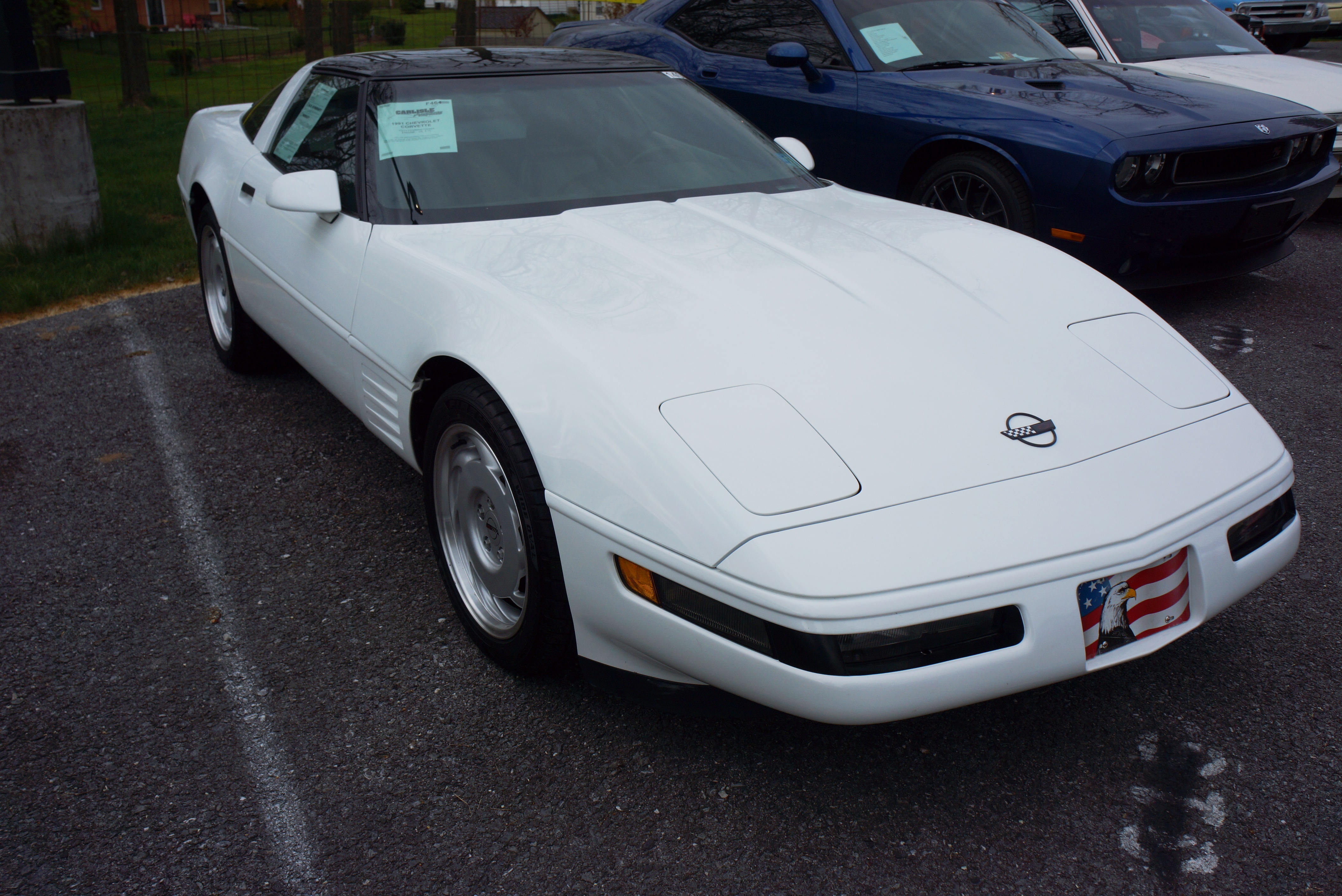
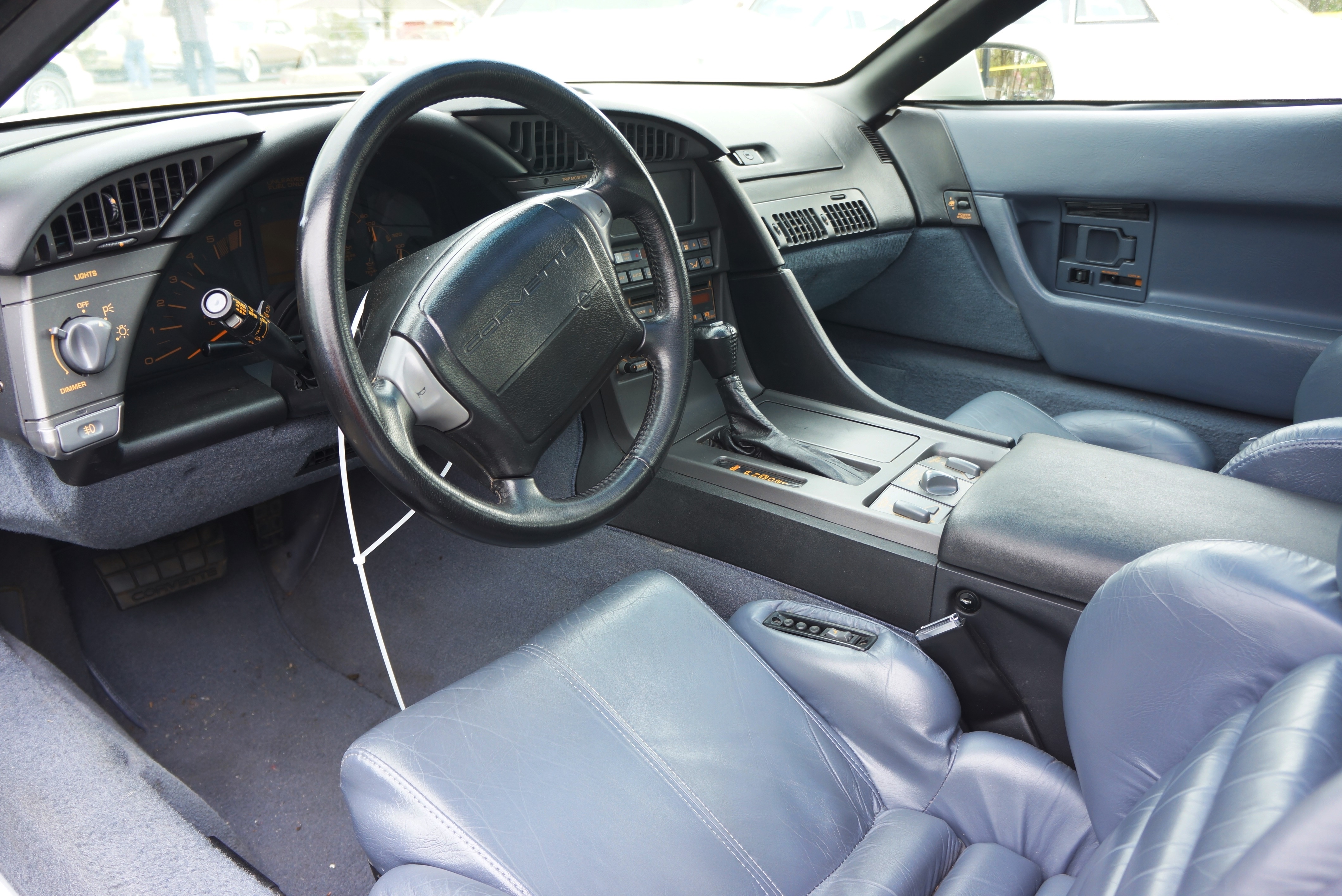
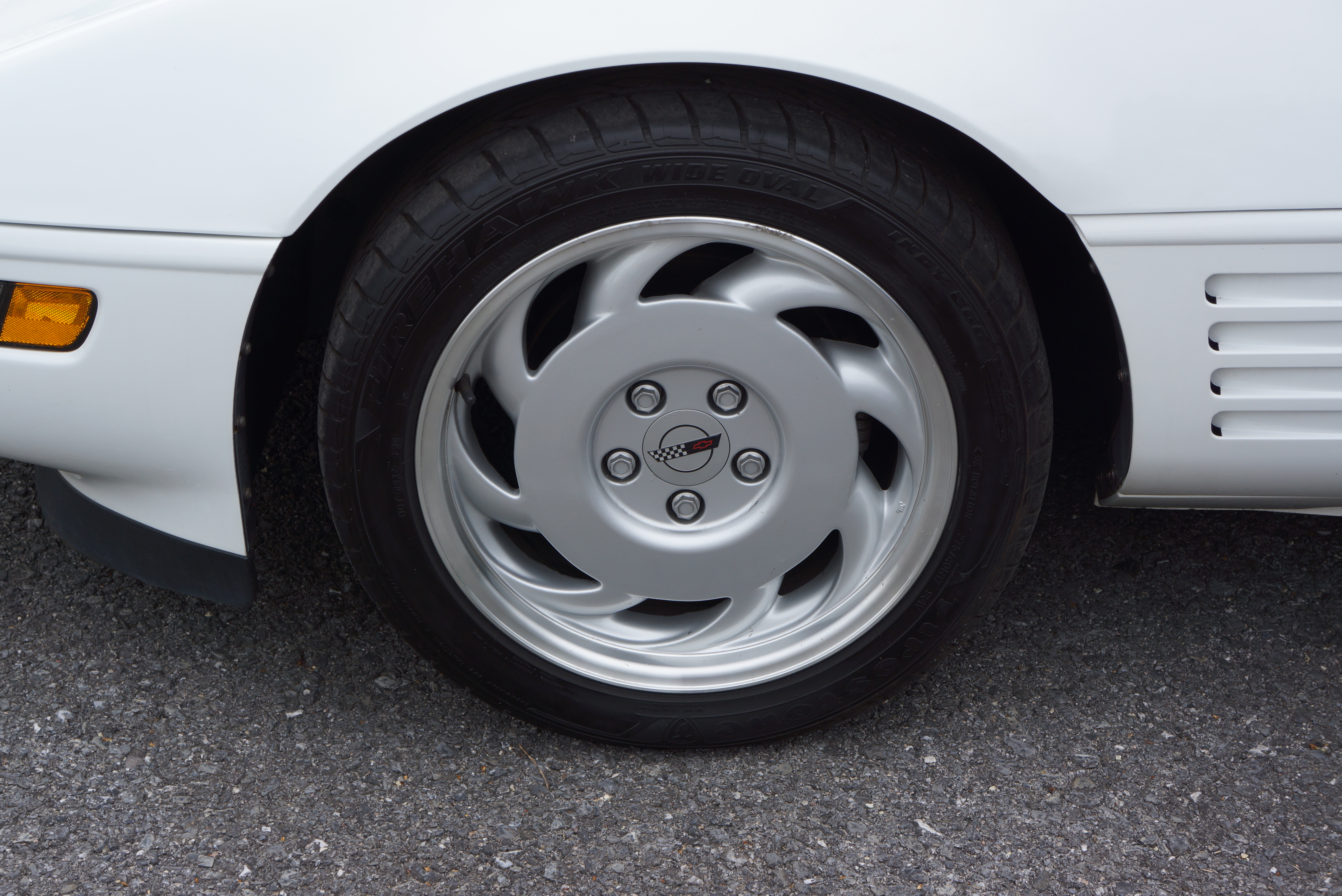
F464 1991 Chevy Corvette coupe, VIN 1G1YY2386M5104468, white, smoke glass top, 5.7L V8, automatic, 24,000 original miles, just serviced. Corvette alloy wheels are unmarked. Nose shows no paint chips or scrapes. Door seals in good shape. Interior is blue/gray, automatic, with slight carpet wear. Interior supports mileage claim. Paint looks original, all looks presentable. Glass OK. This car was very late in crossing the block, but bidder interest was high, possibly because of the low miles. Car was still sold within the CPI “good” range, so we’ll call this one well-bought.
CONDITION: 2-
HIGH BID: $9,200 SOLD!
CPI: $9,000-15,000
1991 Corvette
Clean interior, auto trans
Corvette directional alloys
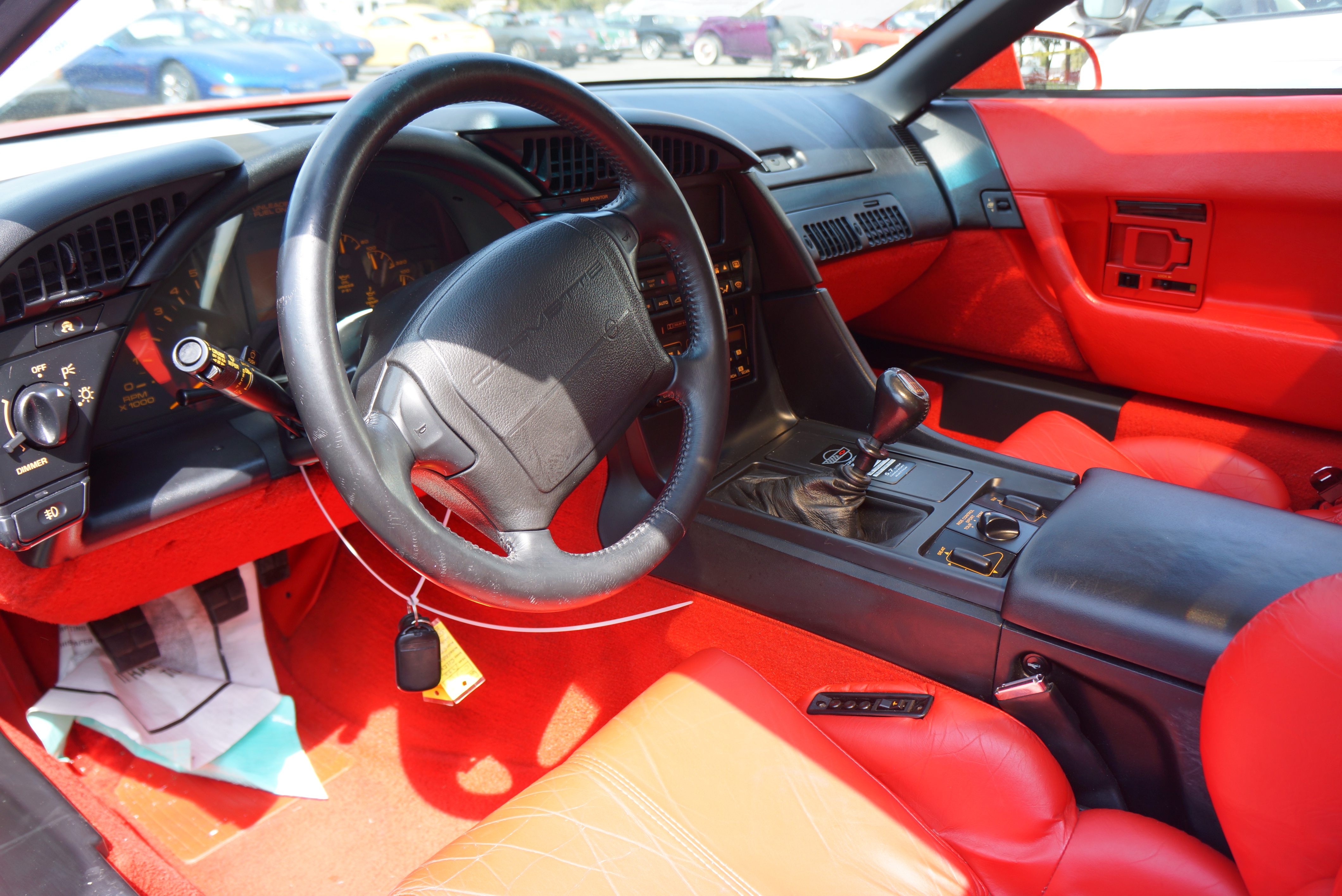
T106 1993 Chevy Corvette coupe, VIN 1G1YY23P2P5107900, LT1 350, 6-speed manual, mileage is 91000, red, smoke top, red interior, paint looks original, nose is unchipped, Corvette alloys are clean, one touch-up on driver’s door edge, typical wear to C4 window seals, red on red is garish, but driver’s seat shows little wear. If you like red, this was your car. This did not look like a car with 90k on it, and there was little to fault. There were at least 6 C4s among about 30 Corvettes at this auction, and in retrospect, this appears to be one of the best deals of the week.
CONDITION: 2-
HIGH BID: $7,600, SOLD!
CPI: $10,000-16,000
1993 Corvette
Rear as clean as front
red-on-red helped by 6-speed
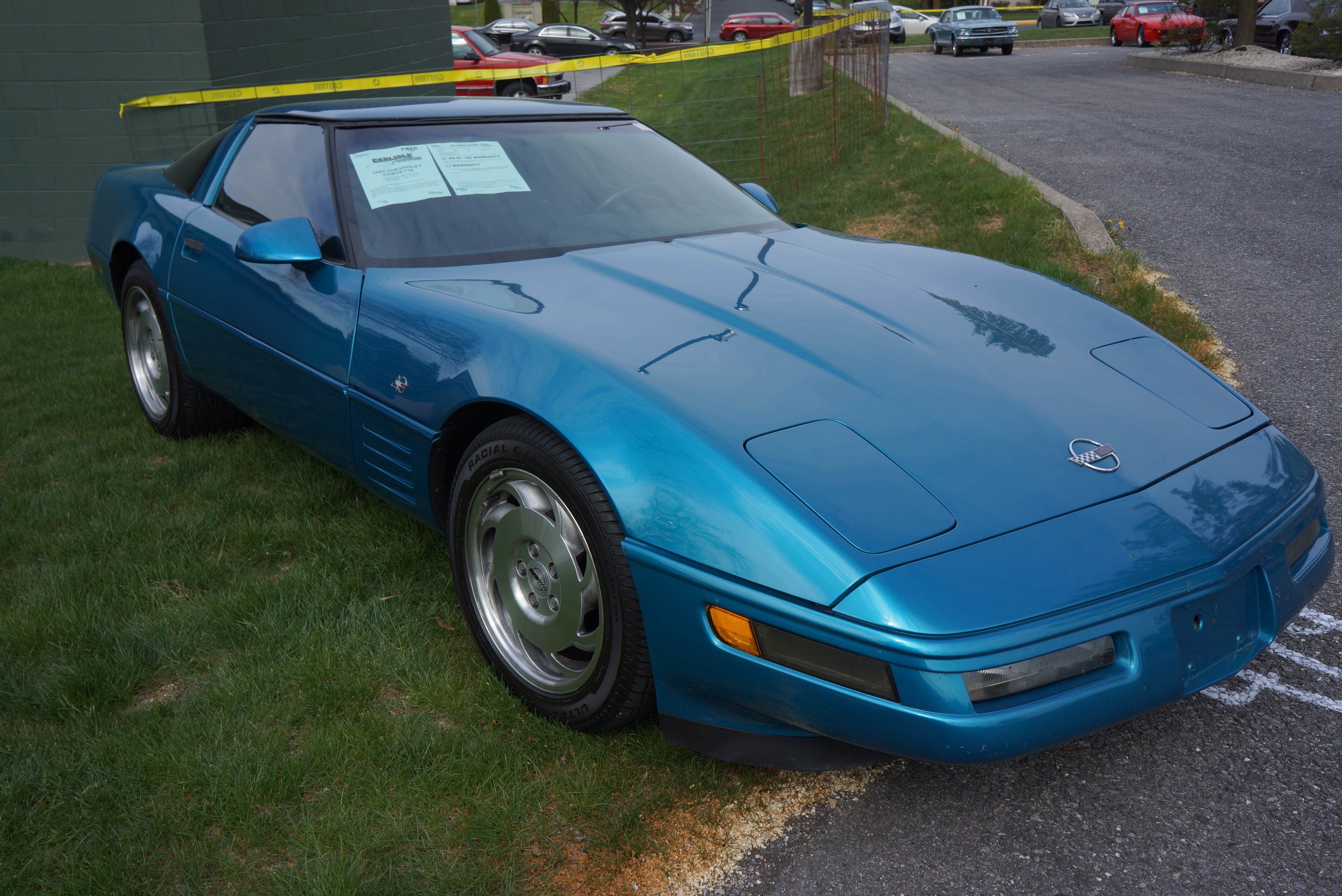
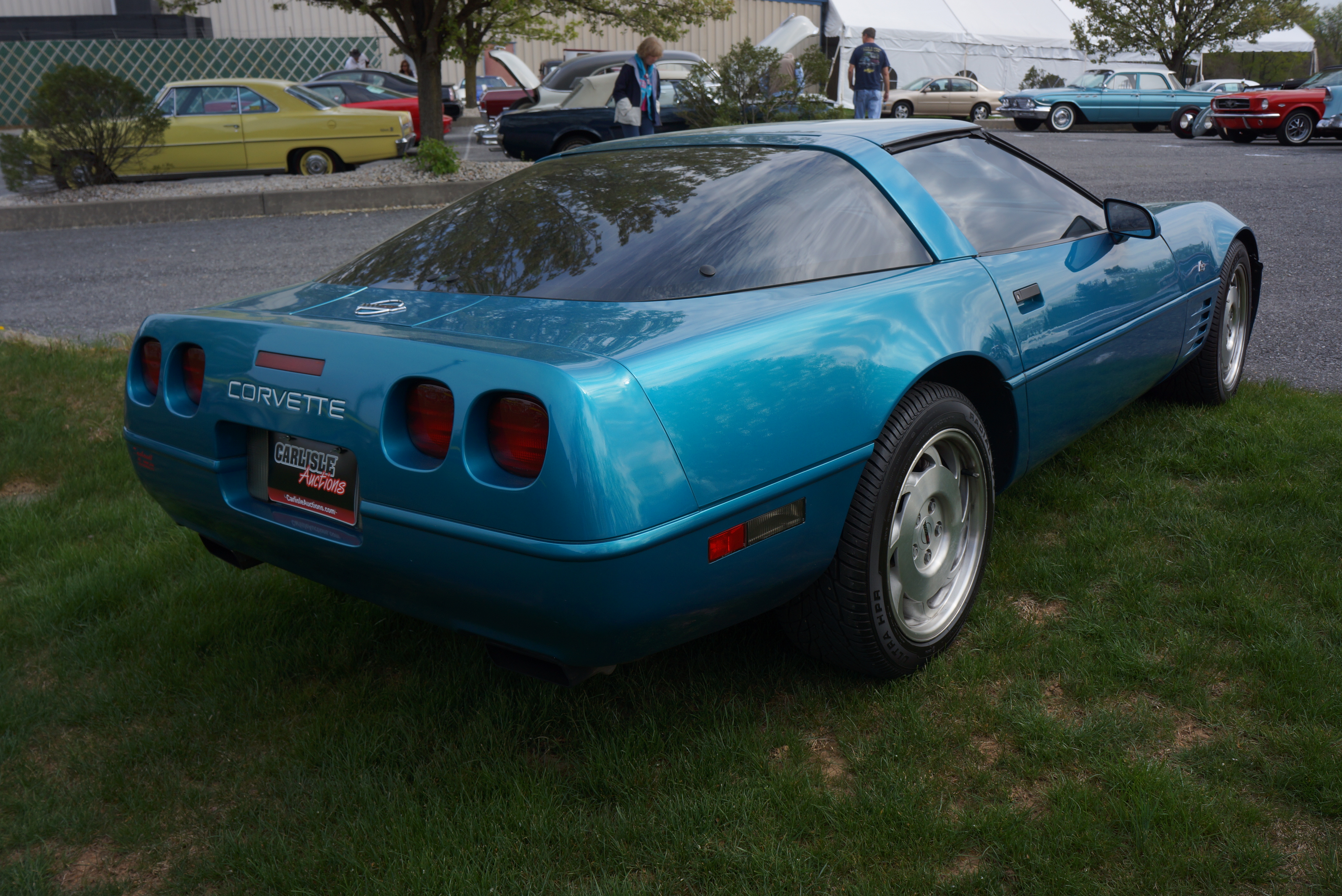
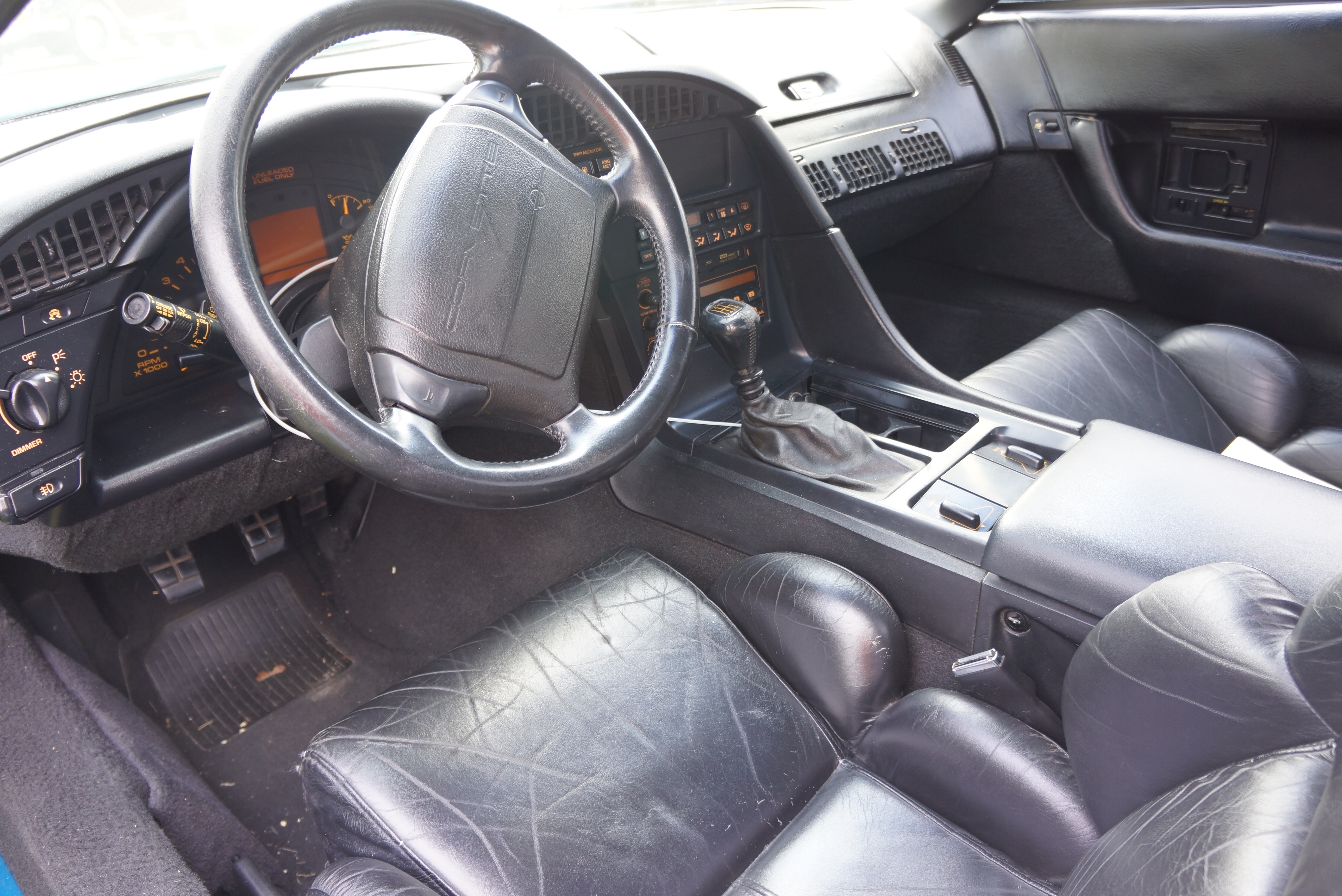
F479 1993 Chevy Corvette coupe, 5.7 V8, 40th anniversary edition, 6-speed manual, mileage unknown. Teal color is very ‘90s, black leather interior gives dark ambience. Corvette alloys, some chips in nose. 40th anniversary emblems in front fenders. Drivers door window rubber worn out. Driver’s seat bolster worn. Body color roof panel. This was the last car to cross the auction block, at 9:30 Friday night. The crowd had dwindled to less than half of it peak. They were close, but couldn’t get it done.
CONDITION: 3-
HIGH BID: $6,700, NOT SOLD
RESERVE: $7,500
CPI: $6,000-15,000
1993 40th anniversary ‘vette
from the rear
black interior is drab & dark
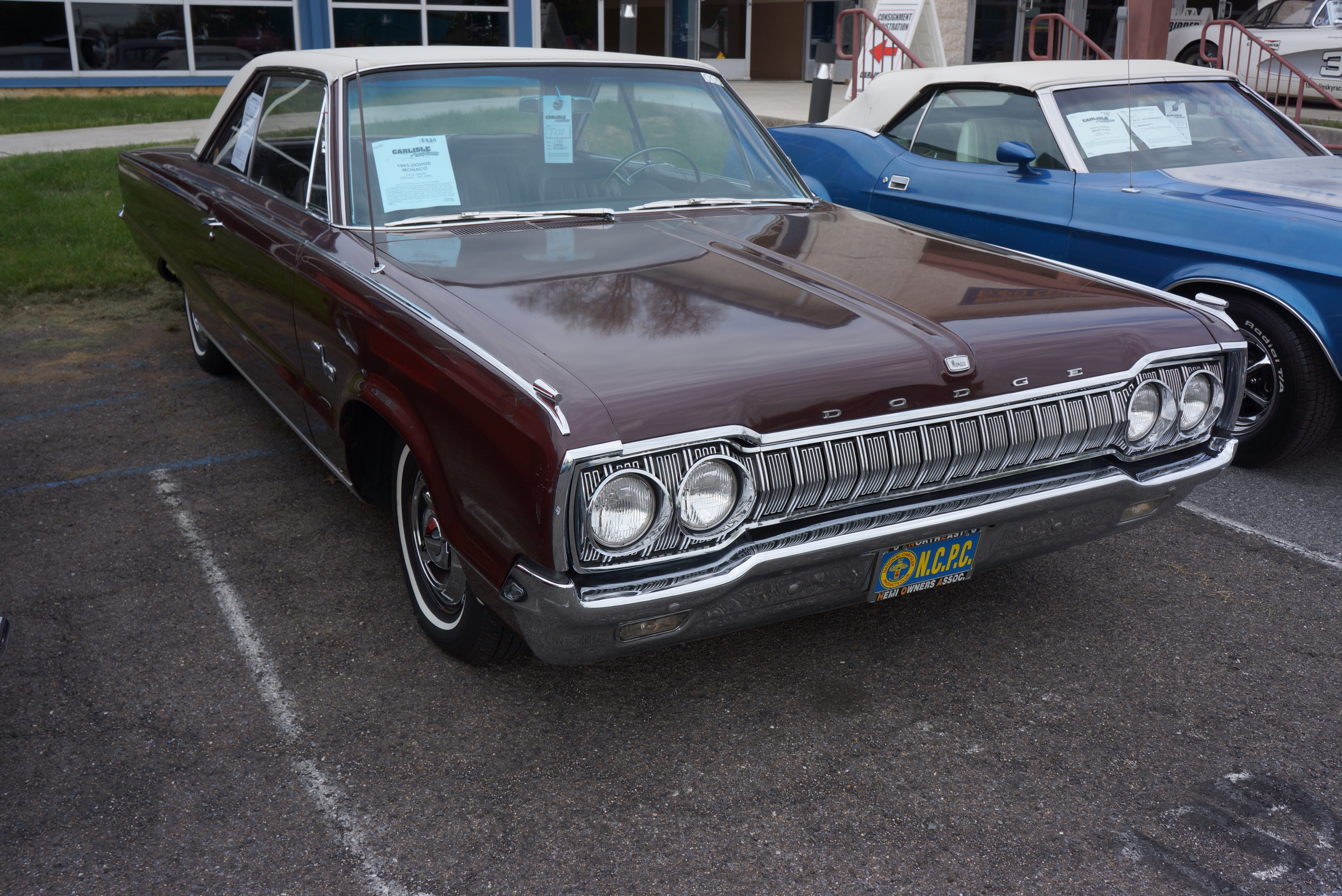
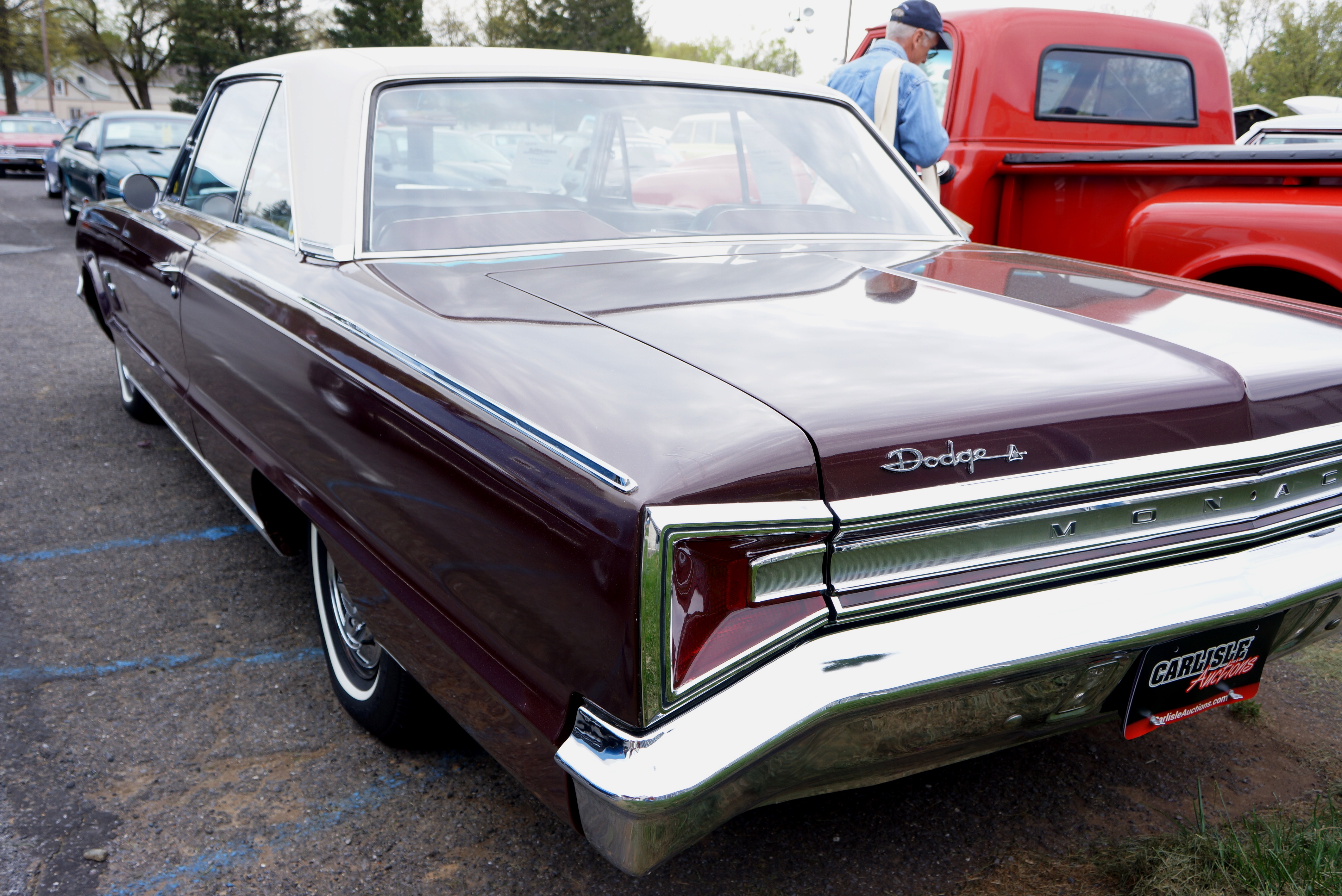
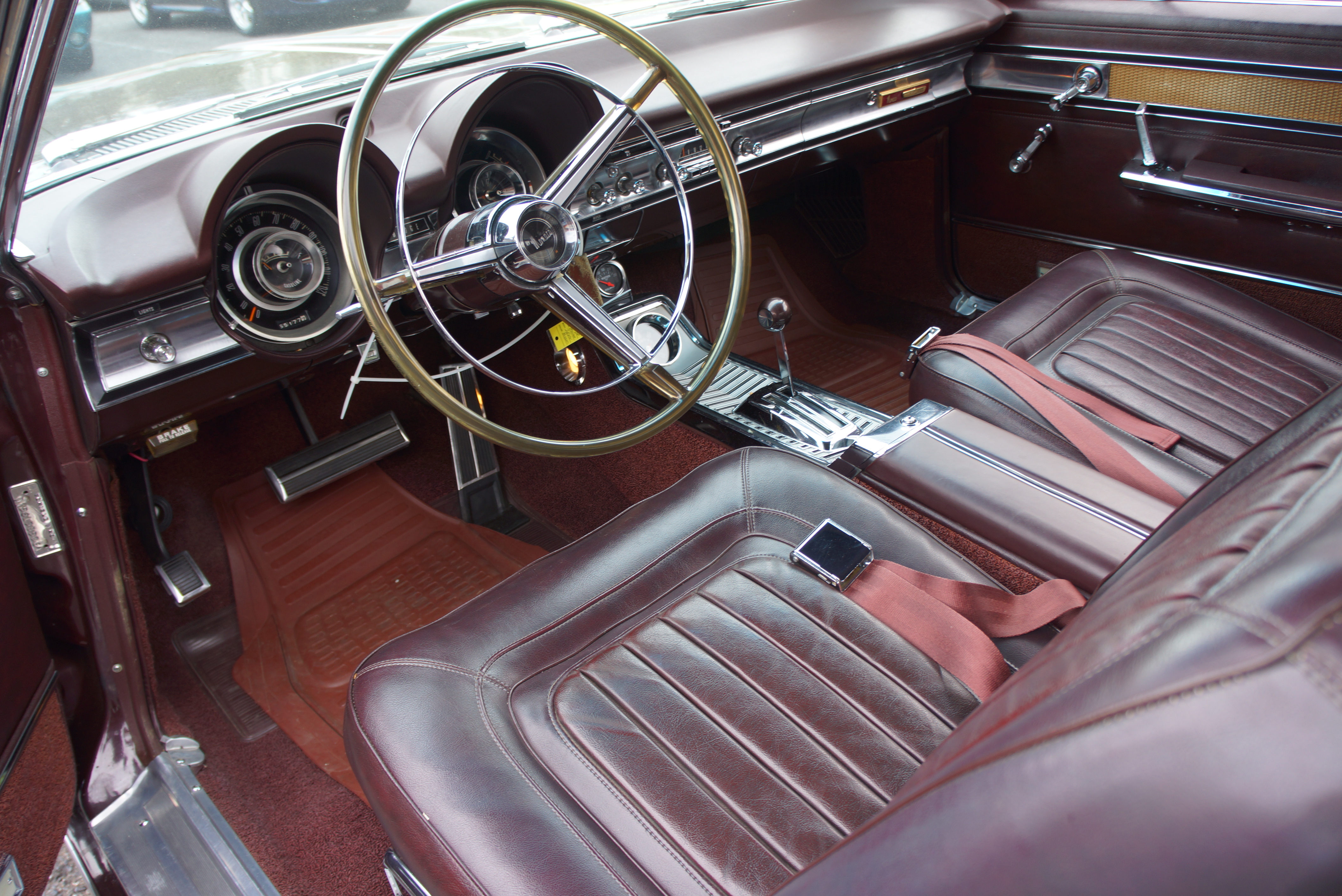
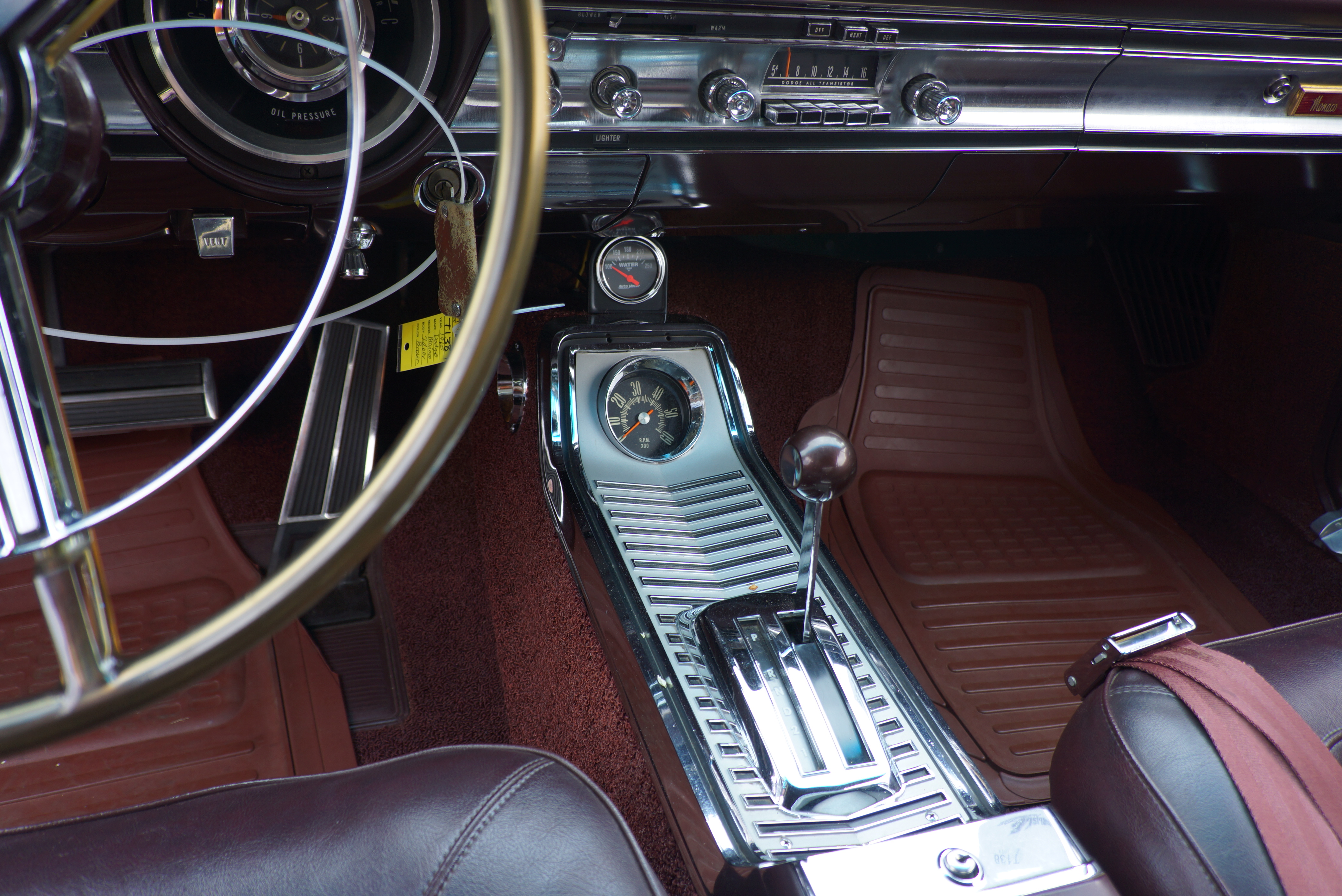
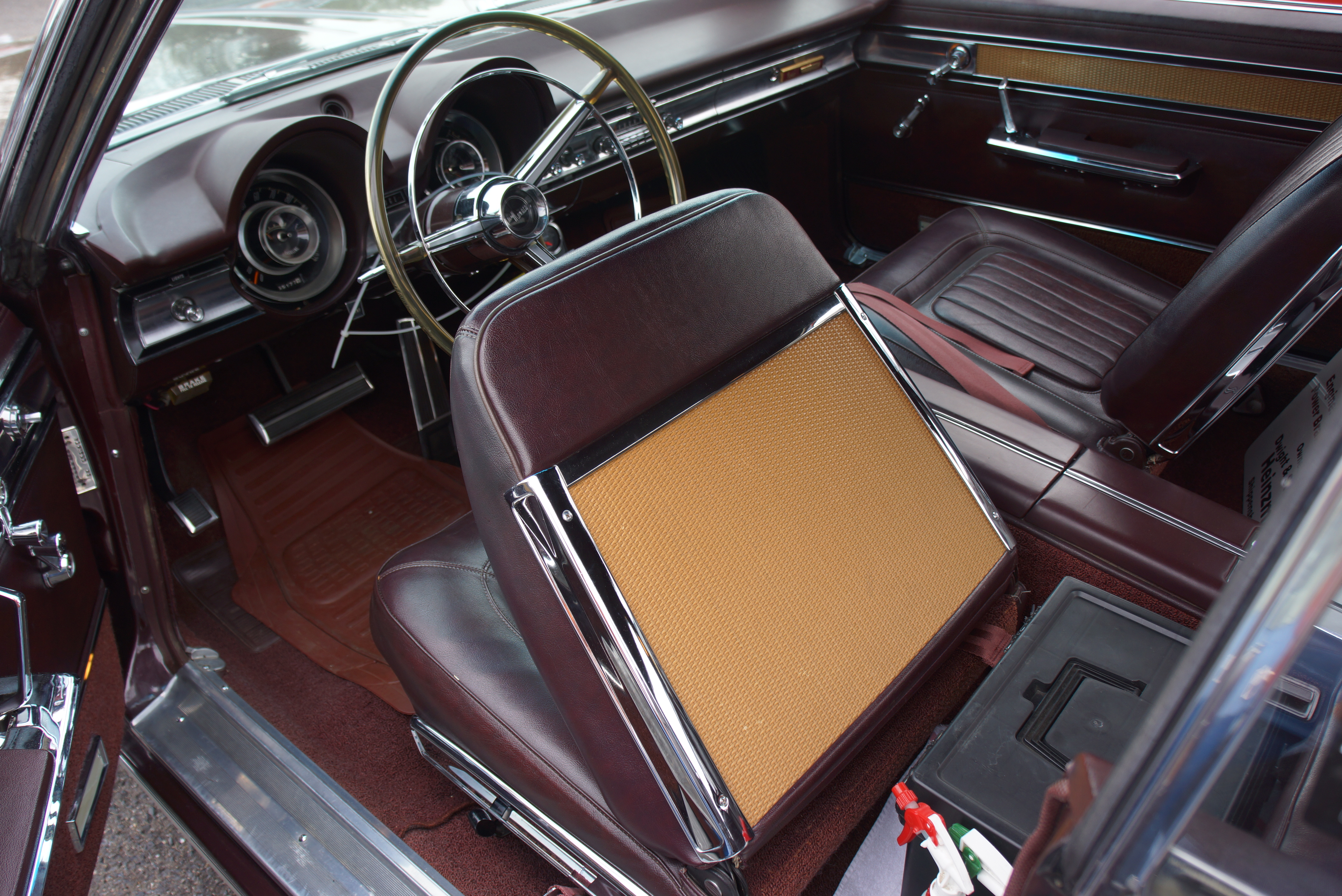
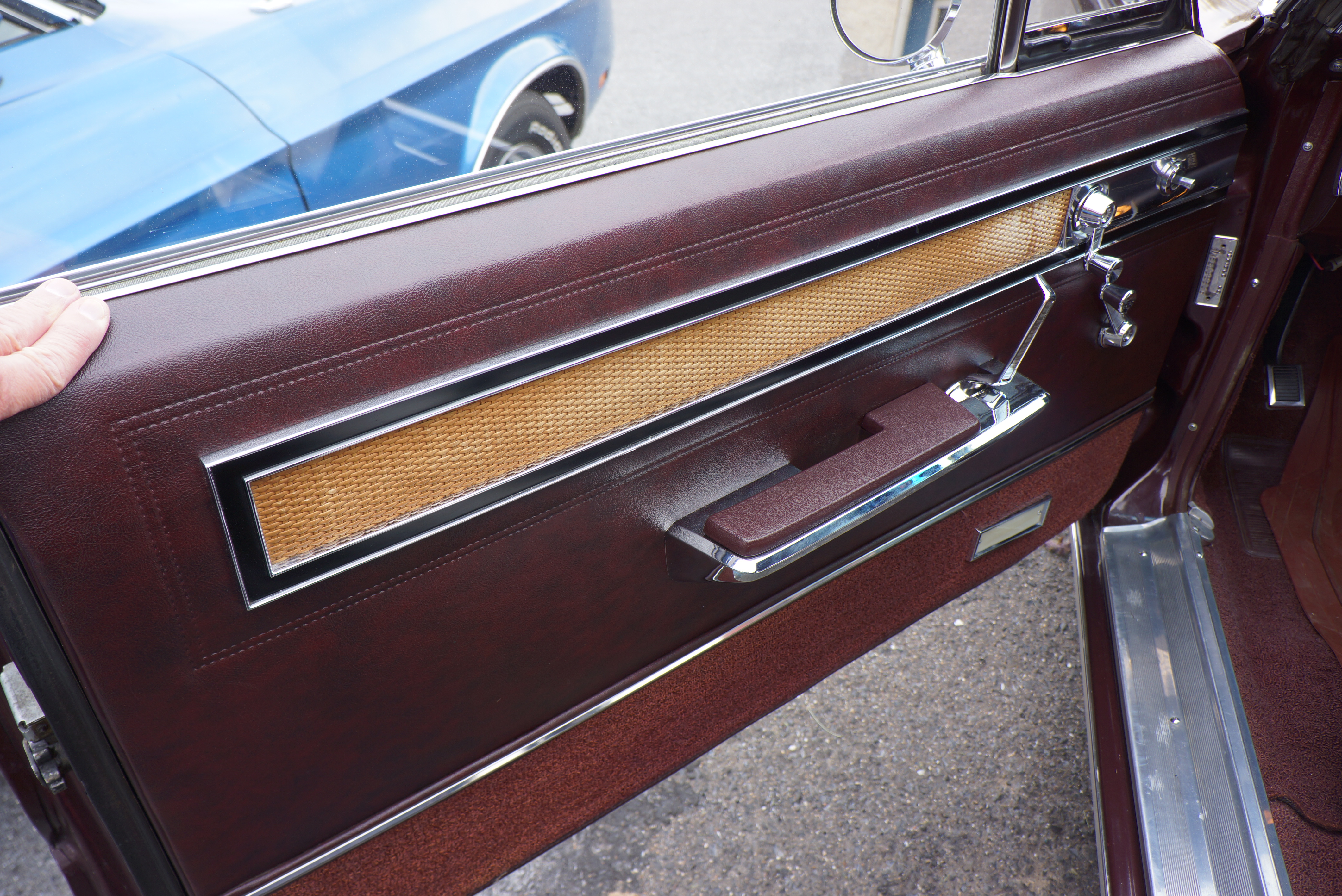
T138 1965 Dodge Monaco, VIN D456138536, 2-door hardtop, 66,000 original miles, 383 4-barrel, automatic, dark burgundy, white vinyl top, burgundy interior. Dent in front of hood is heartbreaking, given how clean and straight remainder of car is. Tires appear one size too small. Car is stunning in person for its originality. Interior is a knockout – center console, buckets, gauges, cane inserts on door panels and seat backs. Glass good, doors shut OK. This was a highlight of the auction, both for its rarity and its originality. Alas, if bidders want a Mopar, they want a hemi, and the reserve was not met.
CONDITION: 2+
HIGH BID: $8,700, NOT SOLD
RESERVE: unknown
CPI: $7,000-17,000
1965 Dodge Monaco
claimed to be 100% original
Interior is outstanding in design & condition
Center console detail
Woven cane on seat backs
as well as door panels
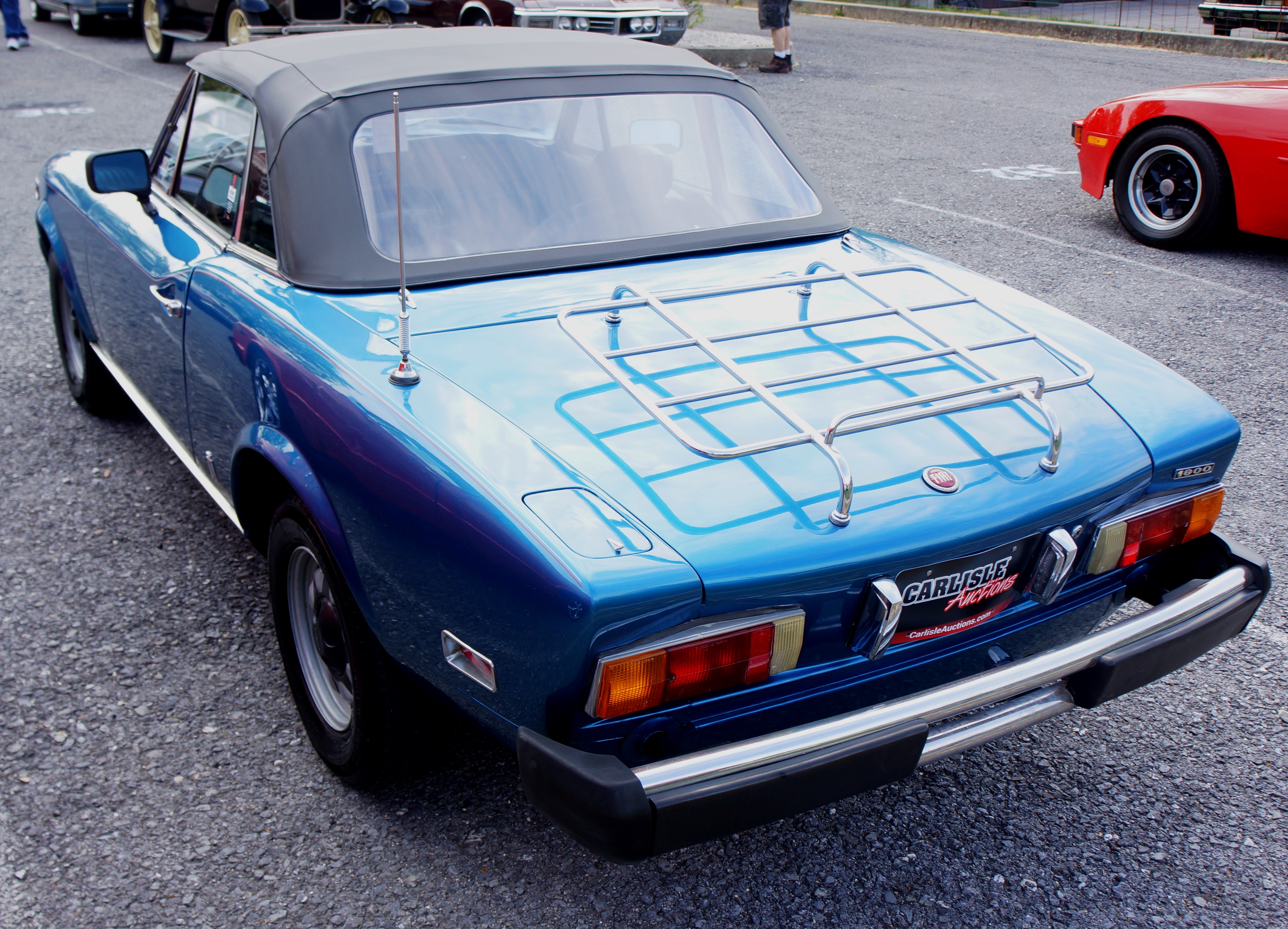
F330 1977 Fiat 124 spider, 124CS10120860, blue metallic, black top, black vinyl interior, Fiat alloy wheels. No visible rust, paint looks OK if a bit thick in places, not sure that this shade of blue is a factory Fiat color. Interior decent at first glance; however, steering wheel cracked. Gauges and seats show no obvious problems. With a new Fiat 124 spider due to hit dealerships in the fall, some have speculated that the old Fiats will start to move up the price ladder. The audience here did not agree.
CONDITION: 3
HIGH BID: $4,250, NOT SOLD
RESERVE: $7,000
CPI: $6,000-15,000
1977 Fiat 124 spider
Luggage rack on trunk
Interior OK despite cracked wheel
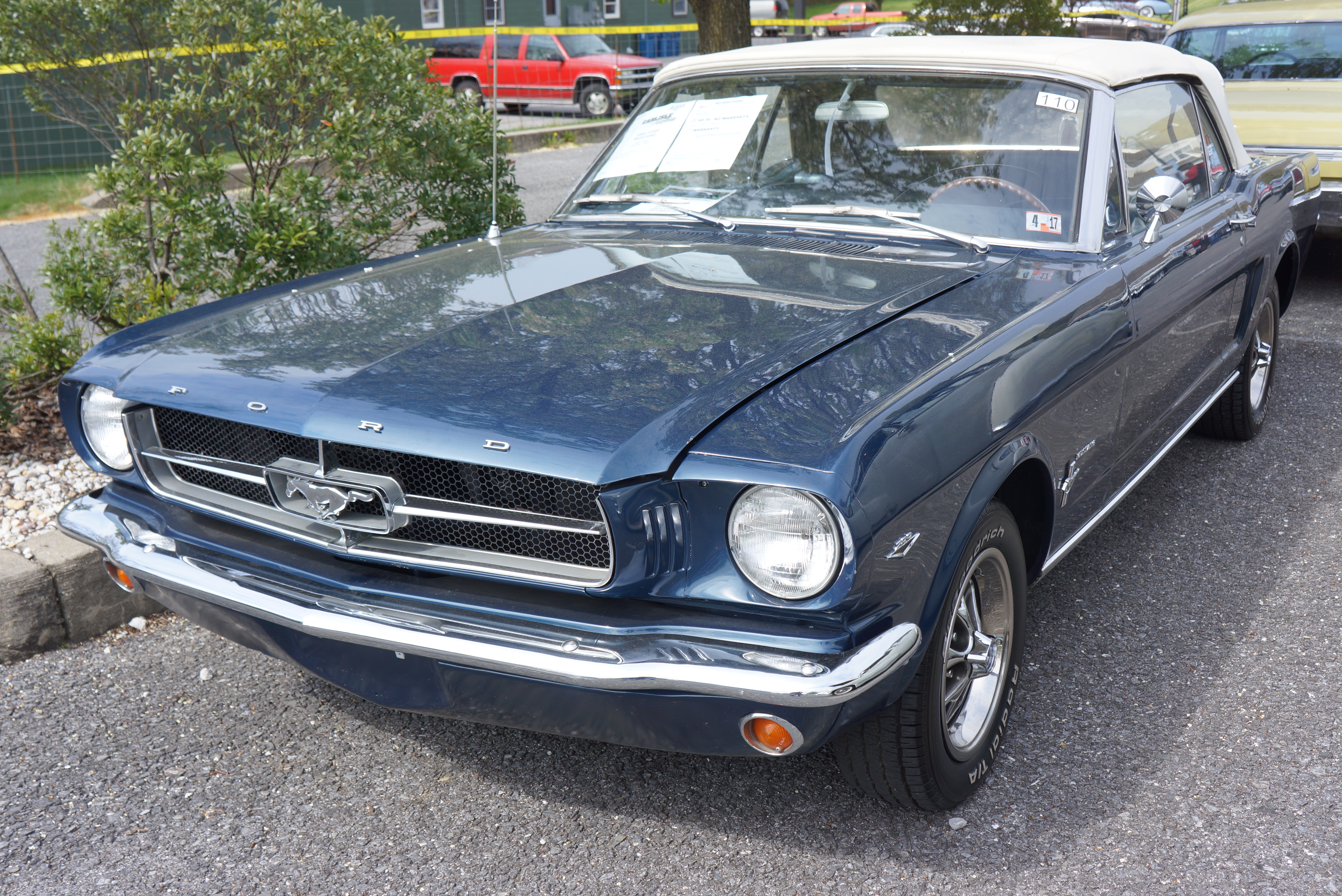
F355 1965 Ford Mustang convertible, dark blue, white top, blue interior. VIN 5F08C776691. 289 V8, 3-speed manual, mileage reads 82,548, claimed to be original miles. Ford styled steel wheels, clean underhood, chrome valve covers and open air cleaner. No Power steering, brakes, or AC. Paint defects in LF fender and door, checked and cracked, possibly older paint job that is letting go. Vinyl top OK but dirty. Wood wheel, center console. Interior presentable overall. JVC cassette unit in dash. Plastic rear window OK. Chrome is so-so, with some pitting. Just a driver, but a V8 drop-top driver. Car has many needs, but only if you’re trying to collect trophies. If you’re looking for cruise night fun, this was a great entry into the hobby, and with a first-gen Mustang V8 convertible to boot.
CONDITION: 3-
HIGH BID: $17,500 SOLD!
CPI: $20,000-42,000
1965 Ford Mustang
Convertible looks good
Some paint defects
3-speed manual, center console
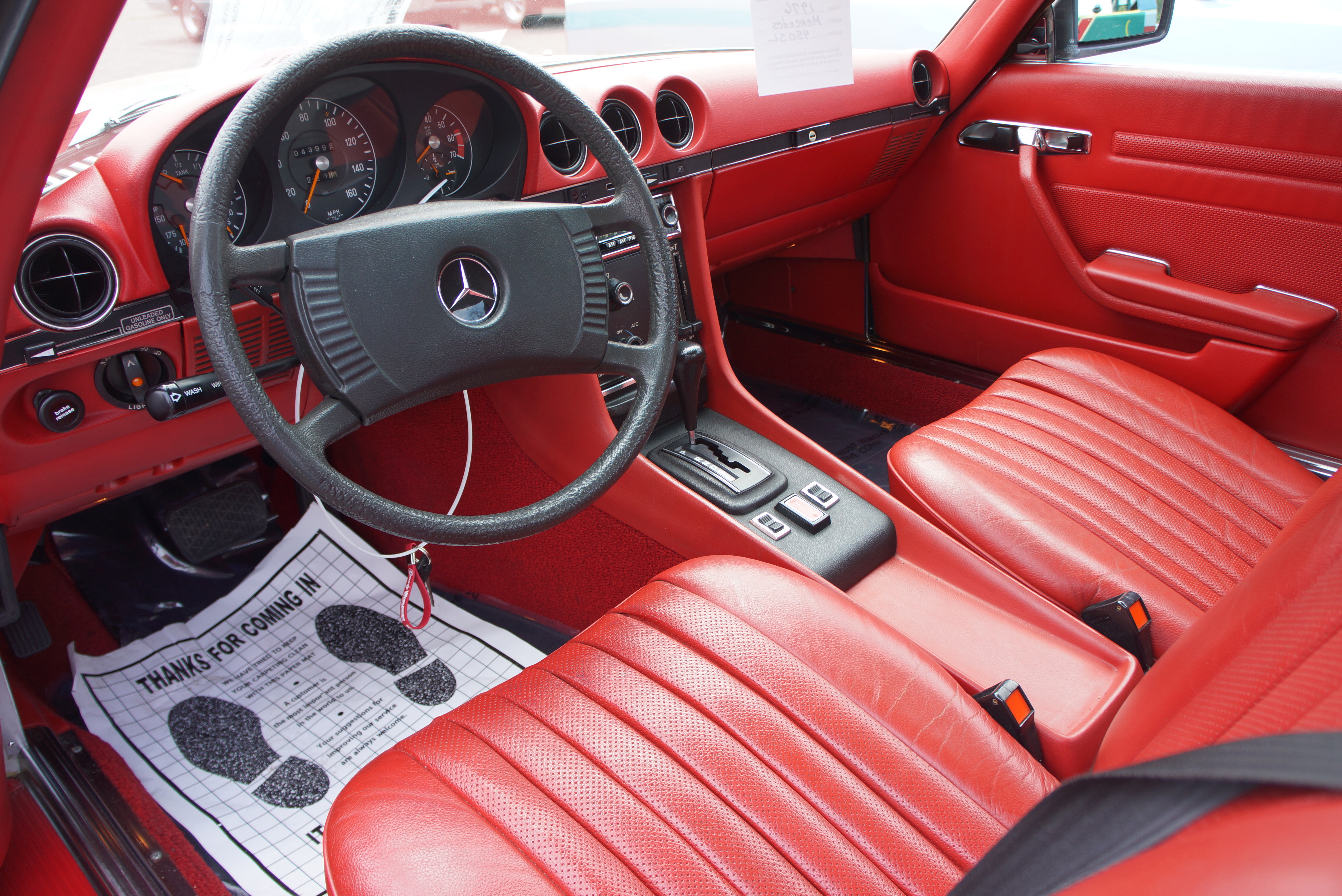
F409 1976 Mercedes Benz 450SL, silver, red interior, hardtop, no sign of soft top. Six-digit odometer reads 043998. Very nice shape outside, looks all original and well kept. Blackwalls on MB alloys. Paint looks good. Red interior striking, very little wear which supports mileage claim. Door panels OK. FMVSS label confirms US spec car, mfd. 9/76. Doors shut like bank vaults. Overall very clean and striking looking car. With a half-dozen of these 107-model SLs here, this one stood out. The result was some of the more spirited bidding of the auction.
CONDITION: 2+
HIGH BID: $17,750, SOLD!
CPI: $10,000-21,000
1976 MB 450 SL
Claimed 43k miles and looks it
Interior looks almost new
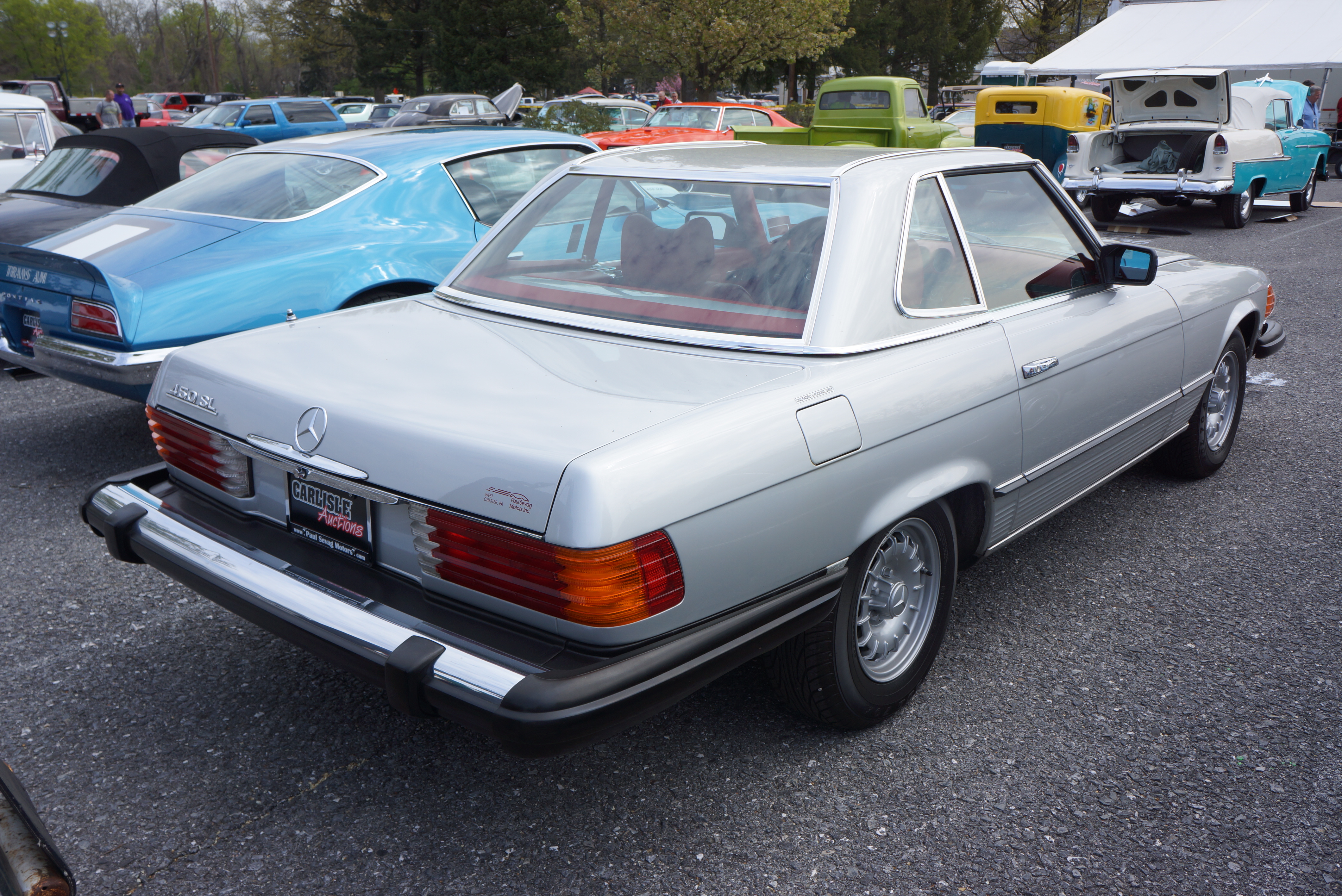
T117 1980 Mercedes Benz 450 SL, VIN 10704412065489, mileage is 129,734. New tires, soft top included, hard top in place. Gold with dark brown interior. Aftermarket lights in front plate look tacky, front fog lights, blackwalls on MB alloys, car is dirty overall. Interior: both seats show leather which is cracked and dried, carpet faded from brown to green. Buyers will step up for high mileage cars which are clean; they will shy away from high mileage cars which are not. There are too many SLs on the market at any time to make this one worth more than what was bid.
CONDITION: 4+
HIGH BID: $5,000, NOT SOLD
RESERVE: unknown
CPI: $12,000-24,000
1980 MB 450 SL
Exterior needs a good detail
Upholstery may be deal-breaker
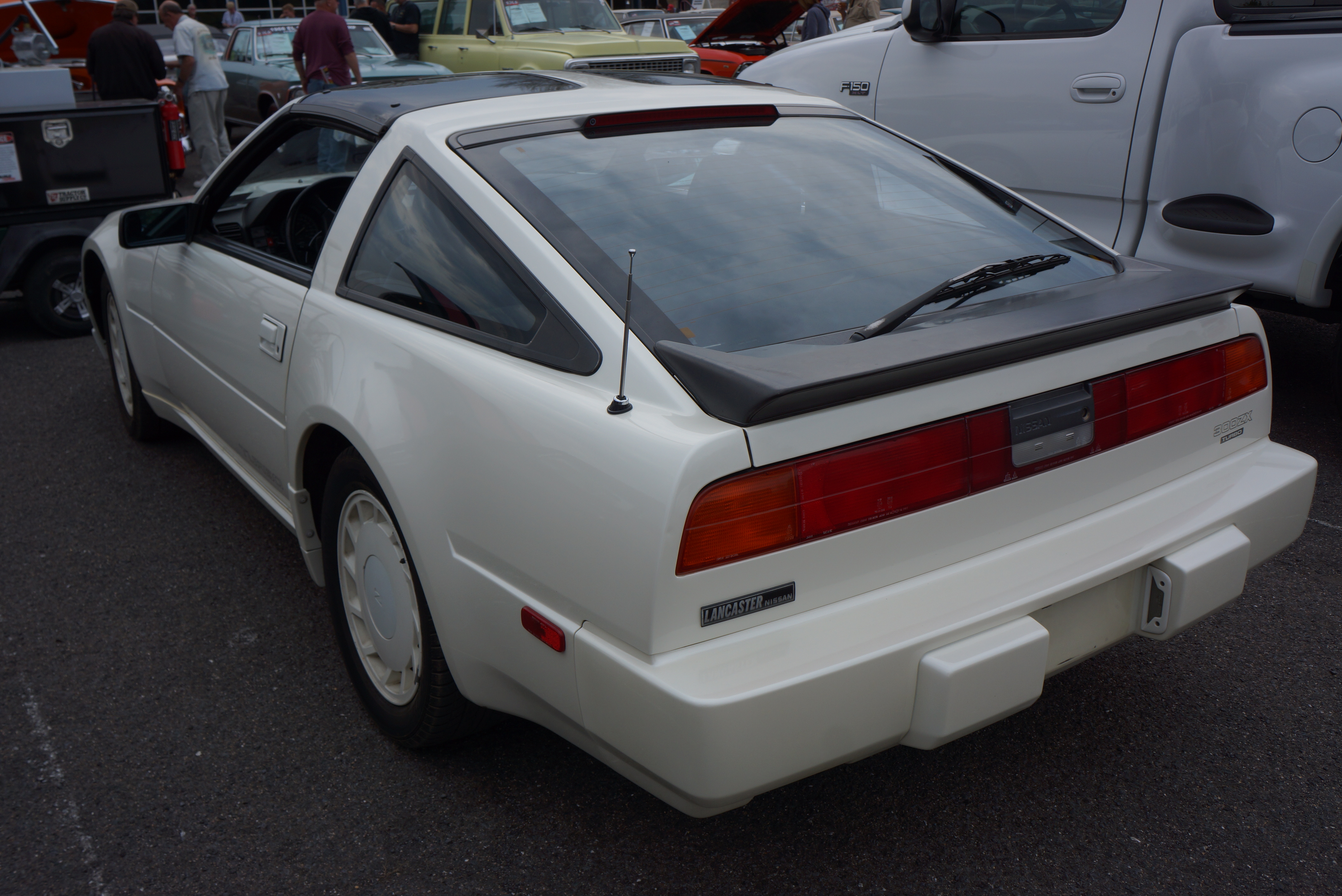
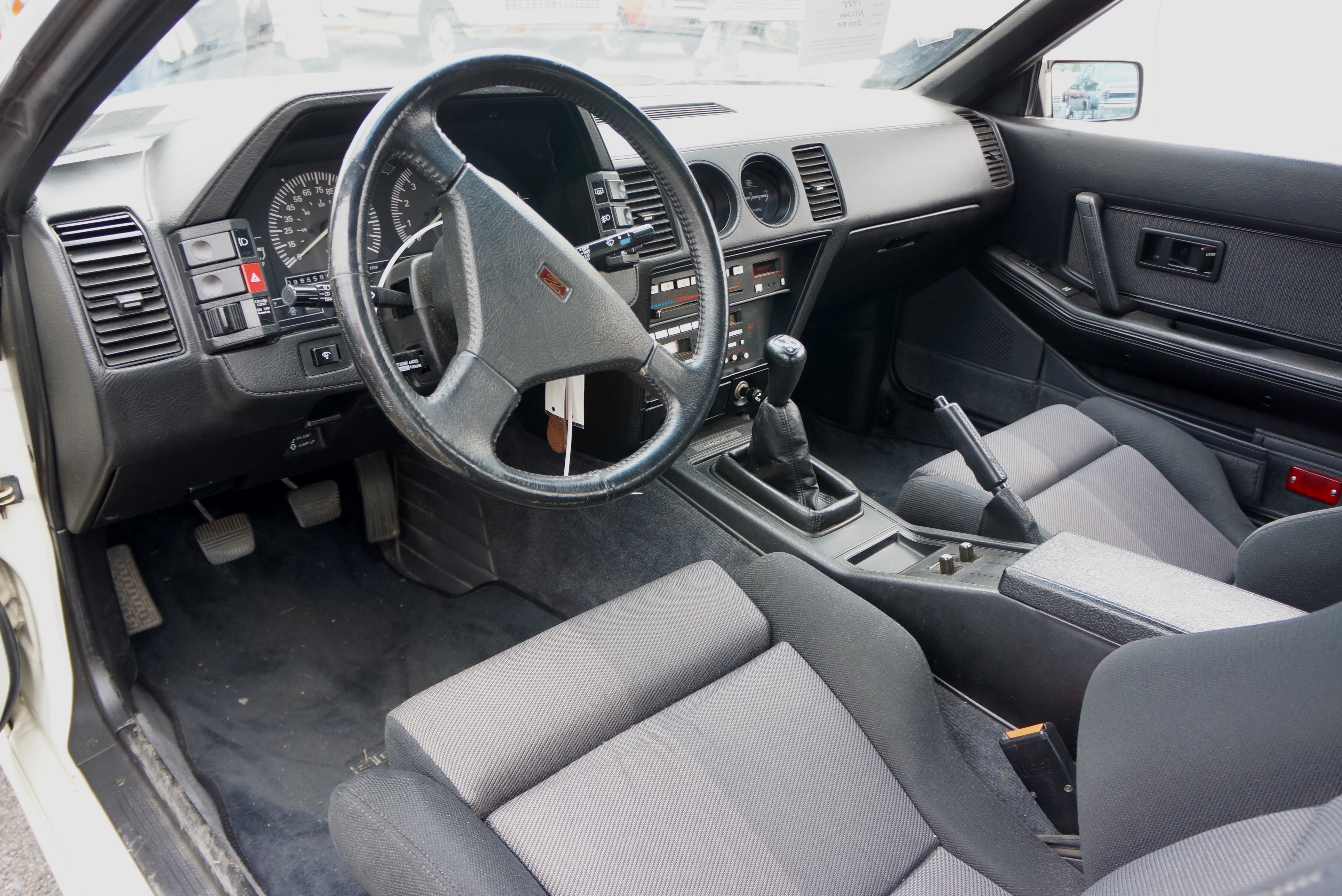
T198 1988 Nissan 300ZX turbo, VIN JN1CZ14S0JX203504, white, grey and black interior. Six-digit odometer reads 098558. Shiro special edition , 5-speed manual, Recaro seats. Pearl white paint with matching wheels scream ‘80s disco. Minor wear on driver’s seat bolster. Interior looks OK, has T-tops. Black rear spoiler faded to light grey. These Shiro cars, of which a little over a thousand were made, play to a very narrow audience. CPI does not call out a separate price for the Shiro package. Car was seen the next day across the street in the Car Corral, with an ask of $12,900, but on the block, it was said that “10” would get it done. Caveat Emptor.
CONDITION: 3+
HIGH BID: $8,000, NOT SOLD
RESERVE: $10,000
CPI: $5,000-10,000
1988 Nissan 300ZX Turbo
Shiro model includes matching wheels
Recaro seats are nice touch
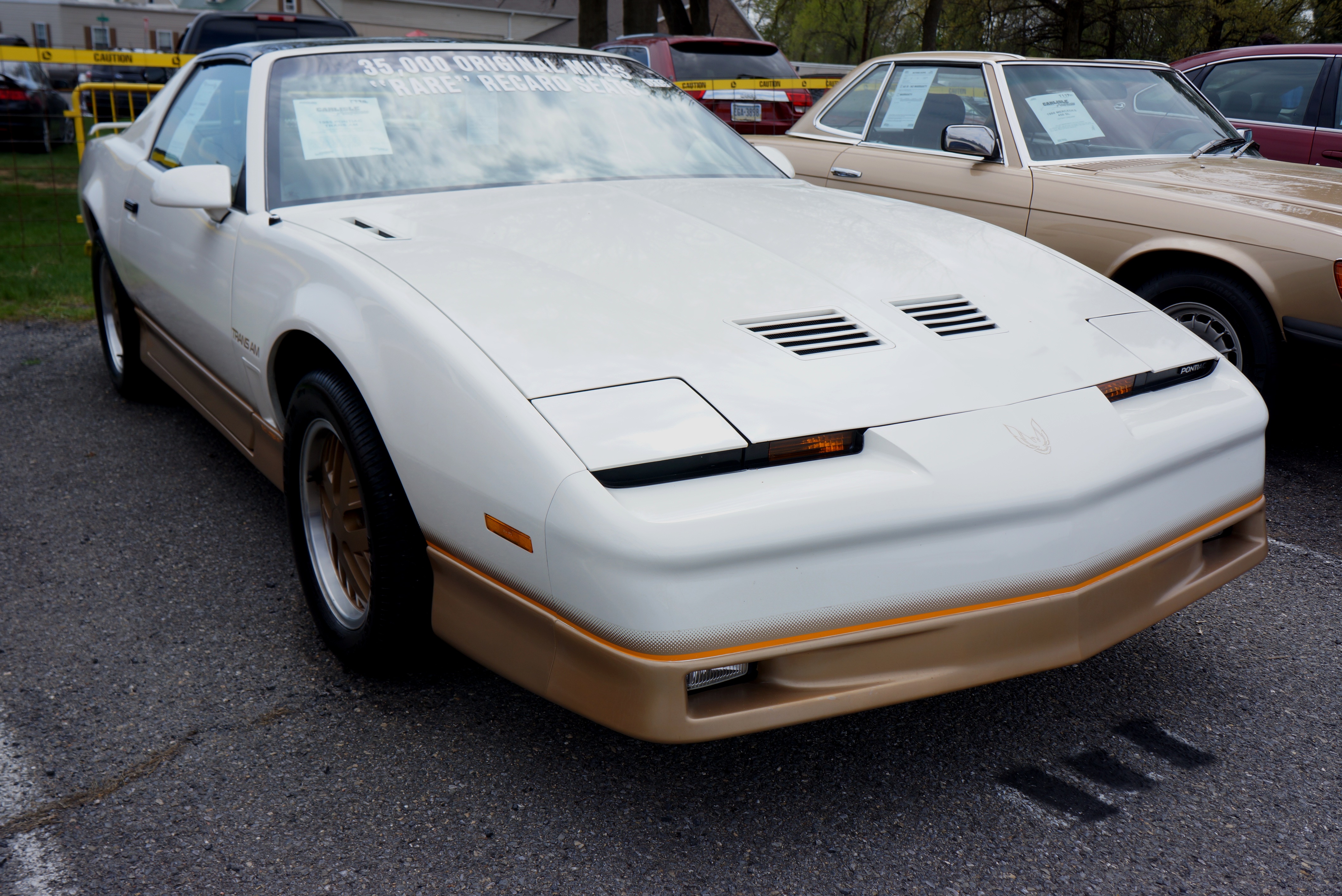
T118 1986 Pontiac Trans Am, VIN 1G2FW87F4FN228262, 5.0 V8 fuel injected, rare Recaro seats, T-tops, white, gold trim, black/tan/grey interior. Odometer reads 35,263, claimed to be original. Paint OK, could use buff out, nose unmarked. Screaming chicken reduced to Cornish hen on hood, B-pillars, and rear valence. Interior condition does support miles, as seats show no wear at all. No signs of wear on wheel, shifter, pedals. A decent looking Trans-Am, and the low miles and Recaro seats make it worth a little more than what was bid.
CONDITION: 2-
HIGH BID: $9,500, NOT SOLD
RESERVE: unknown
CPI: $6,000-13,000
1985 Pontiac Trans Am
Trans Am styling was toned down
Interior supports low mileage claim
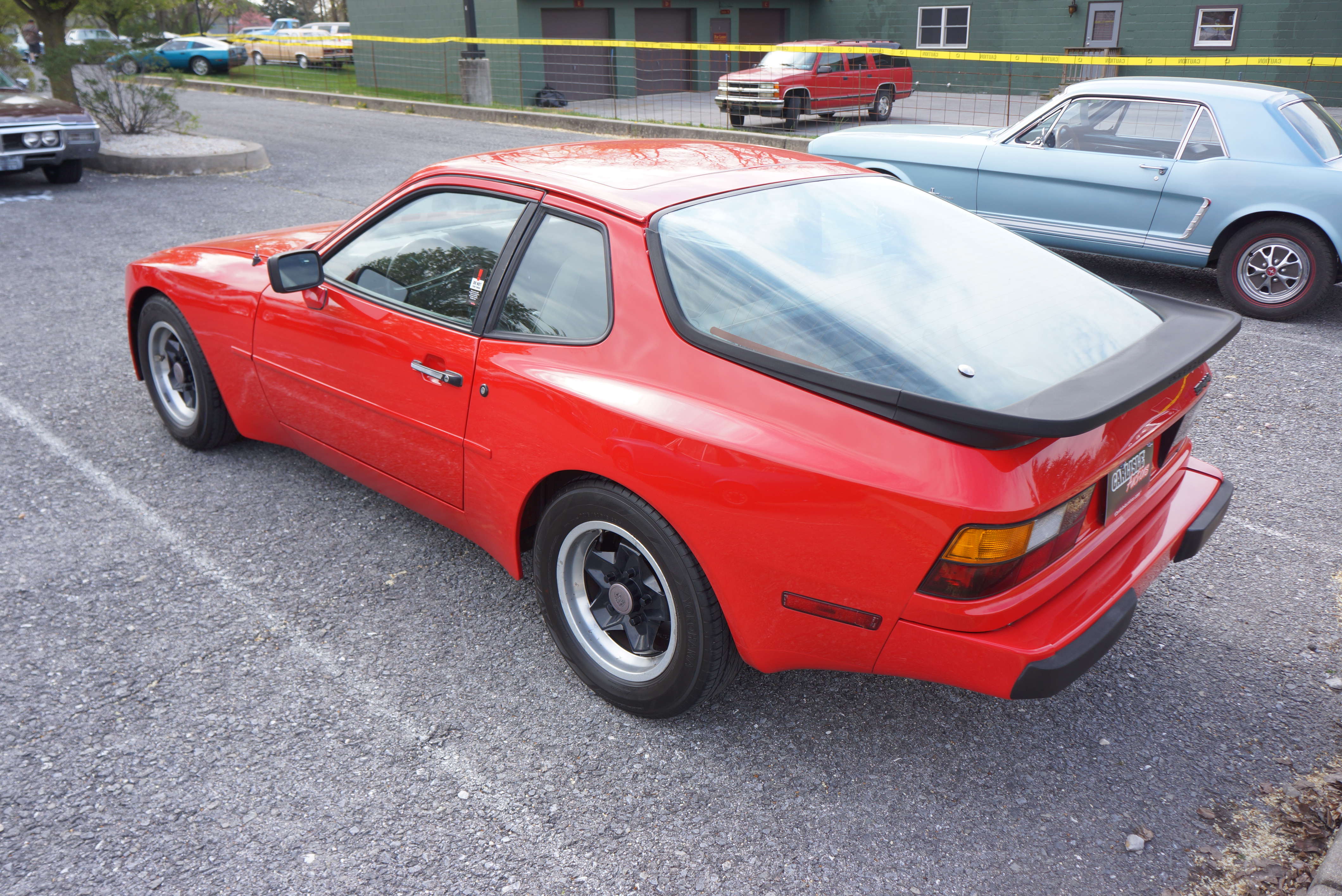
F332 1984 Porsche 944 WP0AA0944EN465320, red, tan interior, 2.5L inline 4, 5 speed, sport seats, sunroof, black and silver Porsche alloys. Odometer reads 61,778, might be on first go-round. Paint looks thick in places, but repaint shows well, with no overspray. Body color side rub strips, some small touch ups. Wheels are slightly marked up. Interior not torn, but dirty, leather dry. Aftermarket Blaupunkt sound system. Porsche floor mats. There are a million (OK, a few less) 924-944 cars for sale at any time, with conditions running the gamut. This car was straight-looking, and if the mileage is accurate, represented a very good buy at the sale price.
CONDITION: 2-
HIGH BID: $4,200, SOLD!
CPI: $7,000-14,000
1984 Porsche 944
Exterior is good overall
Interior shows some wear
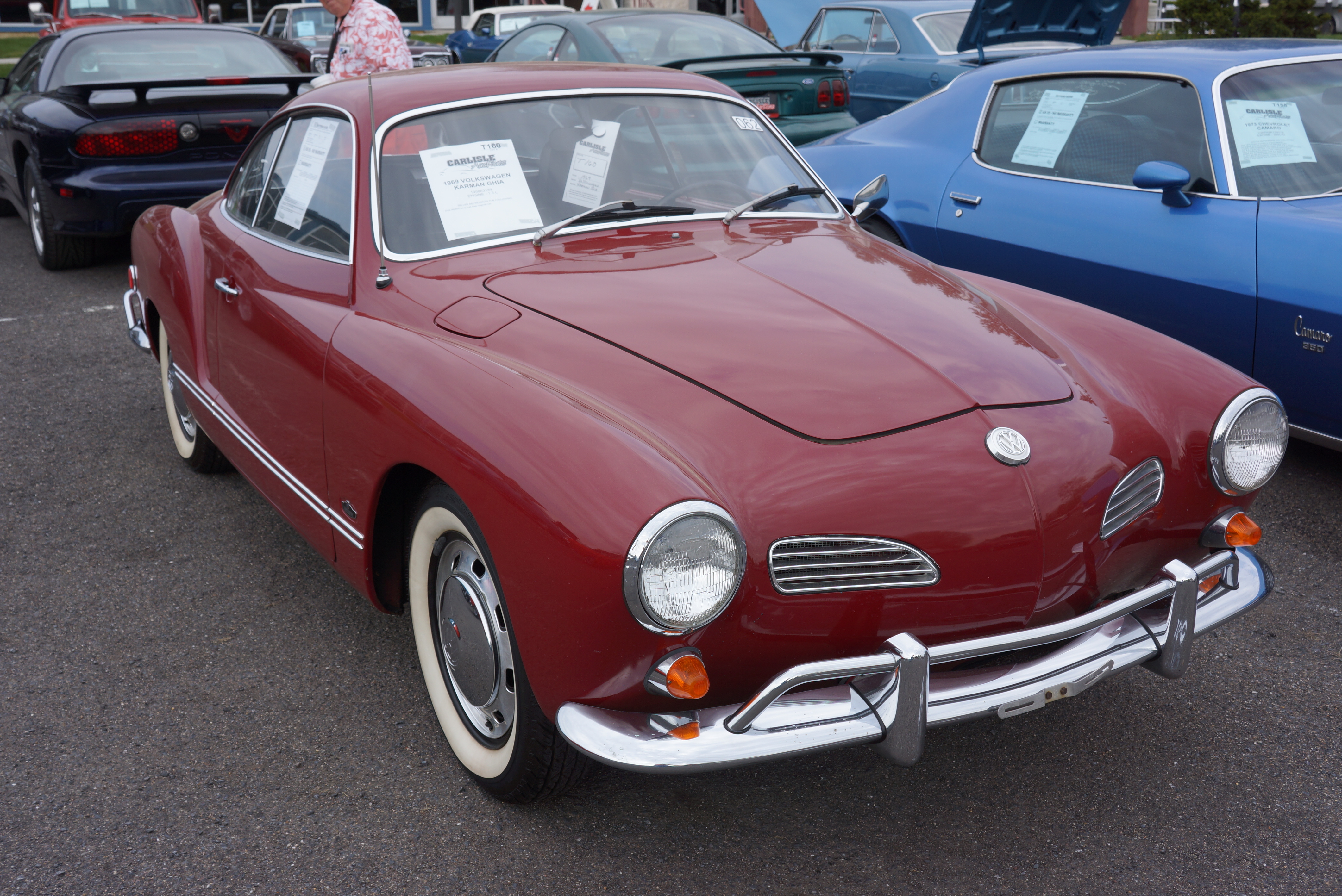
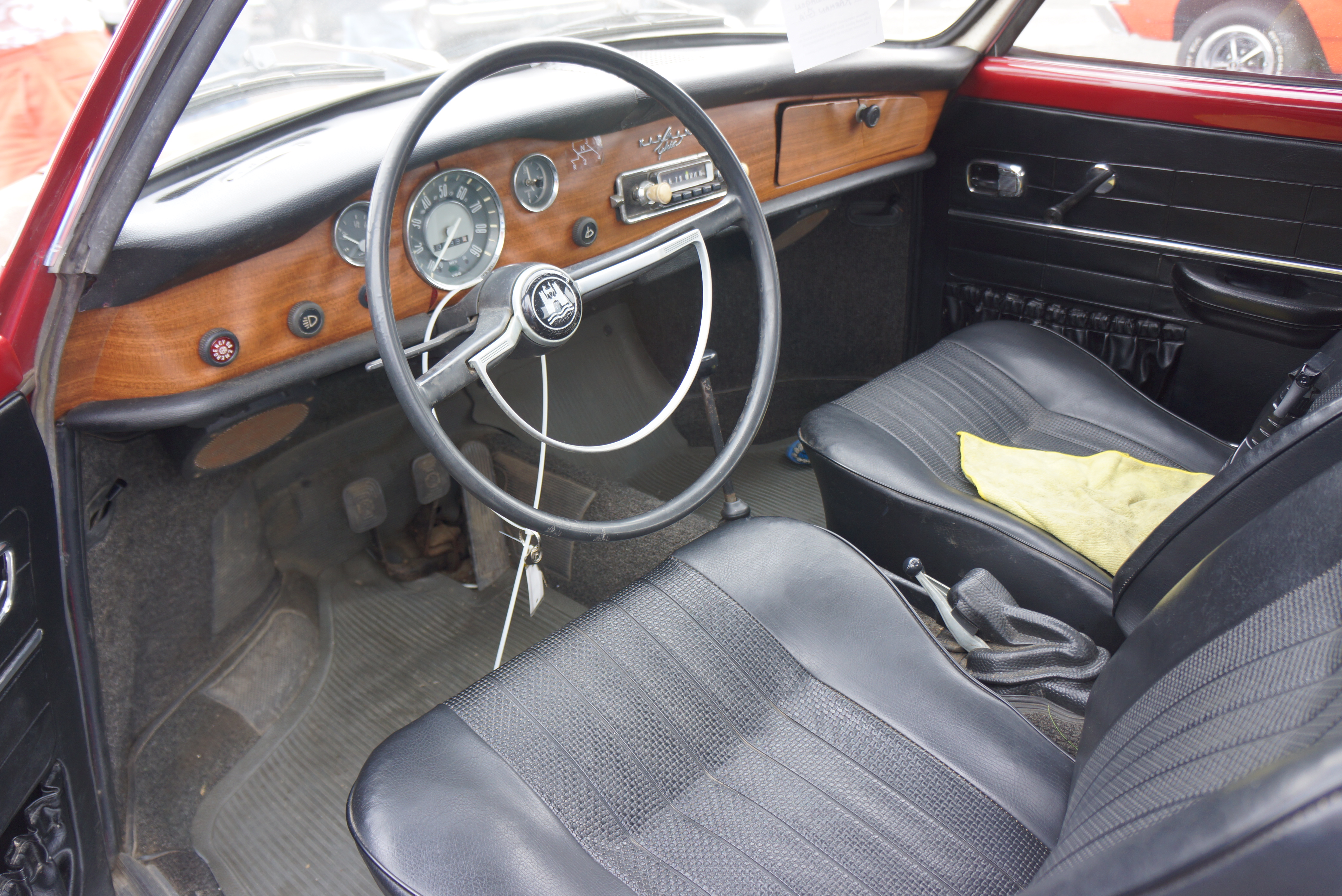
T160 1969 VW Karmann Ghia coupe, 4-speed, odometer reads 63,989, VIN 149863189, dark red, sign says “one repaint on rust free car”, black interior. Rear side reflectors, no front reflectors. Wide white wall tires look out of place on late ‘60s car. Nose unbent. Black wipers look out of place, all outside stainless trim is good. Paint looks fresh. Interior smells musty, cracked dash fixed with tape, seat upholstery OK. Carpet shot. FMVSS label confirms US spec car. Overall, car appears original except for repaint. Chrome on bumpers very thin, starting to peel and pit. These sporty VWs used to be all over; the tin worm ate most of the northeast ones, so there was plenty of interest in this honest-looking example, which sold at a number fair to buyer and seller.
CONDITION: 3
HIGH BID: $10,750 SOLD!
CPI: $8,000-19,000
1969 VW Karmann Ghia
Back end shows side markers
Interior worn but all there
QUICKIES:
T147, 1940 Ford Coupe: This Ford looked completely stock on the outside, but had an early ‘50s Cadillac V8 under the hood. It was a no-sale at a high bid of $32,500.
T175, 1977 Pontiac Firebird “Skybird”: a rare factory option package, the blue-on-blue is not for everyone, but it is different. Sold at $9,750.
T183, 1962 Buick Invicta convertible: striking in off-white with a two-tone tan and beige interior, this was one of the few auctions cars almost worthy of a #1 condition rating. Sold for $25,500. Have the only one at the next Cars & Coffee.
F312, 1966 Ford Mustang convertible: a late entry, this car’s two-tone pony interior was striking, but possibly was the only good thing about it. Quickie repaint in blah beige, filthy underhood, it was bid to $17,500 and not sold. Owner should have cut it loose (see lot F355 above).
F314, 1989 Porsche 944: With 81,000 miles, an automatic, and rock-hard leather seats, it is amazing that this car sold for $6,100, or almost $2,000 more than lot F332.
F319, 1974 MGB: Cosmetically, this car was almost perfect. However, we observed the Carlisle staff struggle to get it running on Thursday. Friday morning, we struck up a conversation with the owner while he “tuned it up”. He told us he had just bought it (to flip it), but the spark plugs were hand-tight, and the distributor hold-down was completely loose, so at idle, the engine vibration constantly changed the timing. It did drive OK across the block, where it sold for $13,100.
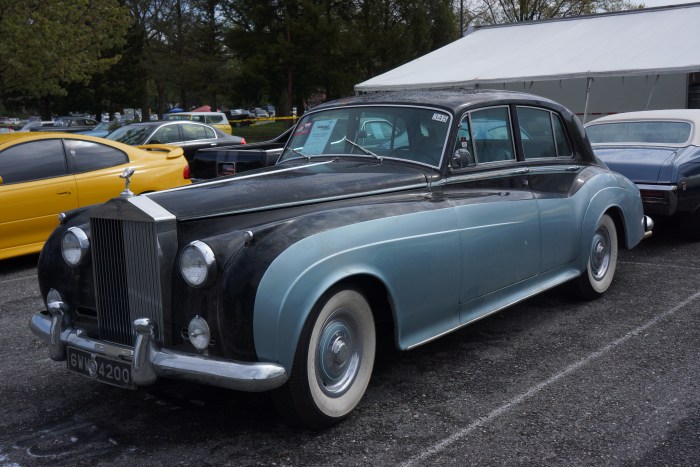
F434, 1960 Rolls Royce Silver Cloud: My photo does not do justice to the poor paint on this automobile. A literal barn find, one observer was overhead to mutter “the most expensive car in the world is a cheap Rolls Royce”. Bidding shocked me when it sailed past $5,000 to end at $8,900.
F469, 1994 Jaguar XJS V12 convertible: The colors were right, as it’s hard to argue with BRG and saddle, but this car gave off a vibe of neglect. If you’re not afraid of the big 12, perhaps you could do worse than the successful bidder who took this home for $8,500.
































































 richardscarblog