Part of my frustration in putting that blog post together was the lack of any hard information about Auburn Speedster values, either based on recent sales or on numbers published in price guides. So I was pleasantly surprised when I leafed through my copy of the 2020 edition of Keith Martin’s Sports Car Market Pocket Price Guide, and found figures for Auburn Speedsters!
First, there was an 8-cylinder Speedster made from ’31-’34, which I had neglected to mention. The SCM median price for that model is $245,000. The V12 Speedster from the same vintage is shown with a value of $410,000. The 1935-1936 Speedster (they are all boattails) with the supercharged straight 8 sits at the top of the heap: SCM claims a median price of $756,000.
These numbers baffled me, because I expected the V12 to be more highly valued than the 8, even if the 8 was supercharged. Googling some further images solved that puzzle. The ’31-’34 Speedsters, while attractive cars, carried over a linearity from the 1920’s in their styling. A vertical grille, standalone headlamps, dual sidemounts, and bulky running boards stood in stark contrast to its reclining windshield and new-fangled boat tail.
When I compared this model with the updated ’35-’36, I understood why market values are higher for the newer car. All its features are swept back, making it look like it’s going 90 standing still. The fenders have started to become integrated with the body. The entire exterior appears to be more of a single piece of sculpture. While each car would draw a crowd today (and certainly did in the 1930s), there’s no mistaking the supercharged model as the prettier ride.
By the way, supercharging, like turbocharging, provides a lot more grunt with fewer cubes. The Lycoming V12, with 392 cubic inches, produced 160 horsepower. The I-8 with 280 c.i. pushed out 150 boosted ponies, impressive for 1935.
Let’s also quote some interesting sales facts from this article:
A writer from Sports Illustrated magazine in attendance claimed that “the standing record price for a car at auction was $45,000 for ‘the legendary ‘Harry Johnson’ Mercer back in 1968”.
A Duesenberg Le Baron Phaeton was reportedly bid to $66,000, but did not meet reserve and was declared a ‘no sale’.
The highest sale price of the auction was $20,000, for a 12-cylinder Auburn Speedster. It was reported that the new owner planned to drive the Auburn from the auction location in Philadelphia back to his residence in Indiana.
Reading some of these numbers from the perspective of 2020 is dizzying. The $45,000 record sale price would today barely get you into a near-luxury sedan or SUV. Checking my June 1971 Car & Driver, I see that a new 1971 Corvette with a 454 LS6 engine listed for $7,619. A new 1971 Volvo 142E had a list price of $4,032. The back cover ad for the de Tomaso Pantera stated that the car is “around $10,000”. So twenty grand in 1971 dollars for any car, much less an old Auburn, was a lot of coin.
A 12-cylinder Auburn Speedster is, of course, the striking boattail. My reference books indicate that the V-12 Speedsters were made for two model years only, 1932-1933. The 1933 model cost $1,745 new (a 1933 Ford V8 cabriolet was $585). This was during the Great Depression! It’s a coveted model today, so coveted that an entire cottage industry has sprung up building replicas which tend to sell in the $40,000-60,000 range, if Mecum’s recent sales of them are an indicator.
The 1971 sale car was a real one – the ‘tribute’ market had not been born yet. In 1971, $20,000 could have bought 2 Panteras, or 3 Corvettes, or 5 Volvos, any of which would have served as more reliable daily drivers than an Auburn. So spending twenty large ones on an old car was a real indulgence. Did the owner keep it? If so, for how long? When he sold it, did he earn a profit on the sale? If he or his heirs still own the car today, what is it worth?
There are very few recent documented sales of real Auburn boattail Speedsters. Mecum, at its January 2020 Kissimmee auction, sold a RHD one that needed extensive engine and other mechanical work for $440,000. There is exactly one on Hemmings.com at present, with a supercharged 8 and not a V12, carrying an ask of $795,000. If we split the difference and state that an Auburn Speedster might be worth $600,000 in the real world, that’s a 30-fold increase in value over 49 years.
Wait. We have no idea of this Auburn’s condition in 1971. Sure, it was reported that the new owner planned to drive it back to Indiana, which doesn’t mean that the paint and interior were pristine. Once home, he had to garage it; insure it; perform routine maintenance on it; refresh its cosmetics; acquire a tow vehicle and trailer so as not to sully its refreshed cosmetics; make repairs as items wore out or broke; replace the battery, fluids, tires, brakes, and rubber parts on a regular basis; and so on.
If the car saw any regular use, chances are it would have reached the point where it needed a complete restoration. Even without regular use, cars which sit deteriorate. Depending on how it was stored, maintained, and used, it’s not unreasonable that decades later, it may have needed yet another restoration. Any calculation of ‘final sale price’ as an indicator of profit ignores the decades of maintenance and repair necessary when a valuable old car is under your care.
Old-car enthusiasts who are not active owners seem to presume that all old cars increase in value. I’ve heard it, I’ve read it, and I’ve had it said to me when showing one of my own cars at an event. The conversation goes something like this:
Show-goer: “Hey, nice car! I bet that thing is worth some money!”
Me: “Well, maybe it is, but I’m in the hobby to enjoy the cars and the people”.
Show-goer: “Hey, if you don’t mind my asking, what’s that thing worth?”
Me: “Well, I’m not really sure. Any number I quote is just a figure from a piece of paper anyway”.
Show-goer: “Well, I bet you’re sure that you’re gonna make a killing on that thing when you go to sell it!”
Me: “We’ll see. It’s not for sale, and like I said, I’m in this hobby to enjoy it without focusing on values too much”.
Do classic cars increase in value? The answer is almost certainly “yes”. However, the intrinsic value of the car, its condition, and the length of time between two sale points all play significant roles in any potential value increase. A 1933 Ford 4-door sedan is very likely worth more today than it was in 1971. But there is no comparing such a car with a genuine Auburn boattail. Perhaps the biggest argument against the Ford would be its lack of desirability in today’s collector car market.
I still see too many ‘collectors’ who are more focused on future values than they are on the enjoyment that the hobby can bring. Following recent auction trends, it’s not unusual to see the same cars repeatedly dragged across the block, and either failing to meet an unreasonable reserve, or actually selling for less than the car sold for the previous year. It’s a complete oversimplification to look at this 1971 Auburn sales result and exclaim “I told you that there’s money to be made doing this!” Sure. Would you have had that kind of spare cash in 1971 AND have been able to wait 49 years before reselling? I didn’t think so.
If I had known when I met Kirk White that he did indeed kick-start this entire collector car auction mania, I would have personally thanked him. Are all car auctions great? No. Does every vehicle sold at auction hammer for a number higher than its previous sale? Absolutely not. Have auctions brought many more people into the hobby and served as a source of education and entertainment for collector car enthusiasts? We can only answer that with an unqualified ‘yes’.
Old Postcards Part 1 covered postcards of the two New York World’s Fairs. These three postcards below found in my dad’s collection are a potpourri: two are from Cape Cod MA, one of the places my father liked to visit when he traveled (which was infrequent), and the third is an advert for the Datsun 210. I can hear the youngin’s from here: “What’s a Datsun?”
“BEACH BUGGIES TOURING THE SAND DUNES ALONG RACE POINT, PROVINCETOWN, CAPE COD, MASS.”
So reads the back of this postcard. Beach buggies? The ‘buggy’ in question is an International Harvester Travelall, a forerunner to today’s ubiquitous SUV. Looking at that soft sand, I’m not sure I’d trust ANY 4WD vehicle to return to pavement, but obviously, the folks who ran these tours found these trucks to be up to the job. Carrying capacity was another advantage. Presuming the vehicle had 3 rows of bench seats, it could likely accommodate a driver plus 8 passengers, adding to the tour company’s revenue per outing.
Relying as I do on Wikipedia, it appears that the pictured Travelall is a model year 1968, the last year for this body style. That conclusion is based on the rear quarter panel trim, which seems to have been a 1968-only treatment. In 1969, the Travelall was redesigned and bore an appearance very similar to the smaller IH Scout.
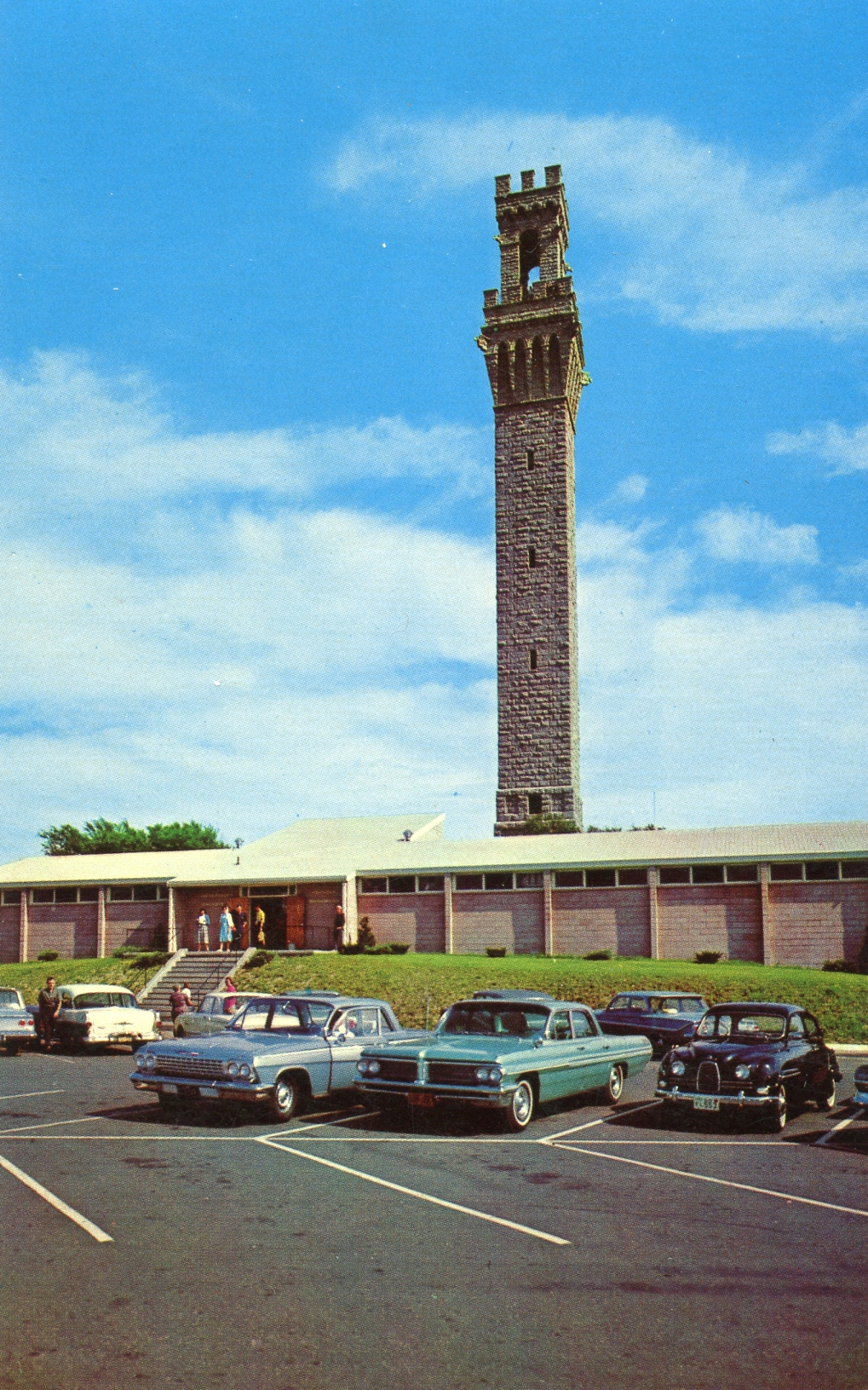
“PROVINCETOWN MUSEUM WITH PILGRIM MONUMENT IN BACKGROUND, PROVINCETOWN, CAPE COD, MASS.”
I can’t say that I recognize either the museum or the monument, but I do recognize all the cars in the parking lot. Was GM having a convention that weekend? Did the Saab owner know that someday the brand would be owned by GM? I kid. Among the GM cars are two ’61 Chevrolets, a ’62 Chevrolet, ’55 and ’62 Pontiacs, and behind the ’62 Chevy, perhaps an early ‘60s Ford Falcon.
At first I had a difficult time determining if the Saab was a late-50s 93, or an early-60s 96, as their front ends are nearly identical. However, the 93s had ‘suicide’ doors while the 96’s doors were hinged conventionally, as appears here. The front grille was substantially redesigned in 1965, putting the postcard car into the 1960-1964 model year range. So except for the ’55 Pontiac, all the cars pictured here are of very similar vintage.
“DATSUN 210: Five models to pick from, with one kind of gas mileage…. It’s economy that makes you feel rich.”
The Datsun 210 had a short run in the U.S.: the model was sold here only from 1979 through 1982. There were indeed 5 body styles: a two-door sedan, four-door sedan, five-door wagon, three-door hatchback coupe, and a special 210MPG two-door sedan.
The U.S. was hit with its 2nd gas crisis of the decade in 1979, so Datsun’s timing was, shall we say, fortunate. The wording on the postcard talks about little other than fuel economy, because that’s what Americans were shopping. The 210MPG model, with a reduced horsepower 1.4L engine and a five-speed manual gearbox, was rated at 47 mpg on the highway. Perhaps most surprising to me is that this vehicle, like almost all Asian imports at this time, was still RWD.
Datsun was still a few years away from switching over its brand name to Nissan, but do note the corporate Nissan symbol in the bottom left-hand corner.
My dad bought a new Datsun 200SX in the early ‘80s, so no doubt he picked up this free postcard at that time. Was he considering the flashy 210 three-door hatchback coupe in the photo? Didn’t the image of the young man serenading his date with a flute influence his decision?
All images are from my personal collection of postcards.
Last year, we moved my mom out of her house and into an assisted living facility. For almost-94, she’s doing remarkably well. The reason I bring this up is that the effort of moving her out of the home that she occupied for 38 years (25 of those with my dad) has unearthed a cornucopia of items, some of which I haven’t seen in decades, and some of which I’ve never seen before.
Some of my earliest blog postings have been of my father’s cars: his Corvair, his Buick, his Mustang, and his VW Bug. These four vehicles were around when I was a kid, taking my own snaps of them. This posting features photos taken earlier than that, and includes the vehicle my dad owned when my folks got married.
1949(?) Jeep Station Wagon
My dad was an early embracer of SUVs. When the first Wagoneer was introduced in the late ‘60s, he would tell me that he really liked it, although he never did buy one. I knew that when my parents got married in 1950 my father had a “Jeep” (mom didn’t have a license yet), but I knew little about it, until I discovered these photos.
From my research, I pin the year of this rig as 1949. According to Wikipedia, Jeep introduced a 4WD variant in 1949 named the “Utility Wagon”, while the 2WD was called the “Station Wagon”. In 1950, the grille changed to a V-shape and added horizontal bars. This Jeep has the original grille, and “Station Wagon” emblems on the front fenders, so I hereby pronounce it a 1949.
My dad labeled everything (those of you who know me really well now know where I got that habit), and that’s my mom in front of the car with the heading “Vermont Cabin Aug. 1952”. I was born in March ’54, and my folks talked about trips to New England during their early days together.
The second photo is a much clearer shot of the Jeep, with my cousins Marsha and Andy. I would guesstimate this pic as from 1950. Note the open cowl vent, two-piece windshield, dog-dish hubcaps, knobby tires, and inside spare tire mount.
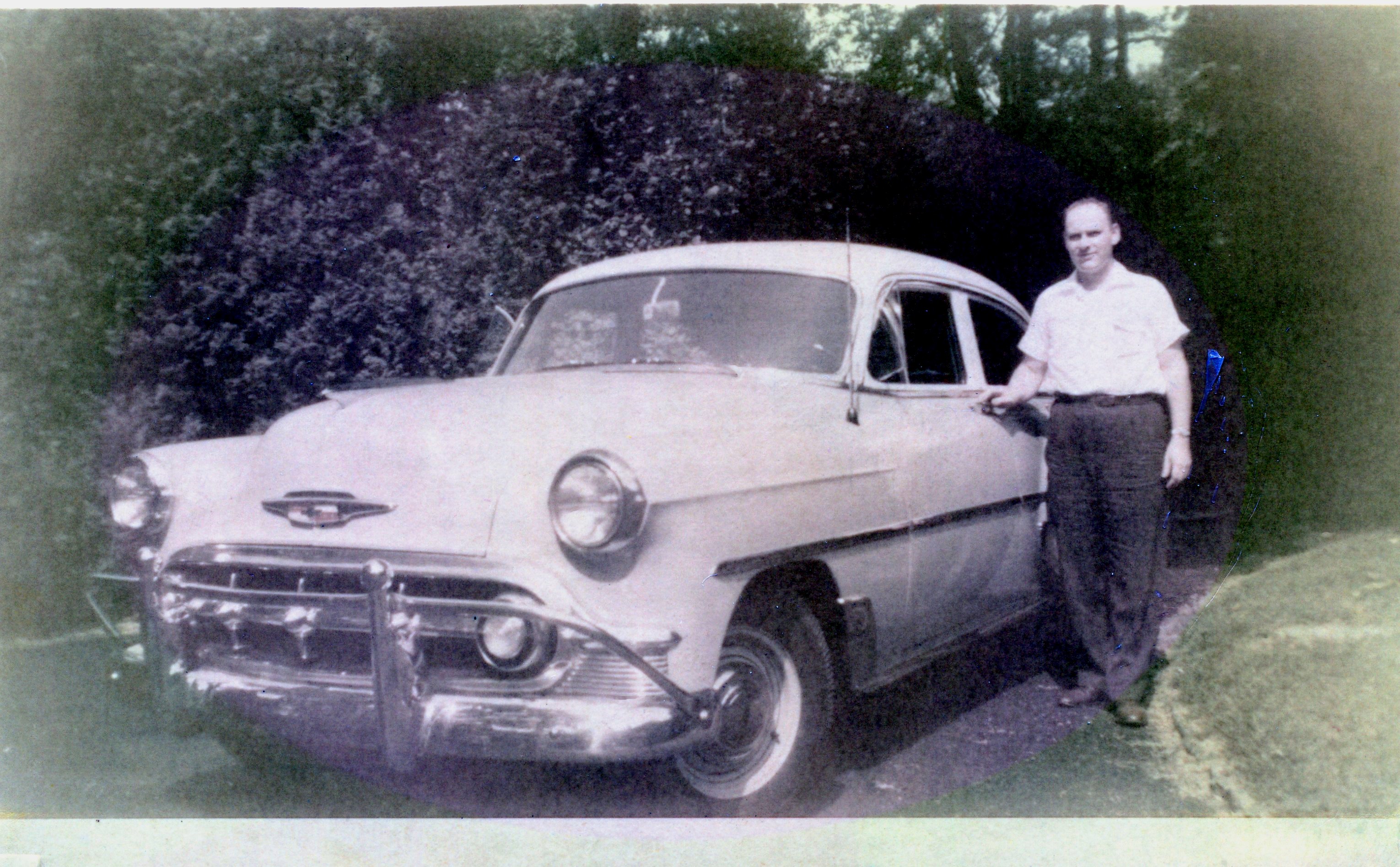
1953 Chevrolet 210 4-door sedan
Dad bought this car new, and I came home from the hospital in this thing. I have vague memories of it, mostly of me staring at the dash while riding in the back seat. This photo is a recent discovery. This is what’s stamped on the back:
“This is a Kodacolor print, made by Eastman Kodak Company, Week of October 26, 1953.”
I’m certain this car was white, but you wouldn’t know it based on this photo. The color print has faded to an almost monochrome sepia. I attempted to color-enhance it, which made marginal improvements. However, you can make out the blue and red in the hood-mounted Chevy emblem. Note the two open vent windows, radio antenna, dog-dish hubcaps, blackwall tires, and accessory front bumper overrider.
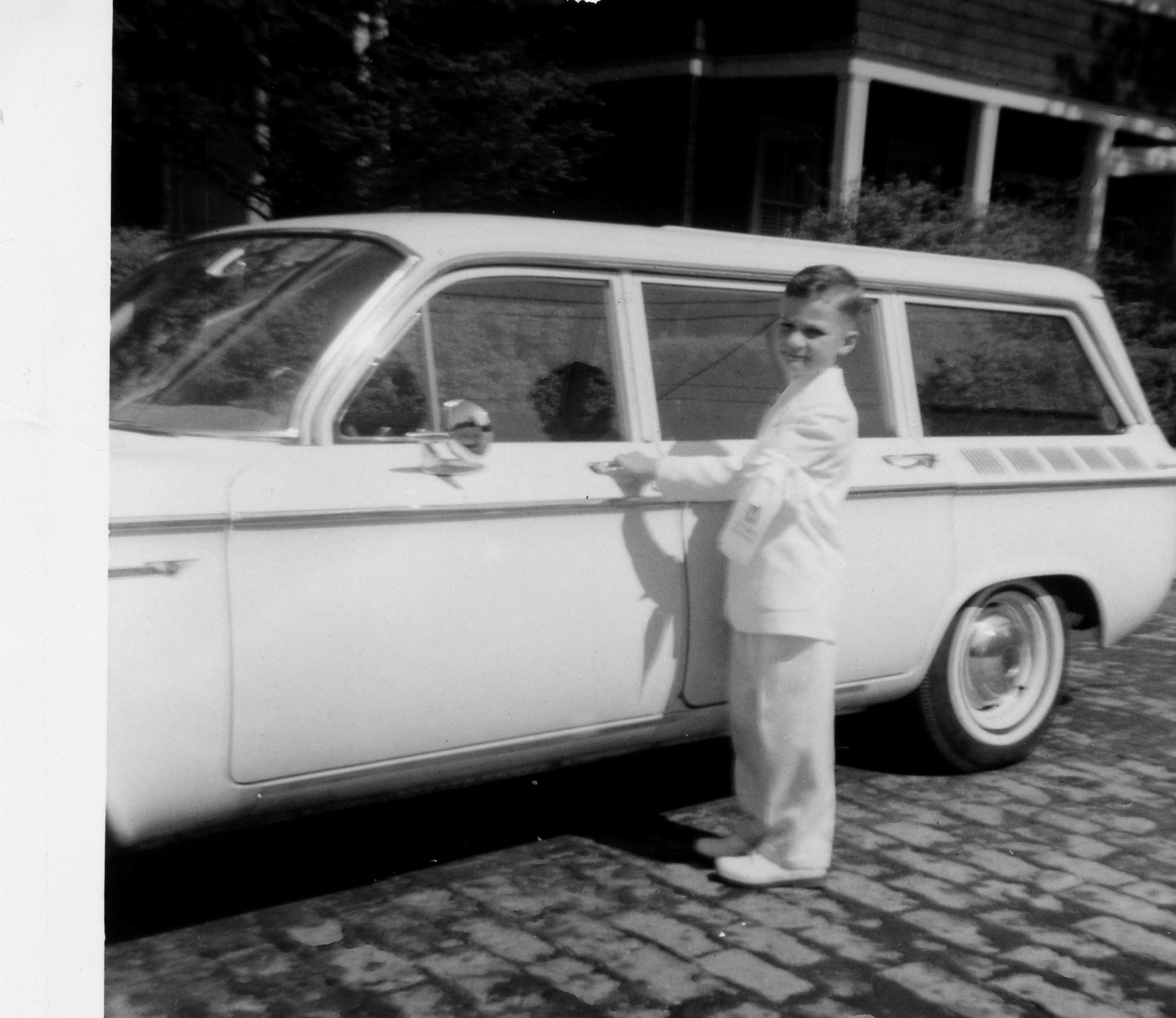
1961 Chevrolet Corvair
Oh, how infatuated my dad was with this car! As most of you know, Chevrolet introduced the new, rear-engine air-cooled Corvair as a 1960 model. Even then, and I was only 6, I can recall his excited tone of voice when talking to my mom about the car (and dad rarely got excited about anything). He waited a year for the station wagon’s introduction in 1961. One of my strongest early automotive memories is riding in the way-back of this wagon when my dad drove it home from the dealership. Both the Jeep and the ’53 were manual gearbox cars. Mom had just gotten her license around this time, and only drove an automatic, and that also drove this purchase decision.
This photo is date-stamped May 1962, and it’s my brother Michael, in his first Communion outfit, acting like he’s about to climb in and drive away. This one was the 700 model (there was also a cheaper 500 version), and dad’s car sports an outside rear-view mirror, dog-dish hubcaps, whitewall tires, and white paint. You can barely see the “Lakewood” emblem just beyond the rear quarter cooling slats.
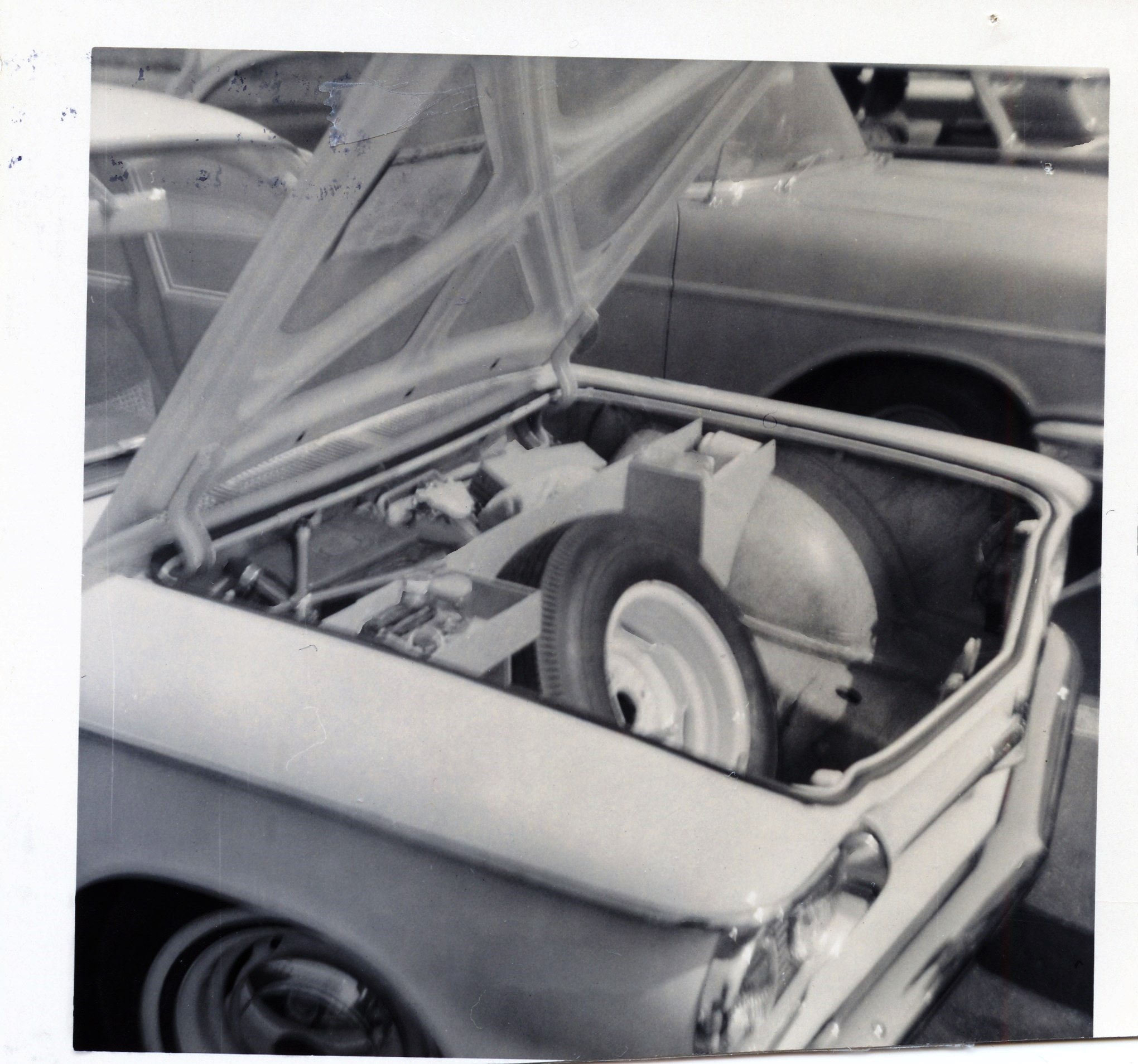
My father enjoyed woodworking, and he found a way to improve his Corvair, by designing and building a storage tray for the front trunk. He sent this photo to a number of magazines, including Popular Mechanics, hoping to get it published, but it didn’t happen. I know he was disappointed by that. Oh, and what’s that car next to the Corvair? Pretty sure I know, but I’ll invite you to guess.
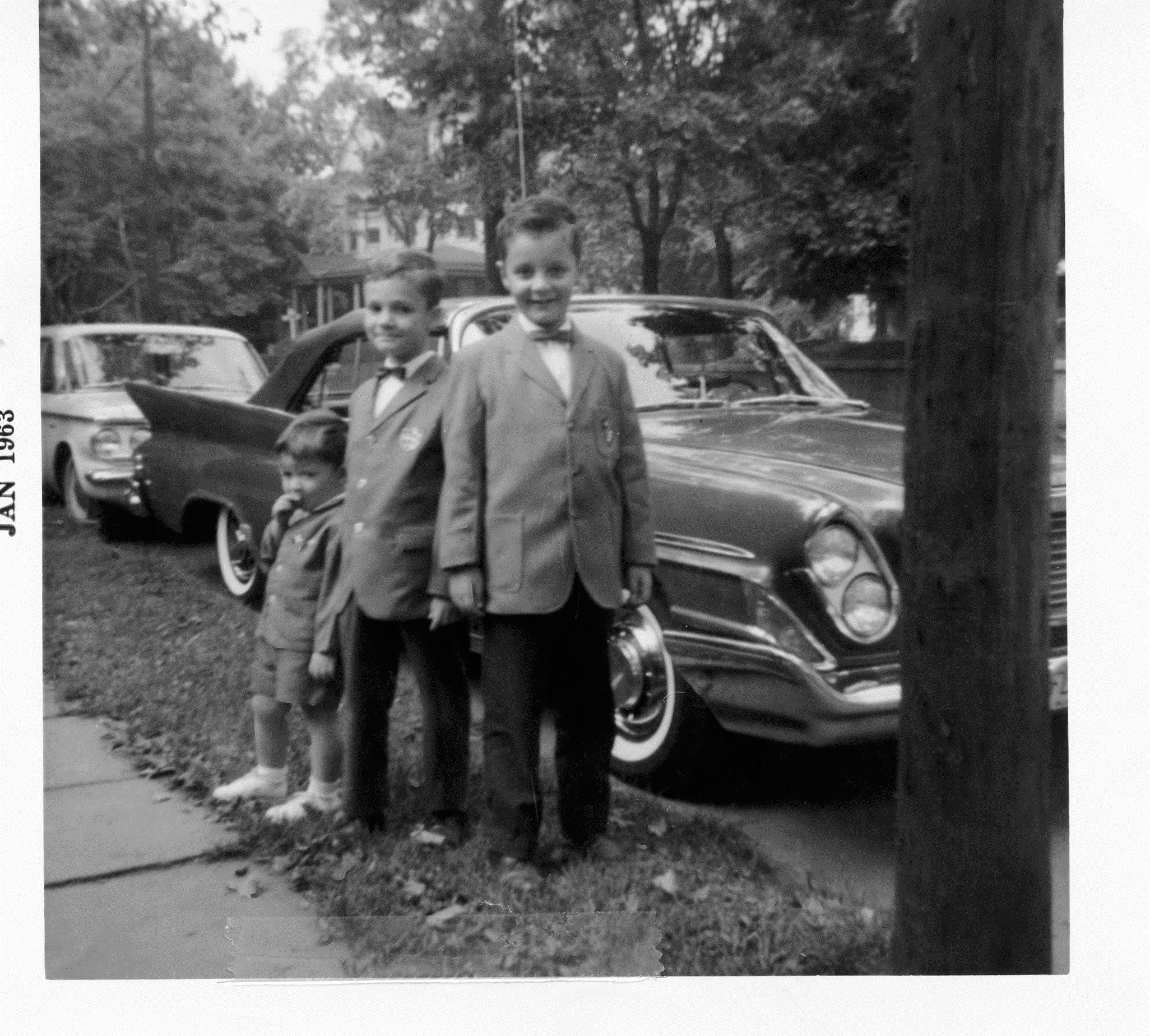
In this 3rd and final shot of the Corvair for this post, the primary subject is my parents’ children. The photo is stamped Jan. 1963 (our clothing would imply it was taken months earlier). From left to right, that’s my brother Karl, my brother Michael, and me; I’m 8, and already a car nut. LOOK WHAT’S DIRECTLY BEHIND US!! A 1961 Chrysler Newport convertible! My research informs me that Chrysler fielded 3 different full-size convertibles that year: Newport, New Yorker, and 300. The grille texture on the 300 was completely different, and the New Yorker had chrome along the wheel well openings. Note the dashboard-mounted inside mirror, canted quad headlights, large bladed front bumper, full wheel covers, and whitewall tires.
There are more of these in some other photo albums at my brother’s house, so watch for future postings of more old family cars!
A big part of this brake project has always been the intention to replace all the hard lines. It was back in the fall of 2019 (days we’ll forever remember as “pre-coronavirus”) when I purchased a 25’ roll of new CuNiFer (copper/nickel/iron) brake line (from FedHill) and all new line fittings (from Classic Alfa), knowing that the day would come when I’d need them.
Well, that day did come, and I’ve spent a somewhat enjoyable last few days in the garage making up the new lines. The rear rotors and calipers have been bolted back in place, so with the old lines as templates, I cut the first two new lines for the two rear calipers to the appropriate lengths.
The creation of new brake lines requires that the ends be flared, which requires a special tool. I have one of those cheap old flaring yokes, a tool I’ve had for so long that I couldn’t tell you the last time I used it. Maybe never. My good friend Mike G owns a high-end brake flaring tool kit made by Eastwood, which he generously loaned to me. I’m going to walk you through the step-by-step process, which on an old Alfa like mine can be a bit tricky! You’ll see in a moment.
The Eastwood brake flaring tool
With the exception of the ¼” hard line from the brake fluid reservoir to the master cylinder, all the other hard lines on the car are 3/16”. That’s the easy part. The fittings, on the other hand, are a mixed bag. The car’s four-wheel ATE calipers use metric M10x1 threads, while most of the remaining connections, such as at both front and rear T-fittings, use UNF 3/8”-24 threads. Further, the M10 end requires an ISO bubble flare, and the 3/8” end takes a double 45° flare. Please don’t ask me why – I’ll just point to the car and say “that’s how the Italians did it!”
The Eastwood tool, which I used for the very first time this week, is a bit intimidating at first. The instructions in the box are ok, but I thought it would be wise to cut a few short pieces of pipe and make some test flares (I purchased about 7 feet more brake line than needed, because sooner or later I’ll make a mistake and need to redo a line).
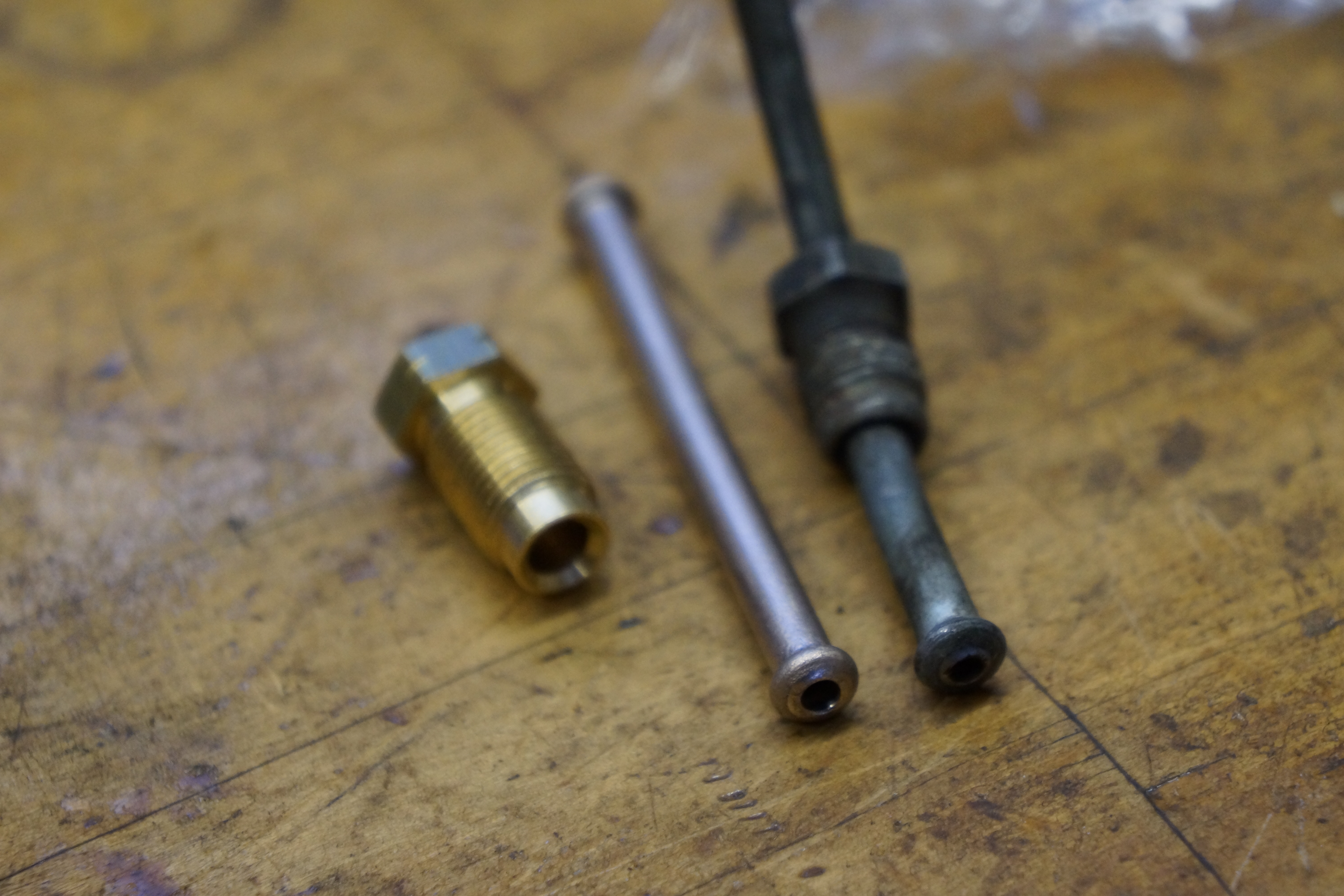
L to R: new fitting, test pipe w/ISO bubble flare, old pipe w/same
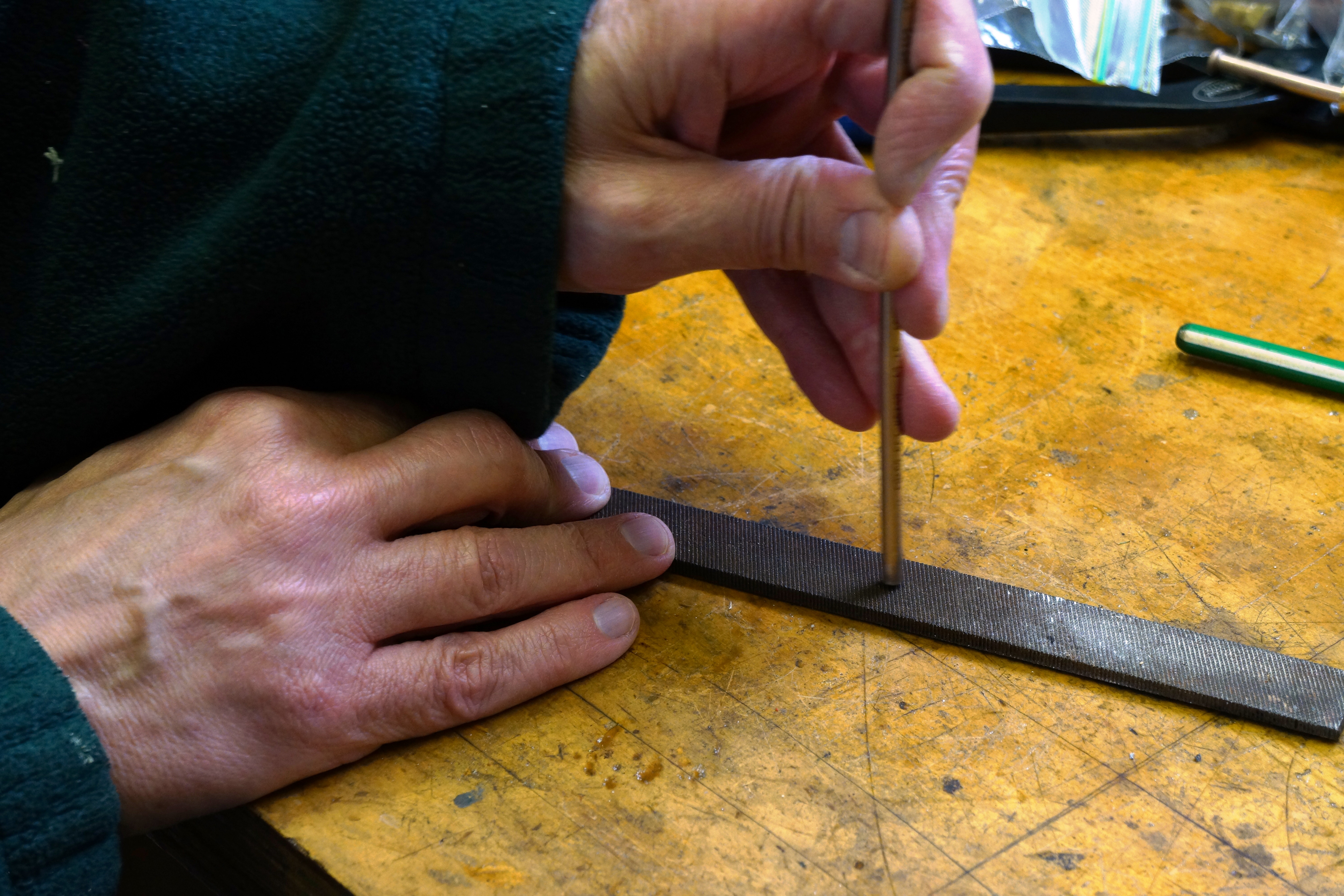
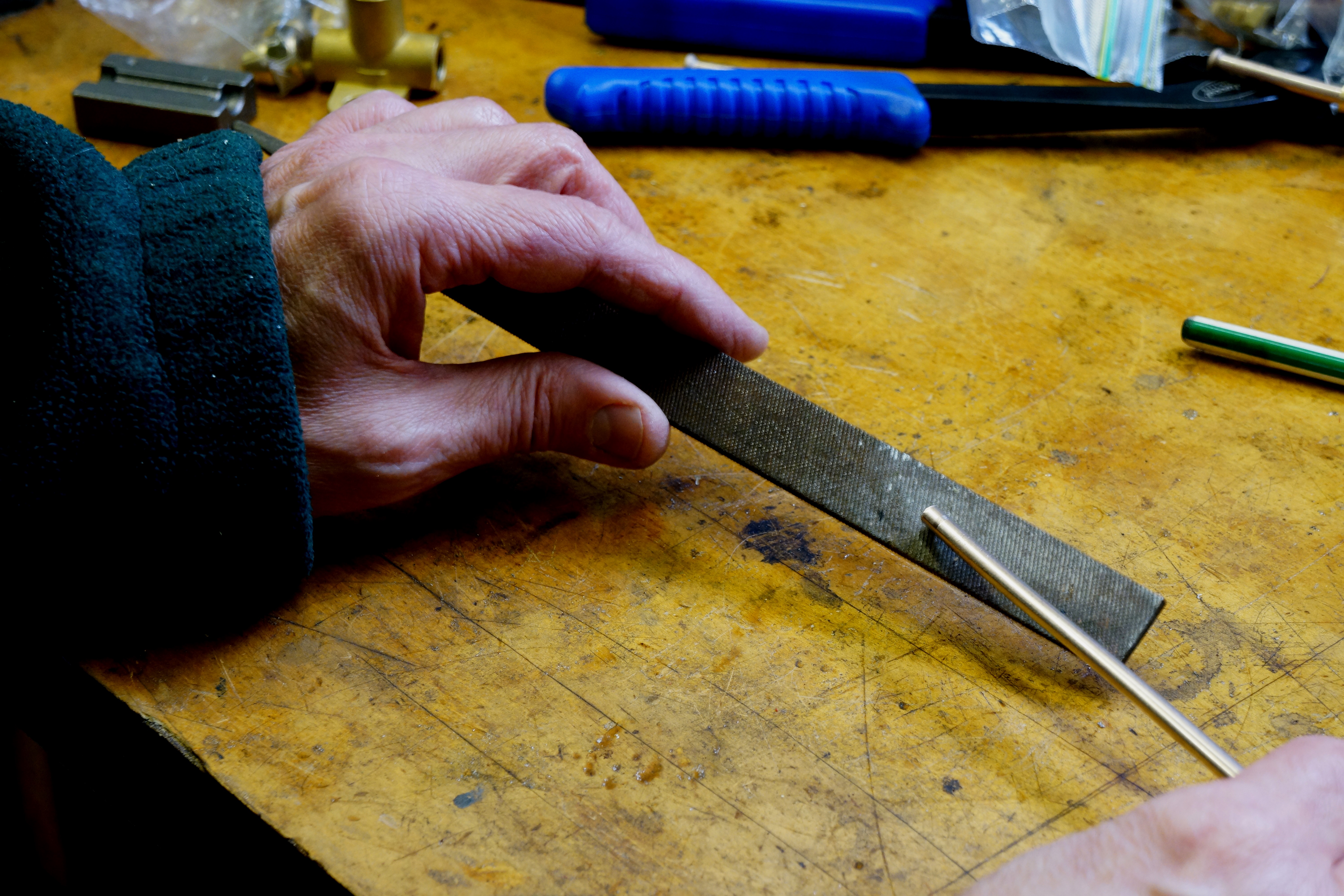
The Eastwood instruction book states that before you make a flare, you should do 3 things with the cut tube: run a file on the inside to remove burrs; run a file on the outside for the same reason; and slightly chamfer the edges. I dutifully followed instructions.
File the inside…
File the outside…
Chamfer the edges
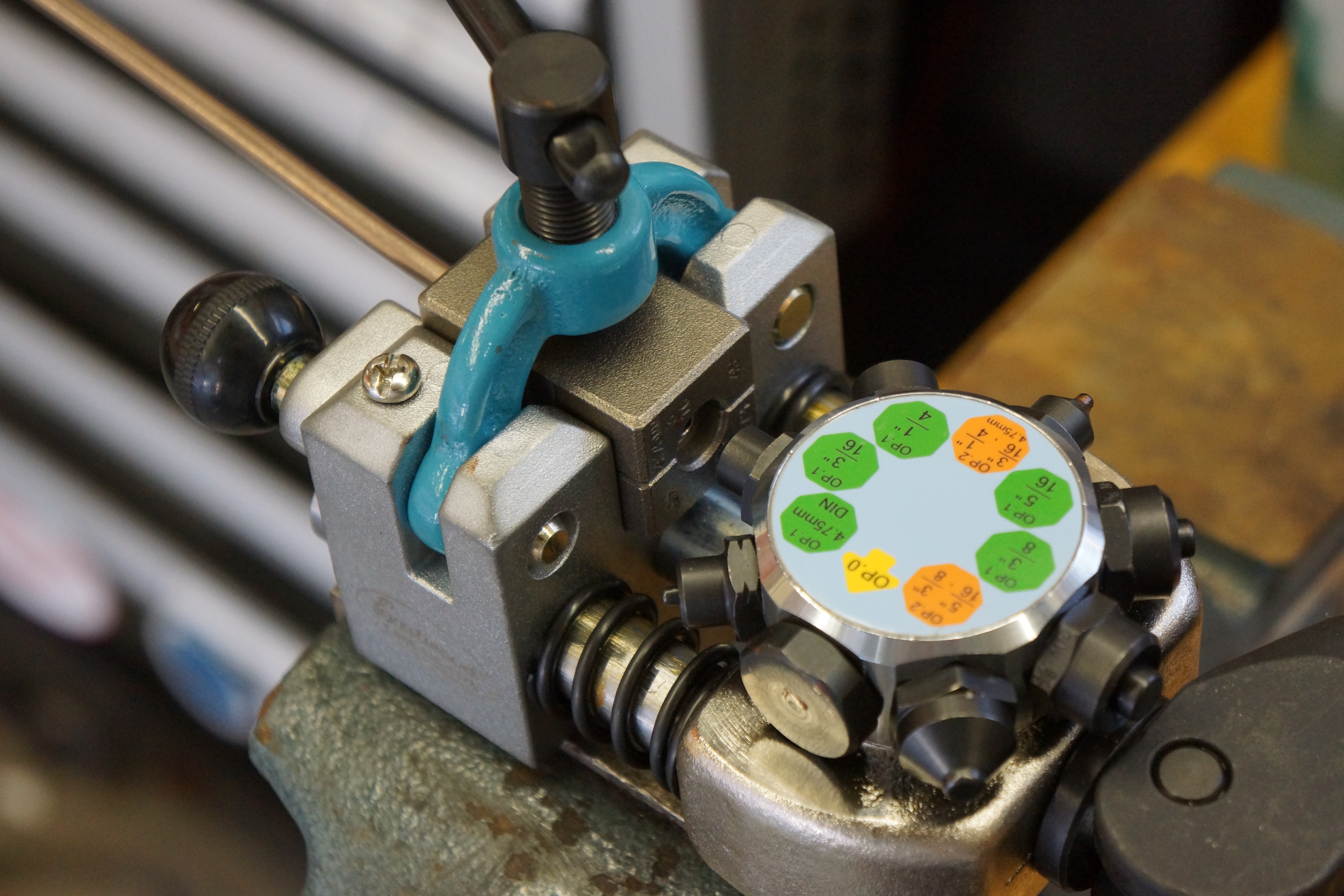
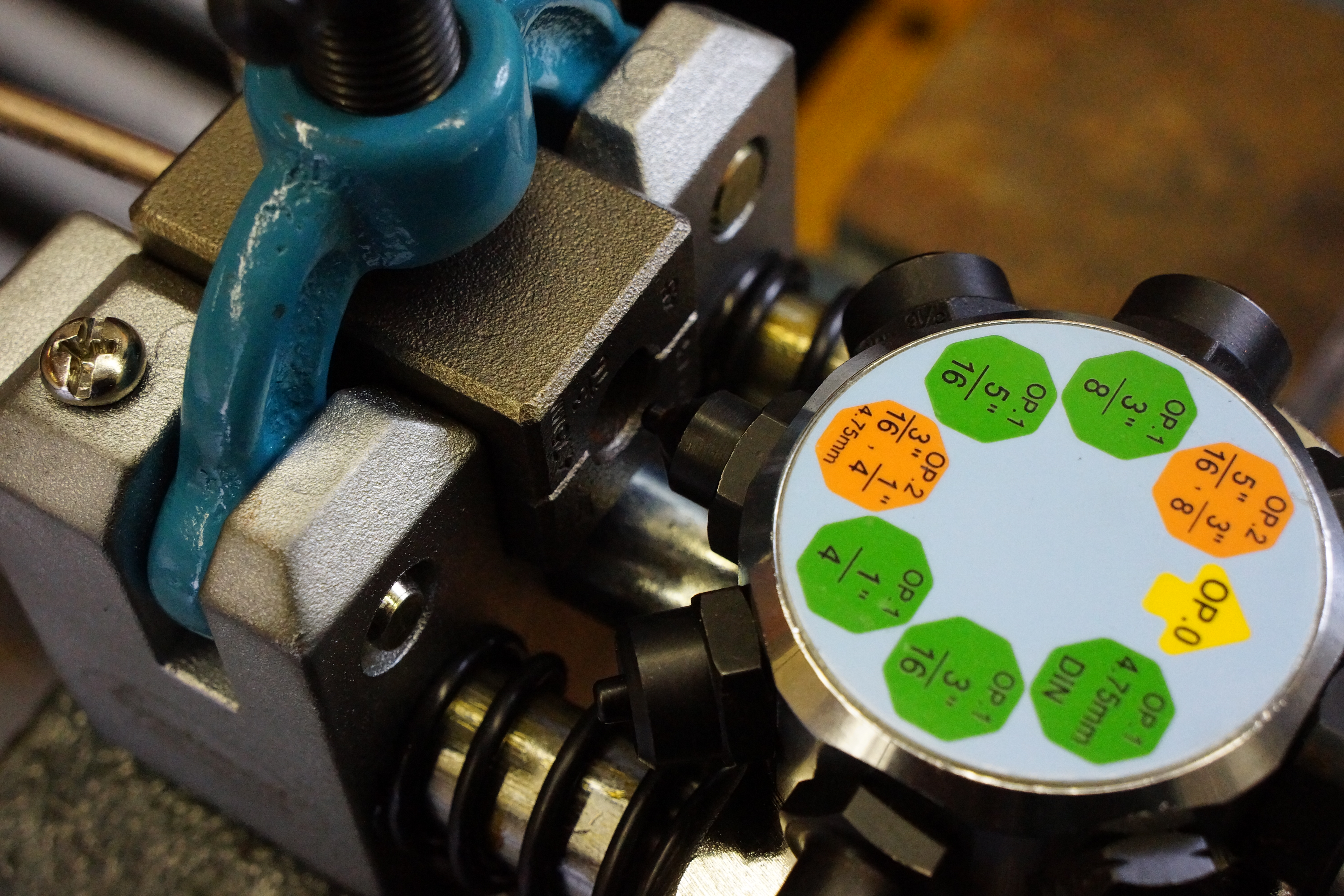
The tool itself is designed to be securely clamped into a bench vise. The two most important pieces which require your utmost intention are the tube-holding dies in 4 different sizes, and a rotatable disc with the various flare-forming dies. This is when I discovered that the 3/16” tube die is double-ended: it says 45° on one side, and DIN on the other. The instruction book didn’t say too much about this.
All the flare-forming dies are on this disc
3/16″ die, 45 degree end
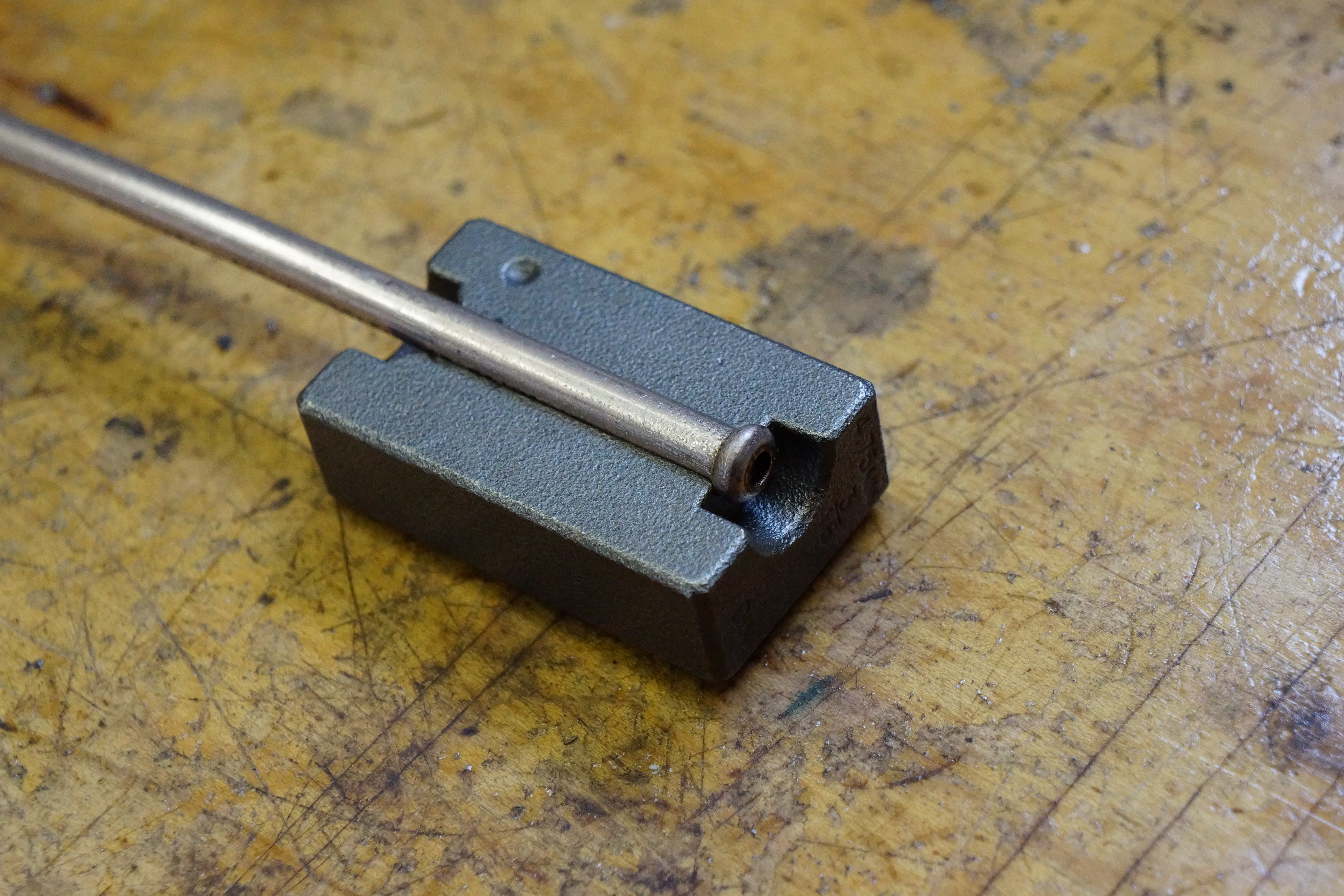
same die, DIN end
I grabbed the 3/16” tube-holding die and placed it into the tool, with the 45° double-flare at the business end. The tube itself was inserted between the two halves of the die, and with the disc’s “OP. 0” (Operation Zero) facing the tube, I pulled the handle. This step simply squares up the end of the tube with the end of the die. Once done, I made sure the clamp was tight.
OP ZERO before squaring the tubingOP ZERO after tubing end is squared with die
Rotating the disc to “OP 1, 3/16”, I again pulled the handle. As a final step, the forming die disc was rotated to “OP 2, 3/16”, the handle was pulled, and I removed the tubing to examine my work. It looked good! I had a nice, neat 45° double flare.
OP 1, step one of the 45 degree flare
OP 2, step 2 of the 45 degree flare
45 degree double flare done!
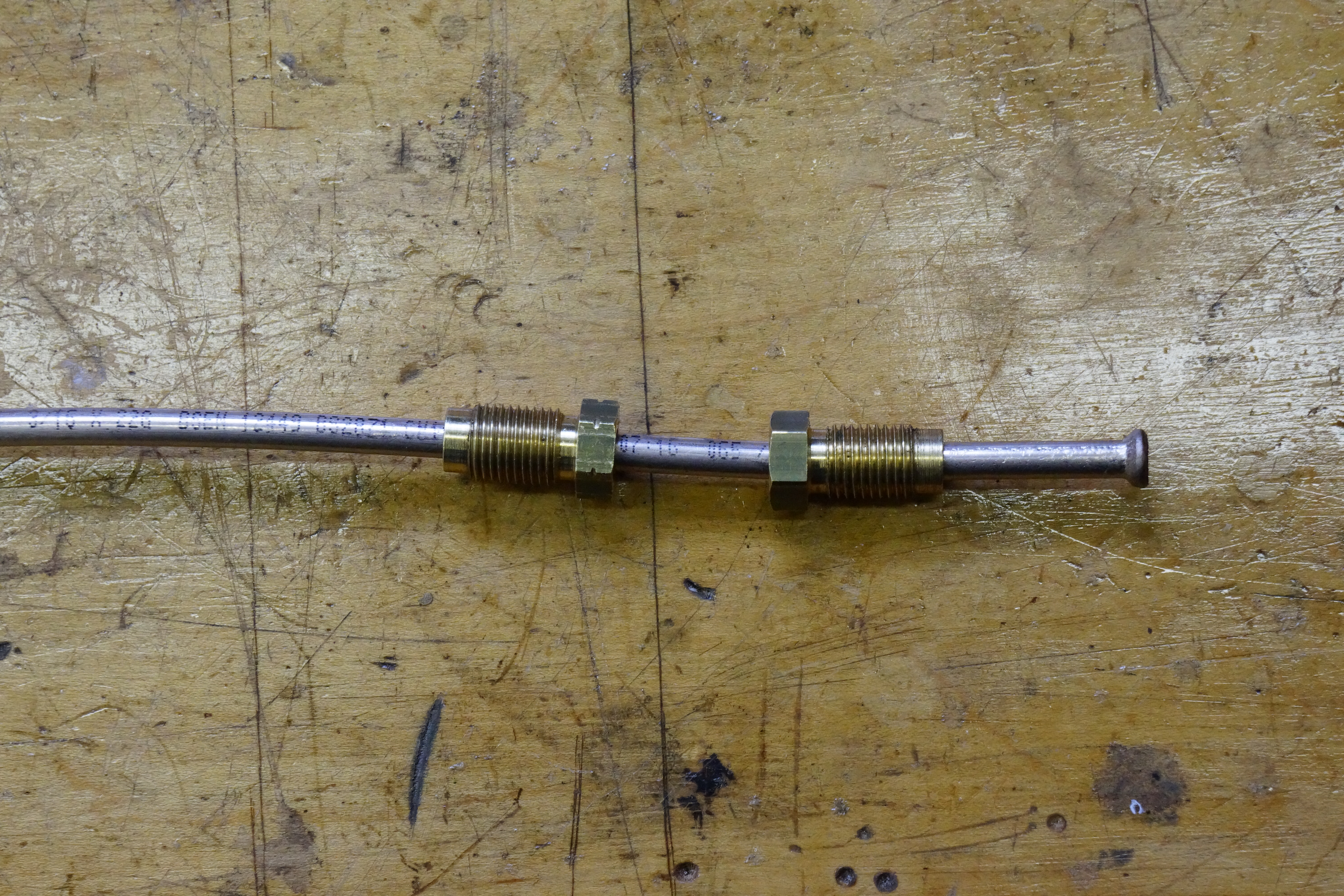
Before you flare the other end of the tube, you MUST slide on the two flare fittings; once both ends are flared, you’ll never get them on. In my case, not only did they need to face the correct way, they needed to be the correct threads! With the 45° double flare done, the 3/8” fitting went on first, and then the M10 fitting. It is highly recommended to delay the celebratory glass of vino until AFTER these steps are completed.
Pay attention! L to R: M10 flare fitting, 3/8″ flare fitting, 45 degree double flare on pipe end
It was a good thing that I had made some test pipes, which is when I discovered that the DIN end of the tubing die would make the needed ISO flare. I further discovered via experimentation that while the forming die does have an “OP 1” and “OP 2” for the DIN flare, I needed only “OP 1” to get a bubble flare that matched my old brake line.
ISO bubble flare done!
I’ve made two lines so far, and am quite pleased with the progress. It’s a nice feeling to have rounded the curve and to have begun reassembly. With most collector car events cancelled for the spring, the pressure is off, but the progress continues.
During the five years I’ve been hosting this blog, I’ve made it an unwavering tenet to avoid any post which primarily consists of a link to another website. My goal has always been to provide original content, based on my own previous and current automotive adventures.
This post breaks with that tradition for the first time. Sorta.
Below is a link to an article published on Ward’s Auto (www.wardsauto.com). The article, “Keeping Cars Germ-Free While Preserving Surfaces”, is a somewhat general treatise about doing our part to help prevent the spread of the Covid-19 virus as we get into and out of our vehicles (with less and less frequency, it seems). You’ll note the author’s name, as this was created while performing my day gig.
I’ve also taken the liberty of copying the text verbatim below. Stay safe, everyone!
As cases of COVID-19 continue to spread throughout the country, many people are looking to disinfect anything and everything they come into contact with on a regular basis. In addition to household items, devices and doorknobs, don’t forget to clean and disinfect your trusty vehicle!
It’s important to ensure that you’re properly sanitizing all aspects of your ride. To stop the spread of germs, it’s crucial to adhere to Centers for Disease Control and EPA standards.
Without a doubt, when cleaning and disinfecting the interior of your car you should exercise more care than you do with many items around your house, such as a light switch or bathroom counter. It’s important to ensure you’re effectively cleaning all your interior surfaces while at the same time not damaging materials such as vinyl, plastic and upholstery.
According to the CDC, cleaning removes germs, dirt and impurities from surfaces, rather than killing them, and reduces the risk of spreading infection by lowering the number of germs on a surface. Disinfecting, on the other hand, kills germs on surfaces and takes the work of cleaning one step further.
You may be thinking, where should I begin? Luckily, properly cleaning and disinfecting your car is not super complicated and with just a few key steps, you can accomplish it in no time!
First, to effectively clean and protect, you should begin with a thorough vacuuming of the entire interior. It’s important to spend time getting into the areas that accumulate the most dirt and dust, which will make cleaning and disinfecting much easier and more effective when you reach that step. If your vacuum has attachments for getting into crevices and tight spots, use them!
Once that’s complete, assess your cleaning products and check the EPA’s list of registered disinfectants that meet the criteria against coronavirus.
Now it’s time to find the proper products, depending on your vehicle’s interior and the materials found there. A very important tip: do not treat all these surfaces as one and the same. While there are combination cleaners that can cover more than one area, it’s important to identify your interior’s material and select the most appropriate and effective cleaning products for the type of material.
Vinyl and synthetic interiors. Since this material doesn’t absorb anything, it’s easier to disinfect. To be cautious and prevent damage, avoid using cleaners that contain alcohol or bleach. Be especially wary of plastic compounds, which are used frequently in consoles, dashes and door panels. They are especially vulnerable to alcohol-based cleaners.
Leather interiors. If you are using an alcohol or detergent-based cleaner on leather seats and dashboards, don’t forget to apply a leather conditioner afterward to restore moisture.
All interiors. As a best practice across the board, it’s worth avoiding all solvents, which include acetone, kerosene and alcohols, when possible.
With that, it’s critical to be especially cognizant of frequently touched items. Make sure to give your steering wheel, seat belt buckle, door handles (inside and out), shift knob and dashboard controls a thorough wipe down with antibacterial products. If you have a touchscreen, do not overly wet it, and use a product specifically for screens.
If you have any doubts about how certain surfaces will respond to harsher cleaners and disinfectants, test the product first on a less-conspicuous spot to ensure it won’t cause damage before performing a more thorough cleaning.
Overall, it’s important to routinely sanitize all surroundings you have access to in order to do your part in reducing the spread of germs and infections. If your vehicle is regularly driven by more than one person, each driver should share in the cleaning responsibility (or appoint one person to be in charge).
Lastly, of course, always defer to the CDC’s guidelines for personal and environmental hygiene to learn more about how you can do your part to keep yourself and those around you safe and healthy!
While rummaging through a box of my parents’ stuff the other day, I rediscovered a trove of postcards that my father had collected. “Collected” might be too formal of a word; I never witnessed my father actually purchase a postcard. In the mid-20th century, many places gladly gave them away for the free publicity they’d garner. To my dad, a depression-era baby, if it was free, it was for him.
Two cards in particular caught my attention: both postcards featured the General Motors exhibit at the New York World’s Fair, with one from 1939-1940, and the other from 1964-1965. My dad went to both. (He was born in Germany, immigrated to the U.S. at the age of 6, and lived in NYC from 1925 to 1981.)
As little as he talked about anything from the past, he enjoyed sharing the story of how, at the age of 21, he won a brand new 1940 Chevrolet at the World’s Fair. I believe he kept that car right up until the time he married my mom in 1950 and bought a Willys station wagon. I’m 100% certain about the ’64-’65 Fair, because he took the entire family six times! We have photos and video from those trips. I was 10, and it was my first time riding the NY Subway. We took the 7 line, and I have strong memory of numerous exhibits, especially the Ford Motor Company rides, the Sinclair dinosaurs, and the NY State Pavilion. I also saw a real baseball stadium for the first time when I got a glimpse of the new Shea Stadium from a vantage point within the Fair.
Back to 1939: the GM exhibit was huge. Named “Futurama”, it was GM’s attempt to predict a vision of life in the U.S. by 1960. This Futurama correctly predicted the interstate highway system, including multiple traffic lanes and higher roads speeds than existed in the late ‘30s.
The GM Futurama exhibit at the ’39-’40 NY World’s Fair
As this Wikipedia entry details, the theme of the 1939-1940 World’s Fair was “The World of Tomorrow”, and the GM exhibit meshed nicely with that theme. Note the image on the postcard: this was a full-scale exhibit. The people walking along the elevated sidewalks and crosswalks were looking down at full-size vehicles positioned on the roadways below. Also note the rooftop parks, signifying a recognition that if the ground space is consumed by roadways, the greenery and outdoor entertainment needs to go somewhere else.
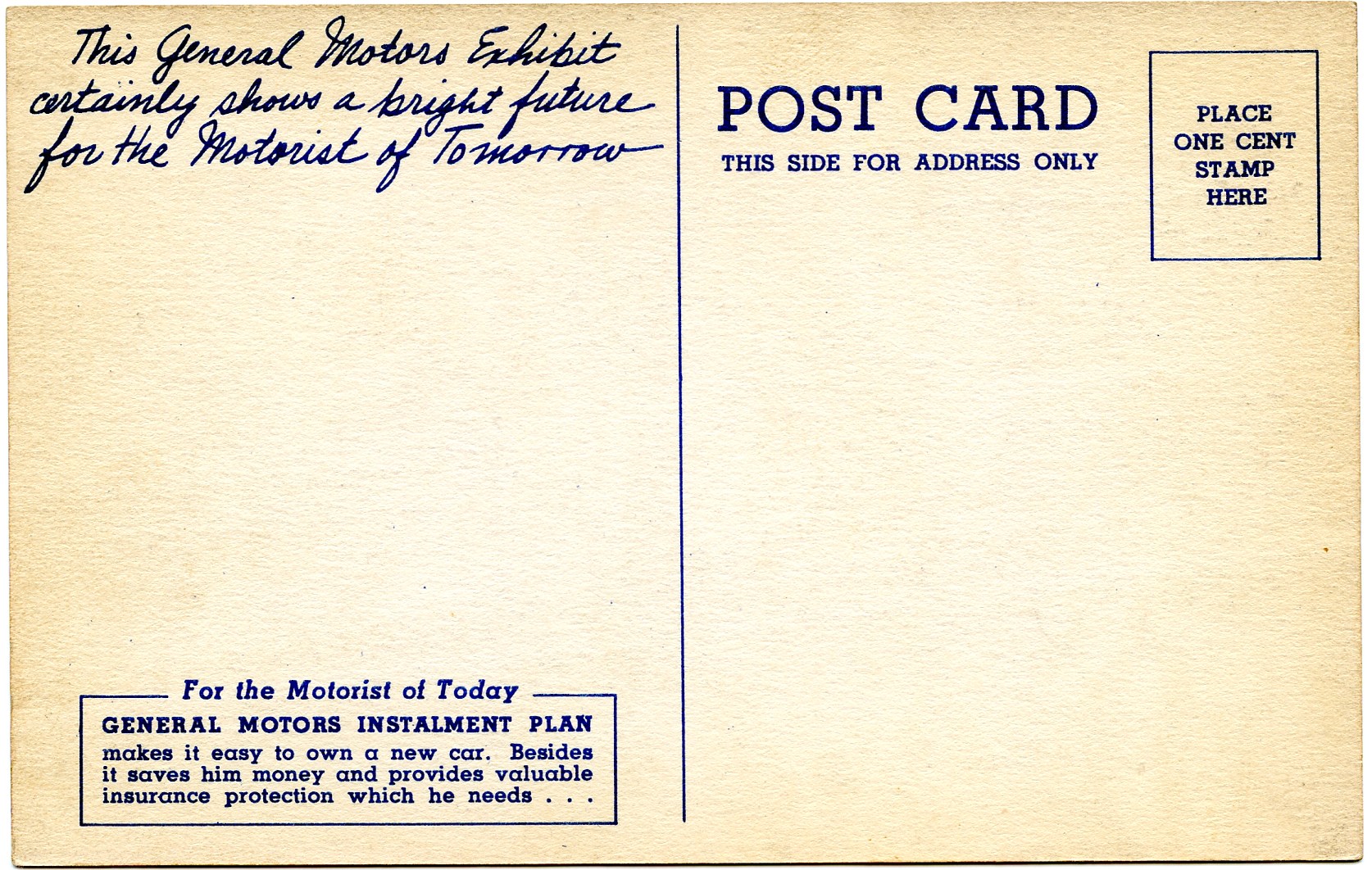
The obverse of the postcard doesn’t miss an opportunity for GM to pitch its “General Motors Installment Plan”, which “makes it easy to own a new car. Besides it saves him money and provides valuable insurance protection which he needs…” So the ladies of the house weren’t making the vehicular purchase decisions yet? Perhaps they were driving down to the Post Office to buy the one-cent stamps needed to mail a postcard.
The back of that postcard; note that it calls for a one-cent stamp
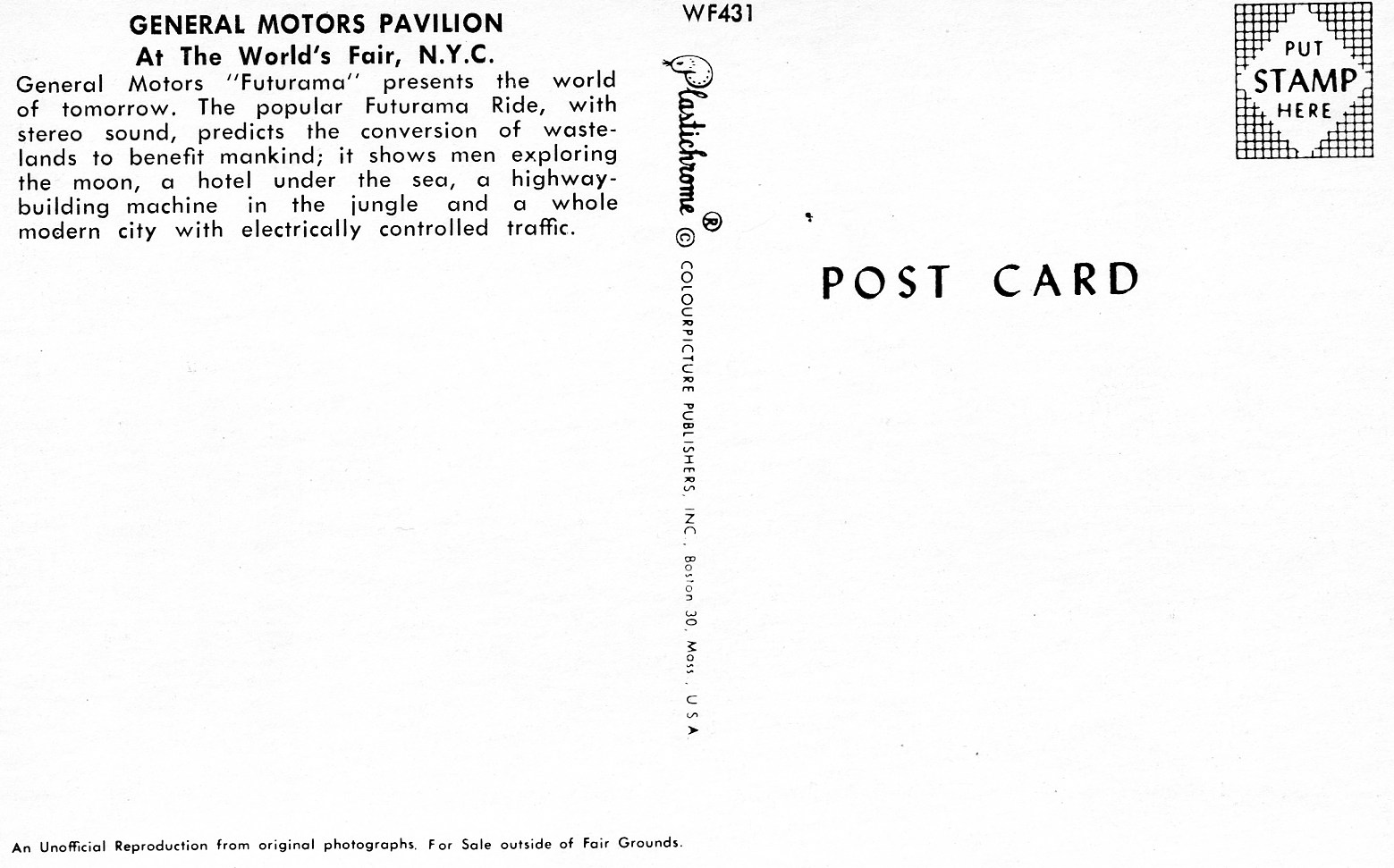
The 1964 postcard displays what passed for futuristic architecture at that time. Whether coincidence or not, the GM pavilion was right along the highway (Grand Central Parkway? The exit sign in the photo reads “495 – Midtown Tun(nel) – Long Island”. Route 495 is the Long Island Expressway). The obverse of the card reads in part: “General Motors ‘Futurama’ presents the world of tomorrow. The popular Futurama Ride, with stereo sound, predicts the conversion of wastelands to benefit mankind;….” Note the thematic repetition from 25 years earlier. This website details the exhibits within the GM building, and some of the themes are tragically predictive: autonomous cars (highway only!), atomic-powered submarines, large-scale deforestation, and “plazas of urban living (rising) over freeways”.
The GM pavilion from the ’64-’65 NY World’s Fair
Part of my daytime gig involves writing and editing articles which attempt to predict the future (autonomous driving has been a very popular topic of late). I’ve made the wry observation that it’s quite difficult to predict the future, and no one is really very good at it. Where are the flying cars? And who predicted the iPhone?
The flip side of that postcard – stereo sound was a big deal!
It’s fun to look at these General Motors postcards, printed 25 years apart. Their World of Tomorrow was all sunshine and flowers. Of course it would be: why try to predict World War II, the imported car invasion, 50,000 traffic deaths a year, the Motor Vehicle Safety Act, two Arab oil embargoes, the Japanese auto revolution, bankruptcies, and bailouts? And to this child of the ‘60s, add the sad news, impossible to imagine as a boy, of the loss of Plymouth, Oldsmobile, Pontiac, and Mercury. Yet we go on, enjoying our cars and trucks, embracing our present while still looking forward to a better tomorrow. It’s the way it should be.
All images are from my personal collection of postcards.
I’ve often referred to the two years I spent as a professional automotive technician as my “post-college” graduate work. It was a different kind of education, and included the benefit of earning a salary. One of the earliest lessons, and one I still carry today, is that there is no substitute for having the right tool for the job at hand. The correct tool ensures that the repair is done correctly, safely, and within a reasonable amount of time. It is not an exaggeration to state that there were times when sweat dripped from my brow, and curses sprang from my lips, when the lack of the appropriate tool made a repair attempt a real struggle.
A corollary lesson states that sometimes, one needs to practice some creativity and “invent” a tool, perhaps by assembling one from hardware parts, or by modifying an existing tool. This point was put into practice during the Isetta restoration, as tools for that car aren’t exactly found in your local NAPA store.
The challenge rose up again during the recent brake work on my Alfa. I found myself struggling with the reassembly of the parking brake shoes, which reside inside the rear brake rotor ‘hat’. The shoes and their assorted springs and clips came apart easily enough. But now my efforts to put it all back together were just taking too long.
Let me be more specific: the brake shoe assembly mounts to a backing plate, like on most cars. Unlike most cars, though, the wheel hub is mounted on a bearing that is press-fitted into place through the backing plate. The parking brake reassembly would be easier if the hub were not in the way, but to remove it, I would need to remove the entire axle and press the hub and backing plate apart. That was more work than I wanted to bother with. I was convinced that there was a way to put the parts back on with the hub in place.
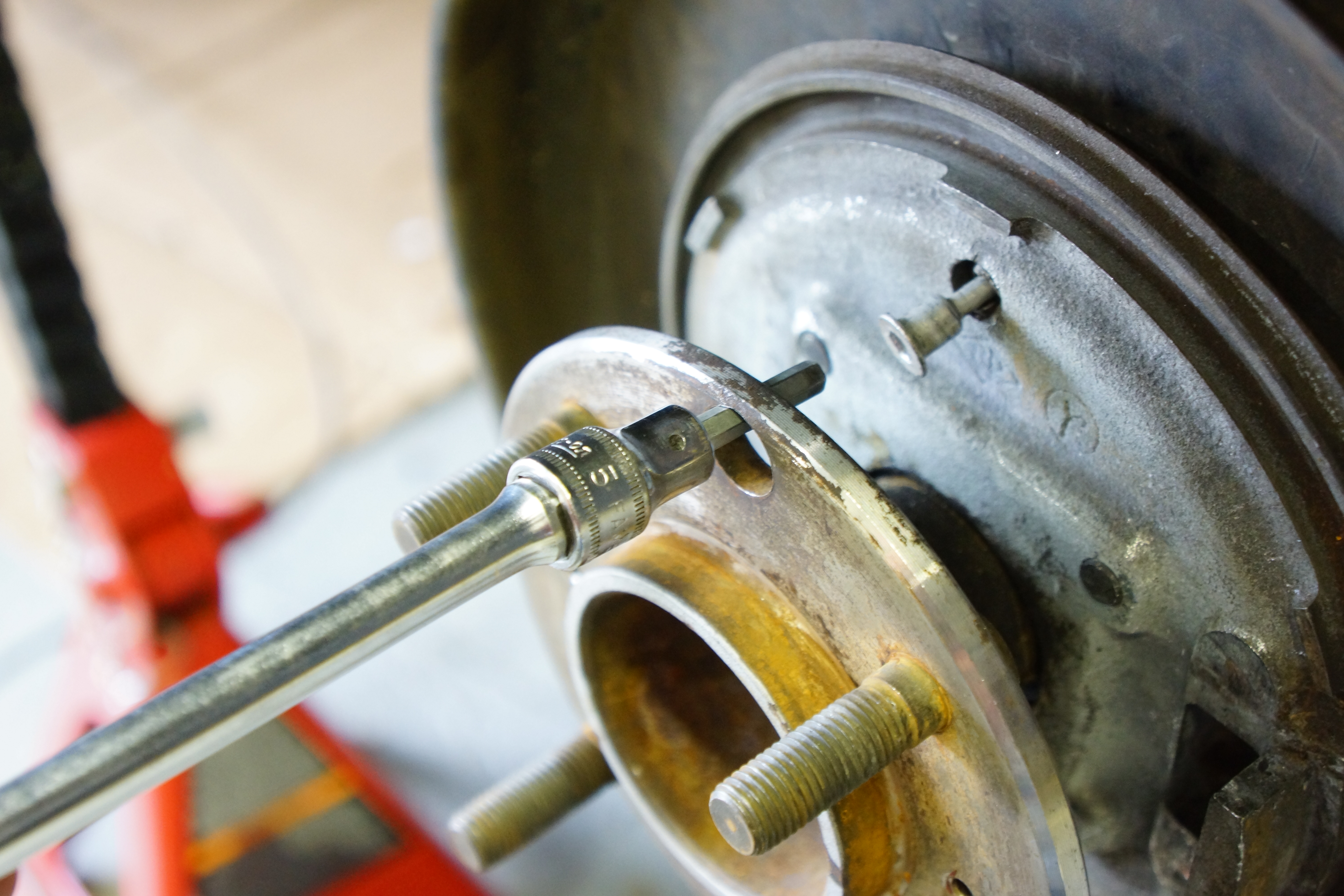
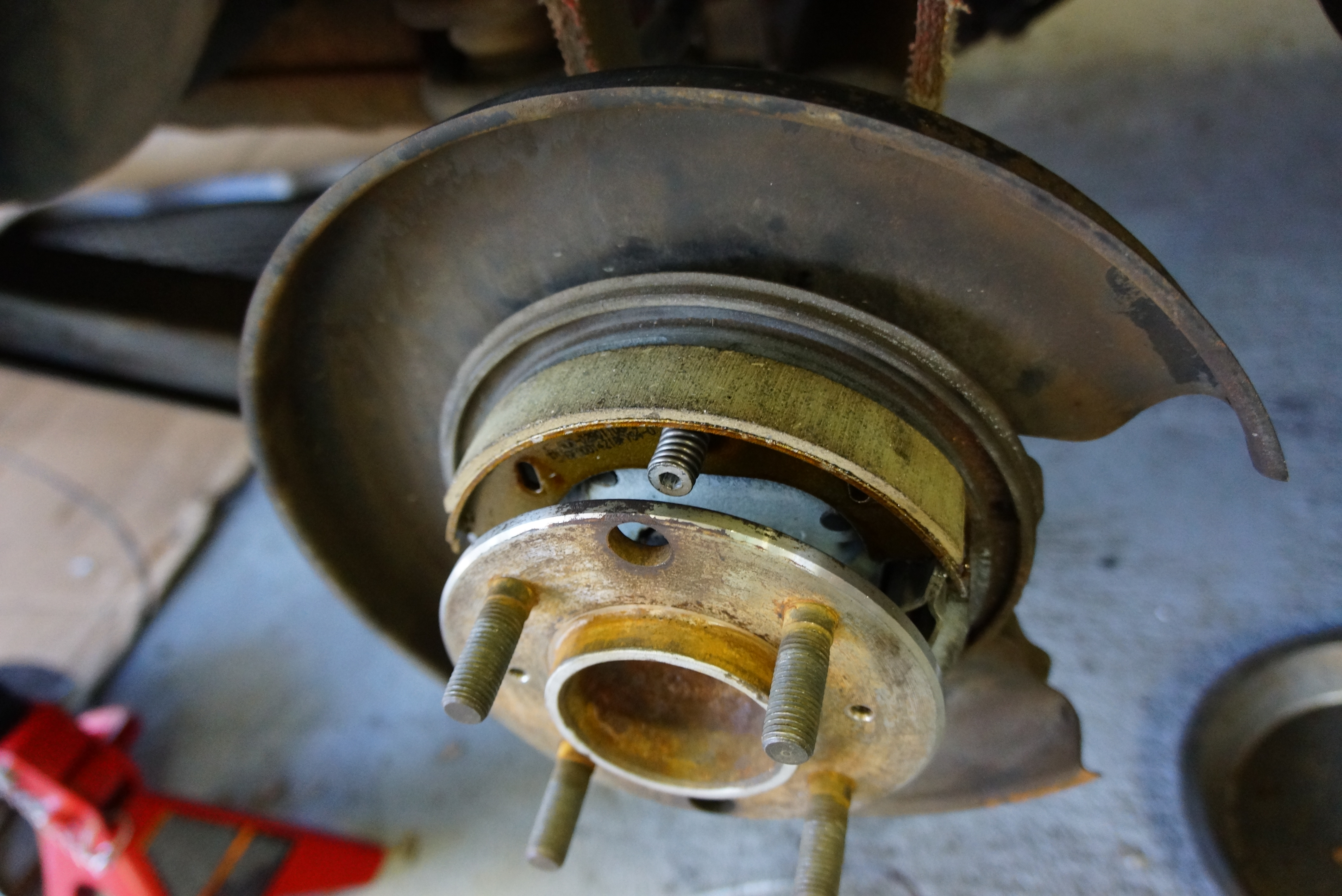
And Alfa Romeo actually made that accommodation. The hub surface has two additional holes, lined up in such a way to allow a tool to pass through them to access the brake shoe hold-down pins. The pins require a 5mm Allen tool, and I have one as a 3/8” drive socket. Since there is so much spring pressure to overcome, putting the Allen socket on an extension, with a 3/8” drive ratchet wrench, provides way more leverage than one could ever get from a tiny hex key.
Original 5mm hex socket on extension is placed through access hole in hub
Herewith was the problem: I could not push the pin in far enough to engage its lock, because the socket was too wide to pass completely through the hole in the hub. I briefly considered grinding down the socket, but a close examination revealed that would likely weaken it to the point of failure once an extension or a wrench was snapped into place. I briefly (like, for 10 seconds) considered enlarging the hole in the hub before rejecting that crazy idea. (Repair lesson #39.b.2: when making permanent modifications, always do so to inexpensive, replaceable objects, NOT to complex, difficult-to-replace components of the vehicle itself.)
Socket bottoms out before pin can be fully inserted in backing plate (spring and shoes removed for clarity)
Staring at things for several minutes brought forth the revelation that if the 5mm hex shaft were longer, I’d have what I needed. After considering a Home Depot run, which I internally wagered would yield a 25% chance of success, I challenged myself to modify the tool I owned. Could I do this in less than an hour? I thought it entirely reasonable.
Here is the Snap-On 5mm Allen socket about to be modified
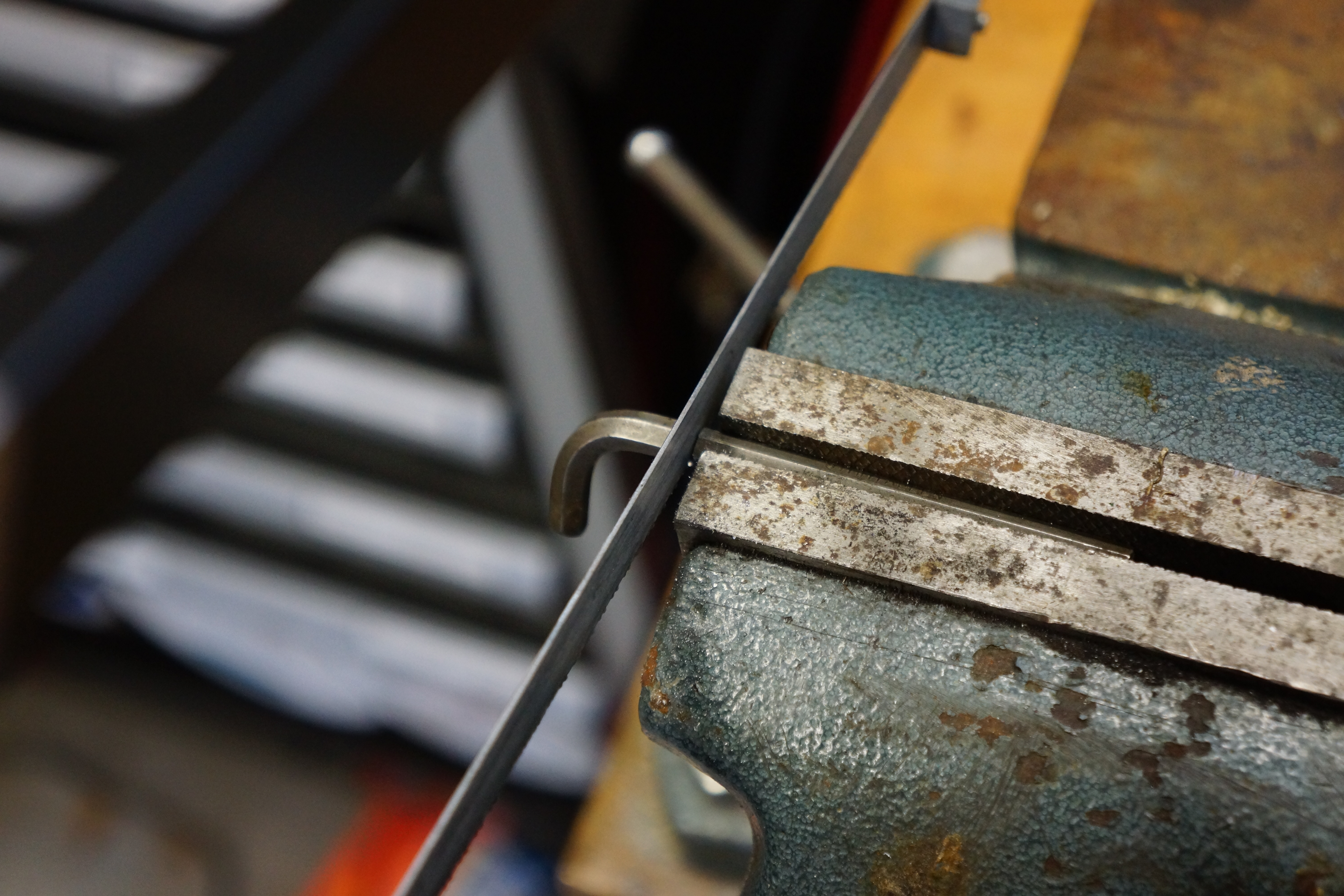
With a 3/32” drift, I hammered out the roll pin and pulled out the existing 5mm bit from the socket. I found a standard 5mm hex key in my Allen key collection, and tested it at the car. It was long enough for my purposes. Next, I secured the longer hex key in the bench vise and hacksawed off the short end. (I really should have pulled out the Dremel tool for this step, as the hardened steel took longer than I thought it would to hack off.) I filed the end smooth, and it fit right into the socket. My attempts to drill a hole in it to reinstall the roll pin resulted in two broken drill bits – like I said, that tool steel is hard! But the new bit was a tight fit in the socket, and since I’d be pushing against it, not pulling on it, I let it be, feeling certain that there was nothing to worry about.
Drift makes short work of roll pin removalThis hex key is about to give up its life for a greater goodHacksaw got the job done, but it took 10 minutes of muscular effort
Total time to modify the 5mm Allen socket: approximately 30 minutes. I attached my ‘new’ socket onto an extension, snapped on a ratchet wrench, and was easily able to engage the brake shoe pins in their locks. Mission accomplished!
“New” socket has considerably longer shaft
I’m keeping my new, longer 5mm Allen socket as is. Who knows when someone might need my help with their Alfa Romeo parking brake shoes? “Hey, I got just the tool for that!”
Success! Longer hex shaft makes short work of engaging pin
The weather today in downtown Neshanic Station NJ reached a balmy (for February) 55 degrees F. While I desperately do NOT want it to be 90 in April, I didn’t mind today’s spring preview; after all, the calendar claims we’re only four weeks away.
That high temp was accompanied by blue skies and lots of sunshine, all of which inspired me to get back to the garage. The Alfa’s brakes have been ignored since last autumn, and even I can’t believe how long it’s been since I’ve put up a blog post about my progress, of which there has been scant little. I have been ordering parts, reading service manuals, and perusing online forums, but there’s been no actual wrench-turning since before Halloween, which feels like a very long time ago.
Old (upper) and new (lower) parking brake cables- note boots
While today’s progress was not substantial, it was significant. The corner has been turned; everything that’s to be removed has been removed. I am now embarking on reassembly, using new parts as required. Starting at the left rear, a new parking brake cable was installed, and a new upper e-brake shoe was also put into place.
Parking brake shoes & springs: old (left) and new (right)
Projects never proceed at an orderly pace. There may be a flurry of activity, then a slowdown. Other, smaller projects may jump the line. Sometimes, it’s a parts delay that forces the pullback. However, there’s something to be said for picking up the tools again after a long layoff: it reinvigorates the soul, and reawakens the motivation.
LR upper e-brake shoe in place
I’m also motivated by an email I received from the NJ Chapter of the Alfa Romeo Owner’s Club, announcing a one-day spring tour for Sunday April 26. That’s nine weeks from today. I plan to drive this car on that tour. Sounds like I have lots of time, but we know how quickly that time will fly. The last time I drove my Alfa was July of last year. I have not gone this long without driving it since my purchase in 2013. So I’m motivated! Let’s hope the trend for an early spring continues.
Back in December of 2019, Hagerty Insurance, that well-known collector-car insurance company, published their self-named “Bull Market List” for 2020. In it, they predict the 10 collector cars most likely to rise in value over the next 12 months.
This was the third year in a row that Hagerty published their picks, based on market trends. But it’s a fool’s game to try to predict which cars will increase in value. The so-called experts have been swinging away at this for decades, and for all the years I’ve been following their prognostications, no one correctly predicted the rise in Porsche 911 values, to name a recent trend that was missed.
If you can’t be bothered reading the article, or even if you have and you want a quick reference, below are their 11 picks for 2020 (10 vehicles plus 1 motorcycle), arranged here in model year order.
Trucks make a strong showing, with the Jeep Cherokee, the Range Rover, and the International Scout on the list. Twenty-five years ago, almost no one thought of trucks as collectible. But go past these models, and you’ll see that many of the remaining vehicles are pure two-seaters like the Ferrari, the Dodge Viper, the Porsche 914, and the BMW M roadster. The new car market has been trying to tell us that cars are no longer desirable, but the collector side of things thinks otherwise.
Whether you prefer cars or trucks, performance vehicles are always collectible. The Ferrari and the Viper may epitomize traditional performance, but the 4-cylinder Integra Type R and the Civic Si were strong performers in their classes, and deserve to be mentioned in the same breath.
Next, let’s note the percentage of newer vehicles on this list. When the full model year range is included, nine of eleven vehicles are from the 1990s and newer. I’m a Baby Boomer, and I can recall when every vehicle on the Bull Market List was new. For me, it can be a stretch to think of any vehicles from the 21st century as belonging on this list. But as Gen Xers and Millennials enter the collector market, they are seeking out the vehicles of their youth. These so-called Youngtimer’s cars are the ones they covet, which will push their value upward as demand outpaces supply.
Note the tremendous diversity in this list: 3 domestic vehicles, 6 Europeans, and 2 Asians. Hatchbacks, two-seaters, convertibles, trucks, and a bike. Front-wheel-drive, rear-wheel-drive, all-wheel-drive, and front- and mid-engine placements. There is no one “type” of collector car. (Speaking of being unable to predict the future, I clearly recall well-versed writers stating “trucks will never become collectible”; and “Japanese cars will never become collectible”.)
As the hobby matures and as the collectors themselves grow old and pull their progeny along, almost anything becomes collectible. Given the explosive revolution and segmentation in the new car market over the last 50 years, this diversity does not surprise at all.
In spite of some recent downward trends witnessed at the high-end auctions (most likely temporary), the overall collector car hobby remains strong, in my opinion. A glance at activities outside of 7-figure auction results attests to that. Once spring hits, you will have a difficult time counting up the number of cruise nights, cars & coffees, rallies, club tours, and old-fashioned parking-lot car shows within a half-day drive of your domicile on any given weekend.
The predicted autonomy ain’t here yet. Cooler heads have now correctly surmised that we are one or two decades away, at best, from self-driving vehicles representing the majority of highway vehicles. In the meantime, even as more semi-autonomous features are brought to market, we still drive our cars. Most people own at least one car, and most families have more than one. Cars bring out peoples’ passions, and folks like to collect what they are passionate about. Cars remind people of their youth, so the passion and the desire to collect go hand-in-hand.
My friends and I have truly lived by this rule: if you’re going to be in the collector-car hobby, buy what you like. Don’t worry about future values. Buy the car because you plan to enjoy it, whether that’s driving it, working on it, or showing it. When it comes time to sell, if you make some money, great, if you break even, you had your fun at no cost, and if you lose some money, well, show me a hobby that doesn’t cost money! Have you priced a good set of golf clubs lately?
Take the Hagerty 2020 Bull Market List for what it is: an attempted dispassionate look at car values. I could never recommend using it as a primary deciding factor; but if it helps you choose one old car over another, do me a favor, and let me know how that works out for you.














 richardscarblog