Up until 1978, the extent of my travels by car had taken me to California and back. My sole trip via air was a family vacation to Florida in my late teens. The only time I had been out of the U.S. was a quick trip to Toronto while a college student.
When my mother and several other family members planned a visit to Italy, I signed on, thinking that the food and the cars would offset the less-desirable attribute of traveling with relatives.
We were there for two weeks in September of 1978. The only one in our foursome not fluent in Italian was me, and since we spent most of our time visiting family members, none of whom spoke English, things could get boring. To entertain myself, I would venture out on my own and purchase car magazines (in Italian, natch), and teach myself how to translate automotive technical terms.
My camera for the trip was a Kodak 110 Instamatic, with negatives the size of your pinky nail. It is amazing that the snapshots looked as good as they did. While most of my photos were of relatives, I did capture some interesting machinery on the street. It’s not surprising that the cars which fascinated me 38 years ago are the cars which fascinate me today. Some things, as the cliché goes, never change.
There was no driving by me during this journey. That would change for my next European visit.
BELOW: This Lancia Fulvia Coupe is from the late ’60s/early ’70s and is already an “old car” for the Italian streets. I always admired its tall greenhouse, reminiscent to me of the Fiat 124 Coupe I had owned. Note the lack of a rear bumper.
Lancia Fulvia Coupe
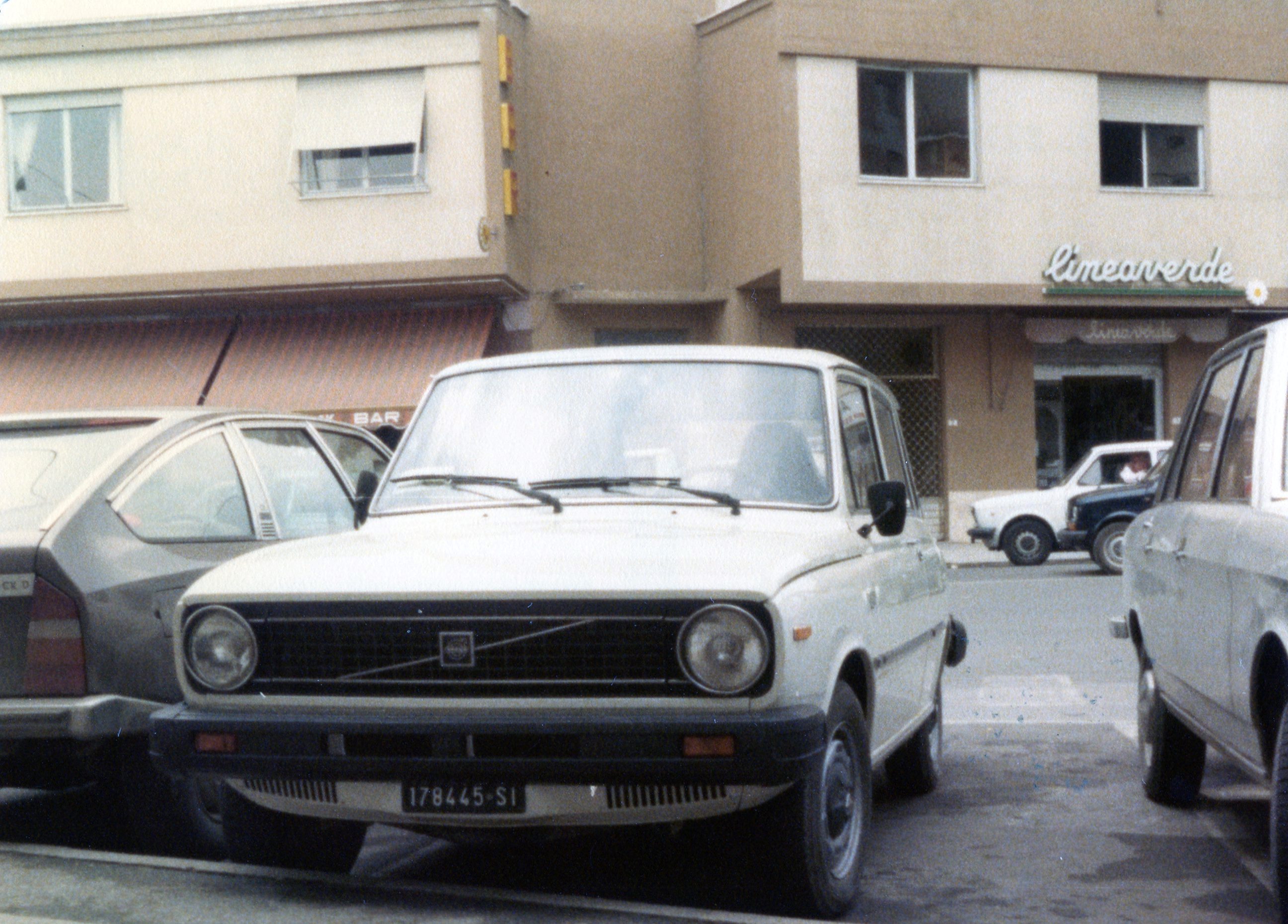
BELOW: This Volvo 66 (really a Dutch Daf with a Volvo grille) was the first non-U.S. Volvo I had ever seen.
Volvo 66
BELOW: This late ’60s Alfa Romeo Giulia GT Coupe is done up to mimic a GTA (on the presumption that it is not a real race-bred GTA). There was no way to determine if the Turbo badging was only an honorary add-on. Like the Lancia, the rear bumper was removed in an effort to add a dash of sportiness.
Alfa Romeo Giulia Coupe
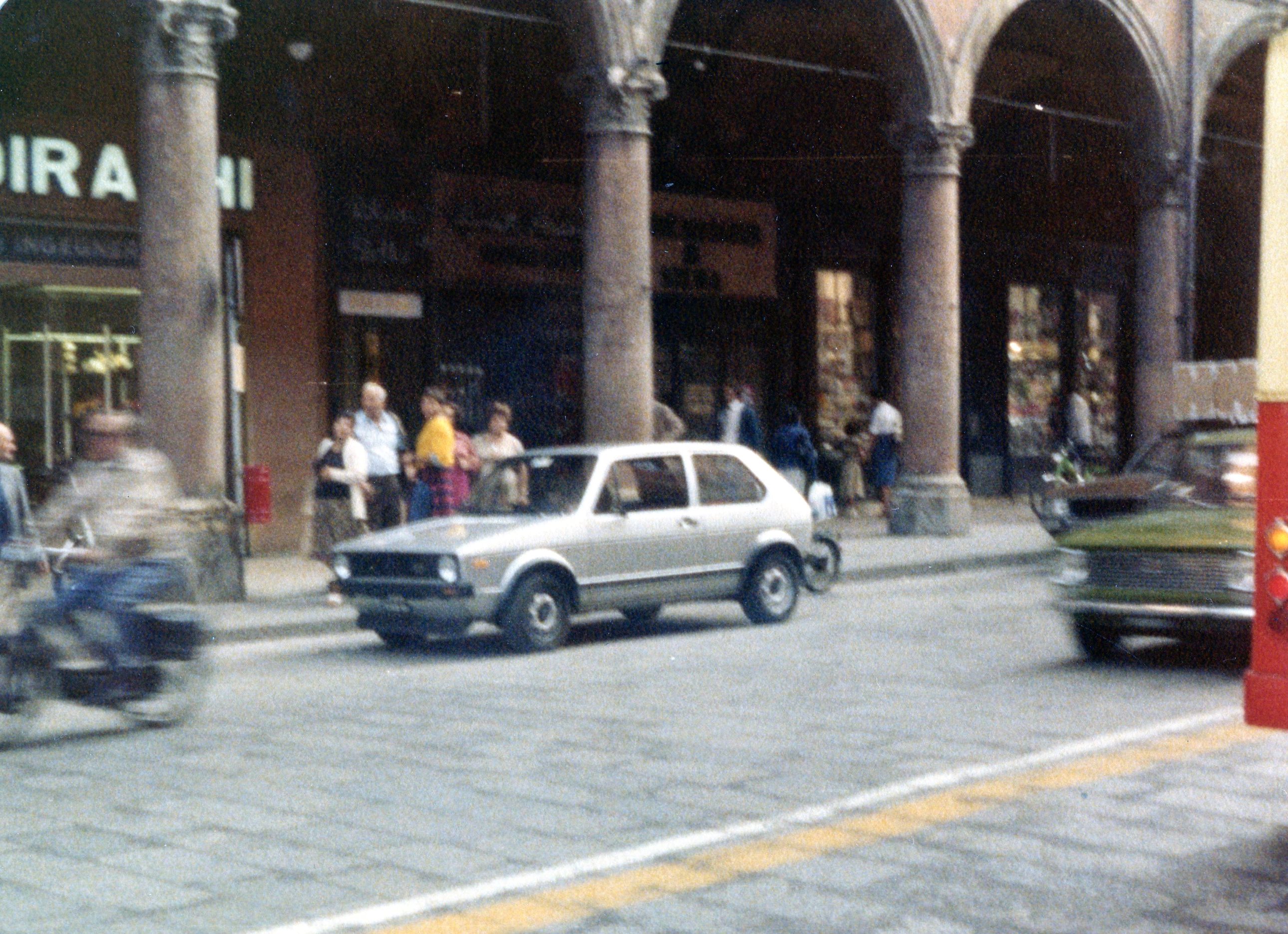
BELOW: At the time of my visit, I owned a ’77 VW Rabbit. The GTi hot hatch version was something that Americans could only dream about, and here was one barrelling down the strada.
VW Golf GTi
BELOW: While being driven to southern Italy by my mother’s cousin, we were forced to come to a temporary stop while a farmer herded his sheep (and other farm animals) across the road. Admittedly, the photo was actually an attempt to capture the herding, but the Opel Kadett happened to be there. (Based on that crowded back seat, it looks like its driver is doing his own herding.)
Opel Kadett
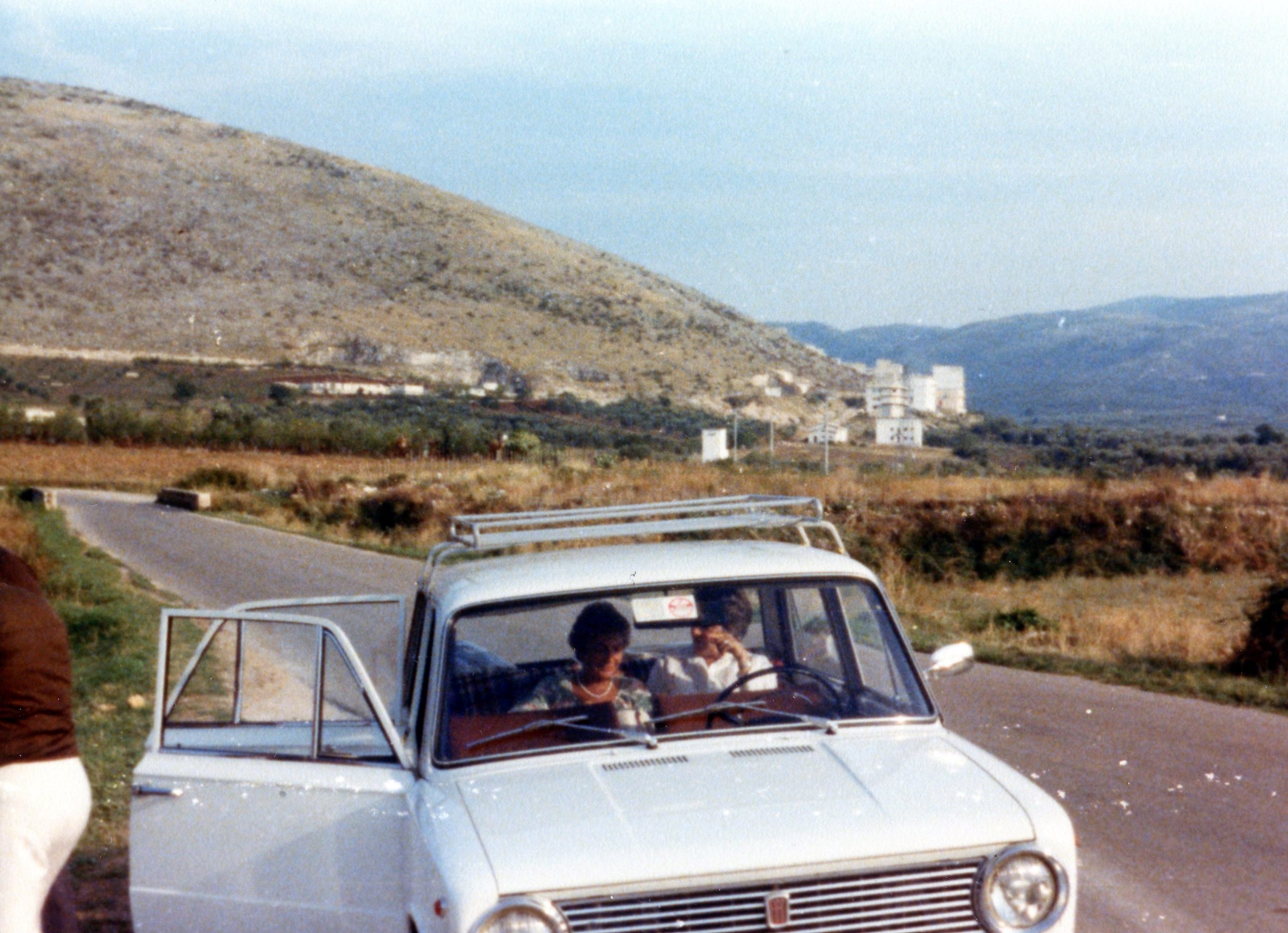
BELOW: This Fiat 124 sedan, owned by my mother’s cousin, was our transportation for 8 hours as we were driven to southern Italy. My mom and aunt patiently wait in the back seat for the herding to end.
Fiat 124 sedan
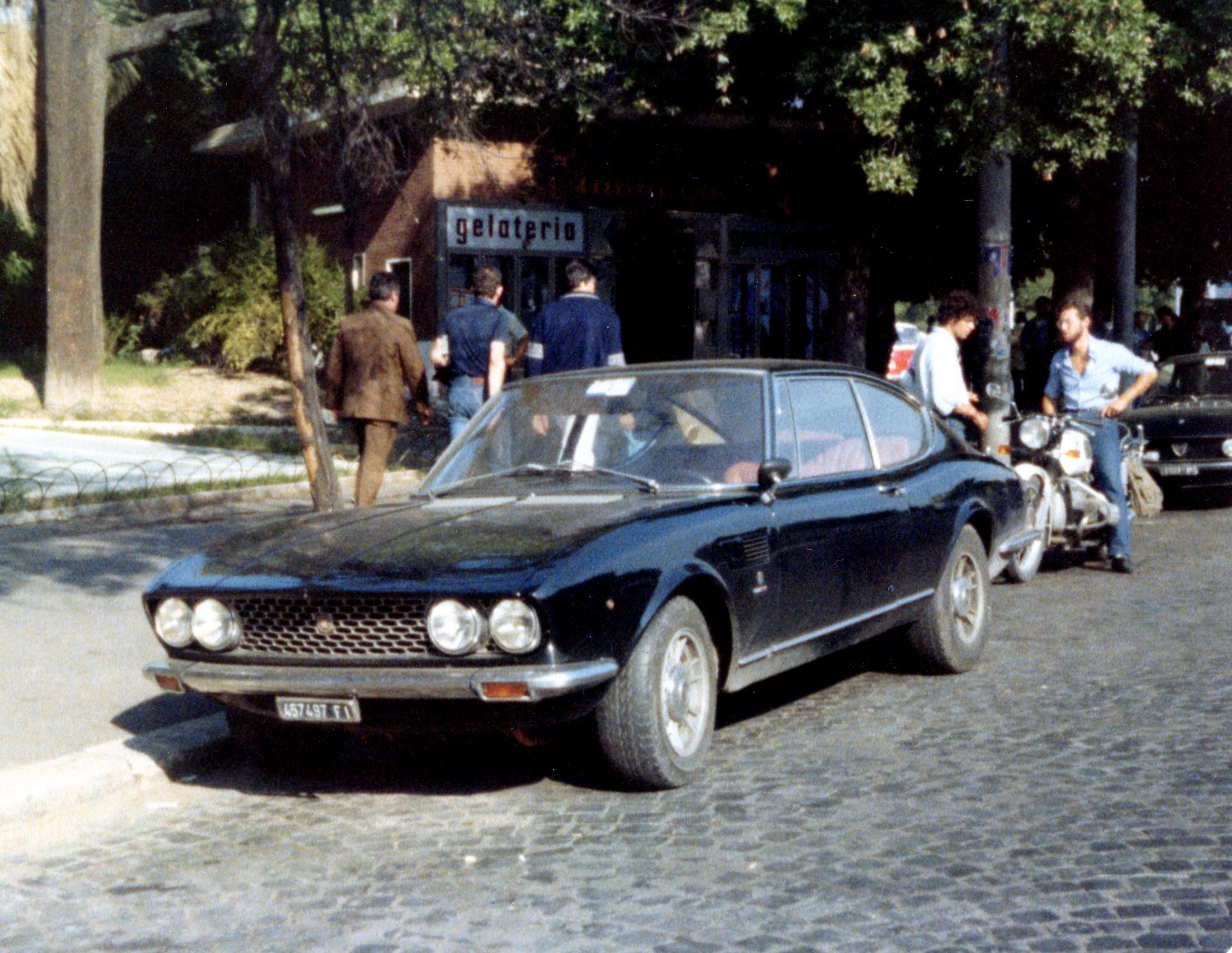
BELOW: On the streets of Rome, I came across this Fiat Dino Coupe, a car that I had certainly read about, but had never seen until now. Look at the dirt which has been kicked up by the front tire onto the fender and rocker panel – this is someone’s daily driver.
It’s been a hot summer in the Northeast, but the morning of August 28, 2016, dawned with somewhat cool temperatures. This usually means that while it would still get quite warm, the humidity would fail to be oppressive. Most importantly, it gave every indication of staying dry for our breakfast drive, a gathering which we last did back in May.
The usual chit-chat before breakfast
Our turnout today was great: 12 cars and 14 participants. Showing the diversity of our automotive interests, we had a mix of 5 domestics and 7 imports, and almost every decade represented from the 1960s through the 2000s. For a switch, let’s list our cars alphabetically by make (OK, I admit it, I want to get the Alfas first):
Alfa Romeo – THREE! Two ’91 Spiders, and your blogger’s ’67 GT Junior.
BMWs – Three: Two Z3s (one an M), and a rather new 2-series convertible.
Cadillac – a ’66 Eldorado convertible.
Chevrolet – Two: A ’72 Nova, and a C4 Corvette coupe.
Dodge – The Green Viper.
Ford – A late-model Mustang convertible.
Porsche – a late ‘80s 911 coupe.
We’re now in the habit of including a fuel and restroom break
Our breakfast destination was the Readington Diner on Route 22 in Whitehouse Station NJ. Once we got off Routes 287 and 10, the roads were a driver’s delight. The diner was most accommodating, as we called ahead, and there was a table waiting for us when we strolled in at 10:30.
Coffee, food, more coffee, talk, and more coffee finally concluded with the usual “why don’t we do this again soon?” So we will. We’re hoping for at least two more runs this year before our classics are tucked away for the winter.
The Friday tradition known as the Somerville NJ cruise night took place as expected on August 26, 2016. However, the usual swarm of domestic muscle cars and old-school hot rods was invaded by members from the NJ Region of the Alfa Romeo Owners Club (AROC). In total, there were 9 Alfa Romeos present, which was an excellent showing for this sweltering late summer evening.
The club had reached out to the cruise night organizers to request a group parking spot. As has been done in the past for other clubs, the spaces in front of the Somerset County Courthouse were reserved for us. The first Alfa was in place before 5pm, with the majority of cars claiming their spots by 6pm. Based on the steady flow of foot traffic parading past our cars, we can presume that the audience enjoyed the rather unexpected gathering of Italian machinery.
There was great model diversity, with Alfetta GTs, Spiders, a 164, two 4Cs, and your scribe’s GT 1300 Junior. The Junior was the sole vehicle from the 1960s, but we had great representation from the ‘70s and ‘80s.
The 4Cs were the surprise of the evening, with one privately-owned car in attendance, as well as a brand new one from the local dealer, Fullerton Fiat-Alfa (thanks, Dave!).
No mirrors were used in this shot
Gorgeous interior (note carbon fiber)
Engine hidden under shroud
Old friends got reacquainted, new friends were made, and with darkness arriving by 8pm, most of us were back on the road by then. It was an enjoyable way to spend an evening with like-minded people, and we hold out hope that our local Alfa club can find its way to organize one more gathering before the cars are stored for the winter.
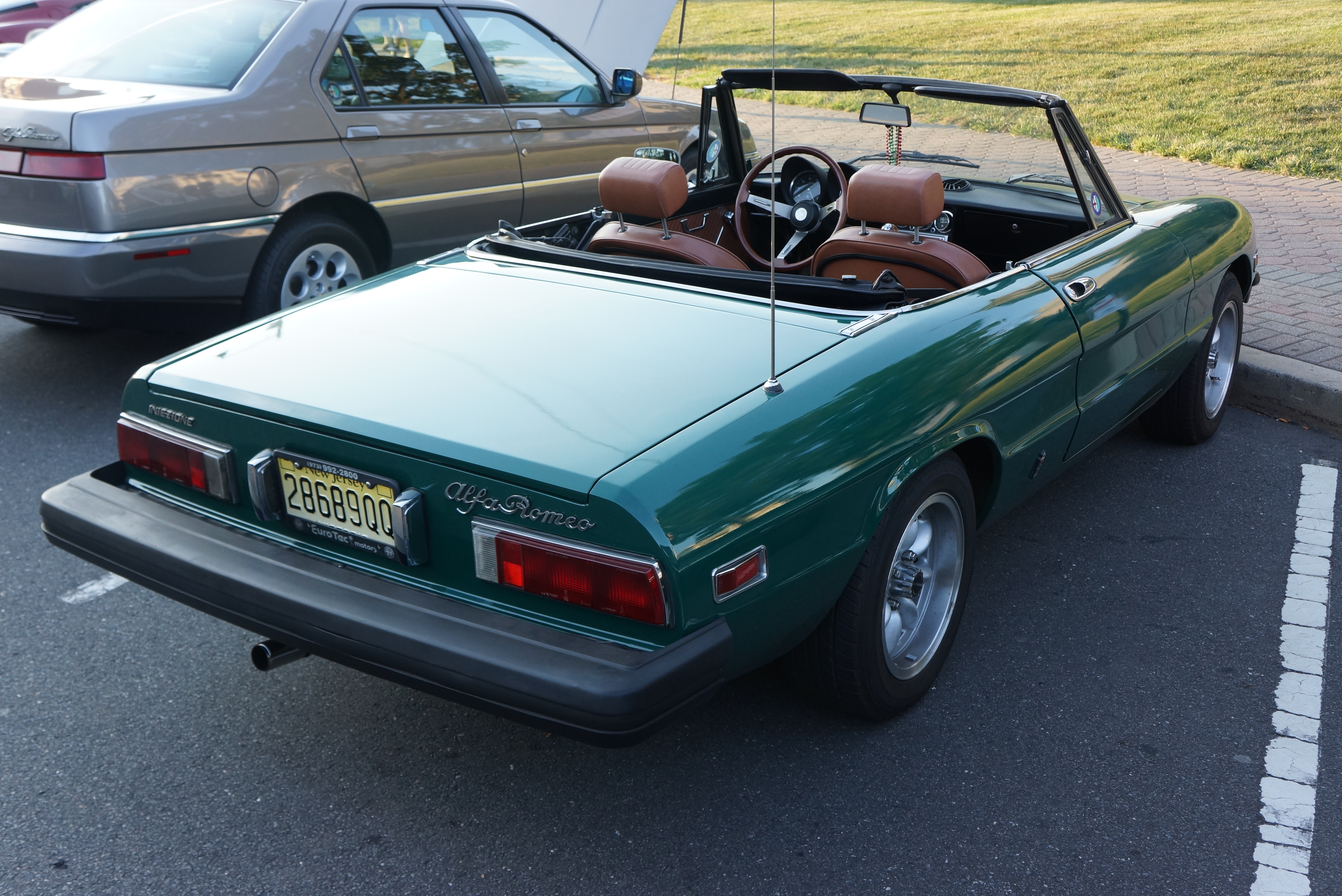
1977 Spider
Still owned by original purchaser
Interior a mix of original and refurbished
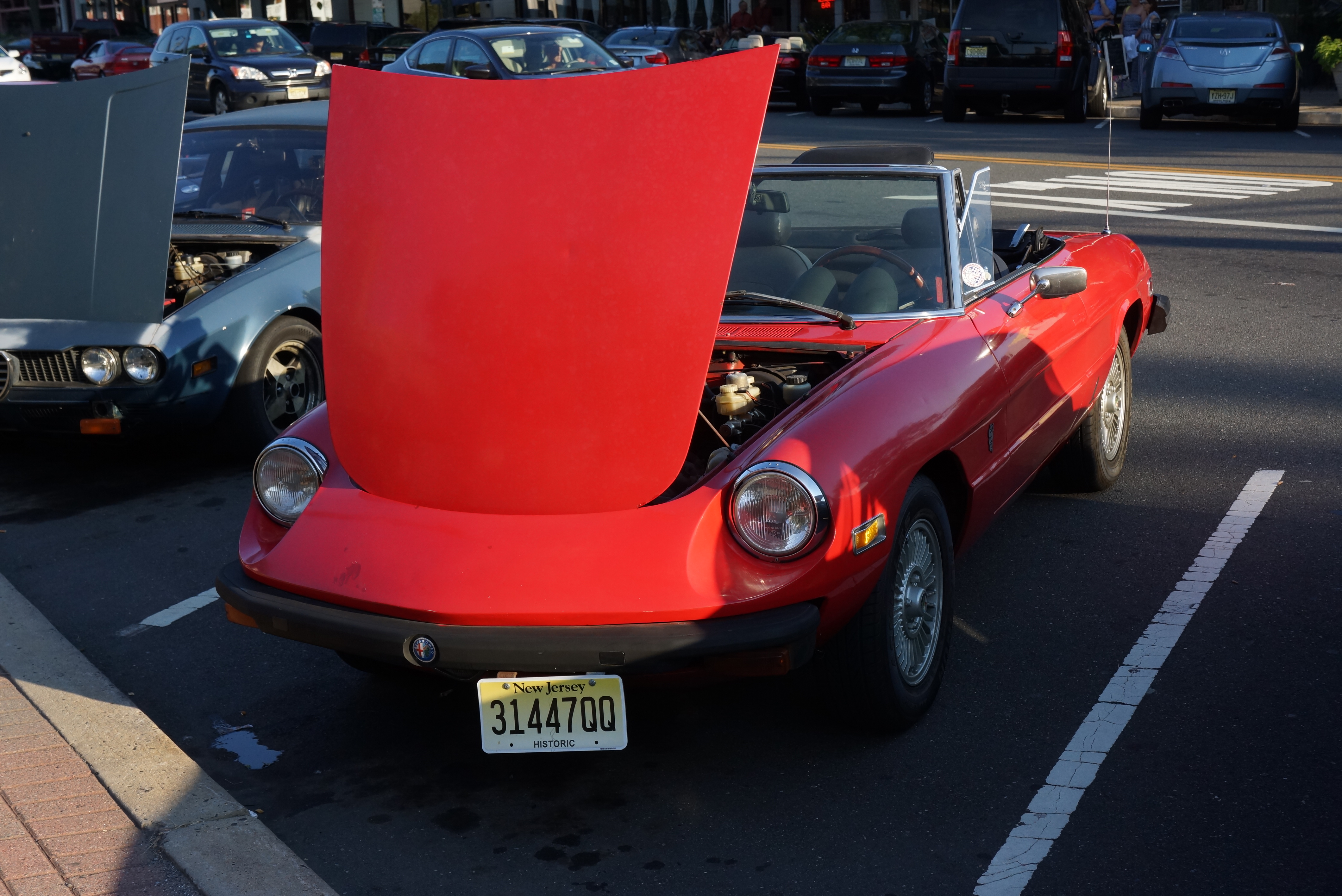
Spider in obligatory red
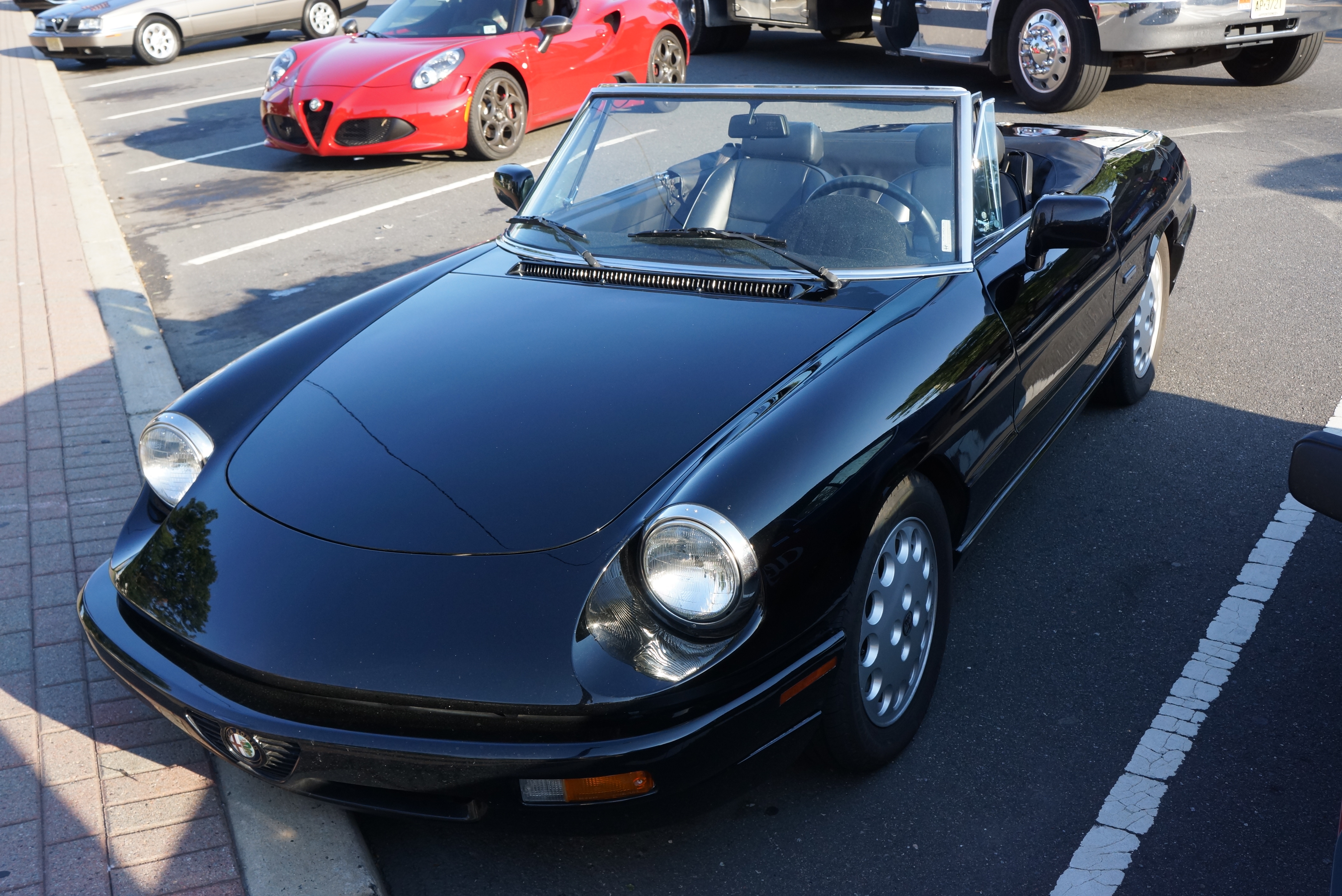
1993 Spider looking sharp in black
’70s era Alfetta GT
In case you didn’t know the marque
Rare twin-plug engine
Earliest Alfettas put tach in front of driver, with speedo pushed to center
The 164: V6 & FWD
So clean it looked a year old
Detailed engine compartment
My 1967 GT 1300 Junior
A V6-equipped ’80s GT Coupe
Sixty years later, Alfa still using manual release in 4C’s door jamb to open trunk
Went to visit my pal Pete yesterday. He’s the family friend from whom I purchased the Alfa. A trip to Pete’s place is always a guaranteed entry into some automotive fun, as he has a nice collection of “older” and “newer” cars, and always gives me a chance to take several of his cars out for drives.
There was no way I could have anticipated the “drive” which was on the horizon this day for both of us.
We were cruising in his 1979 Volvo 265 (original owner, 41,000 miles, AACA Preservation Award winner), with me behind the (thin-rimmed, non-air bag) wheel, when Pete said “see those cars on the left? Pull into that lot”. Those cars on the left were unmistakable, even from a distance of several hundred yards: a first-generation Corvair sedan, and a mid-fifties two-tone Packard sedan. I stopped the car. Pete got out and said “let me find the guy”.
1956 Packard Clipper Custom 4-door sedan
The guy was the proprietor of the gravestone marker business in whose parking lot we were sitting. Pete returned within moments, the Packard’s keys clutched in his hand, the guy right behind him. They were discussing a test drive route in the area. The guy motioned for me to climb in, said to both of us “have fun”, and went back to tend to several ladies who were shopping for granite.
Packard from the rear: it’s as large as it looks
“We” were going for a test drive in this car, a 1956 Packard Clipper 4-door sedan.
Steering wheel feels 3 feet wide – it’s just that modern wheels are so much smaller
Observation #1: there is a lot of room in the front seat of a ’56 Packard. The bench seat, combined with a dash barely extending out from the windshield base, provides a lot of stretch-out space. Pete, who is fit and slender, looked lost behind that enormous steering wheel. With the key in the ignition, the big V8 fired right up. Pete moved the column-mounted shifter into “R”, which on this car is at the far right, next to “L” (can’t say “PRNDL” here), and backed the car out of its parking spot.
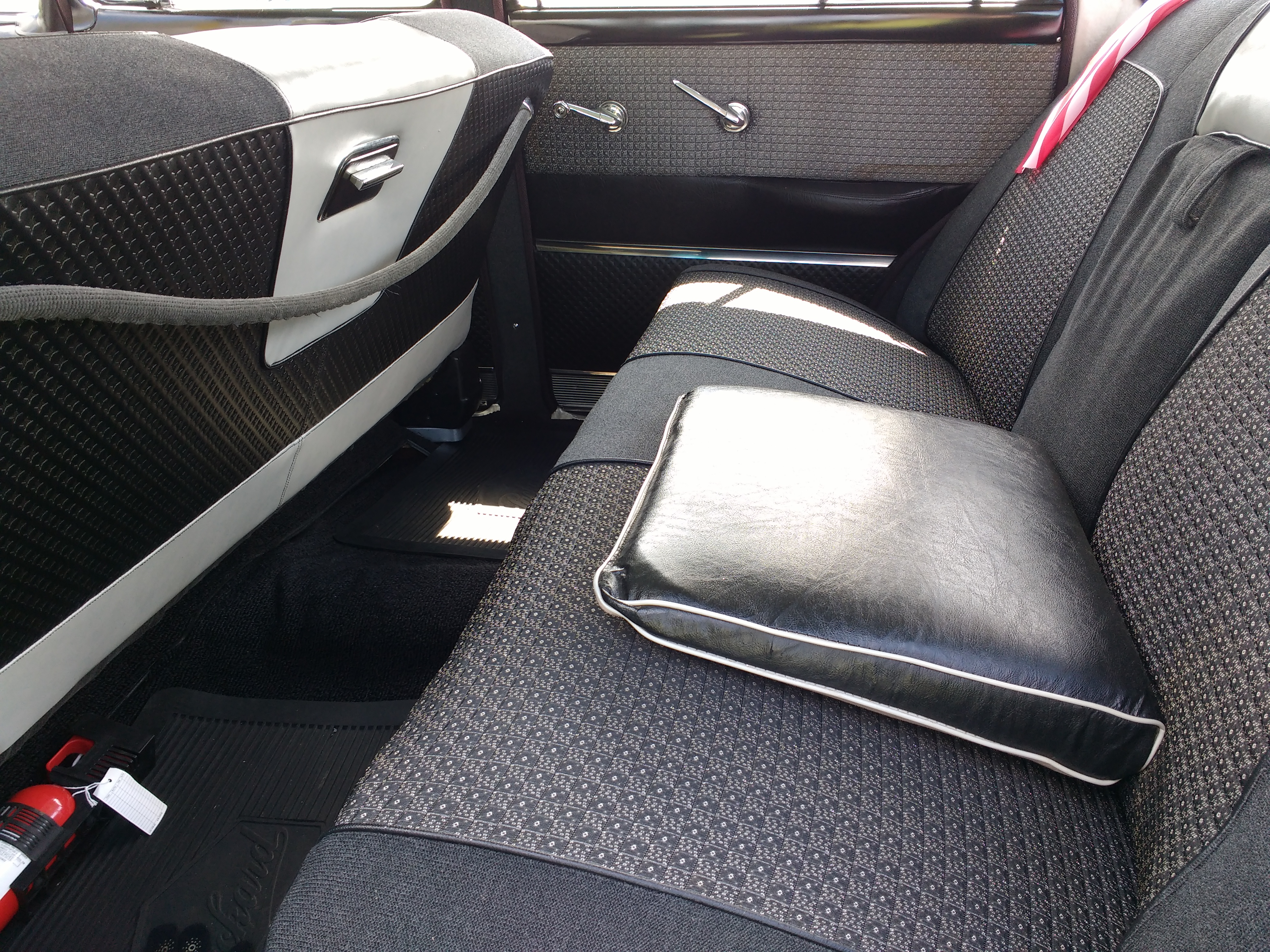
Observation #2: a 1956 Packard does not have seat belts, unless some previous owner had decided to install them at some point during the car’s 50 years of life. No previous owner had made that decision here.
Grab rope is in lieu of belts; note obligatory ashtray
As we headed toward the road, a busy two-lane highway with a de facto speed limit of around 60, I asked Pete “are we turning left or right?”
Pete: “left”.
To myself: “oh shit”.
We both were trusting that this rig would not stall when the gas was mashed, that the steering wheel would at least pretend to be vaguely connected to the front tires, and that the brake pedal would not sink to the floor upon initial application. In other words, there was no parking lot test drive before stepping out to play with Friday’s traffic.
Pete successfully made the left turn, and the car was up to 50-55 with little effort. We cruised for several miles at that speed. I noticed that with Pete’s hand steadily on the wheel, the steering did not need constant correction in order to continue straight – impressive (and certainly not how my ’57 Ford steered).
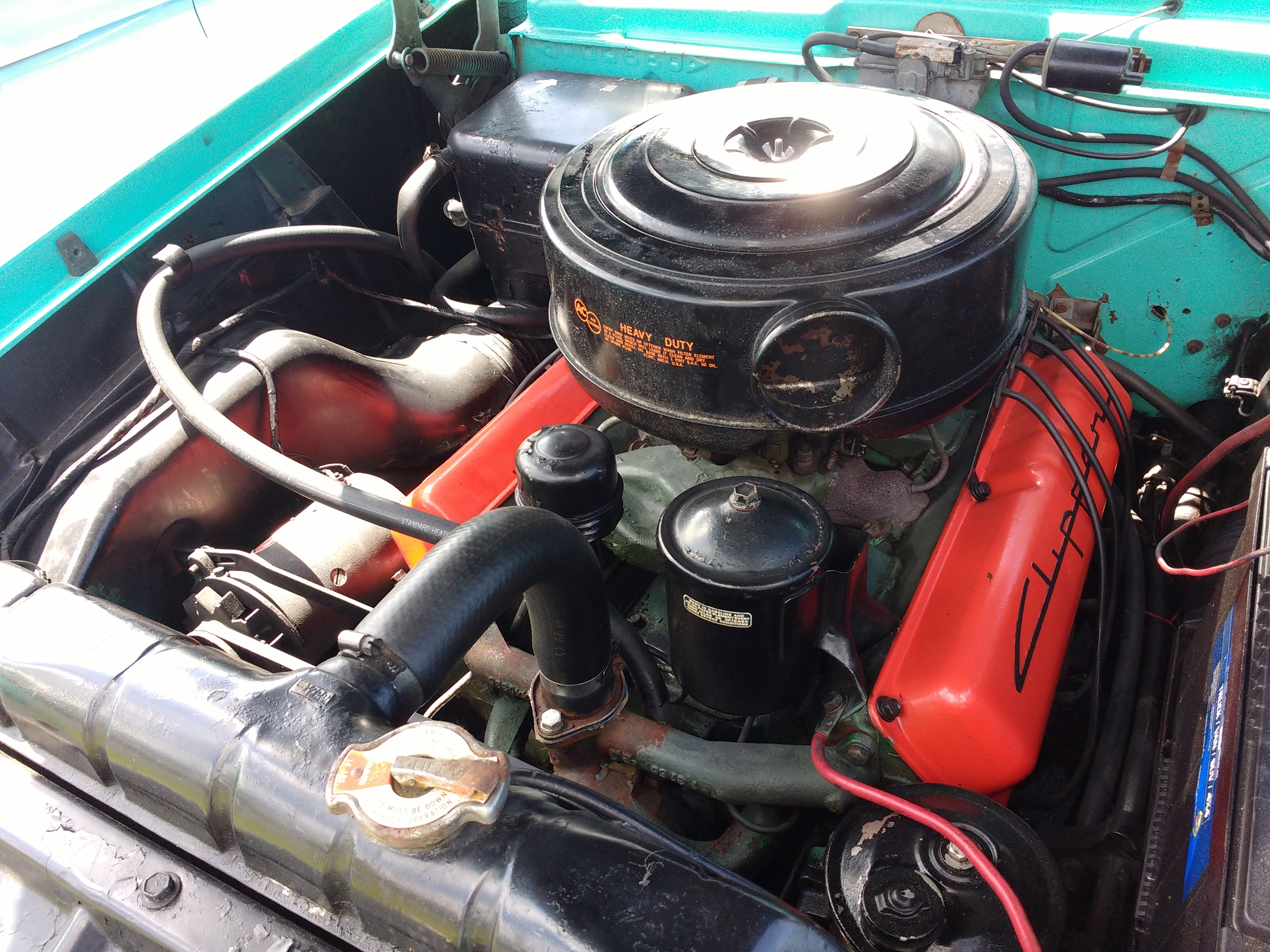
Orange valve covers out of place on green engine block
The road started downhill, the posted speed limit dropped to 40, there was construction on the right, an 18-wheeler was behind us, and the traffic light up ahead turned red. We needed to slow down QUICKLY. Pete braked with his left foot. The car dove to the right, he let up on the pedal, reapplied the brake, and the car darted left. The brakes pulled badly. The tractor trailer, in Pete’s words, was “up my butt”. To his credit, Pete controlled that big wheel, modulated the brakes, and got us safely stopped. Speaking of stopped, my breathing did for about 10 seconds. I recovered. Did I mention that the car had no seat belts?
Battery, hoses, clamps look recent; otherwise things look refreshingly original
As we turned left into a residential area, I was relieved to be away from that busy 2-lane. This was when Pete pulled over, put it in Park, and said “OK, your turn”. I had not driven a ‘50s-era automobile in many years. I had never driven a Packard. This was going to be a thrill.
With the transmission back in “D”, I pulled out onto the quiet 25-mph street. The car’s power steering certainly was effortless, but inputs did have a direct effect on the car’s direction. Accelerator tip-in was fine, and the V8 had lots of torque. The most remarkable observation during the test drive was the car’s ride. It was supple without being too floaty. There was nary a squeak or rattle from any of the four corners. The car handled better than a 2-ton ‘50s American car would be expected to handle. (And this on bias-plies.)
Kids: handle on right controls door window. Rotate one direction to raise, the other to lower
The two issues with the car were the aforementioned (drum) brakes, which needed adjustment or perhaps a service, and the transmission, which needed its quadrant adjusted, and which at one point during a downshift made a groaning sound.
The car’s odometer indicated 57,614 miles, and Pete and I agreed that nothing we saw before, during, or after our test drive would give us reason to doubt those miles were original.
Car’s styling rivals anything else from Big 3 for ’56; note exhaust pipe
Back at the gravestone store, I parked the Packard exactly where we had found it. Pete ran the keys back to the owner. It was then that I got the story that the Packard (and the Corvair) had belonged to the owner’s father, who passed away a year ago. He was just getting around to putting them up for sale. The ask was $16,000. Pete told him that he would think about it.
1962 Chevrolet Corvair 4-door
Ask is lots less than Packard
Roofline shared with full-size GM cars
I know that Pete would love to have the car, but like many of us, he has an issue with room. His 4-car garage is full, and there’s still one (newer) car outside. Additionally, at almost 19 feet in length, there’s some doubt that it would fit (unless one drilled holes in the wall for the Dagmars). This car looks like it’s had one high-quality repaint but otherwise appears to be in fine original condition. It’s just several weekend’s worth of detailing away from being an HPOF candidate at an AACA event.
Front & rear badges say “Clipper”; “Packard” is in small font on side of decklid
Observation #3: a 1950s-era Packard motorcar would make a fine addition to anyone’s car collection.
SIDEBAR: 1956: the year of the last “real” Packards
The history of the Packard Motor Company is a fascinating study of how a successful maker of some of America’s finest luxury cars still managed to go out of business. It is impossible to go into great detail here, except to note that by the 1950s, Packard merged with Studebaker, and finally replaced its straight-8 engine with a V8 for 1955. But there was much more to the 1955 Packards than that. Quoting from my copy of the Encyclopedia of American Cars, by the Auto Editors of Consumer Guide:
“… the 1955 Packard was a technological marvel. Prime among its wonders was “Torsion Level” suspension: long torsion bars connecting front and rear wheels on each side. A complex electrical system enabled the suspension to correct for load weight, and effectively interlinked all four wheels for truly extraordinary ride and handling despite two-ton bulk…. …these were impressively fast and roadable cars…. Customers were scared away by … the ’55 Packards’ notorious quality and service problems. Ironically, the ‘56s were better built….”
Their write-up goes on to say that in a truly desperate move, Packard decided that the “Clipper” would be an entirely separate make for 1956:
“Besides registering the name as a distinct make, (company President James J. Nance) decreed separate Clipper and Packard dealer signs…. As a final touch, “Packard” appeared nowhere on ’56 Clippers except for tiny decklid script – and some didn’t even have that.”
By the 1957 model year, Packards were being built in South Bend, Indiana on restyled Studebaker bodies. It was the end of an era. But reading the above, it’s now understandable why our test-drive car rode so well (and why I’d want to learn more about the suspension’s electrics before plunking down my hard-earned cash). I also had no idea that “Clipper” was a separate make in 1956, which explains the badging on this particular car. Based on the quality and the engineering of the example we drove, it is a shame that Packard did not survive.
After buying new cars in 1977 and 1981, I decided to try to save a little money by returning to something used. Both of the new purchases had been Volkswagens, and my overall experience had been good. Although I was working for a Volvo dealer, the Swedish car maker’s then-current lineup of 240s, 260s, and 700s were too large and staid for a single dude like me. I liked the fuel economy, hatchback utility, and front wheel drive of these German subcompacts.
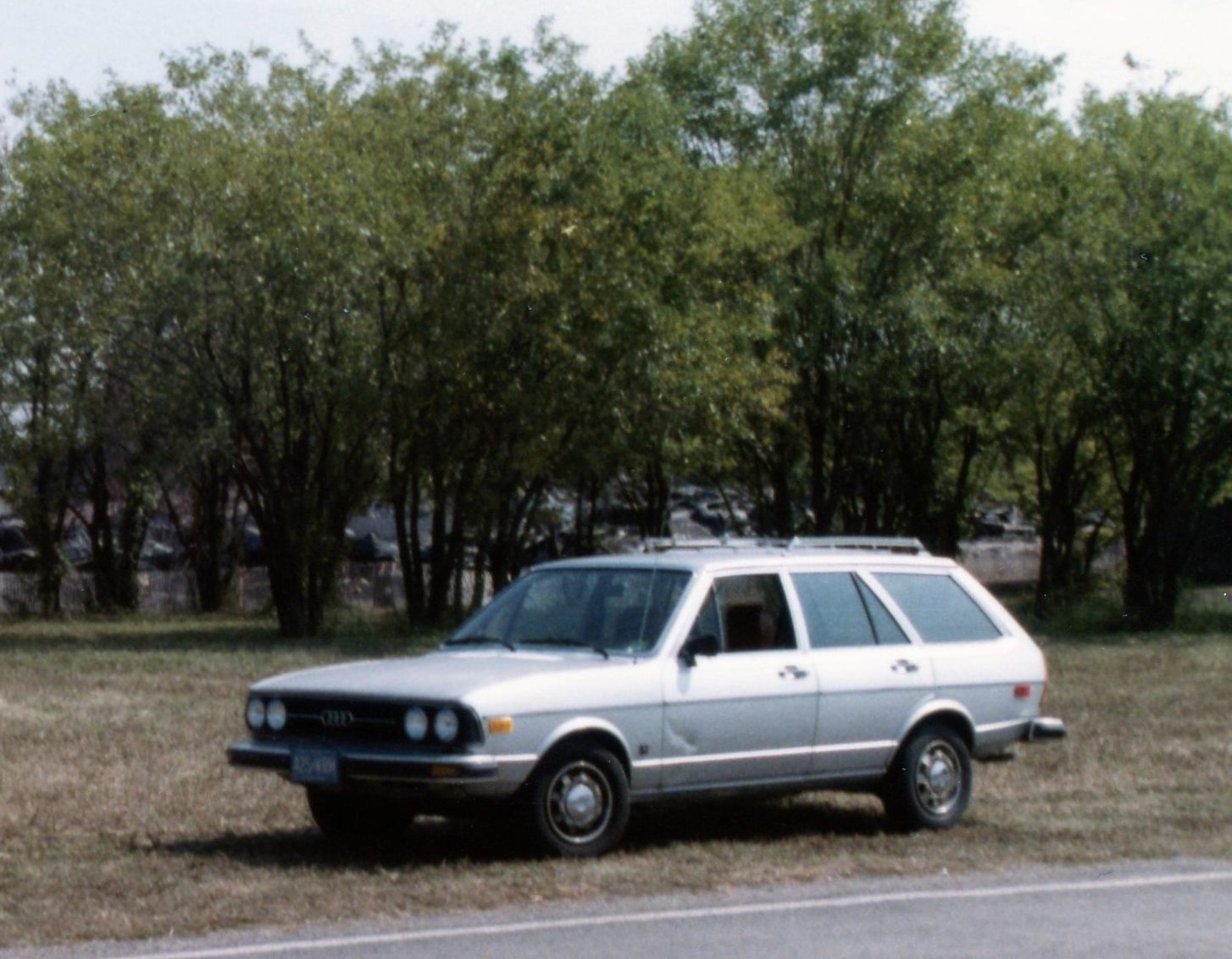
In the summer of 1984, the dealership where I was employed, Smythe Volvo, took in a 1977 Audi Fox station wagon on trade. The outside of the car looked scruffy, but the interior was OK, there was no significant rust, and the mileage of 79,500 was about what you’d expect on a 7-year-old car. Besides, it was a stick (an automatic would have been a deal-breaker). The car was what you might call a “beater”, and my rationale was that since I was mechanically inclined, a beater would give me a cheap entry price and allow me to perform my own maintenance and repairs as necessary.
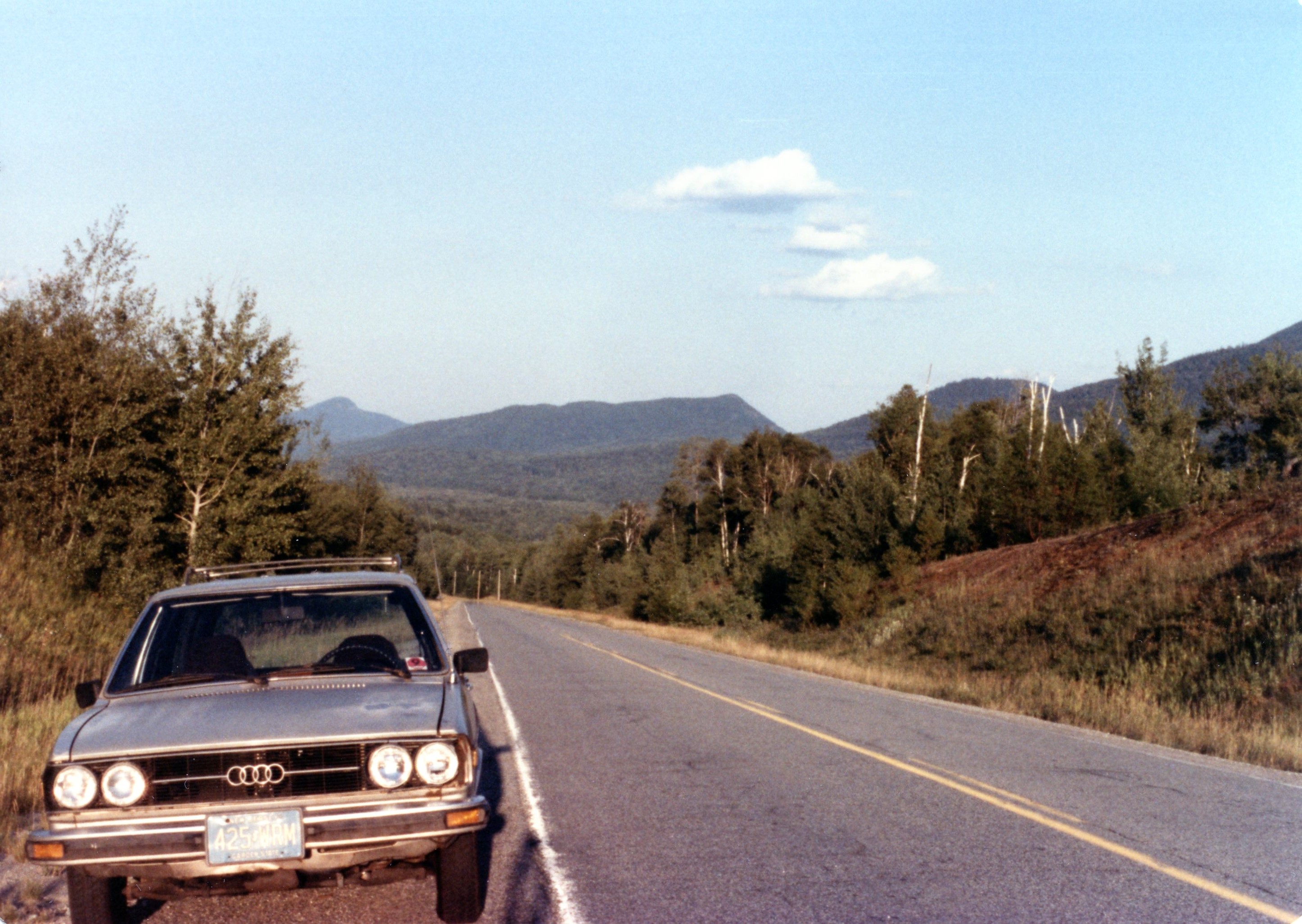
The ’77 Audi Fox, soon after purchase
I spoke to Bill Smythe, one of the dealer principals, about buying the wagon. He seemed reluctant at first, but then relented, and sold me the car for $850 (plus tax & registration; they were kind enough to waive any doc fees).
The Bill of Sale
The Audi Fox was the mechanical equivalent to the VW Dasher of the day (and not to be confused with the later VW Fox). As such, its engine sat longitudinally, not transversely like my two previous VWs. The Audi interior was likely a slight upgrade over its Dasher cousin. Other than that and an Audi grille, the Fox and Dasher were almost indistinguishable from each other.
The farther from the lens, the better it looked
The first issue I had with the car was oil consumption – by now, I knew the problem was valve stem seals, and I had one of the techs in our Service Department take care of it for me as a side job. I attended to the wipers/brakes/tires, to assure that they were good. The problem with the Fox, though, was typical of ‘beaters’ as they teeter toward the end of their useful lives: it was nickel-and-diming me to death.
Who decides on these poses anyway?
Once I got the oil consumption conquered, the exhaust system fell off. The car ate front brake pads every 7-8,000 miles, and I didn’t know why. The radiator sprung a leak and needed replacement. That’s when I saw that every coolant hose was dry rotted. I blew out an almost-new Michelin tire on a sewer grate (not the car’s fault, but still….).
“We” failed inspection- note the sticker. One friend nicknamed it the “worm wagon” (see plate)
While each one of these repairs was simple enough, and none of them broke the bank, it became obvious that the previous owner had neglected the beast. Confidence that the car would get me to my destination and back began to slip away.
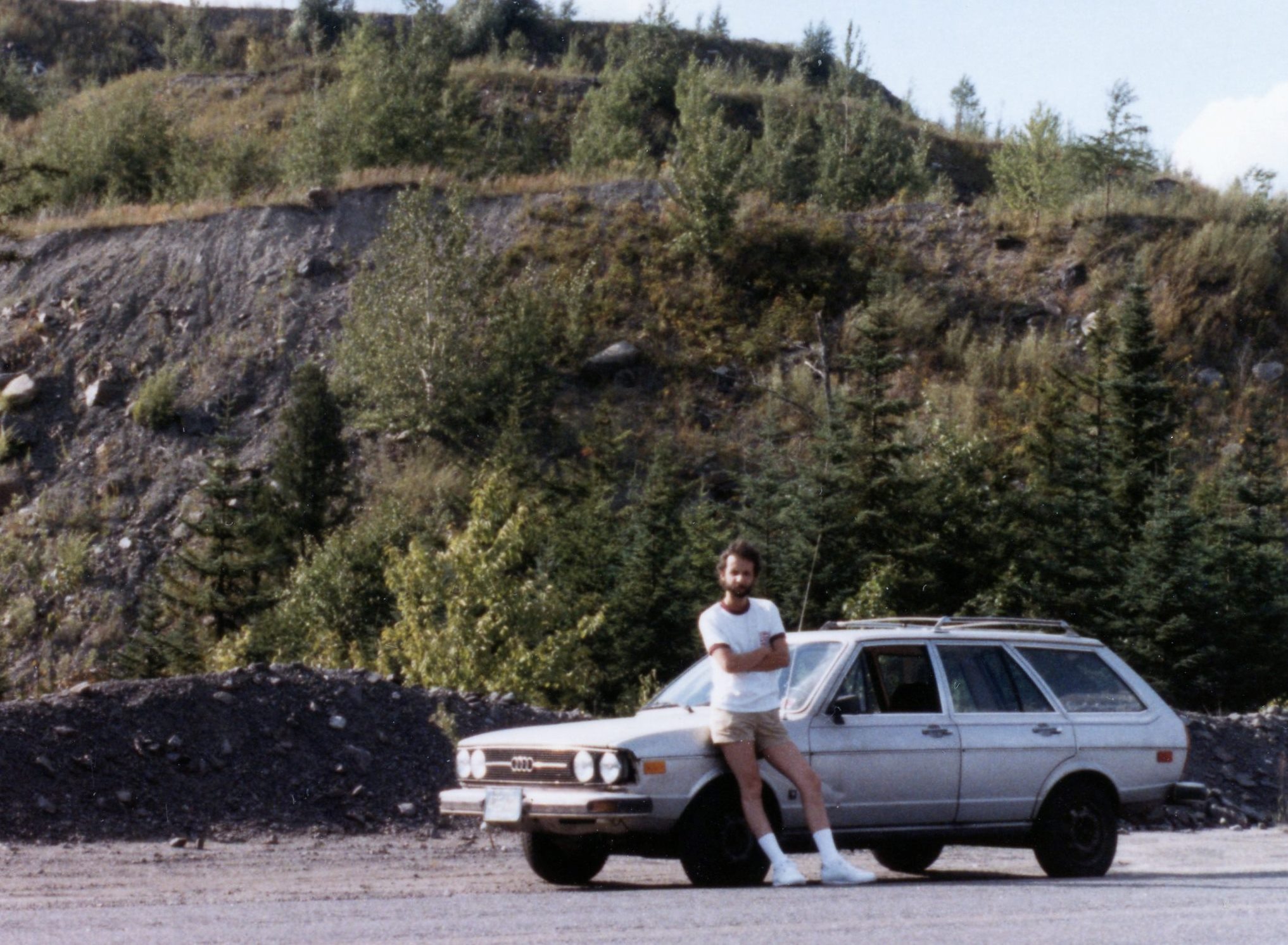
Looking good immersed in Adirondack scenery
One of the final indignities was the fuel pump failure, which happened at a buddy’s house in Brooklyn. I borrowed a car to drive home and get a replacement part, because I had the bright idea to replace the pump in his driveway (in November) in order to save a tow charge. Sure, I got it done, but adding up the time and effort, towing it may have been the better decision.
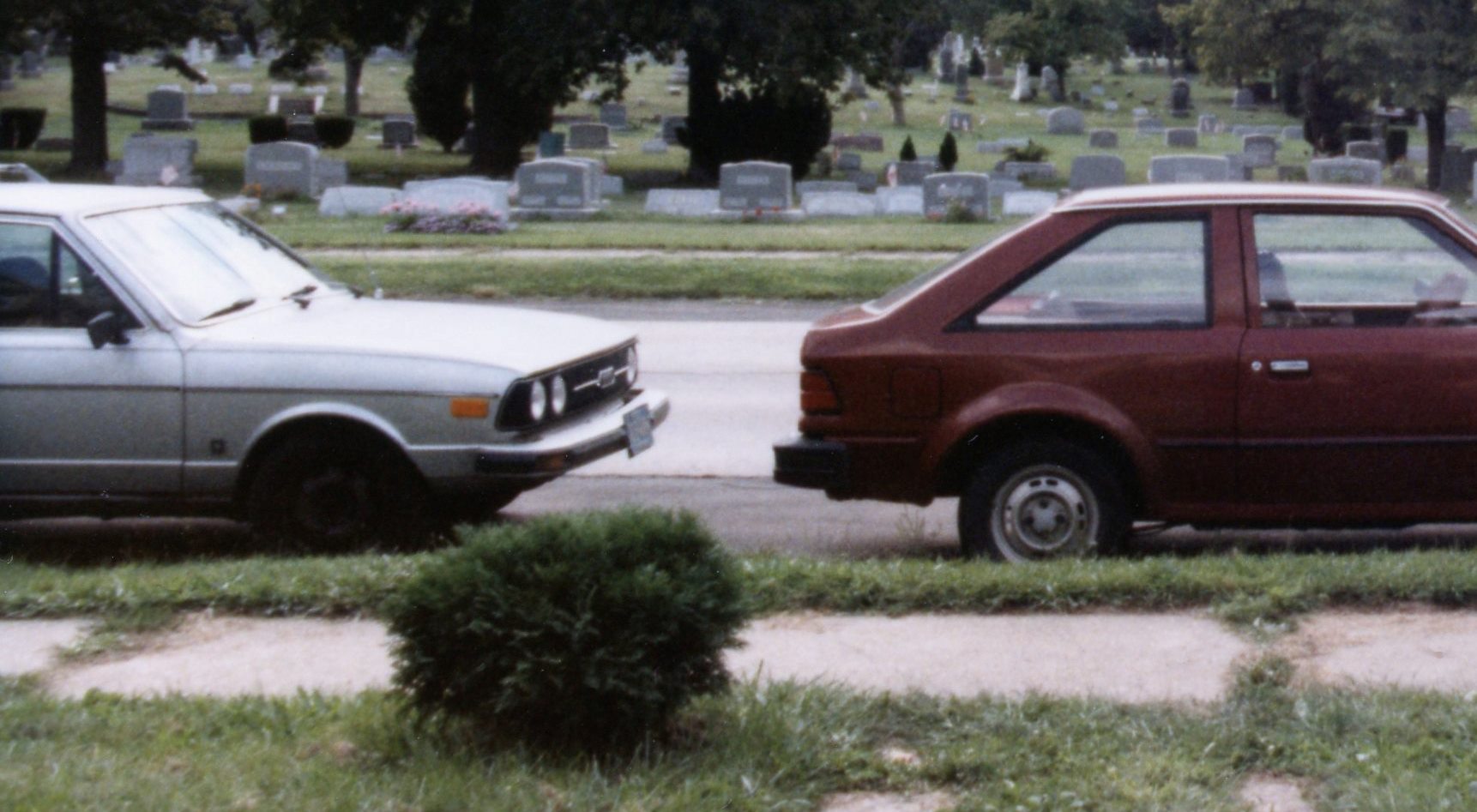
In front of my brother’s house, behind his ’81 Ford Escort
By early 1986, after two and a half years, it was time to quit. According to the log book I kept, I got rid of it at 110,000 miles, which looking back, surprises me. My memory is of a car which almost constantly needed attention, yet, it carried me over 30,000 miles. Nevertheless, it was time to switch brands. After three Volkswagen products in a row, for the next car, I would be turning Japanese for the first time.
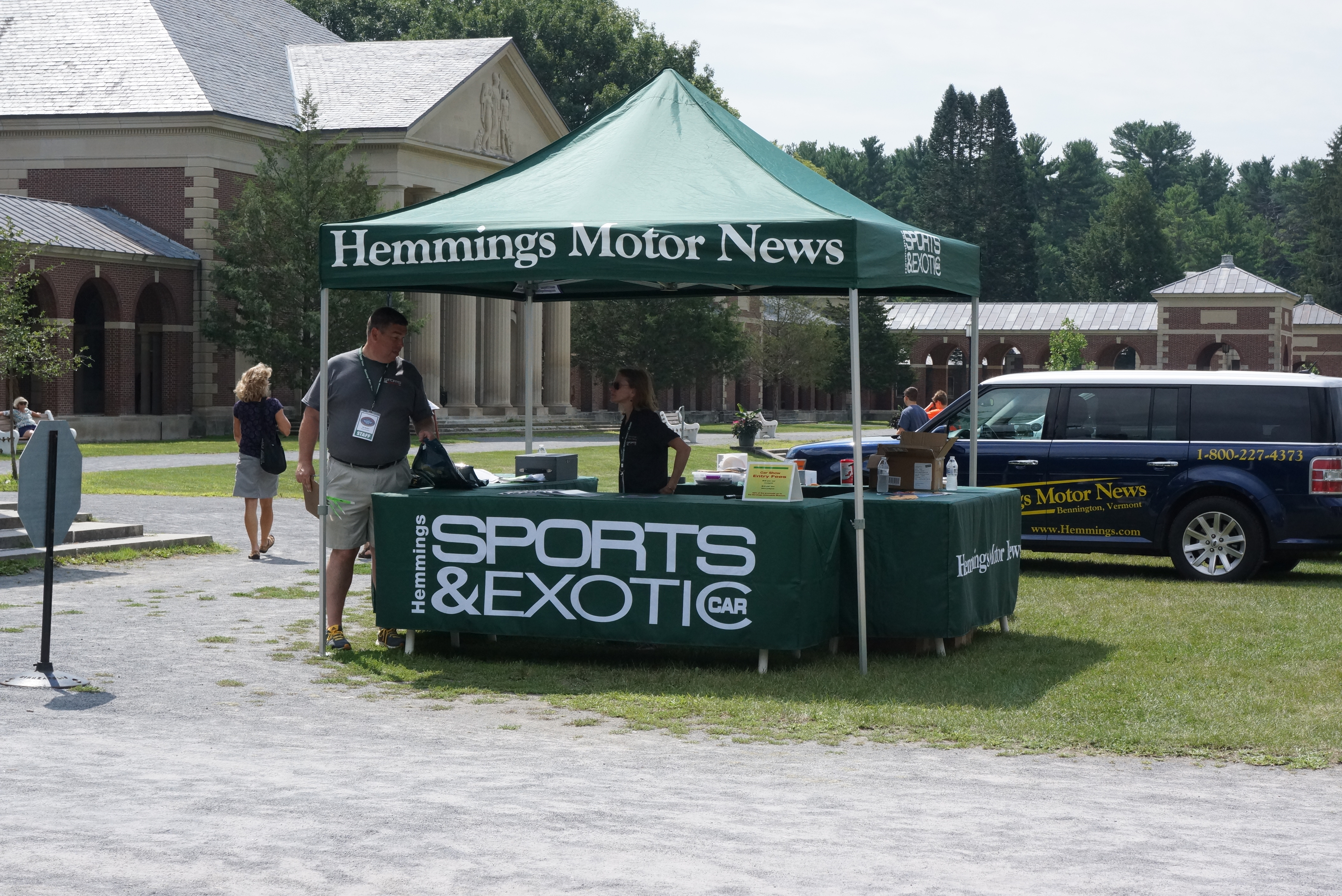
The good folks at “Hemmings”, publishers of several well-known collector car magazines, held their 11th annual Sports & Exotic Car Show on the grounds of the Saratoga Automobile Museum in Saratoga Springs, NY. The event took place on Saturday, August 6, 2016. In spite of a threatening forecast (and a published rain date of Sunday August 7), the organizers decided to press on, and the weather cooperated, as the show field remained sunny and dry, if a bit warm.
The show was open to “sports cars, GTs and exotics built outside the United States prior to 1992.” Those with newer imports were still welcome to attend, but would not have their vehicles judged.
My good friend Peter agreed to accompany me (and did most of the driving – thanks Peter!). Since I had attended one Hemmings show at the same location two years prior, I had reason to expect a professionally-run event, with a decent turnout and quality cars. We were not disappointed.
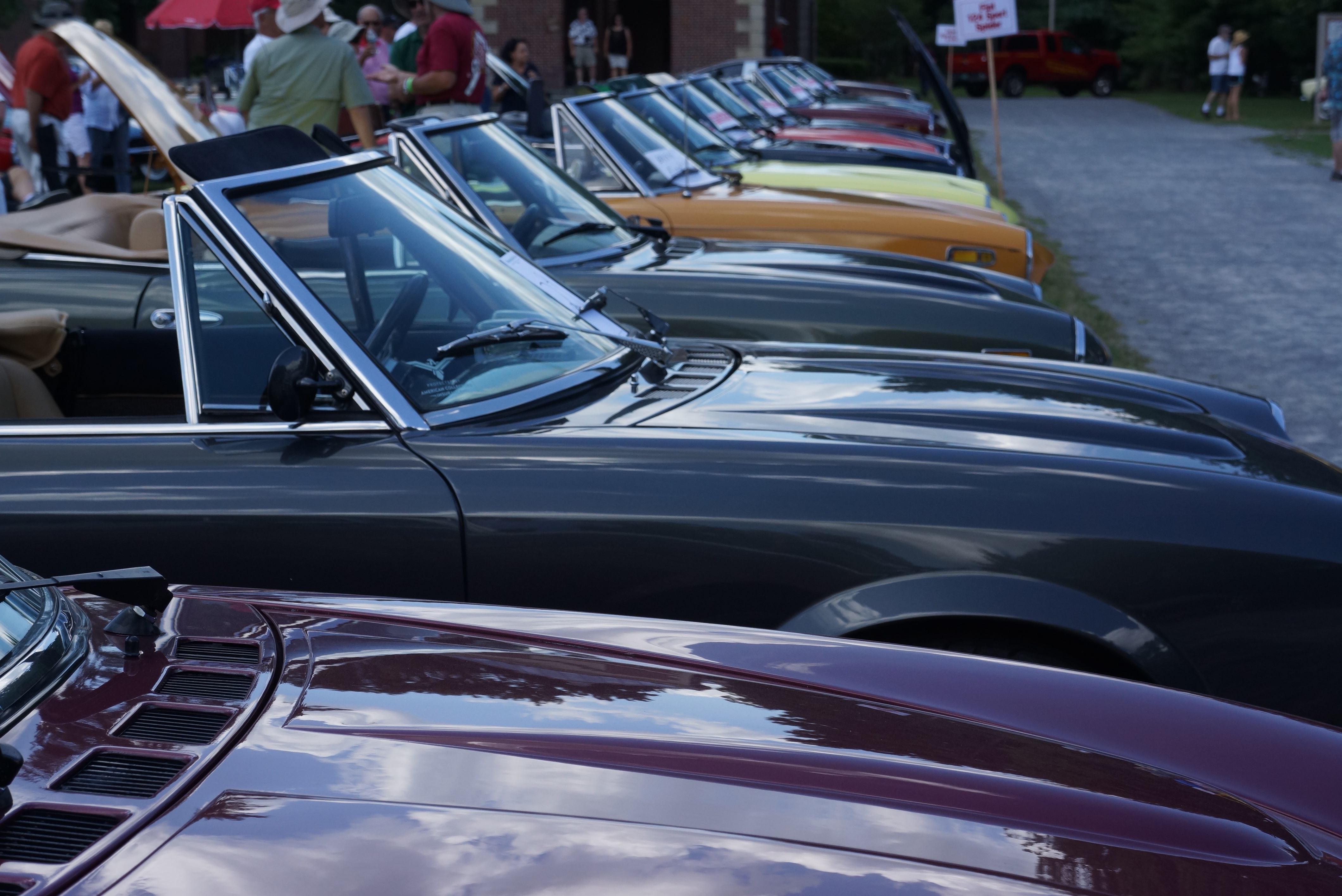
Arriving by 10:30 a.m., the show field was almost completely full. Cars were arranged by class, which for the majority of attendees was Country of Origin. As in years past, this show had several Featured Classes, including pre-1992 Jaguars, Porsche 356s, and Toyota Sports & GT cars. The big attractions for me were the two Italian Featured Classes: Fiat 124 spiders and Alfa Romeo spiders. Both the Fiat 124 spider and the Alfa Duetto/spider were celebrating their 50th anniversaries.
The entire event had a relaxed and casual feel to it. Most cars were prepped for judging, but unlike some other judged shows, the owners seemed carefree. (No one was spotted picking blades of grass out of their tire treads.) Everyone lazily walked the grounds, chatted up the drivers, and shared their stories. The verdant setting helped with the “stroll in the park” ambiance.
At 2 p.m. sharp, the Awards Ceremony began. There was a 2nd place and 1st place trophy for each of 13 classes. (I believe judging was done by that time-honored method known as “which cars do we really like?” Nothing wrong with that, either.) The winners were lined up and slowly driven past an admiring audience. By 2:30, it was over.
Hemmings hold two shows each year in Saratoga Springs, this one, and the larger Concours d’Elegance in September. If you haven’t been, either is highly recommended.
BRITISH
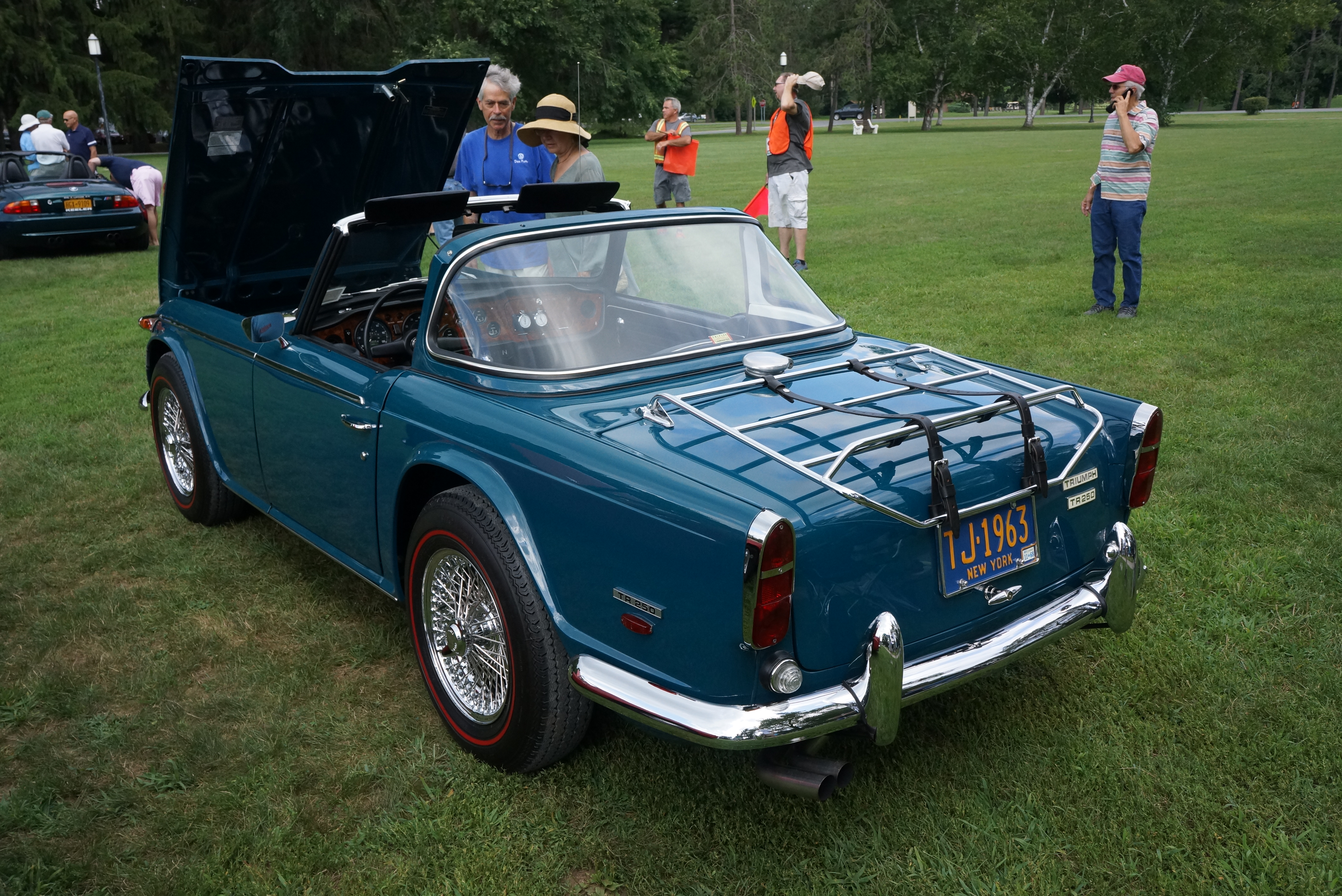
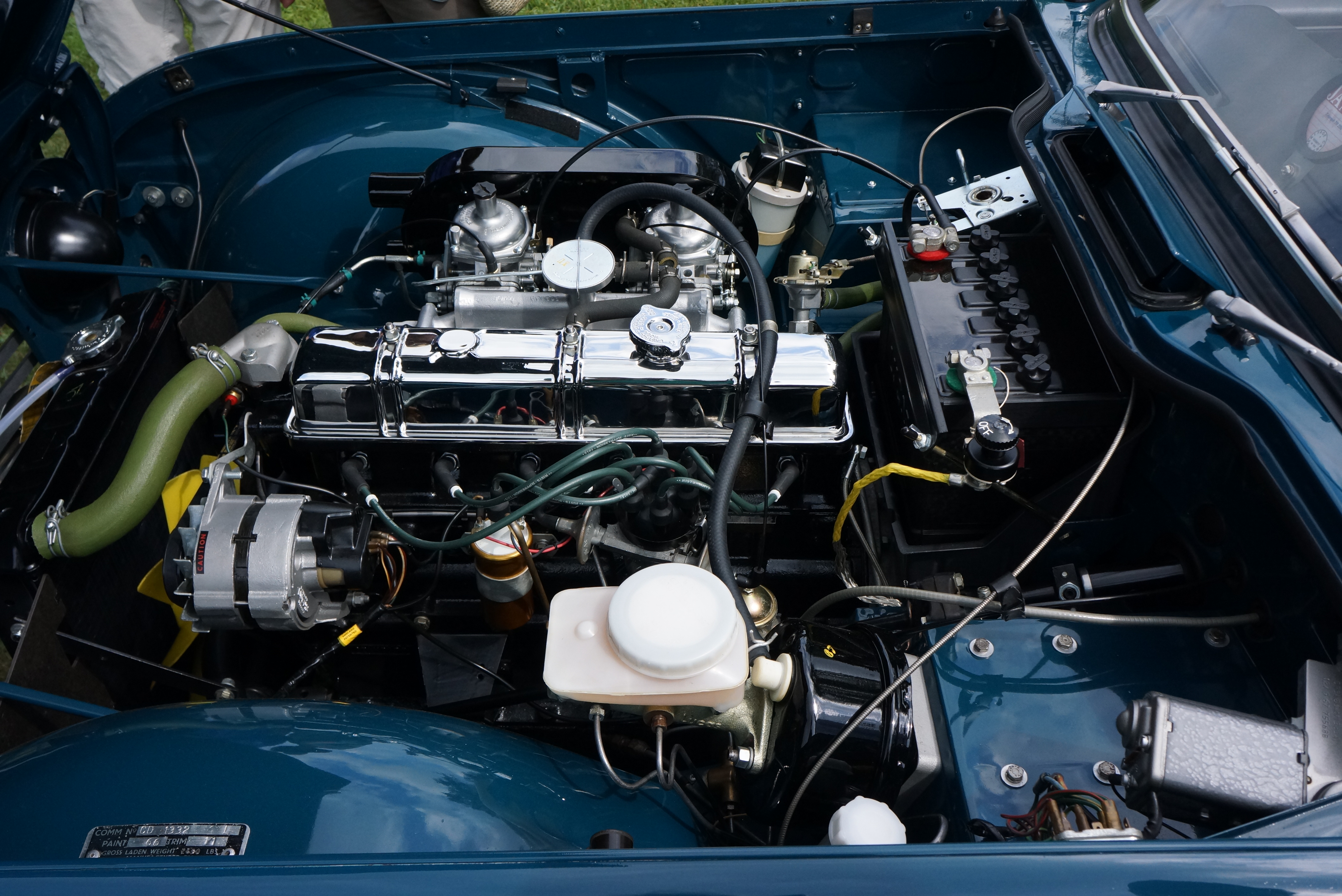
This 1968 Triumph 250 was voted “Best of Show”. It was immaculate, and it deserved it.
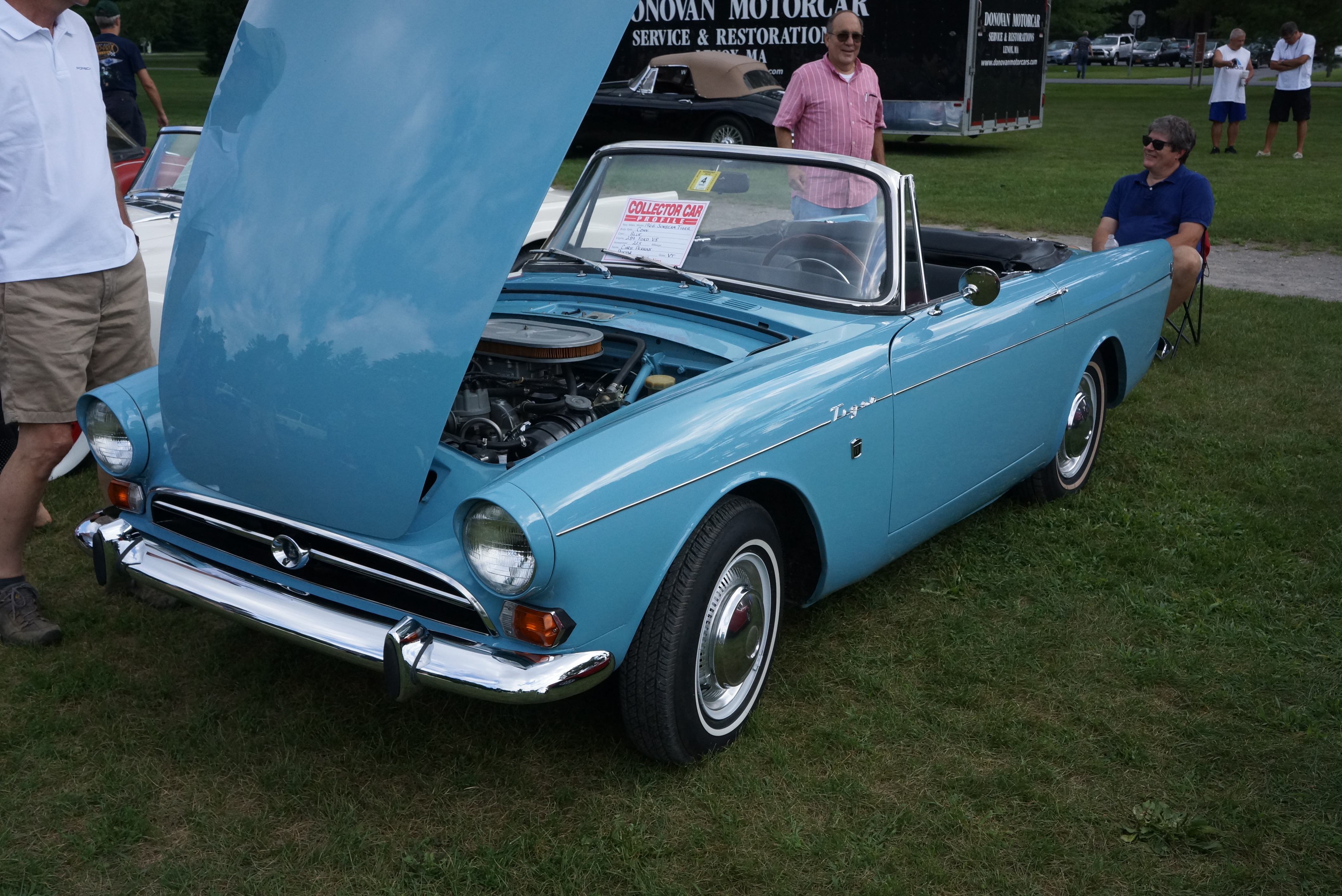
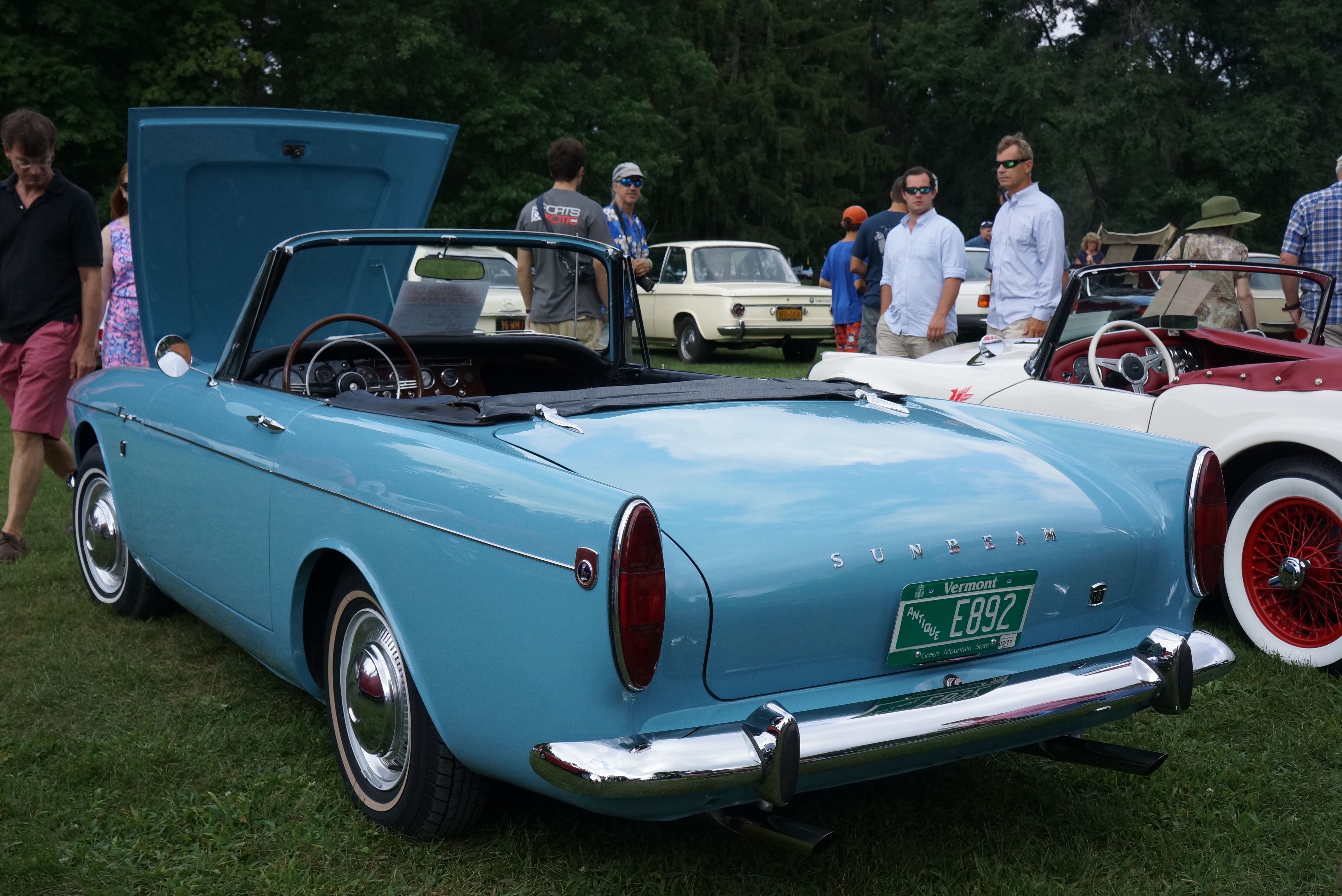
This Sunbeam Tiger was in a most unusual shade of baby blue, and we’re unsure if the color was an original choice from the factory.
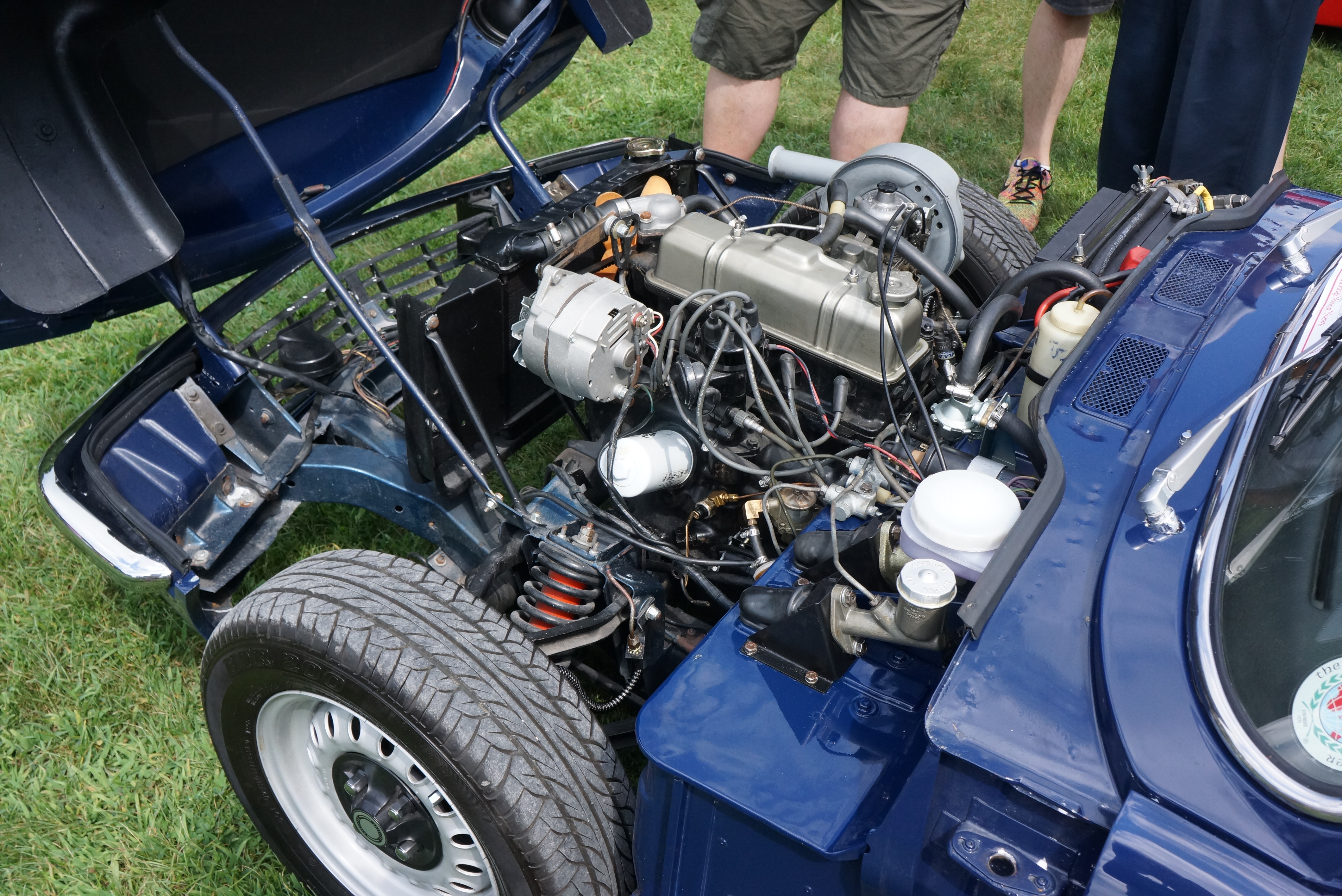
Triumph Spitfires have marvelous engine access.
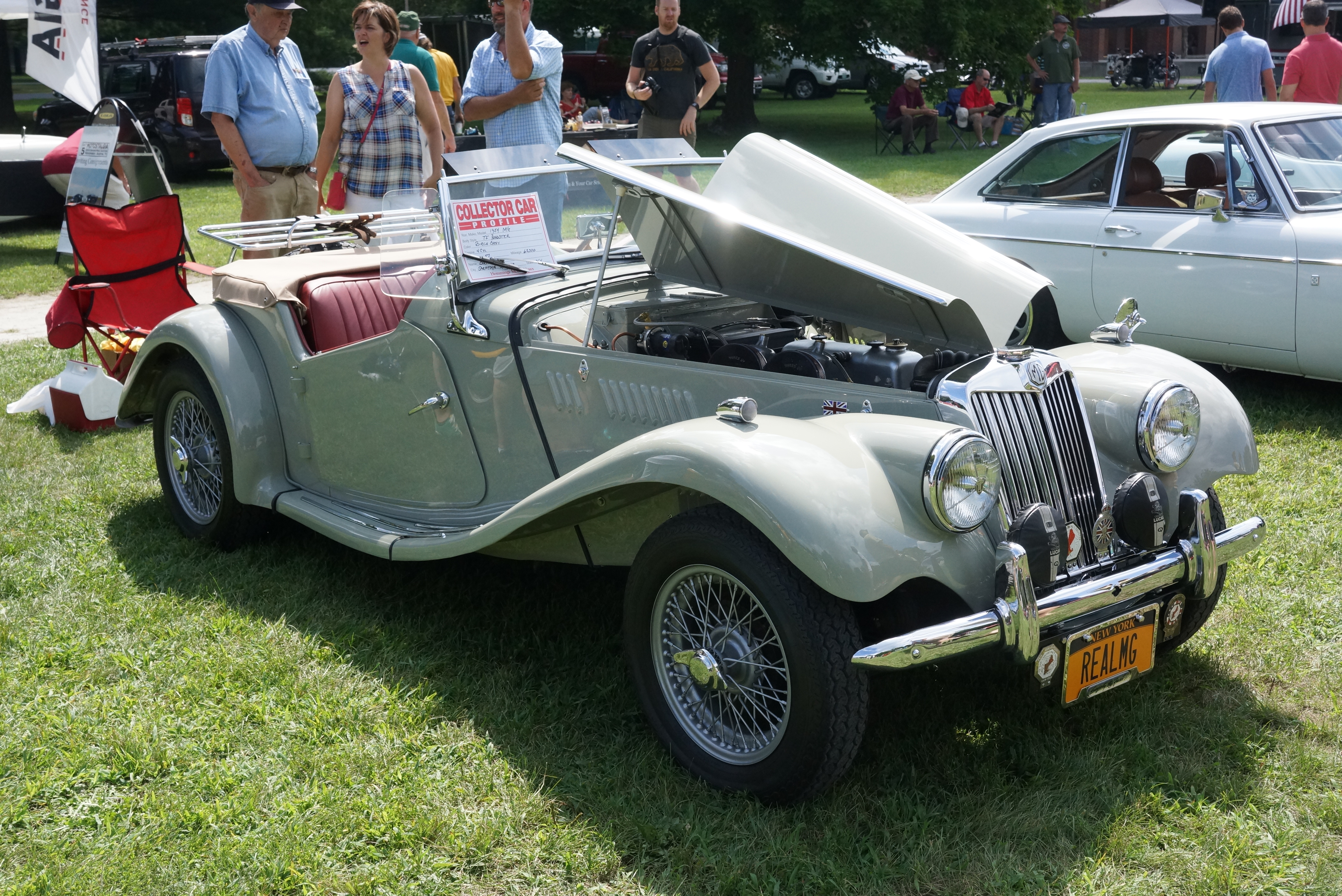
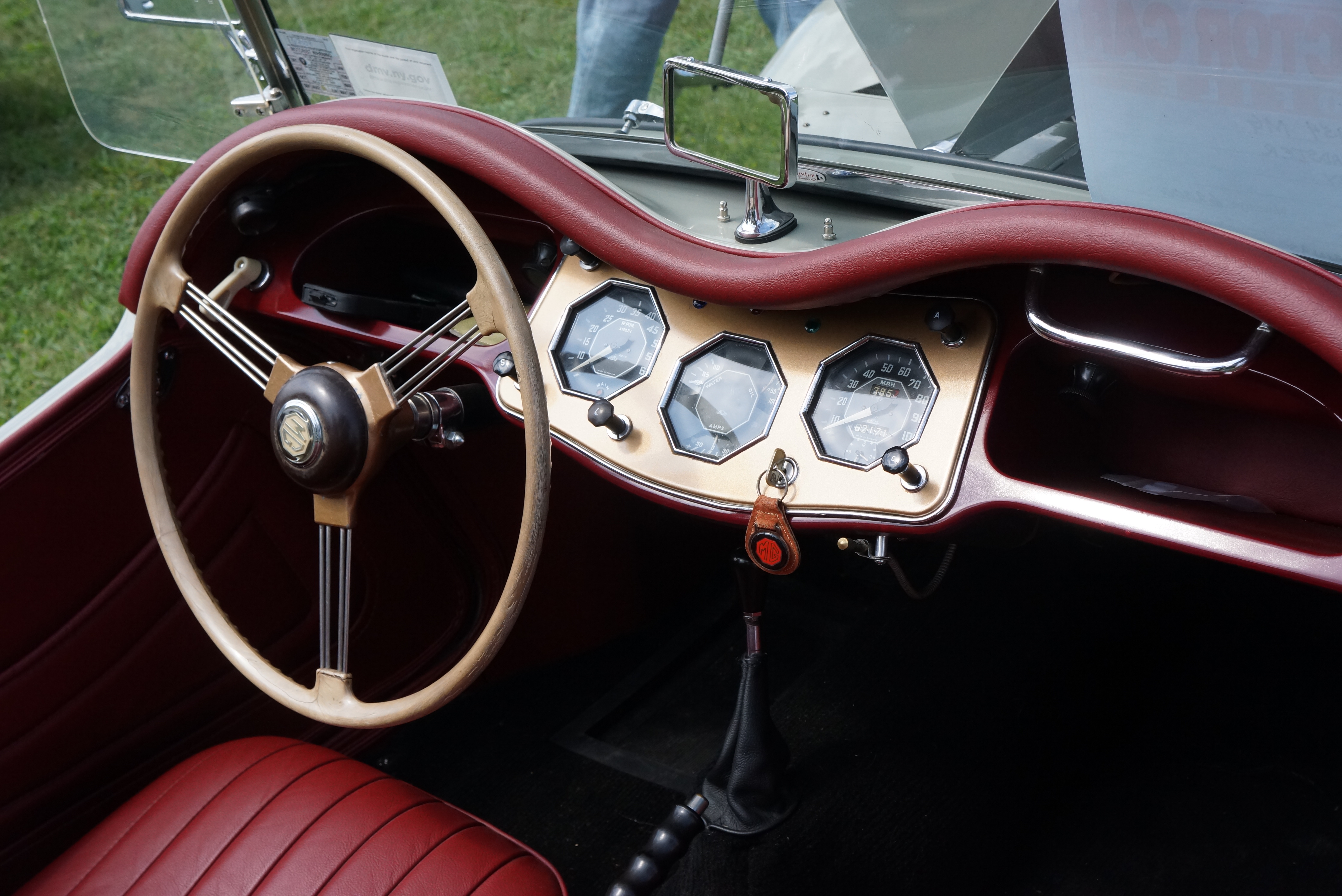
MG-TFs carried the marque’s octagonal badge shape to the instrument cluster.
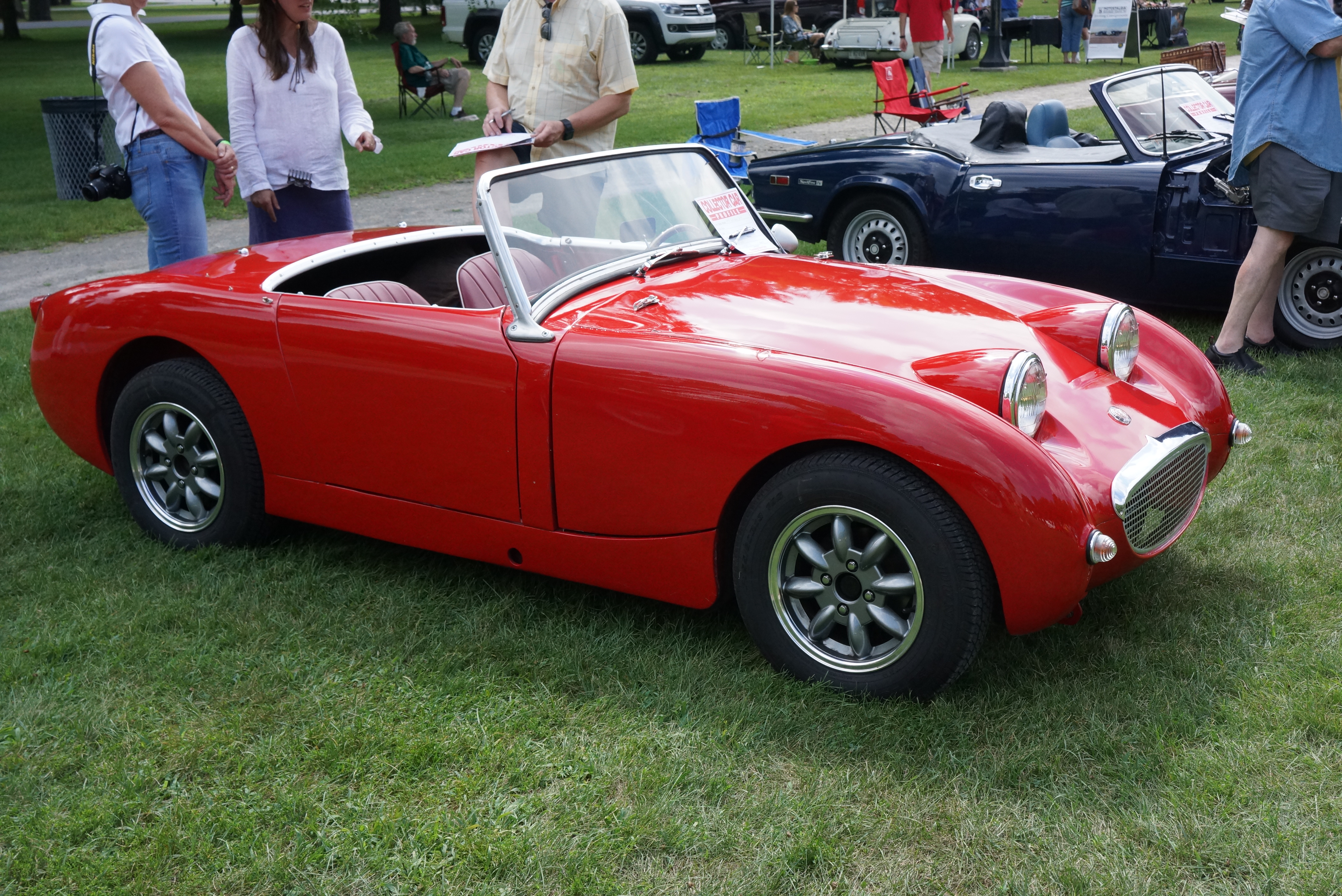
This Austin-Healey Bug Eye Sprite was even cuter sans bumpers.
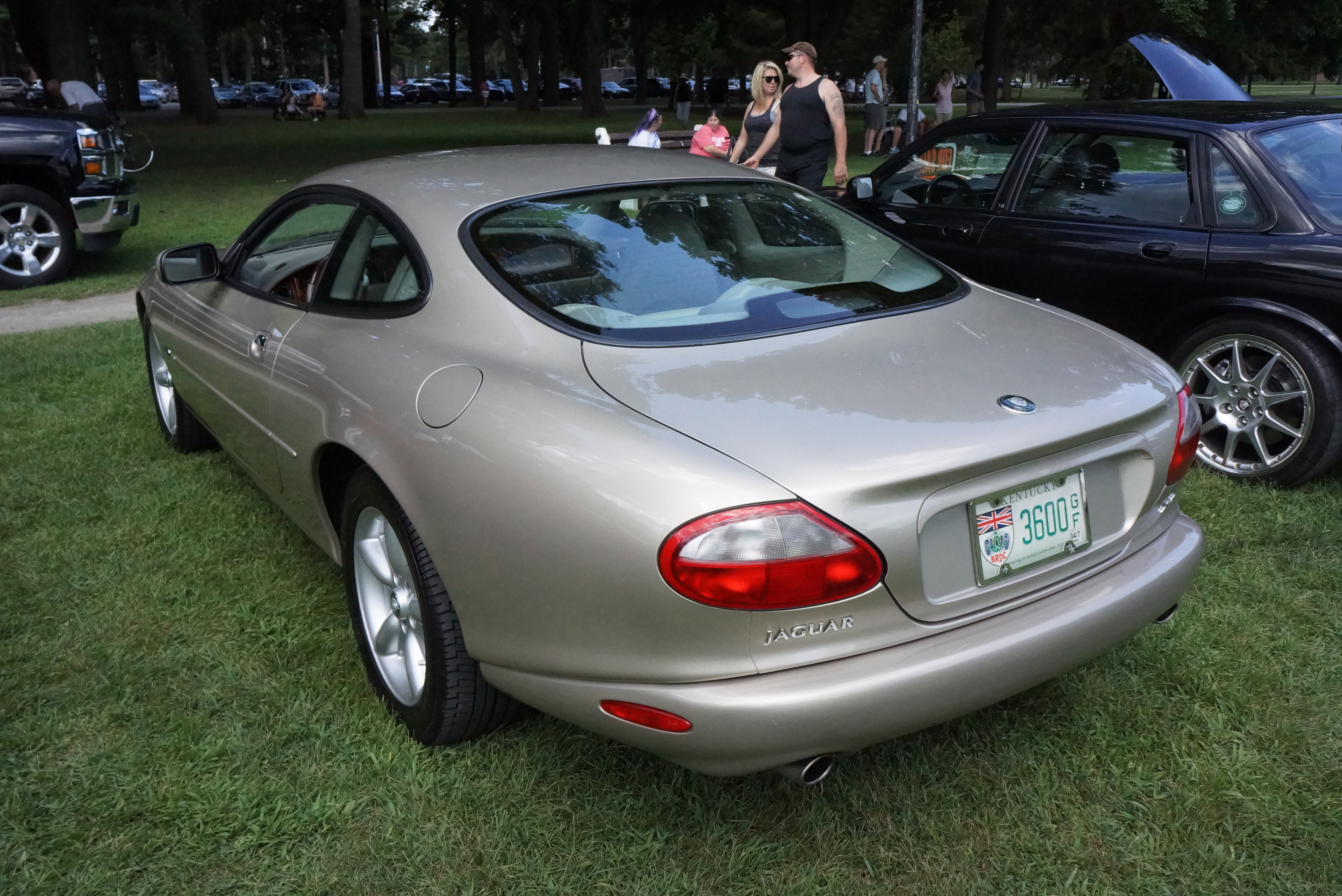
A Jaguar XK8 Coupe.
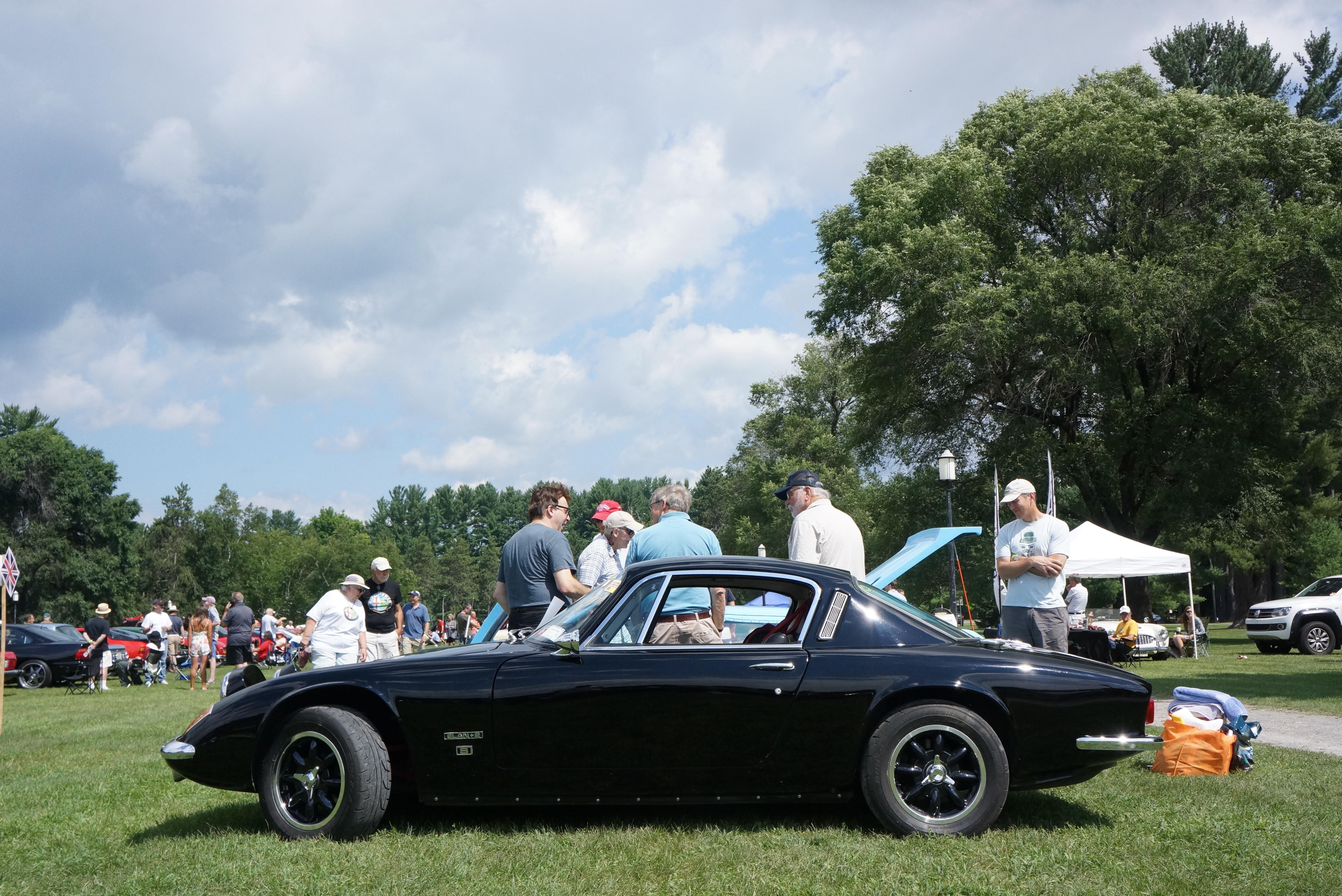
A rarely-seen Lotus Elan +2.
GERMAN
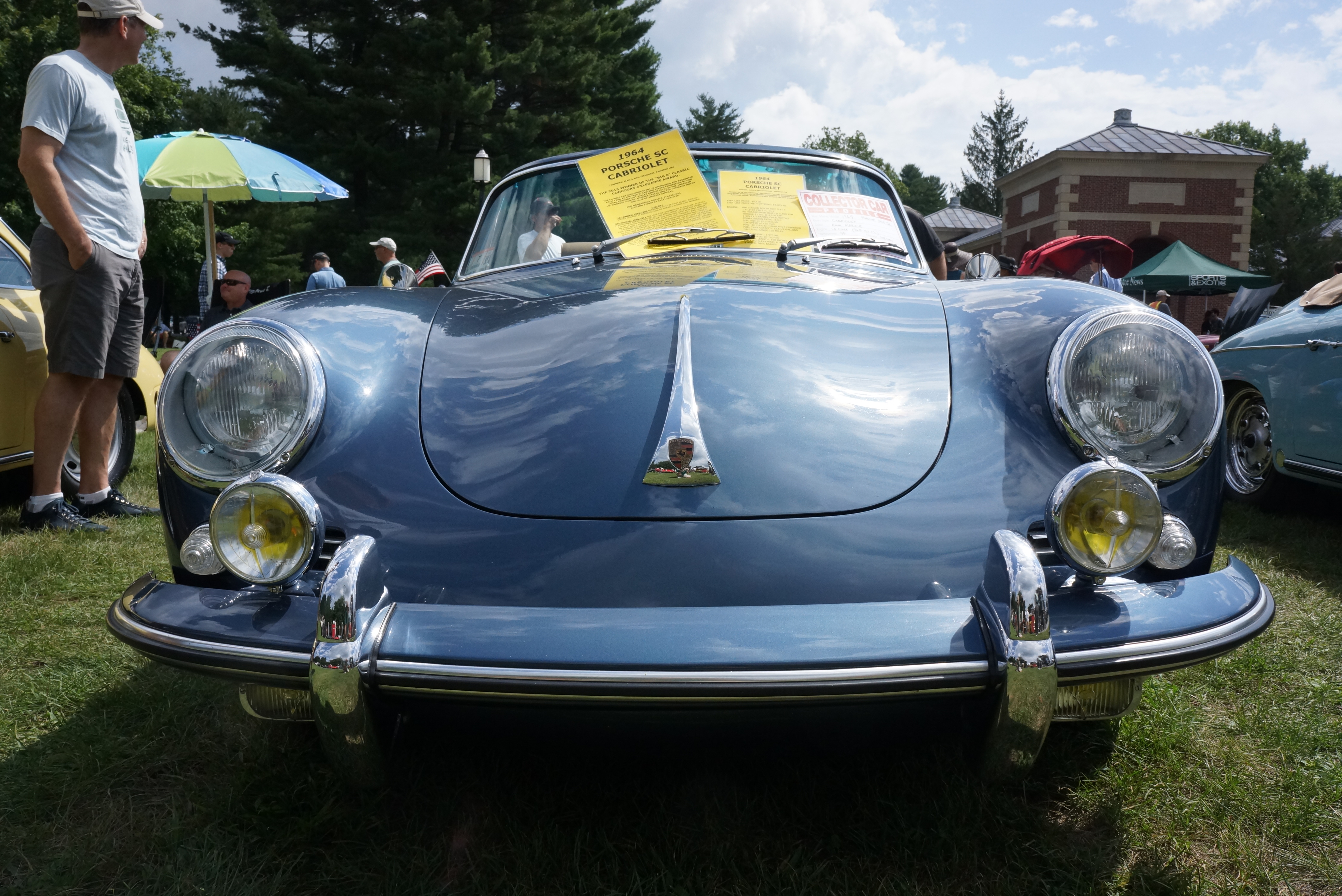
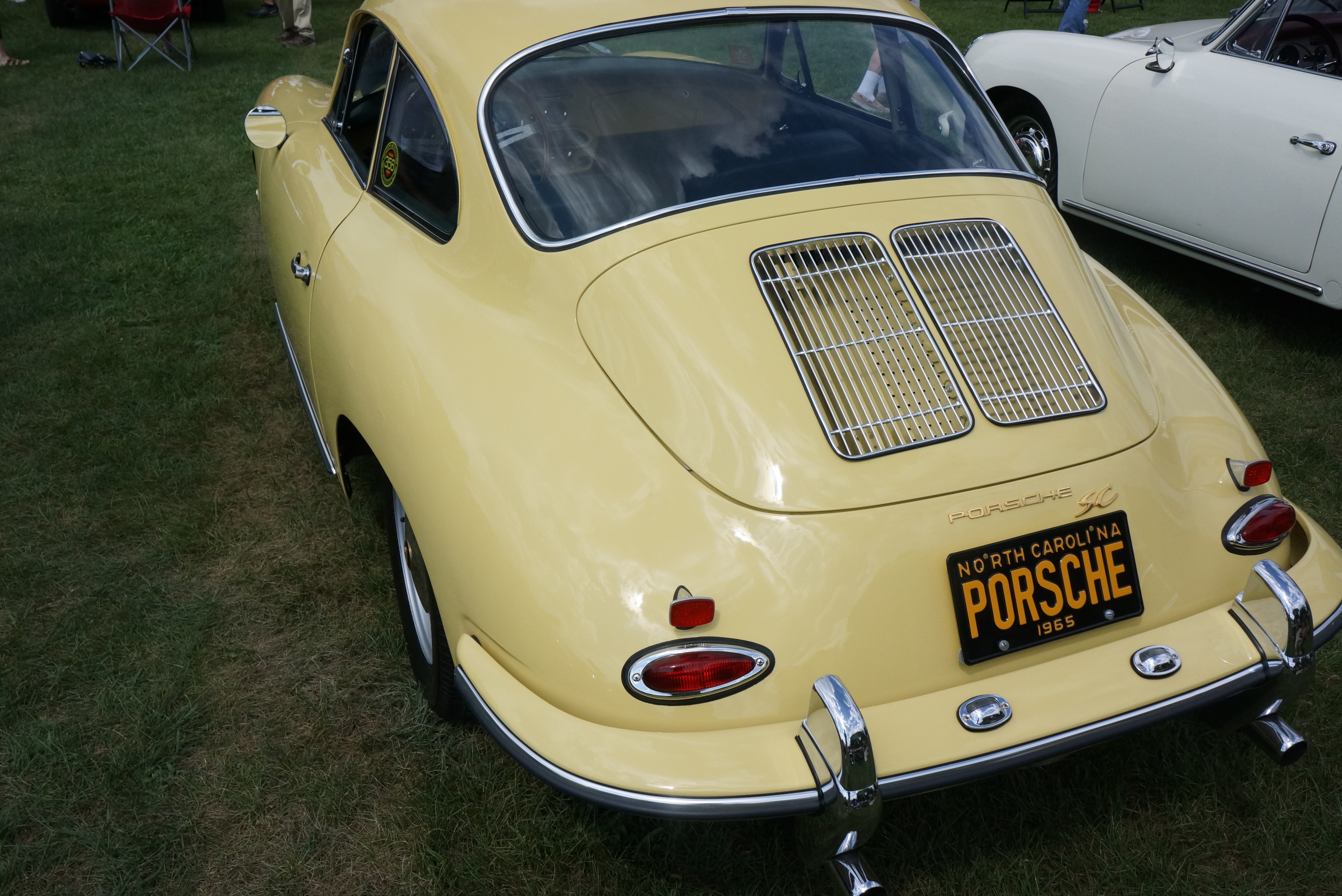
Porsche 356s were one of the Featured Classes.
Two of the more striking ones in attendance.
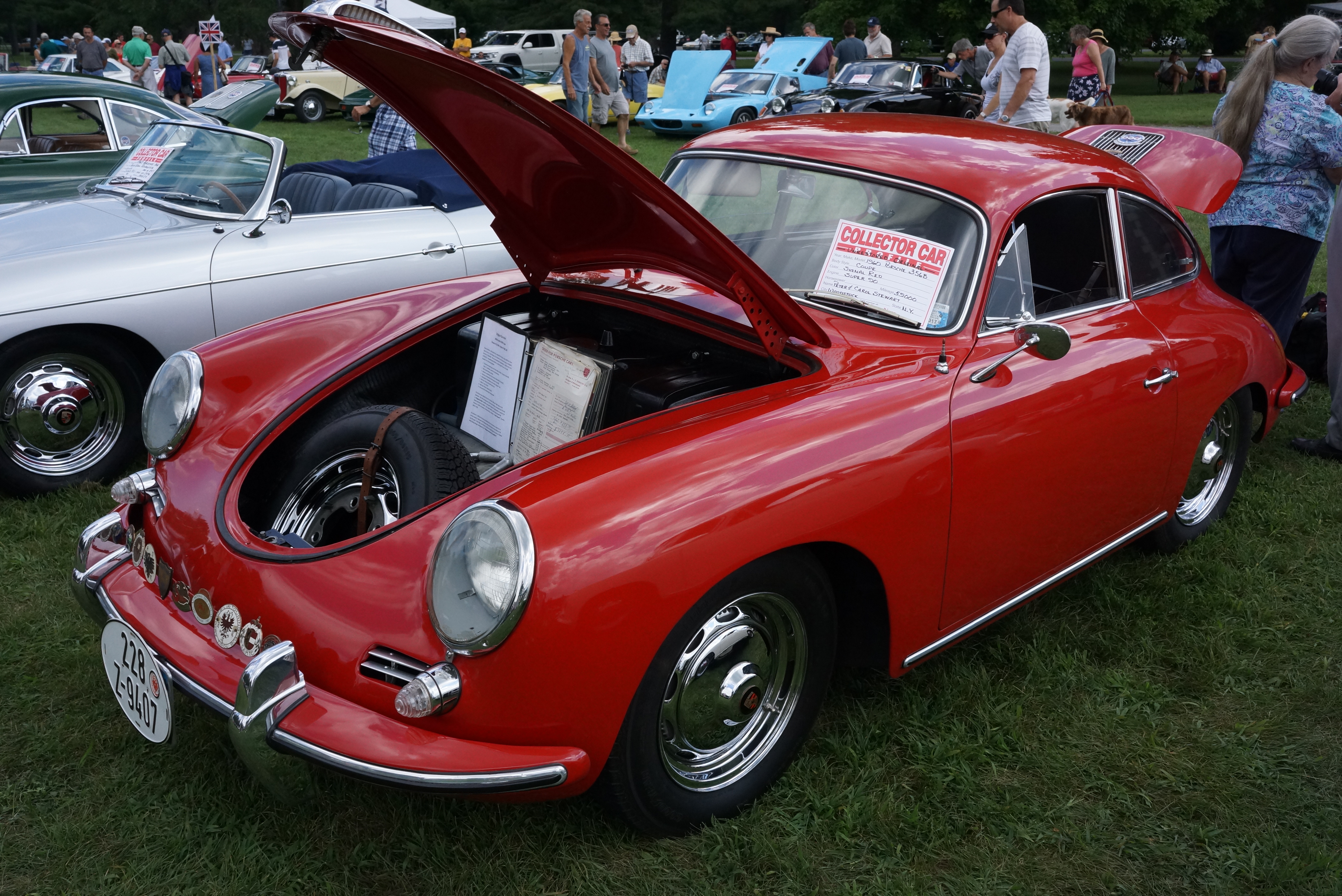
This 1960 356 coupe is an unrestored survivor.
One of my show favorites: this 1969 911 has been with the same owner for 25 years. Paint was peeling off the driver’s door. He told us he didn’t care; he owns the car to drive it.
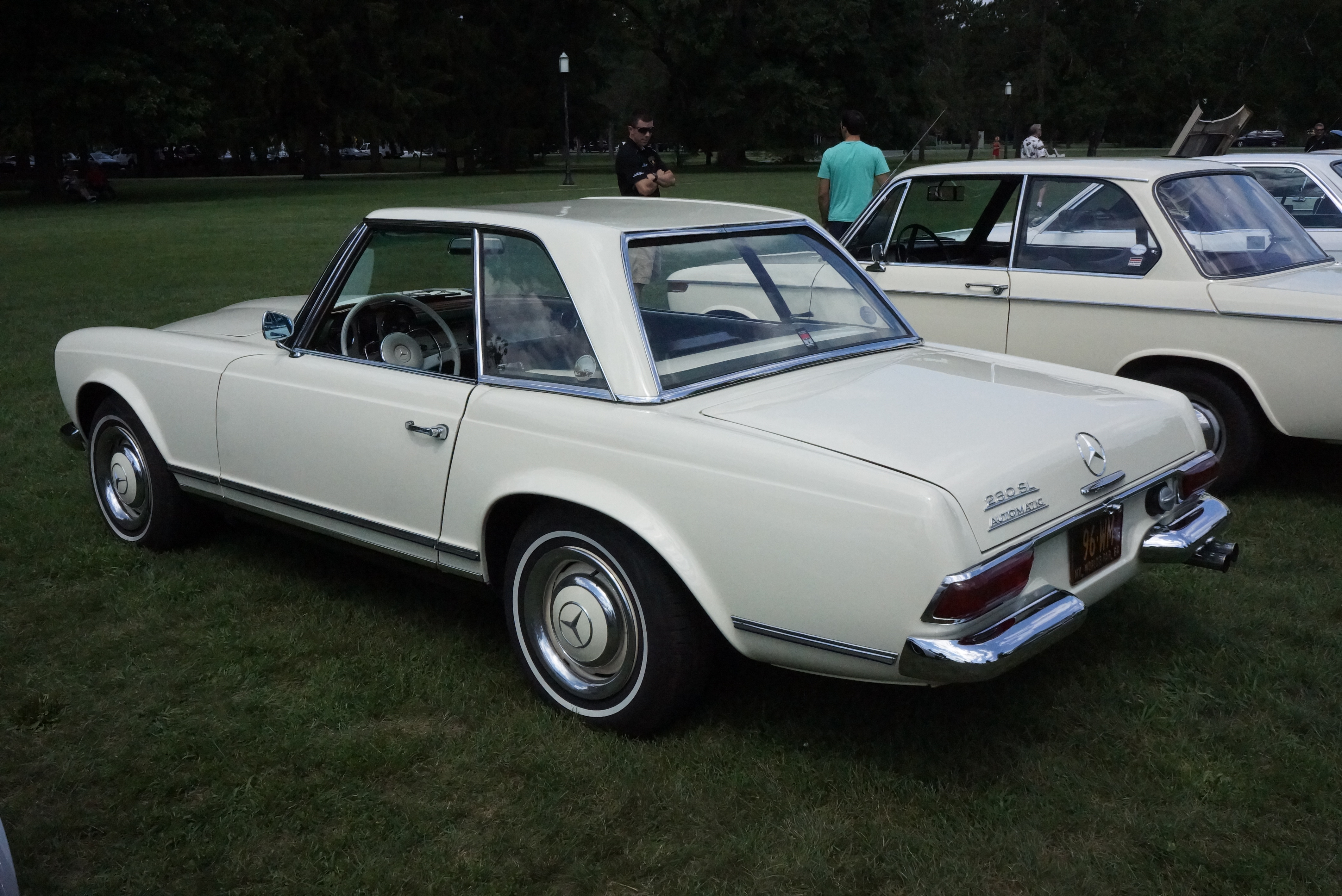
There were German cars there besides Porsche. This Mercedes Benz 230-SL had a side-facing rear jump seat.
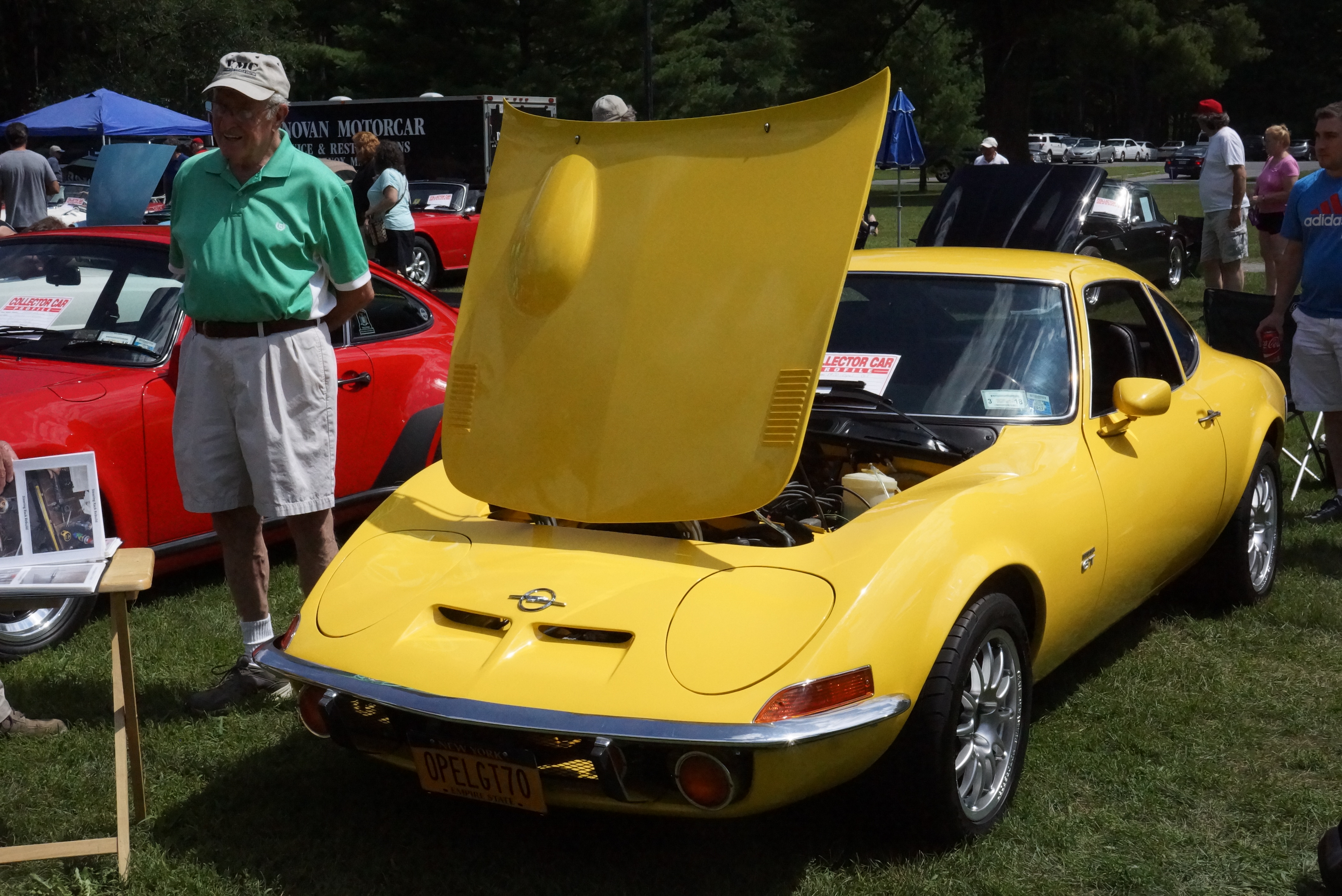
An Opel GT, sold new in the U.S. by Buick dealers.
Another favorite: this 1979 Ford (not Mercury) Capri had been privately imported. The car was tastefully modified, was clean and straight, and must be a hoot to drive.
SWEDISH
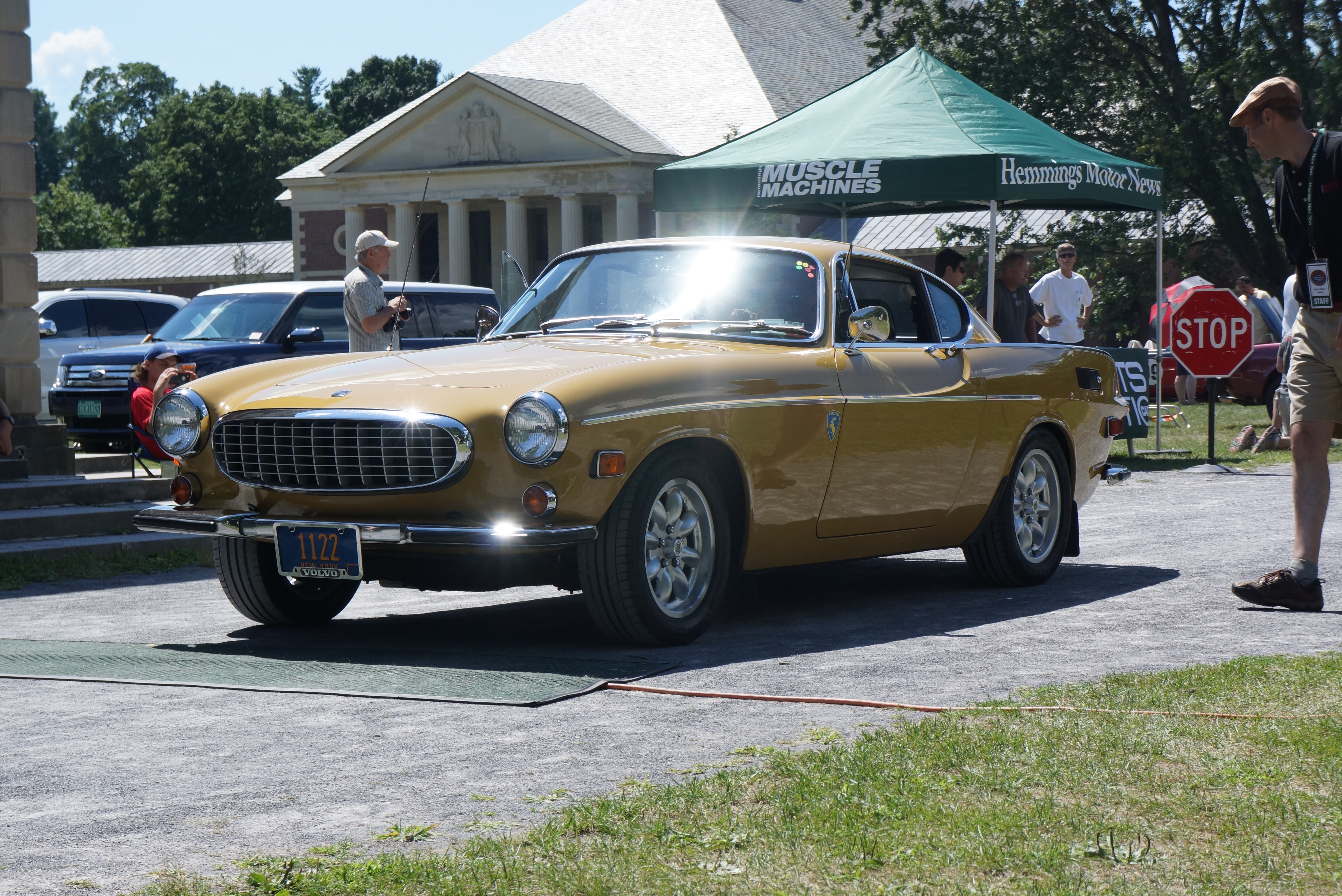
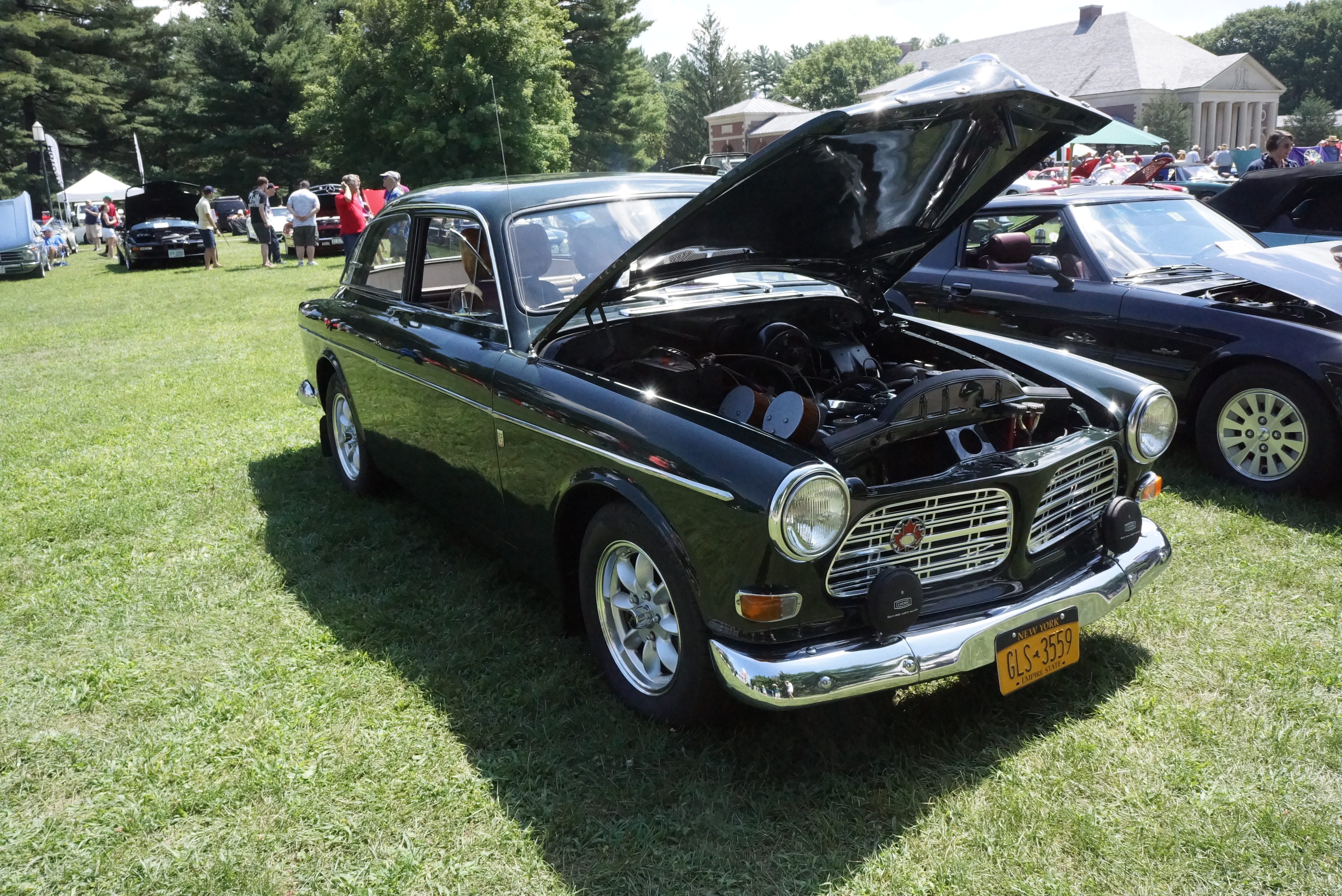
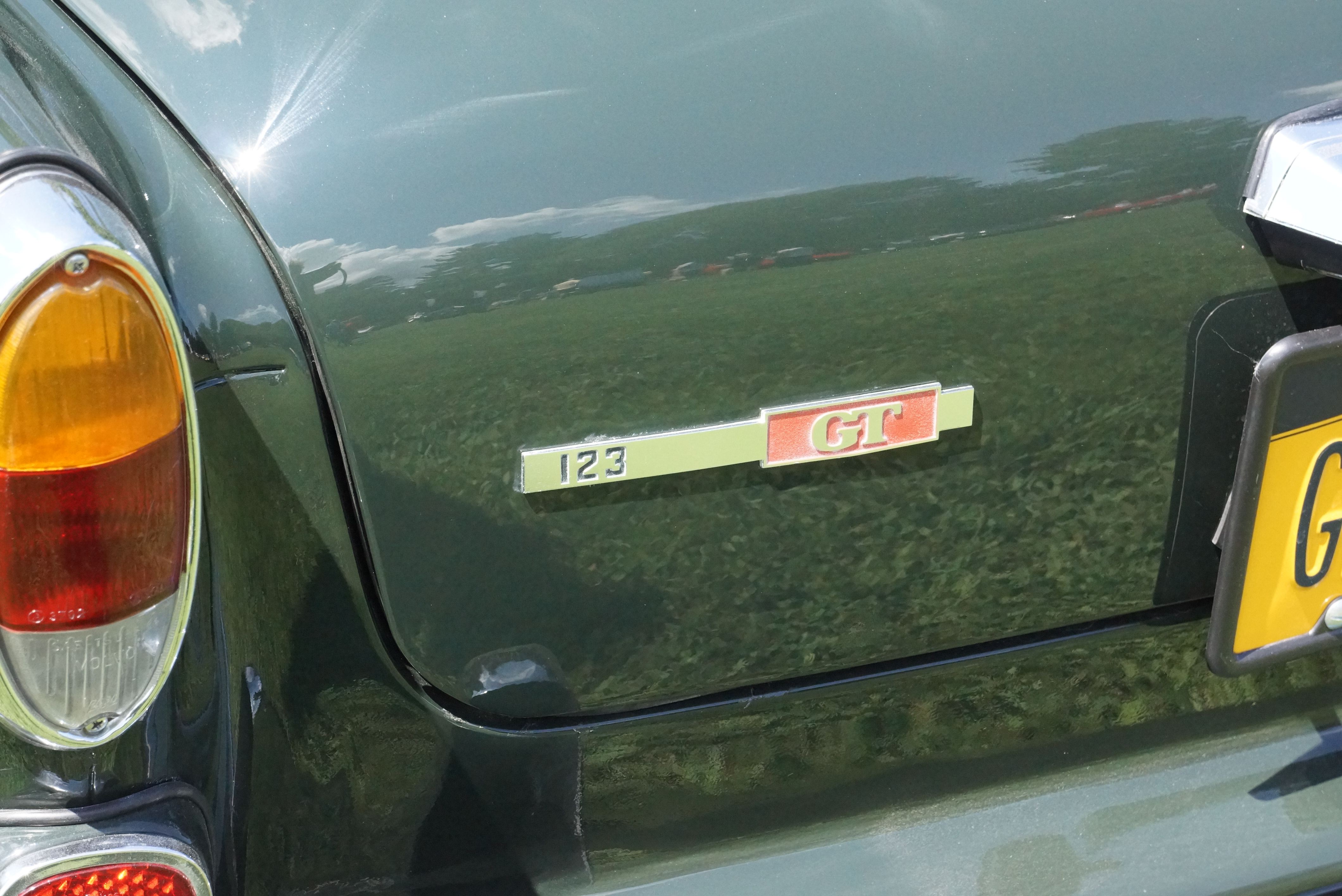
This Volvo 123GT looked authentic; at least it wore the correct badging. I don’t think I’ve seen an actual 123GT in about 20 years.
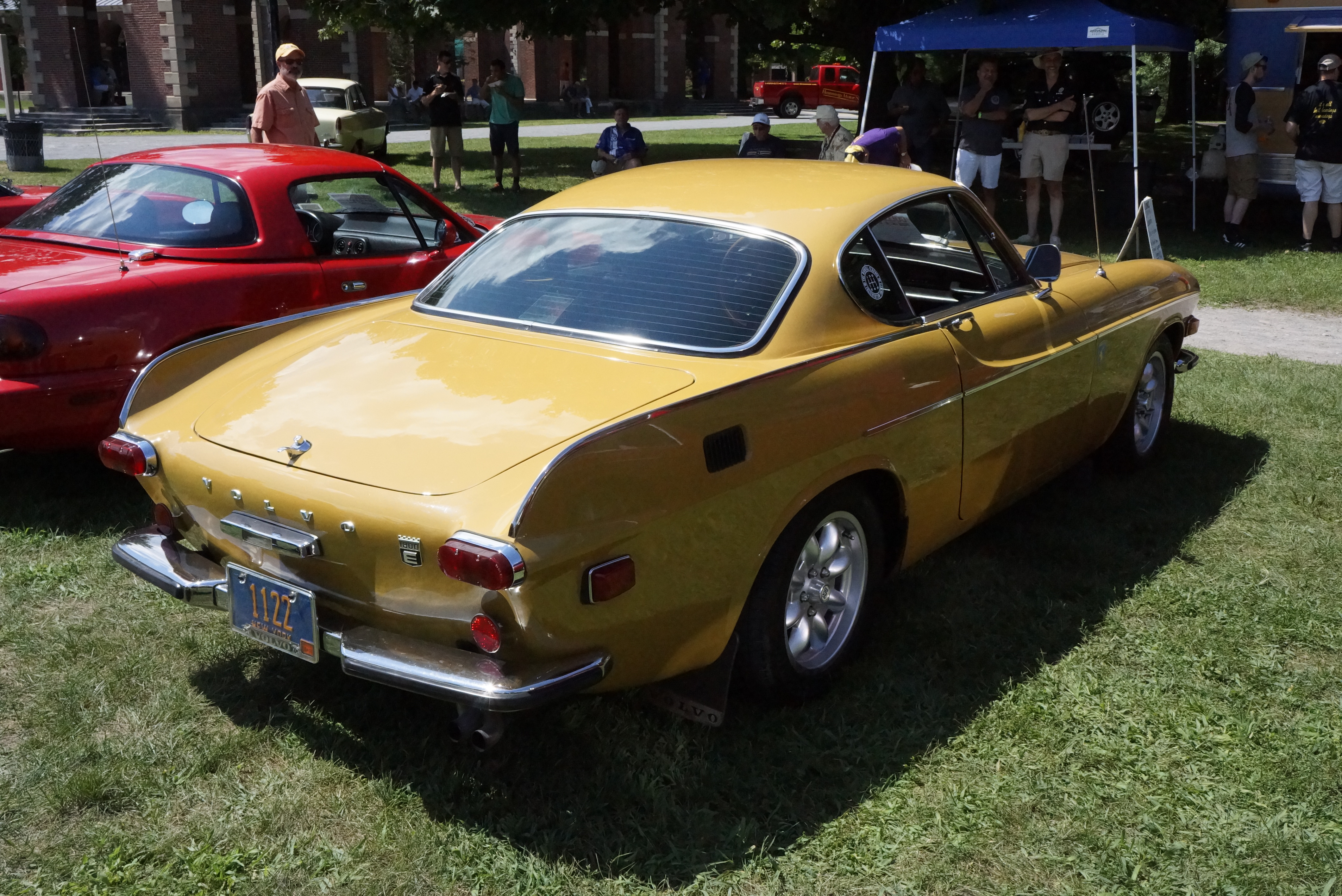
This was the only Volvo 1800 at the show.
FIAT 124 SPIDERS
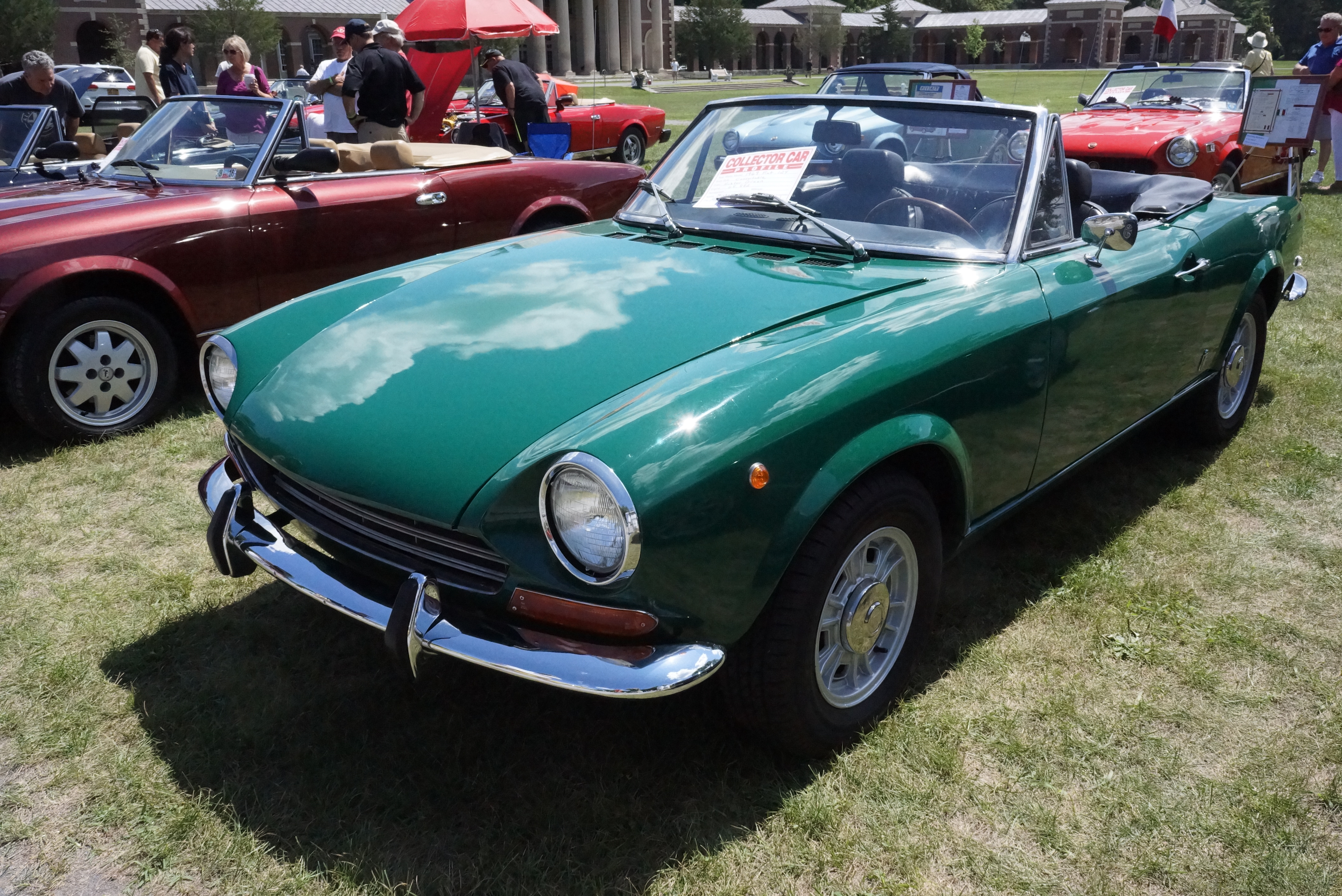
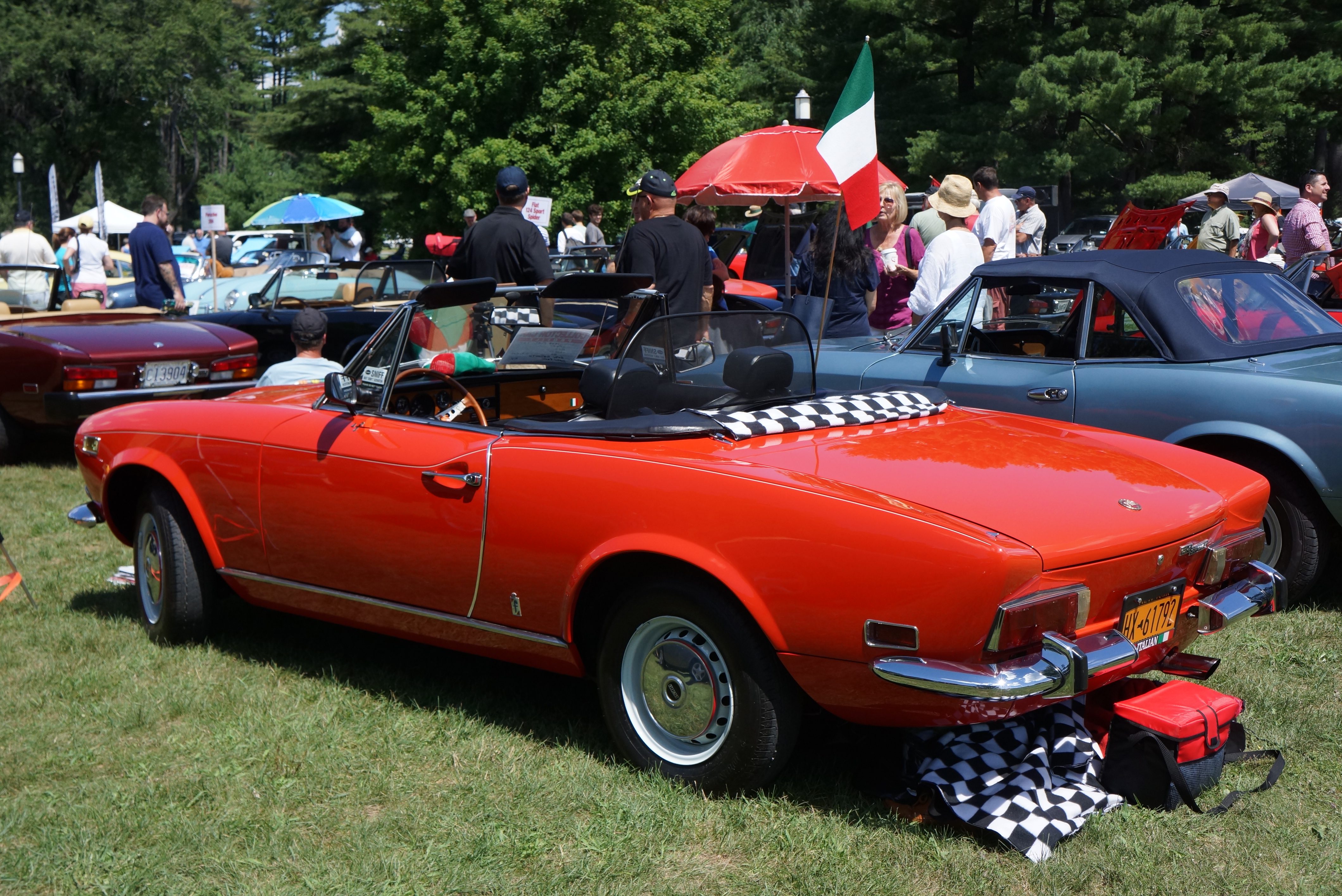
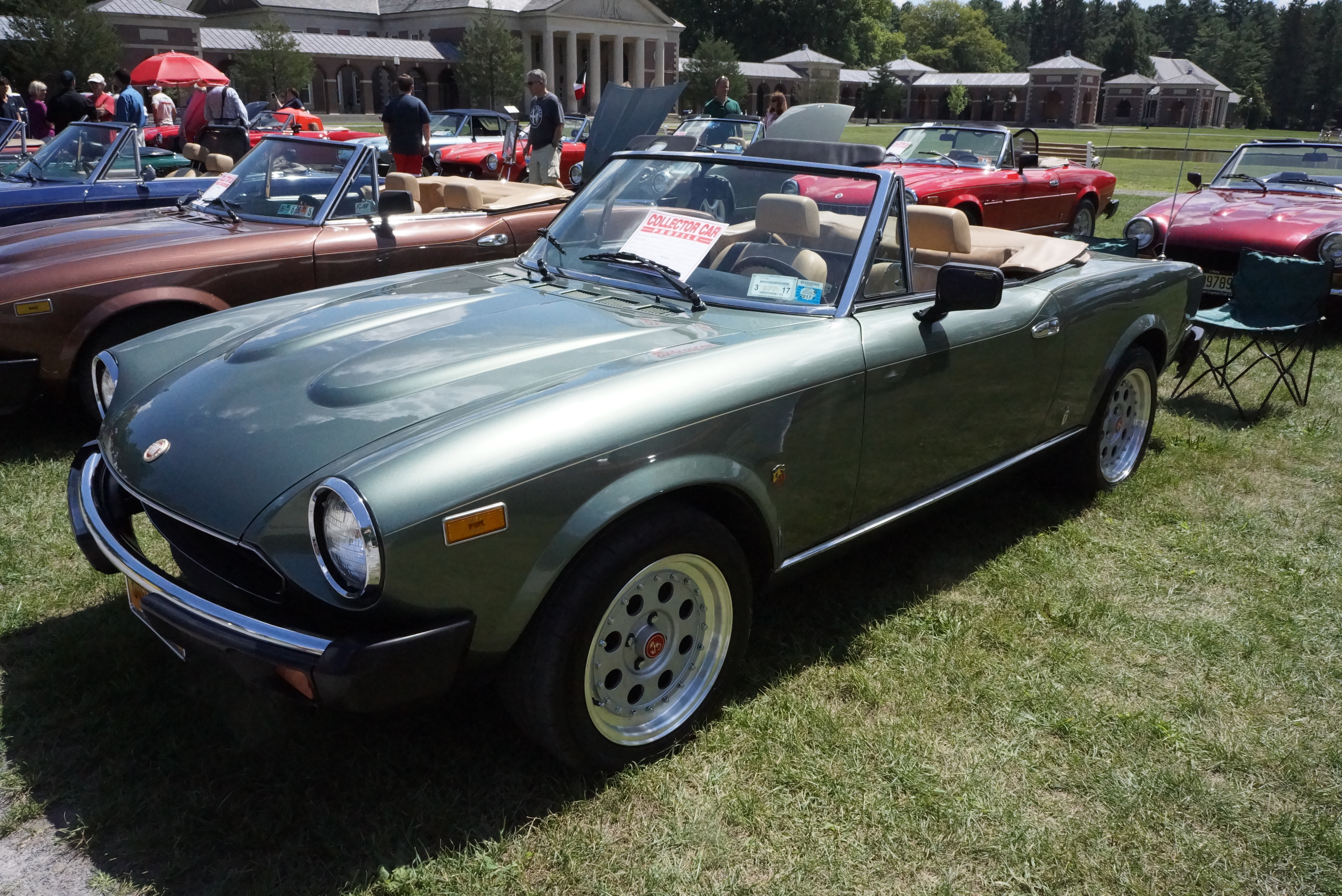
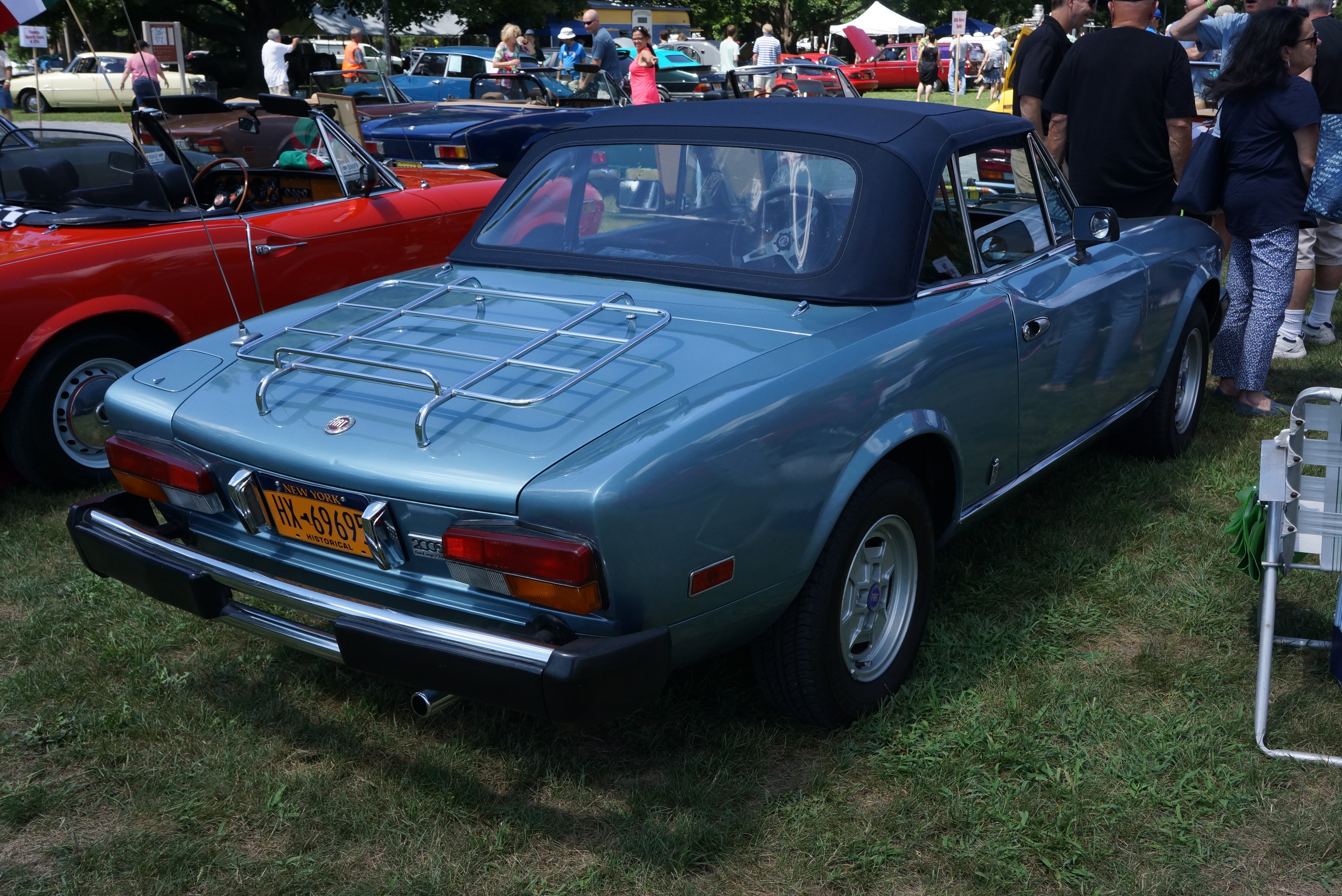
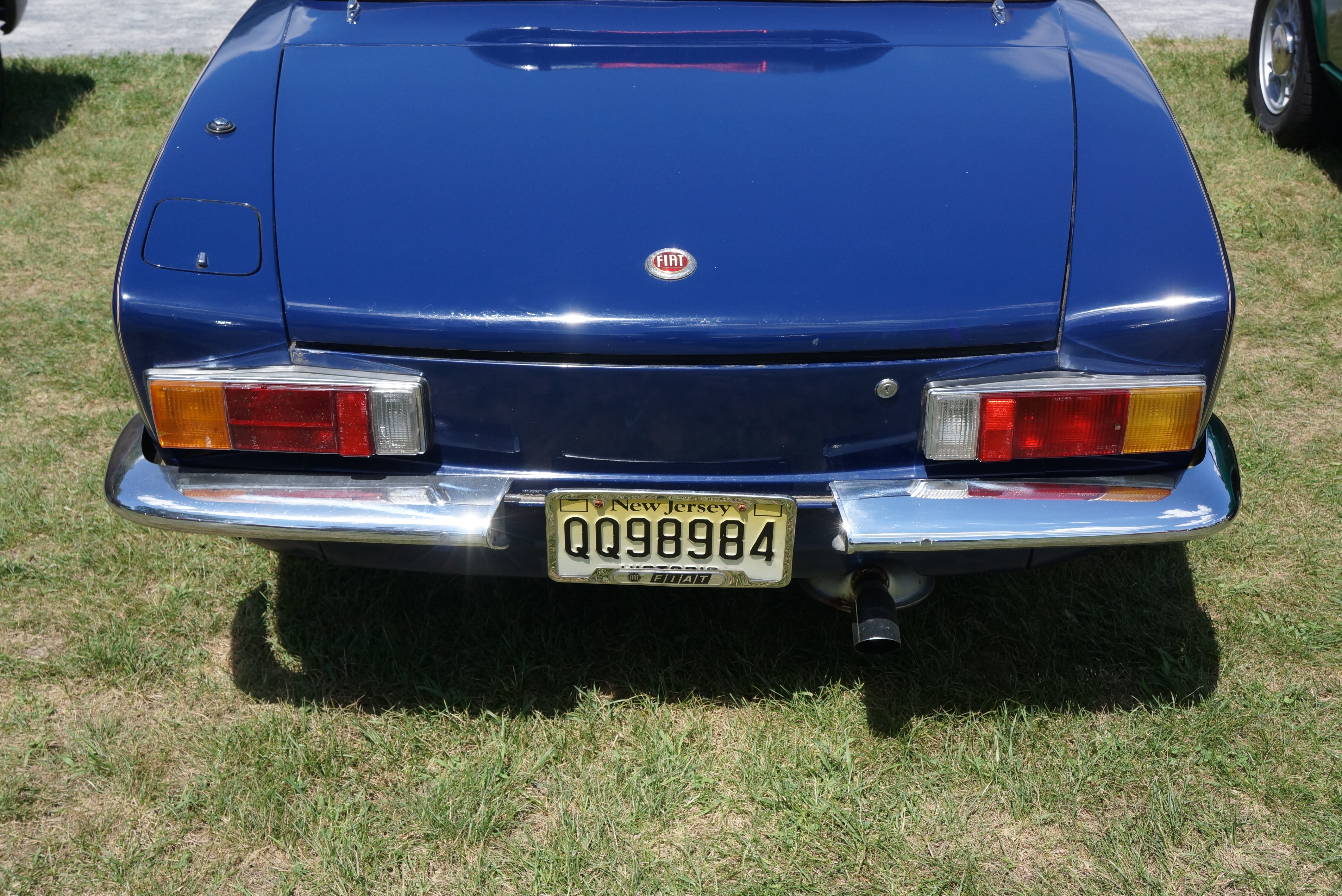
There were about 20 Fiat 124 spiders at the show, with cars from the first generation (late 1960s) right through to the Pininfarina-badged cars of the mid-1980s. As a former Fiat owner, it was difficult for me to believe that this many survived. Best of all, the owners were there just to have a blast. Bellissimo!
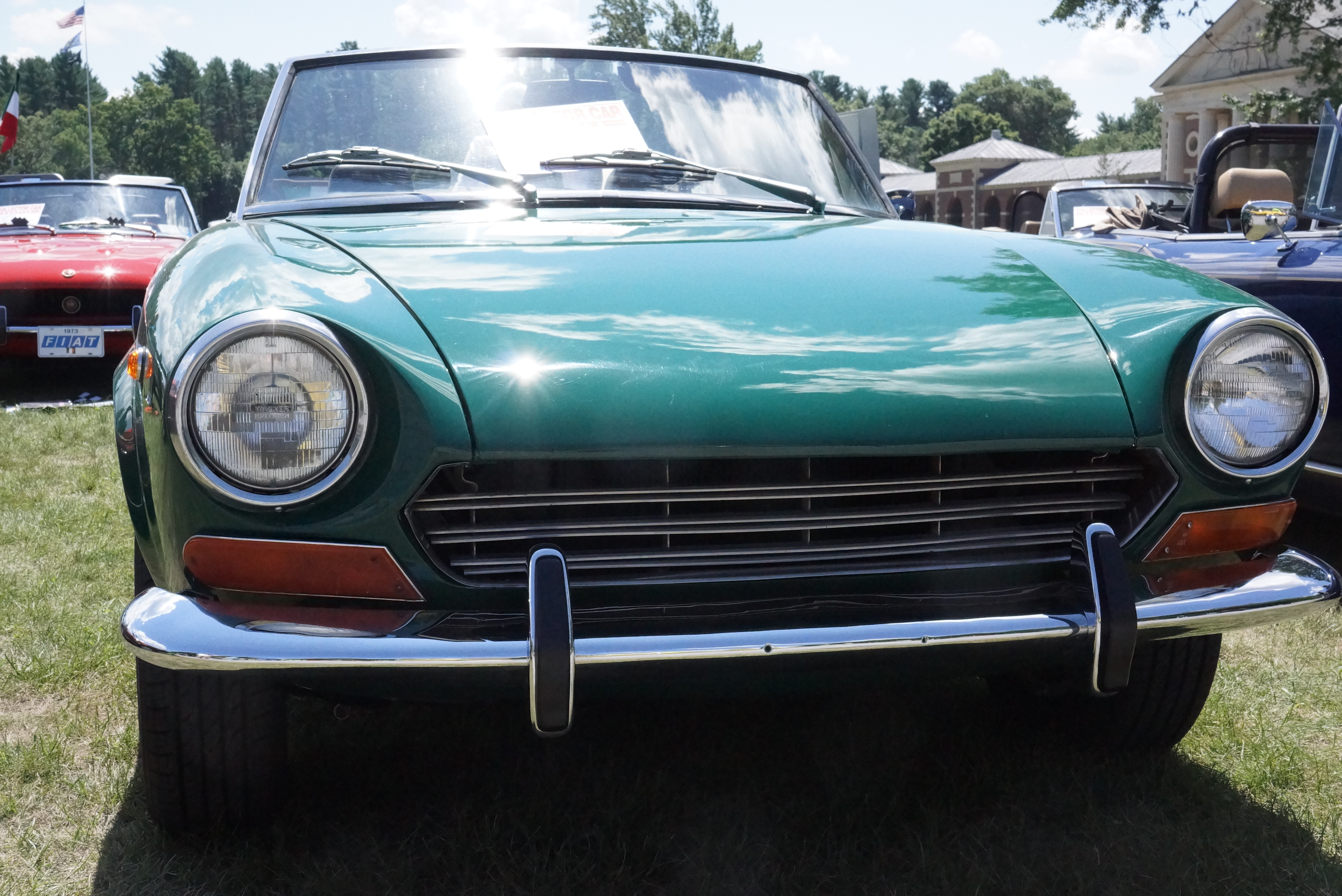
An early car: in addition to the chrome bumpers, note the slatted grille, and the small, round side marker lights.
The placard claimed this to be an unrestored survivor.
We spoke at length to the owner of the Positano Giallo car. He recently bought this car after it had sat, unused, in the previous owner’s garage for 30 years. There had been a small carb fire, and that owner gave up on it. The new owner refreshed the fluids, washed off 30 years of dust, and here it is.
This beauty took home 2nd place in this class.
More, more, more
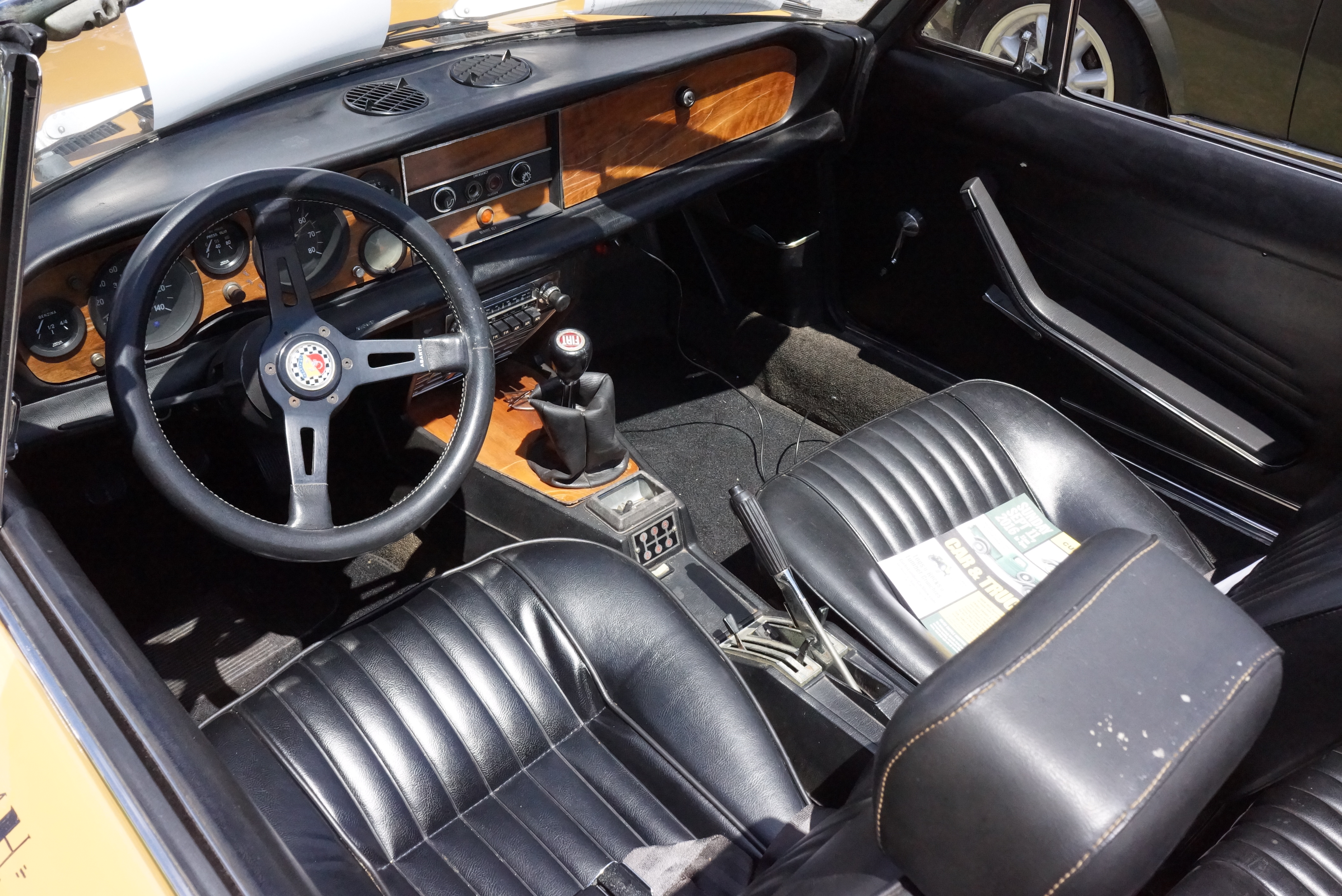
The Pininfarina cars got their first dashboard redesign.
Here you see the 124 Spider tail lights evolve and enlarge.
OTHER ITALIAN
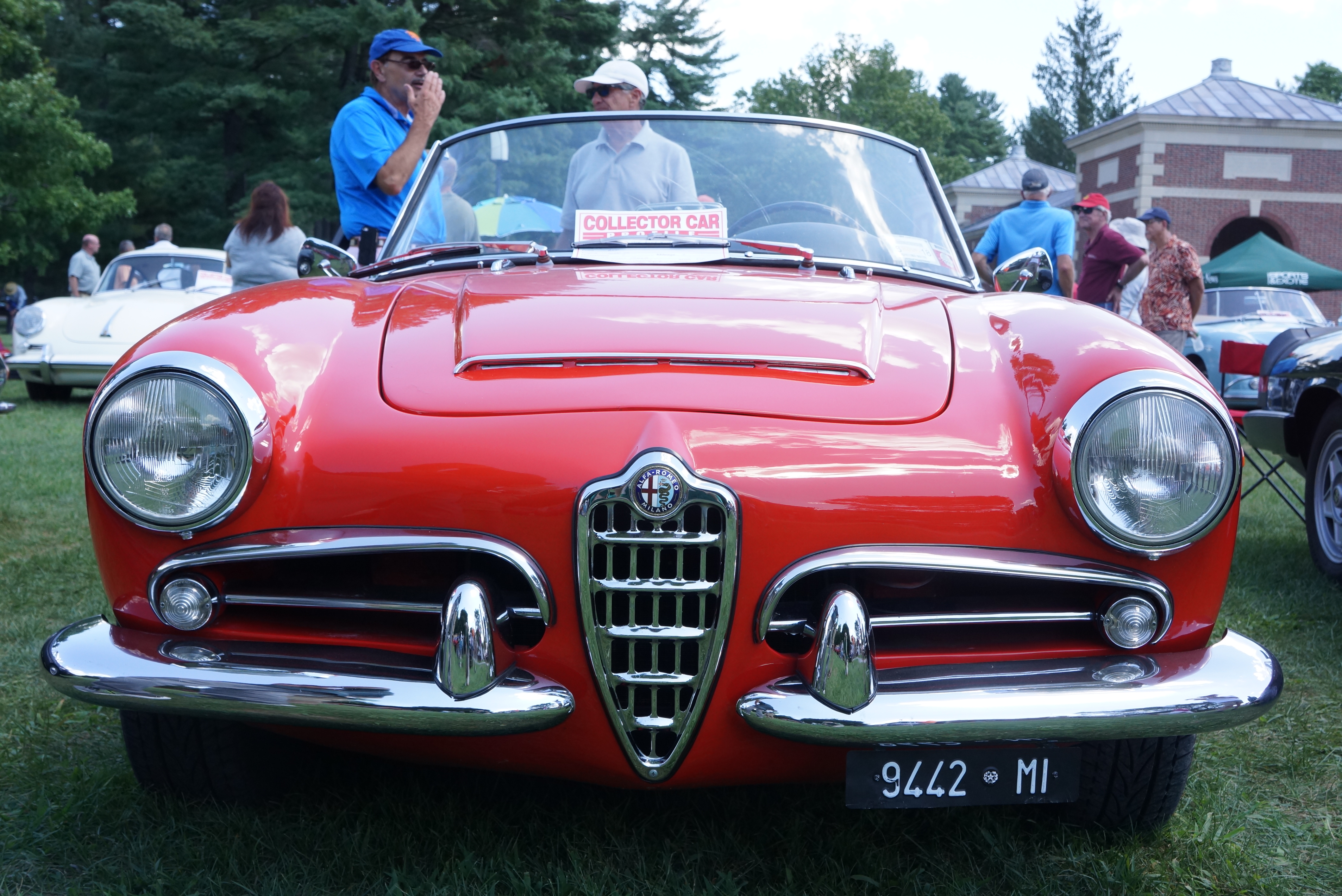
The Alfa class was disappointingly small. However, the cars that were there were gems.
Fine Italian jewelry:
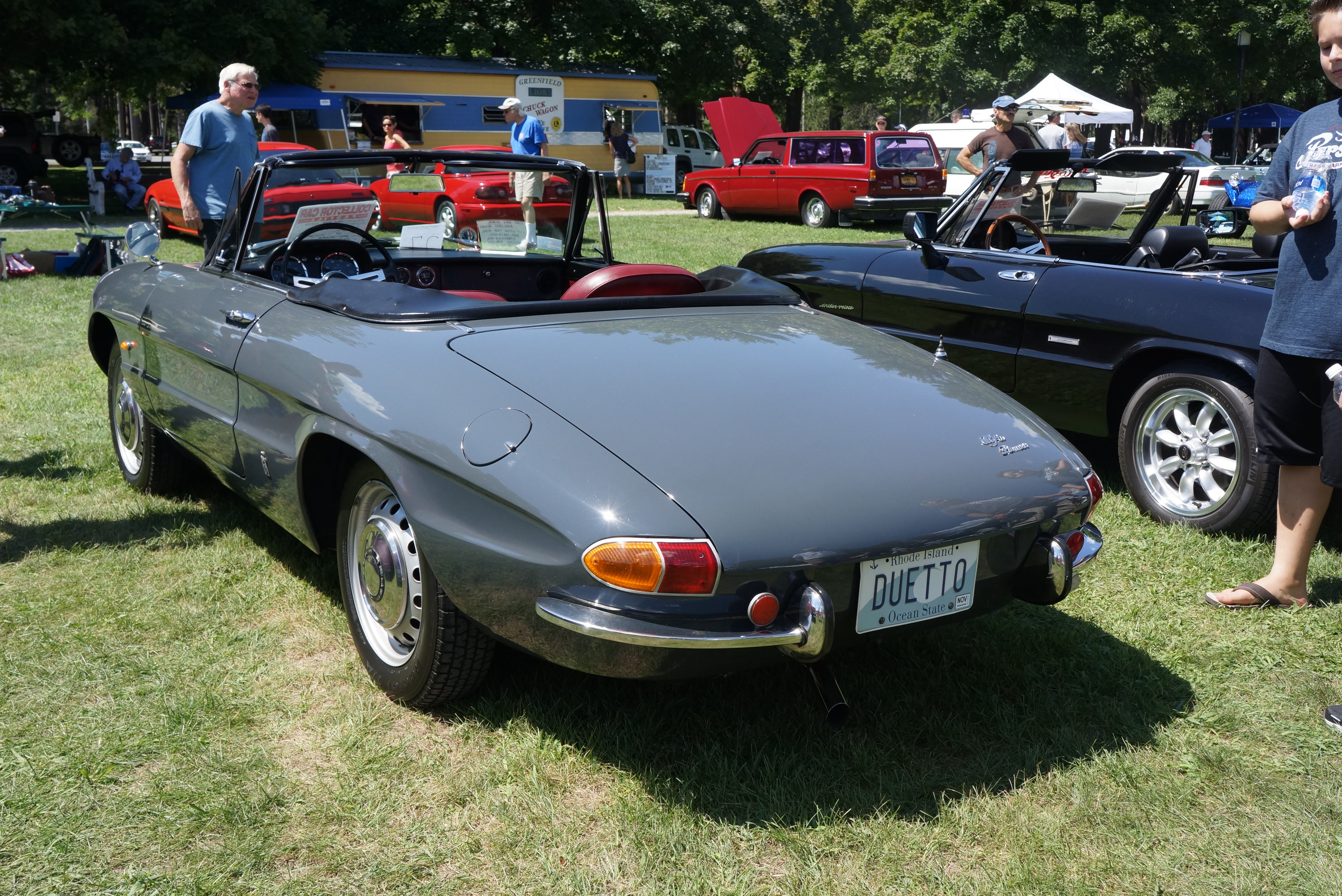
This Duetto, striking in grey, took 1st place in its class.
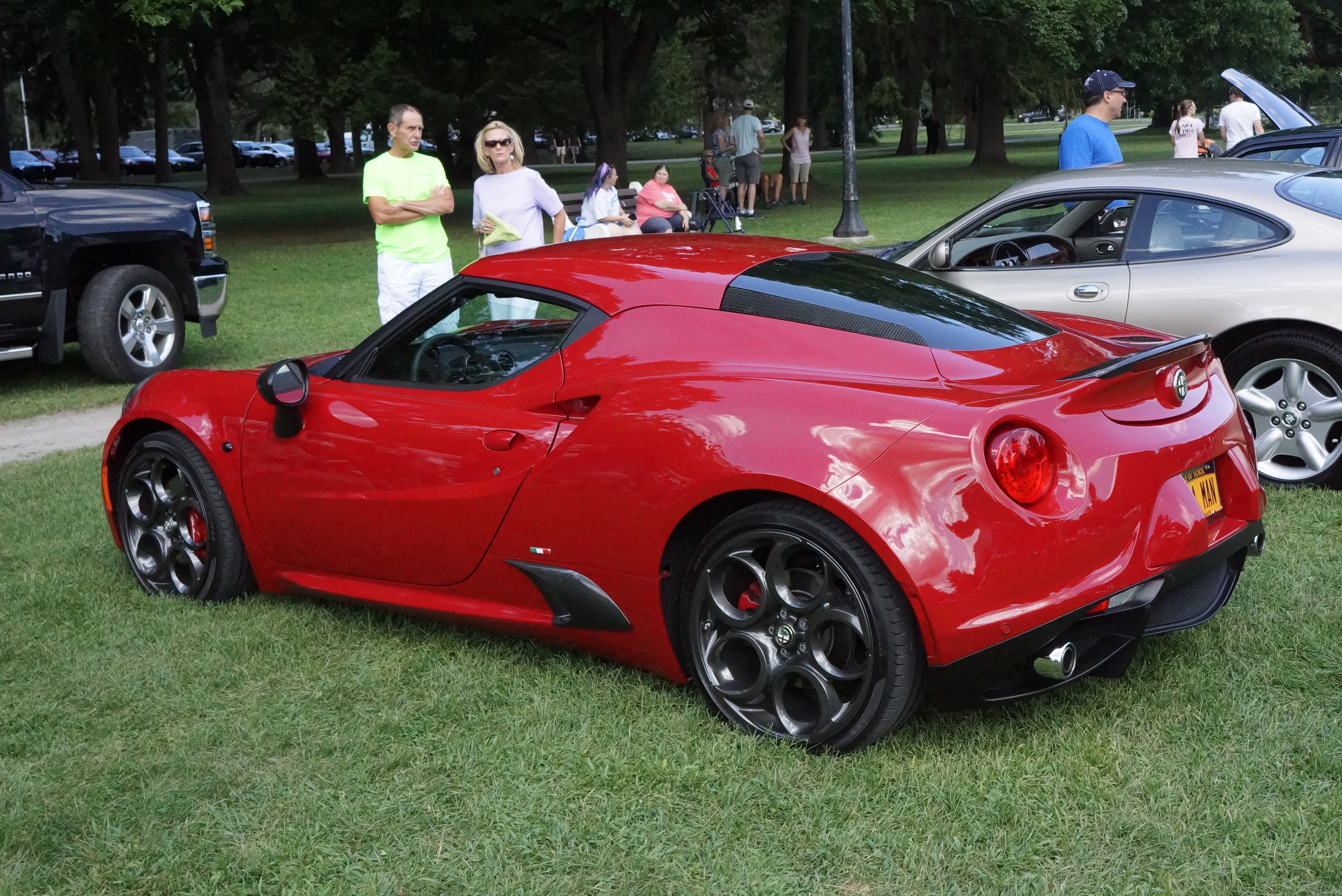
Modern Alfas, in the guise of a 4C coupe and 4C spider:
Car magazines and books are a weakness of mine. My automotive library hold hundreds of car books, and hundreds of various magazine titles. I’ve written in the past of the Car & Driver collection which extends back to the early 1960s. Every year for the past 30+ years, when attending the Carlisle and Hershey flea markets, I am on the lookout for a hardcover or softcover treasure to take home.
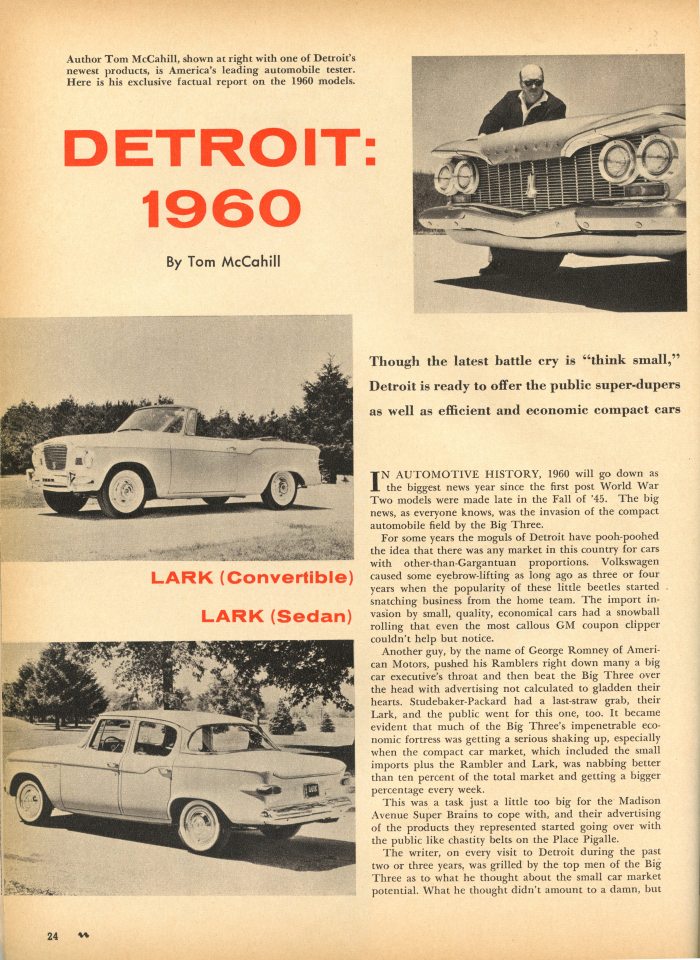
Several years ago, a visit to a “$2 bargain bin” at Carlisle yielded this treasure: Truemagazine’s annual Automobile Yearbook, with none other than Uncle Tom McCahill on the cover. (True, also known as “True, The Man’s Magazine”, was published from 1937 to 1974 by Fawcett Publications. During the 1950s, famous automotive author Ken Purdy was its editor.)
The year 1960 was a watershed year in the U.S. car business, as the Big Three domestic manufacturers each introduced a compact car to fight the growing import car invasion. One vehicle each from GM, Ford, and Chrysler made the cover, but the only compact to do so was the Corvair. Note the picture caption: by mentioning “rear-engine”, perhaps it was seen as Detroit’s best shot to beat Volkswagen at its own game.
The article “Detroit: 1960”, written by McCahill, summarizes the market-share drubbing the big boys were facing, and not just from the imports, but from Rambler and the Studebaker Lark too. As the decade was dawning, these executives were counting on the accuracy of their prediction that the compacts would account for 20% of the new car market. As we know now, it was impossible for them to see what else was in store: intermediate-sized cars, pony cars, government regulations, and further penetration by non-American makes.
Uncle Tom always had a way with words. In this article, he spews out some beauties, such as “… opinions as to what percentage of the market these small cars will pull are as wild as a Third Avenue saloon on Saint Patrick’s Day”; “… good imports …. appear to be put together by guys who really liked what they were doing and not counting the days until their next strike”; and “… 1960 promises to be the wildest year since Louis Chevrolet sat on a bear trap”.
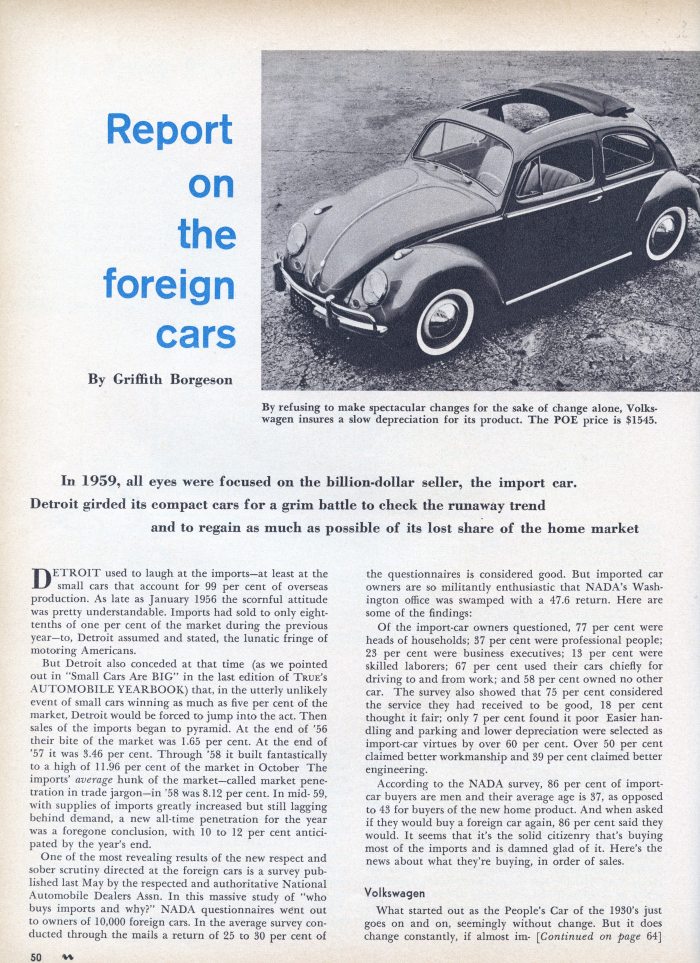
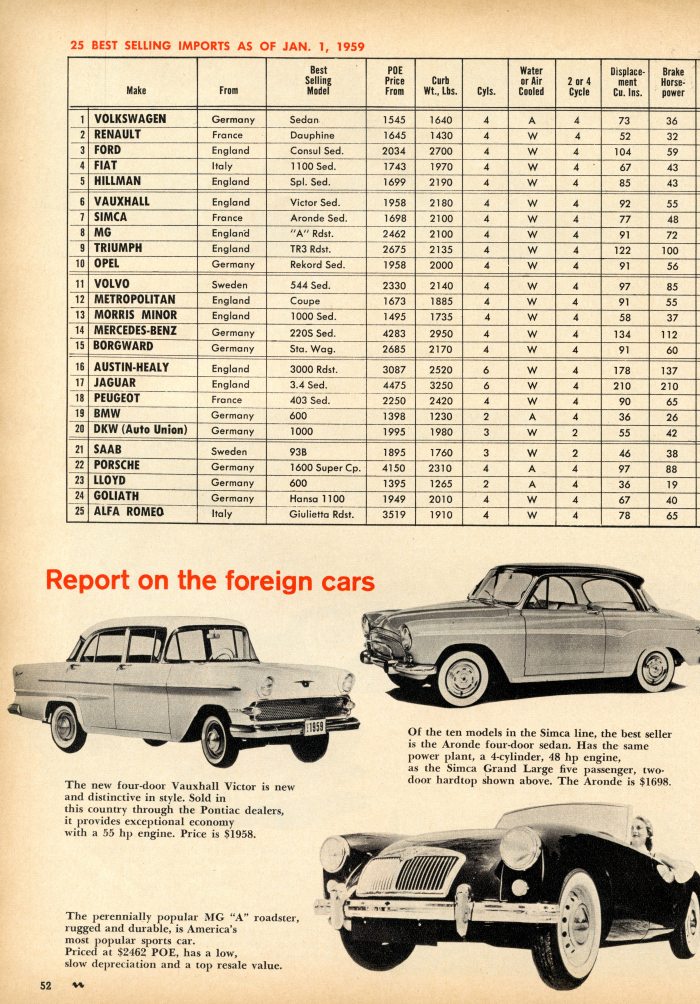
Imports were still viewed as a separate category, deserving of their own story. “The Report on the Foreign Cars” article highlights the tremendous rise in market share, which increased from 1.65% in 1956, to an anticipated 10-12% by the end of 1959.
More telling is this list of the “25 Best Selling Imports as of Jan. 1, 1959”. Number One is no surprise. But the 2nd best-selling car in America was French?
To those who may be seeing data like this from the late ‘50s for the first time (or for those who have not seen this in a while), there are two surprises: one, the relatively low positions of future German giants such as Mercedes-Benz (14th), BMW (19th) and Porsche (22nd); and two, the complete lack of any Asian brands in the top 25 positions.
Indeed, the vehicular landscape would change again (and again). No one would have predicted that England, which held FIVE of the top ten positions, would all but disappear from the ranks. Borgward outsold Jaguar AND Saab AND Alfa Romeo? Really?
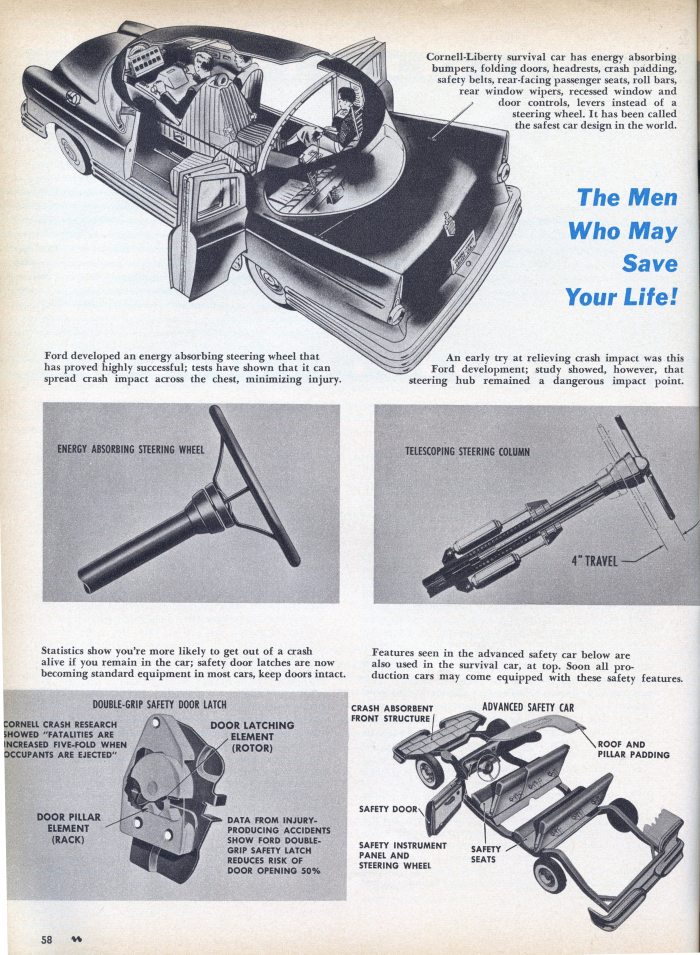
No car magazine from this time period would be considered complete without an article on safety. This excerpt is surprisingly accurate in listing energy-absorbing bumpers, headrests, safety belts, roll bars, and crash-absorbing front structures as features which would save lives. But it would take an act of Congress (the 1966 Motor Vehicle Safety Act) to get many of these features installed. I’ll leave it out of the discussion whether that was because consumers wouldn’t pay for them, or because the car makers preferred to emphasize styling and horsepower.
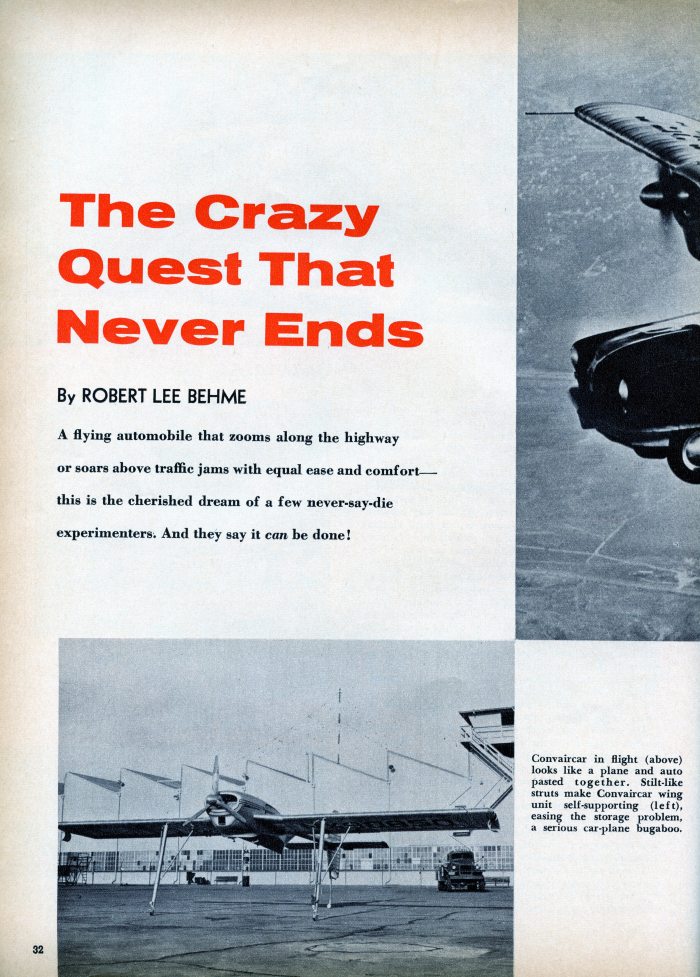
AND, no car magazine from this time period would be complete without an article about… flying cars! (There was an obvious lack of articles from the 1960s about the Internet.) Perhaps it’s best these never came to pass – imagine the issues if pilots were distracted by their cell phones.
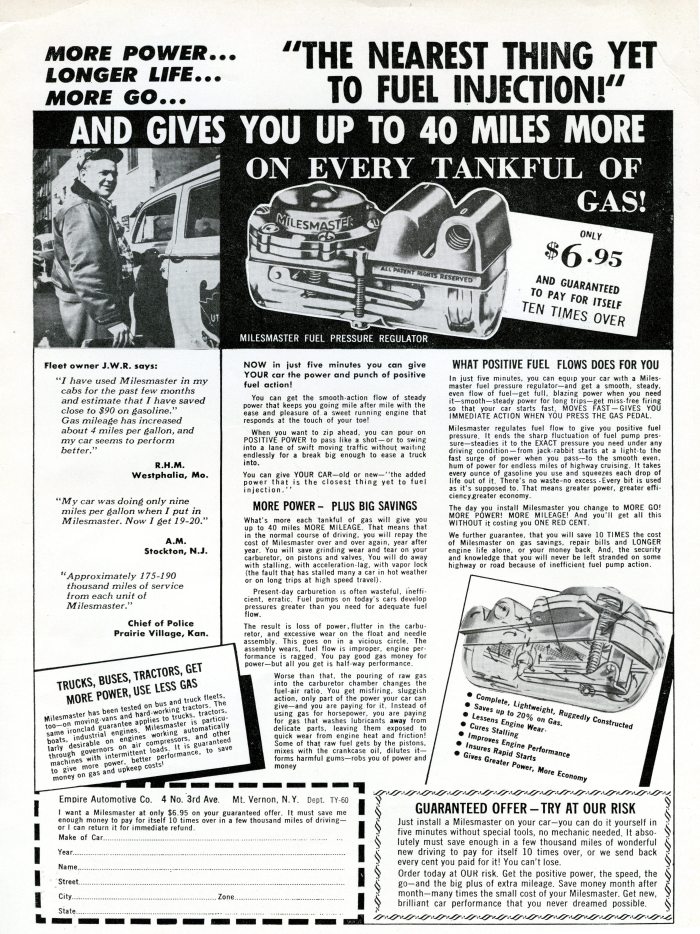
EPILOGUE: The Milesmaster Fuel Pressure Regulator, only $6.95, guaranteed.
Scans are from “TRUE’S Automobile Yearbook for 1960”, which is in the author’s personal collection.
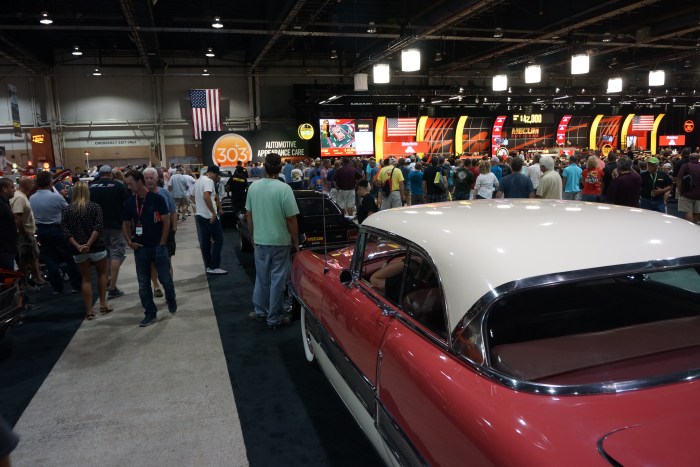
Mecum Auctions came back to Harrisburg PA for the third consecutive year, and held its auction event at the Pennsylvania Farm Show Complex on July 21-23, 2016. Your correspondent was in attendance, also for the third year running, and while external appearances were roughly the same, the men and women of Mecum have been hard at work on incremental improvements.
Mecum builds the same set at every auction
Two years ago, parking was confined to off-site lots which required shuttle buses to usher attendees back and forth. Food was only available from counter service inside the building, with limited menu choices. Signage everywhere was poor, leaving many to wander and wonder which way to turn.
YUGE video screens always give you current bid
This year, ample parking was available within the Complex parking lot itself, allowing one to be inside within minutes. Food trucks lined the back parking lot, offering the traditional burgers and chicken, plus crab cakes, po’ boys, pizza, and Greek gyros. Not only were large signs posted everywhere; upon entry, all who paid admission (NOT just bidders) were handed run sheets, maps, and daily programs. The improvements were palpable, and it reinforced the juggernaut that Mecum has become in the collector car auction business.
Good crowd, plenty of seating, and A/C
The quality of the consignments seemed rather consistent each of the three years, although this year, there were fewer of the vehicles that light my fire (original and/or unrestored American cars, and European sporty cars). The field was heavy with hot rods and resto-mods, and of course, the always-expected Mustangs, Camaros, and Corvettes (as my friend Larry said of them, “the backbone of the hobby”). The latter three models easily comprised about 20% of the total offerings.
The queue on its way to the block
Sitting through two complete days of across-the-block auction action, the room was almost constantly abuzz. Real bidders were bidding, and most cars generated a high level of excitement. When that seemed to wane, Mecum seemingly just turned up the volume on the already-blaring PA system to make sure you were awake.
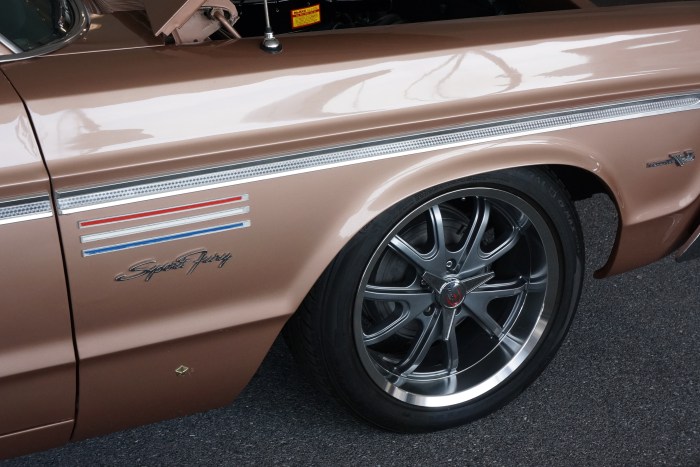
A recent distasteful trend: well-restored cars with modern wheels
Sell-through rate appeared strong (SWAG: 70%), helped by Dana himself arm-twisting owners on the spot to drop their reserves and close the deal. Are some prices off their highs of one to two years ago? Yes. Is everything selling at distress-sale levels? Absolutely not. To those who think that the collector-car hobby is in a slump, I hold up Mecum Harrisburg 2016 as Exhibit #1 that it is not. And if it was slumping, it has bounced back with a vengeance.
Mecum staff excellent at organizing cars in staging tent
Below, in lot number order, are my thoughts on an varied group of cars and trucks which were interesting to me. You, no doubt, would have chosen 14 different vehicles to profile. Let me know which of these, if any, you would have bought for the price.
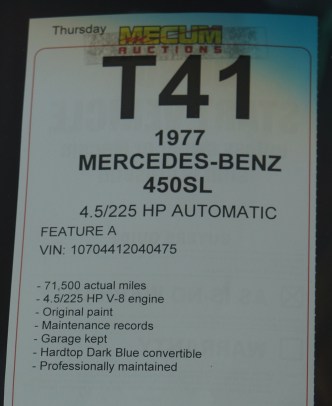
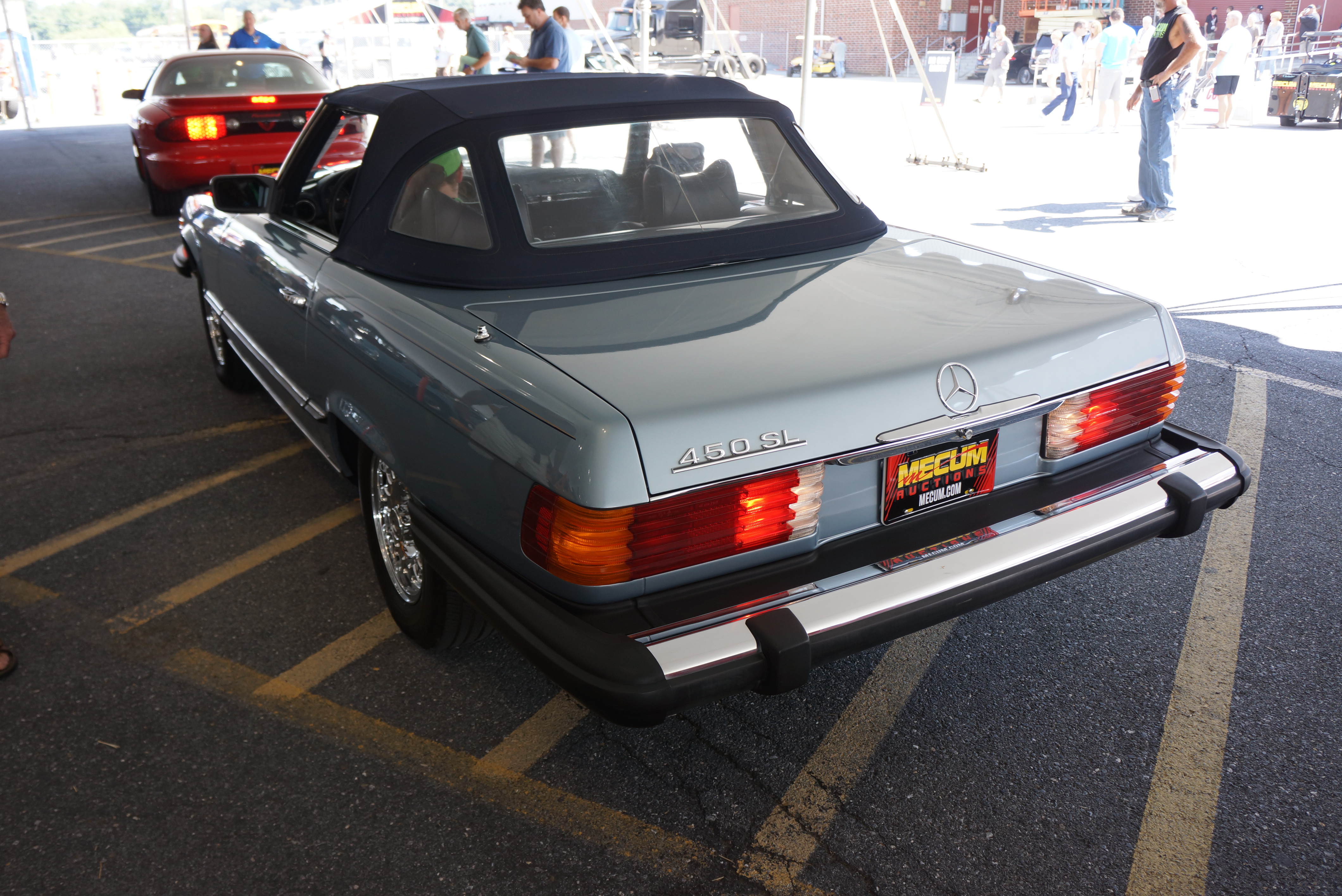
LOT T41, 1977 MERCEDES BENZ 450-SL
Condition estimate: 2+
SOLD for $15,500
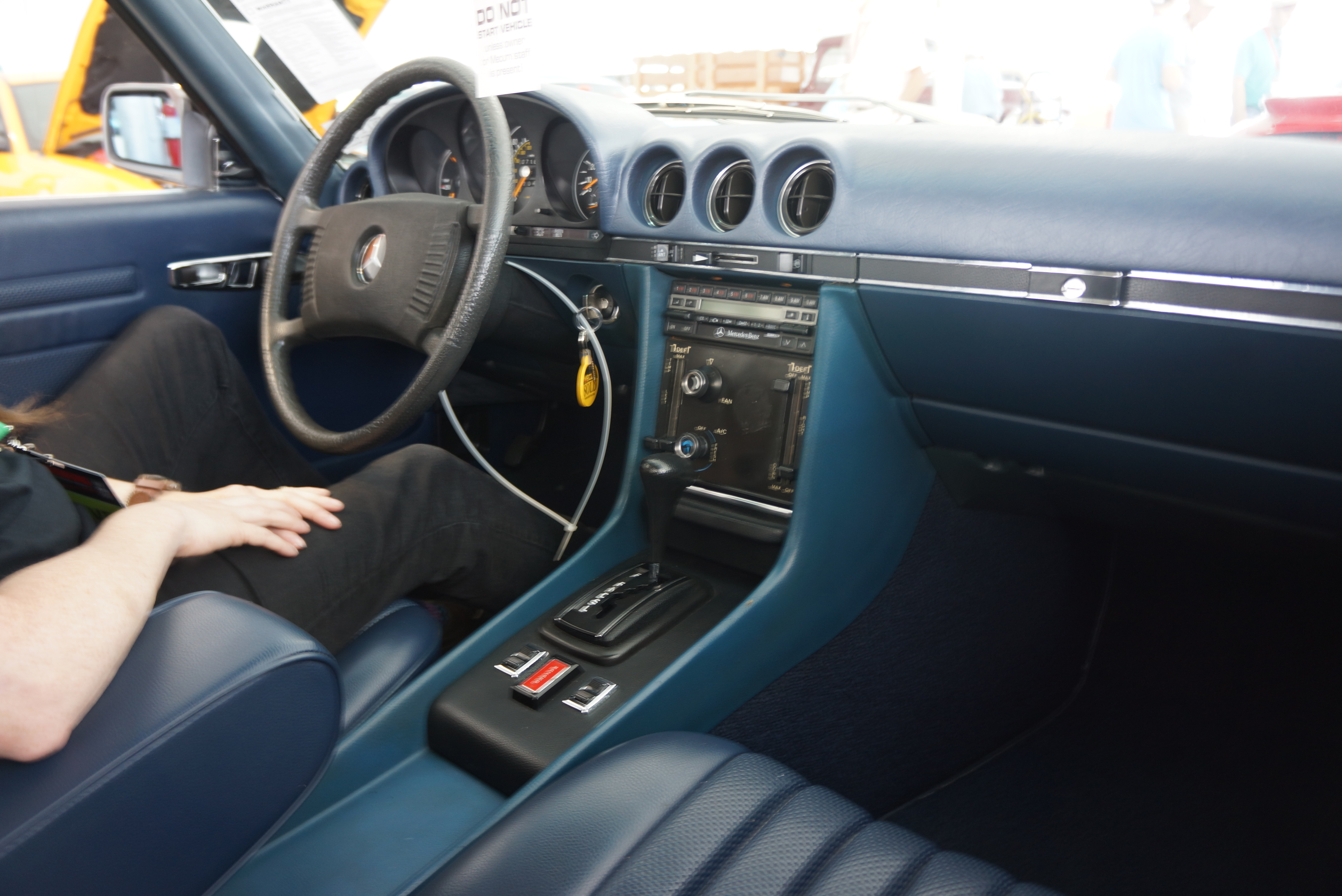
This generation SL is hot right now, especially the 450-SLs from the late ‘70s like this one, and the final 560-SLs. Many of the ones we see at auction are dogs; this one was decidedly not. Price was not a bargain, but fair for a very presentable Benz. This car can likely be enjoyed and then sold in several years for the same or a little more.
’77 MB 450SL, blue on blue
Interior clean in complementary blue
Soft top looks good
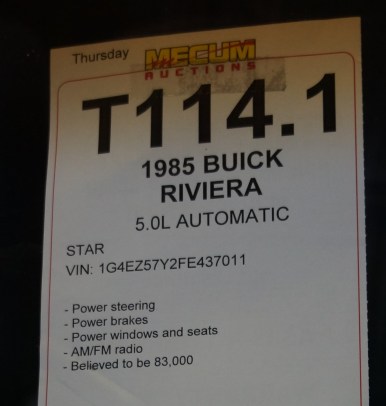
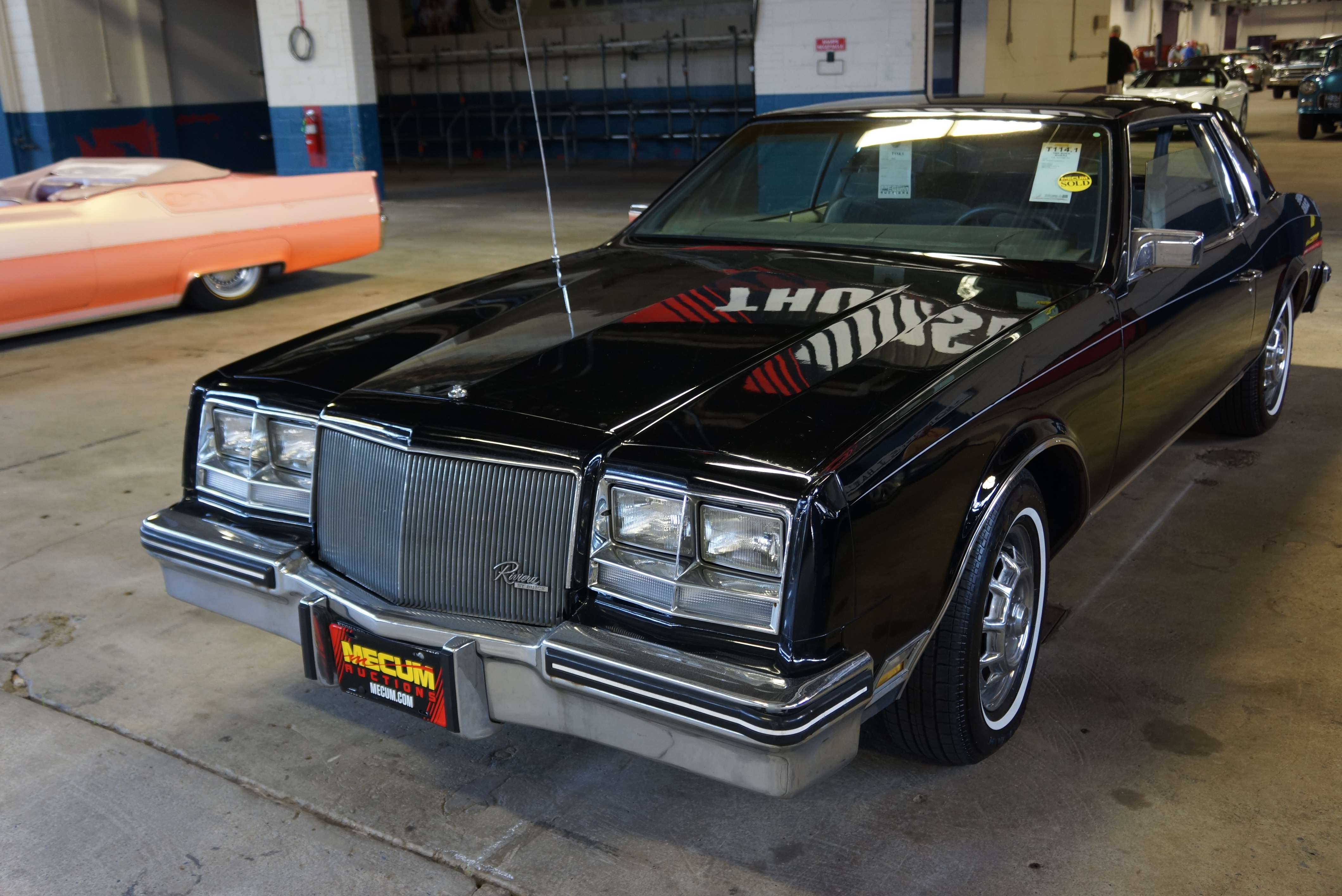
T114.1, 1985 BUICK RIVIERA
Condition estimate: 4
SOLD for $2,000
The scene on the auction block was something I’d never witnessed before. As the car came up, “auctioneer A” could not get a single $1,000 opening bid for it. He asked, begged, cajoled, screamed, and pleaded, all in vain. There was a long pause, and (this was the novel part) Jimmy Landis, Mecum’s well-known town crier, grabbed the microphone and said “let me try”! But still no bids. Jimmy turned to the owner, and into the microphone, said “sir, nobody wants your car!” Finally, someone in the crowd, recognizing that they could buy a running, driving, V8-powered American automobile for cheap, bid $1,000, then $1,500, then $2,000, at which point Jimmy screamed SOLD!!! This entire process took the better part of 10 minutes.
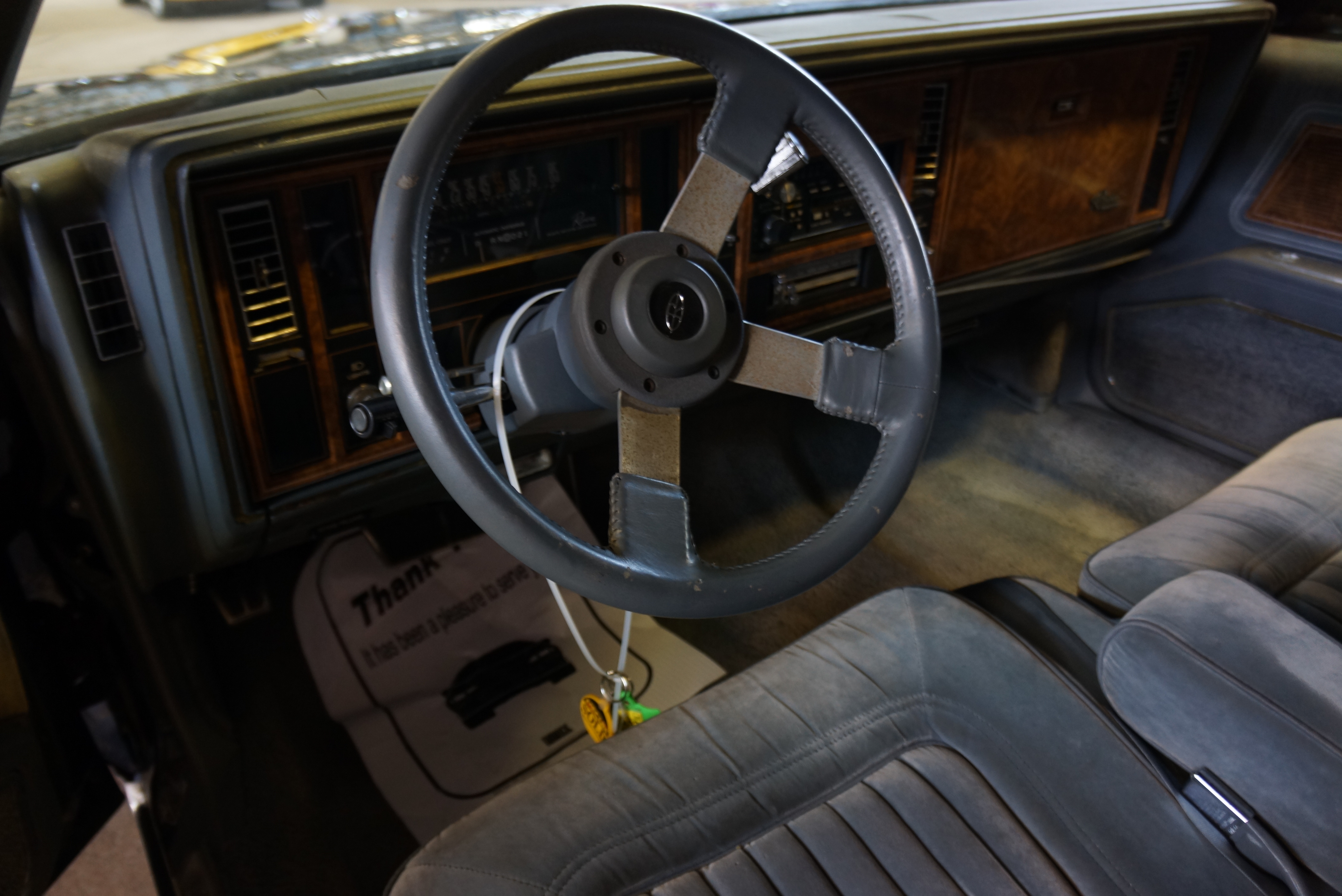
We checked out the car later. The sides were laser-straight, but the black paint on the roof was a little sketchy. The interior was not trashed, and it all seemed to be there. Someone got a driver for very little money.
Riv from the front
Riv from the rear
Interior seems fine
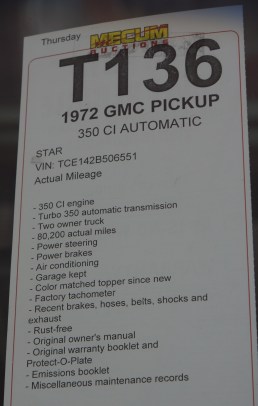
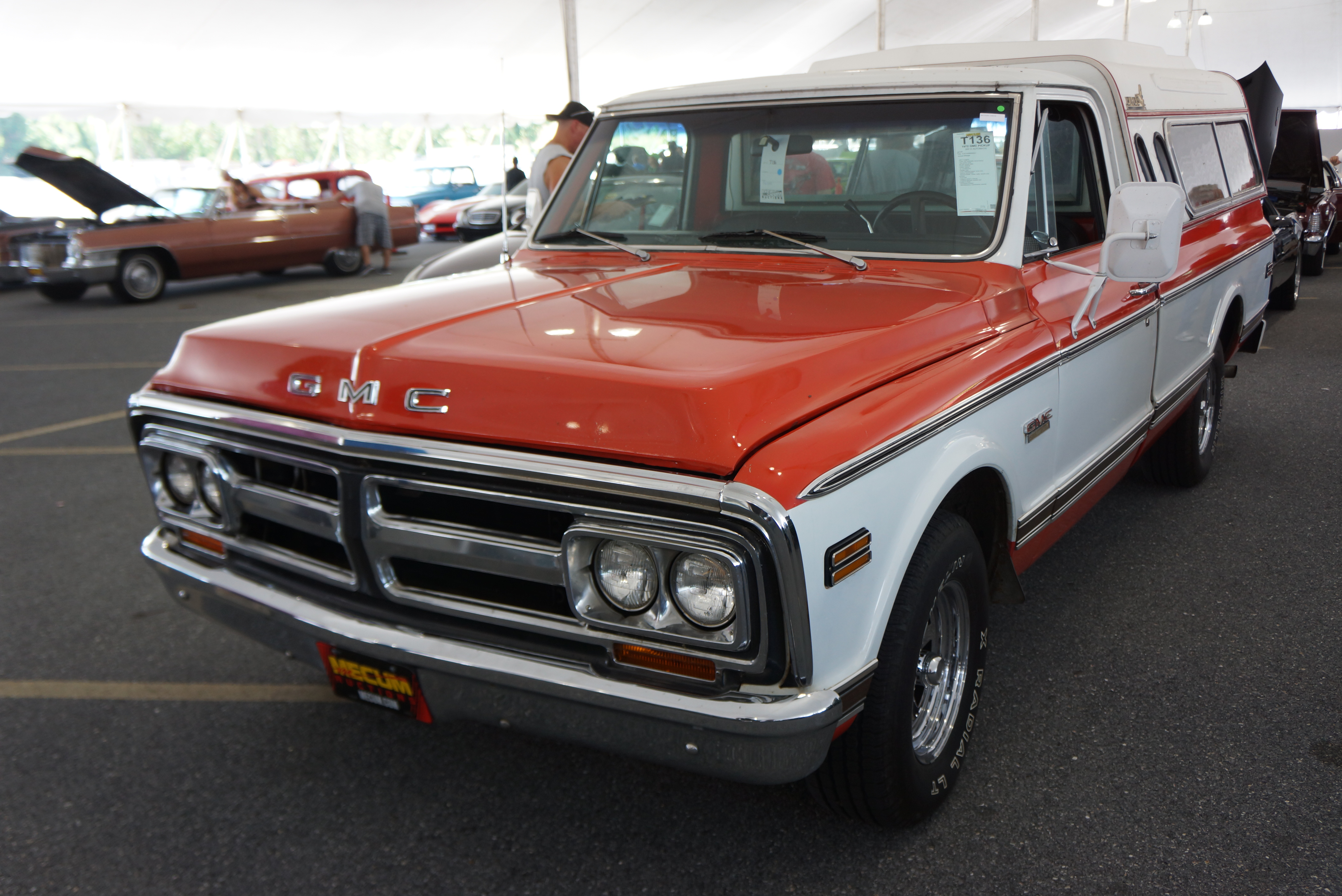
T136, 1972 GMC PICKUP TRUCK
Condition estimate: 3-
SOLD for $12,500
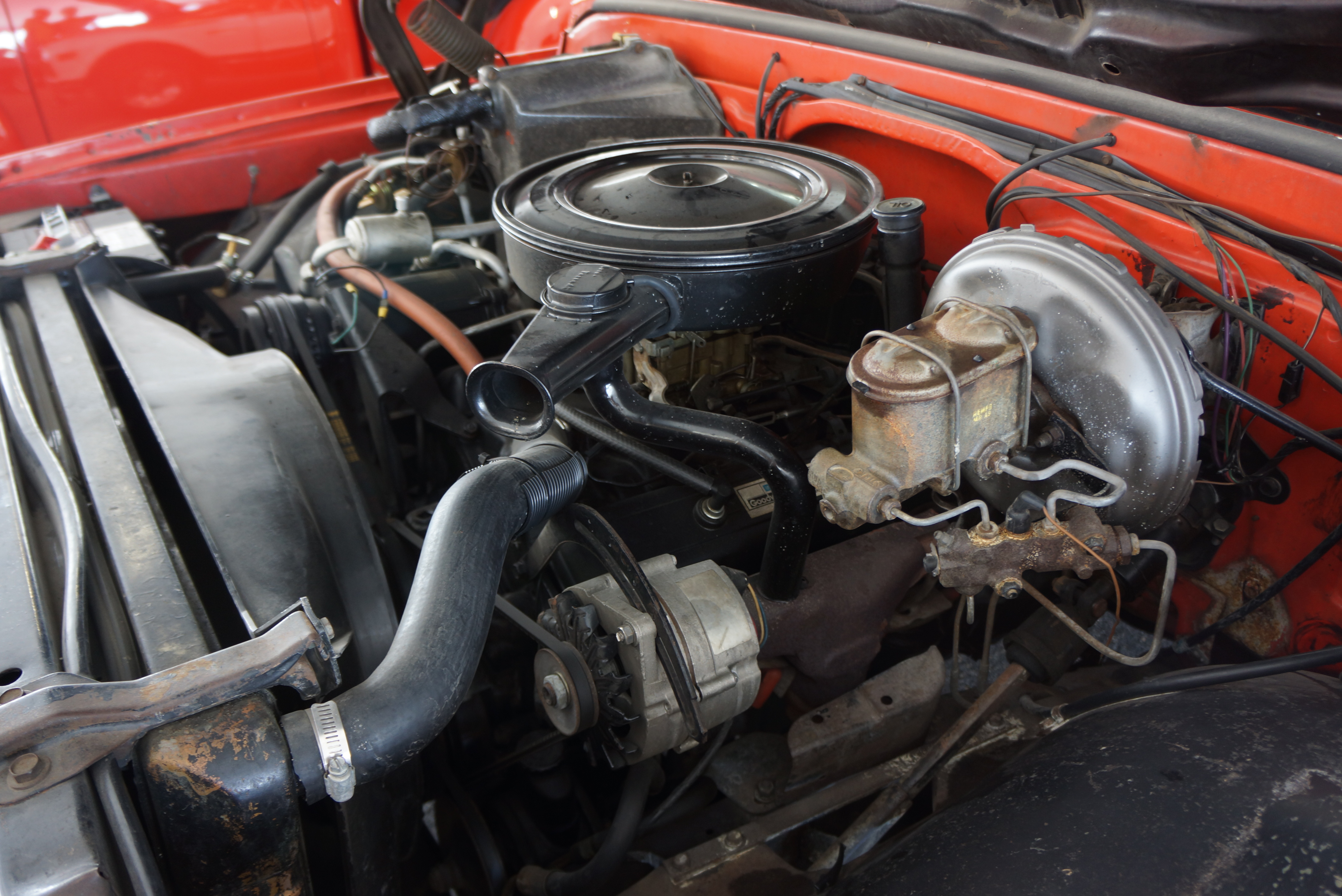
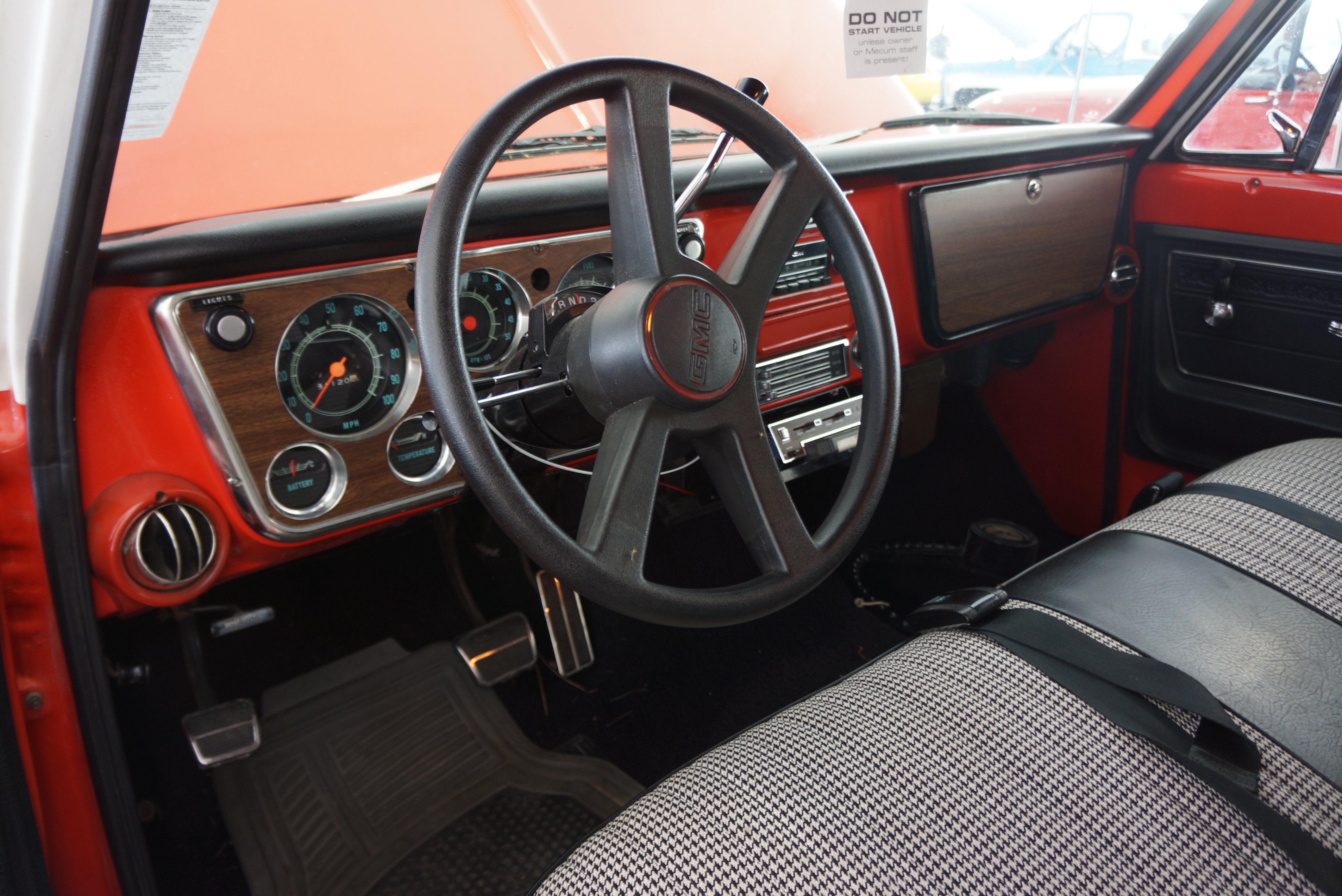
There were a large number of GM pickups from this generation (’67-’72) at the auction, most of which were either restored to #1 condition or were rodded. This was one of the few that appeared to be original and unrestored, and the truck had an honest vibe to it. The price seemed to favor the buyer; a few thousand more would not have surprised.
Very period orange & white
Decent engine compartment
Houndstooth, just like a ’69 Camaro
Bed likely was protected by cap
T140, 2002 JAGUAR XK8 COUPE
Condition estimate: 3-
SOLD for $7,000
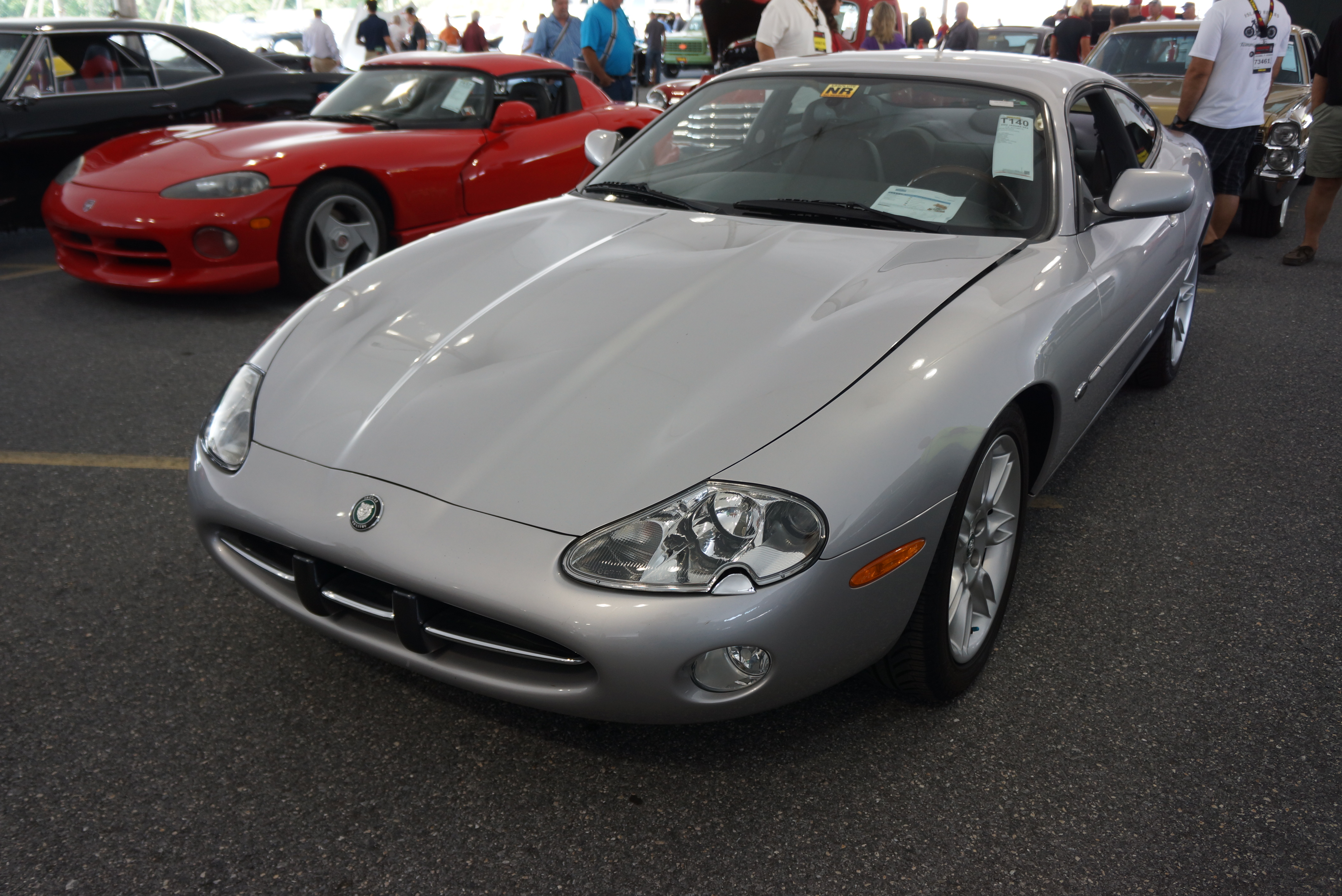
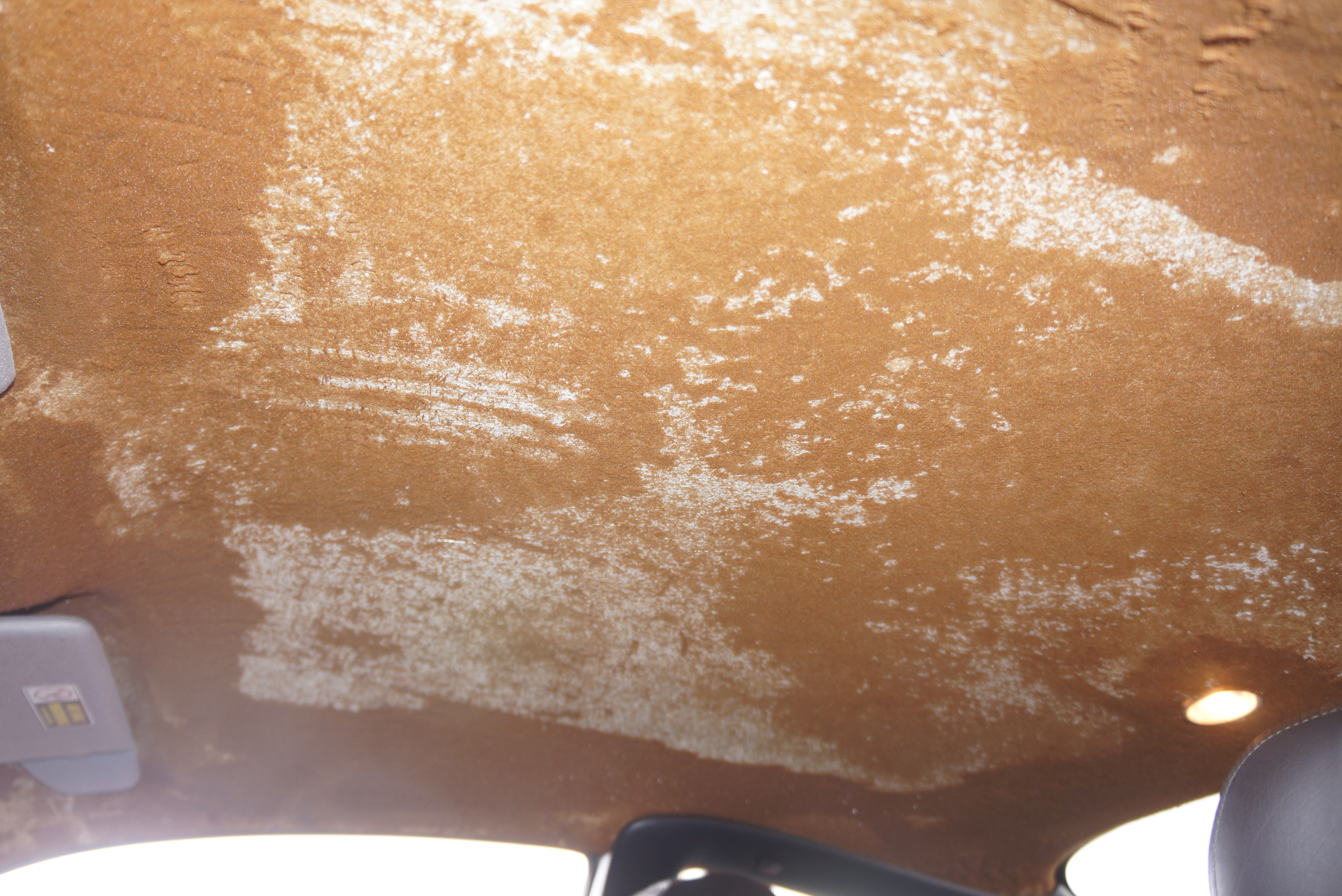
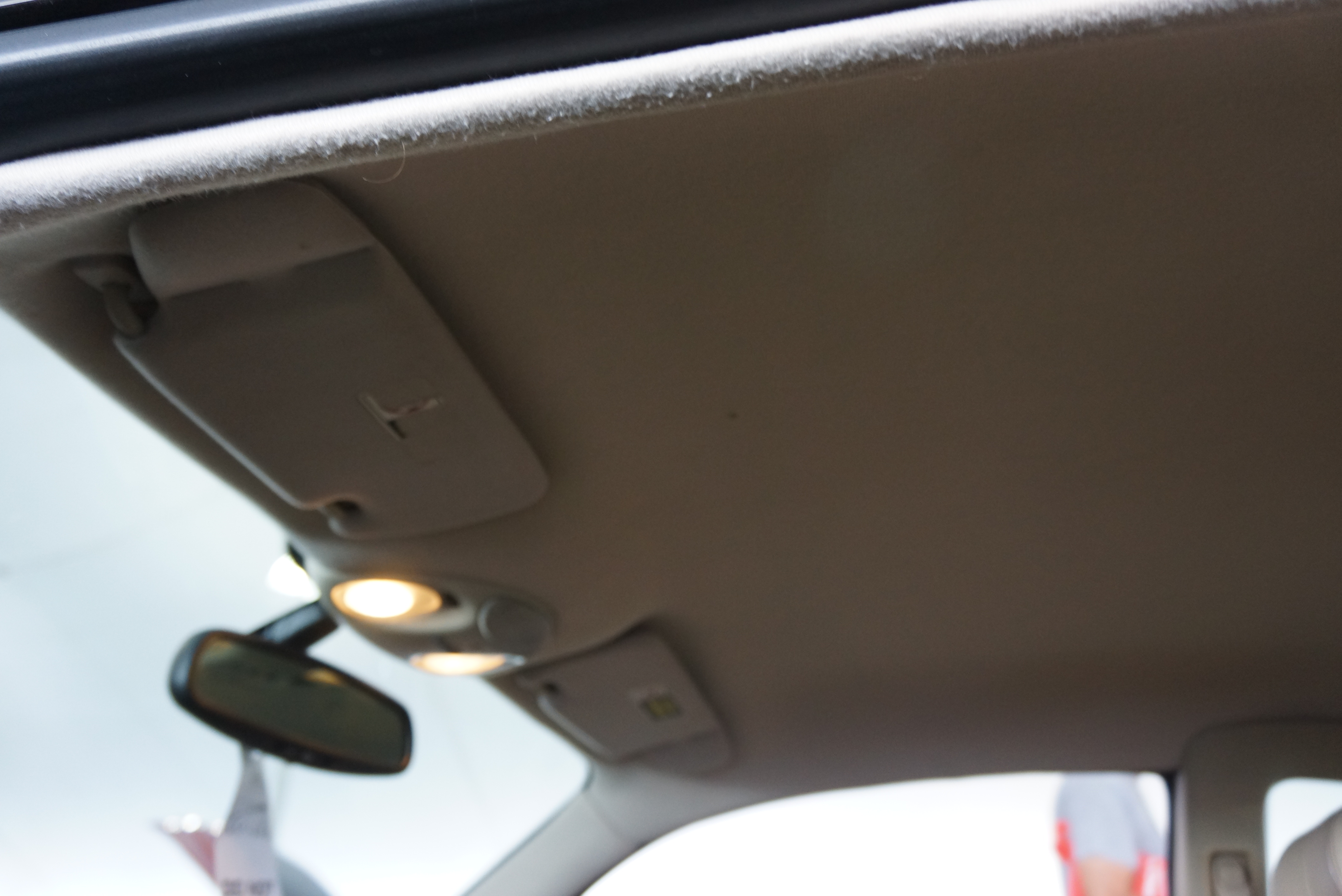
Jaguar XK8 convertibles outsold their coupe counterparts 10 to 1. Coupes are therefore thin on the ground, and it was nice to see one. However, as I sat in the driver’s seat, “crumbs” appeared on my shirt. Looking up, I saw…. that the car had no headliner. This selling price (no reserve) seems fair, but don’t forget to factor in the parts and labor for a headliner.
Nice to see an XK8 coupe
We’re told these engines are strong
Interior looks good until…
you look up to see this
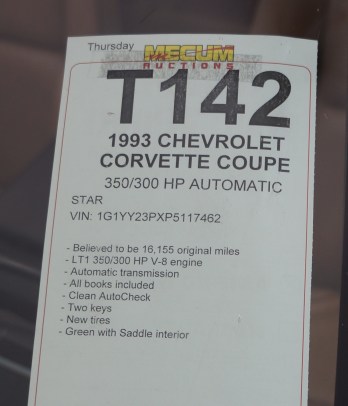
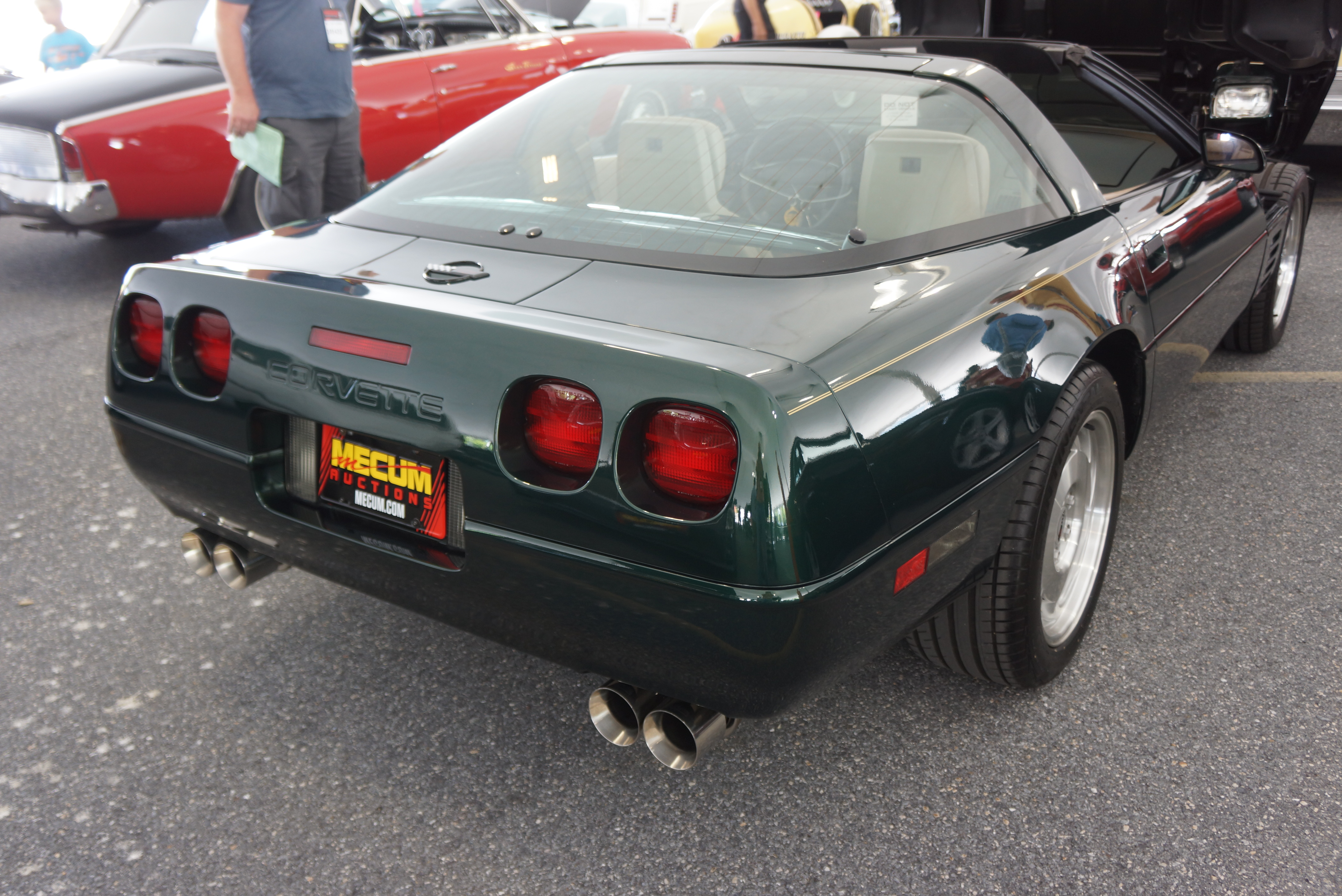
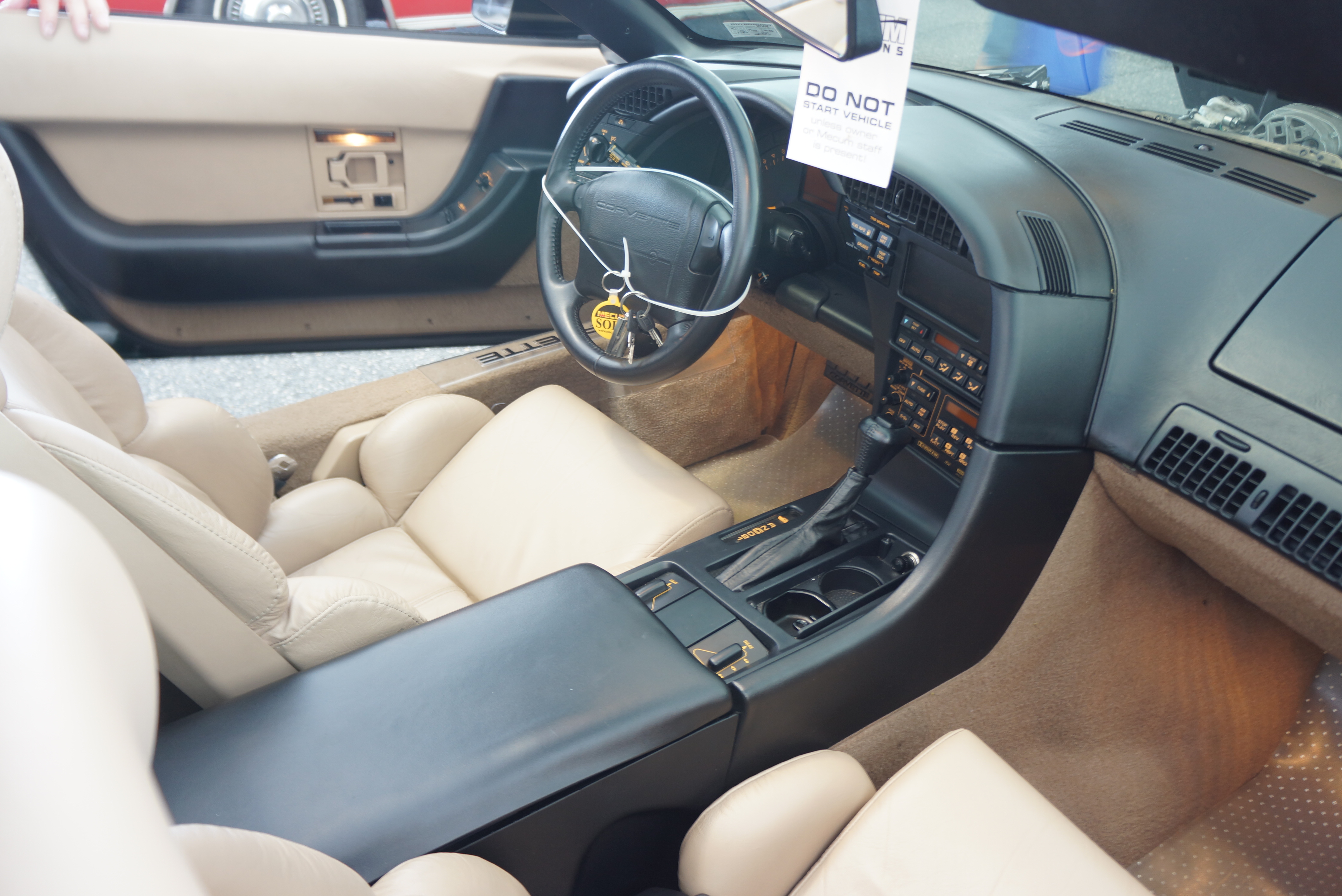
T142, 1993 CHEVROLET CORVETTE COUPE
Condition estimate: 2
SOLD for $13,500
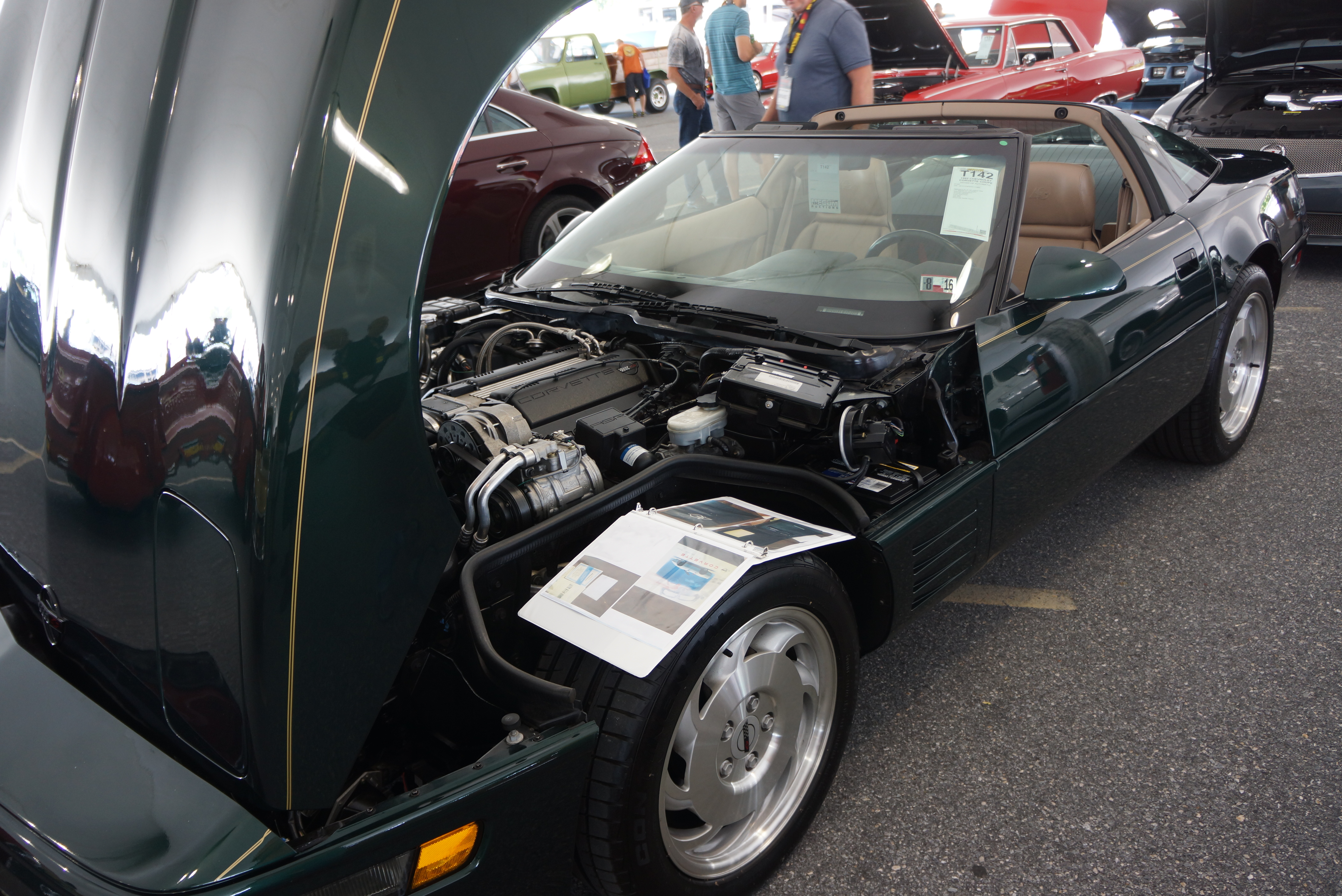
Green over tan is popular on MGs and Jags, but not to everyone’s taste on America’s Sports Car. The car was clean and purportedly very low miles. Price was a bit higher compared to what we saw at Carlisle just 3 months ago; are C4s on the way up?
Sit on the tire to service it
Dark green paint has held up
As has sharp beige interior
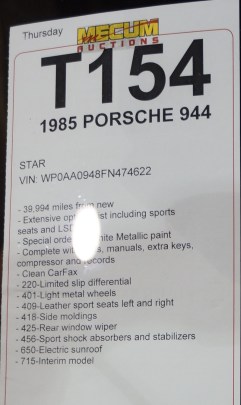
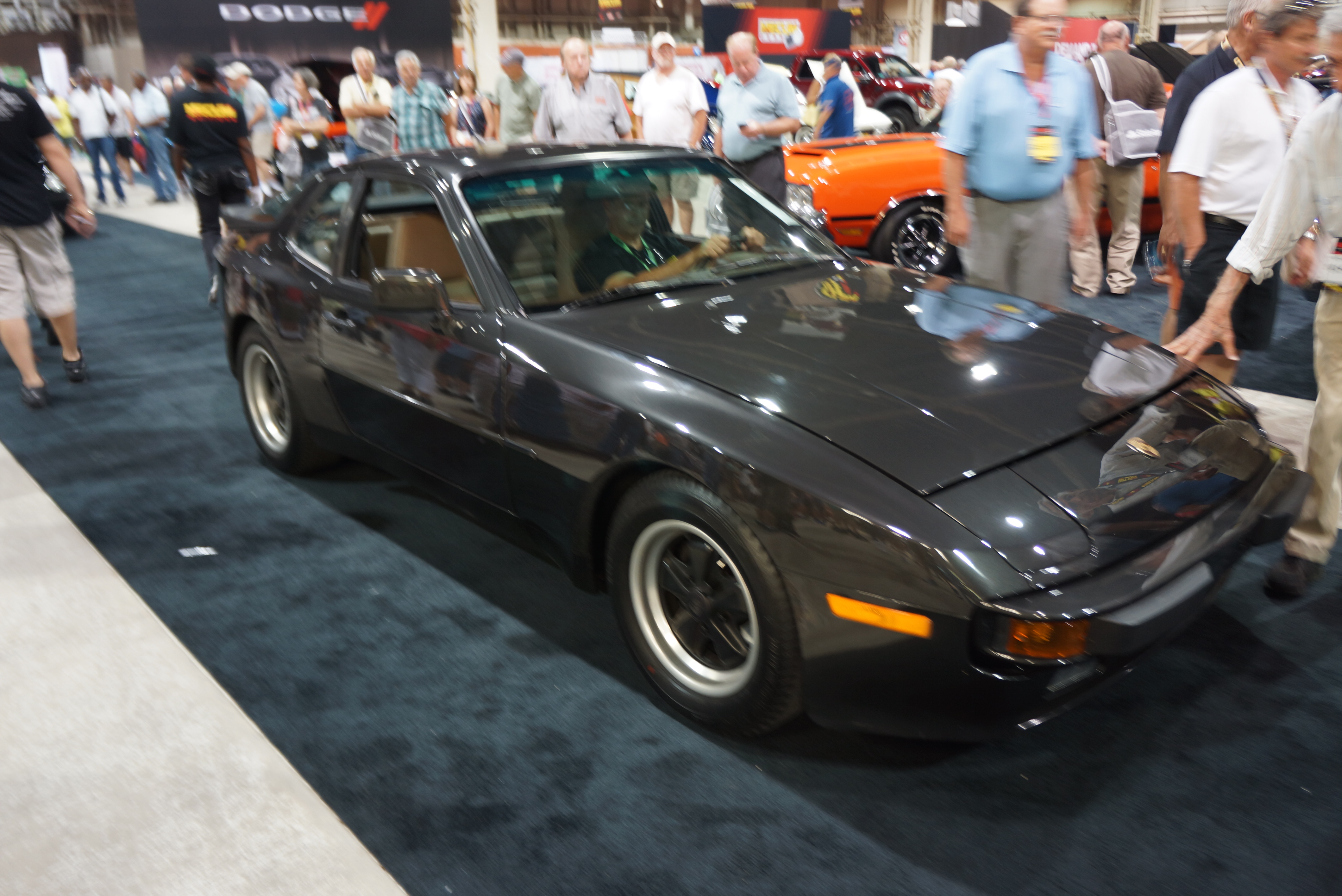
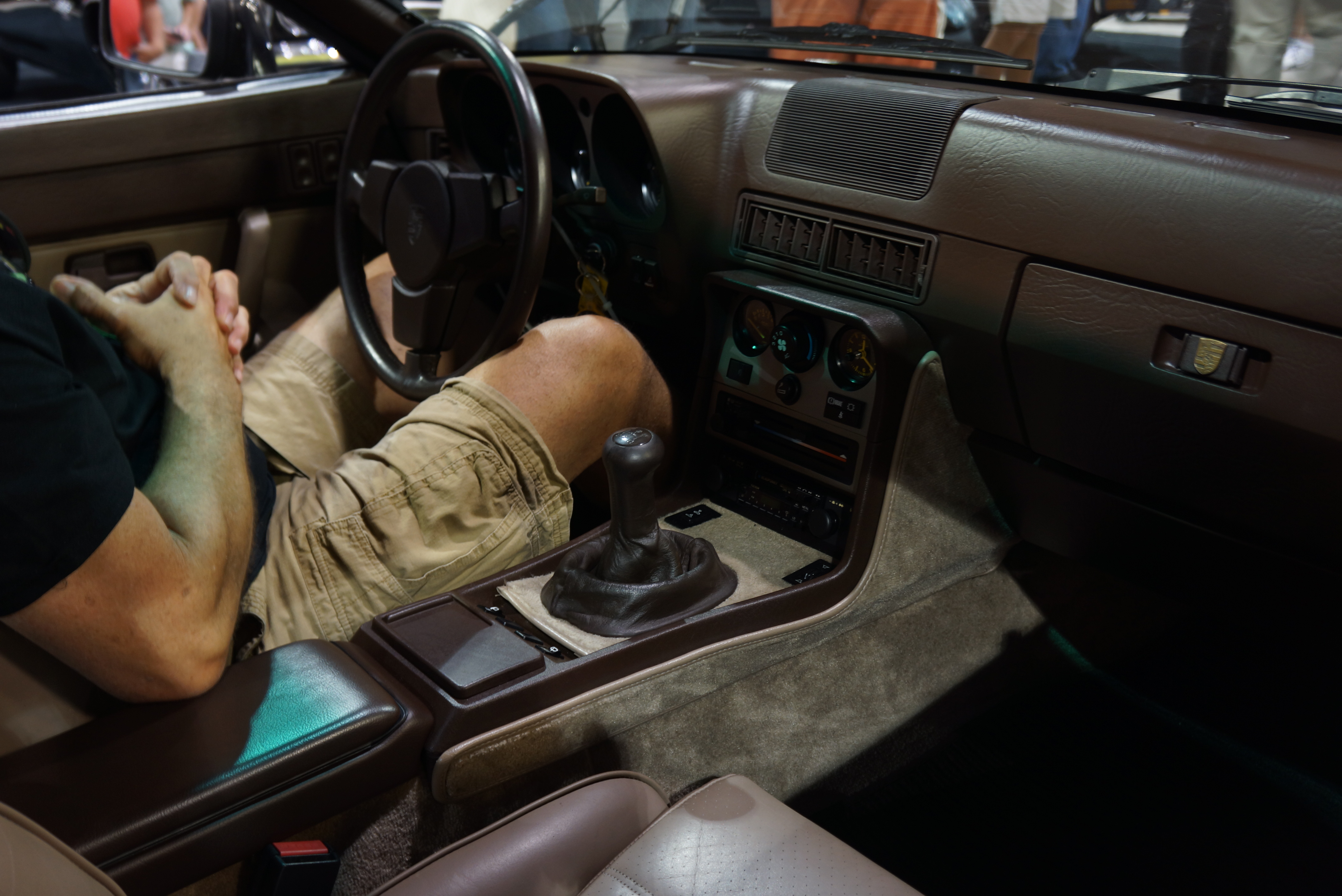
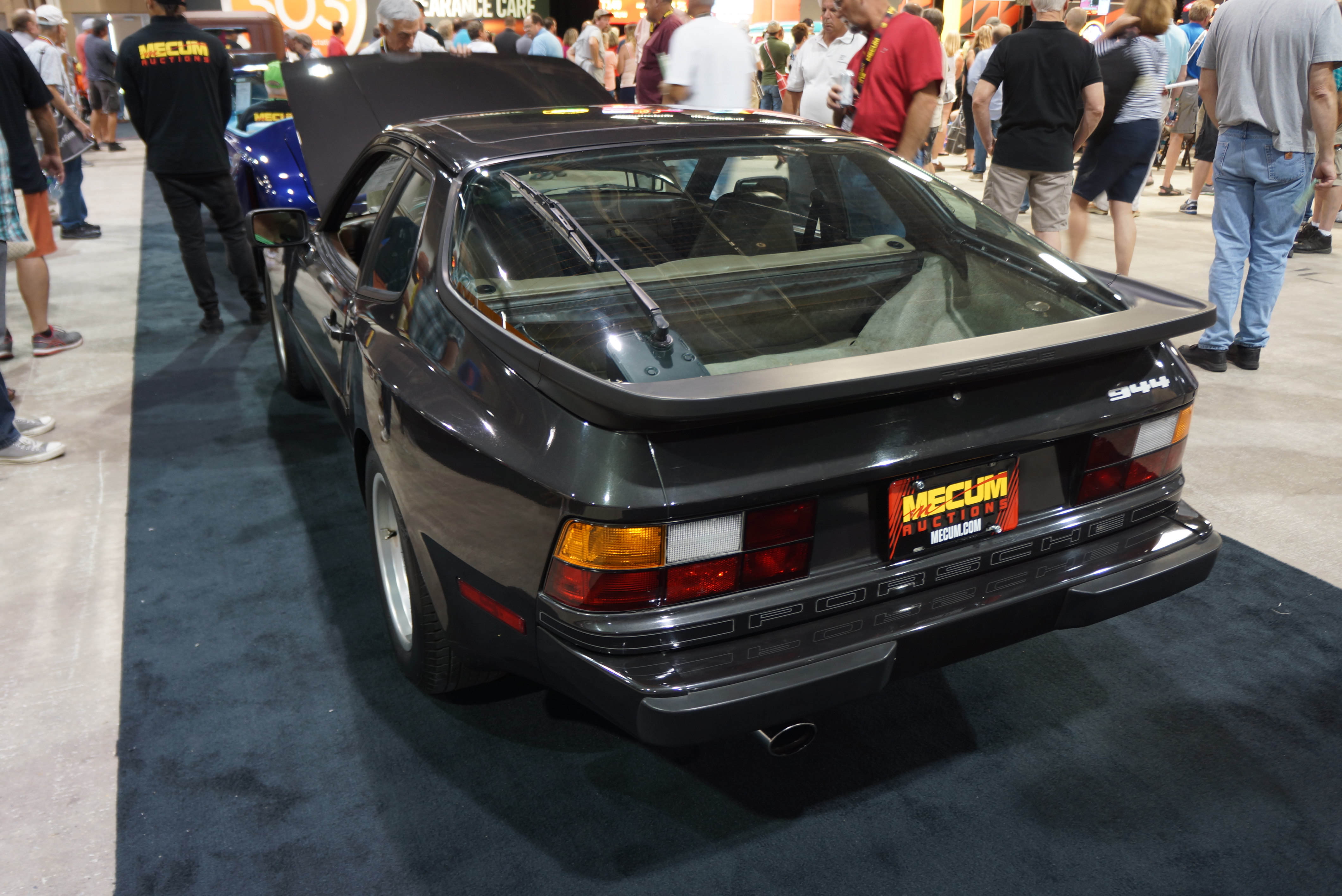
T154, 1984 PORSCHE 944
Condition estimate: 2
NOT SOLD AT $15,000 HIGH BID
As Porsche 911 prices climb beyond a reasonable level for the average collector, other Porsches gain interest. Several years ago, there was no such thing as a five-figure 944. This car, from the model’s third year of production, was highly optioned, and in an attractive and rare color. But it’s the later 944s which are getting bucks in the mid-teens. This car should have sold at this number.
Grey metallic unusual & striking
Dash design was about to change
The 944 look has grown on many
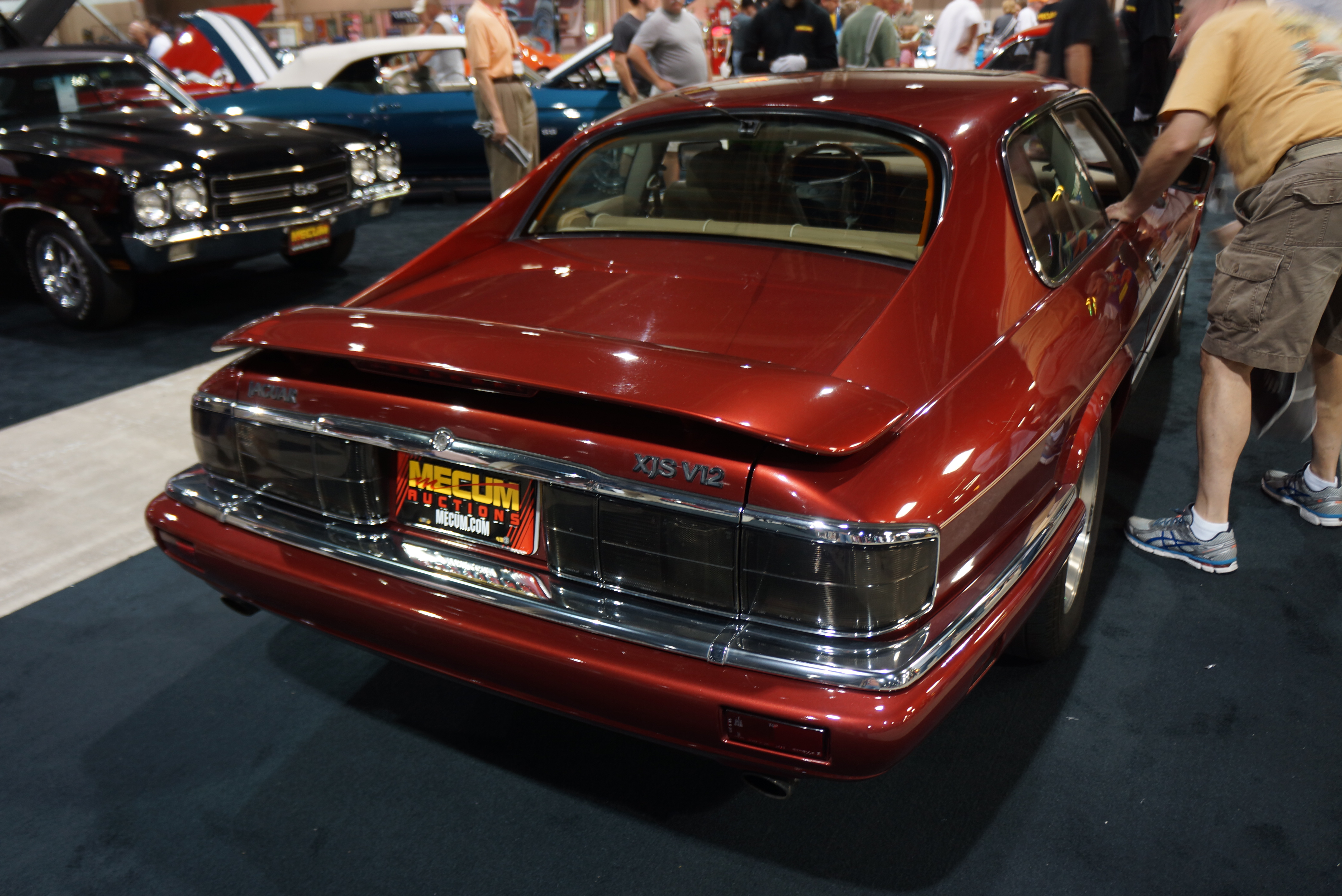
T172, 1995 JAGUAR XJS COUPE
Condition estimate: 2
NOT SOLD AT $10,000 HIGH BID
The 1991 redesign of the XJS actually improved its looks, at which time, the introduction of a 6-cylinder engine and a full convertible meant most were built that way. That makes this late 12-cylinder coupe rare, but as we know, rare does not always equal valuable. The bid price seemed close enough to me, but not to the owner. One would guess we were no more than a few grand away from the reserve.
By ’95, bumpers were color-keyed
and spoiler adorned deck lid
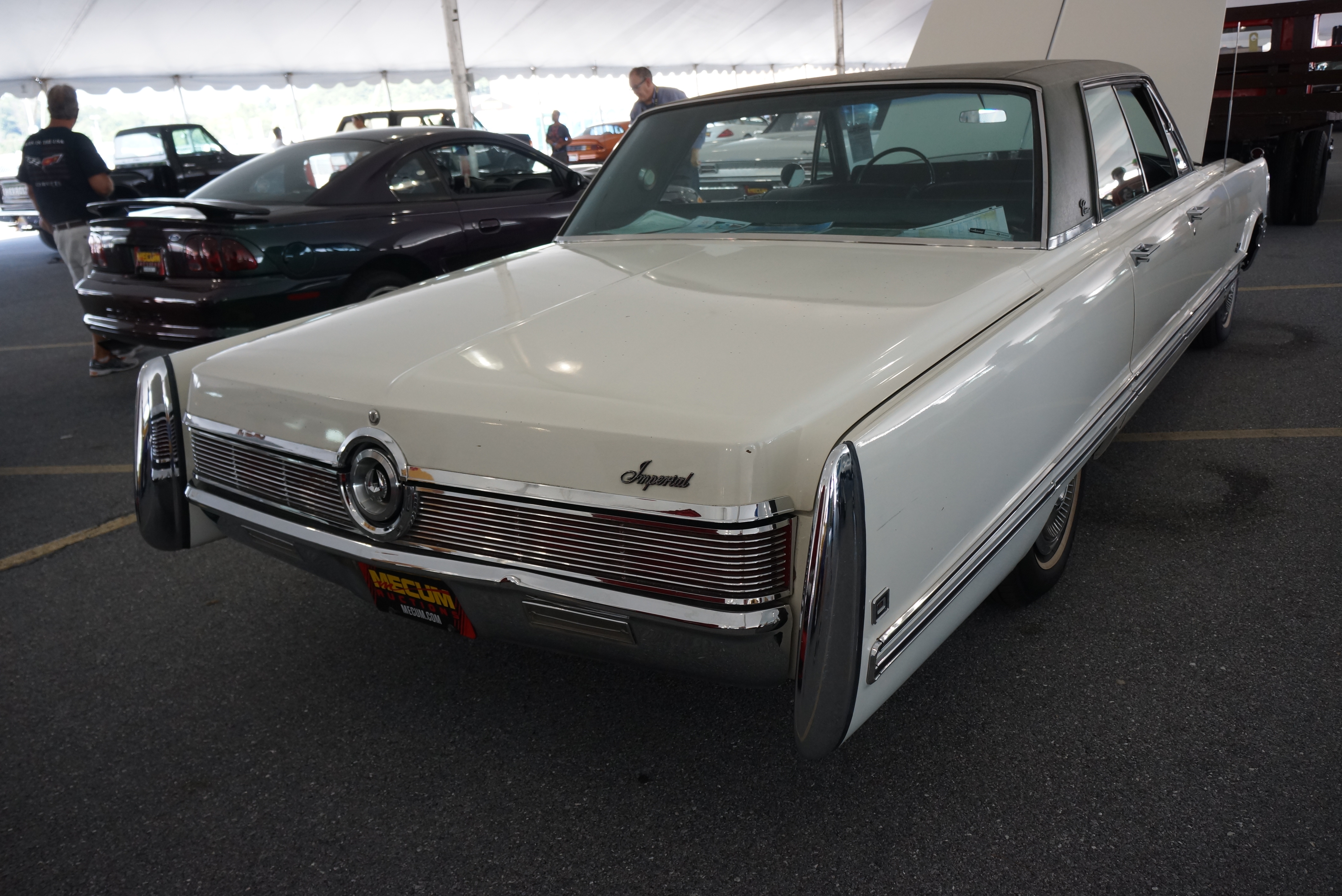
T263, 1968 CHRYSLER IMPERIAL
Condition estimate: 3-
NOT SOLD AT $7,000 HIGH BID
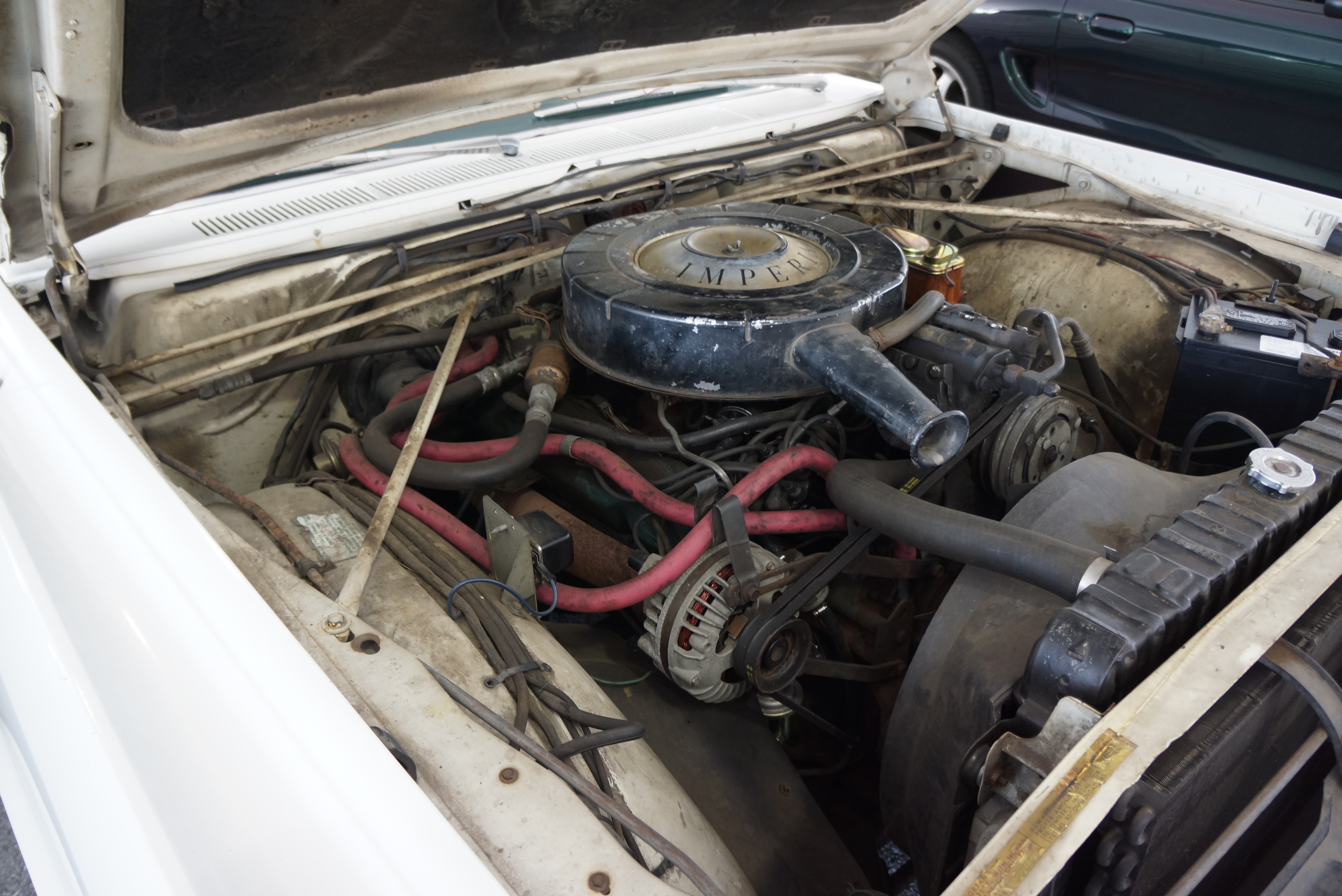
“I got me a Chrysler it’s as big as a whale” sang the B-52s, and it certainly applies here. This car was fascinating on many levels: its size, originality, color scheme, and details like a shrouded dash with hide-away radio panel. This car was American late ‘60s luxury at its finest (if only it fit in my garage). A weekend spent detailing the land yacht (especially underhood) might have garnered a sale price a thousand or two more than the high bid.
Big and heavy from any angle
Back shows vestigal fins
Pic can barely capture expansive dash
Biggest letdown was engine compartment
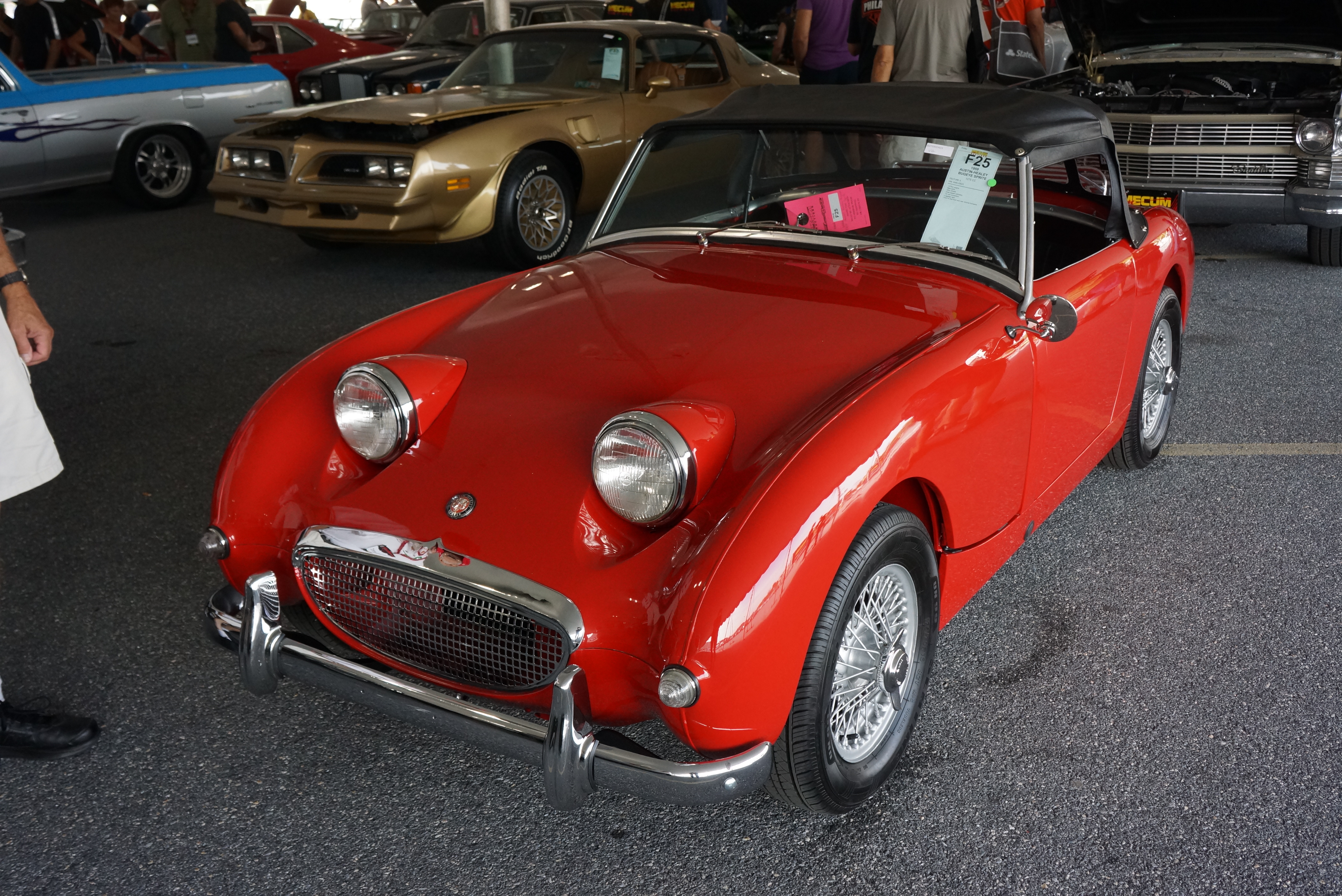
F25, 1959 AUSTIN-HEALEY SPRITE
Condition estimate: 4
NOT SOLD AT $13,000 HIGH BID
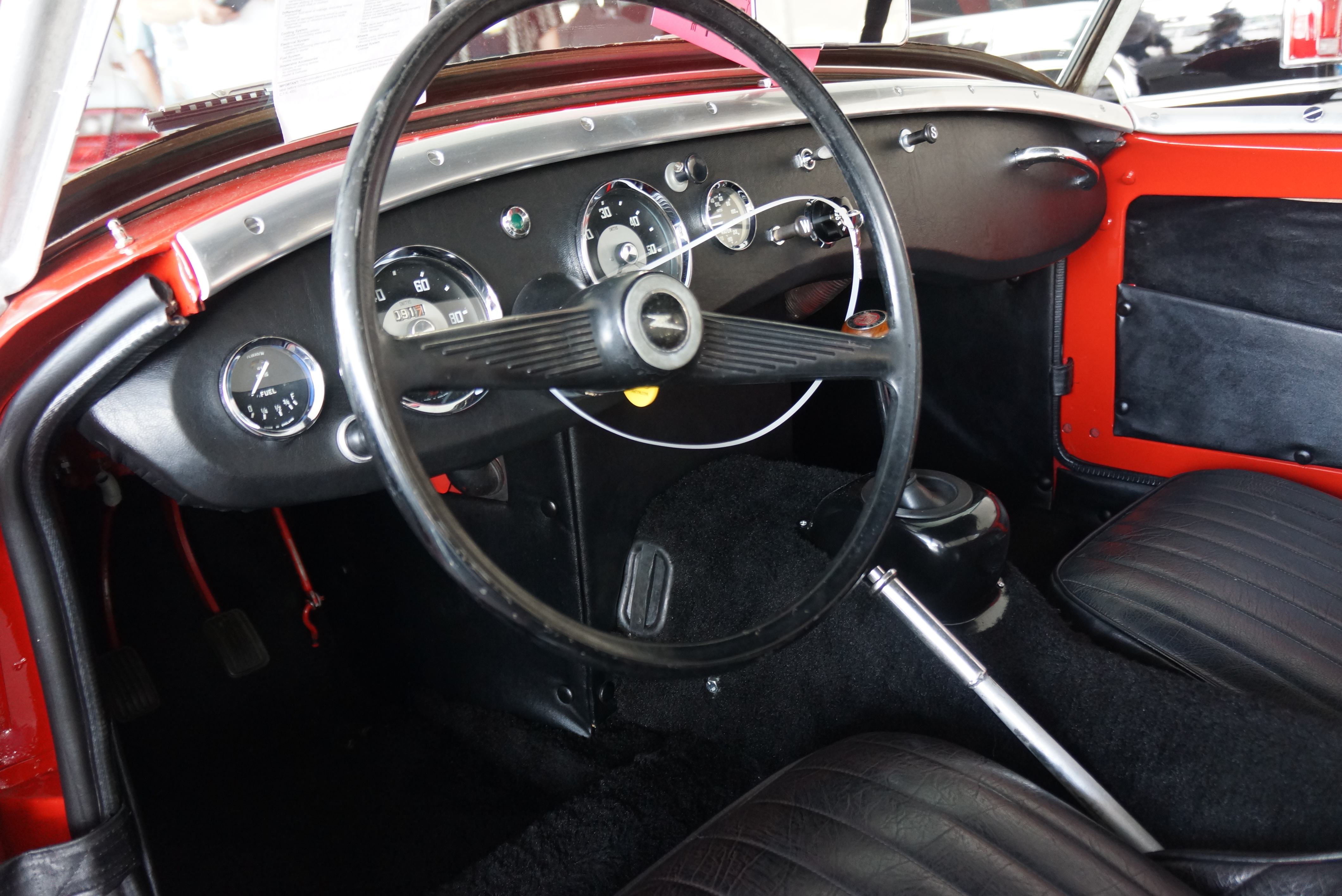
All my friends know that I like small cars, and I’ve always been smitten with Bug-eyes. Sitting in this one, I was appalled at the complete lack of attention to detail. The overall vibe was of a car that was quickly slapped together for resale. Bug-eyes routinely trade in the $10,000-20,000 range, depending on equipment and condition. I don’t know what shocked me more: that the bidding reached $13,000, or that the owner didn’t grab the money and run.
Don’t be fooled by glossy red paint
Plenty of loose parts & overspray
Shiny but needy
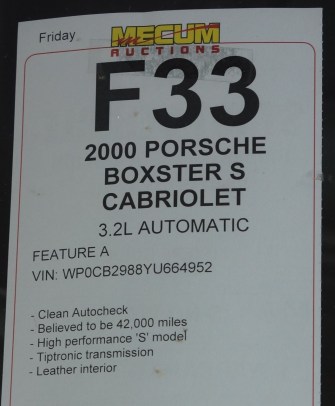
F33, 2000 PORSCHE BOXSTER S
Condition estimate: 2-
SOLD for $12,500
The color scheme, bright yellow with a BLUE cloth top and black interior, turned me off, as did the automatic transmission. There are too many other choices among used Boxsters to rate this as anything but on the expensive side for a late model play toy.
Windshield proclaims low miles
Black interior clean, but gets hot
First gen Boxster styling has held up
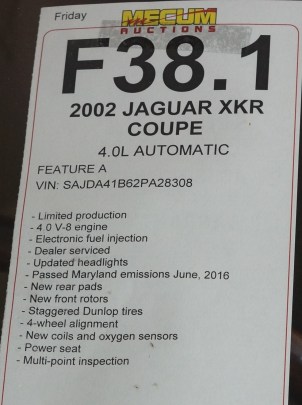
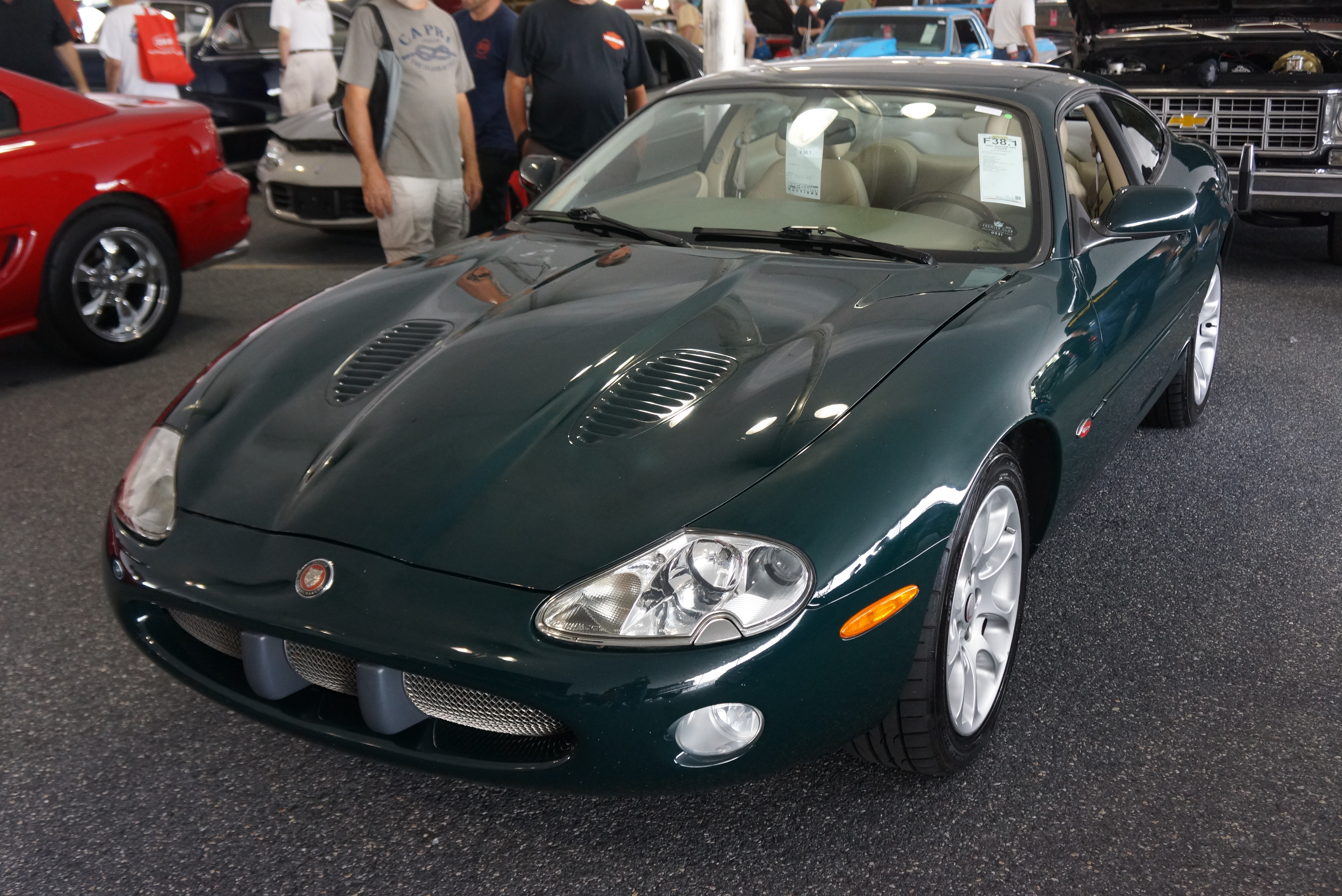
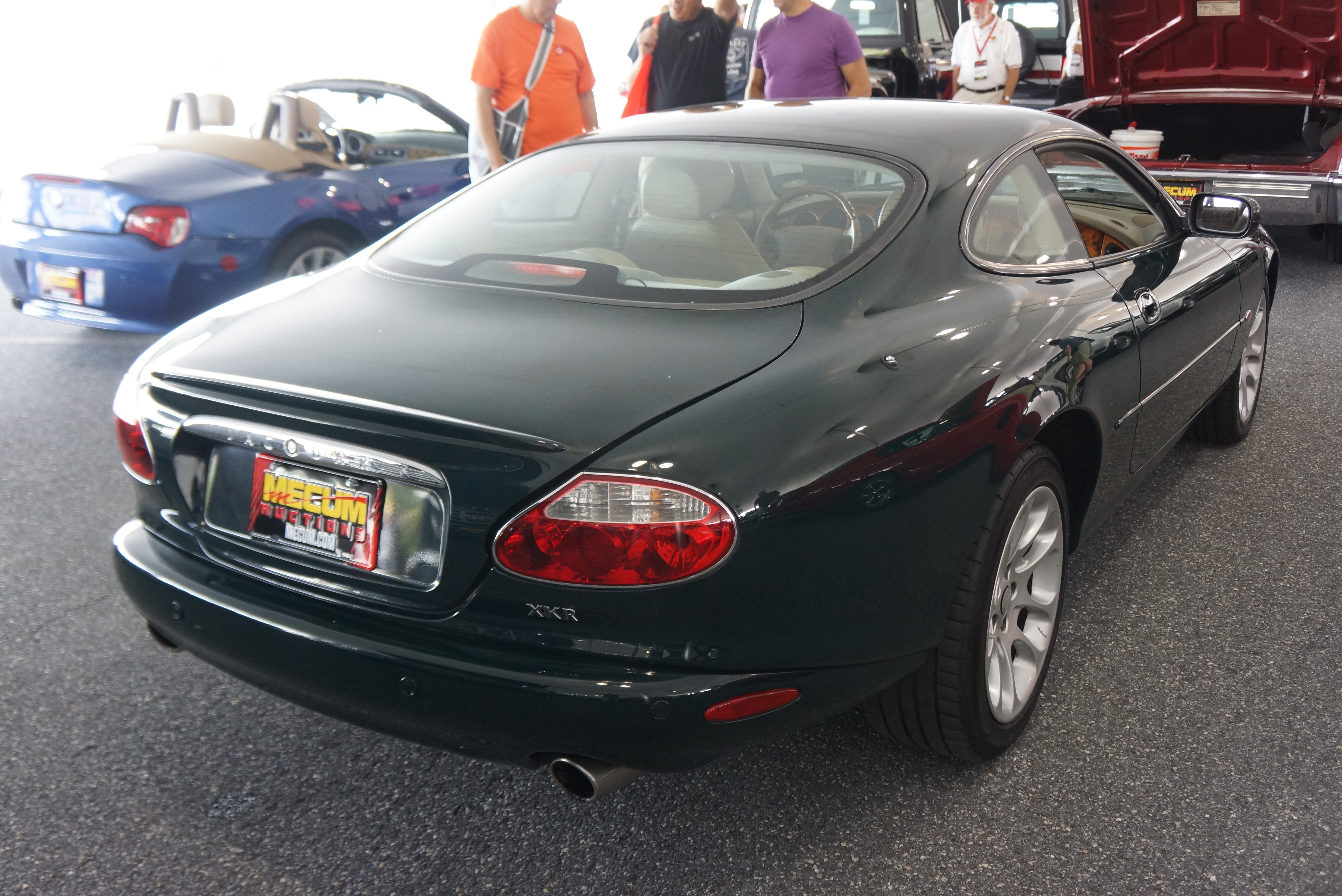
F38.1, 2002 JAGUAR XKR COUPE
Condition estimate: 3
NOT SOLD AT $8,000 HIGH BID
The XKR is the supercharged version, and this car (complete with headliner) deserved more. The miles were relatively high at 85k, but a mid-teens sale price would still be fair.
2nd XK-coupe at this auction
Coupe’s hindquarters look better
Jag has expected leather & wood
and has its headliner in place
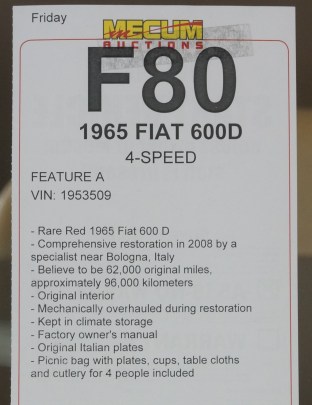
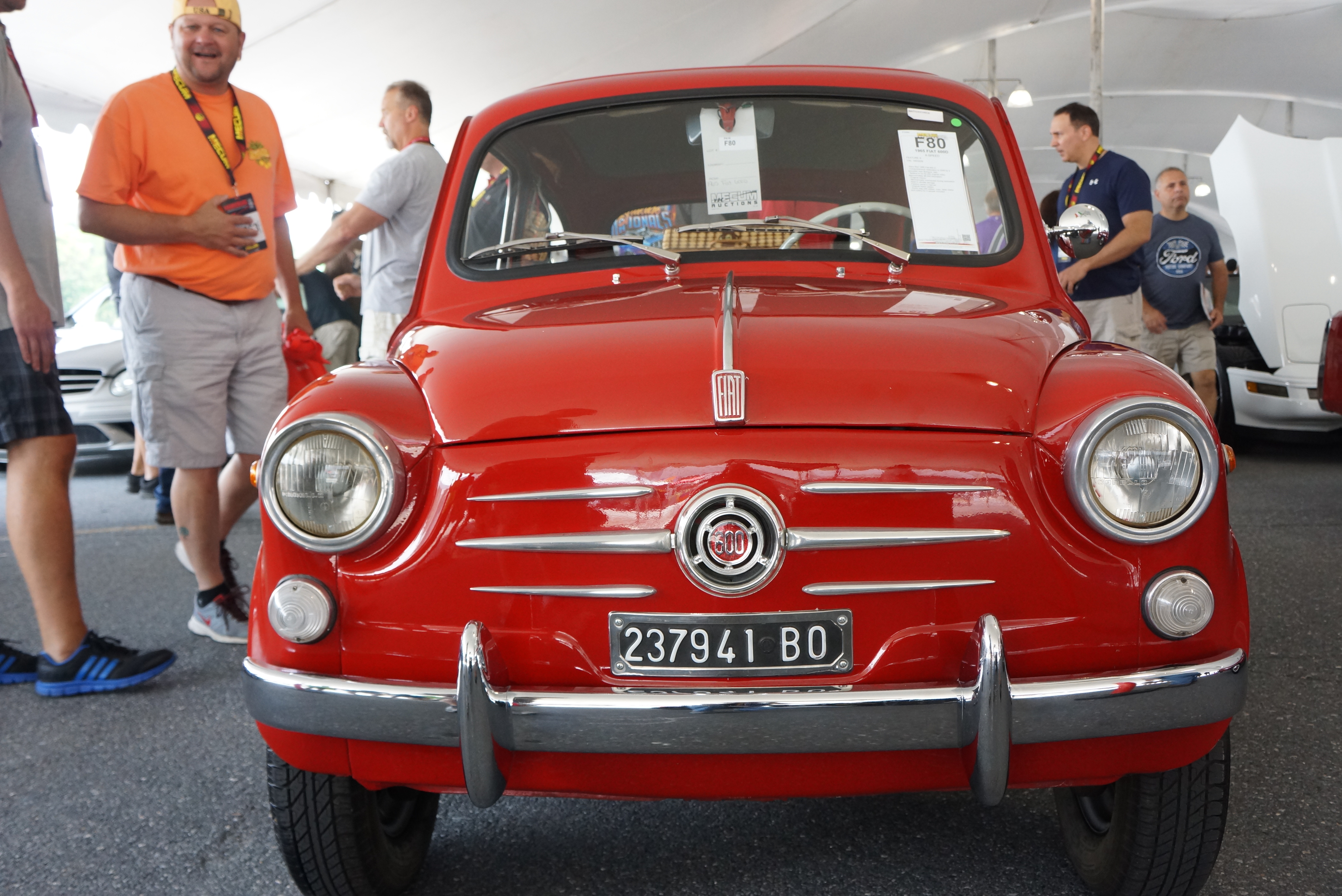
F80, 1965 FIAT 600
Condition estimate: 3
SOLD FOR $13,500
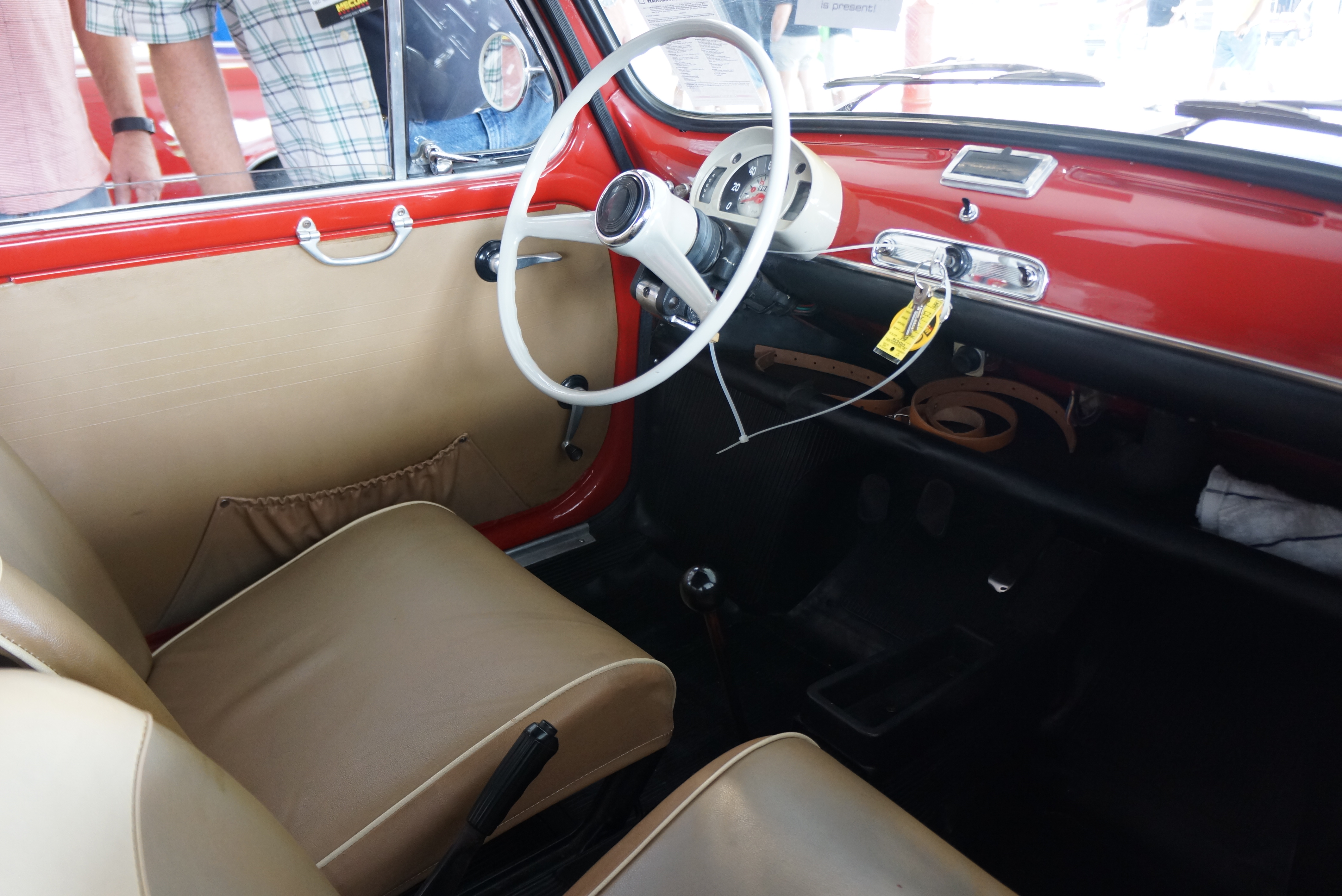
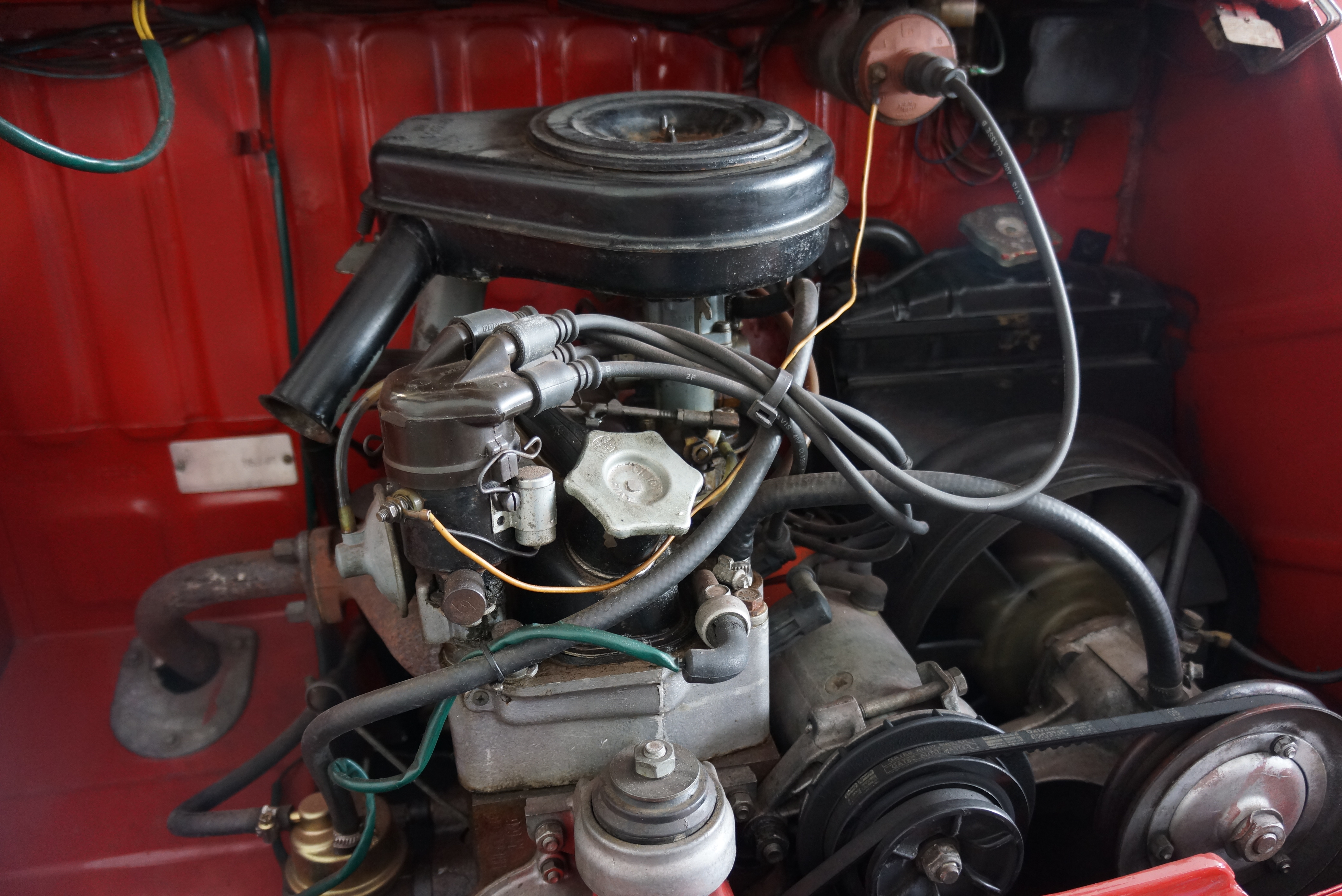
I fell in love again with an Italian redhead, but compared to last year’s 2-cylinder job, this girl runs a 4-banger and is water cooled. Thinking I might steal it if bidding stayed under $10k (hey, this audience is here for ‘murican muscle), bids quickly exceeded that and was hammed sold at what is admittedly a fair price. Just don’t take it on the Turnpike.
What a cute face
Picnic basket corny but effective
Lots of room for everyone
4-cylinder longitudinally mounted; radiator on side
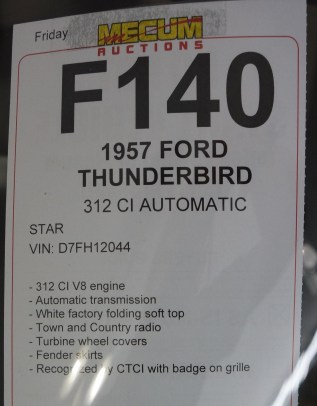
F140, 1957 FORD THUNDERBIRD
Condition estimate: 2-
SOLD for $34,000
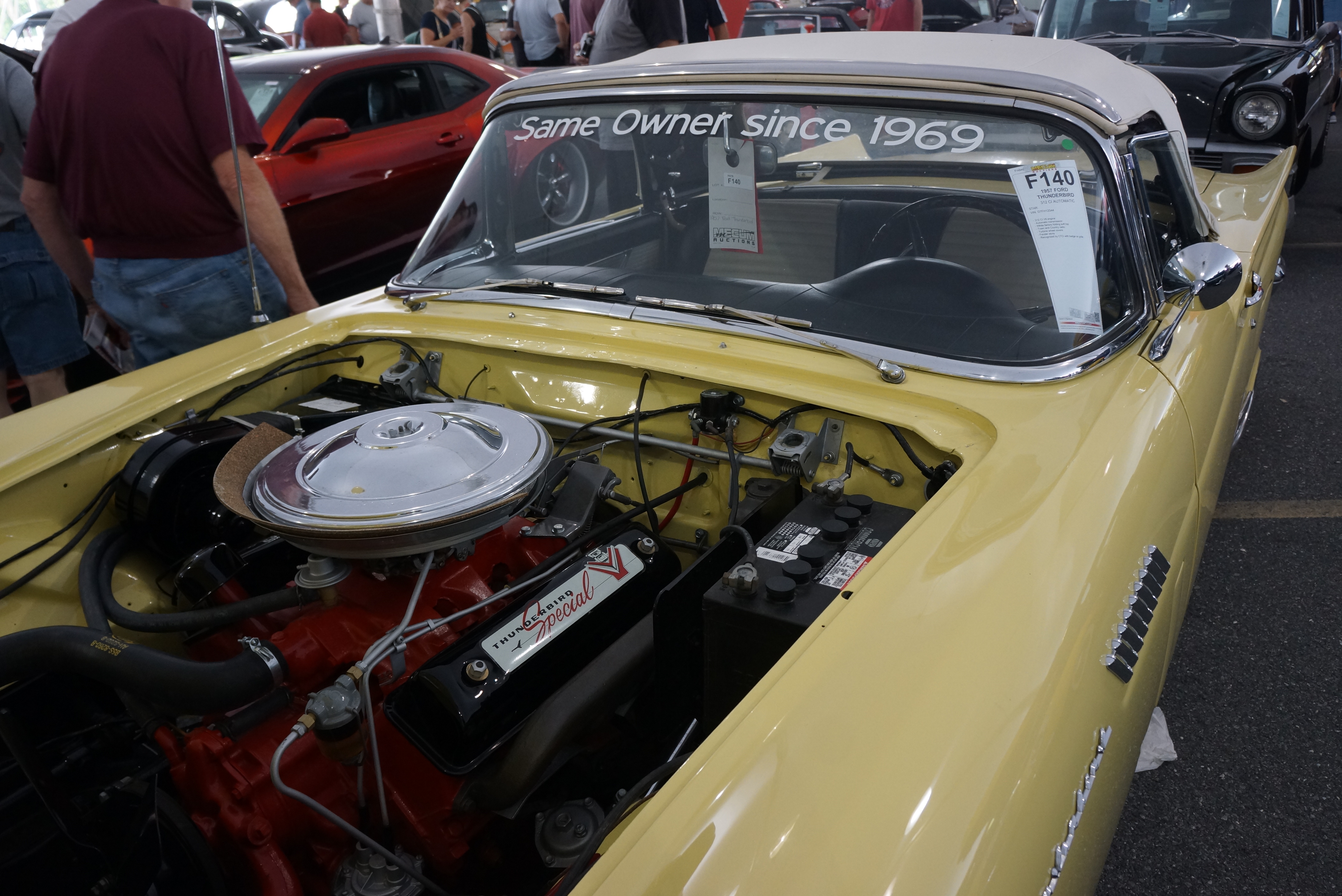
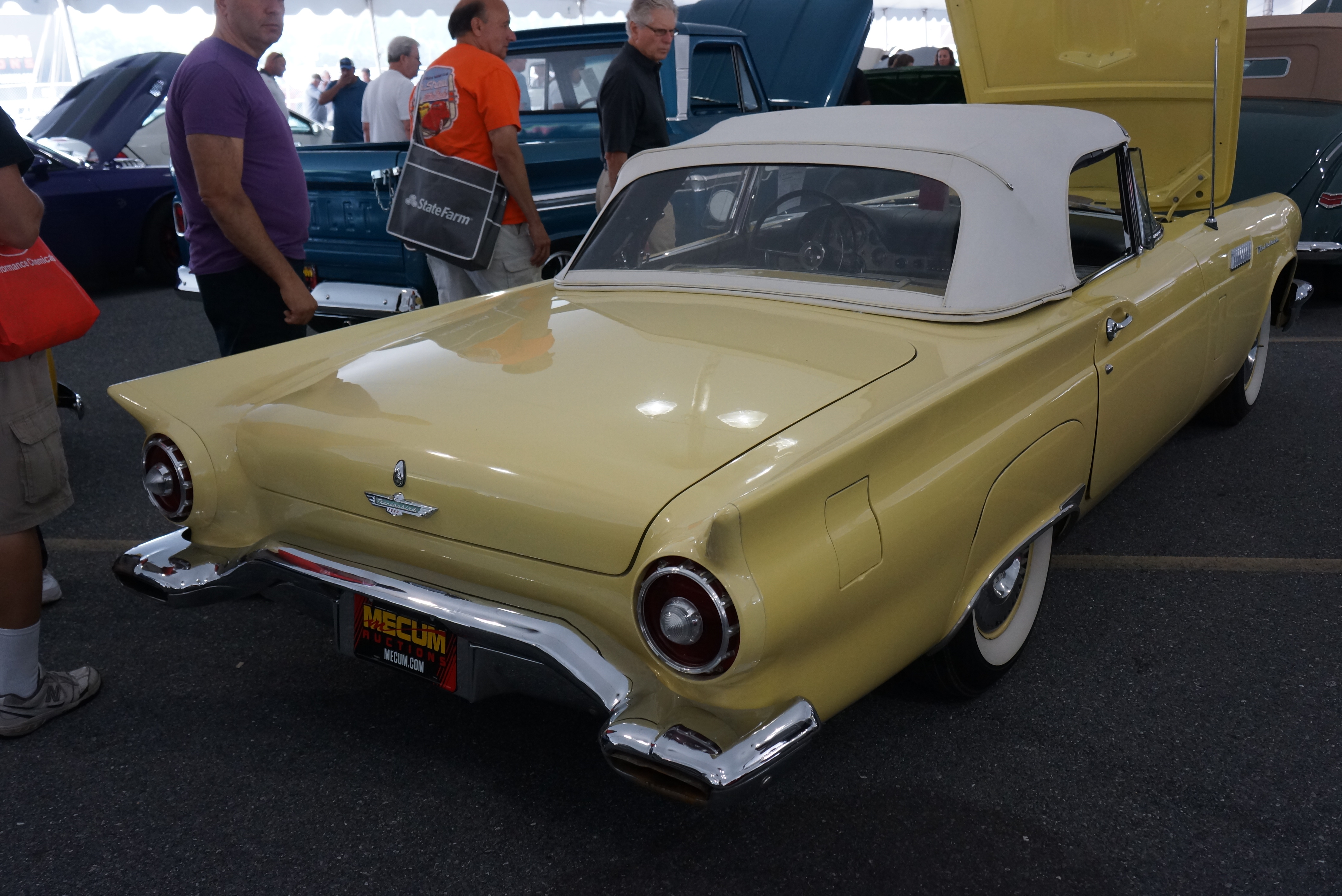
The windshield decal claimed that the car has had the same owner since 1969, which seemed to play in this car’s favor, as it gave the appearance of a car that has been well-kept while still being enjoyed. Two-seat T-Bird prices are all over the place; as the final year of the first-gen car in an attractive color, I call this well-bought.
Clean & straight engine compartment
White soft top looks nice over yellow
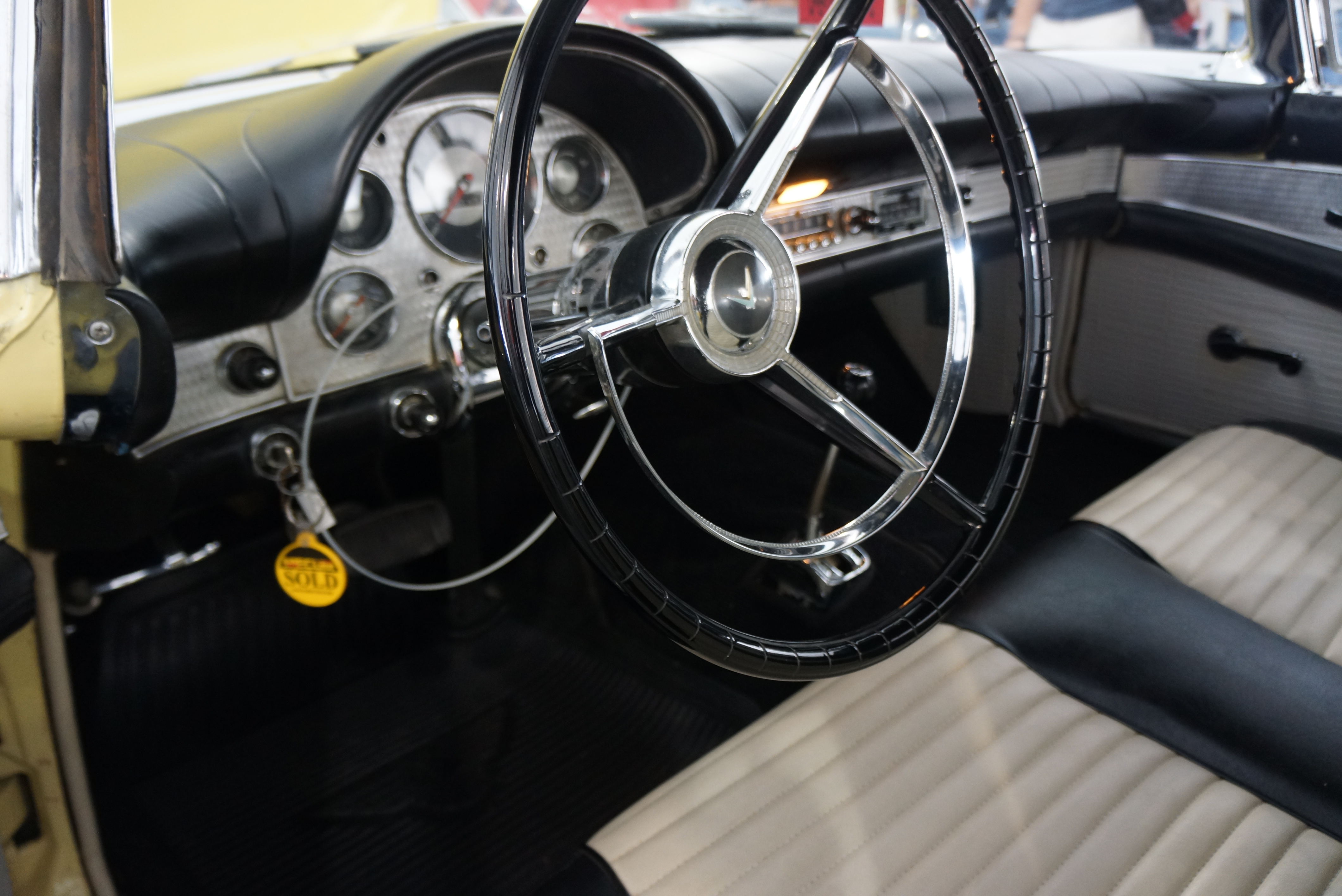
Dash attempts to convey sportiness
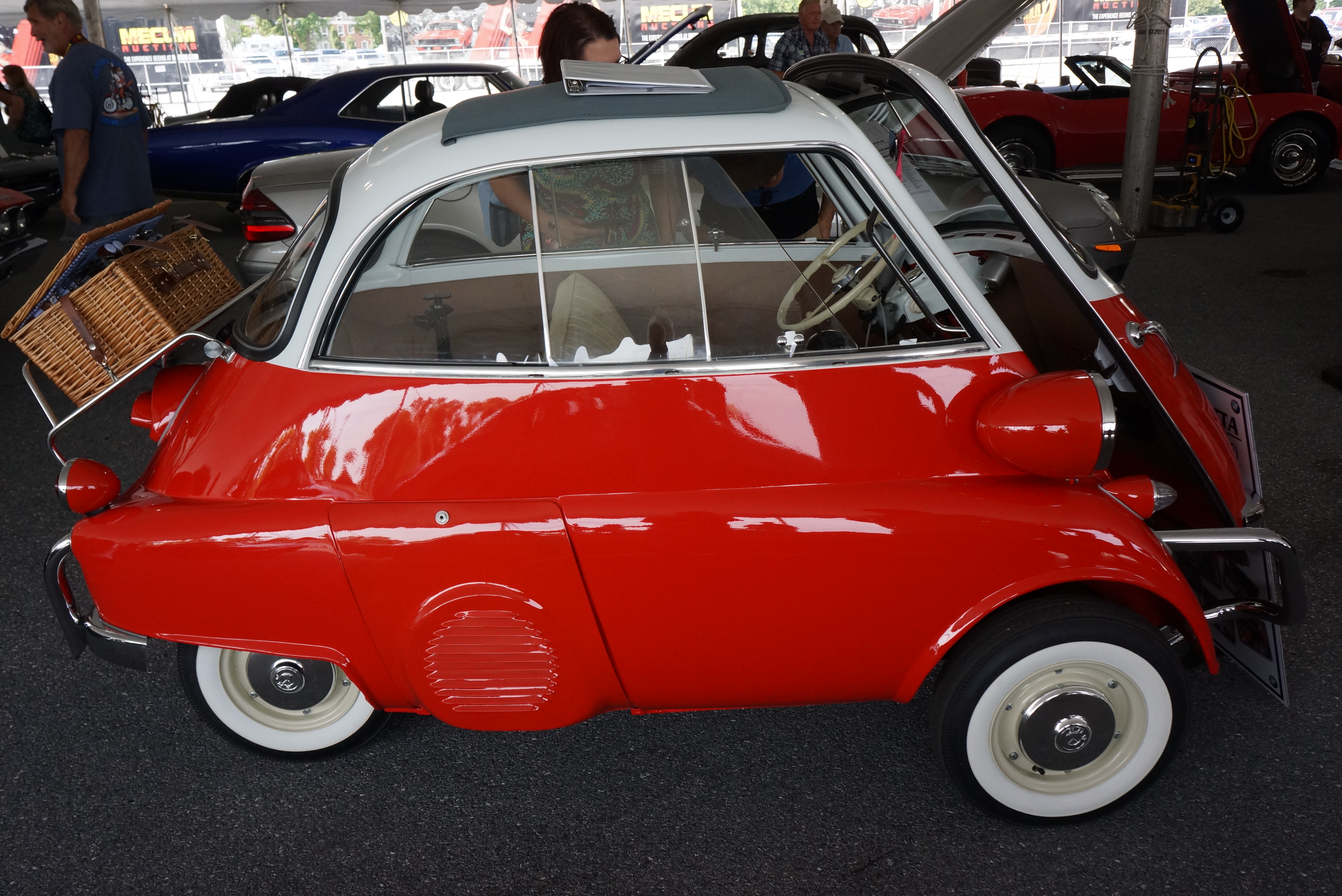
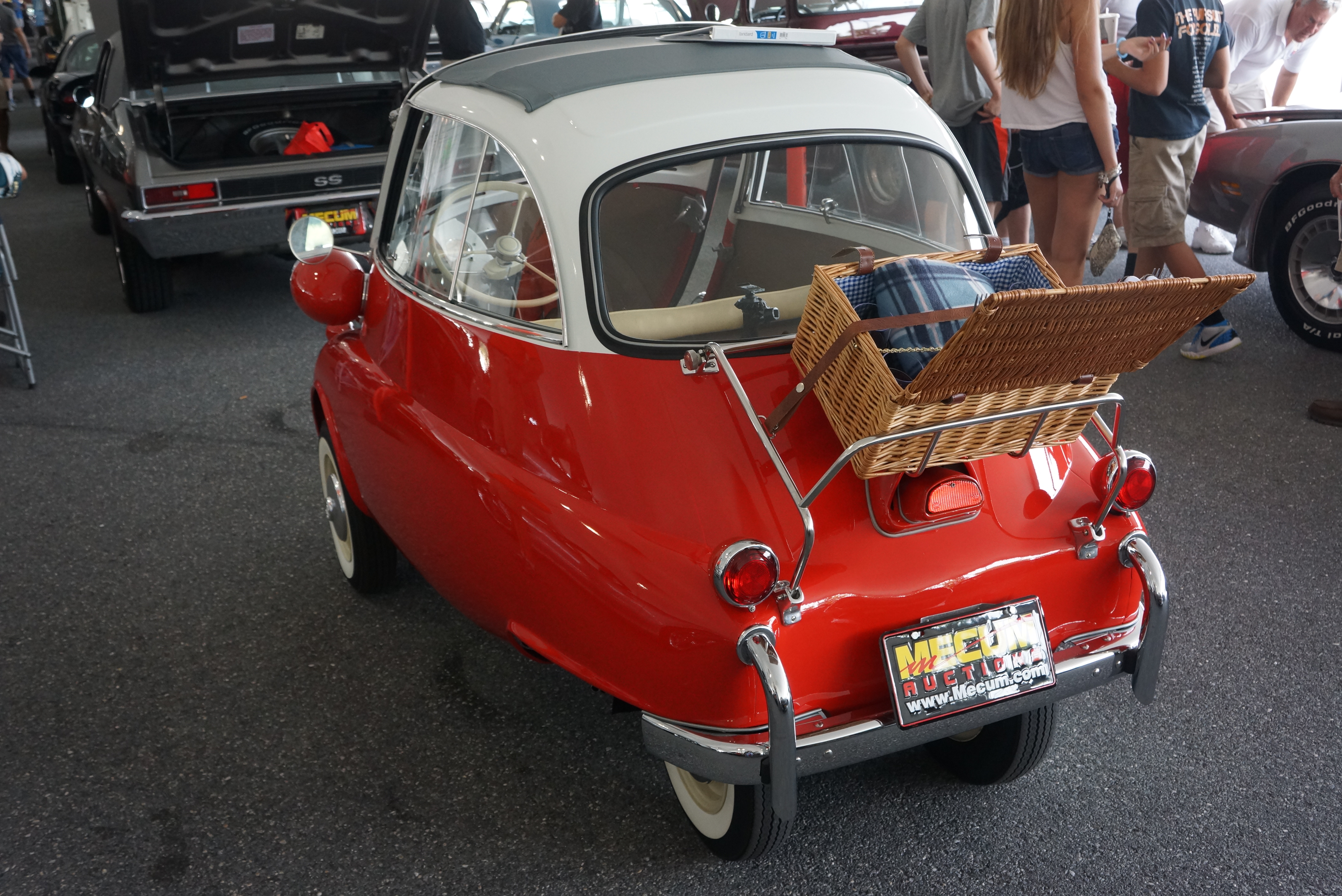
LOT F215, 1957 BMW ISETTA
Condition estimate: 1-
SOLD for $25,000
There’s one at every auction – this one was in the frequently-seen two-tone combo of red and white. It appeared somewhat over-restored, save for some orange peel on the door. I spoke to the owner, who acknowledged that he might be out of his element with this audience, then confided in me that he needed to get $30k for it. I guess Dana changed his mind, because the hammer dropped $5k light.
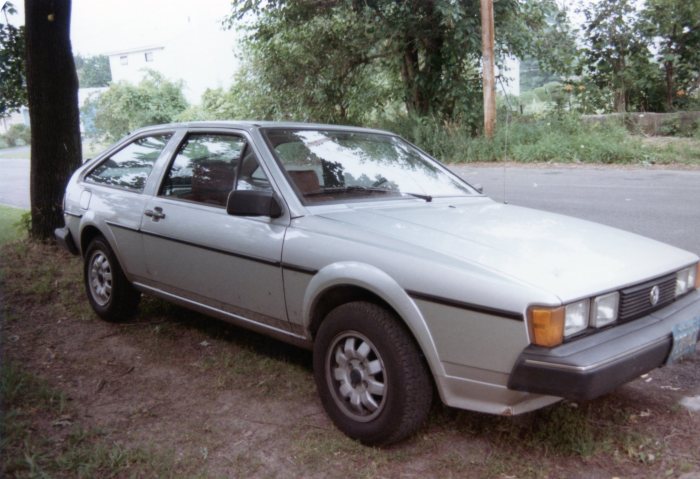
Most disconcerting were the rust bubbles forming at the base of the windshield pillars. The upholstery was starting to wear, and oil consumption was rising. It was around this time that I began to think about a replacement vehicle, and another new Volkswagen was at the top of the list. The Scirocco had always been appealing, but the 1st generation car was tight inside, especially in the all-important hatchback area. The ability to carry my drum set was a top priority. Sometime in 1981 I learned that the Scirocco would be restyled for the 1982 model year.
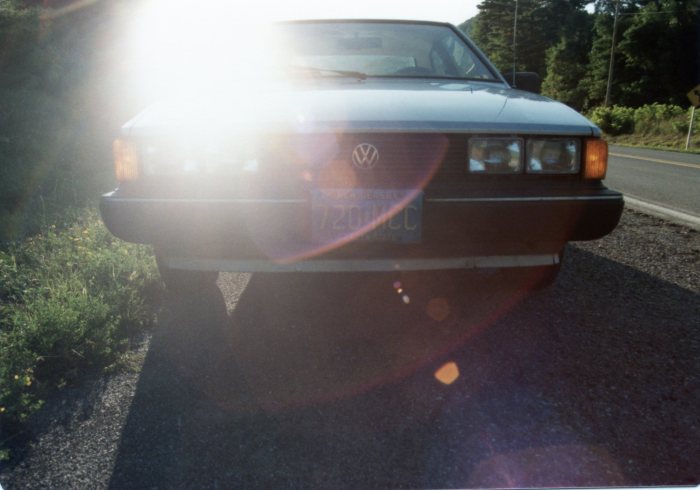
My attempt at an artsy Scirocco shot.
In December 1981 I visited Douglas VW in Summit NJ, which was about a mile from the Volvo dealer where I was employed. They had the new Scirocco on the showroom floor, and I was smitten. Admittedly, the exterior styling was a letdown compared to the previous version, but the interior more than compensated for this. The dash, sport seats, upholstery, and ample trunk space were all factors in its favor.
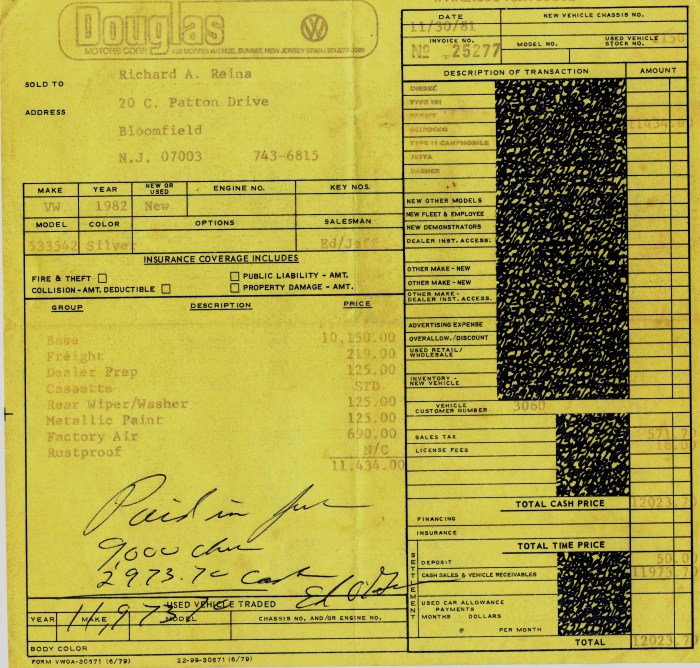
The all-important sales order; seems cheap now, but not in 1981.
Then I looked at the Monroney label. This new car stickered for over $10,000. It seemed like yesterday that I paid $3,599 for the Rabbit! The sticker shock was the result of rampant inflation, as well as a long list of standard and optional equipment which was not on the Rabbit: factory air, AM/FM/cassette radio, alloy wheels, rear wiper, and metallic paint. The Scirocco was a 5-speed, while the Rabbit made do with four, so I also expected fuel mileage to be a tick better.
After test driving the vehicle, I selected a car in stock with silver paint and a red plaid cloth interior. The Rabbit was sold for $1,000 to one of the techs at the Volvo dealership. My car insurance at the time was with Allstate, and they had sent me blurbs that they financed new car purchases, so I “conveniently” (and blindly) arranged a car loan with them.
It’s not clean, but I was on a road trip.
Shock #2: the interest on the loan was 18%! Yes, I was in the car business; no, I was not savvy in the ways of new car purchases. Nevertheless, I wanted this car badly, so I plowed ahead and made the monthly payments.
Compared to the Rabbit, there was much to like. As mentioned above, the interior was especially plush. The sport seats fit me wonderfully. This car, lower than the Rabbit, handled better. I had A/C for the first time since the 1966 Buick. However, several design features did not put VW in the best light, and it took driving in the elements to discover this.
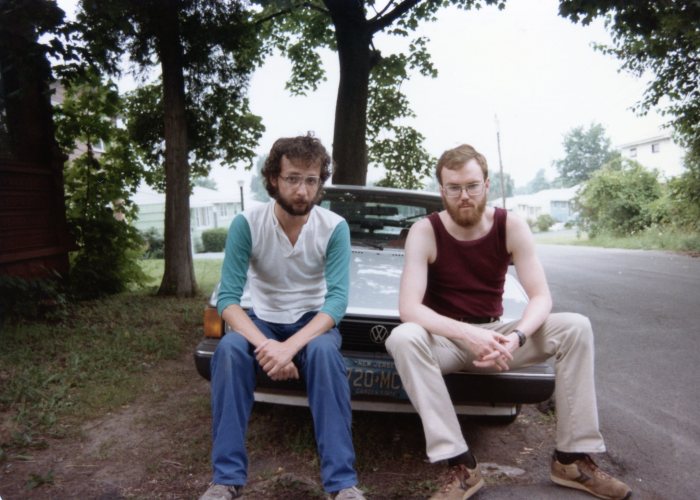
That’s me on the left, visiting college roommate Eric, summer ’84. Beards were in.
First, the front wiper. Yes, singular. The ’82 Scirocco had a single wiper, likely as a styling statement. It looked cool, but didn’t work well. As is the standard for left-hand-drive cars, the wiper parked on the passenger side, and wiped up and toward the left side of the car. The single blade’s tip would reach the middle of the left A-pillar, and would leave two large triangles unwiped in the driver’s line of sight. Several model years later, VW went back to two front wipers on the Scirocco. (Mercedes-Benz would solve this problem with an articulating wiper.)
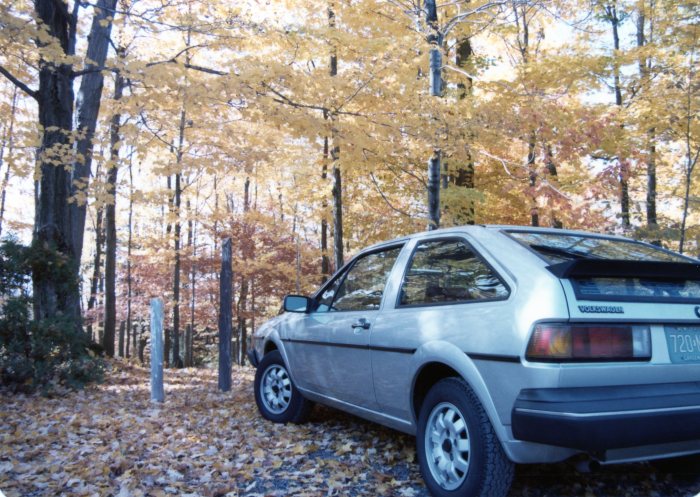
Another artistic angle, this time with fall foliage.
The other issue was the standard rear spoiler, which sat several inches above the lower edge of the hatch glass. In the winter, this spoiler served as a catch for snow. Although the car had a rear wiper, it couldn’t remove the snow that piled up on the spoiler. If I were driving while it was snowing, the backlite would eventually become covered. My solution was to unbolt the rear spoiler for winter driving.
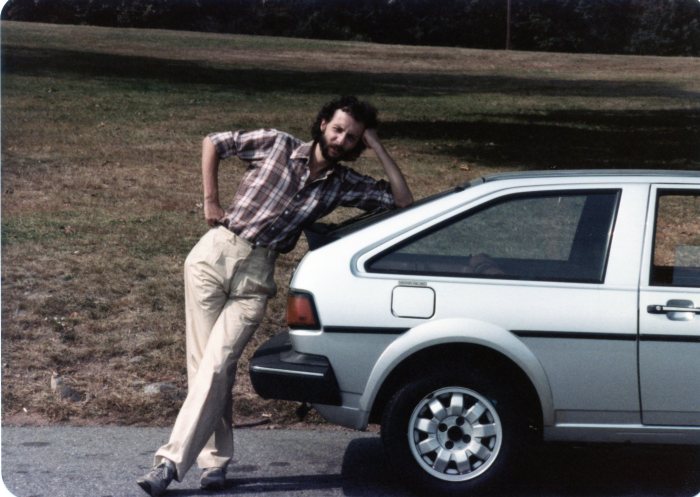
My excuse is, the photographer asked me to pose like this.
Other than these issues, this VW was as reliable as the first one. By 1986, there were over 100,000 miles on it, and I was ready for a replacement, but wanted to save money by buying something used this time. The Scirocco was advertised locally and sold to a young woman. I could not have known that it would be twenty years before I would again step into a new car dealership and purchase or lease a brand new car.
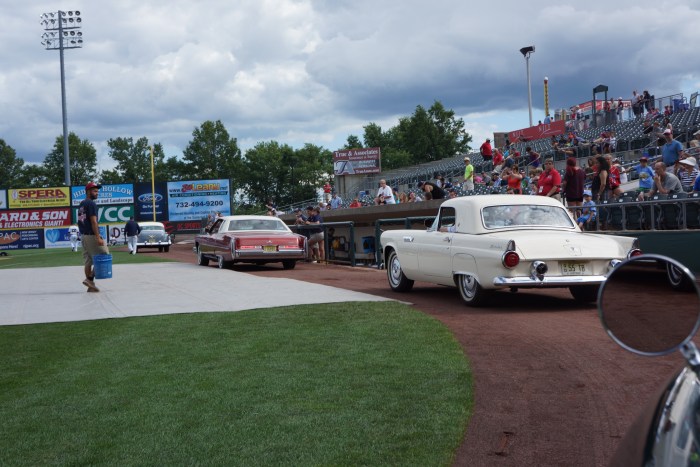
Display cars in the parking lot, with TD Bank Ballpark in the backgroud
Friday, July 8, 2016 was Collector Car Appreciation Day in the U.S., the seventh year in a row that such a date was recognized. The date was designated as per a U.S. Senate resolution which was passed with the support of various auto hobby lobbying groups, most notably SEMA (Specialty Equipment Market Association).
As part of this celebration, the New Jersey Region of the AACA (Antique Automobile Club of America) co-sponsored a car show held in the parking lot of the TD Bank Ballpark, the home stadium in Bridgewater NJ for the Somerset Patriots baseball team. This show was held on Sunday, July 10, 2016.
Another view of the cars on display.
Turnout among NJ AACA members was impressive, with 20 cars from the club on display. The Street Dreams Car Club had also been invited to participate. Their cars and trucks leaned toward newer and /or modified, but not exclusively so. In total, there were close to 50 vehicles in the show. Ballpark employees roped and coned off a section of the lot, allowing us to park together, and game spectators meandered the aisles, enjoying the vehicular variety.
The Street Dreams club cars were mostly at the other end of the lot.
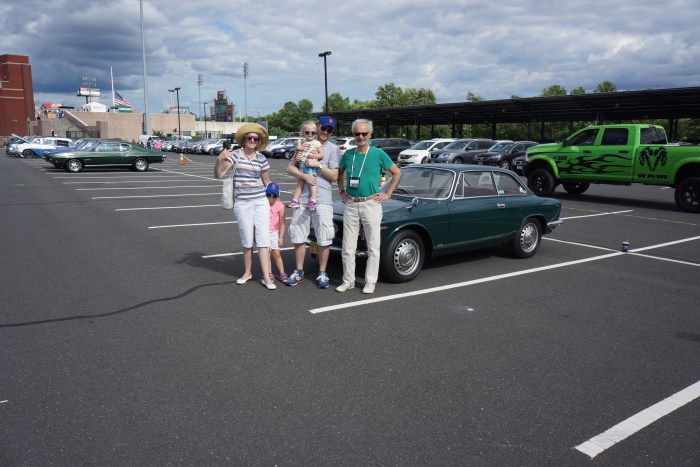
The parking lot show started at 3pm, and the ball game was scheduled to begin at 5pm. Around 4 o’clock, word went out that we all should start our cars and get into a queue near the back of the lot. A large gate swung open, and every show car was allowed to drive one parade lap completely around the field’s warning track. This Alfa Romeo owner had his wife, step-son, and two granddaughters in the car (FIVE occupants, a world record), and we thoroughly enjoyed the chance to see the ballpark from the vantage point of a vintage automobile.
A true family affair. Yes, we all fit into the little Italian job.
At the conclusion of the parade lap, we all returned to the parking lot, and most of us entered the stadium to enjoy a little baseball. This was the first time that the NJ AACA helped conduct such an event, and I understand that the club has already decided to make this an annual occurrence.
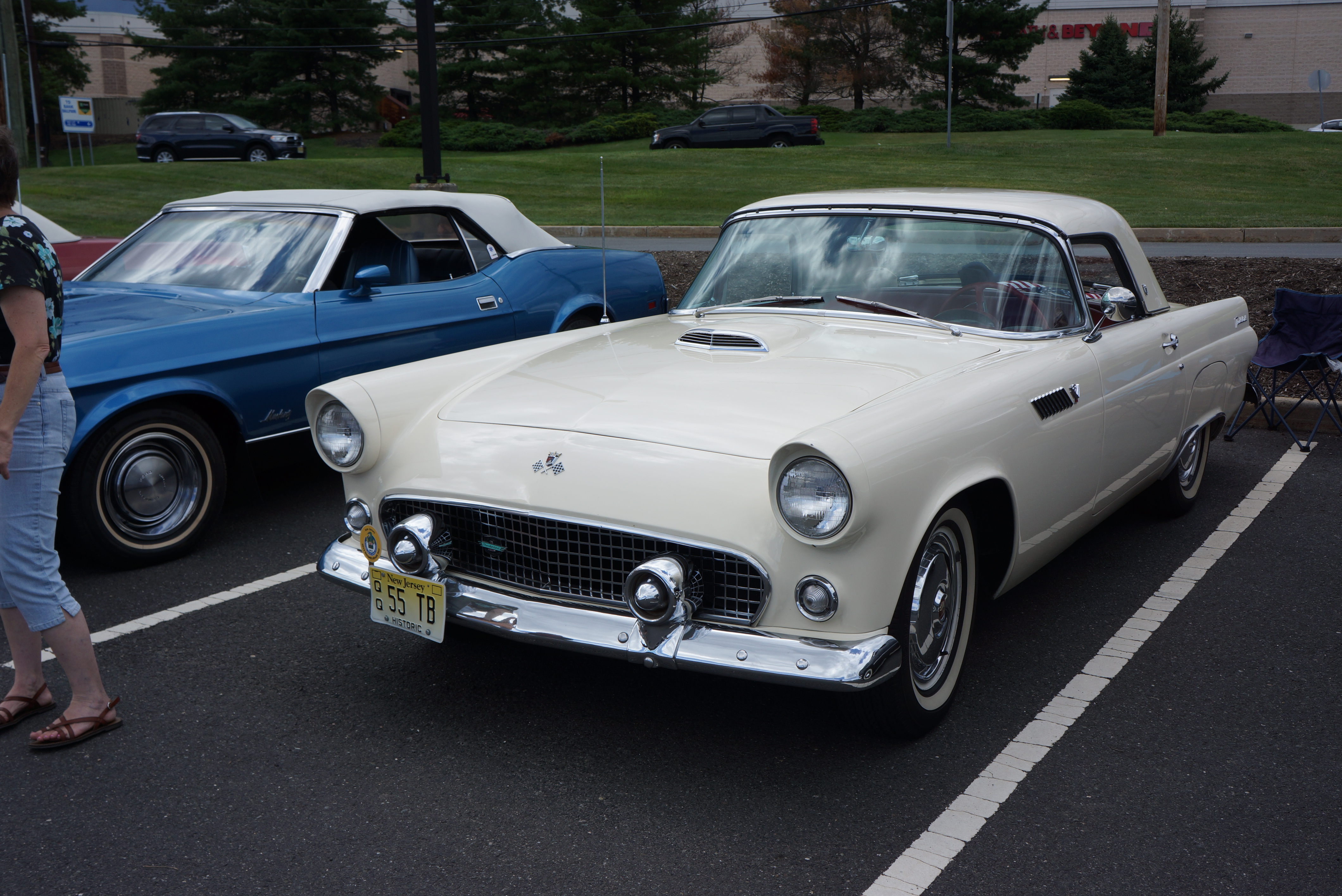
A ’55 T-Bird, first year of production.
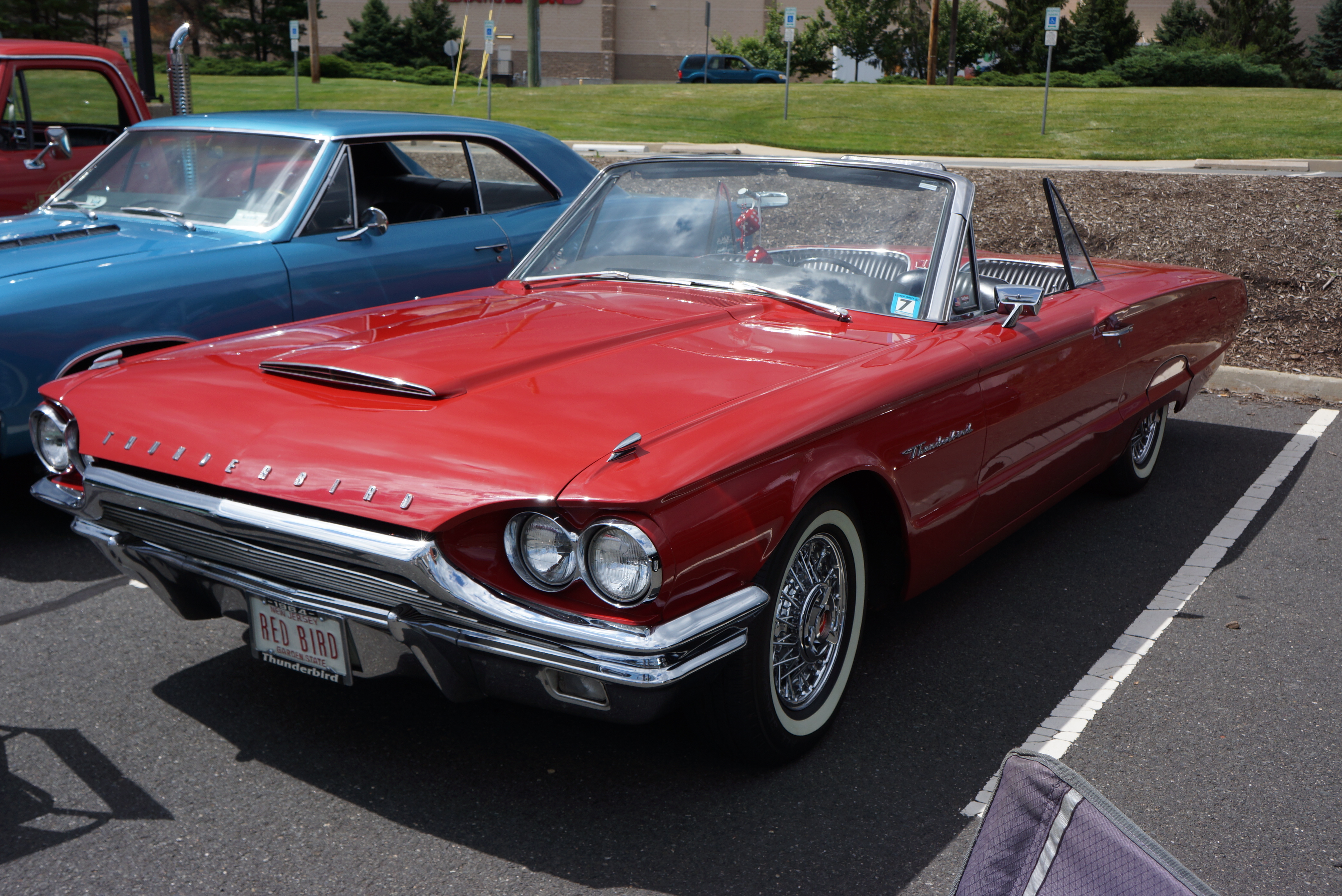
A ’64 T-Bird, one of the last of the so-called collectible Birds.
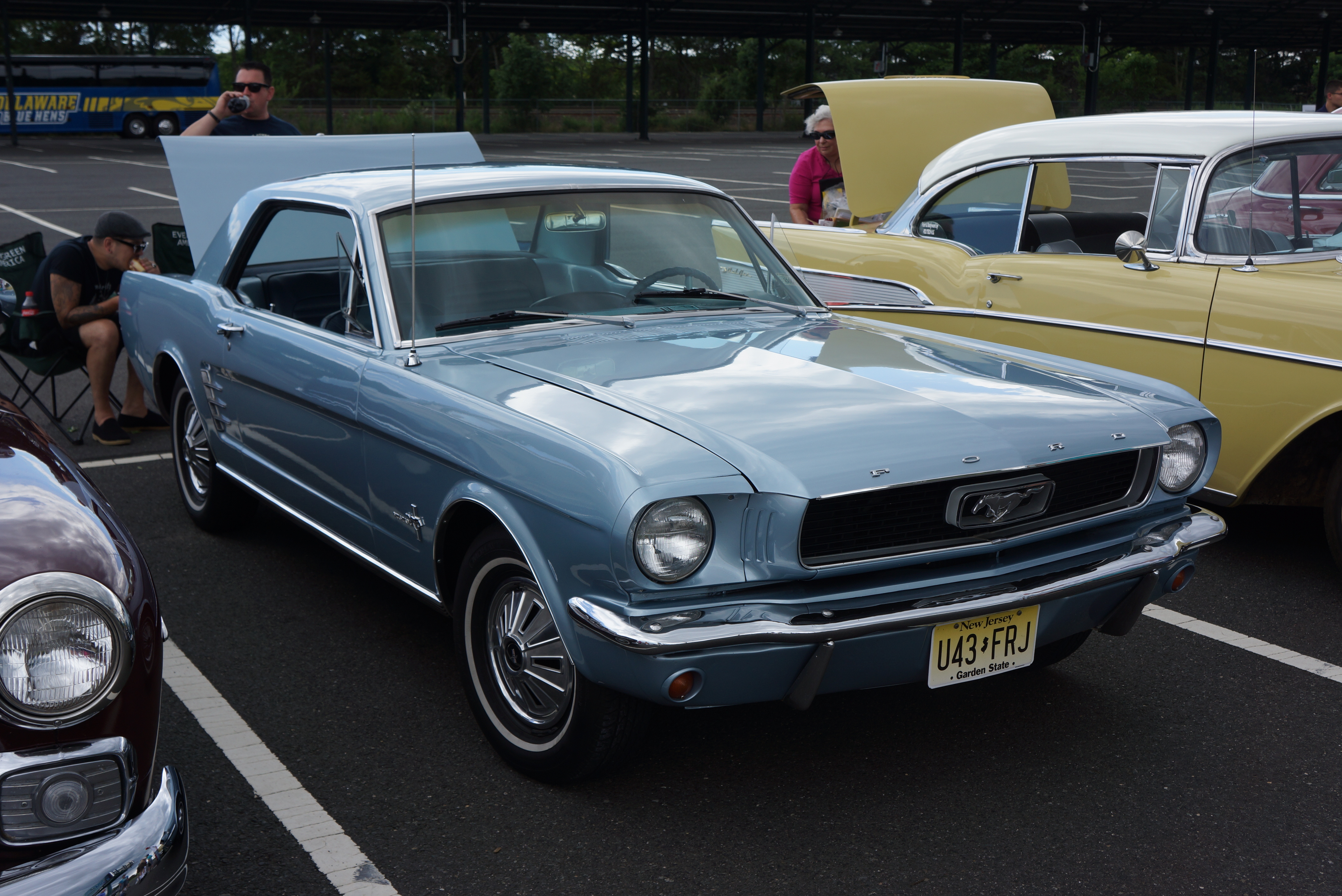
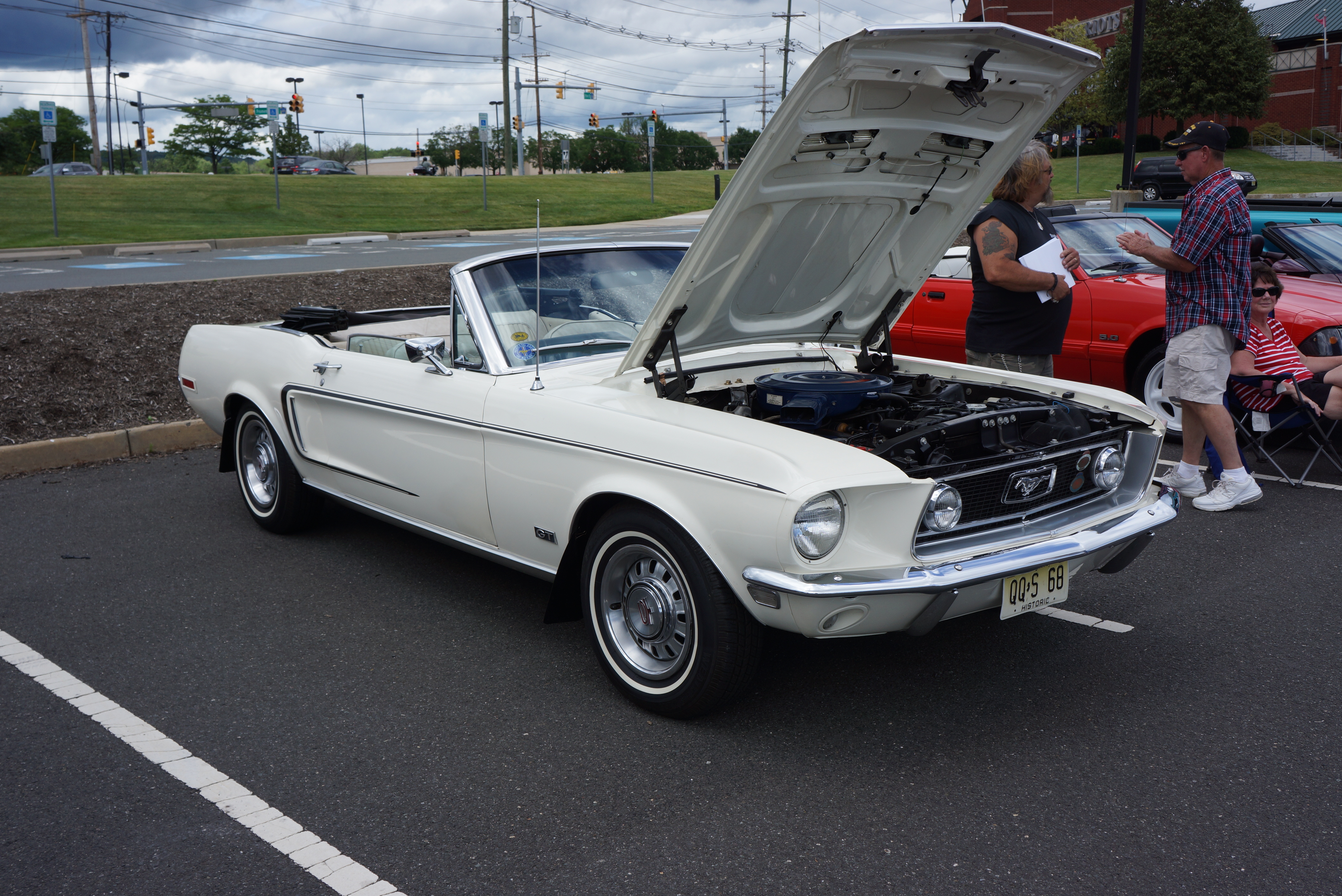
This ’66 Mustang is a 1st generation car.
By 1968, the Mustang’s size grew.
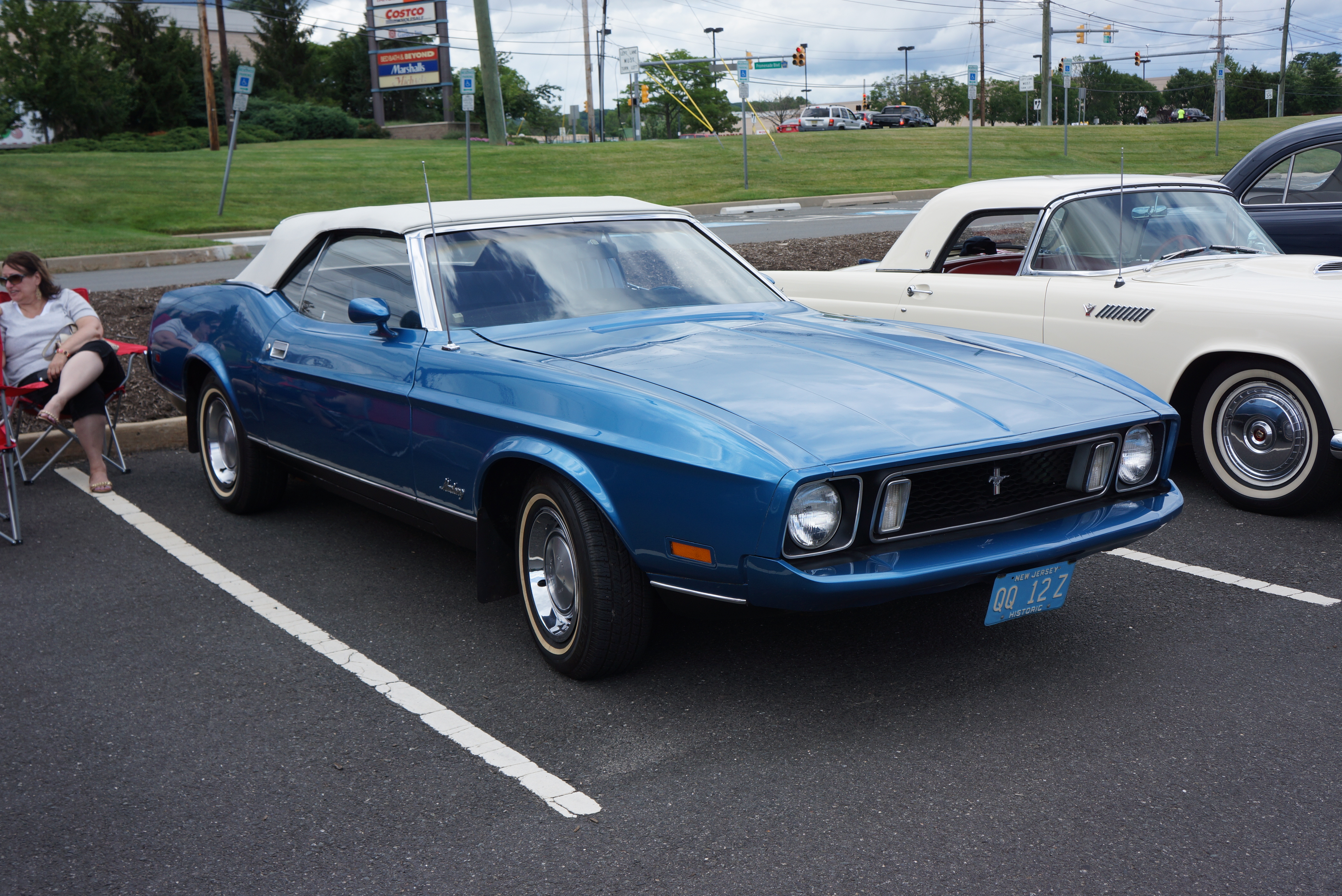
But by ’73, it was yet another size larger.
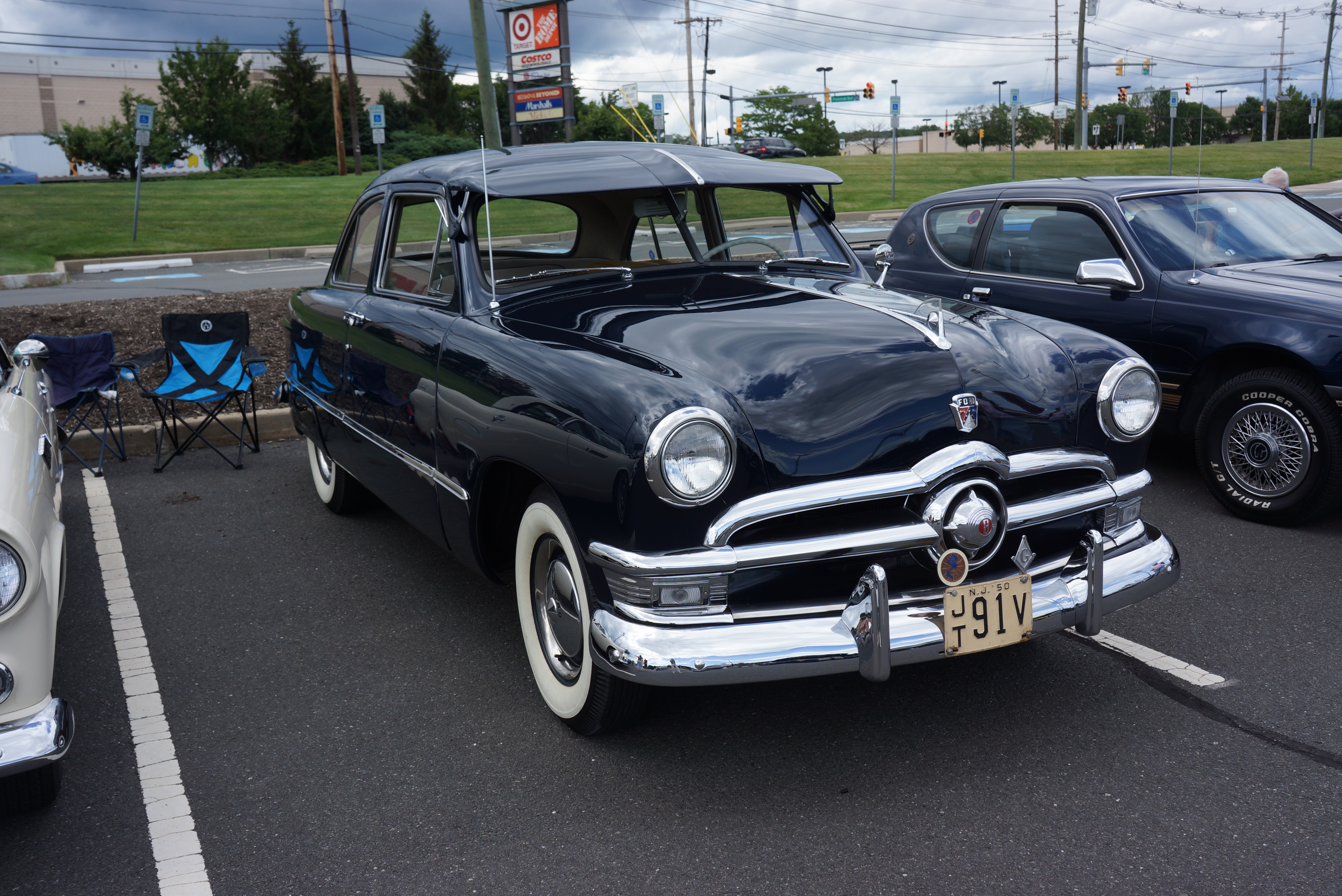
Older FoMoCo cars included this ’50 Ford
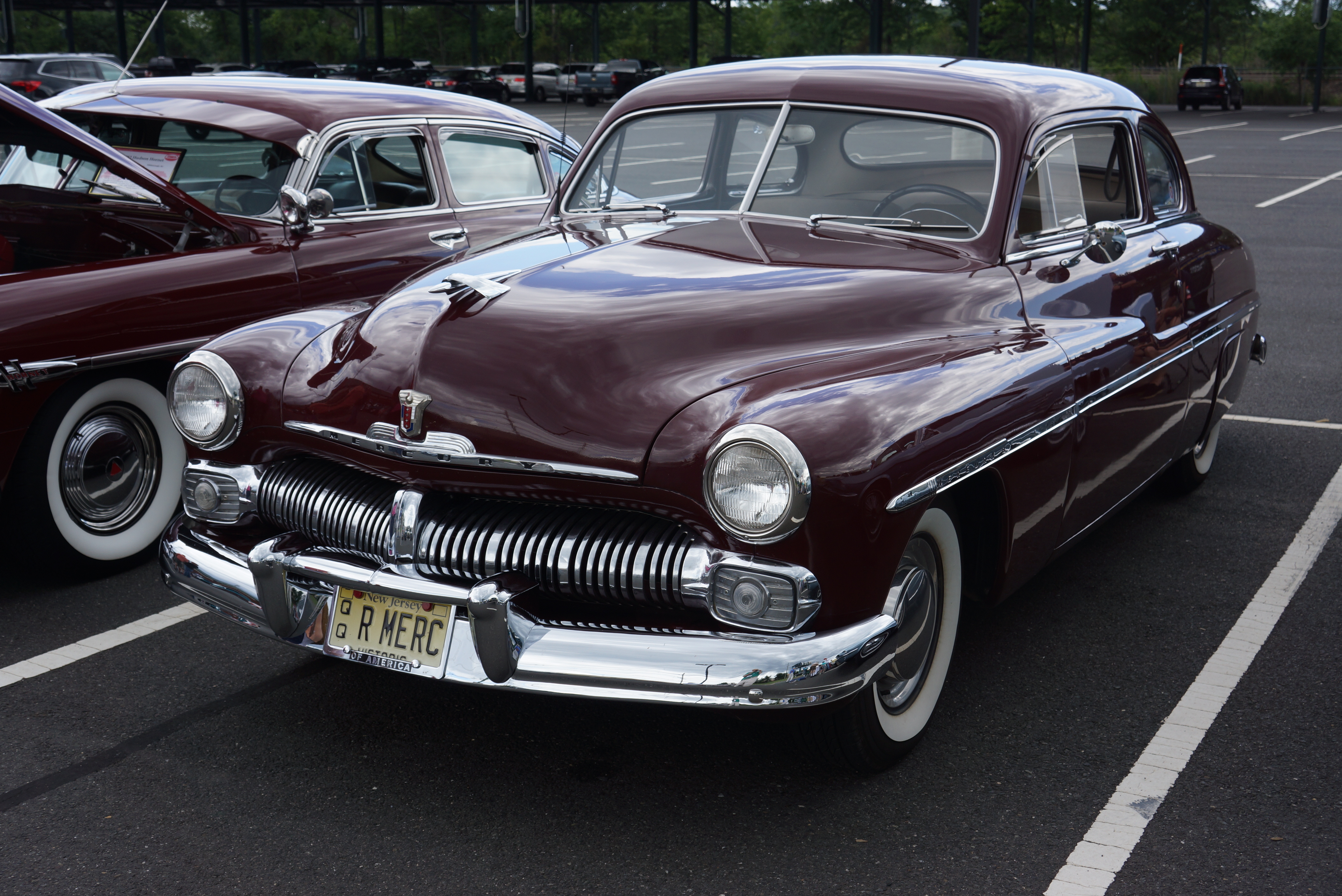
… and this ’50 Mercury.
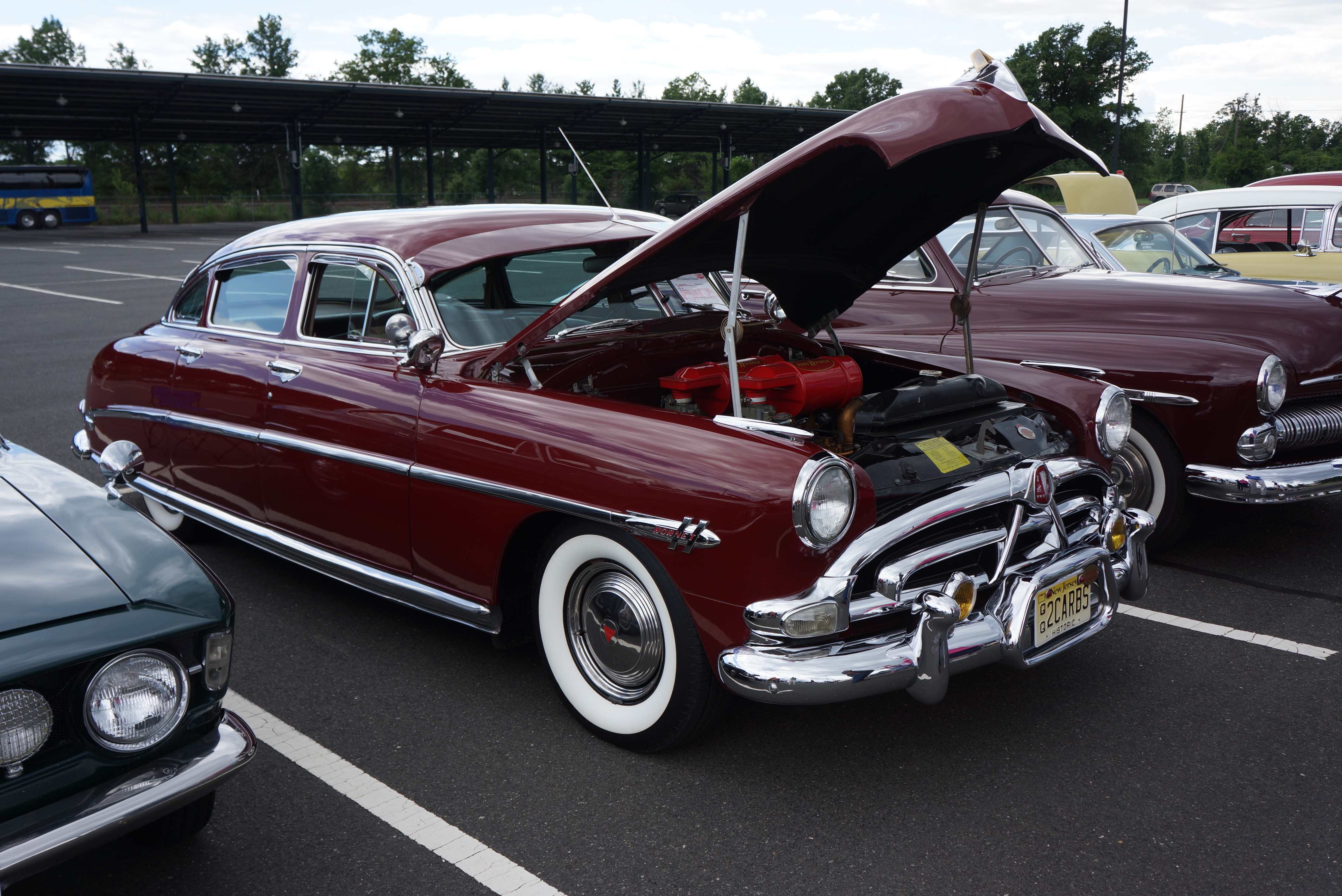
This 1952 Hudson Hornet was immaculate.
Its trunk carried this stylized badge.
The styling similarity between the ’50 Mercury and ’52 Hornet is obvious from the rear.
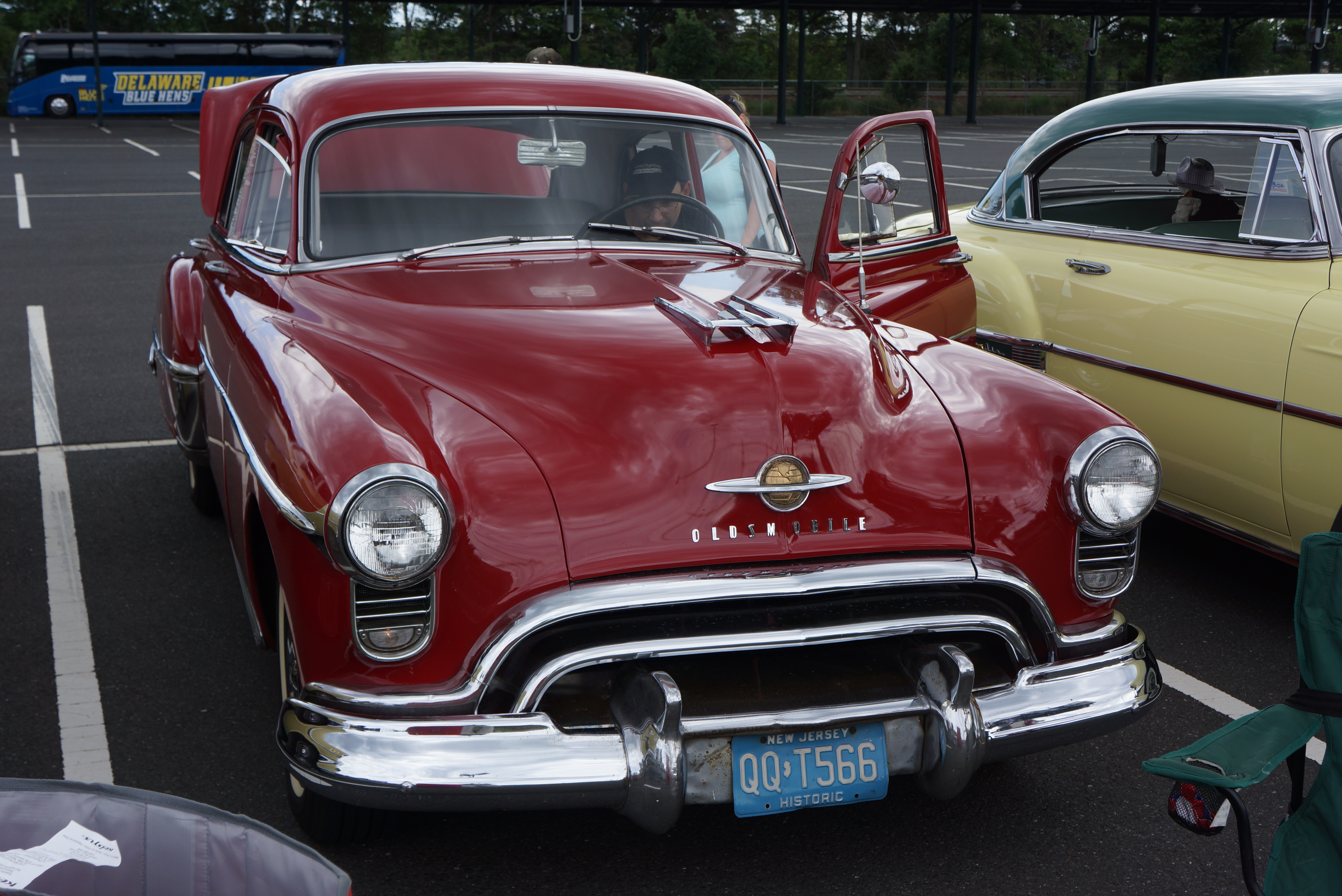
Fifties GM cars included this ’50 Olds,
this 1954 Chevrolet,
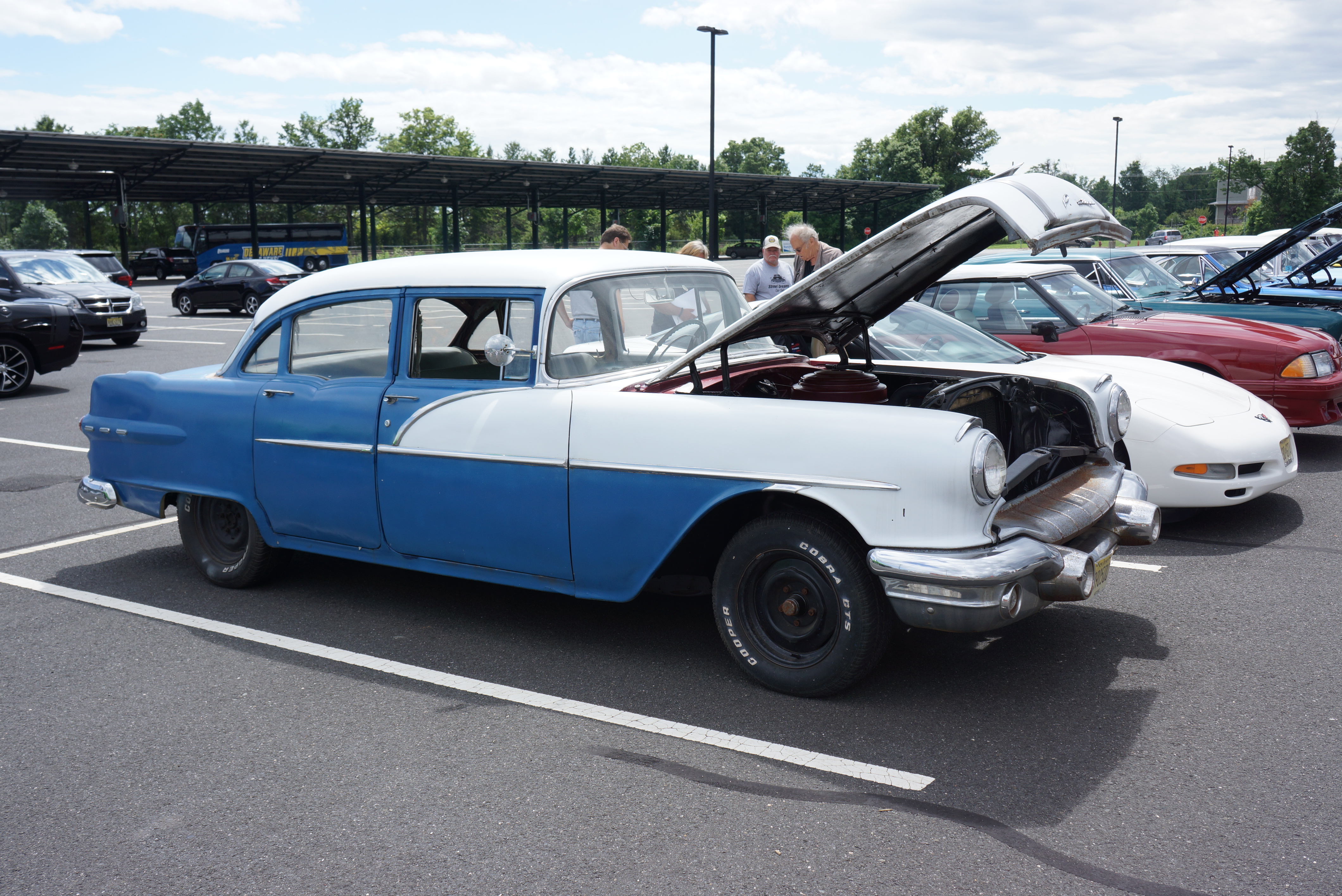
and this unrestored ’56 Pontiac.
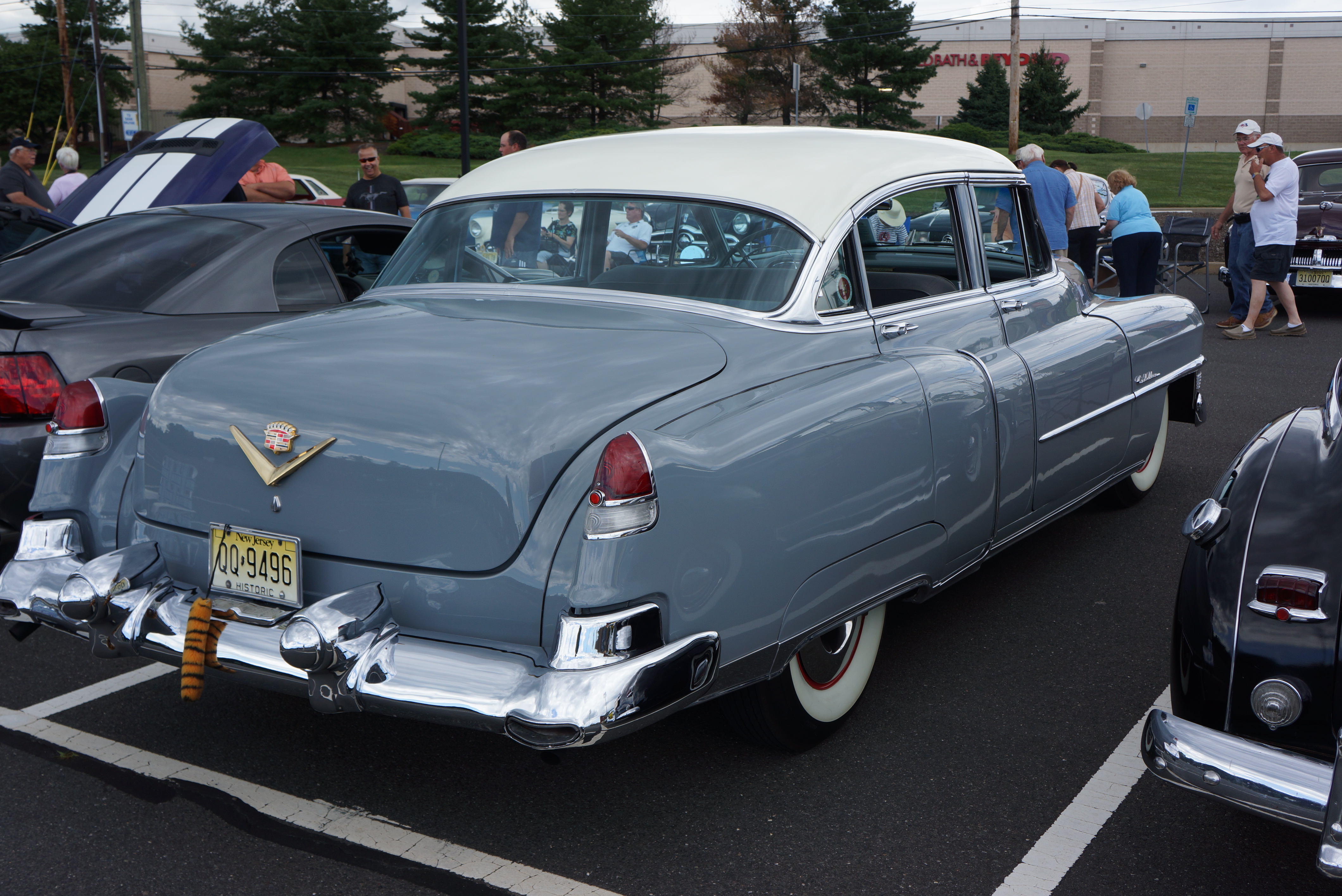
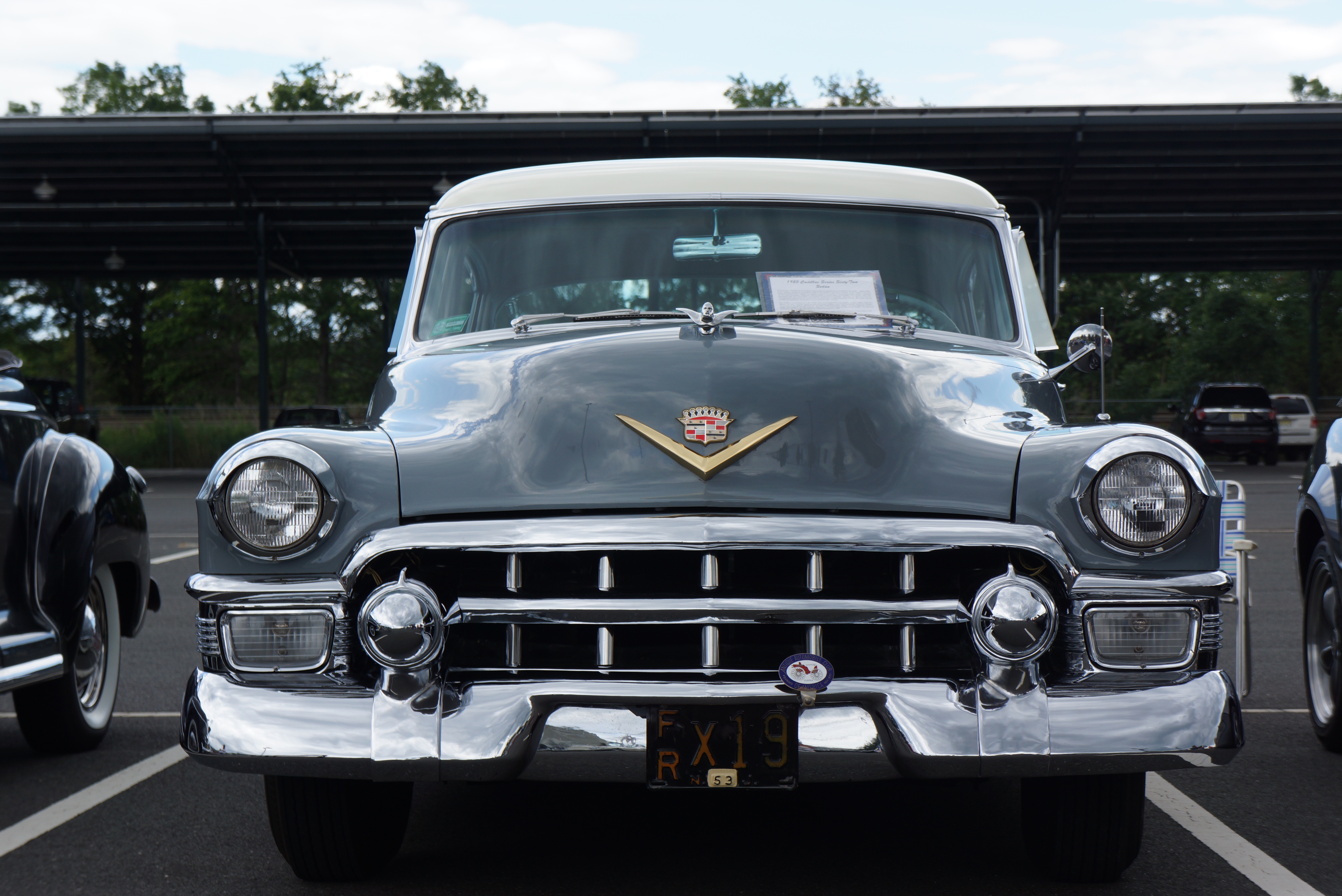
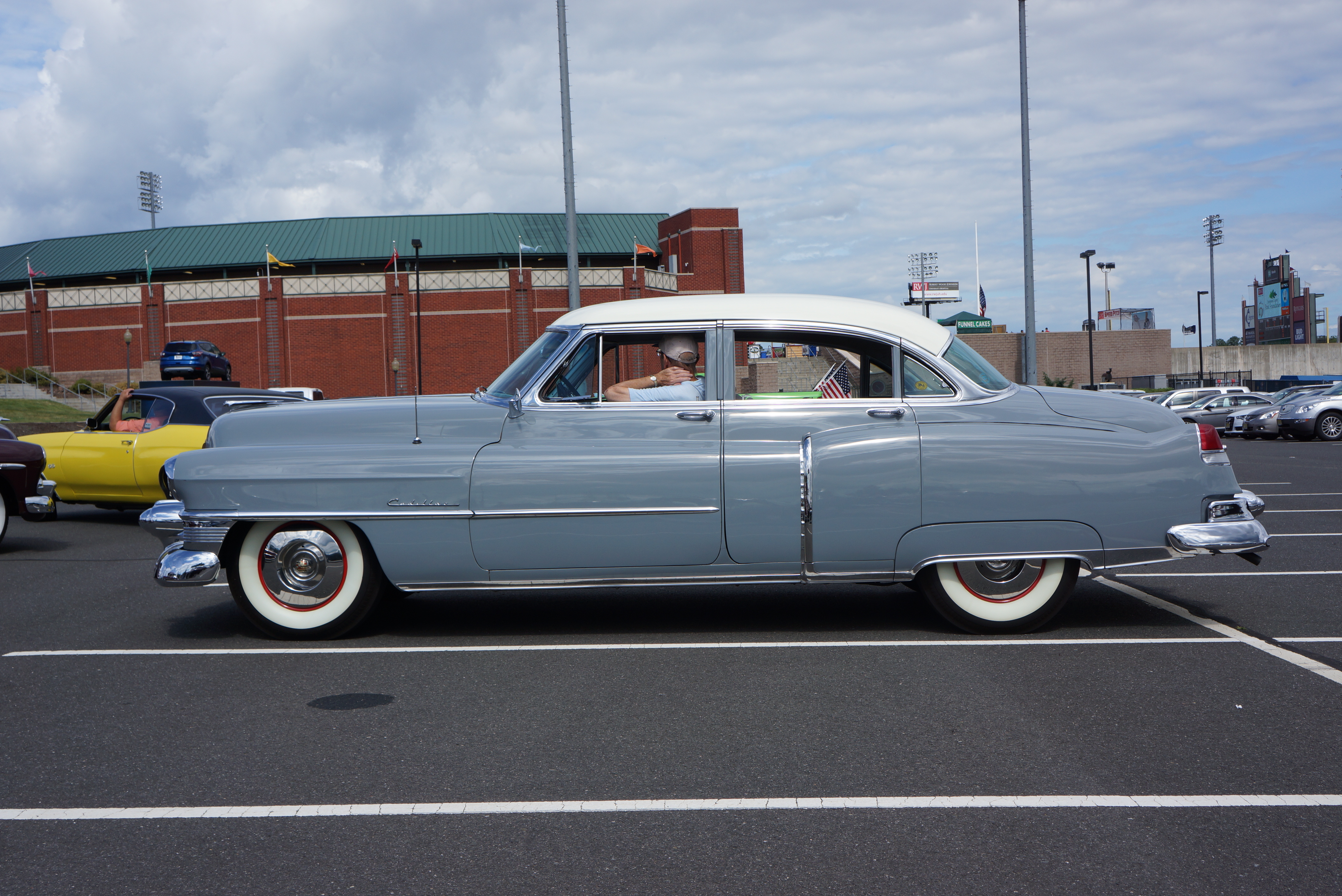
This 53 Cadillac is huge from any angle.
It looks especially wide from the front.
In length, it takes up more than a modern parking spot.
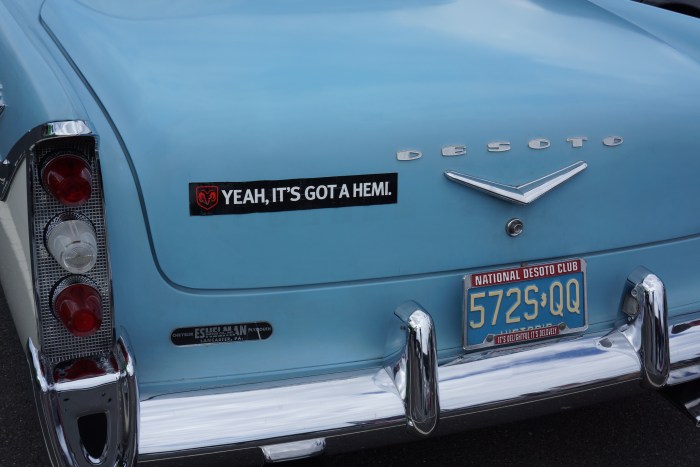
The owner of this ’56 DeSoto has a sense of humor (but it really does have a Hemi).
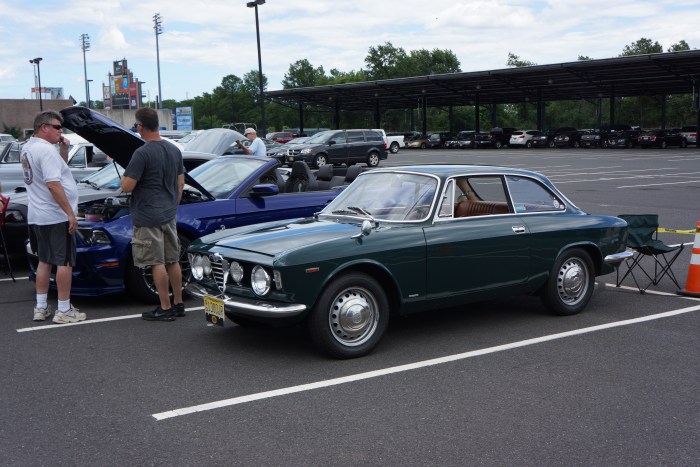
The author’s 1967 Alfa Romeo was the only non-American car in the show.










































































 richardscarblog