The New Jersey Region of the Antique Automobile Club of America (AACA) held its 67th annual Antique Car Show on Sunday May 6, 2018, at the Mennen Arena in Morristown NJ. Yes, you read that correctly. This was the 67th annual show, meaning that the Region began this tradition shortly before I was born. The vast majority of cars at today’s show were manufactured AFTER the premiere event.
NJ Region Pres. Jerry Peck kept on the smiling face
This was the third consecutive year for the show’s “new” location at the Mennen Arena. This was also the third year in the row for show-day weather to be wet and cool. The less I say about the climatic conditions, the more positive this blog post will remain. If there were silver linings, the rain did stop by about 10 a.m., and the dense cloud cover did make for better photographic light.
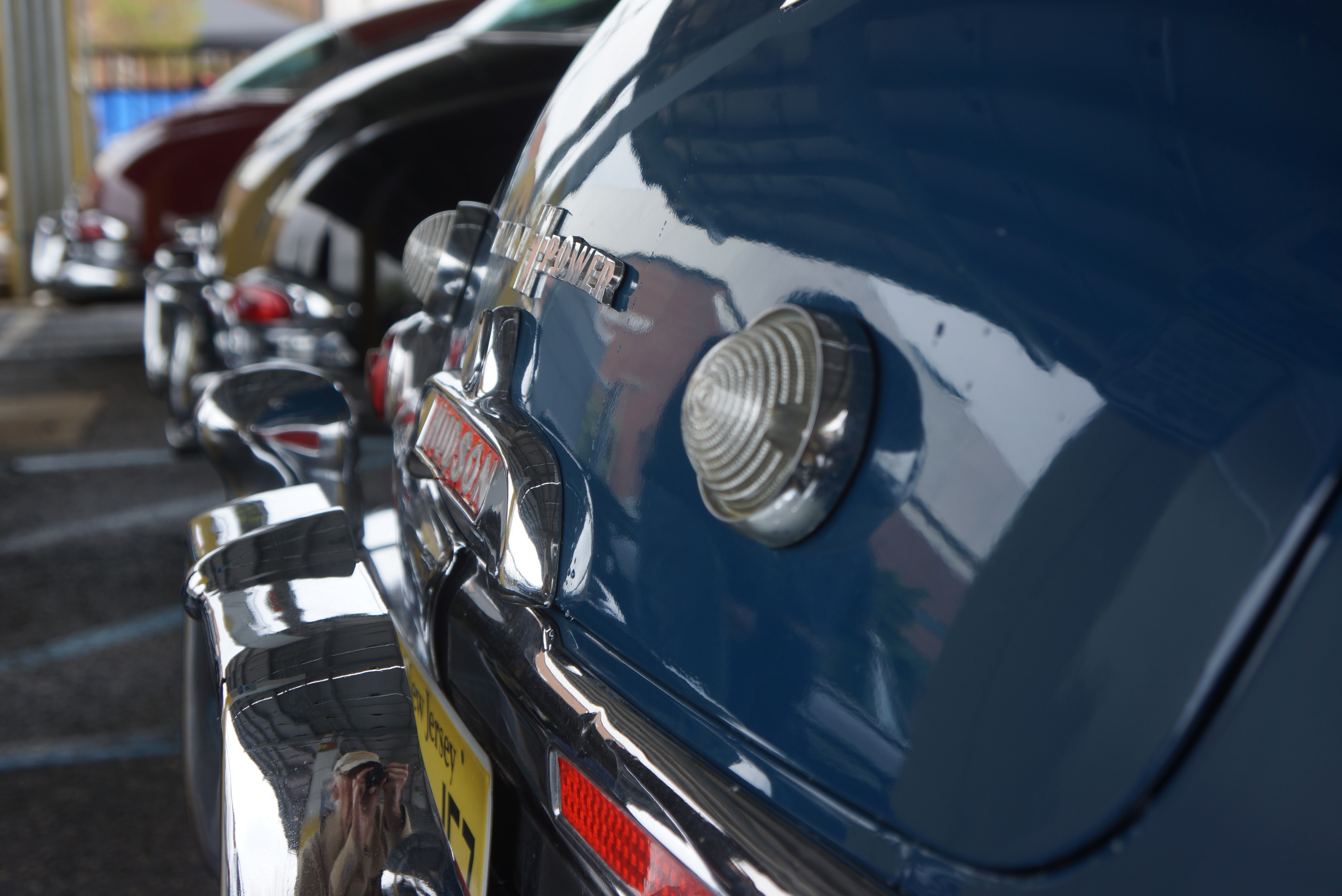
Hudsons front…
For us car guys and gals who can tolerate some dampness, the real disappointment was the reduced vehicle participation. While I didn’t count, I estimate that there were perhaps 50-60 cars on display. Previous years at the old location in Florham Park would net us in excess of 200 show vehicles.
… and rear
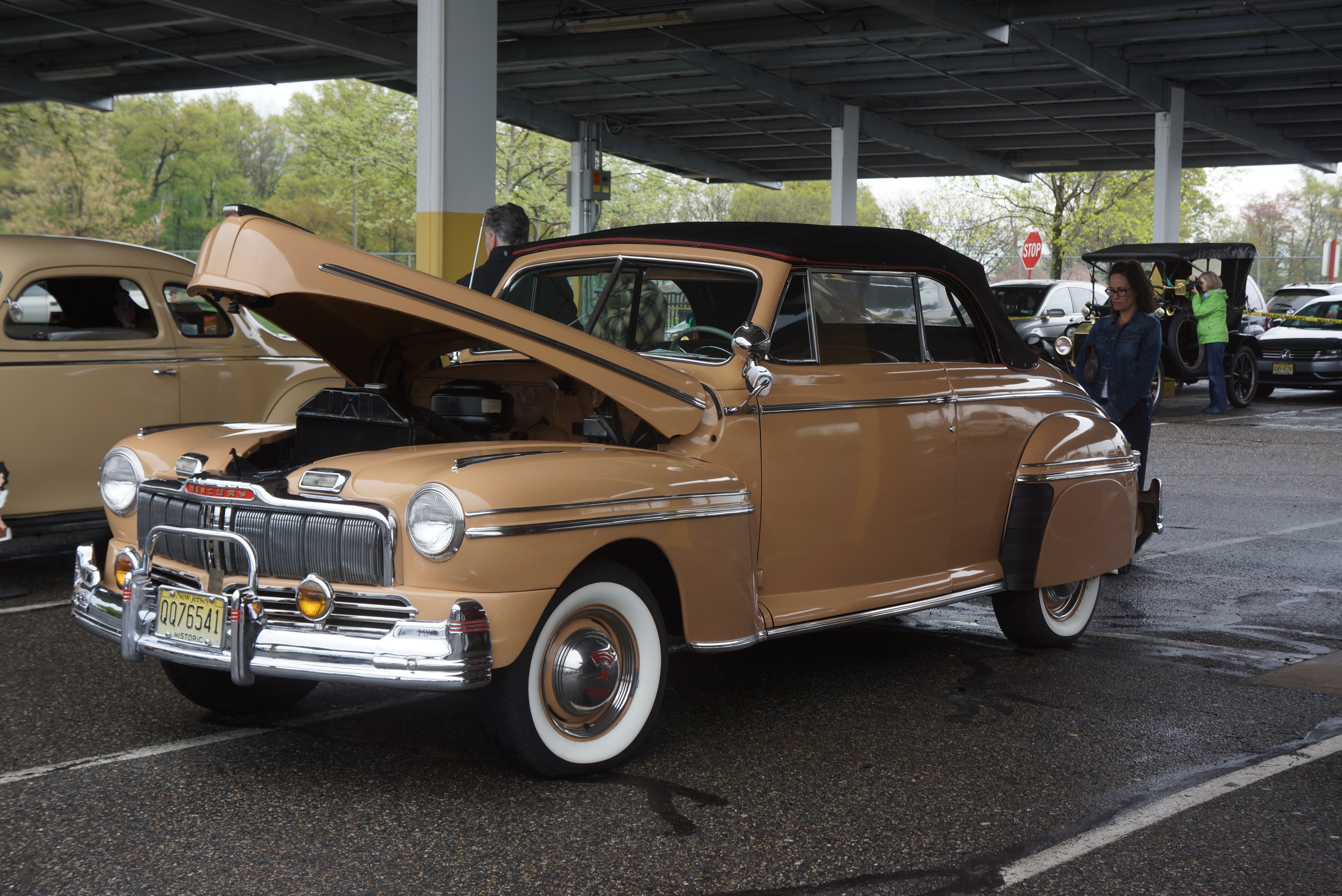
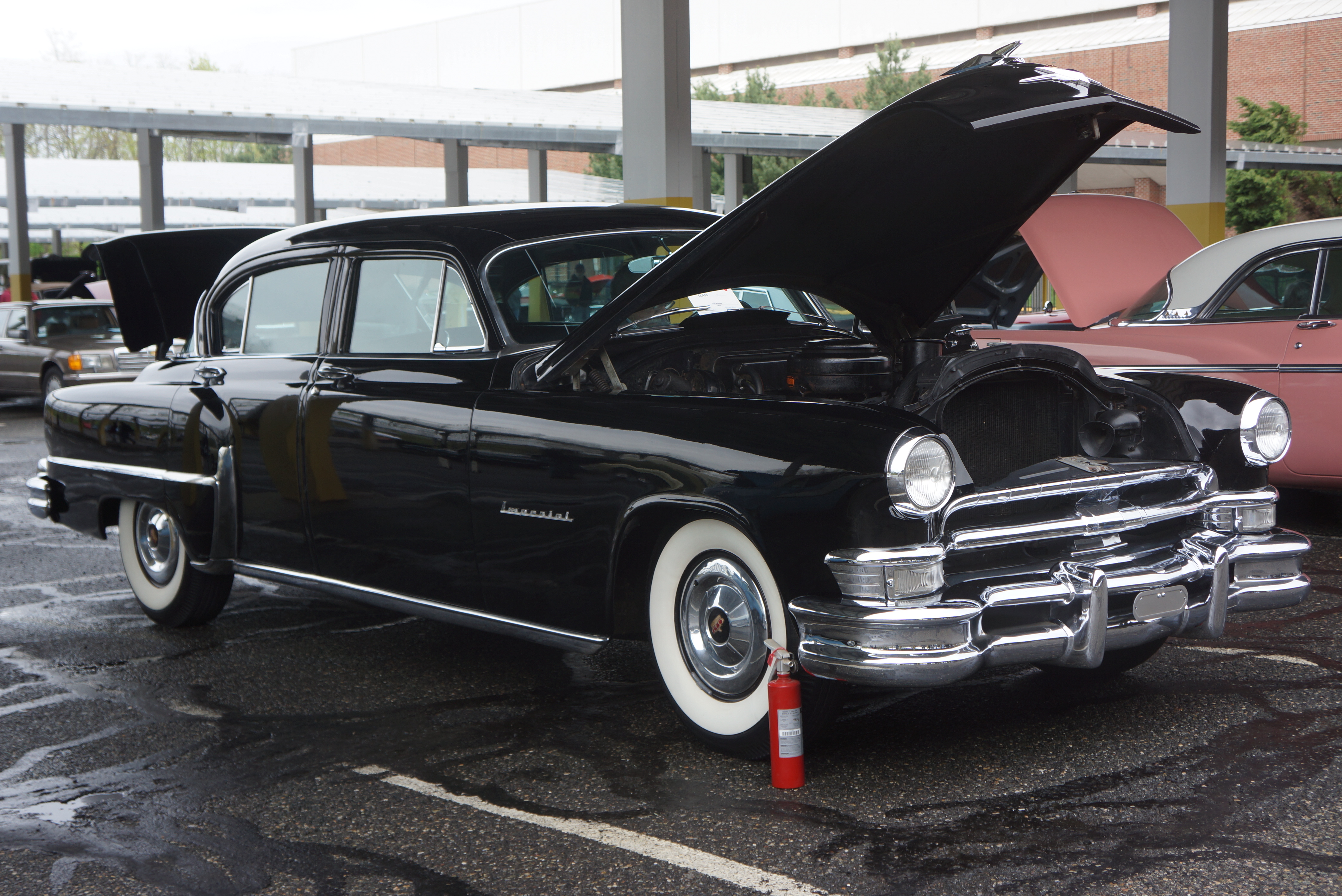
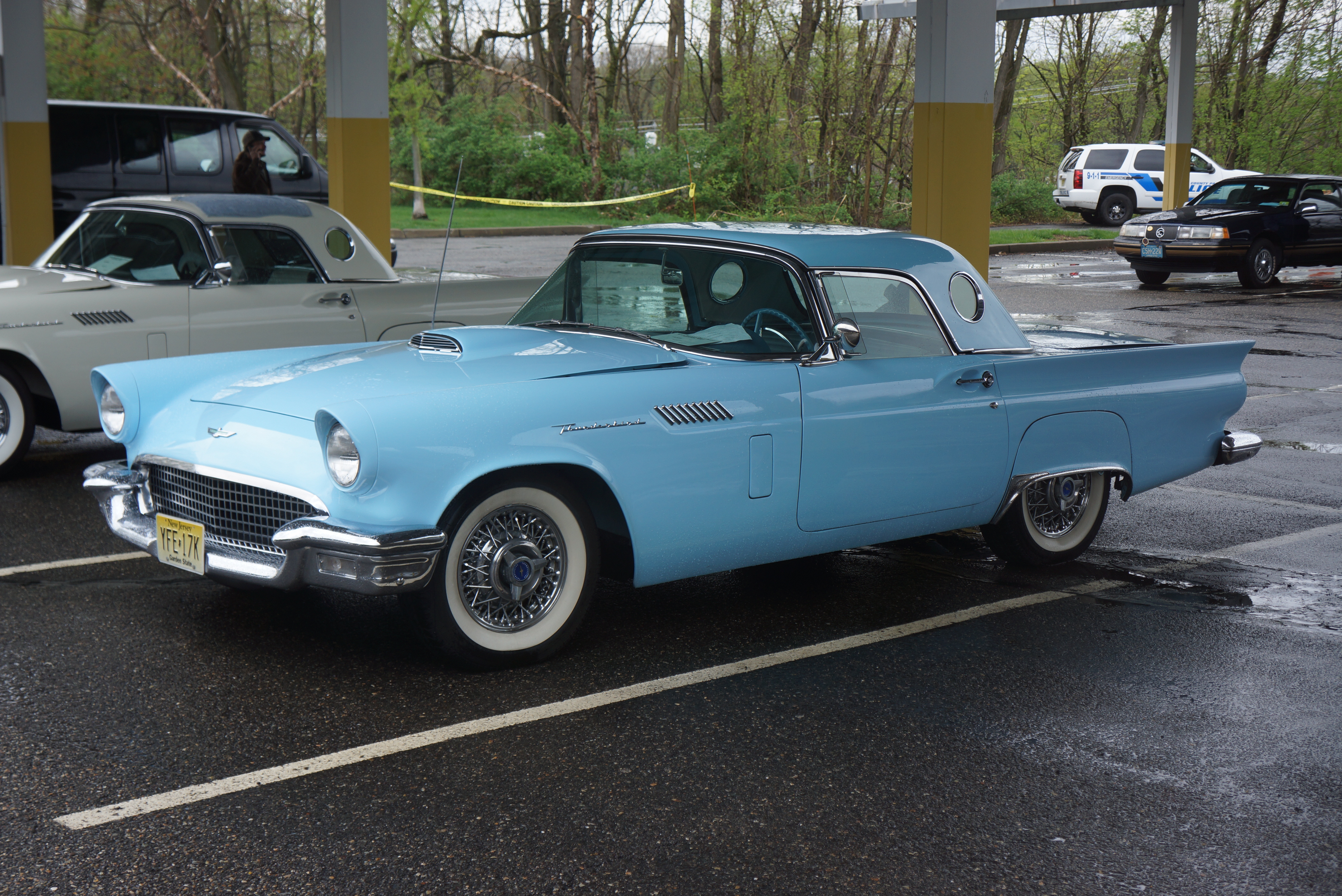
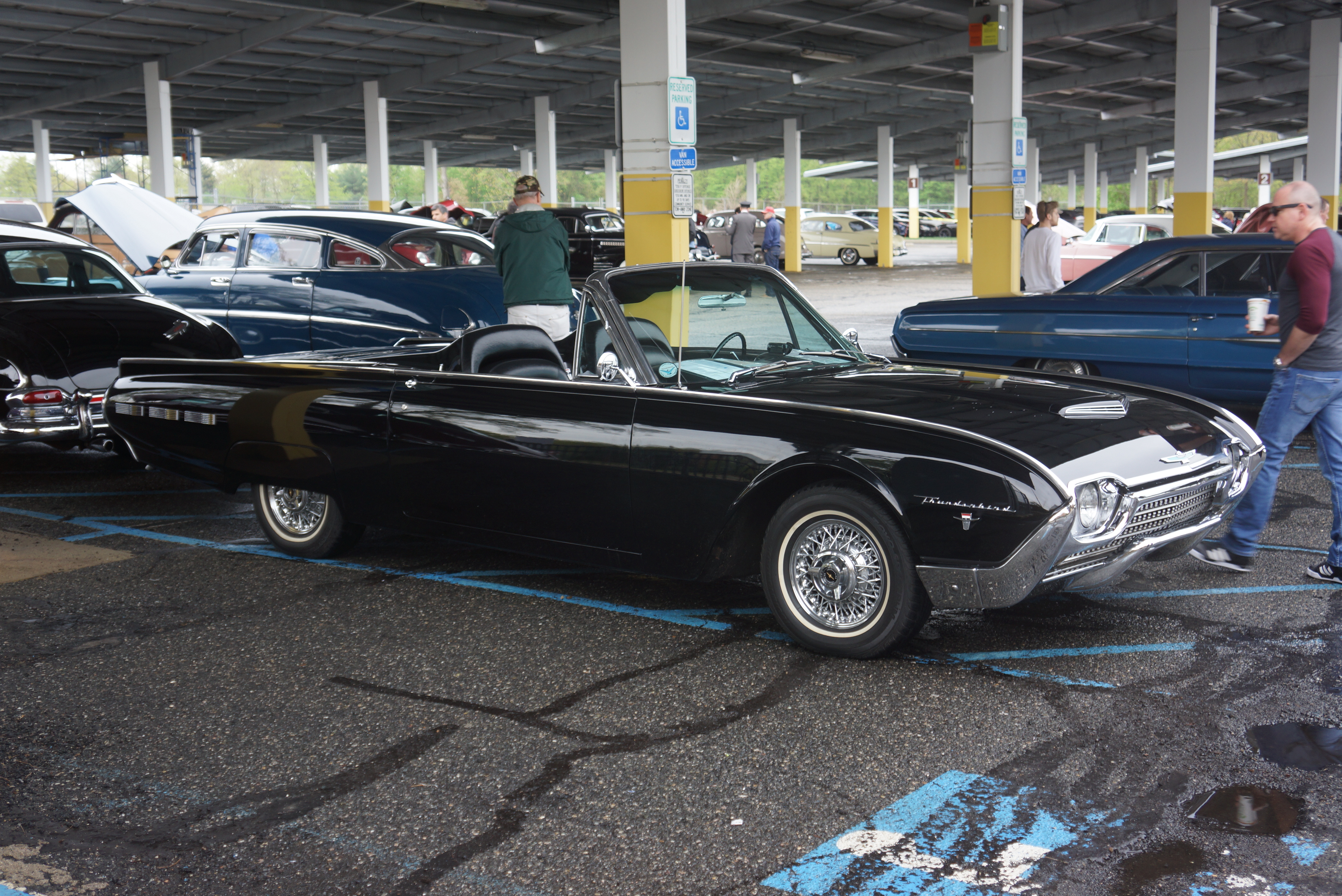
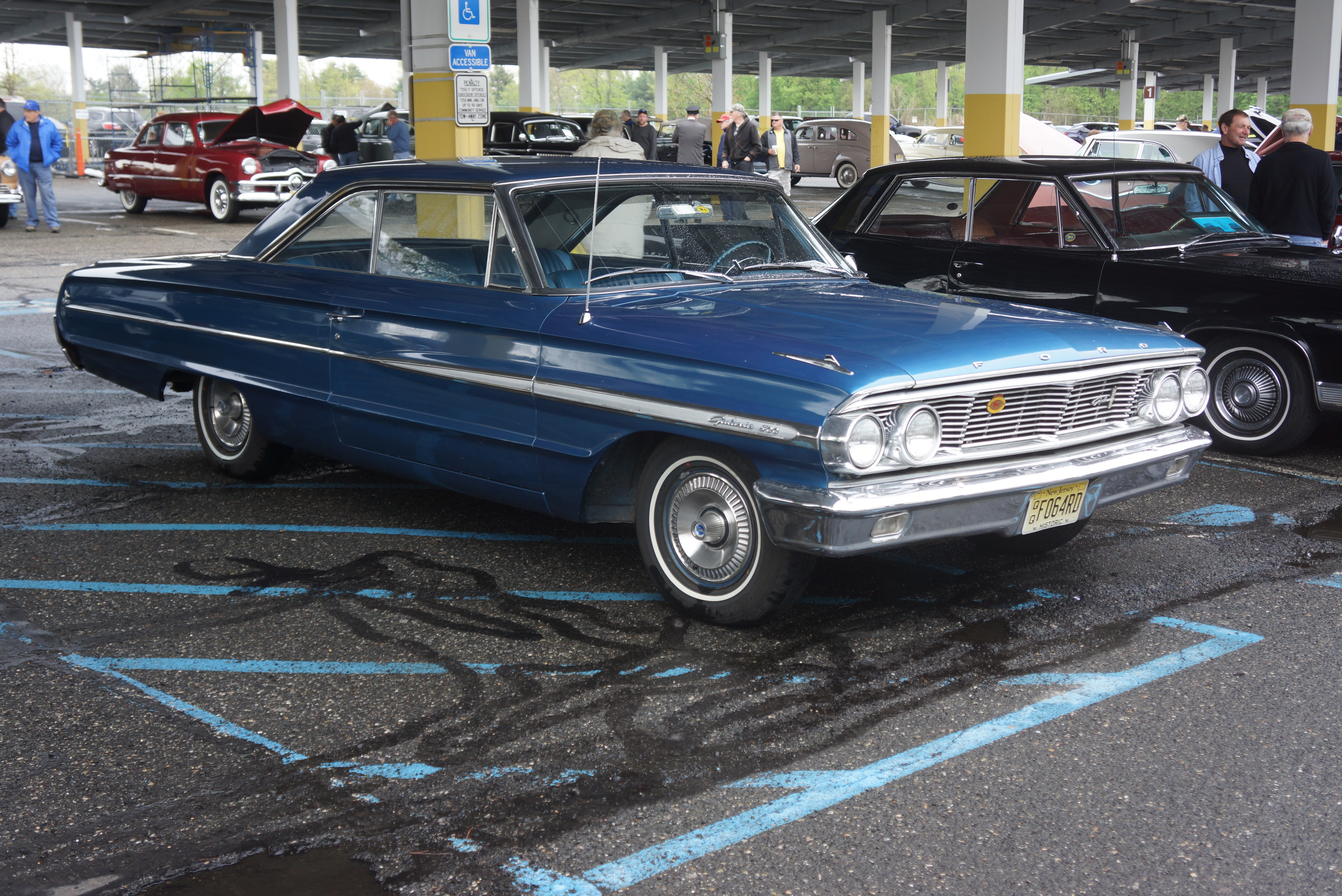
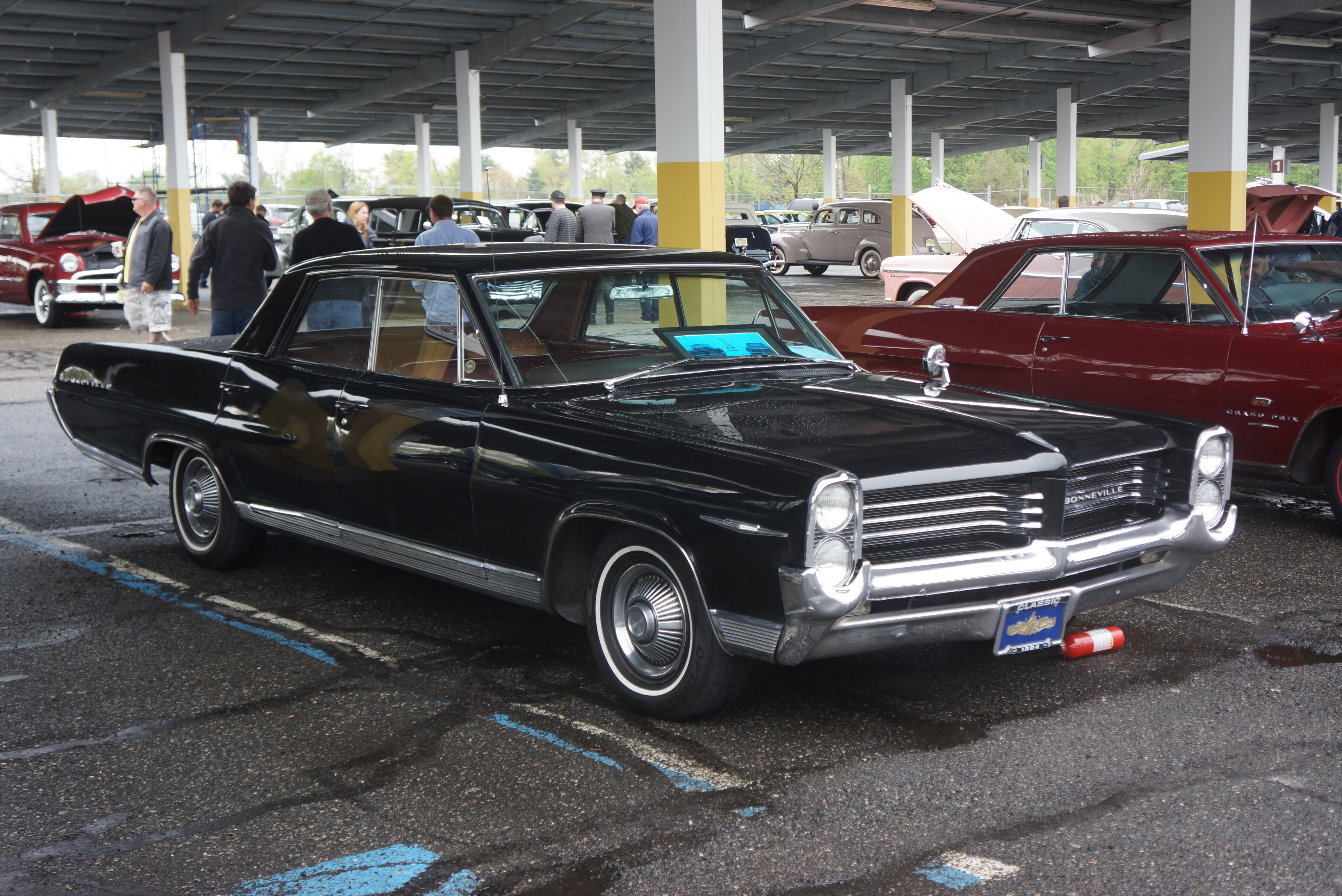
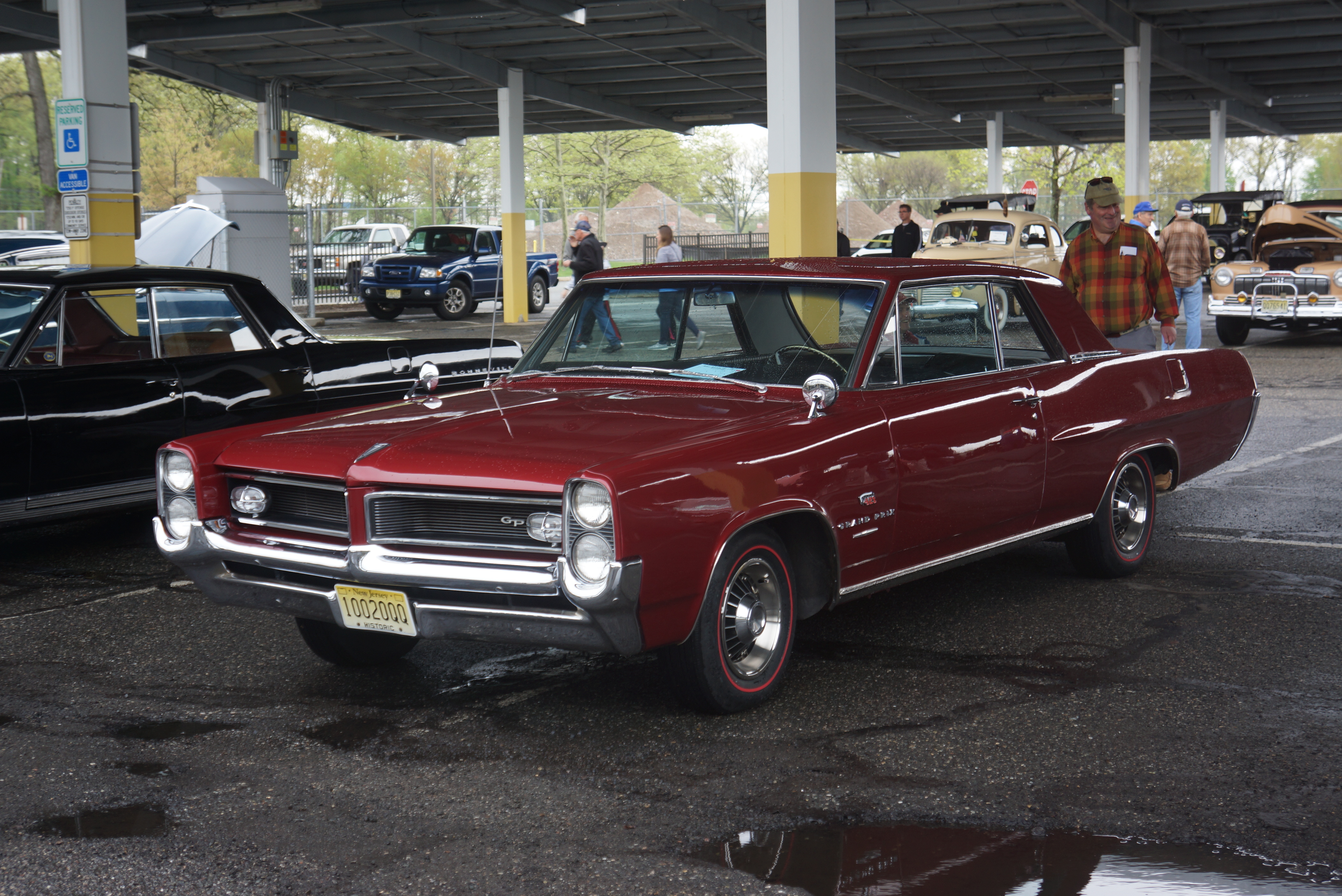
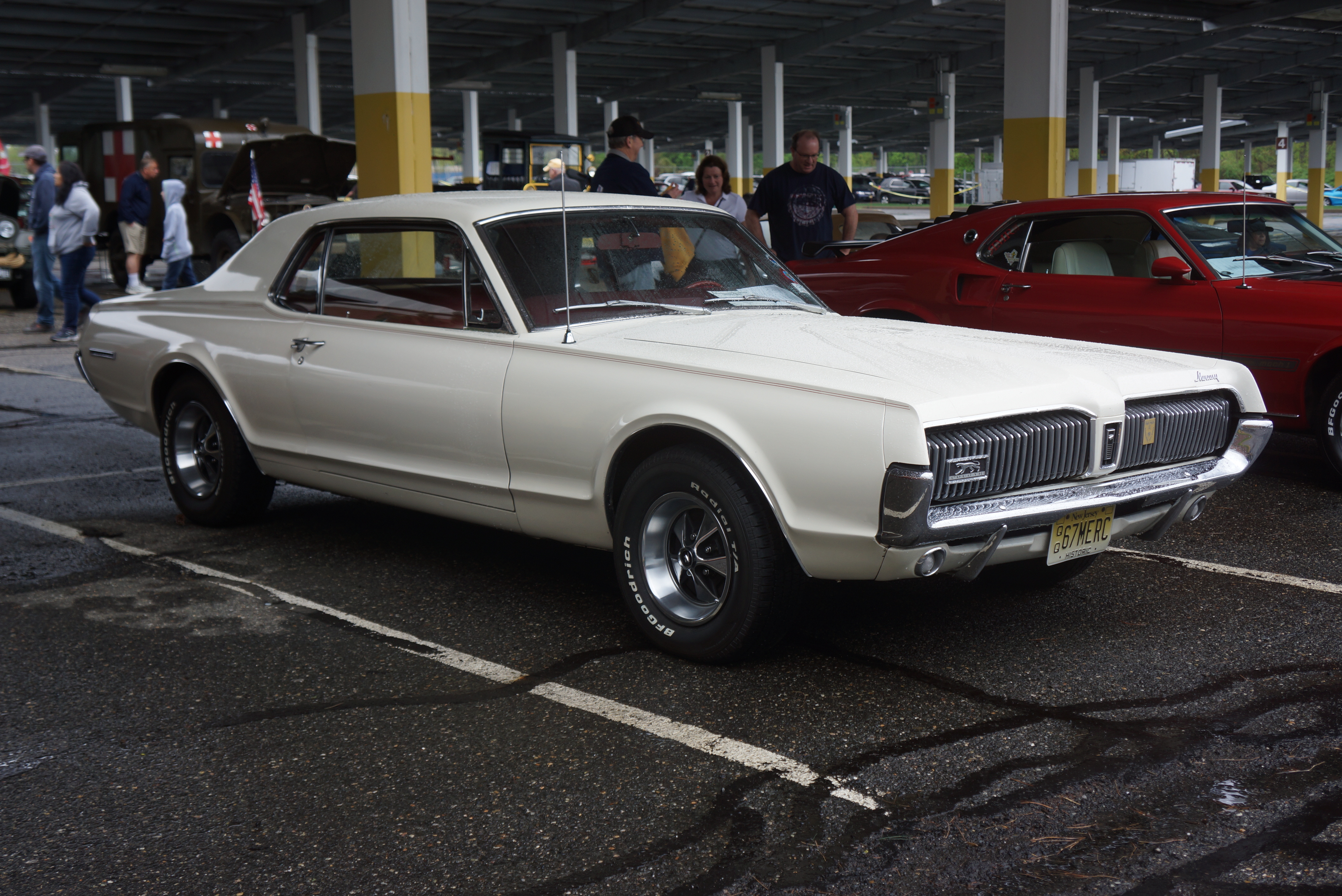
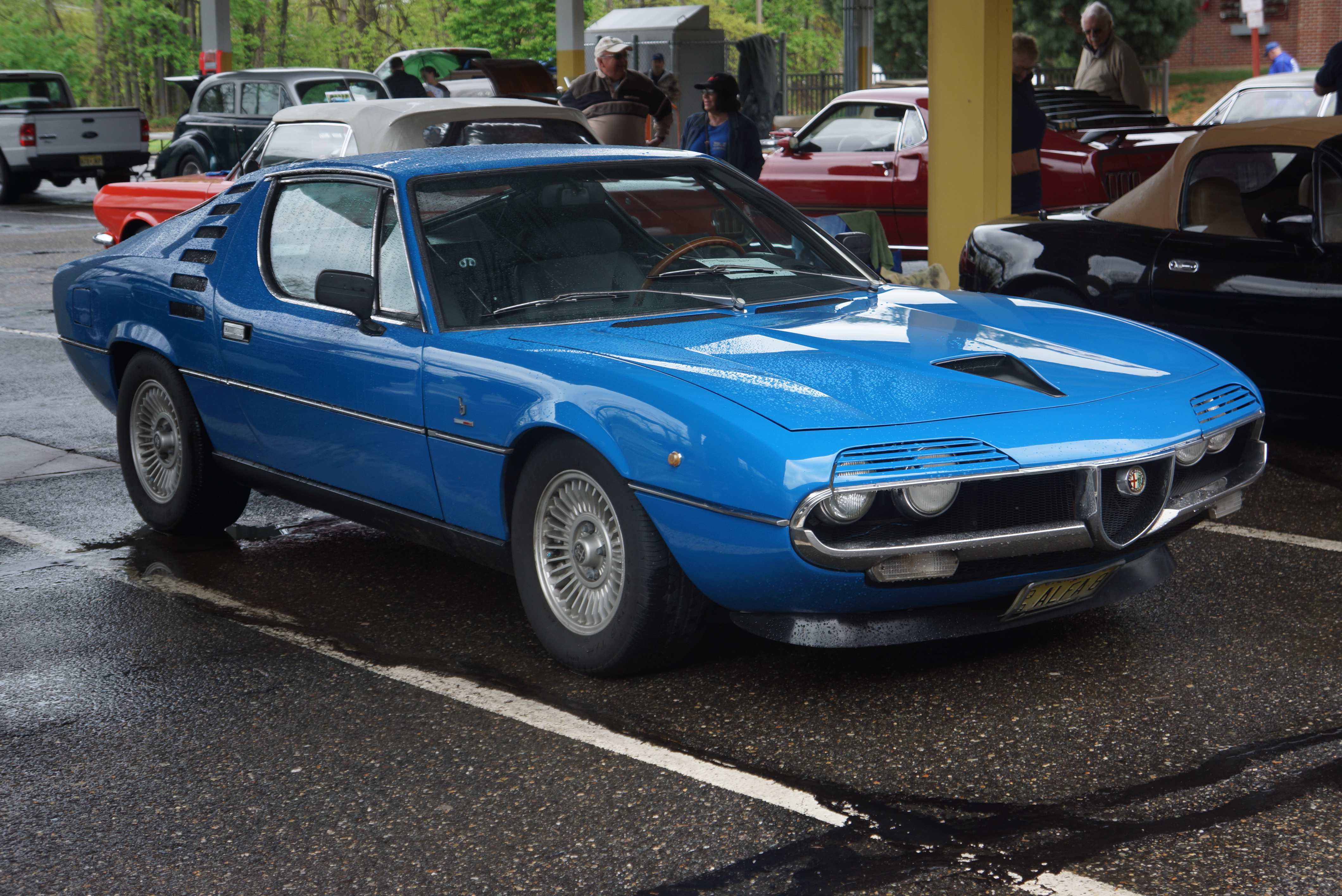
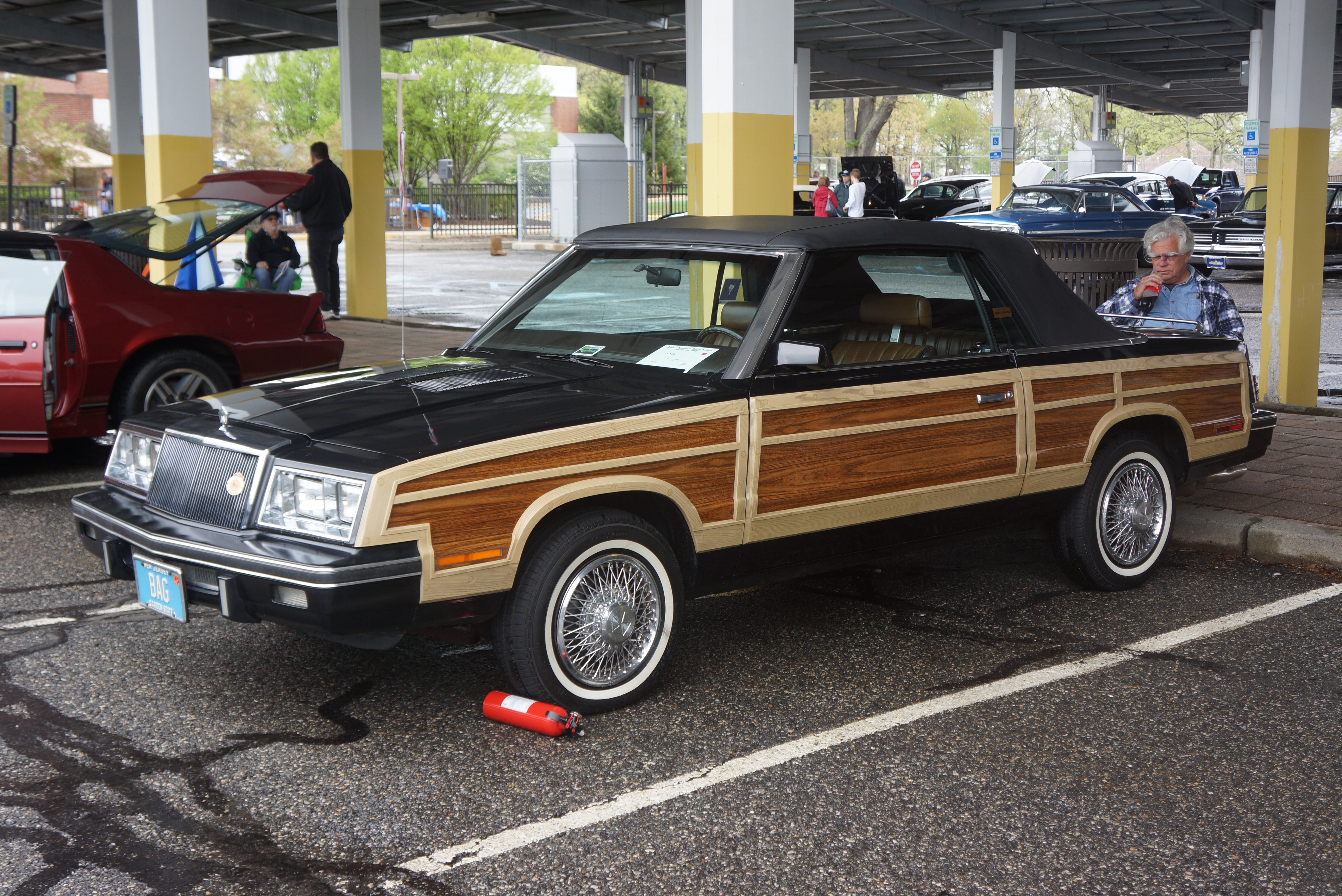
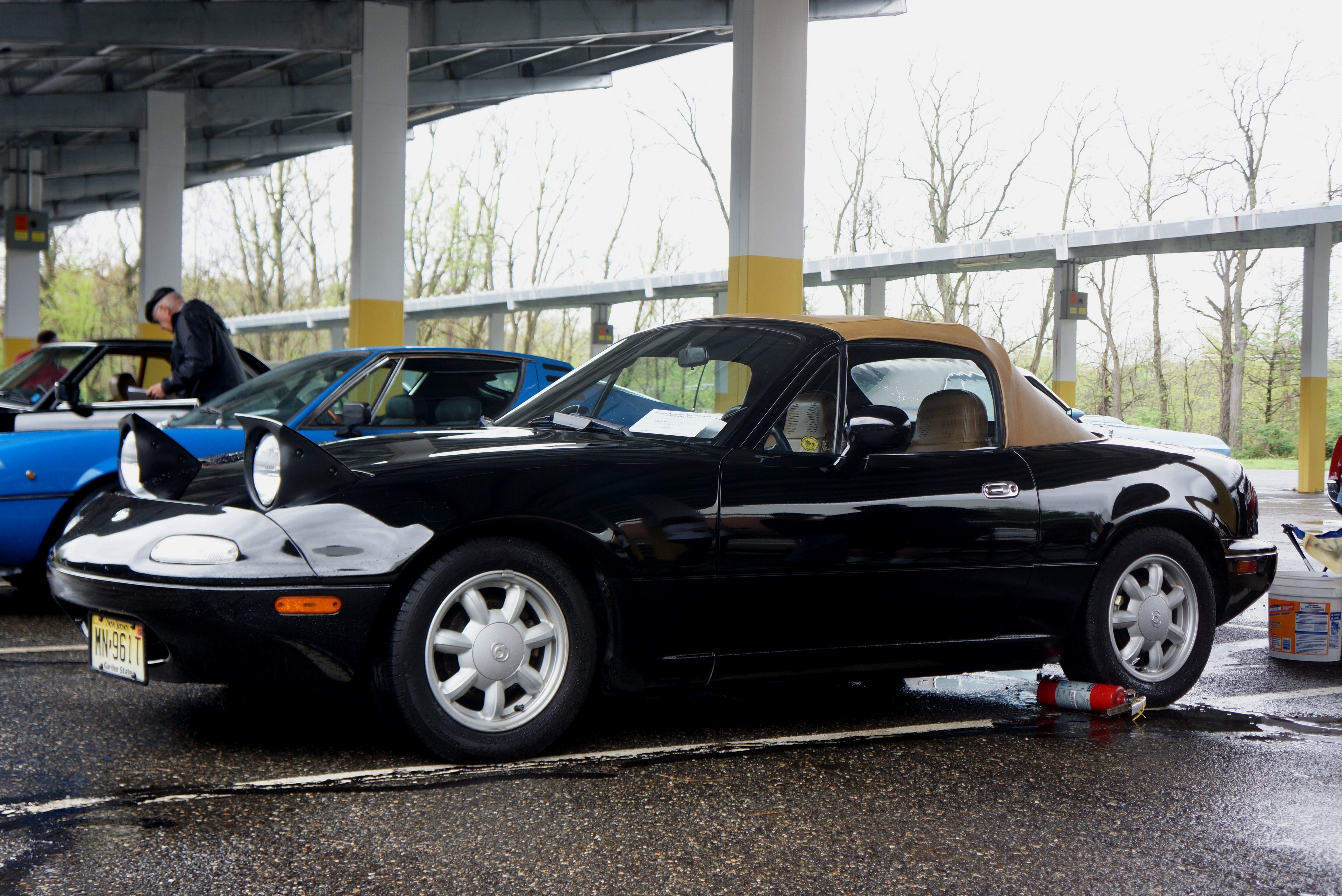
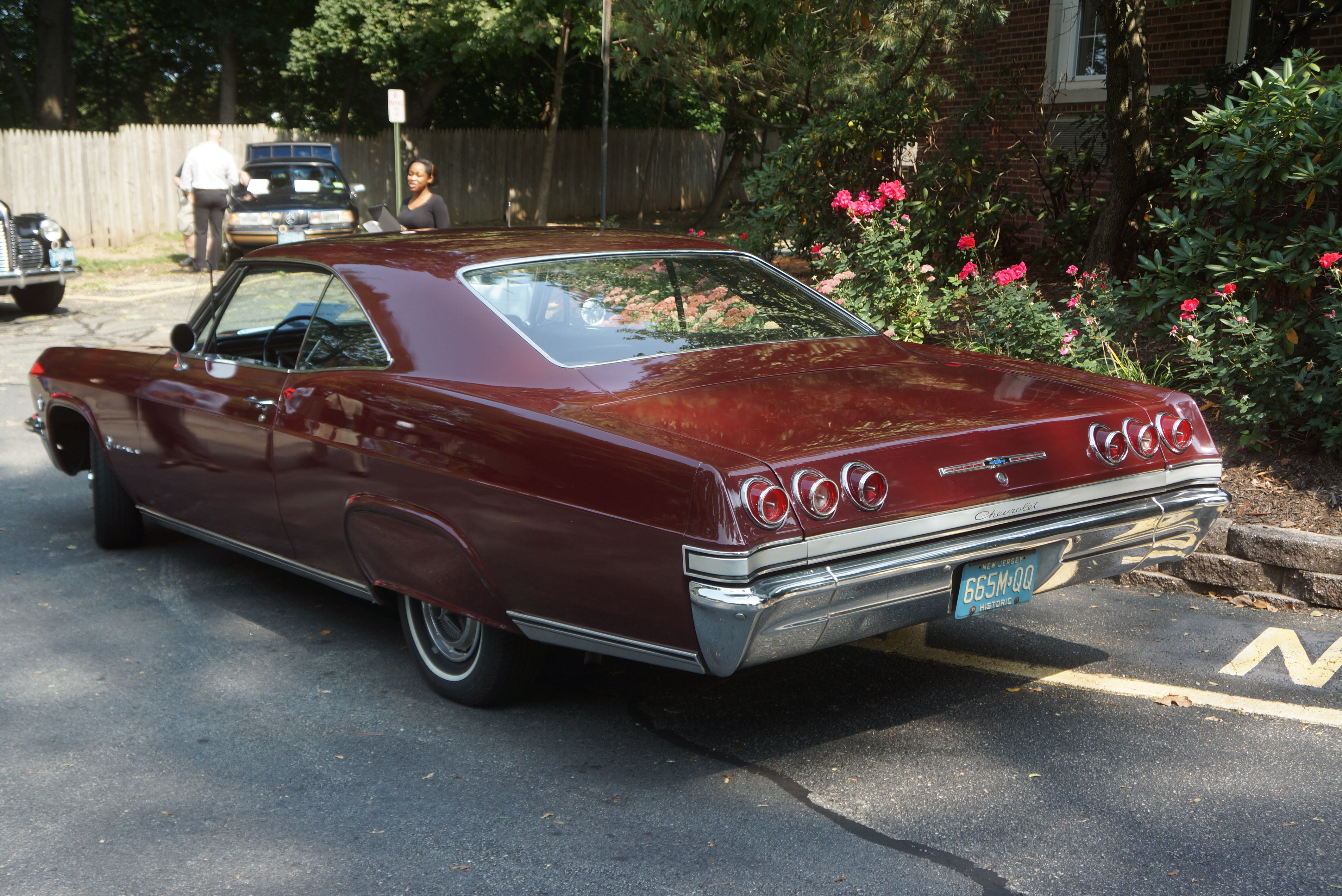
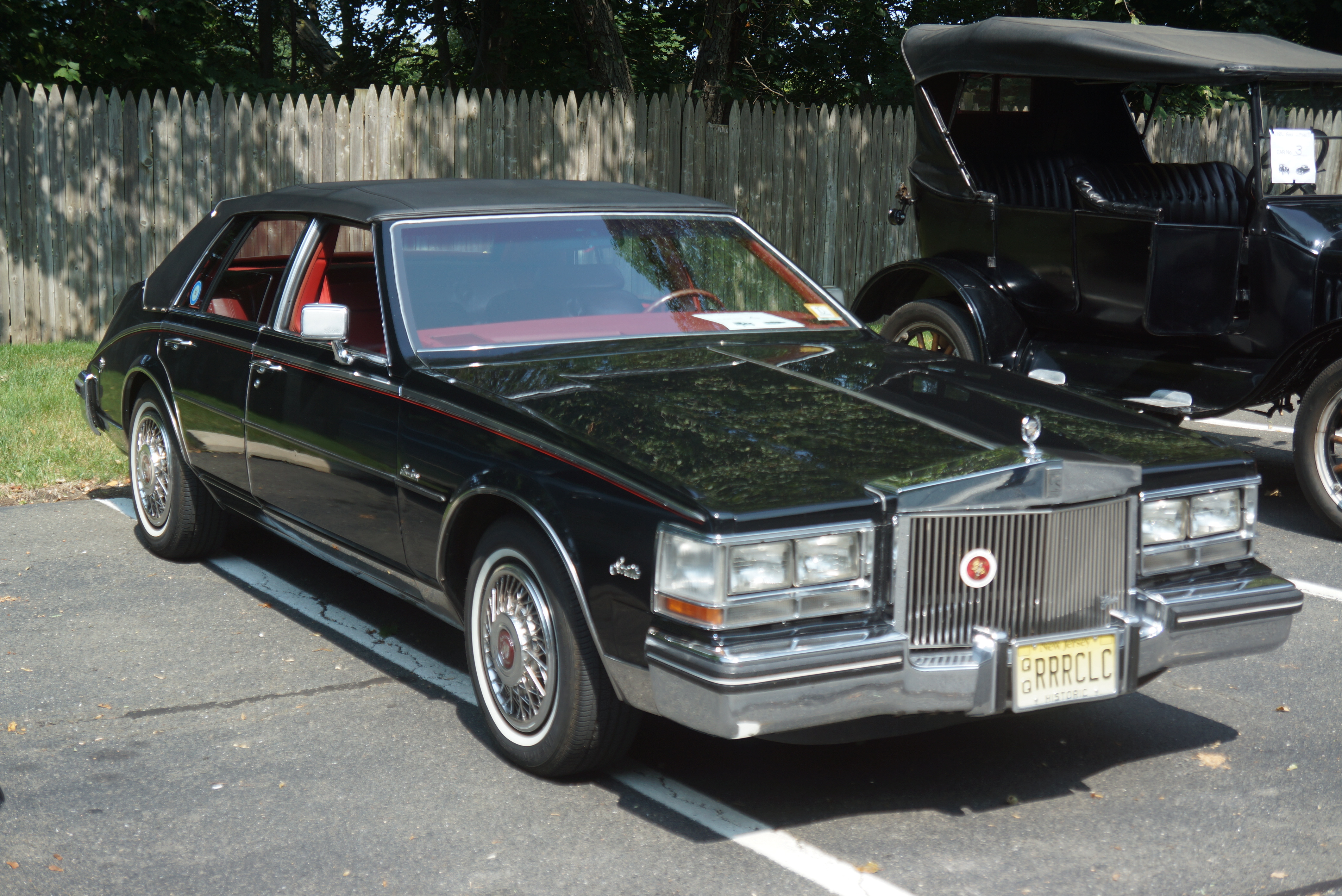
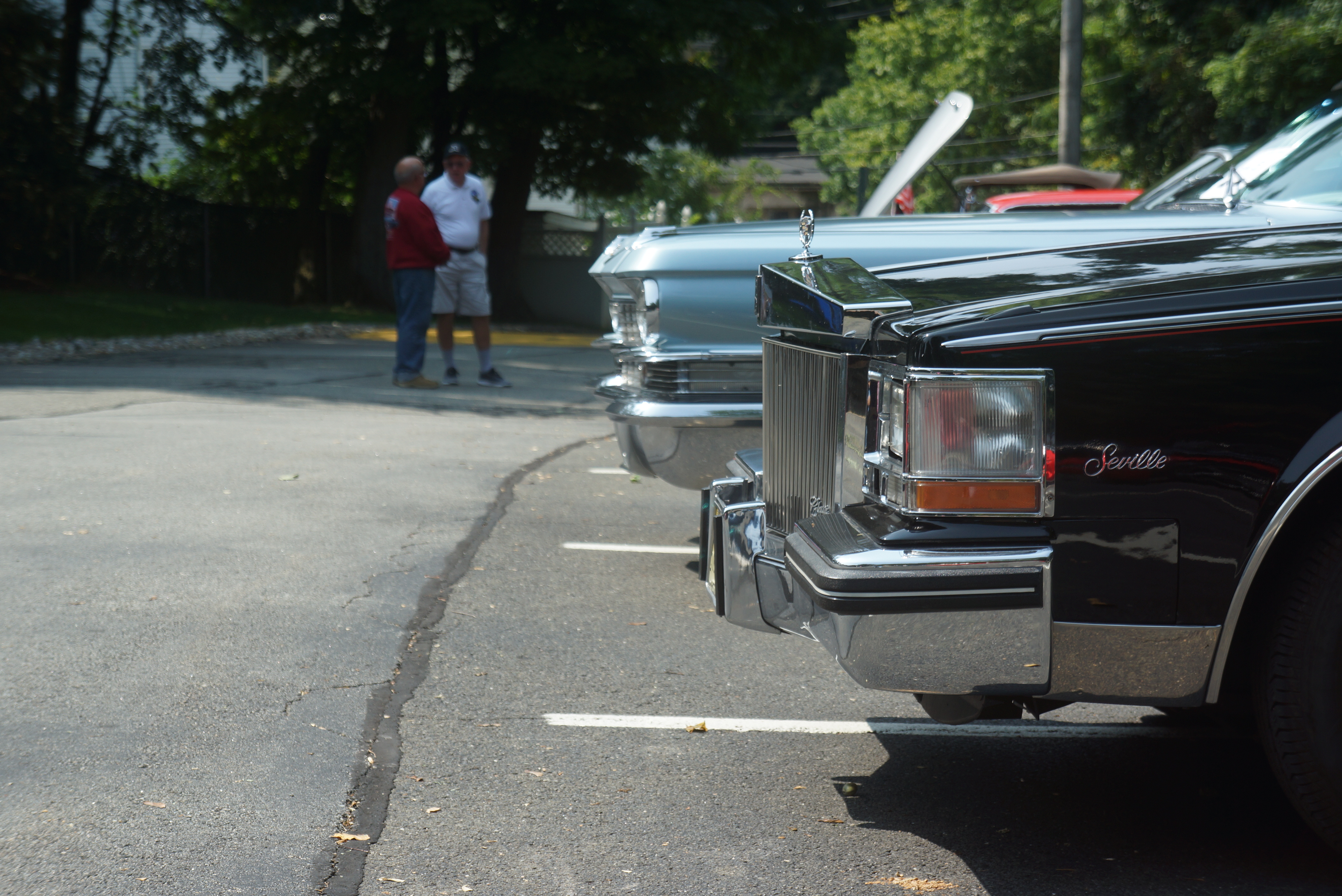
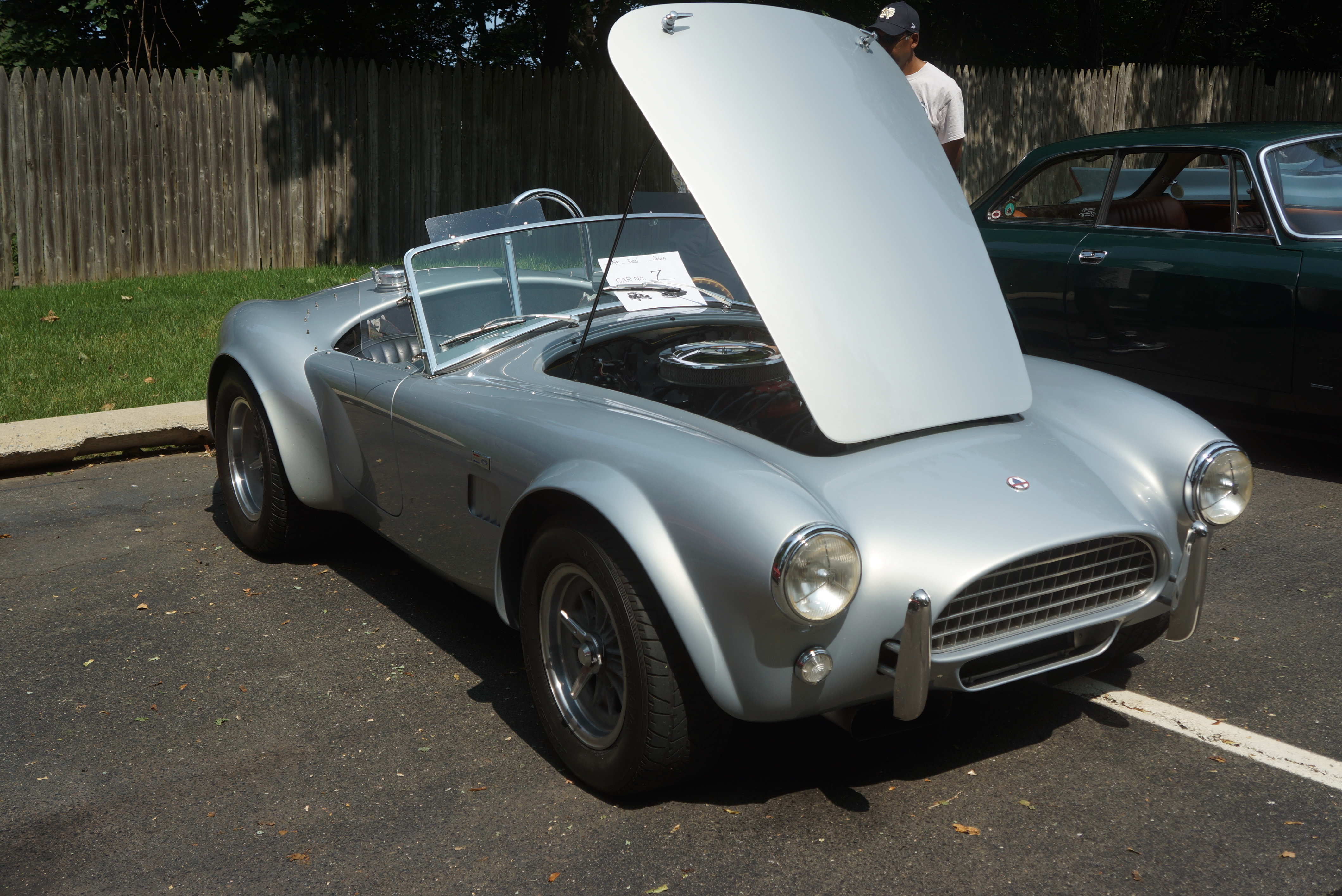
But it is about the cars, and we still had gorgeous vehicles (and their owners) braving the elements. Below is a selection of today’s cars arranged in model year order. Your scribe entered his 1993 Mazda Miata, which at 25 years of age this year, is officially allowed to enter AACA events. Its owner is also humbled to state that the Miata took first in its class (#13b, imported two-seater cars), and it was also awarded a Membership Trophy for “Best Unrestored Car, 1976-1993”.
In Chapter 9, the transmission and final drive got overhauled, and the chain-driven axle was ready to be reattached to the chassis. In Chapter 10, the restored rolling chassis finally sees the light of day.
Smack in the middle of calendar year 1994, elbow-deep in my restoration of this fine German bubble car, I was at a “good news / bad news” crossroads. The good news: much mechanical progress had been made. One engine, minus a cylinder head, was complete. With the transmission and enclosed-chain rear axle both restored, the drivetrain was essentially done. The chassis, currently on its front tires only, was very close to rolling on all four wheels and tires.
But the bad news, like a devil on my shoulder, would lean into my ear and whisper: “You’re not going to get this done”. I still had parts procurement issues. In spite of my dealing with multiple parts suppliers, no one vendor had everything I needed, and there were still some parts which no one seemed to have. My commitment to the rebuild of a 2nd engine was detracting me from progress on my own car. Work to be sent out, in this case the cylinder head rebuild, left me stymied, as I was having difficulty finding a machine shop willing to take on an Isetta valve job. I continued to discover that I was missing parts (remember that I did not disassemble these cars), which had me on the hunt for good used ones. I had not even begun looking into a shop for the body and paint work. Yet I continued to brag how “the Isetta will drive in ‘95”, and 1995 was next year.
Let’s pause for a moment and reflect back, with 25 years of hindsight. Why was I doing this? What were the motivating factors? The truth is that there was nothing rational about the time, money, and effort being expended to restore this microcar which most people never heard of, and which had little monetary value in the collector car market. This was a labor of love, driven by these factors:
Having failed once at an attempt to sell the car, there was little choice but to make something out of the pile of parts.
Fifteen years after purchasing the car, I felt an obligation to do something with it.
It was a pipe dream to prove that I could take a non-running car and restore it.
Having heard horror stories about stalled projects, I was determined to show that it was possible to finish one.
I had the tools, the space, and the mechanical knowledge, giving me the confidence to tackle the work.
This is not to say my time was otherwise not occupied. My career with Volvo was in full swing, and it included regular domestic and international travel. My home and family life were full of commitments. I continued to perform on the drum kit in various bands, although not to the extent I had during the previous decade.
Primarily, the Isetta restoration was my way of immersing myself in the old car hobby. Both the ’57 Ford and ’67 Dart were gone. Aside from the Isetta, my only other car was my daily driver, a company-leased Volvo. There was no room, financially or physically, for another collector car. What drove me? The drive came from the knowledge that a finished, drivable Isetta was my ticket into the world of collector car events.
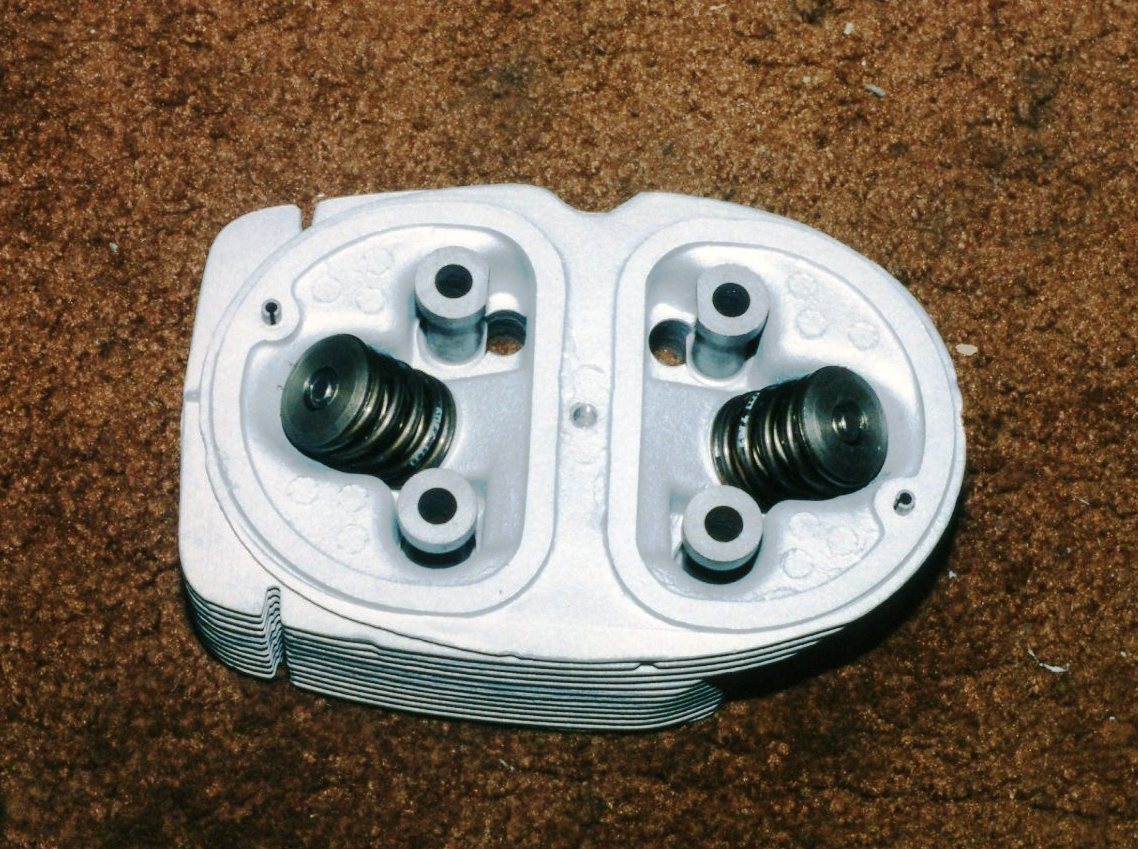
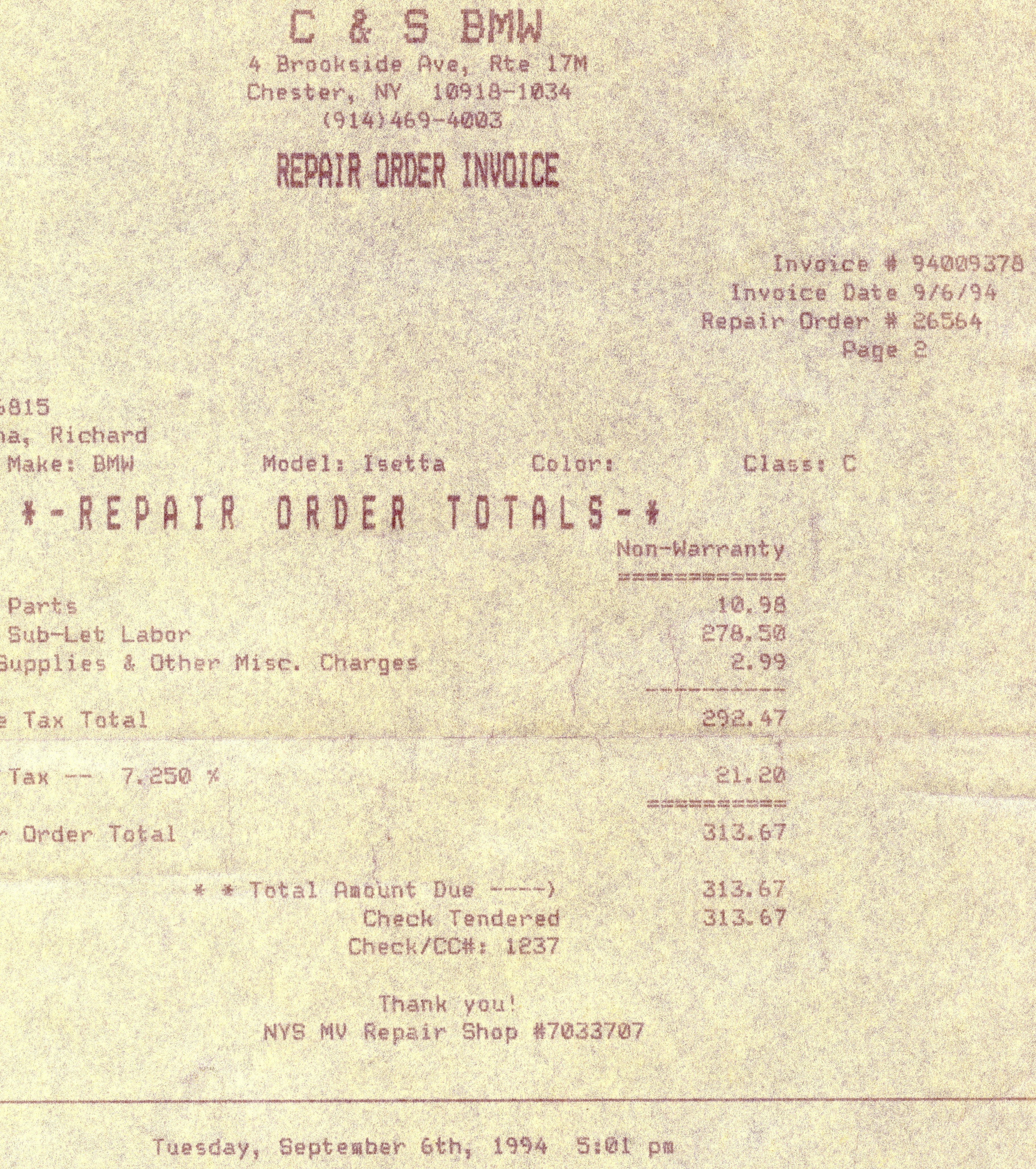
In an earlier post on the Isetta Saga, I mentioned that one cannot embark on these kinds of journeys alone. Working for an automobile company as I did meant that I was surrounded by fellow enthusiasts. In countless ways, they provided advice, assistance, and direction. One of my colleagues, Galen Royer, was a motorcycle guy, which I was not. Speaking to him one day, he mentioned a BMW motorcycle shop near his home. C & S BMW was in Chester NY, in Orange County. Although I had contacted other BMW bike shops (the one-cylinder Isetta engine is motorcycle-based), no one had been willing to take on the head work. From C & S I finally got a positive response. I dropped off one cylinder head with them, and they performed a complete overhaul, including installation of new valve guides, and cutting of valve seats. Finally, I could complete the reassembly of one engine.
A Polaroid of the heads prior to the machine work
New valve guides…
… and recut seats
The bill from C&S; a large expense compared to what I had been spending
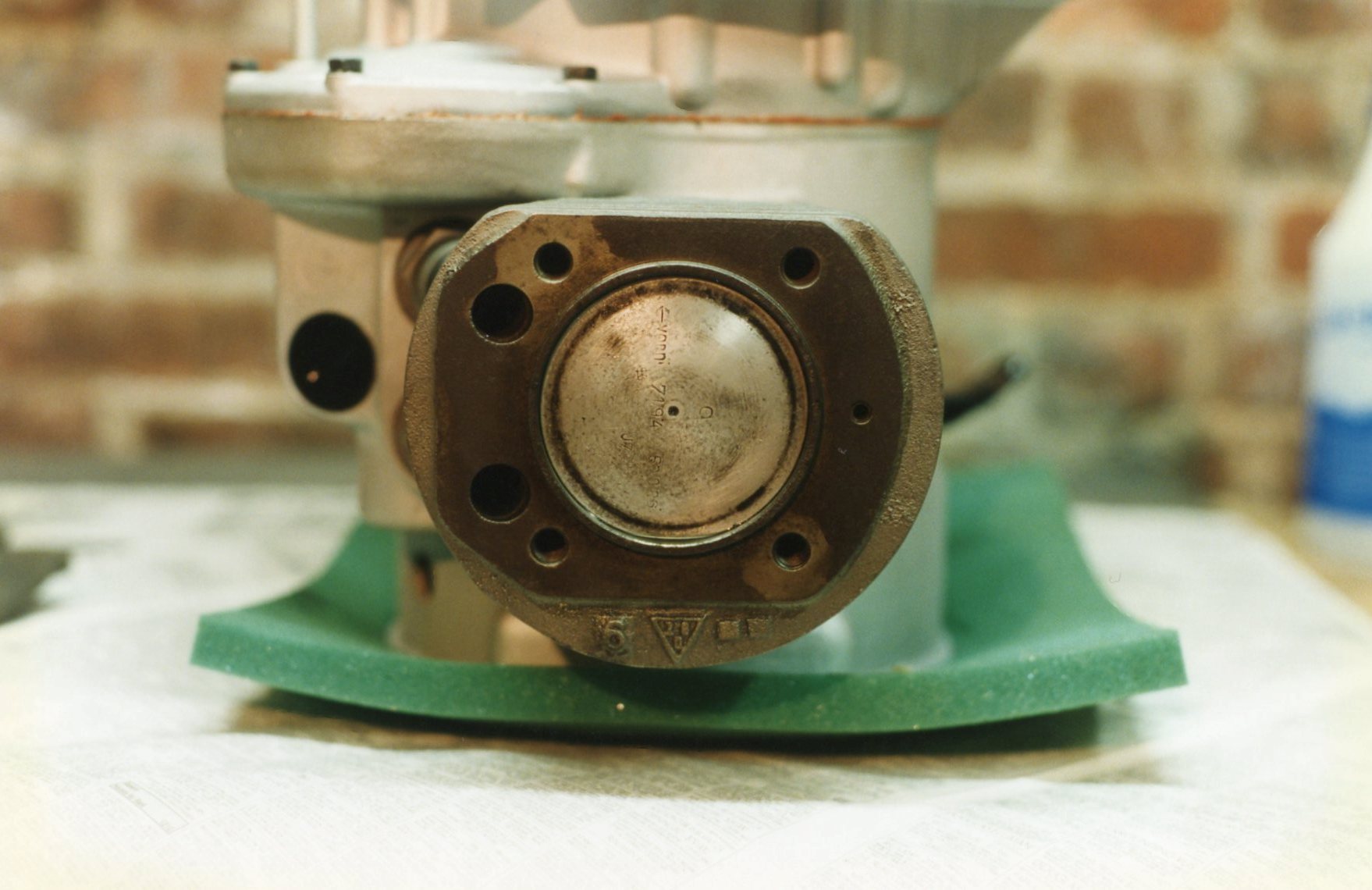
One last shot of piston before head covers it
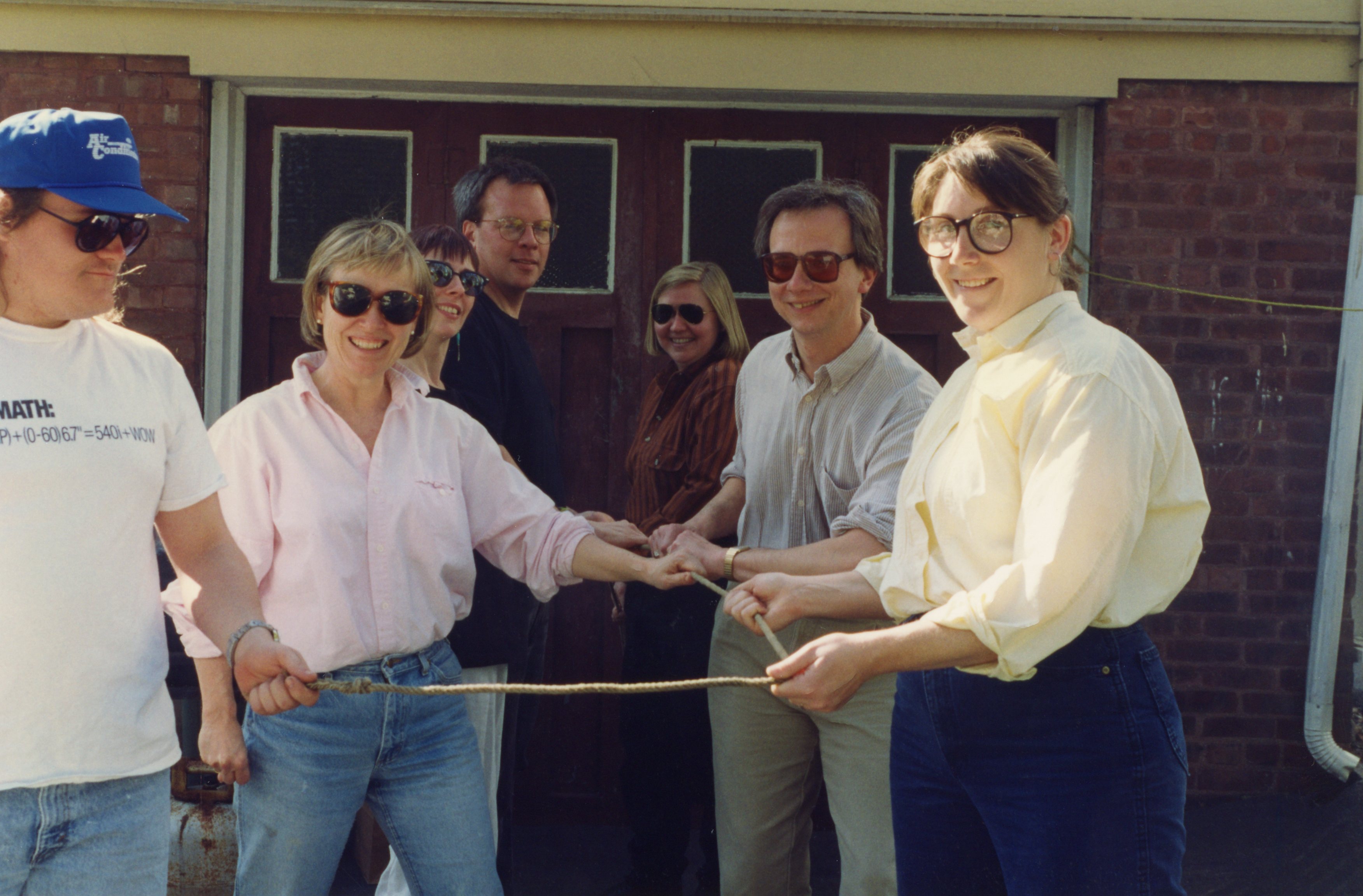
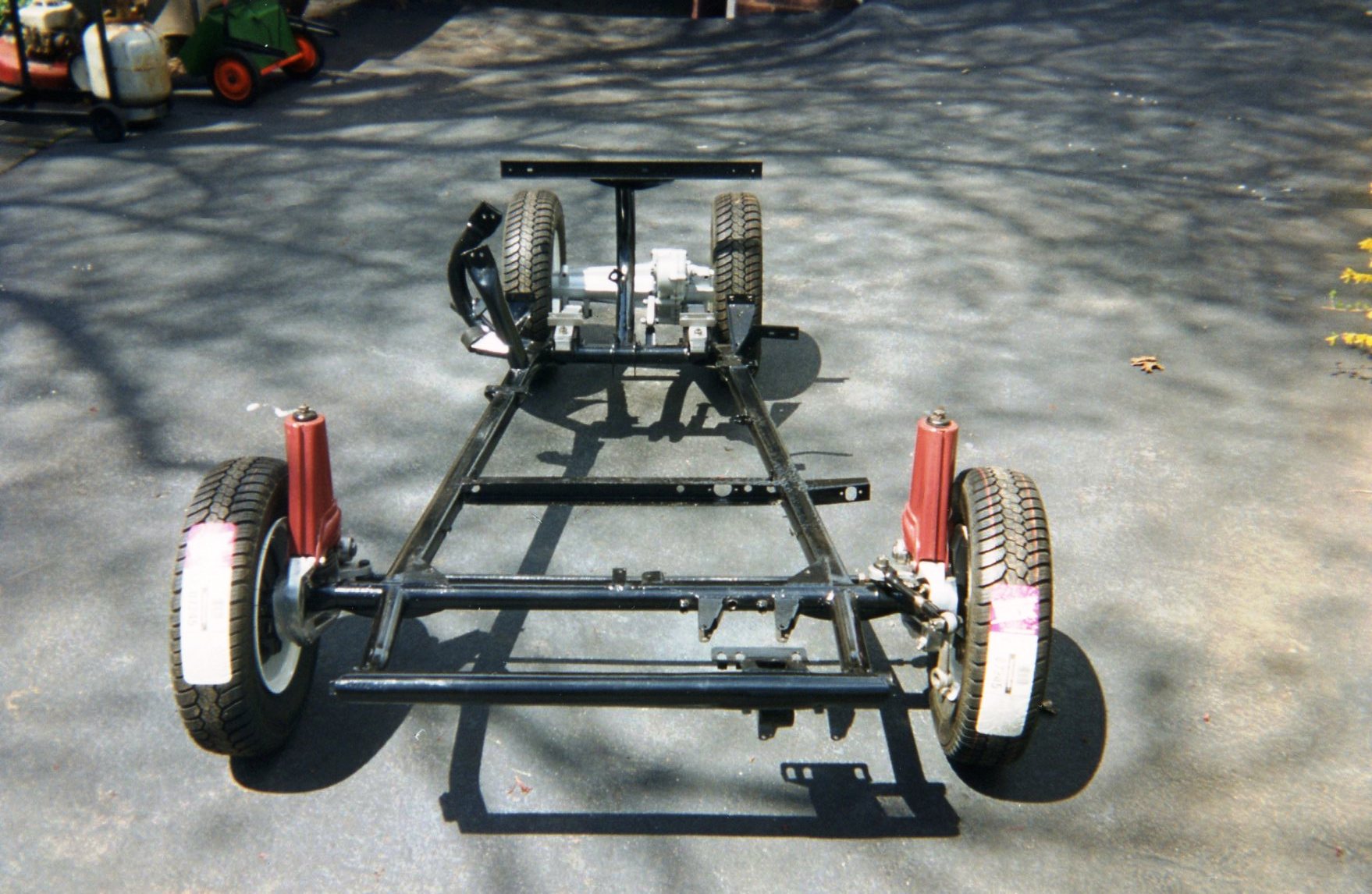
Turning my attention back to the chassis, the restoration of the rear axle along with its various attachment points brought me that much closer to a very important goal: the completion of a chassis rolling on its own four wheels. That goal was reached early in 1994, and I celebrated that accomplishment by throwing a party. Why not?
With rope power, the rolling chassis awaits its debut
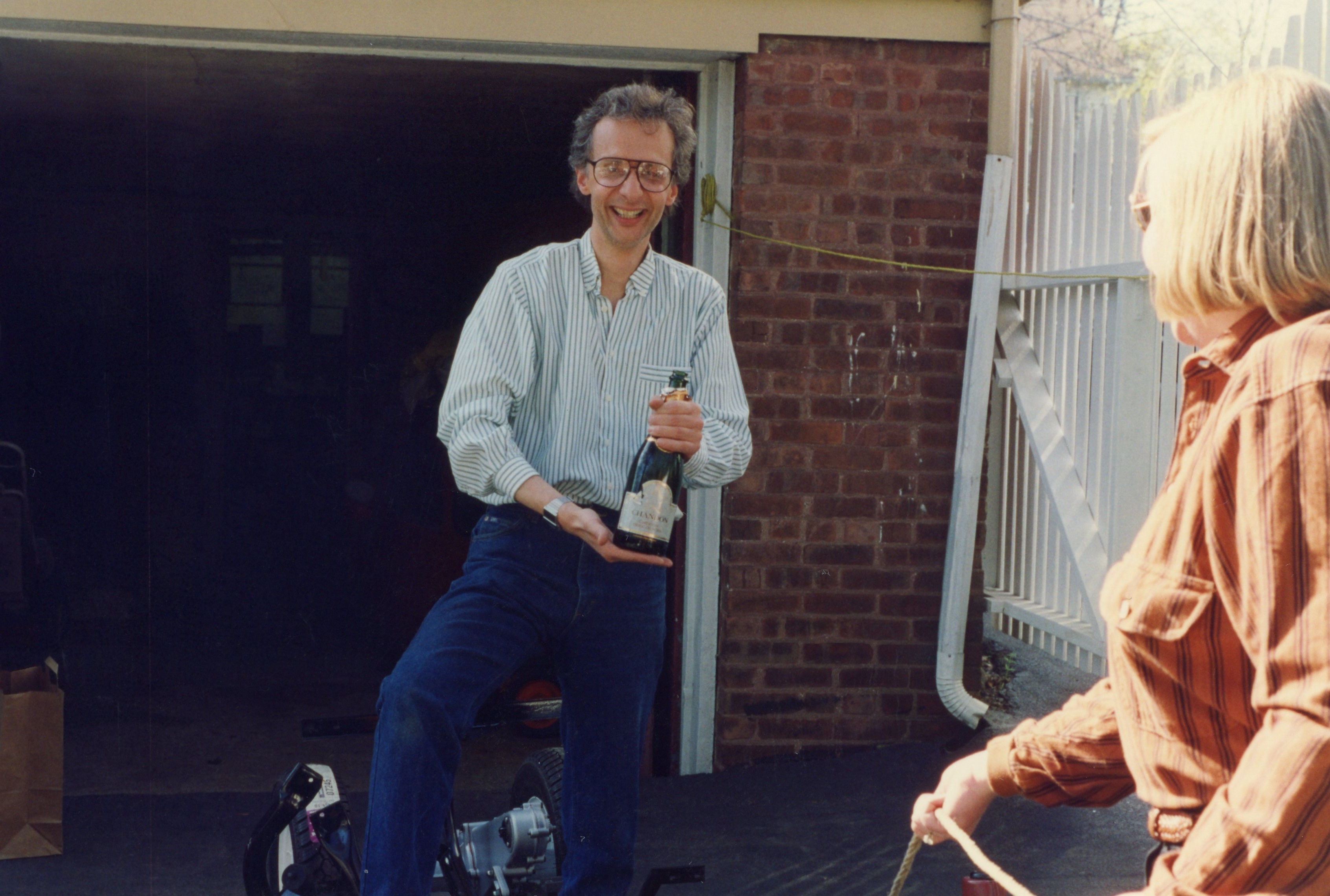
It’s not a party without champagne
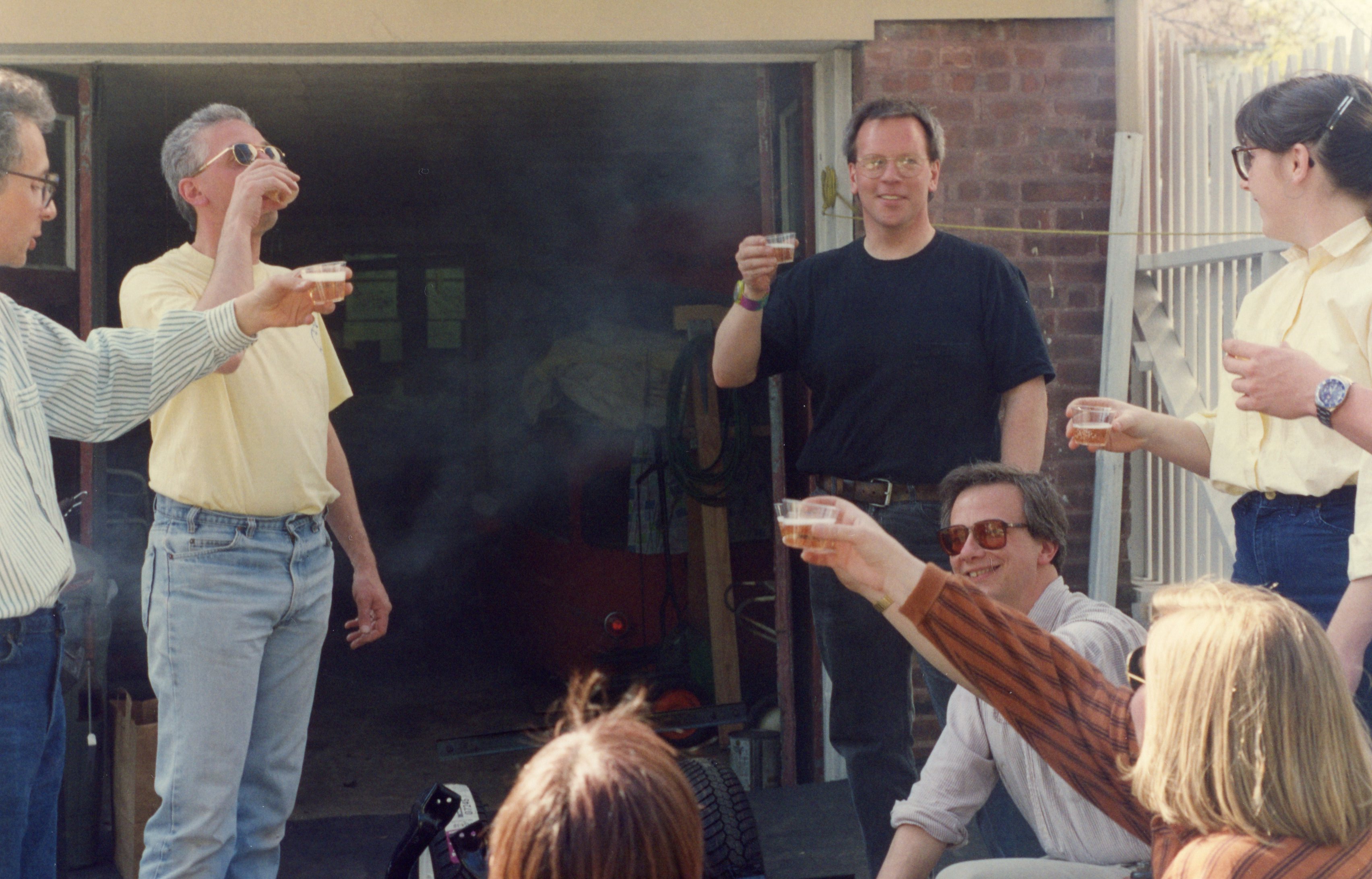
The gathering of friends to raise a glass in toast to a milestone was not intended as an egotistical, “look what I did” exercise in chest-beating. I thought of it as quite the opposite, actually. The small cadre of friends who were invited to the Rolling Chassis Debut all had been playing supporting roles in the restoration. Chris, Steve H, and Linda were of great assistance in procuring parts. Steve M and John had both been to the house multiple times when I needed an extra pair of hands.
Great friends raise a glass…. Judie, Chris, and Linda have passed on….
It was also important that I not take myself too seriously, as serious as I was about doing the highest quality work I could, and getting it done in a timely fashion. It was still “just a car”, and this was supposed to be fun. By having a party, I was letting you in on the secret: this was a lark, an Isetta for heaven’s sake! I wanted you to laugh with me. If that also meant laughing AT me, well, that was OK too. Celebrating a turning point held the promise of future celebrations at future turning points. Let’s pop a few corks, tell a few stories, and hope that you’ll keep helping me as I keep pushing myself to finish the darn thing.
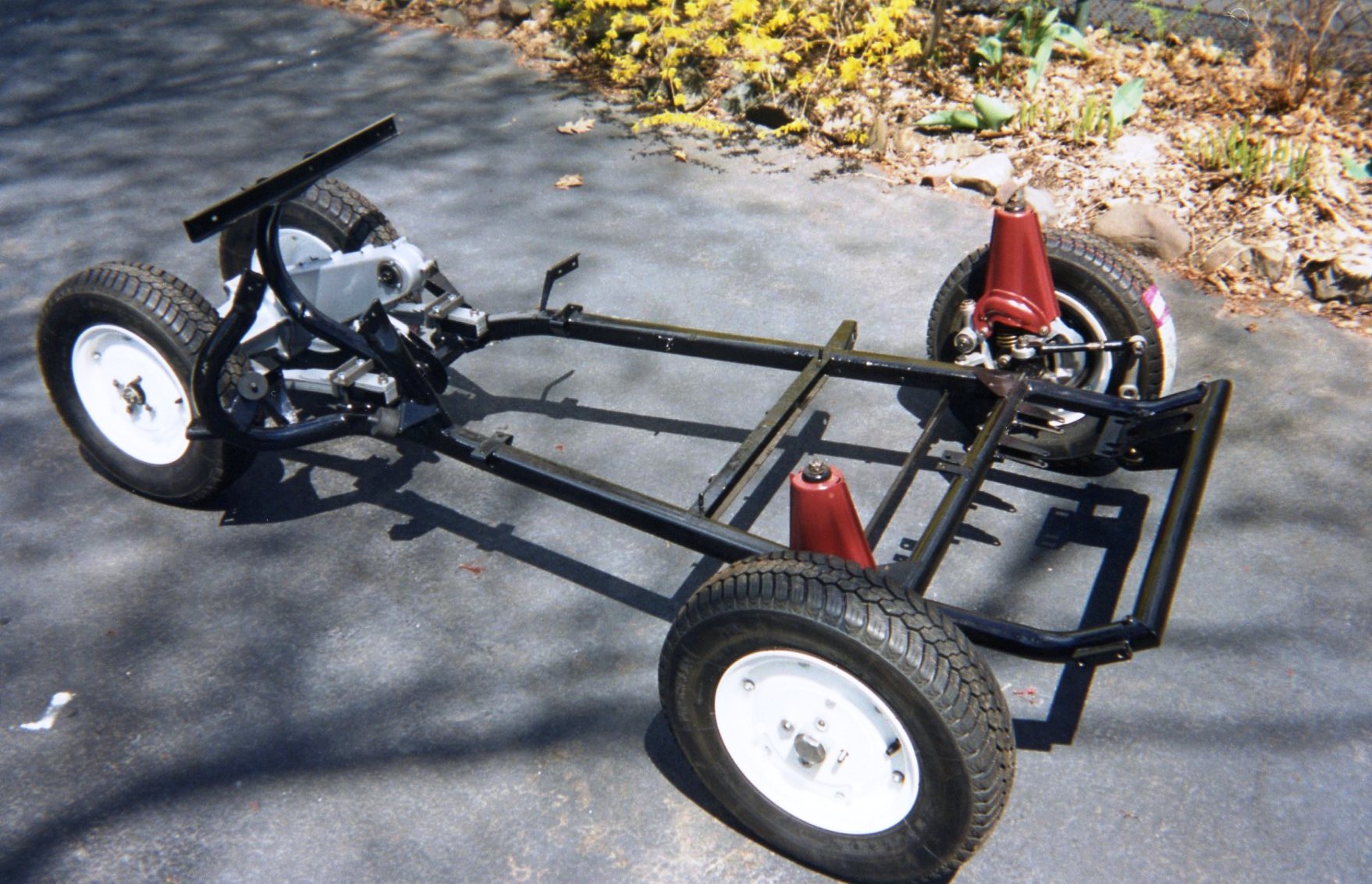
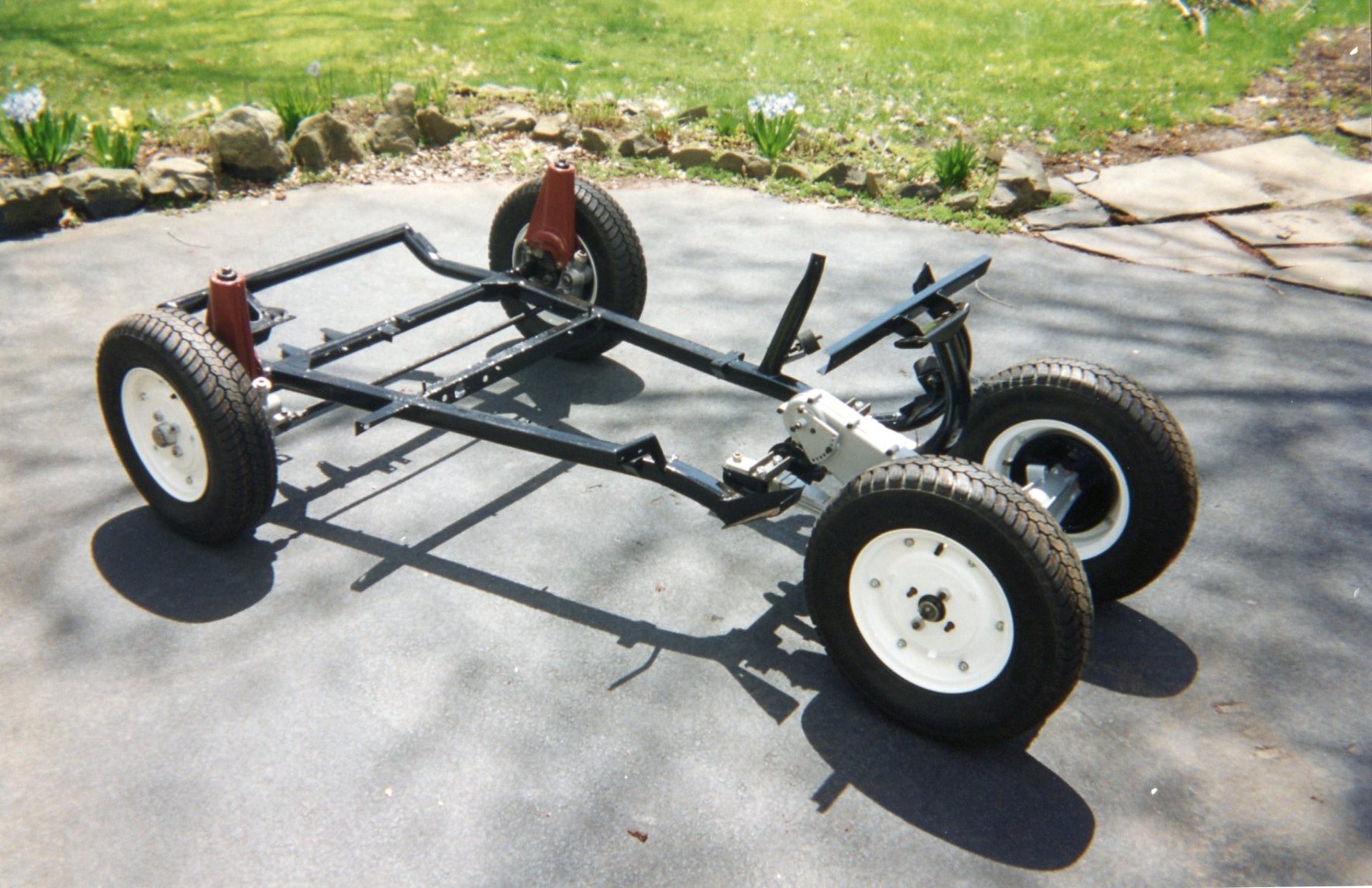
The chassis finally is returned to rolling on 4 wheels
As a reminder, this is how it looked in 1990
From this angle, rear chain drive assembly is shown; no engine or trans yet
Front shock towers were black, now red; front and rear tread difference obvious here
The next big turning point looked like it would be the installation of the engine and transmission onto the chassis. But we were not quite there yet. There were a few subassemblies for the engine, chassis, and interior which needed work:
Brakes
Like almost all cars from the 1950s, the Isetta used drum brakes front and rear. Compared to normal cars, there was a difference: the lack of a differential meant that the two rear wheels, mounted on a solid axle, were not free to spin independently of each other. In execution, only one rear brake was needed, so viola, the Isetta had a total of three drum brakes.
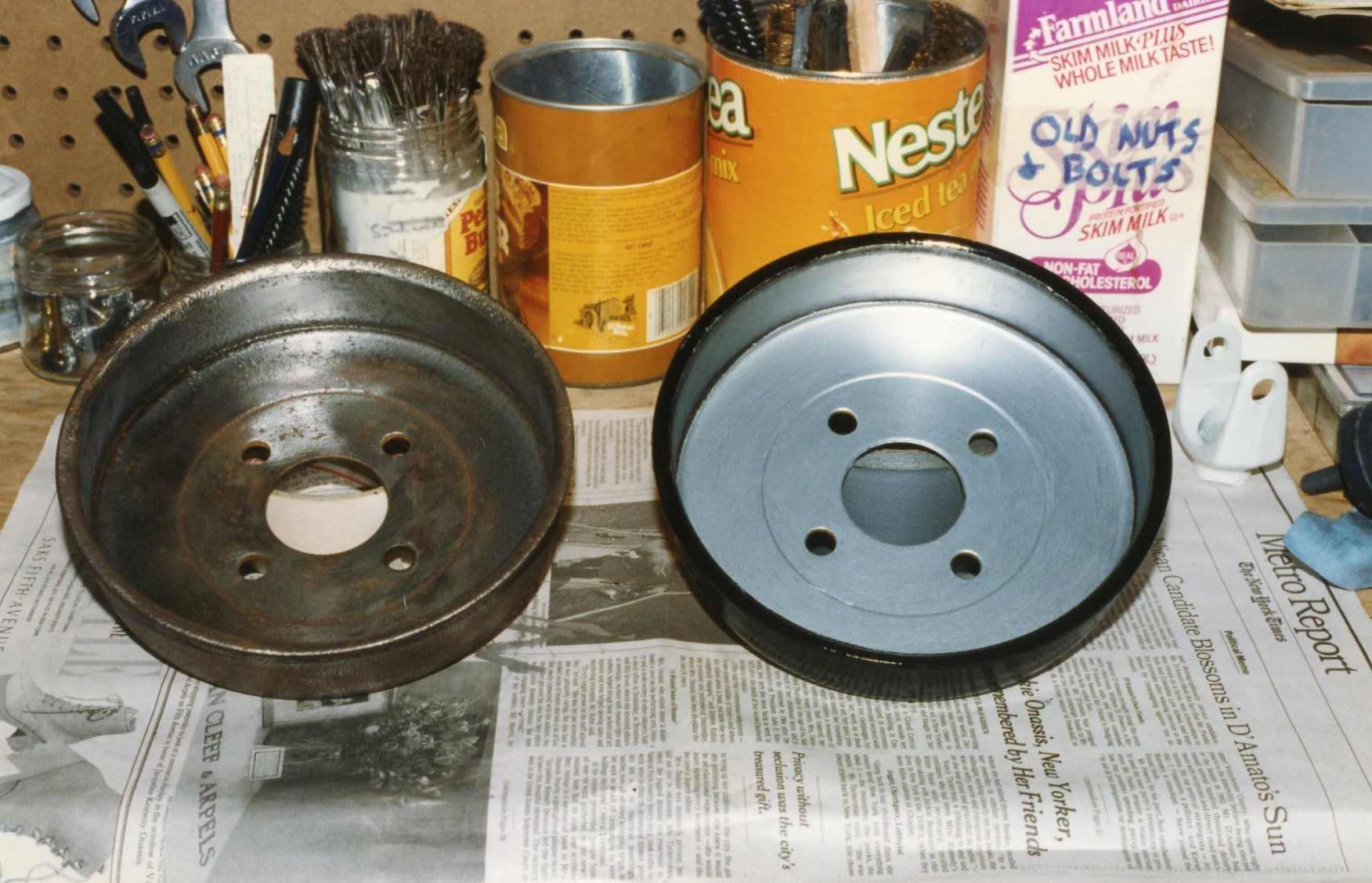
Unpainted and painted drums
Contact surfaces only needed cleaning
The brake rebuild process was not without its challenge. All the wheel cylinders were frozen solid, and dislodging the pistons meant days of soaking in coffee cans full of Liquid Wrench. Even then, the pistons were still removed via destruction. The cylinders themselves were salvageable, and pistons and shoes were available from several of my local suppliers.
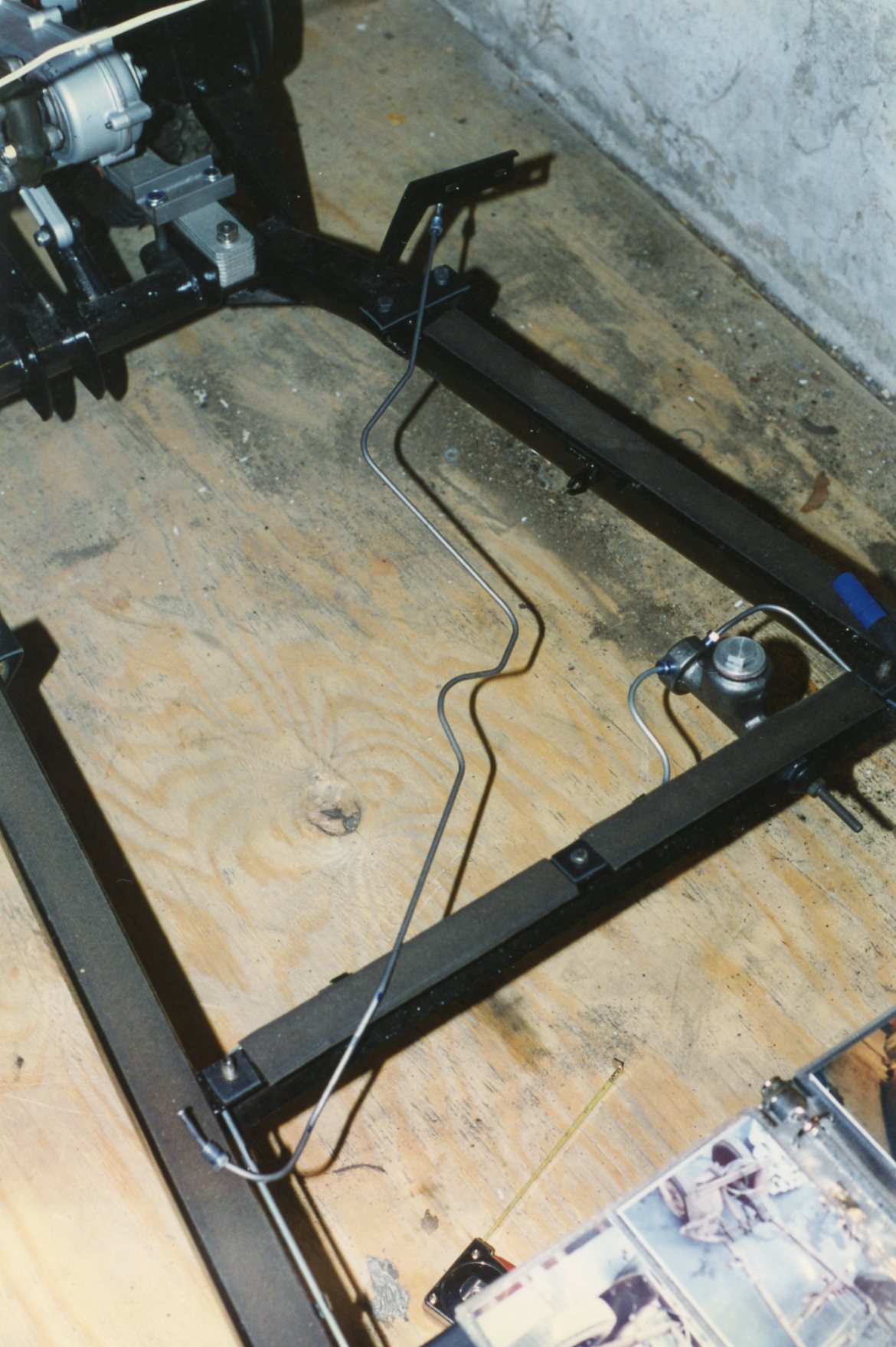
Brake line formation; new master cylinder is in place
Brake lines, on the other hand, were not. The only solution was to purchase metric brake lines, which I cut to length and bent to form using a tubing bender. The flaring of the ends required borrowing an ISO bubble flare tool. (It was a huge advantage to complete with work on the body-less chassis. I cannot imagine doing this with the body in place.) Various articles recommended using VW brake hoses for the front, and that’s exactly what I did.
My “before” photos came in very handy for the forming of new brake lines
Finally, the hunt was on for a new master cylinder, as the ones I had looked like they had been stored in New York Harbor. Mr. Krause in Emmaus delivered on that front, and it was a case of “pay whatever the asking price is”, as at that time, no one else had new Isetta master cylinders for sale.
Front brake shoes and wheel cylinder shown with drum removed
Steering wheel & column
My steering wheel had minimal cracks, and based on some discussions I had with steering wheel restoration companies at Carlisle, I wasn’t about to pay what they wanted to restore a wheel. It looked to me that a complete sanding and recoating of the wheel would get me to where I wanted to be with it.
Steering wheel as found, with worn factory coating
I had read that store-bought epoxy appliance paint, intended to refinish your kitchen fridge or oven, worked quite well on automotive interior items which are subject to handling and wear. Popping into my local Home Depot, I found spray paint in a nice almond shade, and committed to using it on the steering wheel as well as items like the light switch, shift knob, and interior door handle.
After sanding; wheel was overall in decent shape
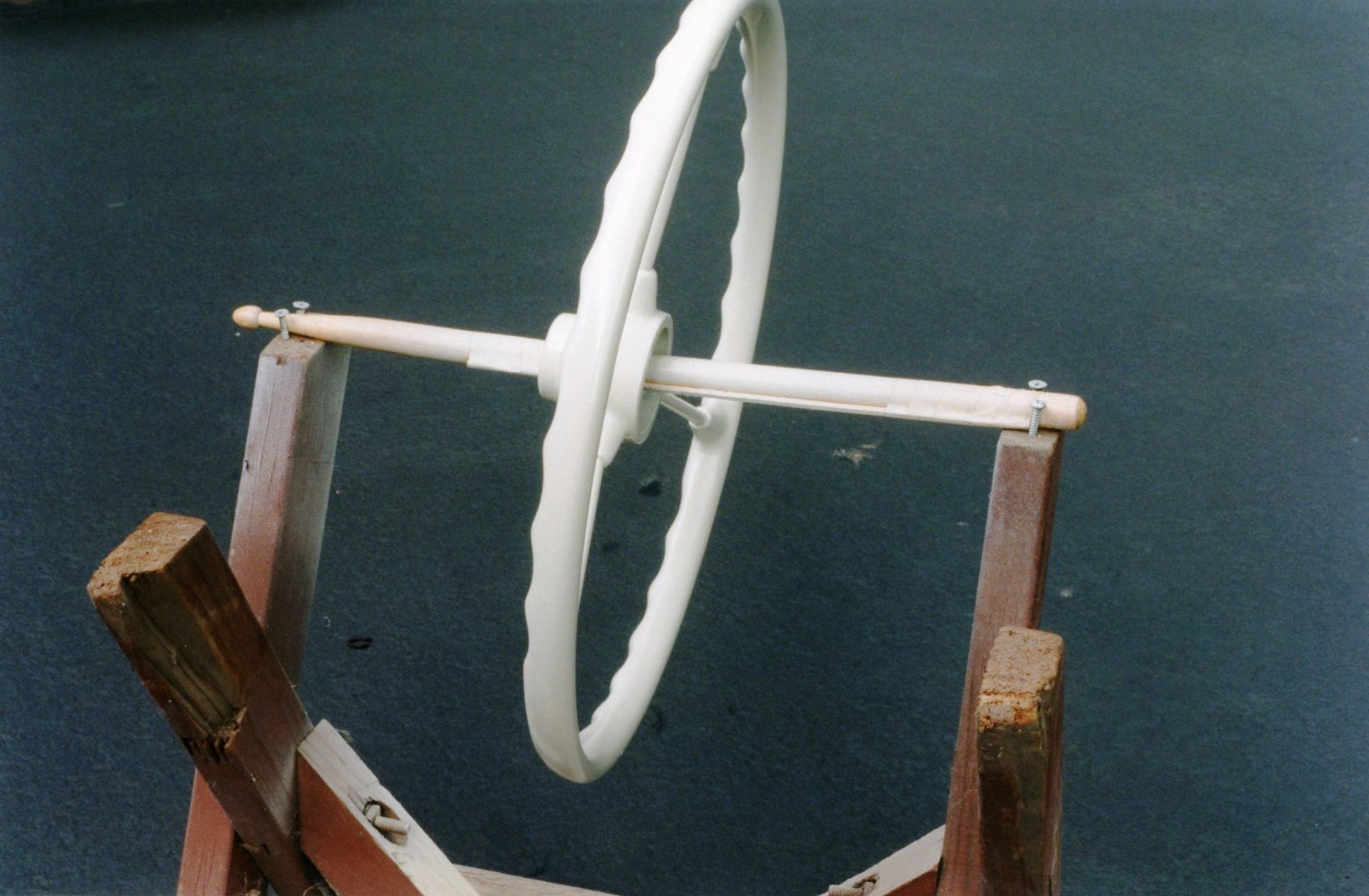
The steering wheel was hand-sanded to remove all traces of existing paint, then given a good cleaning. With the rattle can, the intention was to apply multiple coats as lightly as possible. If I could get the wheel to rotate while spraying it, there would be no chance of runs. Using an old piece of outdoor furniture and a drumstick, I mounted the wheel so that I could spin it and spray it. It probably got four or five coats of paint this way, and to me it looked as good as new.
Restorations drive you to be creative and make your own tools
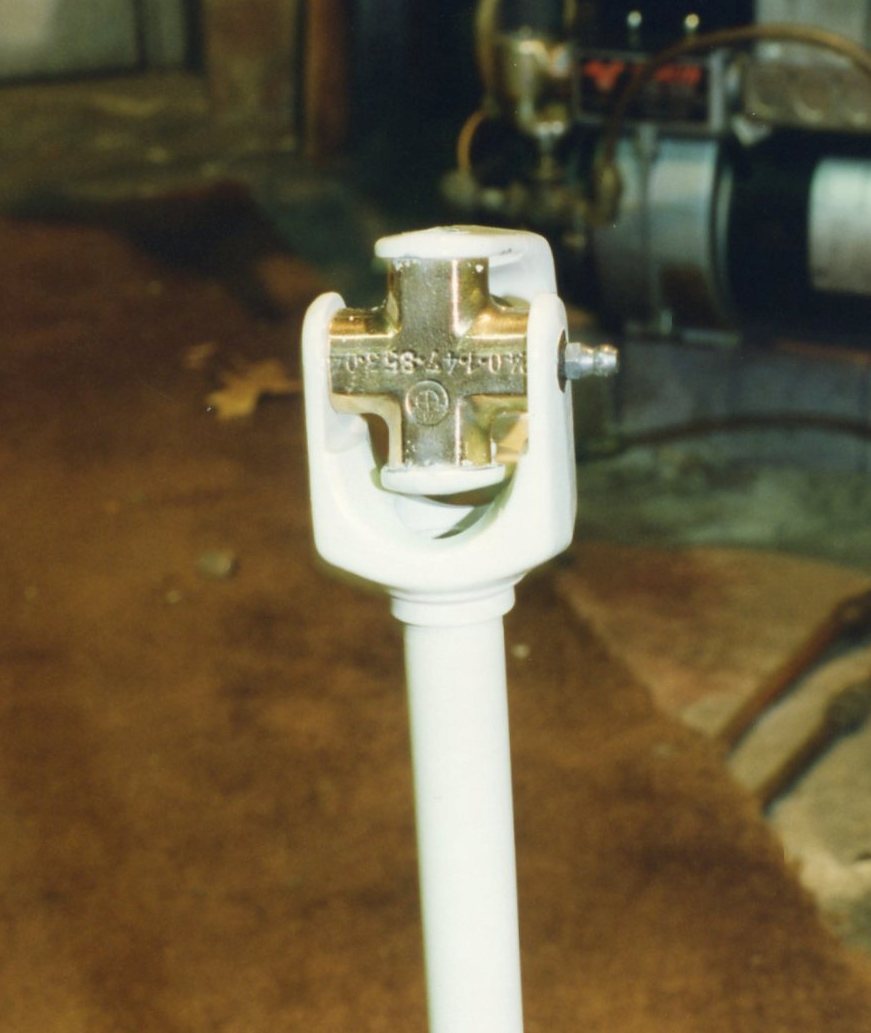
I was unsure if the steering column from the factory was painted silver or the same off-white as the steering wheel. In the end, I decided that the almond color would look better, so that‘s what it got. The u-joint at the bottom of the column was made of brass, and it polished up so brightly that it would have been a shame to paint it, so I didn’t. Instead, I sprayed it with a clear lacquer for protection.
The polished brass steering column u-joint; note BMW roundel stamped into surface
Pedals
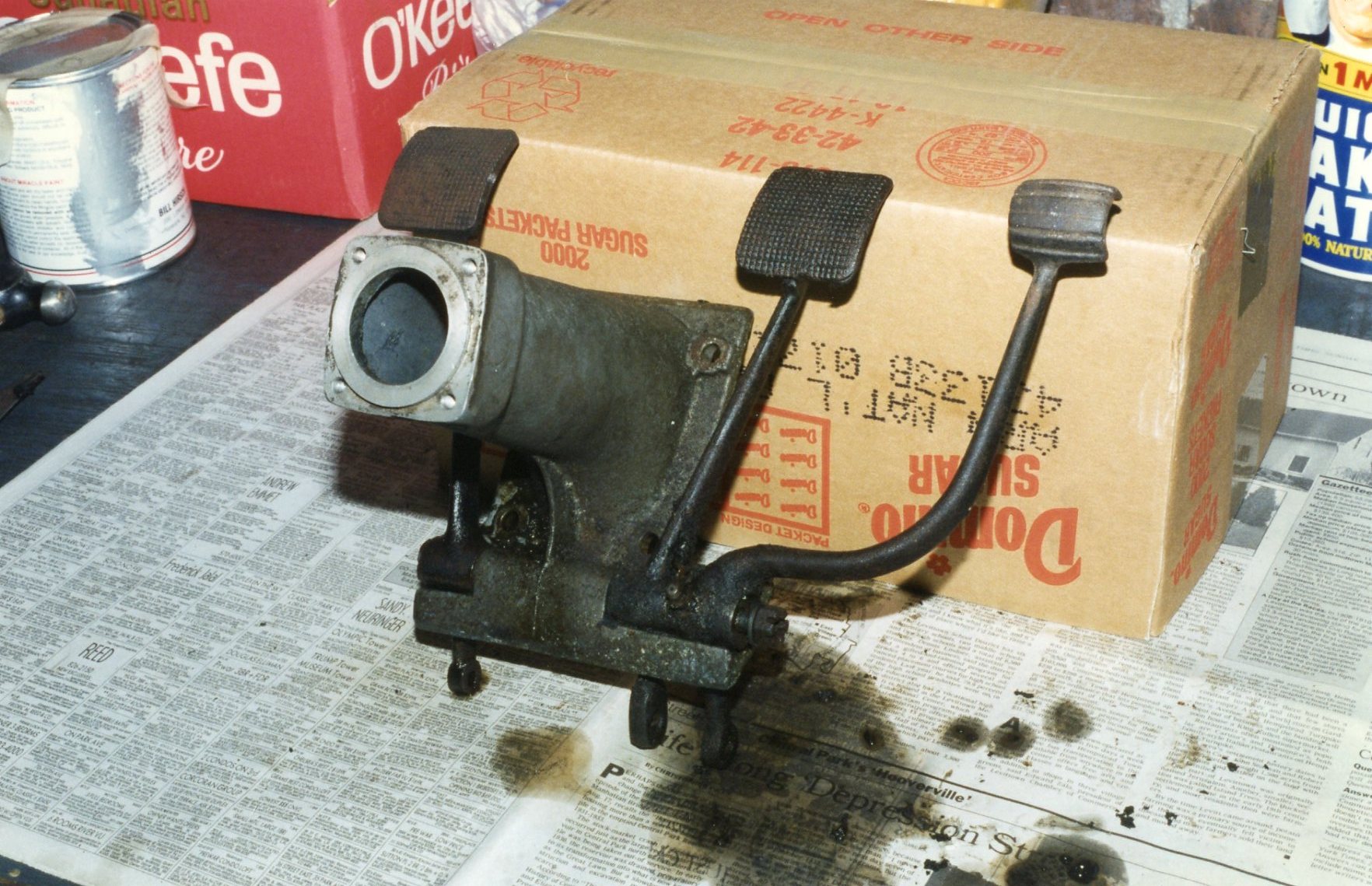
The Isetta pedal setup is conventional: from left to right, there are the clutch, brake, and gas pedals. The steering column is located directly between the clutch and brake pedals, though, so any thought of left-foot braking, much less heel-and-toeing, must be dismissed. What do you think, this is a race car?
The pedal assembly before cleaning; note tube for steering column
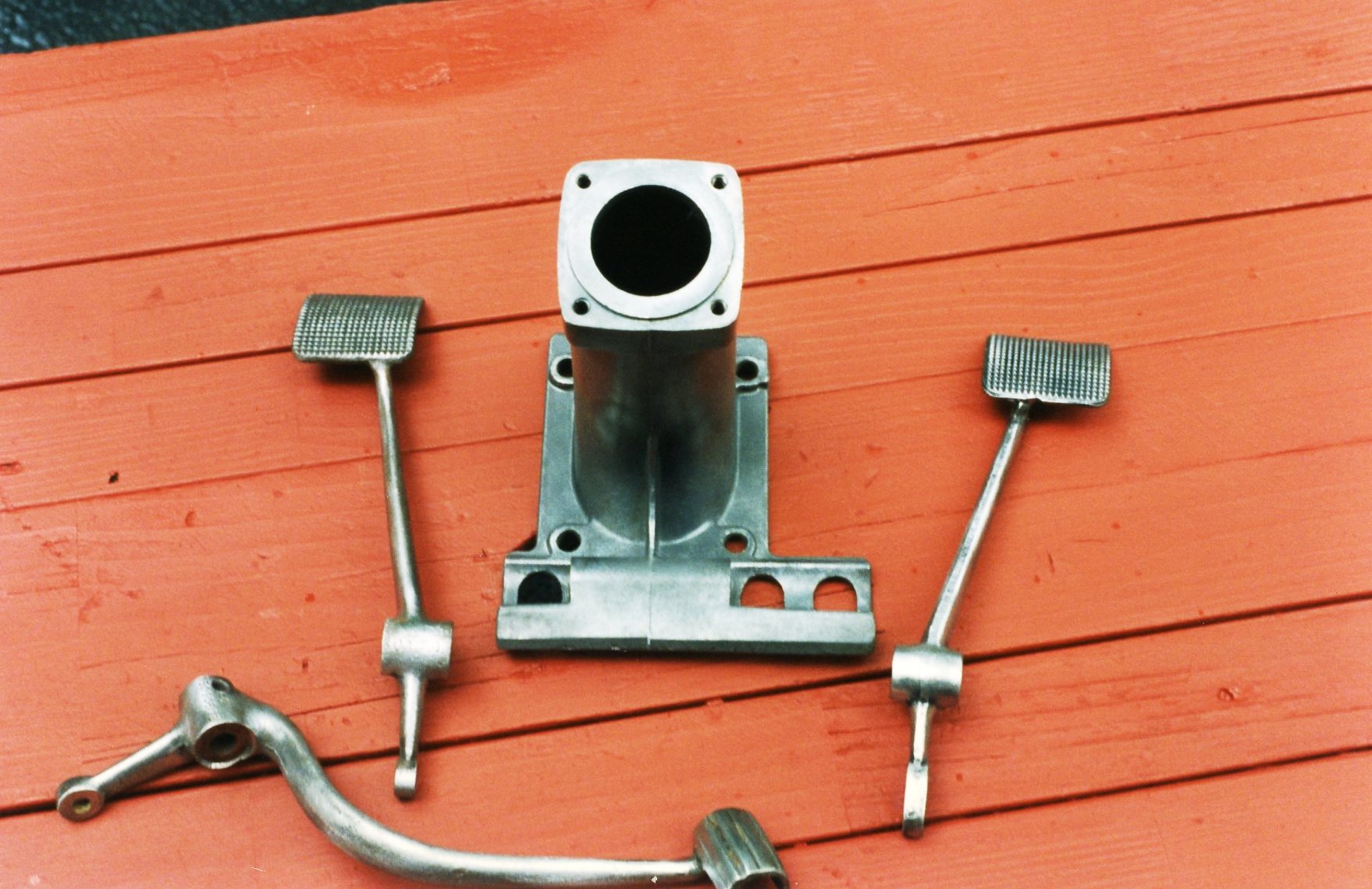
The assembly came apart easily enough, and the metal pedals were cleaned and painted, just like so many other parts. Knowing that the pedal surfaces would eventually show some wear, I applied extra coats of paint to them, and decided that if I drove the car enough to create evidence of use on the pedals, I’d just call it “patina”.
Clean pedals, ready for paint
Dynastart
Instead of a separate starter and generator, the Isetta (and other contemporaneous small cars) used a combined starter/generator called a Dynastart. The combo unit mounted directly on the nose of the crankshaft. A heavy B+ lead went from the battery, to the voltage regulator, then to the starter post on the Dynastart. Turning the ignition key to “start” energized the unit to spin the armature. Once the engine started, it switched to charging mode, and along with regulator, fed DC voltage to the battery.
The Dynastart in “as found” condition
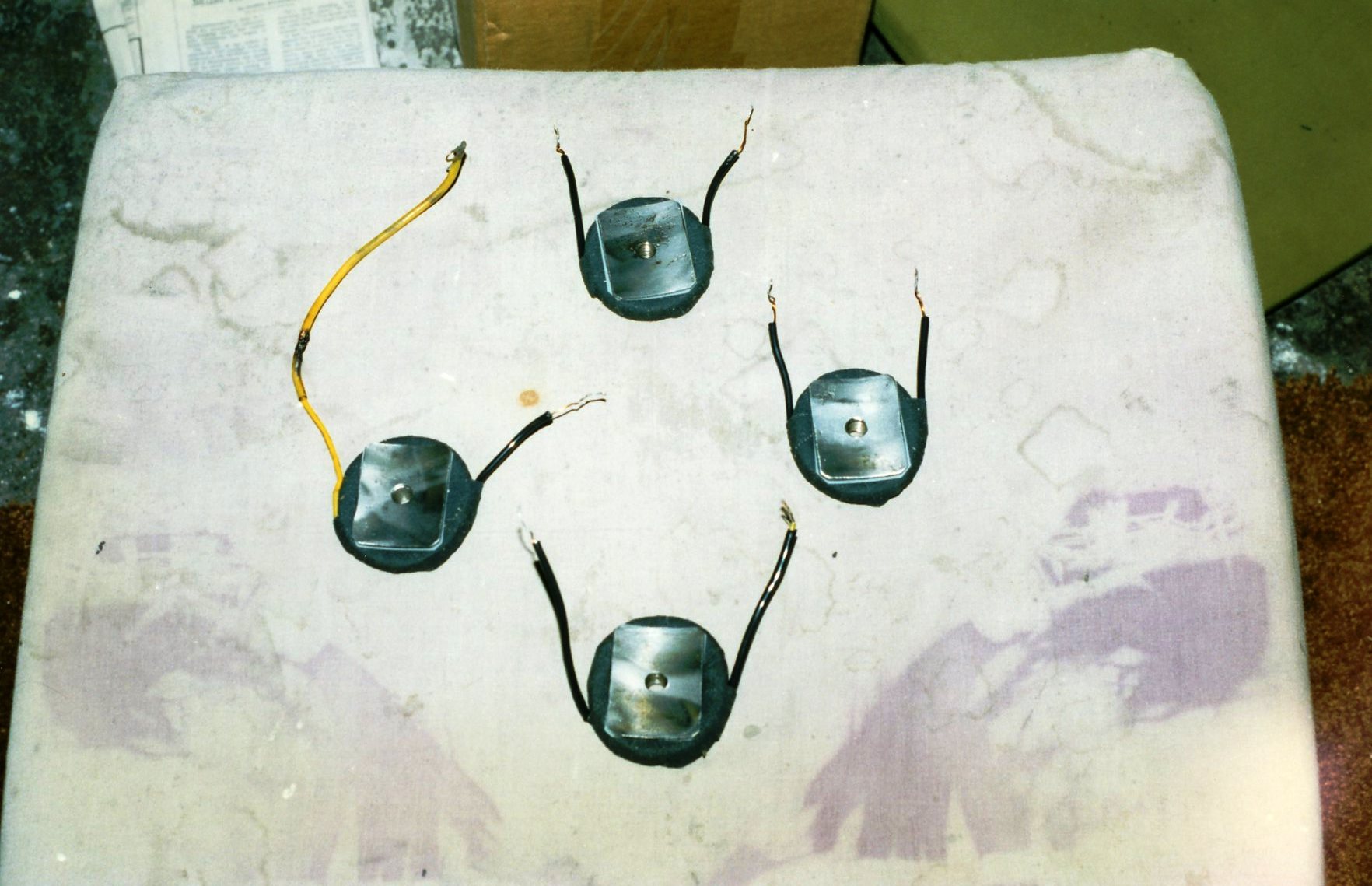
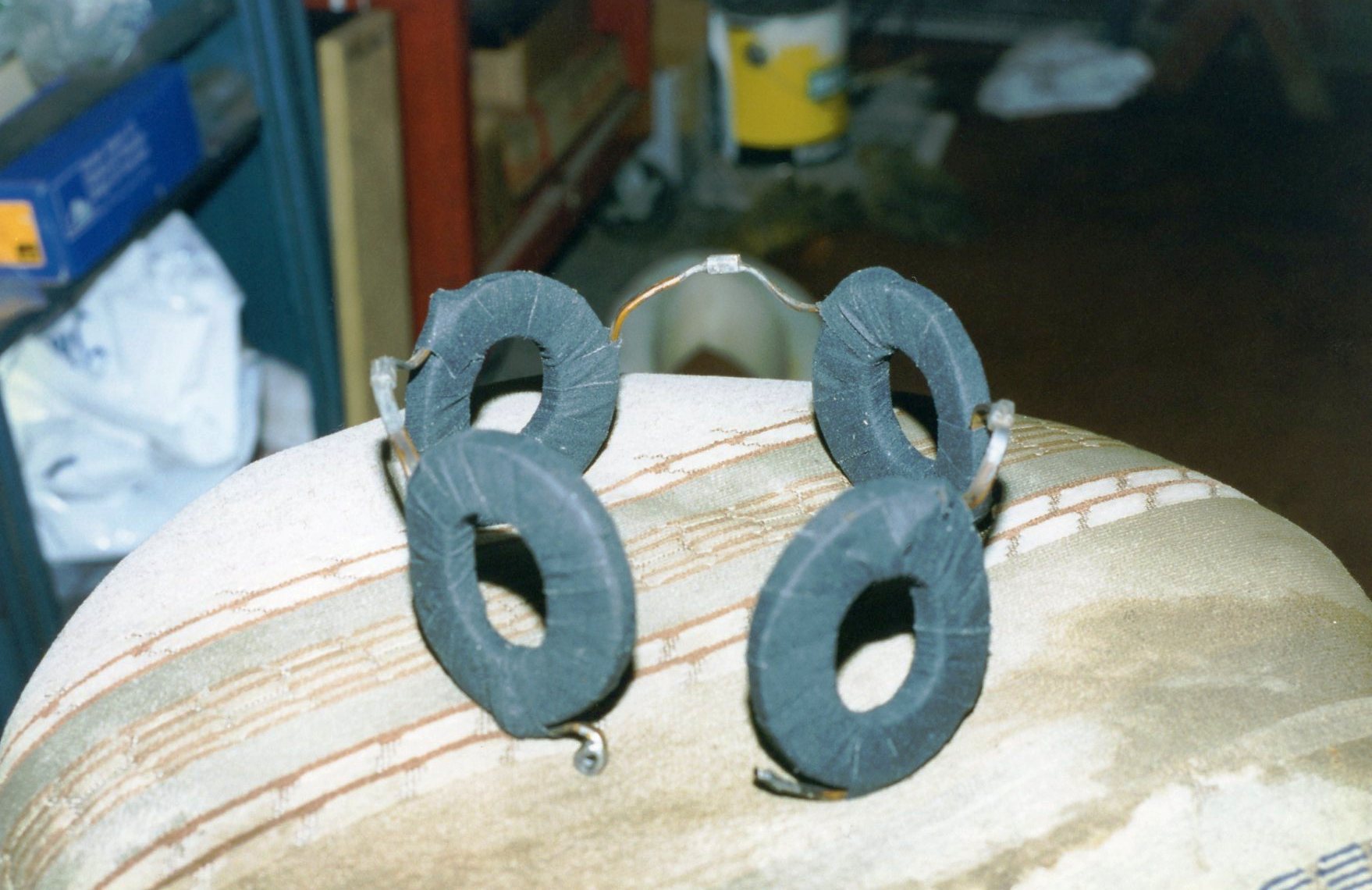
Mine looked like some sparrows had spent several seasons nesting in its confines. The internal magnets, wrapped in electrical tape, showed signs of fraying. Thankfully, John Jensen in his Isetta Restorationbook provided explicit instructions for rebuilding the Dynastart. I took on the task, but not until I purchased supplies of various color wiring and cloth-covered tape.
Magnets removed….
… and retaped
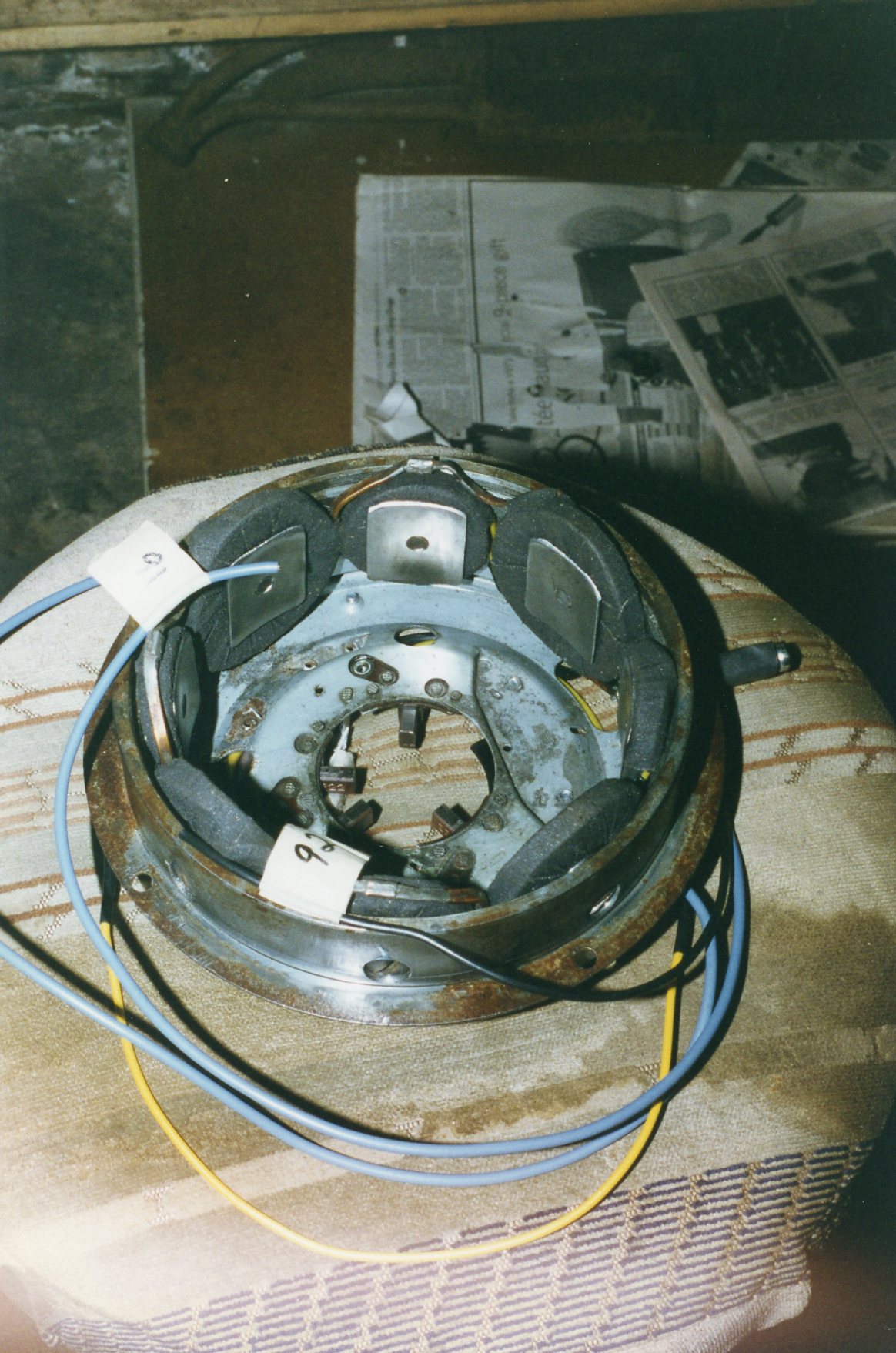
The trickiest part of the job was removing the magnets, and Jensen warned about that. The only way they could be removed was by using a hammer-driven impact tool. Compounding the difficulty, the magnets were held in place with slotted screws, which could be easily stripped. Eventually, it all came apart. All the magnets were retaped, all the wires were replaced, and it all looked visually pleasing. Whether it would start and charge remained to be seen.
The bare shell, to be cleaned and reassembled
Done, and awaiting mounting to engine. Note tags on wiring.
The completed Dynastart meant that I could almost hear that thump-thump-thump of that one-cylinder vertical at idle. That moment would need to wait. With 1994 drawing to a close, the year gave me a final chance to take my car, as it was, to a show:
TOY DAY
My employer, Volvo Cars of North America, had an irregular annual tradition called Toy Day. It was a chance for employees who were auto buffs to display their toys at work. A Toy Day was held in October of 1994, and I was determined to make a presentation, even if I were the only one who wasn’t going to drive his toy to work.
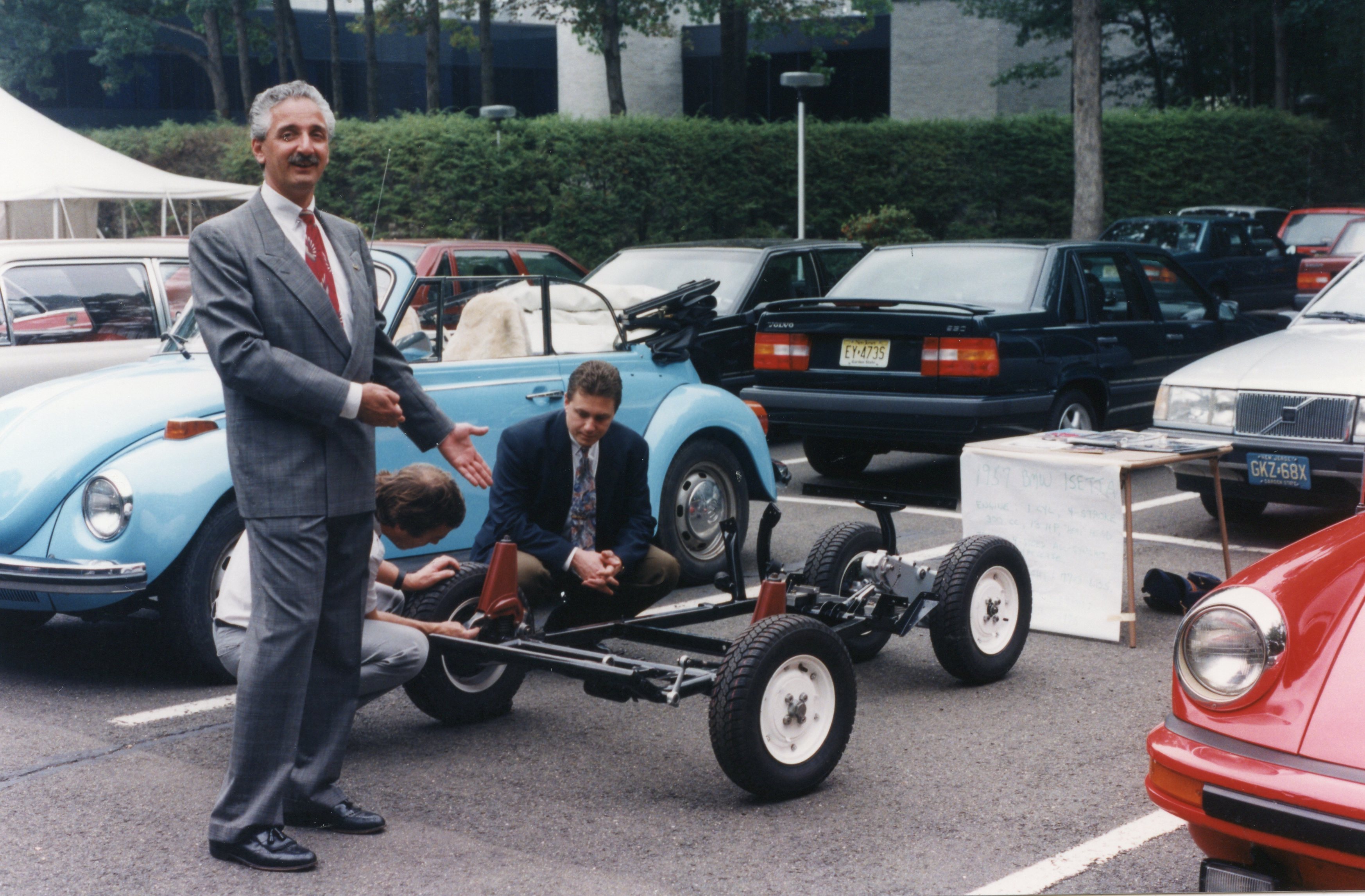
Measuring the back of my Volvo 245, I saw that the rolling chassis would indeed fit in the rear of Sweden’s finest wagon (2nd row seats folded, of course). I maneuvered the chassis in there, and included a folding card table so that I could display my photo album and some Isetta literature. I managed to procure a parking spot between two other fine German automobiles, a Beetle convertible and a Porsche 911. (Re-read above about “willingness to allow others to laugh at you”.) My good friend John felt it was his obligation to effect his best salesperson pose for this photograph:
First “public display”. Along with John, two Swedish engineers steal ideas for future Volvos
Events like this only motivated me to keep going. Next, I would prove that the engine would run. Then, I could turn my attention to the body. Not for the first time, I asked myself, “how difficult could this be?”
Next time in the Isetta Saga: 1995 arrives. I said that “The Isetta Will Drive in ’95”. But will it? The year starts auspiciously, as I explore a risky way to purchase all the parts I’m still missing.
With spring just around the corner (the calendar says next Tuesday, even if I spent part of this morning clearing some residual snow from last week’s double-whammy storms), I realized that I had been remiss in updating my own “Calendar of Events”.
Covers coming off soon!
We car guys and gals patiently wait for those final traces of salt to be washed away so we can unhook the Battery Tenders, check fluid levels and tire pressures, and ease our old iron out into the early spring sunshine. It’s nice to be reminded that there will be plenty to do; here’s what’s on my calendar so far (and this is just the first two months of the season):
In Chapter 5, we counted down as the number of Isettas to be restored dwindled from three, to two, to one. Whew! That looks more manageable now.
In Chapter 6 below, we finally get our hands dirty, and perform the first work of any substance on what will some day be a driving automobile.
The Restoration Plan for what would eventually be ONE running and driving Isetta was coming more into focus. Some extraneous parts had been sold off, and remaining parts had been picked through and sorted, a more time-consuming process than first imagined. My gaze now turned to a rusty, crusty, but complete chassis, and the next course of action would be to remove everything from it, including its factory paint. But first, let’s shoot a roll of film!
A rolling chassis, about to have all its parts removed
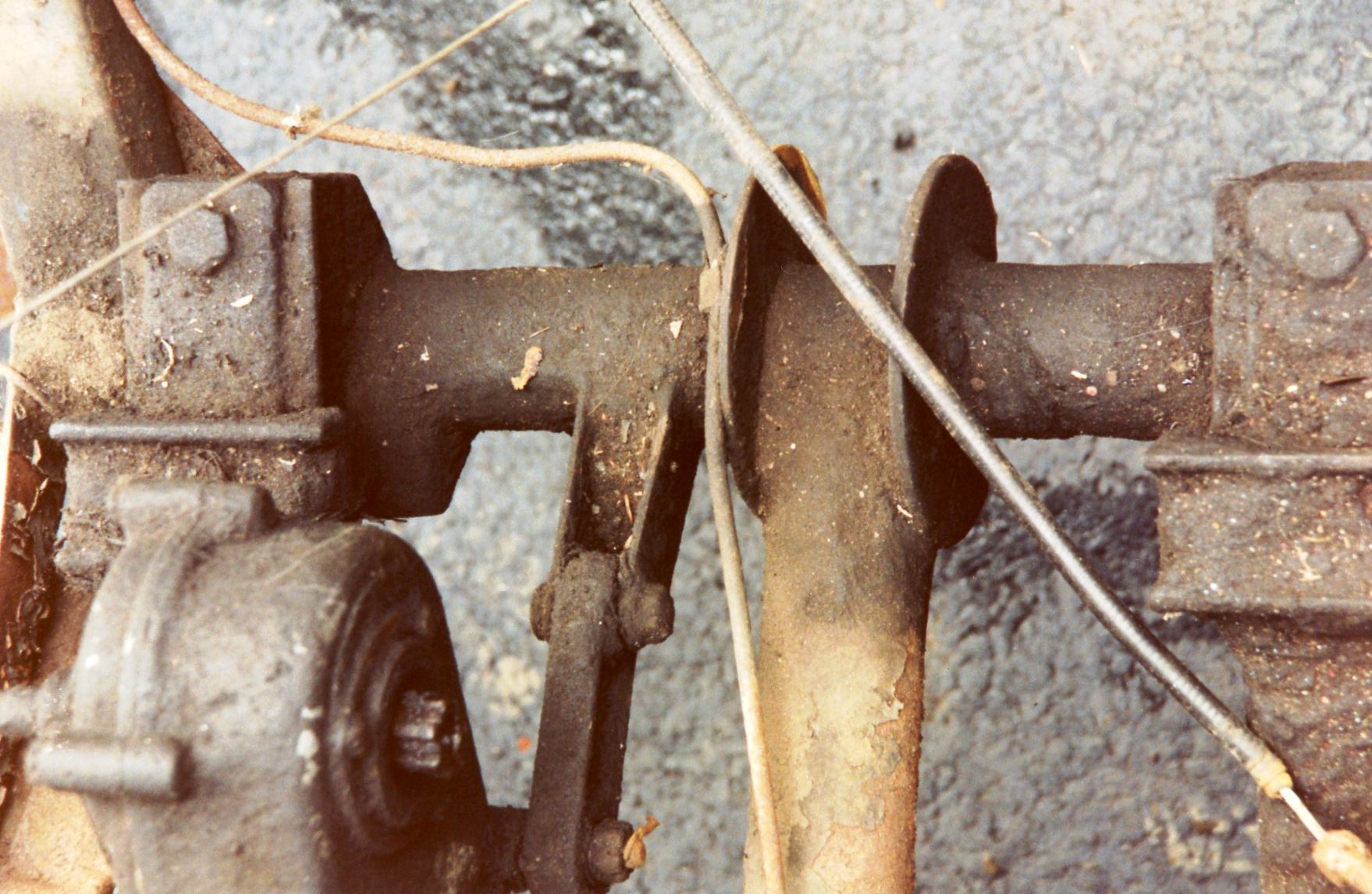
Rear detail; note cables
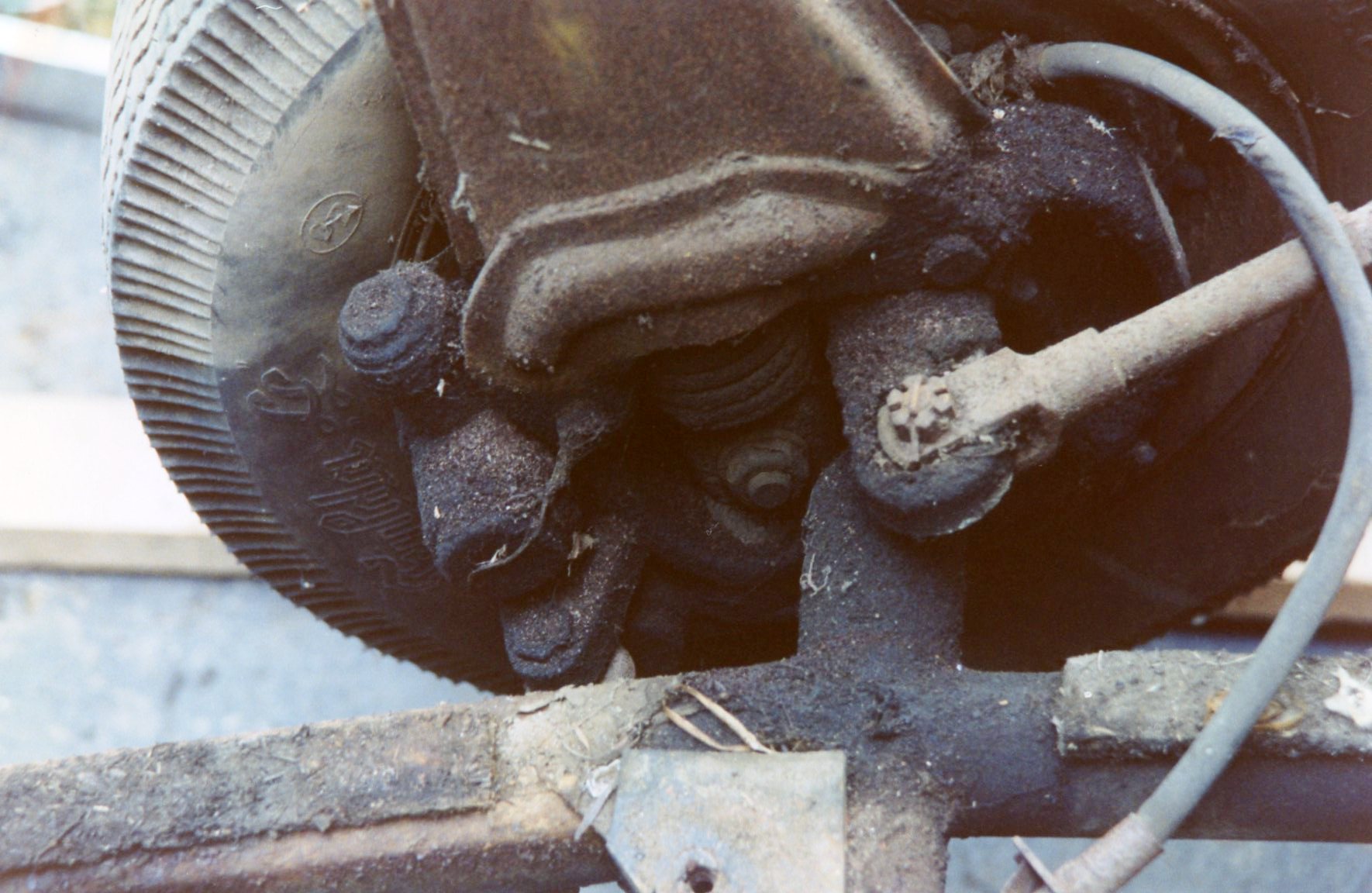
Front detail; note steering stabilizer
Pedal linkage detail
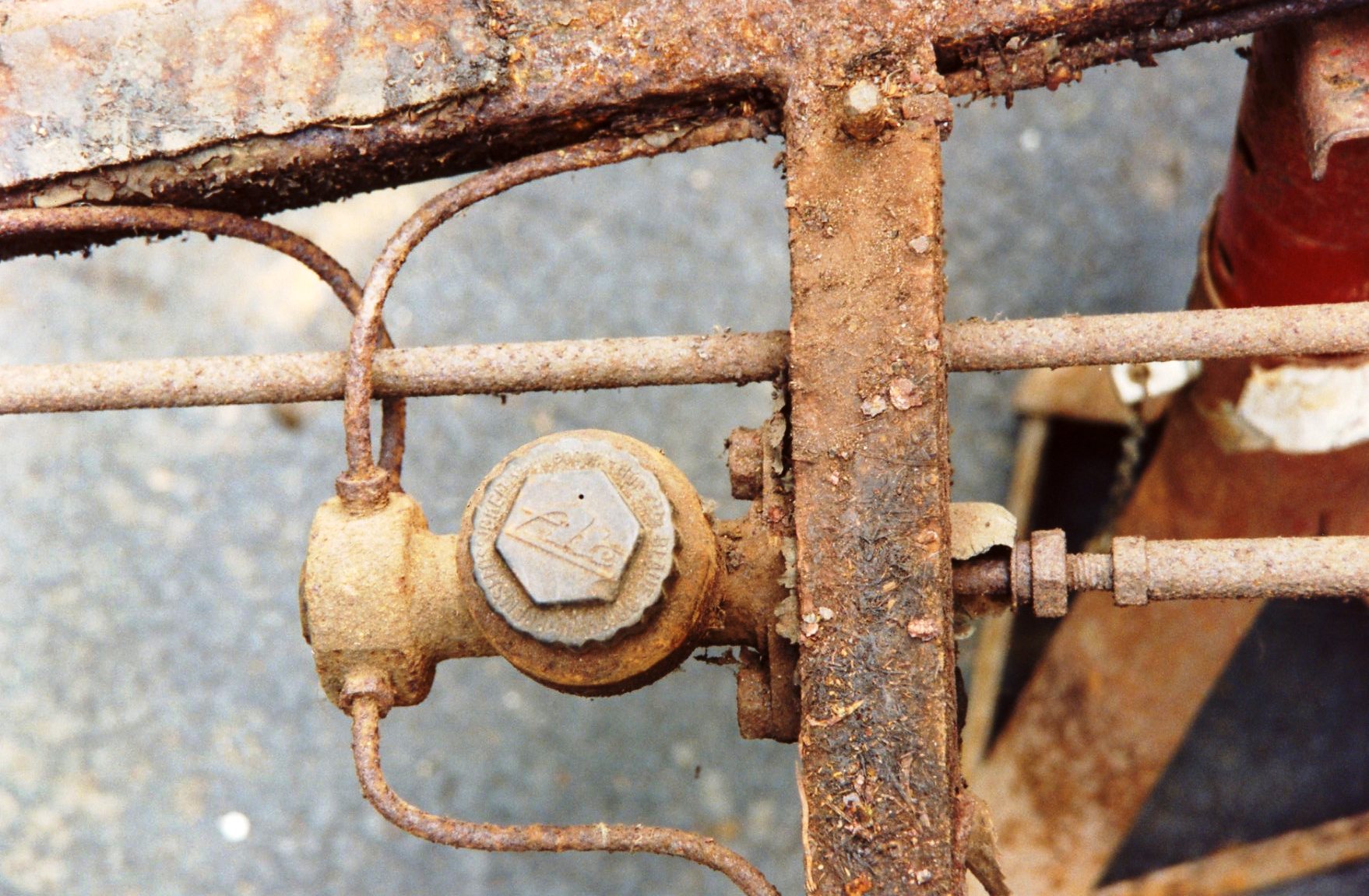
Brake master cylinder detail
Rear brake line detail
Front suspension; note frame padding
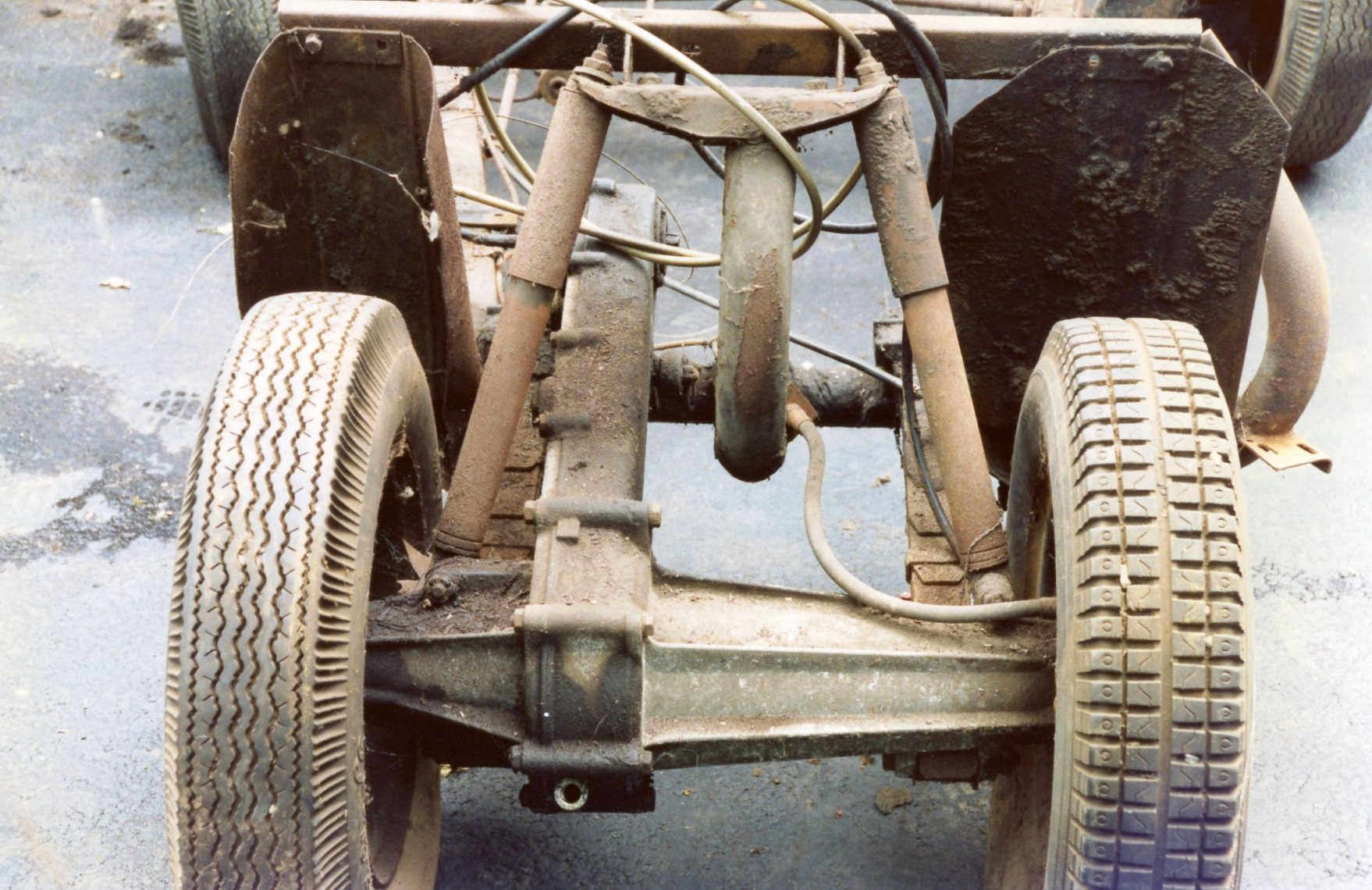
Rear axle; note tube shocks, snow tire
The reasoning (which turned out to be quite correct) was that it could be a few years before I would be reassembling many of these components onto a restored frame. Previous automotive repair work had taught me that you can’t trust your memory, even if you think it’s sharp. (I had experienced instances when, after removing 4 bolts of different lengths from an assembly, I had forgotten the precise locations of those bolts by the next day!)
There was nothing to indicate that any major mechanical work had preceded my ownership of this fine German automobile, so the photographic evidence would provide documentation as to how the brake lines, suspension, foot controls, cables, etc. were installed by the factory. Once the photos were in hand, the chassis was stripped of all mechanical components, and all removed parts were labeled, bagged or boxed, and stored.
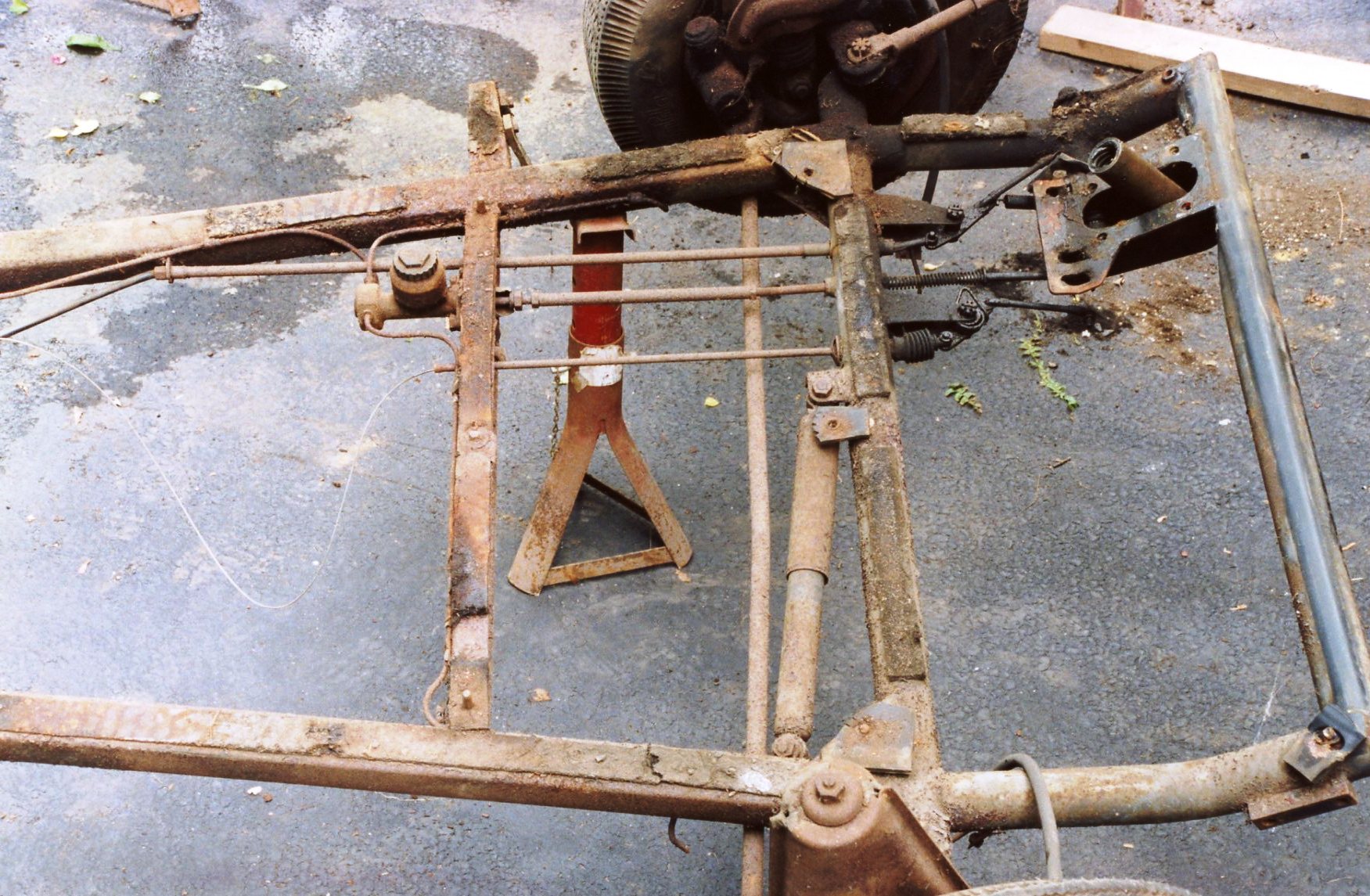
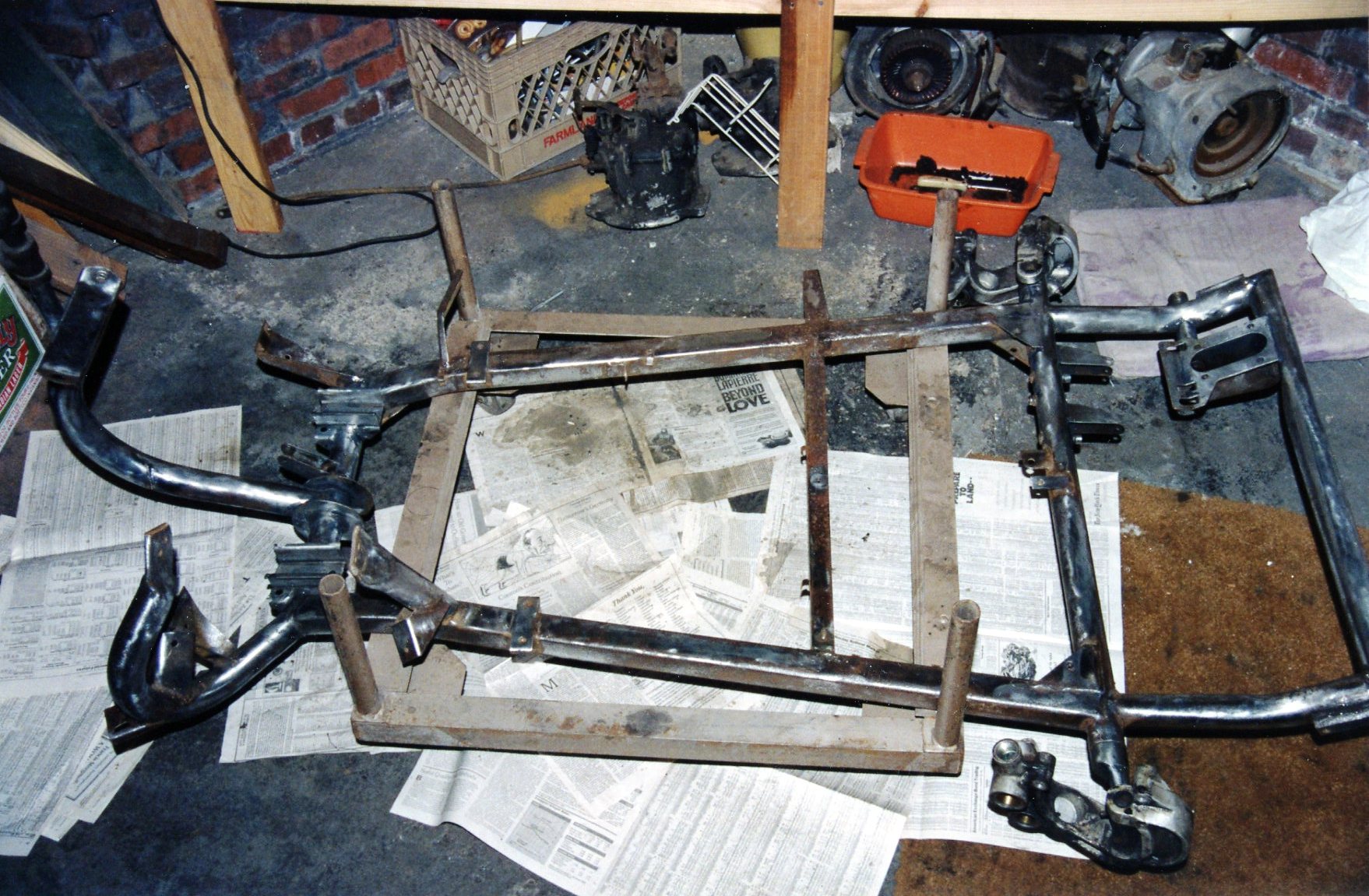
Removed of its parts, but still covered in rust and grime; note as-found dolly
The only untouched parts were the front spindles. They were attached to the chassis via king pins. None of my Isetta parts catalogs showed replacement parts for them, and since I detected no freeplay, I let them be. They were a beautiful cast aluminum, and would not require painting. They would be masked for protection when the chassis was painted.
Cast aluminum spindle in the process of getting spiffed up
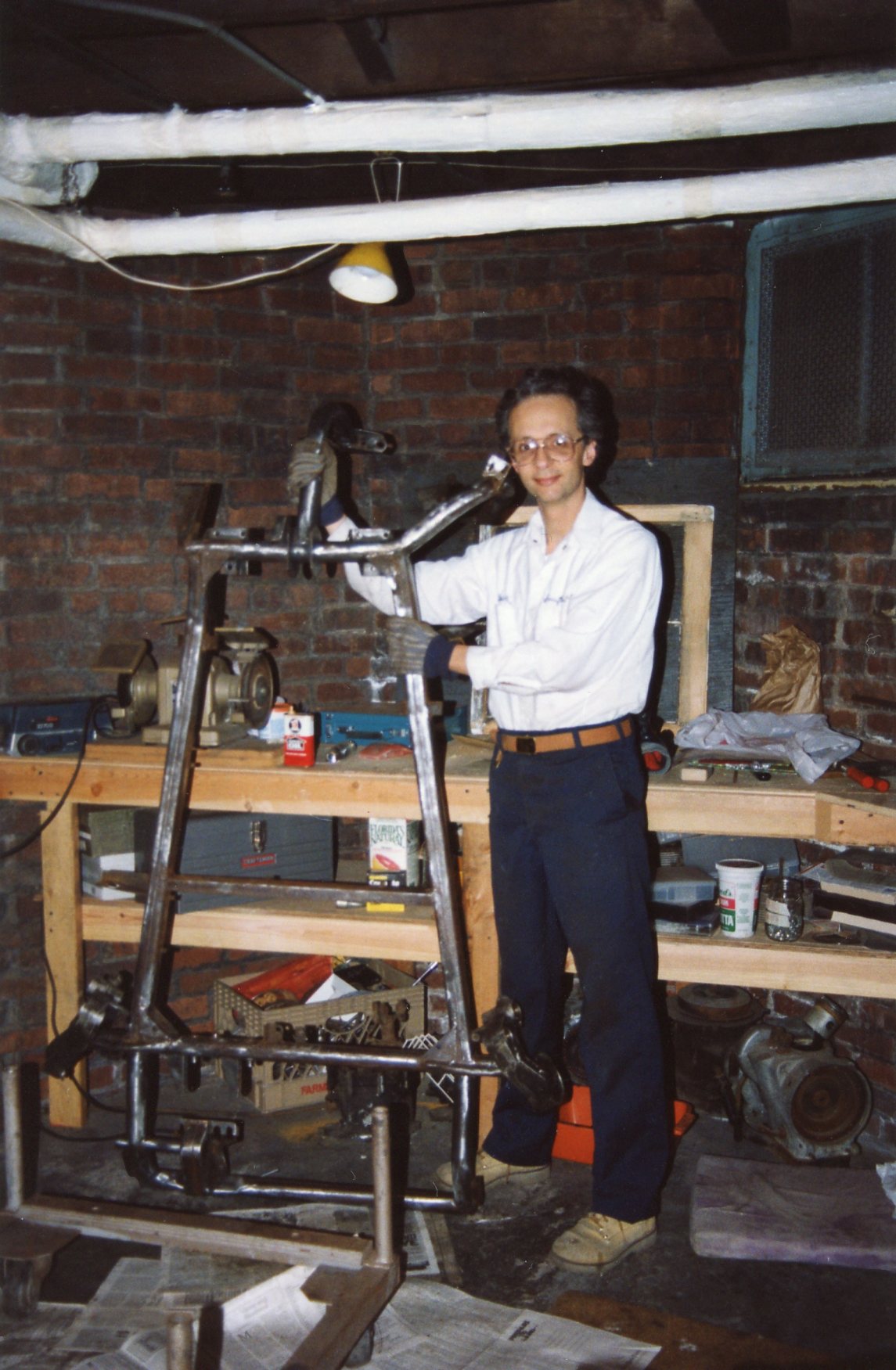
When stood on its end, the bare chassis was about as tall as I was, and weighed perhaps 40-50 pounds. It was a simple affair to lift and carry it into my basement shop, a more comfortable place to work compared to the garage. I set the chassis down onto an all-metal dolly that I found in a trash heap on a Brooklyn street corner while on a music gig. The dolly came home with me, jammed into the back of my wagon along with my drums.
I tackled the old paint and rust with a 3M abrasive wheel, chucked into my handy Black & Decker all-metal drill. A short time later, the chassis was devoid of paint. One could see welding splatter from the factory welds. There were no signs of collision damage, nor had rust permeated the structure in any way.
Protecting my eyes & lungs from the mess
Proud papa poses for portrait
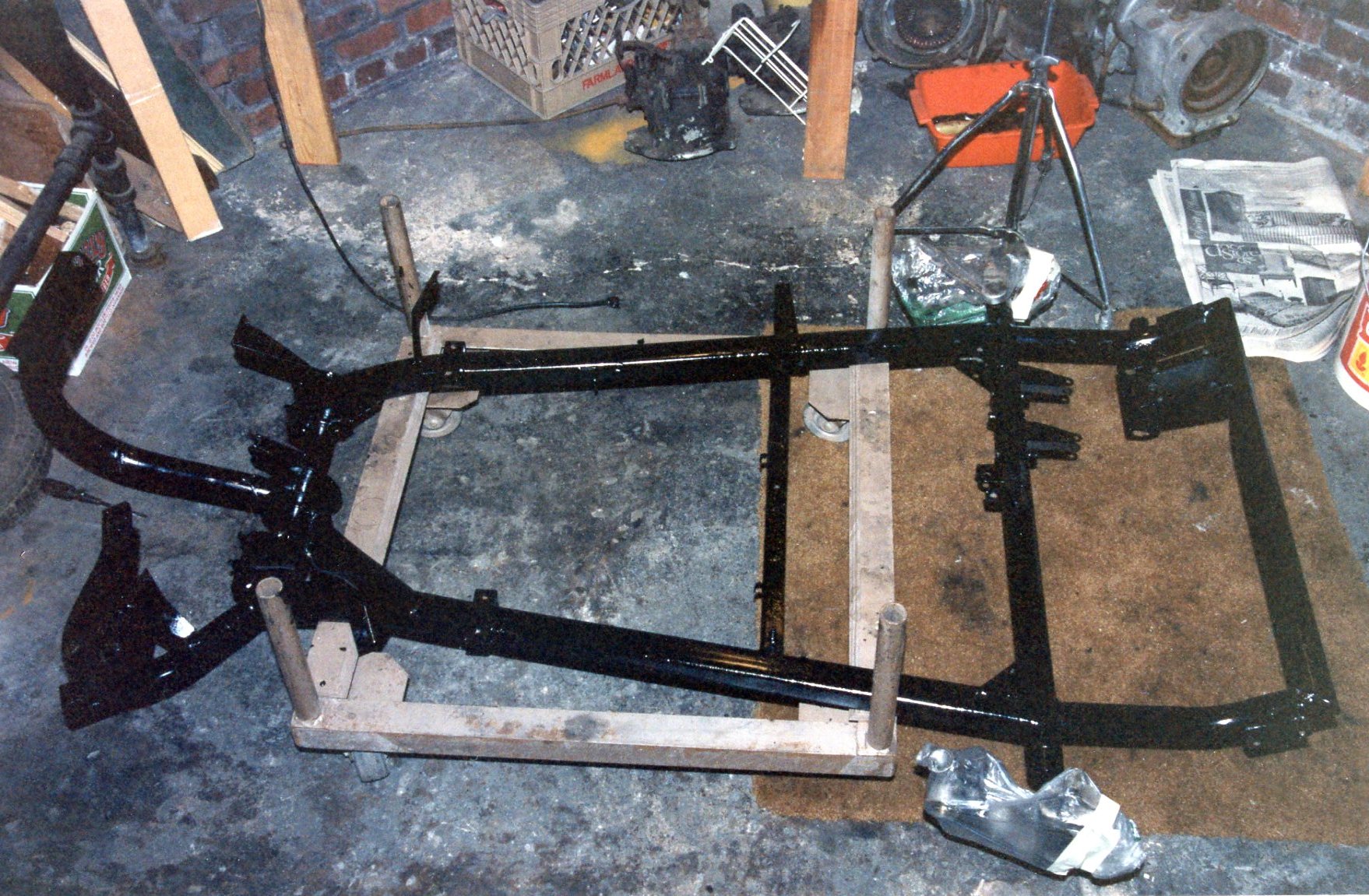
For paint, I settled on Bill Hirsch’s Miracle Paint, a product that was heavily advertised in collector car publications of the day. Compared to POR-15, Miracle Paint was promoted as not requiring a top coat (although one could paint on top of it if desired). Available in black, silver, and clear, I selected black, and when I saw how glossy it was, I decided that no top coat was needed.
Stripped to bare metal
I learned the hard way that if you removed the lid on a can of Miracle Paint, got some paint in the can’s lip, and reinstalled the lid, that lid was not coming off again. The “trick” was this: keep the lid on the can. Shake it well. Using an awl, punch two holes in the top (one slightly larger than the other). Pour out just enough paint as needed into a disposable cup (the 2nd hole allowed the paint to pour out more freely), and close both holes with duct tape. If the duct tape could not be removed, you only had to punch a hole through the tape, and into the existing hole. This worked like a charm.
Although Bill Hirsch sold Miracle Paint solvent, I found it much more efficient to paint with disposable foam brushes. They could be bought at Carlisle for 25 cents each, and the foam left a smooth surface without brush marks. The entire chassis, indeed much of this project, was painted with foam brushes.
Cleaned chassis painted with Miracle Paint
By this time, we were halfway into 1992, and while progress was “steady”, it was also “slow”. In these days, prior to TV shows which glamorized auto restoration, I’d read the occasional article in Old Cars Weekly about someone who restored a ’57 Chevy in six months. Sure! First, you had dozens of parts suppliers who had everything you needed; second, you could attend any car show and find a reference car, should you need to examine one; and third, you were probably retired, and had 40-50 hours a week to devote to the hobby. My path forward offered to none of these advantages.
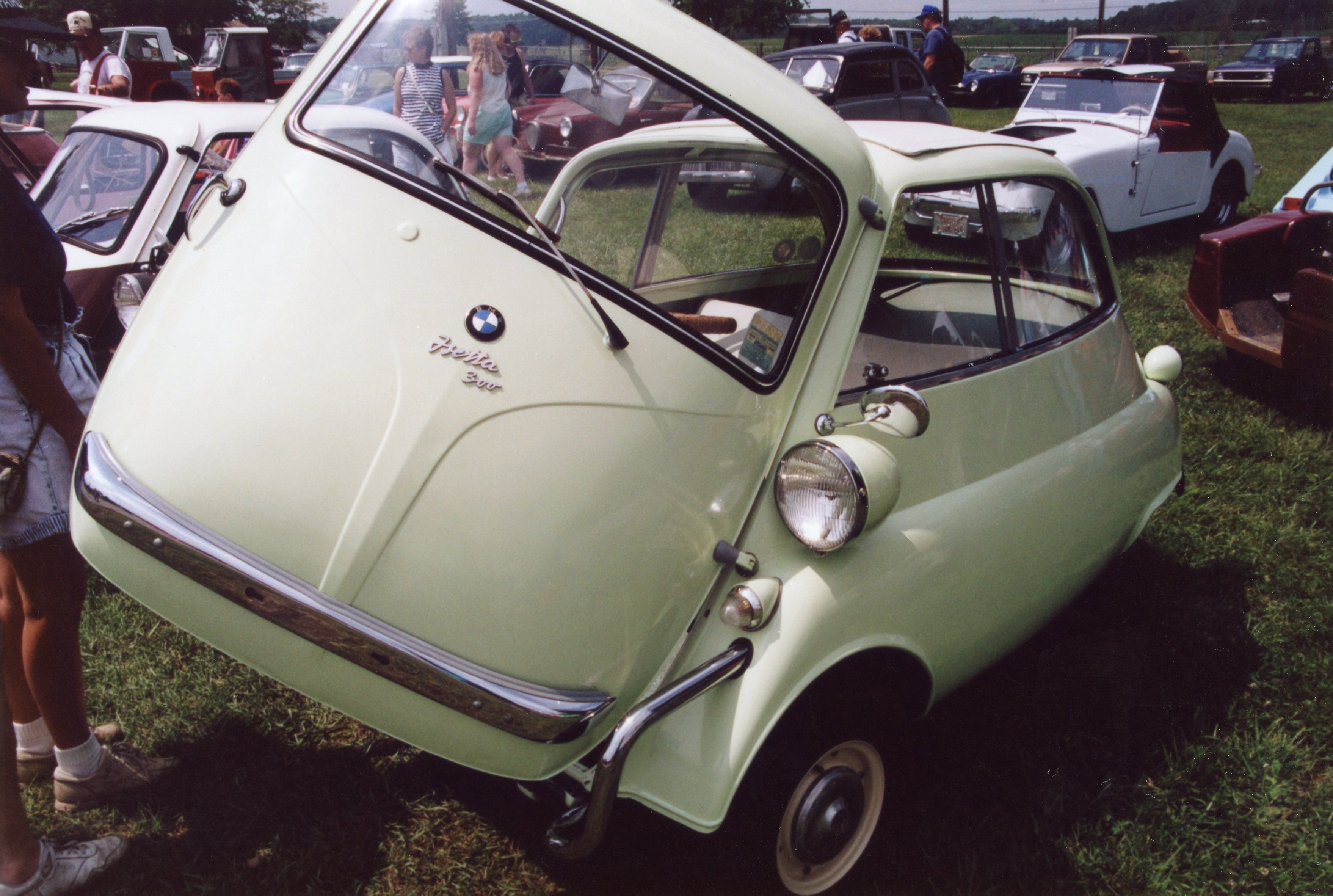
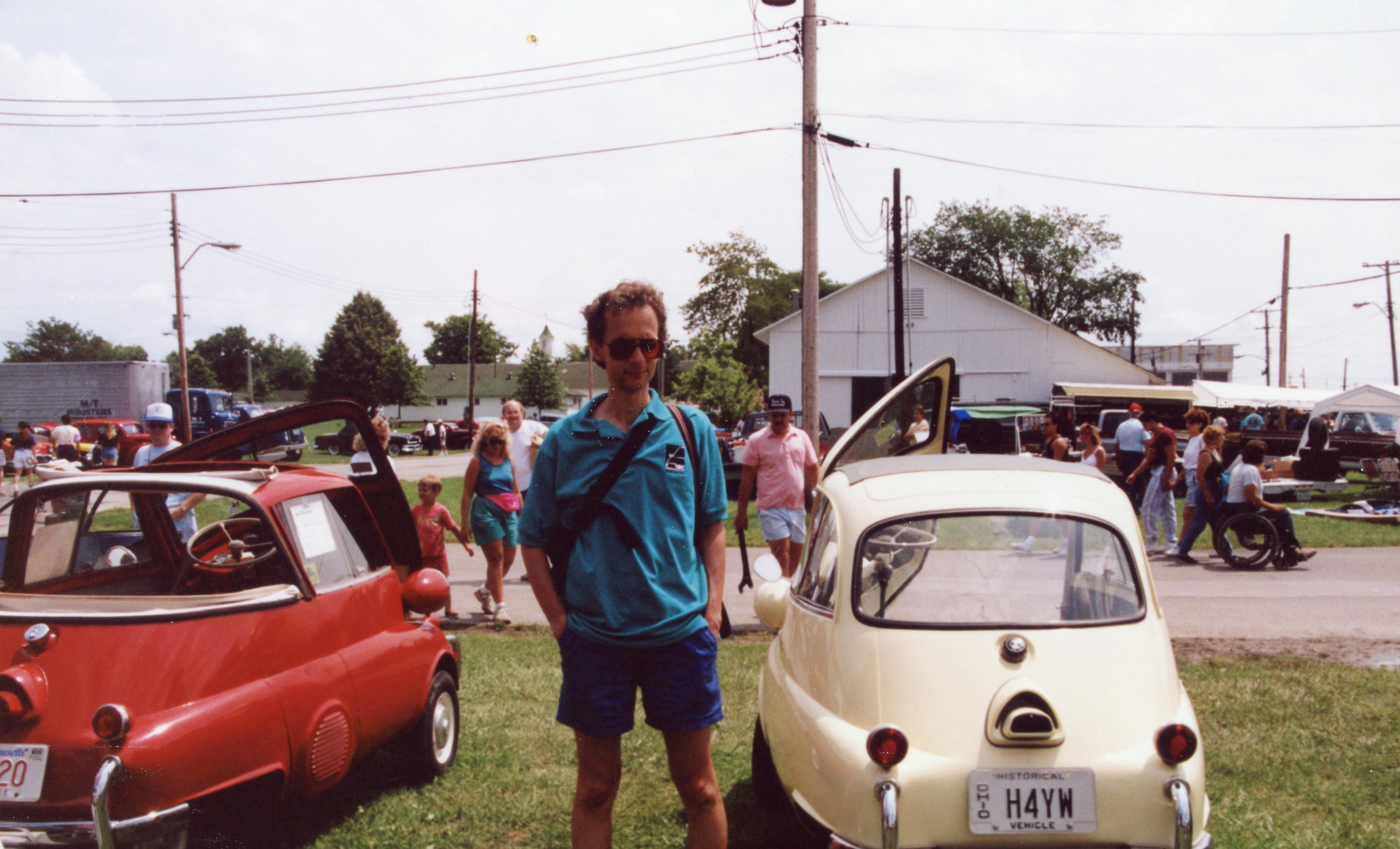
During the summer of 1992, I learned of a car show in eastern Ohio that was planning to feature BMW Isettas in a special class, so we went. Yes, it was a long ride to look at some Isettas, but the last time I had done something like this was ten years prior. My restoration had begun, and I was anxious for the inspiration.
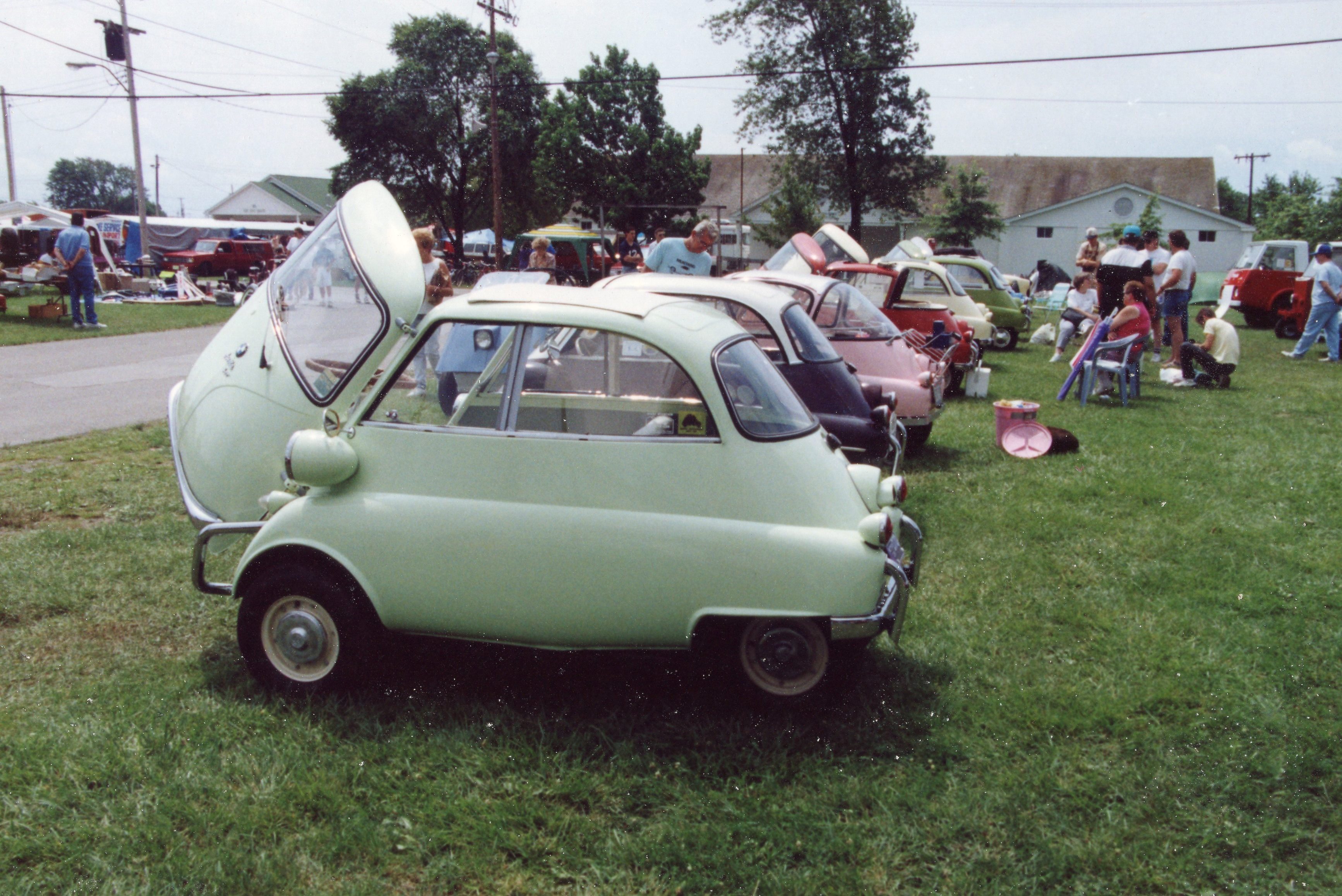
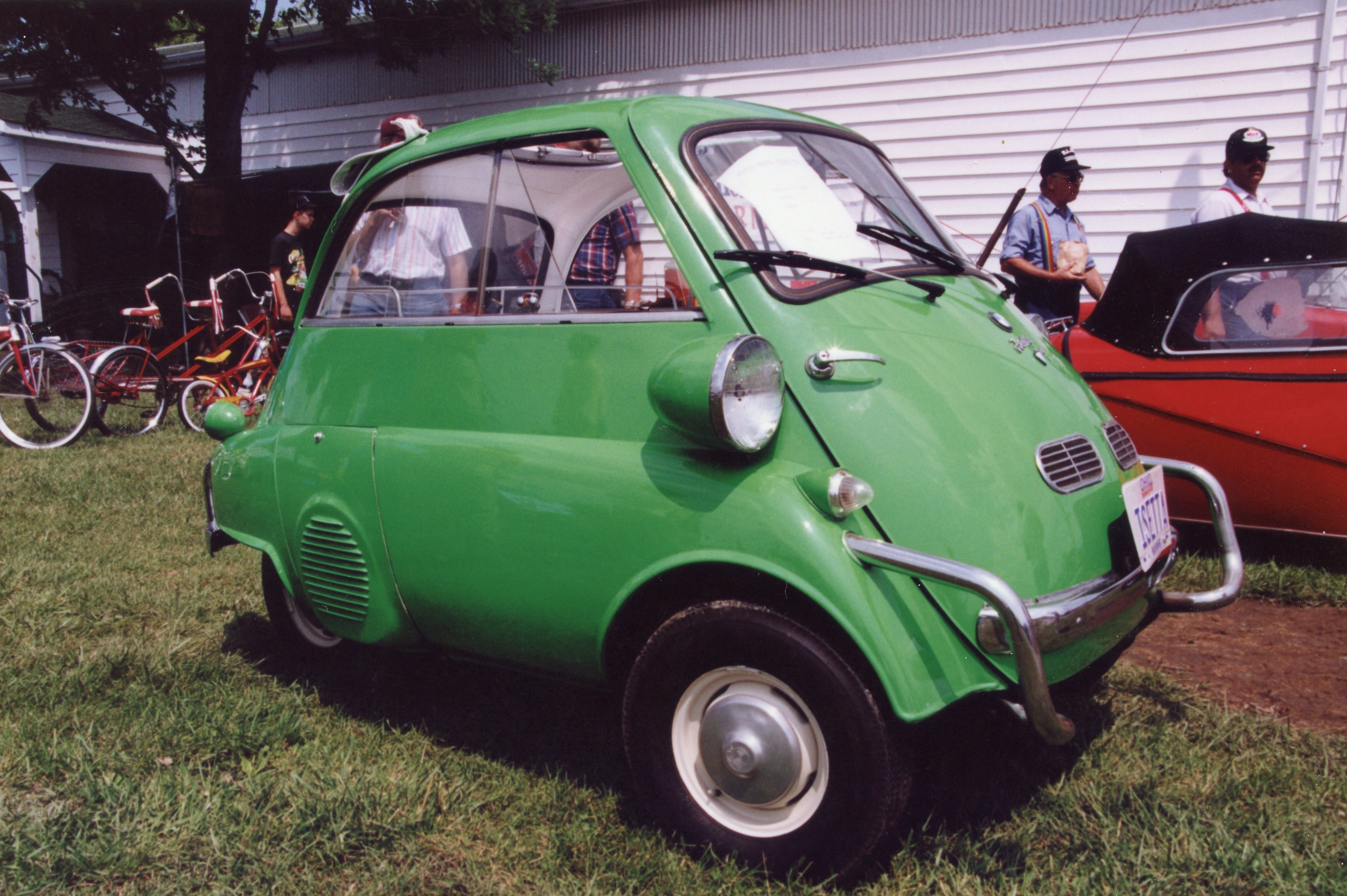
We got to the show, and the turnout was better than expected. Looking much like dyed Easter eggs (and not much larger), the lineup of Isettas made for some striking photos. I chatted with a few owners, one of whom informed me of a new club, called the Microcar and Minicar Club. He provided me with an application, and encouraged me to join.
A row of Isettas is quite the sight
Not an everyday sight in the early ’90s
But the biggest shock of the show was provided by someone who did not have a car on display. I watched as a man set up several display tables, and proceeded to unload crates and boxes of …. new Isetta parts. His name was John Wetzel, and he operated a business that he called Isetta Johns (sic). He lived in Rutherford NJ, most convenient for me, and by all appearances, this was his full-time employment. While I did not purchase from him that day, I obtained his contact information, and assured him that I would be in touch.
Pastel yellow looks like original hue
Bright green, perhaps
A pink one? Elvis’?
My recollection of that show was that it left me feeling overwhelmed, and slightly depressed. I saw that I had a long way to go before my car would be up to the caliber of the cars in Ohio. This, combined with the discovery of someone like Isetta Johns, also altered my thinking about the project. Rather than just get the car to run, only to possibly take it apart again to fully restore it, it seemed the wiser decision to perform a complete restoration while it was all in pieces. I needed to step up my game.
The stern look means “get back to work!”
The business world in the early 1990s was as much about organization and motivation as it was about making profits. This certainly was the case at Volvo, what with newly launched efforts on Vision Statements, Mission Statements, Total Quality Management, and so on. Taking a page from this approach, I decided that a motivating slogan would spur me to keep pushing forward. For the umpteenth time, I asked myself, “this car is so small! How long could it take?” The approximate answer to that was “three more years”, which would land me in 1995.
The slogan was born: “THE ISETTA WILL DRIVE IN ‘95”. I printed out multiple copies, and hung one in my workshop at home, and one in my office at work. Some of my Volvo colleagues took pity on me; others thought I had lost my mind.
In Chapter 7 of the Isetta Saga, you’ll learn how the twin discoveries of an Isetta Restoration Book and an “Isetta Dealership” in Pennsylvania provided the kick start to a rebuild of the 1-cylinder BMW motorcycle engine.
The word “chassis”(pronounced CHA-see) is actually French. Its etymology goes back to Latin, but in 13th century Old French, it was spelled “chassiz”, and defined as a “frame” or “framework”. By the 1660s, the spelling evolved to “chassis”, and more narrowly referred to a “window frame”. In 1869, the word was defined as a “sliding frame or carriage base for a large gun” (I’m picturing something more akin to a cannon, rather than a hand-held gun). In 1903, at the start of the automotive industry, it entered the English language as meaning “the base frame of an automobile”.
Although I could find no further explanation as to how the word switched from guns to cars, it seems logical that given the French dominance in the very early years of the horseless carriage, a French word for a car part would easily be adopted. After all, the word “automobile” also comes to us directly from the French.
Remember this the next time you’re eating French Fries.
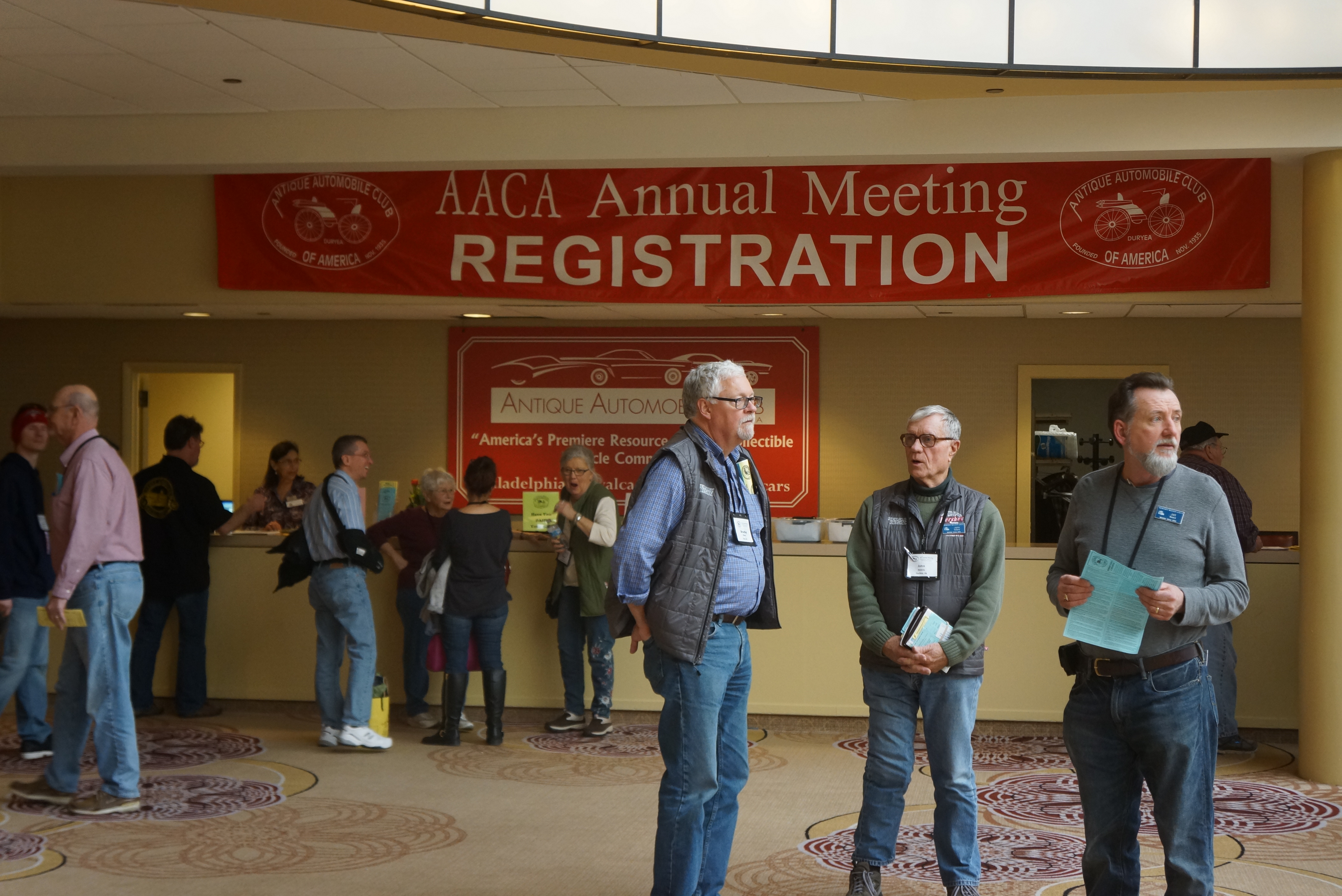
The Antique Automobile Club of America (AACA) held its 82nd annual meeting in Philadelphia PA, from February 8-10, 2018. There is a long history of annual meetings for the club in this city. This was not the first such meeting I’ve attended, but it has been a while since I’ve headed down there. There are years when the Atlantic City Car Show and Auction conflicted with the timing (as was the case this year), but I chose the AACA meeting.
The registration counter at the host hotel, The Sheraton in downtown Philly
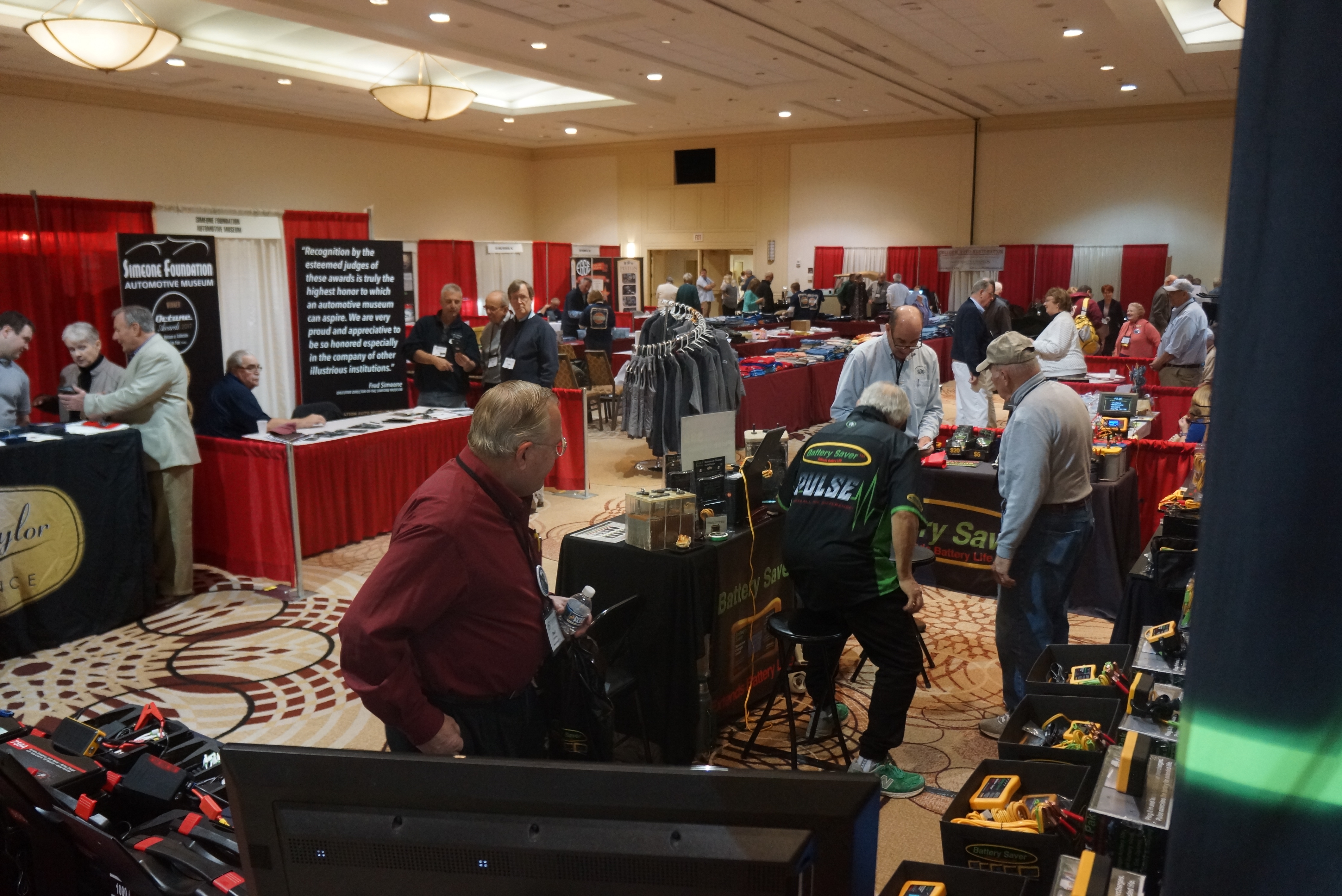
The primary purpose of the annual meeting is the Saturday banquet, during which prize winners from the previous year are recognized. There is a General Membership Meeting on Saturday afternoon. Other meetings for officers, Regional Presidents, and judges are also scheduled. Seminars on various topics of interest to the hobby are held all day Friday, and half the day on Saturday. In parallel, a Trade Show is on site, populated by businesses which support lovers of old cars. For someone like me who attended only on Friday, there is lots to see and do.
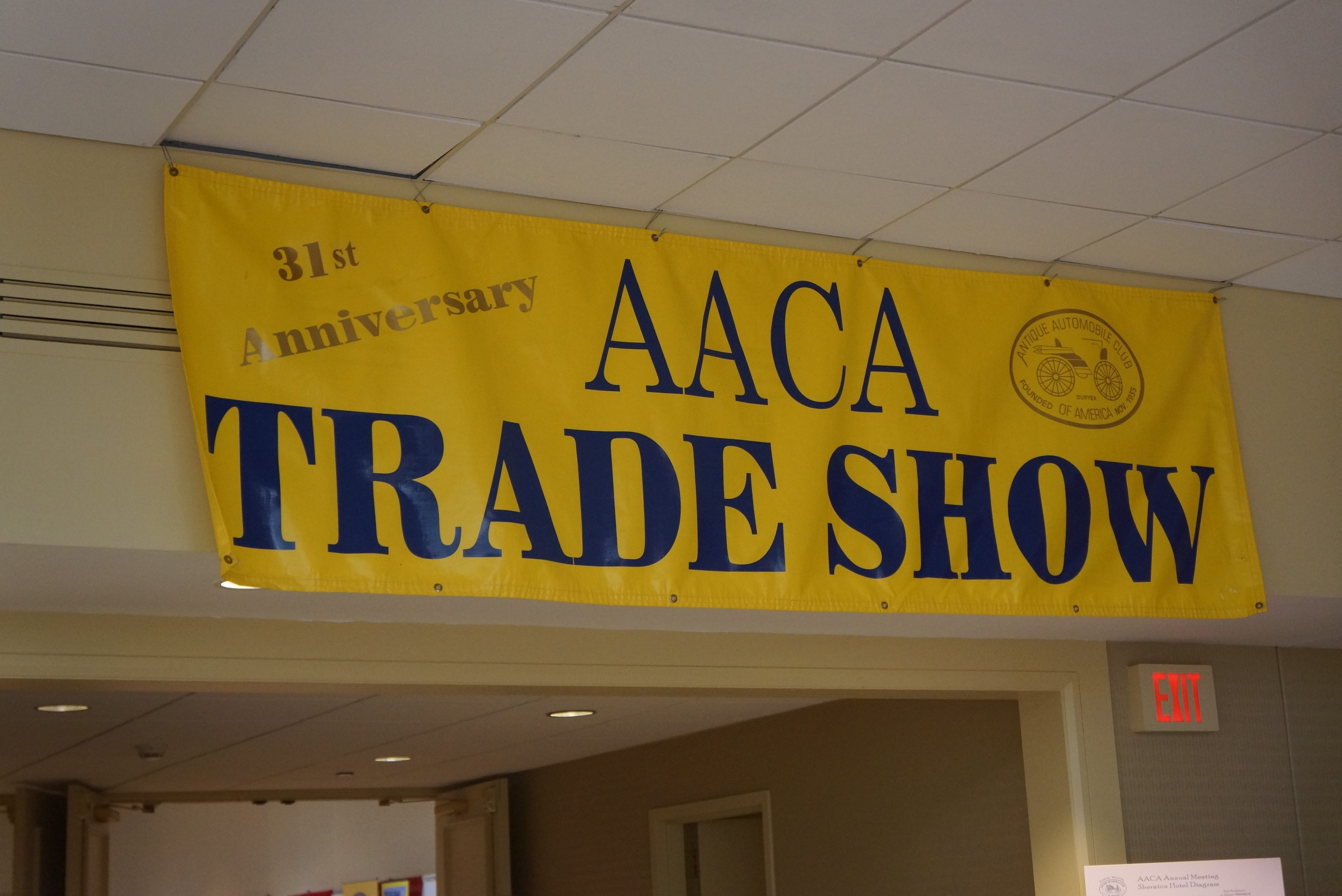
Trade Show banner
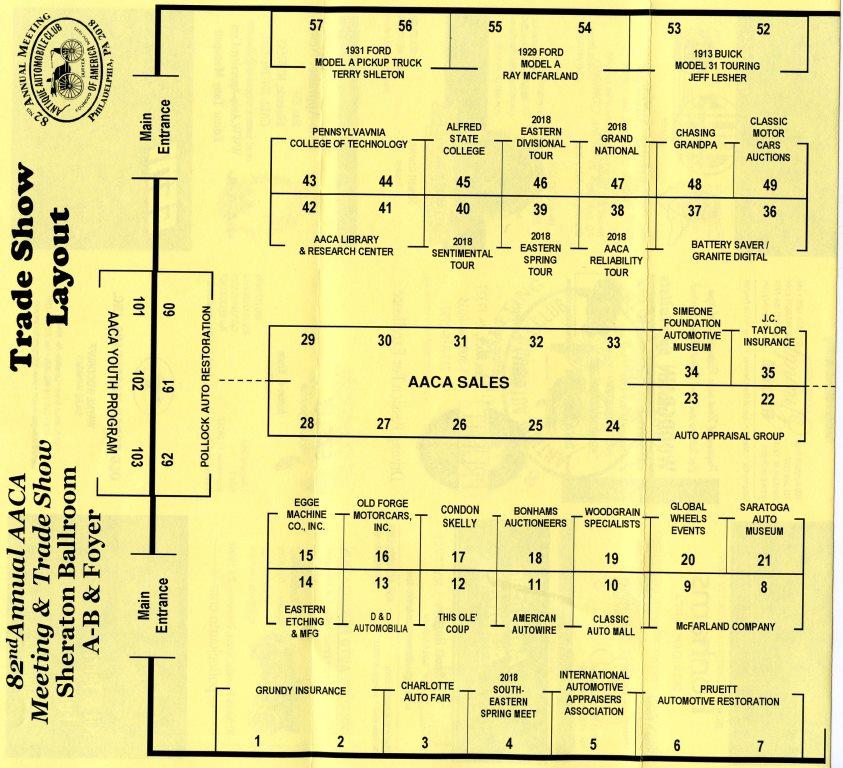
Trade Show floor plan
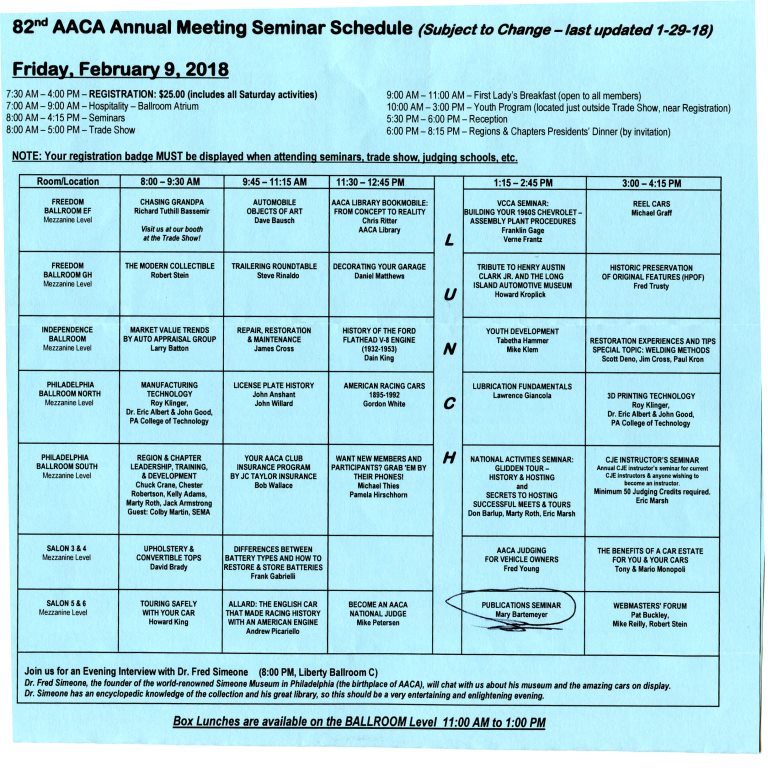
If there is an issue with the Seminar schedule, it’s that one cannot attend every seminar of interest! There are five time blocks during the day on Friday, but each time block is hosting SEVEN different seminars in seven different rooms. So you need to pick the most interesting one. Given that each time block is 90 minutes, there is the option of jumping from room to room, with the obvious downside of potentially missing something interesting.
Friday’s jammed-packed Seminar schedule
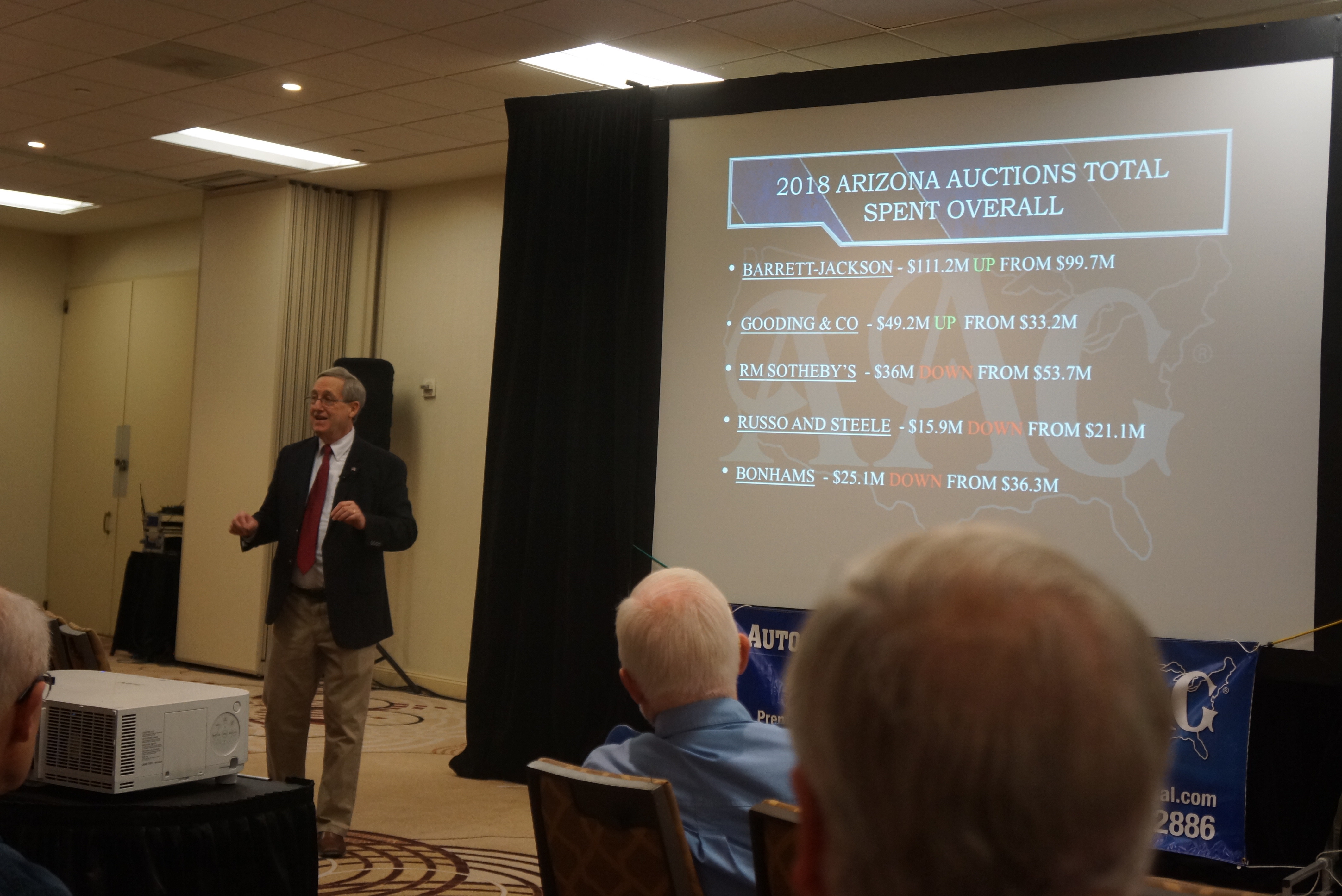
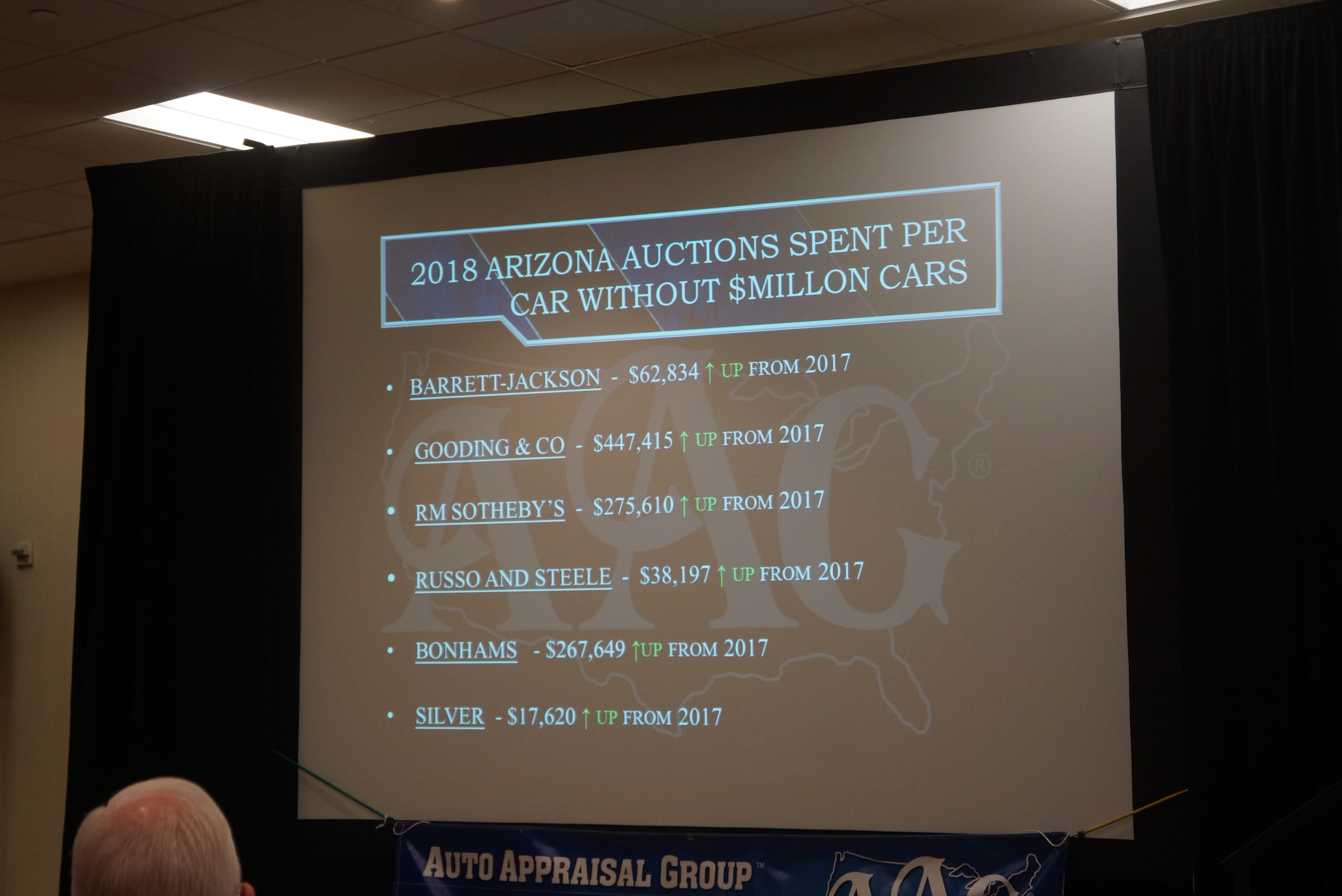
I began Friday morning in the “Market Value Trends” seminar, hosted by the Auto Appraisal Group (AAG) Company. Larry Batton was the presenter, and he showed us various slides which crunched the sales figures from the most recent (Jan. ’18) Arizona auctions. By his own admission, Larry is a numbers guy, and of course, dollars are numbers.
Larry Batton of AAG during his presentation
One of his more interesting observations was summarizing “average sale price” for the auctions MINUS the $1M+ sales, and MINUS the charity sales (which tend to be beyond “fair value”). It gave a somewhat refreshing look at what cars really sell for, once these outliers are struck from the equation.
Larry’s slide shows average sales prices minus the million-dollar cars
He also regaled the audience with a humorous story about a man who “bought back” his own car at an auction, and in doing so, set a world’s record price for that make and model. A few months later, the owner tried to sell the car privately, claiming that the car was worth what he bought it back for. Larry’s point? Do your homework, ask a million questions, ALWAYS ask to see the title, and seek professional help (a plug for his own company).
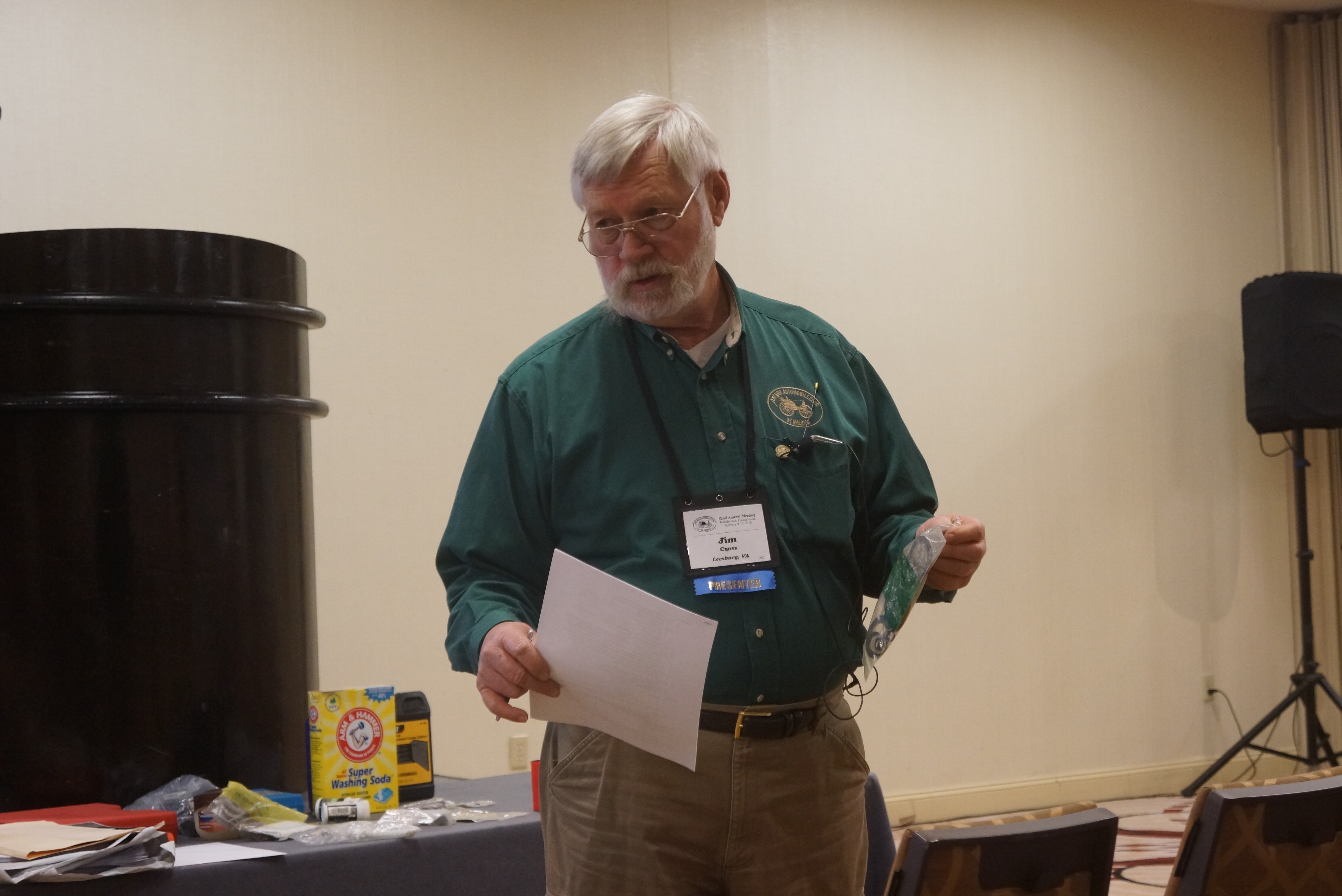
Next was a session called “Repair, Restoration, and Maintenance” by James Cross. Jim approached his topic in a folksy, low-key, somewhat random way. He’s an old-school, likely self-taught restorer who has focused much of his own collection on pre-war cars (he owns a 1909 Buick). He entertained AND educated us with his list of home-brewed remedies (for example, ketchup will clean the outside of brass radiators, and Arm & Hammer Super Washing Soda will clean their insides).
Jim Cross with a bag of his homemade gaskets
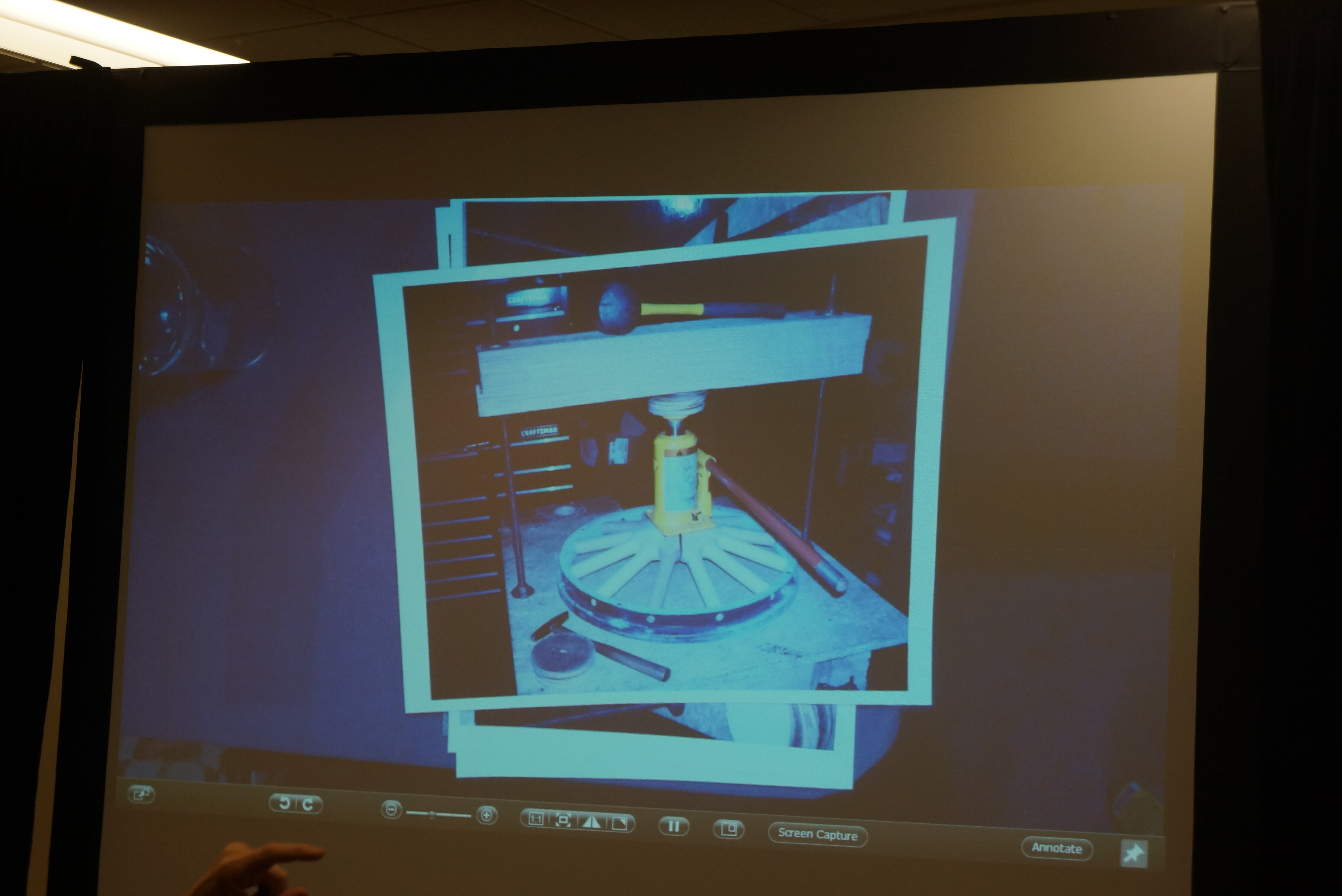
One topic covered by Jim which inspired quite a bit of Q&A from the audience was the repair and restoration of wooden wheels. Based on participants’ reactions, your humble blogger was pleasantly surprised to learn that so many hobbyists still have a need to know how to do this. And this observation brought out the one issue with this presentation (which does not cast the slightest aspersion on Mr. Cross): the room was full of old white men, not one of whom was under the age of 50. All this knowledge is great stuff; but how does it get transferred to succeeding generations? This is not an original thought, of course, and yet it remains a vexing issue for the entire old car hobby.
Jim showed this photo of his own contraption for reassembling wooden wheels
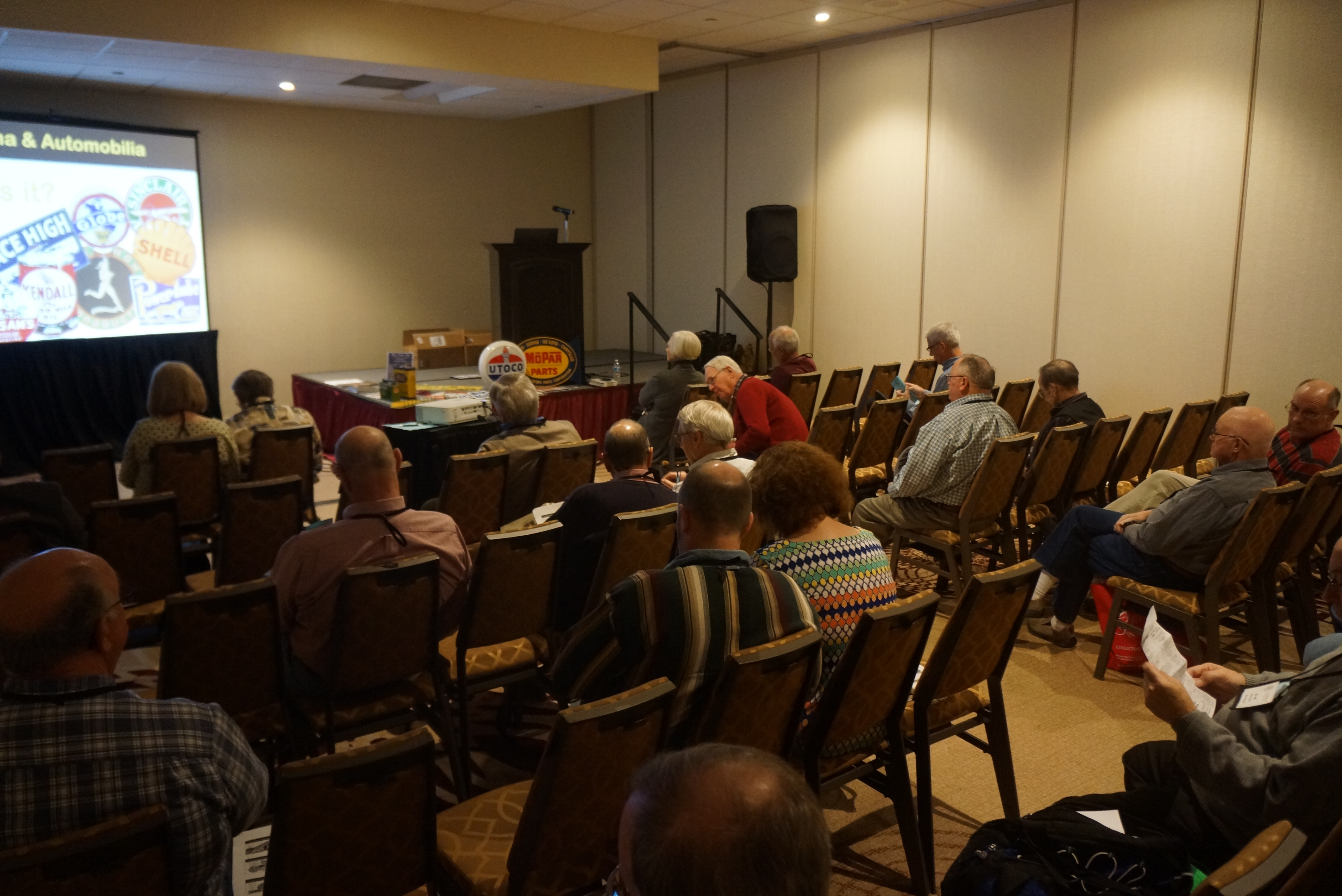
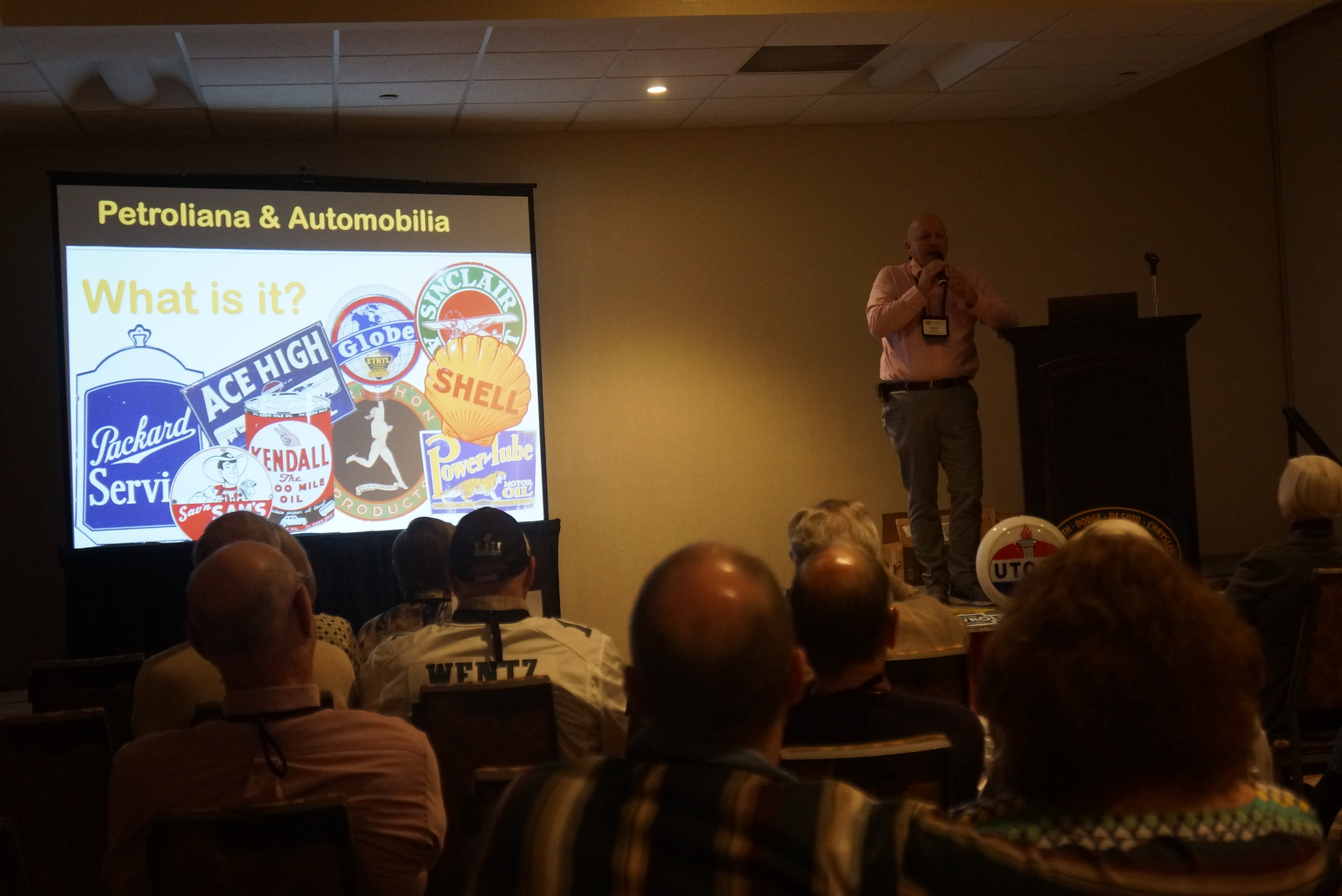
The third and final morning seminar that I joined was given the somewhat misleading title of “Decorating Your Garage”. Dan Matthews, the presenter, is an extremely knowledgeable expert in automobilia and petroliana, having written three books on the topic. His main focus was giving advice to the audience about distinguishing “real” tin and porcelain signs from “reproduction” ones. His fast-paced delivery did not always mesh well with his goal, but it was enough to highlight some of the clues one should look for.
The crowd anxiously awaits the start of “Decorating Your Garage”
It helps if one has some basic knowledge (he was able to rattle off statistics such as “there were only 12 made of this particular sign, and the last one sold for $20,000”), and perhaps one of his books on the subject would help the serious shopper. At the end of the day, the warning is one we’ve heard many times before: “if the price seems too good for it to be real, it probably isn’t”.
Jim Matthews making his presentation
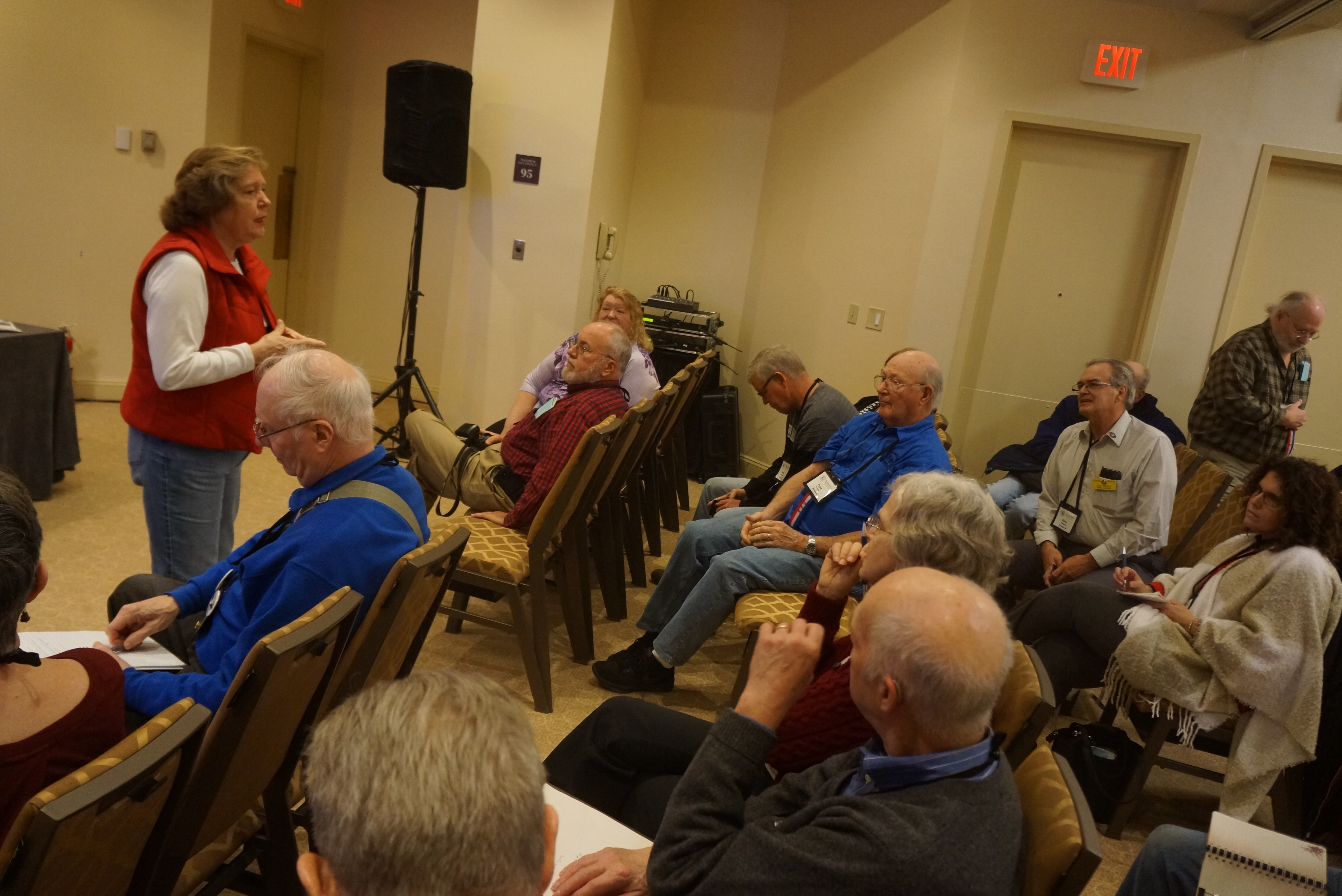
My two post-lunch choices were much more AACA-specific. The “Publications Seminar” hosted by outgoing AACA Publications Chairperson Mary Bartemeyer was designed solely for those who work with their own Regions’ newsletters. (Starting this year, I will be taking a more active role in writing for the NJ Region’s newsletter.) AACA has a long list of “do’s” and “don’ts” for these newsletters, and there is special focus on copyright infringement. We were all admonished that you simply cannot take a photo off the Internet and reprint it in your newsletter.
Mary Bartemeyer, discussing Regional newsletters
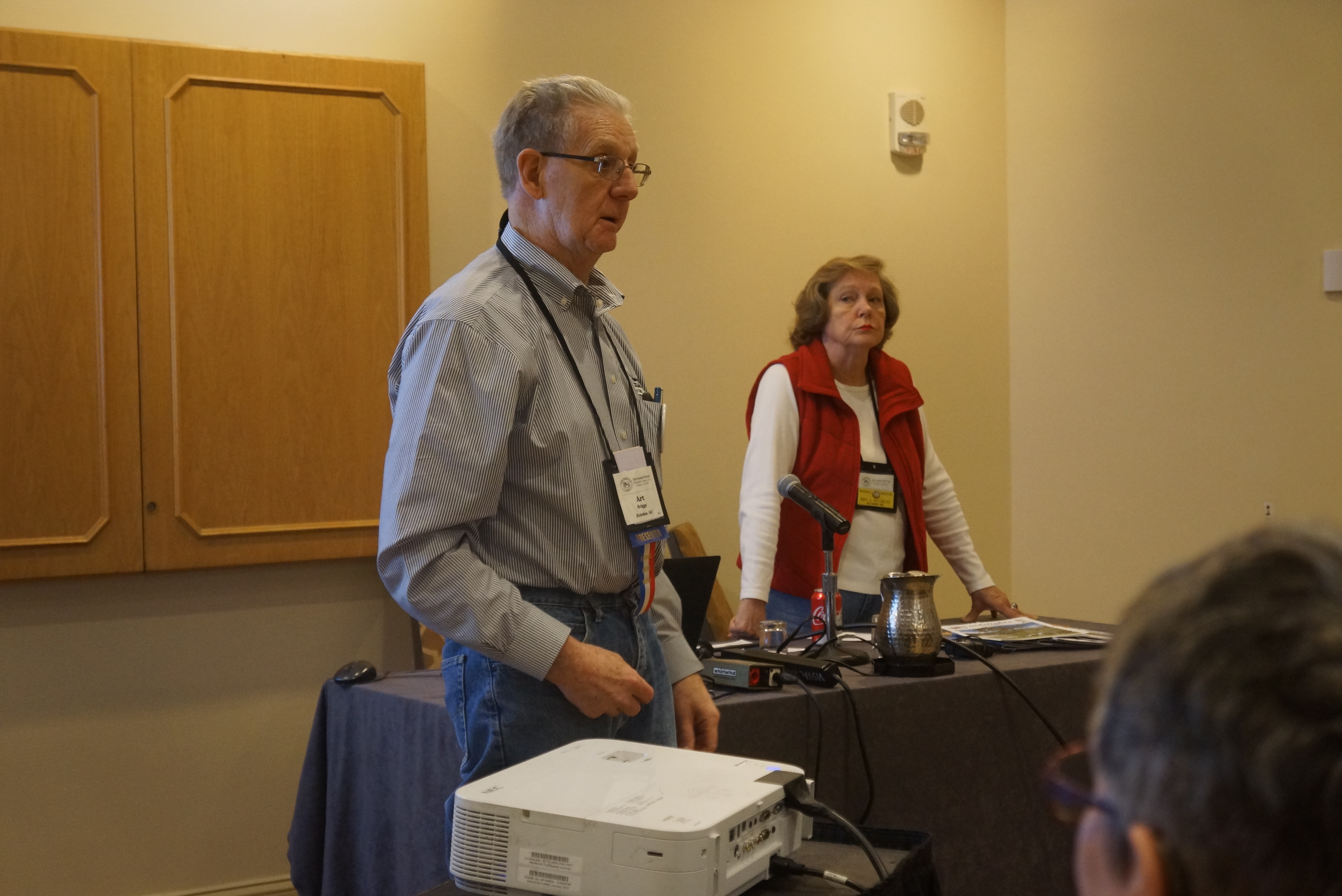
We heard one sad story about a Region which violated a copyright and was contacted by an attorney. When the Regional representative said “hey, we’re sorry, we’re just a non-profit club”, the attorney’s retort was “too bad, this is the amount it is going to cost you to settle or we’re going to court”. Mary made the point that the Club’s insurance does NOT cover such matters!
Art Briggs of the NJ Region spoke about copyrights and newsletters
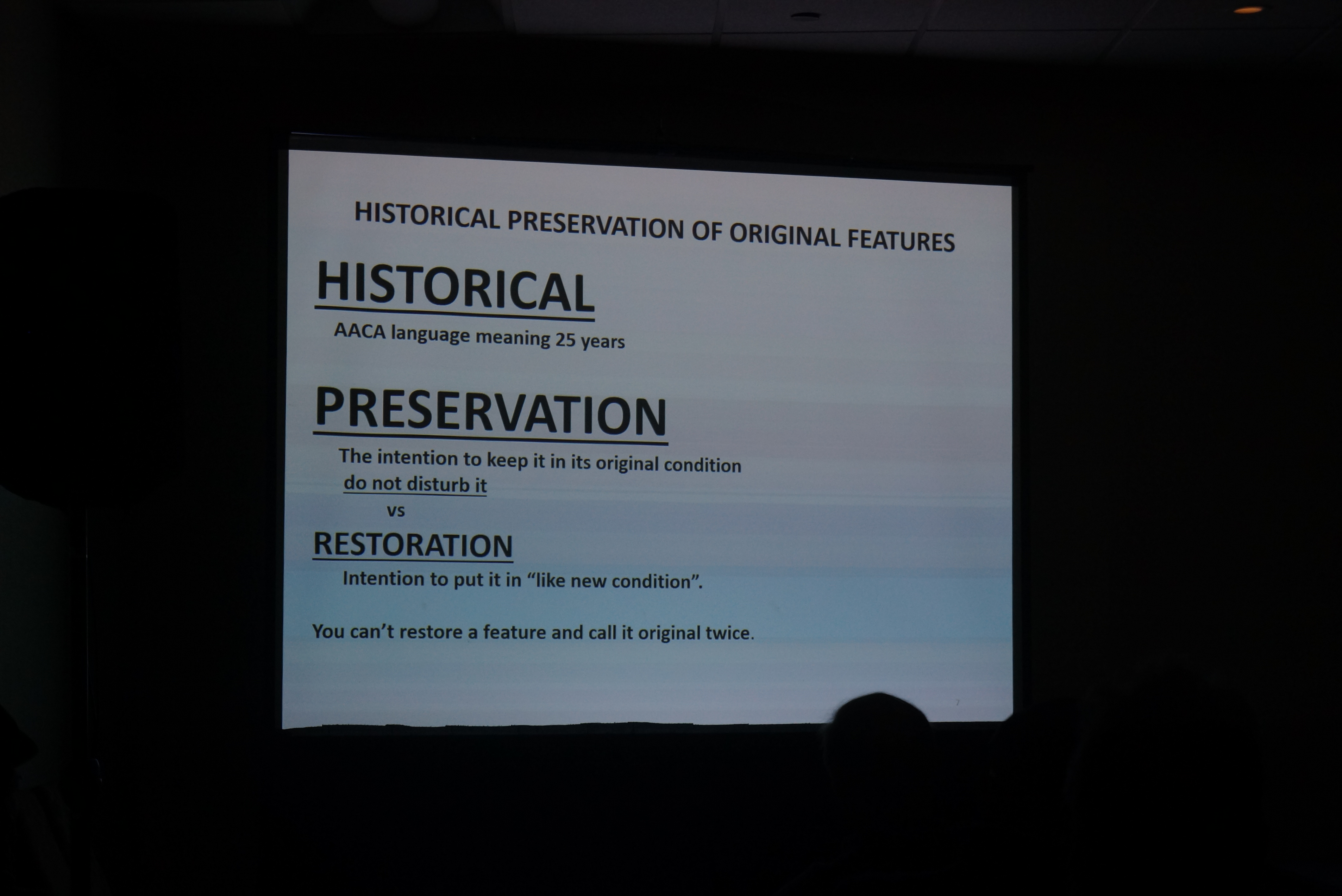
The final seminar for me was simply called “HPOF” (in AACA-speak, that’s Historical Preservation of Original Features). The presenter was Fred Trusty, who is the Chairperson for HPOF. He started with an interesting look back at the origins of HPOF. This new class one born in the late 1980s in part from the realization that many of the vehicles entered into Class Judging were over-restored, and it was no longer possible to literally see how the factory made these cars. Preserving an original car as “original” was deemed to be in the greater interest of the hobby.
This slide from Fred Trusty highlights the emphasis on “preservation”
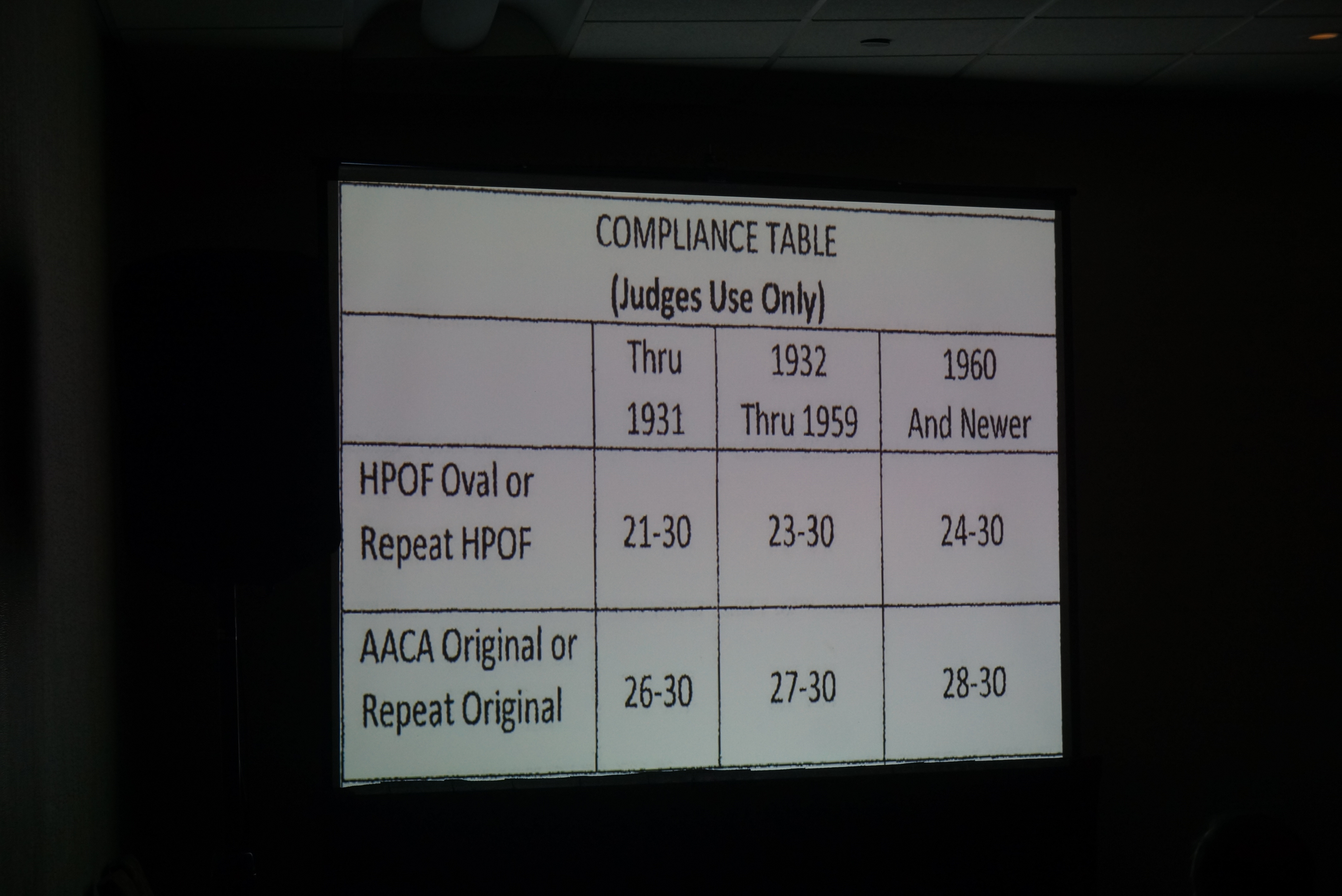
HPOF started off recognizing cars 45 years old and older; that cutoff was then moved to 35 years, and then again to where is it today, cars 25 years old and older. HPOF judges would rather see imperfect yet original, instead of perfect but non-original. There are some grey areas, such as re-painting, however, that also depends on the vehicle’s age.
Regarding paint, two examples were given: a 1920s car that was repainted once, in the 1940s, probably has so much patina that judges cannot tell with absolute certainly how old the paint is. The car would likely be judged to be “original”. On the other hand, a 1970s car with a complete repaint would not be considered eligible for HPOF.
With “30” a perfect score, note the lower standard for older cars to win HPOF
I have a more than passing interest in this class, as my 1967 Alfa Romeo already has its HPOF award, and one of my challenges as its caretaker is to maintain it in as close to original condition as possible, while still driving it about 2,000 miles per year. I also intend to enter my 1993 Mazda Miata (it turns 25 this year) in the HPOF class at Hershey in 2018. I’m anxious to see if it qualifies for an award.
If you are an AACA member and have not attended an Annual Meeting, I highly recommend that you do so. If you are not a member of AACA and are interested in old cars, the history of old cars, and preserving history, I strongly recommend that you join. Ownership of an old car is NOT a prerequisite. For me, the best part about my membership is conversing with like-minded individuals.
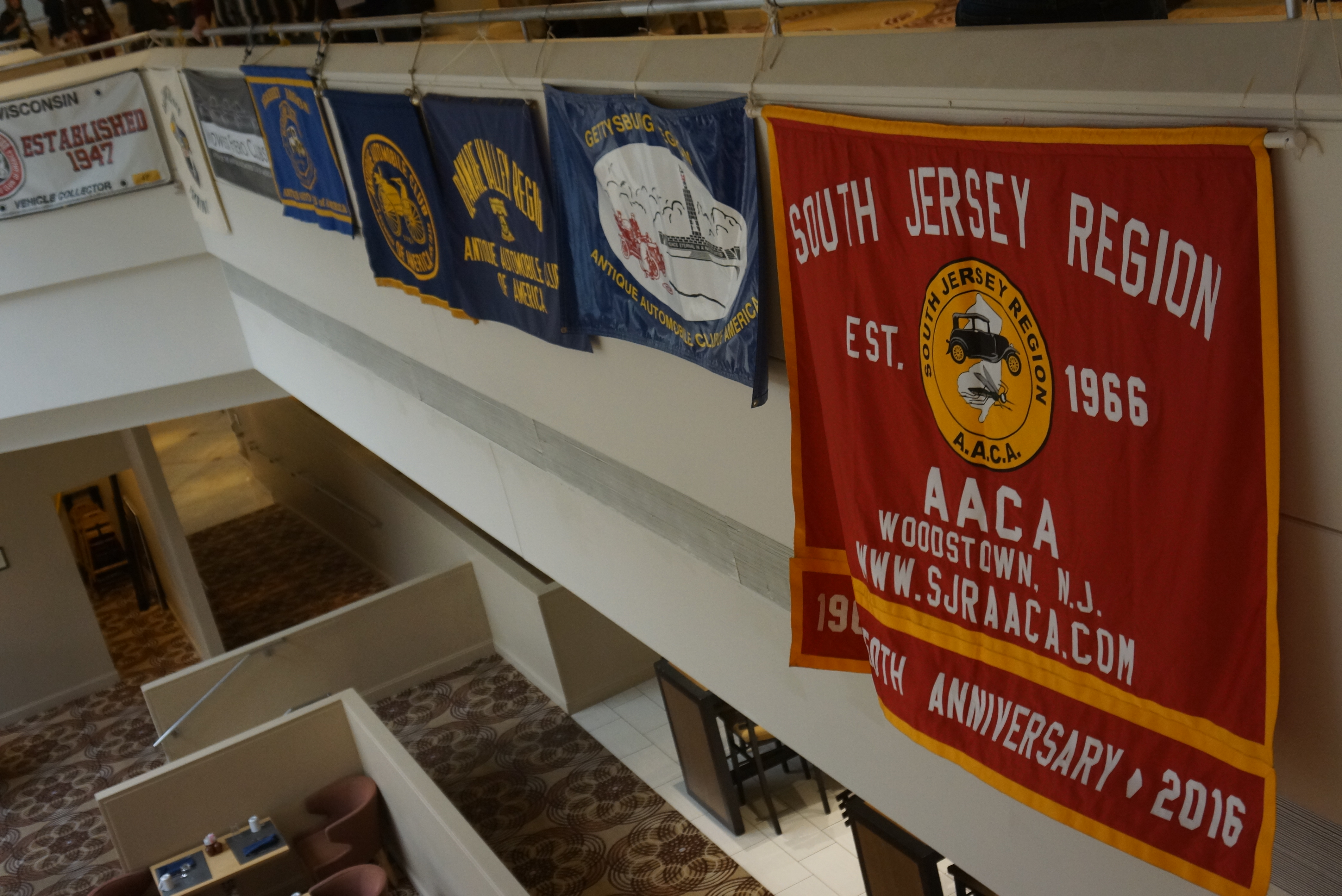
A meeting tradition is the hanging of Regional banners in the hotel lobby
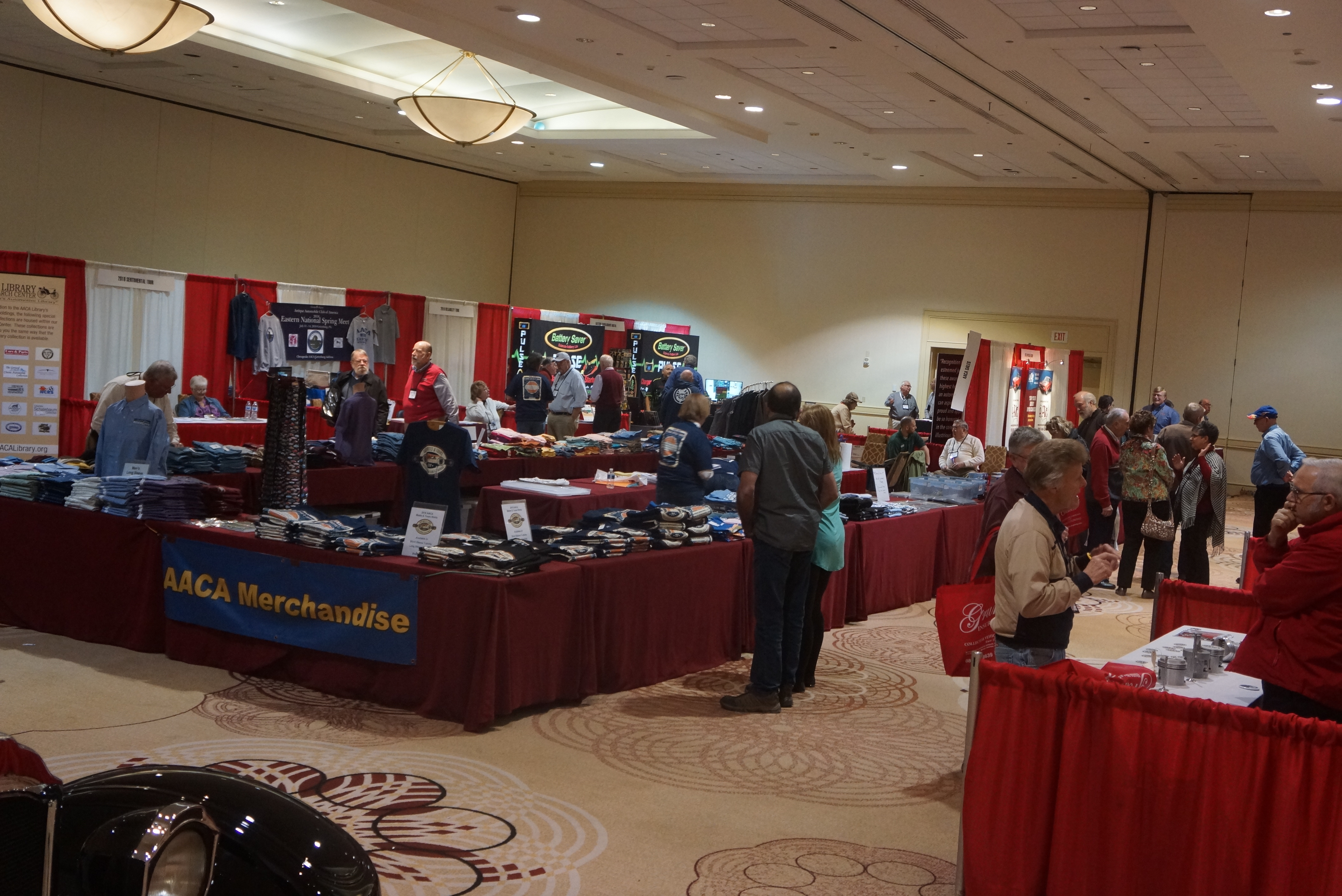
An overview of the trade show
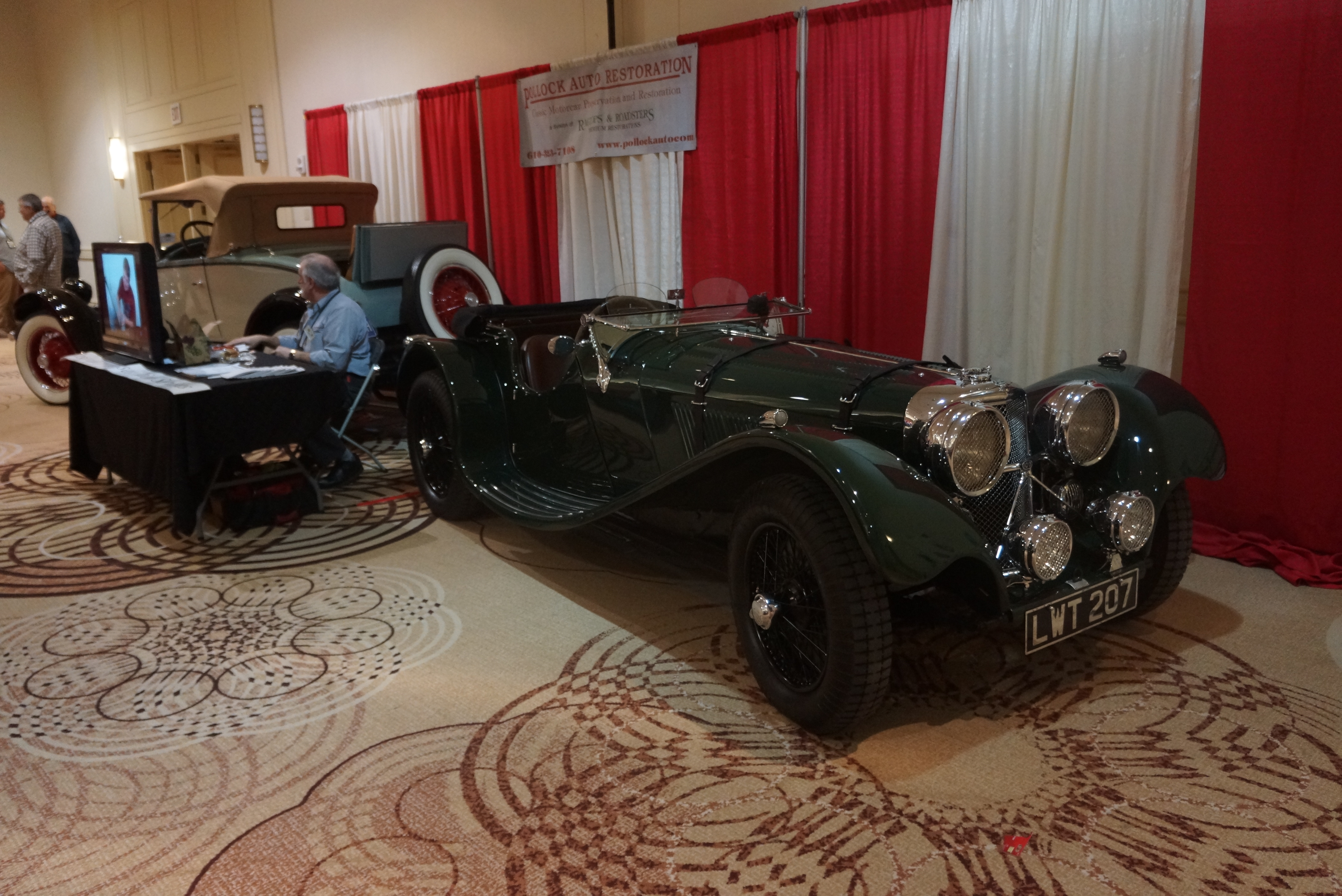
One restoration co. showed this Jag SS
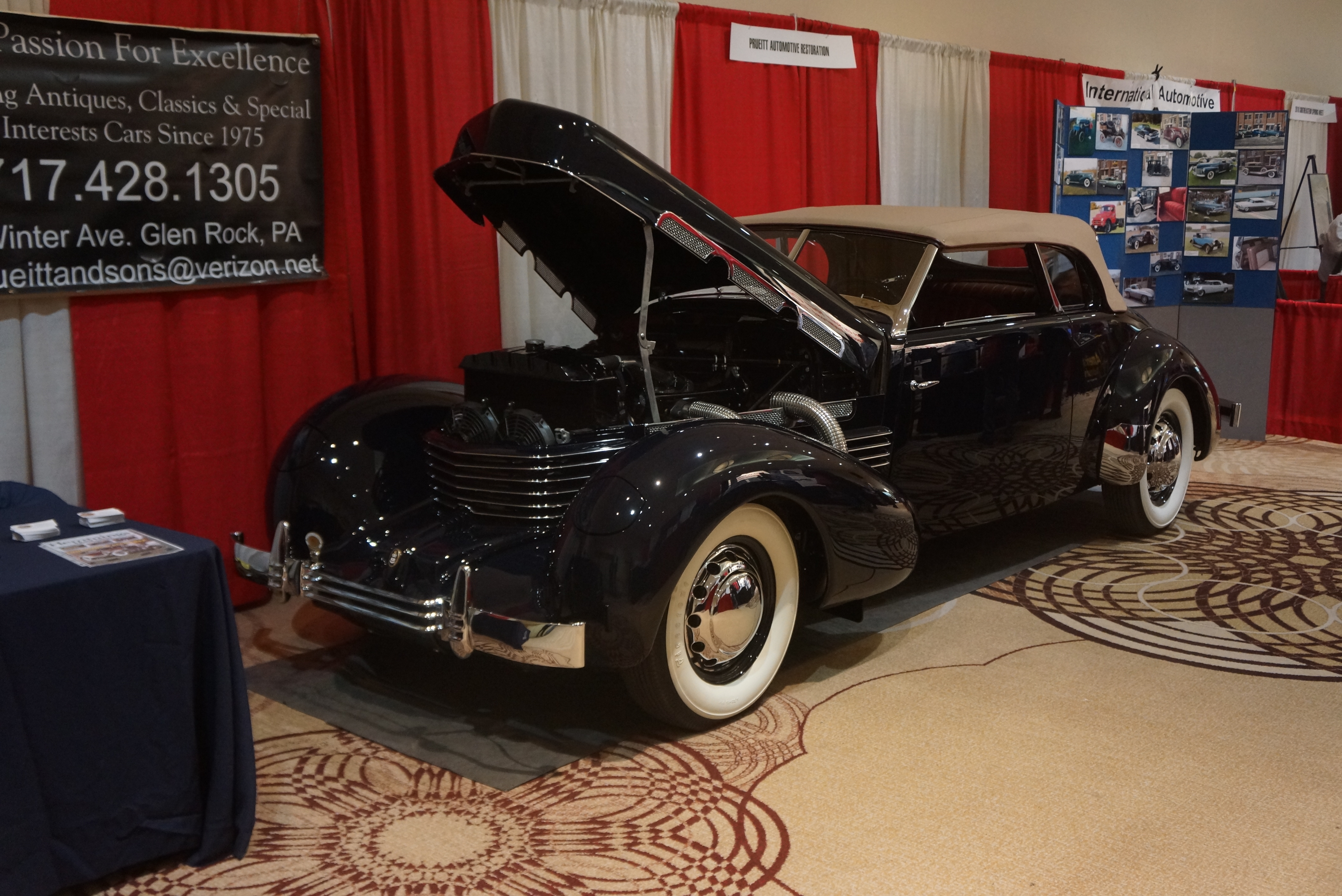
and another one this Cord cabrio
One last one of the Trade Show
You were maybe expecting Chapter Five of the Isetta Saga? It’s coming along nicely, and you’ll read all about it next week, promise.
The original Mazda Miata debuted in the summer of 1989 at the Chicago Auto Show. The first vehicles were 1990 models, making them 28 years old this year. At the time of its introduction, the traditional affordable 2-seat roadster had all but disappeared (Austin-Healey, MG, and Triumph were gone). The Miata’s closest competitor was the Alfa Romeo spider, riding on a body/chassis design that had been introduced in 1966.
In the 1980s, when I began to attend the AACA Hershey events, Saturday was the day to go. First, as a full-time working guy, I didn’t always have the luxury of taking time off, so it was the only day available to make the trek. Second, the best part of Hershey, “the car show”, was on Saturday.
About 20 years ago, I decided that my Hershey visit deserved to encompass multiple days. So I headed out on Thursday, and spent several days roaming among the flea market stalls and vehicles for sale. Saturday morning, wanting an early start, I found myself at the entrance to the show field by 8 a.m., when a funny thing happened.
I discovered the Hershey parade.
AACA rules require that all show cars be driven onto the field under their own power. So, starting very early on Saturday, all the cars line up and serenely motor their way along a predetermined route. What a delight it was to realize that much better than the static show was to witness these glorious automobiles, from early-20th century brass cars to vehicles “just” 25 years old, making their way, and allowing us the joy to see and hear them.
Since then, the Saturday routine has been the same:
Spend Friday night in a hotel close to Hershey;
Arise by 6 a.m. Saturday morning;
Grab some coffee;
Park by 7:30 a.m., and find a good spot along the parade route;
Stand for the next two hours and take it all in.
I’m not the only one with this idea
This routine was followed again in 2017. The photos which follow were for the most part taken along the parade route. The early morning sun only helped further glamorize what are already impeccably restored automotive gems.
This third report concludes our posts covering the 2017 Hershey events. It bears repeating: if you have not visited this fall classic, held every October in Hersheypark PA, it is worth the trip.
Chevrolet Corvair station wagon
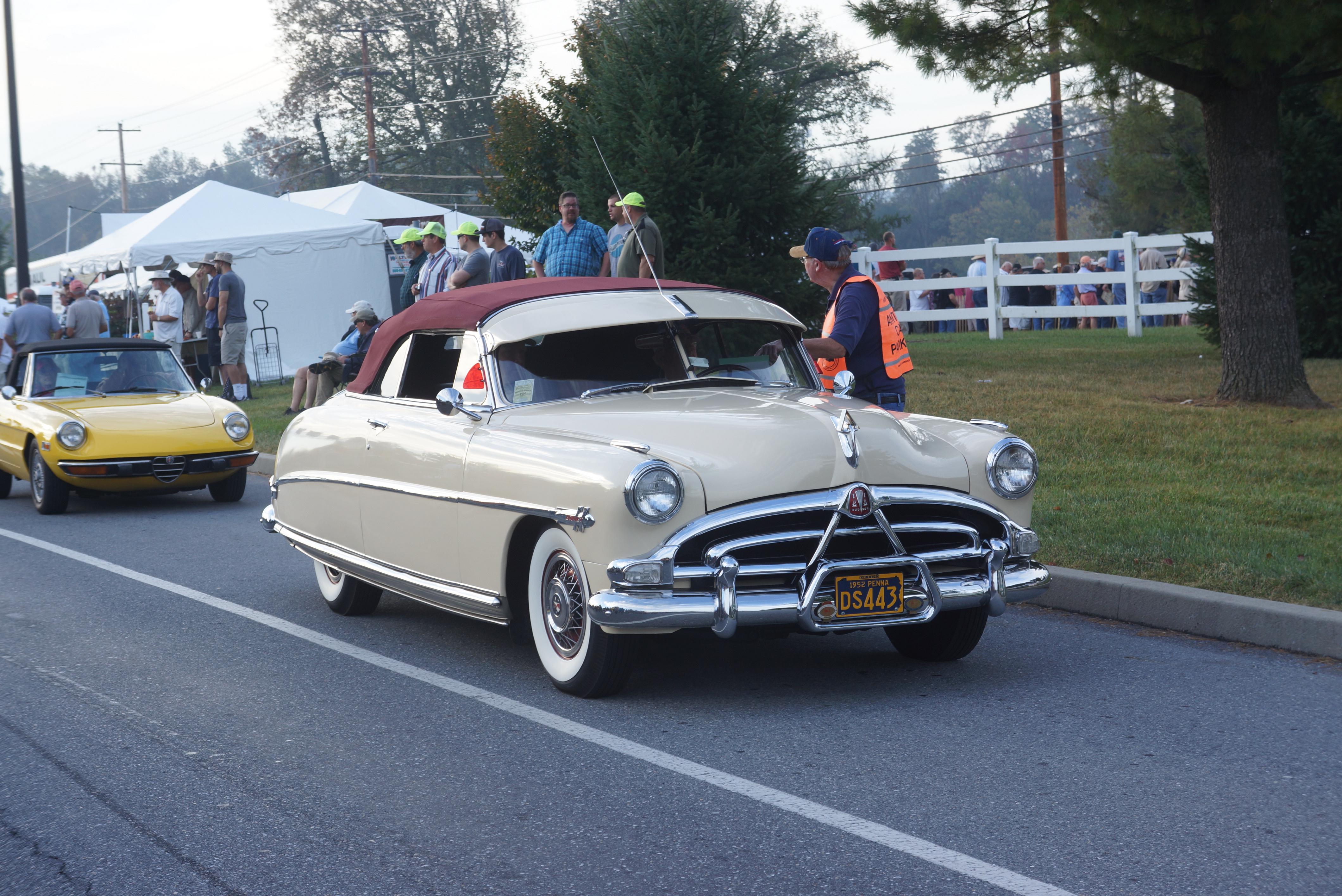
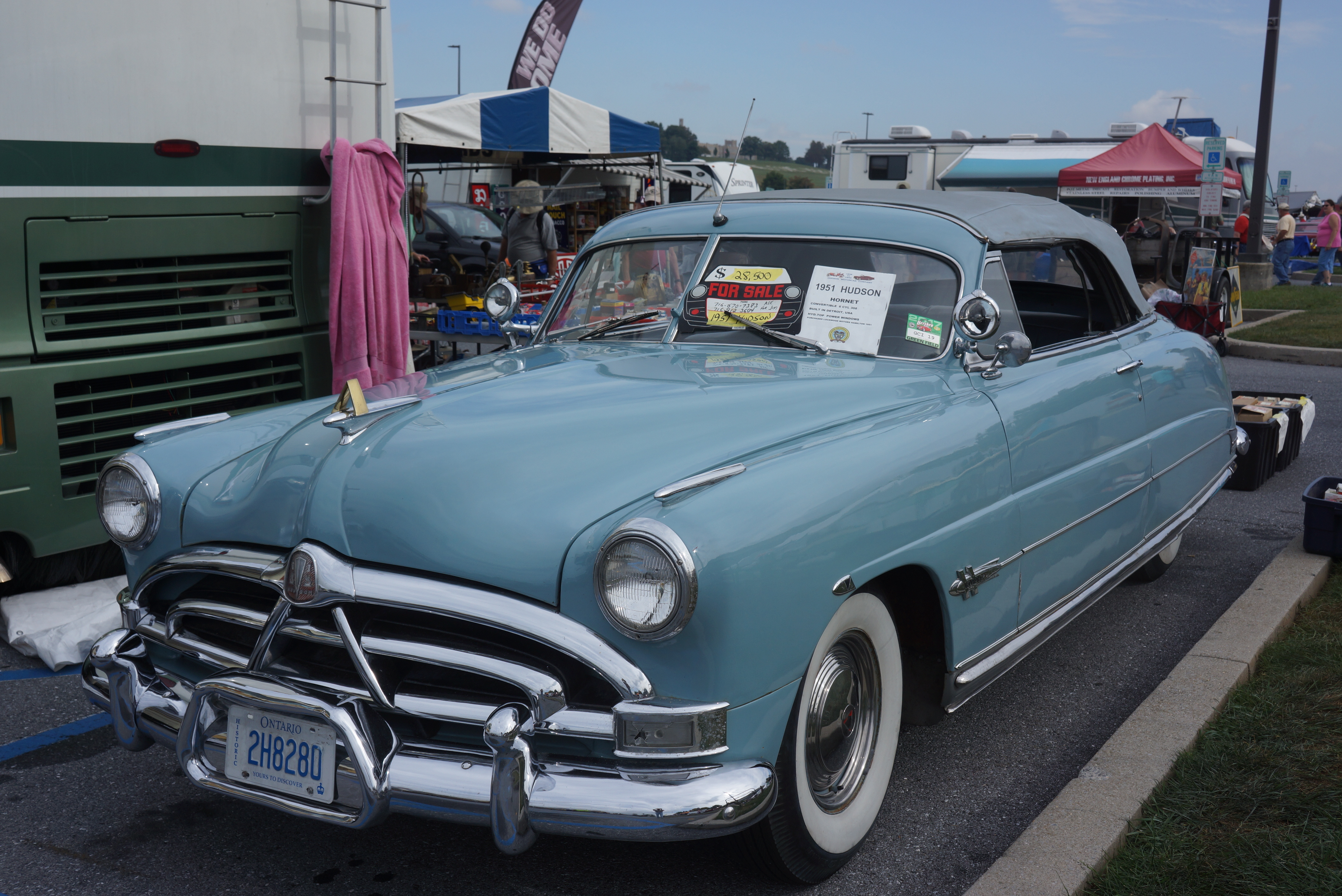
Hudson Hornet convertible
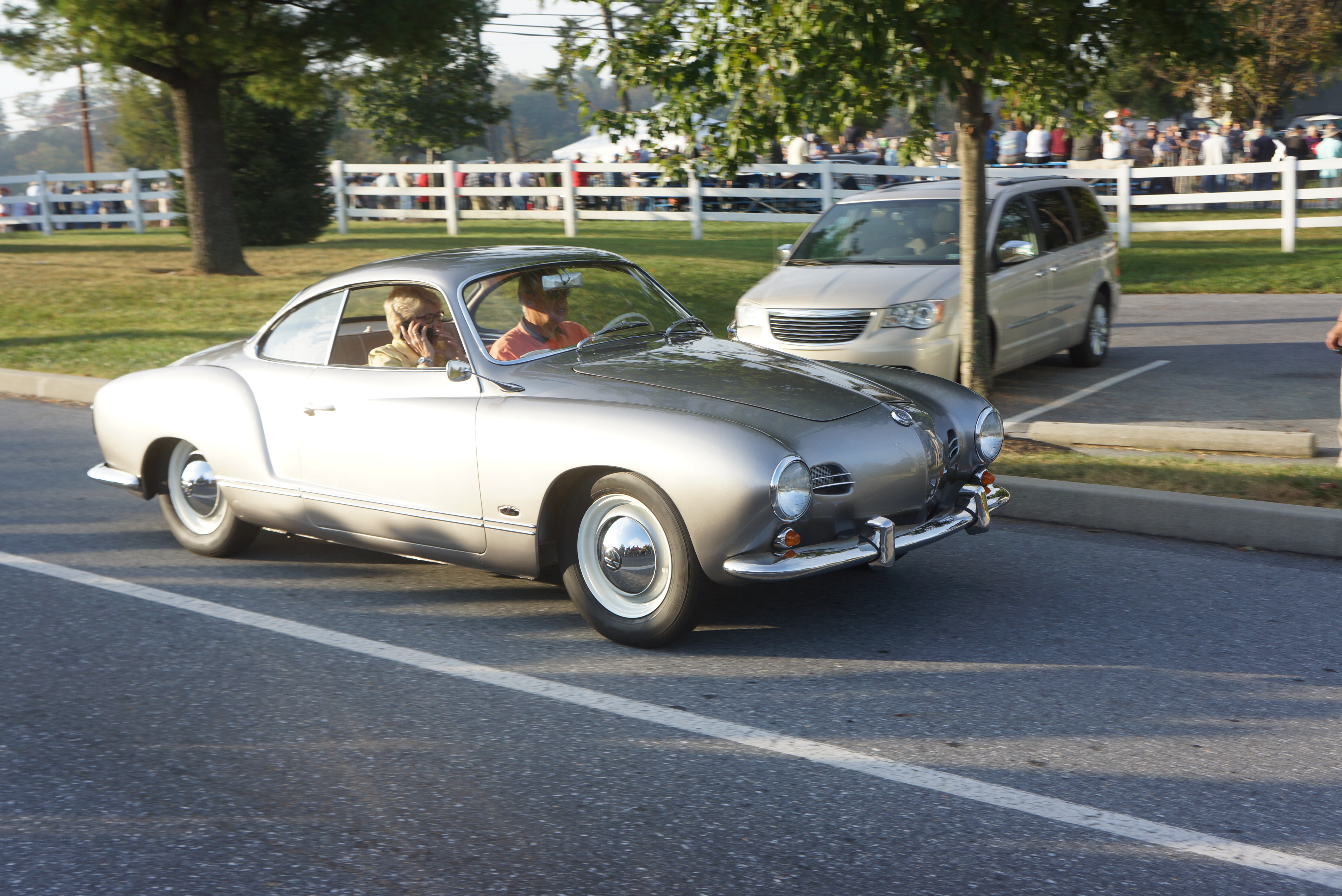
1950s-era VW Karmann Ghia
1957 Dodge
Jaguar XK-150
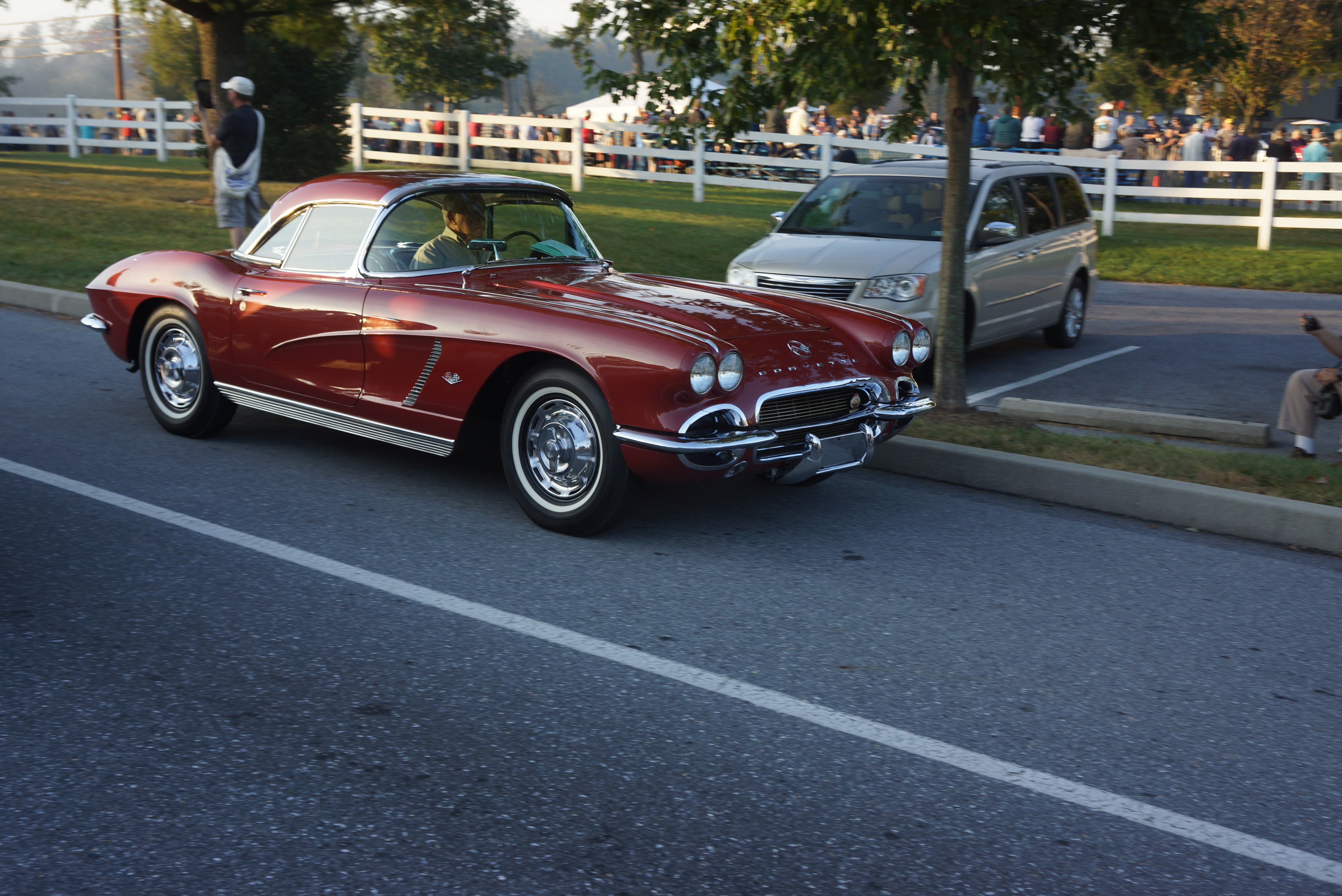
1962 Chevrolet Corvette
Two Triumphs and a Fiat ahead of some American muscle
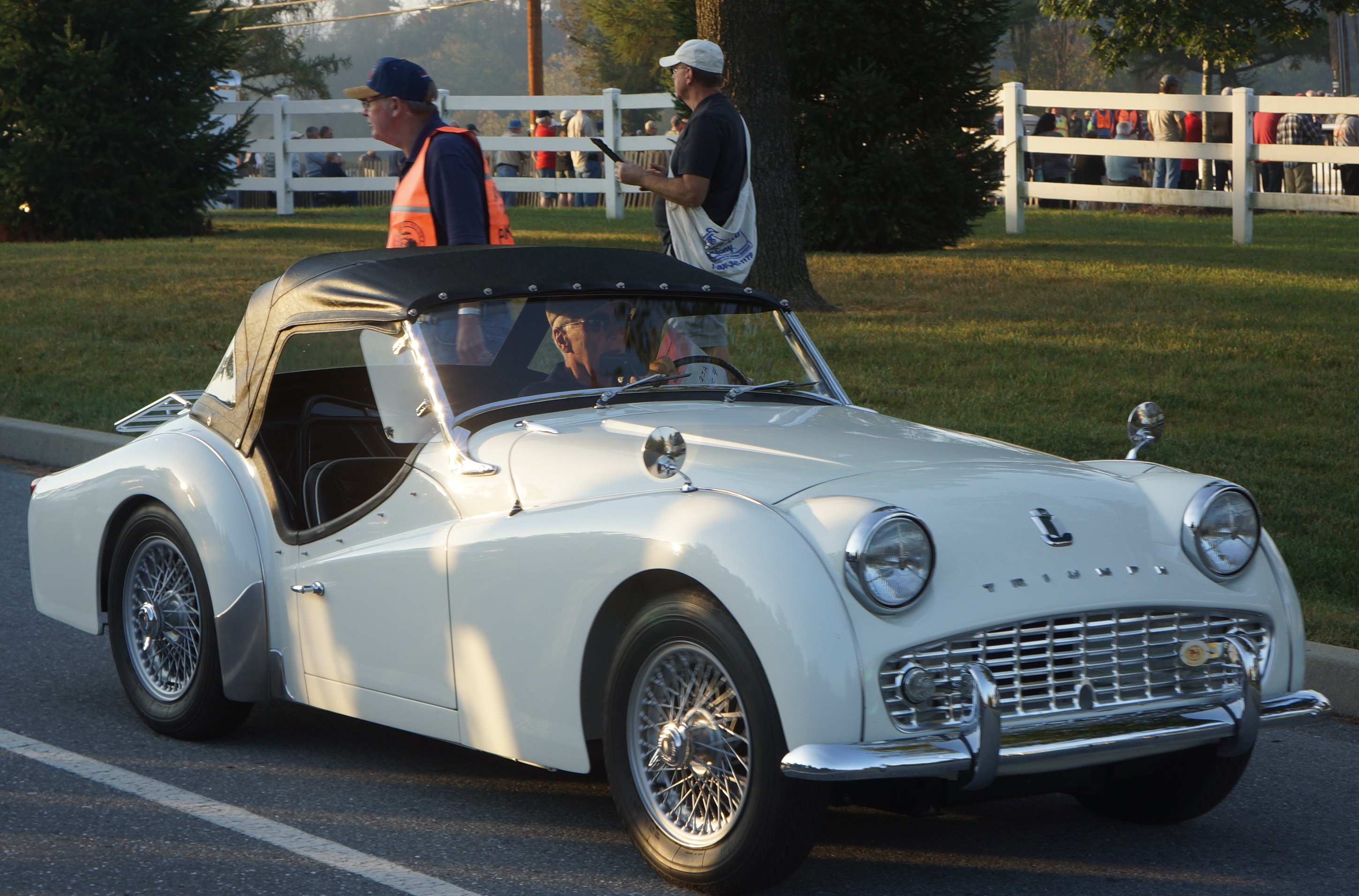
Triumph TR-3
Triumph GT-6
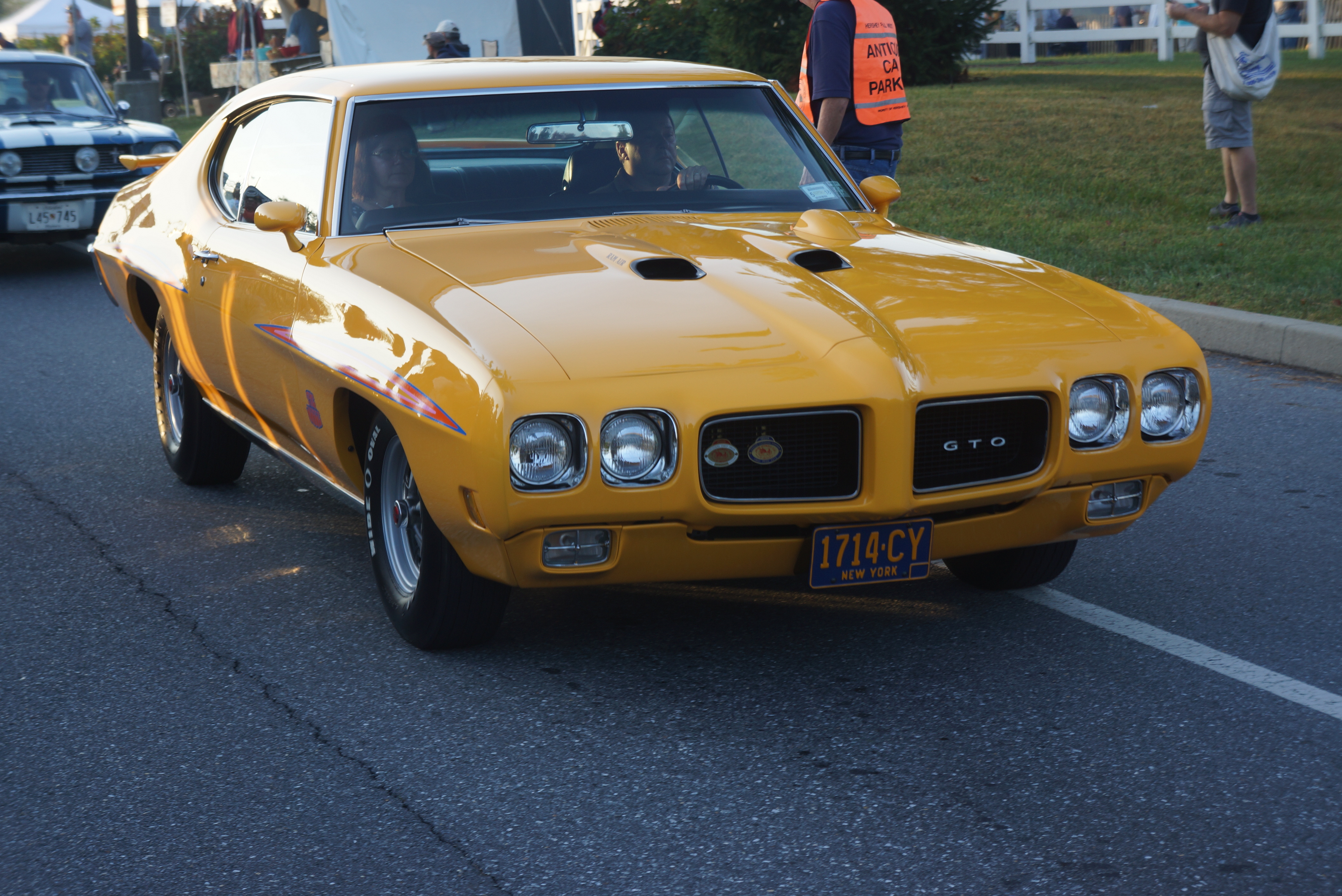
Pontiac GTO Judge
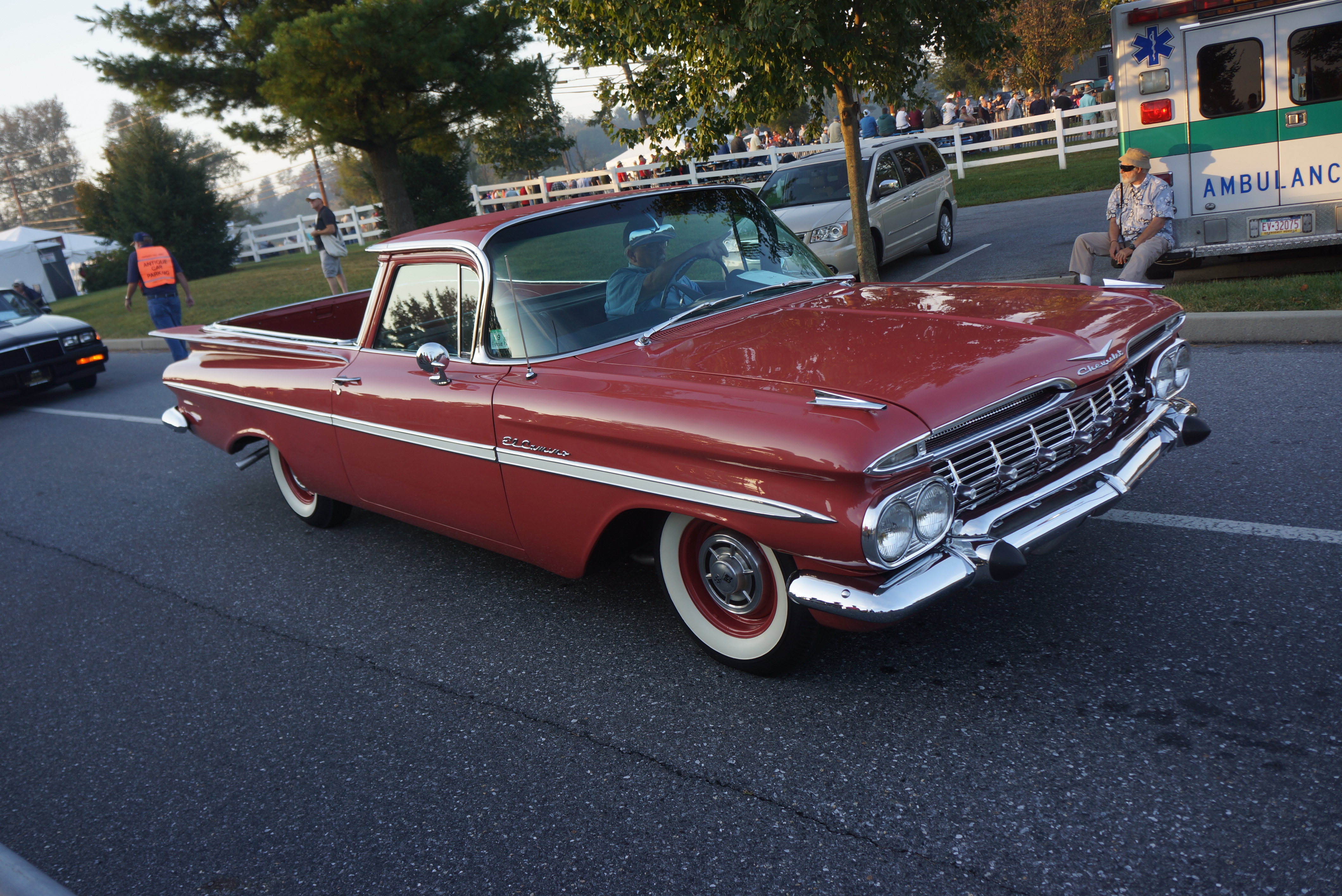
1959 Chevrolet El Camino
MGB roadster
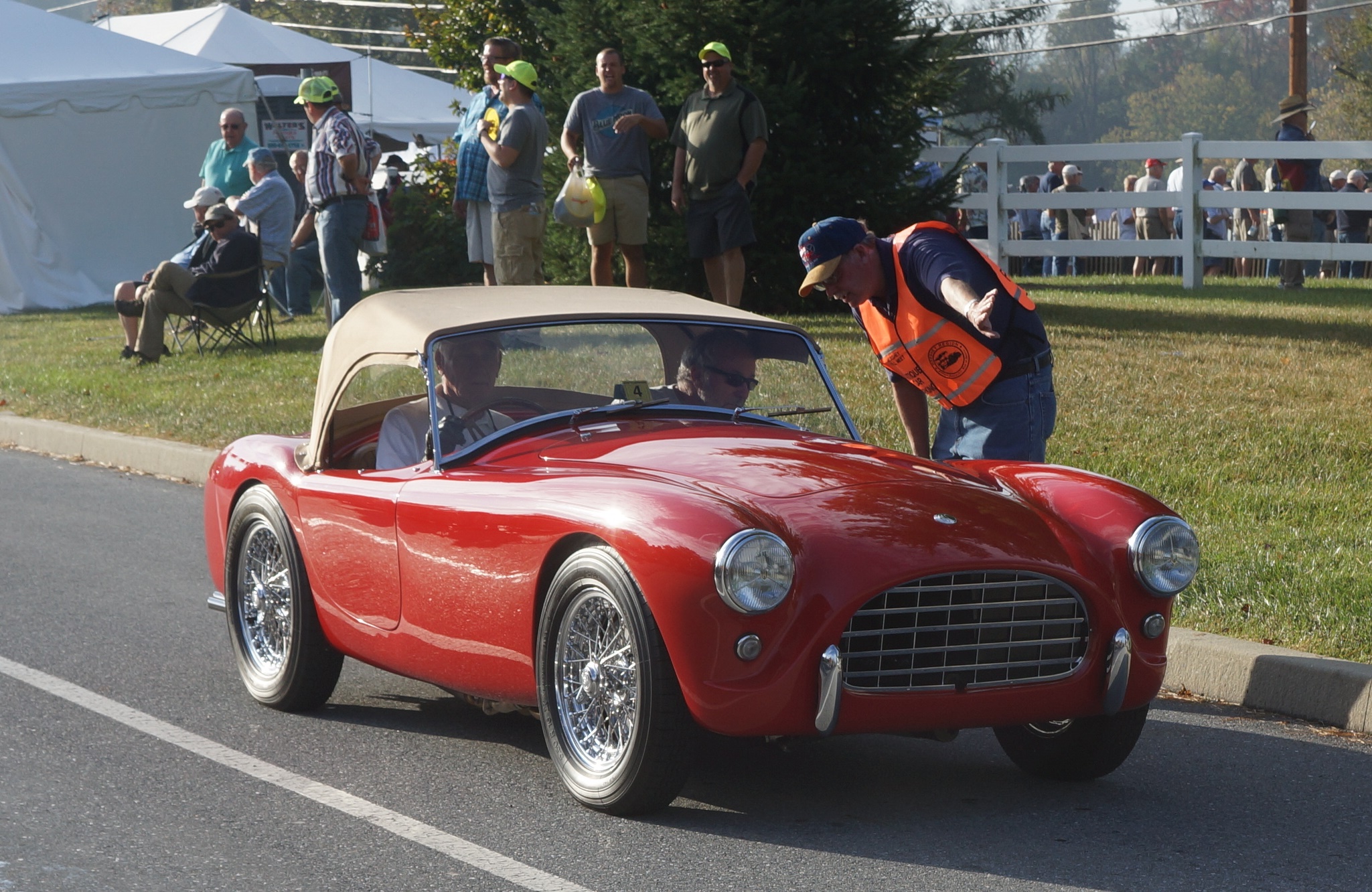
AC Ace Bristol
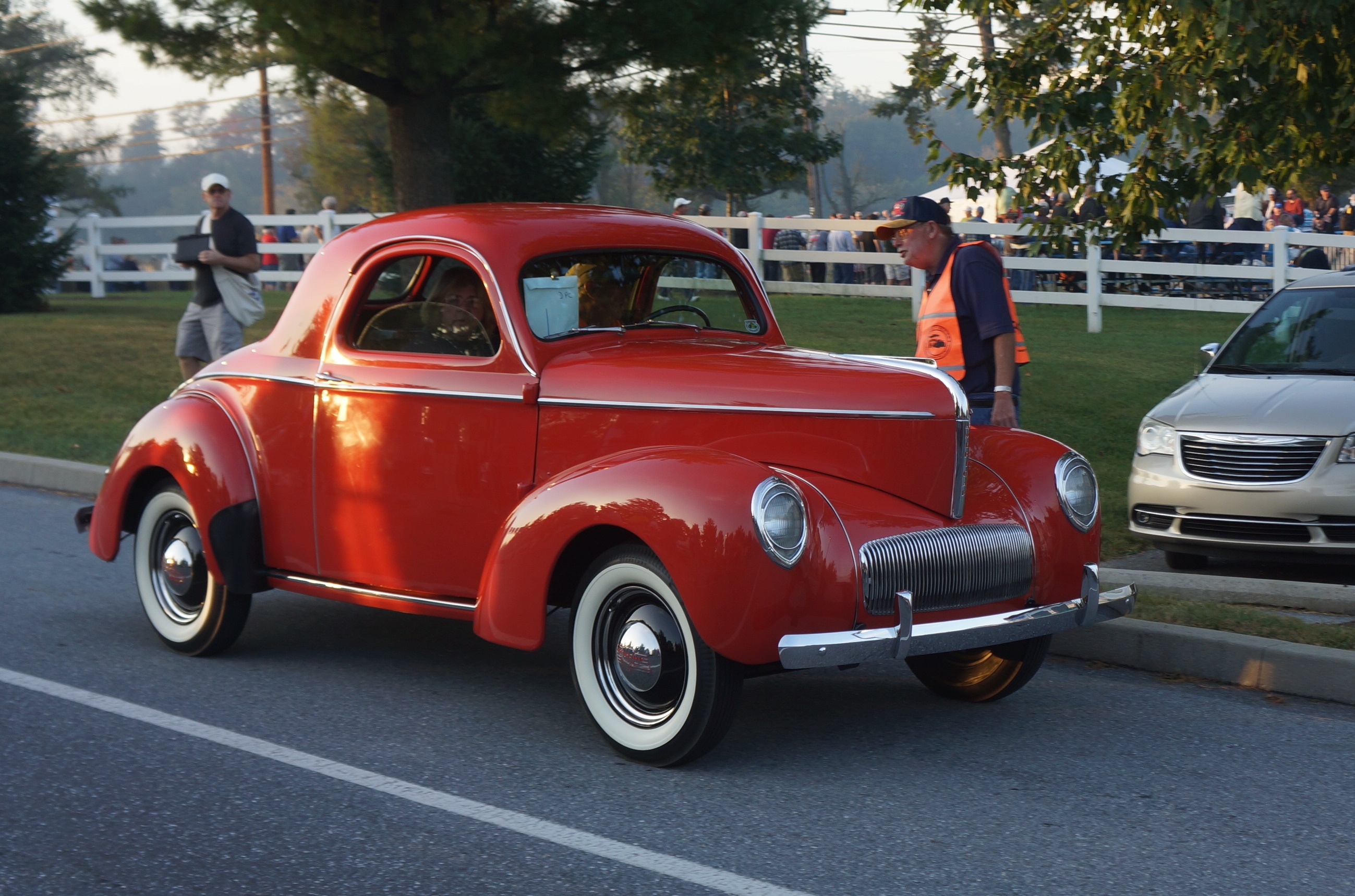
Willys coupe
Nash-Healey roadster
Porsche 356
Mazda Miata
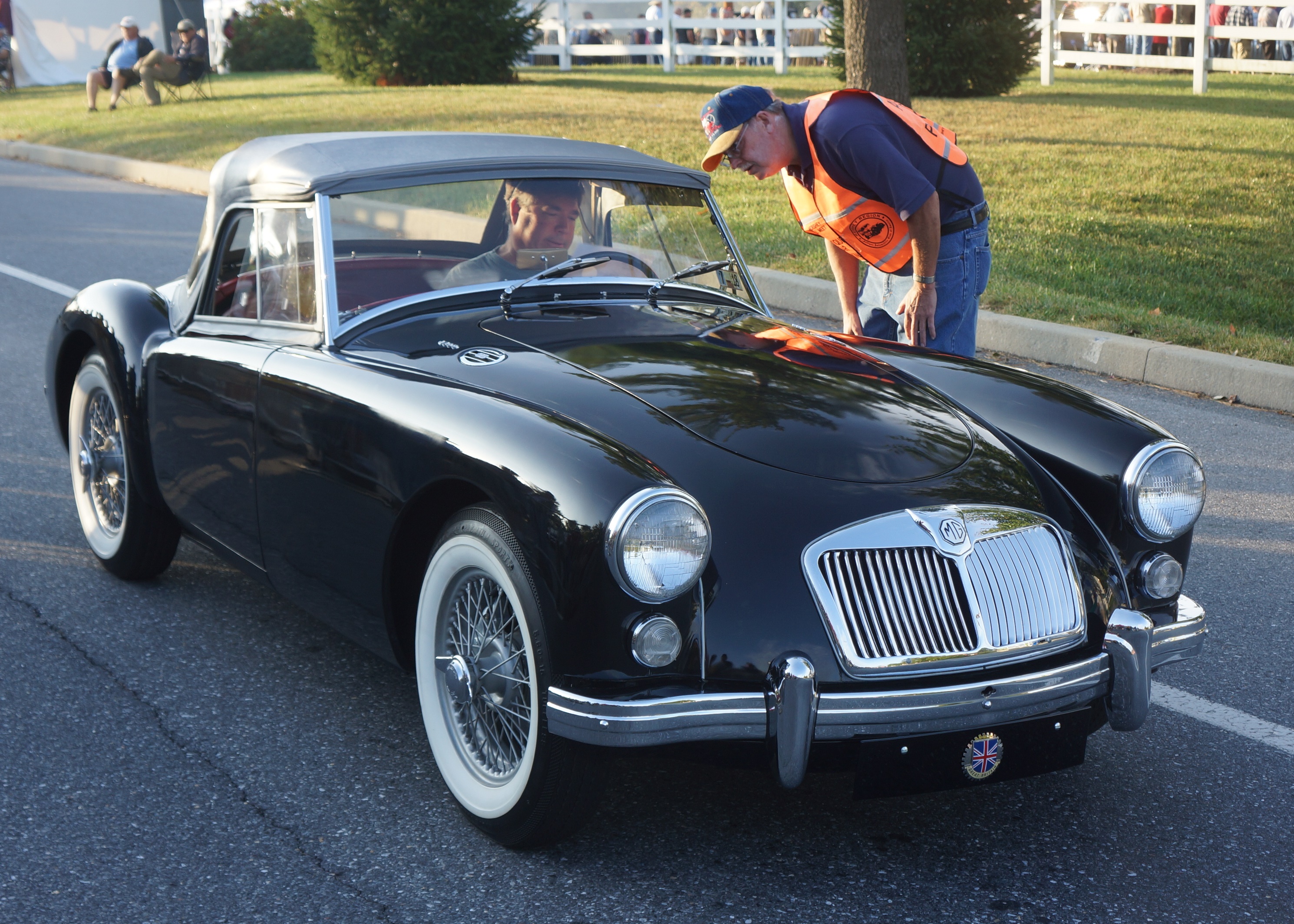
MGA
Stanley Steamer
Alfa Romeo Spider
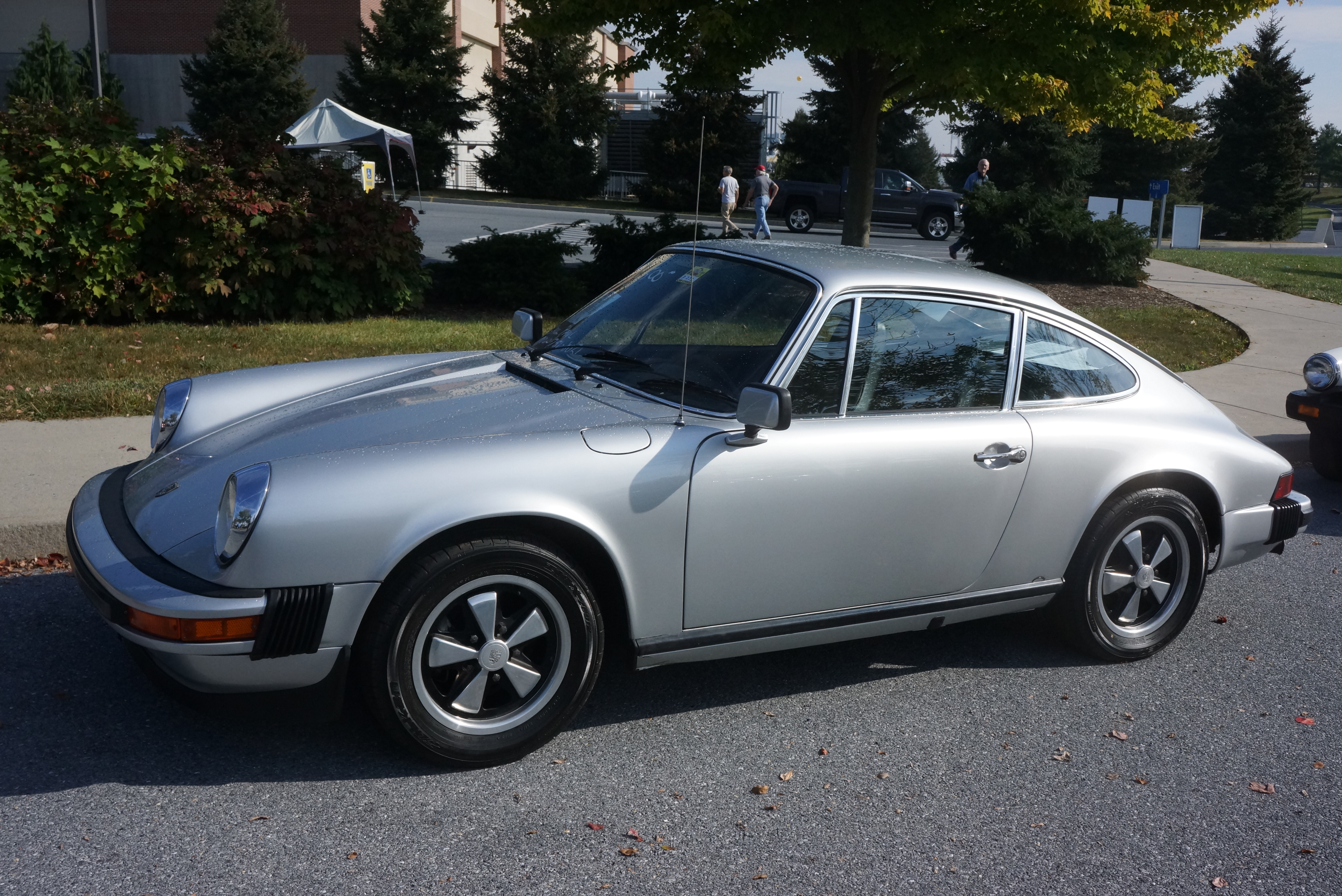
Porsche 911
VW Karmann Ghia Type 3 (not officially imported into U.S.)
Fall Hershey (formally entitled the Antique Automobile Club of America Eastern Division National Fall Meet, which is why we call it Fall Hershey) is an automotive smörgåsbord: collector-car flea market, car corral, judged car show, and auction, encompassing such a voluminous spread of acreage that one needs at least three days to take it all in.
Corral in foreground, flea market behind it, and Giant Center in background
We’ve covered Fall Hershey on this blog in the past; this year, as a tie-in with the report on the previous week’s Carlisle visit, the focus shall be on the car corral. Unlike Carlisle, where one can offer for sale a fat-tired 2003 Toyota pickup truck if one desires, AACA’s rules apply. Vehicles placed in the car corral must be a minimum of 25 years old, and must essentially be in “stock” condition. Beyond that, asking prices are determined by the sellers, and negotiations are strictly between seller and buyer. A car corral office and public notary are on hand to facilitate exchanges.
Let’s not forget where we are
Overall, the quality and variety of cars were on par with previous years. Unlike the recent past, and eerily similar to Carlisle, were the long stretches of empty spots. It was not a ghost town, however, I’d estimate that 25% of available spots remained so.
Some empty spots in this section of the corral
The corral has changed in other ways. Way back in the 1980s and 1990s, most cars for sale were privately owned. Deals were often made among hobbyists who knew each other, or at least had a mutual friend. If buyer and seller were meeting for the first time, the sale would many times be the start of a new friendship.
Today, classic car dealers buy up an entire row in the corral, and place their half-dozen or dozen cars together. (You can always tell: the signage and lettering styles are identical.) Dealers are as likely to be buyers as they are sellers. Asking prices are set by picking numbers out of a hat (I kid, but you do sometimes wonder about the relationship between that number on the windshield and reality).
Cars of all sizes are for sale
Dealers spew the same lines: “it’s a good car, runs good, real solid, real nice condition, all restored, very rare with these options”. The lack of specificity is jarring. Not to disparage dealers, but if you do find an individual owner who is selling, you are more likely to learn more about a vehicle’s true recent history.
A private owner will talk specifics: “I bought it 10 years ago, put 5,000 miles on it, drove it in an AACA tour five years ago, re-did the brakes two winters ago, and drove it here from Maryland”. Comments like these were actually overheard this year.
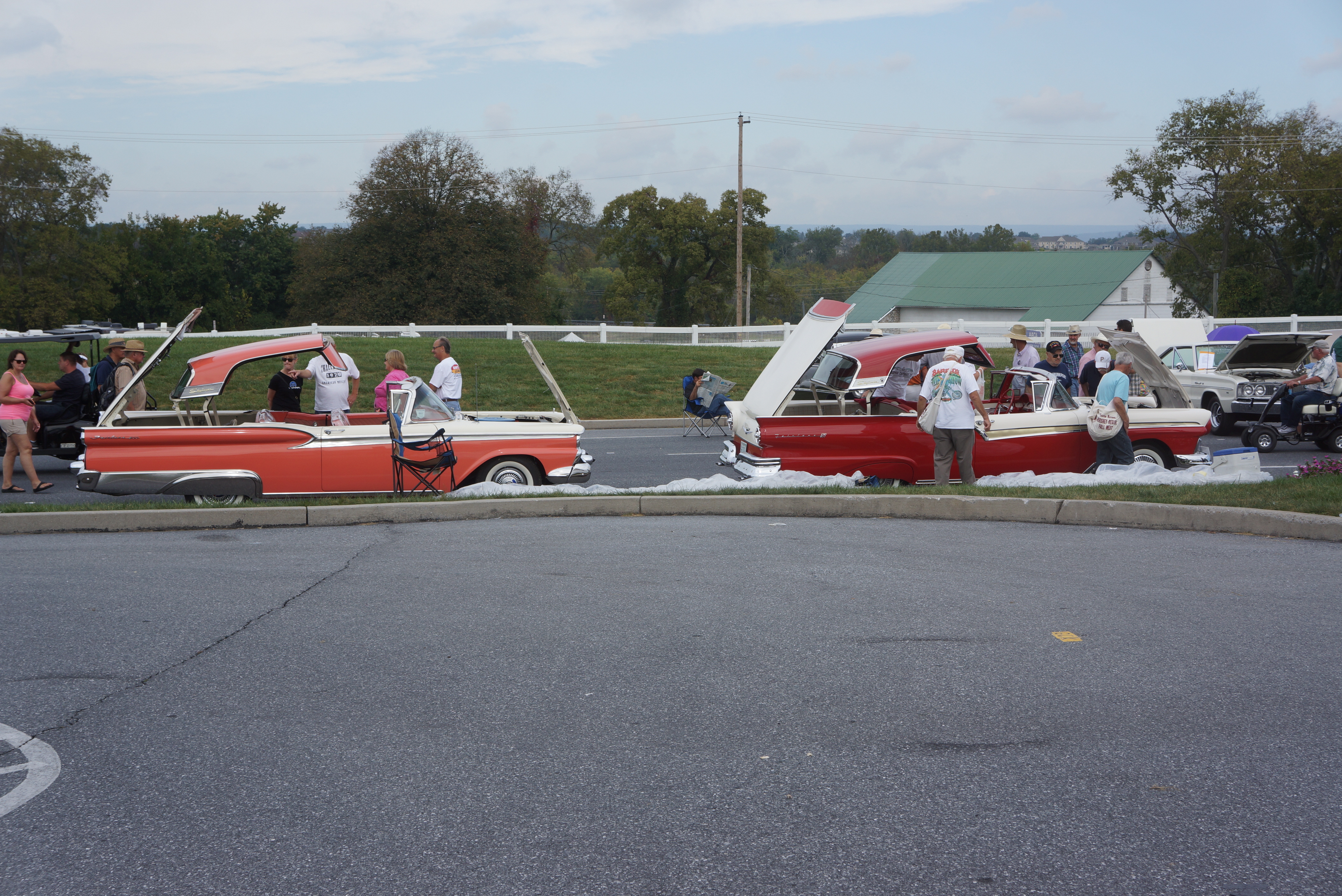
Ford Skyliners flip their lids for you
This lengthy preamble is to set the stage for my eclectic selection from the car corral. The thirty cars below are arranged in order of asking price. No attempt was made to ascertain if the seller was a private owner or dealer. While all these cars “looked good”, condition was not analyzed, and mileage was not recorded. You can presume that none was modified to be non-original. In the case of American cars, the level of optional equipment was not noted. The vast majority of signage indicated “or best offer”, so think of these prices as a negotiable starting point.
Not hard to imagine that the presidential window sticker is original to the car
Organizing them in price ranges allows the reader to make comparative estimates regarding what your collector-car piggy bank can get you. Have fun on your imaginary shopping trip.
Part 2 will be my report on the 2017 RM Sotheby’s Hershey Auction.
Car Corral, $4,900 to $9,500:
1990 Mazda Miata, asking $4,900
1989 VW Fox wagon, asking $5,500
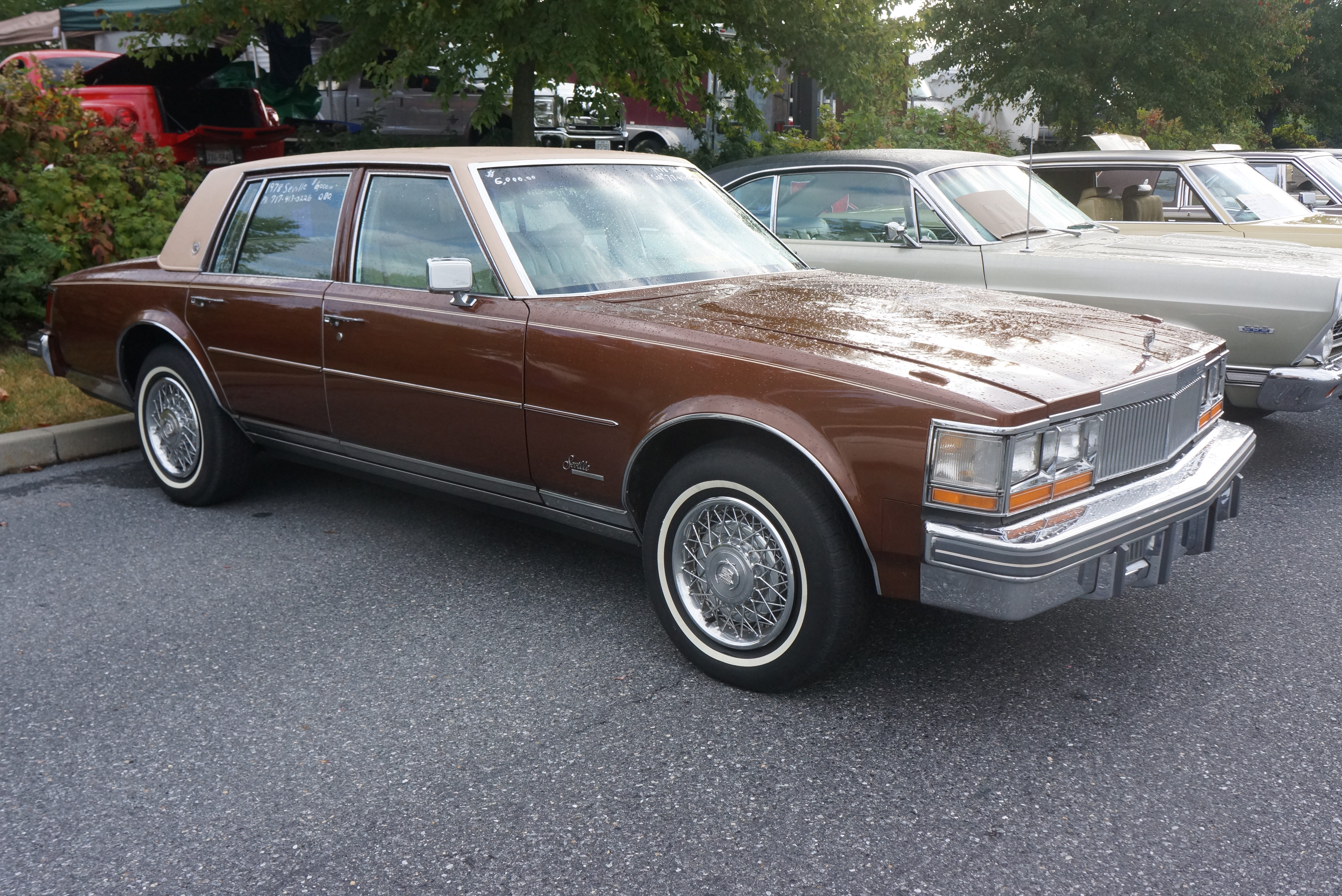
1978 Cadillac Seville, asking $6,000
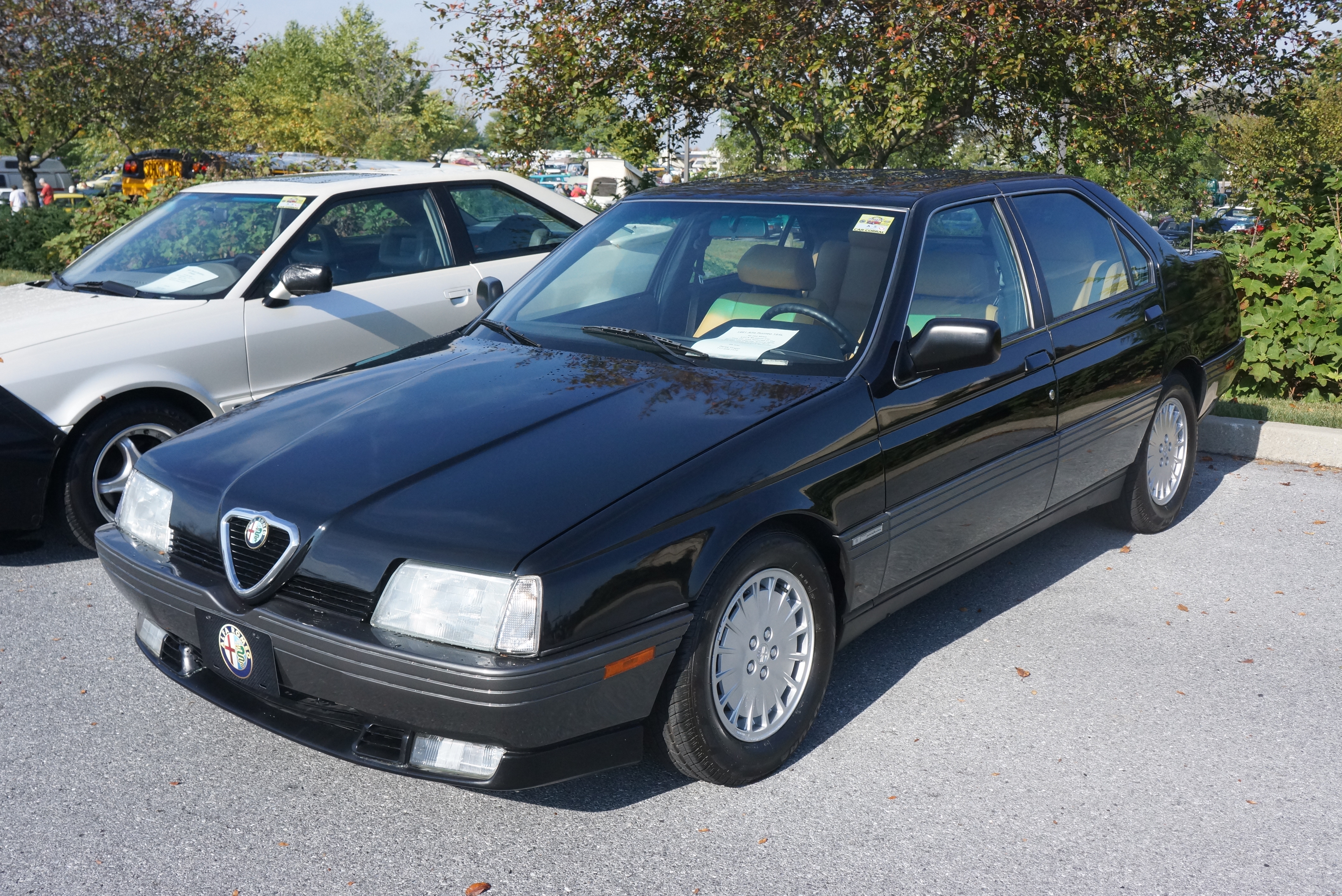
1991 Alfa Romeo 164, asking $6,500
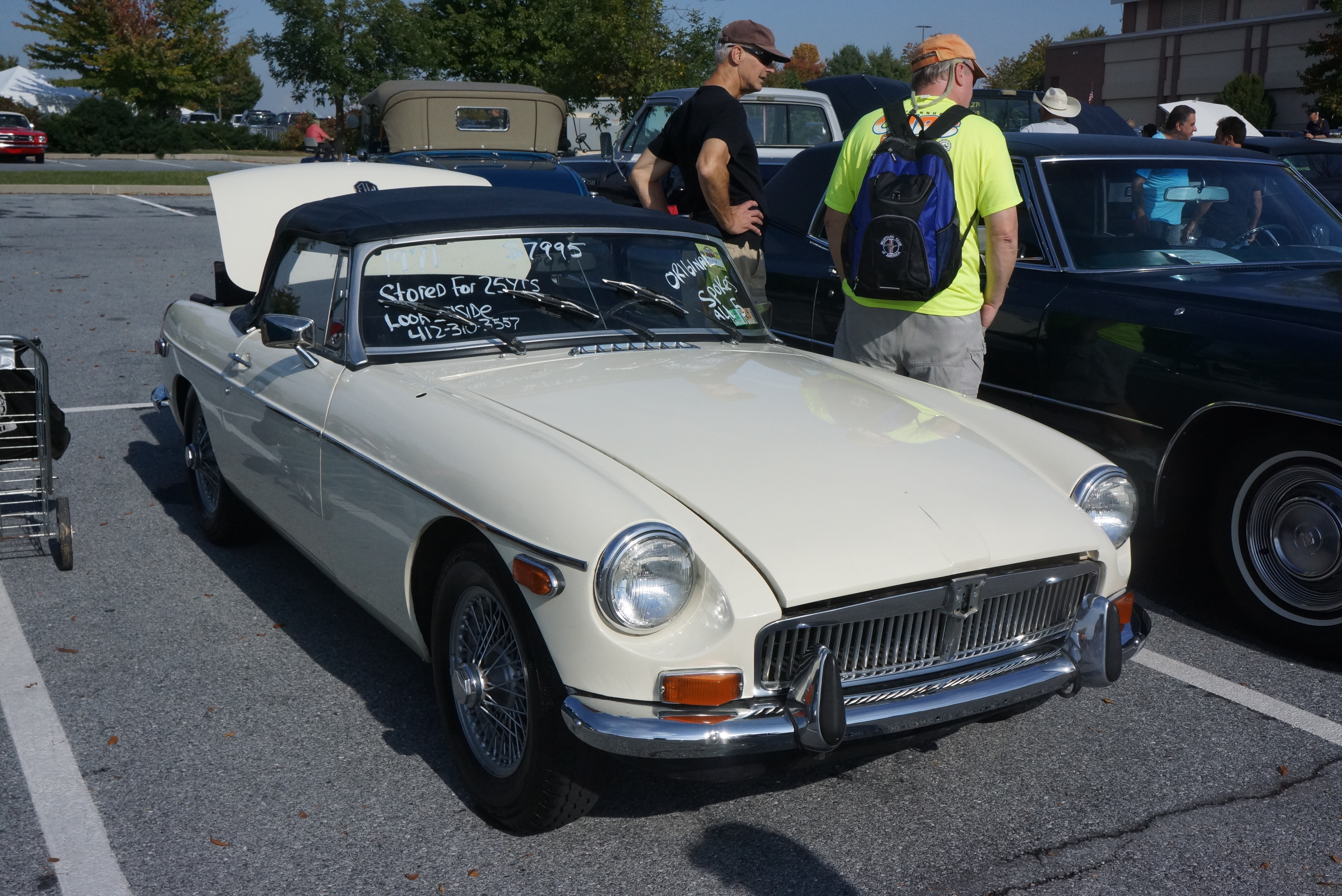
1971 MGB roadster, asking $7,995
1981 Chevy El Camino (6 cyl. 3-speed), asking $8,500
Fall Carlisle 2017, a combination automotive flea market, car corral, and auction, was held at the Carlisle Fairgrounds from September 27 through October 1.
From here, it looks like business as usual
As I strolled through the grounds, the same two questions repeated in my head: “Should someone get in while the getting is good?” Or, “Should we get out while there’s still a way out?”
These questions came up because many of us in the hobby are concerned about its future. It always comes back to “what will my old car be worth down the road?” The Carlisle events, principally Spring and Fall Carlisle, have been a wonderful barometer of the hobby for over 40 years. The car corral this year told a markedly different story: corral spaces were perhaps 60% taken (in the past, one usually had to wait for a car to sell for a spot to become available); yet among the cars on the premises, many seemed to have reasonable asking prices.
In 39 years of attending Carlisle, I’ve never seen the car corral look like this
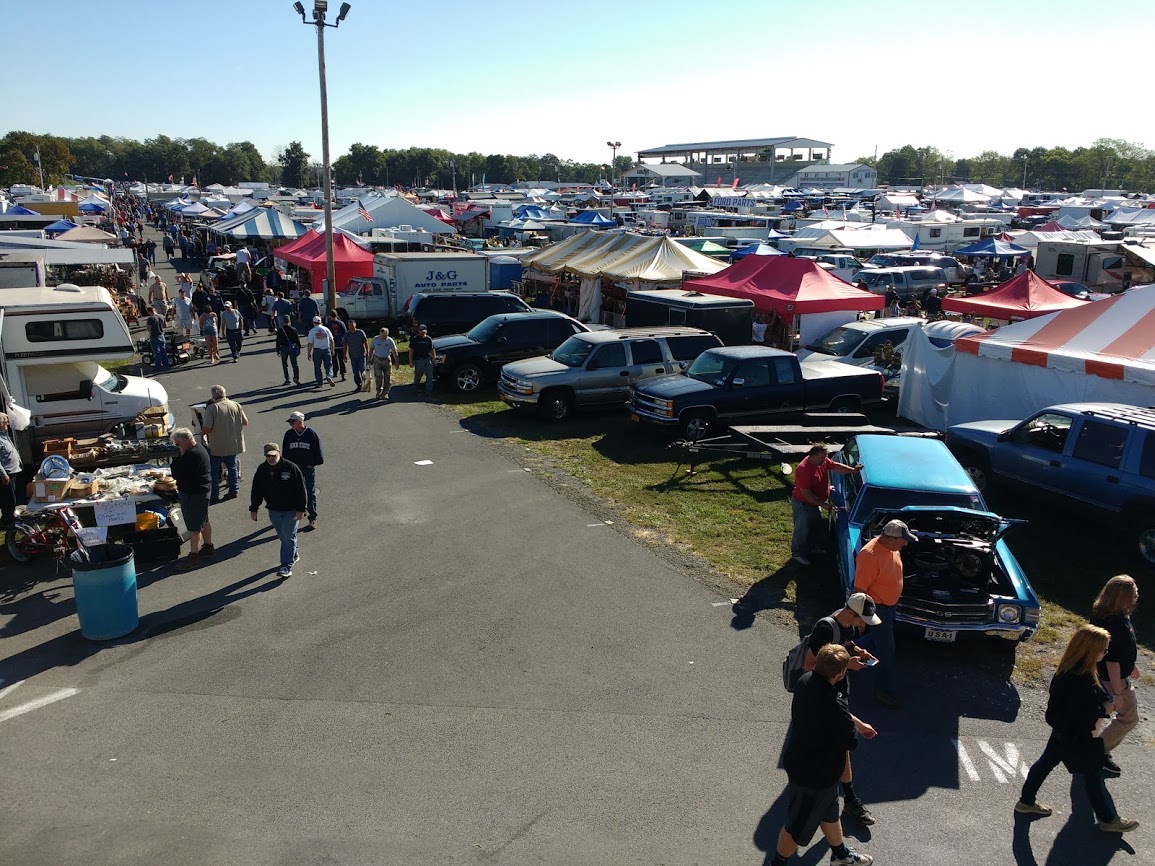
The flea market, on the other hand, was filled to capacity, with nary an open space to be found. Vendors were out in force, even if the crowd on the picture-perfect Friday when I attended was a bit lighter than I would have expected.
We joke, but some of the lunch offerings aren’t bad
I began my morning in the car corral, then after a gourmet lunch under the grandstand, walked a few of the flea market aisles. By 3pm, I was headed across the street to the Expo Center where the Fall 2017 version of Carlisle Auctions was underway. Here we saw the hobby flexing its muscles. The auction has expanded to three days from its previous two; most of the bidders’ seats were taken; and the bidding, while not exceptional, seemed to hold to about a 60-70% sell-through rate. Perhaps, rather than deal with tire kickers in the corral, sellers are rolling the dice on the auction block.
The queue headed into the Expo Center
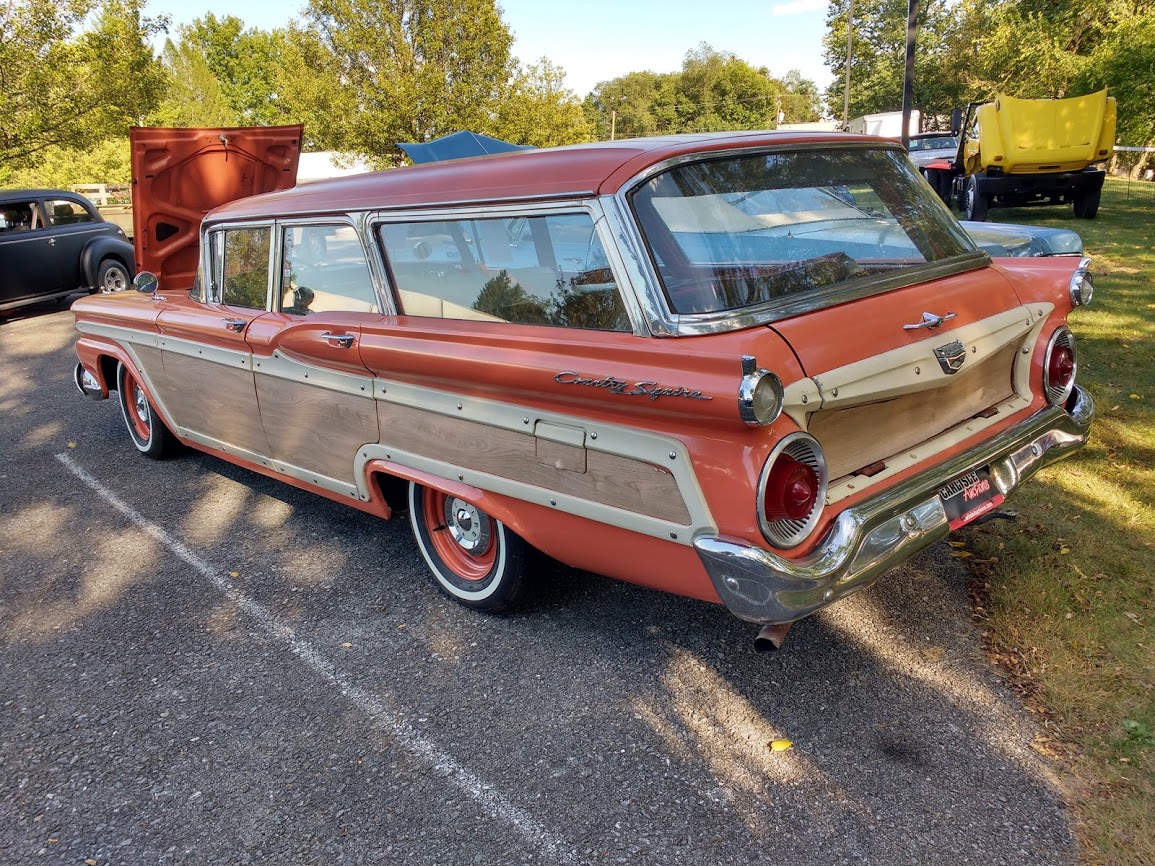
A couple of rare Fords: ’59 Country Squire,
and a very clean Maverick
The photo coverage below is divided into two sections. First, we feature car corral choices with asking prices below 10 grand. If you’ve got some bucks burning a hole in your pocket, or are open-minded enough to be flexible about a first (or additional) collector car, there were plenty to choose from.
Our second section is entitled “Carlisle Auction re-runs”. This is an arbitrary list of vehicles which did not meet reserve. To the credit of the folks who run the show, the high bids are posted on the windshields in plain sight. I sometimes think that going back and trying to negotiate a price AFTER the car has crossed the block might be a better strategy, as it removes the pressure of bidding while the auctioneer is yammering in your ear at 110 decibels.
In both cases, no editorial comment about vehicle condition or value relative to the asking/bid price is supplied. As always, caveat emptor(which is Latin for “collector cars may be worth more or less than what you pay for them”).
CAR CORRAL: UNDER $10,000 EDITION
1988 Mercedes Benz 560 SL roadster, asking $7,000:
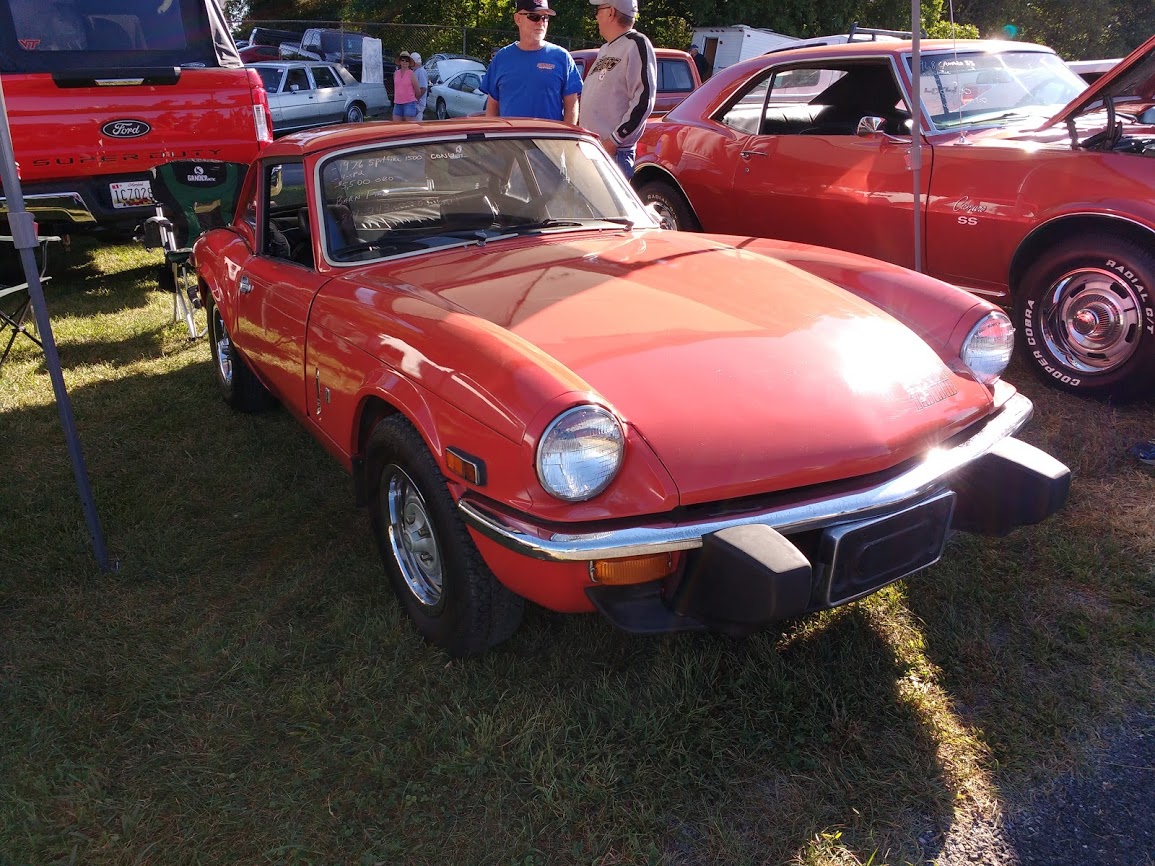
1976 Triumph Spitfire, asking $5,500:
1995 Pontiac Trans Am, asking $8,900:
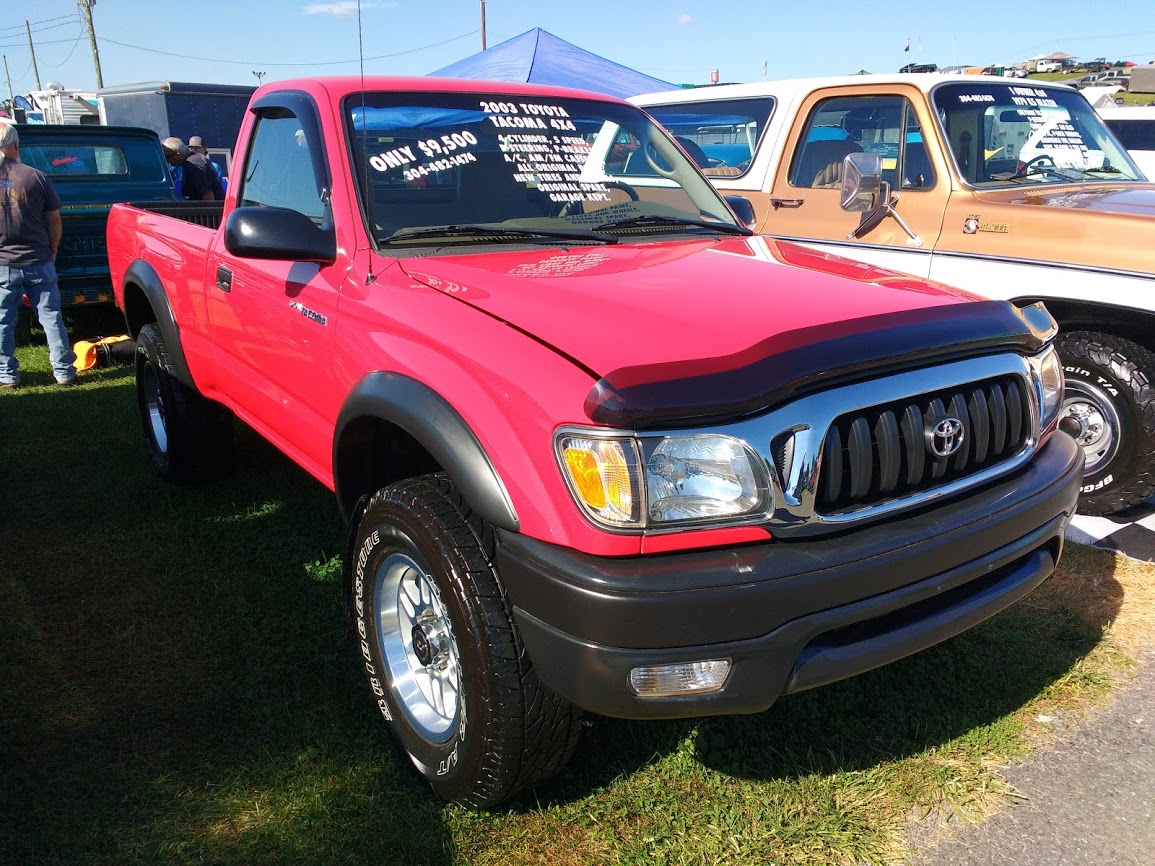
2003 Toyota Tacoma pickup, asking $9,500:
1987 Chevrolet Corvette coupe, asking $5,400:
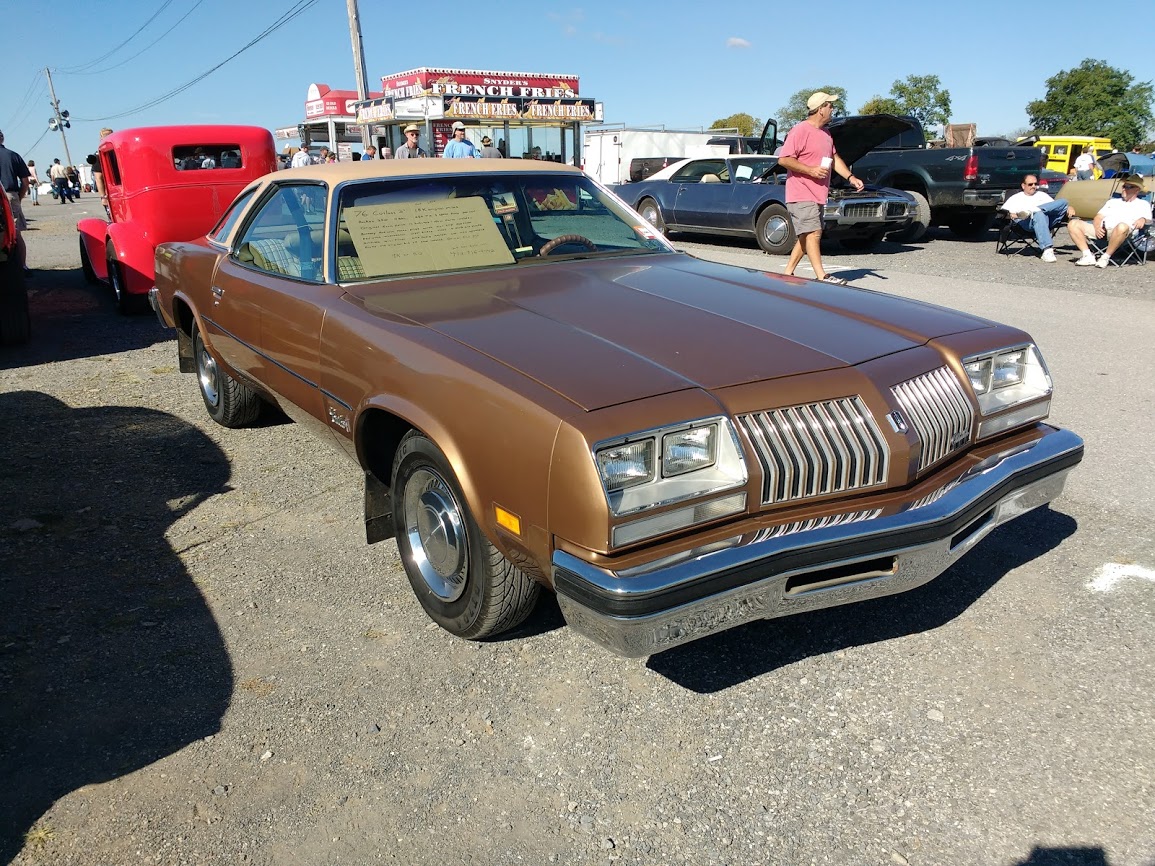
1976 Olds Cutlass coupe, asking $9,000:
1985 Nissan 300ZX 2+2 coupe, asking $7,950:
1977 MGB, asking $8,500:
1995 Pontiac Firebird convertible, asking $5,800:
1995 Chevrolet Camaro, asking $6,500:
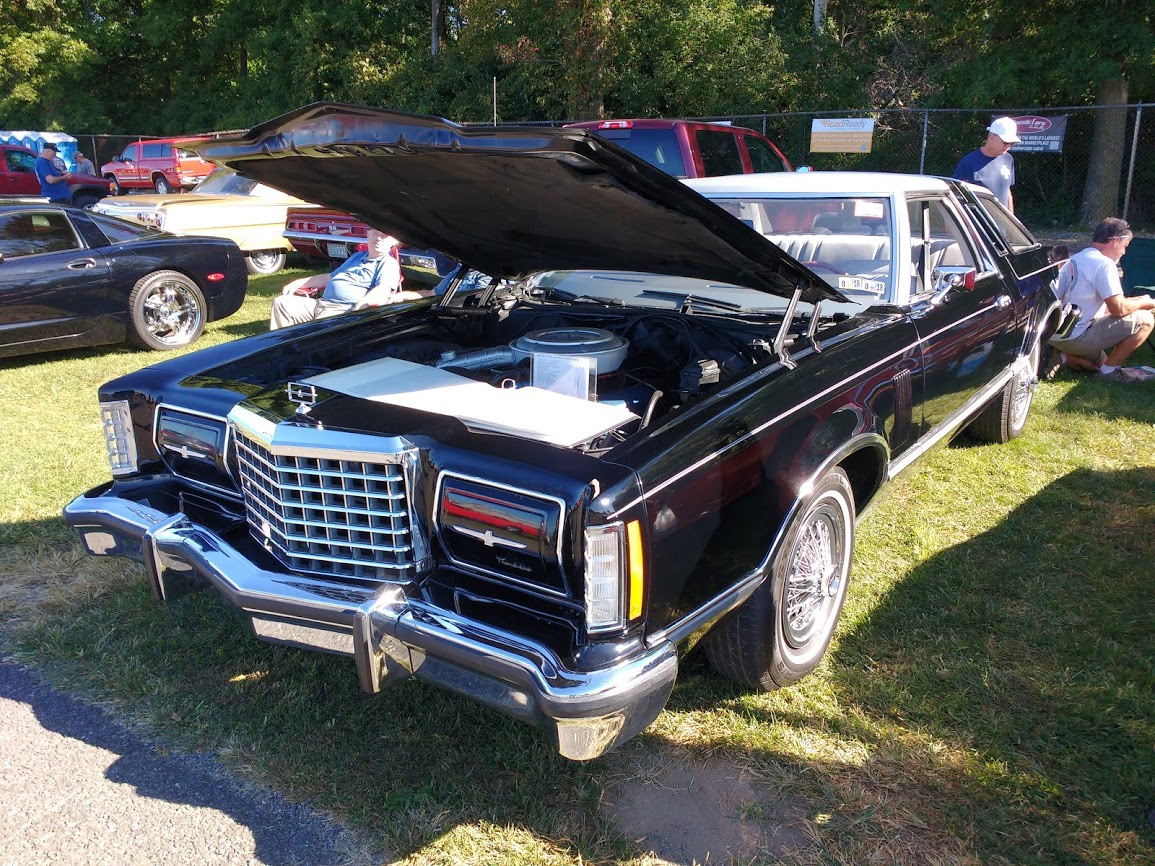
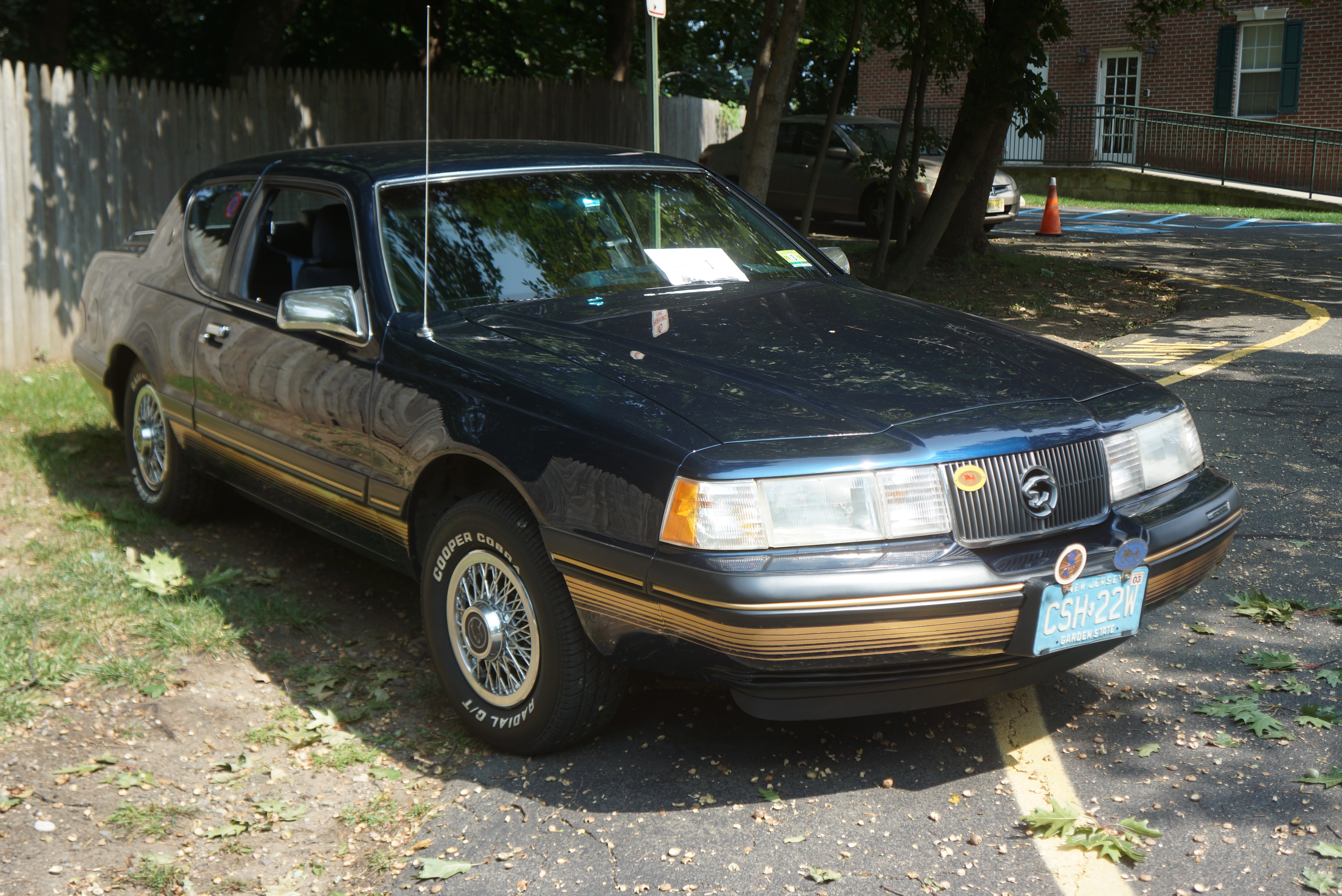
1978 Ford Thunderbird, asking $9,500:
2002 BMW 330Ci convertible, asking $5,995:
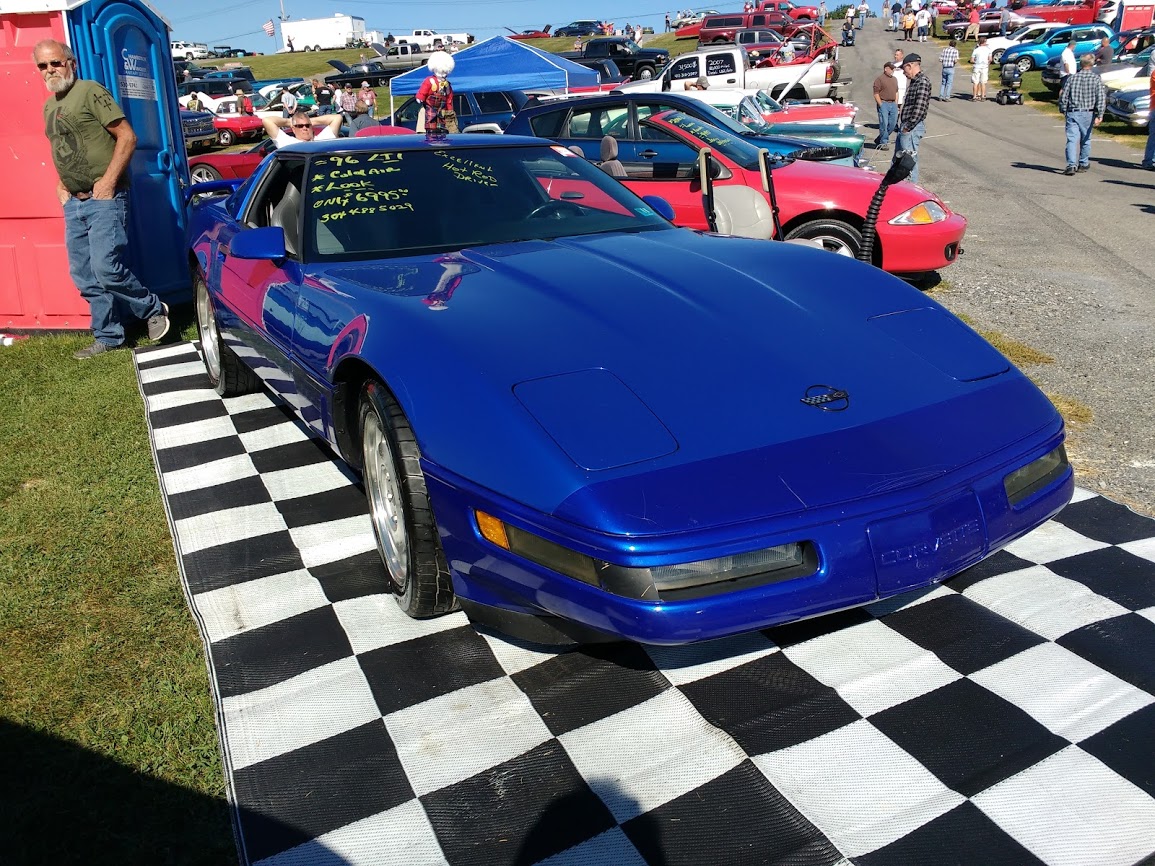
1996 Chevrolet Corvette coupe, asking $6,995:
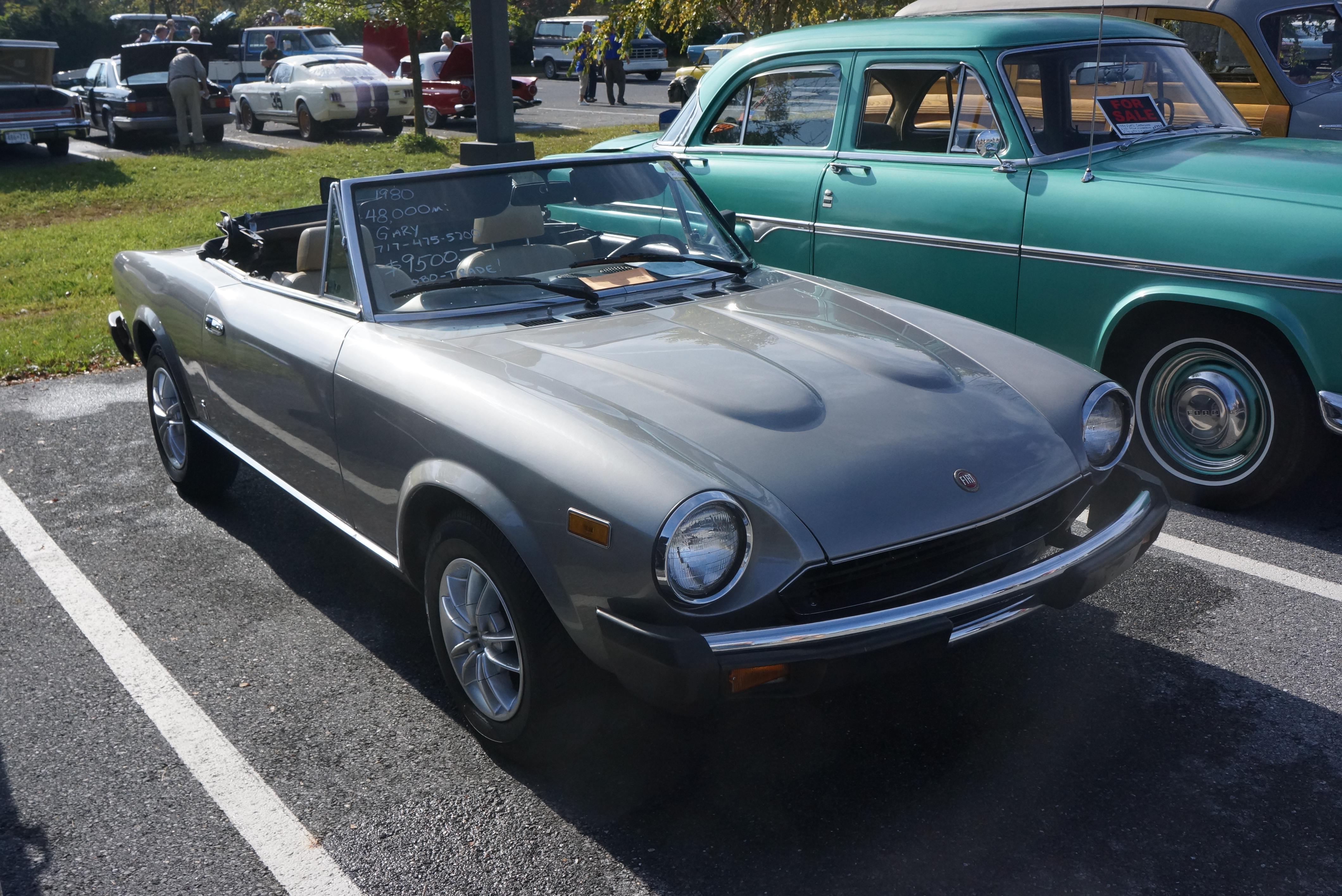
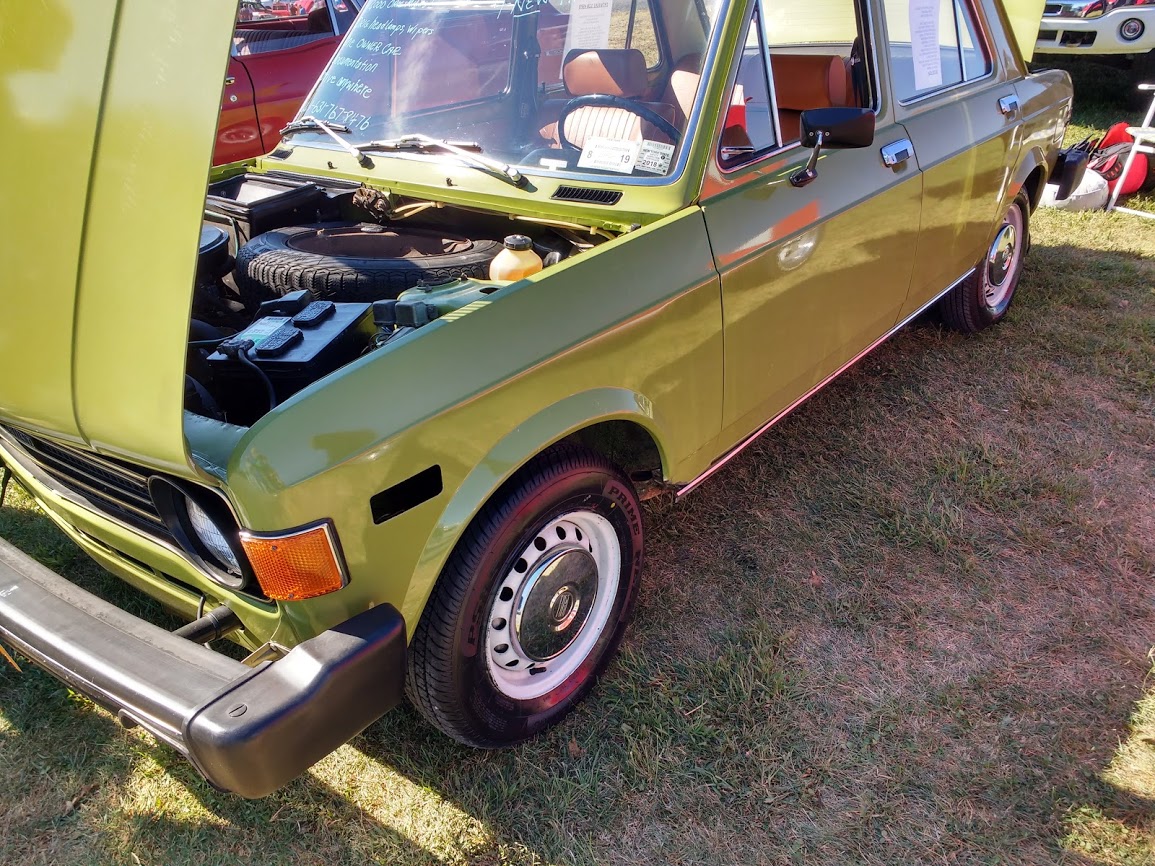
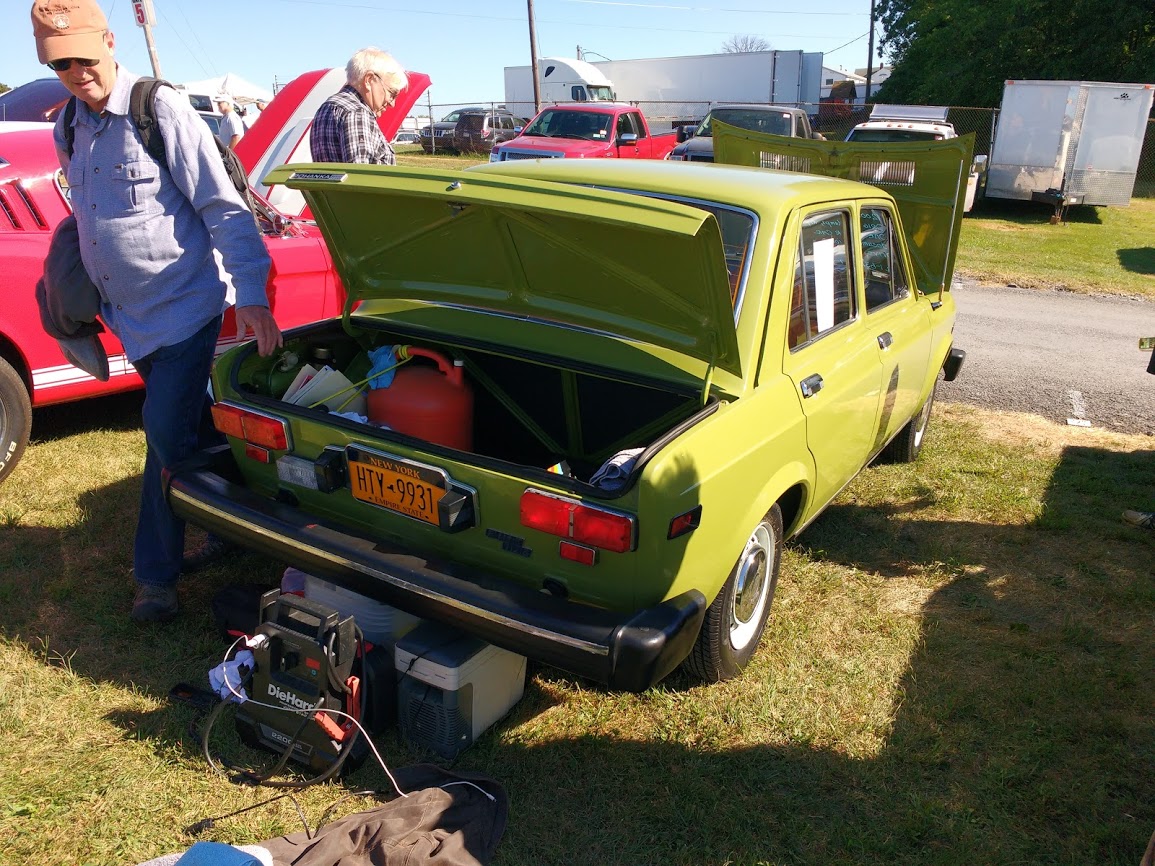
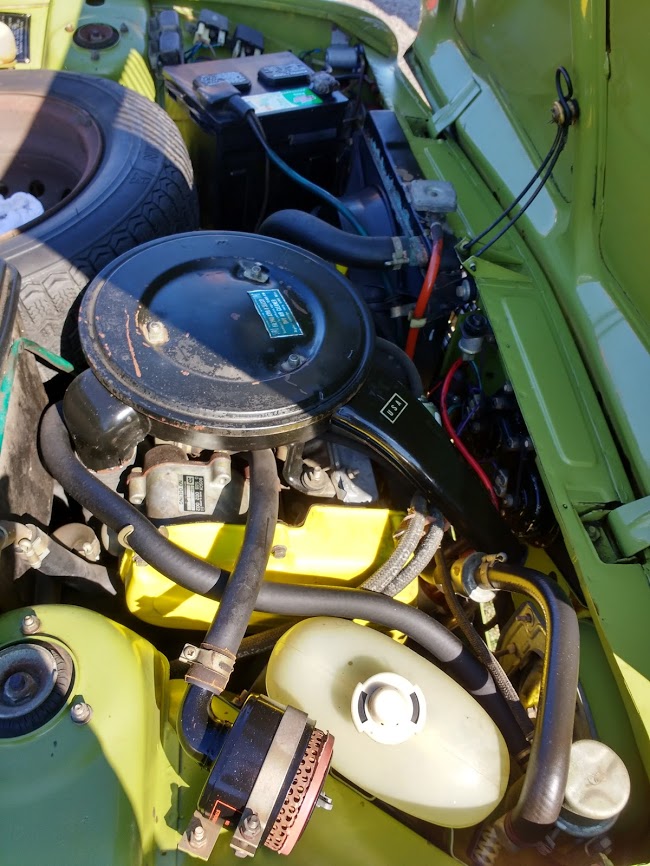
The most attractive and unusual car in the corral (to me) was this 1974 Fiat 128, claimed to have 12,000 original miles (and it looked it):
CARLISLE AUCTION RE-RUNS
1969 MGB-GT, no sale at high bid of $6,750:
1939 La Salle, no sale at high bid of $14,000:
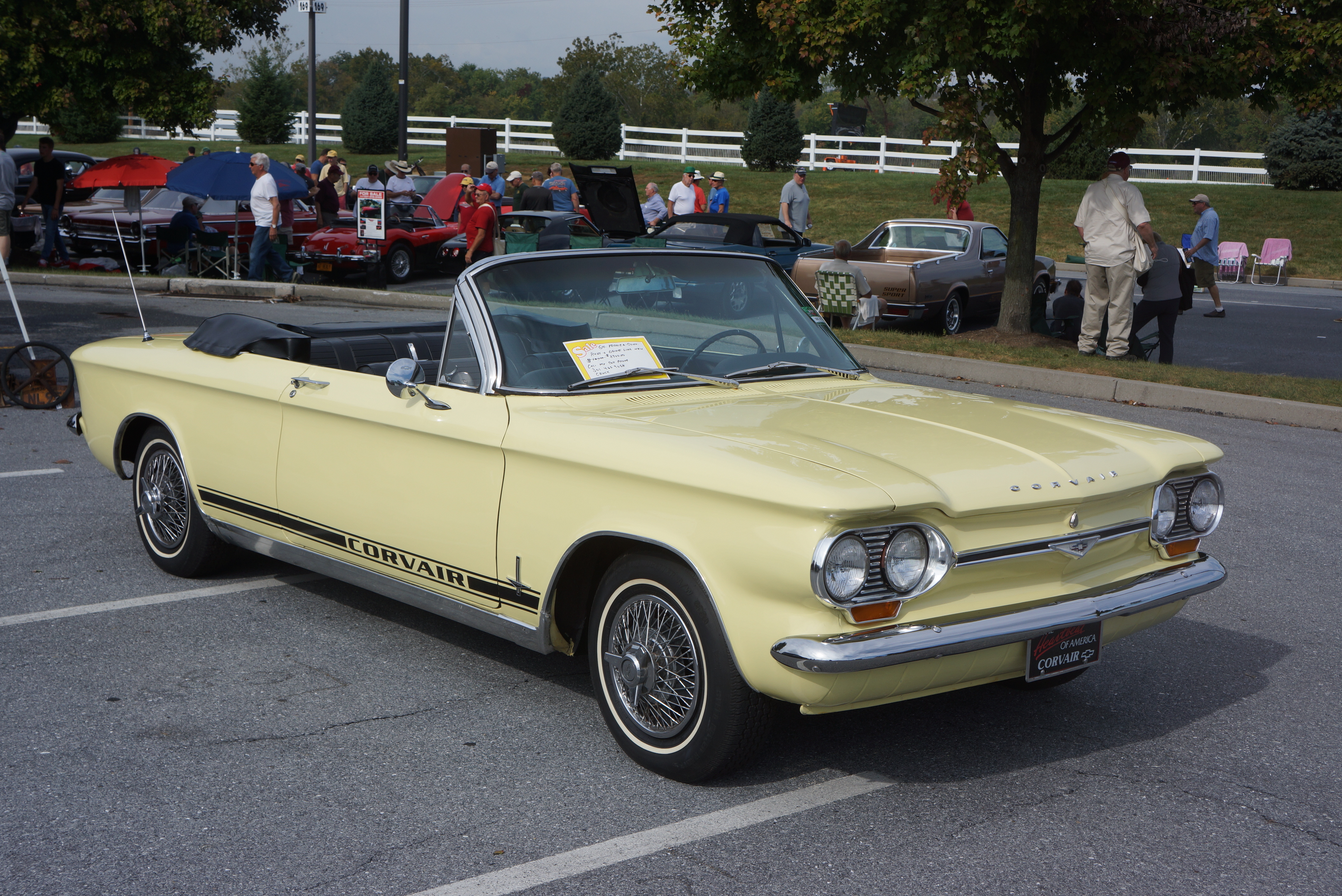
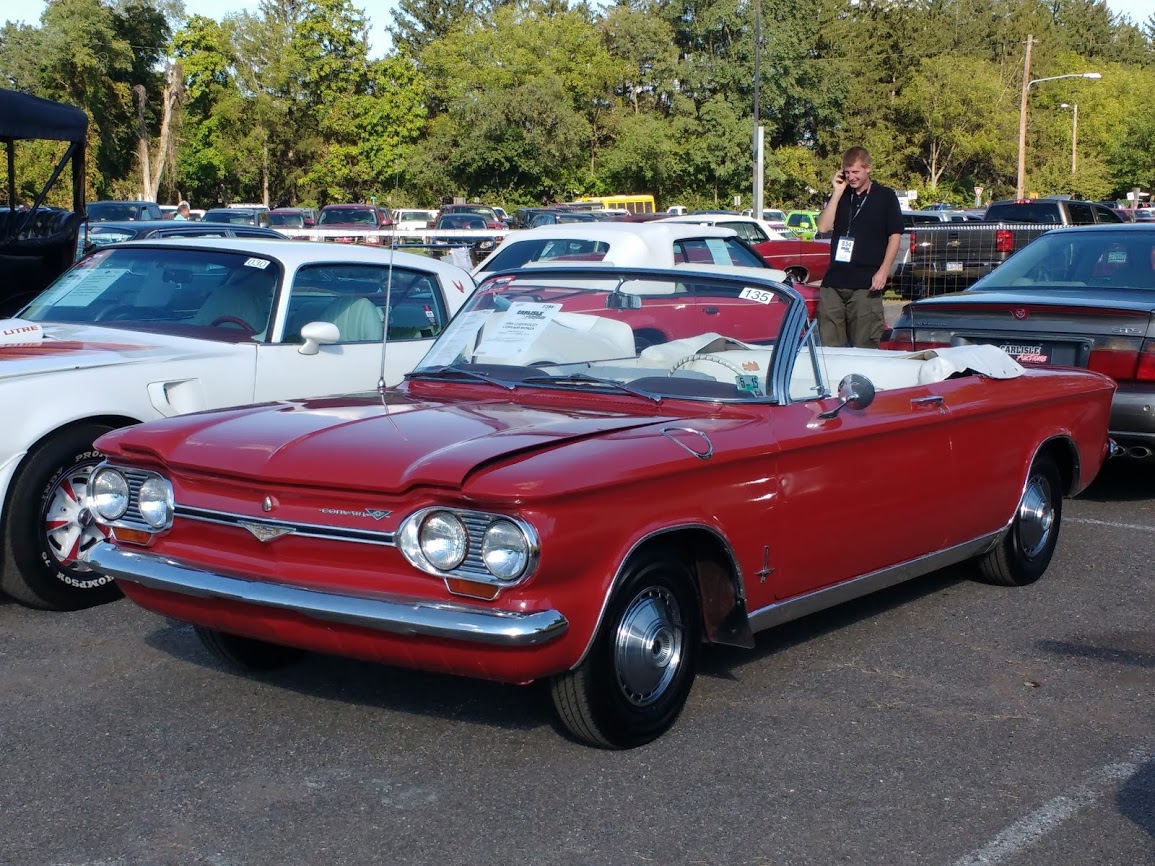
1964 Chevrolet Corvair convertible, no sale at high bid of $5,700:
1988 BMW M3, no sale at high bid of $41,000:
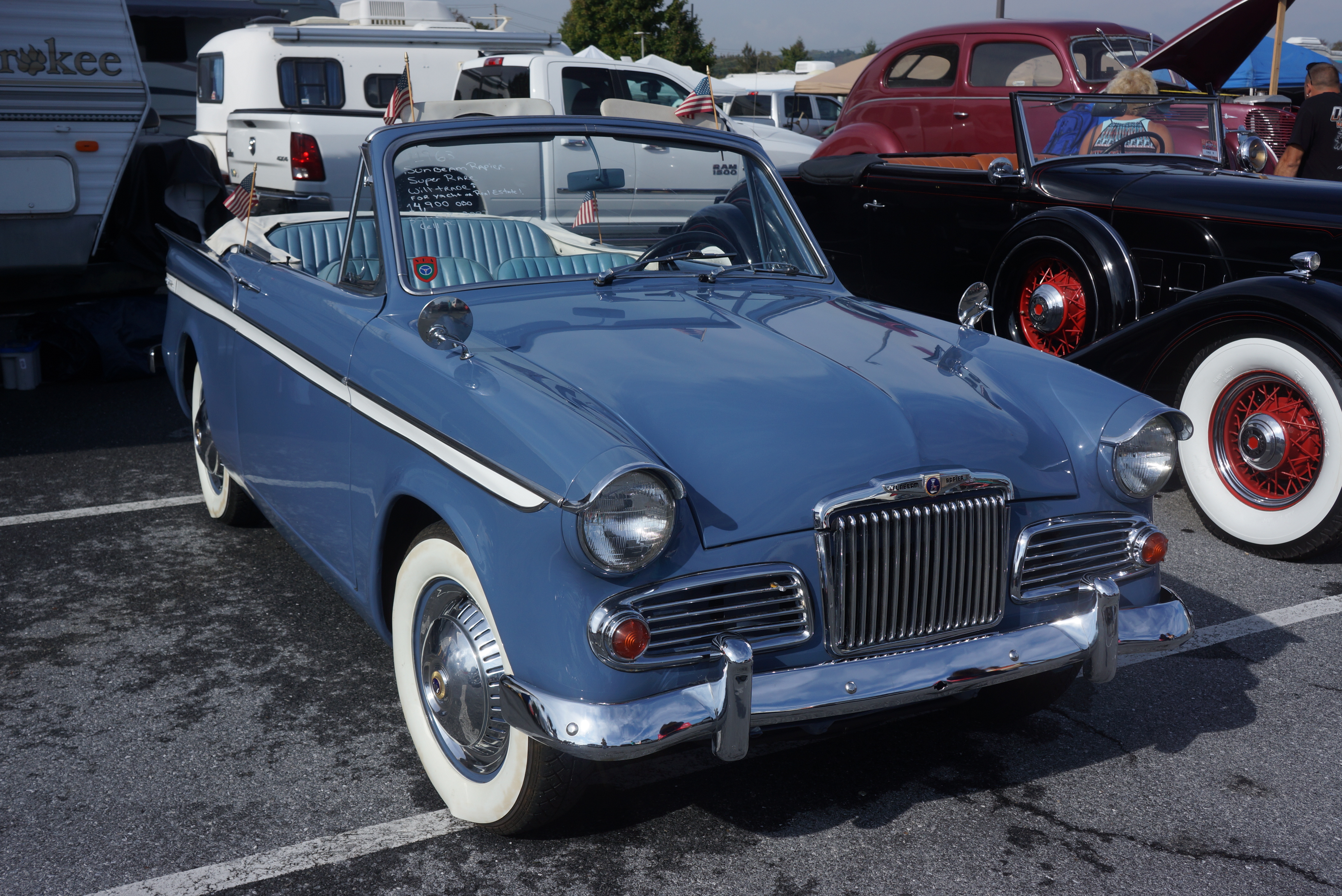
1961 Sunbeam Alpine (Tiger ‘conversion’), no sale at high bid of $4,500:
Who needs a cell phone to double as a key? Just carry a screwdriver…
1991 Ford Mustang convertible, no sale at high bid of $7,250:
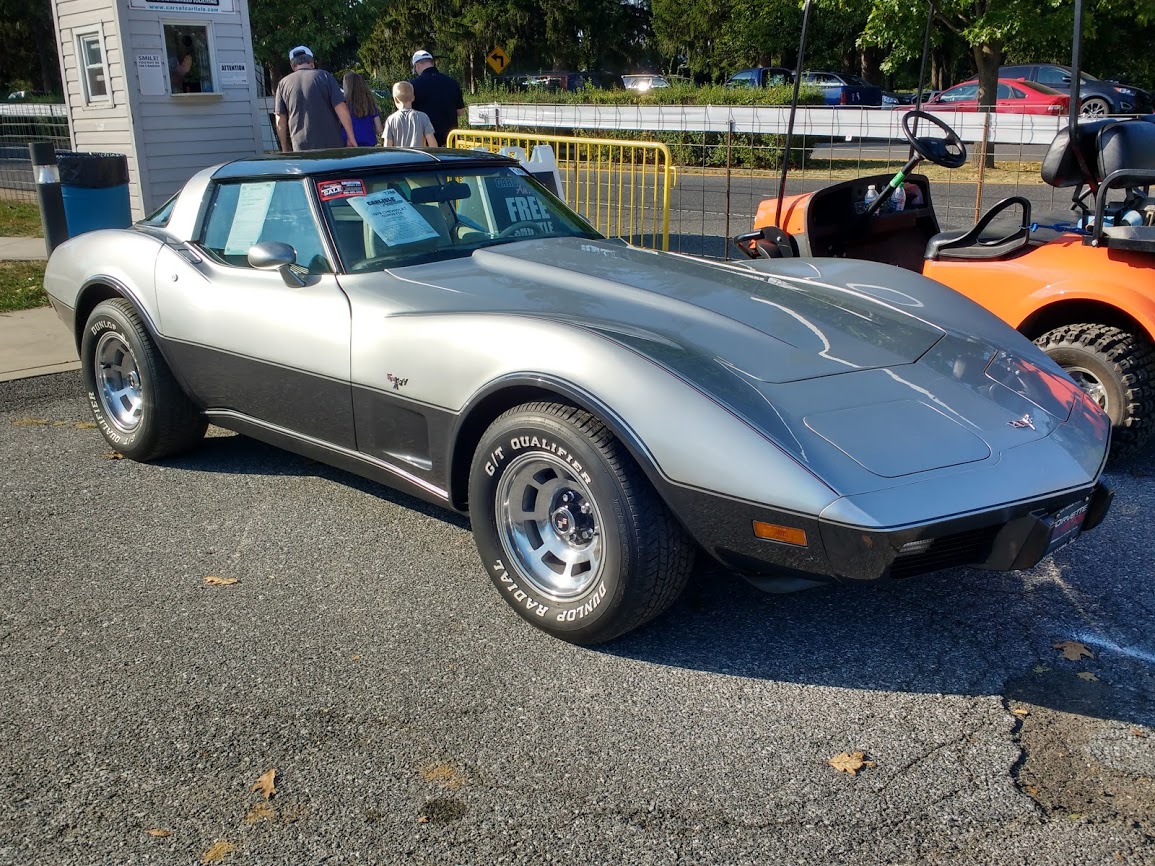
1979 Chevrolet Corvette, no sale at high bid of $10,000:
1969 Chevrolet El Camino, no sale at high bid of $12,000:
1966 Ford Mustang coupe, no sale at high bid of $11,000:
1964 Chevrolet El Camino, no sale at high bid of $16,000:
There is no new material to add to the blog this week. On Friday, I intend to make a one-day visit to Fall Carlisle, and next week is automotive Mecca: 3 days at Fall Hershey. Expect to see full reports here.
In the interim, here’s a blast from the past: one of my very first auction reports. It is interesting to look back at what has changed (and what hasn’t) in the hobby from just two and a half years ago.
Also, for those readers who are relatively new to the blog, this is something you may have missed.
The New Jersey Region of the Antique Automobile Club of America (AACA) hosted a casual car show at the Spring Hills Senior Community facility in Morristown, NJ, on Monday September 11, 2017. For a number of years, the NJ AACA has been welcomed at numerous assisted living operations throughout the state.
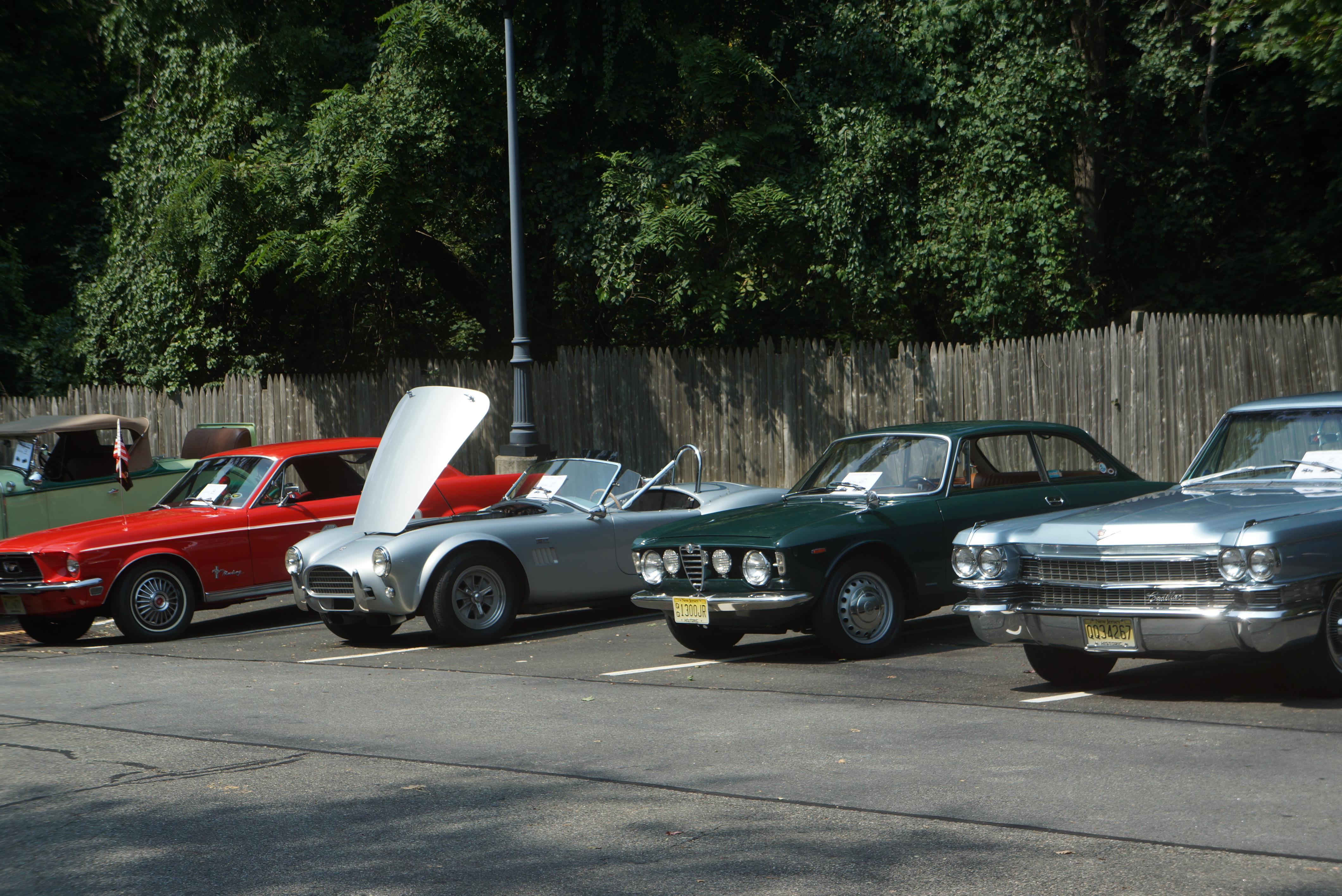
NJ AACA members’ cars lined up for review
The elderly residents are given the chance to peruse the classic cars, and club members are provided the opportunity to show off their four-wheeled beauties. The car owners and residents have lots of time to reminisce, and everyone wins. We saw that effect in full swing on this beautiful late summer day, with sunny skies, low humidity, and temperatures in the 70’s.
The Model T was the fave backdrop car for photos
Event chairperson Abe Platt was pleasantly surprised with a turnout of 11 cars, a copious number for a Monday. Vehicles ranged in age from a 1923 Ford Model T to a 2001 Chevrolet Corvette. The decade with the largest representation was the 1960s. Your author was thrilled to see how many Spring Hills residents could eloquently recall the cars they owned 40, 50, even 60 years ago.
The Alfa was occasionally used as a rest stop
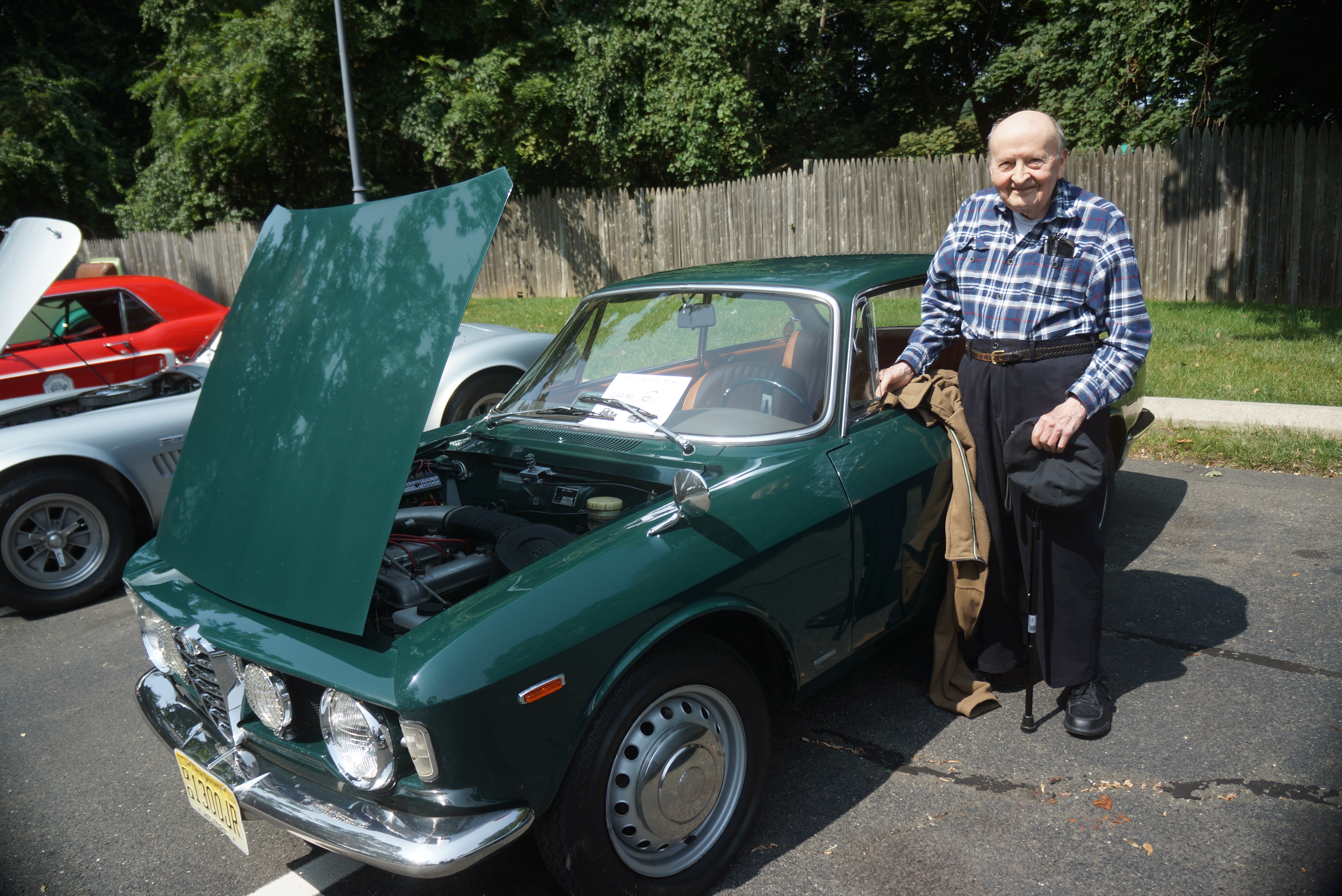
The first gentleman I met approached me as I stood by my Alfa. He told me that in the 1960s, his daily driver was an Austin Healey 3000. He related that the exhaust note on the Healey was so distinctive that his then-three-year-old daughter knew when daddy’s car was about a half block away, and she would get excited knowing her father was almost home. I asked him what his wife drove, and he said “always Volvo wagons. We had them all, from a 122 wagon, to the 140 wagon, then a succession of 240 wagons.” When I admitted that I had spent much of my career with the brand, he said “at Smythe?” In what was the coincidence of the week (nay, the month), it turned out that he knew the owners of the dealership where I was employed in the 1980s. He still regularly communicates with one of the senior partners.
My new friend Bob Detig, he of the Austin-Healey ownership
Another man eyeballed my Alfa and told me that he had purchased a new BMW 2002 tii in the seventies. The BMW replaced a Jaguar E-Type 2+2, which had replaced a Jag 3.8 sedan. With a wink, he said he loved his sports cars, but needed the back seats to carry the family. The last car he owned was a 1999 BMW 7-series, which he would pilot back and forth to Florida at “extra legal” speeds.
Ron was the Jag/BMW owner
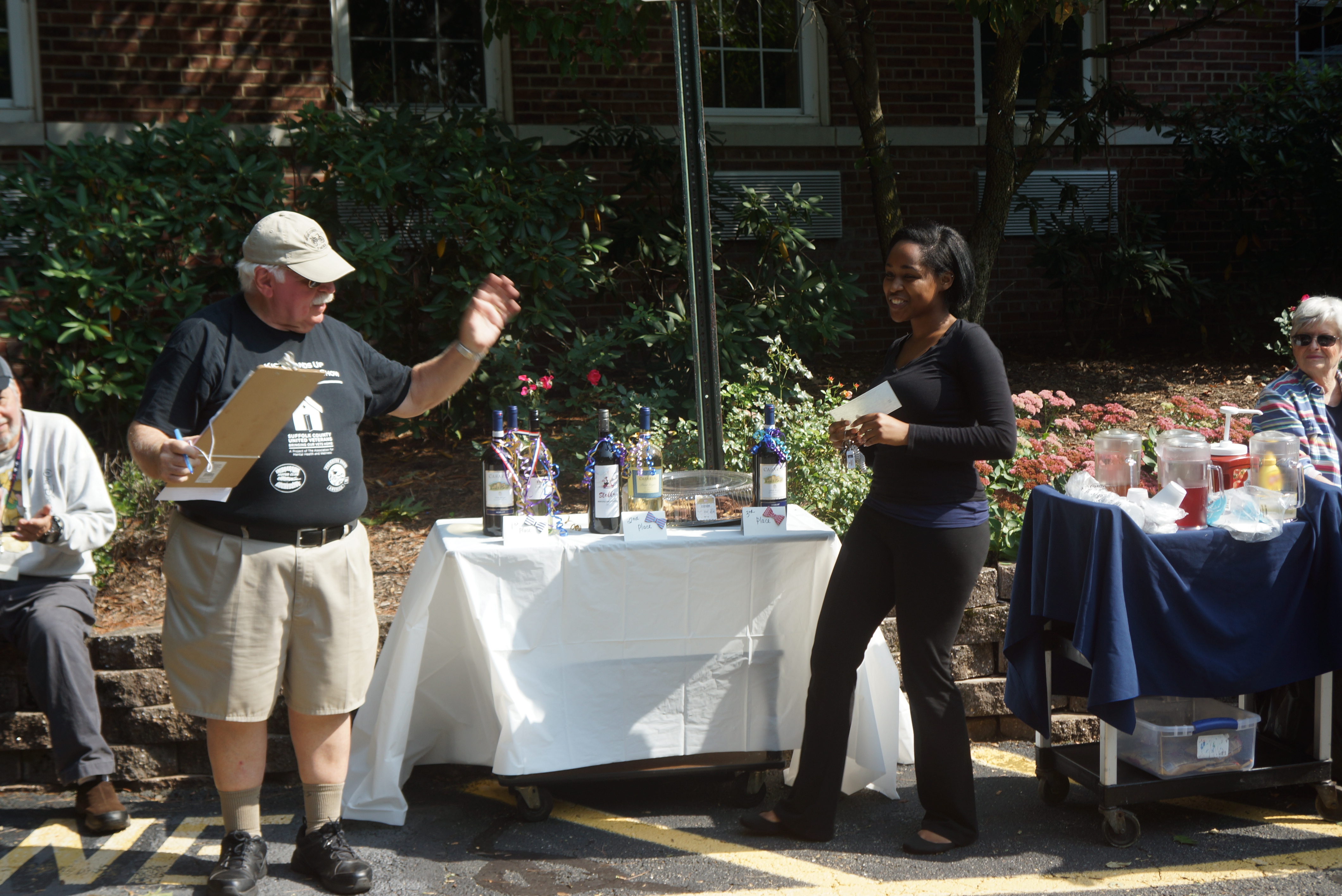
The facility generously provided lunch to the car owners, and bottles of wine were presented as 1st, 2nd, and 3rd place “People’s Choice” awards. The event started at 12:30pm, and was over by 3:15pm. This was the first time I had been able to join the NJ Region in a Senior Living facility visit. I was touched by the opportunity to share stories with the facility residents. Frankly, it was the best way I could have spent my Monday afternoon.











































































 richardscarblog