During the restoration of the Isetta, a frequent question presented to me was “what motivates you to keep going?” Of course, I wanted to see the project reach a successful conclusion, but setbacks, and there were a few, can be demotivating. There were times I questioned my own sanity, as in, “why am I spending so much time, money and effort to restore a 13-horsepower bubble car from the 1950s that most people have never heard of?” With everyday life (job, family, house) swirling around me, I was occasionally tempted to quit the whole deal.
One of my mantras during this 5+ year stretch was “celebrate your successes”. Reaching certain milestones not only feels great, but the achievement can be shared with others, which then inspires you to keep moving forward.
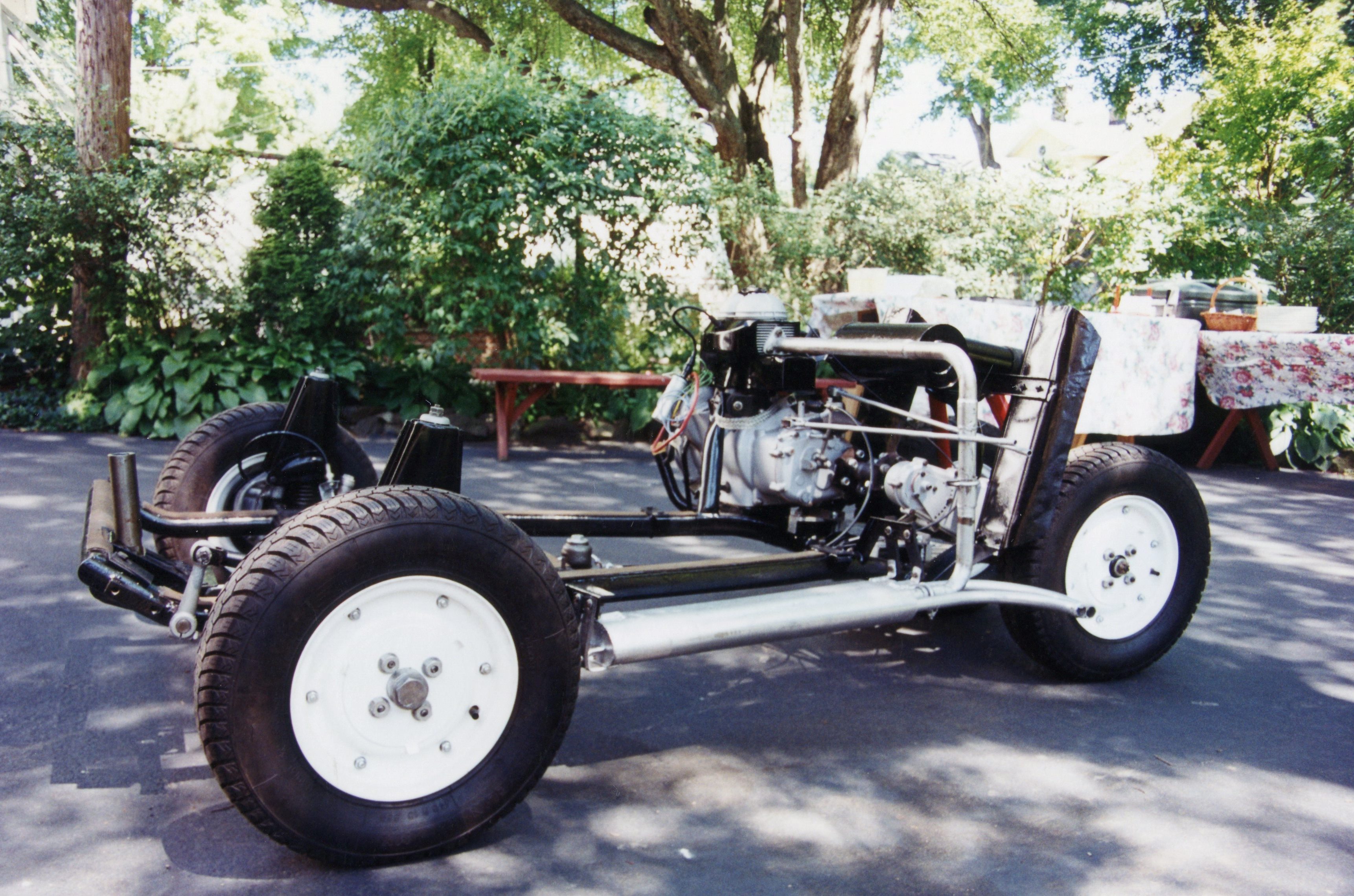
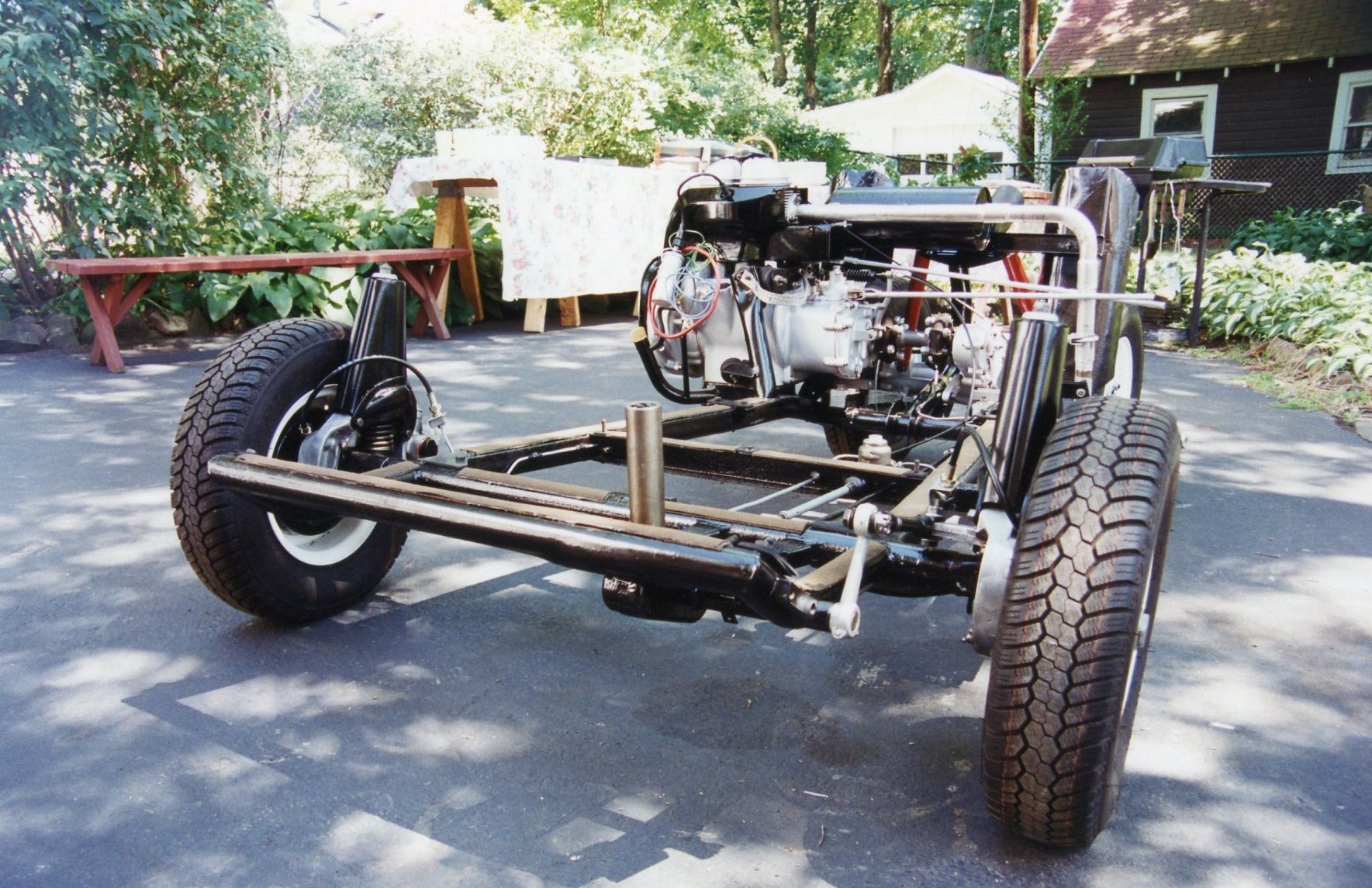
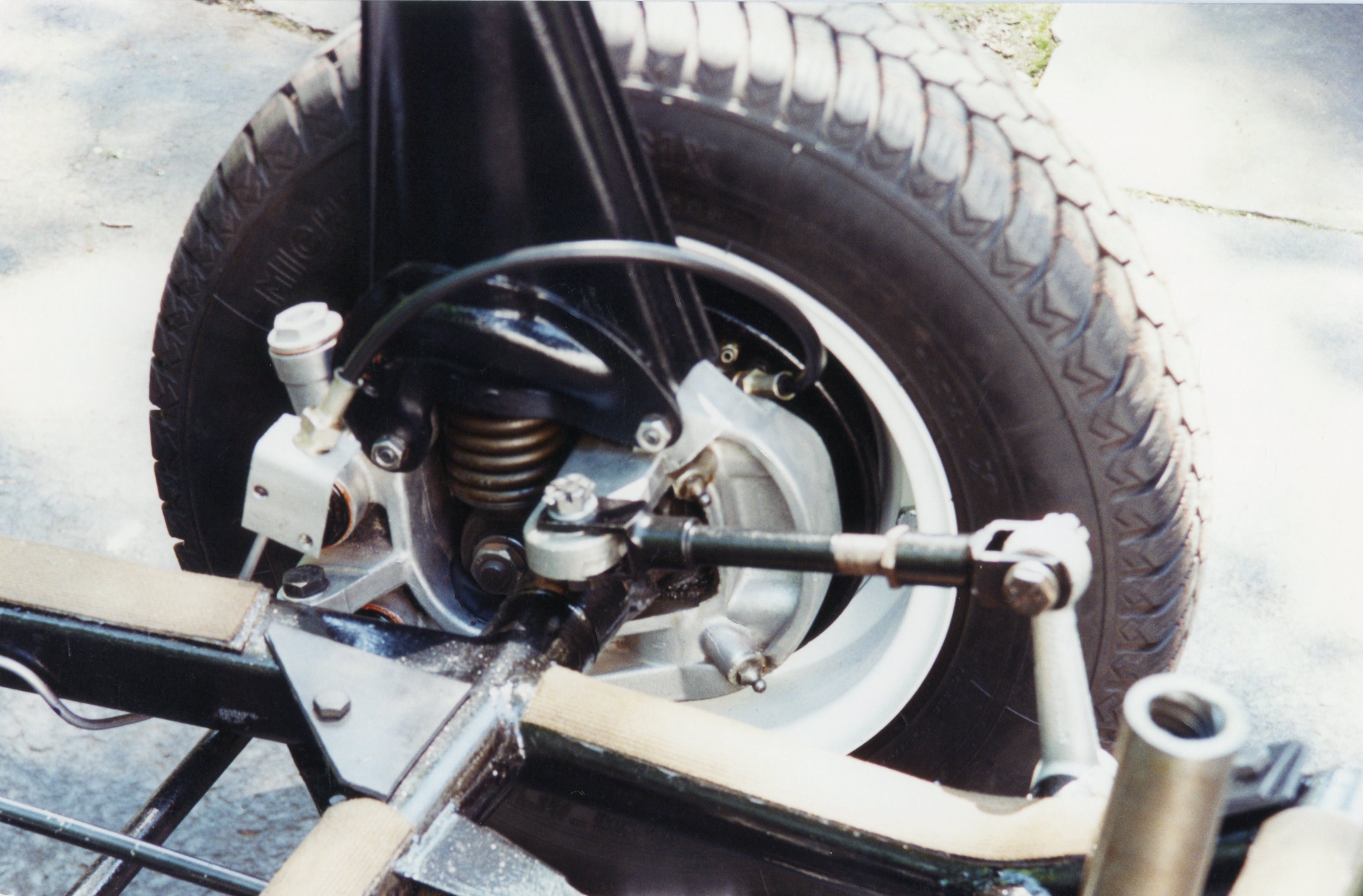
In August of 1995, I was ready for such a celebration: the Isetta body shell, freshly painted and just back from “The Shop”, was about to be reunited with the mechanically-restored chassis. In a traditional automobile assembly plant, the moment of “marrying” the up-until-then separate body and chassis is called the marriage point. So, in honor of that event’s facsimile, we decided to host a wedding. Before, um, consummating this union, since the shiny and clean chassis was about to be covered up again, a final set of photographs was taken to document its return to as-new glory.
The wedding was scheduled for Sunday, August 20, 1995, and since a wedding must have guests, a small ensemble was invited. (Memory doesn’t recall whether any of the invitees were tipped off that there was work to be done before food and beverages would be served.) The chassis was staged in the driveway just beyond the garage doors, with the body patiently hanging out in the garage on four jack stands.
Five intrepid groomspeople (Chris Beyer, John Maggio, Dennis & Ann Marie Nash, and Don Dahringer) vaulted the body back into the daylight. Spotters were assigned to eyeball the body’s descent so that nothing was injured. It took a few moments to clear all the obstacles, but the (re)union was a success.
A video camera (thanks, John) was rolling to capture the event. You can view a 12-minute excerpt at this YouTube clip here:
Whew! My nervous excitement is palatable to me as I watch myself nervously pace back and forth and around the car. In all seriousness, having a group of friends around me helped alleviate my worries. Once I knew the body shell was resting on the chassis rails, we popped the champagne, ate some BBQ, and of course, shared dessert in the form of a wedding cake:
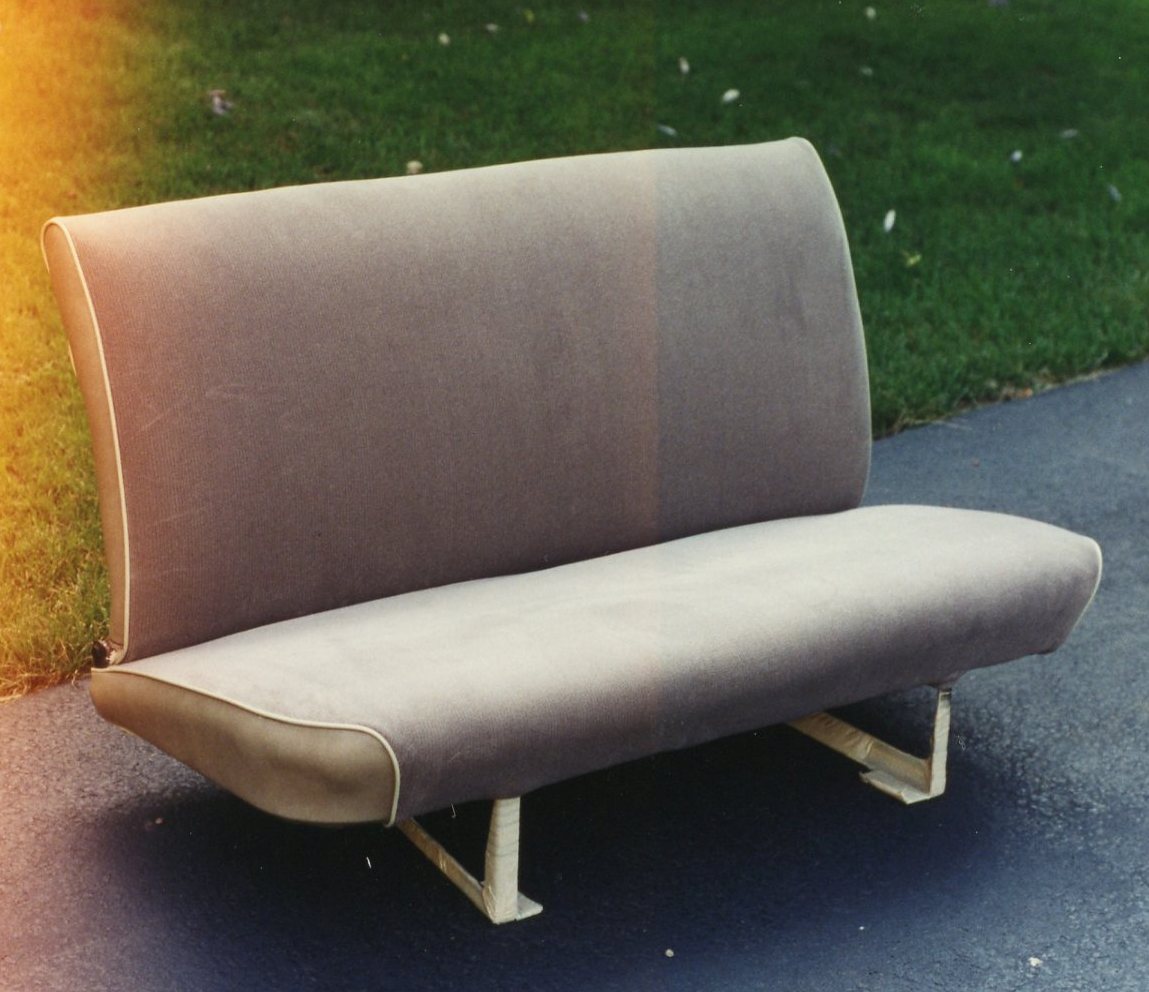
The end of the push to make “The Isetta Drive in ‘95” was close, really, truly close. The steering, pedals, wiring harness, ignition, and seat all needed to be installed and connected. The motivation was the knowledge that I was perhaps a few short weeks away from driving my Isetta for the first time since buying it as a disassembled heap in 1978.
It almost looks ready to drive. Almost.
(Special thanks to my Creative Team pals Cody, Eslam, and Greg for their video-editing assistance. You guys are the DUDES.)
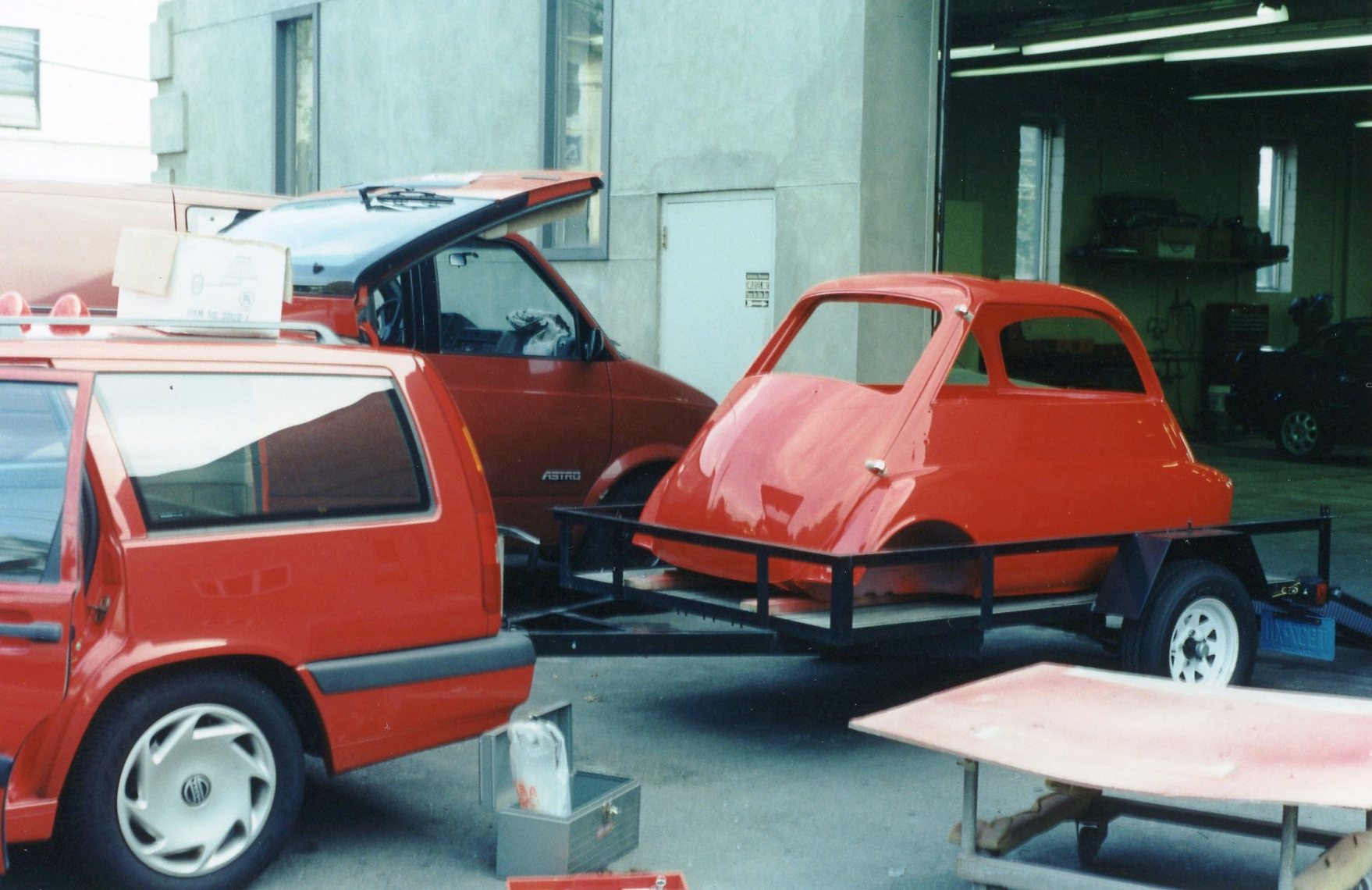
Jody Fitzpatrick, proprietor of “The Shop” in Maplewood NJ, had my Isetta in his possession for one day shy of five weeks. His work was completed, done, finished. I breathed a huge sigh of relief if only for his ability to accurately predict his work timeline, originally estimated at “3 to 4 weeks”. This was close enough. There wouldn’t be any restoration shop horror stories in my future.
Chris Beyer, work colleague, neighbor, and friend, had accompanied me when I dropped off the Isetta body. When I told him that it was ready for pick-up, he was ready and willing to join me again.
The date was Friday July 28, 1995. Nothing in my notes or my memory explains how Chris and I both happened to be off from work that day; but we were. It was a sweltering humid day, hotter than the previous days had been during what was already an oppressive summer. Cranking the A/C in my Volvo 850 wagon did little help; nothing was going to cool me enough to dissipate my nervous excitement over seeing the painted shell.
Jody’s 2nd and final statement
At our arrival, Jody strolled out to greet us, looking and acting nonchalant. “How come HE’S so cool?” I asked no one. Perhaps because he does this every day, and, it’s not his car, and, he just wants to get paid, replied the voice in my head. The body shell, of course, looked perfect, almost too much so. I was afraid to touch it, but with Jody and Chris’s help, we got the same 2x4s bolted back to its underside, and then to the trailer floor.
The red 850, ready to tow home the red Isetta (note dolly and plywood in lower right of photo)
From ugly duckling to gorgeous swan (obviously, beauty is in the eye of the beholder)
Chris and I pose in parking lot of The Shop
Jody got his check, I got my receipt and my obligatory photos, and we were on our way. I must have glanced in the rear view mirror about every 12 seconds to make sure the body was still there. At a red light on the way home, several male teens yelled out “hey, it’s the Urkel-mobile!” Oh My God, I thought, am I going to be hearing this for the duration of my ownership of this thing? (The short answer to that question is “yes”.)
Back home after a 5-week vacation
Soon to be reunited
Leaving the 2x4s in place for now, we carried the body into the garage, and back onto my makeshift dolly. I posed it next to the completed chassis, fully aware that in a few days, five years of mechanical work would be covered forever (or at least until the car is re-restored in 2095).
Light buckets and other externals at the ready
What work was remaining before reuniting the body and chassis? The body’s hand-painted underside now had primer overspray on it, so that got yet another coat of gloss red. The headlight and tail light buckets were bolted on. The fuel tank, which had earlier been restored by coating it with Bill Hirsch’s GasTank Sealer, was secured in place. The 2x4s were finally removed, and the body was placed onto 4 jack stands.
Gas tank bolted into place (note fuel tap in upper left)
In an auto assembly plant, the moment when the car’s body, on one conveyor, is lowered onto a complete chassis, arriving on another conveyor, is called “the marriage point”. The Isetta’s 17-year courtship was coming to an end. It was time to host a wedding party and consummate this marriage.
Jody Fitzpatrick, proprietor of “The Shop” in Maplewood NJ, was my choice to oversee the body restoration of the Isetta for many reasons: he was personally recommended, the business was nearby my residence, his pricing was fair, we had a mutual understanding of what “done” looked like, and his estimated timeframe was reasonable. Another reason is that Jody assured me that I could visit and observe the progress whenever I desired (sort of like conjugal visits for the incarcerated).
Having read more than one “restoration shop horror story” (the car gets pushed to the back, 6 months pass with no progress, the shop demands more upfront money, they lose your car keys, or worst, they close the business and lock the doors with your car inside), having visitation rights was refreshing.
So visit I did.
Three times during that hot July of 1995, I stopped in to have a peek and to snap a few snaps. Jody was always very accommodating and genuinely happy to see me, and gave me free rein to walk around my car and chat up the crew doing the actual labor.
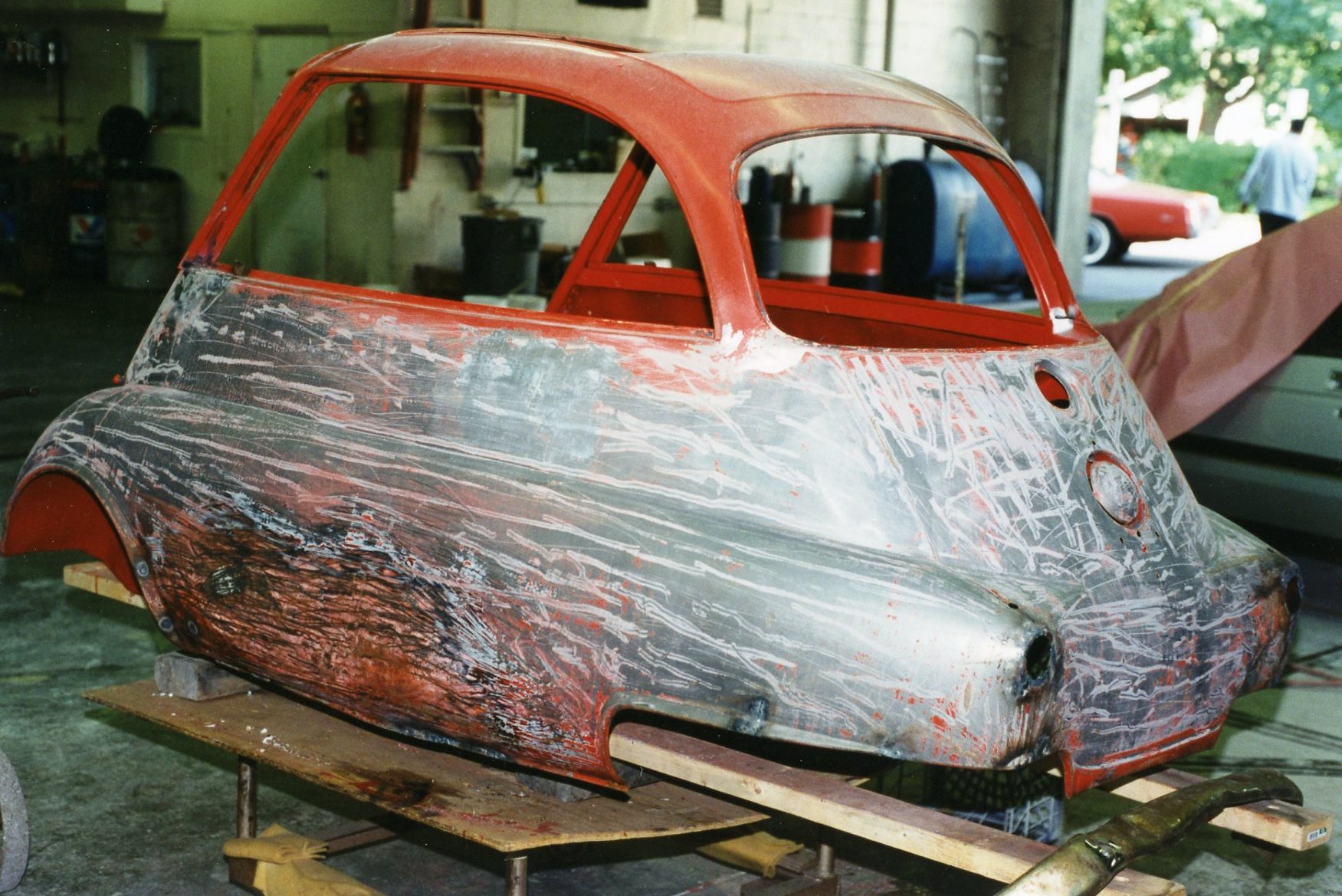
During the first visit, employees were using homemade scrapers to remove the paint. They had decided against chemical dipping or media blasting, fearful of inflicting further damage. They also hammered out any dents and other rough spots, in preparation for some minor welding and an eventual skim coat of putty in spots. (From my own research, I had come to learn that any talk of body repair that doesn’t involve some small use of plastic filler is fantasy.)
THE SHELL IN THE PROCESS OF PAINT BEING REMOVED:
During this visit, Jody and I also finalized the choice of paint color. There was no known “official 1957 BMW Isetta paint code chart” we could refer to, so we did the next best thing. Sampling the unfaded paint we found under the BMW roundel on the door, we matched that to the closest shade among the modern paint code charts in Jody’s possession. We both agreed that the 1995 Ford Mustang shade of “Performance Red” was it. Jody stressed another advantage: should the car need touch-up or repair in the future, the correct paint would be readily available.
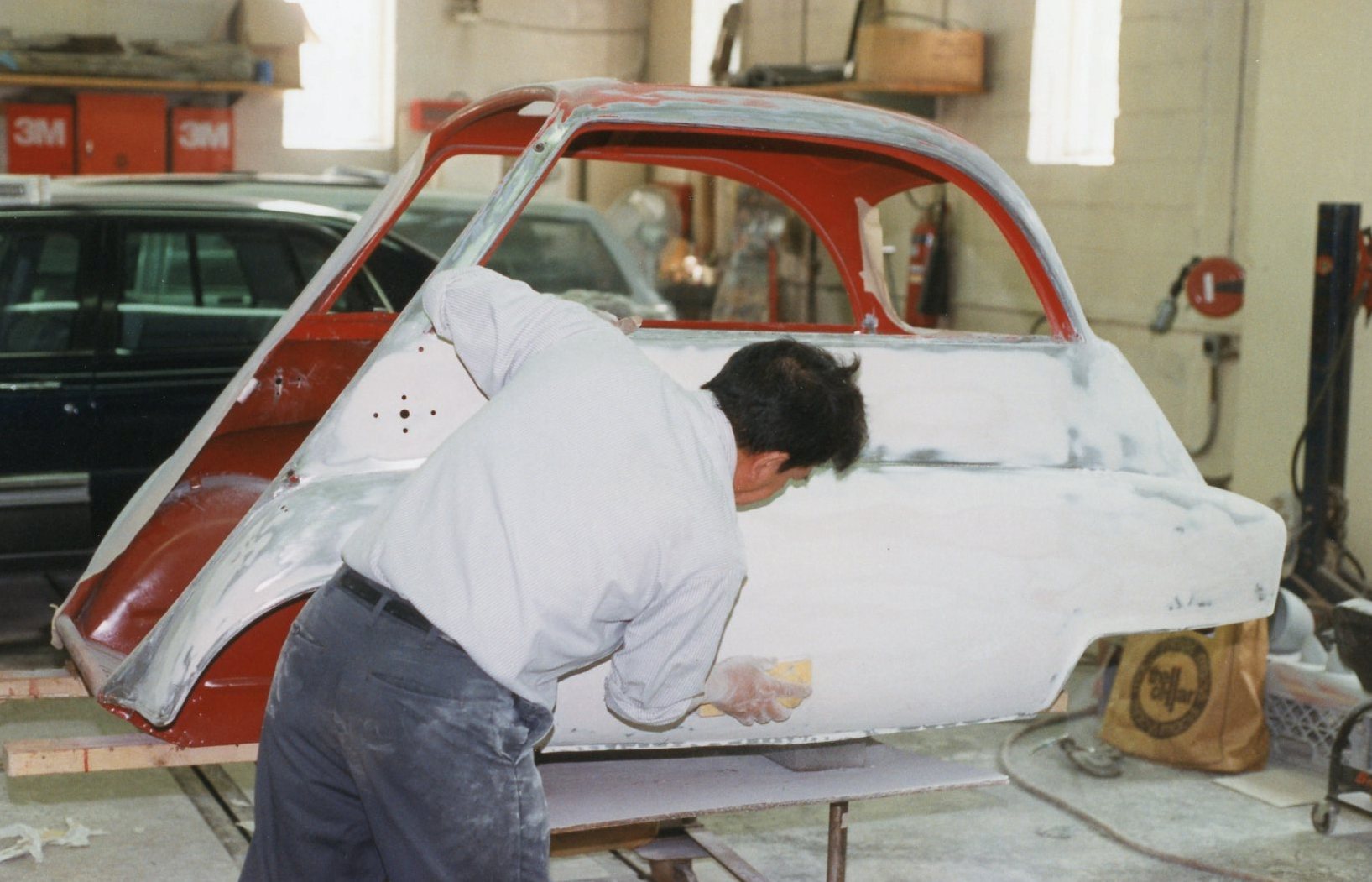
Just a week later, I saw the body with all the original paint gone, and the metal work beginning. I had given Jody a recommendation from John Jensen’s Isetta Restoration book for a method to reinforce the rearmost body panel at the tail lights and rear bumper. This section of the shell was not directly attached to the chassis, and was a known weak spot. Jody stated he would use the printed suggestion to add some additional metal in places.
HAND-SANDING THE FILLER AND THE GUIDE COAT:
During this 2nd visit, I pointed out a number of drilled holes which needed to be filled. These included where the dealer-installed mud flaps and luggage rack had been, neither of which were to be reinstalled. (I would later discover one which I missed, requiring the purchase of a somewhat pricey accessory in order to cover it!) Jody’s suggestion of grinding down the visible factory welds at the body panel joints was rejected by me, as I had every desire to keep to an original look.
Like a proud papa, I posed alongside the work-in-progress:
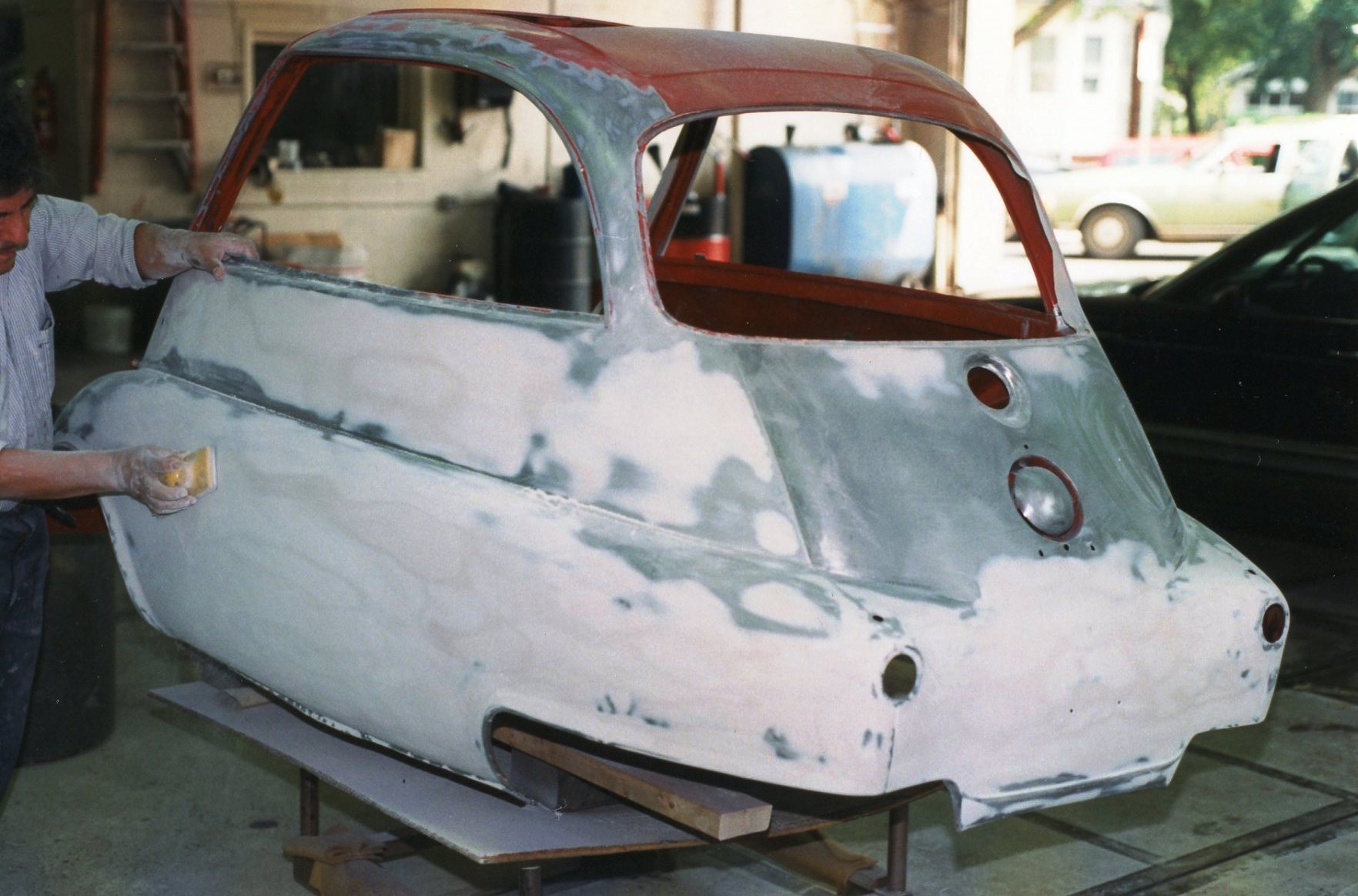
The third visit found the body in full primer. With the metal work done and its flanks as smooth as new, it was not difficult to visualize a freshly painted body shell. Jody had the door and all the other exterior pieces at The Shop, but he also generously offered to hang and align the door for me, something that was not part of our initial negotiation. I brought the freshly-plated door hinges with me so that he could do just that.
THE BODY IN FULL PRIMER, JUST PRIOR TO COLOR COAT:
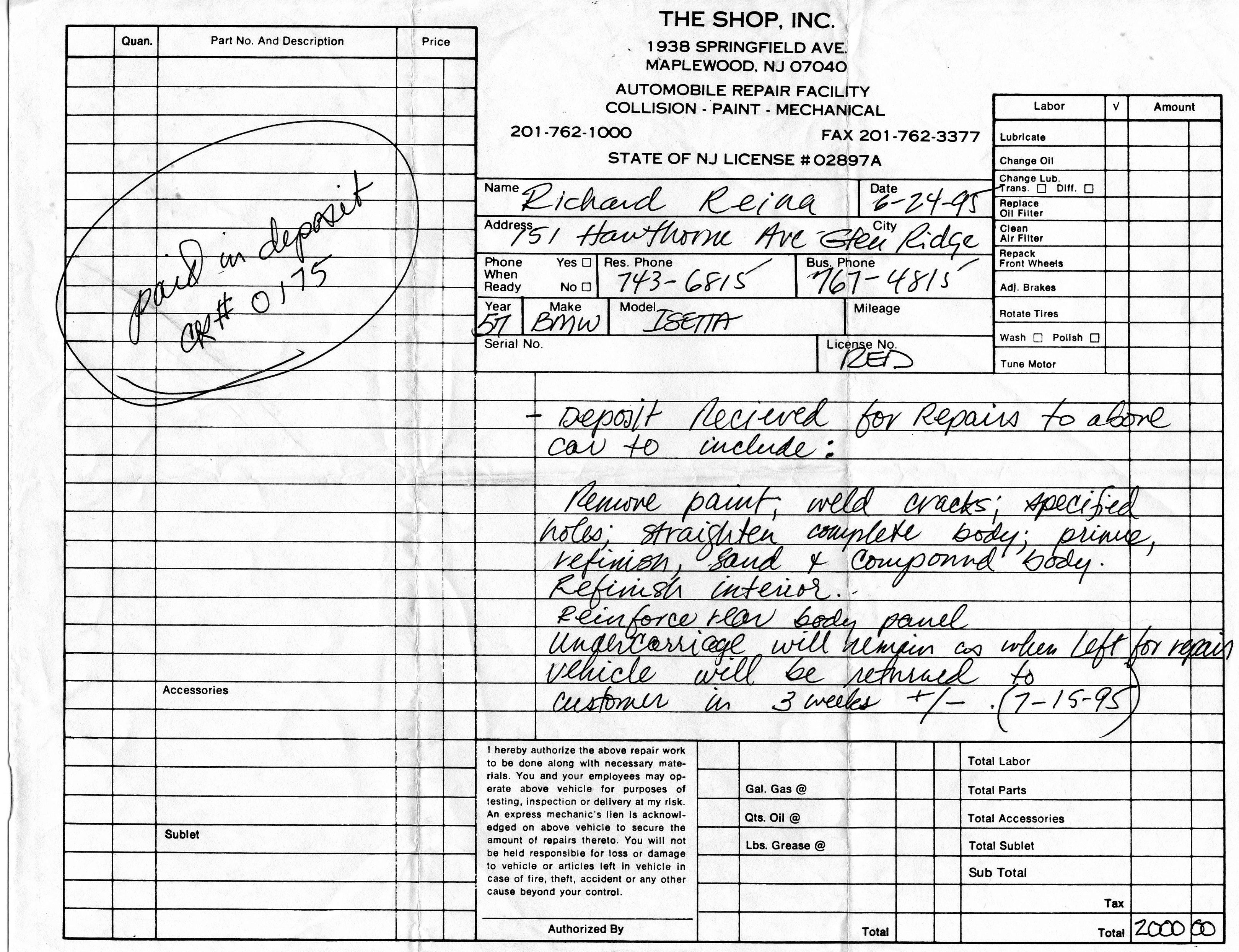
Perhaps the most exciting aspect was that the work was closely adhering to the originally estimated timeframe. Jody said that it might take a week longer than he hoped, but everything looked to be on track for a final pick-up by the end of July. And there were no “pricing surprises” either. Jody had gotten a $2,000 down payment upon drop-off, and he said that all I owed him at completion was the $2,000 balance plus NJ state sales tax.
A few days later I got the call. “It’s ready whenever you are.” That Saturday, I hooked up the trailer to the car and grabbed my checkbook. We were on our way.
Happy New Year! The most recent posting of the Isetta Saga was Chapter 13, way back in May 2018 (it was a busy summer and fall). It’s time to resume the Saga, with intentions to post subsequent chapters more consistently through the winter months.
Chapter 13 ended on a high note: I had found a somewhat local body repair place in Maplewood NJ, “The Shop”, run by Jody Fitzpatrick, who agreed to take on the job. Jody and I had a verbal agreement that for $4,000 in materials and labor, he would perform all needed metal repair work, plus prime and paint the exterior and interior using a single stage paint. (He offered to clear coat it, but I declined, wanting to keep to the factory appearance.)
Notably, for that price he would NOT paint the underside, and his interior work would be limited to paint only. He would perform no metal prep to the interior (and it really didn’t need it), nor would he cut and buff the interior paint.
He suggested that my prep of the shell should include removing all glass, sunroof, and trim; removing the existing “tar paper” soundproofing; priming the interior panels; and painting the underside with whatever top coat color I chose.
Jody estimated that this body and paint work would take about three to four weeks. If I got the shell to him in June, I’d have it back sometime in July, giving me all of August and September to complete the reassembly of the car. In the grand scheme of things, I envisioned an “Isetta Party” for some time in the autumn. There was a lot to do, but it seemed within reach.
Stripping the body of its mechanical and trim pieces was straightforward. I had had practice with the two other body shells which got similar treatment through the years. Out came all the glass, followed by the bumpers, headlight and tail light buckets, and steering wheel & column. Then the wiring harness was removed as a complete assembly, taking care to tag as many of the terminal connections as possible.
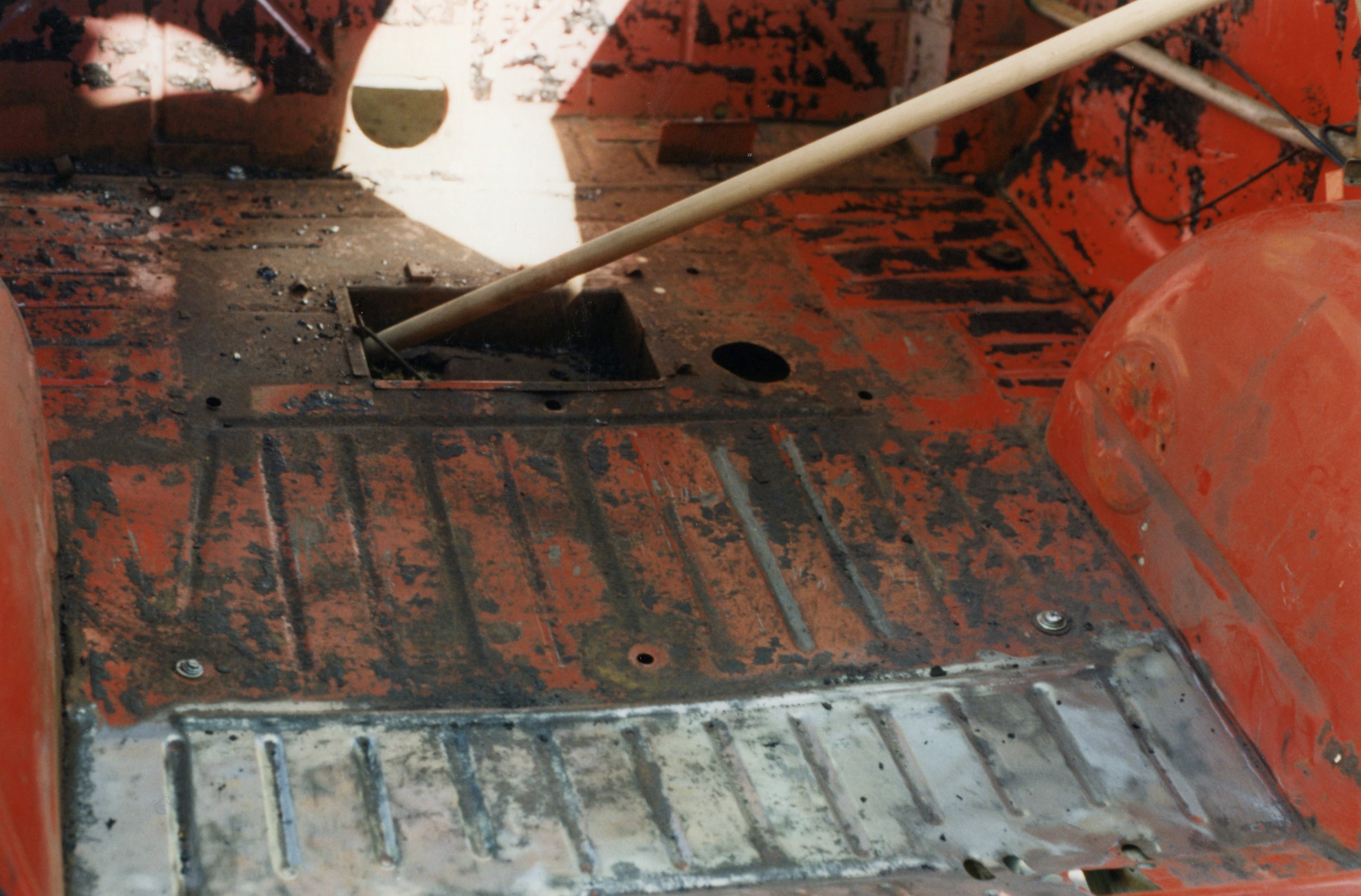
The interior was tackled next. The heavy black tar paper lining the inside of the shell was certainly original. The 38-year-old glue gave me a fight, and I fought back using a heat gun, a putty knife, and lots of grunt work. The final bits were broken loose using a wire brush chucked into my trusty Black & Decker electric drill. Given the age of the car, I went so far as to remove the paint from the floor and wheel wells, so that fresh paint could be applied to bare metal.
Floor in process of being stripped; broomstick holds door open.
The only rust-through in the entire body was a hole in the battery box (as the lowest part of the interior, any water which leaked in was going to settle there.) Since this wasn’t an appearance concern, and I’m no body man, the fix was a thick piece of sheet metal stock, bent to shape, glued and riveted into place from the inside. This was done as opposed to covering the hole from the outside in order to provide support for the battery.
Sheet metal repairs done while you wait
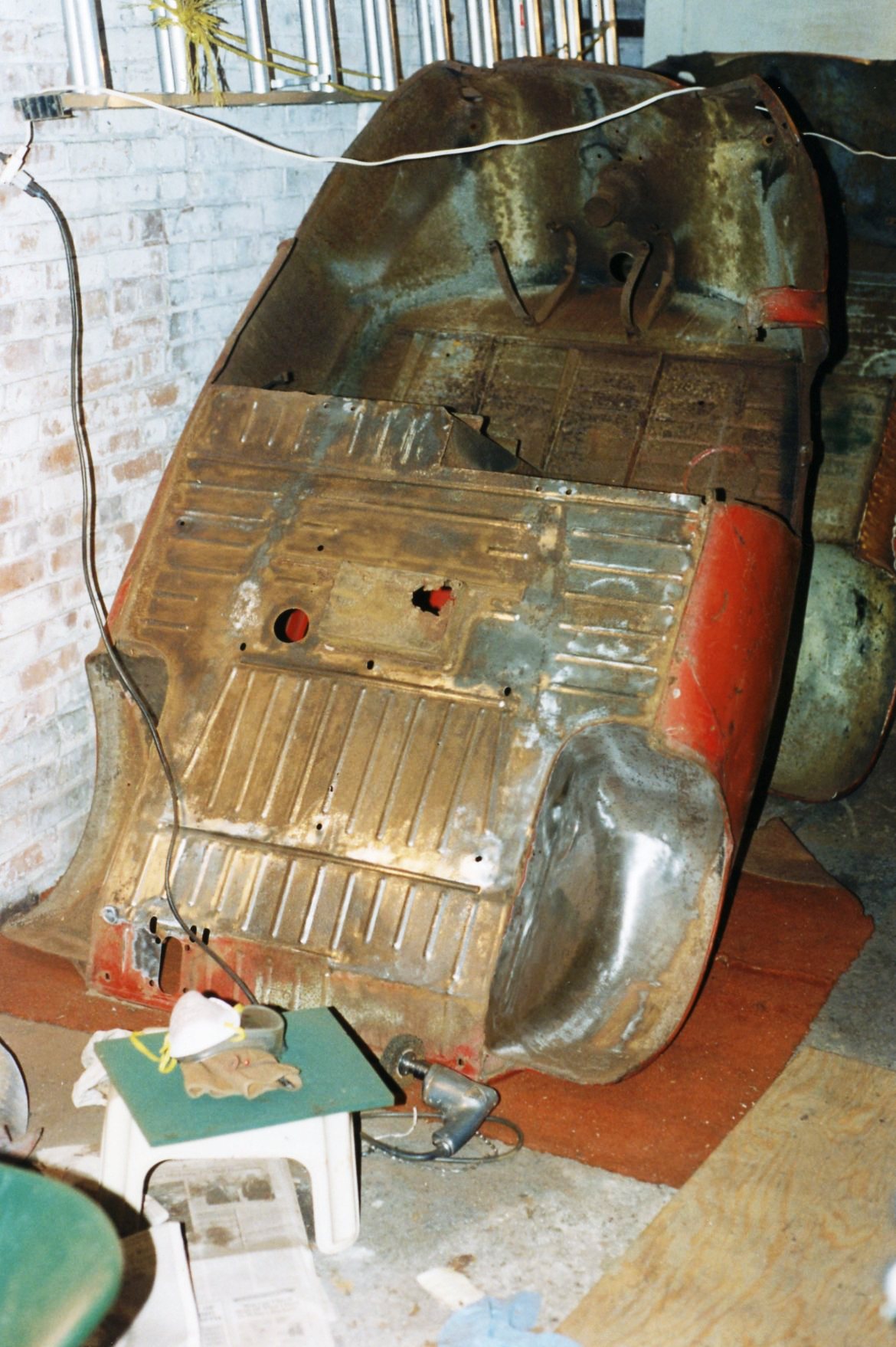
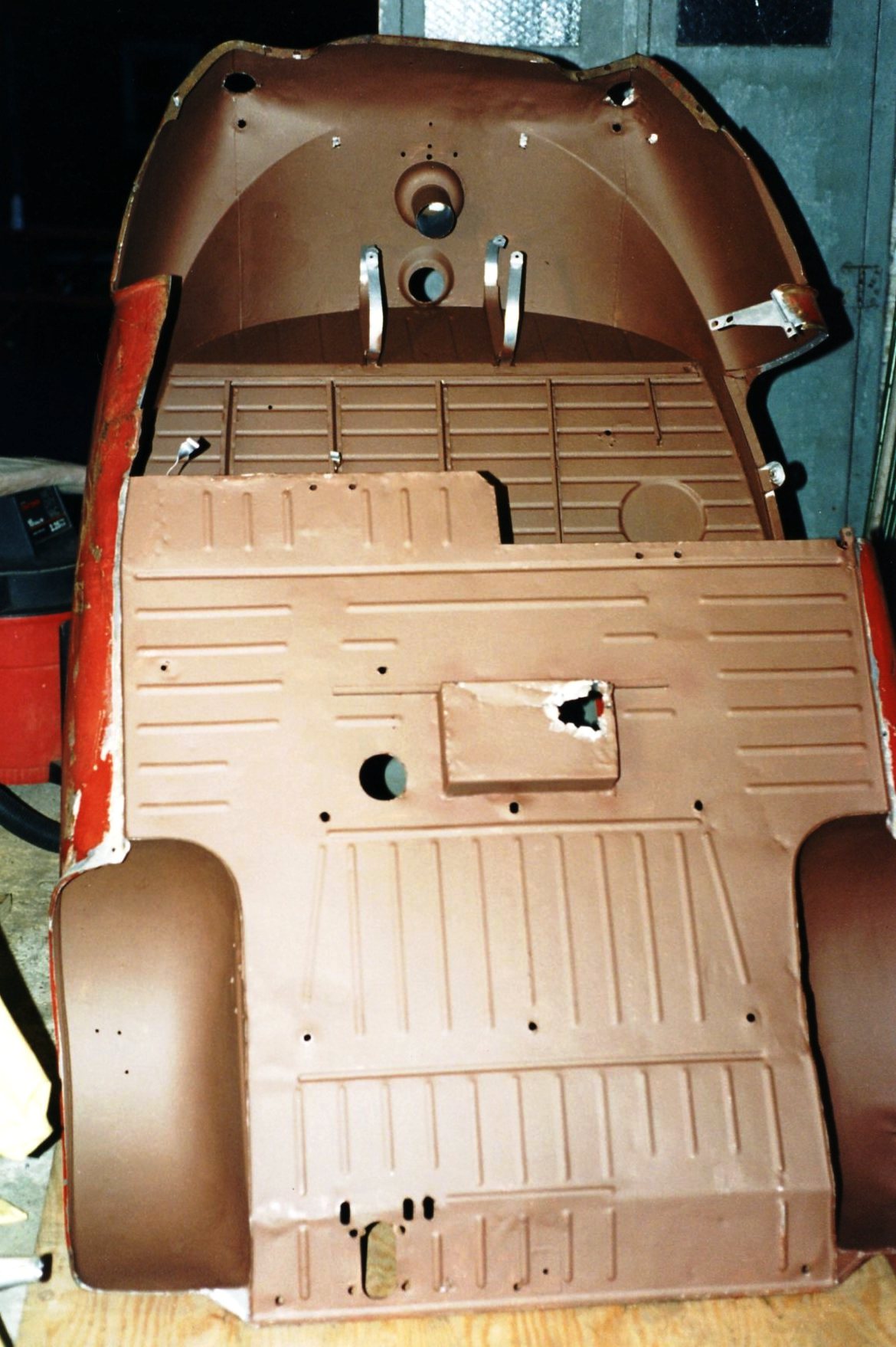
Once the inside was stripped down to bare metal, the body was tipped up onto its door opening (door removed of course), which provided full access to the underside. I’m not sure how the factory finished off the bottom of the body (if they did at all), but I faced a floorpan completely covered with old paint and surface rust. Like the interior, the underside was brought down to bare metal with wire brushes mounted in an electric drill; tedious work, to state the obvious.
James Nanry, having assisted with body tilts, poses with his accomplishments
I decided on a multi-coat approach to provide maximum protection for the sheetmetal. Certainly the car was not going to be driven in inclement weather, but there would still be times when it would be outside in damp and humid conditions.
Midway through the messy job of stripping the underside
First coat: Bill Hirsch zinc paint prep/converter, to neutralize any remaining rust, and to help convert the surface to accept the paint:
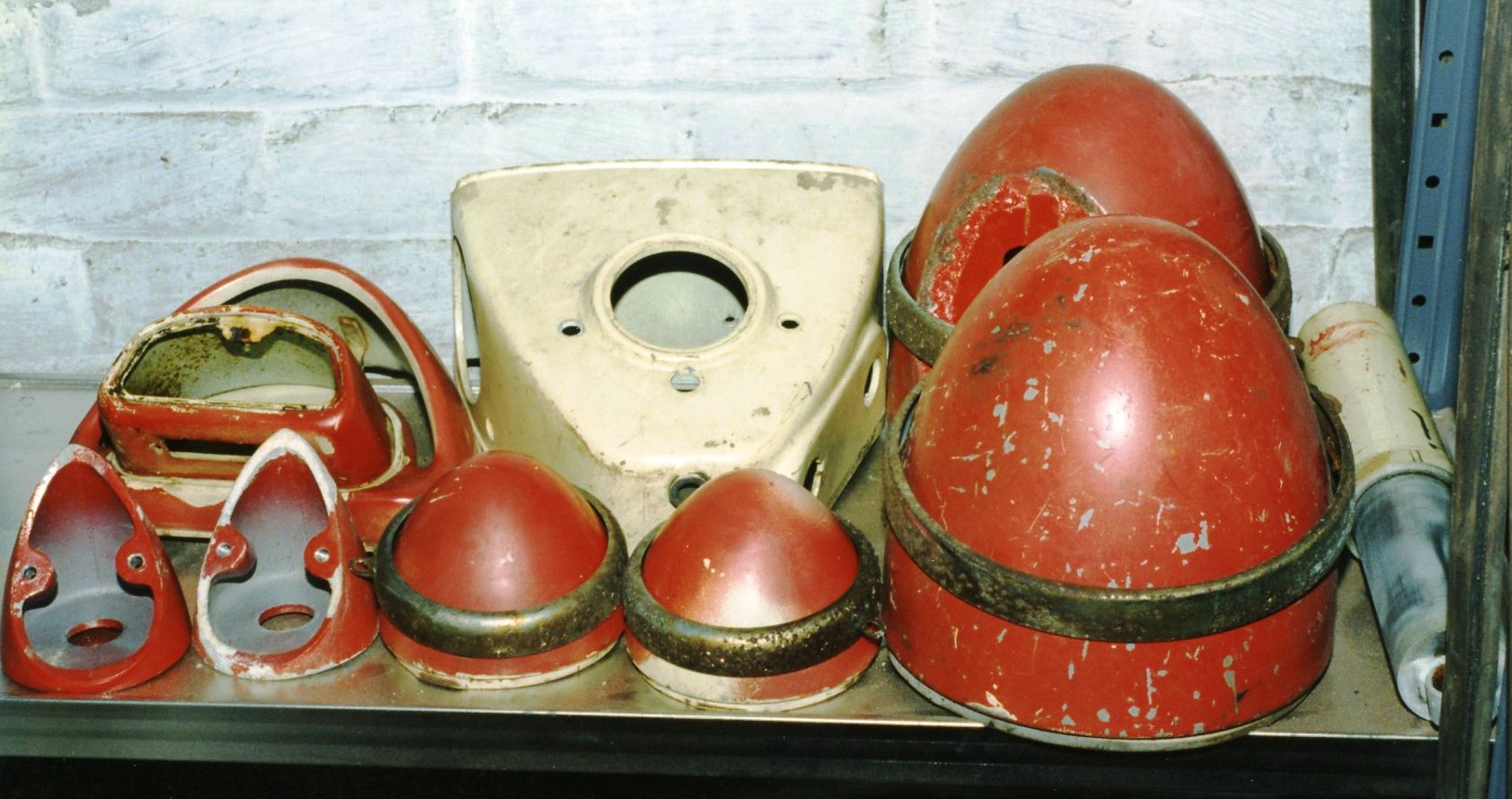
Extraneous parts were delivered along with the body
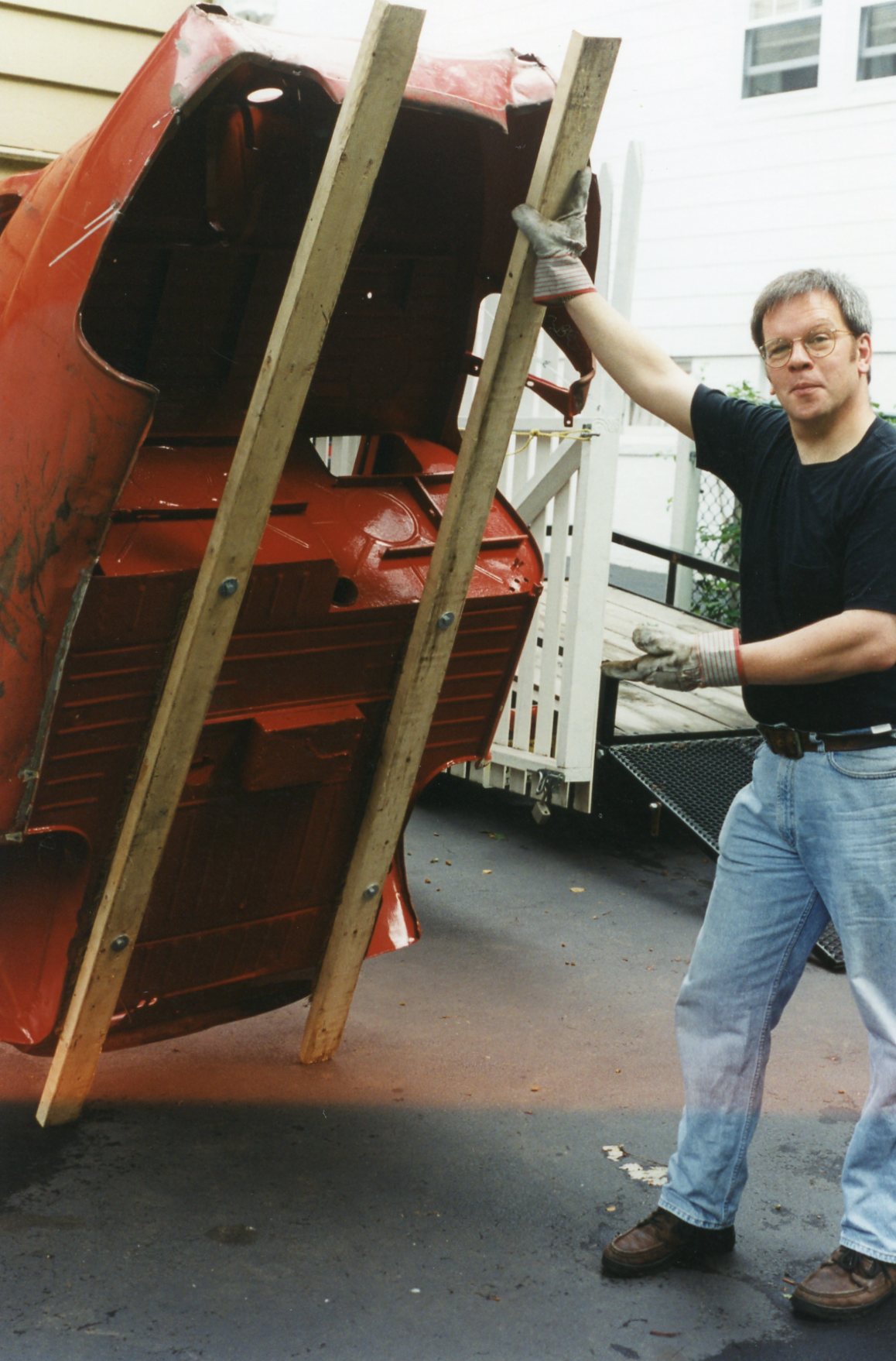
The body (along with the door, headlight buckets, engine cover, and instrument panel, all to be painted the same red) was ready to head to “The Shop”. I bought two 2x4s, glued strips of carpet to them, and bolted them to the underside of the shell using existing mounting holes. I then bolted the 2x4s to the wooden floor of my trailer. It was secure. Photos document my dear departed friend Chris Beyer who so graciously and generously accompanied me that day.
Chris shows off red paint
and 2x4s bolted to body
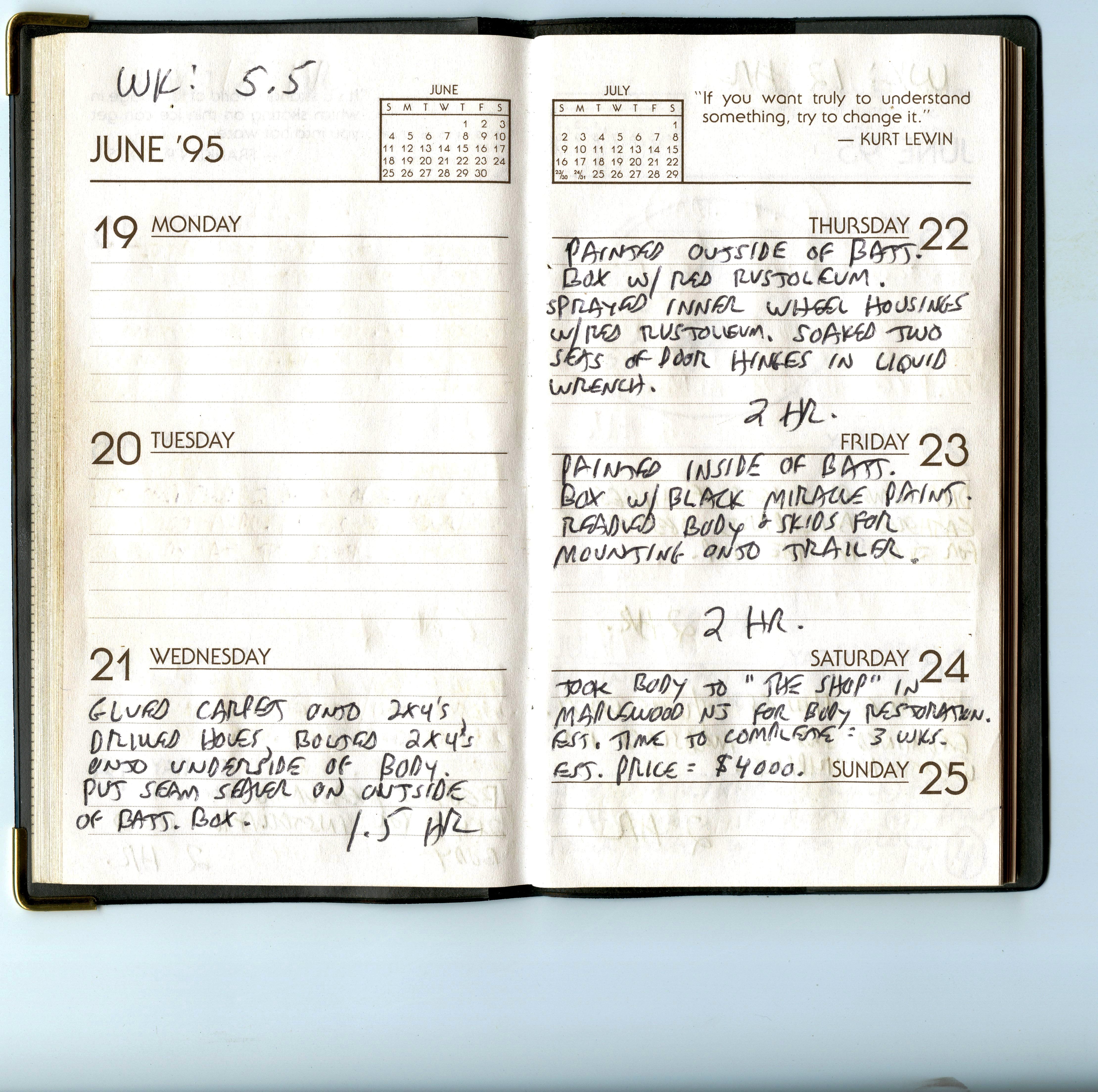
My Isetta log book contains this entry for Saturday, June 24, 1995:
Took body to “The Shop” in Maplewood NJ for body restoration. Est. time to complete = 3 wks. Est. price = $4000.
Deposit of $2000 paid at dropoff; balance due at completion
Now it was up to Jody. I think I went home and had a stiff drink.
Irv Gordon passed away last week. It is almost impossible to be in the old-car hobby and not know about Irv and his claim to fame. In 1966, he purchased a brand new ’66 Volvo 1800S coupe, and proceeded to spend the next 50 years driving it everywhere. He eventually surpassed three million miles in the car, and although he spoke of retiring it (Volvo corporate had already gifted him 3 new Volvos), I read that at the time of his death the 1800 had 3.2 million miles on it.
As an employee of Volvo Cars North America, I had more than a passing relationship with the man. While I likely had met him at one corporate event or the other in the 1990’s, it was during my time as a field service representative on Long Island that he and I became friendly.
As I strolled into the service department of Volvoville one morning, there was Irv, sitting in the service area, shuffling some paperwork. At that time, in the late 1990’s, he had a part-time gig at the dealer, performing test drives and attending to some administrative chores. Parked on the street around the corner from the store was the red 1800, of course, as he used it to commute to work. He used it to fetch a cup of coffee in Boston, and he used it to join dealer events in Oregon. How do you think he got to 3,000,000 miles?
Early in our friendship, I asked him, “Irv, what’s the secret your success?” With a pause and a twinkle in his eye, he replied “a strong bladder”. Watching him in action, he had a ready smile, a quick wit, and the patience to answer whatever questions were put to him. Frequently, he would be standing near the car while being questioned, and not one to waste a moment, he’d check various fluids as he spoke. I learned about Irv’s fastidiousness when I watched him pull the dipstick to check the oil level, but then use the few droplets on the end of the stick to lube his hood hinges!
Later, in the early 2000s, I traveled to SEMA with a group of fellow VCNA employees, and Irv was on that trip too. Watching him at SEMA was like watching a rock star, but one who had some degree of modesty attached. Generosity was another trait that perhaps few saw, but I clearly recall one holiday season at Volvo HQ when Irv showed up with several cases to wine to give out to employees.
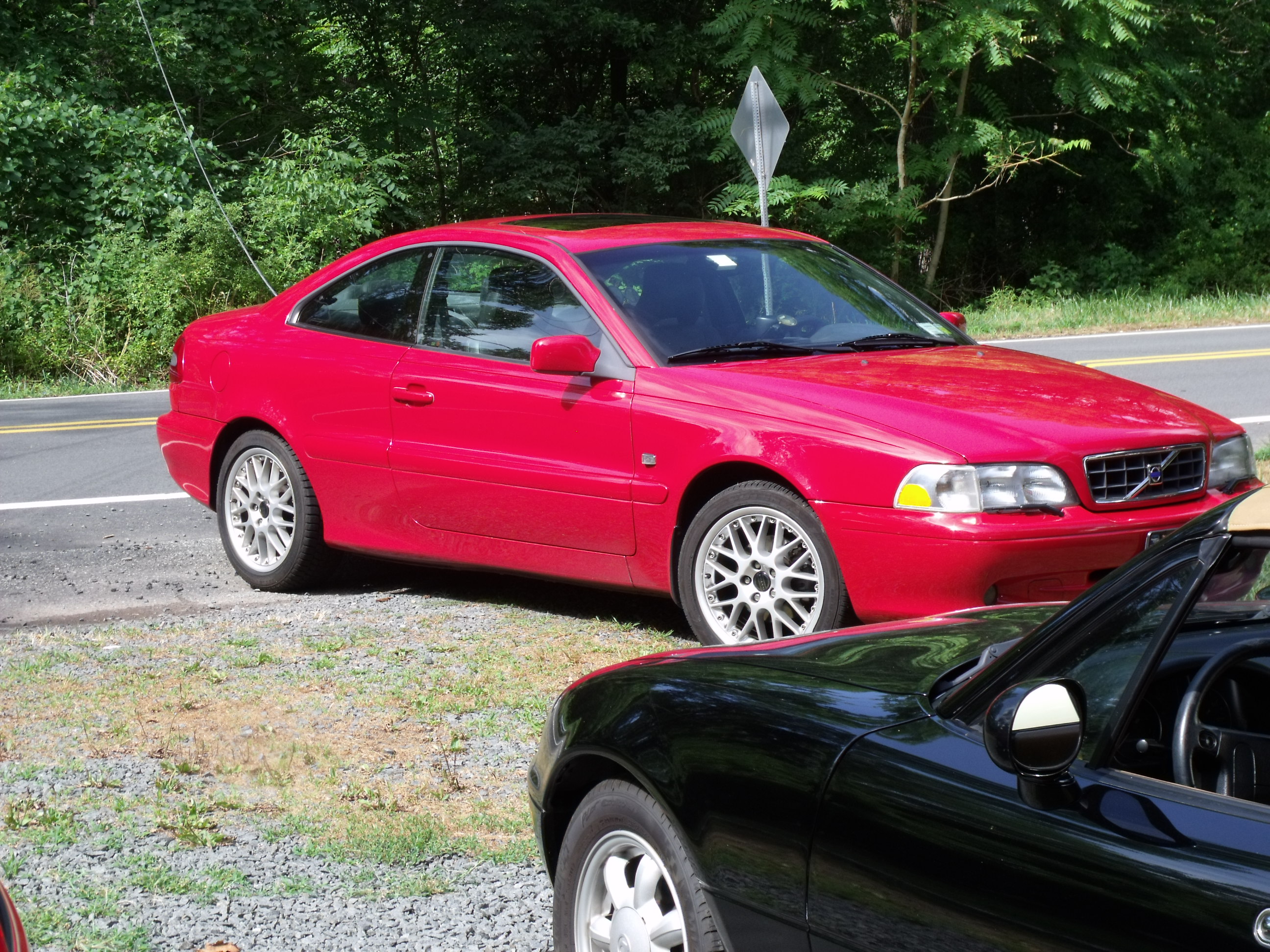
Irv’s C70 coupe at my house; it may have had “only” 100k on it
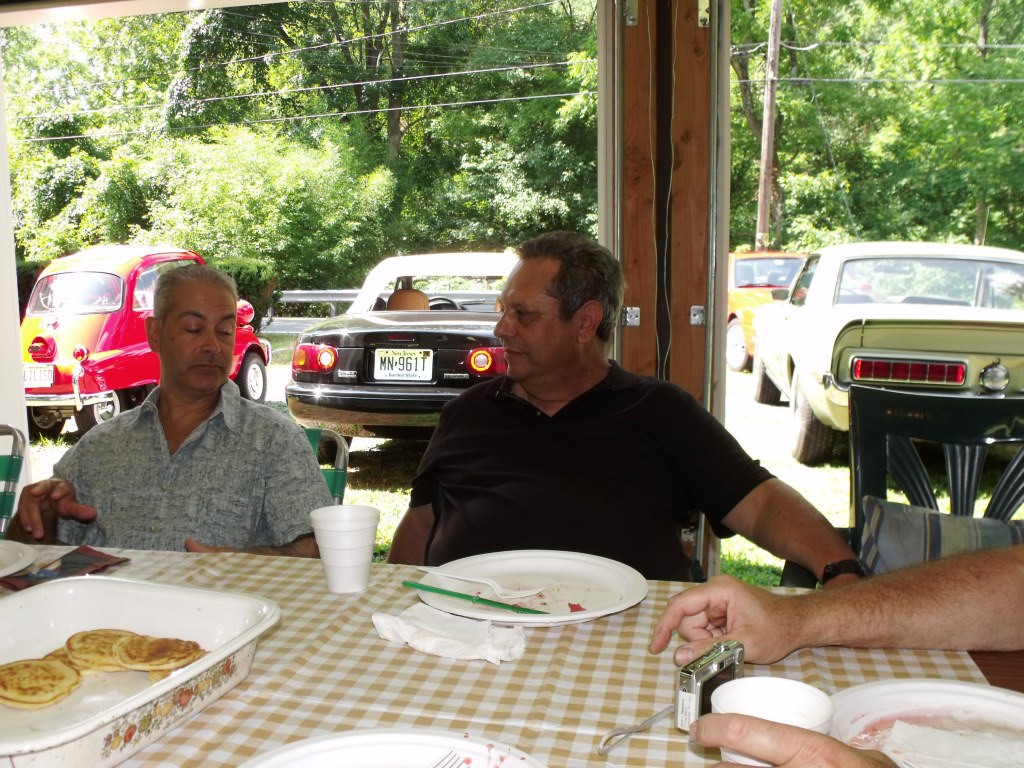
In the summer of 2010, my wife and I hosted a breakfast at our home for a few of our hobbyist friends. Irv was on the invite list, and I was thrilled that he accepted. The day before breakfast, Irv called me. “Hey Rich, do you think the guys will mind if I drive the C70 coupe instead of the 1800? To tell you the truth, it’s hot, and I wouldn’t mind riding in A/C.” (Do I need to point out that the ’66 did NOT have air?) I said “Irv, I don’t think this crowd gives a hoot what you show up in. We’re just glad to have you join us.”
Irv and Nick debate who will finish the pancakes
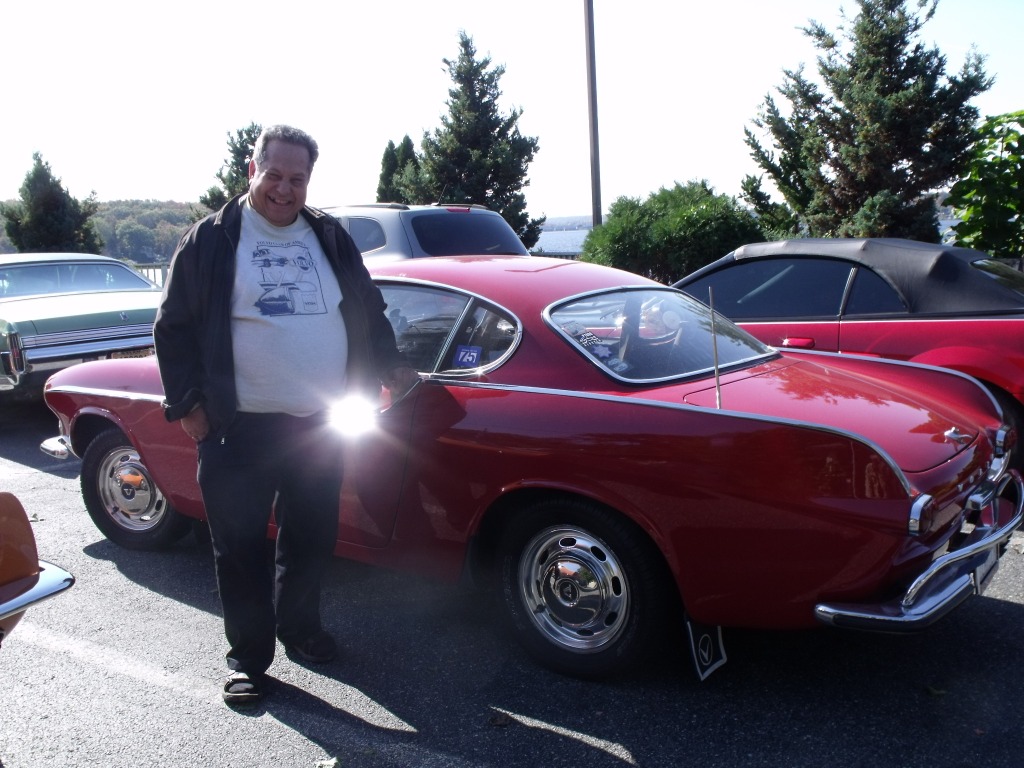
As Larry and I took over the reins for our Sunday morning breakfast runs, Irv was on our distribution list, but rarely joined. He always had some lame excuse, like, “I’m driving to San Antonio that weekend”. However, in October 2010, he did come out for one of our drives, and even brought the 1800. This was probably the last time I saw Irv.
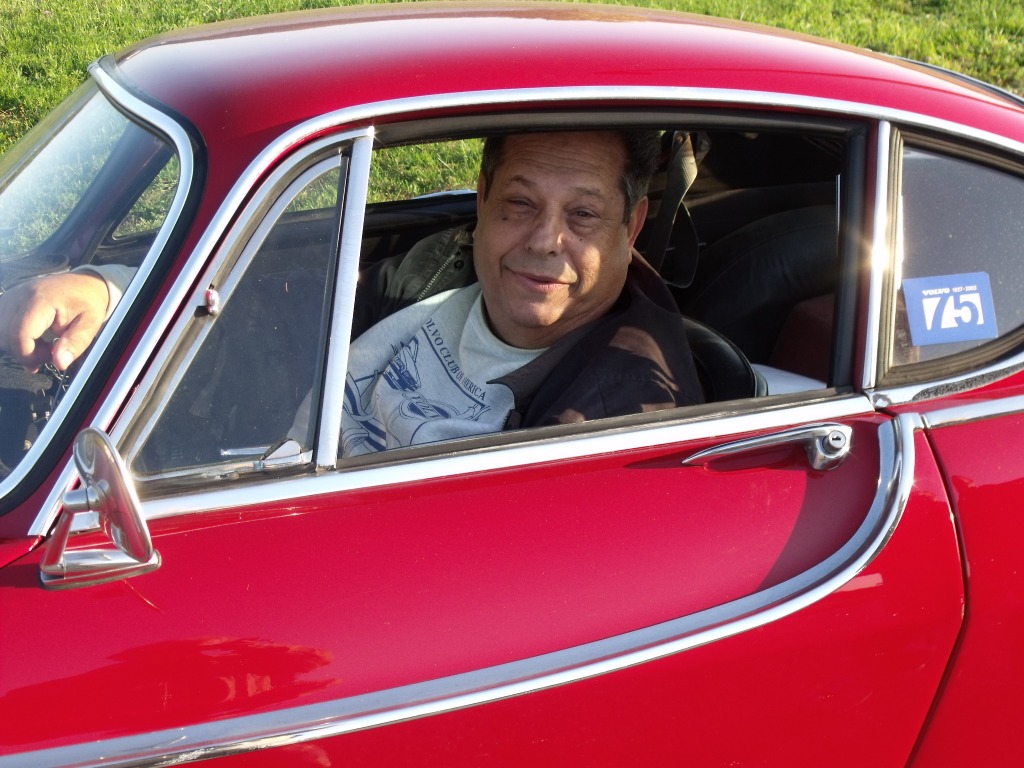
Irv, in the seat he knew so well
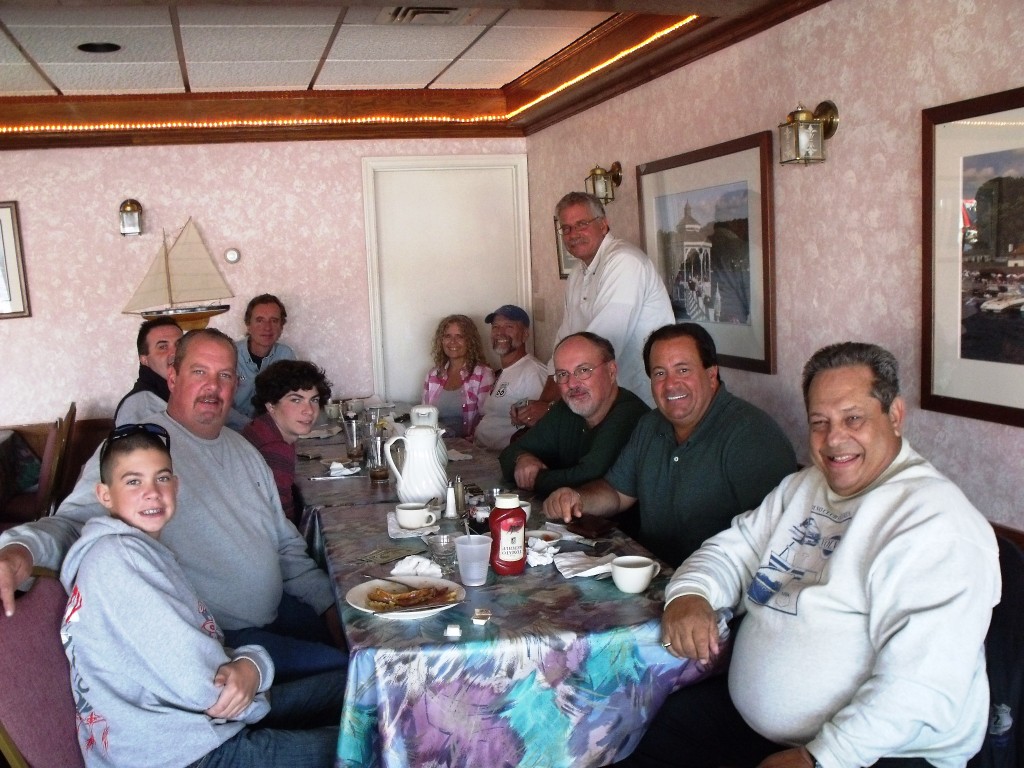
Oct. 2010, breakfast, when we were lucky to get 12 people to join us
Always smiling Irv
I’m glad to have known you, Irv. It was an honor to call you a friend.
A frequent question I get is “what makes a car a classic?” There is no one right answer. The definition of such a car can be up to you! If you think your vehicle is “interesting” on some level, and the car is used more for special occasions (anything from Sunday drives to cruise nights) than as a daily driver, then it fits the bill. Who am I to say that a 3-year-old Camaro which is only driven in dry weather to GM-themed events isn’t a collector car?
Attending various shows around the Northeast bears this out. The variety and quality of vehicles at a Boonton NJ cruise night is certainly different than what’s seen at The Greenwich Concours. Driving events run the gamut from our own Sunday breakfast cruises (featuring a “run what you brung” mentality) to the million-dollar cars in the New England 1000 rally. Sometimes there are no rules, and other times the rule book is voluminous.
Attendees at Antique Automobile Club of America (AACA) shows typically see cars which have been restored to the highest professional standards. A true “#1 condition” car is rare, but you’ll find them in the AACA. These cars are almost never driven on the road; the engines are run long enough to move them into and out of an enclosed trailer to preserve their perfected state, and that’s it for the driving.
My first AACA experience was Hershey in the early 1980s. As a young man not yet 30, the rows of perfect Mustangs and T-Birds depressed me into concluding that I’d never have a vehicle which could qualify there. These owners’ cars were judged by arbiters who would dole out trophies and bragging rights, so there was no such thing as “too nice”.
Except, there was. The Overseers at AACA began to realize they had a problem: strictly speaking, their own rule book said that cars should be restored to be as close as possible to “factory new” condition, when in practice many of these cars were better than new. Trim which the factory buffed was now chromed; single-stage paint now wore a clear coat; and unpainted surfaces were now sealed. It’s a condition called “over-restoration”. Some owners complained that their ultra-low mileage never-restored cars were losing out to restorers with deep pockets and questionable taste.
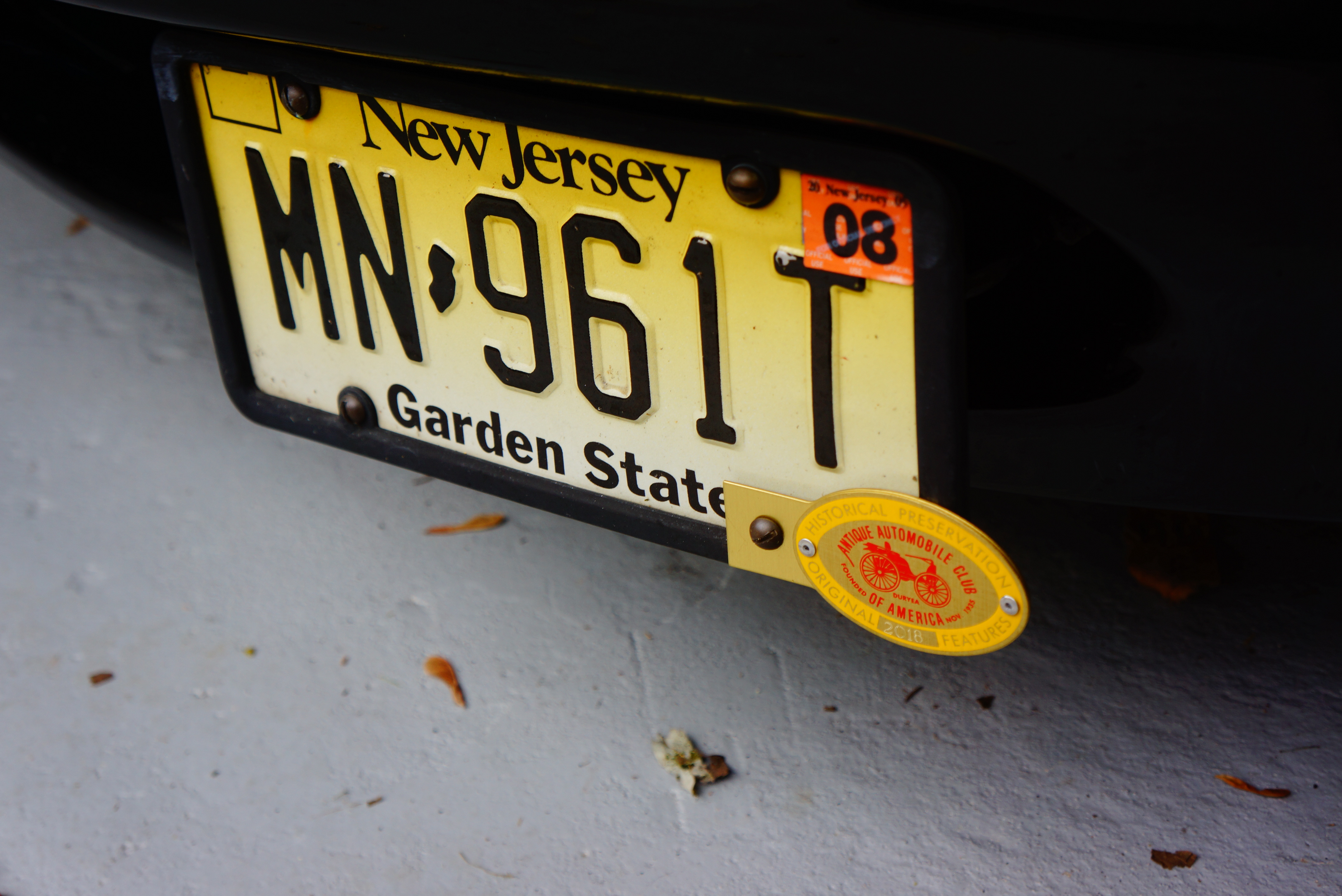
To its credit, AACA created a new judging class: the Historical Preservation of Original Features, or HPOF. The concept was simple: reward vehicle owners whose steeds still were screwed together as the factory did it. Dull paint and worn upholstery didn’t matter, but original equipment and fittings did. The goal was to encourage the preservation of cars in their original state for future generations to observe, study, and learn from them. HPOF has become a very popular category for owners and spectators alike.
As a separate class, there would be no clash in trying to judge an HPOF car against a fully-restored one. An obvious example from the HPOF rule book is paint: a car must wear all or almost all of its original paint to be eligible in this class. In fact, a car which wins an HPOF award and is subsequently repainted will lose its HPOF accreditation.
Aug. 1996: me with my newly-acquired Miata (no SUVs on the streets yet!)
When I purchased my 1993 Mazda Miata in 1996, it was a gently-used 3-year-old car with barely 30,000 miles on it. The first-generation “NA” models were still in Mazda showrooms. The Miata got driven a lot, but never in the winter. I kept up with all maintenance on the car, and I can count the total number of repairs on one hand: a clutch slave cylinder, a power antenna, a heater core, and one headlight bulb. (Service items such as hoses, belts, fluids, brakes and tires are all part of routine maintenance.)
Oct. 2018: the same car on the Hershey show field
Perhaps the most difficult part of owning this car for 22 years (it now has 104,000 miles) has been avoiding the temptation to modify it. The aftermarket business for the Miata has always been strong and keeps getting stronger. I’ve been tempted to add a turbo; replace the stereo; reupholster the seats; install bigger brakes, wheels, and tires; and add interior wood trim. While a few small changes have occurred (I upgraded the floor mats and replaced some lighting with LED bulbs), the car appears the same as it did when I got it in ’96.
Wearing its new badge
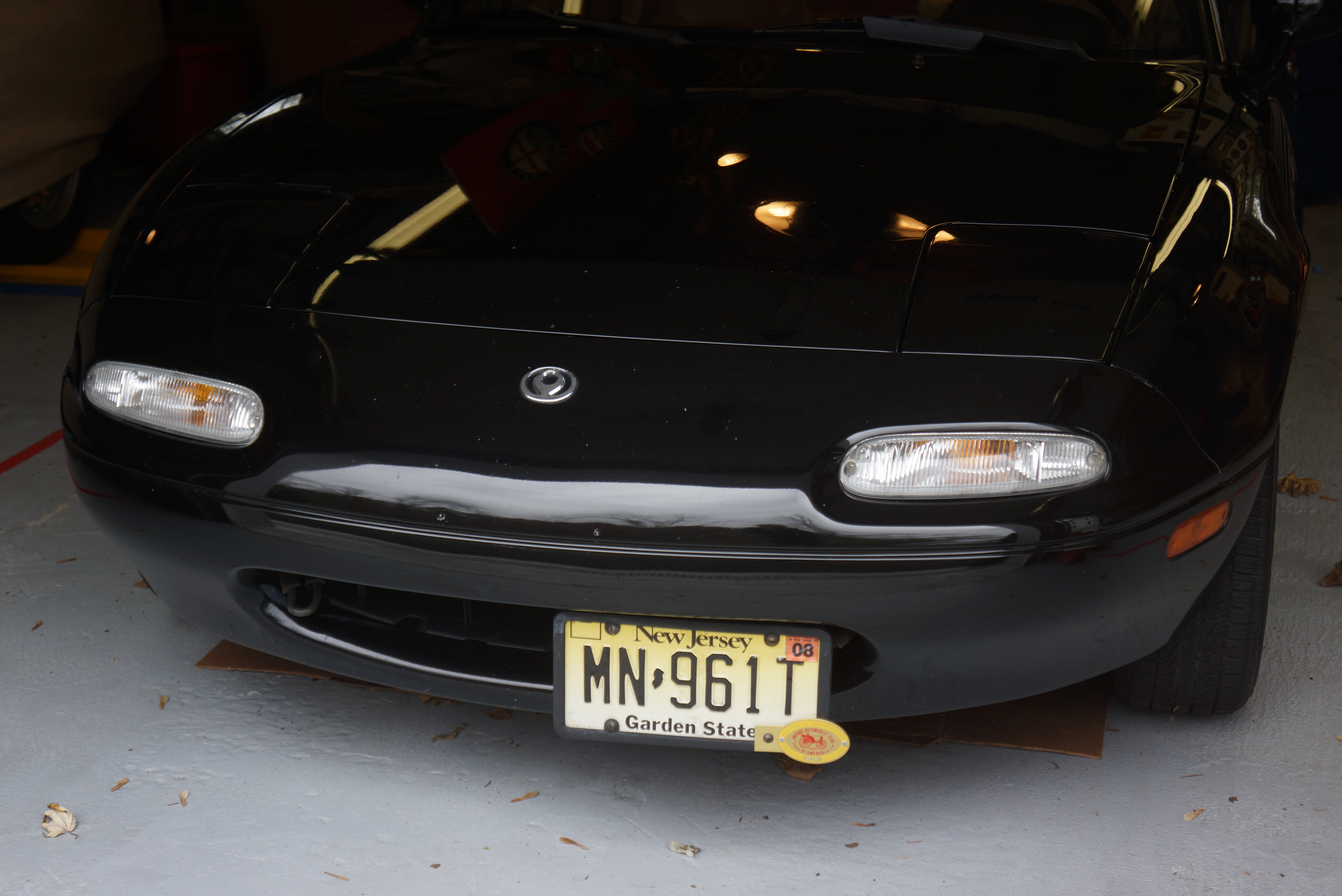
This year, the car turned 25 and became eligible for AACA events. I was excited to enter it into the Hershey show in the HPOF category, and last week, the package arrived informing me that indeed, my 1993 Mazda Miata had earned its HPOF badge. I’m a proud papa, and plan to continue to enter this car in HPOF, notably, in the June 2019 National meet which the NJ Region is hosting in Parsippany NJ. There will be plenty to talk about between now and then.
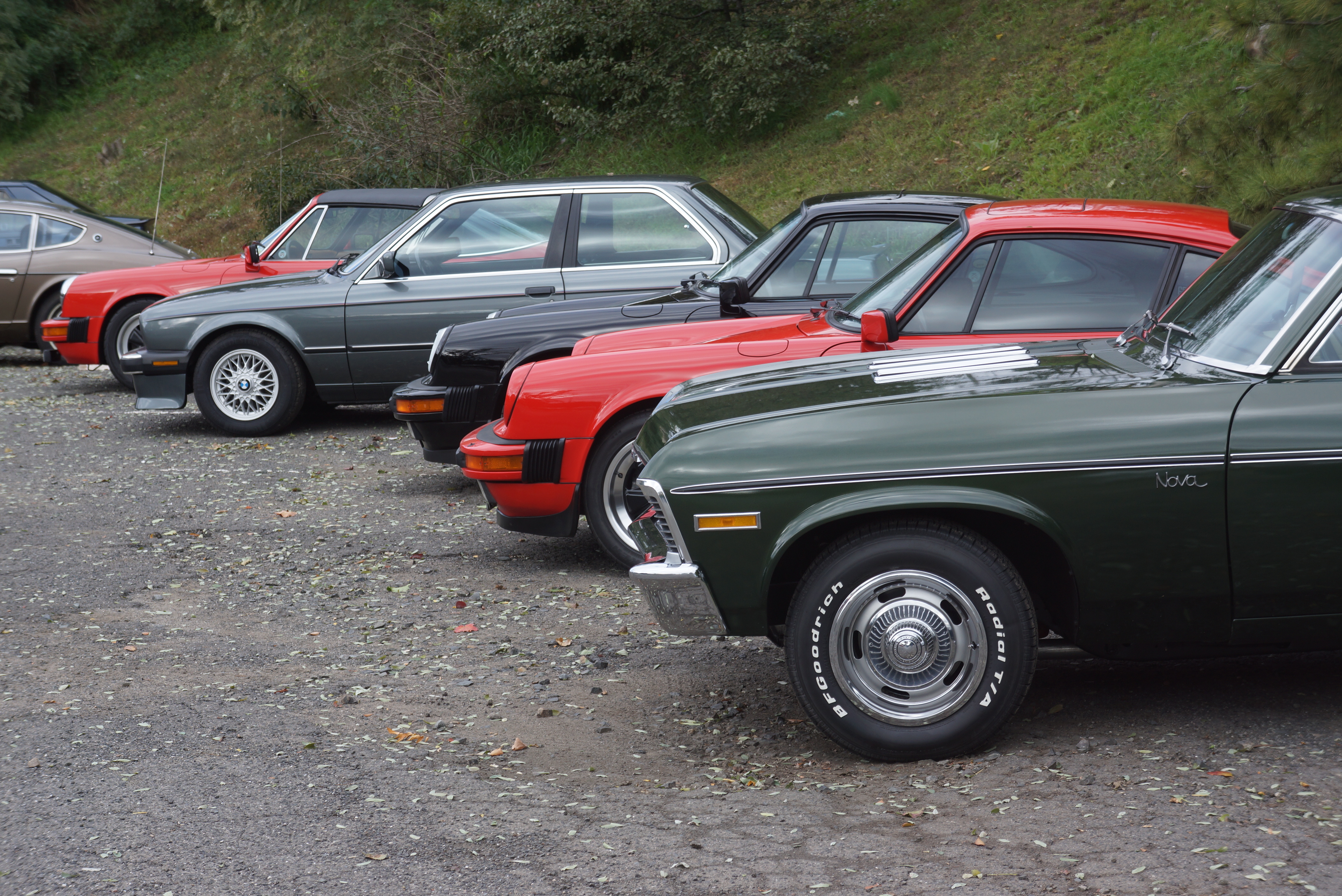
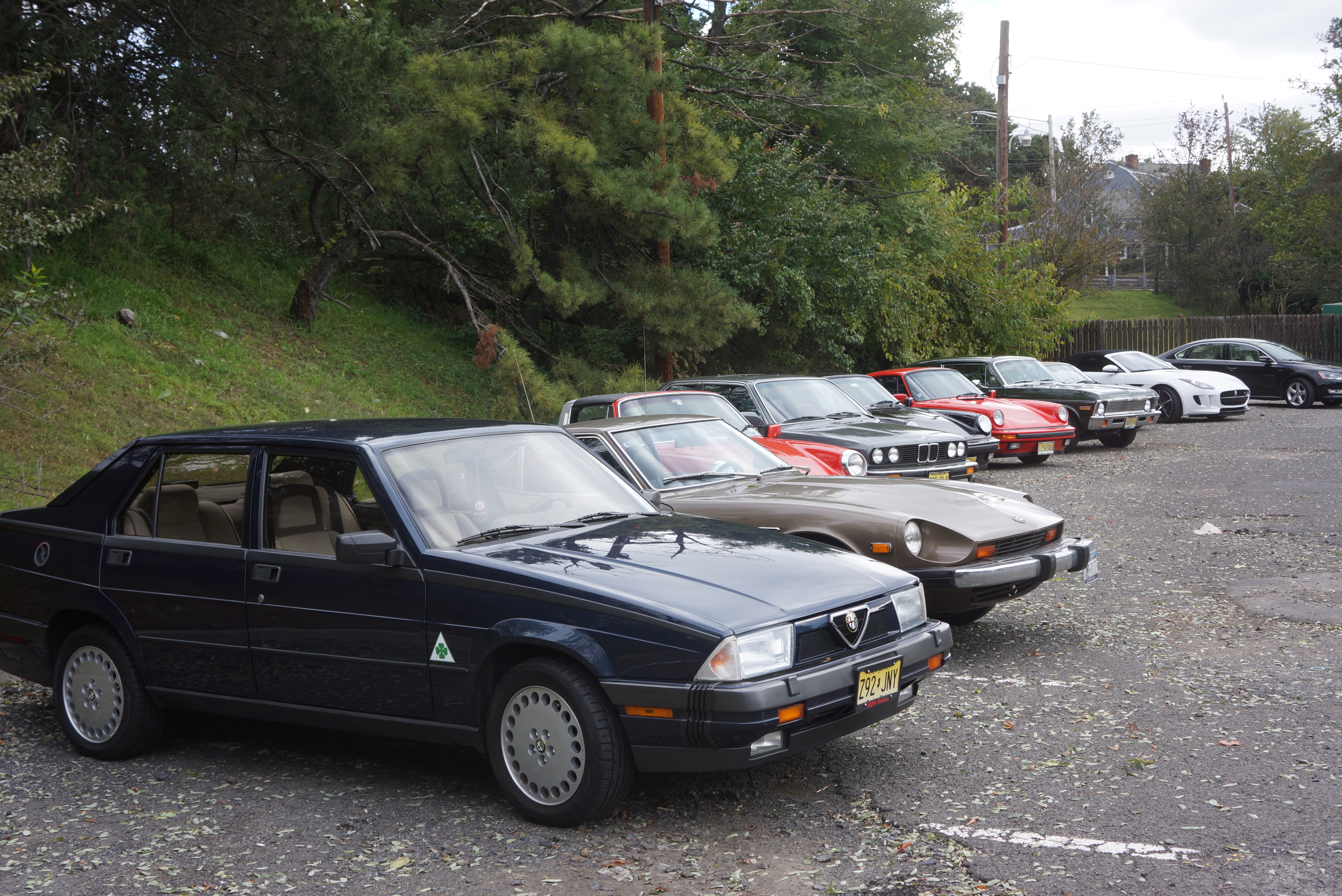
Our “Sunday Morning Breakfast Run” has been a semi-regular feature for so long that my partner-in-crime Larry and I decided to mix it up a little bit: we decided to piggyback onto the popular “Cars & Coffee” trend by holding our own such event. We did so for the first time on Sunday October 21, 2018.
BTW, the name “Cars & Coffee” has become so ubiquitous that organizers around the country are creating variations such as “Cars, Coffee & Donuts”, “Cars & Croissants”, “Caffeine & Carburetors”, and “Caffeine & Octane”. I think we’ll stick to “Cars & Coffee” for now.
Sunday’s lineup
Our choice of rendezvous was The Fireplace, a Paramus NJ fixture for over 60 years. In its favor, it’s easy to reach (on Route 17), it has an extensive breakfast menu, it’s spacious inside and out, counter service means that everyone orders and pays on their own, and the staff will let you sit and hang out as long as you want (with help-yourself coffee refills always available).
There’s no point in talking about the (poor) weather except to point out that at our inaugural event, the participants and their coffee stayed inside! So much for admiring each other’s machinery. The planned loitering was postponed for a more inviting day.
In all, 12 colleagues showed up for breakfast. Toward the end of our stay, our friend Burton arrived with his newly painted 1961 Corvette. On our way out, we lingered long enough to admire the top-notch paint job. Burton was a real trooper showing up in an open car on a cold and windy morning.
The crowd gathers near Burton’s freshly-painted ’61 Corvette
We had considered, and ultimately decided against, a short drive to be conducted after breakfast. Perhaps next spring or summer, with more inviting weather on hand, we can make that part of the event. We certainly did find The Fireplace to be an almost ideal location, so expect to see us return in 2019.
The AACA judging process may seem arcane to the uninitiated, but First Junior, First Senior, Preservation, Grand National, DPC, and HPOF are embedded in the rule book, and are chased with unbridled enthusiasm. Why? For the same set of reasons: points, trophies, bragging rights. The weather, well-known to be unpredictable in this part of the world in October, hardly plays a role. When car owners have spent most of the year prepping their vehicles for The Big One, a little bit of water will not deter them from making an entrance.
U.S. spectators travel from as far as California to attend Hershey
Hershey is glorious when it’s sunny and 65. It’s barely tolerable when it’s cloudy, windy, and 50, as it was in 2018. Yet I would estimate that the show field was 95%+ filled, and foot traffic was more crowded than years past. Since vehicles are arranged by class, it’s easy to walk among the cars you want to see, and skip those you don’t. My continued infatuation with pre-war classics was rewarded with some beautiful machinery. And some newer cars weren’t so bad either. As you’ll read below under STORIES, meeting new hobbyists and hearing their stories continues to be an engaging part of the hobby.
1931 Lincoln
1926 Willys Knight
1931 Jordan
1933 Packard
1940 LaSalle
Porsche 911s front
and rear
1961 Pontiac Ventura
BMW Isetta single color
and two-tone
1957 Dual Ghia
MG-TF
1963 Olds Jetfire Turbo
AACA sign
turbo power in ’63!
1963 Studebaker Avanti
Boattail Riv’s: ’73 (L) shows toned-down tail next to ’72 (R)
Mazda Miata NA (1st gen)
Mopar Muscle:
My 1993 Mazda Miata NA (1st gen), making its Hershey debut in HPOF:
STORIES:
Stan and the Bucket
“Hey, where’d you get the water for the bucket?”
“Ha ha! From my bathtub! I filled it up and carried it down to the parking lot.”
It was Friday evening, the day before The Big Show. The gentleman had alighted from his 1954 Pontiac at the rear of the Harrisburg Marriott where we were both staying, and watched me sponge off my quite dirty Miata using clean water from my bucket. Actually, my car had been spic-and-span clean two days before. It was the drive out on Thursday in the torrential rain which soiled it. Since it was wearing a fresh coat of wax, my theory was that a gentle bath with warm water would cleanse it again, and it seemed to be working.
Stan’s 1954 Pontiac in HPOF
“Gee, that would work on my car, if only I had remembered to bring a bucket.”
“I’m actually done with the Miata. You staying here? You can borrow my bucket and give it back to me later.”
“You sure? Ok, well, thanks.”
With that, Stan took my bucket while I said to myself, the worst that happens is I never see the bucket again. No big deal.
Saturday morning, I headed out to my car, and sure enough, my bucket was next to my car. Whether Stan had gotten to use it or not, he was honest enough to return it.
Heading inside for breakfast, I ran into Stan, and he invited me to sit with him. He was traveling by himself, as I was. We talked cars (natch), and he told me that his Pontiac was going to be a first-time entry in HPOF, as was the case for my Miata.
We shared some tips with each other about preserving paint and the like, which is when Stan told me that he had some other cars at home in Maryland, including a 1967 Volvo 1800S.
“Oh, I know those Volvos a little bit…” I always start out cautiously with a new friend about any Volvo knowledge I might possess. Treading lightly is a good start in case they have reason to despise the marque, and also to avoid any implication that I’m some kind of expert, which I’m not.
Stan continued: “I actually have a bunch of other Fords and Chevys home, and I like them all. But there’s something special about that 1800….”
I learned for the umpteenth time not to make suppositions about car people. Watching someone motor along in his 1954 Pontiac, I would never presume that the same collector would also enjoy a ‘60s Swedish sporty car. I was glad to be wrong.
Larry and the Fire Extinguisher
My Miata and I arrived on the show field a few minutes past 9am. Normally I would have preferred to make my entrance earlier, but the morning sprinkles caused me to delay my departure to minimize re-soiling my clean car. It got dirty anyway. Out came the cleaning supplies, and the Great Car Show Detailing commenced once again.
Judging was due to start at 10am. At 9:55, I was still wiping down the painted horizontal surfaces when I heard the voice: “Is this your car?” I spun ‘round to face two men wearing judge’s hats. They’re early, I muttered to myself. Can’t blame them; they’ve got a lot of cars to judge.
The judges spent perhaps five minutes looking over my car. As the proud owner, I was too anxious to answer questions they hadn’t asked. They thanked me for bringing it, and moved to the ’68 Camaro next to me. I looked at my watch: 10:01am. This was a blessing! With no need to hang around my car, the day was free to move among all the glorious machinery on the show field. I began by walking down the row of the remaining HPOF cars.
It stood out like a bright light among the cars surrounding it: a 1st gen Porsche 928 in white. The owner was still wiping it down when I engaged him with some questions.
Larry’s Porsche 928 in HPOF
“How long have you had it?”
“Since new.”
“Tell me, how are the maintenance and repair costs? I hear horror stories.”
“Not bad, really. Stay up on the preventative stuff, and it’s quite reliable.”
“Do you do your own work on it?”
“No, but it’s still not bad to maintain.”
With that, the 928 owner exclaimed “Oh crap. I forgot a fire extinguisher. Now what am I gonna do?”
“Listen”, I said, “my car’s been judged. I don’t need mine. I’d be happy to loan it to you.”
“Really? I’d appreciate it.”
I jogged back to the Miata, grabbed the extinguisher, and hustled it back to him.
“What’s your name?”
“Larry.”
“I’m Richard. I’ll swing by later, or, if you don’t see me, my car is the black Miata in the row behind you.”
“Thanks again, I really appreciate it.”
It hadn’t occurred to me that this was my weekend to loan items to fellow car owners, but it was OK. Again, the worst that could happen would be I would be out a relatively inexpensive fire extinguisher.
Hours later, I was finally heading back to my car. The extinguisher was on the floor, and I thought I would swing past the 928 one more time to see how he did. Its owner was sitting in the front seat. But I had forgotten his name. As I approached the car, I glanced at the dashboard placard: “Larry Holbert”.
“Hey Larry, how did you do?”
“Oh, judging went fine. And thanks for the extinguisher. I returned it.”
“Yes, I saw. Listen, I just noticed your last name, and the dealer plate on the back says this car came from Holbert Porsche. Any relation?”
I told Larry about my band buddy, and expressed my condolences over his loss.
A while later, I looked up Larry Holbert. Up until the dealership was sold a few years ago, he had been president and CEO of Holbert Porsche. Yet when I asked him about his 928, said nothing about his executive status. He gave no hint that his stature meant that he could have these things taken care of. On a cool October Saturday on a show field in Hershey, Pennsylvania, he was just Larry, fellow car enthusiast.
“The Greatest Show on Earth”; “Automotive Mecca”; “The High Holy Days of Hershey”. The repetitive use of all these terms describes what is formally known as the AACA Eastern Fall Meet, a car show extravaganza that has been held in the quaint town of Hershey PA (“Chocolate Town USA”) since the early 1950s. This blog previously reported on Hershey in 2015, 2016, and 2017.
The most special auction cars were in the lobby of the Hersey Lodge
The Hershey Show has evolved and expanded through the decades into its current three-part form: a weekday flea market/car corral, now exclusively held on paved ground (the infamous Hershey mud is no more); a Saturday judged car show, currently held on a mostly-smooth grassy lawn; and a two-day auction conducted by RM Sotheby’s (“the official auction of AACA Hershey”).
Here we present Act II, The RM/Sotheby’s Auction.
The RM Sotheby’s Hershey Auction, a mainstay event for the last several years, is now “the official auction of AACA Hershey”. For the uninitiated, it is held on the grounds of the Hershey Lodge, about four miles from the flea market/car corral at Hersheypark.
Bidders pay $200 for an auction catalog, granting them entry into the arena. For everyone else, it’s not so bad: there’s plenty of free parking (provided you show up before the 5:30pm kickoff); a bidder’s badge is NOT required for you to walk among the cars under the tents; and outdoor loudspeakers broadcast the auctioneer’s chants and gavel smacks. Perhaps best of all, you can watch the dedicated RM staff get each of these beasts running and driving into the building. Unless you plan to bid, the real show is outside.
It’s a two-day affair, held on both Thursday and Friday, and I was there only on the first day. RM has long specialized in auctioning primarily American iron, both pre- and post-war, with a smattering of high end European vehicles thrown into the mix. If anything, by my casual observation, the American offerings have become even more mainstream (witness the ’68 Camaro, something I thought I’d more likely see at Mecum). But pre-war cars continue to rise to the top of the “sold” column (more about that in a bit).
Several auction trends continue. “Estate sales” again constituted a large percentage of cars here. There were three such named estate lots on offer, and the first of these to cross the block, the Richard L. Burdick collection, did so early on Thursday.
Mr. Burdick, a successful businessman and collector, passed away earlier this year, and obviously, his family decided that the auction method was the cleanest way to liquidate his automotive holdings. Trend #2 is to note the high percentage of “no reserve” sales, such as almost every car in the Burdick Collection.
In spite of what some perceive as a softening in the collector car hobby, the auction houses hold a good amount of power: they have continued to demonstrate their ability to move the metal (especially noteworthy in our digital-rich age); they can arrange for cars to be brought to the auction site; and they may even include some auction prep work (for the appropriate fee).
In exchange for the advertising, marketing, host location, and expected bidders, the auction company can state that all this is done on the condition of a no-reserve sale. It’s positioned as a win-win-win: the car is sold to an exuberant new owner, the seller/estate gets paid, the auction company earns its slice, and everyone goes home happy. And that’s not a bad thing! Bidders and observers alike find it a special treat to see a no-reserve car climb the block, knowing that the car is guaranteed to sell.
If no-reserve sales have potentially pushed down values, no one is seen complaining. The reality is that both buyer and seller may be happier with a guaranteed sale at 80% of perceived value compared to no sale at 100% of perceived (and unachieved) value. (Two days after the auction ended, RM Sotheby’s rightly bragged about their 94% sell-through rate.)
Automobilia is a big part of the auction
Staying on values, much has been written about the ups and downs of market values, driven in no small measure by collectors of various ages entering and leaving the hobby. For example, we know that Baby Boomers, born between 1946 and 1962, collect the cars of their youth. As the oldest Boomers leave the market, it’s said, then the cars they’ve been chasing (in this case, American cars of the early-to-mid ‘50s) drop in value. To some extent, that has been true. Many American cars of that time period hit their value peak a few years back, and while they are certainly not worthless, prices have dipped.
The other side of the curve has seen demand (and therefore values) rise for cars of the ‘80s and ‘90s as young entrepreneurs and executives, dripping with newfound wealth or at least some disposable income, snap up the cars whose posters adorned their bedroom walls. We’ve seen it with everything from Fox-body Mustangs to Lamborghini Countachs.
If we follow this logic, then it should stand to reason that most cars built before World War II would have little or no following, and I’ve heard that uttered by more than one pundit. Let’s do the math: a 1934 Lincoln should be attractive to someone who got their driver’s license that year. He or she could probably barely afford a used Model T, but they lusted for that Lincoln (or Packard, Cadillac, Duesenberg, etc.). Someone who turned 18 in 1934 was born in 1916. If alive today (unlikely), that person would be 102 (and if I’m wrong, Happy Birthday).
Reality at RM Hershey is this: of the top 10 highest-priced cars which sold, NINE were pre-war (the only exception a 1960 Plymouth Fury convertible). Here is a quote from the email I received from RM:
“… top honors going to the 1930 Cadillac V-16 Roadster, which exceeded its pre-sale estimate and achieved a final price of $495,000. Other strong results for American classics included a 1941 Packard Custom Super Eight One Eighty Convertible Victoria by Darrin, which reached a final price of $357,500, and a 1934 Lincoln Model KB Convertible Sedan by Dietrich, which exceeded estimate at $286,000.”
So who is buying these cars? My own theory is that the great American pre-war classics are being purchased by a variety of well-heeled collectors of no particular age group. They see these cars as transcending any pre-ordained value curve. Instead, the cars have been elevated to a status of collectability akin to fine art: they are admired for their style, grandeur, and place in history. Whether the purchaser remembers this car from an earlier time is of no consequence. Just as someone with means may decide to grab a vase, table, or piece of jewelry from a time long ago for its intrinsic beauty and value, automobiles from the earliest decades of the 20th century are now in that same rarefied position.
The cars featured below are a sample of the Thursday auction cars which I inspected and which sold. Hammer prices are shown exclusive of 10% buyer’s premium. (Of the 16 here, 11 hammered under estimate.)
Vehicles are arranged in ascending price order.
Lot 155, 1980 Mercedes-Benz 450SL, champagne/brown, pre-sale estimate $20-25,000, no reserve
SOLD FOR $15,500
Just another used 107-platform SL, like seen so often at Carlisle and Mecum. Buyer didn’t take pre-sale bait.
Lot 172, 1969 Buick Riviera, brown, tan vinyl top, tan interior. Dealer emblem on back is from Quebec Canada. Pre-sale estimate $25-30,000, no reserve
SOLD FOR $16,000
The RWD Rivs consistently sell in the mid-high teens, so price was appropriate.
Lot 171, 1989 Mercedes-Benz 450SL, white, white hardtop, black softop, pre-sale estimate $20-25,000, no reserve
SOLD FOR $16,000
1989 was the last year for the 107 chassis, and they usually bring a higher price, so well-bought. May have been held back a bit by the refrigerator white color.
Lot 175, 1968 Chevrolet Camaro convertible, blue/blue, 350/automatic, “SS exterior trim” implying fakey-doo, pre-sale estimate $35-40,000, no reserve
SOLD FOR $25,500
I’m no Camaro expert, but the price seemed fair for the condition.
Lot 199, 1951 Kaiser Dragon sedan, two-tone green, dragon skin upholstery, claimed 11k original miles, pre-sale estimate $35-50,000, no reserve
SOLD FOR $26,000
From the Burdick collection. If you had to have a Dragon, this might have been the one to have.
Lot 176, 1959 Ford Sunliner convertible, blue/white inside and out, Continental Kit, pre-sale estimate $40-45,000, no reserve
SOLD FOR $26,000
The Skyliner retractable gets all the attention; the soft-top Sunliner, with its ‘normal’ sized trunk, is arguably the better-looking car.
Lot 195, 1954 Ford Crestline Skyliner, white, blue painted top, blue interior. Glass roof, claimed “rare peek-a-boo” hood; pre-sale estimate $40-50,000, no reserve
SOLD FOR $28,000
From the Burdick Collection. Claimed 13k original miles and cosmetic restoration.
Lot 173, 1969 VW Microbus camper, blue/white, “weekender” edition fully equipped for camping, pre-sale estimate $25-30,000, no reserve
SOLD FOR $30,000
One of the few cars seen on Thursday to sell within estimate. VW buses continue to gain traction in the hobby, and you can even live in this one if you have to.
Lot 196, 1947 Lincoln Continental convertible, green/tan top/green, V12, one of just 738 made, pre-sale estimate $35-45,000, no reserve
SOLD FOR $34,000
From the Burdick Collection. The post-war restyle did this car no favors, and neither did the color (and I like green cars, but not this green). Sold for a grand under low estimate. Cheap way to get 12 cylinders.
Lot 156, 1964 Lincoln Continental 4-door convertible, white, dark red leather, factory air, pre-sale estimate $30-40,000, no reserve
SOLD FOR $35,000
Sold exactly at estimate mid-point. Clean, good looking, imposing car. Someone got a decent deal on a great cruiser.
Lot 153, 1971 Volvo 1800E, dark silver/red, pre-sale estimate $25-30,000, no reserve
SOLD FOR $35,000
This was the first car to cross the block (after the automobilia). Someone got excited and paid above estimate. To my eye, the color and the alloys weren’t right. Well above market for an 1800 Coupe.
Lot 178, 1957 Olds 98 convertible, red & white in & out, J-2 tri-power, pre-sale estimate $50-60,000, no reserve
SOLD FOR $47,500
1957 was a peak year for GM styling, before it went a bit haywire in ’58. This was a great-looking full-size American convertible. Well bought.
This is the only car in this report to have had a reserve. Usually, the low number on the pre-sale estimate IS the reserve, yet this sold for two grand under that. Most people who want a FWD Cord will hold out for a drop-top, but I find these sedans to be just as attractive.
Lot 179, 1954 Chevrolet Corvette, white/red, inline 6 and Powerglide as built, pre-sale estimate $60-70,000, no reserve
SOLD FOR $59,500
Close enough to say that it just sold at low end of estimate. These first and second year 6-cylinder cars have their followers.
Lot 180, 1958 Jaguar XK150 Coupe, white/red, wires, pre-sale estimate $50-60,000, no reserve
SOLD FOR $70,000
It was a nice-looking restoration, but these coupes don’t look as good to my eye as the convertibles. Someone saw more value here than RM did, and they may have been correct.
Lot 157, 1948 Playboy retractable hardtop/convertible, light blue, white painted top, tan interior, pre-sale estimate $55-75,000, no reserve
SOLD FOR $120,000
I’ve never seen one in the metal. It’s a sad and pathetic looking little thing, and this is coming from a former Isetta owner. It’s so rare that there may be no prior sales history, so making an accurate estimate is not possible. Whoever got it will have the only one at every show they attend.
“The Greatest Show on Earth”; “Automotive Mecca”; “The High Holy Days of Hershey”. The repetitive use of all these terms describes what is formally known as the AACA Eastern Fall Meet, a car show extravaganza that has been held in the quaint town of Hershey PA (“Chocolate Town USA”) since the early 1950s. This blog previously reported on Hershey in 2015, 2016, and 2017.
The Hershey Show has evolved and expanded through the decades into its current three-part form: a weekday flea market/car corral, now exclusively held on paved ground (the infamous Hershey mud is no more); a Saturday judged car show, currently held on a mostly-smooth grassy lawn; and a two-day auction conducted by RM Sotheby’s (“the official auction of AACA Hershey”).
Here we present Act I, The Car Corral.
If the RM Auction represents the higher end of the automotive hobby here in eastern PA, the Car Corral is the everyperson’s version. By AACA’s requirements, cars for sale must be 25 years old or older, and essentially stock. (Minor mods like wheels and custom paint seem to be conveniently overlooked.)
In spite of brisk weather,
the crowds AND cars came out
If you still think you need a small fortune to enter the hobby, then you haven’t cruised the Car Corral. Asking prices of under $15,000 are the rule rather than the exception. (A dozen cars below make that cut, and there were many more not documented here.) Better if you’re open to some off-beat choices in the way of makes or body styles.
1956 Chrysler 300B
Mustangs & Shelbys line up in the corral
Below are my selections of Car Corral vehicles which piqued my interest. Sellers are a mix of dealers who bring a dozen cars at a time, and individuals who present an air of credibility as they attempt to gauge your desire for their prized set of wheels. Note that asking prices are just that, asking. Serious shoppers are encouraged to banter, barter, and bring cash.
$1,400 TO $5,900:
1989 AUDI 200 QUATTRO WAGON, 5-SPEED
ASKING $1,400
By far, the cheapest car I found in the corral. For the true Audi enthusiast. Manual gearbox obviates concerns over unintended acceleration.
1972 VW BEETLE, LIGHT BLUE, CLAIMED 65,000 MILES
ASKING $5,500
Parts availability and technical support make this a great starter collector car, as long as you’re not racing against Hemis.
1985 MERCEDES-BENZ 280SE 4-DOOR, CLAIMED 65,000 ORIGINAL MILES
ASKING $5,900
When it stops running, it still looks impressive sitting in your driveway.
$7,500 TO $9,900:
1975 BUICK ESTATE WAGON, 6-PASSENGER, CLAIMED 87,000 MILES
ASKING $7,500
So-called “long roofs” are on the upswing in the hobby. This seemed like a deal for a full-size GM wagon.
1988 PORSCHE 924SE, BLACK/BLACK, CLAIMED 76,000 MILES
ASKING $7,900
Long the poster-child for deferred maintenance Porsches, this 924 looked reasonably well-kept on the outside, which is not a small feat for a car with black paint.
1986 PORSCHE 944, RED/BLACK, 5-SPEED
ASKING $8,250
For a few dollars more than the 924, you could move up to this 944. I peeked inside and was pleasantly surprised to see an uncracked dash, a known issue with these.
1956 DeSOTO FIREDOME 2-DOOR HARDTOP, HEMI ENGINE
ASKING $9,500
Who said that you’ve been priced out of the Hemi collector market? The paint on this was a bit shoddy in places. However, the entrance fee got you a genuine hardtop.
OPEL GT, YELLOW/BLACK
ASKING $9,900
The whitewall tires did this no favors. Seems like an affordable way to get a baby ‘vette, unless you can spend a few more dollars for a real one….
$12,000 TO $14,500:
1993 CHEVY CORVETTE COUPE, 40th ANNIV., 6-SPEED, CLAIMED 32,000 MILES
ASKING $12,000
Clean car and lots of performance for the dollar. C4 Corvettes continue to be a bargain.
1963 CHRYSLER 300 (NON-LETTER CAR), DARK RED/DARK RED, CLAIMED 71,000 MILES
ASKING $12,750
The mags and oversize tires detracted from what was otherwise an unusual MoPar. The style was polarizing in 1963 when they downsized, but it has mellowed with age.
1982 ALFA ROMEO SPIDER, LIGHT BEIGE/TAN, CLAIMED 34,000 MILES
ASKING $13,000
This S2 spider had a surprisingly clean interior; most of them show significantly more wear. If the Italian tin worm has been kept at bay, this represents some affordable top-down fun.
1957 VOLVO PV444, BLUE, CLAIMED 97,000 MILES
ASKING $14,500
Not sure if this blue was an original Volvo color, but other than the repaint, the car looked stock. A PV for the Volvo aficionado.
$18,000 TO $25,000:
1965 FIAT 600D, RED, CLAIMED 61,000 MILES
ASKING $18,000
What does the Fiat 600 have over the Fiat 500? Two more cylinders. These Italian cuties continue to be popular, in spite of asking prices twice that of the more usable 124 spiders.
1972 VOLVO 1800ES, ORANGE/BLACK
ASKING $18,500
The broken side marker light and painted rockers did not instill confidence. Still, if you must have an ES, the 1972 model offers the advantage of a smaller front bumper compared to the ’73 model.
1969 BUICK RIVIERA GS, CLAIMED 20,000 MILES
ASKING $18,900
I’m on a Riviera fixation lately. This is a big car, with a big engine, big doors, and big style. If the mileage and GS status check out, you could turn this into a nice cruiser. Bring a gas card.
1980 PORSCHE 928, SILVER/BLACK, 5-SPEED
ASKING $22,000
This is included only because I’ve been following the 928 market for years. There was nothing special here, and the ask was at least 50% higher than recent real-world transactions. Ironically, this car was spotted on Saturday in the Driver’s Participation Class (DPC). Ignore the hearse next door.
1957 IMPERIAL 4-DOOR SEDAN, 392 HEMI V8
ASKING $25,000
A rare car when new, even rarer 60 years later. Guaranteed to impress at the next Chryslers at Carlisle event. Clean out your garage; you’re going to need every inch.
$32,000 TO $35,900:
1958 PACKARD STARLIGHT HARDTOP
ASKING $32,000
A “Packard-baker”; Not attractive at all, but certainly unique. An orphan’s orphan.
1957 BMW ISETTA, RECENTLY RESTORED
ASKING $35,000
The non-original green metallic was the only glaring fault in what otherwise appeared to be a very nice restoration. Every time I walked past it a crowd had gathered ‘round.
1986 FERRARI MONDIAL SPYDER, RED/TAN
ASKING $35,000
The cheapest Ferrari you’ll find for sale, for a reason, as most don’t want a four-seater. Still, online comments from Mondial owners claim that it’s a great driving car.
1963 BUICK RIVIERA, DARK RED/DARK TAN
ASKING $35,900
The first year for the Riv, Bill Mitchell’s design hit it out of the park new, and hasn’t lost a beat since. The colors on this one were gorgeous, but the raised white-letter tires gotta go.
$39,000 TO $49,000:
1989 BMW M3, RED/BLACK
ASKING $39,000
These first-generation M3s routinely sell on Bring-a-Trailer for over $40,000, so this price seemed within reason.
1967 PORSCHE 912, 4-CYLINDER, SAND/BLACK, 5-SPEED
ASKING $49,375
Porsche 912s used to sell for 4 figures. Then, 911 values skyrocketed, and as the cliché goes, “a rising tide lifts all boats”, ergo, 912s are now priced above where even 911s were a few years ago.