The Isetta Saga, Chapter 26: A Return to Form in 2004

After two consecutive years of successfully showing the Isetta at several shows, two of which involved a lengthy drive to Connecticut, I was ready to take some time off from the circuit. A glance through my photo archives reveals little participation in automotive events of any kind for the years 2002 and 2003. In the autumn of ’03, I purchased the 1968 Mustang California Special, which made me feel like I was cheating on the Isetta. Now I had to divide my attention between two cars, and the Mustang beckoned, not only because it was newer, but also because a trailer was not required. The medium-term plan was to drive the Mustang in an upcoming New England 1000 rally, a task that the Isetta was sadly not up to.

Before I knew it, it was 2004, and three years had passed since showing the little red car at Greenwich in 2001. Concours rules said “a vehicle displayed at Greenwich is eligible for showing every three years”, so I applied and was accepted.

Rain or shine, it was car show time


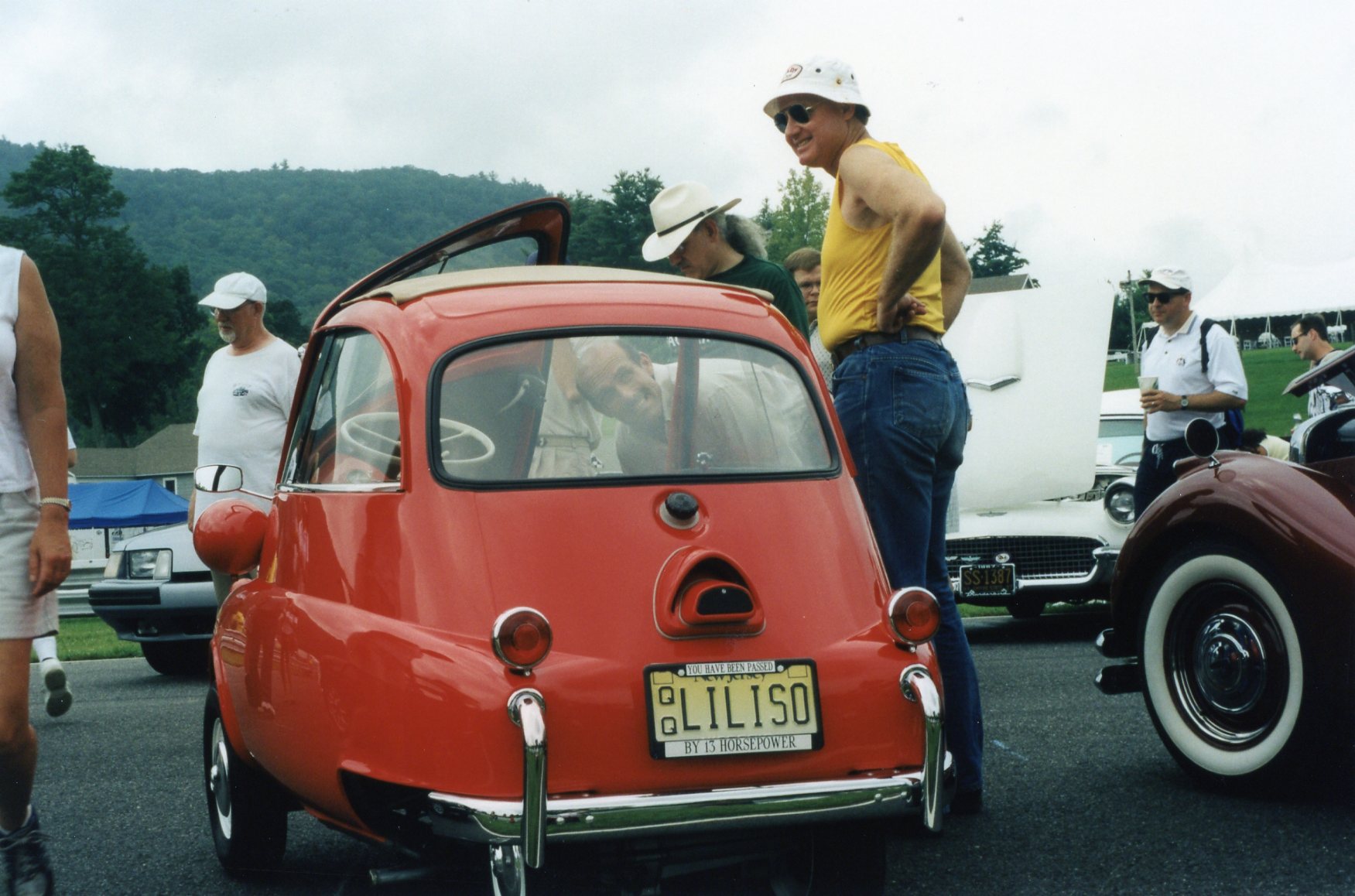
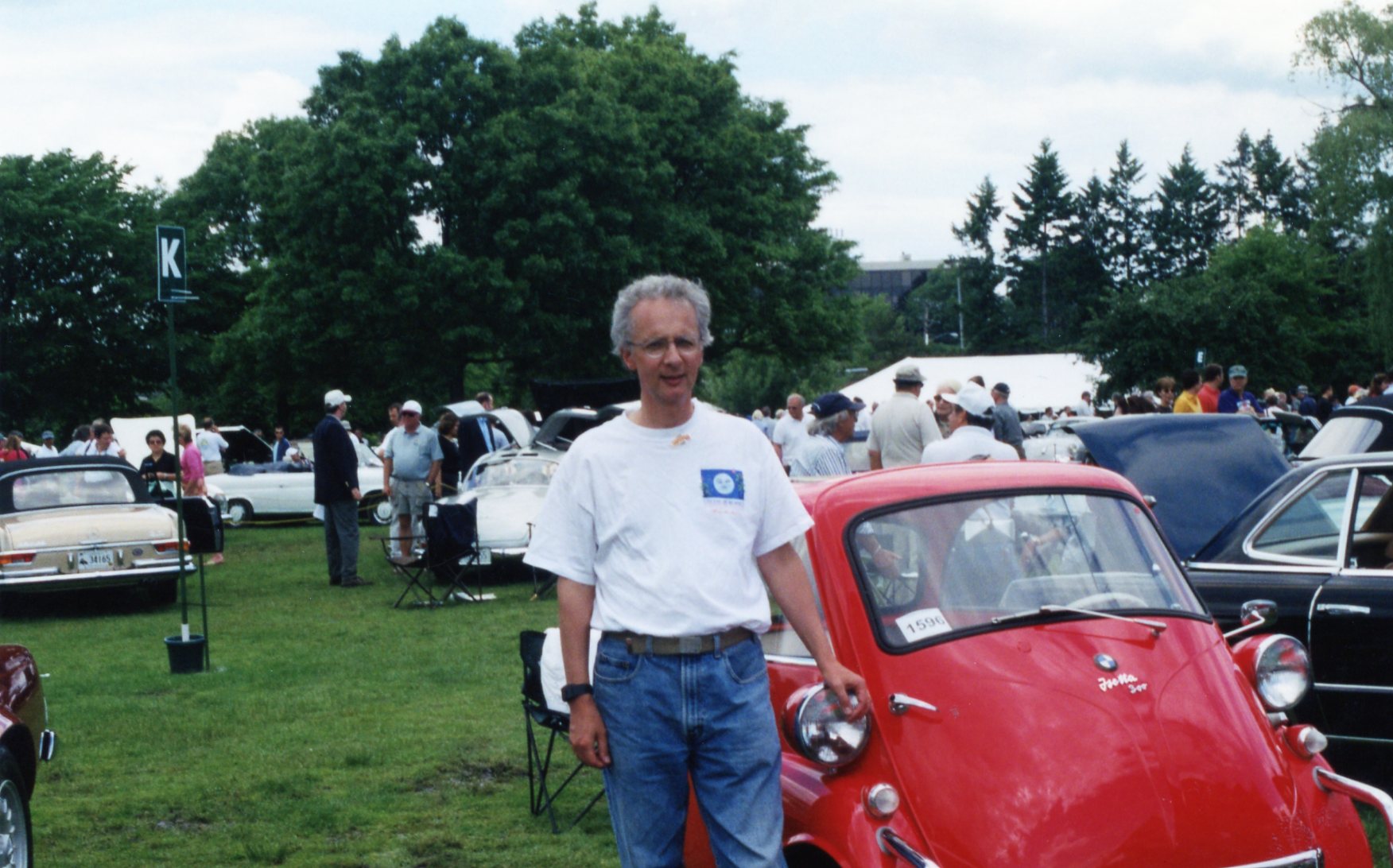
My Isetta with its BMW brethren

This time, my BMW was correctly placed in the same display circle as the other BMWs. But that was about the only happy element of the event. It was a day of miserable weather, with a steady cool rain which kept spectators away. My wife and I were dressed for the occasion, and worked to make the best of it.

My wife Margaretanne was a trooper for tolerating the weather

Parked directly next to my car was a BMW 600 (often incorrectly referred to as an “Isetta 600” –its officially name is “BMW 600 Limousine”). From the front, most people mistake it for an Isetta. It does share its front-hinged door and pivoting steering column with its little brother. Built on a slightly longer wheelbase, the 600 included a 2nd row of seats, one side door for access to that row, and most importantly, a two-cylinder boxer engine displacing about 600 cc.

The differences between the 600 (L) and 300 (R) are obvious here

The 600 is an interesting vehicle in BMW’s history. With the runaway success of the Isetta on a global scale (ultimately, 160,000 units produced, which made it BMW’s largest-volume model to date), company management wanted that success to be a springboard to a larger model, presumably to attract a bigger audience. Unlike the Isetta which was designed by the Italian firm Iso, the BMW 600 was designed in-house. Complaints that the Isetta was too small, underpowered, and lacked passenger room were all addressed in this larger model. Alas, the public did not respond in kind. Produced from 1957 to 1959, only 35,000 units were sold. The silver lining is that the 600 begat the “normal looking” BMW 700, which begat the Neue Klasse cars, and the rest, as several million people before me have said, is history.

The BMW 600, which some feel is less cute than the 300

Back to the car at the show: the young woman who piloted the 600 there was not the owner. She claimed that the car was owned by her boss, and he asked her to bring it to the show. Yet she seemed to be well-versed in its history. She had no issue with the idea that she would be driving her boss’s 600 back in the rain!

She was more than happy to display her boss’s 600

Awards were announced, and what’s this? No award for the Isetta this year? Hey Bruce, what gives? I was getting used to the accolades. Oh well, I told myself, I’m not here for the trophy, I’m here for the experience.

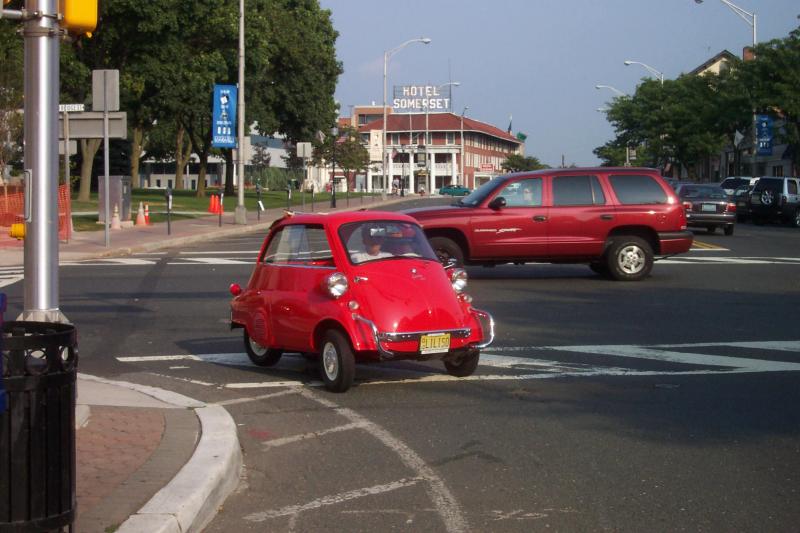
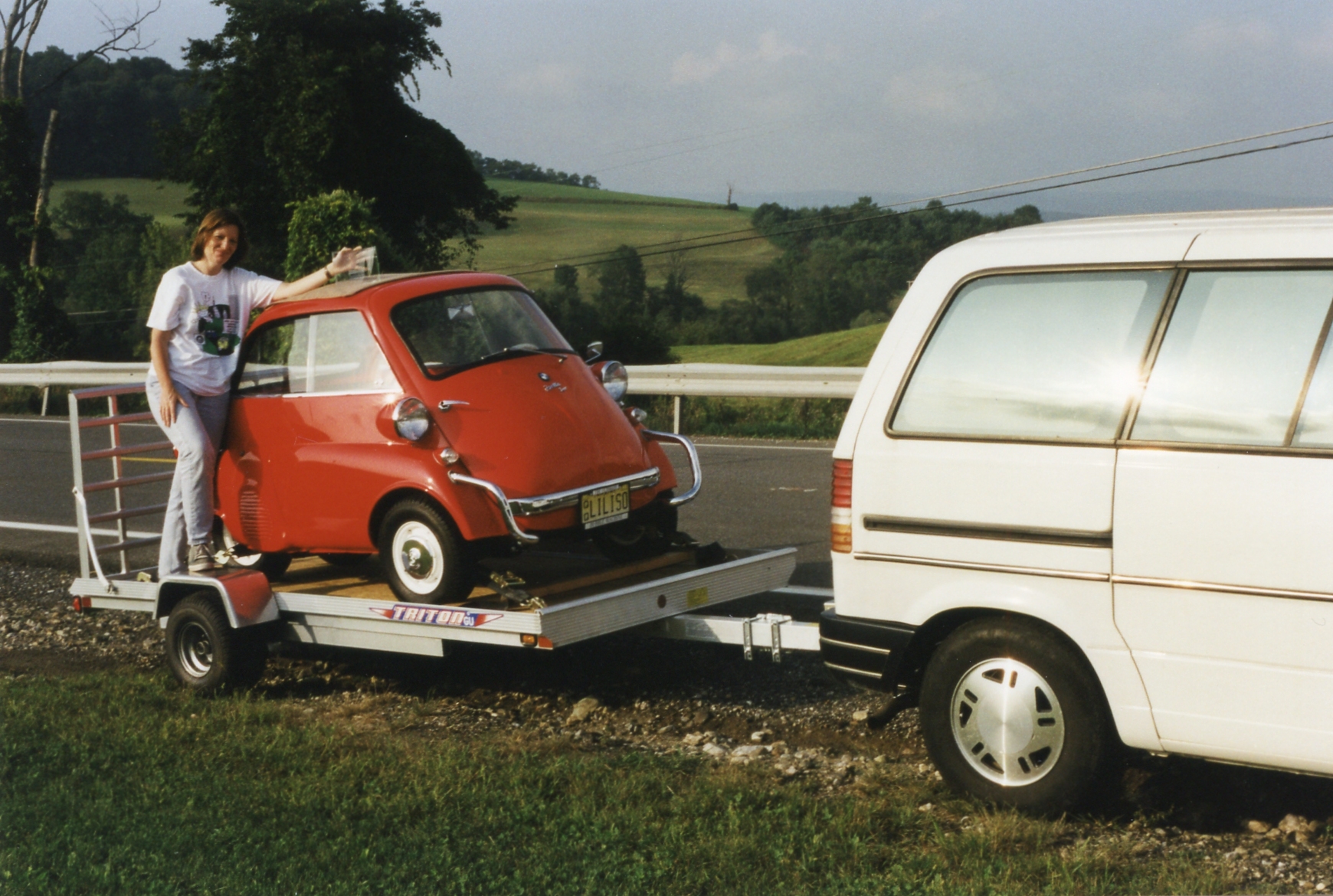
A few months later, I decided to bring the Isetta to the Somerville (NJ) Cruise Night, held every Friday between Memorial Day and Labor Day (and weather permitting, extended for as long as cars show up). This time, my stepson accompanied me, and assisted with trailer duties and photography. Like many cruise nights, there is no pre-registration, and parking on the street is on a first-come, first-served basis. We parked the trailer several blocks away, and got to drive the Isetta on some local streets through town. Luckily, as soon as I turned onto Main St., the show’s location, a parking spot appeared.

Stepson John takes first known photo from inside my moving Isetta


Just another red car out for a cruise


Managing to avoid Dodge Durango while turning onto Main St.


Blowby from tractor-trailer threatened to flip Isetta

It’s one thing to look at the Isetta and say “that thing is small”. It’s another thing to park it adjacent to other vehicles and see how truly tiny it is.
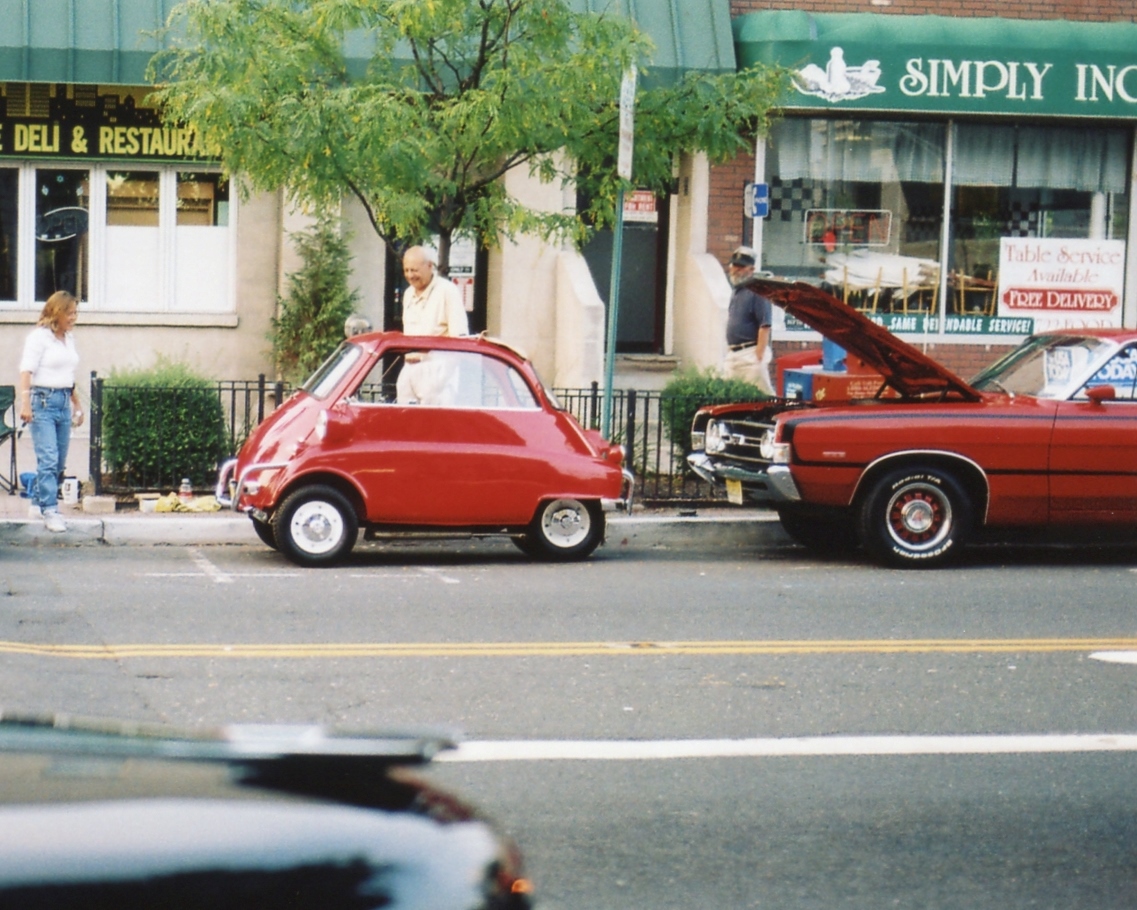
Isetta’s length matches hood of Torino behind it

As has been the trend, I spent much of the evening answering what seemed to be the same half-dozen questions:

  • Is this thing street-legal? (Sure, I drove it here)
  • How much horsepower does it have? (Thirteen, but a healthy 12-year-old boy on a bicycle can outdrag me)
  • What the top speed? (50 mph, downhill with a tailwind)
  • What kind of gas mileage does it get? (60 miles per gallon, so the 3-gallon tank gives me a cruising range of 180 miles)
  • How many people can you fit in there? (Two, but they really have to like each other)


The Isetta was proving to be a consistent attraction

The repetition was encouraging me to shoot back the same zany answers every time. By 9 p.m., it was time to get the Isetta back on the trailer. At least home was only eight miles away.

Later that year, while attending Hershey, I saw a beautiful yellow Isetta at the show. This was the germination of an idea: perhaps I could look into entering my Isetta at a future AACA event….
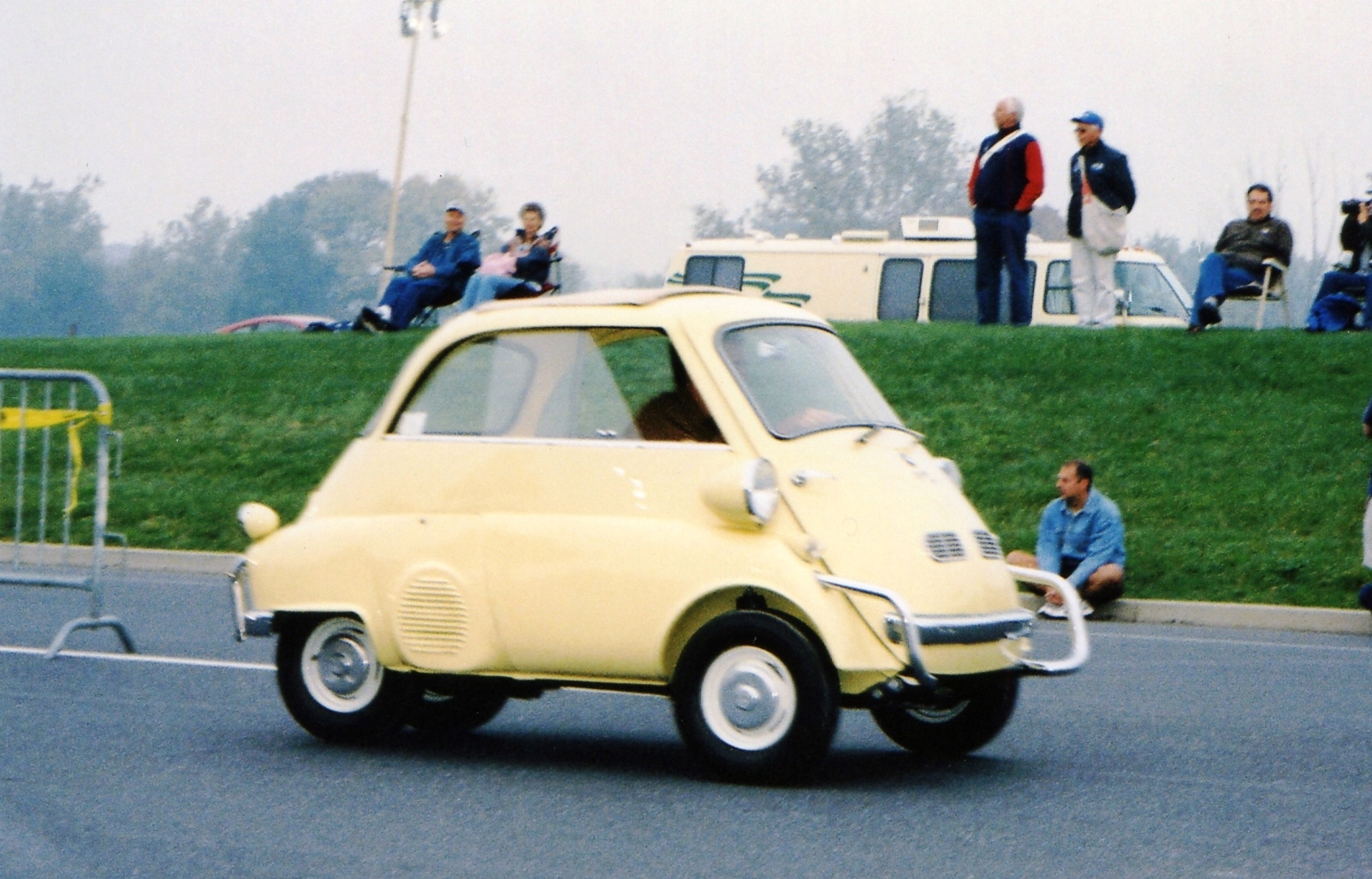
Taken at AACA Hershey 2004

All photographs copyright © 2020 Richard A. Reina. Photos may not be copied or reproduced without express written permission.


The Isetta Saga, Chapter 25: the 2001 Greenwich Concours d’Elegance

The Greenwich (CT) Concours d’Elegance, which began in 1996, was an almost immediate success. It is one of the few true classic concours held in the NY/NJ/CT metro area, and it has much more than that going for it. The show, traditionally held on the first weekend of June, is located in a small park bordering Long Island Sound. The park’s size limits the show’s size – visitors feel welcomed knowing that the entire show can be viewed in the course of a day with no need to rush. Clusters of trees provide shade when needed, and the grassy field is far superior to pavement. Vehicle manufacturers and dealers showcase new cars along the park’s perimeter. Perhaps best of all, each day’s lineup is unique: Saturday’s arrangement focuses on historic American vehicles, while Sunday’s participants arrive in European classics (this convention has changed somewhat in the last several years). Combined, these attributes make the Greenwich Concours one of the most unique and enjoyable car shows I’ve attended.

My relationship with the Concours, and more specifically with its chairperson Bruce Wennerstrom, began professionally. Volvo Cars of North America, my employer, was invited by Bruce to bring new cars to the show (and to monetarily contribute for the privilege of doing so), and my job was to provide the iron, which I did starting in 1997. As mentioned in Chapter 24 of the Isetta Saga, Bruce saw me and my Isetta at the 2000 Lime Rock Fall Vintage Festival, and invited me to bring my car to Greenwich in 2001, an invitation I immediately accepted.

We (Margaretanne and I) of course would be attending on Sunday, which at that time was referred to as “Concours Europa”. The date was June 3, 2001, and like every other participant, I could only hope for good weather. But Bruce’s luck had run out. After years of avoiding the wet stuff, it rained for the Saturday portion of the show. It wasn’t a total washout, though, as the skies cleared on Sunday; they just didn’t clear early enough to dry the grass.

Arriving with Isetta on trailer, I was directed to “trailer parking”, about a half mile away. I unloaded the car, we hopped in, and I drove to the park’s entrance. The routine went like this: each car and driver stopped at the registration table and was handed a packet. On the outside of the packet was a large letter indicating your ‘circle’. All the show cars were parked in circles, the cars perpendicular to the circle’s circumference, facing outward (got that, geometry majors?). Once cleared of check-in, the driver (me) held up the envelope so that volunteers could direct me to the appropriate circle, which as I understood it, was the BMW circle.

This shot gives you an idea of the field’s wet condition

The first hundred feet or so within the park was paved. As soon as I turned right, as directed, and hit the wet and muddy grass, all forward motion ceased. I had no traction. Weighing under 1,000 pounds with passengers, I suspect that the Isetta’s 10-inch tires didn’t have enough mass pushing downward. Show workers tried to push the car, but it was slow going, not helped by their own struggles to keep their sneakers from slipping. We made it a few yards at a time when someone in a supervisory role spoke up and said to me “look, your circle is on the other side of the park. We’re not going to get there. We’re just going to put you in this circle near to us”. Who was I to argue? I said “sure”, and we entered the circle and parked. Climbing out, I saw that I had the only BMW in a circle of … Mercedes-Benzes.

The lone Bimmer among the Benzes. At least they’re all German.

The Benzes were beautiful –exactly what you’d expect, with most of them SL models, including one 300SL Gullwing. I cleaned my car the best I could (the tires and wheel wells were quite muddy), set up our lawn chairs, and tried to relax. This was to be a judged show again (and yes, I dusted the spare!).

In the collector car hobby, it is a fact that most car owners enjoy talking about their cars. I again bore first-hand witness to the incredible reactions show-goers had to a BMW Isetta, and all the questions which were directed at me. Attendees tended to fall into one of two general camps: those who had never seen an Isetta and didn’t know the first thing about it; and those who knew something about the model yet had not seen one in years. So the time passed quickly, because everyone wanted to talk to me about my car. I also noticed that people chatting it up with me spent little or no time at the other vehicles in my circle. A friend who was at the show let it be known that he overheard two Mercedes owners complaining about “that intruder BMW” in their midst.

Taking a break from non-stop gabbing

Here’s another fun feature employed by the Greenwich staff: as class winners are announced, the winning vehicles line up and are driven at parade speed past a viewing stand. Each car stops, and the driver is handed a trophy and invited to say a few words. I had observed in previous years that Bruce and his wife Genia made it a point to have multiple classes in order to provide participants with as much recognition as possible. It was still a shock, though, when my name was called as winner of the Concours Europa “Best Special-Interest Car”. I honestly think mine was the ONLY special-interest car!

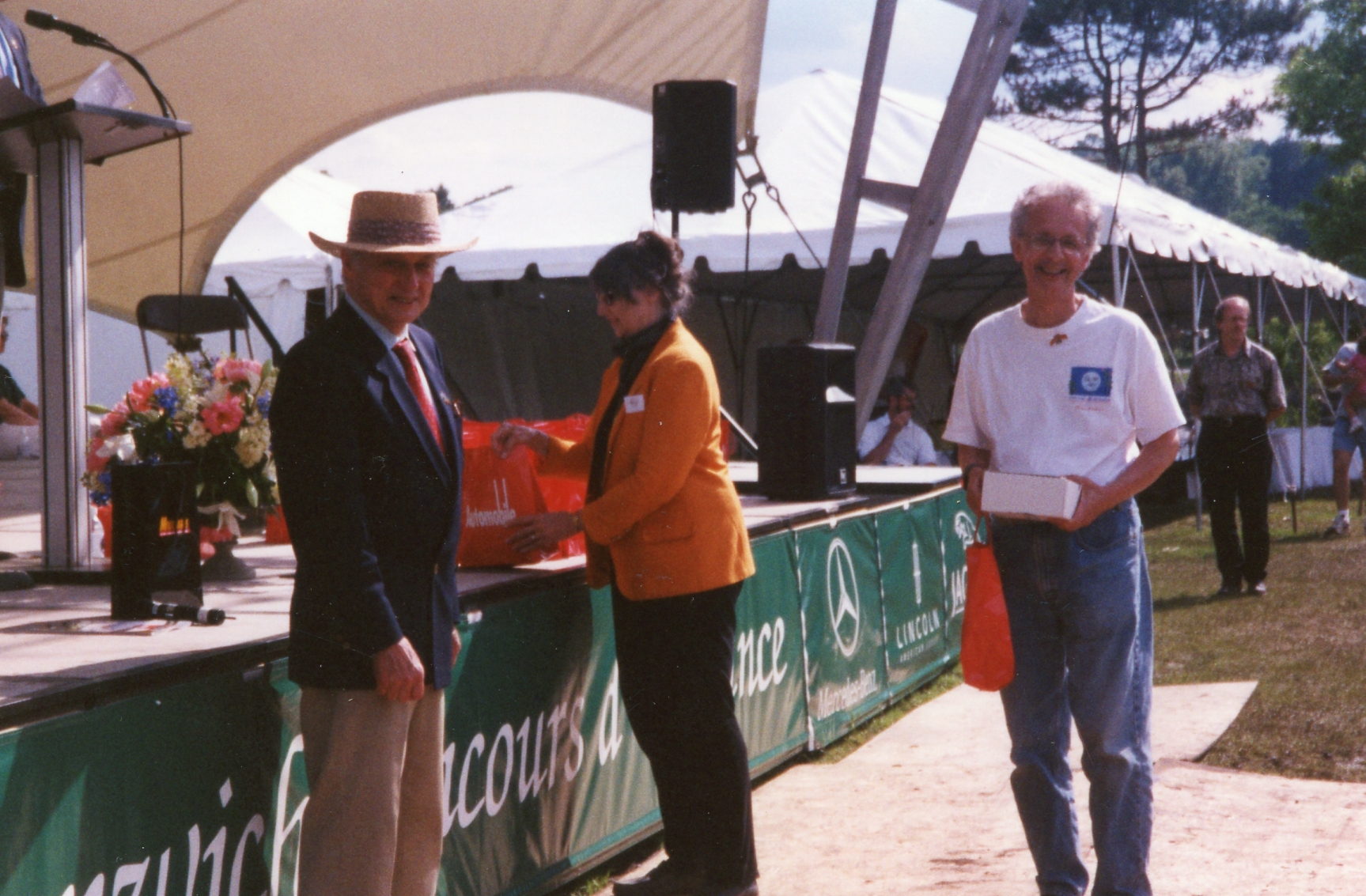
We pose by the car (photo courtesy Dennis & Ann Marie Nash)

We got in the queue (with better traction on the now-dry grass) and motored up to Bruce. He stuck a microphone through the car’s open sliding window and asked me about my car. I mumbled something about it being a U.S.-spec Isetta. This seemed to catch him by surprise, and he asked me what the difference was. I replied “The European Isettas got a 12-horsepower engine, but here in the States, we were given the bigger engine, which made 13 horsepower”. This sent Bruce into a fit of laughter, but he managed to make sure the audience understood that my Isetta had “the big block”.

Bruce Wennerstrom and his wife Genia hand me the goodies (photo courtesy Dennis & Ann Marie Nash)

Another car show, another trophy! During the entire restoration, I repeatedly told myself that I was NOT doing this in order to collect what I derisively referred to as “dust-collectors”. But again, the recognition among my peers was humbling, and certainly rewarding. We loaded the Isetta back on the trailer and headed home, with no immediate plans for any future car shows for my little red cuddle-box.

EPILOGUE

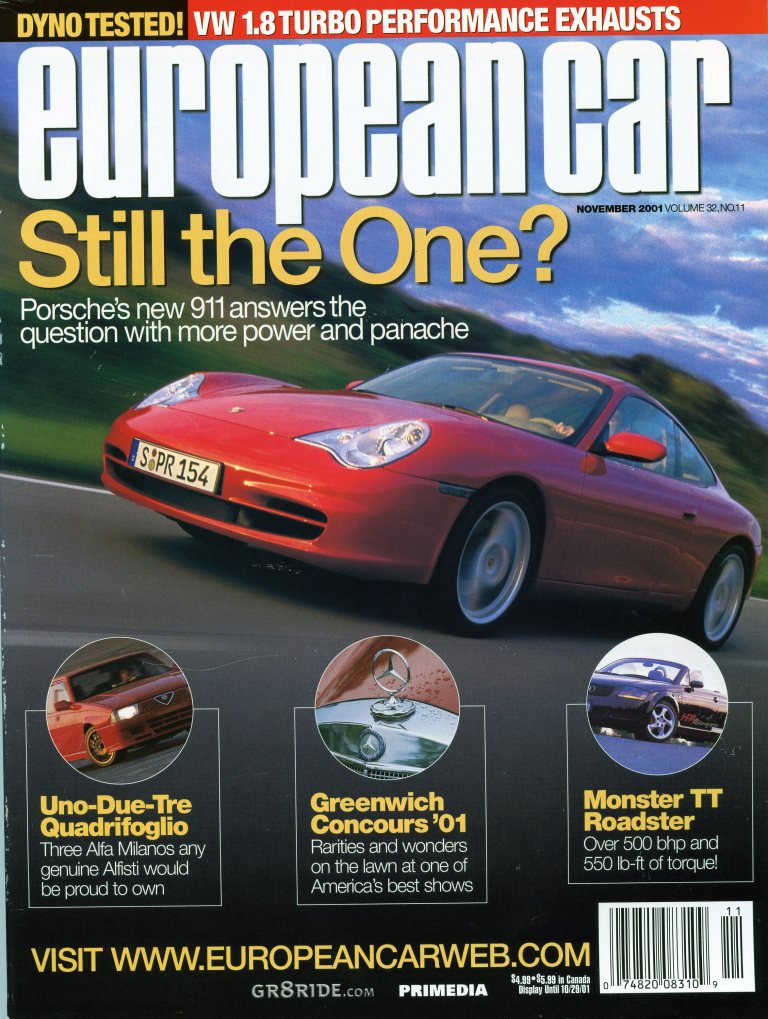
The November 2001 issue of (now defunct) European Car magazine published a story on the most recent Greenwich Concours, and even included a cover blurb: “Rarities and wonders on the lawn at one of America’s best shows”. Lo and behold, the magazine, which titled the story “Rainwich” Concours, included a small story about my small car.


All photographs copyright © 2020 Richard A. Reina. Photos may not be copied or reproduced without express written permission.


The Isetta Saga, Chapter 24: The 2000 Lime Rock Fall Vintage Festival

Feeling optimistic after successfully trailering the Isetta in August of 2000 to its first public show, I was ready to repeat the process. Labor Day weekend at Lime Rock Park in Connecticut has long been known to me for its Fall Vintage Festival (the event itself has gone through several name changes while staying true to its mission). Saturday and Monday of the weekend are devoted to vintage car racing, and on Sunday, when local ordinances prohibit racing, the track is given over to a static car show.

I’ve attended Lime Rock on Labor Day weekend at least as far back as 1991, when I purchased my ’67 Dodge Dart after spotting it on the field with a For Sale sign on it. During the summer of 2000, I made use of this new-fangled thing called the Internet, and found an online application form to register the Isetta for the show. It was only a matter of days when I received an email response in the affirmative.

Lime Rock CT, nestled in the Berkshires, is a little further from home than Park Ridge NJ. In a modern car, sans trailer, the trip from central Jersey is 2.5–3 hours. In an Aerostar van, pulling a trailer loaded with precious cargo, it’s a bit longer. Margaretanne and I left the house before sunrise; the communique from the Lime Rock officials requested that the car be on the field by 9 a.m.

Posing with the car. Lime Rock’s lush greenery is on full display in the background.

On arrival, we were greeted by a trio of track workers who were in a tizzy. Apparently, they did not know into which class they should place this microcar. Eventually, I was told “you’re in Class 18 – postwar European two-doors”. Instead of protesting the incorrect door count (what was I going to say? “Oh no, you want to place me in the postwar European ONE-door class”), I motored on, found the class, unloaded the car, and drove it into its display position. As had happened in Park Ridge, a small crowd gathered in amazement to watch this egg move under its own power.

The Isetta among its (class) peers

We set up the folding lawn chairs, and I got to work with the detail bucket. It was hot and humid, and while morning clouds threatened, they were gone by midday, and took some of the humidity with them. Cleaning my car gave me the opportunity to take in my competition. On one side of me was a large Jaguar drophead coupe; on the other side, an Austin/Morris Mini (the original one; the successor had not been born yet). Other vehicles in my class included a VW Bug and a Mercedes-Benz 280SE cabriolet. This was as eclectic a group of vehicles as I could have imagined.

There wasn’t much detailing to do and soon after I settled into my folding chair, the judging team arrived. This was my first exposure to “show judging”, and my slight nervousness caused me at one point to yell out to the judges “what’s taking you so long? It’s a pretty small car!”. This verbal jab resulted in an elbow jab from Margaretanne, admonishing me to behave. One of the judges asked “where’s the spare?” and with that, I folded the seat back forward (the spare is in a recess behind the seat). The judge made a comment about dust on the spare wheel/tire assembly, and this time I kept my mouth shut, making a mental note to clean the spare when I got home.

A spectator ponders if he could fit (probably could)

The judges moved on, and I tried to relax while the show attendees stopped to inspect my Isetta and ask the occasional question. I heard a female voice from a few yards away say “oh, I know that car! I helped procure a bunch of parts for it!” It was Linda Gronlund, whom I knew from her days at Volvo Corporate. She had left Volvo to work at BMW USA, and was still employed there. She had indeed played a role in helping me obtain some genuine BMW parts as long as I was able to provide her with genuine BMW part numbers. It was nice to see her, and most tragically, it was the last time I ever saw Linda. Almost exactly one year later, she was a passenger on United flight #93 which crashed in PA on 9/11/2001.

Sometime later in the day at Lime Rock, another voice, this time a male one, called my name out loud after reading it from the windshield entry card. It was Bruce Wennerstrom, who chaired the prestigious Greenwich (CT) Concours d’Elegance. I knew Bruce because Volvo had been a corporate sponsor of his event, and part of my job responsibilities included chauffeuring new Volvos to be put on display at Greenwich. Bruce and I exchanged pleasantries, and then he utterly shocked me by asking “would you like to display your Isetta at the Greenwich show next year?” I was flattered, and flabbergasted. I stammered a “yes” and told Bruce that I was honored.

By 3 p.m., Margaretanne and I were talking about getting an early start to our long trip back home. The award ceremony had just begun, and I didn’t feel it necessary to stick around for it, that is, until I heard “Isetta” over the PA system. I walked up to the awards table and, in a day full of surprises, had my biggest surprise when I learned that my car had won 1st in its class (dusty spare and all). While I am not in this hobby for trophy-collecting, it is nice to be recognized.

Margaretanne is quite proud of the award


As is the car’s owner


The Isetta was done with car shows for the year 2000. There was already something to look forward to in 2001, and that would be Greenwich in June. I had all winter to detail that spare.

All photographs copyright © 2020 Richard A. Reina. Photos may not be copied or reproduced without express written permission.

My Old Isetta is Going Back on the Block

In the almost seven years since I sold my Isetta at an RM auction in October of 2013, I occasionally scan the automotive classifieds, both in print and online, wondering if I will come across my former car for sale. Up until a few weeks ago, that search had turned up blank.

My Isetta at the Oct. ’13 RM auction in Hershey PA. Note suitcase on package shelf.

Checking out an email I received for an upcoming RM Sotheby’s auction, I was drawn to what appeared to be an outstanding collection of Italian cars: the expected Ferraris and Alfas but also Autobianchis, Isos, and some rarely-seen Fiats. That’s when I saw it.

An all-red BMW Isetta was part of the sale. Clicking on the photos, I looked for tell-tale signs, the kinds of things that I, having owned the beast for 35 years, would recognize. (I’m fond of an expression picked up from a hobbyist friend, who says of his own car: “I know where the bodies are buried”.) Checking the chassis number was the final proof. I called my wife into the room and showed her the photos.

Wife: “How do you know it’s yours?”

Me: “509090.”

Wife: “Huh?”

Me: “It’s the chassis number. I have it memorized.” (Oh, and still on the package shelf is the ‘50s-era suitcase covered in travel decals which I picked up in an antique store for $10.)

The auction, billed by RM Sotheby’s as “The Elkhart Collection”, is scheduled to take place on October 23 & 24 of 2020. Those are the rescheduled dates; initially the auction was supposed to run in May, and it’s presumed that the coronavirus was the proximate cause of the postponement. At this writing, it’s listed as a “live” auction, however, all RM Sotheby auctions since the global shutdown have been online only. While I’m long out of the business of predicting the future, I would venture to guess without too much risk that this one will revert to the online-only format soon enough.

Here’s how the RM Sotheby’s website describes the collection:

OVER 240 CARS AND WIDE SELECTION OF COLLECTIBLES OFFERED ALMOST ENTIRELY WITHOUT RESERVE

The result of decades of judicious and targeted collecting, The Elkhart Collection – Offered Almost Entirely Without Reserve comprises the most exceptional marques and models in automotive history. The focus is at once broad but highly selective from sporting British and Italian cars to microcars, classics, supercars, modern sports cars, ‘50s convertibles and coachbuilt icons. Stay tuned for the digital catalogue coming soon. To view lot listing, click here

It didn’t take much snooping to get the rest of the story. This is from AutoWeek:

Damn, This Accused Fraudster Has Excellent Taste in Cars

There’s something for everyone in the RM Sotheby’s Elkhart Collection catalog—and with the sale moved to October, you’ve got plenty of time to browse it.

The gist of the AutoWeek story is that this 240+ car collection was amassed by one person, an Indiana businessman named Najeeb Khan, who has now been accused of fraud, although the author is also quick to note that he has not been charged with a crime. But his collection is being liquidated so that he can pay back his creditors.

Personally, I don’t really care about this guy’s personal problems. He has excellent taste in cars, especially of the Italian variety, although the remainder of the collection is also worth a gander. I’ve asked myself if Mr. Khan is the person who purchased my car at the 2013 Hershey auction. While it’s impossible to make that determination from the auction company’s website, I checked the mileage on my car on the date that I sold it, and the mileage shown in the current listing. The Isetta has been driven exactly one mile in the previous 6.5 years. Which is a shame, really, because the car runs well and it’s a blast to drive!

To the new owner, whoever you are: get some new tires. I bought those Michelins in the early ‘90s.

There’s more to discuss about the Elkart Collection Auction in future posts. The discovery of my old car will also spur me to resume the Isetta Saga. There’s lots more to share, and I want all those bidders to have the entire story!

All photographs copyright © 2020 Richard A. Reina. Photos may not be copied or reproduced without express written permission.


Alfa Romeo brake system overhaul, Part 8

With the Alfa’s hydraulic brake replacement essentially finished, there was one more related task to complete. As the previous owner had suggested to me, the battery B+ cable could stand to be replaced. Not only had he indicated that it was undersized, he also wasn’t sure that its attachment points had stood up over time. (My car was born with its battery in the engine compartment, but Pete had relocated it to the trunk, where it still is.)

Conveniently, the cable almost completely followed the routing of the brake line from rear to front. There was no extra work to dropping the battery cable when removing the brake lines. The old cable looked to be possibly 2 gauge; I had purchased a “Battery Relocation Kit” which included 20 feet of zero gauge cable (the smaller the number, the larger the cross-section). I only needed about 16 feet.

The old cable had been secured in place with metal hose clamps; thankfully, there were no signs of potential incendiary damage. The new cable followed the same routing as the old, and instead of clamps, I used about two dozen high-temp plastic cable ties. (Cable, or “zip” ties, are available in different quality levels. In the past, I had some which snapped upon tightening. For this job, I researched and purchased higher quality cables.) I was quite happy with the appearance of the end result; the new cable is tucked far enough up into the underside that at no point is it the lowest object under the car.

New battery cable securely in place under the car

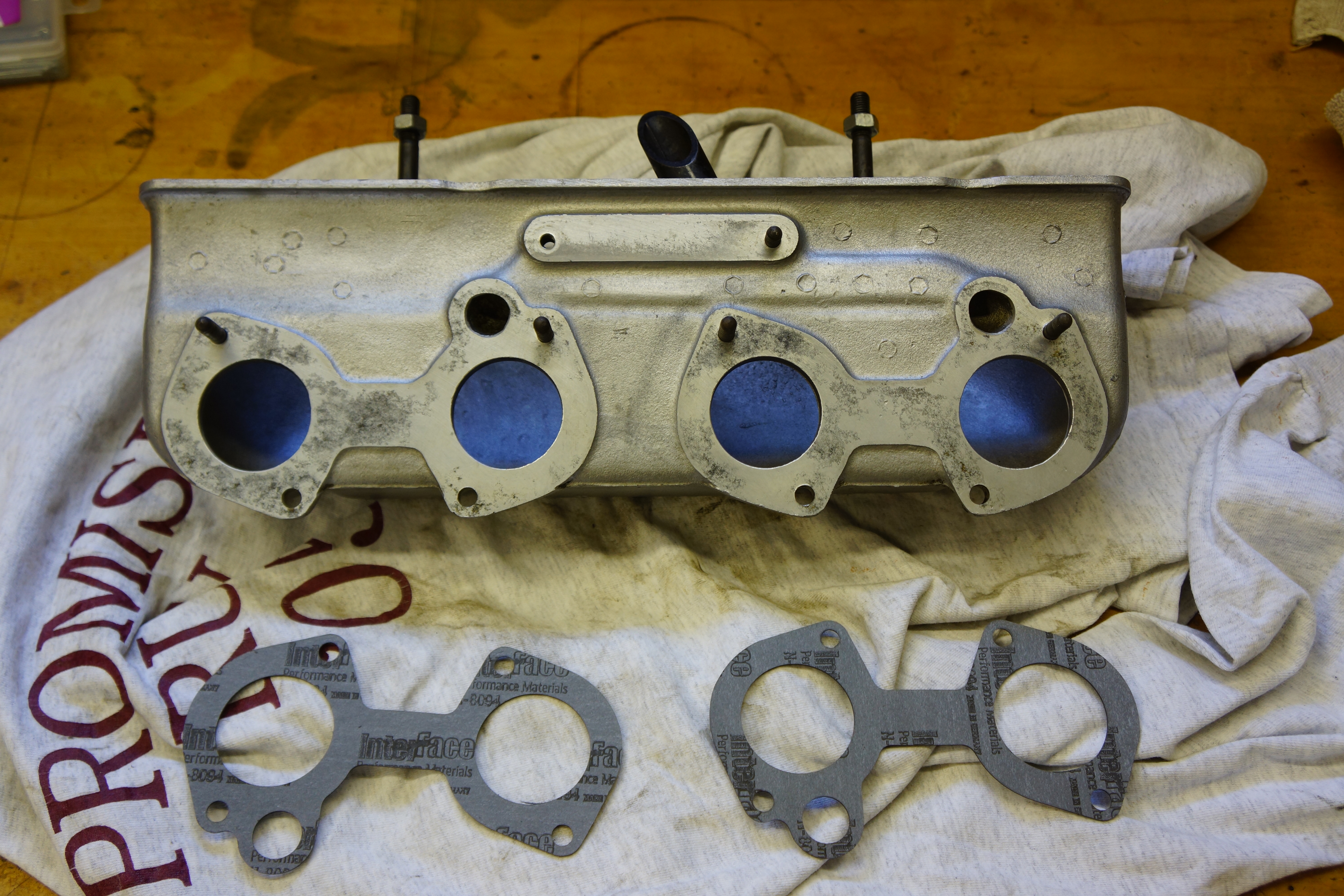
To gain access to the starter solenoid, I had removed the intake plenum. (Alfas and some other Italian cars do not have a traditional intake manifold. Instead, the air filter feeds air to the plenum, mounted to the outside of the side-draft carburetors. The carbs in turn are mounted to small tubes which themselves are bolted directly to the cylinder head.) I gave the plenum a cleaning, ran a 6mm x 1.0 tap on all the studs, used new washers and nuts, and with new gaskets at the ready between plenum and carbs, bolted it all back together. The thread chasing and new nuts helped immensely given that 4 of these attachments are completely blind and are in tight quarters.

Dirty plenum, old gaskets
Clean plenum, new gaskets

Saturday was going to be the big day; there always are the dozen final details (spark plug wires and various other small connections underhood), and I triple checked all around the car, which was still on jackstands, still with tires off. The battery had been on trickle charge. Nervously, I completed the final connections at the battery. Nothing caught fire. Climbing up into the driver’s seat, I turned the key on, pumped the pedal about a half-dozen times, and cranked. The crank was strong, but the engine made no attempt to run on its own. Key off, pump the pedal some more, try again. And again. I smelled fuel, got out, and peered underneath. Raw fuel was pouring out from under the front right corner. Key off, battery safety switch turned to off. Time to stop, take a breath, and think.

Was this related to what I had been working on the last 11 months, or was this complete coincidence? Grabbing a flashlight, I looked into the right front corner, where the mechanical fuel pump and fuel filter are. Feeling with my hands, the wettest area was the rubber fuel line for the pump’s outlet. It took about 2 minutes to loosen the clamps and remove the hose.

Old hose looks quite bad

The hose was completely dry-rotted. First, I breathed a sigh of relief that it was ‘just’ a hose. I also immediately realized that, like the brake system I had just overhauled, I really didn’t know how old these hoses were. A quick car ride (with mask) to Advance Auto Parts, and I was back with 3 feet of 5/16” fuel hose.

Old hose looks worse close up

Sunday morning, all 4 fuel hoses, each only about 8-10 inches long, came off and were replaced with fresh rubber. Time to try again. This time, after about 7 to 8 pumps of the pedal (and no leaks), the engine started. Hooray! I bolted the tires back into place, removed the jackstands, and my Alfa was back on the ground for the first time since July of last year.

New fuel hose is CARB-compliant

Gingerly, I moved the car outside under its own power. The brakes worked well, even if the pedal still felt a little soft. One more round of bleeding is in order. I’m also going to try to adjust the ‘throw’ at the master cylinder, as the brake pedal is not quite lined up with the clutch pedal. These are mere details, and I will get to them in the coming days. For now, I’m happy, satisfied, and truly pleased to be able to say that this project is done.

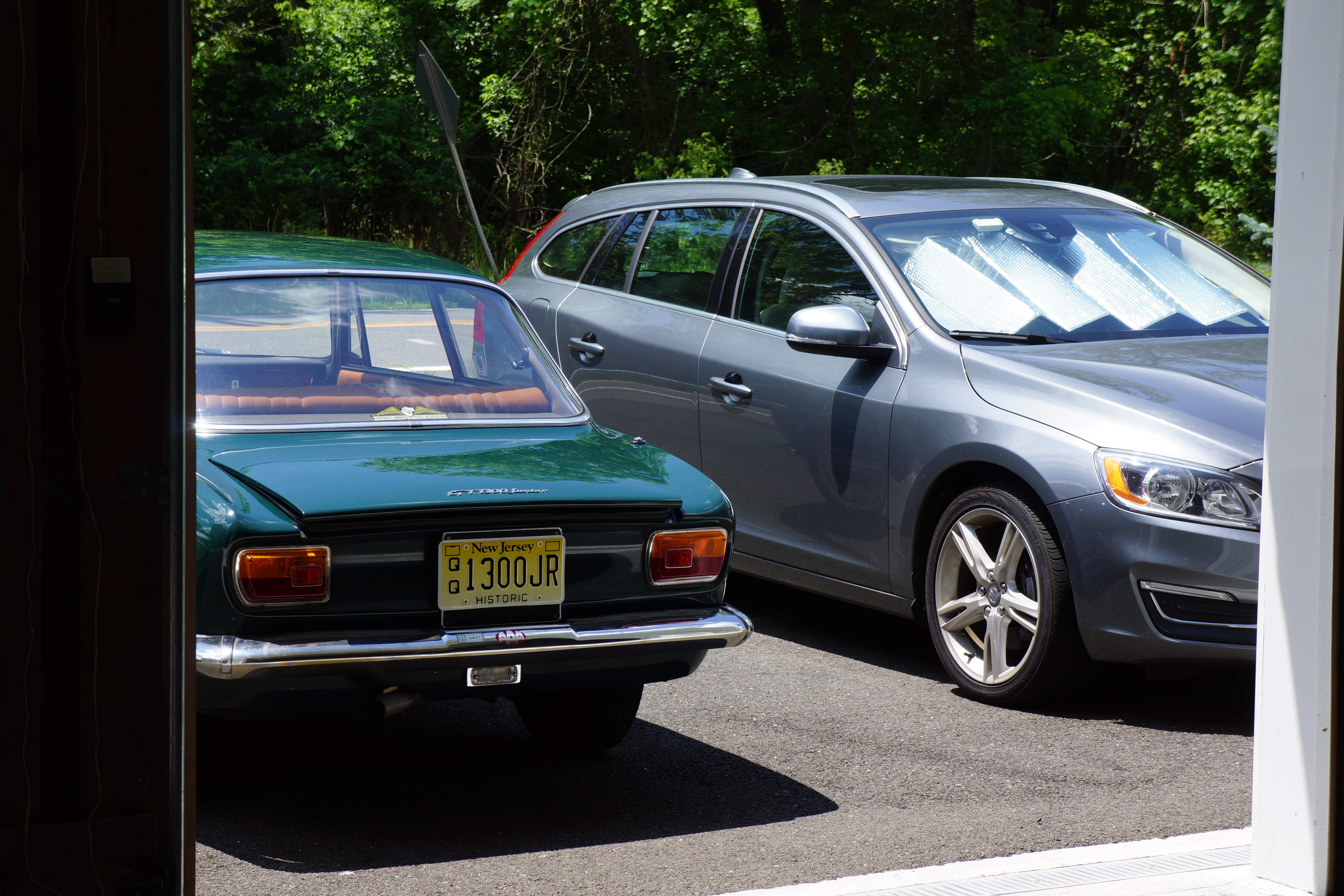
My Alfa sees sunshine for the first time in 11 months


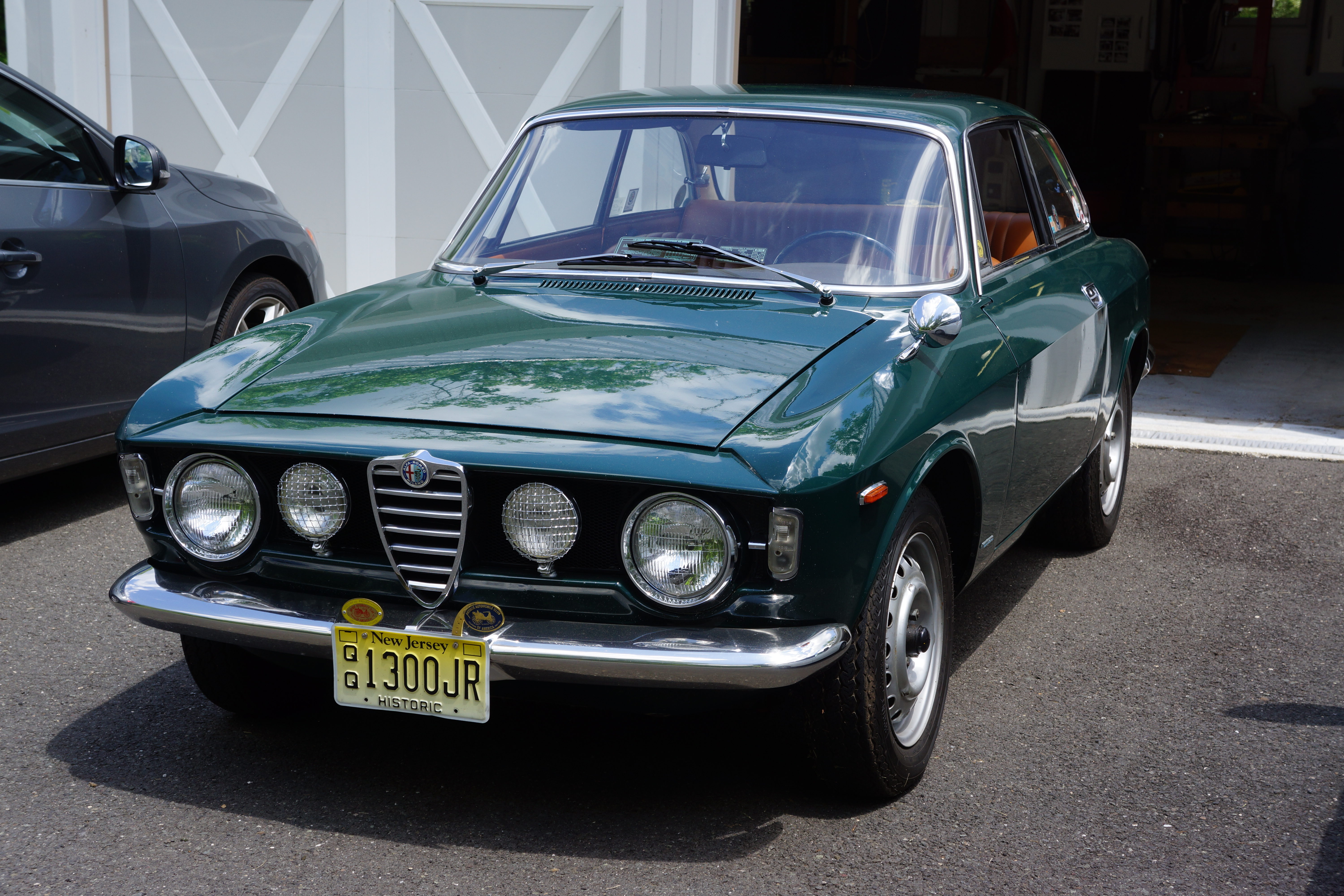
Here, nicely framed by garage door; can’t wait to put some miles on it.


All photographs copyright © 2020 Richard A. Reina. Photos may not be copied or reproduced without express written permission.


Alfa Romeo brake system overhaul, Part 7

I’ve always likened working on an old car, when there’s little or nothing in the way of published instruction, to dancing the tango. It’s two steps forward, and one step back. Two forward, one back. And repeat….

In the last post about the Alfa’s brakes, two weeks ago, I wrote about the awkward position of the brake master cylinder. Like so many cars with pedals coming up from the floor (what Alfisti call “standing pedals”), the master is underneath, bolted to the pedal box. When I removed the master cylinder last fall, there were no written instructions to follow. I loosened the pedal box just enough to lower it and access the two bolts holding the master in place. The removal was such a chore that frankly I had been dreading the reinstallation.

Re-reading my words in that last post, I see that I was unintentionally vague. The sentence that now bothers me reads “Once the lines to the master cylinder are done, I need to reinstall the pedal box in the driver’s footwell, as all three pedals had to be loosened/removed to gain access to the master.” My sentence leaves it completely unclear whether I had removed the entire pedal box, or had merely loosened it, when in fact it was the latter.

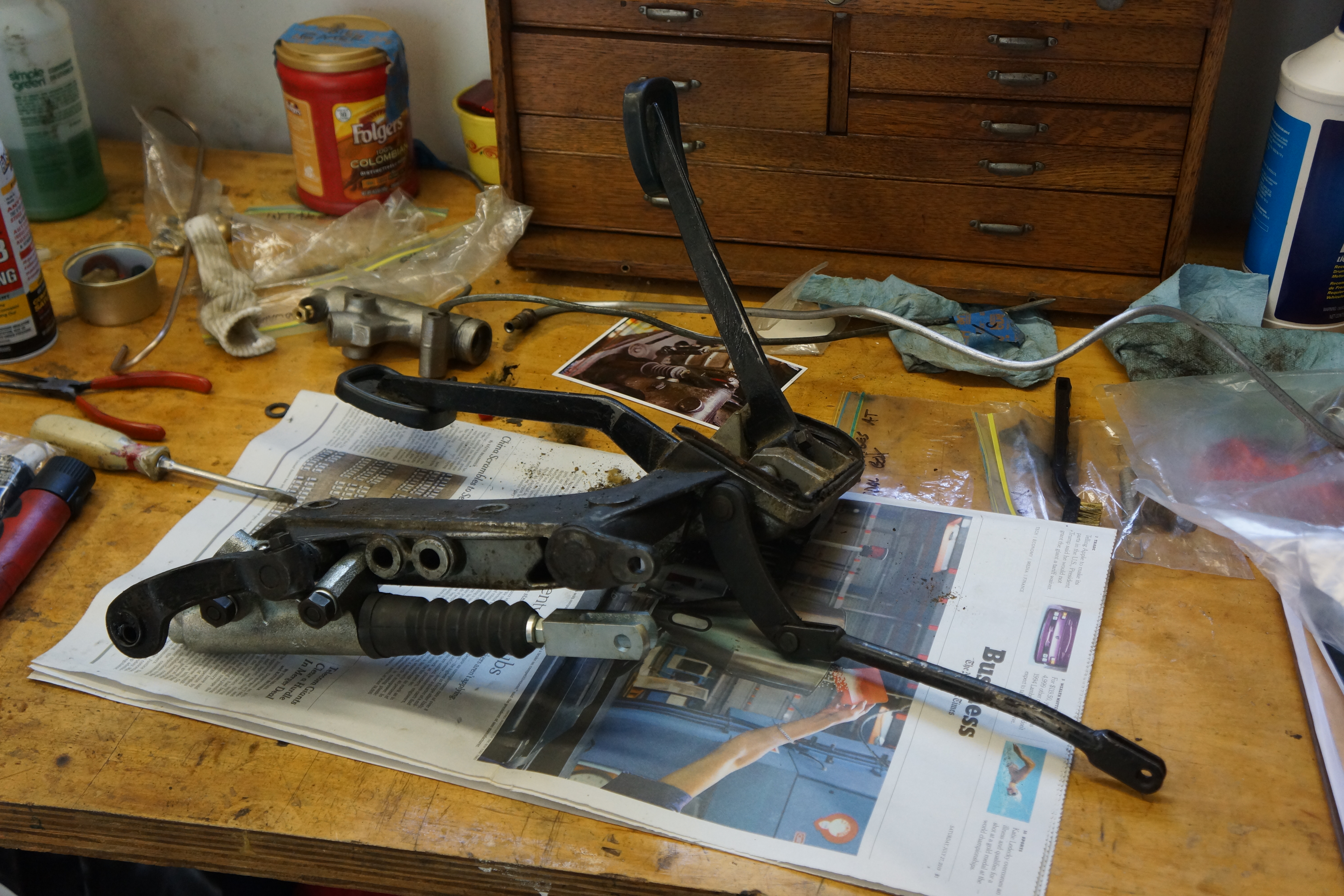
Why am I harping on this? Because I found myself doing the tango. In the process of attempting to reinstall the new master, I ended up completely removing the pedal box from the car. If only I had done this during the initial disassembly! The hang-up was a bracket which I had mistakenly identified as part of the transmission cross member, but is a bracket for the front exhaust pipe. Laying on my back, on the garage floor, holding a flashlight, and trying to focus through my progressive lenses made its correct identification difficult. Once I realized that it could be safely removed, I undid 5 bolts and it was off. Suddenly, the entire pedal box was in my hands. Eureka!

Pedal box on my workbench. New master is in front.

Since the exhaust bracket was off, I replaced the two rubber bushings inside it, cleaned it up, and repainted it with Eastwood Chassis Black. When friends ask why this brake job isn’t finished yet, it’s these “might as well as” side jobs which eat up time, but are important to complete.


With paint open, I dipped the bolt heads and nuts in it. Drilled wood holds them while they dry.

With the new master cylinder bolted in place, I reinstalled the pedal box, sealing it against the unibody with fresh dum-dum (I have a box of 3M dum-dum that’s probably 25 years old, and that stuff stays pliable!). The two final brake lines were bent to line up with the threaded inserts on the master, and I was happily surprised that I got the threads to “bite” after just a few minutes of trying.

Brake lines at master, ready to be bent to shape

The time had come to add fresh brake fluid to the system. I filled the reservoir, attached the little magnetic one-man bleeder bottle from Eastwood to the right rear caliper bleed screw (always start with the brake furthest from the master), and began to pump the brake pedal by hand. Forum posts on the Alfa Bulletin Board (AlfaBB) recited tales of horror about the difficulties in bleeding Alfa hydraulic brakes. I believe that later cars with dual circuits AND dual servos can be a challenge to bleed. I was happily shocked that I had fresh fluid coming through the hose on the bleeder screw on the second or third try.

This item, under $10, makes one-person bleeding a breeze

I was less happily shocked to also see that I had some leaks. There were two leaks at flare fittings that still weren’t tight enough. An eighth of a turn with the 7/16” flare nut wrench solved that. I continued to add fluid and pump the pedal, moving from right rear to left rear to right front to left front. But then a larger fluid leak sprung, from a lousy location: the master cylinder. I got under the car, but both lines at the master were as tight as I dared to make them. My heart sank. Could the new master cylinder be defective?

When you’re doing the tango, and your feet start to go in a direction that could make you trip and fall, it’s sometimes best to get off the dance floor. I put down all the tools, exited the garage, went for a walk, and came back to have lunch. (I learned during the Isetta restoration that before anxiety drives you to act hastily and BREAK something, walk away, think about it, then go back to it.)

An hour later, I believed I had diagnosed the problem, without even touching the car. The leaking line ran from the exit port on the master up to the brass four-way junction block on the firewall. I remembered that when I had formed that line, I told myself that it was “symmetrical”, that is, the same flares and the same flare nuts on each end. While the flare NUTS were the same, the flare at the master needed to be an ISO bubble flare, and I had formed a 45 degree double flare. It took about two minutes to pop that line out of the master to confirm my diagnosis. Yup – I formed the wrong flare fitting.

Oops. Old line at left is bubble flare; new line with double flare doesn’t match.

Back to the two steps forward and one back routine. It was a complete pain to remove that line, cut off the wrong flare, make a new flare, and fit the line back in place. However, the rapid diagnosis made up for it. The fixed line was back on the car, bleeding resumed, and there were no leaks. In a short while, I had a pedal! I’ll bleed the entire system one more time, then the hydraulic work will be done.


This is better.


All photographs copyright © 2020 Richard A. Reina. Photos may not be copied or reproduced without express written permission.
Alfa Romeo brake system overhaul, Part 6

There is light at the end of the tunnel.

Perhaps the ongoing lockdown has distorted my sense of time. Brake System Update Part 5 was posted on April 3, and I would have guessed that it was more recent than that. Progress has continued, and I’m not shy about admitting that 12 weeks of working from home has allotted additional free time with the removal of a two hour round-trip commute. It also felt redundant and nonconstructive to add a post which only stated “… and today I cut and flared two more brake lines….”

The month of May had me in limbo because of the master cylinder. I was keen on keeping the original part and simply rebuilding it. I had taken a chance last year by ordering a rebuild kit that I knew might not work, and it didn’t. Then I found a new supplier based in Germany whose website looked like they had the correct ATE rebuild kit. That order was placed in late April, and I’m still waiting. Supposedly DHL has the part (or more likely has lost the part).

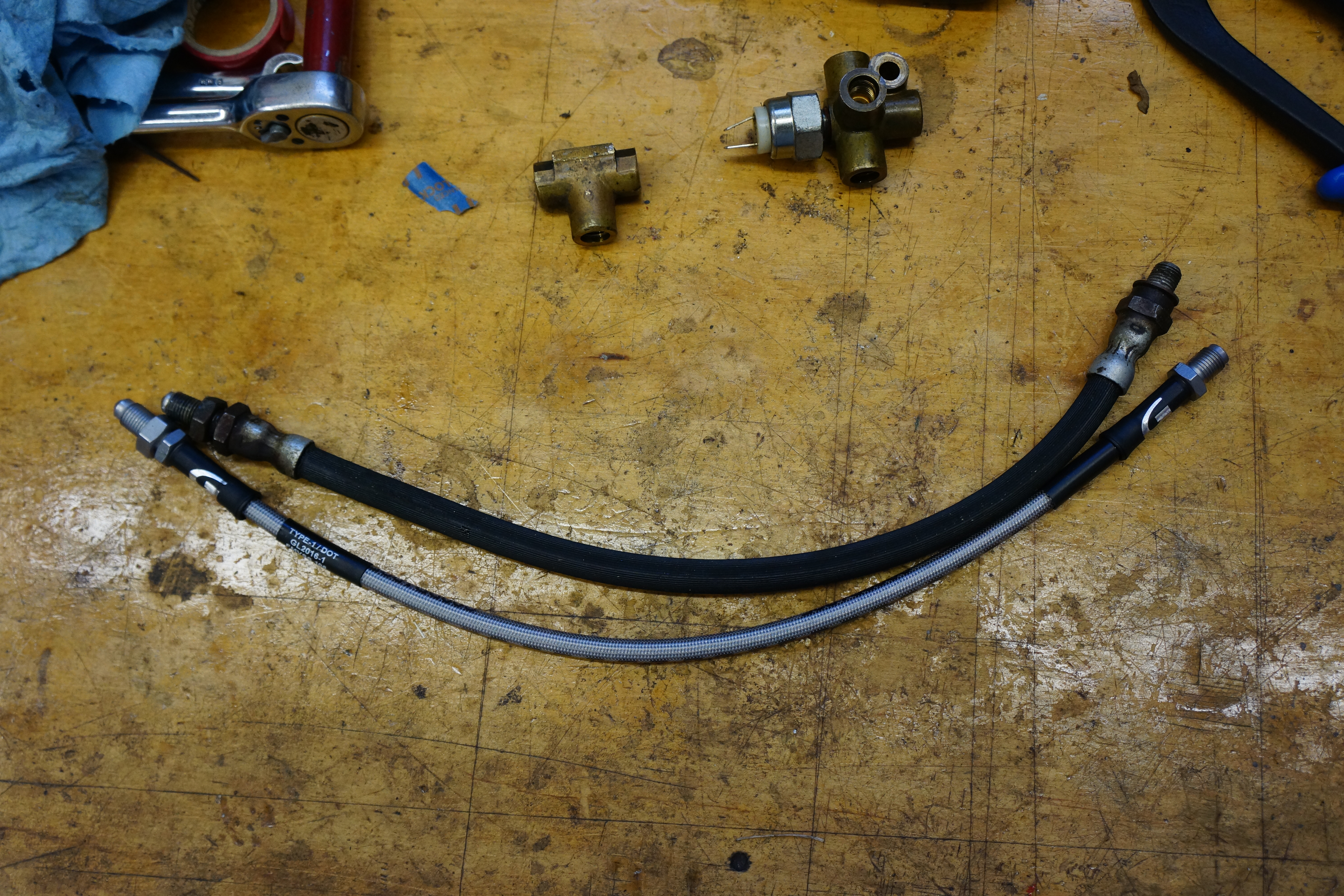
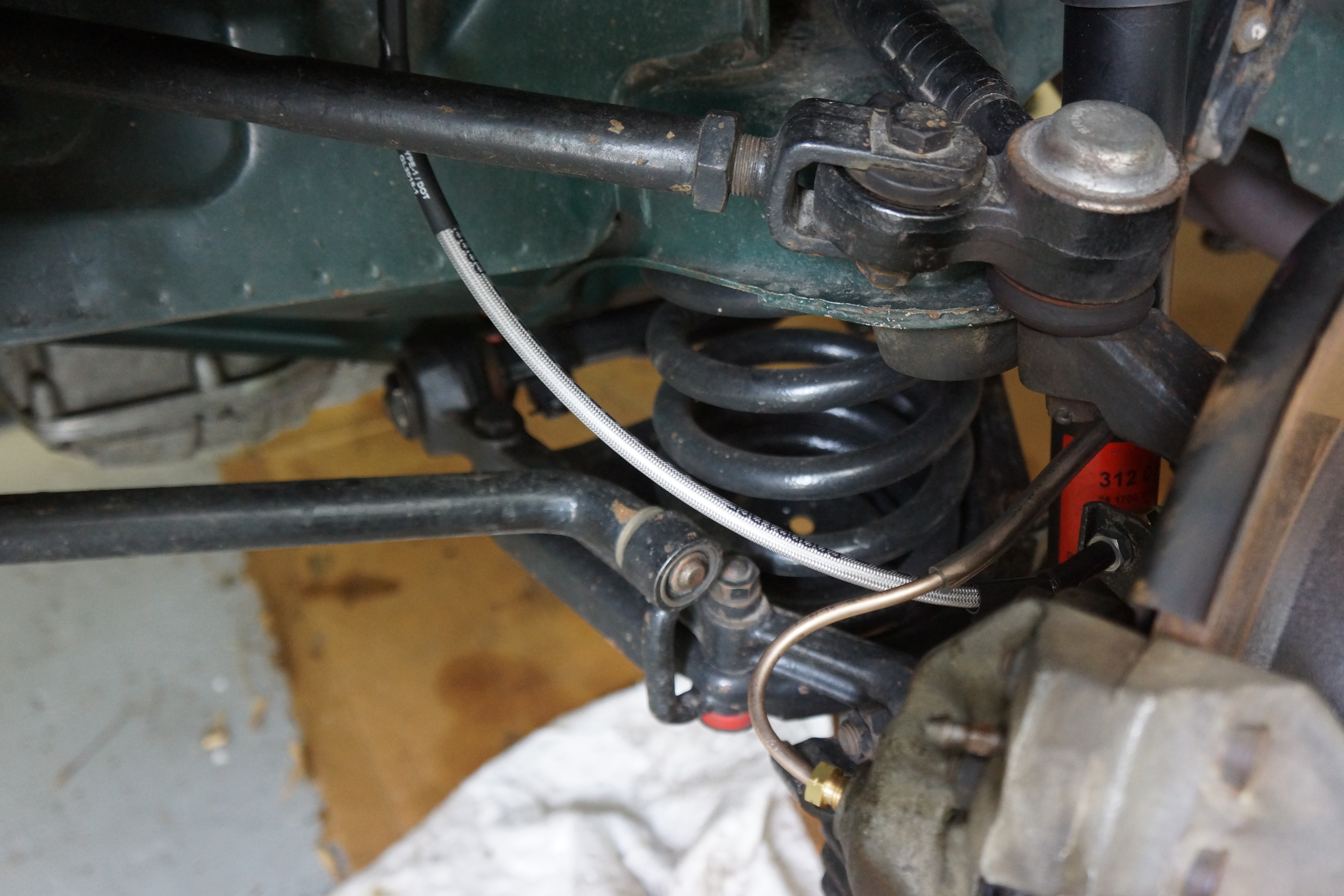
New reinforced brake hose alongside old hose

As much as I wanted to avoid the expense of a new master, I bit the bullet and bought a brand new unit (almost two bills) from my main vendor Classic Alfa. One concern is that there are so many master cylinder variants (standing vs hanging pedals, LHD vs RHD, non-servo vs one servo vs two servos, 20mm bore vs 22mm bore). While I was nervous about getting the correct one, I needn’t had worried. It arrived in two days (the usual Classic Alfa timeliness), and all threaded fittings and mounting points are 100% accurate.

Clamping the brake line forming tool in the bench vise frees up both hands to manipulate the line

As of today: all 3/16” brake lines have been replaced with new lines cut and formed by me, all new flare fittings are on, and all lines are in place on the car (some final fitting still needs to be done). All three rubber brake hoses have been replaced with steel woven reinforced pieces (this is a case where originality is easily overridden by better quality).

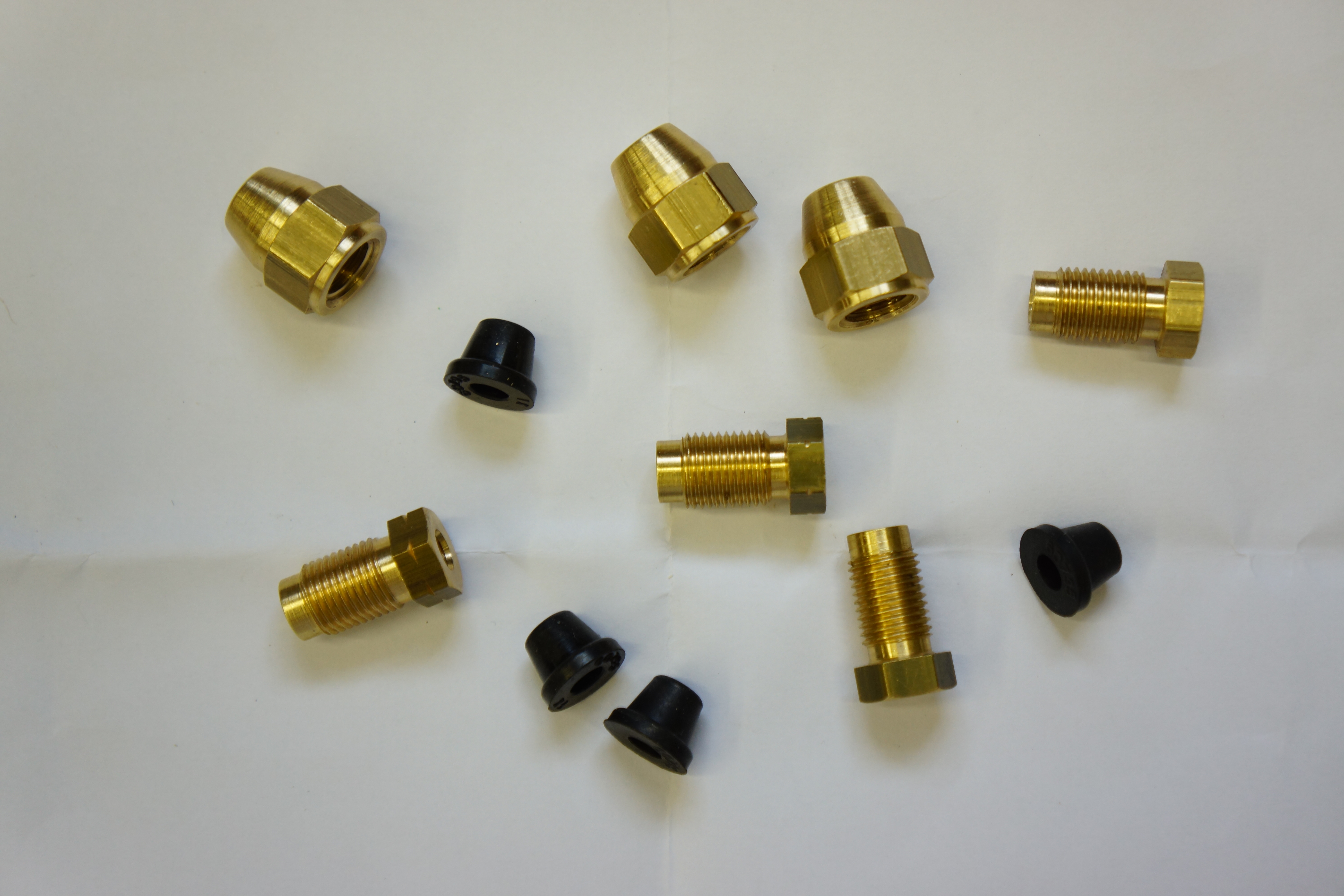
New male and female brake line fittings plus bleeder screw caps

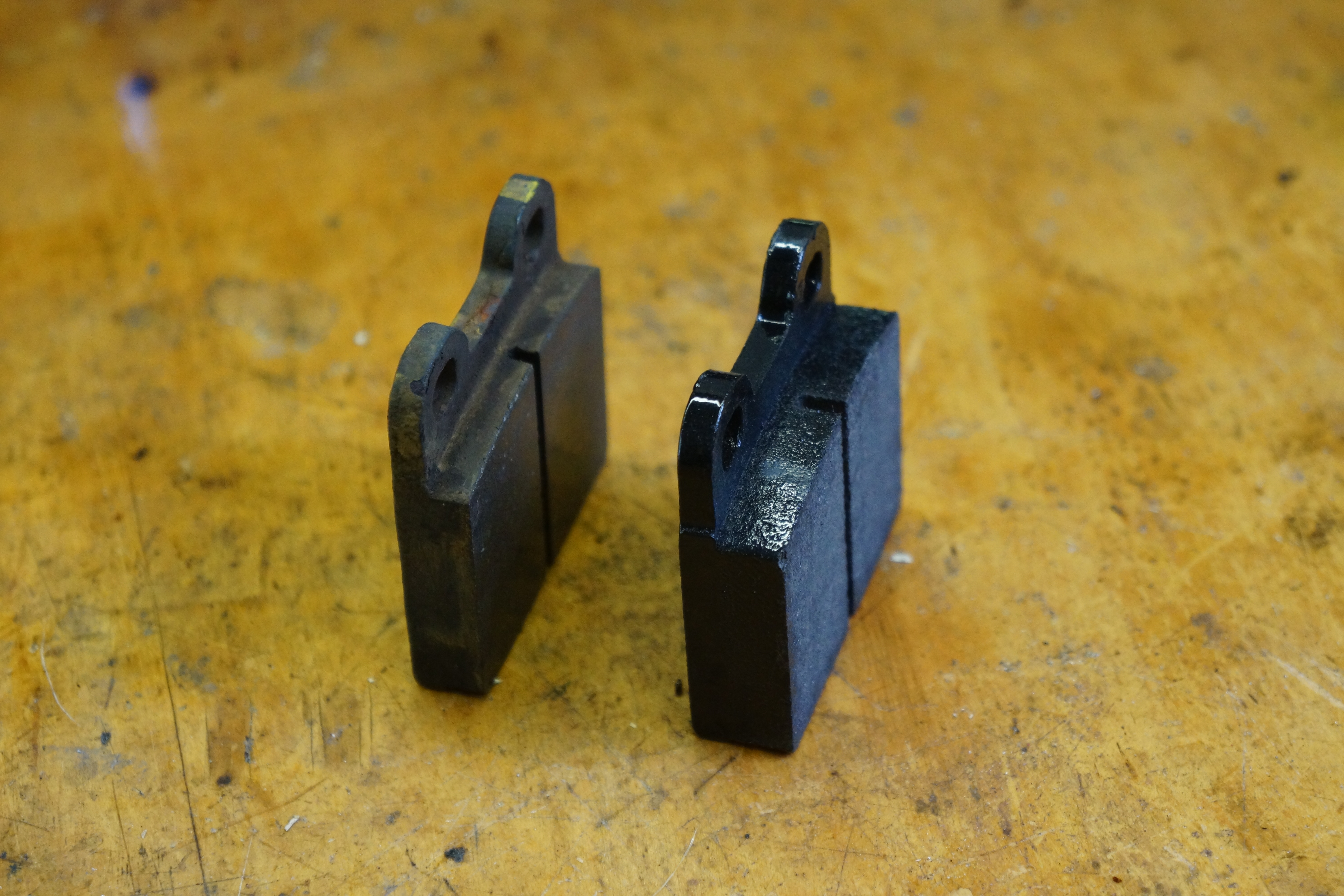
All four rebuilt brake calipers have been reinstalled, with new Ferodo pads in place (the Centric front pads I had installed several years back shed a lot of dust; let’s see if these are better).

Old and new pads side-by-side

The new master is (loosely) bolted in place, but the two brake line connections have yet to be made to it. (Not since the Isetta have I worked on a car with the master located below the floor. The Isetta was easy because the body had been removed from the chassis. The accessibility on the Alfa is horrible.) Once the lines to the master cylinder are done, I need to reinstall the pedal box in the driver’s footwell, as all three pedals had to be loosened/removed to gain access to the master.

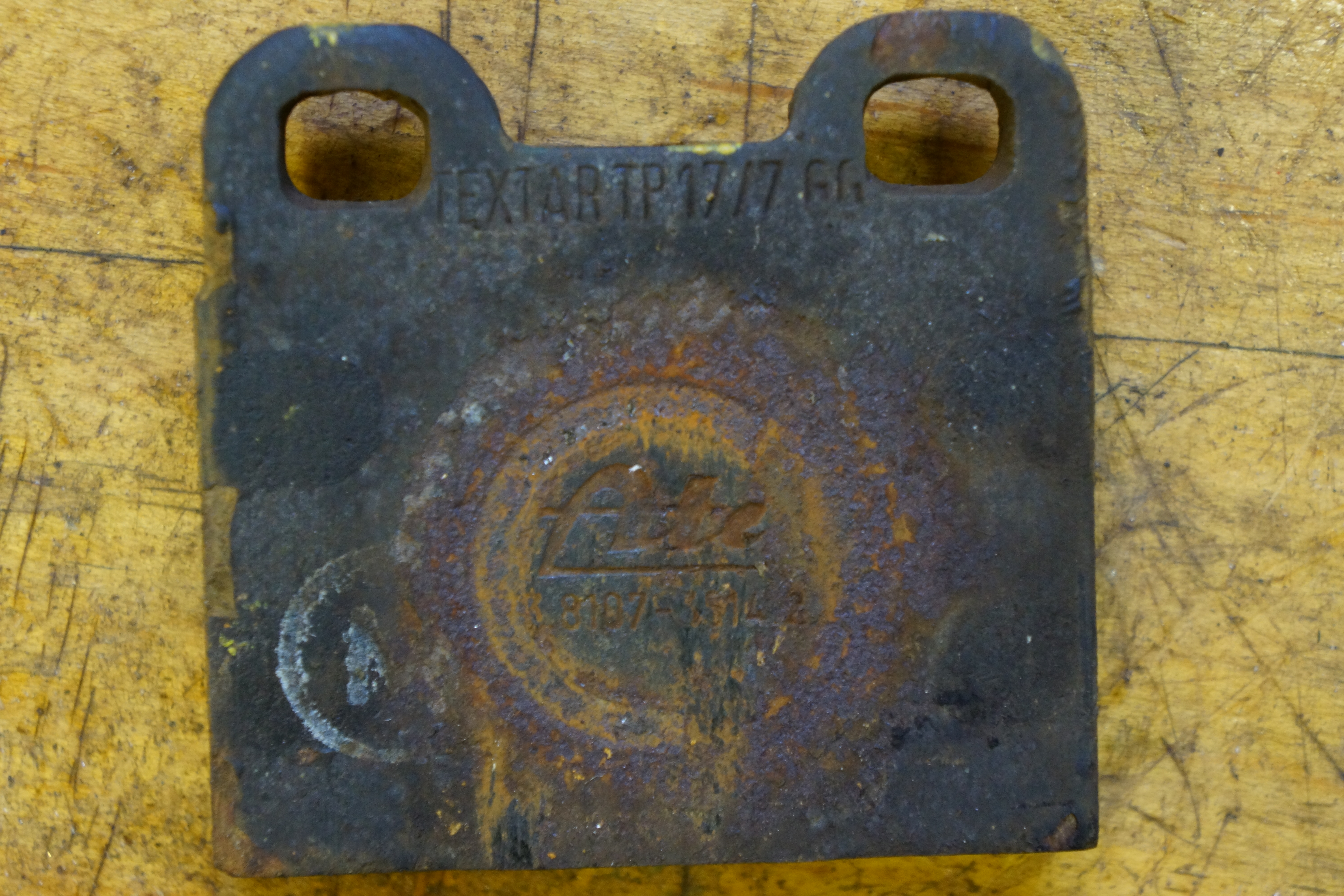
I can’t prove it, but “ATE” mark on rear pad might indicate it’s never been replaced

I then have the ‘extra’ job of replacing the positive cable for the battery. The previous owner had relocated this car’s battery from the engine compartment to the trunk, and used (in his own words) “a battery cable sourced from a junkyard Renault”. Since purchasing the car from him, he has recommended that I replace this cable. I’ve purchased a much heavier-duty one from Taylor Cable, which needs to be cut to size and have the appropriate terminals connected. Part of the intake plenum was removed for access to the starter, so that will need to go back together.

New caliper pins (L) didn’t fit, had to clean up & reuse old ones (C & R). Never throw old parts away!

The goal is to get this vehicle off the 4 jack stands upon which it’s been sitting before we reach the first anniversary of the brake seizure which happened in July 2019. I miss driving my Alfa! As I said, there is light at the end of the tunnel.

It may not look like much, but this is progress


All photographs copyright © 2020 Richard A. Reina. Photos may not be copied or reproduced without express written permission.


Alfa Romeo brake system overhaul, Part 5

A big part of this brake project has always been the intention to replace all the hard lines. It was back in the fall of 2019 (days we’ll forever remember as “pre-coronavirus”) when I purchased a 25’ roll of new CuNiFer (copper/nickel/iron) brake line (from FedHill) and all new line fittings (from Classic Alfa), knowing that the day would come when I’d need them.

Well, that day did come, and I’ve spent a somewhat enjoyable last few days in the garage making up the new lines. The rear rotors and calipers have been bolted back in place, so with the old lines as templates, I cut the first two new lines for the two rear calipers to the appropriate lengths.

The creation of new brake lines requires that the ends be flared, which requires a special tool. I have one of those cheap old flaring yokes, a tool I’ve had for so long that I couldn’t tell you the last time I used it. Maybe never. My good friend Mike G owns a high-end brake flaring tool kit made by Eastwood, which he generously loaned to me. I’m going to walk you through the step-by-step process, which on an old Alfa like mine can be a bit tricky! You’ll see in a moment.

The Eastwood brake flaring tool

With the exception of the ¼” hard line from the brake fluid reservoir to the master cylinder, all the other hard lines on the car are 3/16”. That’s the easy part. The fittings, on the other hand, are a mixed bag. The car’s four-wheel ATE calipers use metric M10x1 threads, while most of the remaining connections, such as at both front and rear T-fittings, use UNF 3/8”-24 threads. Further, the M10 end requires an ISO bubble flare, and the 3/8” end takes a double 45° flare. Please don’t ask me why – I’ll just point to the car and say “that’s how the Italians did it!”

The Eastwood tool, which I used for the very first time this week, is a bit intimidating at first. The instructions in the box are ok, but I thought it would be wise to cut a few short pieces of pipe and make some test flares (I purchased about 7 feet more brake line than needed, because sooner or later I’ll make a mistake and need to redo a line).

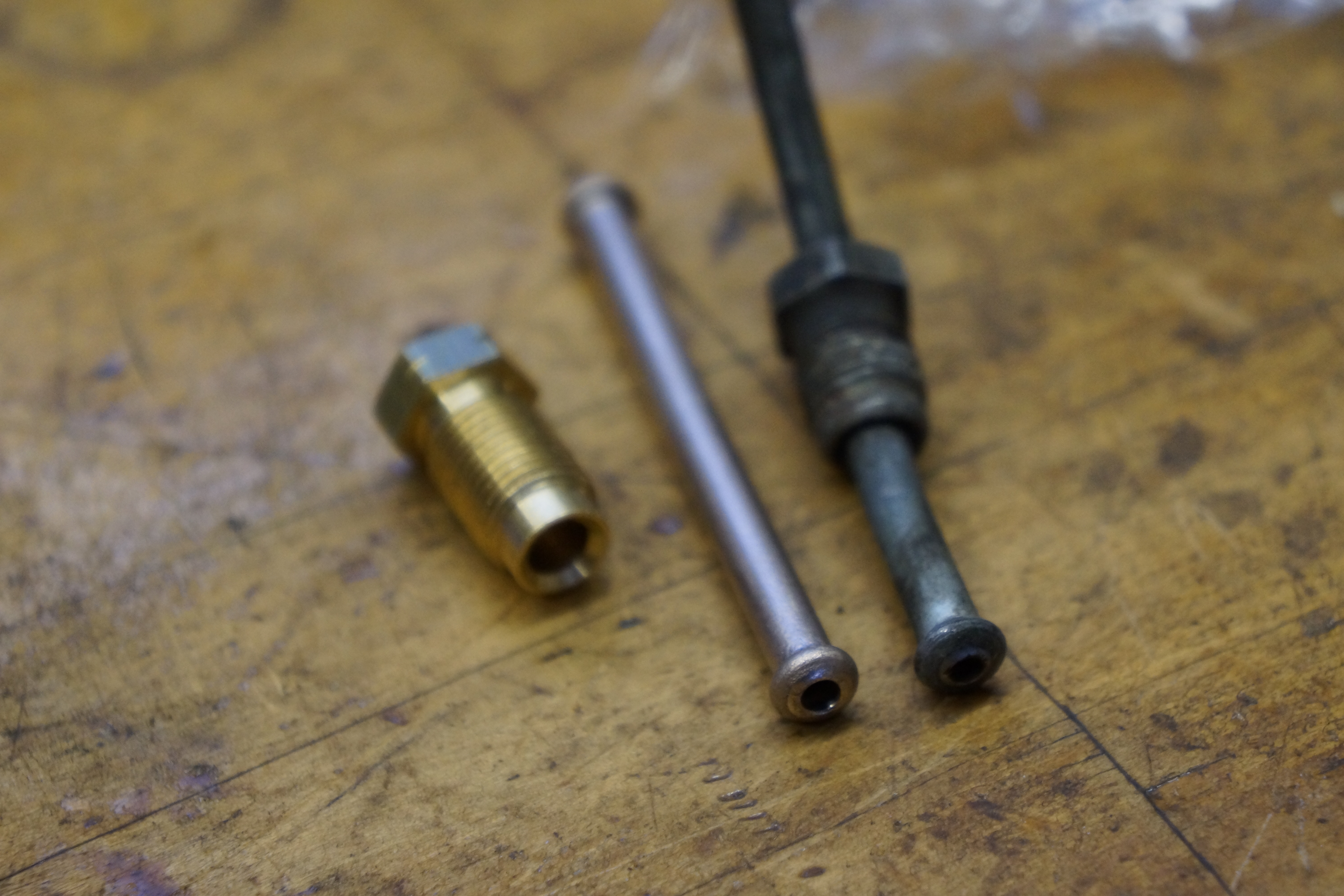
L to R: new fitting, test pipe w/ISO bubble flare, old pipe w/same

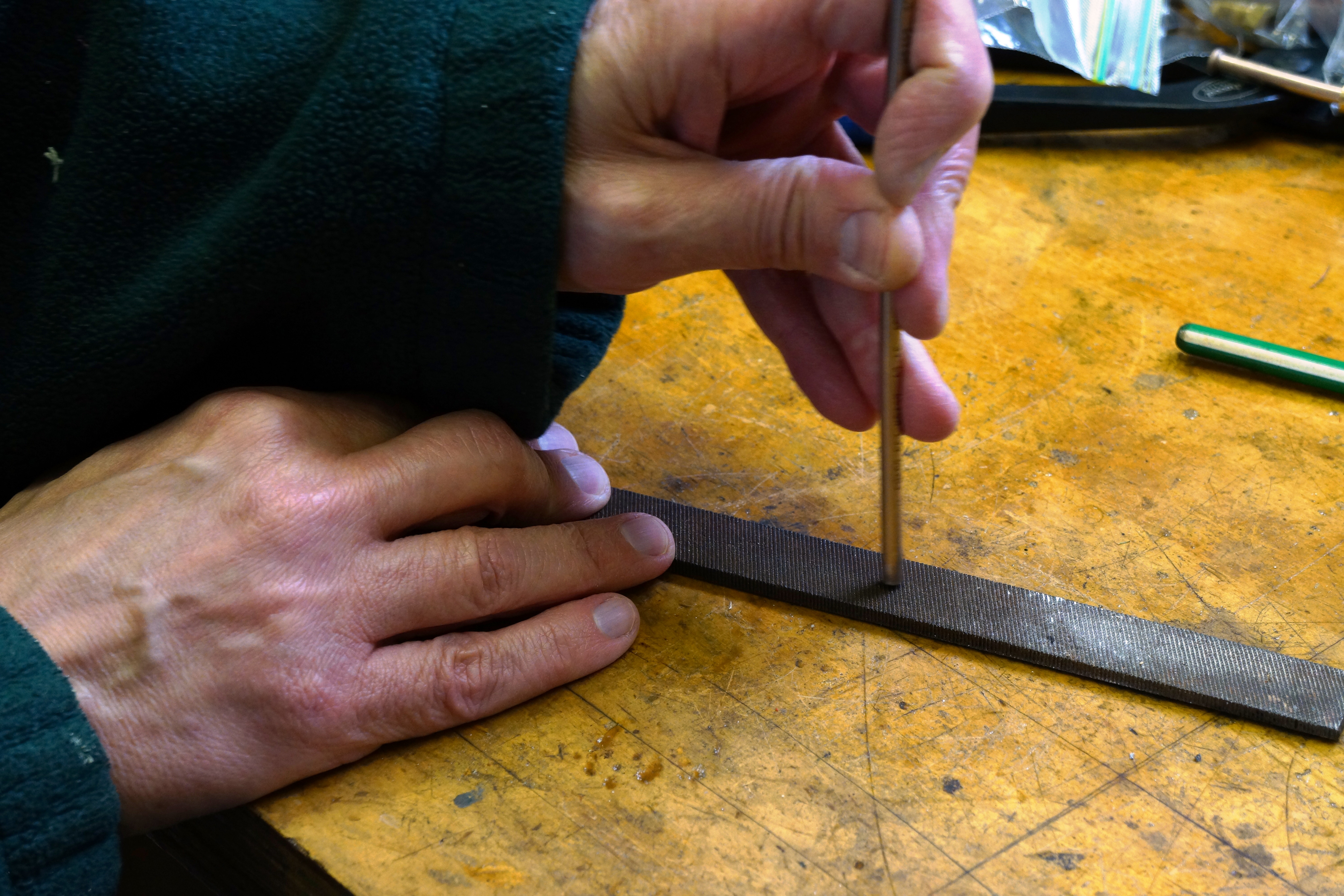
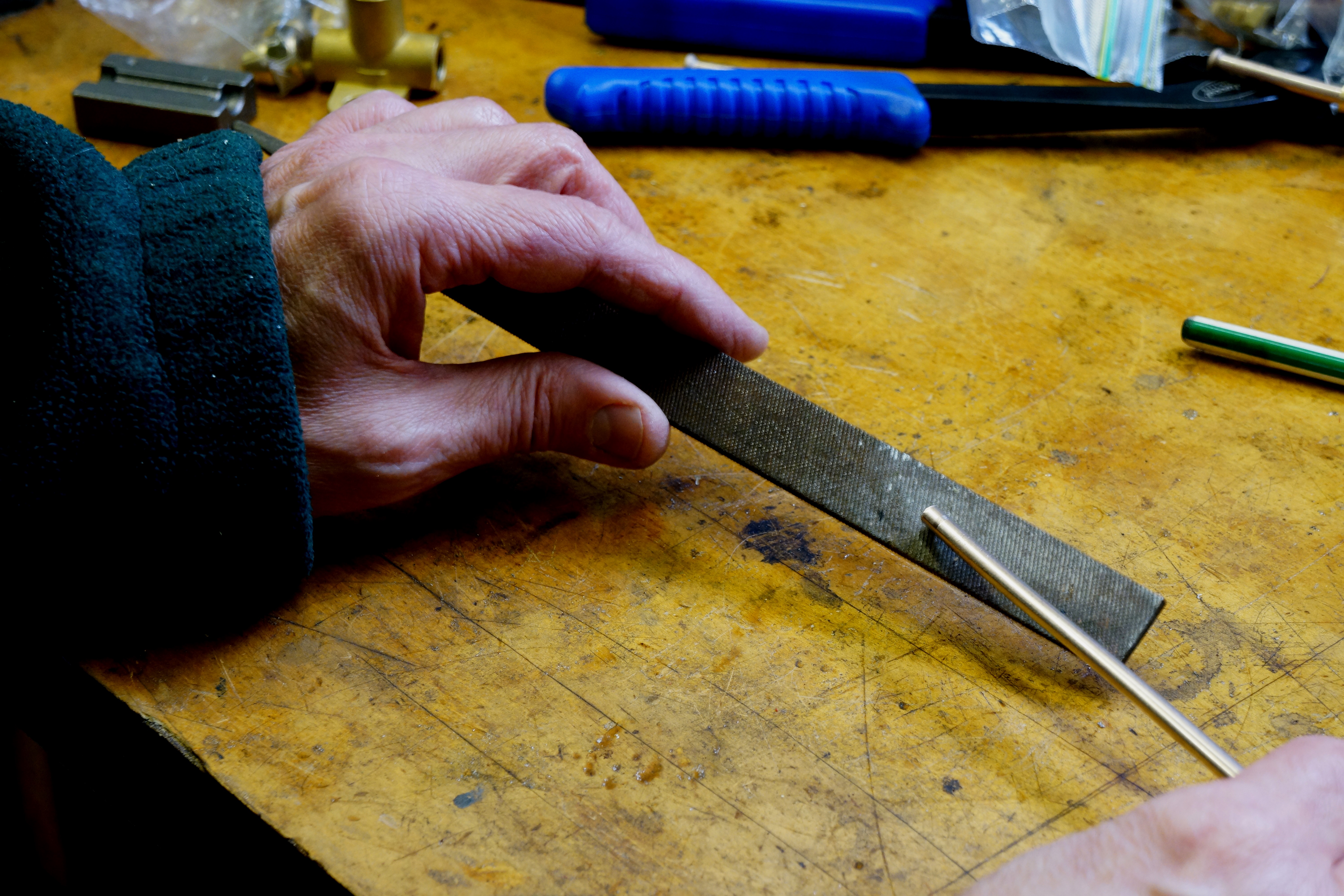
The Eastwood instruction book states that before you make a flare, you should do 3 things with the cut tube: run a file on the inside to remove burrs; run a file on the outside for the same reason; and slightly chamfer the edges. I dutifully followed instructions.

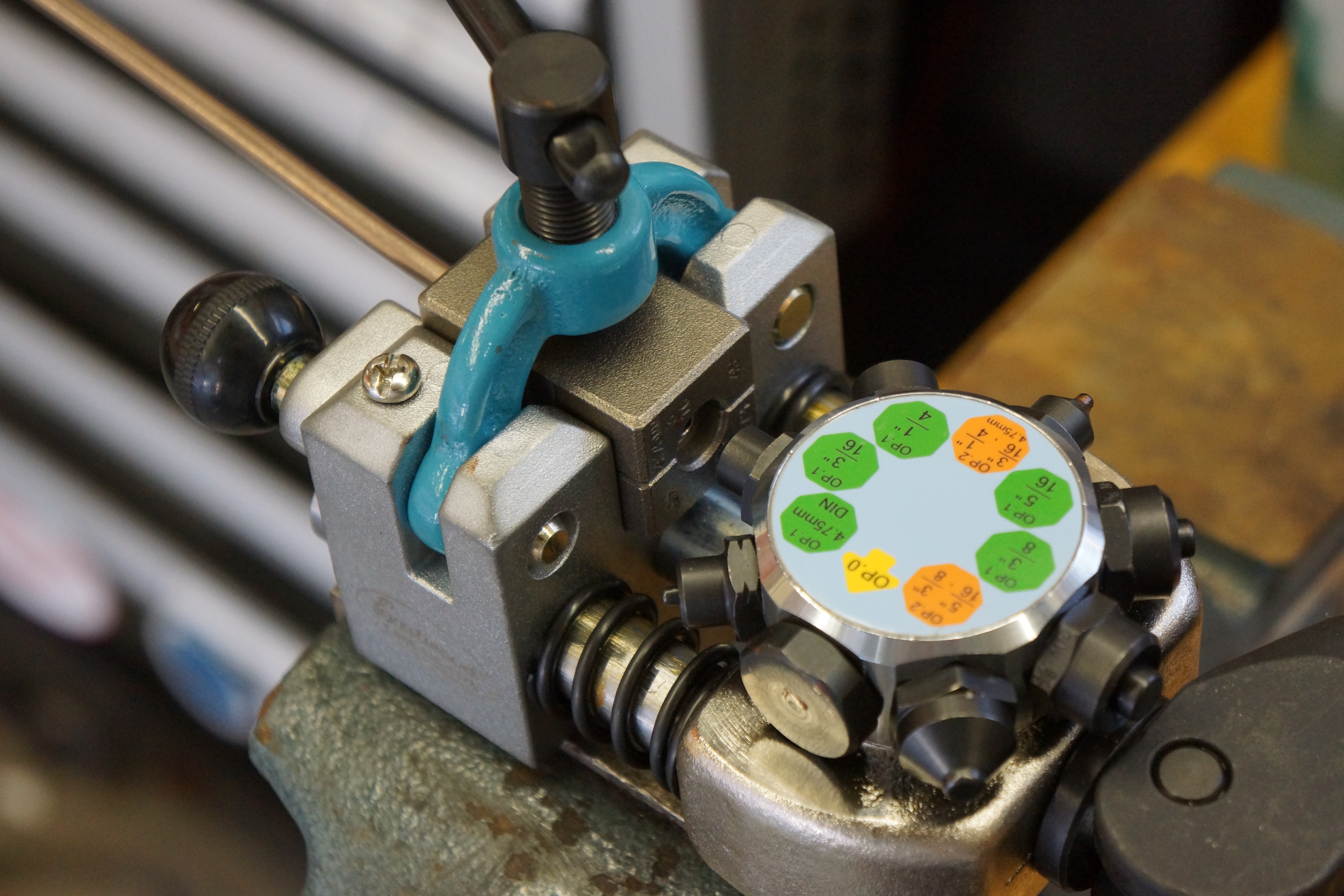
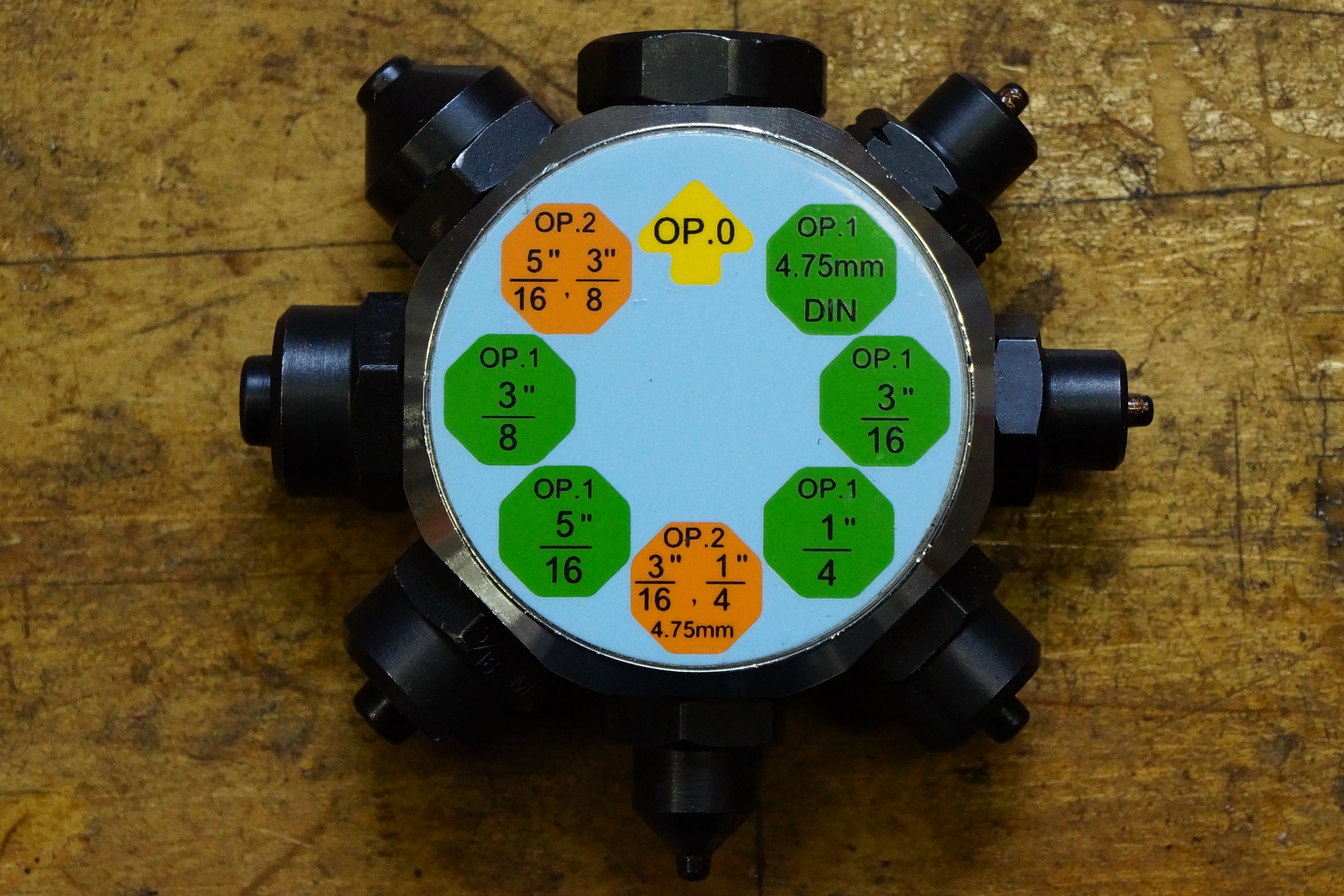
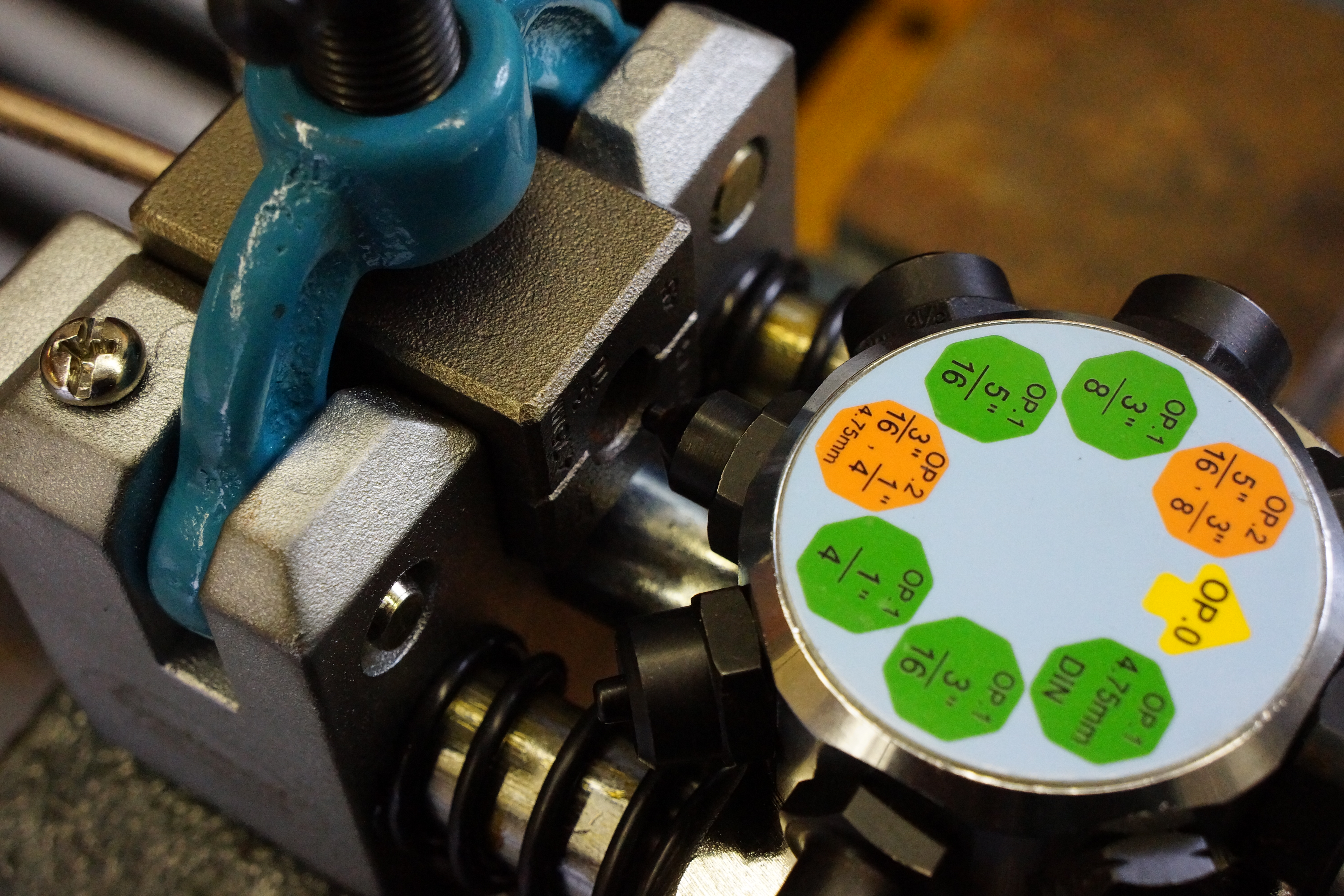
The tool itself is designed to be securely clamped into a bench vise. The two most important pieces which require your utmost intention are the tube-holding dies in 4 different sizes, and a rotatable disc with the various flare-forming dies. This is when I discovered that the 3/16” tube die is double-ended: it says 45° on one side, and DIN on the other. The instruction book didn’t say too much about this.

All the flare-forming dies are on this disc


I grabbed the 3/16” tube-holding die and placed it into the tool, with the 45° double-flare at the business end. The tube itself was inserted between the two halves of the die, and with the disc’s “OP. 0” (Operation Zero) facing the tube, I pulled the handle. This step simply squares up the end of the tube with the end of the die. Once done, I made sure the clamp was tight.

OP ZERO before squaring the tubing
OP ZERO after tubing end is squared with die

Rotating the disc to “OP 1, 3/16”, I again pulled the handle. As a final step, the forming die disc was rotated to “OP 2, 3/16”, the handle was pulled, and I removed the tubing to examine my work. It looked good! I had a nice, neat 45° double flare.

OP 1, step one of the 45 degree flare


OP 2, step 2 of the 45 degree flare


45 degree double flare done!

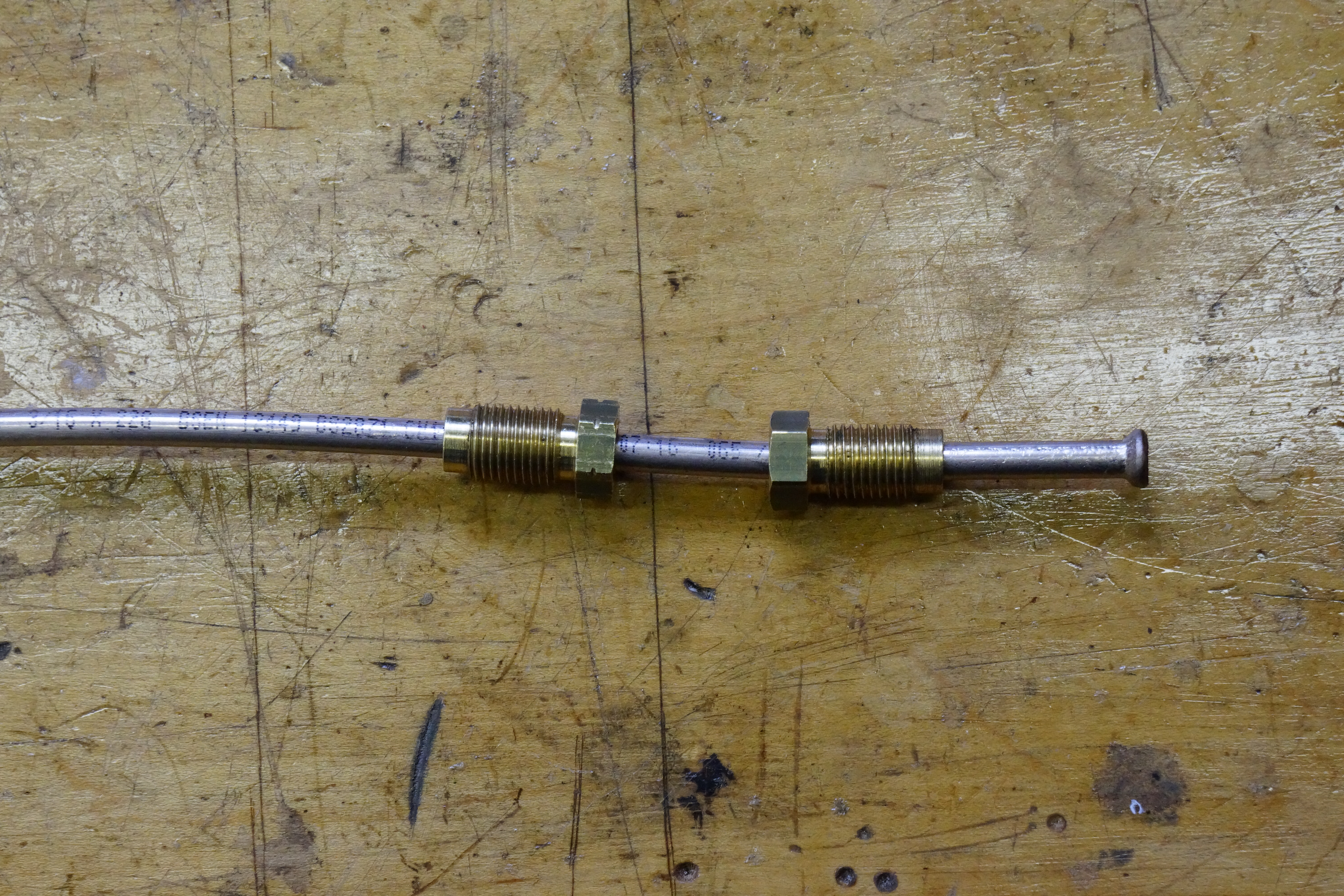
Before you flare the other end of the tube, you MUST slide on the two flare fittings; once both ends are flared, you’ll never get them on. In my case, not only did they need to face the correct way, they needed to be the correct threads! With the 45° double flare done, the 3/8” fitting went on first, and then the M10 fitting. It is highly recommended to delay the celebratory glass of vino until AFTER these steps are completed.

Pay attention! L to R: M10 flare fitting, 3/8″ flare fitting, 45 degree double flare on pipe end

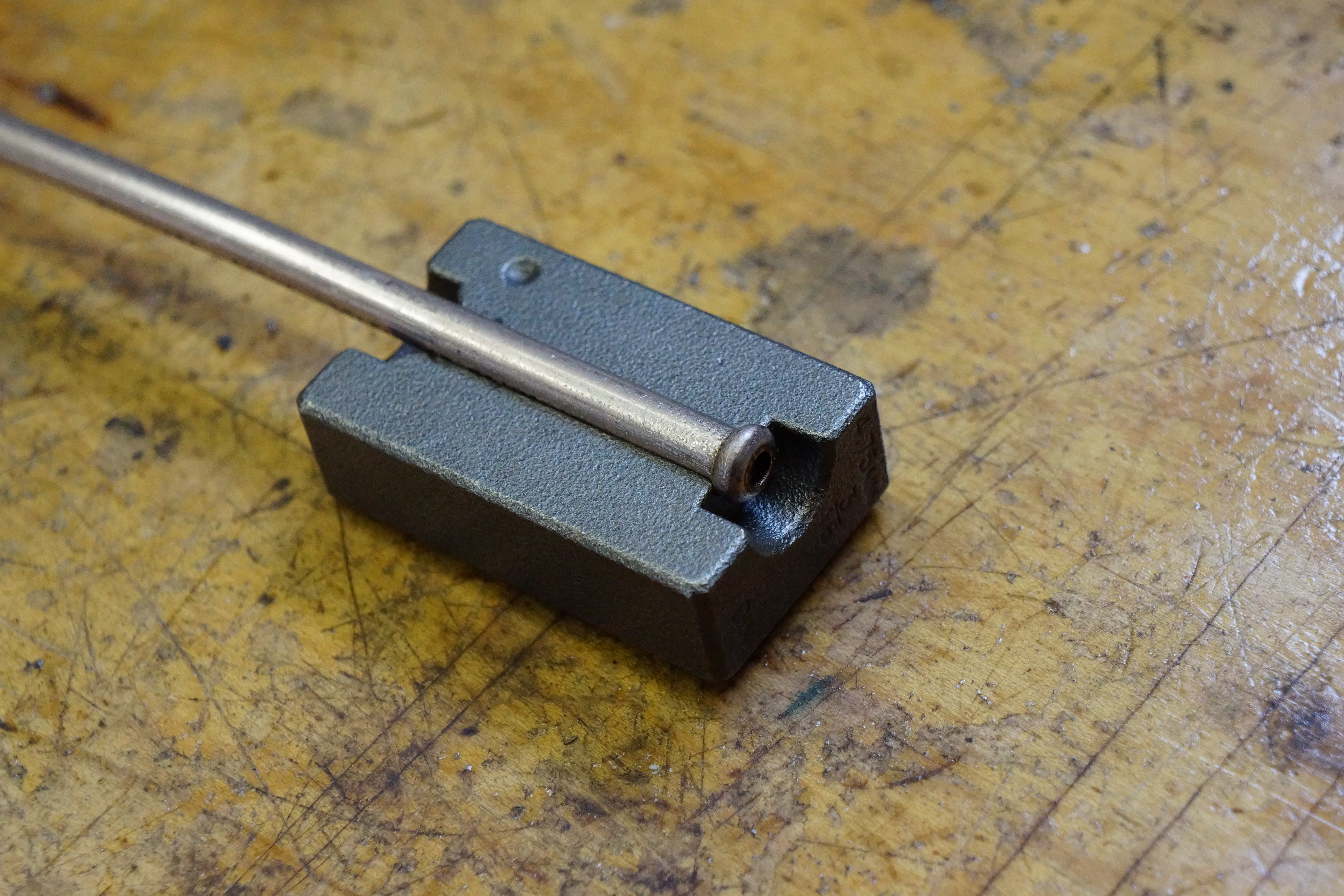
It was a good thing that I had made some test pipes, which is when I discovered that the DIN end of the tubing die would make the needed ISO flare. I further discovered via experimentation that while the forming die does have an “OP 1” and “OP 2” for the DIN flare, I needed only “OP 1” to get a bubble flare that matched my old brake line.

ISO bubble flare done!

I’ve made two lines so far, and am quite pleased with the progress. It’s a nice feeling to have rounded the curve and to have begun reassembly. With most collector car events cancelled for the spring, the pressure is off, but the progress continues.


All photographs copyright © 2020 Richard A. Reina. Photos may not be copied or reproduced without express written permission.
 

Don’t have the right tool for the Alfa’s brakes? Then MAKE the tool!

I’ve often referred to the two years I spent as a professional automotive technician as my “post-college” graduate work. It was a different kind of education, and included the benefit of earning a salary. One of the earliest lessons, and one I still carry today, is that there is no substitute for having the right tool for the job at hand. The correct tool ensures that the repair is done correctly, safely, and within a reasonable amount of time. It is not an exaggeration to state that there were times when sweat dripped from my brow, and curses sprang from my lips, when the lack of the appropriate tool made a repair attempt a real struggle.

A corollary lesson states that sometimes, one needs to practice some creativity and “invent” a tool, perhaps by assembling one from hardware parts, or by modifying an existing tool. This point was put into practice during the Isetta restoration, as tools for that car aren’t exactly found in your local NAPA store.

The challenge rose up again during the recent brake work on my Alfa. I found myself struggling with the reassembly of the parking brake shoes, which reside inside the rear brake rotor ‘hat’. The shoes and their assorted springs and clips came apart easily enough. But now my efforts to put it all back together were just taking too long.

Let me be more specific: the brake shoe assembly mounts to a backing plate, like on most cars. Unlike most cars, though, the wheel hub is mounted on a bearing that is press-fitted into place through the backing plate. The parking brake reassembly would be easier if the hub were not in the way, but to remove it, I would need to remove the entire axle and press the hub and backing plate apart. That was more work than I wanted to bother with. I was convinced that there was a way to put the parts back on with the hub in place.

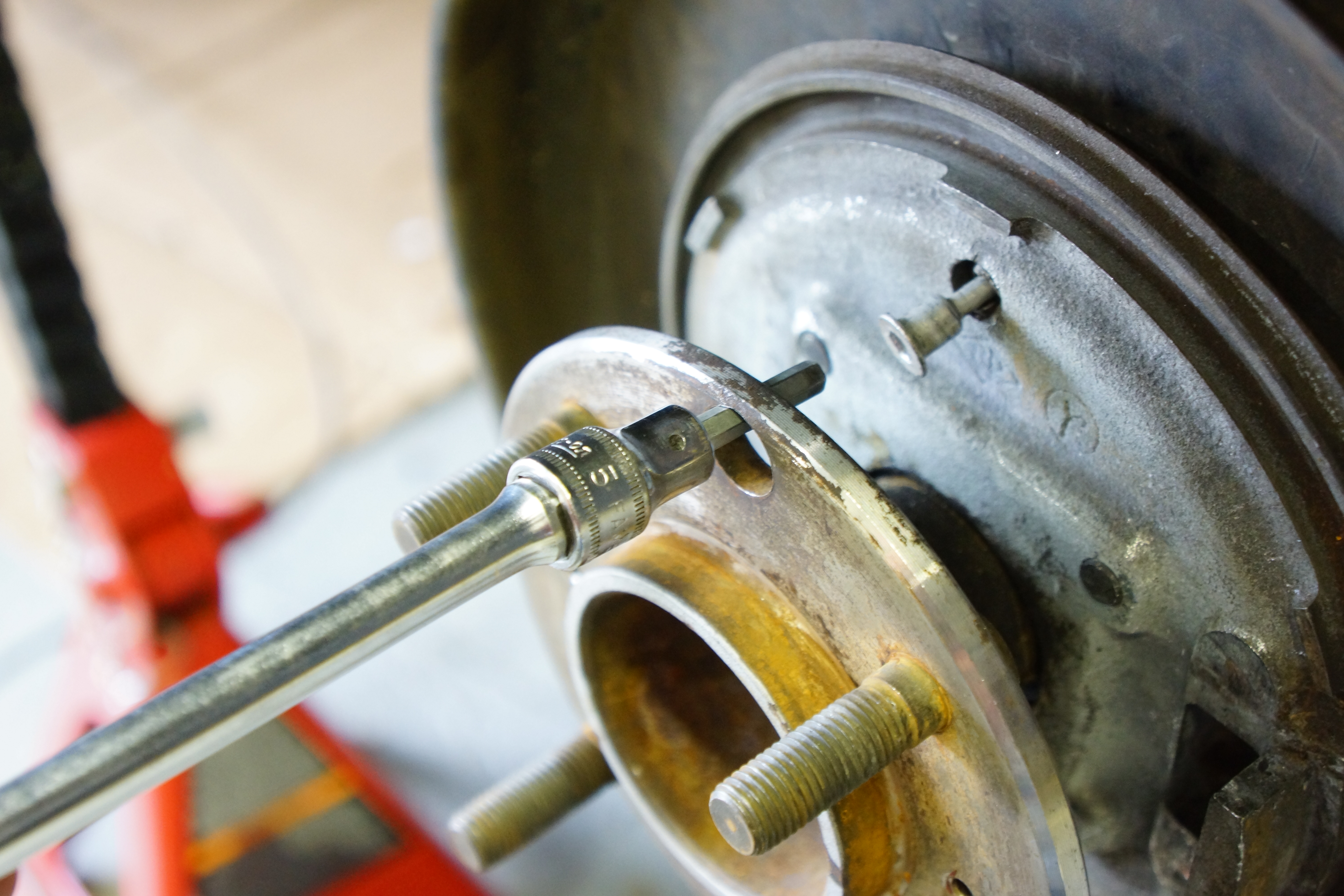
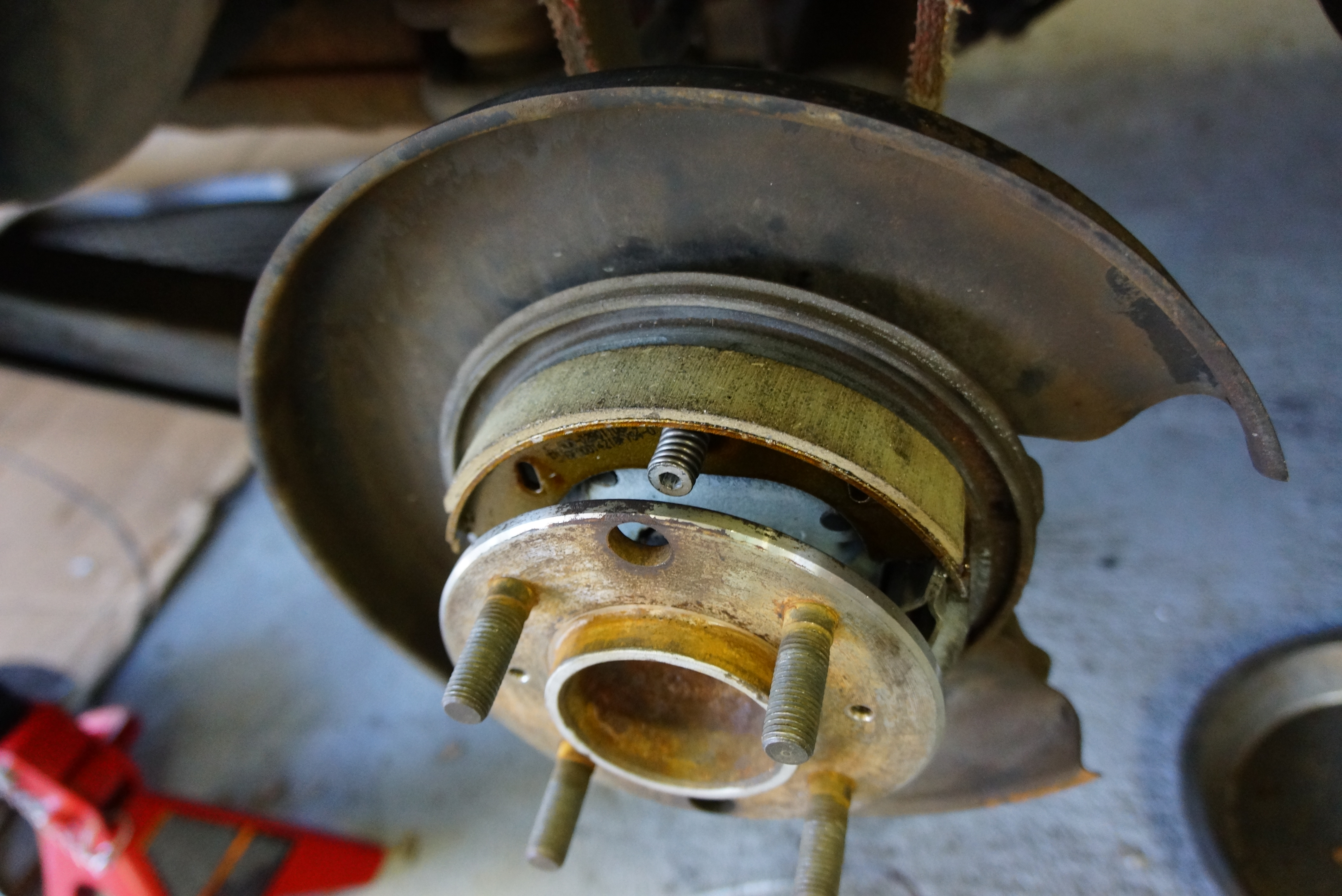
And Alfa Romeo actually made that accommodation. The hub surface has two additional holes, lined up in such a way to allow a tool to pass through them to access the brake shoe hold-down pins. The pins require a 5mm Allen tool, and I have one as a 3/8” drive socket. Since there is so much spring pressure to overcome, putting the Allen socket on an extension, with a 3/8” drive ratchet wrench, provides way more leverage than one could ever get from a tiny hex key.

Original 5mm hex socket on extension is placed through access hole in hub

Herewith was the problem: I could not push the pin in far enough to engage its lock, because the socket was too wide to pass completely through the hole in the hub. I briefly considered grinding down the socket, but a close examination revealed that would likely weaken it to the point of failure once an extension or a wrench was snapped into place. I briefly (like, for 10 seconds) considered enlarging the hole in the hub before rejecting that crazy idea. (Repair lesson #39.b.2: when making permanent modifications, always do so to inexpensive, replaceable objects, NOT to complex, difficult-to-replace components of the vehicle itself.)

Socket bottoms out before pin can be fully inserted in backing plate (spring and shoes removed for clarity)

Staring at things for several minutes brought forth the revelation that if the 5mm hex shaft were longer, I’d have what I needed. After considering a Home Depot run, which I internally wagered would yield a 25% chance of success, I challenged myself to modify the tool I owned. Could I do this in less than an hour? I thought it entirely reasonable.

Here is the Snap-On 5mm Allen socket about to be modified

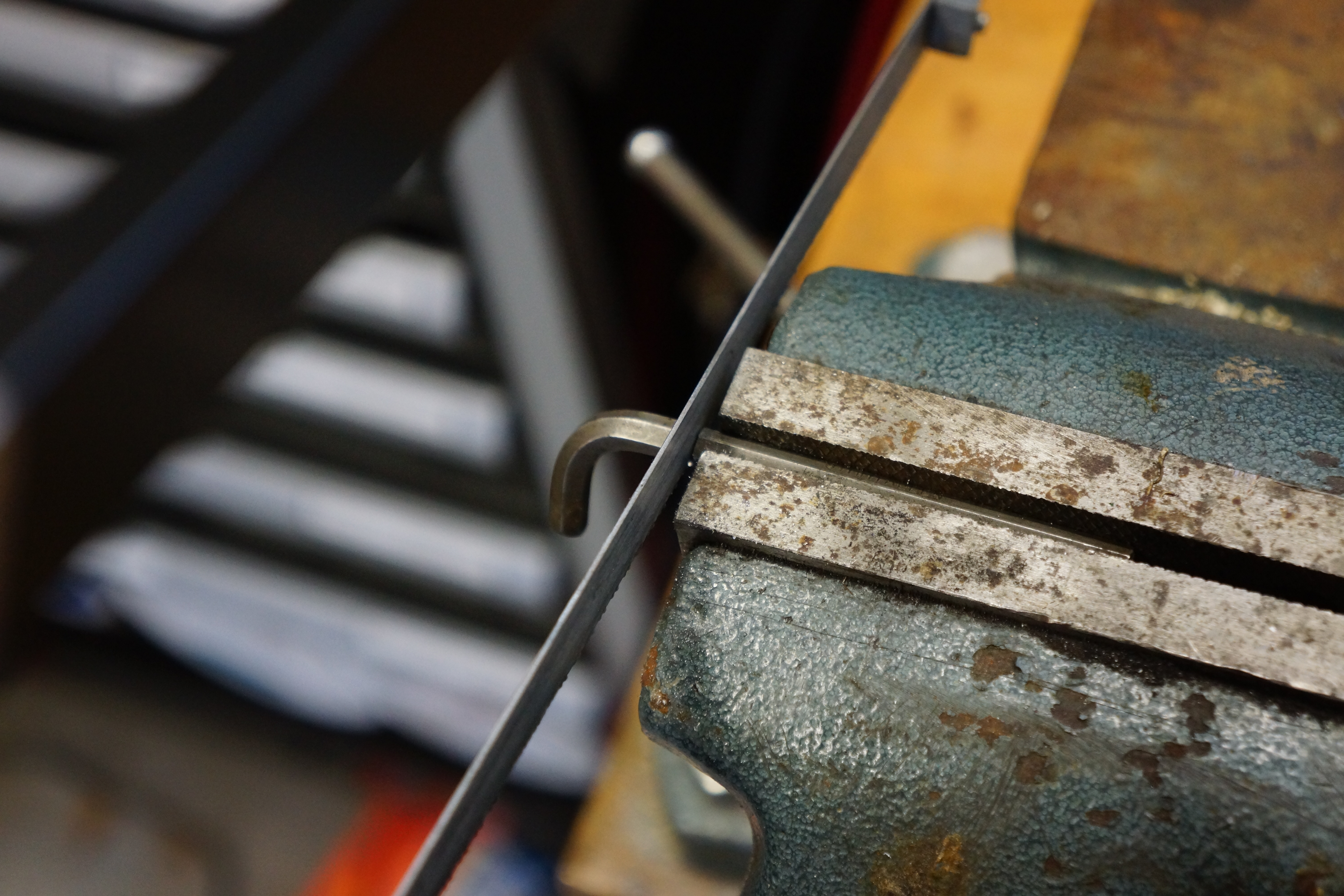
With a 3/32” drift, I hammered out the roll pin and pulled out the existing 5mm bit from the socket. I found a standard 5mm hex key in my Allen key collection, and tested it at the car. It was long enough for my purposes. Next, I secured the longer hex key in the bench vise and hacksawed off the short end. (I really should have pulled out the Dremel tool for this step, as the hardened steel took longer than I thought it would to hack off.) I filed the end smooth, and it fit right into the socket. My attempts to drill a hole in it to reinstall the roll pin resulted in two broken drill bits – like I said, that tool steel is hard! But the new bit was a tight fit in the socket, and since I’d be pushing against it, not pulling on it, I let it be, feeling certain that there was nothing to worry about.

Drift makes short work of roll pin removal
This hex key is about to give up its life for a greater good
Hacksaw got the job done, but it took 10 minutes of muscular effort

Total time to modify the 5mm Allen socket: approximately 30 minutes. I attached my ‘new’ socket onto an extension, snapped on a ratchet wrench, and was easily able to engage the brake shoe pins in their locks. Mission accomplished!

“New” socket has considerably longer shaft

I’m keeping my new, longer 5mm Allen socket as is. Who knows when someone might need my help with their Alfa Romeo parking brake shoes? “Hey, I got just the tool for that!”

Success! Longer hex shaft makes short work of engaging pin


All photographs copyright © 2020 Richard A. Reina. Photos may not be copied or reproduced without express written permission.


Alfa Romeo brake system overhaul, Part 4

The weather today in downtown Neshanic Station NJ reached a balmy (for February) 55 degrees F. While I desperately do NOT want it to be 90 in April, I didn’t mind today’s spring preview; after all, the calendar claims we’re only four weeks away.

That high temp was accompanied by blue skies and lots of sunshine, all of which inspired me to get back to the garage. The Alfa’s brakes have been ignored since last autumn, and even I can’t believe how long it’s been since I’ve put up a blog post about my progress, of which there has been scant little. I have been ordering parts, reading service manuals, and perusing online forums, but there’s been no actual wrench-turning since before Halloween, which feels like a very long time ago.

Old (upper) and new (lower) parking brake cables- note boots

While today’s progress was not substantial, it was significant. The corner has been turned; everything that’s to be removed has been removed. I am now embarking on reassembly, using new parts as required. Starting at the left rear, a new parking brake cable was installed, and a new upper e-brake shoe was also put into place.

Parking brake shoes & springs: old (left) and new (right)

Projects never proceed at an orderly pace. There may be a flurry of activity, then a slowdown. Other, smaller projects may jump the line. Sometimes, it’s a parts delay that forces the pullback. However, there’s something to be said for picking up the tools again after a long layoff: it reinvigorates the soul, and reawakens the motivation.

LR upper e-brake shoe in place

I’m also motivated by an email I received from the NJ Chapter of the Alfa Romeo Owner’s Club, announcing a one-day spring tour for Sunday April 26. That’s nine weeks from today. I plan to drive this car on that tour. Sounds like I have lots of time, but we know how quickly that time will fly. The last time I drove my Alfa was July of last year. I have not gone this long without driving it since my purchase in 2013. So I’m motivated! Let’s hope the trend for an early spring continues.
 

All photographs copyright © 2020 Richard A. Reina. Photos may not be copied or reproduced without express written permission.